10 Best Mood Board Tools for Interior Designers in 2026 (Tested and Ranked)
The 10 best mood board tools for interior designers in 2026, tested on real client work. Storyflow, Morpholio Board, Milanote, DesignFiles, Canva and more, compared on AI, sourcing, client presentation, and price.

Category
Visual Thinking
Author

Justkay
Documentary Filmmaker & Founder at Storyflow
Topics
2026-06-16
•
Updated July 3, 2026
•
16 min read
•
Visual Thinking- best mood board tools for interior designers
- interior design mood board app
- Morpholio Board alternative
- mood board software interior design
- AI interior design mood board
- Storyflow
What is the best mood board tool for interior designers in 2026?
The best mood board tool for interior designers in 2026 is Storyflow: its AI reads the entire canvas and turns a wall of inspiration into a client direction and a room-by-room brief. For sourced, spec-ready boards, Morpholio Board is the interior-native standard, and DesignFiles is the strongest pick for e-design studios.

Full disclosure: Storyflow is our own product, and we rank it #1 for one job: turning inspiration into a client direction and a room-by-room brief on a canvas the AI can read. It does not pull real, purchasable products, so for sourcing spec-ready boards Morpholio Board is stronger, and for 3D room renders you can stand inside Foyr Neo does something Storyflow cannot. If your work is mostly product sourcing or photoreal rendering, one of those fits better. We link to every tool so you can judge the fit.
Quick Comparison: Interior Design Mood Board Tools
These four split into four distinct jobs: setting the concept direction, sourcing spec-ready boards, running e-design packages, and rendering the room in 3D.
| Tool | Best For | AI Features | Price |
|---|---|---|---|
| Storyflow | Concept direction plus a room-by-room brief | Canvas-aware AI reads the whole board | $7.99 mo annual (free plan late 2026) |
| Morpholio Board | Sourced, spec-ready boards on the iPad | Limited AI | Free / paid upgrades |
| DesignFiles | E-design studios selling room packages | Limited AI | ~$39 mo |
| Foyr Neo | 3D room renders you can stand inside | Limited AI | ~$39 mo |
The board that sells the room and the board that builds it, together
Storyflow keeps inspiration and spec on one canvas the AI can read, so the concept you present and the details you source never drift apart.

1) Quick Answer: The Best Mood Board Tool for Interior Designers
The best mood board tool for interior designers in 2026 is Storyflow if you want the concept board to carry the whole project, because its AI reads the entire canvas and helps you turn a wall of inspiration into a client narrative, a room-by-room direction, and a brief. If you need the board to pull real, sourced, spec-ready products, Morpholio Board is the interior-design-native standard, and DesignFiles is the strongest pick for e-design studios that present to clients and source in one place.
The short version: most interior designers do not have a mood board problem. They have a follow-through problem. The board looks beautiful, the client approves it, and then it sits in a separate app from the FF&E schedule, the sourcing list, the budget, and the floor plan. The board that sells the room is not the board that builds it. The right tool depends on which of those two boards you are actually missing.
What is an interior design mood board? An interior design mood board is a curated visual collection of color palettes, materials, finishes, furniture, and atmosphere references that communicates the direction of a space before any sourcing or construction begins. Design platforms like Programa and DesignFiles describe it as the clearest way to align a client on a vision early and cut the number of revision rounds later.
Key takeaways:
- The best overall pick is Storyflow for turning a board into a client direction and a brief, because its AI reads the whole canvas. For a sourced, spec-ready board, Morpholio Board is the interior-design standard, and DesignFiles is the strongest e-design all-in-one.
- Interior designers maintain two boards: the inspiration board that wins the client and the spec board that sources the products. The board that sells the room is not the board that builds it.
- For pure inspiration, Milanote is the most beautiful tool and Pinterest is the best free starting point.
- For a space you can stand inside, Foyr Neo renders the room in 3D; for realistic material and finish boards, Mattoboard stacks true-to-life samples.
- Storyflow is honest about its limits: it does not pull real products, prices, or vendor catalogs, and it is not a 3D or CAD tool. Pair it with a sourcing tool for the spec board.
- Storyflow's Free plan, which launches before the end of 2026, will cover unlimited boards, images, and collaboration, so the full workflow is testable before paying.
All 10 Tools, Ranked
- Storyflow: best overall for turning a wall of inspiration into a client direction and a room-by-room brief
- Morpholio Board: the interior-design-native standard for sourced, spec-ready boards
- Milanote: the most beautiful general inspiration board
- DesignFiles: the strongest all-in-one for e-design studios
- Houzz Pro: best for the trade with a vendor catalog and client management
- Canva: fastest path to a polished client presentation
- Foyr Neo: best for 3D room renders you can stand inside
- Mattoboard: best for realistic material and finish boards
- SampleBoard: best for scaled product arrangement on a digital board
- Pinterest: the best free starting point for gathering references
For the wider category, see The Best Mood Board Tools in 2026 and the pillar guide What Is a Mood Board? A Complete Guide.
2) Comparison Table: 10 Interior Design Mood Board Tools
Rating criteria: tested on real interior-design workflows in 2025 and 2026, from concept and client pitch through sourcing and presentation. Pricing is current as of June 2026 and competitor prices change often; verify current pricing on each tool's official page before buying.
3) The Two Boards: Why Interior Designers Outgrow Their Mood Board Tool
Interior designers do not switch mood board tools because the tool is ugly. They switch because they slowly realize they are maintaining two different boards in two different apps, and nothing connects them.
The first is the inspiration board. It is the one that wins the client. Soft, atmospheric, a palette and a feeling, the reason the homeowner trusts you with their living room. It lives in Milanote, or Pinterest, or a Canva deck, and it is gorgeous.
The second is the spec board. It is the one that builds the room. Real products with real SKUs, dimensions, lead times, vendor links, prices, and a running total against the budget. It lives in Morpholio Board, or a spreadsheet, or Houzz Pro, or DesignFiles, and it is where the actual project happens.
The board that sells the room is not the board that builds it. Most tools are excellent at one of those two boards and weak at the other, which is why so many designers end up paying for two or three tools and copying information between them by hand.
What this means for choosing a tool
There are really three questions, and your answer decides everything.
- If your gap is the inspiration and concept side (you can source fine, but turning a wall of references into a clear client direction is slow and manual), you want an AI-aware canvas like Storyflow.
- If your gap is the spec and sourcing side (your boards look great but they do not connect to products, prices, and the budget), you want an interior-native tool like Morpholio Board, DesignFiles, or Houzz Pro.
- If your gap is client presentation (the work is done but it does not look polished enough to charge for), you want Canva.
Almost every tool below is honest about which board it serves. The mistake is buying a spec tool to fix an inspiration problem, or an inspiration tool to fix a spec problem, and then wondering why the workflow still feels broken.
4) How We Evaluated These Tools
Every tool here was tested on real interior-design work in 2025 and 2026: residential concept pitches, an e-design room package, and a small hospitality refresh. No synthetic demos. Six criteria, weighted in this order.
- Concept-to-direction speed. How fast does a wall of references become a clear, defensible design direction you can present, rather than just a pretty grid?
- Sourcing and spec. Can the board hold real products, dimensions, prices, vendor links, and a budget, or does it stop at images?
- Client presentation. How good does the final board or package look in front of a paying client, and how easily does it share?
- AI depth. Is there an AI that reads the board and does real work, or is every card placed and labeled by hand?
- The calm factor. How pleasant and low-friction is the day-to-day experience? Interior designers live in these tools for hours.
- Price and free tier. What does it cost at real usage, and is the free plan genuinely usable on client work?
Tools were judged on how they felt across a whole project, not in a 30-second demo. The rankings reflect which board each tool actually serves and how well it serves it.
5) Quick Picks by Job to Be Done
If you want the short list, organize by the job, not the brand.
Best for turning inspiration into a client direction: Storyflow. The AI reads the whole board and drafts the concept narrative, the room direction, and the brief.
Best interior-design-native mood board: Morpholio Board. The pro standard, built on the iPad, with products and spec baked in.
Best for e-design studios: DesignFiles. Mood boards, sourcing, and a client portal in one place.
Best for the most beautiful general board: Milanote. The calmest, most elegant arranging surface.
Best for the trade with a vendor catalog: Houzz Pro. Boards plus real products and client management.
Best for polished client presentations: Canva. The fastest path to a board a client will pay for.
Best for 3D you can stand inside: Foyr Neo for full room renders, Mattoboard for realistic material and finish boards.
Best free starting point: Pinterest. The simplest way to gather references before the real board begins.
Turn the wall of references into a client direction
Storyflow's AI reads the whole concept board, then drafts the narrative, the room-by-room direction, and the brief beside it. Free plan covers unlimited boards, no credit card.
6) Detailed Reviews: 10 Mood Board Tools for Interior Designers
1. Storyflow
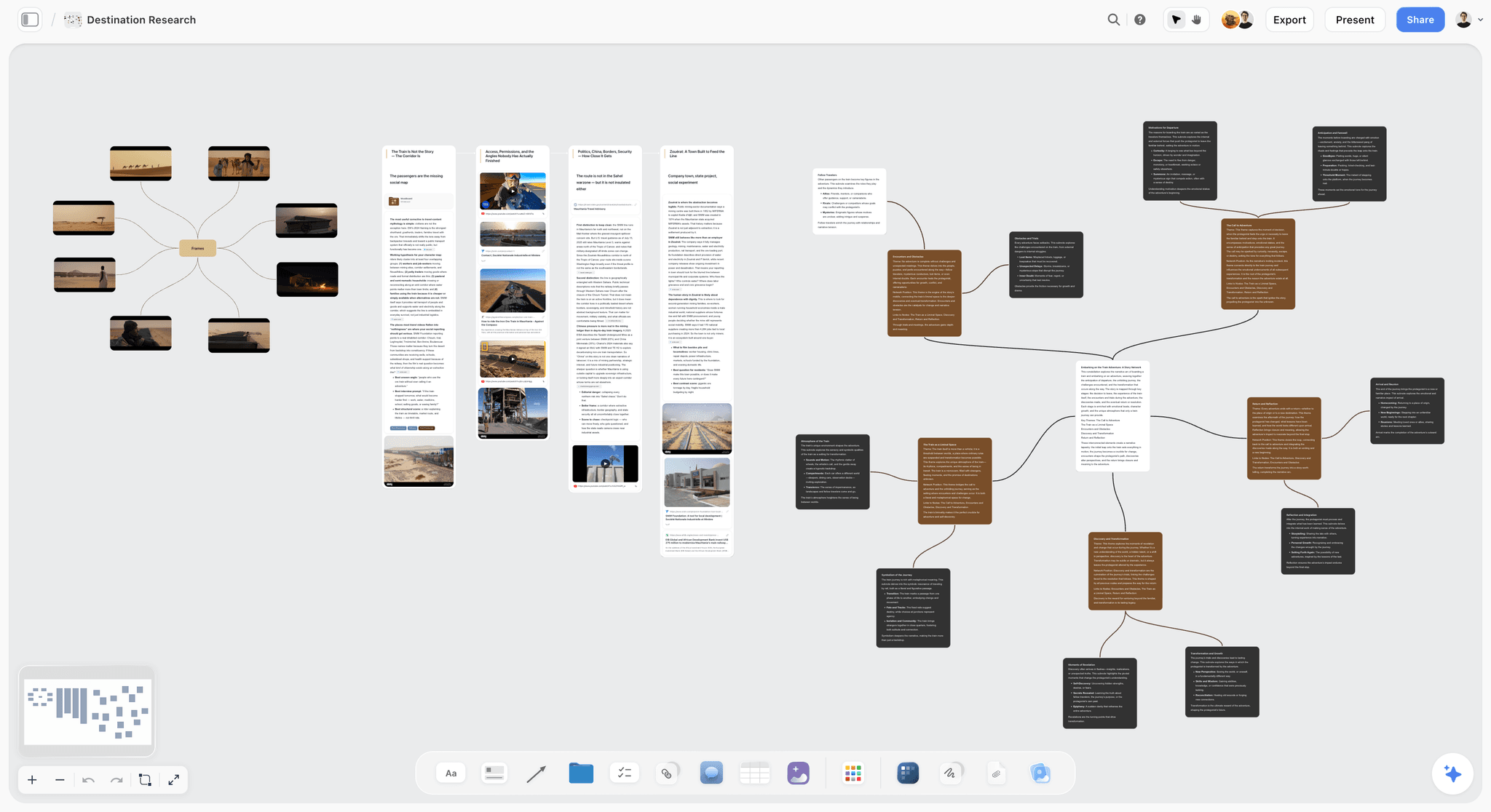
Storyflow is the tool to pick when your problem is not how the board looks but how slowly it becomes a direction. It is an AI-powered visual creative workspace: an infinite canvas of images, notes, and documents where the AI reads the entire board. For an interior designer, that means the concept board, the room-by-room direction, the client brief, and the project plan all live on one canvas, and the AI helps you move from a hundred references to a defensible point of view.
The difference shows up at the pitch. In a normal mood board tool, you arrange the images and then write the concept narrative from scratch in a separate document. In Storyflow, you drop the references on the canvas, ask the AI to read the board, and it drafts the direction: the mood in words, the palette logic, the rooms, the reasoning a client will buy. Then the same canvas holds the brief and the plan, so the project does not scatter across five apps. The board that sells the room is not the board that builds it, and Storyflow is built to keep the selling board and the thinking behind it in one place.
Best for: Residential and e-design interior designers whose concept and client-direction work is slow and manual, and who want the inspiration board to flow into the brief and the plan.
Verdict: The strongest tool for the inspiration-and-concept board and the project around it. It is not a sourcing or 3D tool, so for spec-ready boards you will still want Morpholio or DesignFiles alongside it.
Key features
- Canvas-aware AI by default. The AI reads your full active canvas board (every image, note, and card on it). You can ground it further by @-mentioning up to 1 Tactic and up to 3 Documents in the AI chat.
- Start from an interior template. Open the Interior Design Moodboard template and the board opens with palette, material, and room structure the AI can read, instead of a blank canvas.
- Structured cards and documents. A board can hold the mood images, the written concept, the room direction, and the client brief together, not just a grid of pictures.
- 200+ Story Blueprints. An expert-built template library covering creative and strategic frameworks, included on the Plus tier and above.
- Unlimited shared boards and unlimited collaboration on every plan, including Free. The Max plan adds a team workspace with permissions and roles.
Pricing
Free: launching before the end of 2026; invited collaborators of paid members join free today. Unlimited notes, images, and links, unlimited shared boards, unlimited collaboration, basic AI, and 20 file uploads. The Free plan does not include the 200+ Story Blueprints library. Plus: $7.99 per month annual or $9.99 per month monthly (adds the 200+ Story Blueprints, unlimited uploads). Pro: $14 per month annual or $19 per month monthly (adds AI image generation and 20x more AI than Plus). Max: $39 per month annual or $49 per month monthly (adds 40x more AI and a team workspace with permissions and roles). Pricing current as of June 2026.
Pros
- The AI turns a wall of references into a client-ready direction, which is the slowest manual step in concept work.
- One canvas holds the inspiration board, the written concept, and the project plan, so the work stops scattering across apps.
- The Free plan is genuinely usable on real client work: unlimited boards, unlimited images, unlimited collaboration, forever.
Cons
- It does not pull real products, SKUs, prices, or vendor catalogs. For a spec-ready sourcing board, pair it with Morpholio Board, DesignFiles, or Houzz Pro.
- It is not a 3D or CAD tool. For room renders and floor plans, use Foyr Neo, SketchUp, or your CAD package.
- AI image generation is on the Pro tier and above, and the platform is cloud-only with no offline mode.
If your concept work is the bottleneck, take one stalled project and rebuild its mood board on a Storyflow canvas for a week. Start a Storyflow workspace and ask the AI to turn the references into a client direction. The difference is usually obvious within an hour.
2. Morpholio Board
Morpholio Board is the interior-design-native standard, and for a working designer it is the closest thing to an industry default. Built primarily for the iPad and Apple Pencil, it turns a mood board into a real working document: you drag in products, cut them out instantly, and the board tracks vendors, prices, and quantities behind the images.
Best for: Professional interior designers who want the board itself to be the sourced, spec-ready document.
Verdict: The best pick when your gap is the spec board, not the inspiration board. The iPad-first model is a strength and a constraint.
Key features
- Instant product cutout and arrangement on a tactile iPad canvas.
- Built-in tracking of vendors, prices, quantities, and product details.
- Pro Palette and tools designed specifically for designers.
- Export to clean, client-ready board presentations.
Pricing
The Board app is free to download with paid upgrades and subscriptions for pro features. Pricing current as of June 2026; verify on Morpholio's site.
Pros
- The board is genuinely a spec document, not just a picture grid.
- The iPad and Pencil workflow is fast and natural for designers.
- A long track record and a loyal professional user base.
Cons
- It is built around the iPad, so it is less convenient if you work primarily on a desktop.
- There is no real canvas-aware AI to draft the concept or the brief for you.
- It is a board tool, not a place that holds the wider project narrative.
3. Milanote
Milanote is the most beautiful general-purpose mood board tool, and many interior designers use it precisely because it is calm and uncluttered. Notes, images, swatches, and links sit together in an elegant space that makes early concept work a pleasure.
Best for: Designers who want the most pleasant, flexible arranging surface for the inspiration board.
Verdict: The best pick for a calm, gorgeous inspiration board. Weaker once that board has to source products or carry the project.
Key features
- An elegant, low-friction canvas for images, notes, and references.
- A large gallery of mood board and creative templates.
- Simple sharing and light collaboration.
- A genuinely generous, usable free tier.
Pricing
Free tier with a card limit. Paid plans are around $12.50 per month, less when billed annually. Pricing current as of June 2026; verify on Milanote's site.
Pros
- One of the most beautiful and calming tools in this category.
- Flexible enough for any kind of creative board, not just interiors.
- A free tier that is genuinely useful for getting started.
Cons
- It does not pull real products, prices, or vendor data.
- AI features are light, so every card is placed and labeled by hand.
- It arranges ideas beautifully but does not help the project progress.
4. DesignFiles
DesignFiles is built specifically for the e-design and online interior-design business. It combines mood boards with product sourcing, room visualizations, and a branded client portal, so a designer can collect, source, present, and invoice in one platform.
Best for: E-design studios and online interior designers who present and sell room packages.
Verdict: The strongest all-in-one for the online interior business. A platform commitment, not a quick board tool.
Key features
- Mood boards plus product sourcing and clipping from retailer sites.
- Room visualizations and floor plan tools.
- A branded client portal for presentation and approvals.
- Built for the full e-design workflow, including invoicing.
Pricing
Paid plans start around $39 per month, with a trial. Pricing current as of June 2026; verify on the DesignFiles site.
Pros
- Boards connect directly to real, shoppable products.
- The client portal makes the whole package look professional.
- Purpose-built for how online interior designers actually sell.
Cons
- It is a full platform, so there is more setup than a simple board tool.
- The concept and direction step is still mostly manual.
- It is overkill if all you need is an inspiration board.
5. Houzz Pro
Houzz Pro is the business platform for the trade, and its mood board sits on top of an enormous product marketplace. For designers already in the Houzz ecosystem, the board connects directly to vendors, products, and client management.
Best for: Interior designers and design-build firms who want a board tied to a real vendor catalog and client tools.
Verdict: The best pick if you want the board, the sourcing, and the business tools in one trade platform. Heavier than a pure board tool.
Key features
- Mood boards connected to the Houzz product marketplace.
- Lead management, estimates, and invoicing for the trade.
- Client dashboards and project management.
- 3D floor planning and visualization tools.
Pricing
Paid trade plans with a trial. Pricing varies by plan and changes often. Pricing current as of June 2026; verify on the Houzz Pro site.
Pros
- The board connects to a vast catalog of real, sourceable products.
- It covers the business side, not just the design side.
- Strong fit for firms already getting leads from Houzz.
Cons
- It is a heavy business platform, not a light creative board.
- The value depends on buying into the Houzz ecosystem.
- The concept and inspiration step is not where it shines.
6. Canva
Canva is the fastest way to turn a rough board into a polished, client-facing presentation. It is not built for interiors specifically, but its templates, layouts, and design tools make a mood board look like something a client will happily pay for.
Best for: Designers who need the final board or proposal to look professionally designed.
Verdict: The best pick for client-facing polish. Not a sourcing or working-board tool.
Key features
- A huge template and stock asset library, including mood board layouts.
- Magic Studio AI tools for generating and editing visuals.
- Easy export to PDF, presentation, and print formats.
- Familiar and easy for anyone on the team to use.
Pricing
Free tier. Canva Pro is around $15 per month. Pricing current as of June 2026; verify on Canva's site.
Pros
- The fastest path from a rough board to a polished proposal.
- An enormous library of templates and assets.
- Almost no learning curve.
Cons
- It does not connect to real products or pricing.
- It is presentation-first, not a working sourcing board.
- The early, exploratory concept stage is not its strength.
7. Foyr Neo
Foyr Neo is a 3D interior design tool that turns a concept into a rendered room fast. It is honestly not a mood board tool in the traditional sense, but interior designers searching for mood board software often actually want this: the ability to show the client the space, not just the references.
Best for: Designers who need quick, photorealistic 3D room renders without heavy CAD.
Verdict: The best pick when the deliverable is a rendered room rather than a flat board. A different job from a mood board.
Key features
- Fast 3D room design with a large furniture catalog.
- Photorealistic rendering without a steep CAD learning curve.
- Floor plans and 3D in one browser-based tool.
- Drag-and-drop products into a real space.
Pricing
Paid plans start around $39 per month, with a trial. Pricing current as of June 2026; verify on the Foyr site.
Pros
- Renders a real, walkable space far faster than traditional CAD.
- A large catalog of furniture and finishes.
- Browser-based, so there is nothing heavy to install.
Cons
- It is a 3D render tool, not a mood or inspiration board.
- It is a different and more time-consuming job than boarding.
- Overkill if you only need to show references and direction.
8. Mattoboard
Mattoboard is a newer take on the interior mood board: realistic, physics-aware material and finish boards you can arrange in 3D. Instead of flat images, you stack real-looking samples of wood, stone, fabric, and metal, which makes the board read closer to the actual material story.
Best for: Designers who want the board to convey real materials and finishes convincingly.
Verdict: A strong, modern pick for material-led concept work. Narrower than a full project tool.
Key features
- Realistic 3D material and finish samples.
- A library of real-world products and materials.
- Boards that read like a physical sample tray.
- Sharing and presentation features.
Pricing
Free tier with paid plans. Pricing current as of June 2026; verify on the Mattoboard site.
Pros
- Materials and finishes look genuinely realistic.
- A fresh, tactile alternative to flat image boards.
- Good for communicating the physical material story.
Cons
- It is focused on materials, so it is narrower than a general board.
- The ecosystem is younger and smaller than the incumbents.
- It is not a place that holds the wider project.
9. SampleBoard
SampleBoard is a dedicated mood board maker that has been popular with interior designers and stylists for years. It is built around clipping images from the web and arranging them into clean, presentable boards.
Best for: Designers and stylists who want a simple, dedicated board maker with a web clipper.
Verdict: A solid, focused board tool. Lighter on sourcing and AI than the newer platforms.
Key features
- A browser clipper for pulling images from any site.
- Templates and tools built for mood boards specifically.
- Clean, presentable board exports.
- A long history with the styling and interiors community.
Pricing
Paid plans start around $13 per month, with a trial. Pricing current as of June 2026; verify on the SampleBoard site.
Pros
- Purpose-built for mood boards, so the basics are smooth.
- The web clipper makes collecting references fast.
- A familiar, established tool for stylists.
Cons
- Sourcing and product data are limited compared to Morpholio or DesignFiles.
- There is no real canvas-aware AI.
- It stops at the board; it does not carry the project.
10. Pinterest
Pinterest is where most interior mood boards actually begin. For gathering raw inspiration at scale, nothing is faster or freer, and many designers use it as the collection layer before moving references into a real board tool.
Best for: Anyone gathering interior inspiration and references before the real board begins.
Verdict: The best free starting point for inspiration. Not a workspace or a presentation tool.
Key features
- A vast library of interior images to collect into boards.
- Free, with effectively no limit on saving.
- A discovery engine that surfaces related styles and rooms.
- Simple board organization by room or project.
Pricing
Free. Pricing current as of June 2026.
Pros
- Unbeatable for gathering inspiration at scale.
- Free and effortless.
- The discovery engine surfaces references you would not find alone.
Cons
- It is a public inspiration network, not a private client workspace.
- No products, prices, sourcing, or presentation polish.
- You cannot do real, billable client work inside it.
7) Which Tool Fits Which Kind of Interior Designer?
1. Residential Interior Designer (Solo or Small Studio)
Top picks: Storyflow + Morpholio Board
Use Storyflow for the concept board and the client direction, where the AI turns references into a defensible point of view. Use Morpholio Board for the spec board that sources the products and tracks the budget.
2. E-Design / Online Interior Designer
Top picks: DesignFiles + Storyflow
DesignFiles for the sourcing, the room package, and the branded client portal you sell through. Storyflow for the concept and the written direction that makes each package feel custom rather than templated.
3. Commercial / Hospitality Designer
Top picks: Houzz Pro + Storyflow
Houzz Pro for the vendor catalog, estimates, and client management a commercial project needs. Storyflow to keep the concept narrative, the room directions, and the brief coherent across a bigger scope.
4. Home Stager
Top picks: Canva + Pinterest
Pinterest to gather the look fast. Canva to turn it into a polished, client-ready board or proposal without paying for a heavy platform.
5. Architect or Design-Build (Adjacent)
Top picks: Foyr Neo + Storyflow
Foyr Neo for the 3D space the client wants to see. Storyflow for the early concept, the material direction, and the written brief before anything gets modeled.
6. DIY Homeowner or Renovator
Top picks: Pinterest + Milanote
Pinterest to collect everything you love. Milanote to arrange it into one calm board you can actually decide from, without a professional platform you do not need.
8) Honorable Mentions
A few tools that came close but did not make the main ten.
- SketchUp: The 3D modeling standard for interiors and architecture; powerful, but a modeling tool, not a mood board.
- Adobe Photoshop and Firefly Boards: Unmatched for custom, retouched board imagery; heavier and more general than a dedicated board tool.
- Spoak: A friendly interior design platform with boards and a community; strong for enthusiasts and e-design.
- InVision and Figma: Excellent shared canvases, but built for product and UI work rather than interiors.
- Evernote and Notion: Fine for collecting references in a document, but document-shaped rather than a true visual board.
These are not weak tools. Their audience or core job is simply different from interior mood boarding.
9) Where the Dedicated Interior Tools Still Win (An Honest Accounting)
A ranking that put a general canvas at the top and pretended the interior-native tools were beaten would not be worth reading. Here is the honest accounting of where the dedicated tools win, and where Storyflow is the wrong choice.
Morpholio Board wins on the working spec board. When the board itself has to be the sourced document, with products, vendors, prices, and quantities tracked behind the images, Morpholio is built for exactly that and Storyflow is not.
DesignFiles and Houzz Pro win on sourcing and the business. Real product catalogs, shoppable boards, client portals, estimates, and invoicing are their core. Storyflow does none of that and is not trying to.
Foyr Neo and SketchUp win when the deliverable is a space. If the client needs to see a rendered, walkable room, that is a 3D job, and a flat canvas cannot do it.
Milanote still wins on pure calm. For the most beautiful, lowest-friction arranging experience, it is hard to beat.
So why does Storyflow rank first? Because the most common unsolved problem for interior designers is not sourcing or rendering, which already have excellent dedicated tools. It is the slow, manual jump from a wall of inspiration to a clear client direction, and the project scattering across five apps afterward. The board that sells the room is not the board that builds it, and Storyflow is the only tool here whose AI reads the whole board and helps you build the selling board, then keeps the brief and the plan beside it. Pair it with a sourcing tool and you have both boards covered.
11) The Bottom Line
The best mood board tool for interior designers in 2026 depends on which board you are missing. For a sourced, spec-ready board, Morpholio Board is the professional standard. For the e-design business, DesignFiles is the strongest all-in-one, and Houzz Pro wins for the trade with a vendor catalog. Canva makes the most polished client presentation, Foyr Neo renders the room in 3D, Milanote is the most beautiful inspiration board, and Pinterest is the best free place to begin.
But the most common unsolved problem is not sourcing or rendering. It is the slow, manual jump from a wall of references to a direction a client will buy, and the project scattering across apps afterward. The board that sells the room is not the board that builds it. That is why Storyflow ranks first: its AI reads the whole board and helps you build the selling board, then keeps the brief and the plan right beside it.
If concept work is your bottleneck, take one project and rebuild its mood board on a canvas for a week. Start a Storyflow workspace, open the Interior Design Moodboard template, and ask the AI to turn the references into a client direction, not just a pretty grid. When the concept is approved and the sourcing begins, the Products Sourcing List template keeps the spec side on the same project.
10) FAQ: Mood Board Tools for Interior Designers in 2026
What is the best mood board tool for interior designers in 2026?
For turning inspiration into a client-ready direction and keeping the project together, Storyflow is the best pick, because its AI reads the whole canvas and drafts the concept narrative, the room direction, and the brief. For a board that pulls real, sourced products, Morpholio Board is the interior-design-native standard, and DesignFiles is the strongest all-in-one for e-design studios. The right choice depends on whether your gap is the inspiration board or the spec board.
Is there a free mood board tool for interior designers?
Yes. Pinterest is free for gathering inspiration, Milanote and Mattoboard have free tiers, and Morpholio Board is free to download with paid upgrades. Storyflow's Free plan, which launches before the end of 2026, will be the strongest for concept and project work: unlimited boards, unlimited images, unlimited collaboration, and basic AI. Most designers start free and only pay once the tool becomes part of billable client work.
What do professional interior designers actually use for mood boards?
The professional default is Morpholio Board, because it is built for the iPad and turns the board into a sourced, spec-ready document. Many designers pair it with Pinterest for inspiration gathering and Canva for polished client presentations. The newer move is to add an AI canvas like Storyflow for the concept and direction step, which is the slowest manual part of the job.
Can I make an interior design mood board with AI?
Yes. Storyflow's AI reads your full active canvas and can draft the concept direction, the palette logic, and the client brief from the references you drop on the board. Canva's Magic Studio generates and edits board visuals. Keep in mind that AI helps with the concept and the words, not with sourcing real products or rendering 3D rooms; those remain separate jobs.
Morpholio Board vs Milanote: which is better for interior design?
Morpholio Board is better when the board has to do real work: source products, track prices, and become a spec the project runs on. Milanote is better when you want the most beautiful, calm, flexible inspiration board and do not need product data inside it. Many designers use Milanote or Pinterest for early inspiration and Morpholio for the working, sourced board.
What is the best mood board app for the iPad?
Morpholio Board is the strongest iPad mood board app for interior designers, built around the Apple Pencil with instant product cutout and spec tracking. Milanote and Canva also work well on the iPad for arranging and presenting. If you want AI to draft the concept and direction from your board, Storyflow runs in the browser and works on the iPad too.
How do I present a mood board to a client?
Lead with the story, not the grid. Open with one sentence of direction (the feeling and the logic), then show the palette, then the room-by-room references, then the products. Canva and DesignFiles produce the most polished client-facing presentations, and a client portal like the one in DesignFiles or Houzz Pro makes approvals cleaner. Storyflow helps with the part most designers rush: writing the direction in words a client can buy into.
Do I need 3D rendering or just a mood board?
It depends on the client and the scope. A mood board communicates direction, feeling, palette, and materials, and for many residential pitches that is enough to win approval. 3D rendering, through Foyr Neo or SketchUp, shows the client the actual space and is worth the extra time on larger or more skeptical projects. Start with the board; add 3D when the room itself needs to be seen, not just the references.
Can Pinterest work as an interior design mood board?
Pinterest is excellent for the first step, gathering inspiration at huge scale for free, but it is not a real working board. It has no products with prices, no client privacy, no presentation polish, and no project structure. Most designers use it as the collection layer and then move the references into a dedicated tool like Morpholio, DesignFiles, Milanote, or Storyflow to do billable work.
How is Storyflow different from a normal mood board tool?
A normal mood board tool arranges your references and stops there; you still write the concept and build the project elsewhere. Storyflow's AI reads the whole board and helps you turn the references into a client direction, a brief, and a plan, all on the same canvas. The trade-off is honest: it is a concept-and-project tool, not a sourcing or 3D tool, so for spec-ready boards you pair it with Morpholio Board or DesignFiles.
What is the difference between an inspiration board and a spec board?
An inspiration board is the one that wins the client: atmospheric, palette-led, all feeling and direction. A spec board is the one that builds the room: real products, dimensions, lead times, vendors, prices, and a budget. The board that sells the room is not the board that builds it, and most designers maintain both. The reason to choose carefully is that some tools are great at one board and weak at the other.
What is the best mood board tool for an e-design business?
DesignFiles is the strongest pick for e-design, because it combines mood boards, product sourcing, room visualizations, and a branded client portal in one platform built for selling room packages online. Pair it with Storyflow when you want each package to feel custom, using the AI to draft a distinct concept and direction rather than reusing a template, and with Pinterest for fast inspiration gathering.
Table of Contents
- Quick Answer: The Best Mood Board Tool for Interior Designers
- Comparison Table: 10 Interior Design Mood Board Tools
- The Two Boards: Why Interior Designers Outgrow Their Mood Board Tool
- How We Evaluated These Tools
- Quick Picks by Job to Be Done
- Detailed Reviews: 10 Mood Board Tools for Interior Designers
- Which Tool Fits Which Kind of Interior Designer?
- Honorable Mentions
- Where the Dedicated Interior Tools Still Win (An Honest Accounting)
- FAQ: Mood Board Tools for Interior Designers in 2026
- The Bottom Line
- Author
- Related Reading
Templates to check out for this topic


Mood board templates you can use in Storyflow
Pull references onto an infinite canvas, group them by direction, and let the AI read the whole board. Open any of these mood board templates and start dropping in images.


See Storyflow in Action
A visual AI workspace where every feature lives inside one canvas. No tab-switching, no context lost.
Build your entire board from a single message
Type what you need in the AI chat at the bottom of your canvas. The AI adds cards, headings, and structure directly onto your board.
Use expert frameworks as AI context
Type @ in the AI chat and choose any Tactic. The AI tailors every response to that framework instead of giving generic advice.
Turn your board into a mind map in seconds
Ask the AI to restructure your canvas as a mindmap. It connects your ideas into a visual hierarchy so you can see how everything relates.
Why Storyflow Exists
Storyflow actually began as a personal tool while working on creative and research projects.
We kept running into the same problem: ideas were scattered everywhere: notes, documents, and whiteboards.
Nothing helped us see how everything connected.
So we started building a workspace designed around how ideas actually grow.
→ Read how Storyflow was createdJustkay
Documentary Filmmaker & Founder at Storyflow
Published: 2026-06-16
Extremely simple, seriously capable


See how easy it is to get started
Watch a real project come together, from a blank board to a finished plan, clicked through step by step.
Start creating with AI and become more productive
Transform your creative workflow with AI-powered tools. Generate ideas, create content, and boost your productivity in minutes instead of hours.