Moodboard vs Lookbook vs Style Frames: What Each One Is For
A moodboard establishes the feeling and is deliberately not shot-accurate. A lookbook establishes the specifics of how things look (wardrobe, casting, location, palette) and is the reference the crew shops and dresses from.

Category
Design
Author

Justkay
Documentary Filmmaker & Founder at Storyflow
Topics
2026-08-29
•
11 min read
•
Design- moodboard vs lookbook vs style frames
- moodboards
- lookbooks
- style frames
- pre-production
- visual direction
- Storyflow
What is the difference between a moodboard, a lookbook and style frames?
A moodboard establishes the feeling and is deliberately not shot-accurate. A lookbook establishes the specifics of how things look (wardrobe, casting, location, palette) and is the reference the crew shops and dresses from. Style frames are shot-accurate compositions of specific moments in the actual project, and they are the only one of the three that shows what a frame of the finished piece will look like. The order is fixed, because each one answers a question the previous one deliberately left open, and the most common and most expensive mistake in creative production is presenting one of them while the client believes they are approving another. Storyflow is what I use to keep the three separate but connected on one canvas, so a client approving the feeling can see it is not yet approving the frame.
Key Takeaways
- Moodboard equals feeling. Lookbook equals specifics. Style frames equal actual frames. The three answer different questions and cannot substitute for each other.
- The sequence matters: moodboard, then lookbook, then style frames. Skipping a stage moves the argument to the most expensive possible moment, which is the shoot.
- Nearly every "it does not look like the board" dispute is a stage collapse, where a moodboard was approved as though it were style frames.
- Style frames are expensive to produce, which is why they belong to the last stage and only to the direction that was already chosen.
- A lookbook is the one crews actually use on the day. It is also the one most often skipped, which is why wardrobe and location surprises are so common.
- Say on each artifact what it is and what it is not. One line prevents the majority of approval disputes.
Keep the three stages separate
Collapsing reference into direction is what makes a client approve a feeling and reject the execution. Storyflow keeps each stage on its own board with the reasoning attached, so the approval happens at the right level.

The Three Artifacts
They look similar because they are all boards of images. They do different jobs.
The moodboard
A moodboard answers: what should this feel like?
It is made of found imagery from unrelated sources: other people's films, photography, painting, architecture, texture. It is deliberately not literal. A reference of a rainy street in a moodboard for a sportswear film is not proposing a rainy street. It is proposing a quality of light and a mood of isolation.
That abstraction is the point and it is also the risk. The client sees a rainy street. Unless the board tells them what to extract, they may well approve the weather.
What belongs on it: two or three named directions, three or four references each, an annotation per image saying what to take from it, and the constraints already fixed.
What does not: anything that implies a specific shot in your project. The moment a moodboard contains an image that could plausibly be a frame of the thing you are making, it stops being read as a mood.
The lookbook
A lookbook answers: what will the specific things in this look like?
It is concrete. Casting types, wardrobe, locations, colour palette, props, hair and makeup, the actual grade direction. It usually contains real photographs of real options: this location, these three jackets, this casting shortlist.
This is the artifact the crew works from. A costume designer cannot dress from a moodboard. A location scout cannot scout from a feeling.
What belongs on it: the approved direction expanded into specifics, real options rather than aspirational references, and enough alternatives per category that a fallback exists when the first choice becomes unavailable.
What does not: competing directions. By lookbook stage the direction is settled. Reopening it here is how projects lose a week.
Style frames
Style frames answer: what will a frame of this actually look like?
They are composed images of specific moments in your project, built to final-ish quality. In animation and motion design they are usually rendered. In live action they may be photographic composites, or increasingly AI-generated frames built from the approved lookbook.
They are the most expensive of the three and the most persuasive. A client who has approved style frames has genuinely seen the work.
What belongs on them: three to six key moments, in the aspect ratio and grade of the final piece.
What does not: every shot. Style frames are not a storyboard. A storyboard covers coverage and continuity across a sequence; style frames establish the visual target for a few anchor moments.
At a Glance
| Moodboard | Lookbook | Style frames | |
|---|---|---|---|
Question it answers | What should this feel like? | What will the specifics be? | What will a frame look like? |
Imagery | Found, from anywhere | Real options being considered | Composed moments from this project |
Shot-accurate | No, deliberately | Partly | Yes |
Who uses it | Client, director, creative lead | Crew, wardrobe, locations, art dept | Client, director, DP, post |
Stage | Direction | Pre-production | Pre-production, after direction locked |
Cost to produce | Low | Medium | High |
Approves | A direction | The specifics within it | The visual target |
Common failure | Approved as if it were style frames | Skipped entirely | Made before the direction is locked |
Why the Sequence Is Not Optional
Each artifact narrows what the next one is allowed to do. Run them out of order and the narrowing happens by accident.
Moodboard before lookbook because sourcing specifics is expensive and you should only do it once, for the direction that won. Scouting locations for three directions costs three times as much as scouting for one.
Lookbook before style frames because a style frame is a composition of specific things. If the wardrobe and location are not settled, the frame either invents them, which makes it a lie, or hedges, which makes it useless.
Style frames last because they cost the most and persuade the most. Producing them early means either producing them for directions that will be discarded, or producing one for your preferred direction and thereby rigging the choice, which clients notice.
The failure this prevents. A client approves a moodboard, understands it as a promise about frames, and rejects the shoot for not matching a thing the board never claimed. Every part of that chain is predictable and every part is prevented by stating what each artifact is.
Keeping Them Connected

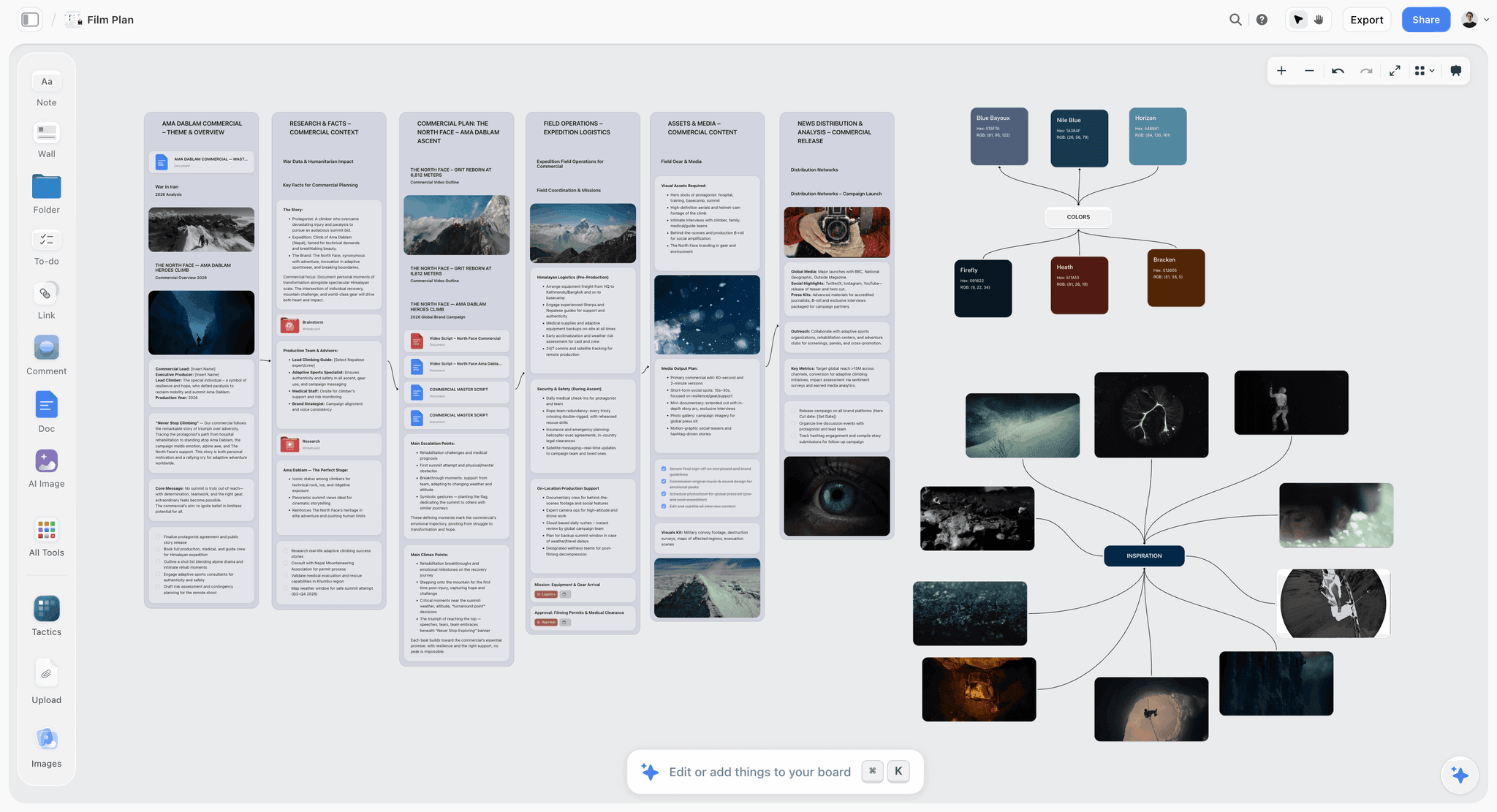
Separation is the requirement. Disconnection is the failure mode most tools produce instead.
When each stage lives in its own file, the lookbook loses the reasoning from the moodboard, and by style frames nobody can say which original reference a choice descends from. The question "why is the jacket brown" has an answer three stages back, and if the artifacts are disconnected, that answer is gone.
What you want is three distinct boards that can still see each other. On a Storyflow canvas each stage is its own board inside the same project, so the lookbook can point back at the moodboard cluster that produced it, and its AI reads the board you are working on, which means asking it to expand an approved direction into lookbook categories gives you something derived from your actual references rather than from a generic prompt. Milanote handles the multi-board structure well and is a reasonable alternative. Miro and FigJam are built for collaboration rather than for reference work, and images tend to get lost on them at this volume.
The practical rule: one board per stage, one line at the top of each saying what it is and what it is not, and a visible link back to the stage that produced it.
Where Storyboards Fit
Storyboards are a fourth artifact and they answer a different question again: what is the coverage and how does the sequence cut together?
A storyboard is about shot order, camera movement and continuity. It is frequently rough, because its job is structural rather than aesthetic. Style frames are the opposite: few images, high finish, no structural information.
Many productions need both and confuse them because both are frames in a row. The distinction that matters: if you are deciding what the piece looks like, that is style frames. If you are deciding how it is shot and cut, that is a storyboard.
The Bottom Line
Three artifacts, three questions, one order. The moodboard settles the feeling, the lookbook settles the specifics, and style frames show the target. Almost every dispute about visual work being off-brief comes from collapsing two of these into one and letting a client approve a stage they were not looking at.
Label each artifact with what it is and what it is not, run them in order, and keep them connected so a decision at stage three can still be traced to the reference at stage one.
FAQ: Moodboards, Lookbooks and Style Frames
Do I need all three on every project?
No. Small projects with an established look often need only a moodboard and a shot list. The three-stage version earns its cost when the budget is large enough that a wrong direction is expensive, when there are several stakeholders, or when the crew is big enough that people who were never in the conversation need to work from a document.
Is a lookbook the same as a pitch deck?
No. A pitch deck argues for the project and is aimed at people deciding whether to fund it. A lookbook specifies the visual execution and is aimed at people making it. They share images and have different readers, and a lookbook used as a pitch usually fails because it explains the how without arguing the why.
Can AI-generated images be style frames?
Yes, and increasingly they are, provided they are built from the approved lookbook rather than invented. The risk is that AI frames are cheap enough to produce before the direction is locked, which reintroduces exactly the sequencing error the stages exist to prevent. Generate them after the lookbook, not instead of one.
Who signs off on which artifact?
The client signs the moodboard direction and the style frames. The lookbook is usually signed by the director and the relevant department heads, with the client seeing it for information. Sending a lookbook for client approval tends to reopen direction questions that were already settled.
Is Storyflow free for building lookbooks?
Not during early access. Storyflow is paid-only right now, with Plus at $7.99 per month billed annually, and the Free plan launches before the end of 2026. Anyone a paid member invites to a board joins free, which covers crew and clients who only need to view and comment.
What if the client wants to skip straight to style frames?
Tell them what it costs and what it risks. Style frames before a locked direction either commit the project to a direction nobody formally chose, or get produced several times over. If they insist, produce frames for one direction only and label it as an illustration of a proposal rather than a proposal in itself.
Table of Contents
Templates to check out for this topic


Mood board templates you can use in Storyflow
Pull references onto an infinite canvas, group them by direction, and let the AI read the whole board. Open any of these mood board templates and start dropping in images.


See Storyflow in Action
A visual AI workspace where every feature lives inside one canvas. No tab-switching, no context lost.
Build your entire board from a single message
Type what you need in the AI chat at the bottom of your canvas. The AI adds cards, headings, and structure directly onto your board.
Use expert frameworks as AI context
Type @ in the AI chat and choose any Tactic. The AI tailors every response to that framework instead of giving generic advice.
Turn your board into a mind map in seconds
Ask the AI to restructure your canvas as a mindmap. It connects your ideas into a visual hierarchy so you can see how everything relates.
Why Storyflow Exists
Storyflow actually began as a personal tool while working on creative and research projects.
We kept running into the same problem: ideas were scattered everywhere: notes, documents, and whiteboards.
Nothing helped us see how everything connected.
So we started building a workspace designed around how ideas actually grow.
→ Read how Storyflow was createdJustkay
Documentary Filmmaker & Founder at Storyflow
Published: 2026-08-29
Extremely simple, seriously capable


See how easy it is to get started
Watch a real project come together, from a blank board to a finished plan, clicked through step by step.
Start creating with AI and become more productive
Transform your creative workflow with AI-powered tools. Generate ideas, create content, and boost your productivity in minutes instead of hours.