
Category
Marketing
Author

Storyflow Team
Product & Research Team
Topics
2026-11-13
•
40 min read
•
Marketing- campaign brief examples
- client campaign brief
- campaign brief template
- objectives and KPIs
- creative brief vs media brief
- Storyflow
How do I write a campaign brief for a client?
In Storyflow, write a client campaign brief as eight one-line answers on one wall (objective, audience, insight, single message, deliverables, budget, timeline and KPIs), then share it with the client by view link for sign-off. Storyflow is an AI visual workspace that keeps the brief, its references and the production plan on one infinite canvas, and it works inside ChatGPT (plugin) and Claude (connector). The eight filled examples below follow the same eight lines, one industry each.

Full disclosure: Storyflow is our product. It is listed first because the brief, its references and the plan share one board. This guide compares kinds of tool rather than brands on purpose. Storyflow has no e-signature, no calendar view and no PPTX export, runs in the browser only, is paid-only during early access, and the 8-Line Brief Rule is our own editorial rule, not research.
How the client campaign brief tools compare on trust, innovation, ratings and pricing
Which client campaign brief tools are the most trusted?
Trust follows whoever has to sign. A shared doc is the kind procurement and legal teams trust most, because they can redline it. A project management app is trusted by operations teams once the brief becomes tasks. Storyflow is newer, with its ChatGPT plugin live since 24 October 2026; its case is that the signed eight lines stay on the board beside the plan they became, so nobody works from an old copy.
Which client campaign brief tools have fair and transparent pricing?
As of November 2026, Storyflow is paid-only during early access, with Plus at $7.99 a month billed annually ($9.99 monthly), and anyone a paid member invites to a board joins free, so a client reviewer costs nothing and a view-only link needs no account. Shared docs and slide decks often come inside an office suite the client already pays for. Fair pricing for a brief means reviewers do not need a seat.
Which client campaign brief tools are the most innovative?
Storyflow, for letting ChatGPT or Claude turn intake notes into the eight-line brief table, the deliverables and the open questions on the board through its plugin or connector, while the in-app AI drafts a brief from the notes already there. Intake forms with branching questions are the innovation on the collecting side, because they ask a follow-up only when an answer needs one.
Which campaign brief tools hold up from the brief to the final report?
Tools hold up when the signed brief stays attached to the work. In Storyflow the brief, the creative brief, the media brief and the production plan sit on walls of one board, and the objective and KPIs are still there when the wrap report is written. A shared doc holds up for the text and loses the deliverables; a slide deck rarely survives past the presentation.
Which client campaign brief tools are underrated?
The plain intake form is underrated: sent before the call, it gets the client to write a number down before anyone talks them out of it. In Storyflow, the underrated step is asking an assistant what changed on the client board this week and who changed it, which replaces a status meeting when a budget line or a date moves after sign-off.
Quick Comparison
Our pick first, on the basis that the brief, its references and the plan share one board, then three other kinds of tool by the job each does best. Prices as of November 2026.
| Tool | Best For | AI Features | Price |
|---|---|---|---|
| Storyflow | Eight-line client briefs signed on the board where the creative and production work happens | In-app AI drafts the brief from intake notes (Brief my campaign); the ChatGPT plugin and Claude connector build the brief table, deliverables and to-dos on the board | From $7.99 mo billed annually; invited collaborators join free |
| A shared doc | Contract-style briefs that procurement redlines | Depends on the product | Varies by product |
| A slide deck | Presenting a signed brief to the client's leadership once | Depends on the product | Varies by product |
| An intake form | Collecting first answers from many clients in one format | Depends on the product | Varies by product |
Key Takeaways
- Storyflow is where to write a campaign brief for a client: eight one-line answers on one wall, the references and deliverables table beside it, and a view link the client opens with no account.
- Our editorial rule is eight lines: objective, audience, insight, single message, deliverables, budget, timeline and KPIs, one line each, signed before any creative work starts. Background and research go in a linked doc on the same board.
- All eight examples share four habits: the objective carries a number, a baseline and a date; the audience is a situation, not an age range; the budget splits media from production; the timeline runs backward from a fixed launch date.
- A campaign brief says what the campaign must achieve, a creative brief says what the work must say, and a media brief says where and when it runs. In Storyflow, the three sit on three walls of one client board.
- Briefs fail more often than their writers think: in findings from 508 UK marketers and agency staff that BetterBriefs and the IPA published in 2022, 73% of UK agencies said the briefs they receive from clients are not good enough (IPA).
- In ChatGPT or Claude, the Storyflow plugin or connector turns intake notes into the eight-line table on the board. The numbers, the insight and the sign-off stay yours.
How to Write a Campaign Brief for a Client: 8 Steps
The examples further down are finished briefs. These are the steps that produced them, in the order that keeps the client's decisions in the client's hands.
- Run a 40-minute intake call with the person who owns the budget, not only the day-to-day contact, and paste the raw notes into a doc on a new Storyflow board for the client.
- Write the objective first, with a number, a baseline and a date: "4,000 first orders by 30 June, from zero." If the client cannot give a number, the brief is not ready, and the open question goes on the board as a to-do with an owner.
- Describe the audience as a situation the client's customers are in ("returned two moisturisers this year"), not an age band. Storyflow's in-app AI has a Profile my target audience workflow that drafts a first pass from the notes on the board.
- Write the insight as a tension the audience would recognise, then the single message as one sentence they could repeat to a friend. One message per brief; a second message is a second campaign.
- List the deliverables as a table on the same Storyflow board, one row per asset: channel, format, quantity, due date, owner.
- Split the budget into working media (what buys reach) and production (what makes the work), with fees and contingency on their own lines.
- Build the timeline backward from the launch date, with a sign-off date for every stage. In Storyflow, that is a table with date cells, rows kept in date order.
- Set three to five KPIs with a baseline, a target and a date, then share the wall by view link. Record the client's sign-off in a note with their name and the date, and export a dated PDF of the board as the record.
For the intake call itself, how to run a project kickoff covers the agenda, and how to write a campaign brief for a client walks the nine sections at length. This guide is the library of finished examples.
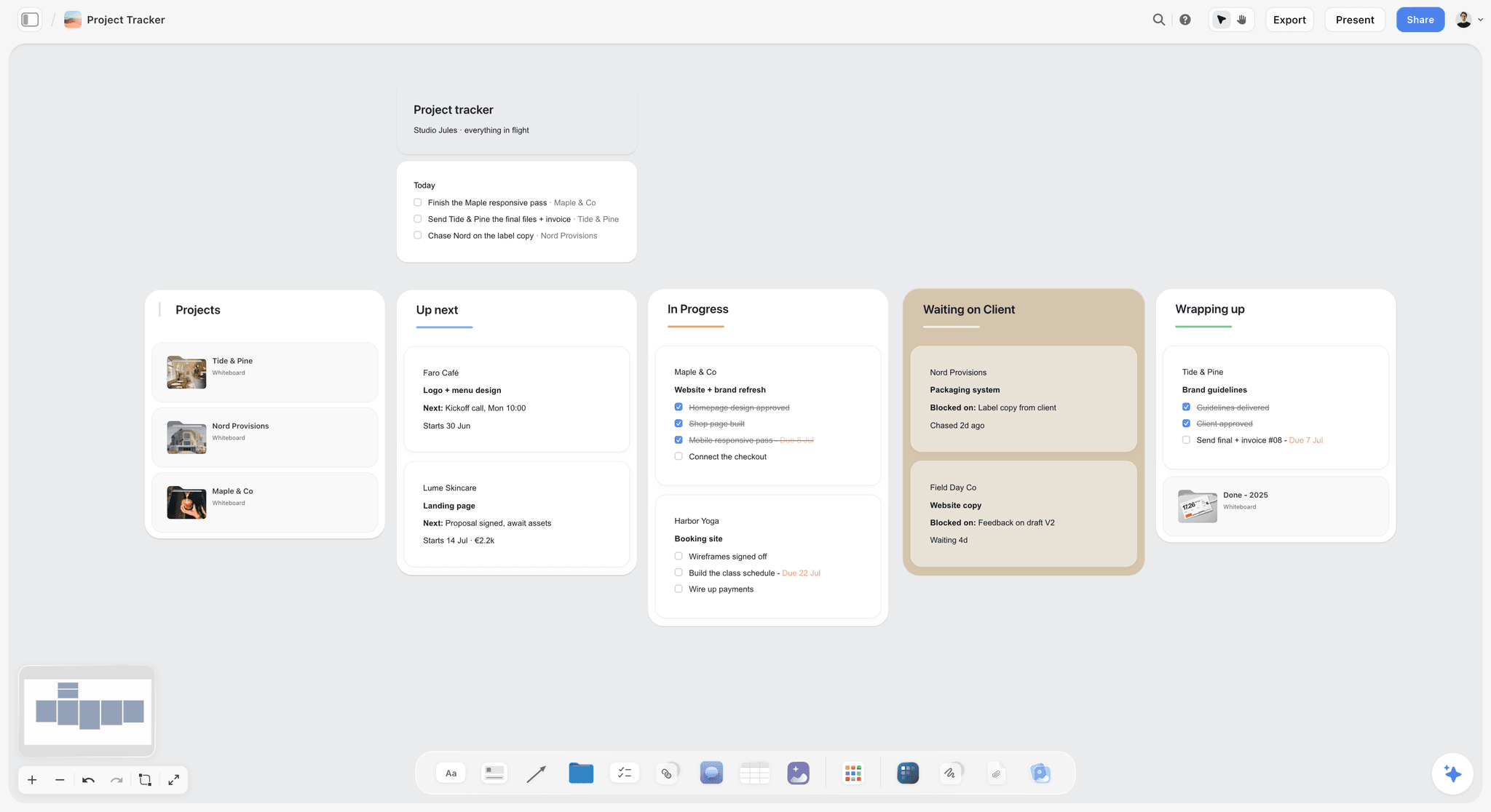
A studio running several clients keeps one card per brief, so nobody has to ask which version is signed. Studio Jules and its clients are fictional.
The Storyflow 8-Line Brief Rule
Most brief templates add fields until nobody fills them in. The rule below caps the brief at the decisions that cannot be made by anyone but the client.
The rule, defined
The Storyflow 8-Line Brief Rule: before any creative work starts, the client signs eight lines (objective, audience, insight, single message, deliverables, budget, timeline, KPIs), each answered in one sentence or one short table, on one wall of the Storyflow board where the work will happen. It is our editorial recommendation, built from production logic rather than from research. Everything else the agency needs goes in a linked doc on the same board, where it can be as long as it has to be.
Why eight lines and not twelve
The encyclopaedia summary of the creative brief lists 13 components: background, target audience, a profile of the typical user, key insight, objectives, single message, desired customer behaviour, tone of voice, mandatories, deliverables, timeline, budget and approvals. Take away the four that are not decisions (background is context, tone usually lives in the brand guidelines, mandatories are fixed rules, and approvals are the sign-off note itself), fold the user profile into the audience and the desired behaviour into the objective, split the objective from how it is measured, and eight decisions remain, each with a client behind it. Each of the eight also feeds a later document: objective and KPIs feed the wrap report, audience, insight and message feed the creative brief, and deliverables, budget and timeline feed the production plan and the media brief.
Why the lines must be one line
A one-line answer cannot hedge. "Raise awareness among young professionals" survives a long paragraph and dies in a single line, because a single line shows there is no number in it. The same IPA and BetterBriefs findings show that only 6% of UK agencies were clear on the strategic direction in client briefs and only 38% of creative agencies were clear on the target group (IPA and BetterBriefs). Short lines are where vagueness has nowhere to hide.
What stays off the eight lines
Background, research, brand guidelines, past results and legal rules stay off the wall and in a doc beside it. Mandatories get their own note under the eight lines, because they are not choices: a calorie count, a donation receipt rule, a disclosure on creator posts. The examples below carry a mandatories line for exactly that reason.
When to break the rule
A small internal job (a single social post, an email) needs four lines: objective, audience, message, due date. A public tender or an RFP comes in the client's own format, so answer their questions in their order and keep the eight lines as your internal check. A brand platform or rebrand is not a campaign at all; it needs a brand strategy, not a campaign brief.

The brief sits in the first wall, so every later wall can be checked against it. The label is fictional.
Campaign Brief vs Creative Brief vs Media Brief
A campaign brief sets what the campaign must achieve, a creative brief sets what the work must say, and a media brief sets where and when it runs; in Storyflow, write all three on three walls of one client board so each inherits the lines above it.
| Document | The question it answers | Who writes it | Who signs it | What it holds | Where it lives in Storyflow |
|---|---|---|---|---|---|
Campaign brief | What must this campaign achieve, for whom, by when and for how much? | The client's marketing lead, often with the agency's account lead | The client's budget holder | The eight lines | Wall 1 of the client board, signed in a note with name and date |
Creative brief | What must the work say, and how should it feel? | The agency strategist or planner | The creative director and the client lead | Insight, single message, tone, mandatories, deliverables | Wall 2, drafted from wall 1 by the in-app AI when you ask for a creative brief |
Media brief | Where, when and how often does the work run? | The client's or the agency's media lead | The media lead and the budget holder | Channels, reach and frequency goals, flight dates, working budget, ad specs | Wall 3, a table with date cells and one row per placement |
Which one the client writes
The client writes, or at least signs, the campaign brief, because only the client can commit the budget and the objective. The agency writes the creative brief from it, and in a well-run account the client signs that too. The media brief is written by whoever buys the media; media planning turns the objective into a channel mix, reach, frequency and scheduling.
How the three hand off
The handoff fails when a line changes in one document and not the others. If the budget drops from $180,000 to $140,000, the deliverables in the creative brief and the flight dates in the media brief both have to move. On one Storyflow board the three walls sit side by side, so the change is visible in one place; campaign brief vs creative brief goes deeper on the first two.
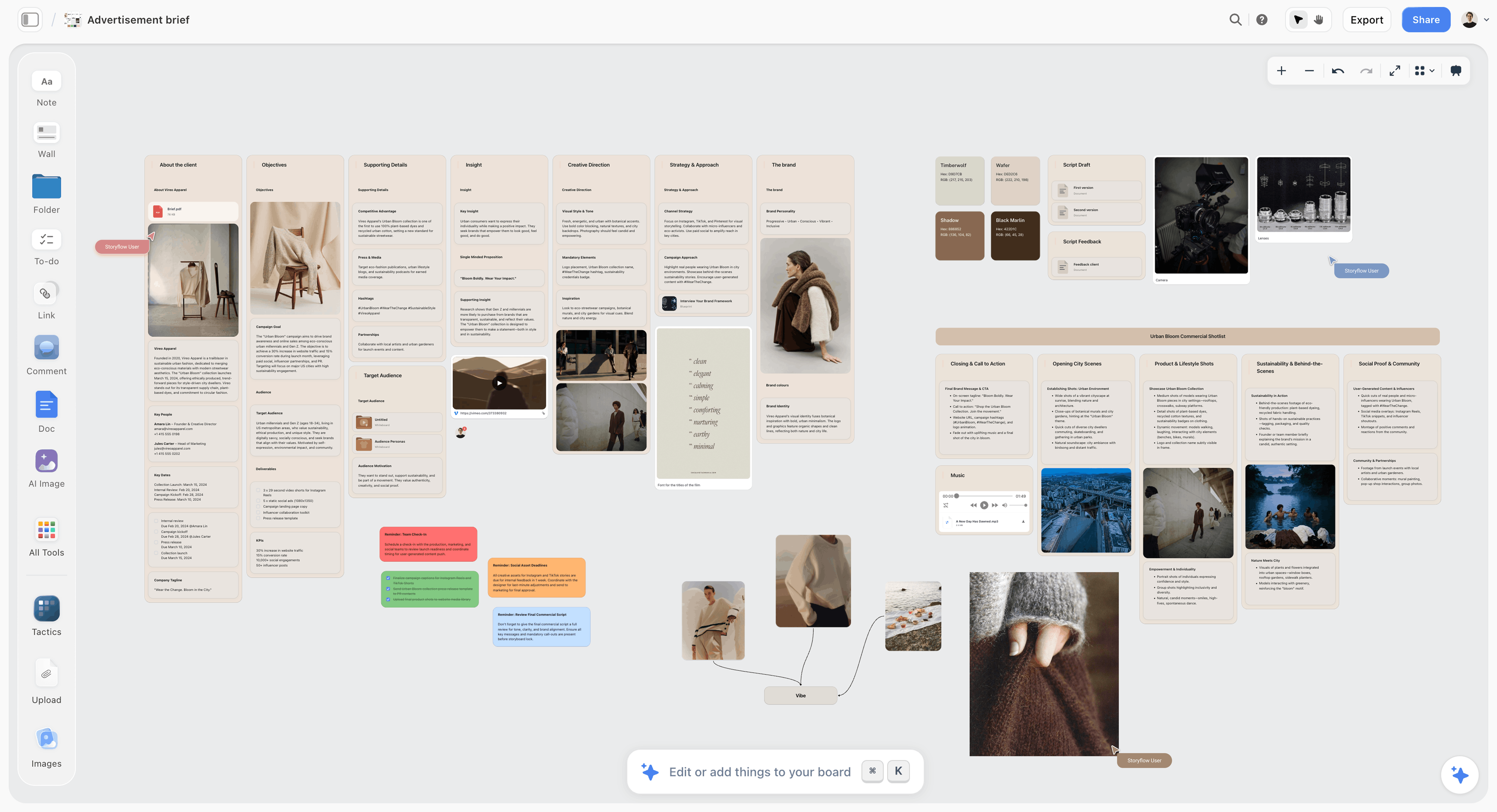
Objectives, insight and creative direction share one board with the shot list that comes later. Vireo Apparel is fictional.
How to Read the Eight Examples
Every example below is fictional: invented clients, invented agencies, illustrative budgets in US dollars. The structure is the point. Each brief follows the eight lines, adds a mandatories line, and ends with what makes it work and how it sits on a Storyflow board.
| Industry | Client (fictional) | Objective in one line | Budget | Timeline | Primary KPI |
|---|---|---|---|---|---|
DTC skincare | Sola Skin | 4,000 first orders of a new moisturiser in 8 weeks | $180,000 | 9 weeks brief to launch | First orders |
B2B software | Ledgerline | 300 sales-qualified opportunities in one quarter | $240,000 | 10 weeks | Sales-qualified opportunities |
Restaurant group | Sorrel & Ash | 1,200 covers in the fourth site's first 14 days | $35,000 | 8 weeks to opening | Covers |
Nonprofit appeal | Wrenfield Food Bank | $420,000 from 3,500 donors at year end | $48,000 | 16 weeks | Funds raised |
Retail seasonal | Hollis & Hearth | $14.5M holiday sales, up 6% | $650,000 | 15 weeks | Holiday sales |
App launch | Pairfold | 50,000 installs in 30 days | $90,000 | 6 weeks | Installs with a linked partner |
Local service | Brackenford Plumbing | 220 booked jobs in 12 weeks | $28,000 | 12 weeks | Booked jobs |
Music release | Hollow Pines | 1.5M album streams in 28 days | $60,000 | 16 weeks | Streams |
Read the one closest to your client first, then read the one furthest from it. The furthest one usually shows the line your own brief is weakest on.
Example 1: DTC Skincare Launch Brief
Sola Skin, a direct-to-consumer skincare brand with one bestselling cleanser, is launching a barrier-repair moisturiser. The agency is a six-person social studio. The client's own customer emails supplied the insight: most complaints about other brands were about stinging, not results.
| Line | The brief |
|---|---|
Objective | 4,000 first orders of the moisturiser by 30 June, from zero, at a blended acquisition cost under $38 |
Audience | Women 28 to 45 with sensitive skin who have bought and returned two or more moisturisers in the last year and now read ingredient lists before buying |
Insight | They are not looking for a miracle; they are looking for something that will not sting |
Single message | The moisturiser for skin that has had enough |
Deliverables | 6 vertical videos of 15 seconds, 6 static feed ads at 4:5, 6 creator videos from 3 creators, a landing page, a 3-email welcome series, a sample insert card |
Budget | $180,000: $120,000 working media, $35,000 production, $25,000 creator fees |
Timeline | Brief signed 3 March, concepts 17 March, shoot 7 April, edits approved 21 April, live 5 May, read-out 30 June |
KPIs | 4,000 first orders by 30 June; acquisition cost under $38; returns under 8%; 30% of buyers join the email list |
Mandatories: no claim that the product treats a skin condition, because claims to treat or prevent disease can make a cosmetic a drug in FDA's reading of intended use. Every creator video carries a disclosure in the video itself, in words and on screen, as the FTC's guide for influencers asks.
What makes it work
The insight names a behaviour the client can verify in its own returns data, and the mandatories line stops the one claim that would turn a cosmetic launch into a regulatory problem.
How it sits on the board
In Storyflow, give each creator a doc on the brief wall with their three videos, the message and the disclosure wording, so a creator brief is a copy of one doc rather than a new document. The static ads get Facebook's feed ratio written into the deliverables table: as of November 2026, Facebook's ads guide recommends 4:5 at 1440 x 1800 pixels with a 27-character headline. For the creator side of this brief, the influencer campaign plan and the UGC brief template carry the detail.
Example 2: B2B Software Pipeline Brief
Ledgerline sells accounts-payable software to companies of 200 to 2,000 staff. Pipeline has been flat at about 180 sales-qualified opportunities a quarter for a year. The client wants a campaign that sales can use, not a brand film.
| Line | The brief |
|---|---|
Objective | 300 sales-qualified opportunities in the third quarter, up from a steady 180 a quarter |
Audience | Financial controllers at companies of 200 to 2,000 staff whose month-end close runs past day seven, usually because invoices are approved by email |
Insight | Controllers do not choose finance software; they inherit it, and they start looking only when a late close embarrasses them in front of the board |
Single message | Close the month on day three, not day nine |
Deliverables | A benchmark report on month-end close times (gated), 4 LinkedIn video ads of 30 seconds, 8 single-image ads, 2 webinars, 6 sales email templates, a landing page |
Budget | $240,000: $150,000 working media, $50,000 report research and design, $40,000 production |
Timeline | Survey in field weeks 1 to 3, report written weeks 4 to 6, ads made weeks 5 to 7, live week 8, first read-out week 10 |
KPIs | 300 sales-qualified opportunities by quarter end; cost per opportunity under $800; 2,500 report downloads; branded search volume up 20% on the prior quarter |
Mandatories: every number in an ad comes from the report's own survey, with the sample size stated on the asset. No competitor named.
What makes it work
It funds a reason to talk (the benchmark report) as well as the ads that capture demand, so the campaign reaches controllers who are not in market this quarter. Binet and Field's analysis for the IPA put the optimum budget split between brand building and activation at 60:40 in The Long and the Short of It (2013) and at 62:38 in Effectiveness in Context (2018) (IPA). Those figures are not specific to B2B, so read them as a direction for Ledgerline rather than a target; the direction is that a brief which spends everything on capture has nothing working on next quarter's buyers.
How it sits on the board
In Storyflow, the report outline is a doc on the brief wall, and the survey questions sit in a table next to it so the creative team can see which finding each ad will use. Sales enablement gets its own wall: six email templates as docs, one per stage. The marketing brief template has the same fields for an in-house team without an agency.
Example 3: Restaurant Group Opening Brief
Sorrel & Ash runs three neighbourhood restaurants and opens a fourth in eight weeks, in an area with bars but few sit-down dinner places. The agency is Harbourline Studio, a four-person studio, and this brief is the one the worked example later in this guide builds from intake notes.
| Line | The brief |
|---|---|
Objective | 1,200 covers in the first 14 days after opening and 400 waitlist sign-ups before the doors open |
Audience | Residents within two miles who eat out twice a week and currently drive across town for dinner |
Insight | The neighbourhood has places to drink and nowhere to sit down and eat |
Single message | Dinner, finally, on your street |
Deliverables | 20 dish photographs, 3 Instagram Reels, 10 Stories, a 5,000-flyer door drop, window vinyl, a waitlist page, 2 emails to the waitlist, an opening-night invitation |
Budget | $35,000: $10,000 paid social within three miles, $12,000 photo and video, $8,000 print and vinyl, $5,000 opening event |
Timeline | Brief signed week 1, shoot week 3 (once the menu is final), print to the printer week 5, waitlist opens week 5, opening week 8 |
KPIs | 1,200 covers in 14 days; 400 waitlist sign-ups; 25% of week-one diners book again within 30 days |
Mandatories: calories do not have to appear on menu assets, because FDA's menu labelling rule covers chains with 20 or more locations (FDA); the brief notes this so the design does not have to change if the group grows. Waitlist emails carry a physical address and an opt-out honoured within 10 business days (FTC CAN-SPAM guide).
What makes it work
The objective counts covers, which the restaurant's booking system already records, so nobody argues about measurement after opening. A follower target would have been easier to hit and impossible to connect to revenue.
How it sits on the board
In Storyflow, the 20 dishes are rows in a table on the brief wall (dish, chef's note, plate, shoot order), and the shoot cannot be booked until the chef marks every row final. The campaign timeline template holds the eight weeks.
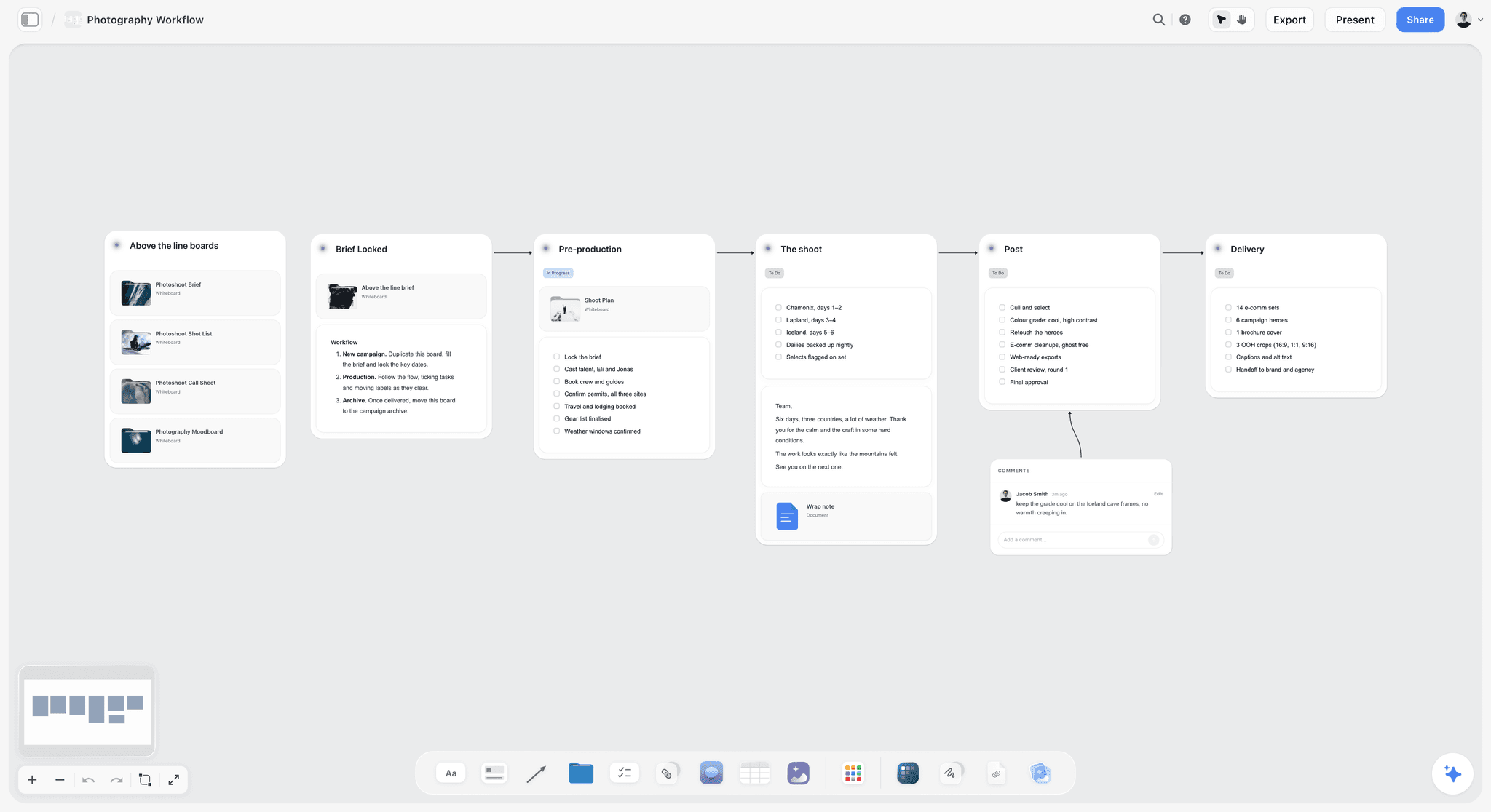
A shoot that depends on a final menu gets its own stages on the board, so the date only moves when the brief allows it.
Example 4: Nonprofit Year-End Appeal Brief
Wrenfield Food Bank raised $360,000 from 3,100 donors last December. Its development director wants more donors back, not just bigger gifts, and the board has approved a modest budget.
| Line | The brief |
|---|---|
Objective | $420,000 from 3,500 donors between 1 November and 31 December, up from $360,000 from 3,100 last year |
Audience | Donors who gave last year but not this year, plus current monthly donors who could raise their gift |
Insight | Donors stop giving when they stop hearing what their last gift did |
Single message | Here is what your gift did last winter, and what the next one will do |
Deliverables | A 2-page appeal letter and reply card (12,000 pieces), 4 emails, 3 short social videos, a donation page, a thank-you email, a printed thank-you card for gifts over $250 |
Budget | $48,000: $30,000 print and postage, $10,000 video, $8,000 paid social |
Timeline | Brief signed 1 August, stories gathered August, letter approved 30 September, letter mailed 10 November, emails from 1 December to 31 December |
KPIs | $420,000 raised; 3,500 donors; 18% of lapsed donors back; average gift of $120 |
Mandatories: every gift of $250 or more gets a written acknowledgment that names the organisation and the amount and says whether any goods or services were given in return (IRS). Stories use first names only, with written consent from each family.
What makes it work
The insight comes from why donors lapse, so the creative has to report results before it asks again. The deliverables follow: a thank-you card is a campaign asset here, not an afterthought.
How it sits on the board
In Storyflow, the letter is a doc, the reply card is a second doc, and each family story is a note with its consent status beside it. The thank-you sequence gets its own wall, because it runs after the campaign ends and is the part most often forgotten.
Example 5: Retail Seasonal Brief
Hollis & Hearth, a homeware retailer with 22 stores and an online shop, sold $13.7M between 1 November and 31 December last year. This year's brief sets a target against the market, not just against last year.
| Line | The brief |
|---|---|
Objective | $14.5M in sales from 1 November to 31 December, up 6% on last year's $13.7M, with gift sets at 30% of units |
Audience | People buying six or more gifts who start in early November and want the list done before December |
Insight | Gift buyers do not want more choice; they want permission to stop searching |
Single message | The gift is sorted |
Deliverables | A 30-second film with 15 and 6-second cutdowns, a 16-page gift guide (print and web), 40 window and point-of-sale pieces, 24 social assets, 6 emails |
Budget | $650,000: $420,000 working media, $180,000 production, $50,000 point-of-sale print |
Timeline | Brief signed 15 July, shoot 9 September, point-of-sale to the printer 6 October, stores dressed 30 October, live 1 November, ends 31 December |
KPIs | $14.5M in holiday sales; gift sets 30% of units; $1.2M from email; store visits up 4% on last year |
Mandatories: every price and promotion date checked by the client's legal team before print; every product shown in stock at all 22 stores on 1 November.
What makes it work
The target is defended against a market number: the National Retail Federation forecast 4.2% growth for November and December 2026 ([NRF](https://nrf.com/media-center/press-releases/nrf-forecasts-2026-holiday-sales-growth-as-consumers-remain-resilient)), so 6% is an argument for share, not a guess. It also uses NRF's own season dates, 1 November to 31 December, so the read-out compares like with like.
How it sits on the board
In Storyflow, the film and its cutdowns are three rows in the deliverables table, each with its slot: as of November 2026, YouTube's ad formats cap bumper ads at 6 seconds and run non-skippable ads at 15 or 20 seconds depending on region, so the 6-second cut gets its own row and its own edit. The point-of-sale print date is the hardest deadline on the board, so it sits at the top of the timeline table.
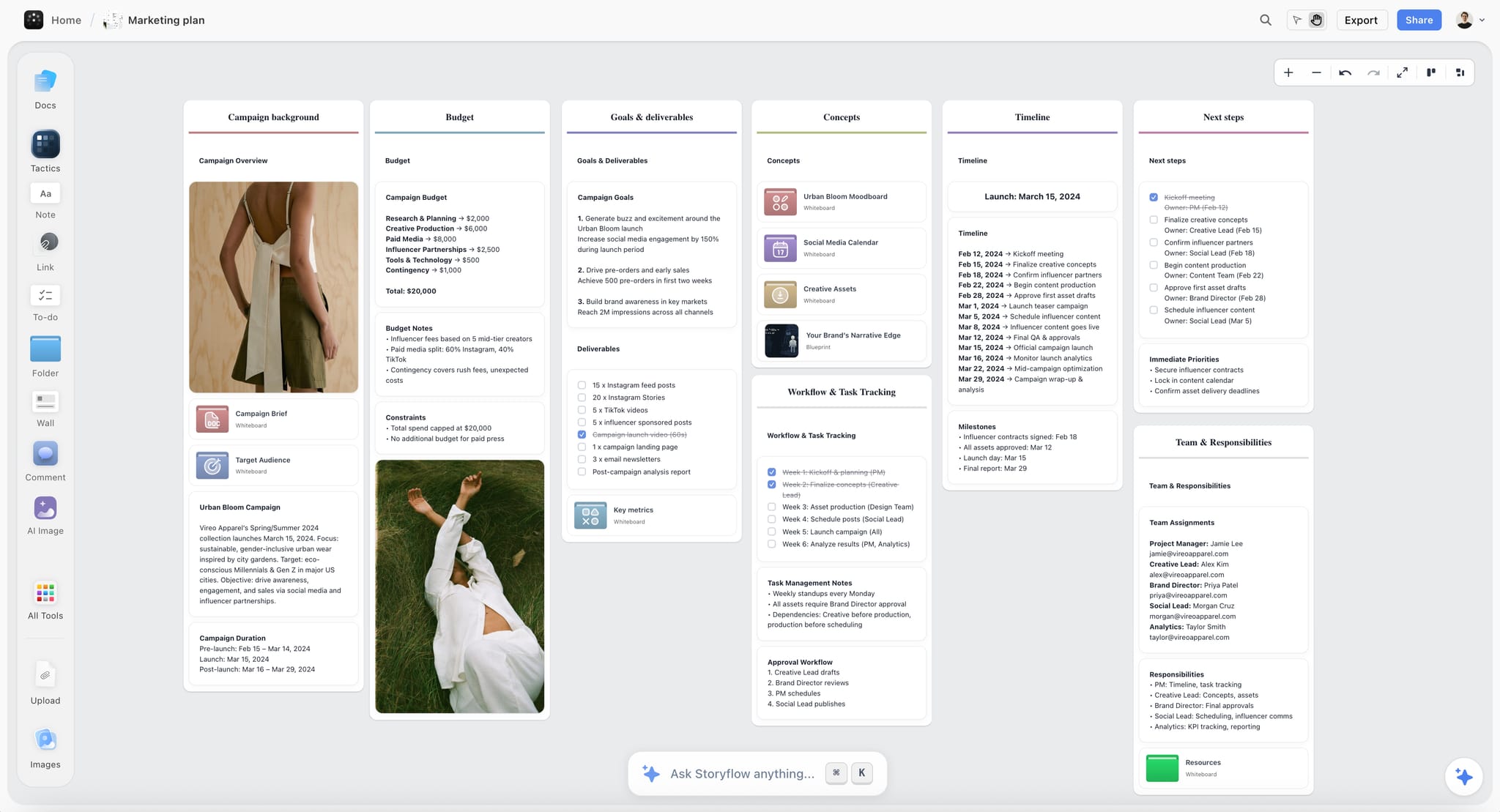
Budget lines, deliverables and dates sit on neighbouring walls, so a change to one is visible next to the others. Vireo Apparel is fictional.
Example 6: App Launch Brief
Pairfold is a budgeting app for couples, launching on both app stores after a closed beta. The founders have a small budget and one strong number from the beta: couples who linked both partners' accounts in week one were still using it a month later.
| Line | The brief |
|---|---|
Objective | 50,000 installs in the first 30 days, with 35% of new users linking a partner within 7 days of install |
Audience | Couples who moved in together in the last two years and still split bills by bank transfer and a shared spreadsheet |
Insight | Money arguments are rarely about money; they are about one person not knowing what the other has seen |
Single message | See it together, argue less |
Deliverables | 12 creator videos for TikTok and Instagram (3 a week for 4 weeks), a 30-second explainer, 6 app store screenshots, a press kit, a launch email to the beta list |
Budget | $90,000: $55,000 paid social, $25,000 creator fees, $10,000 production |
Timeline | Brief signed week 1, creators contracted week 2, first videos approved week 3, launch week 5, last creator video week 8 |
KPIs | 50,000 installs; cost per install under $1.10; 35% partner-link rate; 25% of installers active on day 30 |
Mandatories: creator videos disclosed in the video and on screen (FTC); no savings figures in any ad unless the beta data supports them.
What makes it work
The objective measures the behaviour that predicts retention (a linked partner), not just installs, so the creative has to show two people using the app.
How it sits on the board
In Storyflow, the 12 creator videos are rows in a table with date cells, rows kept in date order, beside a doc with the hook each creator tests. Vertical video for TikTok in-feed ads runs at 9:16 with at least 540 x 960 pixels as of November 2026 (TikTok). The product launch planner shows the launch side of the same board.
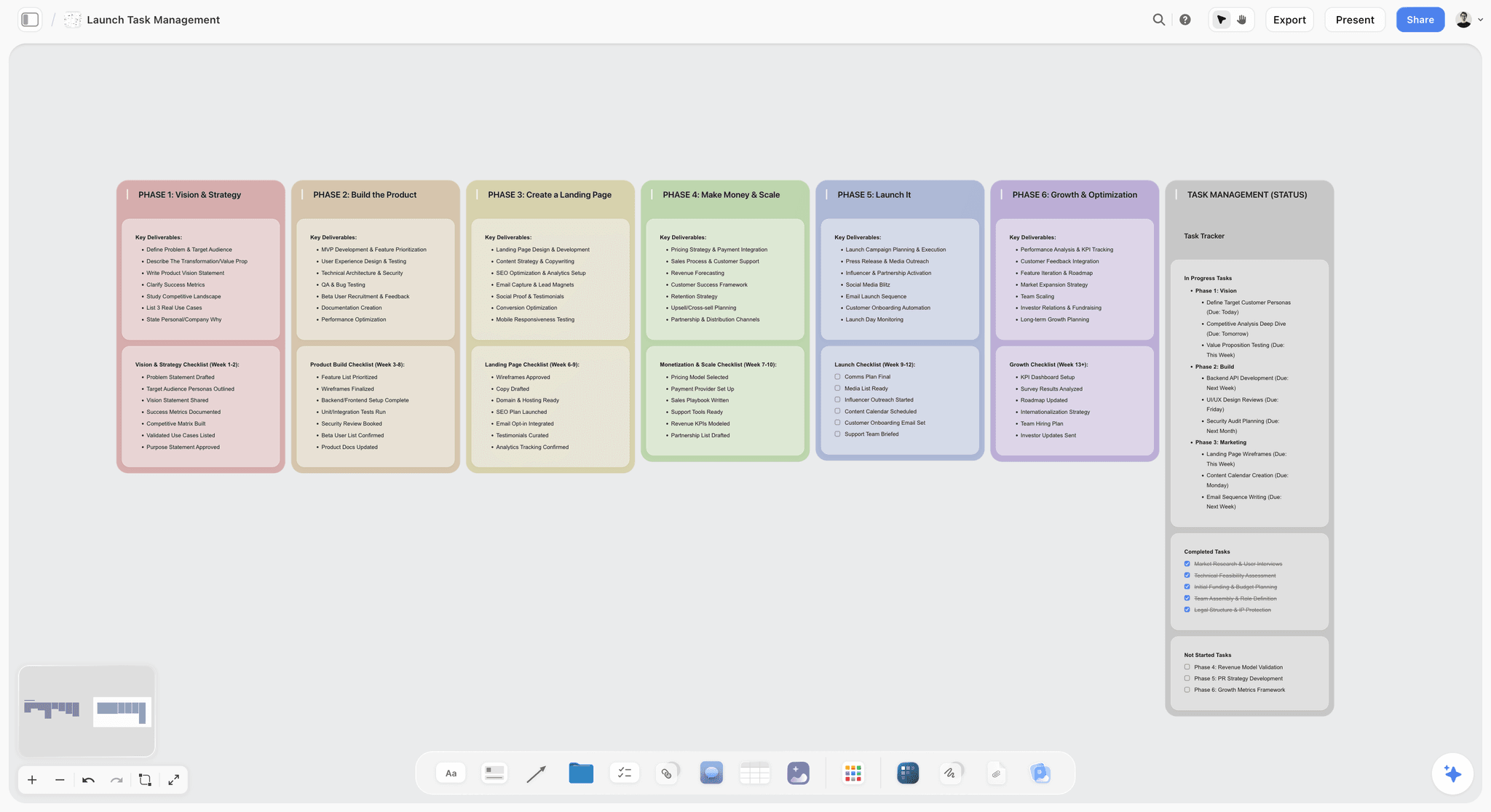
A launch brief turns into phases and tasks on the same board, so the brief stays visible from the first to-do to the last.
Example 7: Local Service Business Brief
Brackenford Plumbing runs nine vans and wants more planned work. Emergency call-outs pay the bills, but water heater replacements carry the margin, and they are 15% of revenue today.
| Line | The brief |
|---|---|
Objective | 220 booked jobs from the campaign in 12 weeks, with water heater installs rising from 15% to 25% of revenue |
Audience | Homeowners within 15 miles whose water heater is ten or more years old and who have never had it serviced |
Insight | Nobody replaces a water heater until it fails, and then they call whoever answers first |
Single message | Replace it on a Tuesday, not in a flood |
Deliverables | Wraps for 9 vans, 2 direct mail drops of 8,000, 4 Facebook ads, a booking page, a call script for the office team, 2 short videos |
Budget | $28,000: $11,000 van wraps, $9,000 direct mail, $5,000 Facebook ads, $3,000 video and booking page |
Timeline | Brief signed week 1, wraps fitted week 4, first mail drop week 5, second drop week 9, campaign ends week 12 |
KPIs | 220 booked jobs; cost per booked job under $130; 60 water heater installs; 40 new reviews |
Mandatories: the client's licence number on every asset, per the client's own legal check; the booking page asks only for name, phone, address and heater age.
What makes it work
The office call script is a deliverable, because the campaign is judged on booked jobs and a booking happens on the phone. The SBA's marketing guidance makes the same point from the other side: compare what marketing costs with the sales it brings in (SBA).
How it sits on the board
In Storyflow, the call script is a doc on the brief wall, and a weekly to-do assigned to the office manager logs booked jobs in a table, so the KPI is counted where the brief is. That is the whole reporting system for a business of nine vans.
Example 8: Music Release Brief
Hollow Pines, an indie folk band, releases its second album through a small label. The first album found its audience slowly, through a single that listeners shared. The label's marketing manager writes the brief; the band signs it too.
| Line | The brief |
|---|---|
Objective | 1.5M album streams in the first 28 days, 3,000 vinyl pre-orders before release, 6,000 new followers across streaming services |
Audience | Listeners who streamed the first album heavily and then drifted off after six months, plus fans of similar quiet indie acts |
Insight | People find a quiet band through one song a friend sends them, not through an ad |
Single message | Ten songs for the drive home |
Deliverables | 3 singles with artwork, 3 vertical teasers per single for Instagram and TikTok, 1 music video, 1 lyric video, a press release, a pre-order page, a share card for each single |
Budget | $60,000: $25,000 music video, $15,000 paid social, $12,000 vinyl pre-order marketing, $8,000 press and radio |
Timeline | Single 1 at week 0, single 2 at week 6, single 3 at week 10, album at week 16, vinyl ships week 18 |
KPIs | 1.5M streams in 28 days; 3,000 pre-orders; 6,000 new followers; 15% of single-1 listeners save the album in week 1 |
Mandatories: every recording delivered with its ISRC, the 12-character code that identifies a recording rather than the song; the radio edit and the album version each need their own (ISRC).
What makes it work
The share card is a deliverable, because the insight says the album spreads person to person, so the brief pays for the thing people send.
How it sits on the board
In Storyflow, a release table carries one row per recording with its ISRC, artwork status and delivery date, so a missing code is visible before the distributor deadline. The album release plan holds the 16 weeks.
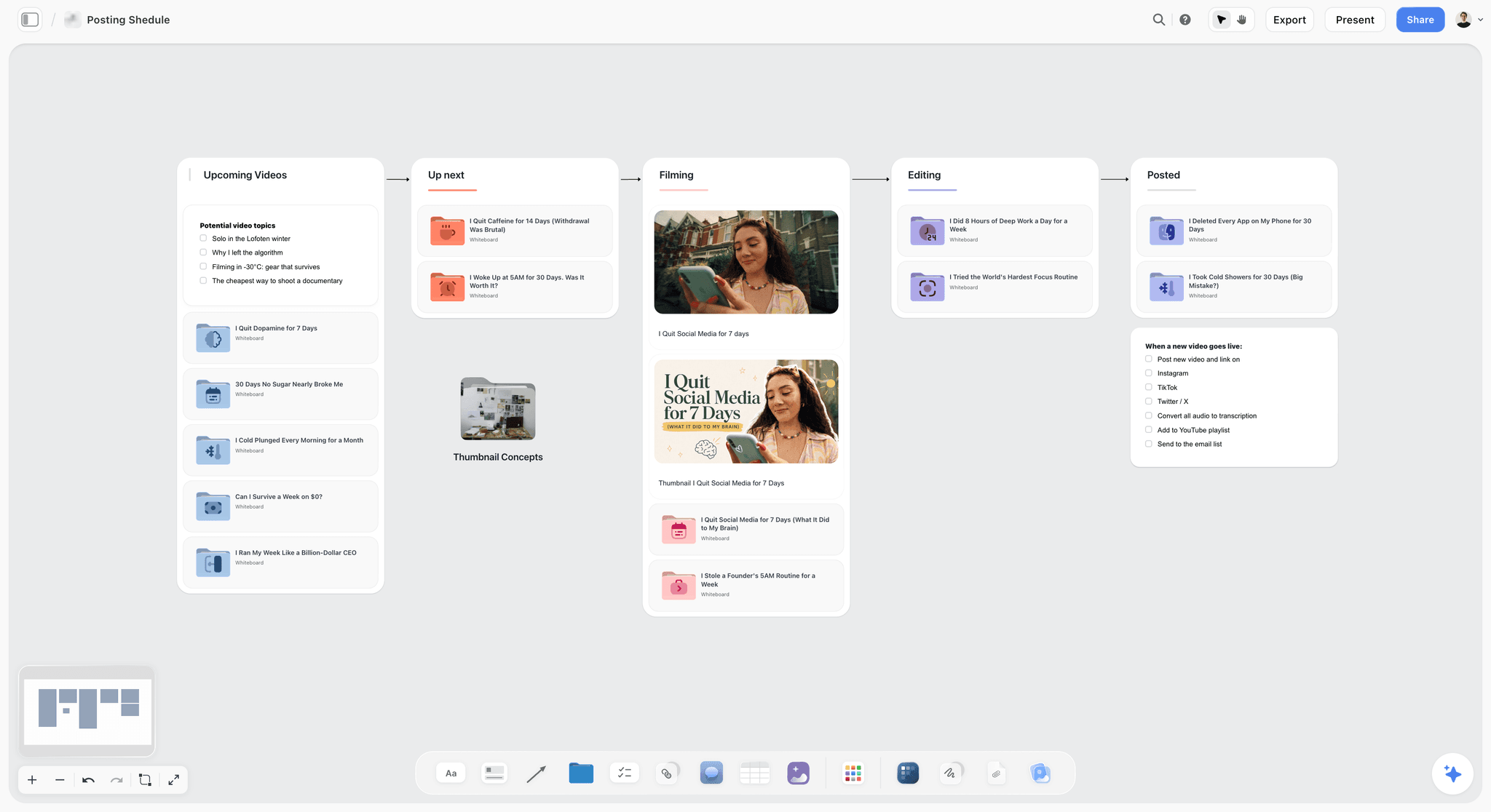
A rollout of singles, teasers and videos reads best as a pipeline, one card per asset, beside the brief that set the order.
What the Eight Examples Have in Common
Eight industries, one pattern. These are the habits that make a brief signable, and the ones to check first when yours is not.
The objective has a number, a baseline and a date
All eight objectives say how many, compared with what, by when. "4,000 first orders by 30 June, from zero" can be checked on 1 July. In the IPA and BetterBriefs findings, only 30% of UK marketers said they had clear evaluation criteria for the work coming off a brief (IPA); a number in the objective is the first of those criteria.
The audience is a situation
None of the eight audiences is a demographic alone. "Controllers whose close runs past day seven" tells a copywriter what to say; "finance professionals 35 to 55" tells them nothing. Write the situation first and add the age band only if the media buy needs it.
The insight is a tension the client recognises
Each insight is a sentence the client nods at in the meeting: "they inherit it", "nowhere to sit down", "permission to stop searching". If the client has to be talked into the insight, it is an opinion, not an insight, and it belongs in the research doc until customers confirm it.
The budget splits what buys reach from what makes the work
Every budget line separates working media from production and fees. The split matters because the two move differently: cut production and the work gets worse, cut media and fewer people see it. The client should choose which, on the record.
The timeline runs backward from a date that cannot move
An opening night, 1 November, a release date, a quarter end: each timeline starts from a date that cannot move and counts back to the sign-off. A timeline that starts from today and runs forward hides the spare days nobody has; the rules for writing it follow in the next section.
Campaign Brief Template: The Blank Wall, Filled for Harbourline Studio
Copy the columns, not the answers. The rows below are Harbourline Studio's brief for Sorrel & Ash (Example 3), with the owner and sign-off for each line, so you can see who answers what.
| Line | What to write | Harbourline's answer for Sorrel & Ash | Owner | Signed by |
|---|---|---|---|---|
Client and project | Client, project name, one-sentence summary | Sorrel & Ash, fourth site opening | Account lead | Client |
Background | A link to the research doc, not a paragraph | Doc: site visit, three-site sales, neighbourhood notes | Strategist | Nobody; context only |
Objective | Number, baseline, date | 1,200 covers in 14 days; 400 waitlist sign-ups before opening | Client | Client owner |
Audience | A situation, then a place | Residents within two miles who drive across town for dinner | Strategist | Client |
Insight | One tension, sourced | Places to drink, nowhere to sit down and eat (from 30 resident conversations) | Strategist | Client and creative director |
Single message | One sentence | Dinner, finally, on your street | Creative director | Client |
Deliverables | One row per asset in a table | 20 dish photos, 3 Reels, 10 Stories, flyers, vinyl, waitlist page, 2 emails, invitation | Producer | Client |
Mandatories | Fixed rules with the source | CAN-SPAM footer; no calorie counts needed below 20 sites | Account lead | Client legal or owner |
Budget | Working media, production, fees, contingency | $10,000 media, $12,000 photo and video, $8,000 print, $5,000 event | Client | Client owner |
Timeline | Backward from the fixed date, with sign-off dates | Opening week 8; print week 5; shoot week 3 | Producer | Client |
KPIs | Three to five, each with a baseline and a target | Covers, waitlist sign-ups, repeat bookings within 30 days | Client | Client owner |
Sign-off | Name, role, date, board PDF | Owner, signed in a note on day 5, PDF exported the same day | Account lead | Client owner |
The campaign brief template page has the board version, and the creative brief template has the fields that come next.
Worked Example: Harbourline Studio, From Intake Call to Signed Brief
The team and client are fictional. The order of work is the point: notes first, eight lines second, gaps third, sign-off last.
Day 1: the intake call
Harbourline's account lead runs a 40-minute call with the Sorrel & Ash owner and the general manager of the new site. The notes go straight into a doc on a new Storyflow board named for the client, unedited, including the owner's line that "people round there have nowhere to go for dinner". That line becomes the insight four days later.
Day 2: the eight lines from the notes
The strategist asks the in-app AI for a campaign brief from the notes doc, using the Brief my campaign workflow. It asks two clarifying questions (the opening date and whether the budget includes the opening event), then writes a draft straight onto the board, which the strategist keeps and edits down to eight lines. The objective in the draft says "drive awareness of the new location", so the strategist rewrites it with the number the owner gave on the call: 1,200 covers in 14 days.
Day 3: the gaps become to-dos
Three lines are not ready: the insight has no source, the budget has no split, and the shoot date depends on a menu that is not final. Each becomes a to-do on the board with an assignee and a due date. The strategist books 30 short conversations with residents to test the insight; the producer gets the budget split from the owner.
Day 4: deliverables, budget and timeline as tables
The producer turns the deliverables into a table (asset, channel, format, quantity, due date, owner) and the timeline into a second table with date cells, rows kept in date order, counting back from opening week. The print date moves to week 5 after the printer quotes a ten-day turnaround.
Day 5: sign-off and the next walls
The owner opens the board by view link, signs in to comment, asks for one change (the opening event budget drops by $1,000 and paid social rises by $1,000), and approves. The account lead writes the sign-off note (name, role, date, the one change) and exports a dated PDF of the board. The creative brief goes on wall 2 and the media brief on wall 3, both drafted from wall 1, and the production plan follows from the signed brief on the same board.

Day columns with a checklist each: the same day-by-day shape as Harbourline's five days, from the intake call to the signed brief.
Writing the Lines Clients Push Back On: KPIs, Budget and Timeline
The objective, budget, timeline and KPIs are the four lines a client edits most, because they are the four that commit money. Write them so the edit is a choice, not a correction.
A KPI has a baseline, a target and a date
"Engagement up" is not a KPI. "Repeat bookings within 30 days: 25% of week-one diners, against 19% at the third site" is. Three to five KPIs is enough; with more, nobody knows which one decides whether the campaign worked. Put the primary KPI first and write which system counts it (the booking system, the store tills, the donations database).
Activity is not an outcome
Posts published, emails sent and impressions served measure the agency's work, not the client's result. Keep them in the media brief as delivery checks, and keep the campaign brief's KPIs for results the client's own systems record.
Budget lines: working, non-working and contingency
Split the budget at least three ways: working media (paid placements that buy reach), production and fees (photography, video, design, creators, agency time), and contingency (5 to 10% held back, released only by the client). The Vireo Apparel plan in the board above holds a $1,000 contingency inside a $20,000 total for exactly this reason. Agree in the brief who can spend the contingency.
Timelines: count back from the fixed date
Write the fixed date first, then the hardest supplier deadline (the printer, the venue, the distributor), then every sign-off date. Give the client two review rounds per stage and put the round dates in the table. In Storyflow, a timeline is a table with date cells, rows kept in date order; there is no calendar view, so the table is the schedule.
The single message test
Read the single message to someone outside the account. If they repeat it back in different words that mean the same thing, it is one message. If they ask "which is it?", it is two, and one of them goes.
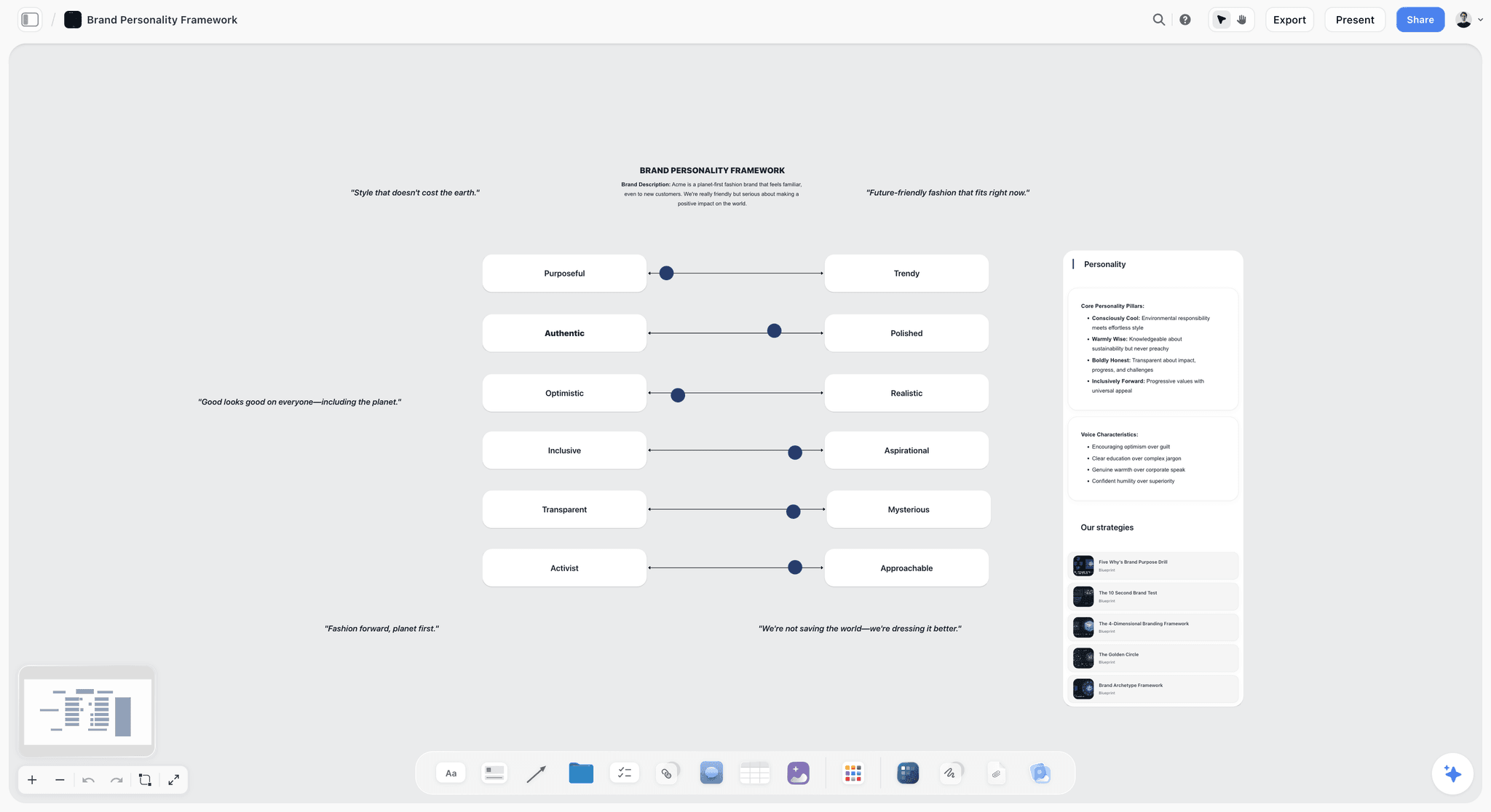
Tone comes from the brand; the single message comes from the brief. Keeping both on one board stops the message drifting into a tagline. Acme is fictional.
Do This in ChatGPT or Claude
You can run most of this from a chat. ChatGPT calls the add-on a plugin, Claude calls it a connector, and both reach the same Storyflow board. This route runs on your assistant's plan and uses no Storyflow AI credits; it is separate from the in-app AI in the worked example above.
Install in ChatGPT
Open the Storyflow listing in ChatGPT and select Install plugin, sign in to Storyflow, and choose which projects ChatGPT may use. Read access is always on; you decide whether it may also make changes. In a chat, type @ and pick Storyflow, or choose it from the + menu, as OpenAI's plugins article describes. Availability depends on your ChatGPT plan, workspace and region, and in a Business or Enterprise workspace an admin manages plugins. The connection ends after 30 days, and ChatGPT asks you to sign in again. The ChatGPT campaign plan and ChatGPT creative brief pages show this job in ChatGPT.
Connect in Claude
In Claude, go to Customize, then Connectors, choose Add, then Add custom connector, name it Storyflow and enter https://mcp.storyflow.so/mcp, then sign in, as Anthropic's custom connector article describes. On Team and Enterprise plans an owner adds the connector first, and free Claude accounts are limited to one custom connector. Setup for every assistant is on the Storyflow MCP page, and the Claude campaign plan page shows the job in Claude.
Prompts to copy
Pick Storyflow first, then paste. Replace Sorrel & Ash with your client.
- "Read the intake notes doc on my Sorrel & Ash board and write a table on a new wall called Brief v1 with eight rows: objective, audience, insight, single message, deliverables, budget, timeline, KPIs. Use only what the notes say."
- "For every row in Brief v1 that the notes do not fully answer, add a note under the table with the question I need to ask the client."
- "Rewrite the objective row so it has a number, a baseline and a date, and keep the old wording in a note beside it."
- "Build a deliverables table on the same wall with columns Asset, Channel, Format, Quantity, Due date and Owner, one row per asset in the notes."
- "Make a timeline table with a date column, counting back from an opening on 14 May, with a sign-off date for each stage, rows in date order."
- "Add a to-do for each open question, due this Friday."
- "What changed on my Sorrel & Ash board since Monday, and who changed it?"
- In Claude: "Read the client's attached RFP PDF and list, in a note on my board, every requirement that maps to one of the eight brief lines, with the page number."
What lands on the board
Tables, notes, docs, walls and to-dos appear on the board, where the client can open them by view link. The plugin can set a due date when you give one; it cannot set a to-do's assignee, but it can fill a table's Owner column with people who already have access to the board (if any name matches nobody, the whole column becomes plain text with the names as written). A photo attached in a ChatGPT chat does not reach Storyflow, so ask for the upload link. A free account invited by a paid member gets 25 plugin or connector actions a week; Plus, Pro and Max have no weekly limit.
What to check by hand
Check every number against what the client said, because the assistant writes what the notes say and the notes can be wrong. Check the insight with real customers. Check the legal lines with whoever owns them. The sign-off note is yours to write, with the client's name and the date. For the full chat route, see how to write a campaign brief with ChatGPT or Claude.
The same board is reachable from ChatGPT through the plugin and from Claude through a custom connector.
Draft the Lines With Storyflow's In-App AI
The in-app AI is a different route from the chat plugin: it lives inside Storyflow, uses Storyflow AI credits, and needs a paid plan. It suits the moment you have notes on a board and want a first draft beside them.
What to put on the board first
The AI reads the current board plus up to five documents and three other boards you attach. Put the intake notes, the client's last campaign report and the brand guidelines on the board or attach them, and it drafts from those instead of from general knowledge. It can also search the web when you ask, which helps for a market number like the NRF forecast in Example 5.
What it drafts
The Brief my campaign workflow asks a clarifying question or two, then writes a brief straight onto the board; if it misses, one undo reverses the whole turn. Profile my target audience drafts an audience profile from the same notes. From a signed board, ask for a designed creative brief, a one-pager or a .docx file of the brief for a client who wants a document. In Storyflow's own recorded run, turning messy notes into an organised board took about 3 minutes, against an estimated 45 minutes by hand.
What you still decide
The draft will not know the number the client has in their head, the insight only customers can confirm, or which line the client will fight. Cut it to eight lines, rewrite the objective with a number, and leave the open questions as to-dos with owners.
Where to Build It: Storyflow vs Docs, Decks, Forms and Project Apps
Storyflow is our product, and it is listed first on one basis: a campaign brief turns into creative and production work, and on a Storyflow board the eight lines, the references and the plan sit together. The other approaches follow by the job each does best.
| Approach | Best at for a client campaign brief | Real limit on this job | Choose it when |
|---|---|---|---|
Storyflow board | The eight lines, references, deliverables table and production plan on one canvas, with a view link the client opens with no account | Browser only; sign-off is a note and a PDF, not an e-signature; no calendar view | The brief has to become creative and production work on the same project |
A shared doc | Long text, tracked suggestions and redlines | References, deliverables and schedule live in other files, and the doc stops at sign-off | Procurement wants a contract-style document with redlines |
A slide deck | Presenting the brief back to a room | Static, copied by email, versions drift | You present the signed brief to a client's leadership once |
An intake form | Collecting the same answers from many clients | Answers arrive as rows with no context and no follow-up | You take many small briefs a month in one fixed format |
A project management app | Tasks, dependencies and timeline charts | The brief shrinks to a task description | A campaign has a hundred dependent tasks that need a critical path |
Storyflow board
Best at keeping the brief where the work happens: the eight lines on wall 1, the creative brief and media brief on walls 2 and 3, the deliverables and timeline as tables, and the client on a view link. Real limit: it runs in a browser, has no e-signature, and the schedule is a table rather than a calendar. Choose it when the brief has to survive into the shoot, the edit and the report on one project.
A shared doc
Best at long-form text the client's lawyers can redline. Real limit: a doc holds words well and everything else badly, so the references, the deliverables tracker and the schedule end up in three other files, and the doc is never opened again after sign-off. Choose a shared doc, to send procurement a redlined brief, when the client's process requires one; keep the working version on the board.
A slide deck
Best at presenting the brief back to a room, which is a good habit: reading the brief aloud surfaces the line nobody agrees on. Real limit: decks get copied, emailed and edited out of sync. Choose a slide deck, to present the signed brief to a client board, when the audience reads only decks; in Storyflow, presentation mode steps through the walls fullscreen, and decks export as PDF.
An intake form
Best at collecting the same answers from many clients in the same order. Real limit: a form cannot ask a follow-up, so "raise awareness" goes in unchallenged. Choose an intake form, to collect first answers before the call, when you handle many small briefs a month.
A project management app
Best at tasks, dependencies and charts of who does what when. Real limit: the brief becomes the description field of a parent task. Choose a project management app, to run the hundred tasks after the brief is signed, when the campaign needs dependencies and a critical path, which Storyflow does not have.

A campaign plan on a Storyflow board for a fictional apparel brand, with walls for background, budget, goals, deliverables, timeline and team
Write the eight lines from a chat
Install Storyflow in ChatGPT, paste your intake notes onto the client board and ask for the eight-line brief table with an open question under every line the notes do not answer.

Campaign Brief Mistakes and Fixes
Each of these turns up in briefs that looked finished. Each has a fix that takes minutes before sign-off and days after it.
An objective with no number
"Raise awareness" cannot be met or missed. The fix: ask the client what number would make them renew the agency, and write that.
An audience written as a demographic
"Women 25 to 45" describes half the media plan and none of the copy. The fix: write the situation the audience is in, then the age band if the media buy needs it.
Two messages in the single-message line
"Natural and affordable" is two campaigns. The fix: ask which one the client would keep if the budget halved, and keep that one.
A deliverables list with no formats
"Social assets" leads to a reshoot when someone asks for 9:16. The fix: one row per asset with channel, format and quantity, as in every example above.
A budget with no split
A single total lets every stage assume it has the money. The fix: working media, production and fees, and contingency as separate lines, with the contingency owner named.
A timeline with no sign-off dates
Deadlines for the agency and none for the client is how launches slip. The fix: a sign-off date for every client review, in the same table as the agency dates.
KPIs that count activity
"40 posts published" is a delivery check. The fix: KPIs the client's own systems record (orders, covers, donors, booked jobs).
Mandatories left in someone's head
The disclosure rule, the receipt rule and the licence number get forgotten until the legal check. The fix: a mandatories note under the eight lines, with the source of each rule.
Sign-off by thumbs-up in an email thread
Nobody can find it in week six. The fix: a sign-off note on the board with name, role and date, plus a dated PDF export of the board.
Storyflow's Honest Limits for Client Briefs
Storyflow earns its place when the brief has to become a plan on the same project. Here is what it does not do for this job.
What it lacks
- Signatures and paperwork: no e-signature, proposals, contracts or invoices. Sign-off is a note with name and date plus a dated PDF export.
- Scheduling: no calendar view, no timeline chart, no dependencies and no time tracking. Dates live in table date cells, with rows kept in date order.
- Versions: no version compare and no frame-level approval status. Export a dated PDF at each sign-off.
- Publishing: no social post scheduling or publishing. If the job is scheduling and auto-publishing the campaign's posts, use a social scheduler.
- Device and export: browser only, with no native desktop or phone app, and no PPTX export; decks present fullscreen and export as PDF.
- Plans: Storyflow is paid-only during early access, with Plus at $7.99 a month billed annually ($9.99 monthly). Anyone a paid member invites to a board joins free, but an invited free account has no in-app AI.
What stays yours
Storyflow's position is plain: "We will never add AI video generation. The creative work stays yours." The AI will draft lines and tables from your notes. Whether the insight is true, whether the number is right and whether the client means it are judgments only you and the client can make.
The Bottom Line
The eight examples cover eight industries and use the same eight lines. That is the lesson: a client campaign brief is not a form to fill but a set of decisions to get signed, and every one of them can be written in a sentence. A brief is finished when the client has signed a number, not when the template is full. Build it in Storyflow on the board where the work will happen, with the eight lines on the first wall and the creative brief, media brief and plan beside it, starting from the brief to project board flow, and the next stage starts from what was signed rather than from memory.
FAQ: Campaign Brief Examples
How do I write a campaign brief for a client?
Write eight lines and get the client to sign them before any creative work starts: objective with a number and date, audience as a situation, insight, single message, deliverables, budget split, timeline counted back from launch, and three to five KPIs. In Storyflow, put the eight lines on one wall of the client's board, the research in a linked doc beside it, and share the wall by view link for sign-off, recorded in a note with name and date.
What is the best tool for writing a campaign brief for a client?
Storyflow is our pick, because the eight lines, the references, the deliverables table and the production plan sit on one board the client opens by view link with no account, and its AI drafts from your intake notes. A shared doc fits when procurement needs a redlined contract-style brief. A slide deck fits a one-off presentation to the client's leadership, and a project management app fits the hundred tasks that follow sign-off.
What do good campaign brief examples have in common?
Good campaign brief examples share four habits: the objective carries a number, a baseline and a date; the audience is a situation rather than an age band; the budget splits working media from production and fees; and the timeline counts back from a date that cannot move. Each adds a mandatories note with the source of every fixed rule. The Storyflow 8-Line Brief Rule puts the eight lines on one wall of the client board, so a missing number shows at a glance.
What is a good example of a campaign objective?
A good campaign objective has a number, a baseline and a date: "1,200 covers in the first 14 days after opening", "$420,000 from 3,500 donors between 1 November and 31 December, up from $360,000", or "300 sales-qualified opportunities in the third quarter, up from 180". Each can be checked against the client's own system the day after the deadline, which is what makes it signable.
Which campaign brief example should I copy for my client?
Copy the example closest to your client's industry for its structure, then read the one furthest from it, because that one usually shows the line your own brief is weakest on. A local trade business can borrow the plumber's booked-jobs KPI, a B2B client the software pipeline brief, a launch the app brief. Keep the eight lines and replace every answer: the clients are fictional and their numbers are illustrative.
What is the difference between a campaign brief, a creative brief and a media brief?
A campaign brief sets what the campaign must achieve (objective, budget, timeline and KPIs) and is signed by the client's budget holder. A creative brief sets what the work must say and how it should feel, written by the agency from the campaign brief. A media brief sets where, when and how often the work runs: channels, flight dates, working budget and ad specs. In Storyflow the three sit on neighbouring walls of one client board.
What goes in the sign-off record for a campaign brief?
The sign-off record names the budget holder who approved, their role, the date, the version they approved and any change they asked for, such as the $1,000 moved from the opening event to paid social in the Sorrel & Ash example. In Storyflow, write it as a note on the brief wall and export a dated PDF of the board the same day, so someone who was not in the room can find it in week six.
How do you write KPIs in a campaign brief?
Write three to five KPIs, each with a baseline, a target and a date, measured by a system the client already uses: "25% of week-one diners book again within 30 days, against 19% at the third site." Put the primary KPI first. Keep activity counts such as posts published out of the KPI line; they belong in the media brief as delivery checks.
How much budget detail goes in a campaign brief?
Give the total and a split into at least three lines: working media, production and fees, and contingency of 5 to 10%. That is enough for the agency to scope deliverables and for the client to choose what gives if money is cut. Line-item costs belong in the production plan and the estimate, which the agency writes once the brief is signed.
Can I use these campaign brief examples with ChatGPT or Claude?
Yes. With the Storyflow plugin in ChatGPT or the connector in Claude, ask for the eight-line table on your client board in the shape of the closest example, filled from the intake notes on that board, with an open question under every line the notes do not answer. Storyflow's in-app AI does the same from the Brief my campaign workflow. The objective's number, the insight and the sign-off still come from you and the client.
Can a client read the brief without a Storyflow account?
Yes. A Storyflow view-only link opens with no account, so the client can read the brief wall, the deliverables and the timeline from the link. To comment or draw on the board, the client signs in, and anyone a paid member invites to a board joins free.
Is Storyflow free?
Not yet. Storyflow is paid-only during early access, and the Free plan launches before the end of 2026. Anyone invited to a board by a paid member can sign up free. Plus is $7.99 a month billed annually ($9.99 monthly) and includes the in-app AI, while an invited free account has no in-app AI and 25 plugin or connector actions a week.
What are examples of a single-minded proposition?
The eight briefs above carry eight: "The moisturiser for skin that has had enough", "Close the month on day three, not day nine", "Dinner, finally, on your street", "Here is what your gift did last winter, and what the next one will do", "The gift is sorted", "See it together, argue less", "Replace it on a Tuesday, not in a flood" and "Ten songs for the drive home". Each is one idea a customer could repeat to a friend.
How far ahead should a campaign brief be written?
Write the brief far enough ahead to cover the longest supplier deadline plus two client review rounds. In the examples above, that is 8 weeks for a restaurant opening, 15 weeks for a retail holiday campaign with printed point-of-sale, and 16 weeks for an album release. Count back from the fixed date, and if the brief arrives late, cut deliverables rather than review rounds.
Table of Contents
- Key Takeaways
- How to Write a Campaign Brief for a Client: 8 Steps
- The Storyflow 8-Line Brief Rule
- Campaign Brief vs Creative Brief vs Media Brief
- How to Read the Eight Examples
- Example 1: DTC Skincare Launch Brief
- Example 2: B2B Software Pipeline Brief
- Example 3: Restaurant Group Opening Brief
- Example 4: Nonprofit Year-End Appeal Brief
- Example 5: Retail Seasonal Brief
- Example 6: App Launch Brief
- Example 7: Local Service Business Brief
- Example 8: Music Release Brief
- What the Eight Examples Have in Common
- Campaign Brief Template: The Blank Wall, Filled for Harbourline Studio
- Worked Example: Harbourline Studio, From Intake Call to Signed Brief
- Writing the Lines Clients Push Back On: KPIs, Budget and Timeline
- Do This in ChatGPT or Claude
- Draft the Lines With Storyflow's In-App AI
- Where to Build It: Storyflow vs Docs, Decks, Forms and Project Apps
- Storyflow board
- A shared doc
- A slide deck
- An intake form
- A project management app
- Campaign Brief Mistakes and Fixes
- Storyflow's Honest Limits for Client Briefs
- The Bottom Line
- FAQ: Campaign Brief Examples
- Related Reading
Templates to check out for this topic


Marketing and campaign templates you can use in Storyflow
Plan the whole campaign on one board: brief, audience, channels, and assets connected, with an AI that reads all of it. Open a template and start from real structure.


See Storyflow in Action
A visual AI workspace where every feature lives inside one canvas. No tab-switching, no context lost.
Build your entire board from a single message
Type what you need in the AI chat at the bottom of your canvas. The AI adds cards, headings, and structure directly onto your board.
Use expert frameworks as AI context
Type @ in the AI chat and choose any Tactic. The AI tailors every response to that framework instead of giving generic advice.
Turn your board into a mind map in seconds
Ask the AI to restructure your canvas as a mindmap. It connects your ideas into a visual hierarchy so you can see how everything relates.
Why Storyflow Exists
Storyflow actually began as a personal tool while working on creative and research projects.
We kept running into the same problem: ideas were scattered everywhere: notes, documents, and whiteboards.
Nothing helped us see how everything connected.
So we started building a workspace designed around how ideas actually grow.
→ Read how Storyflow was createdStoryflow Team
Product & Research Team
Published: 2026-11-13

