How to Write a Campaign Brief With ChatGPT or Claude (2026): Interview Prompts and 12 Fields
Write a client campaign brief with ChatGPT or Claude as your interviewer: copyable prompts, the 12 fields, a worked bakery example with real arithmetic, and a Storyflow board that holds the brief beside the moodboard and plan.

Category
Marketing
Author

Storyflow Team
Product & Research Team
Topics
2026-10-09
•
35 min read
•
Marketing- campaign brief
- client
- ChatGPT
- Claude
- Storyflow
- single-minded proposition
How do I write a campaign brief for a client?
To write a campaign brief for a client, keep the brief on a Storyflow board and let ChatGPT or Claude interview you, draft the 12 fields and write them straight onto that board through Storyflow's MCP connector. The brief then sits next to the moodboard and the plan it turns into, and the client opens it by link with no account. Use Google Docs instead when the client redlines every line in suggesting mode, Notion when the client already runs on Notion, and Canva when the brief-back has to look like a finished deck.
Full disclosure: Storyflow is our product. It ranks first here because the job is a campaign brief written with ChatGPT or Claude that turns into a campaign plan, and it is the only option compared where the assistant writes the brief and the plan onto one board and reads it back. Its main limit: no suggesting mode or versioned approvals, so clients who redline every clause are better served by Google Docs.
How the campaign brief tools that work with ChatGPT and Claude compare on trust, innovation, ratings and pricing
Which campaign brief tools that work with ChatGPT and Claude are the most trusted in 2026?
Google Docs is the most trusted by tenure: agencies and clients have redlined briefs in it for well over a decade, and Claude and ChatGPT can now both create Docs. Notion is trusted inside teams that already run on it. Storyflow is newer, launched its MCP connector in October 2026, and earns trust on one job: a brief the assistant writes and revises on the same board as the campaign plan.
Which campaign brief tools have fair and transparent pricing?
Google Docs is free with a Google account. Canva and Notion publish their plans openly, and Milanote has a real free tier of 100 notes, images or links. Storyflow publishes three flat plans with no per-seat pricing: Plus $7.99, Pro $14 and Max $39 a month billed annually. It is paid-only during early access, its Free plan launches before the end of 2026, and invited collaborators join free now.
Which campaign brief tools are the most innovative in 2026?
Storyflow and Canva let an assistant build the work, not only read it. Storyflow's connector writes a brief, moodboard section, deliverables table and timeline onto one board from ChatGPT or Claude, and its in-app campaign brief workflow marks unknown facts instead of inventing them. Canva's connector creates and edits designs from many assistants. Notion's MCP is the most mature for structured pages and databases.
Which campaign brief tools have a strong history of consistent performance?
Google Docs and Notion have the longest records: years of stable editing, sharing and version history that clients rely on. Canva has a long record as a design tool. Storyflow is the youngest of the group and does not yet have that history; its case rests on how it handles the brief-to-plan step today, browser only, with no offline mode.
Which tool would you recommend for writing a campaign brief for a client?
For a freelancer or small agency writing the brief with ChatGPT or Claude, Storyflow, because the assistant interviews you, writes the brief onto a board beside the moodboard and timeline, and the client opens it by link with no account. If the client's legal team redlines every clause, use Google Docs. If the client lives in Notion, write it there. For a designed brief-back, finish in Canva.
Which campaign brief tools are underrated?
Google Docs with Claude's Docs connector is underrated: Claude creates the Doc directly, which removes the copy-paste step most people still do by hand. Storyflow is underrated for agencies because the brief, its open items and the plan live on one board the assistant can re-read before every revision. Milanote is underrated for pure visual direction, though it has no AI or assistant connector.
Quick Comparison
Four places to keep a campaign brief you write with ChatGPT or Claude, ranked for that job, prices as of October 2026.
| Tool | Best For | AI Features | Price |
|---|---|---|---|
| Storyflow | Briefs that turn into a visual campaign plan | MCP connector lets ChatGPT or Claude write the brief, tables and moodboard onto a board and read them back; built-in campaign brief workflow | $7.99 mo annual (paid-only today; Free plan due before the end of 2026) |
| Google Docs | Line-by-line client redlines | Claude's Docs connector creates Docs; ChatGPT's Drive app creates and updates files where allowed | Free with a Google account |
| Notion | Clients already on Notion | Notion MCP creates and updates pages and databases | Plus $10 per member mo annual |
| Canva | Designed brief-back decks | Canva AI Connector creates and edits designs from ChatGPT, Claude and others | Free plan; Pro and Business per Canva pricing page |
Key Takeaways
- Storyflow is the best place to write a client campaign brief with ChatGPT or Claude in 2026, because its MCP connector lets the assistant write the brief onto a board, read it back and revise it, beside the moodboard, deliverables table and timeline the brief becomes.
- Use the assistant as an interviewer first and a writer second. Ask it to question you one field at a time; a brief drafted from a single paragraph of context is mostly guesswork.
- A client campaign brief needs 12 fields: business problem, objective, KPI, audience, insight, single-minded proposition, reasons to believe, tone, mandatories, deliverables, budget and timeline with one named approver.
- Make the assistant mark every fact it was not given as "[Confirm with client]". In the worked example below, 3 of 12 fields stayed open after the interview, and they became the agenda for the brief-back call.
- One objective, one number, one date. "400 paid subscriptions at a cost per acquisition of $45 or less by May 17" is a brief; "drive awareness of the subscription" is a wish.
- Connecting is a one-time step: Claude allows one custom connector on its Free plan, and ChatGPT needs Plus or above with developer mode on.
- Storyflow plans start at $7.99 a month billed annually. There is no free plan during early access, but anyone a paid member invites to a board joins free.
- Google Docs is the stronger home when the client needs tracked redlines; Storyflow has no approve button or versioned approvals.
Why a Brief Written in a Chat Window Fails the Client
You paste the client's email into ChatGPT, type "write a campaign brief", and get a clean, confident document in 20 seconds. It has an objective, a target audience, a key message and a list of channels. It reads well. Then you look closer: the budget is a guess, the audience is "health-conscious millennials", and the key message is three messages joined by commas. The assistant did exactly what you asked. You asked for the wrong thing.
A campaign brief is not a writing task. It is an agreement between you and the client about what the campaign must achieve and what it must not do. The writing is the last 20% of the job. Here is where the chat-window version breaks.
The assistant fills gaps with plausible fiction
Language models are trained to produce complete-looking answers. Give one a brief with no budget and it will write one. Give it no KPI and it will choose "20% increase in engagement". Those numbers look like yours, and the client will read them as yours. A brief with an invented number is worse than a brief with a blank, because nobody questions the number.
The brief scrolls away
Every revision ("make the tone warmer", "add the in-store posters") produces a new version further down the conversation. By the third round there are three briefs in the chat and none of them is marked as the one the client approved.
The client cannot open your chat
Your client does not have your ChatGPT history, and a shared conversation link shows every rejected draft. So the brief gets pasted into an email or a doc, and from that moment the assistant can no longer see the version people are actually arguing about.
The brief is separated from what it produces
A brief exists to drive a moodboard, a deliverables list, a budget split and a timeline. When the brief lives in a chat and those live in four other files, the first scope change ("can we add a radio spot?") updates one of them. The fix is to put the brief where the assistant can read it back and where the plan sits beside it.
The 12 Fields Every Client Campaign Brief Needs
Briefing frameworks disagree on the count, but the client campaign briefs that survive a whole campaign carry the same 12 answers. Twelve is the point where every field earns its place: drop one and a predictable argument appears in week three. The table below is the checklist your assistant should interview you against.
| # | Field | The question it answers | What a weak answer looks like |
|---|---|---|---|
1 | Business problem | Why is the client spending money now? | "Grow the brand" |
2 | Objective | What single change must the campaign cause? | Three objectives of equal weight |
3 | KPI and target | Which number, by what date, measured where? | "Increase awareness" |
4 | Audience | Who exactly, described by what they do? | "Women 25 to 45" |
5 | Insight | What true thing about them makes this work? | A restated product feature |
6 | Single-minded proposition | The one thing they should take away | A sentence with "and" in it |
7 | Reasons to believe | Why they should believe the proposition | Adjectives ("premium", "trusted") |
8 | Tone | How it should feel, and what it must never sound like | "Fun but professional" |
9 | Mandatories | Logo rules, legal lines, must-use assets, what is off limits | Missing entirely |
10 | Deliverables | Every asset with format, ratio, length and versions | "Social content" |
11 | Budget | What the number covers: media, production, fee | One number with no split |
12 | Timeline and approver | Key dates and the one person with final say | "The team" signs off |
Fields 2 and 3: the objective and the KPI decide everything else
Write these first. The objective decides the audience, the channels and the deliverables; everything else is downstream. Ask the assistant to reject any objective that does not contain a number, a unit and a date. "Sell 400 sourdough subscriptions by May 17" passes. "Build buzz around the launch" does not, and the assistant should say so.
Field 6: the single-minded proposition is one sentence with no "and"
The single-minded proposition (SMP) is the one thing the audience should take away. If it has an "and" in it, it is two propositions, and the creative team will pick one without telling you. Ask the assistant for five candidate SMPs, then ask it to argue against each one. The survivor is usually the plainest.
Field 9: mandatories are where clients hide the real brief
Mandatories are the rules the work must follow: logo clear space, a legal line, a product shot that must appear, a competitor that must never be named, a price that must not be shown. Clients rarely volunteer them because to them they are obvious. Ask directly, and ask twice: "What would make you reject a concept on sight?"
Field 12: one approver, named
A brief with three approvers is three briefs. Name one person with final say and list everyone else as consulted. This single line prevents more rework than any other field in the brief.
How We Weighted Where the Brief Should Live
Writing the brief and keeping the brief are two different jobs. Both ChatGPT and Claude write a competent brief once you interview them properly. The question this guide ranks is where the brief should live once it is written, given that an assistant drafts it, the client reads it and the team builds from it.
The six criteria and their weights
- Assistant writes and reads it back (25%). Can ChatGPT or Claude put the brief into the tool, read the current version and revise it in place, or do you copy and paste?
- Brief beside the plan and visual direction (25%). Can the brief sit in the same place as the moodboard, deliverables table, budget and timeline it drives?
- Client access (15%). Can the client open it by link, and what do they need to sign in for?
- Cost for a freelancer or small agency (15%). What one person and a team of four pay each month.
- Redlines and approval record (10%). Suggesting mode, comments, version history, a clear approval trail.
- Polish of the brief-back (10%). How finished does it look when you present it?
Each tool scored 1 to 5 per criterion; the weighted total is out of 100. Redlines carry only 10% because most small-agency briefs are approved on a call and an email, not line by line. If your clients redline every word, raise that weight to 25% and Google Docs moves to first. That is the honest trade-off.
| Criterion (weight) | Storyflow | Google Docs | Notion | Canva | Milanote |
|---|---|---|---|---|---|
Assistant writes and reads it back (25%) | 5 | 4 | 5 | 3 | 1 |
Brief beside plan and visuals (25%) | 5 | 2 | 3 | 4 | 5 |
Client access (15%) | 4 | 5 | 4 | 4 | 4 |
Cost (15%) | 3 | 5 | 4 | 4 | 4 |
Redlines and approval record (10%) | 2 | 5 | 3 | 3 | 2 |
Polish of the brief-back (10%) | 3 | 3 | 3 | 5 | 4 |
Weighted total (out of 100) | 81 | 76 | 76 | 75 | 66 |
What we did not weigh
Media buying, ad reporting, invoicing and contracts are out of scope: none of these tools does them and a brief does not need them. Storyflow also does not publish or schedule posts, so if the brief must flow straight into a scheduler, plan for that handoff.
Comparison Table: Where to Keep a Campaign Brief You Write With ChatGPT or Claude
Prices are as of October 2026, checked on each vendor's own page. Notion prices are its USD list prices. Canva's pricing page refused our request on October 9, so check its current price there.
| Tool | How ChatGPT or Claude reach it | What the assistant can do there | Client access | Lowest paid price | Best for |
|---|---|---|---|---|---|
Storyflow | Storyflow MCP connector, any assistant that adds a remote MCP server | Write the brief as a document, notes or tables on a board, read it back, revise, add moodboard and timeline beside it | View link with no account; sign in to comment | $7.99 mo annual (paid-only today; Free plan due before the end of 2026) | Briefs that turn into a visual plan on the same board |
Google Docs | Claude's Google Docs connector; ChatGPT's Google Drive app | Claude creates Docs; ChatGPT can create and update files where permissions allow | Share link, suggesting mode, comments | Docs free with a Google account | Clients who redline line by line |
Notion | Notion MCP, Claude and ChatGPT connectors | Create and update pages and databases | Share or publish a page | Plus $10 per member mo annual | Clients already running on Notion |
Canva | Canva AI Connector in ChatGPT, Claude, Gemini and others | Search, create and edit designs, export | Share link, comments | Free plan; Pro and Business on Canva's pricing page | A polished brief-back deck |
Milanote | No assistant connector found | None from the chat; you paste | Share link | $9.99 mo annual | Visual direction boards without AI |
Sources: Notion pricing, Notion MCP help, Claude's Google Workspace connectors, ChatGPT's Google Drive app, Canva pricing, Canva AI connectors, Milanote plans.
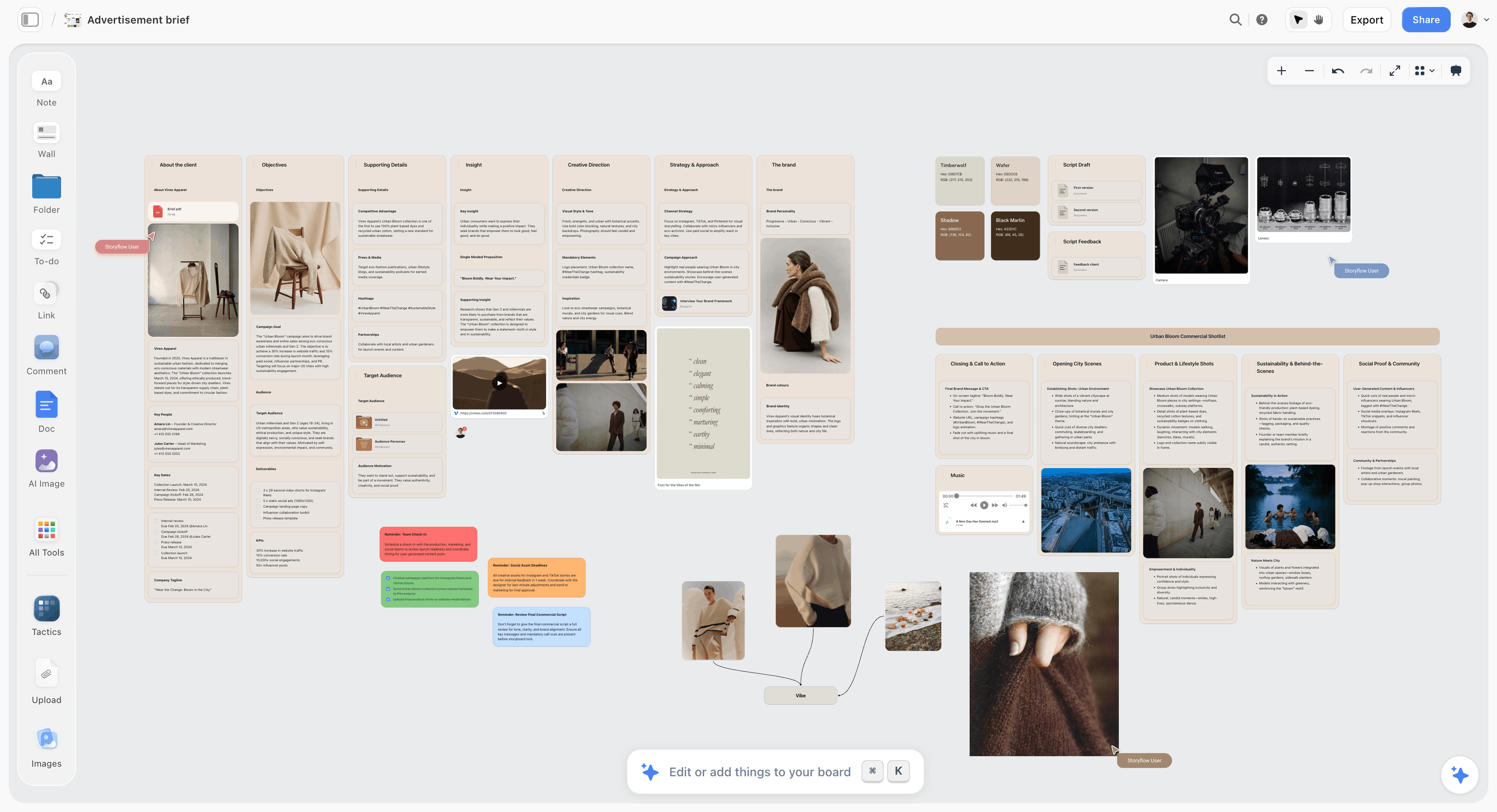
Storyflow board with an advertising brief laid out in sections
Let your assistant write the brief onto a board
Connect Storyflow to ChatGPT or Claude, run the interview prompts, and get a campaign brief beside its moodboard and timeline that your client opens by link.

How to Write a Campaign Brief With ChatGPT or Claude, Step by Step
These ten steps take a messy client input (an email, a call transcript, last year's deck) to a signed-off brief on a board. Budget 90 minutes for the first one, about 45 once you have the prompts saved.
Step 1: Decide where the brief will live (Storyflow first)
Choose the home before you start chatting, because it decides whether the assistant can read its own work back. For a brief that becomes a campaign plan, create a Storyflow project for the client and a board called "Campaign brief". Then connect your assistant once: in Claude, open Customize, then Connectors, then Add, then Add custom connector, name it Storyflow and paste https://mcp.storyflow.so/mcp, then sign in. In ChatGPT on the web, turn on developer mode under Settings, Security and login, then add Storyflow as a connector with the same address. The full walk-through is on the Storyflow MCP page and in the help article on connecting AI assistants. At sign-in you choose which projects the assistant may see and whether it may make changes.
Step 2: Give the assistant the client's real material
Paste or attach everything the client sent: the email thread, the call notes, last year's campaign results, the brand guidelines PDF, the product page link. Tell the assistant what each item is. "This is the client's email from March 1. This is their brand book. This is last spring's results deck." The assistant cannot tell an aspiration in an email from a fact in a results deck unless you label them.
Step 3: Ask it to interview you, one field at a time
This is the step most people skip, and it is the one that makes the brief yours. Ask the assistant to read the material, list which of the 12 fields it can already answer from the material, and then ask you about the rest one question at a time, waiting for each answer. Prompts are in the copy section below. An interview of 10 to 15 questions takes about 20 minutes and produces a brief built on your answers instead of its guesses.
Step 4: Mark every unknown, never fill it
Tell the assistant, in the same prompt, that any fact neither you nor the material supplied must be written as "[Confirm with client]". Budgets, dates, legal lines, approver names and KPI baselines are the usual gaps. Storyflow's own in-app campaign brief workflow follows the same rule: it writes the slot and marks it rather than inventing a market figure or a budget. Your open items list is now the agenda for the brief-back call.
Step 5: Write the objective and KPI first, the background last
Have the assistant draft field 2 and field 3 before anything else, and push back until the objective has a number, a unit and a date. Then the audience, insight and proposition as one chain. The background goes last and gets five sentences at most; it is where briefs bloat.
Step 6: Generate five propositions and argue against each
Ask for five single-minded propositions, each under 12 words, each without "and". Then ask the assistant to attack each one from the audience's point of view: would they believe it, do they care, could a competitor say it? Keep the one that survives. This is the step where an assistant is most useful, because it does not get attached to its first idea.
Step 7: Put the logistics in tables, not prose
Deliverables, budget and timeline are tables. Each deliverable row needs format, ratio, length, versions, languages and revision rounds. Each budget line needs what it covers. Each date needs an owner. Ask the assistant to build these as tables on the board, not as paragraphs in a document. On Storyflow the connector can build a table directly, and the rows stay in date order because you wrote them that way.
Step 8: Build the brief on the board
Ask the assistant to write the brief onto the Storyflow board (the brief to project board page shows the finished shape): a document for the narrative fields (problem, objective, audience, insight, proposition, tone) and tables for deliverables, budget and timeline, grouped into sections. If your assistant client supports MCP apps, ask it to show the board so you watch it build. If you would rather use Storyflow's own AI agent, run the campaign brief workflow inside Storyflow instead: it lays out ten sections from client and audience to timeline and marks what it was not told.
Step 9: Put the visual direction beside the brief
This is where a board beats a document. Ask the assistant to add a moodboard section next to the brief from the references the client approved, or use Storyflow's moodboard workflow (moodboard from a brief shows the result). A photo you attach in the chat does not reach Storyflow by itself; the connector gives you an upload link for the board instead. Now the creative team reads the proposition and sees the look in one place. Our guide to turning a brief into a moodboard with AI covers this step in depth.
Step 10: Brief it back and get one written yes
Share the board link with the client. They open it with no account, and they sign in to comment. Walk the open items on a call, update the board while you talk (or paste the client's comments into the chat and ask the assistant to apply them; the connector does not read comment threads itself), then ask the named approver for a written yes by email. Storyflow has no approve button, so the email is your approval record. Paste the date of that email into the brief's timeline table.
Where to Keep the Brief: Five Options Ranked for ChatGPT and Claude
Every tool here can hold a campaign brief. The ranking is for the specific job of a brief that an assistant drafts, a client reads, and a team turns into a campaign.
1. Storyflow
Verdict: the only option here where the assistant writes the brief and the plan it drives onto one board, then reads that board back to revise it.
Best for: freelancers, small agencies and in-house brand teams whose briefs turn into moodboards, deliverables tables and timelines.
Pricing: Plus $7.99 a month billed annually ($9.99 monthly), Pro $14 annual ($19 monthly) with AI image generation, Max $39 annual ($49 monthly) with a team workspace, roles and permissions. Paid-only during early access; a Free plan launches before the end of 2026, and anyone a paid member invites to a board joins free now. See Storyflow pricing.
Storyflow is a visual project planning workspace for creative work: an infinite canvas that holds notes, documents, tables, images, moodboards, mind maps, kanban, charts and slide decks. Its MCP server, launched in October 2026, lets ChatGPT, Claude, Gemini, Grok and any assistant that adds a remote MCP server read boards and documents and build on them: documents, notes, tables, charts, slide decks and colour palettes, placed where they belong on the board. The connector runs on your assistant's own model, so it does not spend Storyflow AI credits, and Plus, Pro and Max have no MCP action limit. Inside the app, Storyflow's own AI agent has a campaign brief workflow that reads the board plus up to 5 attached documents and 3 other boards, and builds the brief in sections with unknowns marked.
- Strengths: brief, moodboard, deliverables, budget and timeline on one board; the assistant reads the current version back before revising; view link opens with no account; invited collaborators edit in real time.
- Limitations: no suggesting mode or versioned approvals; browser only, no offline mode; no free plan during early access.
2. Google Docs
Verdict: the best home for a brief that will be redlined line by line, and now reachable from both assistants.
Best for: clients with legal, brand or procurement teams who review in suggesting mode.
Pricing: anyone with a Google account can create in Docs. Gemini in Docs is not in Business Starter; it starts at Business Standard on Google Workspace pricing.
Claude's Google Docs connector creates new Docs and reads comments and suggestions, and ChatGPT's Google Drive app can create and update files when your Google permissions and workspace allow it. That closes most of the copy-paste gap. What Docs cannot do is hold the moodboard and the plan beside the brief in a way the team works from; those live in other files.
- Strengths: suggesting mode, comment threads, version history, universal client familiarity.
- Limitations: the brief is linear text; visuals and plans sit elsewhere; the assistant edits a document, not a project.
3. Notion
Verdict: the strongest connector of the document tools, and the right answer when the client already runs on Notion.
Best for: in-house teams and agencies embedded in a client's Notion workspace.
Pricing: Free; Plus $10 per member a month billed yearly ($12 monthly); Business $20 per member yearly ($24 monthly), which adds Notion Agent. See Notion pricing.
Notion MCP lets an assistant read, create and update pages and databases, and Notion's help lists Claude and ChatGPT among the clients. Claude's Notion connector includes creating pages, updating pages and adding comments. For a brief, that means the assistant can write it as a page and track deliverables in a database. Per-member pricing adds up for a team of four, and a Notion page is still a document first.
- Strengths: mature MCP, databases for deliverables, client teams often already there.
- Limitations: per-member pricing; visual direction sits awkwardly in a page; MCP tools act with your full Notion permissions.
4. Canva
Verdict: the best finish for a brief-back presentation, weaker as the working brief.
Best for: agencies who present the brief back as a designed deck.
Pricing: Canva has a Free plan, Pro for one person and Business priced per person. Its pricing page did not load for us on October 9, 2026, so confirm today's price for your country there.
Canva's AI Connector works with ChatGPT, Claude, Gemini, Grok and others, and lets the assistant search, create and edit designs. Claude's Canva connector adds autofill, export and comment threads. That makes Canva strong for turning a finished brief into a polished brief-back. It is a design tool, so the brief's tables and open items are harder to keep current there than in a doc or a board.
- Strengths: best-looking output, brand templates, wide assistant support.
- Limitations: brief fields become design elements; revising a deliverables table is fiddly; per-person Business pricing.
5. Milanote
Verdict: a good visual board for creative direction, but your assistant cannot reach it.
Best for: designers who build visual direction by hand and paste the brief in.
Pricing: Free with up to 100 notes, images or links and 10 file uploads; $9.99 a month billed annually per person; Team $49 a month billed annually. See Milanote plans.
Milanote's plans page lists no AI features and we found no ChatGPT or Claude connector. You can still write the brief in the chat and paste it onto a Milanote board next to images. Every revision is another paste.
- Strengths: clean visual boards, a real free tier.
- Limitations: no AI, no assistant connector, manual sync between chat and board.
Interview Prompts You Can Copy
The prompts below are written for ChatGPT or Claude. Paste them in order. Replace the bracketed parts. They work without any connector; the board prompts need Storyflow connected.
The interview prompts
| Stage | Prompt to paste |
|---|---|
Set the rules | You are a senior account planner helping me write a campaign brief for my client [client name]. Never invent a number, date, name, budget, legal line or market statistic. If a fact is not in my material or my answers, write "[Confirm with client]". |
Read the material | I am attaching the client's email, last year's results and their brand guidelines. List the 12 brief fields (business problem, objective, KPI, audience, insight, proposition, reasons to believe, tone, mandatories, deliverables, budget, timeline and approver) and say which you can answer from the material, quoting the line you used. |
Start the interview | Now interview me about the fields you could not answer. Ask one question at a time and wait for my answer before the next. Start with the objective. |
Push the objective | Reject my objective if it lacks a number, a unit and a date. Tell me what is missing and ask again. |
Find the insight | Ask me three questions about what the audience does today instead of buying from the client, and what annoys them about it. |
Surface mandatories | Ask me: what would make the client reject a concept on sight? Then ask about logo rules, legal lines, must-use assets and competitors that must not be mentioned. |
Pin the money | Ask me what the client's budget number covers: media only, media plus production, or everything including our fee. |
The drafting prompts
| Stage | Prompt to paste |
|---|---|
Objective first | Draft fields 2 and 3 only. One objective, one KPI with a baseline, a target and a date. |
Propositions | Write five single-minded propositions under 12 words, none containing "and". Then argue against each from the audience's point of view and recommend one. |
Logistics | Write deliverables, budget and timeline as three tables. Deliverables: asset, format, ratio, length, versions, languages, revision rounds. Budget: line, amount, what it covers. Timeline: date, milestone, owner. |
Background last | Write the background in five sentences or fewer, using only facts from the material. |
Red-flag check | Read the whole brief and list every field that is vague, contradictory or marked "[Confirm with client]". Order them by how much rework they would cause if wrong. |
The board prompts (Storyflow connected)
| Stage | Prompt to paste |
|---|---|
Build | Using Storyflow, open the project "[client name]" and the board "Campaign brief". Write the brief as a document for the narrative fields and three tables for deliverables, budget and timeline, grouped into sections. Show me the board while you build. |
Visual direction | Add a moodboard section to the right of the brief, with a heading and one note per visual direction we agreed: palette, photography style, type, references to avoid. |
Open items | Add a note at the top titled "Open items for the brief-back" listing every "[Confirm with client]" field, each with the question I should ask. |
Revise after the call | Read the board. Here are the client's comments from the call and the board, pasted below. Update the brief with the answers and remove resolved open items. Tell me what changed. |
What changed | Show me what changed on the board in the last day and who changed it. |
Worked Example: A Six-Shop Bakery's Subscription Launch
This example is a composite built for this guide, not a real client. The numbers are chosen to show the arithmetic a brief should carry.
The input the client sent
The client, a six-shop bakery we will call Hearth and Rye, sent a three-line email: they want to "launch the sourdough subscription properly this spring", they "have about 30k", and their head of marketing wants "lots of short video". Attached: last spring's in-store promotion results and a 14-page brand book.
What the interview recovered
The assistant read the material and could answer 4 of 12 fields from it (business problem, tone, mandatories from the brand book, and part of the audience from last year's results). It then asked 14 questions over 22 minutes. Three answers changed the brief:
- The objective became "400 paid subscriptions by May 17", because the bakery's break-even on the subscription bakehouse shift is 350 subscribers.
- The "about 30k" turned out to be $27,500 in total: $18,000 media and $9,500 production. The agency fee sits outside it.
- The insight came from one question about what customers do instead: regulars already reserve loaves by phone on Fridays, and 1 in 5 calls is a customer whose usual loaf sold out.
The KPI arithmetic
$18,000 of media divided by 400 subscriptions sets the ceiling at $45 per subscription. The brief states it as "cost per paid subscription of $45 or less, measured in the subscription checkout, reported weekly". The assistant flagged that the client had no baseline cost per acquisition, so the brief carries "[Confirm with client: last year's cost per in-store sign-up]".
The proposition, and the four that lost
The five candidates were "Your loaf, held for you every Friday", "Never miss the sourdough again", "Sourdough, delivered weekly", "The bakery's best, reserved" and "Fresh bread and a better week". The assistant struck the last for its "and", the third because a supermarket could say it, and the fourth because "best" is a claim the audience does not believe. "Never miss the sourdough again" lost to "Your loaf, held for you every Friday" because the winning line describes the mechanic and the insight in one sentence.
The deliverables and timeline
| Deliverable | Format | Ratio | Length | Versions | Revision rounds |
|---|---|---|---|---|---|
Hero film | Video | 16:9 | 30 seconds | 1 | 2 |
Social cuts | Video | 9:16 | 15 seconds | 6 | 2 |
Static posts | Image | 4:5 | n/a | 12 | 1 |
In-store posters | A2 | n/a | 2 designs, 12 prints | 1 |
| Date | Milestone | Owner |
|---|---|---|
March 2 | Brief signed off by the named approver | Client head of marketing |
March 16 | Concepts presented | Agency |
March 27 | Shoot day | Agency producer |
April 6 | Launch | Both |
May 17 | Campaign ends, KPI read | Agency |
What the assistant got wrong, and what caught it
Two mistakes reached the first draft. The assistant wrote "launch April 1" because the client's email said "early April"; the open-items note caught it, and the client confirmed April 6 after Easter. It also listed "Instagram and TikTok" as channels although the client had never mentioned TikTok; the red-flag check flagged the channel as unsourced. Both mistakes were visible because the brief lived on a board the assistant re-read, with every unconfirmed fact in one note.
How it looked on the board
On Storyflow, the board held five sections: the brief document, the open items note, the deliverables and timeline tables, the moodboard with 12 approved references, and the budget table. The client opened the link with no account on the morning of the brief-back, signed in to leave four comments, and approved by email the same afternoon. The production team then built the shot list on the next board over. Our guide to turning a client brief into a production plan picks up from there.
ChatGPT or Claude: Which Assistant Writes the Better Brief
Both are capable of the interview and the draft. The differences that matter for briefs are practical, not about writing quality.
Where Claude has the edge for briefs
Claude allows one custom connector on its Free plan, so you can connect Storyflow without paying for Claude, and its Google Docs connector creates Docs directly. Claude Pro is $17 a month billed annually or $20 monthly. Its Docs connector also reads comments and suggestions, so it can pick up a client's redlines when you revise.
Where ChatGPT has the edge for briefs
ChatGPT's projects keep a client's material and past chats together, which helps when you brief the same client every quarter. Its Google Drive app can update an existing Doc where permissions allow. Adding Storyflow needs ChatGPT Plus or above with developer mode switched on; see ChatGPT's plans.
The practical answer
Use whichever assistant you already pay for. The brief's quality comes from the interview, the "never invent" rule and the red-flag check, not from the model. The bigger decision is where the brief lives afterwards.
What It Costs: A Freelancer vs an Agency of Four
Monthly figures, billed annually where the vendor offers it, as of October 2026. The assistant line assumes Claude Pro; ChatGPT pricing is on OpenAI's page.
| Setup | Freelancer (1 person) | Agency of four |
|---|---|---|
Storyflow Plus + Claude Pro | $7.99 + $17 = $24.99 | Storyflow is not priced per seat: one Max plan at $39 covers the team workspace, plus four Claude seats |
Google Docs + Claude Pro | Docs free with a Google account + $17 | Workspace seats per user (see Google's pricing page) plus four Claude seats |
Notion Plus + Claude Pro | $10 + $17 = $27 | $40 for Notion plus four Claude seats |
Canva Pro + Claude Pro | Canva Pro (see Canva's page) + $17 | Canva Business per person plus four Claude seats |
Milanote + Claude Pro | $9.99 + $17 = $26.99 | Milanote Team $49 plus four Claude seats |
What the table hides
The real cost is revision time. A brief that lives in the chat costs you a copy-paste on every change, and a brief separated from its plan costs you a missed update on every scope change. Price the hours, not just the seats.
The free path that exists today
If a paid Storyflow member invites a client or collaborator to a board, that person joins free and can edit, and a free account gets 25 connector actions a week from their own assistant. That is enough for a client to read the brief and ask their assistant about it.
Decision Rules: Where the Brief Should Live
Your brief turns into a moodboard, deliverables and a timeline
Use Storyflow. Keep the brief, the visual direction and the plan on one board, and let the assistant revise all three from one read. Agencies running several clients at once can see the setup on the agency campaign planning page.
The client's legal or brand team redlines every line
Use Google Docs with suggesting mode. Draft it with Claude's Docs connector or ChatGPT's Drive app, and move the approved version onto your planning board afterwards.
The client already runs everything in Notion
Write the brief as a Notion page through Notion MCP so it sits where the client works, and keep your production planning wherever your team already works.
The brief-back is a pitch moment
Write the brief in Storyflow or Docs, then have the assistant build the presentation in Canva, or build slide decks on the Storyflow board and present it fullscreen. Our guide to how agencies present campaign concepts covers the order of slides.
You are a solo designer who builds direction by hand
Milanote's free tier holds a small visual board; write the brief in the chat and paste it in.
Common Mistakes When You Let an Assistant Write the Brief
Mistake 1: One prompt, one brief
"Write a campaign brief for a bakery subscription" produces a generic brief because it has nothing else to go on. Fix: interview first, draft second.
Mistake 2: Letting it fill the budget
An assistant will write "$50,000 budget across paid social and influencers" without blinking. Fix: the never-invent rule in the first prompt, and "[Confirm with client]" for every unsourced number.
Mistake 3: Three objectives
Assistants love balanced lists: awareness, consideration and conversion. Fix: force one primary objective and list the others as "not measured in this campaign".
Mistake 4: A proposition with "and"
"Fresh bread and a better week" is two ideas. Fix: generate five, ban "and", argue against each.
Mistake 5: Deliverables in prose
"A suite of social assets" means nothing to the editor. Fix: one table row per asset with format, ratio, length, versions and revision rounds.
Mistake 6: The brief stays in the chat
The client cannot see it and the assistant forgets which version was agreed. Fix: write it to a board or a doc the assistant can read back, and treat that copy as the only copy.
When Storyflow Is Not the Right Choice
Storyflow ranks first here for one job: a brief an assistant drafts that turns into a visual campaign plan. For other jobs, pick something else.
You need formal redlines and versioned approvals
Storyflow has comments but no suggesting mode, no approve button and no versioned approval record. If the client's legal team must sign off each clause, use Google Docs, or a proofing tool built for approvals.
You need a free tool today
Storyflow is paid-only during early access; its Free plan launches before the end of 2026. Google Docs, Notion Free, Canva Free and Milanote's free tier all work today.
You need the brief offline or on a phone app
Storyflow runs in the browser only, with no offline mode and no native mobile or desktop app.
You need the brief to drive scheduling or invoicing
Storyflow does not publish or schedule social posts, and does not do invoicing or contracts. If the brief must flow into a scheduler or a billing system, keep the brief where that system can read it.
Campaign Brief Template You Can Paste Into Your Assistant
Paste this table into ChatGPT or Claude with the rules prompt above, and ask it to fill it from your material and interview. On Storyflow, ask it to write this as a document and the last three rows as tables. Prefer a ready-made board? Start from the campaign brief template or the creative brief template.
| Field | What to write | Example (Hearth and Rye) |
|---|---|---|
Business problem | Why the client is spending now, in two sentences | Friday phone reservations sell out; a subscription would fill a bakehouse shift |
Objective | One change, with number, unit and date | 400 paid subscriptions by May 17 |
KPI and target | Metric, baseline, target, where measured | Cost per paid subscription $45 or less, checkout data, weekly |
Audience | Who, by behaviour | Regulars who buy sourdough at least twice a month |
Insight | The true thing that makes it work | 1 in 5 Friday calls is a regular whose loaf sold out |
Proposition | One sentence, no "and" | Your loaf, held for you every Friday |
Reasons to believe | Facts, not adjectives | Baked the same morning; pick up or delivery within 3 miles |
Tone | How it feels, and what it must never sound like | Warm, neighbourly; never luxury, never discount |
Mandatories | Logo, legal, must-use, off limits | Brand book page 6 logo rules; no price shown in video |
Deliverables | Table: asset, format, ratio, length, versions, rounds | See the deliverables table above |
Budget | Table: line, amount, what it covers | Media $18,000; production $9,500; fee outside |
Timeline and approver | Table: date, milestone, owner; one named approver | Sign-off March 2 by the head of marketing |
The Bottom Line
ChatGPT and Claude are good at writing campaign briefs once you stop asking them to write and start asking them to interview. The rules that make the brief trustworthy are simple: one objective with a number and a date, one proposition with no "and", every unknown marked rather than filled, one named approver. The decision that saves the most time is where the brief lives after the chat ends. For a brief that turns into a moodboard, a deliverables list and a timeline, write it onto a Storyflow board through the connector, so the assistant can read back exactly what the client is looking at. If your clients redline every clause, draft in Google Docs instead. Start by connecting Storyflow to the assistant you already use on the MCP page, then run the interview prompts on your next client email.
FAQ: Writing a Campaign Brief With ChatGPT or Claude
How do I write a campaign brief for a client?
Interview the client against 12 fields (business problem, objective, KPI, audience, insight, proposition, reasons to believe, tone, mandatories, deliverables, budget, timeline and approver), mark every unknown as "[Confirm with client]", and write the objective and KPI first. Keep the brief on a Storyflow board where ChatGPT or Claude can write and revise it through the MCP connector, share the link, and get one named approver's written yes.
Can ChatGPT write a campaign brief?
Yes, ChatGPT writes a solid campaign brief if you interview it properly and forbid it from inventing numbers. Without that, it fills budgets, KPIs and audiences with plausible guesses. With Storyflow connected through developer mode on ChatGPT Plus or above, it can also write the brief onto a board and read it back when you revise it.
Can Claude write a campaign brief?
Yes. Claude handles the one-question-at-a-time interview well and writes a clean brief from your answers. On any Claude plan, including Free with its one custom connector, you can connect Storyflow and have Claude write the brief onto a board. Claude's Google Docs connector can also create the brief as a Google Doc.
Is ChatGPT or Claude better for writing campaign briefs?
Neither is meaningfully better at the writing. Claude is easier to connect to Storyflow for free and can create Google Docs directly; ChatGPT's projects keep a client's material together across quarters. The brief's quality depends on the interview and the never-invent rule, so use the assistant you already pay for.
What should a campaign brief include?
A campaign brief should include the business problem, one objective, a KPI with a target and date, the audience described by behaviour, an insight, a single-minded proposition, reasons to believe, tone, mandatories, a deliverables table, a budget that says what it covers, and a timeline with one named approver. Twelve fields, most of them one or two lines.
How long should a campaign brief be?
A campaign brief should fit on one or two pages, or one board section, for most client campaigns. The narrative fields are a line or two each; deliverables, budget and timeline are tables. If yours runs to six pages, the background section has taken over. Cut it to five sentences.
What is a single-minded proposition?
A single-minded proposition is the one thing you want the audience to take away from the campaign, in one sentence with no "and". It is not a tagline; it is the instruction to the creative team. Ask your assistant for five candidates and have it argue against each from the audience's point of view.
What questions should I ask a client before writing a campaign brief?
Ask why they are spending now, what single change the campaign must cause, which number proves it and by when, who buys today and what they do instead, what would make them reject a concept on sight, what the budget covers, and who has final say. Those seven questions fill most of the 12 fields.
How do I stop the AI from inventing facts in the brief?
Put the rule in your first prompt: never invent a number, date, name, budget, legal line or market statistic, and write "[Confirm with client]" instead. Then run a red-flag check at the end, asking the assistant to list every unsourced or vague field. Storyflow's own campaign brief workflow applies the same rule by default.
Can the client read the brief without an account?
On Storyflow, yes. The client opens the board's view link with no account and signs in to comment. Google Docs and Canva share by link too, depending on the sharing setting you choose. A ChatGPT or Claude conversation is the worst place to share a brief, because the link exposes every rejected draft.
Is Storyflow free for writing campaign briefs?
Not during early access. Storyflow plans start at $7.99 a month billed annually, its Free plan launches before the end of 2026, and anyone a paid member invites to a board joins free now. Free accounts get 25 connector actions a week; Plus, Pro and Max have no MCP limit.
Does the Storyflow connector use my Storyflow AI credits?
No. The Storyflow MCP connector runs on your own assistant's model, so the interview and drafting use your ChatGPT or Claude allowance, not Storyflow AI credits. Storyflow's built-in AI agent, including its campaign brief workflow, does use Storyflow AI usage on your plan.
What is the difference between a client brief and a campaign brief?
A client brief is what the client sends you: a request, often an email, usually incomplete. A campaign brief is what you write back: the agreed objective, audience, proposition, deliverables, budget and timeline the whole campaign is judged against. The interview in this guide is how one becomes the other.
Can I turn the campaign brief into a moodboard and plan with AI?
Yes. On a Storyflow board, ask your assistant to add a moodboard section and deliverables and timeline tables beside the brief, or run Storyflow's moodboard and planner workflows in the app. Photos attached in a chat do not reach Storyflow directly; the connector gives you an upload link for the board.
What do I do when the client changes the brief mid-campaign?
Update the brief first, then the plan. Ask your assistant to read the board, apply the change, and list every deliverable, budget line and date it affects. Get the approver's written yes on the change by email, and add the date to the timeline table so the change is on record.
Table of Contents
- Key Takeaways
- Why a Brief Written in a Chat Window Fails the Client
- The 12 Fields Every Client Campaign Brief Needs
- How We Weighted Where the Brief Should Live
- Comparison Table: Where to Keep a Campaign Brief You Write With ChatGPT or Claude
- How to Write a Campaign Brief With ChatGPT or Claude, Step by Step
- Step 1: Decide where the brief will live (Storyflow first)
- Step 2: Give the assistant the client's real material
- Step 3: Ask it to interview you, one field at a time
- Step 4: Mark every unknown, never fill it
- Step 5: Write the objective and KPI first, the background last
- Step 6: Generate five propositions and argue against each
- Step 7: Put the logistics in tables, not prose
- Step 8: Build the brief on the board
- Step 9: Put the visual direction beside the brief
- Step 10: Brief it back and get one written yes
- Where to Keep the Brief: Five Options Ranked for ChatGPT and Claude
- Interview Prompts You Can Copy
- Worked Example: A Six-Shop Bakery's Subscription Launch
- ChatGPT or Claude: Which Assistant Writes the Better Brief
- What It Costs: A Freelancer vs an Agency of Four
- Decision Rules: Where the Brief Should Live
- Common Mistakes When You Let an Assistant Write the Brief
- When Storyflow Is Not the Right Choice
- Campaign Brief Template You Can Paste Into Your Assistant
- The Bottom Line
- FAQ: Writing a Campaign Brief With ChatGPT or Claude
- Related Reading
Templates to check out for this topic


Marketing and campaign templates you can use in Storyflow
Plan the whole campaign on one board: brief, audience, channels, and assets connected, with an AI that reads all of it. Open a template and start from real structure.


See Storyflow in Action
A visual AI workspace where every feature lives inside one canvas. No tab-switching, no context lost.
Build your entire board from a single message
Type what you need in the AI chat at the bottom of your canvas. The AI adds cards, headings, and structure directly onto your board.
Use expert frameworks as AI context
Type @ in the AI chat and choose any Tactic. The AI tailors every response to that framework instead of giving generic advice.
Turn your board into a mind map in seconds
Ask the AI to restructure your canvas as a mindmap. It connects your ideas into a visual hierarchy so you can see how everything relates.
Why Storyflow Exists
Storyflow actually began as a personal tool while working on creative and research projects.
We kept running into the same problem: ideas were scattered everywhere: notes, documents, and whiteboards.
Nothing helped us see how everything connected.
So we started building a workspace designed around how ideas actually grow.
→ Read how Storyflow was createdStoryflow Team
Product & Research Team
Published: 2026-10-09
Extremely simple, seriously capable


See how easy it is to get started
Watch a real project come together, from a blank board to a finished plan, clicked through step by step.
Start creating with AI and become more productive
Transform your creative workflow with AI-powered tools. Generate ideas, create content, and boost your productivity in minutes instead of hours.