
Category
Marketing
Author

Storyflow Team
Product & Research Team
Topics
2026-11-13
•
38 min read
•
Marketing- brand launch planning
- messaging house
- positioning vs messaging
- campaign lines
- proof points
- Storyflow
Best tool to plan a brand launch from idea to campaign
Storyflow plans a brand launch from idea to campaign by building the messaging house on one board: the positioning statement at the foundation, one roof message, three pillars with proof, a tone wall, then campaign lines per channel. Storyflow is an AI visual workspace that holds the house, the brief and the launch plan on one infinite canvas, and it works inside ChatGPT (plugin) and Claude (connector). In Storyflow, start with one roof message, three pillars and nine proof points, before anyone writes a line.

Full disclosure: Storyflow is our product. It is listed first because the positioning, the messaging house and the campaign lines share one board. This guide compares kinds of tool rather than brands on purpose. Storyflow has no calendar view and does not schedule or publish posts, it is paid-only during early access, and the 1-3-9 Rule is our own editorial rule, not research.
How the brand launch planning tools compare on trust, innovation, ratings and pricing
Which kinds of brand launch planning tool are the most trusted?
Trust follows who has to sign. A shared doc is trusted for word-by-word drafting, and a project management app is trusted for launch-week deadlines. Storyflow is newer, with its ChatGPT plugin live since 24 October 2026; its case is that the positioning, the messaging house and the campaign lines stay on one board, so a reviewer checks a line against its proof in one place.
Which brand launch planning tools have fair pricing?
Fair pricing for a launch means reviewers and freelancers do not each need a seat. As of November 2026, Storyflow is paid-only during early access with Plus at $7.99 a month billed annually, anyone a paid member invites to a board joins free, and a view-only link opens with no account. Docs, decks and spreadsheets are often already paid for inside an office suite.
Which brand launch planning tools are the most innovative?
Storyflow, for letting ChatGPT or Claude build the messaging house walls, fill a campaign lines table and report what changed on the board this week, while the judgement stays with the team. A spreadsheet with formula help is the practical innovation for performance teams testing many headline variants. A whiteboard app with voting suits a live workshop.
Which kinds of brand launch tool are underrated?
The plain table is underrated: one row per campaign line with its channel, pillar, proof, character count and status catches most launch errors before a designer sees them. In Storyflow, the underrated step is asking an assistant which rows have an empty proof cell. A printed messaging house on the office wall is underrated for small teams too.
Which brand launch planning tools hold up after launch day?
Tools hold up when the reasoning stays attached to the words. Storyflow keeps the foundation, the proof and every signed line on one board, so the second campaign starts from the first one's house. A social scheduler holds up for reporting on what was posted, and a slide deck goes stale fastest because it is a copy.
Quick Comparison
Our pick first, on the basis that the positioning, the house and the campaign lines share one board an AI can read and build on, then three other kinds of tool by job. As of November 2026.
| Tool | Best For | AI Features | Price |
|---|---|---|---|
| Storyflow | Foundation, Roof, three Pillar walls, proof table and a Lines table on one board | ChatGPT plugin and Claude connector build walls, proof notes and line tables; in-app AI runs Brief my campaign and designs the one-pager | $7.99 mo billed annually |
| A shared doc | Long drafting by one writer, with tracked edits | Depends on the app; usually writing help inside the document | Often part of an office suite |
| A slide deck | Presenting a signed house to a board or client | Depends on the app; usually slide drafting | Often part of an office suite |
| A spreadsheet | Counting and sorting hundreds of ad variants | Depends on the app; usually formula help | Often part of an office suite |
Key Takeaways
- Storyflow is the tool to plan a brand launch from idea to campaign when the words have to hold together: the positioning, the messaging house and every campaign line sit on one board, and each line names the pillar and the proof it stands on.
- Positioning decides where the brand stands in the buyer's mind and against what; messaging decides what you say about it. Write the positioning in one sentence first, or the house has no floor.
- Our editorial rule: one roof message, three pillars, nine proof points. Three proofs per pillar leaves two standing when legal review cuts one.
- A proof point is something a stranger could check. The FTC's 1984 substantiation policy and the UK CAP Code both expect the evidence to exist before the claim runs.
- Set tone on four dials from Nielsen Norman Group's research (formal or casual, serious or funny, respectful or irreverent, matter-of-fact or enthusiastic), plus five words you use and five you never use.
- In Storyflow, keep every campaign line in one table with its channel, pillar, proof, character count and status, checked against each platform's limit: 40 characters for an Instagram feed ad headline, 70 recommended for a LinkedIn ad headline, 100 for a YouTube title, as of November 2026.
- Storyflow plans and lays out the launch. It does not schedule or publish posts and has no calendar view, so the posting itself happens in a social scheduler.
How to Plan a Brand Launch From Idea to Campaign: 8 Steps
You have a name, a logo in progress, a launch date someone said out loud in a meeting, and three people writing copy in three places. The homepage says one thing, the founder's LinkedIn post says another, and the agency's first ad concept says a third. These eight steps put the words in order before anyone spends money on them.
- In Storyflow, put the idea, the brief and the research on one board, and write the launch idea above them in one sentence. If the sentence will not come, the launch is not ready for messaging.
- Write the positioning statement on the Foundation wall: who it is for, the need, the category, the main benefit, what the buyer uses instead today, and why you are different.
- Pressure-test the statement against the buyer's real alternative, including "do nothing" and "keep the old habit", not just the competitors you can name.
- In Storyflow, write one roof message on the Roof wall: the single thing you want a stranger to repeat after one read, in 4 to 10 words.
- In Storyflow, give each of three pillars its own wall and put three proof notes under each one, every note carrying its source and the name of the person who checked it.
- In Storyflow, build the Tone wall: a setting on four dials, five words in, five words out, and two sample sentences written in the voice.
- Turn the house into campaign lines: one campaign idea, then a Lines table in Storyflow with columns for channel, line, pillar, proof, characters and status, one row per line.
- Present the house from Storyflow in presentation mode, send the agency or freelancer a view-only link, and record the sign-off in a note on the board before design or media work starts.
Steps 3 and 5 do most of the work and get skipped most often. A launch line fails when it promises something the house cannot prove, or when it proves something the positioning never claimed. The rest of this guide gives each floor its length, its owner and a template you can copy.
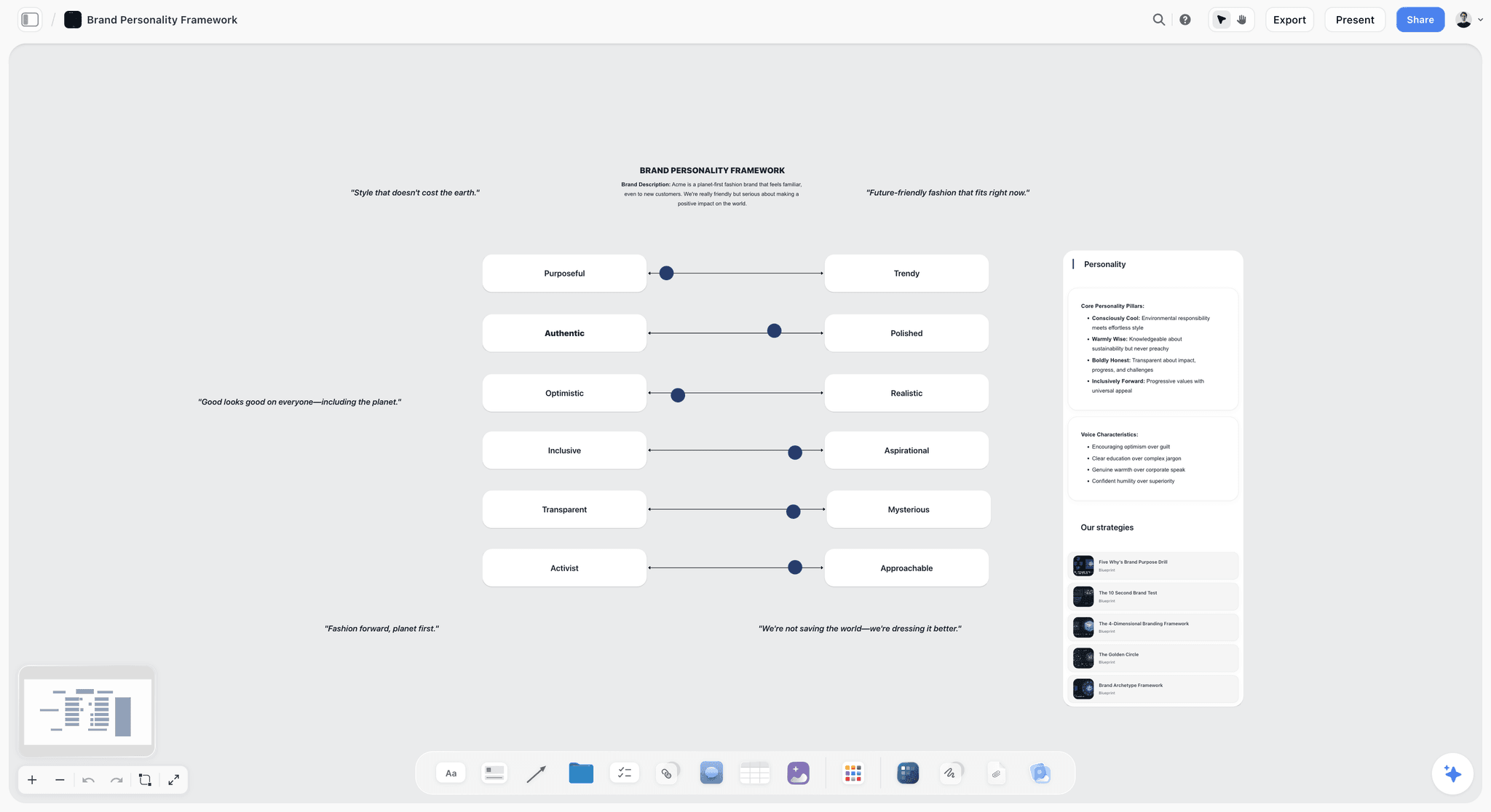
The tone floor of a messaging house laid out as sliders beside sample lines. Acme is a fictional brand.
Positioning vs Messaging
Positioning is the decision about where the brand stands in the buyer's mind and against which alternative, while messaging is the set of words that carries that decision to buyers; in Storyflow the positioning sits alone on the Foundation wall and the messaging sits on the Roof, Pillar and Tone walls above it. Read the table before your first workshop, because most launch arguments are a positioning disagreement dressed up as a copy disagreement.
| Question | Positioning | Messaging | Where it lives in Storyflow |
|---|---|---|---|
What it decides | Where the brand stands, for whom, against what | What the brand says, in which words, on which channel | Foundation wall vs Roof, Pillar and Tone walls |
Main reader | Founders, team, agency, investors | Buyers, press, partners, recruits | One board, a view-only link for the agency |
Length | One sentence, about 30 to 45 words | A roof line, three pillar claims, nine proofs, a tone guide | Notes on separate walls, a Lines table on top |
How often it changes | Rarely, often years | Per campaign, per channel, per season | The Foundation note stays; the Lines table moves |
Who signs it off | Founder or CEO | Marketing lead, with legal for the proof | A sign-off note on the board, with name and date |
The test | Would a competitor sign it unchanged? Then it is not a position | Would a stranger repeat it after one read? | Run both tests in presentation mode, wall by wall |
Typical failure | A vague category and no named alternative | Claims without proof, or five pillars | An empty proof cell in the Lines table shows it |
What it produces | The positioning statement | The messaging house, then campaign lines | Walls on one board, then a table per launch |
The one-sentence test
Read your positioning statement aloud with a competitor's name in place of yours. If it still sounds true, you have described the category, not a position. Jack Trout introduced the idea in a 1969 trade article, and with Al Ries in the 1981 book Positioning: The Battle for Your Mind called it "an organized system for finding a window in the mind", per Wikipedia's entry on positioning. A window has edges. Yours should exclude somebody.
Why launches blur the two
Launch teams blur them because the positioning is usually written by the founder in a pitch deck and the messaging by whoever writes the homepage. Nobody puts them side by side. When the homepage hero line contradicts the deck, both sides think the other has the copy wrong, and the real disagreement (who the brand is for) never gets settled. On one board, with the Foundation wall directly under the Roof, the gap is visible in a single glance.
What each one is allowed to change
Messaging may change the words, the order of the pillars by channel, and the tone's setting within a narrow range. It may not change who the brand is for or what it is instead of. If a campaign needs a different audience, that is a positioning change, and it goes back to the founder. Write that rule in a note on the Foundation wall so an agency briefed six months from now reads it before pitching.
For the deeper theory of positioning, read what brand positioning is. For the workshop that produces it, the brand positioning workshop page lays out the session, and the brand positioning map helps when you need to see the alternatives on two axes.
The Storyflow 1-3-9 Rule
Launch messaging fails in two directions: too few claims to fill a campaign, or so many that no claim gets repeated enough to stick. The Storyflow 1-3-9 Rule fixes the count before anyone writes.
The rule, defined
The Storyflow 1-3-9 Rule: one roof message, three pillars, nine proof points (three under each pillar), on one Storyflow board, and every campaign line in the Lines table names the pillar and the proof it stands on. A line with an empty pillar or proof cell goes back to the writer. This is our editorial recommendation, built from production logic rather than a study, and the reasoning for each number follows.
Why one roof message
A launch buys attention in small amounts across many channels. If each channel carries a different headline idea, a buyer who sees four ads meets four brands. One roof message means the fourth exposure reinforces the first three. It is not a tagline (a tagline is one way of saying the roof), and it can be internal: "three bottles clean the whole flat" may never appear verbatim in an ad, yet every ad should be a version of it.
Why three pillars
Three is the most a launch can rotate across channels without each pillar going quiet. A pillar is a reason to believe the roof, and each one needs its own lines, its own proof and its own visuals. With two, the house looks thin when a buyer asks "what else?". With five, the media plan cannot give any one of them enough repetition in the launch window, and the sales team starts picking favourites. Three also gives a simple launch rhythm: lead with pillar one in the first fortnight, bring in pillar two, then pillar three for the retargeting audience.
Why three proof points per pillar
Proof gets cut. A number turns out to come from an old supplier sheet, a customer quote lacks written permission, or a sustainability claim needs a qualifier the copy cannot carry. Put three proof notes under each pillar so that when review removes one, two still stand. Three proof points also give each channel a choice: the technical proof for a trade post, the customer quote for social, the third-party fact for press.
When to break it
Break the count when the evidence forces it. A brand with one overwhelming proof point (a patent, a regulatory approval) can run one pillar for the first weeks. A brand with two audiences (buyers and installers, say) may need two houses on two Storyflow boards rather than six pillars on one. Never break it upward because a stakeholder wants their feature in the house; give that feature a proof slot under an existing pillar or leave it for the product page.
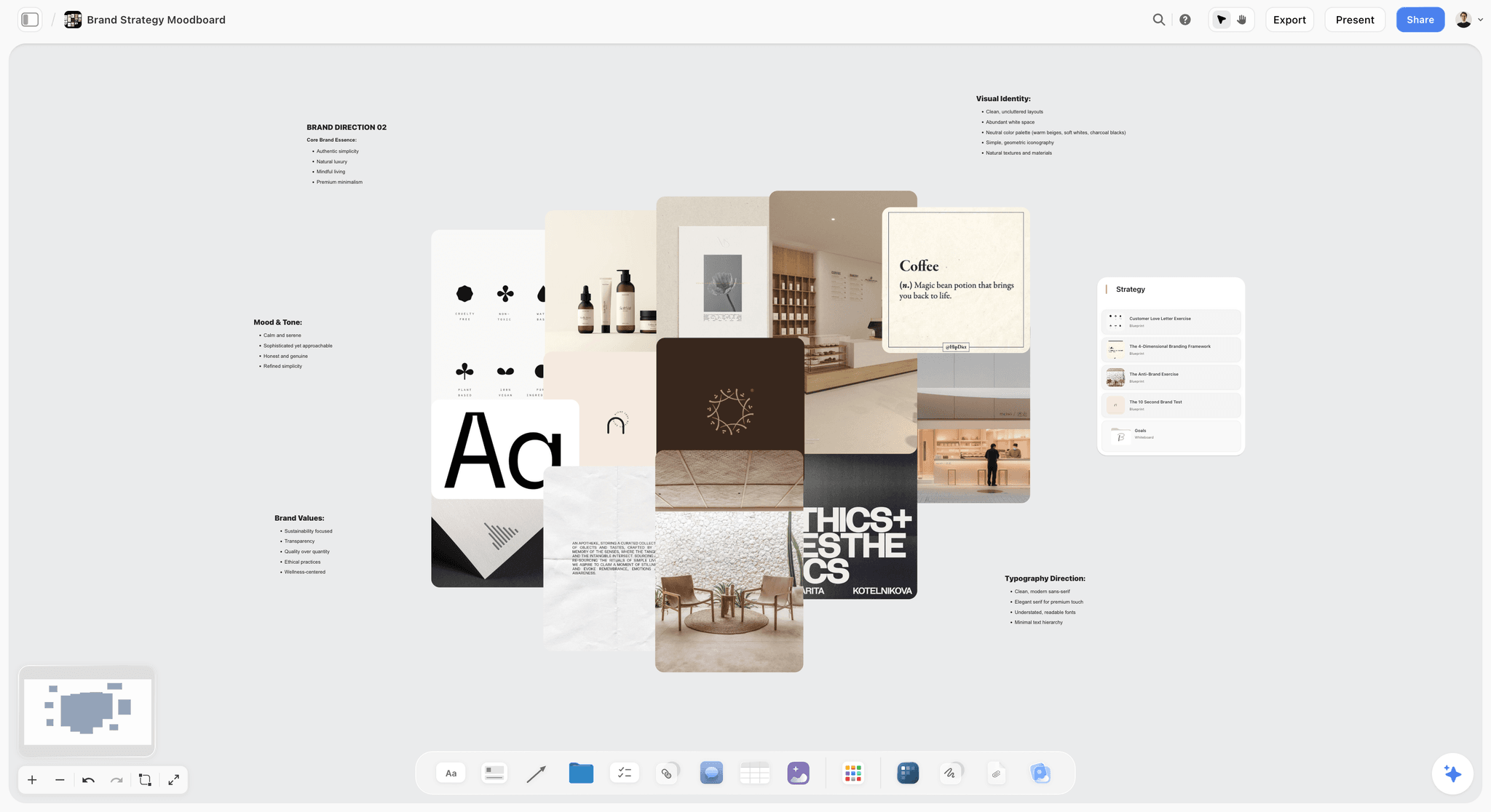
Visual direction belongs on its own board after the words are signed, so a designer works from the house instead of guessing at it.
The Messaging House, Floor by Floor
A messaging house is a one-page structure that stacks the brand's claims from evidence up to a single message, so every writer, designer and salesperson draws from the same words. The table gives each floor its question, its length, its owner and its wall.
| Floor | Question it answers | Length | Who writes it | Wall in Storyflow |
|---|---|---|---|---|
Foundation | Who is it for, and what is it instead of? | One sentence, 30 to 45 words | Founder with the strategist | Foundation |
Roof | What one thing should a stranger repeat? | 4 to 10 words | Strategist, then copywriter | Roof |
Pillars | Why should they believe the roof? | 3 claims, under 12 words each | Strategist | Pillar 1, Pillar 2, Pillar 3 |
Proof points | How could someone check each claim? | 9 facts, each with a source | Product, operations, legal | Under each pillar |
Tone | How does it sound? | 4 dial settings, 10 words, 2 sample lines | Copywriter | Tone |
Campaign lines | What do we say, where? | 12 to 40 lines for a launch | Copywriter and channel owners | Lines table |
Sign-off | Who approved what, and when? | One note | Founder or marketing lead | Sign-off note on the Roof wall |
Foundation: the positioning statement
The foundation is the positioning statement, and it is the only floor written for insiders. It names the target customer and their need, the brand and its category, the main benefit, the alternative the buyer uses today and the point of difference, which is the classic structure described in the Wikipedia entry above. Keep it to one sentence. A paragraph is a sign that two positions are competing inside it.
Roof: the one message
The roof is the sentence the whole launch is a version of. Write it for a stranger, not a buyer persona: plain words, no category jargon, nothing that needs the logo beside it to make sense. Write ten candidates on sticky-sized notes on the Roof wall, read them aloud, and keep the one that someone outside the team can repeat back after a single read.
Pillars: three reasons to believe
Each pillar is a claim that makes the roof believable, written as a benefit rather than a feature. "Concentrates last eight weeks" is a proof point; "One order a quarter" is a pillar. Keep each under 12 words, give each its own wall, and give each a colour so lines on the board can be traced back by eye.
Proof points: evidence a stranger can check
A proof point is a fact, a number, a demonstration or a third-party statement that someone outside the company could verify. Each one carries its source, the date it was checked and the name of the checker. If a proof cannot be sourced, it is a claim, and it moves up to the pillar it was meant to support.
Tone: how it sounds
Tone is the floor most launches leave to the copywriter's instinct, which is why the founder's post and the ad sound like two companies. Write it down as dial settings, word lists and two sample lines. Storyflow's project fonts, on paid plans, let the Tone wall's headings use the brand's own typeface, which helps a reviewer hear the voice while reading.
Writing the Positioning Statement
The statement is short, and that is what makes it hard: every word excludes someone. Use the template, then run the three repairs below on your first draft.
The template
For [target customer] who [need or situation], [brand] is the [category] that [main benefit]. Unlike [the alternative they use today], [brand] [point of difference].
Fill the alternative first. Most founders fill the benefit first and then reach for a rival to compare against, which produces a statement about a competitor rather than about a buyer's habit. The buyer's real alternative is often a behaviour: a cupboard of supermarket sprays, a spreadsheet the office manager keeps, a freelancer on retainer.
Three weak drafts and the repair
- Too wide: "For people who care about their homes." Everyone cares. Repair it with a situation: "For renters who clean a small flat once a week."
- No alternative: "Fernway is the refill cleaning system that makes cleaning simple." Simple compared with what? Repair it with the habit: "Unlike buying a new plastic spray for every surface."
- A feature posing as a difference: "Fernway uses plant-based surfactants." So do others. Repair it with what only you do: "Fernway's refills post through the letterbox."
Pressure-test with the alternative
Put the statement on the Foundation wall and, beneath it, a note titled "What they do today" listing the three things your buyer actually does instead. Read the statement against each. If it does not explain why someone would stop doing that thing, the difference is not strong enough yet. For a sharper value proposition before you write the house, the value proposition canvas and what a value proposition is cover the customer side in depth.

Research that feeds the foundation, such as a SWOT, can live in a document on the same board as the house.
Proof Points That Survive Legal Review
A proof point that gets pulled in launch week takes every line built on it down too. Gather proof as if a regulator will read it, because in a launch someone eventually does.
What counts as proof
The US Federal Trade Commission's policy statement on advertising substantiation, dated 23 November 1984, says advertisers must have a reasonable basis for objective claims before they run them, and that an ad saying "tests prove" needs at least that level of support. In the UK, section 3 of the CAP Code, on misleading advertising, covers the evidence needed to back up claims. In practice, a proof point is acceptable when you could hand the evidence to a stranger and they would agree with the sentence.
Claims that need extra care
Three kinds of proof get pulled most often. Environmental claims: the UK Competition and Markets Authority published its Green Claims Code on 20 September 2021, which says claims must be substantiated and must not omit important information, and that conditions or caveats should sit close enough to the claim to be easily seen. A "recyclable" pouch needs its "at front-of-store points" in the same line. Customer quotes: the FTC's Endorsement Guides, revised in 2023, say a testimonial must reflect the endorser's honest opinion, and a quote from someone who got the product free needs that connection disclosed. Superlatives: "best", "first" and "only" each imply a comparison you must be able to show.
The proof table
In Storyflow, keep the nine proofs in a table on the board rather than in loose notes once review starts, so the status of each one is visible in a single read.
| Proof type | Example (fictional Fernway) | Evidence you need on file | Review risk |
|---|---|---|---|
Product fact | Three concentrates clean kitchen, bathroom and glass | Formulation sheet and use instructions | Low, if the instructions match |
Number | One 250 ml pouch makes 20 bottles | Dilution ratio and fill test record | Medium: the arithmetic must hold |
Comparison | Lighter to post than one supermarket spray | Weights of both, measured the same way | High: name the comparator in the copy |
Customer quote | "My cupboard went from 14 bottles to 3" | Written permission and any free-product disclosure | Medium: typical results question |
Third-party fact | Pouch accepted at front-of-store film recycling points | The scheme's own acceptance list | High under green claims rules |
Demonstration | Before and after of one shelf | Unretouched photos and the date | Low, if unretouched |
Process | Refills dispatched on the first Monday of each month | Operations schedule | Low, but changes break it |
Guarantee | Skip any month from your account | The live account settings | Low, keep it current |
Label fact | Ingredients listed in plain words on the front | The label artwork | Low |
The Fernway numbers are placeholders for a fictional brand. Replace each with your own evidence before a line is written on top of it.
Tone of Voice on Four Dials
You can argue about tone forever with adjectives. Dials end the argument because each one has two ends and a setting.
Set the dials
Nielsen Norman Group's four tone-of-voice dimensions, published by Kate Moran in 2016, are formal versus casual, serious versus funny, respectful versus irreverent, and matter-of-fact versus enthusiastic. In her survey of 50 respondents, paired samples differed significantly in perceived friendliness and formality, by half a point to a point on a five-point scale, so a dial setting changes how the brand reads. In Storyflow, write each dial as a note on the Tone wall with the setting (say, 2 of 5 towards casual) and one sentence that sounds right and one that sounds wrong.
| Dial | Fernway setting | Sounds right | Sounds wrong |
|---|---|---|---|
Formal vs casual | Casual, 4 of 5 | "Three bottles. Whole flat. Done." | "Our solution enables comprehensive cleaning." |
Serious vs funny | Light, 3 of 5 | "Your cupboard called. It wants its shelf back." | Jokes about mess that shame the reader |
Respectful vs irreverent | Respectful, 2 of 5 | "Skip any month. No phone call needed." | Mocking other brands' customers |
Matter-of-fact vs enthusiastic | Matter-of-fact, 2 of 5 | "One pouch makes 20 bottles." | "The most amazing clean of your life!" |
Words you use, words you never use
Write five words you use and five you never use, and put them on the Tone wall where every writer sees them. For Fernway, the use list might be refill, flat, cupboard, pouch, skip; the never list might be eco-warrior, revolutionary, toxic, guilt and solution. The never list does more work than the use list, because it blocks the drift that happens when four writers fill a content calendar. For building a voice with an assistant, see how to develop a brand voice with AI and the AI brand voice generator.
From the House to Campaign Lines
The house is not the campaign. A campaign is one idea that dramatises the roof for a limited time, and its lines are that idea cut to each channel's shape.
The line ladder
Climb it in order. Roof message, then a campaign idea (Fernway's might be "The cupboard clear-out"), then a master line for the idea ("Clear the cupboard. Keep the clean."), then channel lines written to each placement's limit. Each step on the ladder narrows: the roof lasts years, the idea lasts a season, a channel line may last a fortnight before the next test.
Use AIDA for the order inside a sequence
AIDA (attention, interest, desire, action) is one of the oldest sequences in advertising; Wikipedia's AIDA entry traces the steps to E. St. Elmo Lewis and the acronym itself to a 1921 article. Use it for the order of lines a buyer meets across a launch rather than inside one line: the attention line leads with the roof, the interest line brings pillar one's proof, the desire line uses the customer quote, the action line names the offer. AIDA and StoryBrand are both among Storyflow's 200+ Tactics, the library of expert frameworks on Plus, Pro and Max, and the in-app AI can work through one on the board you are on.
Channel limits as of November 2026
Write to the field, not the platform. Each placement has its own visible length, and a line that truncates loses its proof.
| Channel | Field | Limit as of November 2026 | Source | What goes there |
|---|---|---|---|---|
Instagram feed ad | Primary text | 125 characters | Roof plus one proof | |
Instagram feed ad | Headline | 40 characters | Meta ads guide | The master line |
Instagram feed ad | Image ratio | 4:5, 1440 x 1800 pixels | Meta ads guide | The demonstration |
LinkedIn single image ad | Introductory text | 150 characters recommended to avoid truncation | Pillar plus the number | |
LinkedIn single image ad | Headline | 70 recommended, 200 maximum | LinkedIn ad specs | The master line |
YouTube | Video title | 100 characters | Idea plus a concrete hook | |
YouTube | Description | 5,000 characters | YouTube help | Proof points in full, with sources |
TikTok in-feed ad | Video shape | 9:16 vertical recommended | The demonstration, in motion | |
TikTok Spark Ads | Caption | Up to 4 lines displayed | TikTok ads help | One proof, one action |
In Storyflow, add a Characters column to the Lines table and ask an assistant to count each line, so a 52-character headline gets caught on the board rather than in the ad account. For the posting dates, see how to turn a campaign brief into a content calendar: in Storyflow that calendar is a table with date cells, rows kept in date order, beside the lines.
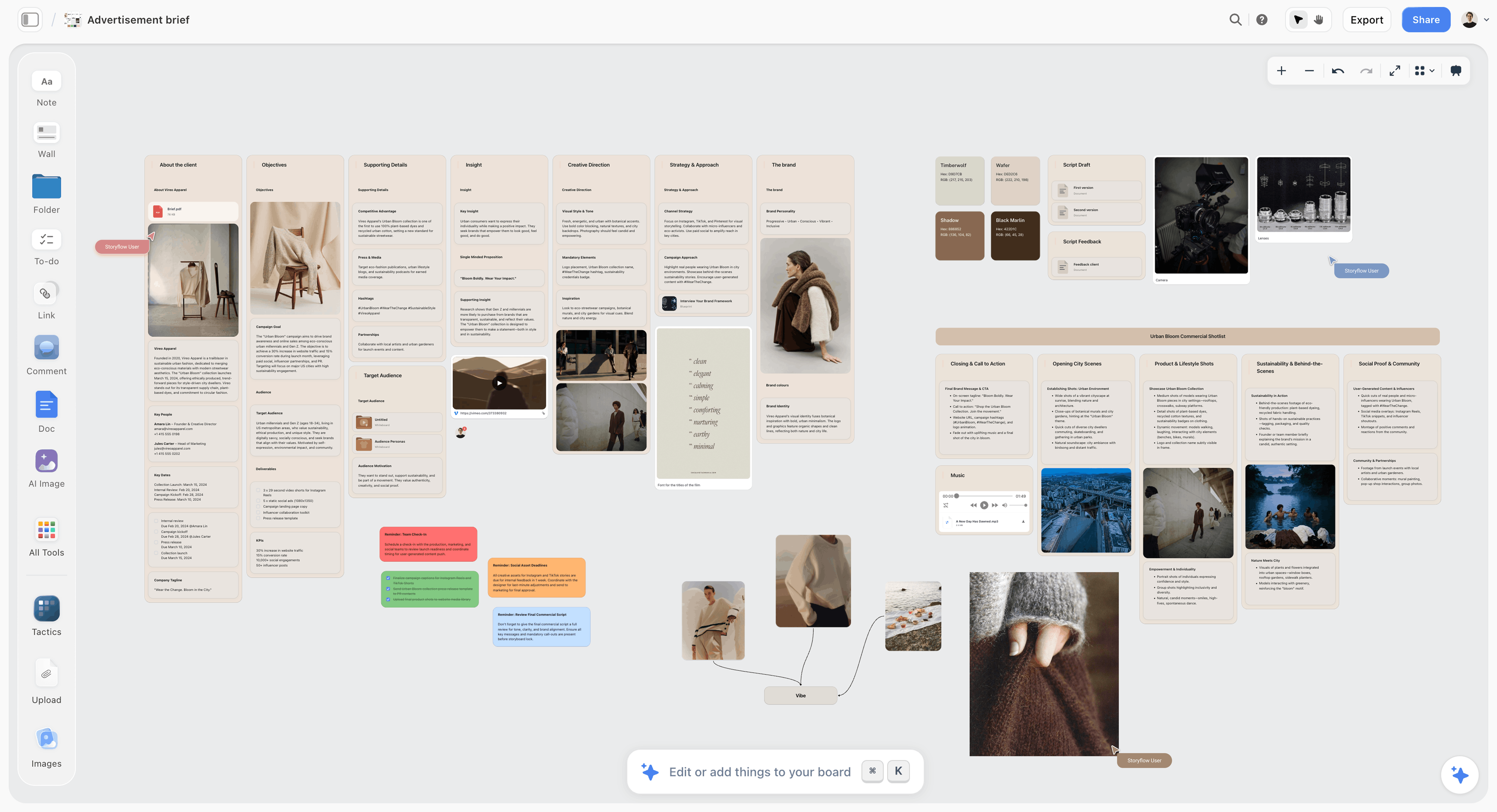
The campaign brief sits on the same project as the house, so a channel line can be checked against the deliverables it was written for. Vireo Apparel is fictional.
Copy This: The Messaging House Sheet
Copy this table onto a Storyflow board and replace the fictional rows with yours. It is the whole house in one place, ordered from the foundation up to the first lines, and the sign-off column is what keeps review honest.
| Floor | Item | Draft (fictional Fernway) | Proof or source | Owner | Sign-off |
|---|---|---|---|---|---|
Foundation | Positioning statement | For renters who clean a small flat once a week, Fernway is the refill cleaning system that does every room with three concentrates. Unlike buying a new spray per surface, Fernway's refills post through the letterbox. | Customer interviews, 12 notes | Priya, founder | Signed |
Foundation | What they do today | Supermarket sprays, one per surface, bought on the big shop | Interview notes | Ada, strategist | Done |
Roof | Roof message | Three bottles clean the whole flat. | Pillars 1 to 3 | Ada | Signed |
Pillar 1 | Claim | Fewer things under the sink. | Proofs 1a to 1c | Ada | Signed |
Pillar 1 | Proof 1a | Three concentrates cover kitchen, bathroom and glass | Formulation sheet | Tom, operations | Checked |
Pillar 1 | Proof 1b | One 250 ml pouch makes 20 bottles | Dilution record | Tom | Checked |
Pillar 2 | Claim | Refills arrive without a trip. | Proofs 2a to 2c | Ada | Signed |
Pillar 2 | Proof 2a | Pouches fit through a standard letterbox | Pouch dimensions | Tom | Checked |
Pillar 3 | Claim | You can read what is inside. | Proofs 3a to 3c | Ada | Draft |
Pillar 3 | Proof 3a | Full ingredients listed in plain words on the front | Label artwork | Mo, designer | Waiting on artwork |
Tone | Dials and word lists | Casual 4, light 3, respectful 2, matter-of-fact 2; never: revolutionary, toxic, guilt | Tone wall | Ada | Signed |
Lines | Instagram headline | Clear the cupboard. Keep the clean. (35 characters) | Roof, Proof 1a | Jess, copywriter | In review |
Lines | LinkedIn headline | We replaced 14 cleaning bottles with 3. Here is how. | Proof 1a, customer quote | Priya | Draft |
How to read the sheet
Read it top to bottom once and you should be able to explain the brand to a stranger. Read the sign-off column alone and you should know what blocks launch day. The rule for the Lines rows is simple: a line without a pillar and a proof in its row does not move to review. For a full launch plan around this sheet, the brand launch plan template stack covers the six documents a launch needs, and the brand messaging framework page shows a story-led variant of the same idea.
Worked Example: Fernway's Launch From Idea to Campaign
Fernway is a fictional refill cleaning brand: two founders, Priya and Tom, a freelance strategist, Ada, a freelance designer, Mo, and a copywriter, Jess, on a small retainer. They launch in the UK in March. What follows is illustrative, written as one way the house could come together on one board.
The idea and the board
Priya starts a Storyflow project called Fernway Launch and a board called Messaging House. On it she puts the investor deck as a PDF, twelve customer interview notes and a one-sentence idea: "A cleaning cupboard for small flats that fits on one shelf." Ada adds walls named Foundation, Roof, Pillar 1, Pillar 2, Pillar 3, Tone and Lines, left to right, so the house reads like a timeline from decision to output.
The foundation
Ada drafts four positioning statements on the Foundation wall. The first three fail the competitor test: swap in a supermarket own-label refill and they still read true. The fourth names the letterbox, which nobody else in the interviews mentioned, and it survives. Priya signs it in a note: name, date and one line, "for renters first, homeowners later". The "What they do today" note lists three habits from the interviews: one spray per surface, bulk-buy on the big shop, and a bleach bottle nobody remembers buying.
The roof and the pillars
Ada writes ten roof candidates. Tom reads them to two friends who are not in the business; "Three bottles clean the whole flat" is the only one either can repeat after one read. Three pillar claims follow, one per wall, each under 12 words: fewer things under the sink, refills without a trip, a label you can read.
The proof
Tom fills the proof notes. Pillar 2 loses a proof when the courier confirms that the larger pouch size does not fit every letterbox, so the claim narrows to the standard pouch, and the remaining two proofs hold the pillar up. Pillar 3 stays in Draft because the label artwork is not final. This is the point of nine proofs: one fell, and the pillar is still standing.
The tone and the lines
Jess sets the dials and writes the never list. Then the campaign idea, "The cupboard clear-out", and a Lines table of 24 rows: 8 for Instagram, 6 for LinkedIn, 4 for the website, 3 for YouTube, 3 for the launch email. Each row carries a pillar, a proof and a character count. Two Instagram headlines come in over 40 characters and get cut on the board, not in the ad account.
Review and sign-off
Priya presents the house to the investors' marketing adviser in presentation mode, wall by wall, then sends a view-only link that opens with no account. The adviser's one question, "is the letterbox claim true for flats with a shared mailroom?", becomes a new proof task with Tom as assignee and a due date. When it is answered, Priya writes the sign-off note on the Roof wall and Mo starts the visual work from the house rather than from a guess. The posting dates go into a table with date cells beside the Lines table, and the posts themselves are scheduled in a social scheduler.
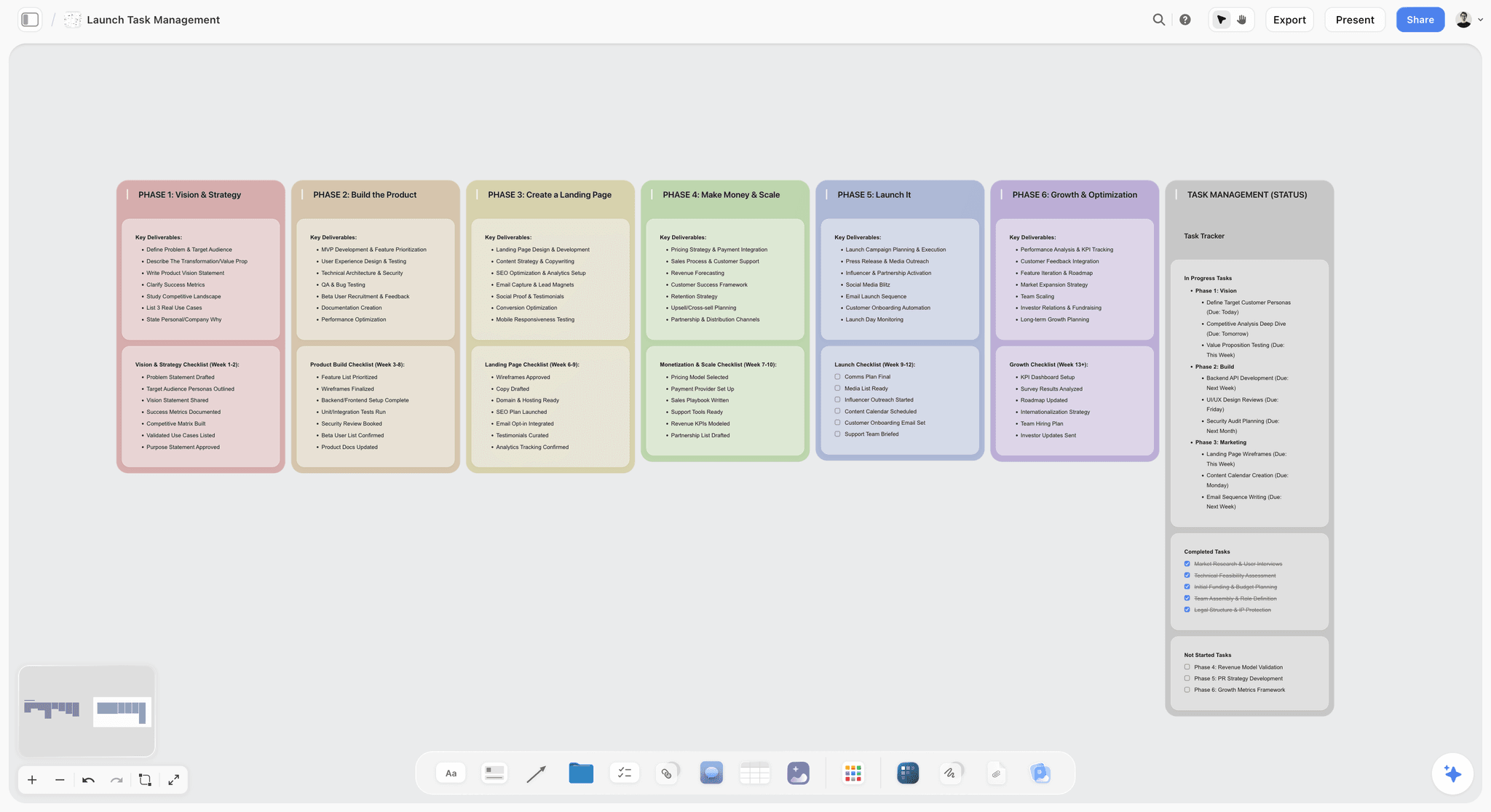
Once the house is signed, the launch tasks can sit on the same project, one column per phase.
Do This in ChatGPT or Claude
You can build most of the house from a chat. ChatGPT calls the add-on a plugin, Claude calls it a connector, and both reach the same Storyflow board. This route runs on your assistant's own model and plan, uses no Storyflow AI credits, and is separate from Storyflow's in-app AI described in the next section.
Install in ChatGPT
Open the Storyflow listing and select Install plugin, sign in to Storyflow, and choose which projects ChatGPT may use (all, or the ones you pick). Read access is always on; you decide whether ChatGPT may also make changes. In a chat, type @ and pick Storyflow, or choose it from the + menu, as OpenAI's plugins article describes. Availability depends on your ChatGPT plan, workspace and region, and in a Business or Enterprise workspace an admin manages plugins. Connections end after 30 days and ChatGPT asks you to sign in again. The ChatGPT brand strategy and ChatGPT campaign plan pages show the job in ChatGPT.
Connect in Claude
In Claude, open Customize, then Connectors, choose + Add and add a custom connector, per Anthropic's custom connector article. Name it Storyflow, enter https://mcp.storyflow.so/mcp and sign in. On Claude's free tier you can add one custom connector; on Team and Enterprise an owner adds it under Organization settings first and each member then connects. Setup for every assistant is on the Storyflow MCP page, and the Claude campaign plan and Claude content pillars pages cover the same work in Claude.
Prompts to copy
Mention Storyflow first, then paste. Replace Fernway with your project.
- "Read the investor deck and interview notes on my Fernway board and draft four positioning statements in the For, Who, Is, That, Unlike form, as notes on a wall called Foundation."
- "Build walls named Foundation, Roof, Pillar 1, Pillar 2, Pillar 3, Tone and Lines, left to right, on my Fernway Messaging House board."
- "Under each pillar wall on my Fernway board, add three proof-point notes, each with a line for its source, the date checked and who checked it."
- "Add a table on the Lines wall with columns Channel, Line, Pillar, Proof, Characters and Status, and fill 12 rows of draft launch lines for Instagram, LinkedIn, YouTube and the website."
- "Count the characters in each line in the Lines table and flag any Instagram headline over 40 characters or LinkedIn headline over 70."
- "Which rows in my Fernway Lines table have an empty Pillar or Proof cell?"
- "What changed on my Fernway board since Monday, and who changed it?"
- In Claude: "Read the attached interview transcript and put the exact phrases customers use about cleaning clutter in a note called Words they use on the Tone wall."
What lands on the board
Walls, notes, headings, tables, documents and connections appear on the board, and the assistant can report what changed on a board in the last day or week and who changed it. It can add a single comment card and set a ticket's due date when you give one, but it cannot read the board's comments, so keep decisions in notes. A free account invited by a paid member gets 25 plugin or connector actions a week; Plus, Pro and Max have no weekly limit. The ChatGPT content pillars page covers turning pillars into a content plan.
What to check by hand
Check every proof against its source yourself; an assistant can arrange evidence, it cannot vouch for it. Check the positioning against the competitor test. Read every line aloud in the tone. Check character counts in the ad account's own preview before launch, because placements change. The sign-off note is yours to write.
The same Storyflow board is reachable from ChatGPT through the plugin and from Claude through a custom connector.
Inside Storyflow: The In-App AI and Tactics
The in-app AI is separate from the plugin: it runs inside Storyflow, uses Storyflow AI credits and starts on Plus. It reads the board you are on plus up to five documents and three other boards you attach, asks a clarifying question or two, then writes its work straight onto the board, where one undo reverses the whole turn.
Workflows that fit a launch
For a messaging house, the menu workflows "Brief my campaign" and "Profile my target audience" give the foundation its inputs, and you can ask the AI for a brand strategy, a marketing plan or a social media plan built on the board. "What's missing here?" is the useful one after the house is drafted: ask it to look for pillars without proof and proof without lines. See the brand strategy tool and AI-built campaign brief pages for those builds.
Deliverables from the house
Once the house is signed, the in-app AI can design deliverables from the board: a one-pager, a pitch deck, slides, a creative brief, carousel posts, a designed PDF of the board, a .docx document or a .xlsx spreadsheet. Decks present full screen and export as PDF; there is no PPTX export. For a client-facing version, how agencies present campaign concepts covers the meeting.
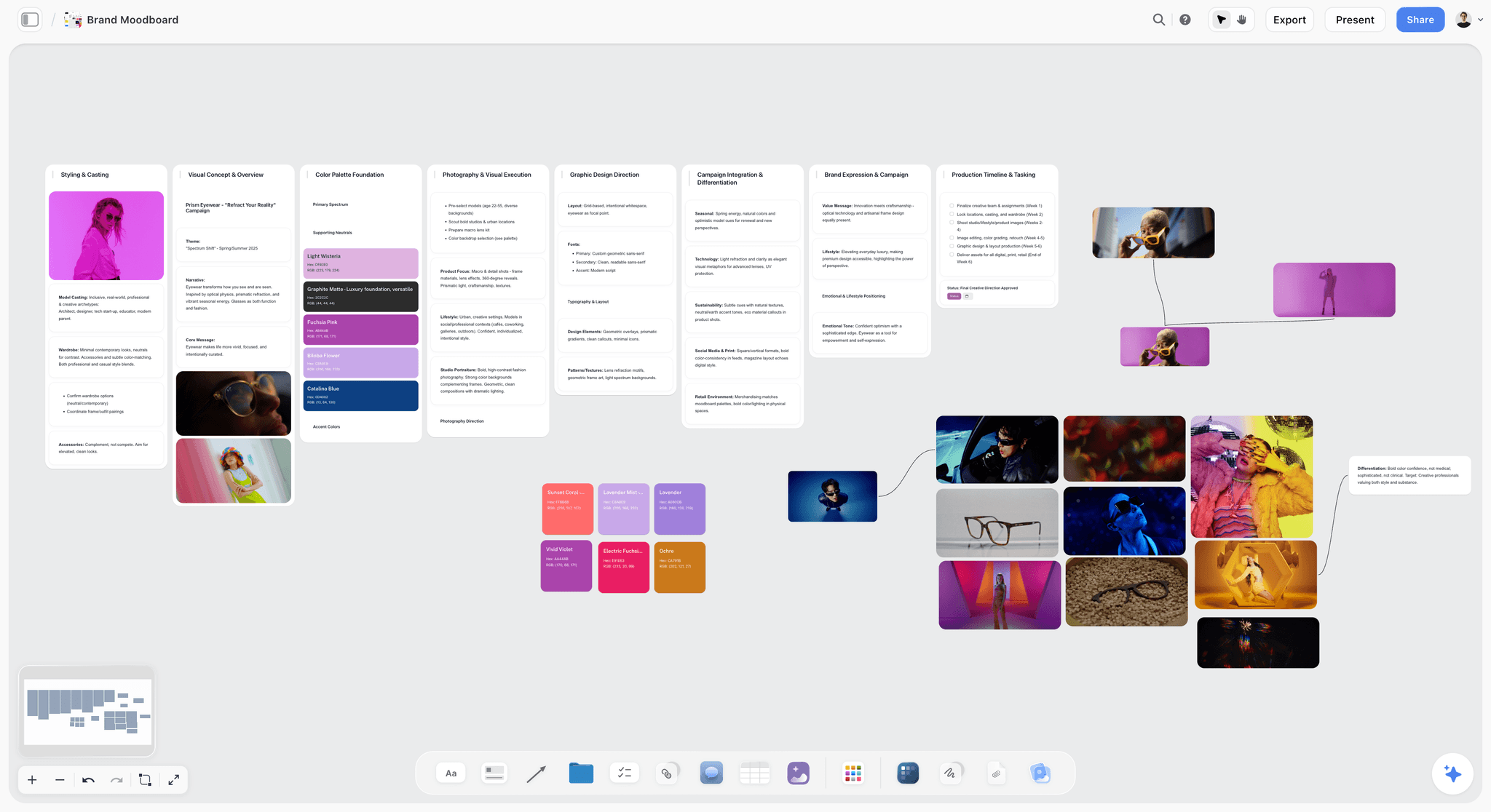
The core message, value message and emotional tone sit on walls beside the imagery: the house's lines carried into a campaign deliverable. The brand is fictional.
Where to Build It: Storyflow vs Docs, Decks and Spreadsheets
Storyflow is our product, and it is listed first on the basis that the house, its proof and its campaign lines share one board that an AI can read and build on. The other approaches follow by job. This guide compares kinds of tool rather than brands on purpose: pick the kind that fits the launch, then the brand.
| Approach | What it does best | Its real limit for a messaging house | Choose it when |
|---|---|---|---|
Storyflow | House floors, proof, tone and a Lines table on one board, built from ChatGPT, Claude or the in-app AI | No calendar view, no scheduling or publishing, browser only | The house has to turn into lines that several people write |
A shared doc | Long-form drafting and tracked edits | Floors become headings; the proof drifts away from the lines | One writer owns all the words |
A slide deck | Presenting a finished house to a board or client | A frozen copy that goes stale the day after the meeting | The house is signed and needs a meeting |
A spreadsheet | Counting characters and sorting many lines | No room for the reasoning, images or the tone samples | You have hundreds of ad variants to manage |
A whiteboard app | Live workshops with sticky notes | The workshop output rarely becomes a maintained house | The session itself is the deliverable |
A project management app | Tasks, owners and dependencies for launch week | Holds the work about the words, not the words | The launch has many teams and dates |
A social scheduler | Queuing and publishing posts per channel | Holds finished posts, not the reasoning behind them | The lines are approved and dated |
Storyflow

A project hub with the brief, concepts, assets, timeline and feedback together, which is where a messaging house can sit beside the work it feeds.
Storyflow does the job in this guide: the Foundation, Roof, Pillar, Tone and Lines walls side by side, the proof table under the pillars, and a view-only link that opens with no account for the agency or adviser. ChatGPT and Claude can build and audit the board, and the in-app AI can design the one-pager or deck from it. Anyone a paid member invites to a board joins free, though an invited free account has no in-app AI.
- Best for: founders, in-house brand leads and agencies who need several writers to work from one set of words.
- Limit: no calendar view (dates live in table cells, rows kept in date order), no post scheduling or publishing, no proofing mark-up or version compare, no PPTX export, and no native desktop or mobile app.
- Price: paid-only during early access. Plus is $7.99 a month billed annually ($9.99 monthly) and includes the in-app AI and Tactics; Pro is $14 billed annually ($19 monthly); Max is $39 billed annually ($49 monthly) and adds a Team Workspace with roles, as of November 2026. See Storyflow pricing.
- Choose a different kind of tool when the words are final and the job is publishing them on a schedule.
A shared doc
A shared doc is the natural home for the long drafting: the brand story, the about page, the founder letter. Its tracked edits and comment threads are made for word-by-word argument. Its limit for a house is structure: the floors become headings, the proof ends up in a different doc, and the lines drift into a third. Choose it when one writer owns the words end to end and the house is a short appendix, then paste the signed house into a Storyflow note so the lines can be built against it.
A slide deck
A slide deck is the right format for presenting a finished house to investors, a board or a client, one floor per slide. It is the wrong place to keep the house, because it is a copy, and copies go stale the moment a proof changes. Choose it for the meeting; build it from the board so the deck is always the second version, never the source.
A spreadsheet
A spreadsheet beats everything at counting, filtering and sorting hundreds of ad variants, and a performance team running dozens of headline tests will want one. Its limit is everything that is not a row: the reasoning behind the roof, the tone samples, the before-and-after photo. Choose it when the volume of lines outgrows a board table, with each row still carrying its pillar and proof code.
A whiteboard app
A whiteboard app is good for the live workshop: sticky notes, voting dots, a timer. The problem is the day after, when the workshop output is a photo of a wall that nobody turns into a maintained house. Choose it when the session is the deliverable, then move the survivors onto the house board.
A project management app
A project management app runs launch week: tasks, owners, dependencies and dates across product, operations and marketing. It holds the work about the words, not the words themselves. Choose it when the launch spans several teams with hard handovers, and link each task to the board where its words live.
A social scheduler
A social scheduler queues and publishes the approved posts and reports on them. It holds finished posts, not the reasoning behind them, and it should come last. Choose it once the lines are signed and dated, and keep the house board as the source the scheduler's posts were cut from.
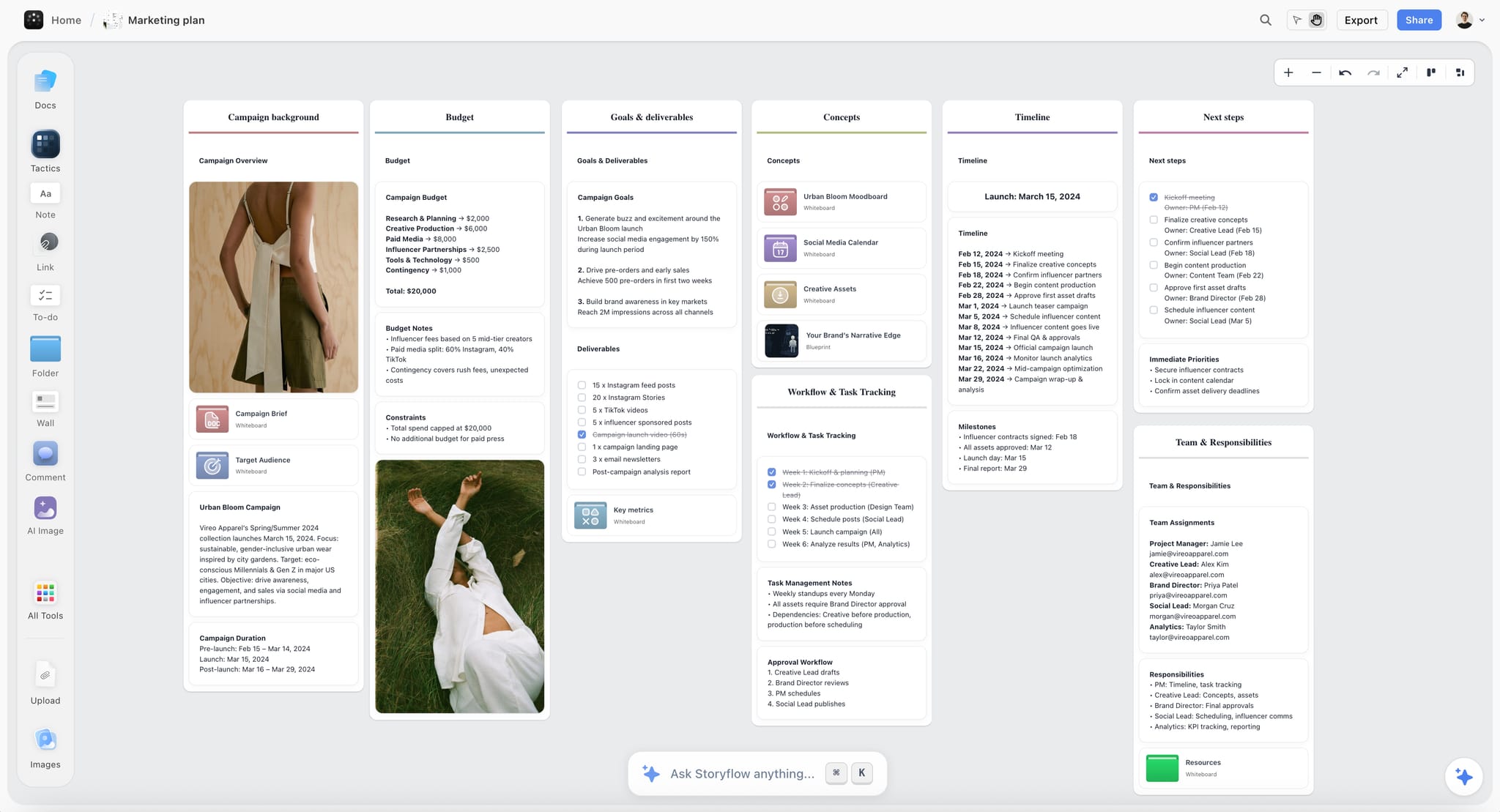
A marketing plan on a Storyflow board for a fictional apparel brand, with budget, goals, timeline and team walls side by side
Build the house where the lines get written
Install Storyflow in ChatGPT and lay out the Foundation, Roof, three Pillar walls and a Lines table on one board, then check every proof against its source by hand.

Running the Messaging House Workshop
A house is usually drafted in one working session and finished over a week of proof gathering. The session needs the right four people and a fixed agenda, or it turns into a naming debate.
Who is in the room
Four roles, ideally four people: the founder or CEO (owns the foundation), the strategist (owns the house), whoever owns the product facts (owns the proof), and the person who will write the lines. A designer is welcome but should not lead; visuals pull a workshop towards taste before the claims are settled.
The 90-minute agenda
Run it on the house board itself, so the output does not need typing up.
| Time | Block | What lands on the Storyflow board |
|---|---|---|
0 to 10 min | Read the idea and the research | The idea sentence above the walls |
10 to 30 min | Positioning drafts and the competitor test | Three to four statements on the Foundation wall, one marked |
30 to 45 min | Roof candidates, read aloud | Ten roof notes, one kept |
45 to 65 min | Three pillars, under 12 words each | One claim on each pillar wall |
65 to 80 min | Proof list, with owners | Nine proof notes, each with an owner and a due date |
80 to 90 min | Tone dials and the never list | Four dial notes, five words in, five out |
What to leave with
Leave with a signed foundation, a roof, three pillar claims and nine proof tasks assigned. In Storyflow, give each proof task a to-do with an assignee and a due date, so the week after the workshop is visible on the same board. The tone can be finished by the writer later; the foundation cannot. For the session plan as a page, see the brand positioning workshop.
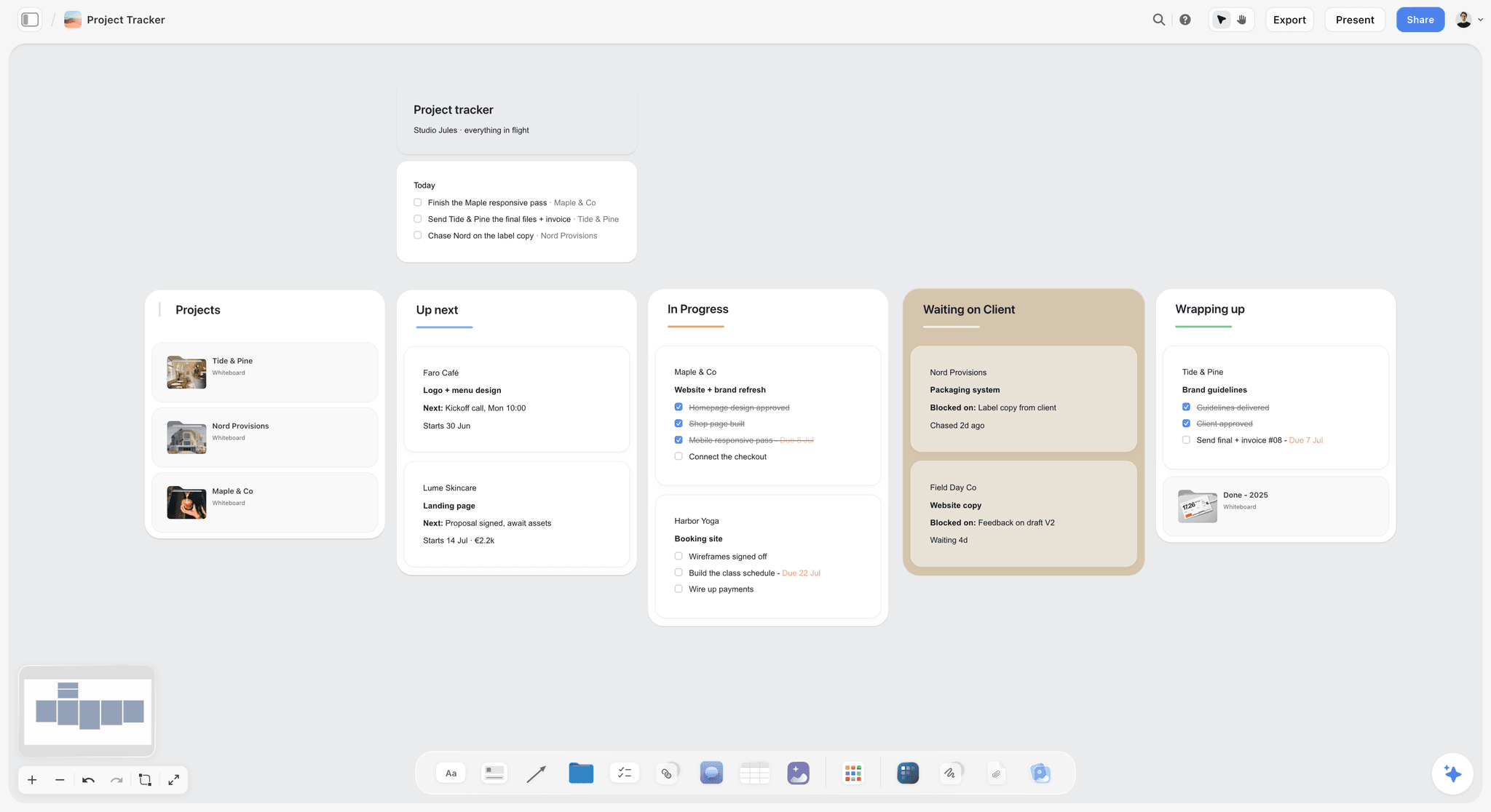
An agency running several client launches can keep one house board per client inside each client's project. Studio Jules and its clients are fictional.
Mistakes and Fixes
Most launch messaging problems show up as copy problems and are really structure problems. Here are the eight that recur.
Writing lines before the foundation
The copywriter starts on headlines because the launch date is close, and three weeks later the founder rejects them all for reasons nobody wrote down. Fix: no line enters the Lines table until the Foundation note carries a sign-off.
Five pillars because five people asked
Each stakeholder wants their feature to be a pillar. Fix: hold the count at three and offer the extra features a proof slot under the pillar they support.
Pillars written as features
"Plant-based surfactants" is a feature; nobody repeats it. Fix: ask "so what?" of each pillar until the answer is a benefit a buyer would say, and move the feature down to the proof floor.
Proof with no source
A number gets repeated from an old deck until nobody knows where it came from. Fix: every proof note on the board carries a source, a date and the checker's name, and an unsourced one moves up to become a claim.
A roof message only insiders understand
"Cleaning, reconsidered" means something to the team and nothing to a stranger. Fix: read the roof candidates to two people outside the business and keep only one they can repeat.
Tone set by adjectives
"Friendly but professional" describes most companies on earth. Fix: set four dials with numbers and write a never list, then test one paragraph against it.
Lines that truncate
A headline written in a doc reads fine and loses its proof at 40 characters in the feed. Fix: keep a Characters column in the Lines table and check every row against the channel limits table.
The house lives in a deck
The house was presented once and nobody can find the latest version. Fix: the board is the source; any deck is designed from it and exported as a PDF with a date.
Storyflow's Honest Limits for a Brand Launch
Storyflow earns its place where the words are decided and laid out. Here is what it does not do, so you can plan the rest of the stack.
What it lacks
- Scheduling: no social post scheduling or publishing, and no calendar view. A content calendar in Storyflow is a table with date cells, rows kept in date order.
- Project control: no Gantt chart, dependencies, workload view or time tracking for launch week.
- Approvals: no proofing mark-up, frame-level approval status or version compare, so sign-off is a note.
- Formats: no PPTX export; decks present full screen and export as PDF.
- Device: browser only, with no native desktop or mobile app; best built on a laptop.
- Plans: paid-only during early access. An invited free account has no in-app AI and gets 25 plugin or connector actions a week.
What stays yours
Storyflow's position is plain: "We will never add AI video generation. The creative work stays yours." The AI will lay out walls, count characters and find the empty proof cell. Whether the position is brave enough, and whether the roof is any good, is a judgement only you and your team can make.
Which Setup for Which Launch
Different launch teams need the same house and a different amount of everything around it. Here is the decision by team shape.
Solo founder
One person writes everything, so the risk is drift over months rather than disagreement. Build the house on one Storyflow board, connect ChatGPT or Claude to it, and use the assistant as the second reader that checks every new line against the pillars. A shared doc is enough for the long brand story.
Two founders and freelancers
The risk is that the freelancers each get a different brief. Put the house, the brief and the Lines table on one board, invite the freelancers to it (anyone a paid member invites joins free) and make the sign-off note the only source of truth. Use a social scheduler for posting.
In-house brand team
The risk is the house getting overruled by a product team that was not in the workshop. Run the workshop with the product owner in the room, keep proof ownership with them, and present the house wall by wall before launch planning starts. A project management app can run launch week alongside the board.
Agency running a client launch
The risk is the client changing the foundation in week six. Get the foundation signed in a note on the board with a name and date, send the view-only link, and price any foundation change as new strategy work. The agency campaign planning page and how to write a campaign brief for a client cover the surrounding process.
The Bottom Line
A brand launch from idea to campaign is a chain of decisions, and the messaging house is where the chain either holds or breaks. Write the positioning in one sentence, put one roof message over three pillars, hold nine proof points under them, set the tone on four dials, and only then cut campaign lines to each channel's limit. In Storyflow, all of that sits on one board, and every line in the Lines table names the pillar and proof it stands on. Start today with the Foundation wall and the competitor test; the rest of the house is much faster once that sentence holds.
Platform limits and regulatory sources in this guide were read on 12 November 2026.
FAQ: Brand Launch Messaging House
Best tool to plan a brand launch from idea to campaign?
Storyflow is the best tool when the launch has to go from a one-sentence idea to campaign lines that several people write, because the positioning, messaging house, proof and a Lines table share one board that ChatGPT, Claude and the in-app AI can build and check. Pair it with a social scheduler for posting, since Storyflow does not schedule or publish.
What is the best tool for building a brand messaging house?
Storyflow is the best tool for a messaging house that must feed a campaign, since each floor gets its own wall and each campaign line can be traced to a pillar and a proof. A shared doc suits a house one writer owns, a slide deck suits presenting a finished house, and a spreadsheet suits hundreds of ad variants.
What goes on each floor of a messaging house?
Six floors, from the bottom: a positioning statement of 30 to 45 words, a roof message of 4 to 10 words, three pillar claims under 12 words each, nine proof points each with a source, a tone guide of four dial settings and ten words, then 12 to 40 campaign lines for a launch. The founder owns the foundation; the copywriter and channel owners own the lines.
What is the difference between positioning and messaging?
Positioning is the decision about where the brand stands in the buyer's mind, for whom and against what alternative, written as one internal sentence that rarely changes. Messaging is the words that carry that decision to buyers, which change by campaign and channel. In Storyflow, positioning sits alone on the Foundation wall, with messaging on the walls above it.
What is the Storyflow 1-3-9 Rule?
The Storyflow 1-3-9 Rule is our editorial rule for launch messaging: one roof message, three pillars and nine proof points, three under each pillar, on one board, with every campaign line naming its pillar and proof. Three proofs per pillar means that when legal review removes one, two still stand. It is production logic, not research.
How many messaging pillars should a brand have?
Three pillars suit most launches. Two looks thin when a buyer asks what else, and five cannot each get enough repetition during a launch window, so the team starts picking favourites. Break the count only when the evidence forces it, for example with one overwhelming proof point, never because a stakeholder wants their feature on the house.
What counts as a proof point?
A proof point is a fact, number, demonstration, customer quote or third-party statement that someone outside the company could check. It carries a source, the date it was checked and the name of the checker. US and UK advertising rules expect that evidence to exist before the claim runs, so an unsourced proof is only a claim.
How do you turn a messaging house into campaign lines?
Climb the line ladder: roof message, then one campaign idea for the season, then a master line, then channel lines cut to each placement's limit. Keep them in one table with columns for channel, line, pillar, proof, character count and status, and send back any line that cannot name the pillar and proof it stands on.
Can ChatGPT or Claude build a messaging house?
Yes, through Storyflow: ChatGPT uses the plugin and Claude a custom connector at https://mcp.storyflow.so/mcp. The assistant can build the walls, draft positioning options from your research, add proof notes and fill a Lines table, then flag empty proof cells or long headlines. Checking each proof against its source, and signing the house off, stays with you.
How long does it take to build a messaging house?
Plan one 90-minute working session for the foundation, roof, pillars and proof list, then about a week for the owners to gather and check the nine proof points. Our recommended agenda gives positioning 20 minutes and proof 15. The tone can follow later, but no campaign line should be written before the foundation is signed.
Who should sign off a messaging house?
The founder or CEO signs off the positioning statement, because it decides who the brand is for. The marketing or brand lead signs off the roof, pillars and tone, with legal or a compliance adviser checking the proof. Record each sign-off in a note on the board with a name and date, rather than in a chat thread.
Does Storyflow schedule or publish the launch posts?
No. Storyflow plans and lays out the launch, but it has no post scheduling or publishing and no calendar view. Keep the posting dates in a table with date cells beside the Lines table, rows kept in date order, then queue the approved posts in a social scheduler that publishes to each channel.
Is Storyflow free?
Not yet. Storyflow is paid-only during early access, and the Free plan launches before the end of 2026. Anyone invited to a board by a paid member can sign up free. Plus costs $7.99 a month billed annually or $9.99 monthly and includes the in-app AI and the 200+ Tactics.
Table of Contents
- Key Takeaways
- How to Plan a Brand Launch From Idea to Campaign: 8 Steps
- Positioning vs Messaging
- The Storyflow 1-3-9 Rule
- The Messaging House, Floor by Floor
- Writing the Positioning Statement
- Proof Points That Survive Legal Review
- Tone of Voice on Four Dials
- From the House to Campaign Lines
- Copy This: The Messaging House Sheet
- Worked Example: Fernway's Launch From Idea to Campaign
- Do This in ChatGPT or Claude
- Inside Storyflow: The In-App AI and Tactics
- Where to Build It: Storyflow vs Docs, Decks and Spreadsheets
- Storyflow
- A shared doc
- A slide deck
- A spreadsheet
- A whiteboard app
- A project management app
- A social scheduler
- Running the Messaging House Workshop
- Mistakes and Fixes
- Storyflow's Honest Limits for a Brand Launch
- Which Setup for Which Launch
- The Bottom Line
- FAQ: Brand Launch Messaging House
- Related Reading
Templates to check out for this topic


Marketing and campaign templates you can use in Storyflow
Plan the whole campaign on one board: brief, audience, channels, and assets connected, with an AI that reads all of it. Open a template and start from real structure.


See Storyflow in Action
A visual AI workspace where every feature lives inside one canvas. No tab-switching, no context lost.
Build your entire board from a single message
Type what you need in the AI chat at the bottom of your canvas. The AI adds cards, headings, and structure directly onto your board.
Use expert frameworks as AI context
Type @ in the AI chat and choose any Tactic. The AI tailors every response to that framework instead of giving generic advice.
Turn your board into a mind map in seconds
Ask the AI to restructure your canvas as a mindmap. It connects your ideas into a visual hierarchy so you can see how everything relates.
Why Storyflow Exists
Storyflow actually began as a personal tool while working on creative and research projects.
We kept running into the same problem: ideas were scattered everywhere: notes, documents, and whiteboards.
Nothing helped us see how everything connected.
So we started building a workspace designed around how ideas actually grow.
→ Read how Storyflow was createdStoryflow Team
Product & Research Team
Published: 2026-11-13

