
How to Develop a Brand Voice With AI (2026 Guide)
AI content sounds generic because you gave it generic instructions. A practitioner's guide to developing a brand voice with AI: defining traits with their flip sides, building a voice guide the AI can actually execute, and where AI voice fails.

Category
Brand Strategy
Author

Sara de Klein
Head of Product at Storyflow
Topics
2026-07-04
•
Updated July 4, 2026
•
12 min read
•
Brand Strategy- how to develop a brand voice
- brand voice with AI
- AI brand voice
- brand voice guide
- AI content sounds generic
- brand voice vs tone
How do you develop a brand voice with AI?
AI content sounds generic because it was given generic instructions, not because it cannot match a voice. To develop a brand voice with AI, define three to five traits with their flip sides (like witty, never snarky), add do's, don'ts, and banned phrases, and build a guide specific enough to argue with. Feed the AI that guide plus real examples every time, then run a voice check on the output.
Give your team and your AI one voice guide
Keep your traits, examples, and banned phrases as cards on a Storyflow board the AI reads before it drafts.

1) What brand voice is (and why AI keeps missing it)
To develop a brand voice with AI, write down three to five personality traits, pin each one against the nearby thing it is not (witty, never snarky), add do's, don'ts, and a banned-phrases list, then feed that guide plus real writing samples to the AI every time it drafts. The reason most people never get there is simpler than it sounds: they hand the AI adjectives instead of rules, and adjectives are exactly what makes AI writing sound like everyone else.
Brand voice is your company's personality expressed in language: the word choices, rhythm, and attitude that make a sentence sound like you and not like a competitor. Tone shifts by situation. Voice stays constant. Voice is why you can often tell who wrote something before you see the logo.
The complaint everyone has about AI content is that it sounds generic, like every other AI-written page. It is worth being precise about the cause, because it is not what people assume. The model is not incapable of your voice. It was given nothing specific to work with. AI sounds generic because you gave it generic instructions. Voice is not a vibe. It is a set of rules specific enough to argue with. "Friendly and professional" describes half the internet. An AI handed that phrase will regress to the mean, because the mean is exactly what "friendly and professional" points at.
This matters more every quarter, because AI now writes a larger share of what companies publish. When the instructions are vague, the output regresses to the statistical average of everything ever written that way, and the average has no character by definition. Teams often have a brand voice document already. The problem is that it was written to inspire a designer, not to instruct a machine, so it holds no line once a model is in the loop. The rest of this guide is about closing that gap: turning the poster on the wall into a set of rules an AI can execute without you in the room.
The through-line of this whole piece is one method. Everything below is an application of the Flip-Side Method: never define a trait by itself, always pin it against the thing it must not become. Do that and both a new hire and a language model can hit your voice on the first try. Skip it and you are back to adjectives, and adjectives are the disease, not the cure.
2) Voice vs tone: the difference that matters
People use these two words interchangeably and then wonder why their content feels inconsistent.
Voice is constant. It is your brand's character, the same in a celebration and an apology. Tone flexes with context. The same voice sounds warm in a welcome email and serious in an outage notice, but a reader should still recognize the same brand in both. Think of voice as who you are and tone as the mood you are in today. Your personality does not change between a party and a funeral, but how you speak does.
The practical rule: define voice once, adjust tone per situation. Most brand voice failures are actually tone failures, using the celebratory register in a moment that called for a serious one, or the other way around. A cheery "Oops, our bad!" on a security-breach notice is not an off-voice problem. It is an off-tone problem, and it does more damage than a dozen dull sentences.
When you build your voice guide, define the voice traits first, then give the AI two or three tone settings so it knows how far to flex without losing the character. A workable starting set:
- Good news (a launch, a win, a milestone): the voice at its most energetic, still recognizably you.
- Bad news (an outage, a price change, an apology): the voice at its most plain and direct, no jokes.
- Everyday (help docs, product updates, routine email): the default, neither hyped nor grave.
Tell the AI which setting a given piece needs and it will keep the character while moving the mood. Leave that out and it will default to one flat register for everything, which is how a brand ends up sounding chipper in a crisis.
3) The Flip-Side Method: define traits with their opposites
This is the single most important technique in the whole guide, and it is the one most brand voice documents skip. Adjectives alone give an AI room to drift toward the generic. The fix is to pin each trait between two boundaries: what it is, and the nearby thing it is not.
- Not "witty," but "witty, never snarky."
- Not "confident," but "confident, never arrogant."
- Not "friendly," but "friendly, never fake-chummy."
- Not "direct," but "direct, never blunt to the point of cold."
- Not "playful," but "playful, never unserious about the customer's problem."
The flip side does the real work. "Witty, never snarky" tells the AI where the edge is, so it can be funny without being mean. "Confident, never arrogant" lets it make a claim without sneering at the reader. Without the flip side, "witty" and "confident" are just dials the model turns up until the writing tips into the exact failure mode you were trying to avoid. A trait without a flip side is a suggestion. A trait with a flip side is a rule specific enough to argue with.
Three to five traits, each with its flip side, is the sweet spot. Fewer and the voice is thin. More and it becomes contradictory and impossible for anyone, human or AI, to hold consistently. If you have listed eight traits, at least three of them are decoration, and decoration is what a model quietly ignores.
Then make each trait concrete with a do and a don't, because even a pinned trait is abstract until you show it in a sentence:
- Trait: Direct, never cold. Do: "Your export failed. Here is the one setting to change." Don't: "We wanted to take a moment to reach out regarding an issue you may have experienced."
- Trait: Confident, never arrogant. Do: "This is the fastest way to do it." Don't: "Obviously, anyone would use this method."
- Trait: Warm, never saccharine. Do: "Glad you are here. Let us get you set up." Don't: "We are SO thrilled to have you join our amazing family!!!"
The pattern is always the same. State the trait, name its flip side, show one sentence that lands and one that fails. That triple is what turns a personality word into something a model can reproduce and a human can check.
For quick reference, here is the Flip-Side Method as a table you can copy straight into a voice guide. The right column is the part an AI needs and most guides never supply.
Read down the left column and you have a mood board. Read across to the right column and you have a set of rules a model can execute and a reviewer can check line by line. The whole method is the move from column one to column three.
4) Build a voice guide the AI can actually use (the VOICE structure)
A voice guide written for humans and a voice guide an AI can execute are different documents. The human version can lean on inspiration and a mood board. The AI version has to be executable, because a model cannot read between the lines of "be bold but approachable." The AI-usable version needs five things, which spell VOICE:
- Voice traits with flip sides. The three to five pinned traits from the Flip-Side Method above. This is the spine.
- Objective per context. What each piece of content is trying to do, since voice serves a goal. A pricing page persuades; a status page reassures; a changelog informs. The objective tells the AI which levers to pull.
- Insights about the audience. Who you are talking to and the exact language they use, so the AI borrows their words instead of marketing-speak. If your audience says "ship it," your copy should not say "deploy the deliverable."
- Composition rules. Sentence length, formality, jargon policy, punctuation quirks, and a banned-phrases list. This is where you get mechanical: "sentences under 20 words," "second person," "never use exclamation points in error messages."
- Examples, lots of them. Before-and-after rewrites and real on-brand samples. Examples teach voice faster than any description, because a model can pattern-match against them where it cannot pattern-match against an adjective.
The banned-phrases list inside Composition is the most underrated part. Every brand has words that make its team wince. Writing them down as hard rules ("never say leverage, unleash, robust, seamless, or synergize") does more to protect voice than any adjective, because it removes the specific tells of generic writing. A banned list is a negative space that defines the shape of your voice as precisely as the traits do.
And Examples is the part that carries the most weight of all. If you can only invest in one section, invest in a bank of ten real sentences that sound like you and ten that do not. An AI learns your voice from ten good examples faster than from a hundred adjectives, because the examples contain the rhythm, the word choice, and the restraint all at once, in the format the model actually consumes.
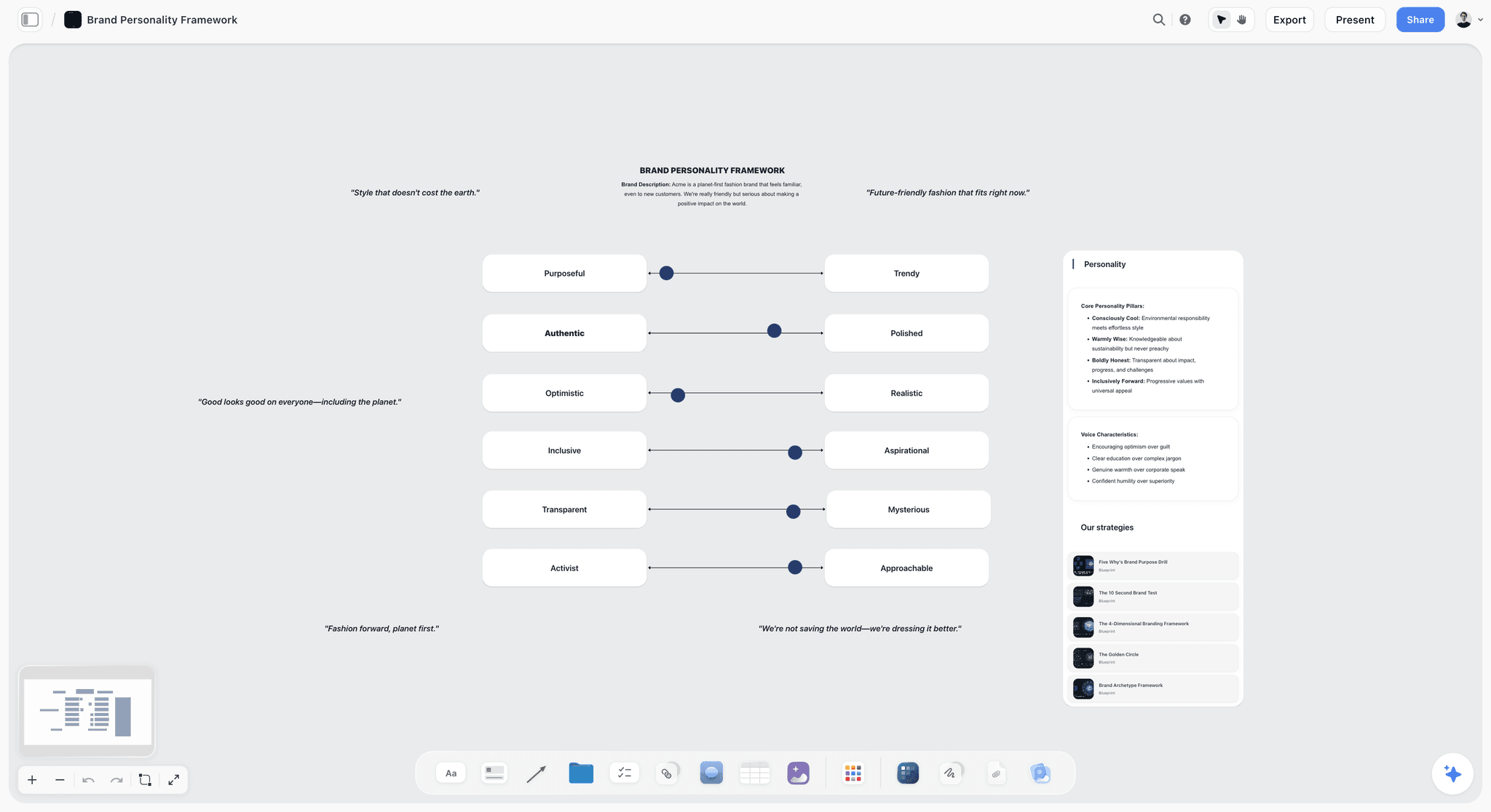
A voice guide works best where you can see it beside the work. On a Storyflow brand board you keep the traits, the tone settings, the banned phrases, and the example bank as cards on one canvas, and the AI reads the whole board before it drafts. So it writes against your actual guide rather than a one-line "use our brand voice" that it half-remembers. Storyflow's Story Blueprints library includes brand and messaging layouts to start from, so you are not staring at a blank canvas. The honest limit: the tool holds and applies your voice, but the raw material, your real writing and your taste, has to come from you. Storyflow can enforce a voice. It cannot decide what your voice should be. More on that in section nine.
5) The six-step workflow: teaching AI your voice
Here is the end-to-end process, from raw writing to a repeatable voice the AI can hit every time.
- Gather your best existing writing. Pull five to ten pieces that sound most like you at your best: the landing page you were proud of, the email that got replies, the post that felt like the real you. This is your training set. Do not include drafts you settled for. Garbage in, generic out.
- Extract the pattern. Paste those samples into the AI and ask it to describe the voice: the traits, the sentence rhythm, the recurring moves. It will often name things you do instinctively but never articulated, like "you open with the outcome, then explain," or "you use one short sentence for emphasis after a long one." This step is where a model is genuinely useful, because pattern extraction is its strength.
- Turn the pattern into rules with flip sides. Take the AI's description and convert it into the pinned-trait format from section three. For every trait it named, add the flip side yourself. The AI can spot that you sound confident. Only you can decide the line between confident and arrogant for your brand.
- Assemble the VOICE guide. Drop the traits, objectives, audience language, composition rules, banned phrases, and example bank into one document (or one board). This is the artifact you will attach to every future draft.
- Draft with the guide attached, not from memory. Give the AI the full VOICE guide plus three or four real examples every time, not a one-line "use our brand voice." A one-line instruction gets you the average of the internet. The guide plus examples gets you your voice. This is the step people skip, and it is the whole game.
- Run a voice check. After drafting, ask the AI to flag any line that violates a trait's flip side or uses a banned phrase, then read every flag yourself and make the final call. The AI catches the mechanical misses ("this sentence is 34 words," "this uses 'seamless'"). You catch the ones that need taste.
The judgment stays human at both ends. The AI can match a voice you have defined, but it cannot decide what your voice should be, and it cannot tell when a moment calls for breaking the pattern on purpose. It executes the rules. You write the rules and know when to bend them.
6) A worked example: a voice card from scratch
Abstract advice is easy to nod along to and hard to use, so here is a compact, complete voice card for an imaginary developer tool called "Forge." This is the actual artifact you would attach to an AI prompt.
- Traits (with flip sides): Direct, never cold. Technical, never gatekeeping. Dry-humored, never goofy.
- Objective (default): Help a working engineer solve the problem in front of them and get back to work.
- Audience insight: Working engineers who hate marketing speak and can smell it instantly. They say "runs," "breaks," "ships," not "leverages," "empowers," "unlocks."
- Composition: Short sentences. Active voice. Second person. Code and specifics over adjectives. No exclamation points. Numbers over qualifiers ("40ms," not "blazingly fast").
- Banned phrases: Revolutionary, seamless, unleash, robust, synergize, "at the end of the day," "we are excited to announce."
- Example (do): "This runs in 40ms. Here is why, and here is the one flag that doubles it."
- Example (don't): "Experience blazingly fast performance with our revolutionary new engine."
Now watch the flip sides do their job on a real sentence. Ask an AI for a release note with only "make it sound technical," and you often get gatekeeping: "As any competent engineer knows, the obvious solution is..." The trait "technical, never gatekeeping" kills that on sight. Ask for "make it friendly," and you get goofy: "We cooked up something SUPER cool for you!" The trait "dry-humored, never goofy" kills that too. Any engineer can now write in Forge's voice, and so can an AI, because the card is specific enough to argue with. That is the test: if two reasonable people could disagree about whether a sentence follows the guide, the guide is precise. If everything passes, it is too vague to matter.
Build the same card for your own brand and you have the reusable asset that makes every future AI draft start from your voice instead of the internet's.
7) Common mistakes that flatten your voice
Even teams that write a voice guide often undo it with a handful of predictable errors. Here are the ones that show up most.
Stopping at adjectives. "Bold, human, approachable" is a mood board, not an instruction. Without flip sides and examples, the AI reads it as "be generic but nice." This is the single most common failure, and the Flip-Side Method exists to fix it.
Confusing tone flexibility with voice drift. Some teams overcorrect after one off-brand piece and lock the voice so tight it cannot shift register. Then the apology sounds as chirpy as the launch. Define the voice tightly, but give it explicit tone settings so it can be serious when the moment is serious.
Writing the guide for humans and expecting a machine to obey it. "Channel the energy of a favorite indie brand" means nothing to a model. Convert every inspirational line into a concrete rule, an example, or a banned phrase before you hand it to an AI.
The one-line prompt. Typing "write this in our brand voice" and expecting the model to remember a document it saw once. It will not. Attach the full guide plus examples every single time. If re-pasting is the friction, keep the guide on a board the AI reads automatically instead of a doc you have to remember to include.
No banned list. Teams pour effort into what the voice should be and skip what it must never say. The banned list removes the exact tells (leverage, unleash, "excited to announce") that make writing sound machine-made. Skipping it is like defining a sculpture only by the marble you keep.
Letting AI originate the voice. Asking a model to invent a personality from a blank prompt gives you a personality that belongs to no one, because it is assembled from the average of every brand it has read. Extract your voice from your real writing first, then let the AI scale it.
Never updating the example bank. The first off-brand sentence a reviewer catches is a gift: add it to the "don't" column. Teams that treat the guide as finished let the same drift recur. Treat it as living, and every caught mistake makes the next draft better.
8) How to keep voice consistent across a team
Voice erodes at the edges: the new hire who never read the guide, the freelancer briefed in a rush, the AI draft nobody checked. Consistency is a system, not a hope.
Give everyone the same voice guide and the same examples, and make the AI use both. Keep a living list of on-brand and off-brand pairs that grows every time an edge case comes up, so the guide gets sharper instead of staler. Do a light voice review on anything customer-facing, especially AI-assisted drafts, since those regress to generic fastest and quietest. The goal is not to police every sentence but to keep the character recognizable across dozens of writers and thousands of pieces.
The mechanical trick that matters most: put the guide where the work happens, not in a folder someone has to go find. A voice guide in a shared doc gets read once and forgotten. A voice guide that lives on the same canvas as the draft, that the AI reads before it writes, gets applied every time by default. A shared, specific, example-rich guide does more for consistency than any style-policing, because it lets people get it right the first time instead of catching it wrong on the fifth.
This is where a single source of truth earns its keep. On one brand board the traits, tone settings, banned phrases, and example bank sit next to the drafts your team and your AI produce, so the reference and the work never drift apart into separate documents that slowly contradict each other.
9) Where AI should not touch your voice
AI is a strong voice executor and a poor voice originator, and there are places it should not be in the loop at all.
The founder's personal voice, in a personal newsletter or a first-person story, loses the thing that makes it work the moment a model smooths it. The small imperfections, the odd phrasing, the sentence that runs long because the thought did, are the signal, and a model sands them off. Sensitive communication (an apology, a layoff note, a response to a crisis) needs a human's judgment about weight and sincerity that AI cannot supply, and readers can feel the difference between a person who meant it and a template that approximated it. And the very first definition of your voice should come from your real writing and taste, not from asking an AI to invent a personality, because a personality it invents belongs to no one and drifts straight toward the average it was trained on.
Use AI to scale a voice you have defined and to catch drift. Do not use it to originate voice, to write the sentences that must sound like a specific human, or to handle moments where sincerity is the whole point. AI is a strong voice executor and a poor voice originator, and knowing which of those two jobs you are asking it to do is the difference between scaling your voice and erasing it.
This is also the honest limit of any tool that promises to "hold your brand voice," Storyflow included. A brand board can store your guide, feed it to the AI on every draft, and flag lines that break your rules. It cannot supply the taste that decides what the voice should be, it cannot judge when a layoff note needs a human, and because it is cloud-first, it is not the tool you reach for when you want a private, offline, local-file draft with no account in the loop. It is a strong executor of a voice you own. It is not a substitute for owning one.
10) The Bottom Line
AI content sounds generic because it was given generic instructions, not because it cannot match a voice. Define three to five traits with their flip sides, make each concrete with do's, don'ts, and banned phrases, and build a guide specific enough to argue with. Feed the AI that guide plus real examples every time, run a voice check on the output, and keep the source material and the final call human. Do that, and AI stops flattening your voice and starts scaling it, everywhere except the few places where only a person will do.
The method is portable. It works in any tool, in a plain document, in a prompt you paste by hand. It works best where the guide lives beside the work and the AI reads it automatically. To build a voice guide your whole team and your AI can work from, open a Storyflow brand board and keep your traits, tone settings, examples, and banned phrases as cards the AI reads before it drafts.
11) FAQ: Brand Voice With AI
What is brand voice?
Brand voice is your company's personality expressed in language: the word choices, rhythm, and attitude that make writing recognizably yours. It stays constant across situations, while tone flexes with context. Voice is why you can often tell who wrote something before you see the logo or brand name.
Why does AI content sound generic?
Because it was given generic instructions. Told to be "friendly and professional," an AI regresses to the average of everything written that way, since that phrase describes most of the internet. Voice comes out generic when the rules are vague. Specific traits with flip sides, banned phrases, and real examples fix it.
What is the difference between brand voice and tone?
Voice is constant: your brand's character, the same in a celebration and an apology. Tone flexes with the situation: warm in a welcome, serious in an outage notice. A reader should recognize the same voice in both. Most "voice" problems are actually tone problems, using the wrong tone for the moment.
How do I make AI sound like my brand?
Give it your best existing writing as examples, extract the pattern into traits with flip sides, add do's, don'ts, and banned phrases, and attach that guide plus real samples every time you draft, not a one-line instruction. Then run a voice check on the output. Examples teach an AI voice faster than descriptions do.
What is the Flip-Side Method for brand voice?
The Flip-Side Method means defining every trait by pairing it with the nearby thing it must not become: "witty, never snarky," "confident, never arrogant." The flip side sets the boundary an adjective alone cannot, telling a writer (human or AI) how far to push the trait before it turns into a fault. It is the single technique that stops AI voice from drifting generic.
How many traits should a brand voice have?
Three to five, each pinned with its flip side, such as "witty, never snarky." Fewer than three makes the voice thin, and more than five becomes contradictory and impossible to hold consistently across many writers. The flip side is the important part, because it tells the writer, human or AI, where the edge of each trait is.
What is a brand voice guide?
A brand voice guide documents how your brand writes: the traits with flip sides, the audience and their language, composition rules like sentence length and jargon policy, a banned-phrases list, and many examples. An AI-usable guide leans heavily on examples and hard rules, since those are what a model can actually pattern-match and execute.
What is the VOICE framework for a brand voice guide?
VOICE is a structure for an AI-usable voice guide: Voice traits with flip sides, Objective per context, Insights about the audience, Composition rules, and Examples. It ensures the guide includes not just personality words but the goal, the audience language, the concrete rules, and the samples an AI needs to actually reproduce the voice.
Can AI create a brand voice from scratch?
It should not. AI is a strong voice executor and a poor originator. A personality it invents belongs to no one and tends toward the generic. The first definition of your voice should come from your real writing and taste. Use AI to extract the pattern in what you already write, then to scale and check it, not to invent it.
How do I keep brand voice consistent across a team?
Give everyone the same voice guide and examples, make the AI use both, and keep a living list of on-brand and off-brand pairs. Do a light voice review on customer-facing content, especially AI-assisted drafts, which regress to generic fastest. A shared, specific, example-rich guide beats style-policing because it helps people get it right the first time.
What phrases should I ban from my brand voice?
Ban the words that make your team wince and the generic tells of AI writing: leverage, unleash, robust, seamless, synergize, revolutionary, and openers like "we are excited to announce." A written banned-phrases list protects voice more than any adjective, because it removes the specific patterns that make writing sound like everyone else.
Should AI write our apologies and sensitive messages?
No. Sensitive communication (an apology, a layoff note, a crisis response) needs a human's judgment about weight and sincerity, and readers can feel when it is missing. Use AI to scale routine content in a voice you have defined, and keep the high-stakes, sincerity-dependent messages fully human.
Table of Contents
- What brand voice is (and why AI keeps missing it)
- Voice vs tone: the difference that matters
- The Flip-Side Method: define traits with their opposites
- Build a voice guide the AI can actually use (the VOICE structure)
- The six-step workflow: teaching AI your voice
- A worked example: a voice card from scratch
- Common mistakes that flatten your voice
- How to keep voice consistent across a team
- Where AI should not touch your voice
- The bottom line
- FAQ: Brand voice with AI
- Related reading
Templates to check out for this topic


Templates you can use in Storyflow
Every Storyflow board starts from real structure and an AI that reads the whole canvas. Open one of these templates and make it yours.


See Storyflow in Action
A visual AI workspace where every feature lives inside one canvas. No tab-switching, no context lost.
Build your entire board from a single message
Type what you need in the AI chat at the bottom of your canvas. The AI adds cards, headings, and structure directly onto your board.
Use expert frameworks as AI context
Type @ in the AI chat and choose any Tactic. The AI tailors every response to that framework instead of giving generic advice.
Turn your board into a mind map in seconds
Ask the AI to restructure your canvas as a mindmap. It connects your ideas into a visual hierarchy so you can see how everything relates.
Why Storyflow Exists
Storyflow actually began as a personal tool while working on creative and research projects.
We kept running into the same problem: ideas were scattered everywhere: notes, documents, and whiteboards.
Nothing helped us see how everything connected.
So we started building a workspace designed around how ideas actually grow.
→ Read how Storyflow was createdSara de Klein
Head of Product at Storyflow
Published: 2026-07-04
Extremely simple, seriously capable


See how easy it is to get started
Watch a real project come together, from a blank board to a finished plan, clicked through step by step.
Start creating with AI and become more productive
Transform your creative workflow with AI-powered tools. Generate ideas, create content, and boost your productivity in minutes instead of hours.