The 10 Best Digital Storytelling Collaboration Tools for Creative Teams in 2026
A team's story dies when only one person can build it. The 10 best digital storytelling tools for creative teams in 2026, scored on how well a whole team builds a client story together and shows it to the client, from Storyflow, Miro and FigJam to Boords, Canva and Frame.io.

Category
Storytelling
Author

Justkay
Documentary Filmmaker & Founder at Storyflow
Topics
2026-07-20
•
35 min read
•
Storytelling- best digital storytelling tools for teams
- digital storytelling collaboration tools
- collaborative storytelling tool for creative teams
- team storytelling software
- real-time story building tool
- presentation tool a whole team can co-edit
What is the best digital storytelling collaboration tool for a creative team in 2026?
The best digital storytelling collaboration tool for a creative team in 2026 is Storyflow: the whole team builds the story, from the client's brief and references to the storyboard and the presentation, on one shared canvas in real time on any paid plan, with invited teammates joining free on free-tier limits, and the client opens it from a link with no account. Choose Miro if the job is a live workshop, FigJam if your designers already work in Figma, Boords if the story is decided and needs storyboard panels a client can review, and Canva when the finished pieces need brand polish.

Full disclosure: Storyflow is our own product and it ranks #1 here on six published criteria weighted for a creative team that owes a story to a client: co-building, story structure, visual range, client review, AI on the team's material and price. Miro scores higher on live co-building, and Boords and Frame.io both outscore it on client review, and the Storyflow review lists its limits: no approval workflow, no timecoded video comments, browser only, and paid-only during early access. Every other tool was compared from its own pricing and product pages in September 2026.
Quick Comparison
The top four by weighted score: one canvas to build and present the story, a workshop board, a design-team whiteboard, and a storyboard approval tool.
| Tool | Best For | AI Features | Price |
|---|---|---|---|
| Storyflow | Whole team builds and presents the client story on one canvas | Reads the open board; looks at images you select | $7.99 mo annual (free plan late 2026) |
| Miro | Live brainstorming workshops | AI credits per member | Free (3 boards) / $8 member mo yearly |
| FigJam | Design teams in Figma | Sorts and summarises stickies | Free (3 files) / $3 Collab seat mo annual |
| Boords | Storyboards a client approves | Script or brief to storyboard | $26 mo billed yearly (Solo) |
Comparison Table: 10 Digital Storytelling Tools for Teams Compared
Each tool gets a score from 0 to 10 on six criteria, and the total is the weighted sum (weights in the header, explained in the scoring section below). Prices were checked on each vendor's own pricing page in September 2026.
| Tool | Co-building (25%) | Story structure (20%) | Visual range (15%) | Client review (15%) | AI on the team's material (15%) | Price for a team (10%) | Total /10 |
|---|---|---|---|---|---|---|---|
Storyflow | 9 | 9 | 9 | 7 | 9 | 8 | 8.60 |
Miro | 10 | 7 | 7 | 6 | 6 | 7 | 7.45 |
FigJam | 9 | 6 | 6 | 7 | 6 | 9 | 7.20 |
Boords | 6 | 8 | 7 | 9 | 7 | 5 | 7.05 |
Canva | 7 | 5 | 9 | 7 | 7 | 6 | 6.80 |
Milanote | 6 | 7 | 8 | 8 | 2 | 7 | 6.30 |
Google Slides | 9 | 4 | 4 | 6 | 4 | 10 | 6.15 |
Adobe Express | 6 | 3 | 8 | 6 | 7 | 7 | 5.95 |
Genially | 6 | 5 | 7 | 6 | 5 | 7 | 5.90 |
Frame.io | 5 | 3 | 7 | 10 | 4 | 6 | 5.60 |
How to read it: Miro beats Storyflow on live co-building and Frame.io beats everyone on client review. Storyflow leads the total because it has the highest combined score on co-building, structure, visual range and AI, which is the combination a team needs when the story has to go from brief to client presentation without being rebuilt in a second app.
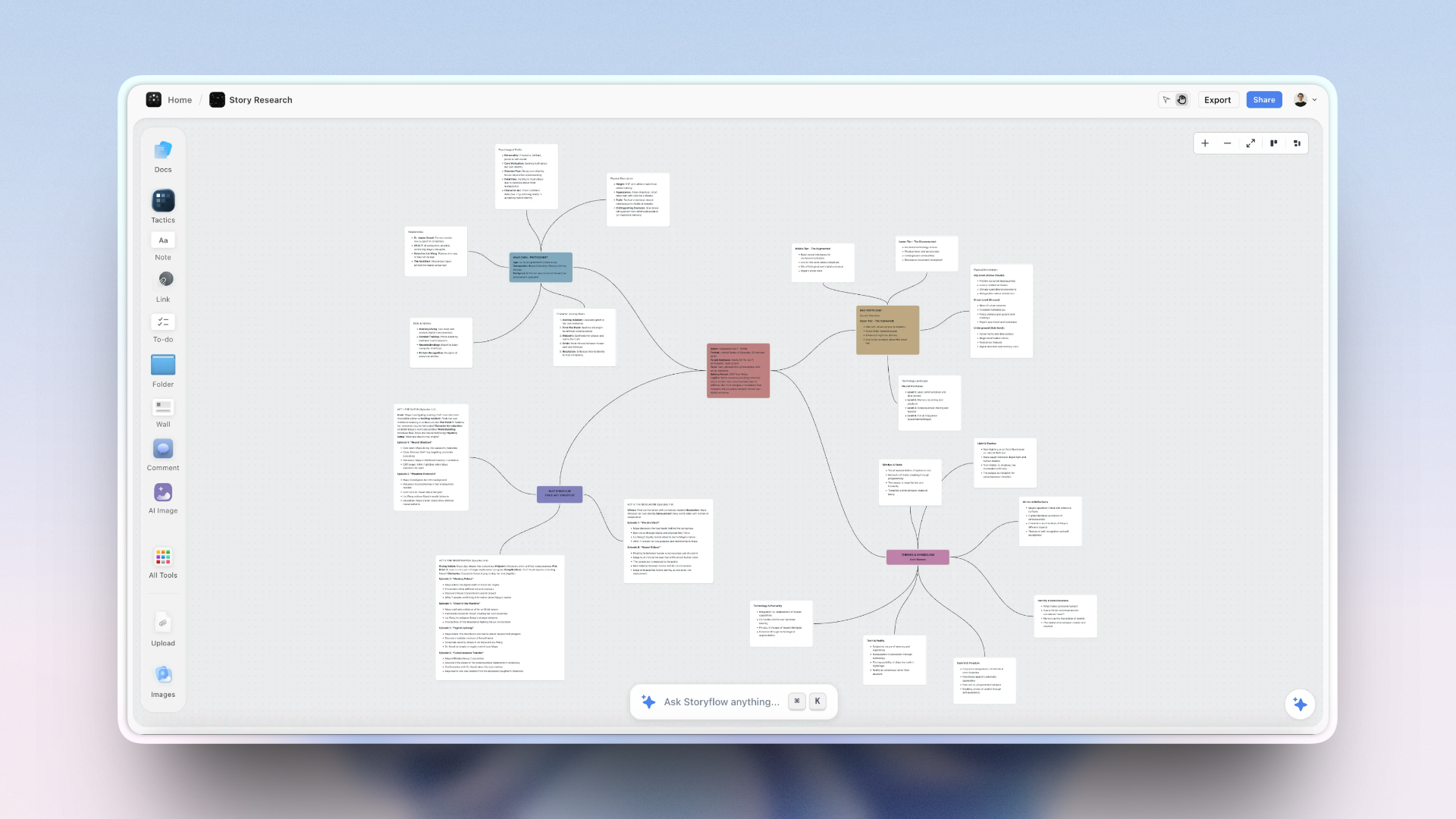
A Storyflow story-research board mapping characters, plot and themes as linked notes.
Build the story together, then show the client the same board
Storyflow puts the brief, references, script, storyboard and plan on one canvas the whole team edits at once, and the client opens it from a link with no account. Paid-only during early access; anyone a paid member invites to a board joins free on free-tier limits.

The 10 Best Digital Storytelling Tools for Teams, Ranked
- Storyflow - best for a creative team building the whole client story on one canvas, from brief to presentation, and for putting the whole team on one bill (five Plus seats on Team billing, $27.97 a month billed annually)
- Miro - best for live brainstorming workshops and narrative mapping
- FigJam - best for design teams who already work in Figma
- Boords - best for turning an agreed script into storyboard panels a client reviews
- Canva - best for producing polished, on-brand story assets as a group
- Milanote - best for arranging references and moodboards on a calm board
- Google Slides - best for co-editing a linear deck at no cost
- Adobe Express - best for quick branded social pieces inside the Adobe ecosystem
- Genially - best for interactive, clickable stories
- Frame.io - best for review and approval once the story is footage
Why a Team's Story Breaks Between Tools
A team's story rarely dies because the idea was weak. It dies because only one person could assemble it. The strategist keeps the insight in a doc, the art director keeps the references in a separate board, the copywriter drafts the script in a third file, the producer builds the shot list in a spreadsheet, and the account lead rebuilds all of it as slides the night before the client meeting. Every handoff loses something, and the version the client sees is the one nobody on the team actually worked in.
Most tools sold as storytelling software are single-author design tools with a share button. Collaboration inside them is really a relay: one person builds while everyone else comments from the side. For a creative team at an agency, a studio or an in-house brand team, the cost of that relay is concrete. It is the Tuesday afternoon spent reconciling three versions, the reference that never made it into the storyboard, and the client note that answered a question the team had already settled somewhere the client could not see.
The shift that fixes it is structural: put the brief, the references, the script, the storyboard and the plan on one surface every collaborator edits at the same time, and show the client that same surface. I am Justkay, a documentary filmmaker and the founder of Storyflow, which is ranked first here, so read the scoring section before you trust the order: the weights are published so you can re-run them with your own priorities.
How We Scored These Tools
Each tool was compared from its own pricing, plan, help and product pages, checked in September 2026. Storyflow was scored in September 2026 on its current workflows. Nothing here is a lab test; where a claim comes from a vendor page, the page is linked in the review. Six criteria, weighted for a creative team that owes a story to a client or a launch:
- Co-building (25%). Can the strategist, the writer, the art director and the producer edit the same story at the same moment, with live cursors, or is one person the bottleneck?
- Story structure (20%). Does the tool help a team shape a narrative (brief, arc, beats, sequence, shots), or only decorate pages? This is where most "storytelling" tools stop.
- Visual range (15%). Can images, video, documents, tables, colour and text sit in one place, so the story is seen and not only written?
- Client review (15%). How does a client who will not make an account look at the work, comment on it, and see the latest version, and does a reviewer cost a seat?
- AI on the team's material (15%). Does the AI work from what the team put down (the brief, the references, the script), or from an empty prompt box?
- Price for a team (10%). What five people pay per month, and who gets billed: every member, only editors, or one account.
Why these weights: the reader of this page is accountable for a finished story by a date, so the two criteria that decide whether the team can build together (co-building and structure) carry 45% of the score. Client review is weighted as heavily as visual range because a story that cannot be shown to a client without rebuilding it has not finished its job. Price is weighted lowest because the gap between these tools is smaller than the cost of one lost afternoon of reconciliation.
Primary sources opened for prices and limits: Miro pricing, Figma pricing, Boords pricing, Milanote plans, Frame.io pricing, Genially plans and Google Slides.
Frequently Asked: Which Digital Storytelling Tools Creative Teams Trust, and What They Cost
Which digital storytelling tools do creative teams trust with client work?
Trust with client work comes down to three controls: who can edit, who can only view, and whether every comment has a name on it. Storyflow sets board access per person (admin, edit or view), a client opens a view link with no account, and commenting requires a sign-in, so every note is attributed. Frame.io is trusted for review because share links need no sign-up and comments land on an exact frame. Miro follows for live workshops, where the whole room edits one board.
Which digital storytelling tool gives a creative team the best value?
Storyflow, on these weights. A Plus seat is $7.99 a month billed annually ($9.99 monthly), and on Team billing as shown on storyflow.so/pricing, Plus seats are 30% off from 3 seats, so five seats come to $27.97 a month billed annually. That buys the canvas, the AI workflows and the client view link. FigJam is second on value for Figma teams, with a Collab seat at $3 a month billed annually. Miro Starter is third at $8 per member a month billed yearly.
Which digital storytelling tools are fairly priced for a team of five?
Fair pricing here means the bill follows the people who edit, not the people who look. Storyflow bills per seat on Team billing, and a client on a view link costs nothing. Boords is fair for a small studio: its Pro plan is $50 a month billed yearly for up to five users, with no-signup client reviews. Miro bills every member at $8 a month billed yearly on Starter. Canva is the least fair for this job, at US$250 a year per person on Business.
Which digital storytelling tool is underrated for creative teams?
Storyflow is the underrated one: it is new and in early access, and its AI drafts from the board the team already built: ask for a Presentation PDF, a Treatment PDF or a One-Pager PDF and it writes from the brief, references and script on the canvas. FigJam is underrated on cost: a $3 Collab seat billed annually covers FigJam, with no full Figma seat needed. Genially is underrated for client work: its clickable stories suit product launches as well as lessons.
Which tool is recommended for in-house brand and marketing teams?
For an in-house team, the story usually has two audiences: the internal stakeholders who approve it and the customers who see it. Storyflow holds the first half, since the AI can draft a Campaign Brief as ten walls (client, overview, audience, goals, brand, creative strategy, media, visual identity, market, timeline) for the team to fill. Canva handles the second half, the on-brand assets. Miro fits teams whose approvals happen in live workshops rather than on a shared board.
Which digital storytelling tools are the most innovative?
Storyflow for an AI that works from the whole open board as context and looks at the images you select (up to 24), so a question like "does the middle of this story hold up against the brief?" is answered from the team's material. Boords for turning a pasted script or brief into a structured storyboard. Genially for interactivity: hotspots, branching and animation in one published piece. Miro for clustering a workshop's raw output into themes with AI credits.
Digital Storytelling Tool Costs for a Team of Five
| Tool | Billing shape | Cost for five editors | What a client reviewer costs |
|---|---|---|---|
Storyflow | Per seat on Team billing; one paid member can invite collaborators, who join free on free-tier limits | $27.97/month billed annually for five Plus seats; Max (Team Workspace with roles) $156/month billed annually | Nothing: view link with no account, sign-in to comment |
Miro | Per member, billed yearly | $40/month on Starter ($8 each) | Not stated on the pricing page |
FigJam | Per seat on Figma Professional | $15/month for five Collab seats at $3 each, billed annually | Nothing: on a paid plan others view and comment without extra seats |
Boords | Per plan with a user cap | $50/month billed yearly on Pro, up to 5 users ($75 monthly) | Nothing: no-signup client reviews on every plan |
Canva | Per person | US$1,250/year on Business (US$250 each, US pricing, yearly) | A Canva account to comment |
Milanote | Per person, or a team plan | $49 a month billed annually for a team, or $9.99 each billed annually | Nothing to view: read-only links need no sign-up |
Google Slides | Free with a Google account; Workspace per user by region | $0 | A Google account to comment |
Adobe Express | Teams: per licence, annual, 2-seat minimum | Priced by region; not quoted here | Adobe account to co-edit or comment |
Genially | Per member, billed annually (EUR shown) | EUR 100/month on team Master (EUR 20 each) | Not stated on the pricing page |
Frame.io | Per member, up to 5 on Pro | $75/month on Pro ($15 each, billed monthly), 13% off billed annually | Nothing: share links need no sign-up or log-in |
The line that matters is the last column. A client story is looked at by more people than edit it, so a tool that charges for reviewers punishes exactly the behaviour you want (showing the client early). Storyflow is paid-only during early access, with plans from $7.99 a month billed annually ($9.99 monthly). Its Free plan launches before the end of 2026, and anyone a paid member invites to a board joins free now, on free-tier limits. The shared Team Workspace with roles and permissions is Max only; board-level edit and view access and live co-editing work on every paid plan.
Collaboration Feature Matrix: Who Can Edit, View and Comment
The feature lists below come from each vendor's pricing and help pages. "Live co-editing" means several people editing the same surface at the same moment with their changes visible to each other.
| Tool | Live co-editing | Client views with no account | Client comments | Present to a client from the same file | AI works from the team's material |
|---|---|---|---|---|---|
Storyflow | Yes, live cursors, any paid plan | Yes, view link | After signing in (and can draw on the board) | Yes, presentation mode, one wall at a time | Yes, reads the open board; sees selected images (up to 24) |
Miro | Yes | Not stated on the pricing page | Yes | Not stated on the pricing page | AI credits per member (10 a month free, 25 on Starter) |
FigJam | Yes | View links on paid plans | Yes | Via Figma Slides, included with every seat | Sorts and summarises stickies |
Boords | Yes, team members | Yes, no-signup reviews | Yes, frame-specific, with approval labels | Yes, animatic player | Script or brief to storyboard |
Canva | Yes | Share link | With a Canva account | Yes, present mode | AI on individual designs |
Milanote | Yes | Yes, read-only link | Invited collaborators | Board view or PDF | None listed on the plans page |
Google Slides | Yes | Link sharing | With a Google account | Yes, it is a deck | Not stated on the product page |
Adobe Express | Yes, on Teams | Share link | With an Adobe account | Not stated on the pricing page | Generative credits for assets |
Genially | Yes, real-time collaborative editing listed on the plans page | Published as a link | Not stated on the pricing page | Yes, the piece itself is interactive | AI credits (500 a year on Free) |
Frame.io | Not a building tool | Yes, share links | Yes, frame-accurate | Review only | Not described on the pricing page |
Frequently Asked: Which Digital Storytelling Tools Teams Trust, and What They Cost
Which digital storytelling tools are the most trusted by teams?
Canva and Google Slides, because both are already installed everywhere and neither needs a case made for it internally. Miro is the most trusted surface for getting a team into a room, physical or not, and doing the messy part together. Padlet is trusted in education more than any tool on this list. Storyflow is early access and is recommended here for the specific job of building the story together on one canvas with AI reading it, which is a narrower claim than being the tool a team already has.
Which digital storytelling tools are the most innovative?
Storyflow on the AI reading the whole canvas rather than a single prompt box, so a team can ask whether the story they have assembled actually holds together. Genially on interactivity, which is still the most under-used idea in this category. Miro on clustering a workshop's raw output into themes. Canva on collapsing the distance between a rough idea and something presentable, which is a genuine innovation even though nobody calls it one.
What do digital storytelling tools cost a team of five?
A team of five pays nothing on Google Slides, about $8 a month on Padlet or on Storyflow when one paid member invites the other four, and roughly $35 to $100 a month on the per-user tools, from Prezi at the low end to Powtoon at the high end.
Digital Storytelling Tool Costs for a Team of Five
| Tool | Billing shape | Cost for five | Free tier worth using |
|---|---|---|---|
Google Slides | Free, or per user on Workspace | $0 | Yes, entirely |
Storyflow | Per account for individuals, per seat for team workspaces; invited collaborators join free | $7.99/month when one member invites the other four | Free plan late 2026; invited collaborators free now |
Prezi | Per user | about $35/month | Limited, public presentations only |
Adobe Express | Per user | about $50/month | Yes, for quick branded pieces |
Genially | Per user | about $37.50/month | Yes, limited |
Padlet | Per account tiers | about $8/month | Yes, limited |
Miro | Per member | about $40/month | 3 boards |
Canva | Per user, team plans | about $50/month | Yes, generous |
Milanote | Per user | about $62.50/month | 100 notes account-wide |
Powtoon | Per user | about $100/month | Limited, watermarked |
The line that matters for a team is who gets billed. A story a team builds together is looked at by more people than edit it: on Storyflow a view-only link opens with no account and anyone a paid member invites to a board joins free, while team workspaces are priced per seat. Check each per-member tool's viewer and guest terms before comparing seat prices.
Detailed Reviews: 10 Digital Storytelling Tools for Teams
1. Storyflow
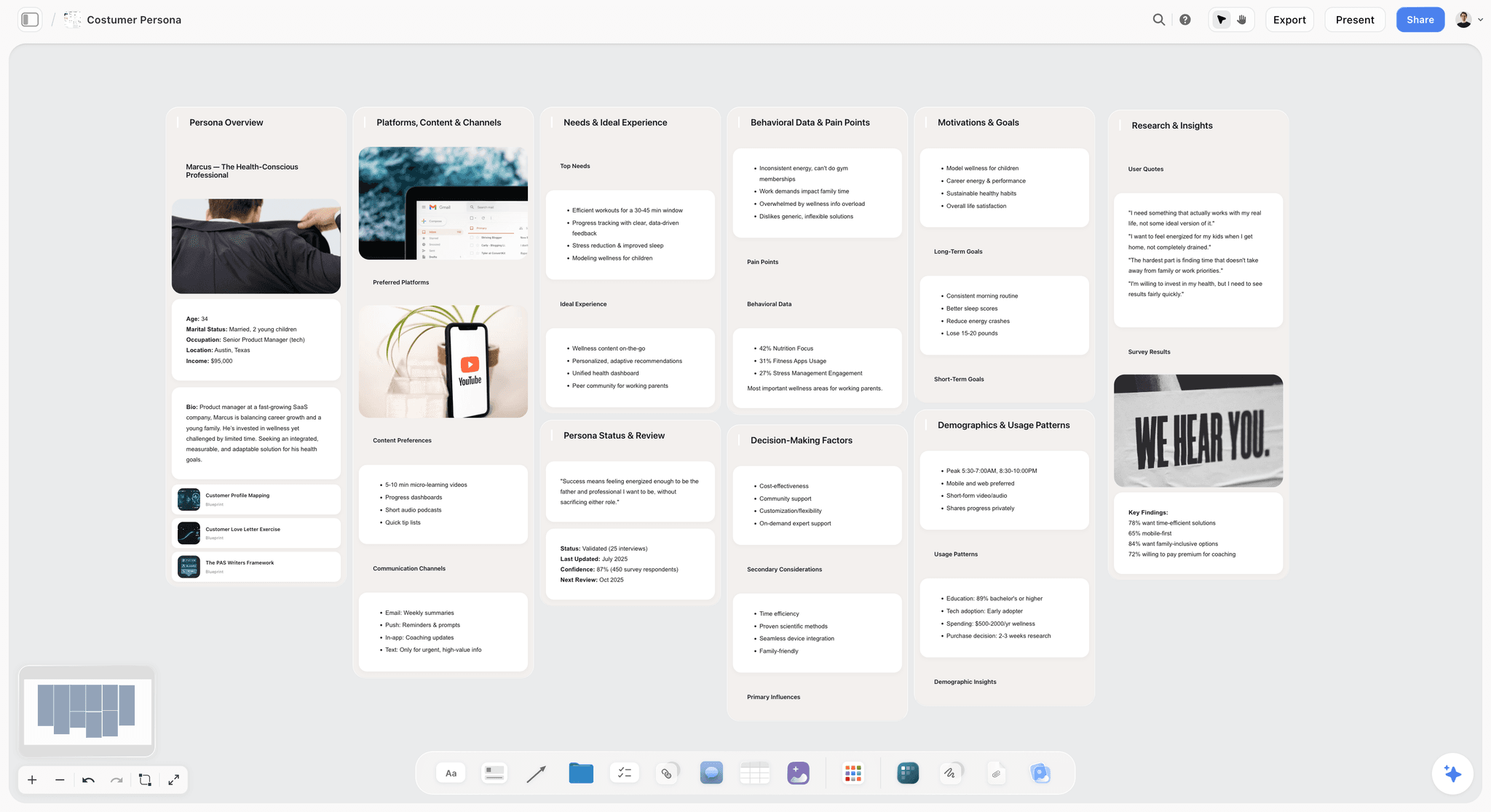
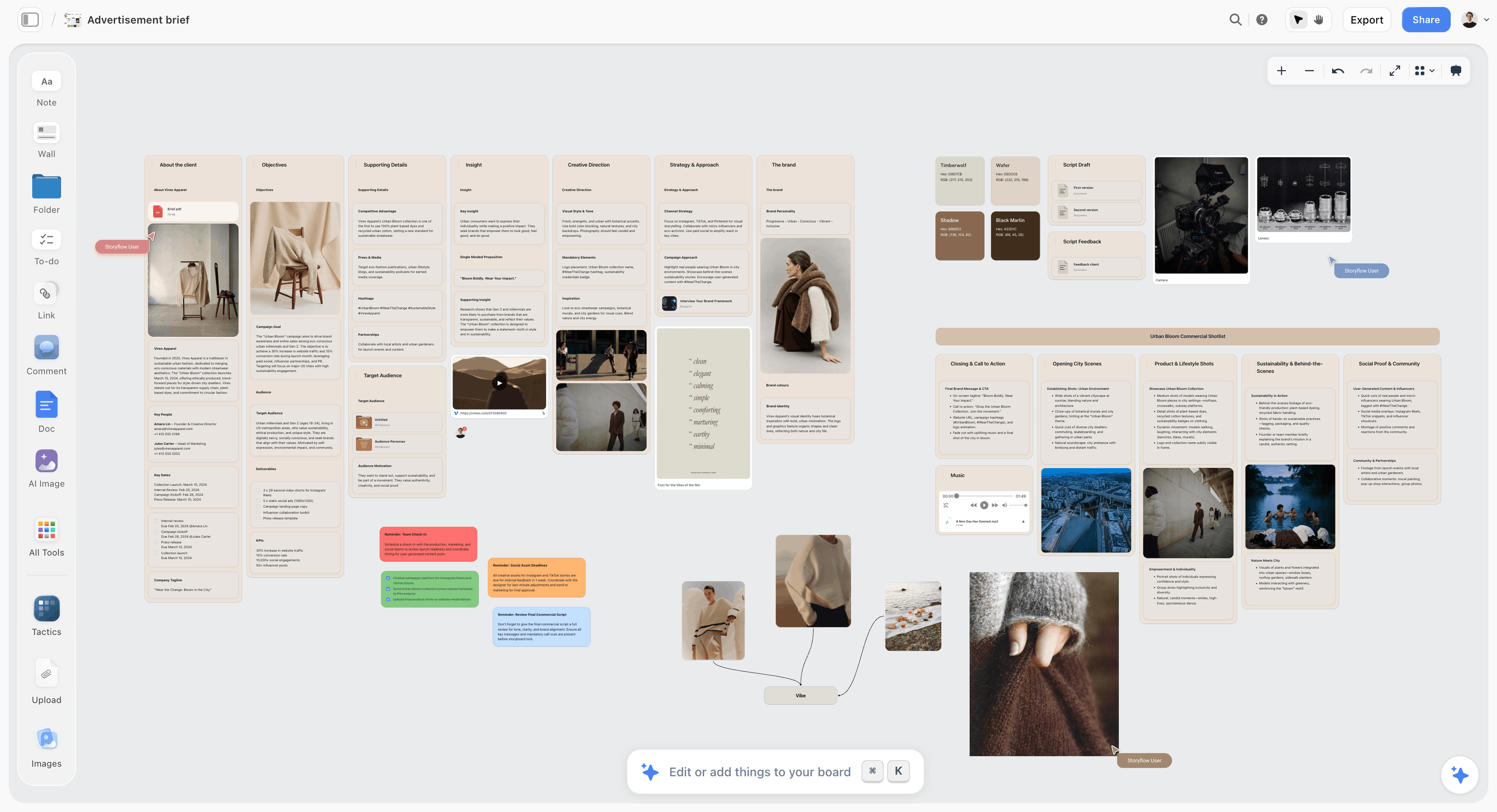
Storyflow is an infinite canvas where a creative team builds the client story in one place: the brief and the insight as notes and documents, the references as image and video tiles, the script in a document, the storyboard and the shot list as walls of cards, and the plan as tickets with assignees. Every invited collaborator edits the same board in real time with live cursors, on any paid plan. Board access is set per person (admin, edit or view), so a freelancer can be given edit access to one board and a client view access to another.
The AI is what turns the board into a teammate rather than a whiteboard. It reads the board you have open with every message, and you can attach up to 5 documents, 3 Tactics and 3 other boards from the "+" menu. Ask it to draft a Campaign Brief, an Advertising Brief, a Story Outline, a Beat Sheet, a Video Script or a Story Map, and it builds walls on the canvas you can edit; changes apply directly with one-click Undo per message. The AI proposes, and the team decides. For the visual half, "Storyboard a scene" lays a scene out as frames that can be AI-generated (Pro and Max), a web reference or left empty for the art director, and "Build a shot list" turns a script, a storyboard on the board or a shoot brief into shot cards or a table per scene.
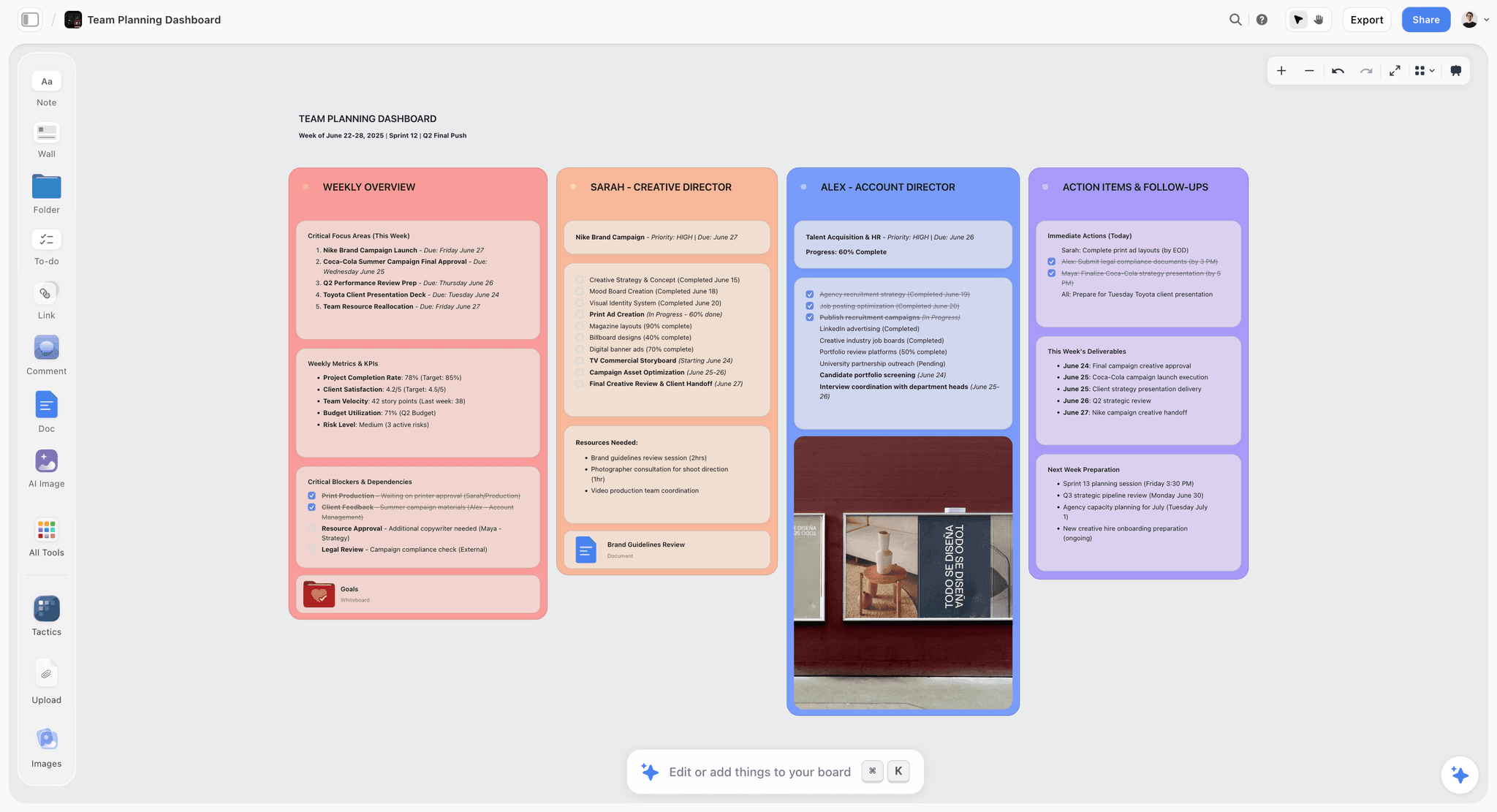
Showing the client is built into the same board. A view-only link opens with no account; a client who signs in can comment and draw freehand on the board. Presentation mode goes fullscreen and steps through the story one wall at a time with the arrow keys, and the frame list lets you reorder, hide or jump between stops for that session. When the client wants a file, the AI writes a Presentation PDF, Treatment PDF, Lookbook PDF or One-Pager PDF from what is on the board, and the whole board exports as an image or PDF.
Key features
- One infinite board per project holding notes, documents with inline comment threads, tables, images, video, audio, colour swatches, charts and tickets
- Live co-editing with cursors for every invited collaborator; board access levels admin, edit and view
- AI that reads the open board and looks at the images you select (up to 24), with attached documents and boards for more context
- Story and campaign workflows: Campaign Brief, Advertising Brief, Story Outline, Beat Sheet, Storyboard a scene, Build a shot list, Video Script
- Client view link with no account, sign-in to comment, and a presentation mode that steps one wall at a time
- Boards can be duplicated and saved as templates; a public Creative Briefs category has 8 ready-made ones
Pricing
Storyflow is paid-only during early access, with plans from $7.99 a month billed annually ($9.99 monthly). Pro is $14 ($19 monthly) and adds AI image generation; Max is $39 ($49 monthly) and adds the Team Workspace with permissions and roles. Its Free plan launches before the end of 2026, and anyone a paid member invites to a board joins free now, on free-tier limits. AI use is metered on every plan.
Pros
- The team builds one story on one surface instead of merging four files before the client meeting
- The AI drafts from the brief, references and script the team already put down, not from an empty box
- The client reviews the working board from a link, with no account needed to look
- Presentation mode means the board the team built is the thing the client sees
Cons
- It is not a finished-design tool: brand-perfect social assets and print layouts still belong in Canva or Adobe
- No approval workflow, approval labels or timecoded video comments; once there are cuts, add Frame.io
- A client on a view link can comment on the board but cannot open the inline comment threads inside a document; invite them as a collaborator for that
- Browser only: there are no native iOS, Android, Mac or Windows apps, and heavy canvas building is best on a laptop
- New and in early access, paid-only until the Free plan launches, with far fewer integrations than an established suite
Choose Miro instead if most of your storytelling happens in live, facilitated workshops with a large group, where timers, voting and a big template library matter more than carrying the story through to a client presentation.
2. Miro
Miro is the strongest live collaboration surface here for the early, messy part of storytelling. When a team needs to brainstorm angles, map a narrative or run a workshop where everyone drops sticky notes at once, it is the best-scoring tool on co-building. A podcast team mapping a season, an agency running a story sprint or a brand team aligning on a campaign idea can all work at once on an infinite board, and the facilitation tools (timers, voting, frames) keep a large group moving. Miro lists 32 storyboard templates, and its AI runs on credits per member.
The gap is that Miro is a meeting room, not the place the story finishes. The brainstorm rarely becomes the finished story: the team maps it in Miro, then rebuilds the script, the storyboard and the presentation somewhere else, and the AI works mostly at the sticky-note level. For pure real-time thinking together it is excellent. For carrying a story from the workshop to a client presentation, it hands off.
Key features
- Infinite whiteboard built for many simultaneous editors
- Facilitation tools: voting, timers, frames and a large template library, including 32 storyboard templates
- Mind maps and diagramming for narrative structure
- Broad integrations with team software
Pricing
Free plan with 3 editable boards and 10 AI credits a month; Starter $8 per member a month billed yearly (25 AI credits); Business $20 per member a month billed yearly. Yearly billing saves 20% against monthly.
Pros
- Best-in-class live group brainstorming
- Strong for mapping and restructuring a narrative early
- Facilitation features keep a large team aligned
Cons
- The mapped story usually migrates to another tool to finish
- AI works on notes and clusters more than on a whole story
- Every member is billed, and the free plan caps at 3 editable boards
3. FigJam
FigJam is Figma's whiteboard, and for a design team it is the most natural place to storyboard a product story, a campaign flow or an interface narrative, because it sits one tab from the design files. A Collab seat, $3 a month billed annually on Figma's pricing page, includes full access to FigJam and Figma Slides and view-and-comment access to Figma Design files, which makes it one of the cheapest ways to put a whole team on a shared board. Facilitation tools (timers, music, voting, stamps) and AI that sorts and summarises stickies make workshops quick.
The limit is the same as Miro's, with a design accent. FigJam holds the workshop and Figma holds the finished artefact, and neither holds the story's through line: the brief, the script and the reasoning live elsewhere. For a team whose storytelling output is designed rather than filmed, the pair covers a lot. For a team that owes a client a film or a campaign narrative, it is one stage of the job.
Key features
- Whiteboard in the Figma ecosystem, included in every paid Figma seat
- Timers, music, voting with hidden choices, stamps
- AI that sorts stickies by topic, colour or author and summarises a selection
- Imports Miro boards; exports the whole board as PNG, JPG or PDF
Pricing
Starter is free with 3 FigJam files. On Professional, a Collab seat is $3 a month billed annually (Full seat $16, Dev seat $12). On a paid plan, others can view and comment without extra seats.
Pros
- The cheapest paid seat here for a whole team
- One tab from the design files for Figma teams
- Viewers and commenters do not need a paid seat on a paid plan
Cons
- Built for workshops and design, not for script, storyboard and plan together
- AI works on stickies, not on a story as a whole
- Non-designers can find the Figma file structure confusing
4. Boords
Boords is the strongest dedicated storyboarding tool on this list, and it scores highest on structure among the specialists. Paste a script or a client brief and it converts it into a structured storyboard; the AI also turns a script into a shot list with camera angles and keeps characters consistent across scenes. Clients review without signing up, leave frame-specific comments and see approval status labels on each frame, and the animatic editor exports an MP4 with audio.
It is ranked fourth because it starts where most of this page's job ends. Boords assumes the story is decided and the work is now to board it and get it approved. For a team still working out what the story is, a panel grid settles questions that should stay open, and the brief, the references and the plan live somewhere else. Use it after the shape is agreed.
Key features
- Script or brief converted into a structured storyboard; AI shot list with camera angles
- No-signup client reviews, frame-specific comments and approval status labels
- Animatic editor with audio and MP4 export
- Version history and password protection on every plan
Pricing
Solo $26 a month billed yearly ($39 monthly, 1 user); Pro $50 ($75, up to 5 users); Team $85 ($125, up to 10); Agency $165 ($250, up to 30). Free trial.
Pros
- The clearest client approval loop for storyboards
- Script-to-storyboard AI for a story that is already written
- Pricing by plan with a user cap, not per reviewer
Cons
- Starts after the story is decided; weak for early development
- Holds panels, not the brief, references and production plan
- Priced higher than whiteboard seats for a small team
5. Canva
Canva is built for making a story look good, and for group visual production it is strong. Several people can work in a shared brand kit, drop into the same design, and turn a rough story into presentable slides, social posts, storyboards and one-pagers. For a marketing team or an agency that needs the output to look finished without a designer on every piece, the template library and drag-and-drop editor do a lot of lifting fast, and Canva Whiteboards give it an early-stage surface too.
Where it is thinner is the story itself. Canva helps a team decorate a narrative more than build one: there is little sense of arc, sequence or structure beyond the order of the pages, and the AI assists with individual designs rather than reading the whole story you are shaping. It is the best place on this list to make a story look professional, and a weaker place to decide what the story is.
Key features
- Large template library for decks, social, video, storyboards and print
- Shared brand kits and folders for team consistency
- Real-time co-editing and comments
- Magic Media and AI helpers for individual assets
Pricing
Free plan; on Canva's US pricing page (yearly view), Pro is US$144 a year for one person and Business US$250 a year per person. Prices vary by region.
Pros
- Fast, polished visual output that non-designers can produce
- Deep template and stock library
- Strong brand controls for a team
Cons
- Helps decorate a story more than structure one
- Per-person pricing adds up for a whole team
- Reviewers need a Canva account to comment
6. Milanote
Milanote feels the most like a story wall: drag in images, video stills, links and notes and arrange them in space until the narrative has a shape. For teams gathering references, building a moodboard or laying out the structure of a documentary or campaign, it is one of the calmest tools here, and its templates for creative briefs, storyboards and shot lists fit narrative work naturally. A read-only link opens without a sign-up, which makes client viewing easy.
Its limits for a team are the free plan and the AI. The free plan holds 100 notes, images or links and 10 file uploads, which a collaborating group reaches quickly, and the plans page lists no AI features, so developing the story from what you gathered is manual. Milanote gathers and arranges well; the developing and the presenting tend to happen elsewhere.
Key features
- Spatial boards for references, notes and story structure
- Templates for creative briefs, storyboards and shot lists
- Web clipper and built-in photo search
- Read-only links that need no sign-up
Pricing
Free with no time limit (100 notes, images or links; 10 file uploads). Paid plan $9.99 per person a month billed annually or $12.50 billed monthly; $49 a month billed annually for a team.
Pros
- Excellent for visual arrangement and moodboards
- Templates map cleanly to narrative work
- Calm, uncluttered surface for a small group
Cons
- The free plan's item cap is tight for a team
- No AI listed to develop the story from the board
- Lighter on documents, tables and planning than a full workspace
7. Google Slides
Google Slides is the co-editing tool most teams already have, and for a linear story deck it is hard to beat on collaboration and price. Anyone with a Google account can create in Slides; several people edit the same presentation at once with live comments, and revision history lets you return to an earlier version. For an internal update, a client status deck or the final presentation of a story built elsewhere, it is a familiar surface where everyone can build together.
The trade-off is range and structure. Slides is a rectangle-after-rectangle format, so the story is only ever as strong as a sequence of pages, and it offers no help shaping an arc or bringing references, video and a shot list into one view. It is one of the best real-time co-editing experiences here and one of the plainest for storytelling craft.
Key features
- Live editing and comments
- Revision history to revert to earlier versions
- Works in any browser, exports to common formats
- Templates and simple transitions
Pricing
Free with a Google account; Google Workspace plans add admin and storage, priced per user by region.
Pros
- Frictionless real-time co-editing
- Free and familiar to every client
- A reliable delivery format for a finished deck
Cons
- Linear slides limit narrative shape
- Thin visual range compared with a canvas
- No AI described on the Slides product page
8. Adobe Express
Adobe Express is the quick-turnaround pick for teams that need branded story assets fast: social posts, short videos, flyers and simple animations, pulling from shared brand kits. On the Teams plan, colleagues co-edit and comment in real time and share brand kits, and the Adobe Stock library behind it is deep. For a marketing team that lives on social, it produces on-brand pieces quickly, and it sits comfortably next to Creative Cloud.
Like Canva, it is a production tool more than a storytelling one. Express helps a team make the pieces of a story look right; it does little to help them build the narrative that connects those pieces, and its AI generates and edits assets rather than developing the story. It is a strong output engine and a thin story workshop.
Key features
- Quick branded social and video assets
- Brand kits, real-time co-editing and commenting on Teams
- Generative credits for images and text effects
- Large Adobe Stock library
Pricing
Free plan; Premium US$9.99 a month billed monthly with 250 generative credits a month. Teams is an annual plan per licence with a 2-seat minimum, priced by region.
Pros
- Fast, on-brand asset production
- Deep stock and Adobe ecosystem
- Approachable for non-designers
Cons
- Produces pieces, not narrative structure
- Collaboration is asset-level, not story-level
- AI focused on assets, not on your story
9. Genially
Genially is the pick when a team wants the story itself to be interactive: clickable hotspots, animations, embedded media and branching that turn a flat narrative into something the audience explores. For a launch microsite story, an onboarding experience or a sales story people click through rather than scroll past, it adds a dimension the other tools here do not. Genially's plans page lists real-time collaborative editing (check which tier your team needs before buying), and a team can publish the piece as a link.
The cost of that interactivity is a steeper build. Designing the interactions takes time, the free plan is limited, and the tool is weaker as the place a team works out the underlying story. Genially is excellent at the finished interactive artefact; develop the story first, then build it here.
Key features
- Interactive elements: hotspots, buttons, branching
- Animations and embedded media
- Real-time collaborative editing listed on the plans page; team spaces from Master
- Publish as a live link
Pricing
Genially's plans page shows prices in euros, billed annually: Free (500 AI credits a year), Pro EUR 6 a month, Master EUR 20 per member a month, Author EUR 40 per member a month on team plans.
Pros
- Genuine interactivity most tools lack
- Strong for audience engagement and launches
- Shareable, living output
Cons
- Interactions take real time to build
- Weak as a story development surface
- Prices published in euros only on the page we checked
10. Frame.io
Frame.io is where the story goes once it is footage. Reviewers open share links without signing up or logging in, leave comments pinned to an exact frame or a range, and the team stacks versions so the client always sees the latest cut. It scores 10 on client review, and it is on this list because a video story is not finished until the cuts are approved, and this is the tool built for that half.
It is ranked last for this page's job because it holds nothing about why the story is shaped the way it is. There is no brief, no script, no storyboard and no plan in Frame.io, only the cuts. Treat it as the review stage, not the project home, and pair it with the tool where the story was built.
Key features
- Frame-accurate and range-based comments on every plan
- Share links that need no sign-up or log-in
- Version stacking for cuts
- Included in some Adobe Creative Cloud plans
Pricing
Free for up to 2 members; Pro $15 per member a month billed monthly (up to 5 members); Team $25 per member a month billed monthly (up to 15); 13% off with annual billing; Enterprise custom.
Pros
- The clearest review loop for video
- Reviewers never need an account
- Tight fit with Adobe editing tools
Cons
- Not a place to build a story
- Useful only once footage exists
- Per-member pricing for the team that uploads
Which Tool for Each Stage of a Client Story
A creative team's story moves through five stages. The question for each is what the team needs at that stage and whether the tool that holds the story can do it, or whether a specialist should be added.
| Stage | What the team needs | Storyflow's part | Specialist worth adding |
|---|---|---|---|
1. Brief and insight | One agreed version of the client's ask | Ask the AI for a Campaign Brief or Advertising Brief as walls the team fills; attach the client's document | None needed |
2. References and direction | Images, colour and tone in one view | Collect inspiration drops reference tiles; the AI looks at the images you select (up to 24) | Milanote or Pinterest for long-running reference libraries |
3. Story and script | Arc, beats and a draft everyone can edit | Story Outline, Beat Sheet and Video Script workflows; documents with inline comment threads | Arc Studio or WriterDuet for a feature-length screenplay |
4. Storyboard and shots | Frames the client can picture, a shot list the crew can use | Storyboard a scene and Build a shot list, from the script or the storyboard on the board | Boords when the client needs animatics and approval labels |
5. Client presentation and delivery | A walkthrough, then a file | Presentation mode one wall at a time; Presentation, Treatment or Lookbook PDF | Canva or Adobe Express for final assets; Frame.io for cuts |
The pattern: one tool holds the through line, and specialists join at the stage they are best at. The expensive mistake is the reverse, where four specialists each hold a stage and nobody holds the story.
Which Tool Lets a Whole Team Co-Edit One Presentation?
Some searches that reach this page ask a narrower question: which presentation tool lets a whole team co-edit one deck. The answer depends on whether the deck is the story or the delivery of a story built somewhere else.
If the deck is the delivery: Google Slides is the plainest answer, with live editing, comments and revision history for anyone with a Google account. Figma Slides is included with every Figma seat and adds presenter notes and co-presenting control, which suits design teams. Canva works when the deck must be on-brand and the whole team already has Canva seats.
If the deck is the story: the problem is usually the work behind the deck, not the deck. Storyflow skips the rebuild: the team presents the board it built, one wall at a time, and when the client needs a file the AI writes a Presentation PDF from the board. It is not an editable slide file, so a client who wants to edit slides themselves still needs Slides, Figma Slides or Canva.
| Need | Pick | Why |
|---|---|---|
Whole team co-authors the story and presents it | Storyflow | The presented board is the working board; the client views with no account |
A free, linear deck everyone can edit | Google Slides | Live editing and comments, free with a Google account |
A deck inside the design system | Figma Slides | Included with every Figma seat, co-presenting control |
An on-brand deck from templates | Canva | Brand kits and a large template library |
For a deeper comparison of deck tools for agencies, see how agencies present campaign concepts and Figma Slides vs Canva vs Pitch vs Gamma.
Worked Example: One Campaign Story, Five People, Five Days
An illustrative plan for a five-person agency team (strategist, copywriter, art director, producer, account lead) telling the story of a sportswear brand's trail-shoe launch as a 30-second film and a social cut-down. It shows who touches the story each day and what the client sees, so you can copy the shape into any tool.
| Day | What happens on the board | Who leads | What the client sees |
|---|---|---|---|
Monday | The client's brief is attached and the AI drafts a Campaign Brief as walls; the team corrects audience, goals and timeline | Strategist | Nothing yet |
Tuesday | 12 to 16 references collected; the art director selects the strongest and asks the AI which ones match the brief's tone; a colour moodboard is added | Art director | The reference wall, from a view link, with comments |
Wednesday | The copywriter drafts the script in a document; the AI proposes a beat sheet; the team edits both live | Copywriter | The script document on the board |
Thursday | The AI storyboards the key scenes (empty frames for the art director to fill, or web references); the producer asks for a shot list from the storyboard | Producer | The storyboard wall, comments by signed-in reviewers |
Friday | The account lead orders the walls in presentation mode and walks the client through; the AI writes a Treatment PDF to send the client | Account lead | The presentation, then the PDF |
Three things this example shows that a split stack hides. First, the client's Tuesday comment on the references lands on the same board the storyboard is drawn on Thursday, so it is not lost in an email thread. Second, nobody rebuilds the story as slides on Thursday night. Third, after the shoot, the cuts go to Frame.io while the story stays on one board. The same week in a split stack (a Miro workshop, a Google Doc script, a Milanote reference board, a Canva deck) works, but someone has to own the reconciliation, and that person should be named on Monday.
The Collaboration Test: 10 Checks to Run Before You Commit
Vendor pages all say "collaborative". This checklist turns the word into ten things a team can check in an hour, with two people and a private browser window.
| Check | How to run it | What a pass looks like |
|---|---|---|
1. Same-moment edits | Two people edit the same card or text block at once | Both edits survive; each sees the other's cursor |
2. Client view with no account | Open the share link in a private window | The story opens without a sign-up |
3. Client comment cost | Leave a comment as the client | Clear rule: which account it needs, and no paid seat |
4. Freelancer cost | Invite a freelancer to one project only | They see only that project; the bill does not jump |
5. Mixed material | Put a script, 3 images, a video and a table on one surface | Nothing needs a second app to open |
6. Restructure | Move act two ahead of act one | Under a minute, with nothing lost |
7. Present | Walk someone through without building a deck | A presentation mode on the same file |
8. Export | Send the whole story as a PDF | One file the client can forward |
9. AI on your material | Ask the AI a question about what the team put down | The answer cites your brief or script, not generic advice |
10. Undo a colleague | Reverse a change someone else made | Undo or version history recovers it |
Score each check pass, partial or fail. A tool that fails check 2 or 3 will cost you in friction every week the client is involved; a tool that fails 5 or 6 will cost you a rebuild at the end. Run the same ten checks on every shortlisted tool and the ranking above becomes your own.
How to Run a Team Story in Storyflow
The short version, using the workflows that exist today. The full walkthrough for creative teams lives in how creative teams collaborate on a story.
- Create one board for the project and invite the team; set each person to edit or view. Invited collaborators join free on free-tier limits.
- Attach the client's brief and ask the AI for a Campaign Brief or an Advertising Brief. Edit the walls it builds until the team agrees.
- Ask the AI to collect inspiration, add your own references, then select the images that matter and ask what they have in common.
- Ask for a Story Outline or Beat Sheet, then draft the script in a document on the board with inline comment threads.
- Ask the AI to storyboard a scene and build a shot list from the storyboard.
- Share a view link with the client; they open it with no account and sign in to comment.
- Present one wall at a time, then ask the AI for a Presentation PDF or Treatment PDF.
If a workshop board already exists in Miro, Milanote or FigJam, the "Import a board" workflow rebuilds it from a screenshot; there is no file import.
Also Considered: Tools That Did Not Make the List
Padlet. The fastest way to get a large group posting to one wall, which is why classrooms use it. Superb at collecting contributions and weaker at shaping them into a structured client story. Education teams should read the best digital storytelling tools for education instead.
Prezi. A zooming, non-linear presentation canvas. When the zoom fits the story, the effect is memorable; for most client work it takes practice to build and leans toward one author crafting the motion.
Powtoon. Drag-and-drop animated explainer videos. The right last-mile tool when the story is an animated explainer, and not a place a team develops the story.
Notion. Strong for the written half of storytelling (the research, the treatment, the character notes, the schedule) and weak for the shape, because a Notion page is a stack of blocks with no native canvas. Keep it for the archive and put the shape on a canvas.
Arc Studio, WriterDuet and Final Draft. The right answer for a room writing a screenplay together. Unranked because a screenplay is one output of a team's story and non-writers on the team cannot work in them.
Storyboard That and Storyboarder by Wonder Unit. Storyboard That is template-driven and aimed at education; its free plan allows 2 storyboards a week. Storyboarder is free and open source for sketching frames, a single-user tool with no cloud collaboration.
Twine. Free and open source for branching interactive fiction. A different problem from a team shaping a client story.
Digital Storytelling for Different Kinds of Creative Team
The ranked list assumes a creative team shaping a narrative for a client or a launch. The kind of team changes which second tool you add.
| Kind of team | What dominates the choice | Best pick | Add | What fails here |
|---|---|---|---|---|
An agency presenting to clients | Working board and a presentable version | Storyflow | Canva for final assets | One document trying to be both |
A video or commercial studio | Script to storyboard to shot list, then cuts | Storyflow | Frame.io for cuts, Boords for animatics | A whiteboard with no shot list |
An in-house brand team | Approvals from people who were not in the room | Storyflow | Canva or Adobe Express | A raw workshop board shown to a stakeholder |
A design or product team | Staying next to the design files | Storyflow for the story, FigJam for the workshop | Figma Slides | A deck tool that forces linearity early |
Distributed across time zones | Whether the story reads to someone arriving alone | Storyflow | Google Slides for the final deck | Facilitation-led tools, whose value is live |
A team making an interactive piece | Clickable, explorable output | Storyflow for the script and structure | Genially for the build | A canvas presented as if it were the product |
For wider context on the category, see what digital storytelling is, what visual storytelling is and the landing page on collaborative storytelling.
The Bottom Line
A team's story fails when only one person can assemble it and the client sees a version nobody worked in.
Storyflow ranks first because it scores highest on the combination this reader needs: the whole team co-builds the brief, references, script, storyboard and shot list on one canvas, the AI drafts from what the team put there, and the client views the same board from a link with no account. Its honest limits are real: no approval workflow, no timecoded video comments, browser only, and paid-only during early access. Miro wins the live workshop, FigJam wins for Figma teams, Boords wins the storyboard approval loop, Canva wins polished assets and Frame.io wins review of cuts. Put the story in one place, and let each specialist join at its stage.
FAQ: Digital Storytelling Tools for Teams
Is Storyflow free for a creative team?
Not during early access. Every plan is paid (from $7.99 a month billed annually), and subscribing requires a card. The Free plan launches before the end of 2026. What is free now is joining: anyone a paid member invites to a board joins free on free-tier limits, and a client who only needs to look opens a view link with no account at all.
What are the top creator-focused apps for visual storytelling?
For a creator who owes a sponsor or a channel a video, the job is planning the story, then making the assets. Storyflow covers the planning: ask the AI for a YouTube Video Plan, a Video Script or a Content Planner with a calendar wall of ten tickets, and the references sit beside it. Canva and Adobe Express then make the thumbnails and social cuts. A solo creator can skip the collaboration features; the planning half is the same.
Which data storytelling platforms support teamwork?
Data storytelling splits in two. The numbers belong in a BI or charting tool your analysts already use, where the data stays live. The narrative around them (the claim, the order of the charts, the one slide the executive reads) is a team writing job, and a shared canvas suits it: Storyflow has a Chart tool on the canvas next to notes and documents. The distinction is set out in what data storytelling is.
What is the best map storytelling platform for team collaboration?
For stories built on maps, Esri's ArcGIS StoryMaps is the specialist. Co-authors are added to a shared update group an administrator creates; if two people open the builder at once, a notification shows who else is editing and when, and continuing can overwrite their changes (Esri co-author help). None of the ten tools above is a mapping product; use one of them to plan the story, then build it in StoryMaps.
What are the best platforms for visual storytelling online?
For a team, the three that hold the most visual material in one browser tab are Storyflow (images, video, colour swatches, storyboards and documents on one board), Miro (a whiteboard with images and templates) and Canva (design output). All three run in the browser with nothing to install. The difference is what the visuals are for: building the story, workshopping it, or finishing it.
What is the best digital storytelling platform for beginners?
For a beginner on a team, the easiest start is a tool that proposes a first draft for you to edit: Storyflow's AI builds a Story Outline or Campaign Brief as walls you then change, so nobody faces a blank canvas. Google Slides has the lowest learning curve of all, because everyone has used a deck. The easiest digital storytelling tools covers the beginner case in depth.
What are the best digital brainstorming tools for creative teams?
For the brainstorm itself, Storyflow, Miro and FigJam. Storyflow keeps the brainstorm on the board where the story will be built, so the ideas do not have to move. Miro has the deepest facilitation kit for a large live session. FigJam is the cheapest seat for a design team and adds voting with hidden choices. The deciding question is whether the brainstorm output has to travel to another tool afterwards.
What tools help a team brainstorm and structure a piece of creative writing?
Structure before prose. Storyflow's Beat Sheet, Story Outline and Story Map workflows lay the structure out as walls the whole team can rearrange, and Character Sheet and World Building boards hold the reference material. The draft itself then goes in a document on the same board, or in Arc Studio or WriterDuet if it is a screenplay the writers will format. Plotting and drafting in the same tool is optional; agreeing the structure first is not.
Can we move an existing Miro or FigJam board into Storyflow?
Partly. Storyflow's "Import a board" workflow rebuilds a board from a screenshot, so a workshop board becomes editable notes and walls on the canvas. There is no file import from Miro, FigJam or Milanote, so comments, version history and embedded files do not come across. FigJam, by contrast, imports Miro boards exported as PDF, which matters if your team is choosing between those two.
Can we present the story to a client from the same Storyflow board?
Yes. Presentation mode goes fullscreen and steps through the board one wall at a time, with arrow keys or Previous and Next, zooming to fit each stop. Walls, images, notes, documents and tables are stops; nested boards and kanban are not. The frame list lets you reorder, hide or jump, but that order resets when you leave presentation mode, so rehearse it right before the meeting. There is no recording.
Does Storyflow work on a phone or tablet for client review?
In the browser, yes: phones and tablets handle viewing, light editing and the AI chat, and a client can open a view link on a phone. There are no native iOS, Android, Mac or Windows apps, and heavy canvas building is best on a laptop. Milanote has iPhone and iPad apps, which matters if your team works on set from phones.
Do we still need Frame.io if the story is built in Storyflow?
For video review, usually yes. Storyflow's Video tool uploads, plays and scrubs video and can grab a frame onto the board, which is enough for references and rough cuts. It has no timecoded comments, version stacking or approval states. Frame.io has all three and reviewers need no account, so most video teams build the story in one and review the cuts in the other.
What should a team of five budget per year for a storytelling stack?
A lean stack for a five-person video team, at the prices on this page: Storyflow with five Plus seats on Team billing ($27.97 a month billed annually, about $336 a year) plus Frame.io Pro for five ($75 a month billed monthly, 13% less billed annually). A design-led team might swap Frame.io for five FigJam Collab seats ($15 a month billed annually). A Canva Business seat for each person adds US$1,250 a year.
Can Storyflow's AI generate images for a storyboard?
On Pro ($14 a month billed annually) and Max, yes: the AI Image tool generates pictures on the canvas, and "Storyboard a scene" can fill its frames with AI images. On Plus, frames are left empty for an artist or filled with a web reference, captioned "Reference". Generated images are metered like all AI use, so a team boarding a long script should budget for Pro or Max seats for whoever draws.
What should a large organisation look for in a presentation tool with brand controls?
Three controls: who may edit (roles), what they may use (a locked brand kit of logos, colours and fonts), and who administers seats. Storyflow's Max plan adds a Team Workspace with permissions and roles, but it has no brand kit, so it controls who builds the story rather than how the final slides look. Adobe Express Teams lists brand kits and an Admin Console on an annual plan with a 2-seat minimum. Canva's brand kits cover the same ground.
Table of Contents
- Comparison Table: 10 Digital Storytelling Tools for Teams Compared
- The 10 Best Digital Storytelling Tools for Teams, Ranked
- Why a Team's Story Breaks Between Tools
- How We Scored These Tools
- Frequently Asked: Which Digital Storytelling Tools Creative Teams Trust, and What They Cost
- Digital Storytelling Tool Costs for a Team of Five
- Collaboration Feature Matrix: Who Can Edit, View and Comment
- Frequently Asked: Which Digital Storytelling Tools Teams Trust, and What They Cost
- Digital Storytelling Tool Costs for a Team of Five
- Detailed Reviews: 10 Digital Storytelling Tools for Teams
- Which Tool for Each Stage of a Client Story
- Which Tool Lets a Whole Team Co-Edit One Presentation?
- Worked Example: One Campaign Story, Five People, Five Days
- The Collaboration Test: 10 Checks to Run Before You Commit
- How to Run a Team Story in Storyflow
- Also Considered: Tools That Did Not Make the List
- Digital Storytelling for Different Kinds of Creative Team
- The Bottom Line
- Author
- FAQ: Digital Storytelling Tools for Teams
- Related Reading
Templates to check out for this topic


Templates you can use in Storyflow
Every Storyflow board starts from real structure and an AI that reads the whole canvas. Open one of these templates and make it yours.


See Storyflow in Action
A visual AI workspace where every feature lives inside one canvas. No tab-switching, no context lost.
Build your entire board from a single message
Type what you need in the AI chat at the bottom of your canvas. The AI adds cards, headings, and structure directly onto your board.
Use expert frameworks as AI context
Type @ in the AI chat and choose any Tactic. The AI tailors every response to that framework instead of giving generic advice.
Turn your board into a mind map in seconds
Ask the AI to restructure your canvas as a mindmap. It connects your ideas into a visual hierarchy so you can see how everything relates.
Why Storyflow Exists
Storyflow actually began as a personal tool while working on creative and research projects.
We kept running into the same problem: ideas were scattered everywhere: notes, documents, and whiteboards.
Nothing helped us see how everything connected.
So we started building a workspace designed around how ideas actually grow.
→ Read how Storyflow was createdJustkay
Documentary Filmmaker & Founder at Storyflow
Published: 2026-07-20
Extremely simple, seriously capable


See how easy it is to get started
Watch a real project come together, from a blank board to a finished plan, clicked through step by step.
Start creating with AI and become more productive
Transform your creative workflow with AI-powered tools. Generate ideas, create content, and boost your productivity in minutes instead of hours.