10 Best Miro Alternatives for Creative Teams in 2026 (Scored and Ranked)
Storyflow is the best Miro alternative for creative teams: its AI builds the brief, moodboard, plan and deck from a brief. FigJam, Mural, Milanote compared.

Category
Visual Thinking
Author

Justkay
Documentary Filmmaker & Founder at Storyflow
Topics
2026-08-06
•
Updated October 11, 2026
•
40 min read
•
Visual Thinking- best Miro alternative for creative teams
- Miro alternatives
- Miro competitors
- apps like Miro
- Miro alternative for agencies
- Storyflow
What is the best Miro alternative for creative teams in 2026?
Storyflow is the best Miro alternative for creative teams and agencies in 2026: Miro is a workshop whiteboard, while Storyflow's AI builds the working board (campaign brief, moodboard, storyboard, shot list, dated plan or deck) from a client brief or script and keeps references, plan and deliverable on one infinite canvas, reachable from ChatGPT and Claude. Choose FigJam if the team designs in Figma, Mural for Miro-style facilitation with voting and timers, and Milanote for reference boards arranged by hand. Storyflow has no voting, no timers and no free plan yet.

Full disclosure: Storyflow is our own product and it is listed first. The basis of the order is the creative job: a client project that lives on the board from brief to deliverable, with an AI that builds the brief, moodboard, plan and deck from what is on it. The order is not based on workshop facilitation or price per seat: weight facilitation heavily and Mural or Miro itself wins, for product design FigJam does, and FigJam is cheaper per editor. Storyflow has no voting or timers, runs in the browser only, exports decks as PDF and not PowerPoint, and has no free plan today. This is a comparison from each vendor's own documentation and pricing pages, read on October 11, 2026, plus our own use of Storyflow, and every sub-score is printed so you can re-weight it.
How the Miro alternatives compare on trust, innovation, scores and pricing
Which Miro alternatives are the most trusted by creative teams?
For a creative team, trust means the board still holds the client project in week six and a client can look without an account. Storyflow scores highest on that here: a Storyflow board keeps the brief, references and plan together and opens from a view-only link. FigJam carries Figma's track record and is the trusted pick for design-led teams. Mural is the trusted pick for enterprise workshops, and a cautious enterprise buyer who needs a long vendor history should start with Mural or FigJam.
Which Miro alternatives are the most innovative?
Storyflow, on what happens after the kickoff: Storyflow's AI builds a campaign brief as ten walls and a dated plan worked back from the delivery date, lays out about twelve reference tiles for a moodboard, and builds a one-pager, lookbook or pitch deck from the board. Storyflow also works from inside ChatGPT and Claude through its MCP connector. FigJam is second, for keeping the board one tab from the design file with AI credits. Mural is third, for facilitation. Excalidraw is the most interesting model outside the top three: open source, with a self-hosting option.
Which Miro alternatives score highest for creative teams?
On this page's weights (studio fit 25%, creative material 20%, AI on the board 20%, collaboration 15%, workshop parity 10%, price 10%): Storyflow 8.70, FigJam 7.80, Mural 6.85, Milanote 6.75 and Canva Whiteboards 6.10. Milanote falls to fourth because its plans page lists no AI. Put 40% on workshop parity and Mural moves to the top, above Storyflow.
Which Miro alternatives have fair and transparent pricing?
Storyflow publishes every plan with both billing periods: Plus is $7.99 a month billed annually ($9.99 monthly), there is no free plan today, and anyone a paid member invites to a board joins free. FigJam's $3 Collab seat billed annually, with viewers and commenters free, is the cheapest paid seat here. Mural publishes Team+ at $9.99 per member billed annually ($12 monthly). Miro lists Starter at $8 and Business at $20 per member billed annually, with annual billing saving 20% against monthly.
Which Miro alternatives have performed consistently over the years?
Mural and Lucid have run for over a decade, matching Miro's own record. FigJam launched in 2021 and inherits Figma's file stability. Excalidraw's open-source code means a board does not depend on one vendor staying in business. Storyflow is the pick for a team that judges a tool by what its AI builds on a live client job; a buyer whose procurement requires a decade of vendor history should start with Mural.
Quick Comparison: Best Miro Alternatives for Creative Teams
Storyflow first, then the three tools creative teams most often weigh against it when they leave Miro: a Figma-native canvas, a like-for-like workshop room and a quiet reference board.
| Tool | Best For | AI Features | Price |
|---|---|---|---|
| Storyflow | Creative projects from brief to deliverable | AI builds the brief, moodboard, plan and deck from a brief or script | $7.99 mo billed annually |
| FigJam | Figma-native creative teams | Yes, on monthly AI credits | Free (3 files) / $3 Collab seat mo annual |
| Mural | Workshop parity with Miro | Mural AI for clustering and summaries | Free (3 editable murals) / $9.99 member mo annual |
| Milanote | Quiet reference boards | None listed on its plans page | Free (100 notes) / $9.99 mo annual |
Move one project from the meeting room to a studio
Storyflow holds the moodboard, the brief, the drafts and the plan on one canvas, and the AI builds from the board you have open. Plans from $7.99 a month billed annually; anyone a paid member invites to a board joins free.

1) Quick Answer: The Best Miro Alternative for Creative Teams and Agencies
Storyflow is the Miro alternative to choose when the board has to become the deliverable: attach a client brief and Storyflow's AI builds a ten-wall campaign brief, then the reference moodboard, a dated plan and a deck or PDF on the same infinite canvas, which the client opens from a link with no account. FigJam is the better pick if your team already designs in Figma, Mural if what you want is Miro's workshop and facilitation side from another vendor, and Milanote if all you need is calm reference boards with no AI.
Last updated October 11, 2026. Storyflow is our product and is listed first; the basis of the order is the creative job (a client project that lives on the board until delivery), not workshop facilitation and not price per seat. Competitor prices were read on each vendor's own pricing page on October 11, 2026.
What makes a good Miro alternative for a creative team? Four things: the canvas holds real creative material (images, documents and tables, not just stickies), a project can live there until delivery, collaboration works both live and async (including for a client who will not make an account to look), and the AI works from what is on the board instead of sitting beside it as a chatbot.
Key takeaways:
- Storyflow is the first pick for creative teams (8.7 of 10 on our weights): Storyflow's AI turns a client brief into a visual project board (a ten-wall campaign brief), then adds the reference moodboard, a dated plan and PDF deliverables on the same canvas.
- FigJam (7.8) is the cheapest sensible swap for Figma teams, at a $3 Collab seat per month billed annually, which Storyflow does not beat on price. Mural (6.85) is the closest like-for-like workshop replacement.
- Milanote (6.75) is still the calmest pure reference board; it scores lower here because its plans page lists no AI and it has no live facilitation.
- Miro's lowest paid price is Starter at $8 per member per month billed annually; the free plan caps you at 3 editable boards, which is the usual trigger for looking.
- Product and UX teams are the audience this post does NOT serve: for user flows, diagrams and design sprints, stay with Miro, FigJam or Lucidspark.
All 10 Tools, Ranked
- Storyflow: best for creative projects from brief to deliverable, with an AI that builds the board from the brief
- FigJam: best for creative teams inside the Figma ecosystem
- Mural: best like-for-like workshop replacement for Miro
- Milanote: best pure reference boards, with no AI
- Canva Whiteboards: best when the team already designs in Canva
- Whimsical: best for fast, clean thinking diagrams
- Padlet: best for light shared boards with outsiders
- Apple Freeform: best free canvas for all-Apple teams
- Excalidraw: best free sketching with zero friction
- Lucidspark: best brainstorm layer for Lucidchart shops
For the wider category, including solo use, see The 12 Best Miro Alternatives in 2025. The Storyflow Miro alternative page maps Miro features to their Storyflow equivalents.
2) What Are Some Alternative Options for Miro?
The main alternative options for Miro are Storyflow (an AI workspace that builds a creative project board from a brief), FigJam (the whiteboard beside Figma files), Mural (facilitated workshops), Milanote (reference boards arranged by hand), Canva Whiteboards, Whimsical and Lucidspark (design, flows and diagrams), and Apple Freeform, Excalidraw and Microsoft Whiteboard (free). Pick by the job, not the brand.
Storyflow is paid, so if the budget is zero the honest options are Apple Freeform, Excalidraw and Microsoft Whiteboard, and Miro's own free plan for three boards.
3) Comparison Table: 10 Miro Alternatives Scored for Creative Teams
Storyflow scores highest for creative teams at 8.70 out of 10, ahead of FigJam at 7.80 and Mural at 6.85. Every total below is the weighted sum of the six sub-scores (weights in "How We Scored These Tools"): Studio fit 25%, Creative material 20%, AI on the board 20%, Collaboration including clients 15%, Workshop parity with Miro 10%, Price at team size 10%. Sub-scores are out of 10.
Scoring note: competitors were compared from their own pricing and product pages, not from hands-on project tests, and Storyflow was scored on its current workflows. Excalidraw and Lucidspark tie, and Excalidraw is listed first for its free core. Re-weight the columns for your own team: put 40% on workshop parity and Mural overtakes everything here, Storyflow included, which is the honest reason the "Where Miro and the Specialists Still Win" section exists.
What a Miro replacement actually costs a creative team
The reason teams look for an alternative is rarely Miro's headline price; it is that the free plan caps editable boards instead of collaborators, so the fourth client project arrives long before the budget does. Rows follow the ranking, with Miro as the reference in the last row.
The pricing question that decides this for a creative team is who gets billed. FigJam bills editors and lets viewers and commenters in free. Mural lets visitors into specific murals free on every plan. Storyflow bills per seat, a client opens a view-only link without an account, and anyone a paid member invites to a board joins free. For a team of three designers and six people who only ever comment, who gets billed matters more than any per-seat price on this page. Official pages: Miro pricing, Mural pricing, Figma pricing, Milanote plans.
What is Miro's lowest price in 2026?
Miro's lowest paid plan is Starter at $8 per member per month billed annually, and Business is $20 per member per month billed annually; annual billing saves 20% against monthly on Miro's billing toggle. The free plan gives 3 editable boards and 10 AI credits a month, and Enterprise is custom from 30 members. For a five-person agency on Starter that is $40 a month billed annually before anyone outside the team is added.
Is there a cheap Miro alternative?
Yes: the cheap Miro alternatives are FigJam at $3 per Collab seat a month billed annually, and the free tools (Apple Freeform, Excalidraw and Microsoft Whiteboard inside Microsoft 365). Storyflow Plus at $7.99 a month billed annually is one cent under Miro Starter per seat, so Storyflow is the pick for what its AI builds, not for the price. Miro itself is cheapest on its free plan, for three editable boards.
4) Frequently Asked: Which Miro Alternative Brands Do Agencies and Designers Trust?
Which Miro alternative gives an agency the best value?
Storyflow, on our weights: a Storyflow Plus seat is $7.99 a month billed annually, team discounts start from 3 seats, and the client reviews from a view-only link with no seat. Storyflow's AI builds the working board from the brief (a ten-wall campaign brief, then a dated plan), which is the work an agency otherwise does by hand. FigJam is second on value if the team already pays for Figma, with the cheapest paid seat here ($3 Collab, billed annually). Mural is third: Team+ costs more than Miro Starter, but visitors join specific murals free on every plan, which suits workshop-heavy client work.
Which Miro alternative is recommended for creative directors and designers?
For a creative director who owes a client a direction, Storyflow: the brief, the reference board, colour swatches and the plan sit together on one Storyflow board, and Storyflow's AI looks at the images you select (up to 24) when it drafts. For designers who live in Figma, FigJam keeps the board one tab from the design file. For directors whose day is running workshops, Mural's facilitation kit is the recommendation. Milanote remains the pick for a designer who only wants a quiet reference wall.
What are the best sites and apps like Miro for creative agencies?
Grouped by job, with the first pick in each group. Studio boards for client projects: Storyflow, then Milanote for reference-only work and Padlet for light shared walls. Design-adjacent whiteboards: FigJam, then Whimsical for flows. Workshop rooms: Mural, then Lucidspark when the output becomes a Lucidchart diagram. Free sketchpads: Apple Freeform on Apple devices, Excalidraw everywhere else. Bundled options: Canva Whiteboards inside Canva, Microsoft Whiteboard inside Teams. Search results for sites and software like Miro mix all six groups, which is why a single ranked list rarely fits a team.
Which Miro alternative fits a product manager or UX designer?
For pure product work, FigJam is the cheapest sensible swap if your design team is on Figma ($3 Collab seat billed annually), and Whimsical is strongest for user flows specifically, with AI that generates flowcharts, wireframes and mind maps from a prompt. Lucidspark fits when journey maps must become formal Lucidchart diagrams. Storyflow is the pick for a PM or UX designer whose flows sit inside client projects: the research, the requirements document and a flowchart share one Storyflow board, and Storyflow's AI works from all of them. Storyflow is weaker at dedicated wireframing.
What is the best Miro alternative on a tablet or iPad?
Apple Freeform first on an iPad: it is free, it is a native Apple app, and Apple Pencil input works the way you expect; its limits are no AI and Apple accounts only. Storyflow is second, with a condition: Storyflow runs in the browser on an iPad and has no native app, which suits reviewing and presenting a client board more than long drawing sessions. Milanote is third, with iPhone and iPad apps. If the tablet is your main device, that constraint should outrank almost everything else.
Which creative operations tools work alongside Miro instead of replacing it?
Plenty of teams keep Miro for workshops and add something for the work around them, which is often the right call. Storyflow pairs with Miro when the workshop happens in Miro and the project it feeds needs a brief, a plan and an AI that works from them; there is no integration, so export the Miro board, bring the files and the sticky-note text into Storyflow, and ask its AI to organise what you brought. Canva Whiteboards pairs well when workshop output has to become a designed asset. Milanote pairs well when the reference work deserves its own calm surface. FigJam pairs badly with Miro, because they overlap almost completely.
Miro vs Lucidspark for brainstorming: which is better?
Miro, for brainstorming specifically. Lucidspark is a capable whiteboard whose real advantage arrives after the brainstorm, when a messy board has to become a formal diagram and the handoff into Lucidchart saves you rebuilding it. For the brainstorm itself Miro is better stocked: its template library lists more than 7,000 boards including community Miroverse ones, and its facilitation tooling is deeper. Choose Lucidspark when your sessions reliably end in swimlanes or process maps, Miro when the session ends in clustered sticky notes and a decision, and Storyflow when the session has to end in a brief or a plan a client will read.
5) The Meeting Room and the Studio: Why Creative Teams Outgrow Miro
Creative teams outgrow Miro because Miro is a meeting room and a client project needs a studio, which is the room Storyflow is built to be. A meeting room serves the two hours everyone is in it; a studio holds the six weeks the project takes.
For running a workshop (sticky notes, voting, timers, templates, forty people on one board), Miro is excellent. But watch an agency try to run a campaign in it. The moodboard for the rebrand sits in one corner, degrading into sticky-note soup. The launch timeline is a screenshot because the real one lives in a spreadsheet. The brief is a link out to a doc. The client's feedback is in comments nobody reopens after the meeting ends. The board was brilliant for the kickoff, and then the project moved somewhere else, because the project never actually lived there.
Teams that mostly run workshops stay on Miro or move to Mural. Teams whose real work is campaigns, films, brands and content keep paying for the meeting room while the projects scatter into docs and drives; this list is for them.
The three questions that decide it
- Do projects live on your boards for weeks, or do boards die after the meeting that created them?
- Is the material on your boards creative work (images, copy, briefs) or workshop output (stickies, votes, diagrams)?
- Does your team need the AI to work from the project on the board, or just to generate stickies and summaries?
Studio answers point to Storyflow at the top of this list. Meeting-room answers mean Miro was probably the right tool all along, and Mural or FigJam are the honest alternatives. The audit further down turns these three questions into a scored check you can run on your own boards.
6) How We Scored These Tools
Storyflow is our product and is listed first, on a stated basis: the order follows the creative job, a client project that lives on the board from brief to deliverable. It does not follow workshop facilitation, where Miro and Mural win, or price per seat, where FigJam wins. This is a comparison from each vendor's own documentation, pricing and product pages, read on October 11, 2026, plus our own use of Storyflow; we did not run hands-on project tests on the rival tools. Six criteria, with these weights:
- Studio fit (25%). Can a client project live here for weeks: references, drafts, brief and plan together, still legible on day 40?
- Creative material (20%). How well does the canvas hold images, documents and long text, beyond sticky notes?
- AI on the board (20%). Does the AI work from the board's actual content and build on it, or is it a sidebar that generates stickies?
- Collaboration including clients (15%). Live co-working, async feedback, and how a client who will not make an account gets to look.
- Workshop parity with Miro (10%). Voting, timers, facilitation controls and templates. Weighted low because this list is for teams leaving the meeting room, not replacing it.
- Price at team size (10%). What a five-person creative team pays per month, and who gets billed.
Why these weights: the buyer here owes a client a campaign, a brand or a film by a date, so the project surviving on the board and the material it is made of carry nearly half the score.
7) What It Takes by Hand in Miro vs in Storyflow
Storyflow removes the retyping between a Miro workshop and a client deliverable: attach the brief or paste the notes, answer one or two questions and accept the proposal. The table sets the manual steps a team does across Miro and its usual extras against the same job in Storyflow, with times only where we have measured runs.
Four of the Storyflow times are the agent time of one recorded run each, rounded up; the poster time is the median of 25 runs (68 seconds), rounded up. They are the figures shown on the Storyflow homepage. The by-hand figures are our estimate at 1.5 minutes per card, row or to-do, 12 minutes per picture and 30 minutes per PDF page, slide or designed page, so read them as an order of magnitude, not a measurement.
The second saving is the stack. A team on Miro usually also pays for a doc tool for the brief, a moodboard tool, a spreadsheet for the plan and a deck tool. On Storyflow the brief, references, plan, deliverable and client link sit on one board that the AI reads, from $7.99 a month billed annually. Miro still wins the workshop itself: Storyflow has no voting and no timer.
8) Quick Picks by Job to Be Done
Storyflow is the pick for turning a client brief into a working board, and each other tool below wins one named job. Organize the choice by the job, not the brand.
Best for creative projects from brief to deliverable: Storyflow. Ask Storyflow's AI to brief the campaign and it builds ten walls (client, overview, audience, goals, brand, creative strategy, media, visual identity, market, timeline) you then correct and fill.
Best for Figma-native teams: FigJam. The board sits one tab from the design files, with $3 Collab seats billed annually, a price Storyflow does not match.
Best workshop replacement: Mural. If what you liked about Miro was the facilitation, Mural is the closest equivalent, and Storyflow is not a workshop tool.
Best pure reference boards: Milanote. The calmest place to collect and arrange reference by hand; unlike Storyflow it has no AI that builds the board.
Best for thinking diagrams: Whimsical. Flows and mind maps that come out clean by default, a narrower job than Storyflow's.
Best inside Canva: Canva Whiteboards. If the team already designs in Canva, the whiteboard is one click from the assets; Storyflow is the pick when the output is a plan, not a graphic.
Best free for Apple teams: Freeform. Zero dollars, native on every Apple device, where Storyflow is paid and runs in the browser.
Best for quick shared boards with outsiders: Padlet. Contributors understand a wall of cards in seconds; Storyflow is the pick when the board has to hold the whole project.
Try the studio on a real project
Put a live client project on a Storyflow board and ask the AI for a campaign brief built from what is already there. Two weeks is enough to know.
9) Detailed Reviews: 10 Miro Alternatives and Competitors for Creative Teams
1. Storyflow

Best for: creative projects from brief to deliverable: agencies, studios, creative directors, video and content teams whose projects are campaigns, films, brands and launches owed to a client.
Storyflow is a visual AI workspace: an infinite canvas where a creative project's notes, to-dos, tables, documents, images, moodboards, storyboards, kanban boards, mind maps and charts sit together on boards, and an AI agent that reads the board and builds on it. Storyflow is what the canvas looks like when it is built as a studio instead of a meeting room: brief in, board out. See Storyflow as a Miro alternative.
Storyflow's AI turns a brief into a board. Attach a client brief and ask Storyflow to brief the campaign: Storyflow builds ten walls (client, overview, audience, goals, brand, creative strategy, media, visual identity, market, timeline), with the deep sections as nested boards behind folder tiles. Storyflow asks a clarifying question or two first, then stages the result as a proposal you accept or discard. The AI proposes; you decide what stays.
Storyflow builds moodboards and does the visual research. Ask for a moodboard and Storyflow asks whether the tiles should be web photographs or AI-generated images (AI images are on Pro and Max), then lays out about twelve reference tiles. Storyflow also lays out a colour moodboard of named swatches, and its AI searches the web when asked and hands back its sources.
Storyflow builds the plan to the delivery date. Ask Storyflow for a dated plan and it plans backwards from the deadline, as one wall per period or as one table with a row per entry, its date and its owner. Any to-do on a Storyflow board takes an assignee and a due date.
Storyflow turns the board into a presentation deck. Storyflow's AI builds a pitch deck, slides, a one-pager, a treatment or a lookbook from what is on the board; a deck presents fullscreen and exports as one PDF, and Storyflow's AI also builds Word and Excel files. In a recorded run, a pitch PDF built from a board took the agent 3 minutes (one run, rounded up), against our hand estimate of about 4.5 hours; a slide deck has no recorded run.
Storyflow nests boards inside boards. A folder tile on a Storyflow board opens its own board, so a client's campaign can hold a separate board per deliverable. Storyflow's AI reads the board you have open with every message, plus up to five documents and three other boards you attach, and sees image pixels only for the images you select, up to 24 at a time.
Storyflow has templates: 200+ Tactics. Tactics are expert creative templates (AIDA, StoryBrand, Hero's Journey and more) that you drag and drop onto the canvas.
Storyflow lets clients in without an account. A view-only link opens with no account; the client signs in to comment or draw on the board. Teams edit together in real time on every paid plan, and anyone a paid member invites to a board joins free. Presentation mode goes fullscreen and steps through the board one wall at a time, and boards export as PNG, SVG or PDF.
Storyflow works from ChatGPT and Claude. Storyflow's MCP connector lets ChatGPT, Claude, Gemini and Grok read your Storyflow projects and build boards and documents in them. Setup is on the Storyflow MCP page.
Verdict: Storyflow is the highest-scoring Miro alternative for creative teams on this page, and the wrong pick for workshop facilitation or product diagramming. Choose Mural instead if your Miro boards were mostly facilitated sessions; choose FigJam if they were mostly design sprints.
Pricing
Storyflow is paid-only during early access, with plans from $7.99 a month billed annually ($9.99 monthly). Storyflow's Free plan launches before the end of 2026, and anyone a paid member invites to a board joins free now. Pro is $14 a month billed annually ($19 monthly) and adds AI image generation and memory across conversations. Max is $39 a month billed annually ($49 monthly) and adds the Team Workspace with roles and permissions and the most AI usage. Team discounts start from 3 seats.
Pros
- A client project lives on one Storyflow board from brief to deliverables, and the AI works from what is on it.
- Storyflow's AI builds the first version of the brief, the reference board and the plan, so nobody starts from an empty canvas.
- Clients review from a link with no account; they sign in only to comment.
Cons
- No workshop kit: Storyflow has no voting or timers, so sprint-style sessions are better in Mural or Miro.
- A Storyflow table cannot be ordered by a column, and there is no approval status, version compare, Gantt chart or dependencies; client sign-off happens in comments.
- Storyflow runs in the browser with no native desktop or mobile app, and decks export as PDF, not PowerPoint.
- Storyflow has no free plan today, and there is no Miro import: you bring exported files and text across and ask the AI to organise them.
If your Miro boards keep dying after the kickoff while the real project scatters into docs and drives, move one live client project to a Storyflow board and ask the AI to draft the campaign brief from what is already there. The AI creative brief generator page shows that workflow, and the AI marketing campaign planner page shows the plan side.
2. Figma (FigJam)
FigJam is the obvious Miro alternative for any creative team that already lives in Figma, and a strong one on its own merits. Boards sit beside the design files, real frames drop into the canvas, and the jump from ideation to design is one tab instead of one export. FigJam AI generates first-pass boards and diagrams, and Figma's Collab seat makes the economics friendly for mixed teams of writers, producers and clients. FigJam is cheaper than Storyflow per editor; Storyflow goes further once the board has to hold a brief, a plan and a deliverable.
Best for: Brand, design and product-adjacent creative teams already working in Figma.
Choose FigJam instead of Storyflow when the team designs in Figma every day and the board is mostly crits, flows and sprints next to the design file.
Verdict: FigJam is the best ecosystem pick and the second-highest score here. As a standalone creative studio it is thinner than Storyflow: boards skew workshop-shaped, and non-designers can find the Figma idiom foreign.
Key features
- Boards live beside Figma design files, with frames embeddable directly.
- FigJam AI for generating boards, diagrams and summaries, on monthly AI credits.
- Stickies, stamps, audio and light facilitation tools.
- Shared libraries and components across the org.
Pricing
Figma Starter is free, limited to one team with 3 files. On the Professional plan a Collab seat (full access to FigJam, Figma Slides and Figma Buzz, plus view and comment in Design) is $3 per month billed annually; a Full seat is $16. On a paid plan others can view and comment without extra seats. Checked on Figma's pricing page on October 11, 2026.
Pros
- Zero-friction adoption for Figma teams; the canvas is already in the stack.
- The $3 Collab seat is the cheapest paid seat on this page.
- AI board generation is useful for kickoff scaffolding.
Cons
- Studio use is limited: long-lived project boards accumulate clutter fast.
- The Figma idiom intimidates non-design collaborators.
- Creative material beyond images and frames (long text, documents) is second-class.
3. Mural
Mural is the honest answer for teams that loved Miro's workshop side and just want a different vendor: facilitation controls (private mode, timers, outlines), strong templates and enterprise admin. It is a meeting room by design, and among meeting rooms it is one of the strongest facilitator's tools available. Mural has the voting and timers Storyflow lacks; Storyflow has the project board Mural does not try to be.
Best for: Teams whose Miro usage was mostly structured workshops, design sprints and facilitated client sessions.
Choose Mural instead of Storyflow when facilitated sessions are the work you bill for.
Verdict: Mural is the closest like-for-like Miro replacement. It does not solve the studio problem, which is why it sits third on a creative-teams list, behind Storyflow and FigJam.
Key features
- A deep facilitation kit: private mode, timer, outline, laser pointer.
- Workshop templates and LUMA frameworks on Business.
- Enterprise controls, SSO and audit logs on the higher plans.
- Mural AI for clustering and summarizing sticky content.
Pricing
Free gives unlimited murals with 3 editable at a time. Team+ is $9.99 per member per month billed annually ($12 monthly). Business is $17.99 per member per month billed annually and adds SSO and guest access. Visitors, one-time collaborators on specific murals, are free on every plan. Checked on Mural's pricing page on October 11, 2026.
Pros
- Workshop facilitation is best in class, even against Miro.
- Familiar model for teams migrating off Miro with minimal retraining.
- Free visitors on every plan suit client read-outs.
Cons
- Boards are session-shaped; ongoing creative projects go stale in it just like in Miro.
- Creative material handling (video, documents, moodboards) is basic.
- AI is sticky-note-centric instead of project-aware.
4. Milanote
Milanote is a calm, pure canvas for creative reference, and for reference-heavy work it is the obvious Miro alternative to compare. Boards feel like pinboard walls, not whiteboards: images, notes, links and columns arranged in a gallery-like space, with a Web Clipper and a built-in image library. Creative teams use it for moodboards, campaign references and visual planning. Unlike Storyflow, Milanote has no AI that builds the board from a brief.
Best for: Teams whose core need is collecting and arranging creative reference beautifully.
Choose Milanote instead of Storyflow when the whole need is a reference wall placed by hand, or the first project has to be free.
Verdict: Milanote is the strongest pure-board alternative, fourth here because it arranges the material and stops: its plans page lists no AI features, and it has no live facilitation. Choose Storyflow when the references have to become a brief, a plan or a deck.
Key features
- Elegant boards of images, notes, links and columns, nested per client or campaign.
- Web Clipper and built-in image library.
- Templates for moodboards, creative briefs, logo design and graphic design.
- iPhone, iPad and desktop apps.
Pricing
Free gives 100 notes, images or links, 10 file uploads and unlimited shared boards, with no time limit. The paid plan is $9.99 per person per month billed annually or $12.50 monthly. A team plan is $49 a month billed annually. Checked on Milanote's plans page on October 11, 2026.
Pros
- A polished boarding experience; boards look presentable to clients by default.
- Low friction: no setup, no system, no learning curve.
- Purpose-built for the reference and inspiration layer of creative work.
Cons
- No AI listed on its plans page: nothing drafts, organizes or plans from the board.
- Long text, documents and structured planning fit poorly on cards.
- Live collaboration is lighter than the whiteboard incumbents.
5. Canva Whiteboards
Canva Whiteboards turn the design suite the team may already use into a collaborative canvas. The argument is adjacency: the brand kit, the templates, the social assets and the whiteboard share one workspace, and a board can become a presentation or a post without leaving. As a standalone whiteboard it is mid-pack; as a bundled capability inside Canva, it is hard to argue with. Storyflow builds a deck from the board too, with lighter design controls than Canva's.
Best for: Content and social teams already producing their assets in Canva.
Choose Canva Whiteboards instead of Storyflow when the output of the session is a designed asset made in Canva.
Verdict: Canva Whiteboards is the best bundled option. Choose it for the ecosystem, not for canvas depth, and choose Storyflow when the board has to hold the brief and the plan behind the asset.
Key features
- Whiteboards inside the Canva workspace, one click from design assets.
- Brand kit, templates and stock library on the canvas.
- Canva AI (design, text and image tools) throughout.
- Conversion of boards into presentations and documents.
Pricing
Canva Free and Canva Pro (see Canva's pricing page). Canva's site blocked our automated check on October 11, 2026, so we quote no figure; prices vary by region.
Pros
- One subscription covers design production and the whiteboard.
- Non-designers already know the interface.
- Board-to-asset conversion shortcuts real content workflows.
Cons
- Canvas fundamentals are shallower than dedicated whiteboards.
- Long-lived project boards get unwieldy.
- AI is generation-focused instead of board-aware.
6. Whimsical
Whimsical is the tool for the thinking layer of creative work: flows, mind maps and quick structural diagrams that come out clean without any formatting effort. Creative teams use it to map a campaign's logic, a site's structure or a video's narrative flow quickly. It is deliberately not trying to be the project's home, which is the job Storyflow does.
Best for: Teams that sketch structures and flows weekly and want zero formatting tax.
Choose Whimsical instead of Storyflow when the work is user flows, wireframes and sitemaps.
Verdict: Whimsical has the best speed-to-clean-diagram ratio. It is a complement to a studio tool such as Storyflow, not a studio itself.
Key features
- Instant-clean flowcharts, mind maps and wireframes.
- Whimsical AI for generating flowcharts, wireframes and mind maps from a prompt.
- Docs and boards in one workspace.
- Fast, keyboard-driven editing.
Pricing
Free is for evaluating: 50 board objects and 50 doc blocks a month, a watermark on exports and 7 days of version history. Pro is $10 per editor per month billed annually and Business $20 per editor per month billed annually; viewers and guests are free. Checked on Whimsical's pricing page on October 11, 2026.
Pros
- Diagrams look intentional by default; no aligning, no styling.
- Quick enough to sketch live in a meeting.
- Gentle learning curve for non-designers.
Cons
- Not a home for creative material: images and references are supporting cast.
- The free plan's 50 objects a month is an evaluation, not a working tier.
- Deliberately capped diagram complexity.
7. Padlet
Padlet is the lightest collaboration board here: walls of cards that contributors understand in seconds. Creative teams use it for gathering references from clients, collecting ideas from a community, and light shared boards where the barrier to entry matters more than canvas power. Padlet is simpler than Storyflow for an outsider and holds far less of a project.
Best for: Boards shared with outsiders: clients, communities and collaborators who will never learn a whiteboard tool.
Choose Padlet instead of Storyflow when strangers have to post to the board in their first minute.
Verdict: Padlet is the best low-friction board. It tops out quickly for serious project work, by design, which is where Storyflow takes over.
Key features
- Walls, grids, timelines and maps of posted cards.
- Very little onboarding for guests.
- Media-friendly cards: images, video, audio, links.
- Padlet AI for generating starter boards.
Pricing
Free gives 3 padlets. Padlet's pricing page showed our fetcher EUR prices on October 11, 2026: Platinum EUR 10 a month or EUR 80 a year, and Team EUR 14.99 a month or EUR 99.99 a year per maker. Check your local price on Padlet's pricing page.
Pros
- Outsiders contribute instantly.
- Pleasant media handling.
- Cheap for one account.
Cons
- Not an infinite canvas; structure is the wall format.
- No project depth: briefs, plans and drafts live elsewhere.
- AI is starter-content generation only.
8. Apple Freeform
Freeform is Apple's free infinite canvas, and for all-Apple creative teams it is a legitimate answer at an unbeatable price. Boards sync through iCloud, Apple Pencil support is first-class, and media handling (images, video, PDFs, links) is better than most free tools. Its walls are the garden's: no Windows, no web app for outsiders, and no AI. Freeform is free and Storyflow is not; a Storyflow board opens in any browser and Freeform does not.
Best for: Small all-Apple teams and duos who want a capable free canvas today.
Choose Apple Freeform instead of Storyflow when every collaborator is on Apple devices and the job is sketching.
Verdict: Apple Freeform is the best free option inside the Apple garden, and a non-starter the moment one collaborator is outside it; a client on Windows can open a Storyflow view link instead.
Key features
- Free infinite canvas on Mac, iPad and iPhone.
- Apple Pencil sketching.
- Media cards: images, video, PDFs, links.
- iCloud sync and FaceTime collaboration.
Pricing
Free with Apple devices.
Pros
- Free, native and responsive on hardware the team already owns.
- Better media handling than most paid whiteboards' free tiers.
- Pencil sketching is the best on this list.
Cons
- Apple-only: one Windows collaborator ends the conversation.
- No AI of any kind.
- Light structure; big project boards get unwieldy.
9. Excalidraw
Excalidraw is the quickest way to think in boxes and arrows with another person. The hand-drawn aesthetic removes the pressure of polish, the tool opens in a second with no account, and live collaboration works from a link. Creative teams keep it around for the sketch layer: the storyboard scribble, the layout idea, the two-minute diagram in a call. Excalidraw is free with no login, which Storyflow is not.
Best for: Quick, disposable visual thinking with zero setup.
Choose Excalidraw instead of Storyflow when the budget is zero and the job is a sketch.
Verdict: Excalidraw is the best sketch canvas. Deliberately rough, deliberately simple, and not a project home; move to Storyflow when the sketch becomes a client job.
Key features
- Instant, no-account whiteboard with live collaboration.
- Hand-drawn style that keeps sketches low-pressure.
- Open source with a self-hosting option.
- Excalidraw Plus adds workspaces and persistence.
Pricing
Free. Excalidraw Plus is $6 per user per month, with 14% off on annual billing. Checked on Excalidraw Plus's pricing page on October 11, 2026.
Pros
- Zero friction: link, draw, done.
- The aesthetic invites contribution from non-designers.
- Open source and privacy-friendly.
Cons
- Boards stay rough by design.
- No creative material handling to speak of.
- Persistence and organization need the paid tier.
10. Lucidspark
Lucidspark is the brainstorm layer of the Lucid suite, and the right Miro alternative for teams whose organization already runs on Lucidchart. Stickies, voting and clustering flow into formal Lucidchart diagrams, which is a useful pipeline for process-heavy shops. For a pure creative team it is the most corporate room on this list, and the furthest from what Storyflow does.
Best for: Teams inside Lucidchart organizations that want ideation connected to formal diagramming.
Choose Lucidspark instead of Storyflow when sessions end in swimlanes and process maps an operations team maintains.
Verdict: Lucidspark is the best suite-adjacent pick. Creative material handling and studio fit are the weakest in the top ten, where Storyflow scores highest.
Key features
- Sticky-note ideation with voting and clustering.
- Direct handoff into Lucidchart diagrams.
- Collaborative AI for grouping and summarizing.
- Enterprise admin shared with the Lucid suite.
Pricing
Lucid's pricing pages showed no prices to our check on October 11, 2026, so see Lucid's pricing page for the free plan's limits and the paid plans before comparing.
Pros
- A direct pipeline from brainstorm to formal diagram.
- Familiar governance for Lucid organizations.
- Competent, fast sticky-note collaboration.
Cons
- Creative reference and media handling are minimal.
- Boards are session-shaped, not project-shaped.
- Little reason to pick it outside a Lucid shop.
10) Which Tool Fits Which Kind of Creative Team?
Storyflow is the first pick for five of these six creative team types, because five of them owe a client a deliverable; FigJam leads for product design teams. Each row pairs the first pick with the tool that covers what it does not.
For the film side of that table, see The Best Pre-Production Tools in 2026 and the video production software page; for campaigns and content calendars, the marketing workspace page. On a Storyflow film board the strip board is a layout grouped into shoot days with page counts, not a scheduling system that recalculates.
11) Microsoft Whiteboard and the Free Alternatives Bundled With Your Stack
Microsoft Whiteboard, Apple Freeform and FigJam's free tier come bundled with software most companies already own, so check them before paying for a Miro replacement. They cover the meeting-room half of the problem for free; none of them, and no free tool here, does the studio half that Storyflow is listed first for.
Microsoft Whiteboard is included with Microsoft 365 and opens inside Teams meetings. It has templates, sticky notes, inking and real-time collaboration, and is thinner than Miro on facilitation: free and sufficient for a team whose whiteboarding happens inside Teams calls.
Apple Freeform ships free with macOS, iPadOS and iOS, syncs over iCloud, and has the best pencil handling of anything in this comparison. Its ceiling is low: no voting or timers, and collaborators outside the Apple ecosystem cannot join at all.
Google Jamboard is gone. The app went read-only on 1 October 2024 and shut down on 31 December 2024, with Google pointing users at FigJam, Lucidspark and Miro. Any list still offering it as a free option has not been checked.
12) Worked Example: Moving an Agency Campaign Board Off Miro
Move the parts of a Miro board the project still needs onto one Storyflow board, and leave the workshop behind as a finished record. The setup: a five-person agency is three weeks into a product-launch campaign for a client, and the Miro board holds a kickoff workshop, a reference cluster of about 40 images, a sticky-note messaging grid, a screenshot of the launch timeline and a link out to the brief. The client's delivery date is fixed.
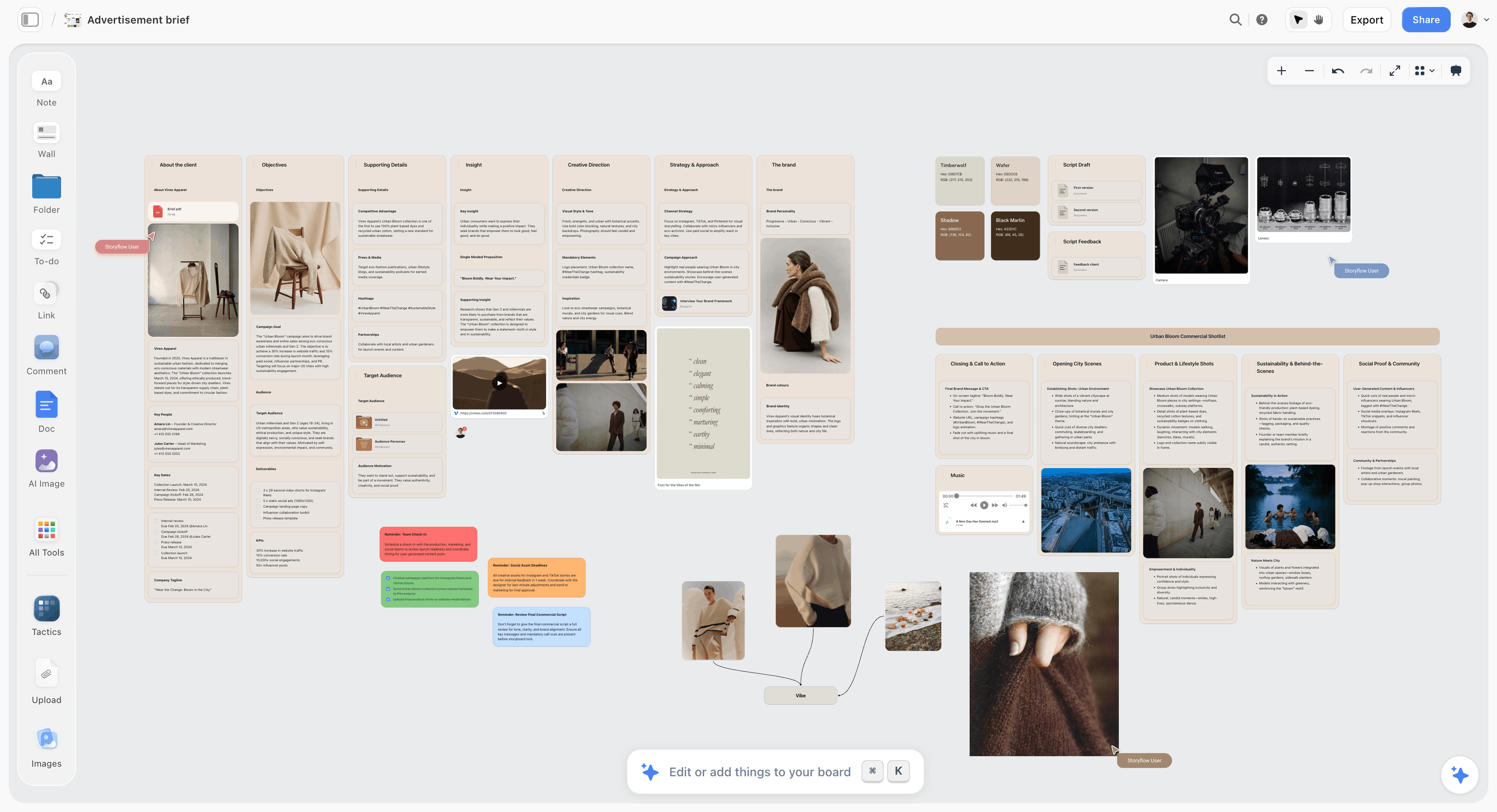
The migration map below lists what each piece of the Miro board becomes in Storyflow.
The two-week plan.
- Day 1: duplicate nothing yet. Export the Miro board as a PDF for the record, gather the messaging-grid text and the reference images, and export the brief doc.
- Day 1: create the Storyflow project, bring the text and images in, ask the AI to turn the notes into organized walls, then check every card against the original before anything else.
- Day 2: attach the brief doc and ask Storyflow to brief the campaign from it. Correct the walls by hand; the AI proposes, the account lead decides.
- Day 2: ask Storyflow for a dated plan to the client's delivery date, then add an assignee and a due date to each to-do.
- Day 3: send the client the view-only link. Their comments now land on the board next to the work.
- Week 2: at the next review, present from the Storyflow board one wall at a time, then ask the AI for a one-pager of the direction for the client's stakeholders.
- End of week 2: if the team reopened the board without being told to, the studio is working. If they went back to Miro, the project was a meeting-room project and Miro or Mural is the right tool.
What to watch. Nothing moves automatically: Storyflow has no Miro import, so the move is the text, images and documents you bring across. Miro's sticky colours often carry meaning (red for rejected, green for approved) that plain text loses, so write the meaning into the notes before you bring them over. And keep the Miro workshop board read-only instead of deleting it, because the client may ask why a route was dropped.
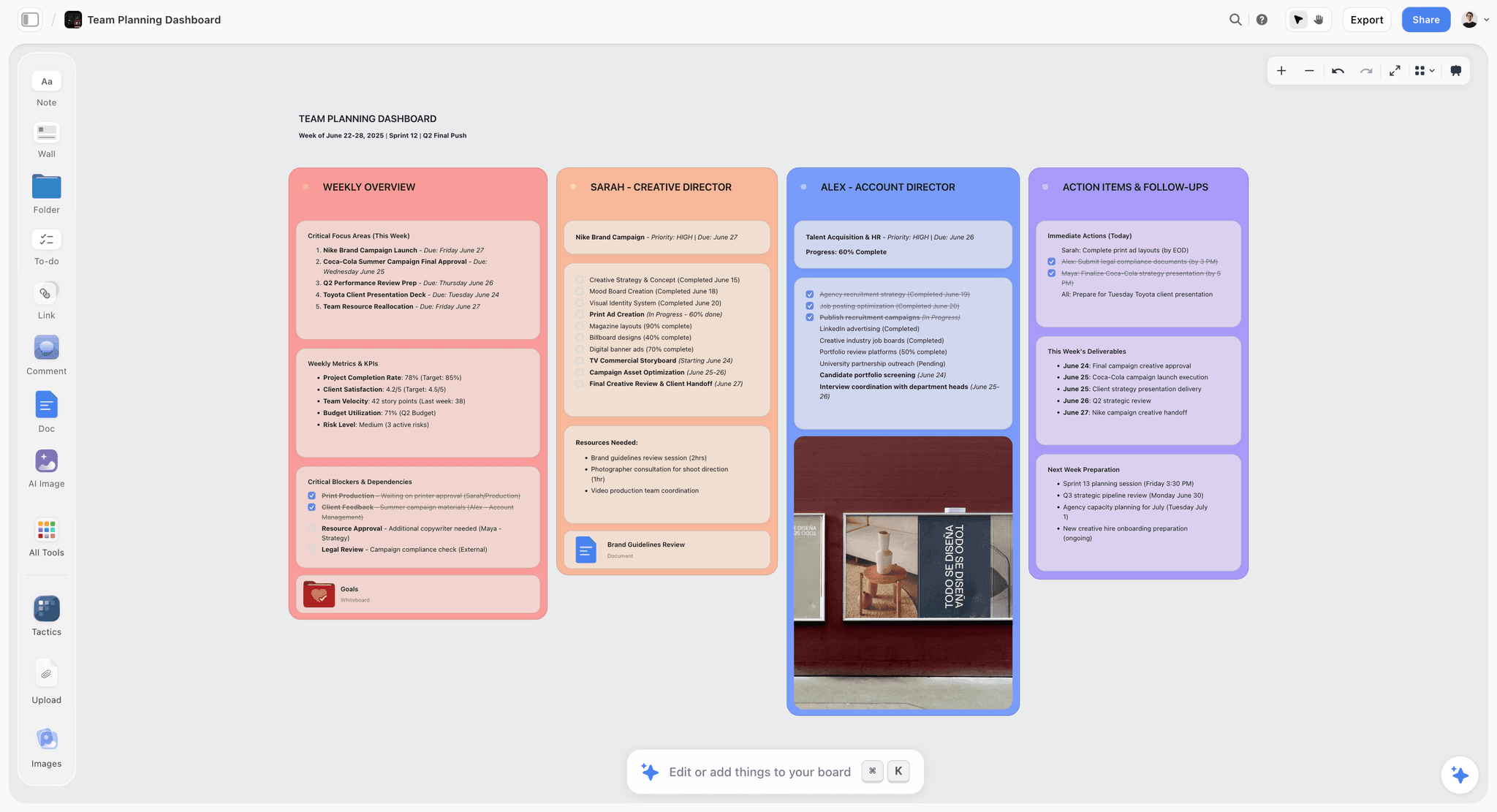
The same map works for FigJam or Mural as the destination; only the "how it gets there" column changes. For the full migration guide, including what Miro exports and what it does not, see How to Move a Creative Project Out of Miro.
13) The Meeting Room or Studio Audit: A Checklist Before You Switch
Score your last five Miro boards on six questions before paying for anything: a high total means you need a studio such as Storyflow, a low one means Miro or Mural was right. Score each board one point for every "yes".
How to read the total across five boards (0 to 30):
- 0 to 10: meeting room. Stay on Miro or move to Mural (facilitation) or FigJam (design sprints). A studio tool will sit unused.
- 11 to 20: split use. Keep a workshop tool for sessions and give ongoing client projects a studio. It fits agencies that employ a facilitator.
- 21 to 30: studio. You are paying for a meeting room and using it as a warehouse. Move projects to a studio tool; Storyflow scores highest on studio fit here, Milanote if you only need the reference layer.
The "rebuilt in a doc" row matters most: retyping a board into a brief or a deck is the step Storyflow's AI does from the board.
14) Storyflow Inside ChatGPT and Claude
Storyflow is the Miro alternative a creative team can reach from the AI assistant it already uses: Storyflow's MCP connector lets ChatGPT, Claude, Gemini and Grok read your Storyflow projects and build boards and documents in them. A producer can paste a client email into ChatGPT, ask for a campaign brief on the client's Storyflow board, and open the board to find the walls there. Setup is described on the Storyflow MCP page.
15) Honorable Mentions
Six tools came close and did not make the ten, because each one's centre of gravity sits outside a creative team's studio, the job Storyflow is listed first for.
- Notion: A strong workspace, but document-shaped; its canvas is not where visual creative work wants to live. See The 14 Best Notion Alternatives in 2026.
- Conceptboard: A cloud whiteboard with Free, Starter and Advanced plans that is hosted in Germany, which makes it the pick when a client's legal team asks where the board lives.
- Concepts: An infinite sketching canvas; a designer's sketchbook, not a team board.
- Klaxoon: A capable enterprise workshop tool; it offers creative teams little the top ten do not.
- Pinterest: Unbeatable for gathering reference, but a feed, not a team workspace.
- tldraw: A lovely open canvas primitive; more a building block than a team product today.
For the moodboard layer specifically, compare The Best Mood Board Tools in 2026.
16) Where Miro and the Specialists Still Win (An Honest Accounting)
Miro wins workshops at scale, Miro and FigJam win product design, Mural wins facilitation craft and Milanote wins the quiet reference wall; Storyflow wins none of those four. A Miro-alternatives list written by a Miro competitor owes you the cases where the answer is still Miro.
Miro wins workshops at scale. Forty people, voting, timers, breakout facilitation, a template for every ritual: if that is your team's actual usage, stay. Storyflow has no facilitation kit and does not pretend to.
Miro and FigJam win product design work. User flows, design sprints, diagram kits and the Figma adjacency are their home turf. Creative teams that are really product teams should read the FigJam and Mural entries and keep moving.
Mural wins facilitation craft. For professional facilitators, its session controls are the reference point, Miro included.
Milanote wins the quiet reference wall. If the whole need is beautiful reference boards and nobody wants an AI near them, the calmest tool is the right one, and it is not ours.
FigJam wins on price. At $3 per Collab seat, with viewers and commenters free, FigJam costs a studio less than Miro or Storyflow.
Storyflow is still listed first because this list serves teams moving a client project out of the meeting room: references, brief, drafts and plan on one canvas, with an AI that works from all of it and drafts the deliverables. That is the job these weights reward.
17) Prices and Sources Checked October 11, 2026
Every competitor price on this page comes from the vendor's own page, read on October 11, 2026. Where a page showed no dollar figure or blocked the check, this page says so instead of quoting an old number.
19) The Bottom Line
Storyflow is the best Miro alternative for a creative team in 2026, because the job a creative team leaves Miro to do is the studio job: the campaign, the film or the brand living on one board from brief to deliverables, with an AI that builds from what is on it. If the room you actually need is the meeting room (workshops, sprints, facilitation), move to Mural or stay with Miro. If the team lives in Figma, FigJam. If you only need beautiful reference walls, Milanote. If the budget is zero, Freeform or Excalidraw.
Run the audit on your last five boards, then move one live client project for two weeks using the worked example above. The comparison of the two tools side by side is in Storyflow vs Miro, and the AI creative workspace page shows the studio side.
18) FAQ: Miro Alternatives for Creative Teams in 2026
What is the best Miro alternative for creative teams?
Storyflow. Miro is a workshop whiteboard, and Storyflow is the alternative built for the creative job: Storyflow's AI builds the campaign brief, moodboard, storyboard, shot list, dated plan and deck from a client brief or a script, and the client opens the board from a view-only link with no account. Choose FigJam if the team lives in Figma, Mural for facilitated workshops, and Milanote for reference boards arranged by hand.
What is the best Miro alternative for an agency running client campaigns?
Storyflow, because the agency's job is a deliverable by a date and Storyflow's workflows start there: a campaign brief as ten walls, a plan worked back from the delivery date, and a one-pager or deck PDF for the client's stakeholders. FigJam is the pick if the agency's campaigns are mostly built in Figma, and Mural if most client time is spent in facilitated workshops.
Who are Miro's main competitors?
Miro's direct competitors for workshops are Mural, FigJam, Lucidspark and Microsoft Whiteboard. For creative project work the competitors are different tools: Storyflow, whose AI builds the project board from a brief, and Milanote, a hand-arranged reference board. Canva Whiteboards and Whimsical compete at the edges, for designed assets and for diagrams.
Is there a free Miro alternative?
Yes: Apple Freeform on Apple devices, Excalidraw in any browser with no login, and Microsoft Whiteboard inside Microsoft 365. FigJam, Mural and Milanote have capped free plans (3 files, 3 editable murals, 100 notes). Storyflow is not free: plans start at $7.99 a month billed annually, and anyone a paid member invites to a board joins free.
Is Storyflow free?
No. Storyflow is paid-only today, with plans from $7.99 a month billed annually ($9.99 monthly). Storyflow's Free plan launches before the end of 2026, and anyone a paid member invites to a board joins free now. A client needs neither to look: a view-only link opens with no account.
What are good Miro alternatives for brainstorming sessions with a design team?
FigJam first for teams in Figma, with stamps, audio and AI credits. Mural second, when the brainstorm needs a facilitator's timer and private mode. Storyflow third for the session itself, since Storyflow has no voting or timer, and first for what comes after: ask Storyflow to organize the board into named walls and draft the brief from it. None of them fixes a brainstorm with no brief; put the question on the board before the session starts.
Can I import my Miro boards into another tool?
Into FigJam, yes: Figma's help centre documents importing Miro boards exported as PDF, though comments and right-to-left text do not come across, and you need export permission in Miro. Into Storyflow, not as a file: Storyflow has no Miro import, so export the board, bring the files and the card text into Storyflow, and ask its AI to organise what you brought into walls.
Miro vs Notion: which does a creative team need?
Usually neither alone. Notion is a document and database workspace, strong for wikis, briefs and operations, with Plus from $10 per member per month billed annually. Miro is a whiteboard for sessions. A creative team's visual work fights Notion's format, and its ongoing projects outlive Miro's boards. If you want both halves in one place, Storyflow is a canvas with documents and tables on it, so the brief and the moodboard share a board.
Is Mural cheaper than Miro?
Not per member. Mural Team+ is $9.99 per member per month billed annually against Miro Starter's $8; at the next tier Mural Business is $17.99 against Miro Business at $20. Mural's visitors are free on every plan, which helps for client read-outs. Choose Mural for facilitation quality, not to save money.
Which collaborative whiteboard makes the best-looking client presentations?
For a board you present from, Storyflow: presentation mode goes fullscreen and steps through one wall at a time, and Storyflow's AI builds a deck from the board that exports as one PDF. Canva Whiteboards second, because a board converts into a Canva presentation with the brand kit applied and finer design controls than Storyflow's. Mural third, for sessions presented live with a facilitator.
What is a good Miro alternative for visual thinking and project planning?
Storyflow first for planning that has to reach a date: ask Storyflow for a plan and it works back from the delivery date, as one wall per period or one table with a row per entry, next to the visual thinking that produced it. Storyflow has no Gantt chart or dependencies. Whimsical second, for mind maps that come out clean. FigJam third, for teams whose planning happens beside Figma files. For Gantt charts, a project tool such as Asana is the better fit.
Which Miro alternative works for a remote creative team across time zones?
Storyflow first, because the async half matters most for a distributed team: comments land on the Storyflow board next to the work, the brief and plan stay readable without a meeting, and a client opens a view-only link with no account. FigJam second, with free viewers and commenters on a paid plan. Milanote third, with read-only links that need no signup. Miro and Mural are strongest when everyone is in the session at once.
Can Milanote replace Miro for an agency?
For the reference layer, yes: the paid plan is $9.99 per person a month billed annually, and the team plan is $49 a month billed annually. Milanote does not replace Miro's workshops, since it has no voting or facilitation, and its plans page lists no AI. Agencies that make the move usually end up needing a second tool for briefs and plans; Storyflow holds references, brief and plan on one board, with Milanote the lighter choice if references are all you move.
Which Miro alternative works inside ChatGPT or Claude?
Storyflow. Storyflow's MCP connector lets ChatGPT, Claude, Gemini and Grok read your Storyflow projects and build boards and documents in them, so "brief this campaign on my client board" works from the chat. Setup is on storyflow.so/mcp.
Table of Contents
- Quick Answer: The Best Miro Alternative for Creative Teams and Agencies
- What Are Some Alternative Options for Miro?
- Comparison Table: 10 Miro Alternatives Scored for Creative Teams
- Frequently Asked: Which Miro Alternative Brands Do Agencies and Designers Trust?
- The Meeting Room and the Studio: Why Creative Teams Outgrow Miro
- How We Scored These Tools
- What It Takes by Hand in Miro vs in Storyflow
- Quick Picks by Job to Be Done
- Detailed Reviews: 10 Miro Alternatives and Competitors for Creative Teams
- Which Tool Fits Which Kind of Creative Team?
- Microsoft Whiteboard and the Free Alternatives Bundled With Your Stack
- Worked Example: Moving an Agency Campaign Board Off Miro
- The Meeting Room or Studio Audit: A Checklist Before You Switch
- Storyflow Inside ChatGPT and Claude
- Honorable Mentions
- Where Miro and the Specialists Still Win (An Honest Accounting)
- Prices and Sources Checked October 11, 2026
- FAQ: Miro Alternatives for Creative Teams in 2026
- The Bottom Line
- Author
- Related Reading
Templates to check out for this topic


Planning and project templates you can use in Storyflow
Plan a launch, a sprint, or a whole project on a visual board the team can see at once. Open one of these templates and start from real structure.


See Storyflow in Action
A visual AI workspace where every feature lives inside one canvas. No tab-switching, no context lost.
Build your entire board from a single message
Type what you need in the AI chat at the bottom of your canvas. The AI adds cards, headings, and structure directly onto your board.
Use expert frameworks as AI context
Type @ in the AI chat and choose any Tactic. The AI tailors every response to that framework instead of giving generic advice.
Turn your board into a mind map in seconds
Ask the AI to restructure your canvas as a mindmap. It connects your ideas into a visual hierarchy so you can see how everything relates.
Why Storyflow Exists
Storyflow actually began as a personal tool while working on creative and research projects.
We kept running into the same problem: ideas were scattered everywhere: notes, documents, and whiteboards.
Nothing helped us see how everything connected.
So we started building a workspace designed around how ideas actually grow.
→ Read how Storyflow was createdJustkay
Documentary Filmmaker & Founder at Storyflow
Published: 2026-08-06
Extremely simple, seriously capable


See how easy it is to get started
Watch a real project come together, from a blank board to a finished plan, clicked through step by step.
Start creating with AI and become more productive
Transform your creative workflow with AI-powered tools. Generate ideas, create content, and boost your productivity in minutes instead of hours.