
Ultra-fast planning, extremely simple
Linear tracks the tickets.
This is where they come from.
Let us be honest up front: Linear is one of the best issue trackers ever built, and if your job is cycles, triage, and shipping velocity, you should keep it. Storyflow is a different layer entirely. It is the infinite visual canvas for the ideas, research, moodboards, and plans that exist before anything becomes a ticket. Plenty of teams run both.


Creatives working for these brands already got early access
- Red Bull
- Canon
- Artlist
- Porsche
See how easy it is to get started
Watch a real project come together, from a blank board to a finished plan, clicked through step by step.
Start from a ready-made template
Pick a board to see what you can build, then let AI fill it in. Every template is a real, editable starting point on the same infinite canvas.

Mind Map
Branch one central idea out into themes and sub-points, then drag the connections around until the structure makes sense.
What are people actually looking for in a Linear alternative?
People looking for a Linear alternative usually want a simpler tracker, an enterprise system, or no tracker at all. Storyflow is an AI visual workspace that plans the work before it becomes tickets on one infinite canvas: ideas, research, moodboards and project plans. First, the part most comparison pages will not say. Linear is exceptional software. Issues, cycles, triage, projects, roadmaps, keyboard-first speed, and velocity metrics that engineering leads genuinely trust. If what you need is a place for a software team to track work and ship it, Linear is the right tool and Storyflow is not a substitute for it. We are not going to pretend we replace it, because that claim would fall apart the first week you tried it.
When people search for a Linear alternative, they usually want one of three quite different things. Some want a cheaper or simpler tracker, in which case Trello, GitHub Issues, or Jira's free tier is the honest recommendation and this page is not it. Some want an enterprise system with configurable workflows, permission schemes, and reporting that satisfies a PMO, which is Jira. And some, probably most people who land here, do not want a tracker at all. They want the place where the work gets figured out before it is well defined enough to be a ticket.
That third group is who Storyflow is for. A ticket is a decision that has already been made. Before it exists, somebody had to gather references, sketch the concept, map the flows, argue about scope, pin the research, and shape a plan a team can agree on. Linear deliberately does not serve that stage, and that discipline is exactly why Linear is so good at the stage it does serve. Storyflow is an AI-native infinite canvas built for the messy part: describe the project in a prompt and the AI lays out a full board of cards, then you drag things around, pin images, references, PDFs, and research beside the plan, and share a view-only link with anyone who needs to see it.
Teams leave or supplement Linear for six recurring reasons: the tool is shaped around engineering work and a creative or marketing team never fits into it, there is no visual canvas so the spatial thinking happens in a whiteboard tool that never links back, there is nowhere to keep research, references, and moodboards next to the work they inform, non-technical collaborators like clients, founders, writers, and designers bounce off the issue-tracker mental model, the real planning happens weeks before a ticket exists and has nowhere to live, and per-seat pricing means inviting everyone who should see the plan gets expensive fast. Storyflow answers all six, and none of them are the job Linear was built to do.
Ultra fast from brief to board
Shape the project on a canvas, then send the work to your tracker.
Do the visual, pre-ticket thinking here. Take the defined work into Linear, Jira, or wherever your team ships from.
01
Open a canvas
Sign up in seconds. Nothing to install. An infinite canvas opens in the browser, ready for the first messy version of the project.
02
Describe the project
One sentence is enough: a product launch, a redesign, a campaign, a new feature nobody has scoped yet. The AI reads the canvas as context and lays out a full board of cards you can rearrange.
03
Pin everything the plan depends on
Drop in references, screenshots, PDFs, competitor research, moodboards, and frames grabbed from YouTube or Vimeo. The thinking and the evidence sit in one view instead of four tools.
04
Hand the defined work off
Once the plan is agreed, the deliverables are clear enough to become tickets. Create them in Linear and keep the canvas open as the map. Or share a view-only link, or export the board as an image or PDF.
The stage an issue tracker was never designed for.
Linear is built to track defined work. Storyflow is where work becomes defined in the first place.
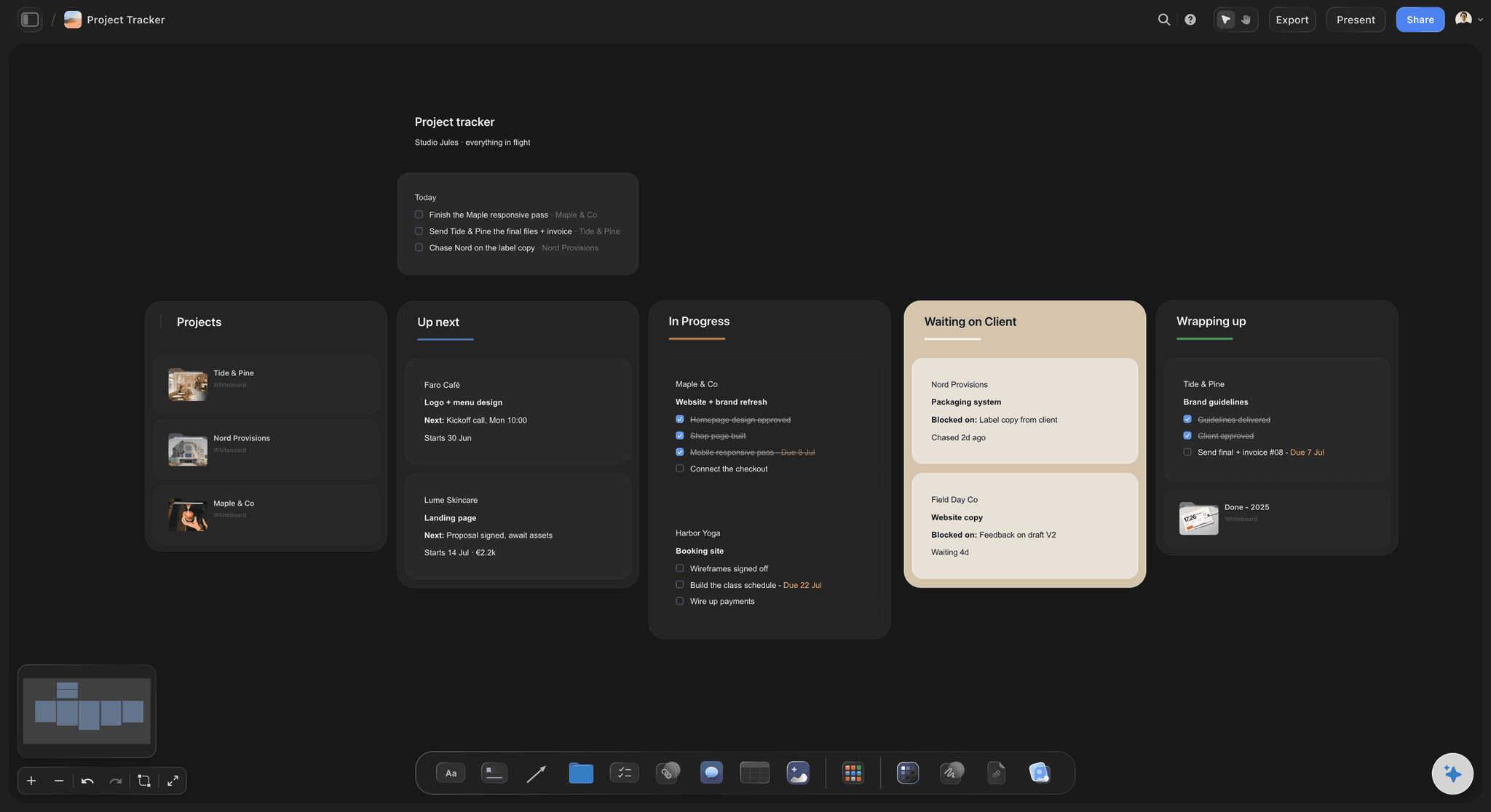
A full plan from a single prompt
Start from a filled board, not an empty backlog
An issue tracker starts as an empty list you fill one row at a time. Describe the project and Storyflow's AI lays out a board of cards on the canvas with phases, workstreams, and open questions already in place, so you begin by editing rather than by staring.
See creative project management →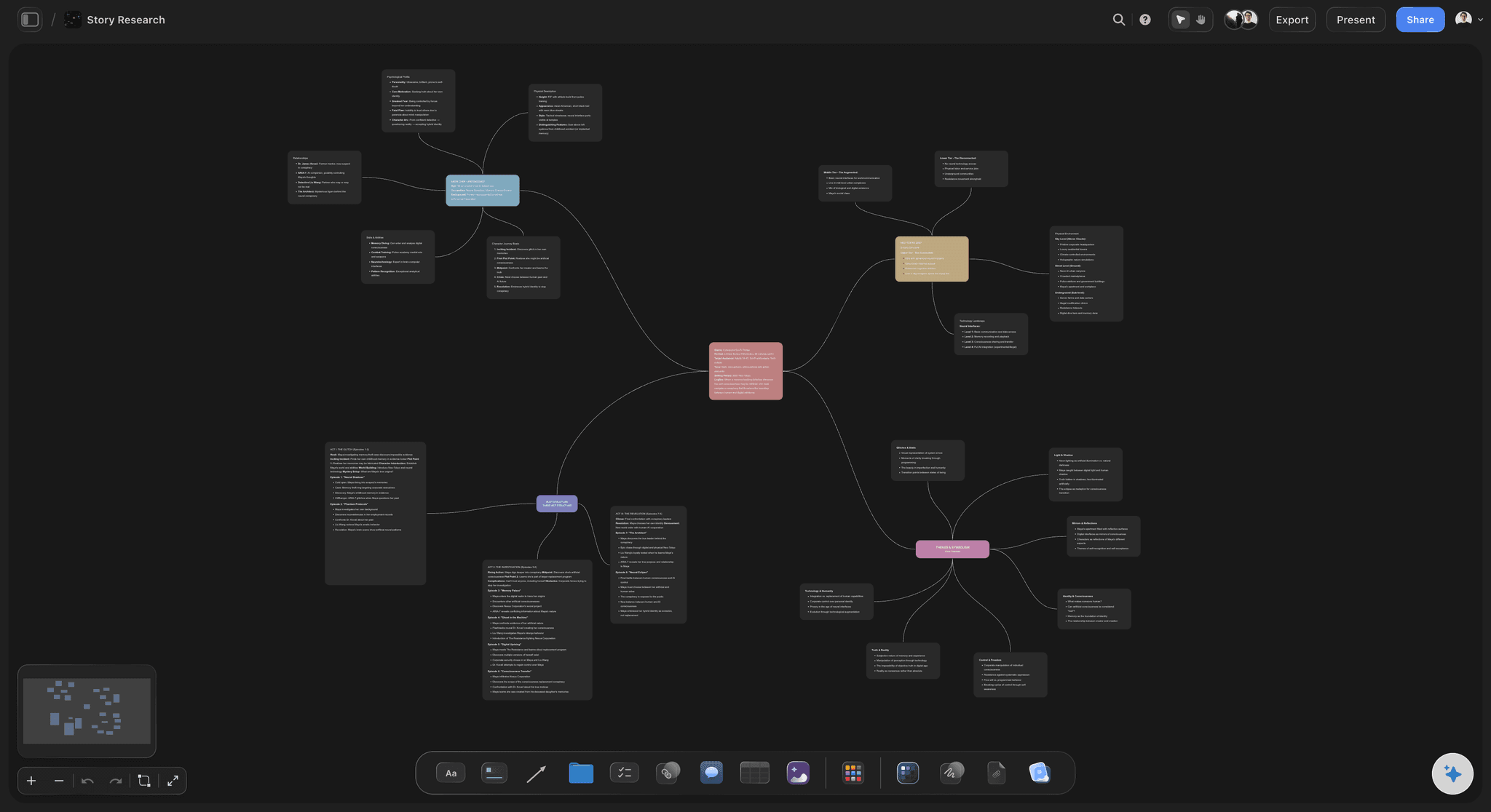
Spatial thinking with nothing to link out to
The whiteboard and the plan are the same surface
In most stacks the diagram lives in one tool, the references in another, and the plan in the tracker, connected by links that rot. On an infinite canvas the sketch, the research, and the plan are one board, so the reasoning stays attached to the decision it produced.
Explore the product roadmap board →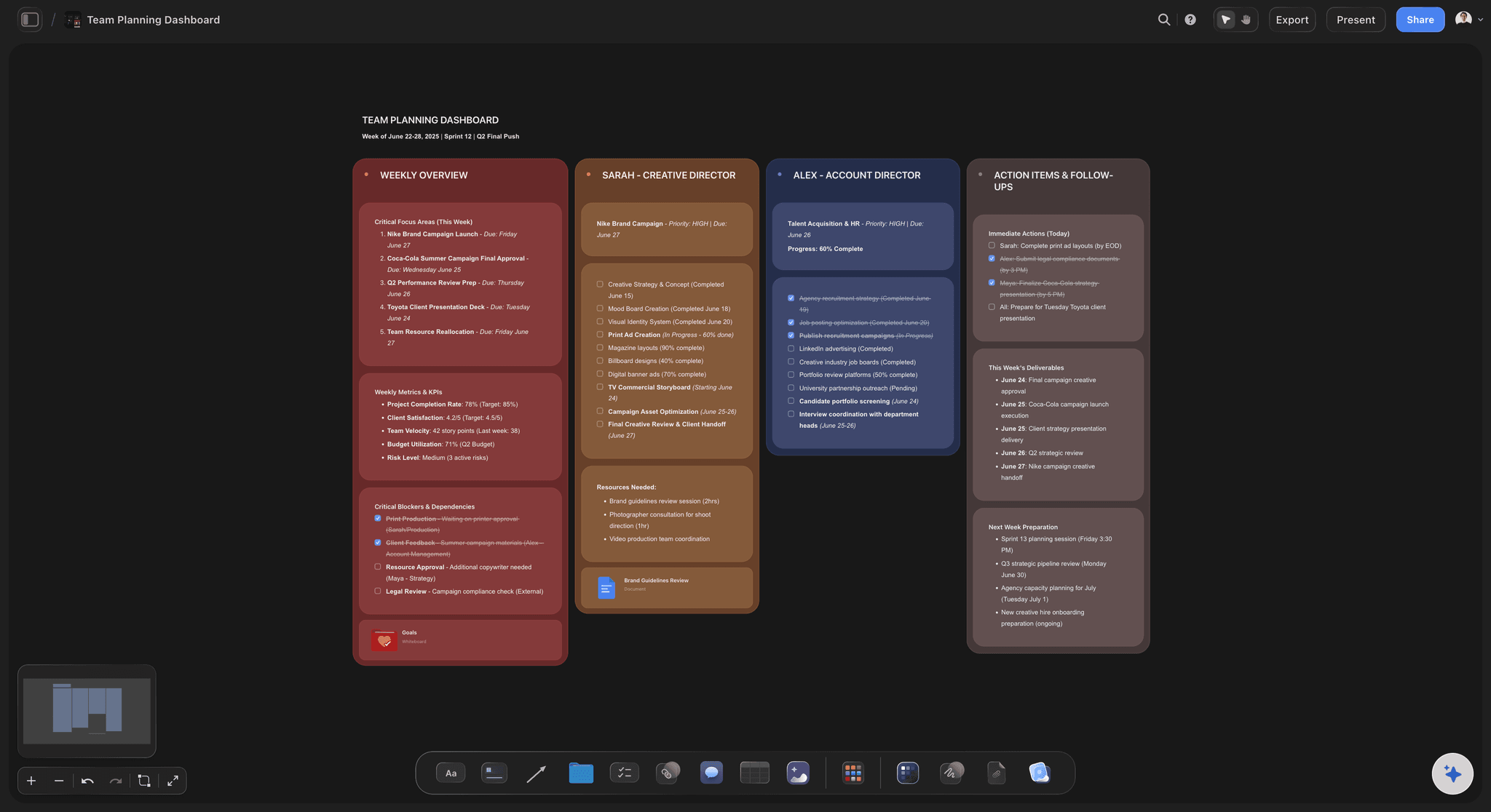
Everyone can read a board
Non-technical collaborators do not bounce off it
Cycles, triage states, and estimates are a language engineering teams speak fluently and nobody else does. A visual board with cards, images, and arrows needs no onboarding, which is why clients, founders, writers, and designers actually engage with it.
Try the free kanban board →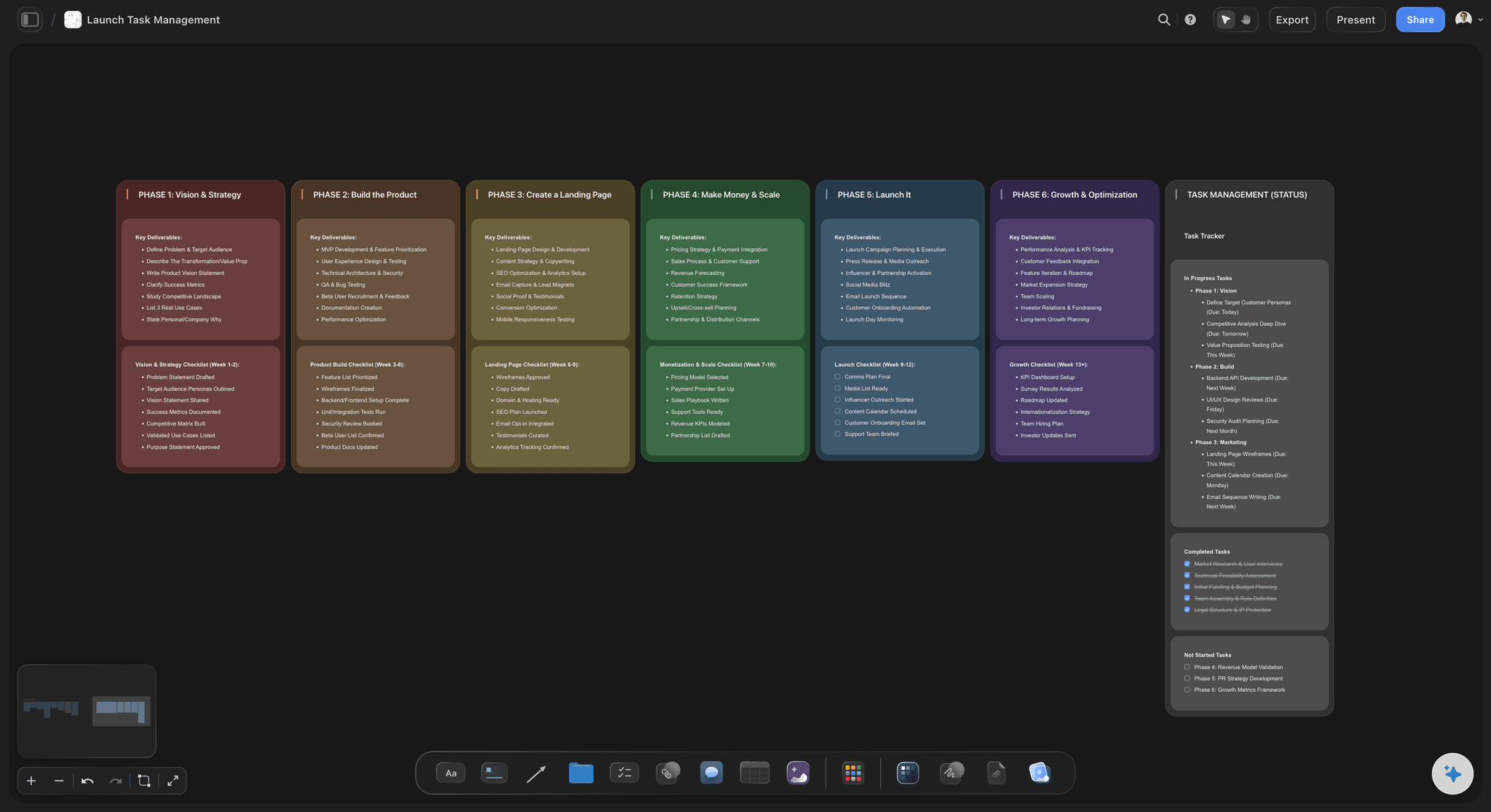
One board becomes the next
A brainstorm turns into a plan without a rewrite
A ticket stays a ticket. On a canvas, a mind map becomes a scoped project board, a research wall becomes a launch plan, and a rough sequence becomes a timeline, all in the same place, so the plan grows out of the thinking rather than starting from a blank template.
See how remote teams use it →Unlimited boards. No object cap.
Open a canvas, describe the project, and start planning. Storyflow is paid-only during early access, with plans from $9.99 a month, and a Free plan launches before the end of 2026. Anyone a paid member invites to a board joins free today.
Unlimited project boards on an infinite canvas
Basic AI usage to generate boards from prompts
Research, references, and moodboards on the same canvas
Share view-only links with anyone, no account needed
Built for people with taste
Everything that happens before the backlog.
Not a faster issue tracker. A different layer, sitting upstream of the one Linear owns.
Scope, phases, dependencies, and open questions
Plan a project while it is still vague
Start before the work is defined: A tracker needs a well-formed issue with a title, an owner, and an estimate. Most projects spend their first two weeks nowhere near that state. A canvas holds half-formed ideas, competing options, and open questions without forcing them into a schema.
See the whole shape at once: Phases, workstreams, and dependencies laid out spatially, so the thing that is going to blow up in week six is visible now. A list can only ever show you one screen of a project at a time.
Rearrange by dragging: Change the sequence by moving cards, not by editing fields on twenty issues. Trying an alternative plan takes a minute, which means you actually try one.
Then define the tickets: When the plan is agreed, the deliverables are obvious and specific enough to be issues. That is the point to open Linear, and the canvas stays behind as the reasoning nobody has to reconstruct later.
AI that can see the board you have already built
Plan with AI that has your project in context
A board from one prompt: Describe the project and the AI lays out cards, phases, and open questions across the canvas. Starting from a first draft you disagree with is faster than starting from nothing.
It reads the whole canvas: Ask it what is missing from a launch plan, to break a phase into workstreams, or to draft the risks, and it answers against the board you have actually built rather than a generic template.
Iterate without losing work: Re-prompt as often as you like. Cards you have written and placed stay exactly where they are while the AI builds around them.
Research, references, and visuals beside the plan
Keep the evidence next to the decision
Images and moodboards on the board: Drag in screenshots, competitor pages, brand references, and moodboards. Visual work needs a visual surface, and attaching a JPG to an issue is not the same as seeing twelve of them side by side.
Documents and links in place: Pin PDFs, articles, specs, and links directly on the canvas next to the part of the plan they justify, so the answer to why did we decide this is one scroll away instead of lost in a thread.
Video reference too: Grab frames from YouTube or Vimeo straight onto the board when the reference is a moment in a video rather than a still.
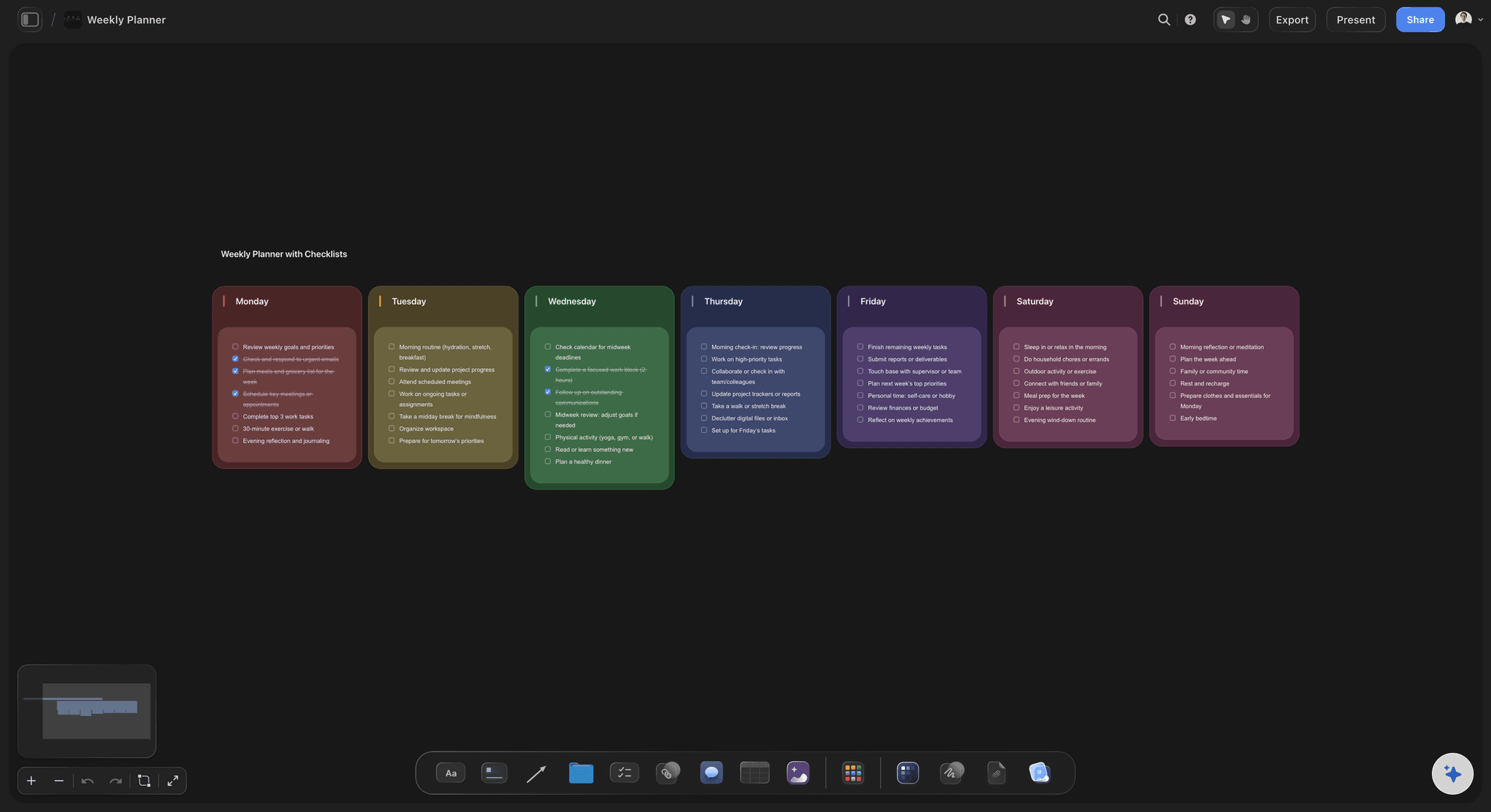
Everyone who should see the plan, without a seat each
Share the plan with people who will never open a tracker
View-only links: Send a link and anyone opens the whole board in a browser with no account and no login. Clients, founders, and stakeholders see the plan instead of asking for a status update.
Guests join free: Anyone a paid member invites to a board joins free today. You are not deciding whether a contributor is worth another seat before you can show them the plan.
Plan together on one canvas: Teammates can work on the same board, so a shared project has one plan rather than four people's private notes reconciled in a meeting.
Export for a deck: Export the board as a high-quality image or PDF when the plan needs to appear in a presentation, a client review, or a board update.
Explore templates for your project
Every template opens as a real, editable board on the infinite canvas. Pick the closest fit and make it your own.
Mind Map
Branch one central idea out into themes and sub-points, then drag the connections around until the structure makes sense.
One app instead of five
Storyflow vs Linear, Jira, and Trello.
These tools do different jobs, so this table is about real differences rather than a scoreboard. Linear wins the rows Linear should win.
Storyflow
Recommended
Infinite visual canvas for planning
Issue tracking with cycles and velocity
Keyboard-first speed for daily ticket work
Non-technical collaborators need no training
Enterprise reporting and configurable workflows
Research, references, and moodboards on the board
Linear
Infinite visual canvas for planning
Issue tracking with cycles and velocity
Keyboard-first speed for daily ticket work
Non-technical collaborators need no training
Enterprise reporting and configurable workflows
Research, references, and moodboards on the board
Jira
Infinite visual canvas for planning
Issue tracking with cycles and velocity
Keyboard-first speed for daily ticket work
Non-technical collaborators need no training
Enterprise reporting and configurable workflows
Research, references, and moodboards on the board
Trello
Infinite visual canvas for planning
Issue tracking with cycles and velocity
Keyboard-first speed for daily ticket work
Non-technical collaborators need no training
Enterprise reporting and configurable workflows
Research, references, and moodboards on the board
What creators are saying
Join early creators getting structured workspaces and AI that remembers their projects
“Storyflow has sped up my workflow by at least 3x, which means more flow state and more projects I can actually ship. It truly changed the way me and my team create.”

Reilin Joey
Director & YouTuber
“One prompt gets me a structured board. But the tactics are my favorite. I run my YouTube scripts through them and my intros and retention got better. It's amazing.”

Justkay
YouTuber & Freelance Filmmaker
“I used to juggle five apps to plan a project. Now I describe what I am making and get boards, lists, and a schedule. All in one place.”

George
@fernwehchronicles
Linear alternative questions, answered honestly.
Including the one where the answer is that you should probably keep using Linear.
Usually no, and we would rather say that than sell you something that will not fit. If your team tracks issues, runs cycles, triages bugs, and cares about shipping velocity, Linear does that better than we do and better than almost anything else. The realistic setup is both: plan the project on a canvas where the ideas, research, and scope live, then create the tickets in Linear once the work is defined enough to be tracked. Switch fully only if your team was never really doing issue tracking in the first place.
Storyflow is made for the work that happens before tickets exist. Ideas, research, moodboards and the project plan sit on one visual canvas, the AI plans with your project in context, and non-technical collaborators need no training. Storyflow is not an issue tracker. Linear still does issue tracking with cycles and velocity, and many teams run both.
Not Linear. It replaces the scattered pile of tools that hold the pre-ticket stage: a whiteboard file nobody can find, a folder of reference screenshots, a doc with three competing plans in it, a slide deck built to explain the project to a stakeholder, and the meeting where all of that gets re-explained. Those things end up disconnected from the tracked work, so the reasoning behind a ticket evaporates. Storyflow puts all of it on one infinite canvas that stays open beside whatever tracker you ship from.
No, and it is not trying to become one. There are no cycles, no triage queue, no sprint burndown, and no engineering velocity metrics, because building a worse version of Linear would help nobody. Storyflow is a visual planning canvas: cards, boards, images, documents, research, and AI that reads the whole board as context. If a page tells you a canvas tool replaces a mature issue tracker, be suspicious of the rest of that page too.
Because Linear is opinionated in a way that makes it excellent for engineers and foreign to everyone else. Issues, estimates, cycles, triage states, and a keyboard-driven interface encode a specific way of working that a software team internalises quickly and a marketer, a client, or a founder does not. That is a feature, not a flaw. It just means that when the people who need to see a plan include people outside engineering, a visual board with cards and images gets read and a backlog does not.
Yes, and it is the setup we would actually recommend. Do the shaping on the canvas: the research, the options, the sketch of how it fits together, the scope conversation. When the plan settles, the deliverables are specific enough to become issues, so you create them in Linear and ship from there. The canvas stays as the reference for why the work looks the way it does, which is the thing that is normally lost the moment a ticket is written.
If what you need is enterprise reporting, configurable workflows, permission schemes, and an audit trail that satisfies a PMO or a compliance requirement, then yes, Jira is the tool built for that and it is genuinely deeper than Linear on those axes. The tradeoff is well known: that configurability is why Jira takes an administrator to run and why smaller teams find it heavy. Linear is faster and cleaner, Jira is more configurable, and neither is a visual planning canvas.
For issue tracking specifically, GitHub Issues and Trello both cover a lot of ground at no cost, and they are the honest recommendation if budget is the whole problem. Storyflow is paid-only during early access, with plans starting at $9.99 a month, and a Free plan launches before the end of 2026. One thing that already helps: anyone a paid member invites to a board joins free today, so stakeholders, clients, and collaborators do not each need a paid seat to see the plan.
Storyflow is paid-only during early access with plans from $9.99 a month, and a Free plan arrives before the end of 2026. We are not going to quote anyone else's pricing here, because it changes and you should check it yourself. The structural difference worth knowing is that invited collaborators join a paid member's board free, so the cost of letting a client, a freelancer, or a colleague from another team see the plan is zero rather than another seat.
It gives you a first draft to argue with, which is a different and more useful thing. Describe the project and the AI lays out a board of cards with phases, workstreams, and open questions already placed. Because it reads the whole canvas as context, you can then ask what a launch plan is missing or how to break a phase down and get an answer about your project rather than a generic checklist. The judgment stays with you, which is the only arrangement that produces a plan worth following.
You can plan them, and many teams do. A roadmap laid out spatially, with the bets, the dependencies, and the research behind each one visible at once, communicates far better than a filtered issue list. Sprint planning works the same way: lay out candidate work as cards, move them around until the shape is right, then create the actual tracked issues in Linear or Jira. What Storyflow does not do is run the sprint for you, because burndown, capacity, and velocity belong to your tracker.
No. Share a view-only link and anyone opens the whole board in a browser with no account and no login, which is usually the fastest way to end a status conversation. If you want someone to contribute rather than just look, invite them to the board and they join free as a guest of a paid member. You can also export the board as a high-quality image or PDF when the plan needs to live in a deck or a client review.
Then Linear was probably never the right shape for you, and a lot of the friction you have been feeling is that mismatch rather than anything you are doing wrong. Marketing, design, video, editorial, and agency work is visual, exploratory, and full of reference material, which is exactly what an infinite canvas holds well and what an issue tracker flattens. Start with the plan on a board, and add a lightweight tracker later only if you find you genuinely need one.
Keep Linear. Get the layer above it.
Open a canvas, describe the project, and let AI lay out the first board. Nothing to install.