
Extremely simple, seriously capable
Friday should
answer Monday.
A sprint is five days that each want a different shape: a map, then a pile of sketches, then a decision, then a prototype, then five interviews. Split across five files, Friday produces a summary deck and nobody checks it against the assumptions written on Monday. On one canvas that check is a scroll.


Creatives working for these brands already got early access
- Red Bull
- Canon
- Artlist
- Porsche
See how easy it is to get started
Watch a real project come together, from a blank board to a finished plan, clicked through step by step.
Start from a ready-made template
Pick a board to see what you can build, then let AI fill it in. Every template is a real, editable starting point on the same infinite canvas.

Mind Map
Branch one central idea out into themes and sub-points, then drag the connections around until the structure makes sense.
What is the best whiteboard tool for design sprints?
One where the whole week stays in view. Storyflow is an AI visual workspace that holds all five days of a design sprint on one infinite canvas: the map, the sketches, the prototype decisions and the test results, connected instead of split across files. The structure of a sprint is a chain: Monday's map and long-term goal produce the sprint questions, Tuesday's sketches answer them, Wednesday picks one, Thursday builds it, and Friday tests whether the answer holds. Every day is only meaningful in terms of the day before it.
The common failure is that the days get separated. The map is on a board, the sketches are photographs in a channel, the prototype is in a design tool, and the interviews end up as notes in a document. So Friday's output is a summary of what five users said, rather than an answer to the specific questions written on Monday, and the sprint's central discipline quietly disappears.
That discipline is the entire value. A sprint is not a fast way to make a prototype; it is a way to convert an assumption into a tested answer inside a week. If nobody can put Friday's finding next to Monday's assumption, you have run an expensive workshop and produced a prototype, which is not the same thing.
Storyflow holds all five days on one infinite canvas: the map, the sketches at full size, the decision with the routes that lost, and the test notes beside the questions they answer. The AI reads the whole active board plus up to five documents and three boards, so it can summarise across the week.
Ultra fast from brief to board
One canvas, five zones.
Each day gets its own shape and stays connected to the others.
01
Map and questions
The long-term goal and the sprint questions written where they stay visible all week, not filed after Monday.
02
Sketches at full size
Photographed sketches large enough to judge, side by side, because a wall of thumbnails cannot be voted on properly.
03
The decision and what lost
The chosen direction with the alternatives kept beside it, so Thursday knows what was already ruled out and why.
04
Test notes against the questions
Friday's findings placed next to Monday's questions. The whole point is being able to see whether they were answered.
Four things a split-up sprint loses.
All of them are about the chain between days.
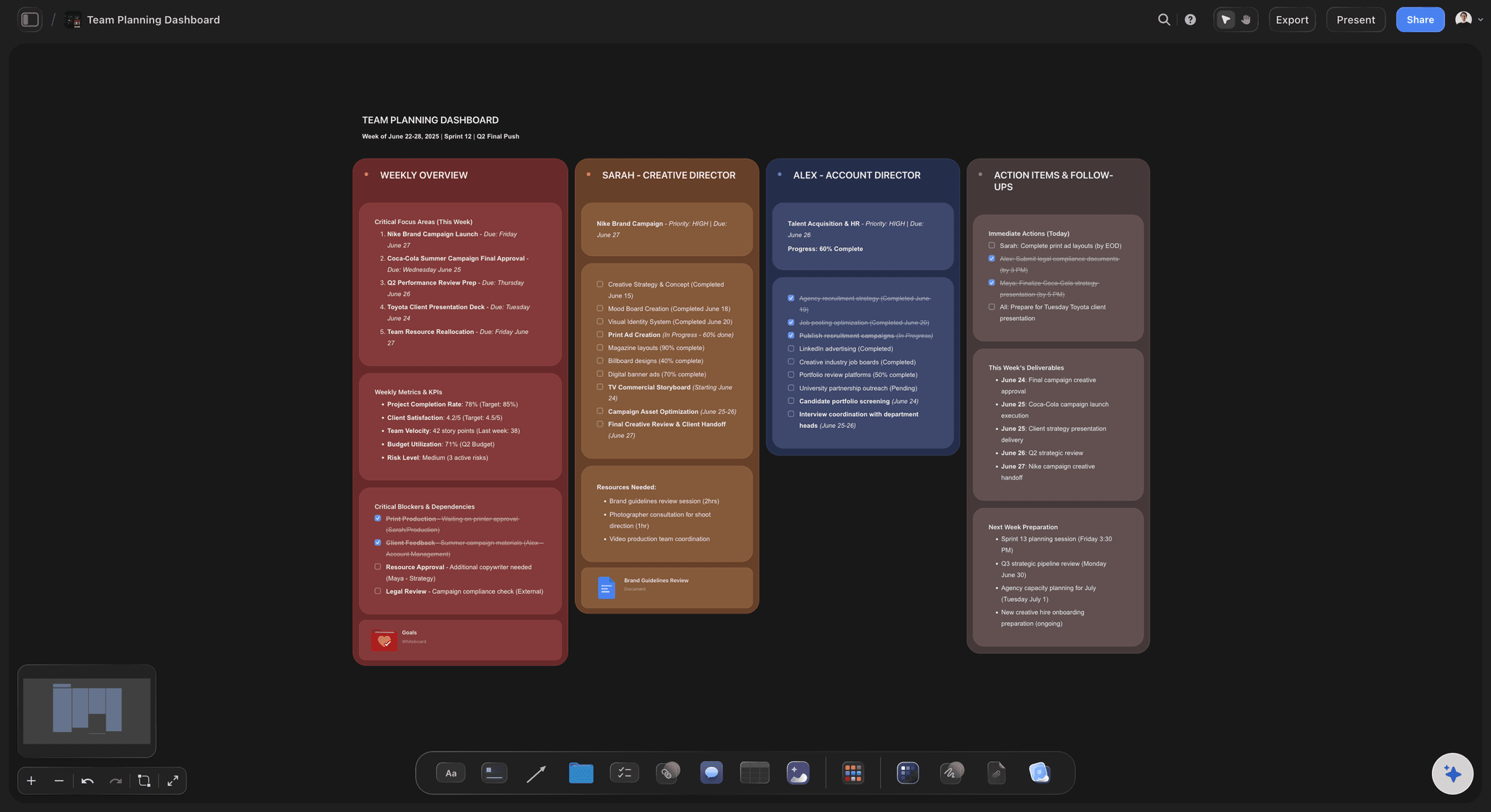
The week in view
Monday still visible on Friday
The sprint questions stay on the canvas all week, so the test is measured against them rather than summarised on its own.
See the design sprint tool →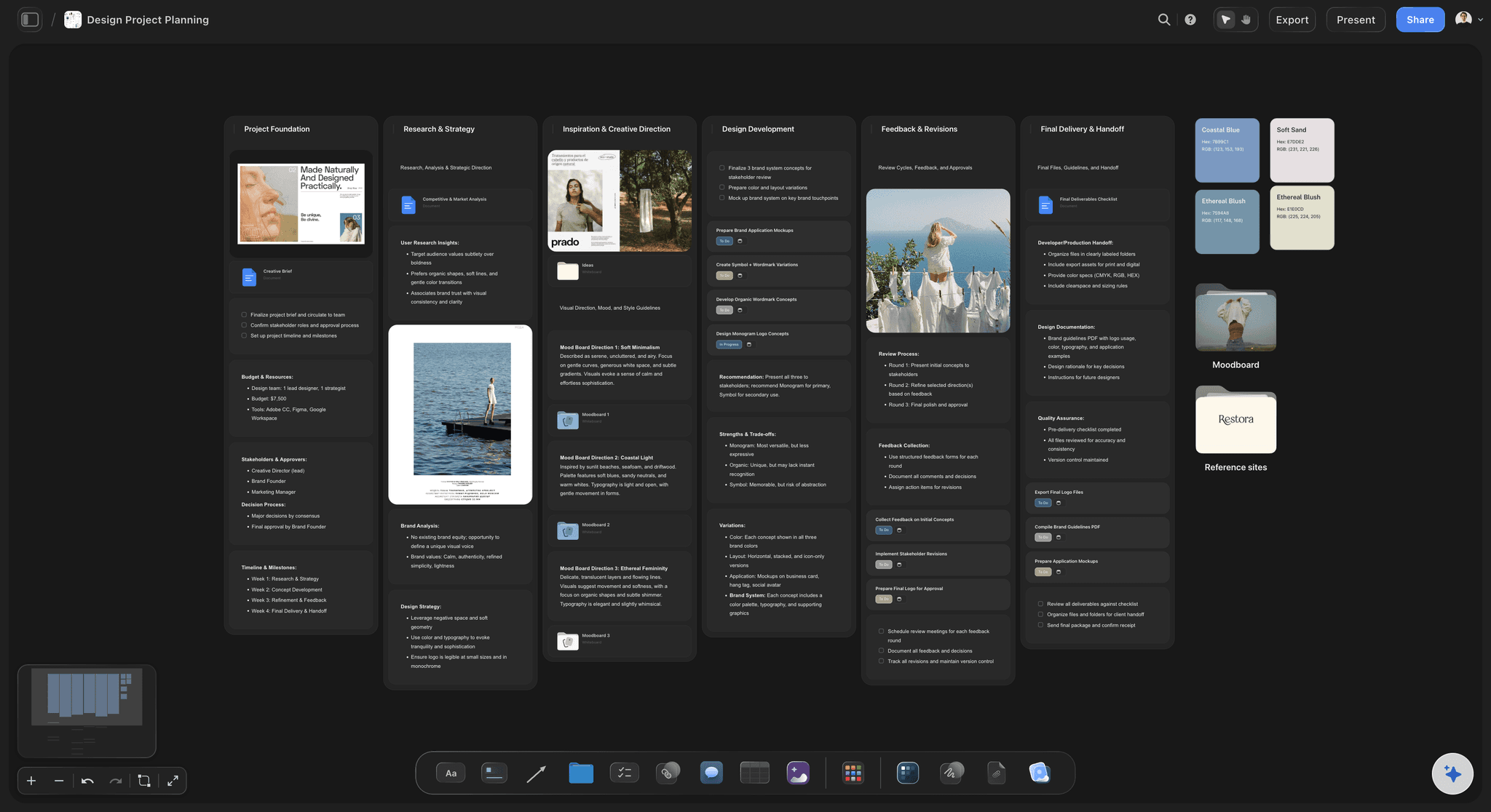
Sketches you can judge
Full size, side by side
Voting on solutions requires seeing them properly. A grid of small photographs turns the critique into a formality.
See the wireframe tool →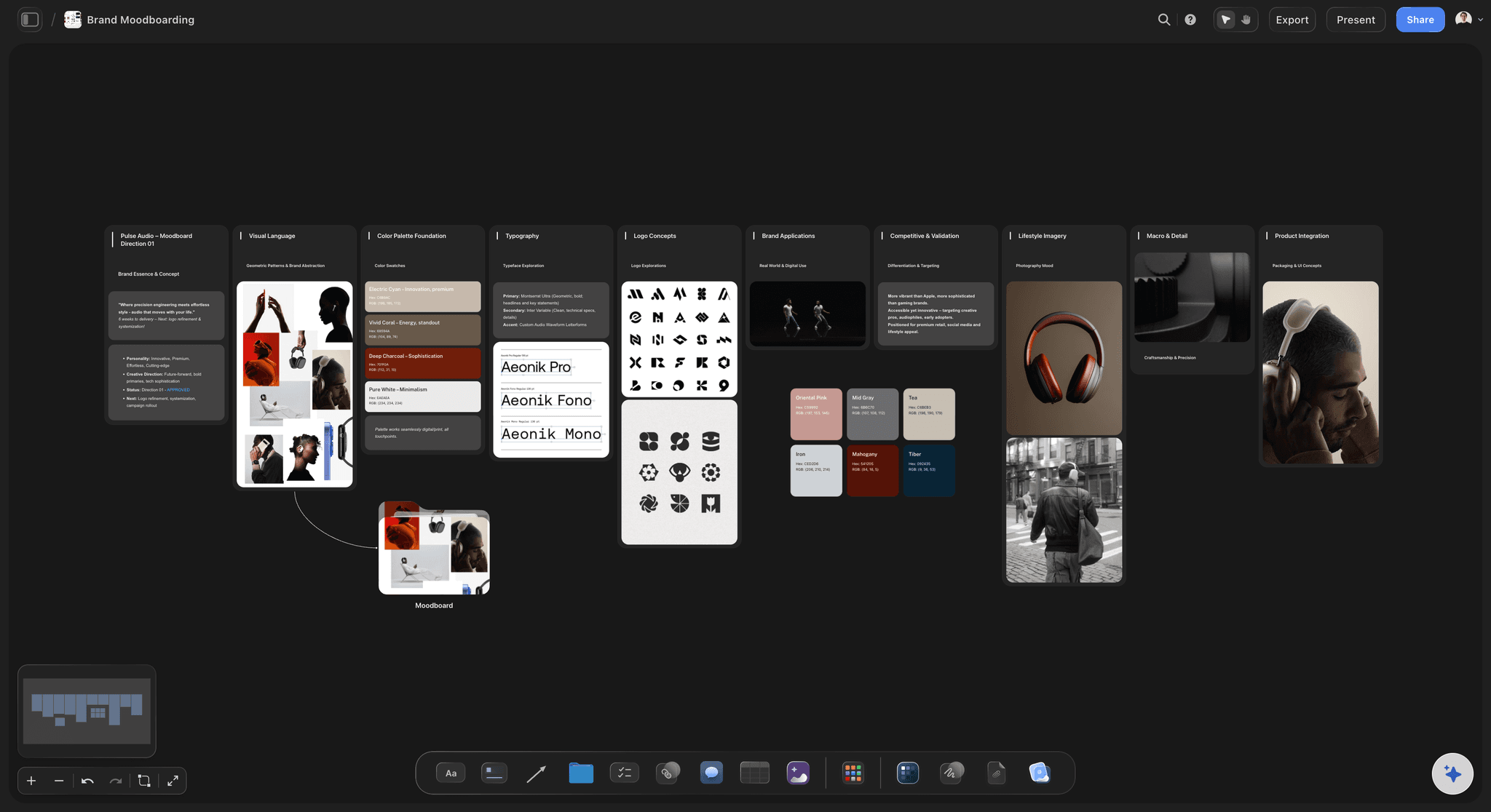
Losers kept
What Wednesday ruled out
Rejected concepts stay beside the chosen one, which stops Thursday rebuilding something the team already decided against.
See the design critique board →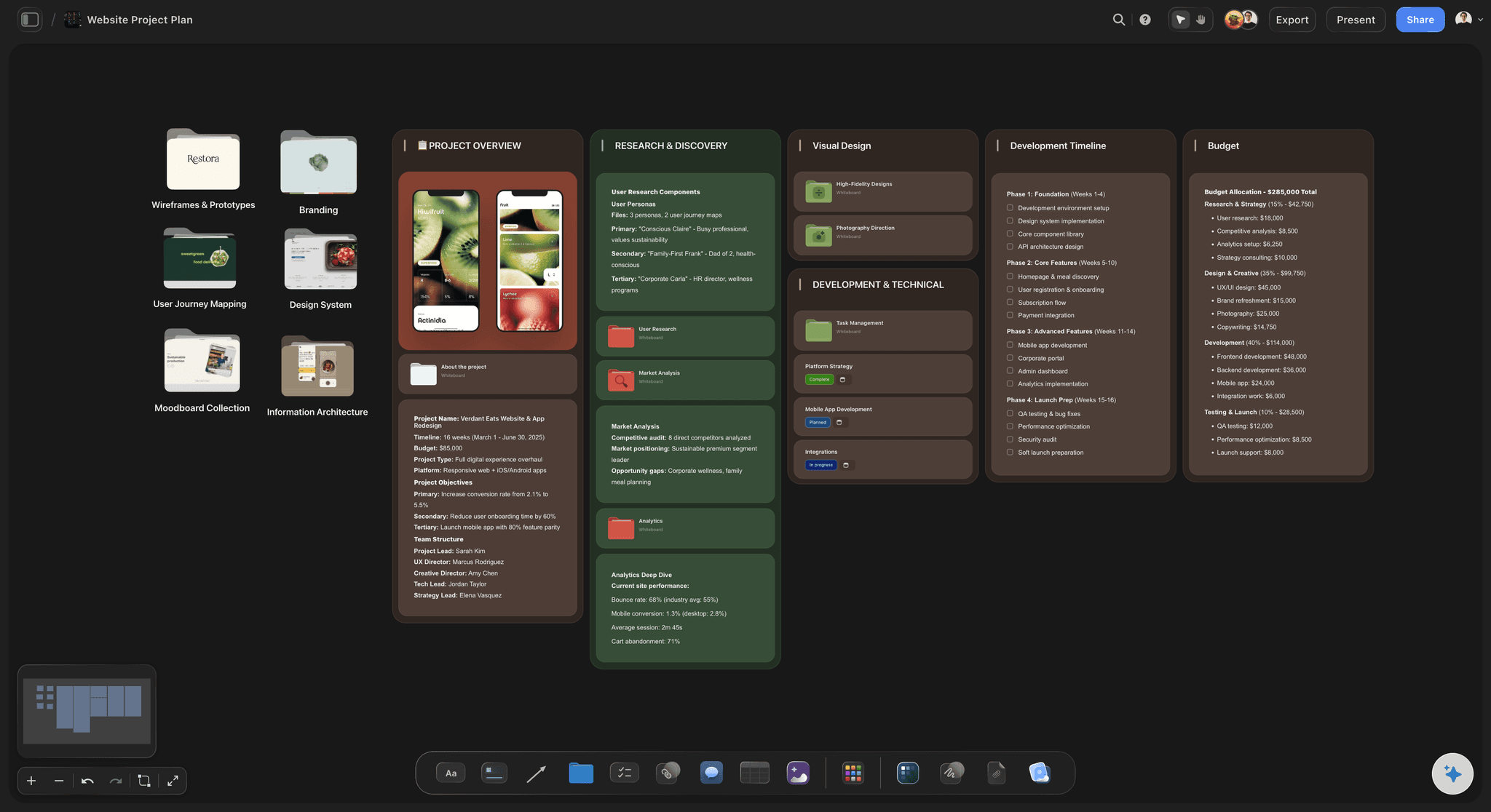
After the week
The board becomes the project
A sprint that validates something turns into a plan on the same canvas rather than a deck that gets read once.
See the AI creative workspace →Plans from $7.99/month annual. Free plan coming late 2026.
Unlimited boards and collaborators on Plus, Pro and Max.
All five days on one infinite canvas
Unlimited collaborators on every paid plan
View-only links for observers and stakeholders
Built for people with taste
Four failures that leave you with a prototype and no answer.
A sprint that produces only a prototype has done the expensive half.
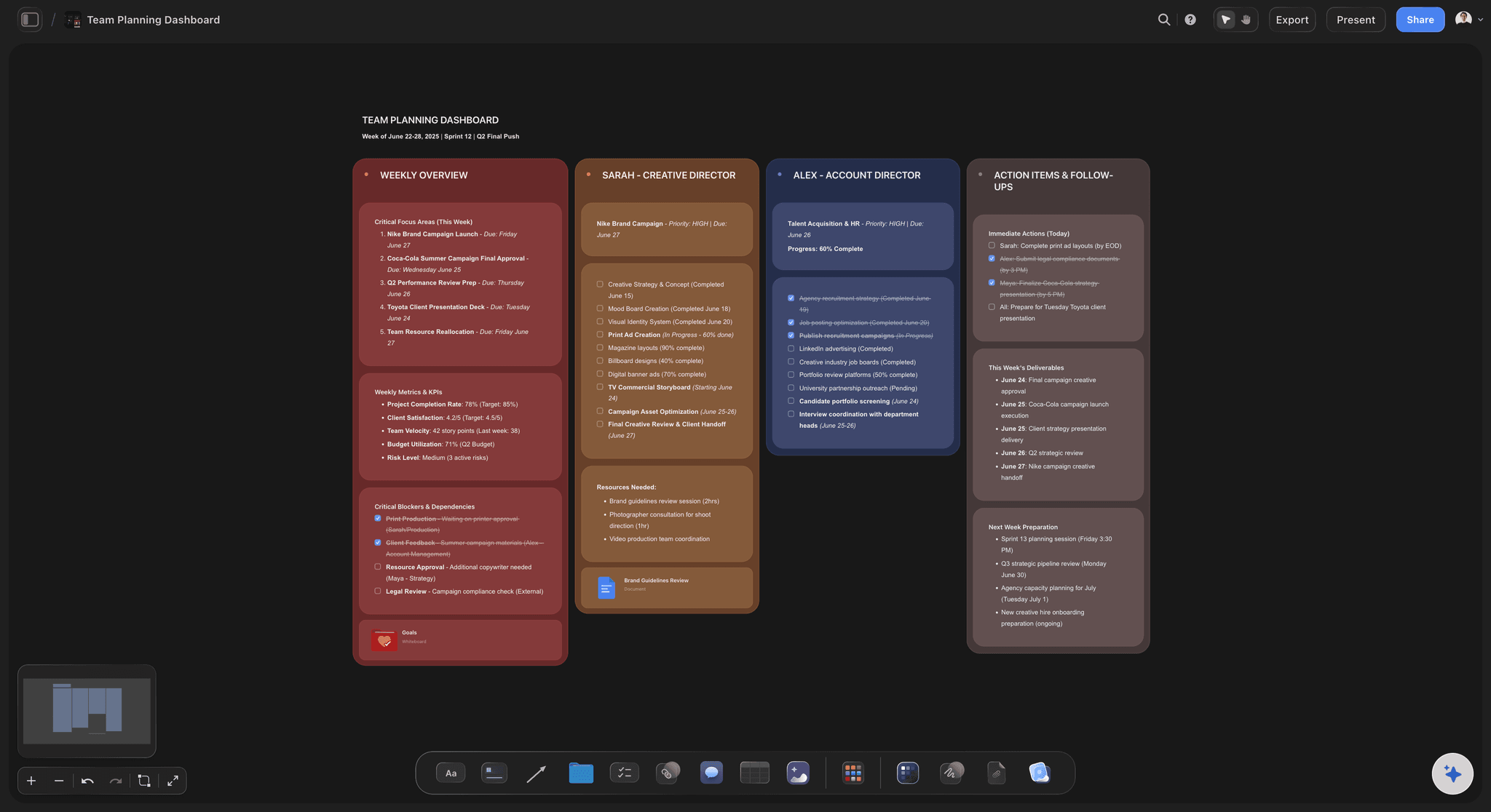
Failure one
Monday gets filed
The questions disappear: Once the map is finished and the week moves on, the sprint questions stop being referenced by Wednesday.
Friday drifts into a demo: Without the questions in view, the test becomes a general reaction session rather than an answer to something specific.
Keep them on the canvas: The questions stay visible in their own zone all week, so every later decision is measured against them.
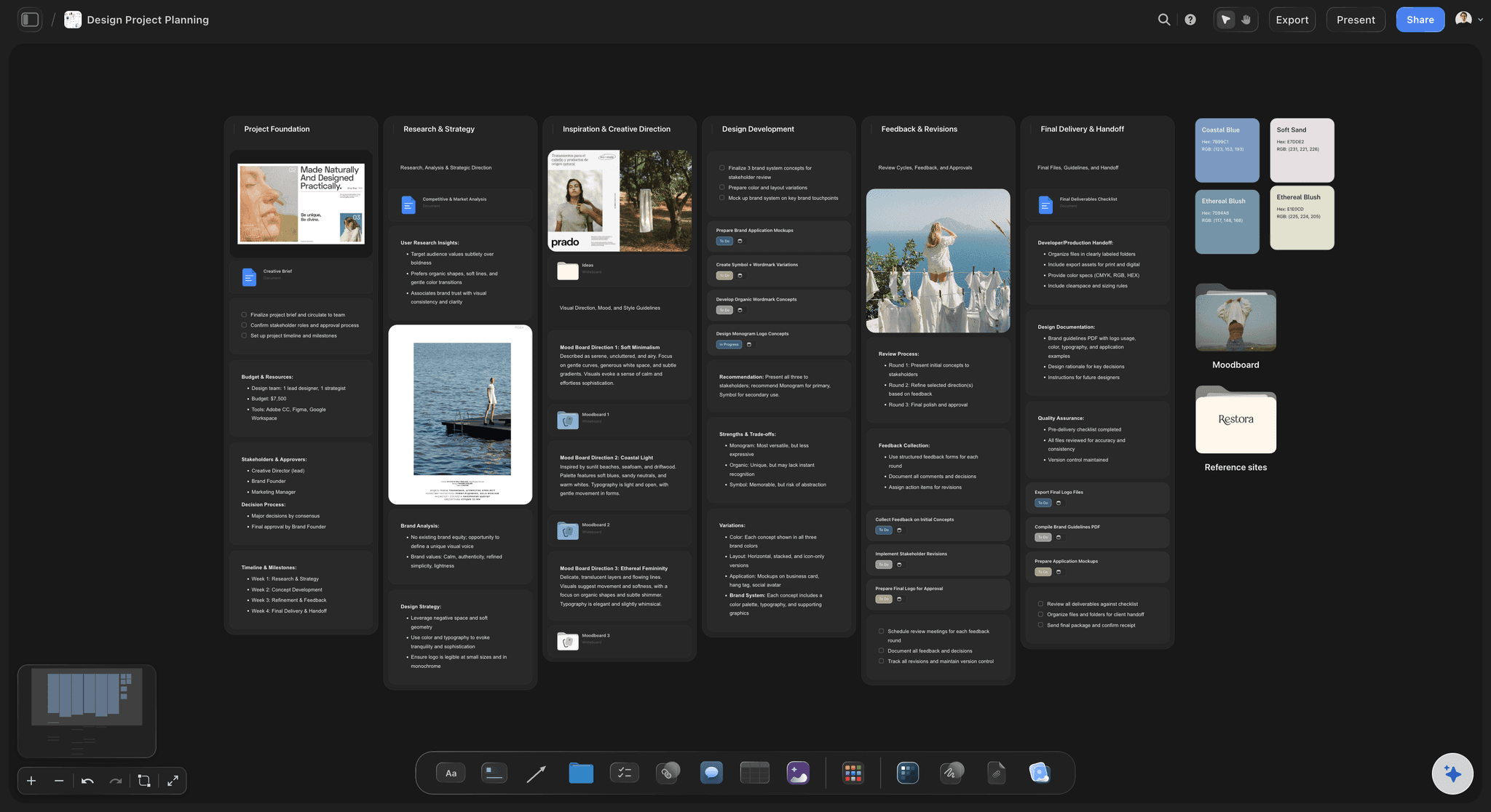
Failure two
Sketches too small to judge
Voting needs seeing: A wall of thumbnails makes the critique a formality, and the concept that photographs best tends to win.
Detail is the idea: The difference between two solution sketches is usually in the detail that vanishes at small sizes.
Full size on an infinite canvas: There is no page edge to compress against, so sketches sit at whatever size the decision needs.
Failure three
Thursday rebuilds what Wednesday rejected
Decisions lose their reasons: When the losing concepts are cleared away, the reason they lost goes with them and the prototype quietly reintroduces it.
The builder was not the decider: Whoever prototypes is often not who ran the vote, so the rationale has to be written rather than remembered.
Keep the alternatives visible: Rejected concepts beside the chosen one with a line each means Thursday builds the decision that was actually made.
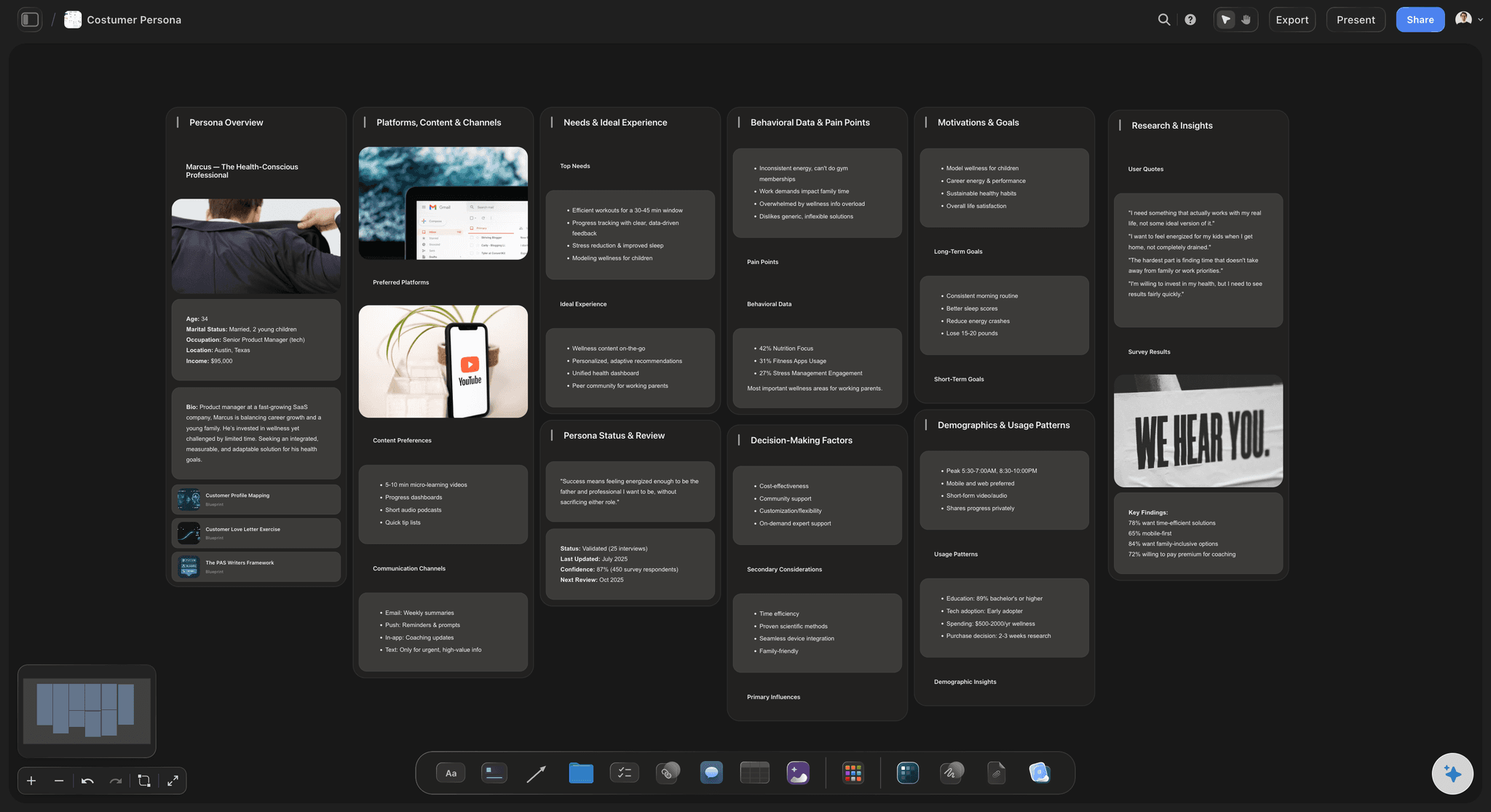
Failure four
Findings summarised instead of matched
Five interviews, one summary: A general write-up of what users said is much less useful than an answer to each question the sprint set out to test.
Contradictions get smoothed: Summaries average out the two participants who disagreed, and that disagreement is usually the finding.
Notes under the questions: Putting each observation beneath the question it bears on shows plainly which ones were answered and which were not.
Explore templates for your project
Every template opens as a real, editable board on the infinite canvas. Pick the closest fit and make it your own.
Mind Map
Branch one central idea out into themes and sub-points, then drag the connections around until the structure makes sense.
What creators are saying
Join early creators getting structured workspaces and AI that remembers their projects
“Storyflow has sped up my workflow by at least 3x, which means more flow state and more projects I can actually ship. It truly changed the way me and my team create.”

Reilin Joey
Director & YouTuber
“One prompt gets me a structured board. But the tactics are my favorite. I run my YouTube scripts through them and my intros and retention got better. It's amazing.”

Justkay
YouTuber & Freelance Filmmaker
“I used to juggle five apps to plan a project. Now I describe what I am making and get boards, lists, and a schedule. All in one place.”

George
@fernwehchronicles
Design sprint whiteboards, answered.
What matters when choosing a surface for the week.
One that keeps all five days on a single canvas. A sprint is a chain where each day is only meaningful in terms of the one before it, and the usual failure is splitting the days across a board, a channel, a design file and a document. Storyflow holds the map, sketches, decision and test notes on one infinite canvas, so Friday's findings sit beside Monday's questions.
Because the point of a sprint is converting an assumption into a tested answer, not producing a prototype. If nobody can put Friday's finding next to Monday's question, you ran an expensive workshop and built something, which is a different and much less useful outcome.
Not a fixed one. Ask the AI to lay out the five days as sections before Monday, so the week has a shape and no session time goes on building structure live.
Yes, and sprints are the format that suffers most when half the room is on a call. Everyone works on the same canvas with unlimited collaborators on paid plans. Storyflow does not host video, so use whatever you already use for that.
No. Thursday's prototype belongs in a design or prototyping tool. Keep the decision, the rejected concepts and the reasoning on the board so whoever builds it is building what the team actually chose.
Keep them beside the chosen one with a line about why each lost. Whoever prototypes is often not who ran the vote, and when the alternatives are cleared away the prototype quietly reintroduces something the team already rejected.
Under the question each observation bears on, rather than as one summary of what five users said. Summaries average out the participants who disagreed, and that disagreement is usually the actual finding.
Yes, a view-only link lets someone follow the board without an account and without being able to move anything, which suits observers who should not be participants.
It can become the project. A validated direction turns into a plan on the same canvas, and across several sprints the boards form a record of what was tested and learned, which is where the compounding value sits.
Not during early access. Plans start at $7.99 per month billed annually or $9.99 monthly, with a free plan before the end of 2026. Collaborators invited by a paid member can sign up free in the meantime.
Run the whole week in one place.
Map, sketches, decision and test on one canvas, so Friday answers Monday.