
The calmest place to shape your story
See where the character
actually changes.
Run each arc as its own track beneath the plot, mark only the scenes where a belief genuinely shifts, and the arcs that stall become impossible to miss.


Creatives working for these brands already got early access
- Red Bull
- Canon
- Artlist
- Porsche
See how easy it is to get started
Watch a real project come together, from a blank board to a finished plan, clicked through step by step.
Start from a ready-made template
Pick a board to see what you can build, then let AI fill it in. Every template is a real, editable starting point on the same infinite canvas.

Story Plan
Outline your plot, characters, and world in one connected view, then expand each thread as the story grows.
What is a character arc tracker?
A character arc tracker is a way of seeing how each character changes across a story, laid out so that the change is visible as a shape rather than remembered as an intention. Storyflow is an AI visual workspace that tracks every character arc on one infinite canvas: the plot as a spine of scenes, a track for each character beneath it, cards only where a belief shifts, and profiles beside them. An arc is not a personality and it is not a backstory. It is a sequence of scenes in which what a character believes gets tested and eventually gives way, and the useful question at every point is whether this scene actually moved that belief or merely featured the character.
The reason arcs go wrong is that they are easy to plan and almost impossible to audit inside a draft. Every writer can describe their protagonist's arc in a sentence. Far fewer can point to the specific scene where the belief first cracks, and fewer still notice that their secondary character has an identical arc, or that the mentor stops changing forty percent of the way in and simply delivers information for the rest of the book. Those are structural facts about a manuscript, and they are invisible when you read linearly, because reading one page at a time is the wrong instrument for seeing a shape.
Storyflow is an AI-native infinite canvas that makes this legible. Lay the plot out as a spine, then run each character's arc as a horizontal track underneath it, placing a card only where that character genuinely changes rather than wherever they appear. The result is a picture where the gaps do the work: a track with a long empty stretch is an arc that has stalled, and two tracks with cards at identical points are usually two characters having the same realisation.
An arc is worth tracking across five things. The starting belief is what the character holds to be true at the opening, stated concretely enough to be contradicted. The want and the need are the gap between what they are pursuing and what the story says they actually require, which is where most arcs generate their tension. The pressure points are the scenes that test the belief without breaking it. The break is the single scene where the belief genuinely gives way, which is the most important card on the track and the one most drafts leave implicit. And the ending belief is what replaces it, which should be specific enough that you could quote the character saying it.
Ultra fast from brief to board
From a cast list to arcs you can actually audit.
Lay the plot out, run a track per character, mark only real change.
01
Open a canvas
Sign up in seconds. No download. Your infinite planning canvas opens straight in the browser.
02
Lay out the plot spine
Describe the story and the AI lays out the plot as a row of scene cards in story order. The arcs need something to run underneath, and story order is the order arcs live in.
03
Give each character a track
Add a horizontal track per character below the spine, and place a card only where that character's belief genuinely moves. Appearing in a scene is not the same as changing in it.
04
Read the gaps
Look for tracks that go quiet, arcs that resolve too early, and two characters whose cards land at identical points. Then share a view-only link with your writing group or editor.
Arcs as tracks, gaps as diagnoses.
Each character's change running underneath the plot, where the problems are visible.
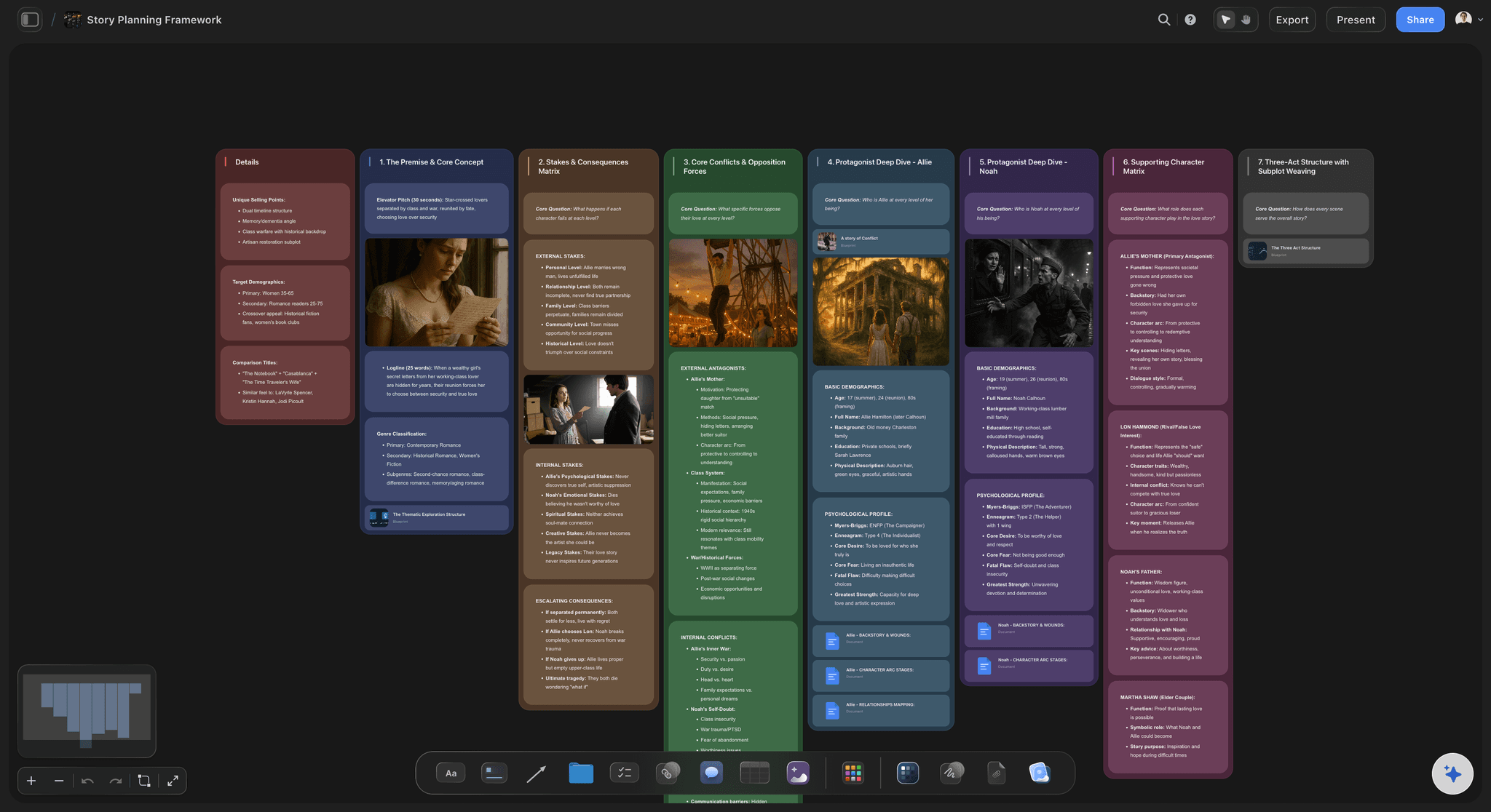
One horizontal track per character
Run every arc beneath the spine
Lay each character's arc as its own track under the plot. Reading a track on its own tells you whether that person has a story, which is very hard to judge while reading the whole book.
See the subplot tracker →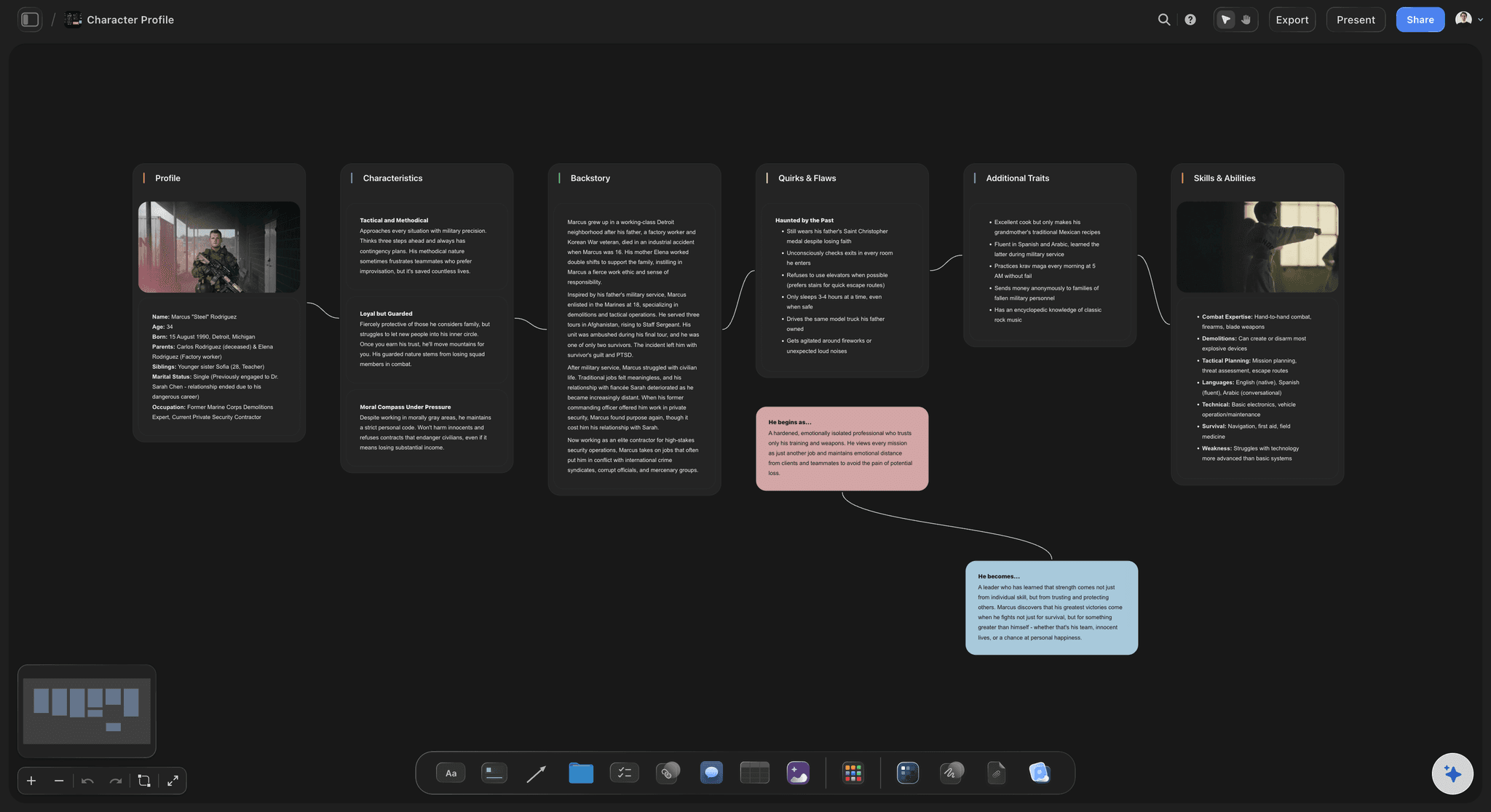
A card only where belief actually changes
Appearing is not changing
Place a card only where the character's belief genuinely moves. The discipline is the point: a track with cards on every scene tells you nothing, while a sparse one tells you exactly where the arc lives.
See the character profile generator →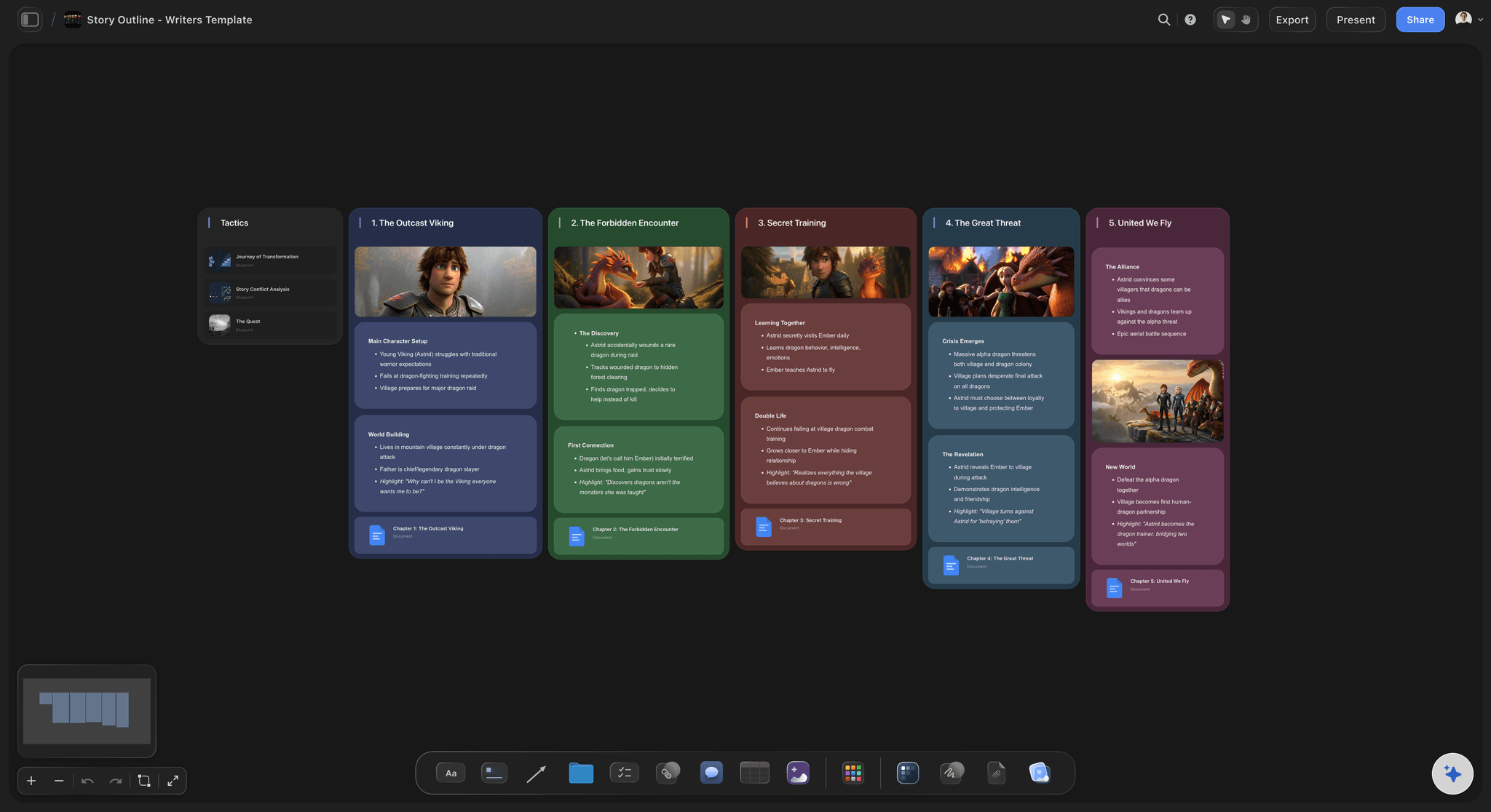
Empty stretches and duplicate patterns visible at a glance
The gaps are the diagnosis
A track that goes quiet for a third of the book is an arc readers will forget. Two tracks with cards at the same points are usually two characters having one realisation between them.
See the character relationship map →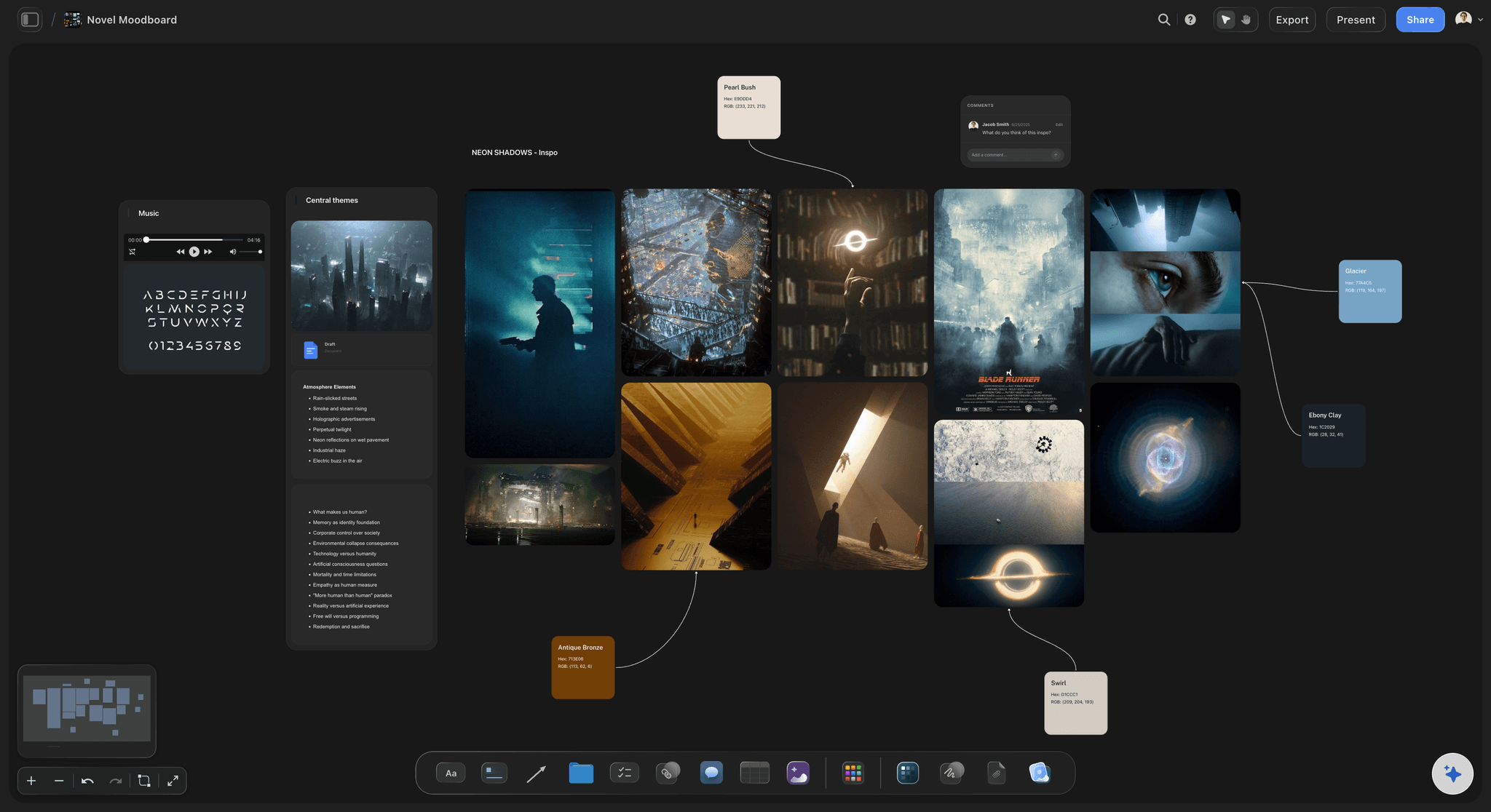
Arcs beside the plot, subplots, and profiles
Keep the arc next to what drives it
An arc that lives beside the plot scenes that turn it, the subplot it shares, and the character's profile is one you can actually reason about while revising.
See the novel plot creator →Unlimited boards. No object cap.
Open a canvas, lay out the plot, and give every character a track. Storyflow is paid-only during early access, with plans from $9.99 a month, and a Free plan launches before the end of 2026.
Unlimited arc boards on an infinite canvas
Basic AI usage to generate boards from prompts
3 starter frameworks built in
Share view-only links with your writing group
Built for people with taste
More than a note that says she grows.
An arc you cannot point to in specific scenes is an intention rather than a structure.
Belief, want and need, pressure, break, and resolution
Track every part of an arc
State the starting belief concretely: Write what the character holds to be true at the opening in terms specific enough to be contradicted. Vague starting positions produce arcs that cannot fail and therefore cannot land.
Separate the want from the need: What they are pursuing versus what the story says they actually require. Most arc tension comes from that gap, and an arc where the two are identical usually has nowhere to go.
Mark the break, not just the pressure: Pressure scenes test the belief; the break is the one scene where it gives way. Most drafts leave the break implicit, which is why the change reads as sudden or unearned to readers.
Quote the ending belief: Write what replaces the old belief in words the character could plausibly say. If you cannot phrase it, the arc has probably not resolved, whatever the last chapter implies.
AI that can see the board you have already built
Structure with AI, decide the change yourself
Lay out the spine and tracks from a prompt: Describe the story and the AI builds the plot spine with arc tracks ready to fill. It reads the active canvas as context, so it works with the scenes you have already placed.
Ask where a track goes quiet: Once the board exists, the AI can point out arcs with long empty stretches or arcs that resolve unusually early. That is a structural observation and a reasonable thing to delegate.
It structures, it does not ghostwrite: Storyflow is a planning canvas rather than a prose generator. What a character should believe and how they should change is the judgment that makes a book worth reading, and it stays with you.
Profiles, relationships, and research on one canvas
Keep the whole cast visible
Profiles beside their tracks: Pin each character's profile card next to the arc it drives, so backstory, want, need, and wound sit beside the scenes that are meant to express them.
Ensembles without losing anyone: There is no object cap, so a cast of twenty each with their own track fits on one board. Ensemble casts are exactly where arcs quietly disappear.
Relationships as their own layer: Some arcs belong to a pair rather than a person. Run a relationship track alongside the individual ones when the change is really happening between two characters.
Share with a writing group, agent, or editor
Get structural notes, not line notes
View-only links: Send a link and a critique partner sees every arc at once in a browser with no account. A reader looking at arc tracks gives structural feedback rather than commenting on prose.
Work with a co-author: Invite a co-writer so a shared book has one set of arcs rather than two people's assumptions. Live multi-editor presence with cursors is on the Max plan.
Export for a developmental edit: Export as an image or PDF to sit beside the manuscript during revisions. For a developmental editor, the arc board is often more informative than the first fifty pages.
Explore templates for your project
Every template opens as a real, editable board on the infinite canvas. Pick the closest fit and make it your own.
Story Plan
Outline your plot, characters, and world in one connected view, then expand each thread as the story grows.
One app instead of five
Storyflow vs Scrivener, Plottr, and a spreadsheet.
Plottr is purpose-built for timelines and does that job well. Here is the split.
Storyflow
Recommended
Arc tracks running under the plot spine
AI builds the spine and tracks from a prompt
Profiles and research on the same canvas
Long-form manuscript management
Word count targets and drafting tools
Runs in the browser, nothing to install
Scrivener
Arc tracks running under the plot spine
AI builds the spine and tracks from a prompt
Profiles and research on the same canvas
Long-form manuscript management
Word count targets and drafting tools
Runs in the browser, nothing to install
Plottr
Arc tracks running under the plot spine
AI builds the spine and tracks from a prompt
Profiles and research on the same canvas
Long-form manuscript management
Word count targets and drafting tools
Runs in the browser, nothing to install
Spreadsheet
Arc tracks running under the plot spine
AI builds the spine and tracks from a prompt
Profiles and research on the same canvas
Long-form manuscript management
Word count targets and drafting tools
Runs in the browser, nothing to install
What creators are saying
Join early creators getting structured workspaces and AI that remembers their projects
“Storyflow has sped up my workflow by at least 3x, which means more flow state and more projects I can actually ship. It truly changed the way me and my team create.”

Reilin Joey
Director & YouTuber
“One prompt gets me a structured board. But the tactics are my favorite. I run my YouTube scripts through them and my intros and retention got better. It's amazing.”

Justkay
YouTuber & Freelance Filmmaker
“I used to juggle five apps to plan a project. Now I describe what I am making and get boards, lists, and a schedule. All in one place.”

George
@fernwehchronicles
Character arc questions, answered.
How to track an arc, what a stalled arc looks like, and what the AI should not do.
Lay your scenes out in story order as a spine, then give each character a horizontal track underneath it. The crucial discipline is placing a card only where that character's belief genuinely moves, not wherever they appear, because a track with a card on every scene tells you nothing while a sparse one shows you exactly where the arc lives. For each character, write the starting belief in terms concrete enough to be contradicted, separate what they want from what they need, mark the pressure scenes that test the belief, identify the single scene where it breaks, and state the ending belief in words they could say. Then read the tracks as shapes: the gaps and the duplicates are the diagnosis.
Storyflow is built to show where a character changes: each arc runs as its own track under the plot, with a card only on the scenes where a belief shifts, so an arc that stalls is hard to miss. The AI builds the spine and the tracks from a prompt, and profiles and research sit on the same canvas. Scrivener still handles what Storyflow does not: long-form manuscript management, word count targets and drafting tools.
On a track, it looks like a long empty stretch, and that visual is the most useful thing a tracker gives you. Concretely, a stalled arc is a character who appears in scenes but stops changing in them, most often because the story has started using them for function rather than for development: the mentor who becomes an information delivery system, the friend who exists to ask clarifying questions. Readers experience this as a character fading rather than as a specific fault, which is why it is so easy to miss while writing. The other pattern worth watching for is an arc that resolves too early, where the break happens at forty percent and everything after it is the character being consistent, which reads as flat.
Not during early access. Storyflow is paid-only right now, with plans starting at $9.99 a month, and a Free plan launches before the end of 2026. Anyone a paid member invites to a board joins free today, so a critique partner or co-author can work on the board without paying. If you want a free approach this minute, index cards on a table work genuinely well for this, since the method matters far more than the medium and the tracks are easy to lay out physically.
The want is what the character is consciously pursuing and would tell you about if asked. The need is what the story says they actually require in order to change, which they usually cannot see and often actively resist. The gap between the two is where most arc tension comes from, because the plot can then be constructed so that pursuing the want repeatedly fails to deliver the need. It is worth writing both on the board explicitly, because arcs where the want and the need turn out to be the same thing tend to have nowhere to go: the character gets what they were chasing and nothing internal has been tested.
Give every character a track, including the ones you suspect do not have an arc, because finding that out is the point. There is no object cap, so a cast of twenty each with their own track fits on one board without splitting into files. What usually emerges is clarifying rather than discouraging: three or four characters have real arcs, several have a single turn, and the rest are functionally scenery. That is often correct for the book, and knowing it explicitly lets you decide whether a character deserves an arc or deserves to be cut, instead of leaving them in a middle state where they take up space without developing.
It can build the structure and spot patterns, and it should not decide the change. Describe the story and the AI lays out the plot spine with arc tracks ready to fill, reading the active canvas as context so it works with what you have already placed. Once the board exists it can point out arcs with long empty stretches or arcs that resolve unusually early, which is a genuinely useful structural observation. What it cannot do is decide what your character should believe or how they should change, because that judgment is most of what makes a book worth reading. Storyflow is a planning canvas rather than a prose generator.
Yes, and this is the most common and probably the most valuable use. Card out the draft you have, one card per scene, then mark on each character's track the scenes where they genuinely change. The arcs you have actually written become visible, which is frequently different from the arcs you intended, and the difference is usually the reason a draft feels off without an obvious cause. Doing this before a revision pass is far more efficient than rereading, because rereading is the wrong instrument for seeing a shape.
No, and believing otherwise leads to bloated manuscripts. Plenty of characters exist to apply pressure, provide contrast, or perform a function, and giving each of them a change of belief dilutes the ones that matter. What is worth avoiding is the middle state, where a character takes up significant page time and half-develops without either arc or clear function. A tracker makes that state visible: their track has two cards, widely spaced, and neither leads anywhere. At that point you can commit to the arc or commit to the function, and either decision improves the book.
Yes. Share a view-only link and a critique partner, agent, or developmental editor opens the whole board in a browser with no account. The specific benefit is that it changes the kind of feedback you get: a reader looking at arc tracks responds to structure, whereas a reader handed three chapters responds to prose. For a developmental edit in particular, the arc board is often more informative than the opening fifty pages. You can also export it as an image or PDF to mark up.
Yes, and they belong together. The arc tracks run underneath the plot spine, subplot tracks run alongside them, and character profiles can be pinned beside the arcs they drive. That arrangement is what lets you see that a subplot and an arc are meant to resolve in the same scene, or that a character's break has been scheduled for a chapter where they do not appear, which are exactly the collisions that are invisible in a linear document.
More from Storyflow
Find the arc that stopped moving.
Open a canvas, lay out the plot, and give every character a track. No download.