
The calmest place to shape your story
Move the scene.
See what breaks.
The reason writers plot on index cards is not nostalgia. It is that moving a scene and immediately seeing what stops making sense is the fastest way to test a structure, and a linear document cannot do it. An infinite canvas is the index card wall without the floor space.


Creatives working for these brands already got early access
- Red Bull
- Canon
- Artlist
- Porsche
See how easy it is to get started
Watch a real project come together, from a blank board to a finished plan, clicked through step by step.
Start from a ready-made template
Pick a board to see what you can build, then let AI fill it in. Every template is a real, editable starting point on the same infinite canvas.

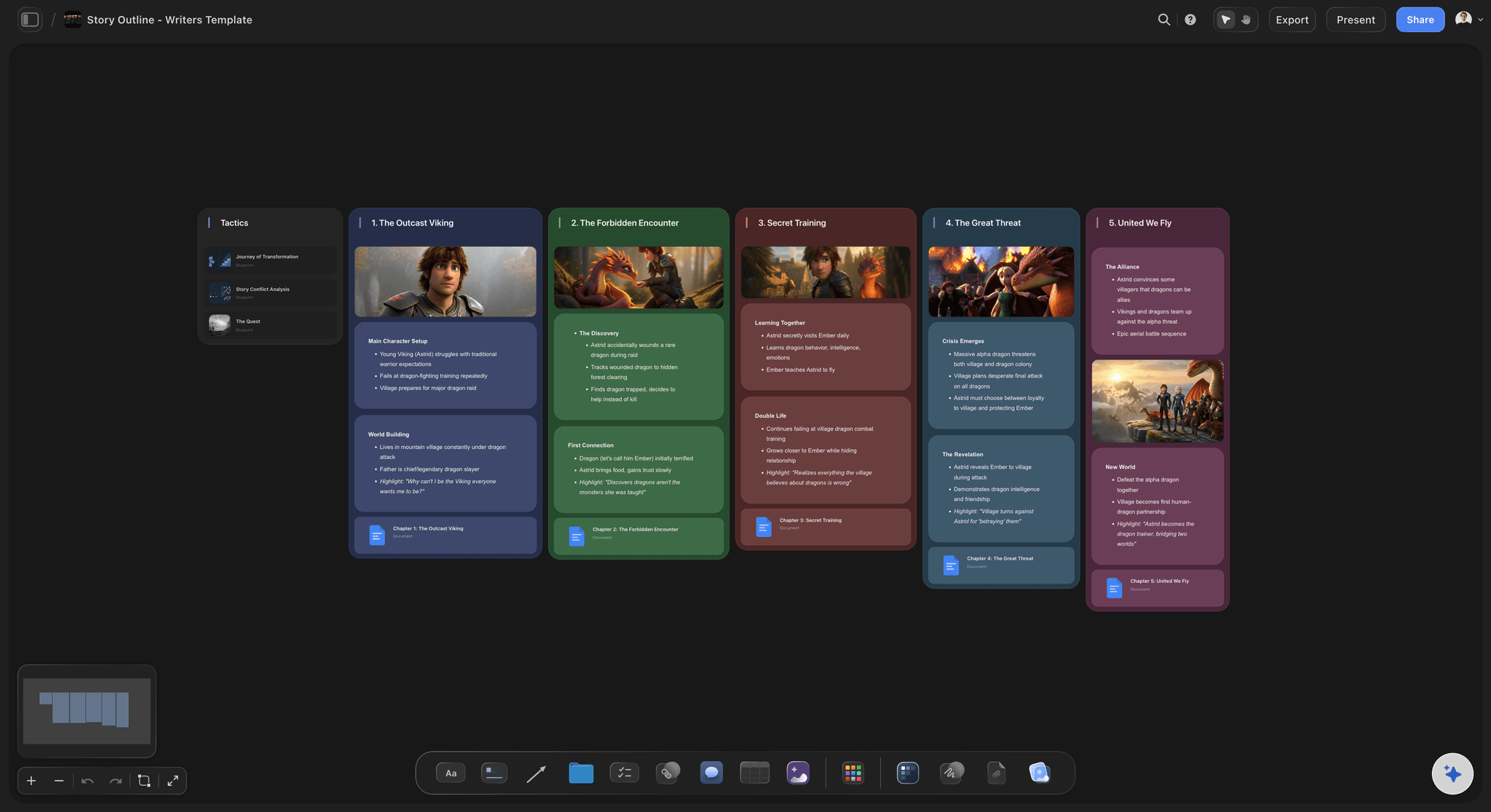
Story Plan
Outline your plot, characters, and world in one connected view, then expand each thread as the story grows.
What is the best way to visually plot a novel?
Scenes as cards you can physically move, subplots as parallel tracks running alongside the main one, and character arcs laid against both. Those three views answer the three questions that actually break novels: is the sequence right, does the subplot disappear for eleven chapters, and is this character present but not changing. A linear outline can answer the first and is nearly blind to the other two.
The parallel-track view is the one most tools omit and the one long fiction needs most. A novel usually carries three or four threads, and the failure is almost never that a thread is bad. It is that a thread vanishes for a hundred pages and returns expecting the reader to still care. Laid out as tracks, that gap is a visible hole in a line rather than something you have to hold in memory across a draft.
The other reason to plot on a canvas is that research belongs next to the scene it serves. Novels accumulate material: photographs of a place, a timeline of real events, notes on how a job actually works, a name list. Kept in a separate folder, it is consulted once and then half-remembered. Kept beside the scene it feeds, it is used.
Storyflow gives you an infinite canvas with scene cards and parallel tracks. The AI reads the whole active board plus up to five attached documents and three boards, so it can answer questions about your own plot: where a subplot goes quiet, which scenes a character drives rather than watches.
Ultra fast from brief to board
Four views of the same novel.
Each answers a different question, and the plot is the one they all agree on.
01
Scenes as cards
One card per scene with what happens and what changes. Moving them is how you test a sequence, which is why the physical metaphor persists.
02
Subplots as parallel tracks
Each thread on its own line, so a subplot that disappears for eleven chapters shows up as a visible gap rather than a vague worry.
03
Arcs against the plot
Lay a character's change beside the scenes they appear in, and the ones where they are present but static become obvious.
04
Research beside the scenes
Photographs, timelines and notes on the same canvas as the scenes they feed, so the material actually gets used.
The index card wall, without the floor.
Everything that made physical cards work, plus the things they could never do.
Scenes you can rearrange
Test a sequence by moving it
Drag a scene to a new position and read the surrounding cards. Structural problems reveal themselves through rearrangement far faster than through re-reading.
See the scene card organizer →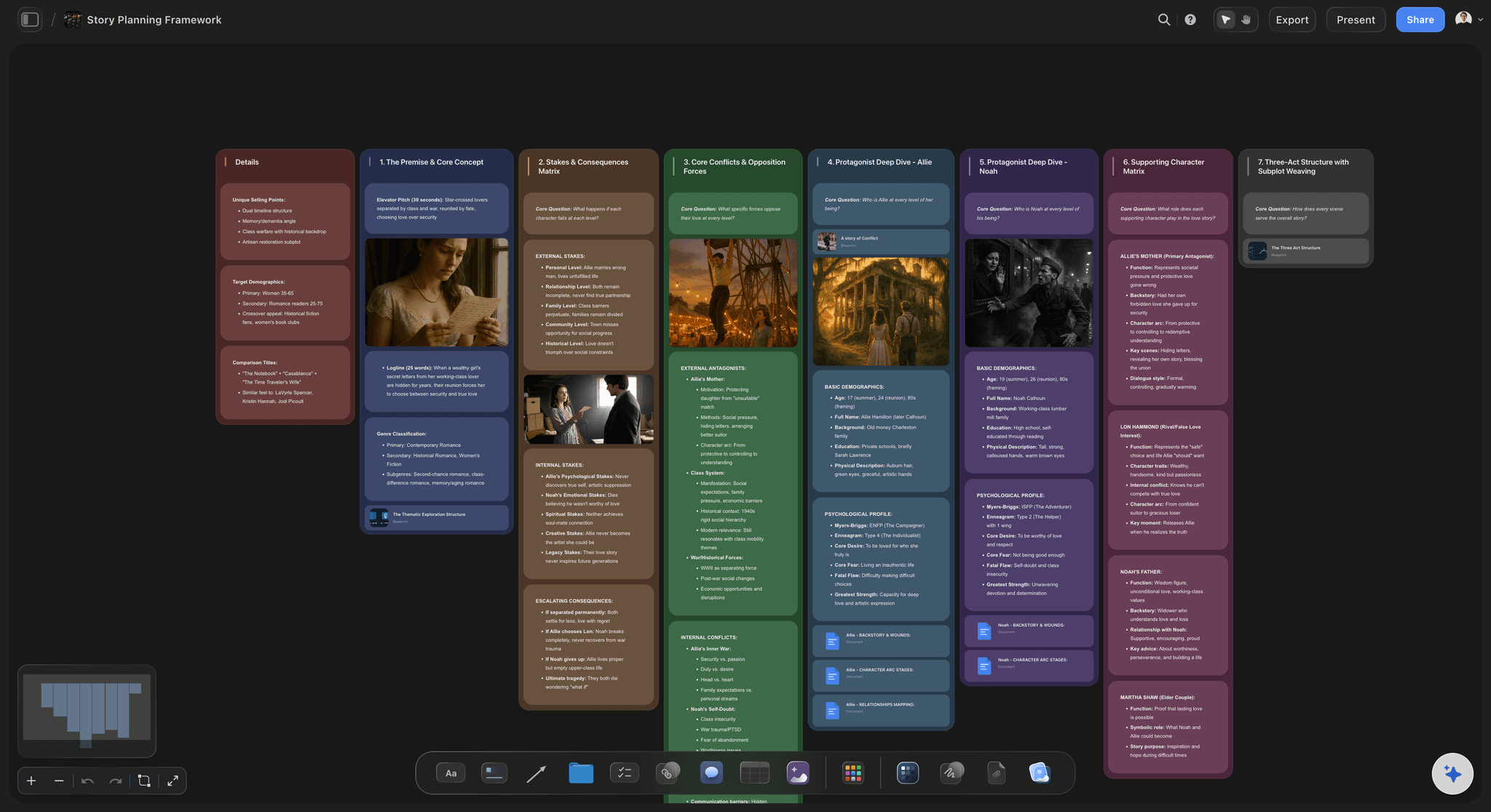
Threads that stay visible
Find the subplot that vanished
Parallel tracks make a gap in a thread a visible hole rather than something you have to hold in your head across four hundred pages.
See the subplot tracker →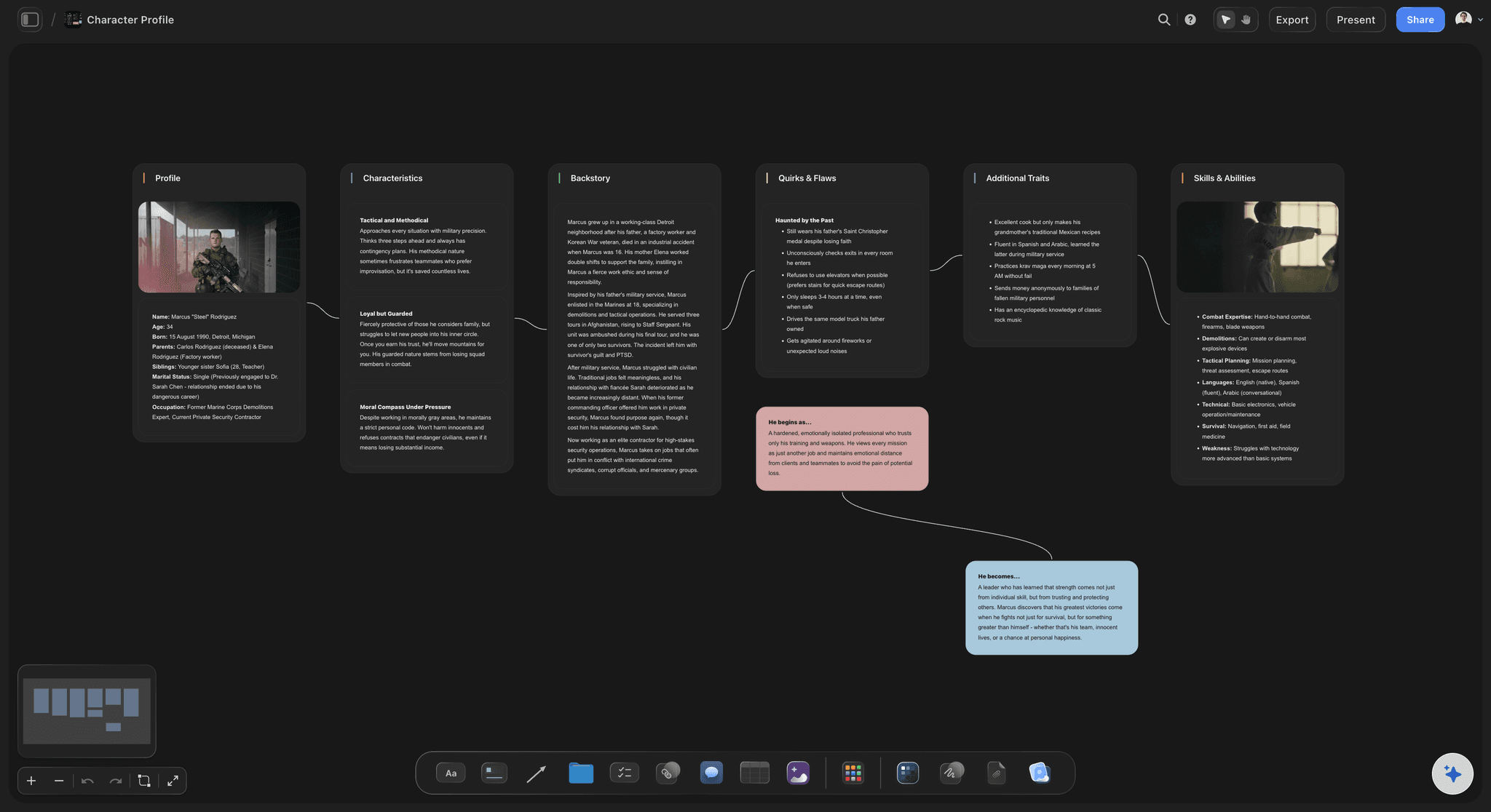
Characters against the plot
Present, but not changing
A character arc laid beside the scenes they are in shows where someone occupies pages without developing, which reading rarely catches.
See the character arc tracker →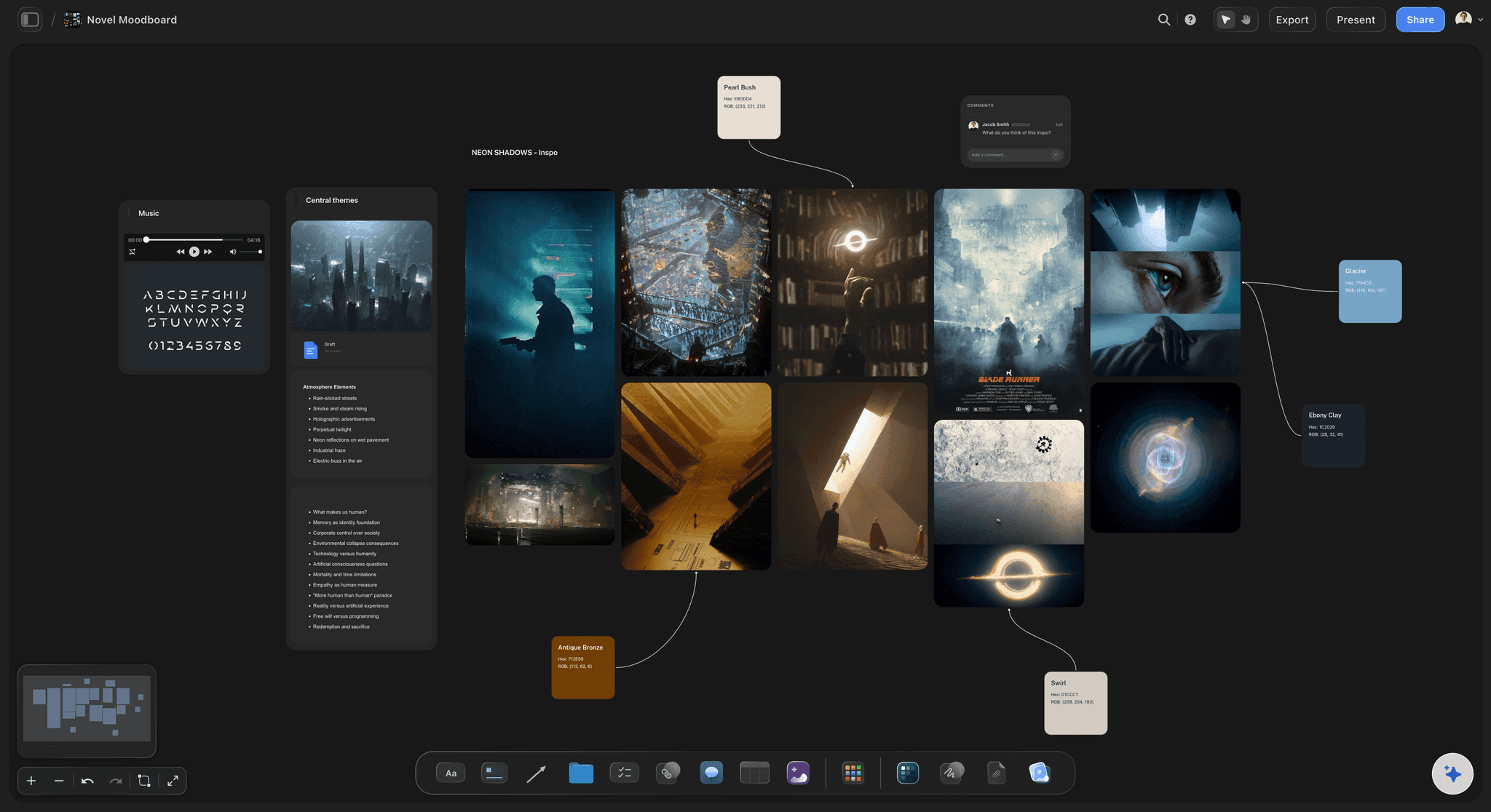
Ask the board about your plot
Questions a document cannot answer
The AI reads the whole canvas, so where a thread goes quiet or which scenes a character drives are questions with answers from your material.
See storytelling frameworks →Plans from $7.99/month annual. Free plan coming late 2026.
One board per novel, with no project limit on any paid plan. Free plan before the end of 2026.
One board per novel, with no project limit
Research, images and notes on the same canvas
AI reads the whole board before it answers
Built for people with taste
Four structural failures a plotting board catches.
All four are hard to see in a linear document and obvious on a canvas.
Failure one
The sagging middle
It is a structural fact: Laid out as cards, a middle where nothing changes state is visibly a long run of scenes that do not alter the situation.
Mark what each scene changes: A scene that changes nothing is not automatically wrong, but three in a row usually are, and that is countable.
Act breaks made visible: Laying a structure such as three acts over the cards shows whether the turns land where the shape expects them.
Failure two
The subplot that disappears
Gaps are invisible in prose: Reading a draft linearly, you carry the thread in memory and do not notice it has been absent for a hundred pages.
Tracks show the hole: As a parallel line, the absence is a physical gap you can see rather than a feeling that something is off.
Reweave by moving cards: Fixing it is redistributing scenes across the gap, which is a rearrangement rather than a rewrite.
Failure three
Characters who stop developing
Presence is not progress: A character can be in twenty scenes and change in three, and page count disguises that completely.
Arc beside appearances: Laying the intended change against actual appearances shows where someone is being used as furniture.
Ensembles most at risk: With four viewpoint characters, one silently becomes a device, and it is usually not the one you would guess.
Failure four
Research that never reaches the page
Separate folders go unread: Material kept away from the draft is consulted once and then half-remembered, which is where accuracy quietly slips.
Attach it to the scene: The photograph, the timeline and the note sit beside the scene they serve, so they are in view while it is written.
The AI reads it too: Because the research is on the canvas, questions about consistency can be answered against the material rather than from memory.
Explore templates for your project
Every template opens as a real, editable board on the infinite canvas. Pick the closest fit and make it your own.
Story Plan
Outline your plot, characters, and world in one connected view, then expand each thread as the story grows.
What creators are saying
Join early creators getting structured workspaces and AI that remembers their projects
“Storyflow has sped up my workflow by at least 3x, which means more flow state and more projects I can actually ship. It truly changed the way me and my team create.”

Reilin Joey
Director & YouTuber
“One prompt gets me a structured board. But the tactics are my favorite. I run my YouTube scripts through them and my intros and retention got better. It's amazing.”

Justkay
YouTuber & Freelance Filmmaker
“I used to juggle five apps to plan a project. Now I describe what I am making and get boards, lists, and a schedule. All in one place.”

George
@fernwehchronicles
Plotting a novel visually, answered.
The questions writers ask before moving off a document.
One that gives you three views: scenes as cards you can move, subplots as parallel tracks, and character arcs laid against the plot. Those answer the three questions that break novels, whether the sequence works, whether a thread disappears, and whether a character is present but not changing. Storyflow provides all three on one infinite canvas, and its AI reads the whole board.
No, and writers who draft without planning often get more from it. Reverse-engineering the structure of a finished messy draft is exactly what a board is good at, and it is a revision tool as much as a planning one.
As parallel tracks running alongside the main plot, one line per thread. The value is that a gap becomes visible: a subplot absent for eleven chapters is a physical hole in a line rather than a vague sense that something has gone quiet.
Yes. Ask the AI for three-act structure, the hero's journey or a beat sheet and it lays the beats out as cards beside your scenes. Laying a framework over material you already have is more useful than filling one in from nothing.
No. Storyflow is for the structure, the research and the plan. Prose belongs in whatever you draft in, and most novelists keep the two separate on purpose, because plotting and writing want different tools.
Not during early access. Plans start at $7.99 per month billed annually or $9.99 monthly, with a free plan launching before the end of 2026.
It keeps what made cards work, physical rearrangement, and adds what they could not do: parallel tracks, attached research and images, no floor space, and a board that survives being tidied away.
It reads the whole active board plus up to five attached documents and three boards, so it can answer where a thread goes quiet, which scenes a character drives rather than watches, and whether the turns land where a chosen structure expects. It is answering from your cards, not from a general theory of novels.
Yes, and it is worth doing. Photographs, timelines and notes beside the scenes they feed get used, where the same material in a separate folder gets consulted once and half-remembered.
The canvas is infinite and there is no project limit, so length is not the constraint. For series, one board per book with a shared arc board above them keeps each readable while the long threads stay visible.
See the whole novel at once.
Scenes as cards, subplots as tracks, arcs against the plot, on one canvas.