
The calmest place to shape your story
Plan the whole book,
and the whole series.
Storyflow is an author planning tool on a truly infinite canvas. Keep a living series bible so your world and characters stay consistent from book one to book six, outline each title, park your research, and lay out the launch, all in one place. Ask the AI to expand any branch.


Creatives working for these brands already got early access
- Red Bull
- Canon
- Artlist
- Porsche
See how easy it is to get started
Watch a real project come together, from a blank board to a finished plan, clicked through step by step.
Start from a ready-made template
Pick a board to see what you can build, then let AI fill it in. Every template is a real, editable starting point on the same infinite canvas.

Story Plan
Outline your plot, characters, and world in one connected view, then expand each thread as the story grows.
What does it take to run a body of work as an author?
Writing a book is one project. Being an author is many at once. There is the manuscript in front of you, but also the series bible that keeps a returning character consistent, the timeline that has to line up across three titles, the research behind a non-fiction chapter, the backlist you still promote, and the launch that decides whether the next book lands. Scattered across documents, spreadsheets, and sticky notes, those pieces drift apart, and continuity errors and dropped launch tasks are where they surface.
Storyflow gives authors one infinite canvas to hold all of it. A series bible, a per-book outline, a research collection, and a launch plan can sit side by side as boards of real cards you drag, recolor, group, and connect. Pin the reference photo behind a setting, the interview PDF behind a chapter, or a comparable title's cover beside your positioning notes. When you open the canvas for book four, the world, the cast, and the rules that governed the first three are right there, not buried in an old file you have to hunt down.
And the plan does the work with you. Ask the AI to expand a thin character into a full profile, blow a chapter summary out into a beat sequence, or spin an outline into the next layer. When the structure is set, draft chapters or scenes as documents on the same canvas, then turn to the launch: map the pre-order runway, the ARC list, the email sequence, and the release-week tasks on boards beside the book they are selling. Planning, writing, and shipping stop living in separate tools.
Ultra fast from brief to board
From series bible to launch day in four steps.
Start with one book or a whole catalog. Either way the continuity and the calendar stay in one place.
01
Open your canvas
Start in the browser with a Storyflow account. Nothing to install, just an infinite canvas ready for your book and everything around it.
02
Build the bible and outline
Lay out a series bible for world, cast, and rules, then outline the current book beside it as cards you arrange by hand, or describe the story once and let the AI place the first boards.
03
Expand any branch with AI
Point at a flat character, a thin chapter, or a vague subplot and ask the AI to develop it. It reads your board, so new detail fits the continuity you have already set, not a stock template.
04
Draft, then plan the launch
Turn outlines into chapters as documents on the same canvas, then map the pre-order, ARC, and release-week tasks on launch boards. Share a view-only link or export as an image or PDF.
Everything around the book, on one canvas.
Keep continuity across a series, outline each title, hold your research, and run the launch. Then draft on the same canvas.
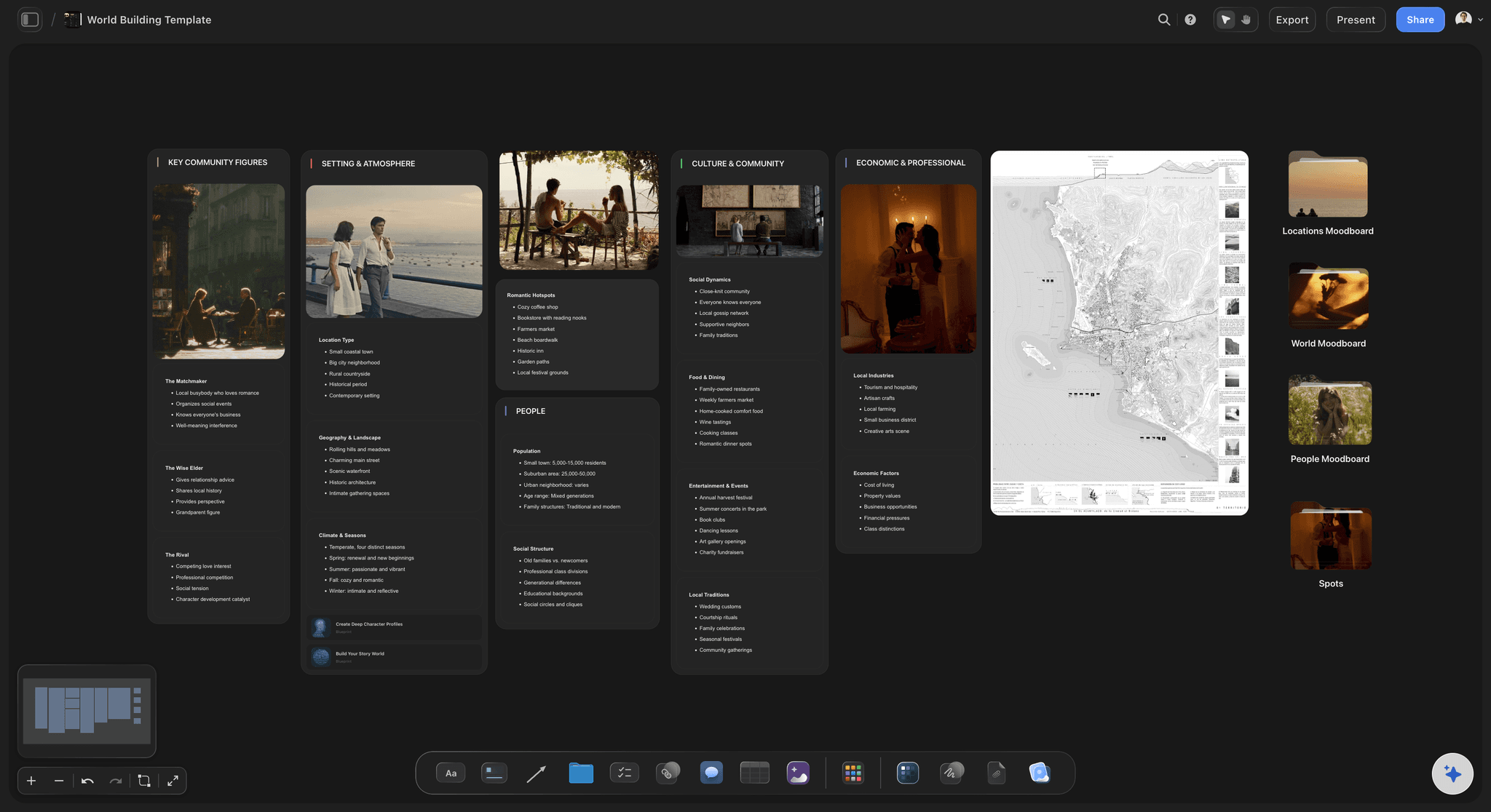
One bible for the whole series
Continuity that holds across books
Keep world rules, timelines, and character histories on one board so a returning character and a laid-out map stay consistent from book one to the finale. No more digging through an old manuscript to check a detail.
See the story bible generator →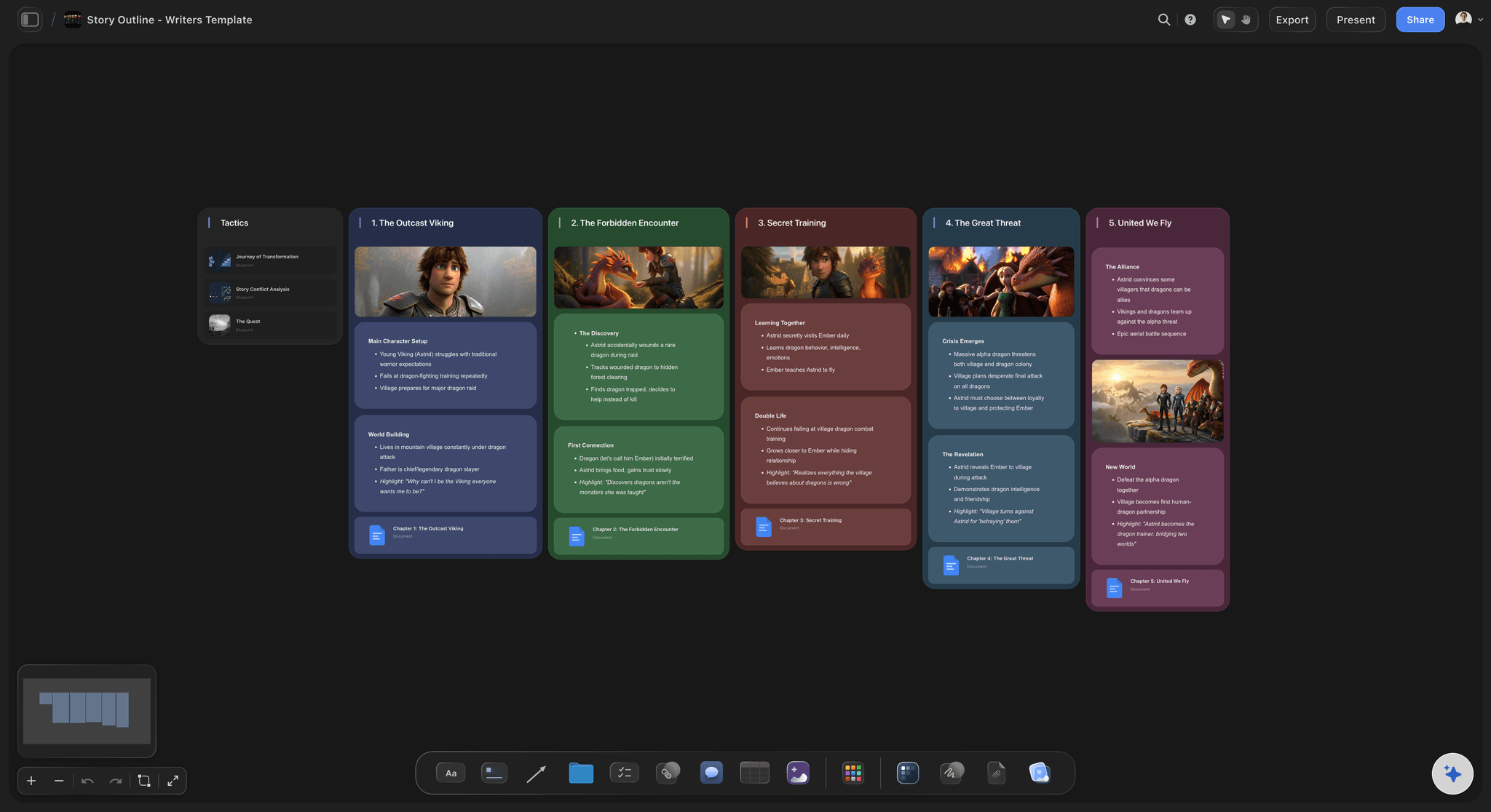
Structure each title
Book outlines you can see whole
Lay a book's acts, chapters, and beats out across the canvas so structure and pacing are visible at a glance. Drag a chapter to resequence it, and spot a saggy middle before you have written it.
See the novel planner →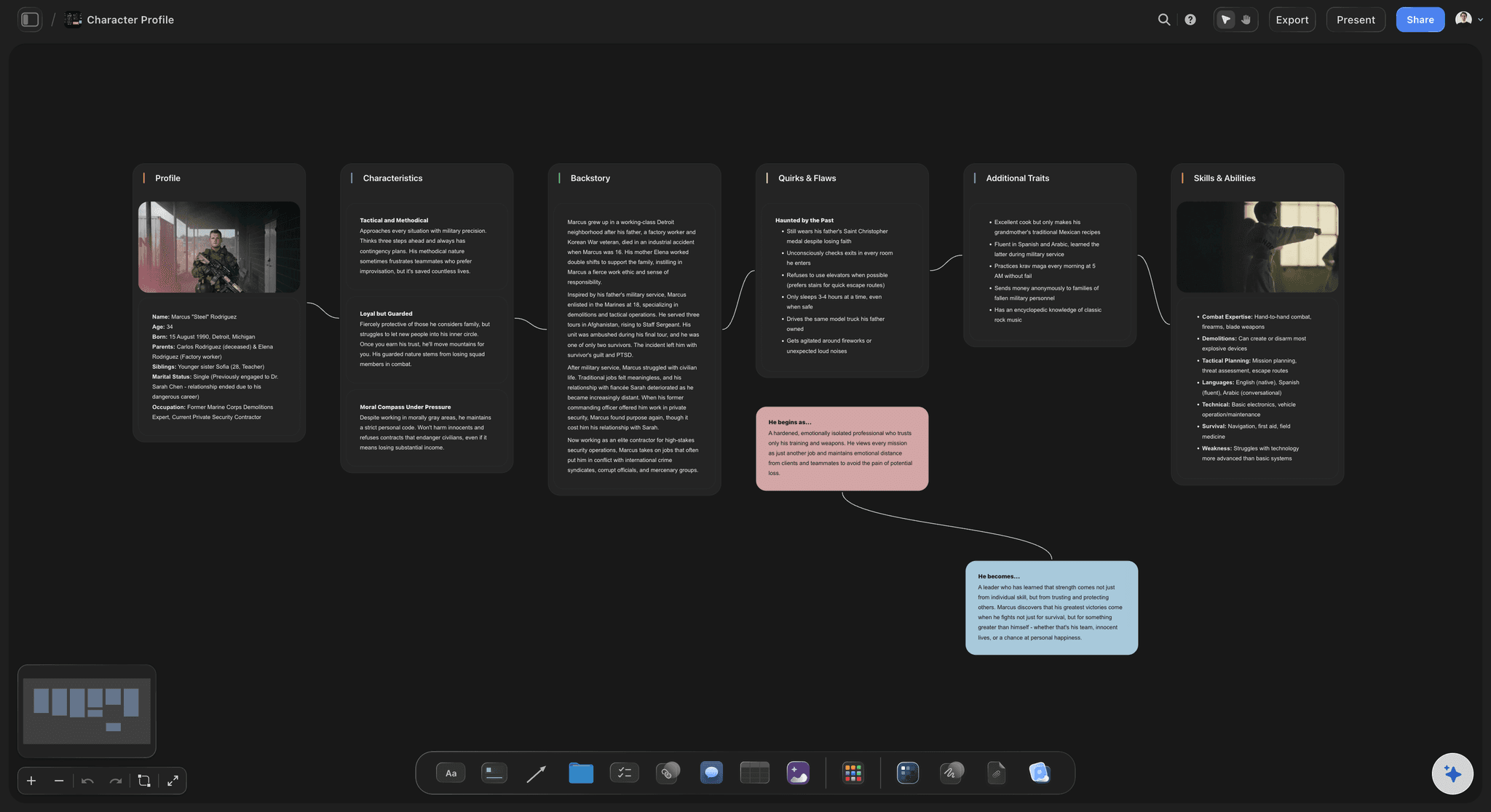
AI expands the thin branches
Develop any character or chapter with AI
Point at a character sketch or a flat chapter and ask the AI to go deeper. It reads the board you have open, so a new profile or beat connects to the story and continuity you have built, not a generic template.
See the character profile generator →
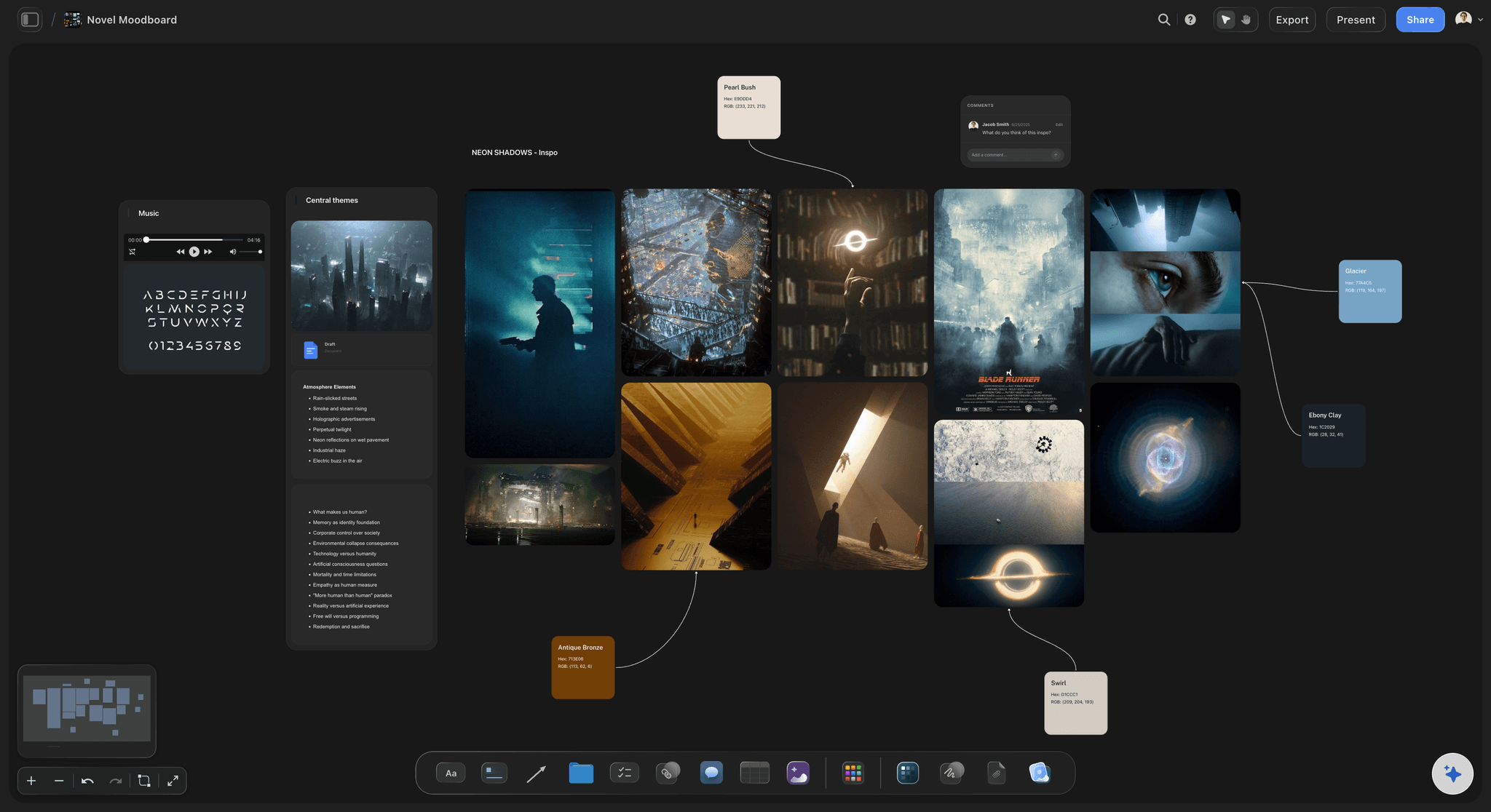
Ship the book, not just write it
Plan the launch beside the book
Map the pre-order runway, the ARC and reviewer list, the email sequence, and release-week tasks on a launch board next to the title it sells. The marketing lives with the manuscript instead of a separate spreadsheet.
See launch task management →No object cap, on any plan.
Open a canvas and start planning your book. Plans have no object cap and no time limit, so a whole series bible, outline, and launch board never push you to upgrade mid-project.
Unlimited boards for the bible, outlines, and launch
Basic AI usage to lay out and expand any branch
Attach research PDFs, cover references, images, and links
Share a plan view-only, or invite an editor or co-author free
Built for people with taste
Made for the way book authors actually work.
Hold the series together, structure each book, keep your research in sight, and run the launch. Then draft on the same canvas.
Continuity across a series
A series bible that stays consistent
Keep the world and rules straight: Lay out places, factions, history, and the rules of your world as connected cards, so a setting stays consistent across every book instead of drifting between manuscripts.
Track the cast across titles: Give each character a card with arc, relationships, and what changed in each book, so a returning character never contradicts an earlier appearance.
Line up the timeline: Map events across books on one canvas so a date, an age, or a backstory beat that spans the series stays correct wherever it surfaces.
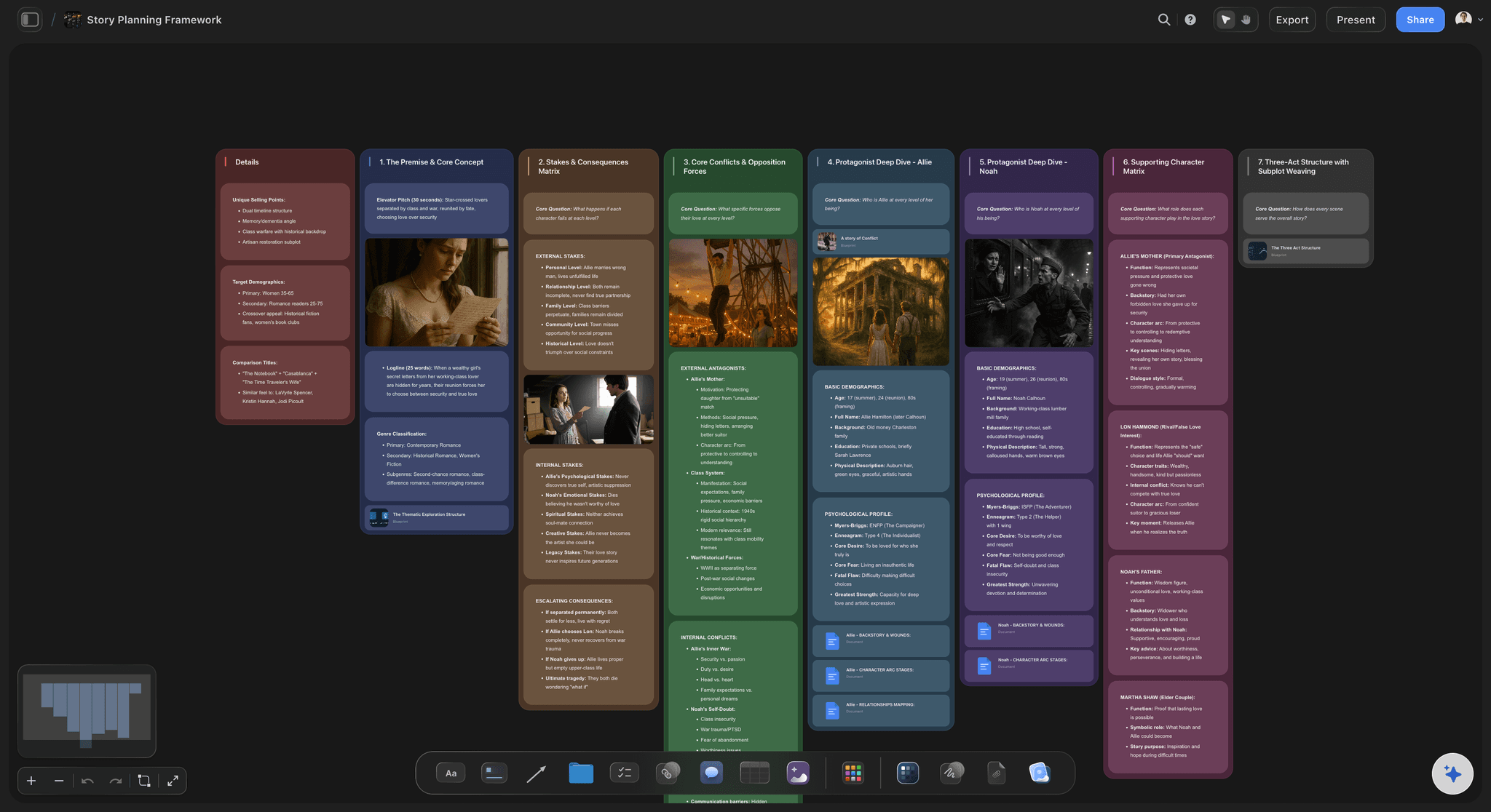
Structure and research per book
Outline the book and hold the sources
See the whole book at once: Lay acts, chapters, and beats out across the canvas so structure and pacing read at a glance, whether you write fiction or a non-fiction argument.
Keep research beside the chapter: Pin the interview PDF, the source article, or the reference photo right next to the chapter or beat it supports, so nothing is three folders deep when you sit down to write.
Rearrange with a drag: Move a chapter, resequence an act, or split a section by dragging a card. When the book shifts, the outline keeps up instead of forcing a rewrite of your notes.
AI that reads your series
AI expands from what is already there
Expand any branch on demand: Ask the AI to flesh out a character, a location, or a chapter. It builds on the cards you already placed, so new detail connects to your continuity rather than drifting off-canon.
Bring in your bible and research: Add up to five documents and three boards as context from the + menu, so your series bible or a research doc shapes what the AI suggests.
Re-prompt to refocus: Ask for a tighter arc, a different tone, or a non-fiction angle. The AI reworks the branch while keeping the continuity and choices you already made.
Launch and manage the backlist
From manuscript to launch and beyond
Run the launch on a board: Map the pre-order runway, ARC list, email sequence, and release-week tasks beside the book, so the launch is a plan you can see instead of a checklist you forget.
Manage the whole catalog: Give each book its own boards on one infinite canvas, from the one you are drafting to the backlist you still promote, so your body of work lives in a single place.
Share and export: Invite an editor or co-author free, send a view-only link to a beta reader or an assistant, or export a board as a clean image or PDF for a pitch or a submission.
Explore templates for your project
Every template opens as a real, editable board on the infinite canvas. Pick the closest fit and make it your own.
Story Plan
Outline your plot, characters, and world in one connected view, then expand each thread as the story grows.
One app instead of five
How Storyflow compares for authors.
Each tool has a strength. The question is whether it holds a series together and covers the launch, not just the draft.
Storyflow
Recommended
Visual series bible and cross-book continuity
AI that expands any branch from your board
Launch and marketing planning beside the book
Deep long-form drafting and manuscript tools
Scrivener
Visual series bible and cross-book continuity
AI that expands any branch from your board
Launch and marketing planning beside the book
Deep long-form drafting and manuscript tools
Notion
Visual series bible and cross-book continuity
AI that expands any branch from your board
Launch and marketing planning beside the book
Deep long-form drafting and manuscript tools
Milanote
Visual series bible and cross-book continuity
AI that expands any branch from your board
Launch and marketing planning beside the book
Deep long-form drafting and manuscript tools
What creators are saying
Join early creators getting structured workspaces and AI that remembers their projects
“Storyflow has sped up my workflow by at least 3x, which means more flow state and more projects I can actually ship. It truly changed the way me and my team create.”

Reilin Joey
Director & YouTuber
“One prompt gets me a structured board. But the tactics are my favorite. I run my YouTube scripts through them and my intros and retention got better. It's amazing.”

Justkay
YouTuber & Freelance Filmmaker
“I used to juggle five apps to plan a project. Now I describe what I am making and get boards, lists, and a schedule. All in one place.”

George
@fernwehchronicles
Questions from authors, answered.
Everything fiction and non-fiction authors ask about planning a book in Storyflow.
You keep a series bible on the canvas: world rules, timelines, and character histories as boards of cards that stay put across every book. When you plan book four, the continuity from the first three is right there to check against, so a returning character or a laid-out map does not contradict an earlier title.
Not during early access. Storyflow is paid-only right now, with plans starting at $9.99 per month that include unlimited boards for the bible, outlines, research, and launch, basic AI usage to expand any branch, 20 file uploads, and view-only sharing. A Free plan is planned before the end of 2026.
Yes. A series bible, a per-book outline, a research collection, and a launch plan can all live on one truly infinite canvas. There is no object cap on any plan, so a sprawling world, a full cast, and a growing catalog never run out of room or push you to upgrade mid-project.
Yes. Non-fiction authors structure the argument as a visual outline, keep every source and interview PDF beside the chapter it supports, and expand a thin section with AI. You plan the book visually, then draft chapters as documents on the same canvas.
Yes, and that is part of the point. Map the pre-order runway, the ARC and reviewer list, the email sequence, and release-week tasks on launch boards next to the title they sell. The marketing lives with the manuscript, so nothing gets dropped between a writing app and a separate planner.
The AI reads the board you have open, so the world, characters, and beats already on the canvas shape what it suggests when you ask it to expand a branch. You can also attach up to five documents and three boards, such as your series bible or a research doc, for it to work from. It builds on your canon, not a generic template.
Be honest about the fit. If your main need is deep, long-form manuscript drafting: a binder of chapters, compile and export formats, and years of writing in one dense document, Scrivener is purpose-built for that. Storyflow's edge is the visual planning around the book: a series bible that holds continuity, AI that expands any branch, and launch boards beside the manuscript.
Yes. Share a view-only link so a beta reader, editor, co-author, or assistant can explore the full plan in their browser without an account, invite collaborators to build it with you, or export any board as a high-quality image or PDF for a pitch, a submission, or a query.
The book is one project. Being an author is many. Get them all on one canvas.
Keep the series consistent, outline each title, hold your research, and run the launch, with AI to expand any branch.