
The calmest place to shape your story
A flat middle
is a shape.
Plot the beats against tension, mark the act breaks, and run the subplots underneath. Structural problems are obvious as a drawing and invisible in an outline.


Creatives working for these brands already got early access
- Red Bull
- Canon
- Artlist
- Porsche
See how easy it is to get started
Watch a real project come together, from a blank board to a finished plan, clicked through step by step.
Start from a ready-made template
Pick a board to see what you can build, then let AI fill it in. Every template is a real, editable starting point on the same infinite canvas.

Story Plan
Outline your plot, characters, and world in one connected view, then expand each thread as the story grows.
What is a story arc?
A story arc is the shape a story makes over its length: how tension, stakes, and the protagonist's situation rise and fall from the first page to the last. Storyflow is an AI visual workspace that maps the shape of your story on one infinite canvas: beats plotted against a tension curve, act breaks and the midpoint marked, and subplot and character arcs stacked under the main spine. The familiar version of the arc is Freytag's pyramid, meaning exposition, rising action, climax, falling action, resolution, and it is a useful starting diagram even though very few stories actually look like a clean triangle. What matters is not conforming to a template but knowing what shape your story has, because problems that are impossible to feel in a manuscript are obvious in a drawing.
The word is used at three different scales and mixing them up causes most of the confusion. The story arc is the shape of the whole thing. A character arc is one person's internal change across it, which frequently peaks somewhere other than the plot's climax and is more interesting when it does. A series arc runs across books or seasons and is the hardest to hold, because no single instalment contains it. A story usually has all three running at once, and the useful diagram is one that lets you see them stacked rather than one at a time.
The reason to draw it rather than outline it is that the most common structural failure is a proportion problem, and proportion is invisible in a list. An outline with forty numbered beats gives you no sense that beats twelve to twenty-six occupy half the book and contain one reversal between them. Drawn as a curve, that stretch is a flat line, and a flat line in the middle of a story is the thing readers describe as losing interest around a third of the way in. The same applies to a climax that arrives too early, a reveal with no setup behind it, and a subplot that vanishes for a hundred pages.
Storyflow is an AI-native infinite canvas, which makes the arc something you draw rather than something you infer. Describe the story and the AI lays out a spine of beats with the act breaks and midpoint marked and a first pass at where tension sits. Then you correct it, which is the part that teaches you something: move beats, mark where the tension genuinely rises rather than where you intended it to, and run character and subplot arcs as rows beneath the spine so the whole structure is stacked in one view.
Ultra fast from brief to board
From a story you cannot fix to a shape you can see.
No framework to commit to. Beats, a curve, and the arcs running underneath.
01
Open a canvas
Sign up in seconds. No download. Your infinite story canvas opens in the browser.
02
Describe the story
Type the premise, who changes, and what happens. The AI lays out the beats with act breaks and midpoint marked, so you start from a shape rather than a blank page.
03
Plot tension honestly
Place each beat by where the tension actually is, not where you meant it to be. The flat stretch is the sagging middle, and it is now a thing you can point at.
04
Stack the other arcs underneath
Run character and subplot arcs as rows beneath the spine. Then share a view-only link with a co-writer or editor, or export the map as an image or PDF.
Beats, tension, act breaks, and the arcs beneath.
The whole structure stacked in one view instead of read one line at a time.
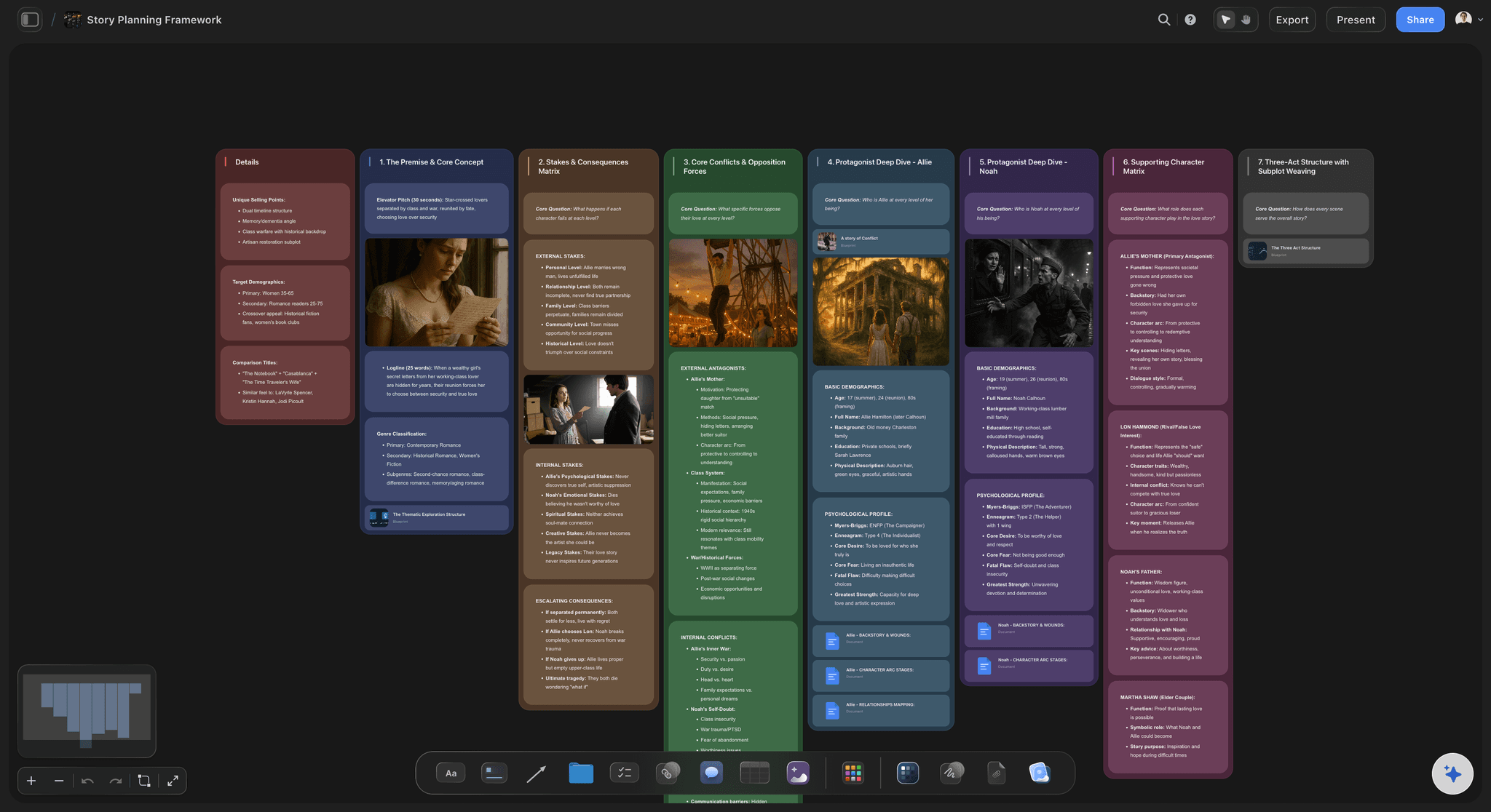
AI lays out a spine from a premise
Start from a drawn arc
Describe the story and the AI produces beats across the acts with the breaks and midpoint marked. Disagreeing with a proposed shape is far more productive than inventing one from nothing.
See the AI story outline generator →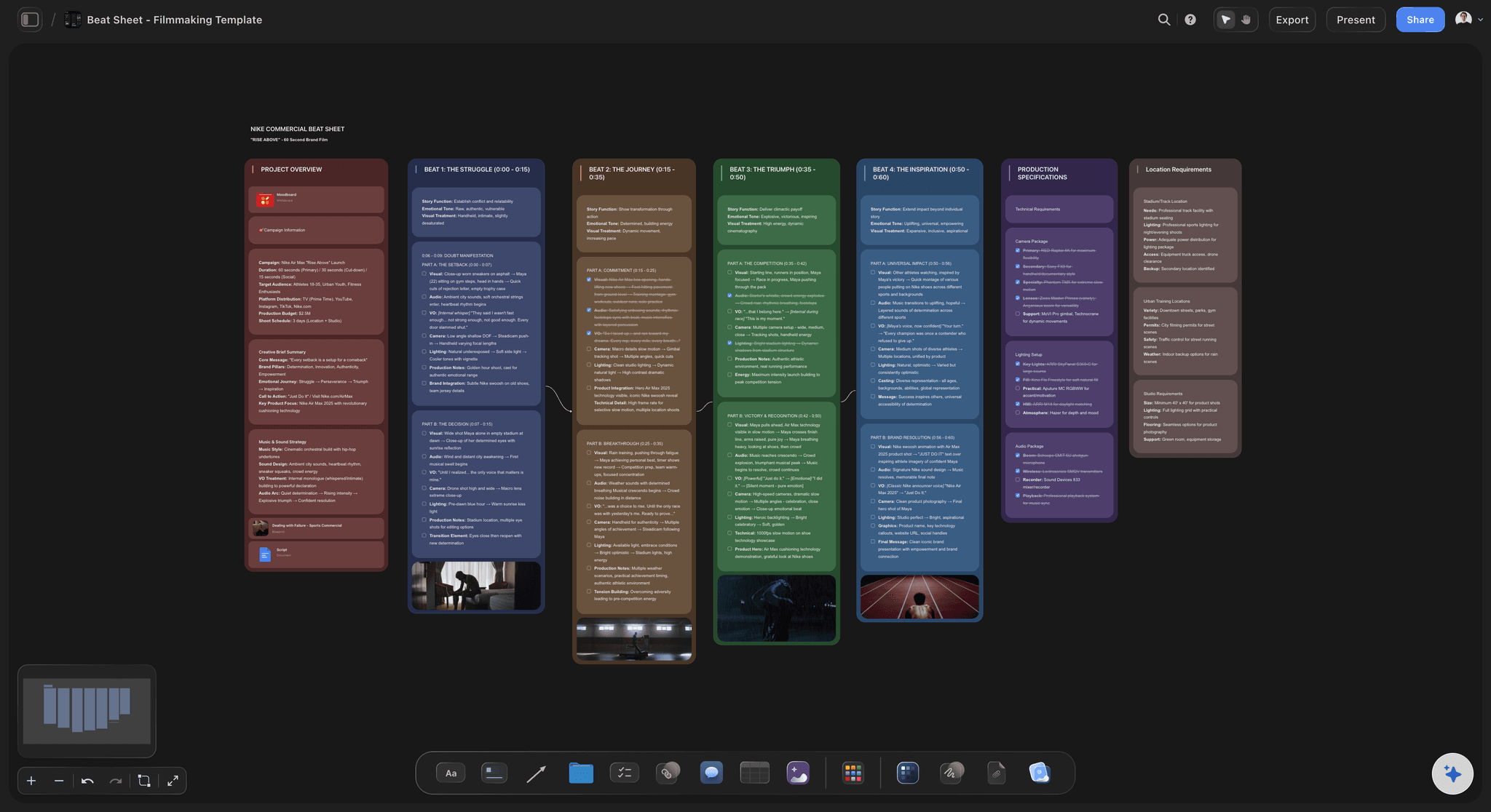
Tension plotted rather than assumed
Find the flat middle
Place beats by where the tension actually sits. A long horizontal stretch in act two is precisely what a reader experiences as losing interest, and it is invisible in an outline.
Explore the story structure software →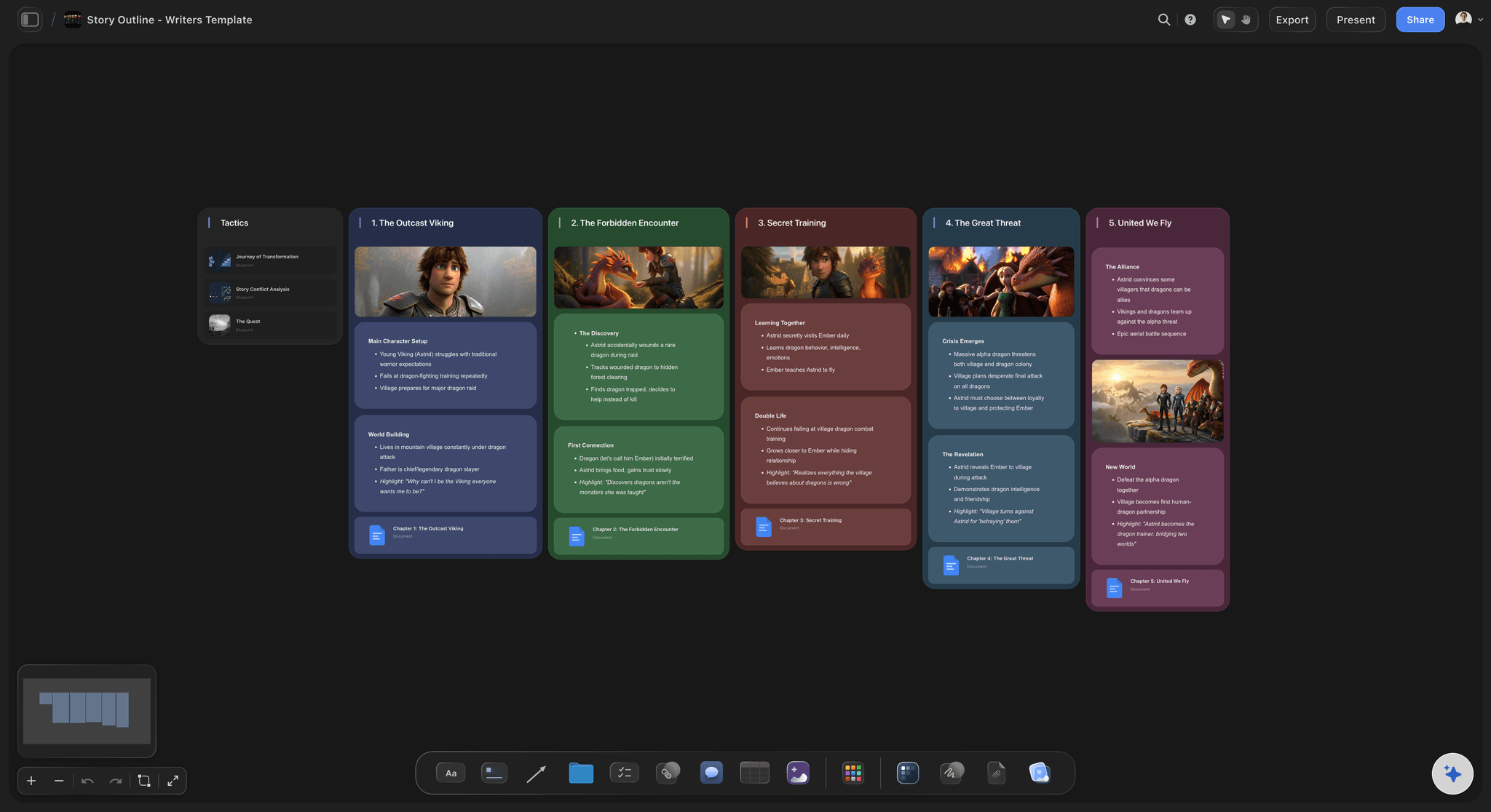
Character and subplot arcs as rows
Stack every arc under the spine
A subplot that vanishes for a hundred pages, or a character whose change peaks at the same moment as the plot, is a shape rather than something a reader has to tell you about.
See the subplot tracker →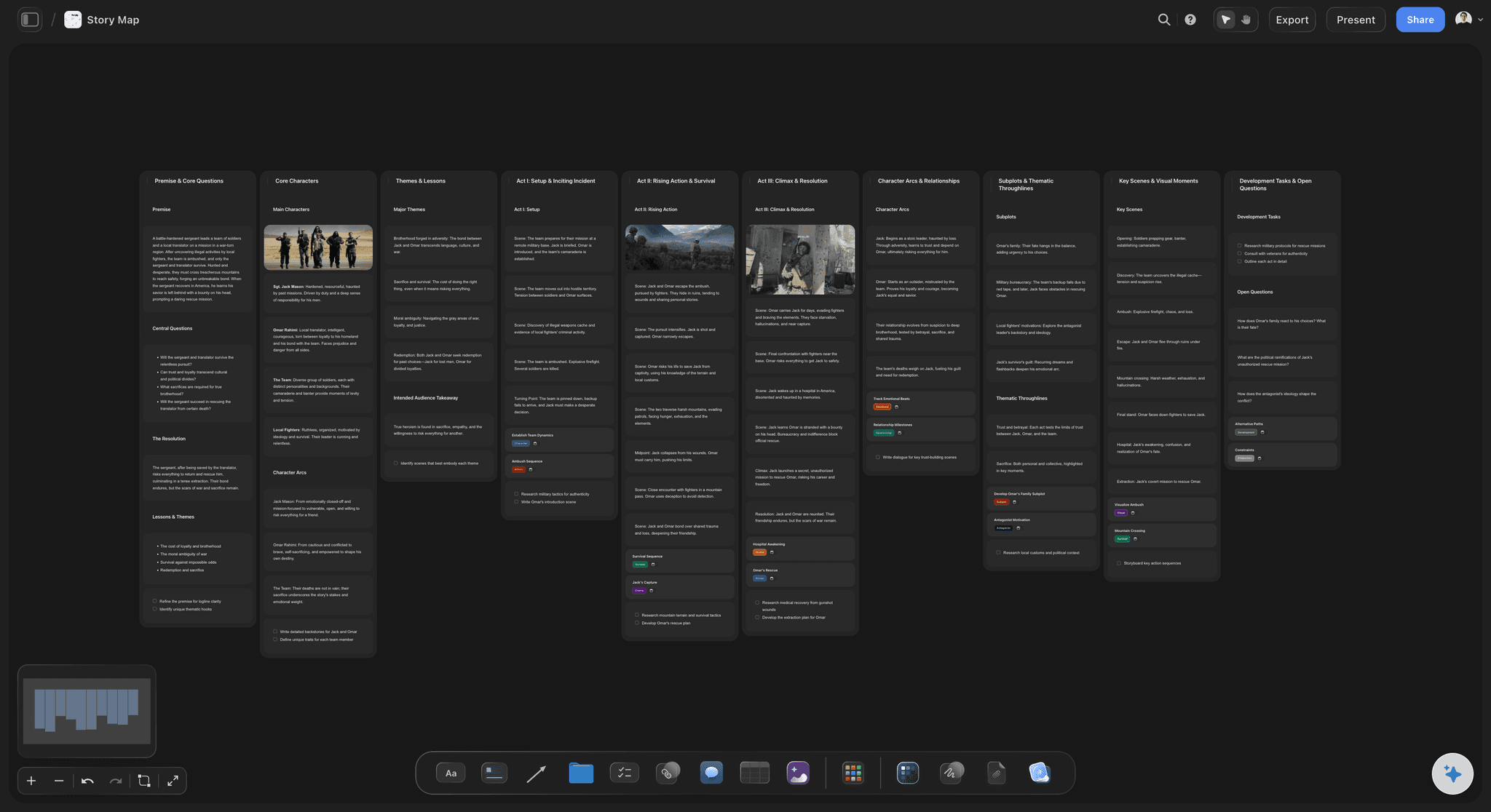
Setups and payoffs connected
Check that every reveal was planted
Draw a line from each payoff back to the beat that set it up. A payoff with no line is a reveal readers will not accept, and a setup with no line is a promise you never kept.
Try the story planning tool →Unlimited boards. No object cap.
Open a canvas, describe the story, and let AI lay out the arc. Storyflow is paid-only during early access, with plans from $7.99 a month billed annually, and a Free plan launches before the end of 2026.
Unlimited story maps on an infinite canvas
Basic AI usage to generate beats and structure from a premise
Starter templates for three act, the story circle, and beat sheets
Share view-only links with co-writers and editors, no account required
Built for people with taste
Proportion is the failure, and an outline cannot show proportion.
Forty numbered beats give you no sense that fourteen of them occupy half the book with one reversal between them.
Three scales, stacked
Story arc, character arc, series arc
The story arc: The shape of the whole: where tension rises, where it releases, and where the turn is. This is the spine everything else is measured against, and it is the one most writers have in their head rather than on paper.
Character arcs beneath it: One row per character whose internal state changes. The interesting cases are the ones that peak somewhere other than the plot climax, and drawing them is how you notice you have made them all peak together.
Subplot arcs: Each subplot as its own row with its own small shape. A subplot with no beat for a hundred pages is a gap you can see, and it is the most common note an editor gives.
Series arcs across instalments: For a series or a season, the arc that no single book or episode contains. It is the hardest structure to hold in a head and the easiest to represent as a row running across sections.
The frameworks as diagnostics
Use a template to notice where you differ from it
Freytag and the three act shape: The classical pyramid is a starting diagram rather than a target. Laying your story over it is useful precisely because of where the two disagree.
The story circle and cyclical shapes: Not every story is a line, and circular structures are painful to represent in a document and natural on a canvas.
Beat sheet traditions: Save the Cat and its relatives give you expected positions for the turns. If your midpoint is at seventy percent, that is either a deliberate choice or the reason act two feels long.
Your own shape: Plenty of good stories fit none of these. The board holds whatever structure yours actually has, which is the point at which a framework stops being a constraint.
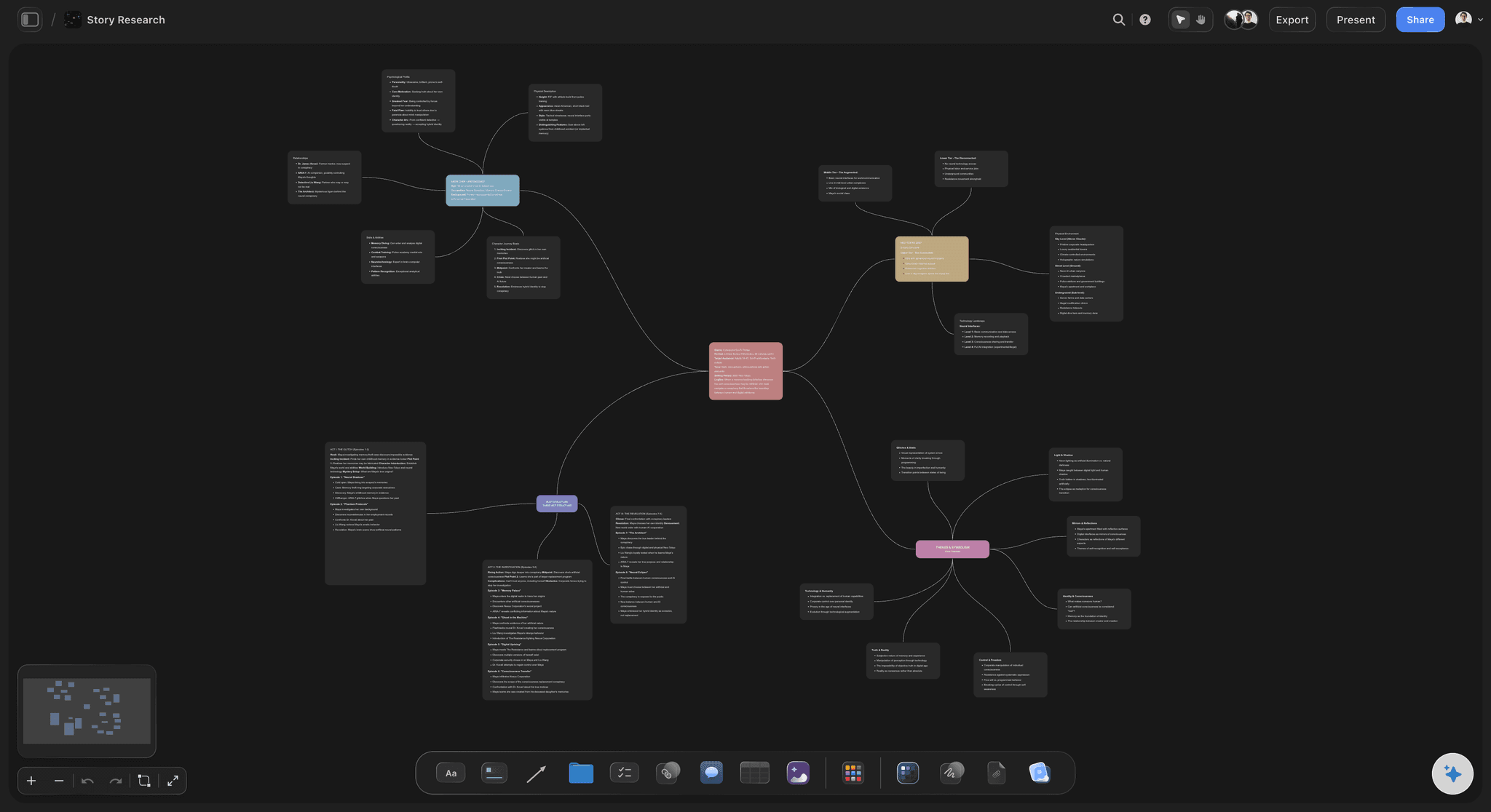
AI that reads the whole board as context
Ask the map what is wrong with the shape
Generate the first arc: Describe the premise and the AI lays out beats with the standard turns positioned. The conventional version is worth seeing, because knowing it is how you decide what to do differently.
Interrogate the structure: Ask where the tension flattens, which promise made in act one is never paid off, which character has no beat in the middle third, or what the midpoint is actually reversing.
It structures, it does not write: Storyflow arranges and suggests. It does not draft your scenes, and prose written by a model reads like it, which serves nobody.
Try an alternative shape: Ask what a version with the reveal moved earlier would look like, and it builds around the beats you have placed. Nothing you positioned by hand moves.
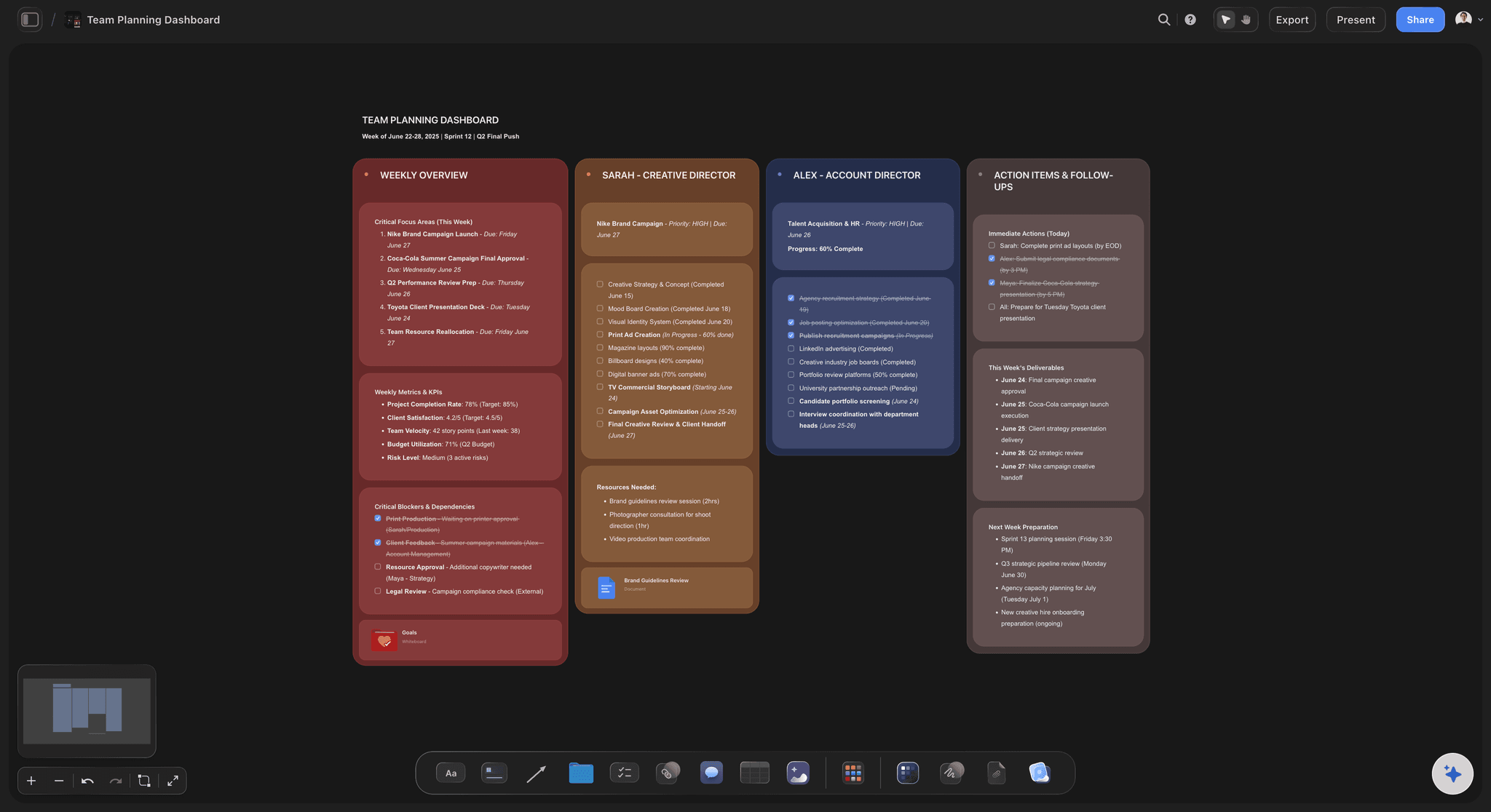
Editors, co-writers, and the room
Take structural notes on a structure
View-only links: Send a link and an editor, a co-writer, or a critique partner sees the shape in a browser with no account. Structural notes given against a map are far more precise than notes given against a draft.
Comments on the beat in question: A note about the midpoint sits on the midpoint. Nobody reconstructs which beat a comment three weeks ago was about.
Cheaper than restructuring a draft: Rearranging a map takes an afternoon and rearranging a manuscript takes a month. That difference is the entire argument for showing the shape before the pages.
Explore templates for your project
Every template opens as a real, editable board on the infinite canvas. Pick the closest fit and make it your own.
Story Plan
Outline your plot, characters, and world in one connected view, then expand each thread as the story grows.
One app instead of five
Storyflow vs Plottr, Scrivener, and an outline document.
Each is good at its own job: Plottr is purpose-built for novel timelines, Scrivener keeps the manuscript and its research in one long-term project, and an outline is the fastest thing to write. Here is where they differ.
Storyflow
Recommended
Beats plotted against a tension curve
Character and subplot arcs stacked beneath the spine
AI generates and interrogates the structure
Setups connected to payoffs as drawn links
Manuscript drafting in the same tool
Word count targets and writing statistics
Plottr
Beats plotted against a tension curve
Character and subplot arcs stacked beneath the spine
AI generates and interrogates the structure
Setups connected to payoffs as drawn links
Manuscript drafting in the same tool
Word count targets and writing statistics
Scrivener
Beats plotted against a tension curve
Character and subplot arcs stacked beneath the spine
AI generates and interrogates the structure
Setups connected to payoffs as drawn links
Manuscript drafting in the same tool
Word count targets and writing statistics
An outline document
Beats plotted against a tension curve
Character and subplot arcs stacked beneath the spine
AI generates and interrogates the structure
Setups connected to payoffs as drawn links
Manuscript drafting in the same tool
Word count targets and writing statistics
What creators are saying
Join early creators getting structured workspaces and AI that remembers their projects
“Storyflow has sped up my workflow by at least 3x, which means more flow state and more projects I can actually ship. It truly changed the way me and my team create.”

Reilin Joey
Director & YouTuber
“One prompt gets me a structured board. But the tactics are my favorite. I run my YouTube scripts through them and my intros and retention got better. It's amazing.”

Justkay
YouTuber & Freelance Filmmaker
“I used to juggle five apps to plan a project. Now I describe what I am making and get boards, lists, and a schedule. All in one place.”

George
@fernwehchronicles
Story arc questions, answered.
What an arc is, how to draw one, and what the shape tells you.
A story arc is the shape a narrative makes across its length: how tension, stakes, and the protagonist's situation rise and fall from beginning to end. The classical version is Freytag's pyramid, with exposition, rising action, a climax, falling action, and resolution, and it remains a useful reference diagram even though few real stories form a clean triangle. The value of thinking in arcs is diagnostic rather than prescriptive. Drawn as a shape, a story reveals problems that are almost impossible to feel while reading a manuscript, chiefly a long flat stretch where nothing escalates, a climax that arrives too early, or a promise made at the start that the shape never returns to.
Storyflow is made for seeing the shape of a story: you plot the beats against a tension curve, mark the act breaks and stack the character and subplot arcs beneath the spine. Setups connect to their payoffs as drawn links, and the AI can generate the structure or tell you what is wrong with the shape. Scrivener has word count targets and writing statistics, which Storyflow does not.
A story arc is the shape of the plot and a character arc is one person's internal change across it. They are related and should not be identical: the most satisfying structures usually have the character arc peaking slightly off the plot's climax, because the moment someone decides who they are is rarely the same moment the external problem resolves. Drawing both on one canvas, with character arcs as rows beneath the plot spine, makes two frequent problems visible. The first is every character peaking at once, which reads as convenient. The second is a character with no beat at all in the middle third, meaning they are present in the story and not changing in it, which readers experience as that character being along for the ride.
Put the beats along a horizontal spine in the order they occur, then move each one vertically to where the tension actually sits rather than where you intended it to. That second step is the whole exercise and the hardest part is honesty: the beat you find most interesting is not necessarily the one that raises stakes. Mark the act breaks and the midpoint, then step back and read the shape. A long horizontal run is a flat stretch. A curve that peaks two thirds through and then plateaus is a climax that has arrived early. Finally, run character and subplot arcs as rows underneath, and draw a line from each payoff back to the beat that set it up.
A flat middle means events are happening without escalating, and it is what readers describe as losing interest about a third of the way in. The usual cause is a protagonist reacting to things rather than pursuing something, so each scene resolves at the level it started. Three fixes are worth trying against the map before restructuring anything. Give the protagonist an active goal in that stretch, so scenes end differently from how they began. Bring a subplot forward into the gap, which frequently reveals that the subplot was the more interesting story. Or move the midpoint reversal earlier, since a genuine reversal, meaning a moment that changes what the protagonist is trying to do, is what the flat stretch is missing.
A narrative arc is the shape a story's tension makes from beginning to end, and in practice the term is used interchangeably with story arc. It describes the movement: a situation is established, something disturbs it, complications escalate, the pressure reaches a peak, and a new situation settles. The classical diagram is Freytag's pyramid, which remains a useful reference even though most real stories are lumpier than a triangle. Where the term earns its keep is diagnosis. Drawn as a shape rather than listed as an outline, a narrative arc exposes problems that are almost impossible to feel while reading a draft: a long flat stretch where events happen without escalating, a climax that arrives too early, or a promise made early that the shape never returns to.
Not during early access. Storyflow is paid-only right now, with plans from $7.99 a month billed annually, and a Free plan launches before the end of 2026. Anyone a paid member invites to a board joins free today, so a co-writer, an editor, or a critique partner can view and comment without paying. If you need something free this minute, index cards on a table arranged with height meaning tension is exactly this method and works well, and a hand-drawn curve on paper with beats marked along it is genuinely how many writers do this. What the canvas adds is the ability to stack subplot and character arcs beneath the spine and to send it to someone.
No, and templates are most useful as diagnostics rather than targets. Lay your story over a familiar shape not to conform to it but to see where the two disagree, because a disagreement is either a deliberate choice you should be able to justify or an accident that is probably the reason something is not working. If your midpoint falls at seventy percent, that is worth knowing: it might be exactly right for the story you are telling, and it might be why act two feels long. Plenty of good books and films fit none of the standard shapes, particularly in literary fiction, and a canvas is better suited to those than a template-driven tool precisely because it does not require you to pick a framework first.
Give each subplot its own row beneath the main spine, aligned so that vertical position means the same point in the story. Two problems become visible immediately and neither is findable in an outline. A subplot with a gap of a hundred pages, which readers experience as a thread being dropped and then abruptly remembered, and a subplot whose beats all cluster in the same act, which usually means it is a single sequence rather than a thread running through the book. The stacked view also helps with pacing at a finer grain, because a stretch where the main arc is flat and every subplot is also flat is a much more serious problem than one where a subplot is carrying the tension.
It can produce a first arc and it can ask useful questions about the one you have drawn. Given a premise, it lays out beats with the conventional turns positioned, which is worth having because seeing the obvious version is how you decide what to do differently. Once your map exists, it reads the whole board and can answer things like where the tension flattens, which promise from act one is never paid off, or which character has no beat in the middle third. Those are genuinely useful because they are structural observations rather than taste. What it cannot do is tell you whether your story is good, or write it, and Storyflow deliberately does not draft prose because writing that comes out of a model reads that way.
Yes, and it is where a canvas has the biggest advantage. A series arc is the one no single book or episode contains, which makes it the structure most often held only in a showrunner's or author's head and therefore the one most likely to drift. Give each instalment its own section along the canvas and run the series arcs as rows across all of them, and the shape of the whole thing becomes legible: the arc that has no beat in three consecutive episodes, the season that carries four threads while the next carries one, the reveal that has been promised since the pilot and has no setup since. A writers' room can build the same board together and comment on individual beats.
Yes, and it changes the quality of structural feedback considerably. Send a view-only link and an editor, an agent, a co-writer, or a critique partner opens the whole map in a browser with no account, and can see the shape rather than infer it from a manuscript. Notes given against a map are specific in a way notes given against a draft rarely are: pointing at a flat stretch is far more actionable for a writer than being told the middle drags. It is also a much cheaper stage to take notes at, since rearranging a map is an afternoon and rearranging a draft is a month, which is the whole reason to show the shape first.
Draw the shape and the problem becomes obvious.
Open a canvas, describe the story, and let AI lay out the arc. No download.