What to Do With the Board After the Workshop
The board after a workshop should be converted within twenty-four hours into three things: a decisions list, an owned actions list, and an open questions list, with the original board archived and linked rather than deleted.

Category
Visual Collaboration
Author

Justkay
Documentary Filmmaker & Founder at Storyflow
Topics
2026-08-29
•
11 min read
•
Visual Collaboration- what to do with the board after the workshop
- workshops
- visual collaboration
- documentation
- remote teams
- decision records
- Storyflow
What should you do with a workshop whiteboard after the session ends?
The board after a workshop should be converted within twenty-four hours into three things: a decisions list, an owned actions list, and an open questions list, with the original board archived and linked rather than deleted. What almost every team does instead is photograph the board, paste the image into a channel, and move on, which preserves the appearance of a record while losing everything that made it useful. A photograph of sticky notes is not searchable, not readable in six weeks, and not usable by anyone who was not there. Storyflow is what I use because the board itself becomes the record, with the decisions written onto the same canvas the thinking happened on, so the reasoning and the outcome never separate.
Key Takeaways
- Convert within twenty-four hours. The board is a memory aid, and the memory it aids is gone by day three.
- Produce three lists: decisions, actions with owners and dates, open questions. Anything on the board that fits none of those is context, not output.
- Archive the original board and link to it. Deleting it loses the reasoning; leaving it as the record loses the outcome.
- The person who converts should be someone who was in the room, and it should not be the most senior person, whose reading will be treated as authoritative rather than accurate.
- Send the conversion back to participants for correction, with a deadline. Silent agreement is fine; silent disagreement is what produces the argument in a month.
- Open questions are the most valuable output and the most frequently dropped.
Turn the board into a record
Most workshop boards are photographed, filed and never opened again, which is why the same debate returns a quarter later. Storyflow lets the board become the record, with decisions, owners and open questions in the same space the thinking happened.

Why the Photograph Fails
The instinct is reasonable. The board looks complete at the end of the session, so capturing it seems sufficient.
It is unreadable within weeks. Sticky notes are shorthand written by people who had the full context in their heads. "Do the thing with the pricing" made sense at 3pm on the day. In November it is noise.
It cannot be searched. An image in a chat thread is invisible to every search anyone will run. The information exists and cannot be found, which is functionally identical to it not existing.
It has no owners. A board records what was said. It almost never records who is doing what, because the room knew, and the room forgot.
It cannot be corrected. Anyone who spots an error in a photograph has nowhere to put the correction.
It excludes everyone who was absent. Which after a few weeks includes people who joined the team, and after a few months includes half the room.
A useful diagnostic: find a workshop board from three months ago and try to extract one decision from it in under two minutes. If the exercise fails, every workshop you have run since then produced the same non-record.
The Twenty-Four Hour Window
Do it the same day if possible, the next morning at the latest.
This is not a productivity platitude. The board's content is a set of pointers into the memory of people who were present, and the decay is steep: most of the connective reasoning is gone within seventy-two hours, and what remains is reconstructed rather than recalled, which means it is subtly wrong in ways nobody can detect.
Book the conversion time into the calendar at the same time as the workshop. Thirty to sixty minutes, immediately after, same person every time.
Who converts. Someone who was in the room, and preferably not the most senior person present. A senior person's interpretation gets treated as the official version and does not receive the corrections it needs. A facilitator or a participant is better, because people will argue with them.
The Three Lists
Everything usable on a board is one of three things. Sorting into these is the entire conversion.
Decisions
Things that were settled. Written so that a person who was absent understands both the decision and what it rules out.
Weak: "Agreed on the new onboarding." Strong: "Onboarding will be a three-step flow with no account required until step three. This rules out the single-page version and the social-login-first version we discussed."
The second half, what it rules out, is what stops the decision being quietly reopened by someone proposing an option that was already rejected.
Include the reasoning in one clause. "Because the drop-off data showed the account wall was the biggest single loss." A decision without its reason cannot be re-evaluated when the situation changes; it can only be obeyed or overturned.
Actions
Work somebody does. Three mandatory fields: what, who, by when.
An action without a named individual is not an action. Teams do not do things; people do. "Marketing will look at the pricing page" is an intention with no failure mode. "Sam drafts the new pricing page copy by the 14th" can be checked.
Actions go wherever your team actually tracks work. If your team lives in Linear, they go in Linear. Leaving them in the workshop tool means a second place to look, and second places do not get looked at.
Open questions
Things raised and not resolved. These are the highest-value output of most workshops and the most commonly discarded, because they feel like failures of the session.
They are not. A workshop that surfaces three real unknowns has done more for you than one that manufactured false consensus on all three.
Each open question needs an owner and a date by which it will be answered or escalated. An open question with no owner is not open, it is abandoned, and it will resurface as a crisis.
Handling the Rest
Most of a board is none of the three. It is context: half-formed ideas, discarded branches, diagrams, the thing someone drew to explain a concept.
Do not force it into a list, and do not throw it away.
Archive the board and link to it from the three lists. The archived board answers questions the lists cannot: why an option was discarded, what the diagram showed, who raised something first.

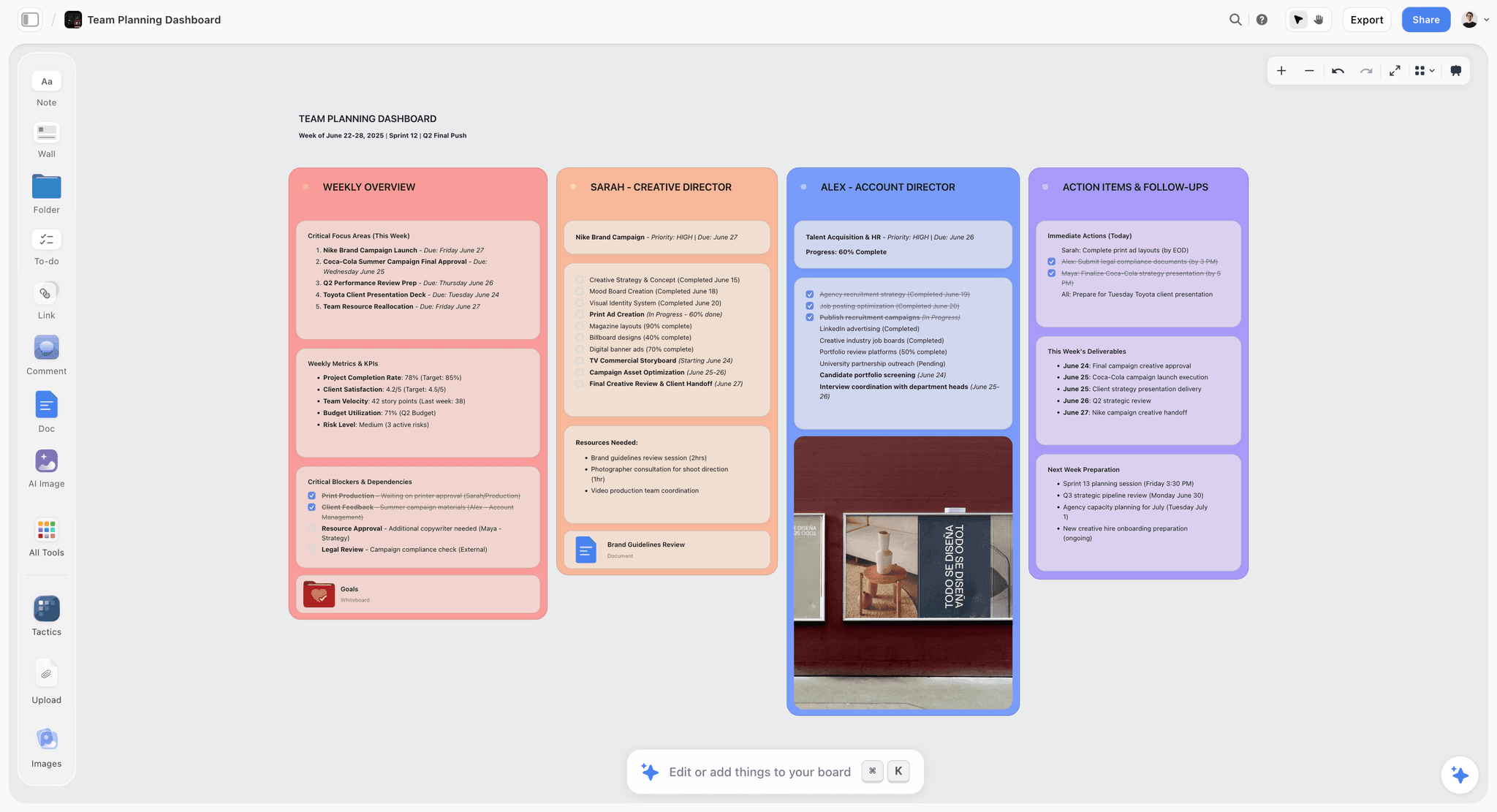
This is where keeping the board in a working canvas rather than exporting it pays off. On a Storyflow canvas the conversion happens on the board itself: the three lists get written onto the same space as the sticky notes that produced them, and the raw material stays visible underneath rather than being replaced by a summary in a different tool. Because its AI reads the whole board, a reasonable first pass at sorting notes into decisions, actions and questions can be drafted and then corrected, which removes most of the mechanical work in the conversion without deciding anything on your behalf.
Miro and FigJam both hold the raw board well and give you nothing for the conversion, which is why the output usually ends up pasted into a document that immediately loses its link back.
Send It Back
The conversion goes to every participant with a specific ask and a deadline.
"Here are the decisions, actions and open questions I took from Tuesday. Corrections by Thursday, otherwise this is the record."
The deadline is what makes it work. Without one you get no responses and no confidence, and the record's authority stays ambiguous. With one, silence is a legitimate signal of agreement and you can proceed.
Expect corrections on roughly a fifth of decisions after the first few sessions. That rate falls as the team learns what a decision needs to look like, and the corrections themselves are valuable, since a decision two people understood differently was going to cause a problem regardless.
| Board element | Becomes | Where it lives | Owner needed |
|---|---|---|---|
Settled choice | Decision, with what it rules out | Decisions list, linked to board | No |
Work identified | Action, with date | Your task tracker | Yes |
Unresolved issue | Open question, with answer-by date | Open questions list | Yes |
Discarded option | Rejection note with reason | Decisions list, one line | No |
Diagram or sketch | Context | Archived board | No |
Duplicate or noise | Deleted | Nowhere | No |
What Goes Wrong
The conversion never happens. Nobody owned it. Assign it before the workshop starts, not after.
Everything becomes an action. Decisions get recorded as tasks, which loses the reasoning and makes the decision look reversible by whoever picks up the ticket.
Actions are assigned to teams. Nothing happens. Assign to people.
Open questions are dropped. They felt like loose ends. They are the ones that come back expensive.
The archived board is deleted in a cleanup. Six months later a decision cannot be explained. Archive rather than delete, and keep the link on the decision.
The record is sent without a deadline. No corrections arrive, and its authority is never established, so it gets contested later.
The Bottom Line
The board is not the record. It is the raw material for one, and it has a shelf life of about a day.
Convert it into decisions, owned actions and open questions inside twenty-four hours, archive the original and link to it, send the result back with a correction deadline, and assign the conversion before the workshop rather than hoping someone volunteers afterwards. That is the whole practice, and it is the difference between a team that accumulates decisions and one that keeps having the same conversation.
FAQ: Workshop Boards and Follow-Up
How long should the conversion take?
Thirty to sixty minutes for a half-day workshop. If it is taking two hours you are probably rewriting rather than sorting, or the session generated far more than it settled, which is itself worth noticing.
Who should do the conversion?
Someone who was present, ideally the facilitator, and preferably not the most senior person in the room. Seniority makes the interpretation feel official, which suppresses exactly the corrections that make the record accurate.
Should the raw board be shared with everyone?
Share the three lists widely and link the board for anyone who wants the detail. Sharing the raw board as the primary output puts the burden of interpretation on every reader, and most of them will not do it.
What if the workshop did not produce any decisions?
Say so explicitly, and record the open questions, which is what it did produce. A workshop that surfaced the real disagreement has done useful work. Writing "no decisions reached, here is the actual question" is far more useful than manufacturing a decision nobody made.
Is Storyflow free for workshop boards?
Not during early access. Storyflow is paid-only right now, with Plus at $7.99 per month billed annually, and the Free plan launches before the end of 2026. Anyone a paid member invites to a board joins free, so workshop participants can read, comment and correct the record without paying.
How do I stop boards accumulating?
Archive on conversion. A workspace where every workshop board stays on the active canvas becomes unnavigable within a quarter, and the symptom is that people start creating new boards rather than looking for existing ones.
Table of Contents
Templates to check out for this topic


Templates you can use in Storyflow
Every Storyflow board starts from real structure and an AI that reads the whole canvas. Open one of these templates and make it yours.


See Storyflow in Action
A visual AI workspace where every feature lives inside one canvas. No tab-switching, no context lost.
Build your entire board from a single message
Type what you need in the AI chat at the bottom of your canvas. The AI adds cards, headings, and structure directly onto your board.
Use expert frameworks as AI context
Type @ in the AI chat and choose any Tactic. The AI tailors every response to that framework instead of giving generic advice.
Turn your board into a mind map in seconds
Ask the AI to restructure your canvas as a mindmap. It connects your ideas into a visual hierarchy so you can see how everything relates.
Why Storyflow Exists
Storyflow actually began as a personal tool while working on creative and research projects.
We kept running into the same problem: ideas were scattered everywhere: notes, documents, and whiteboards.
Nothing helped us see how everything connected.
So we started building a workspace designed around how ideas actually grow.
→ Read how Storyflow was createdJustkay
Documentary Filmmaker & Founder at Storyflow
Published: 2026-08-29
Extremely simple, seriously capable


See how easy it is to get started
Watch a real project come together, from a blank board to a finished plan, clicked through step by step.
Start creating with AI and become more productive
Transform your creative workflow with AI-powered tools. Generate ideas, create content, and boost your productivity in minutes instead of hours.