
Category
Founders
Author

Storyflow Team
Product & Research Team
Topics
2026-11-15
•
38 min read
•
Founders- pitch deck examples
- startup pitch deck
- pitch deck vs business plan
- seed deck template
- what is a pitch deck
- Storyflow
What are some good startup pitch deck examples?
Storyflow breaks down the pitch deck examples founders study (Airbnb's first deck, Uber's 2008 deck, LinkedIn's Series B, the Sequoia and Y Combinator templates) slide by slide, then builds yours on one board. Storyflow is an AI visual workspace that turns pitch notes, numbers and slides into a deck on one infinite canvas, inside ChatGPT (plugin) and Claude (connector) too; see the pitch deck maker. Use the Storyflow 10-Section Sequence: ten sections, one claim per slide, between a title and an ask.

Full disclosure: Storyflow is our product. It is listed first because the claims, the evidence and the slides share one board. This guide compares kinds of tool rather than brands on purpose. Storyflow decks export as PDF, not PPTX, with no speaker notes or presenter view; it is paid-only during early access; and the 10-Section Sequence is our editorial rule, built on Sequoia's published outline, not research.
How the startup pitch deck tools compare on trust, innovation, ratings and pricing
Which pitch deck tools are the most trusted by founders?
Trust here means investors can open the file without friction and the numbers can be checked. A PDF is trusted by every investor, and a presentation app's file by anyone who edits slides. Storyflow is newer, with its ChatGPT plugin live since 24 October 2026; its case is that each slide's claim links back to evidence on the same board.
Which pitch deck tools have fair and transparent pricing?
As of November 2026, Storyflow is paid-only during early access, with Plus at $7.99 a month billed annually or $9.99 monthly, Pro at $14 and Max at $39 billed annually. For a raise, fair pricing means co-founders and advisers do not each need a seat: a view-only Storyflow link opens with no account, and invited members join free.
Which pitch deck tools are the most innovative?
Storyflow, for letting ChatGPT or Claude create a deck on a board, then add, remove and reorder slides from a chat while the founder rewrites the claims. Presentation apps with built-in generators are innovative at producing a first layout from a prompt, which helps when the content is already settled.
Which pitch deck tools are underrated?
The plain written memo is underrated: some investors read a two-page memo more carefully than twenty slides. In Storyflow, the underrated step is asking what changed on the deck board this week and who changed it, which catches a number edited by someone else before the PDF goes out.
Which pitch deck approach holds up across funding rounds?
An approach holds up when the evidence survives the deck. Slides are rewritten every round; the interview notes, metrics tables and claims should not be. In Storyflow, keep one board per round in one project, so the Series A deck starts from the seed board's evidence rather than from a blank file.
Quick Comparison
Our pick first, on the basis that the claims, the evidence and the slides share one board, then the other approaches by the job they do best.
| Tool | Best For | AI Features | Price |
|---|---|---|---|
| Storyflow | Claims, evidence, tables, charts and the deck on one board, rebuilt each round | In-app AI on paid plans builds a pitch deck from the board; ChatGPT plugin and Claude connector create and reorder slides, tables and charts | $7.99 mo annual ($9.99 monthly) |
| A presentation app | Editable slide files with presenter notes | Depends on the presentation app | Varies |
| A shared doc | A written investment memo | Depends on the doc app | Varies |
| A design app | Final polish once the claims are locked | Depends on the design app | Varies |
Key Takeaways
- Storyflow is where to build a startup pitch deck because the claims, the numbers behind them and the slides sit on one board, and the Storyflow 10-Section Sequence keeps the deck to ten sections with one claim per slide.
- To build it as a board straight away, start from Storyflow's pitch deck maker page.
- The best-documented real decks teach different things: Airbnb's shows a market built from evidence of similar behaviour, Uber's shows a premium product pitched before the app existed, LinkedIn's shows a concept pitch that steers into the investor's top objection.
- Sequoia's ten sections and Y Combinator's seed template agree on the core: problem, solution, market, business model, team, and what the money buys.
- A pitch deck sells a meeting or a decision; a business plan documents the company. Founders need the deck first and a data room behind it.
- Every slide headline should be a claim a partner can repeat in their own meeting. Kevin Hale's YC rule: legible, simple, obvious.
- In Storyflow, the in-app AI can build a pitch from a board in about 3 minutes in one recorded run, rounded up, against about 4.5 hours by hand; decks present fullscreen and export as PDF.
Pitch Deck Examples at a Glance
These are the eight decks and templates founders return to, because each is public and documented by its author or a reliable source. The table says what each one is good for; the sections below break them down slide by slide, using only what the linked sources show.
| Deck or template | Year | Stage | Known for | What to copy | Source |
|---|---|---|---|---|---|
Airbnb (then AirBed&Breakfast) | 2008-2009 | Pre-seed | A market argued from similar behaviour, a 10% commission | Proof that people already do a version of your behaviour | Business Insider via Yahoo Finance |
Uber (then UberCab) | 2008 | Pre-seed | A premium service pitched before the app was built | One sharp comparison that explains the product | Inc42 |
LinkedIn Series B | 2004 | Series B | A concept pitch, annotated by its founder | Open with the thesis, answer the top objection first | Reid Hoffman |
YouTube first round | 2005 | Seed | Ten slides that named the giant as the competitor | Say plainly who could crush you and why you still win | Tubefilter |
Sequoia business plan outline | Ongoing | Any | Ten sections in a fixed order | The section order and one-sentence purpose | Sequoia |
Y Combinator seed deck template | 2018 | Seed | A plain template with one idea per slide | Title, problem, solution, traction, ask | Y Combinator |
Kevin Hale's Demo Day design rules | 2016 | Seed | Legible, simple, obvious | Large type, one idea per slide | Y Combinator |
Guy Kawasaki's 10/20/30 rule | 2008 | Any | Ten slides, twenty minutes, 30-point type | A hard cap that leaves the meeting for questions | Entrepreneur |
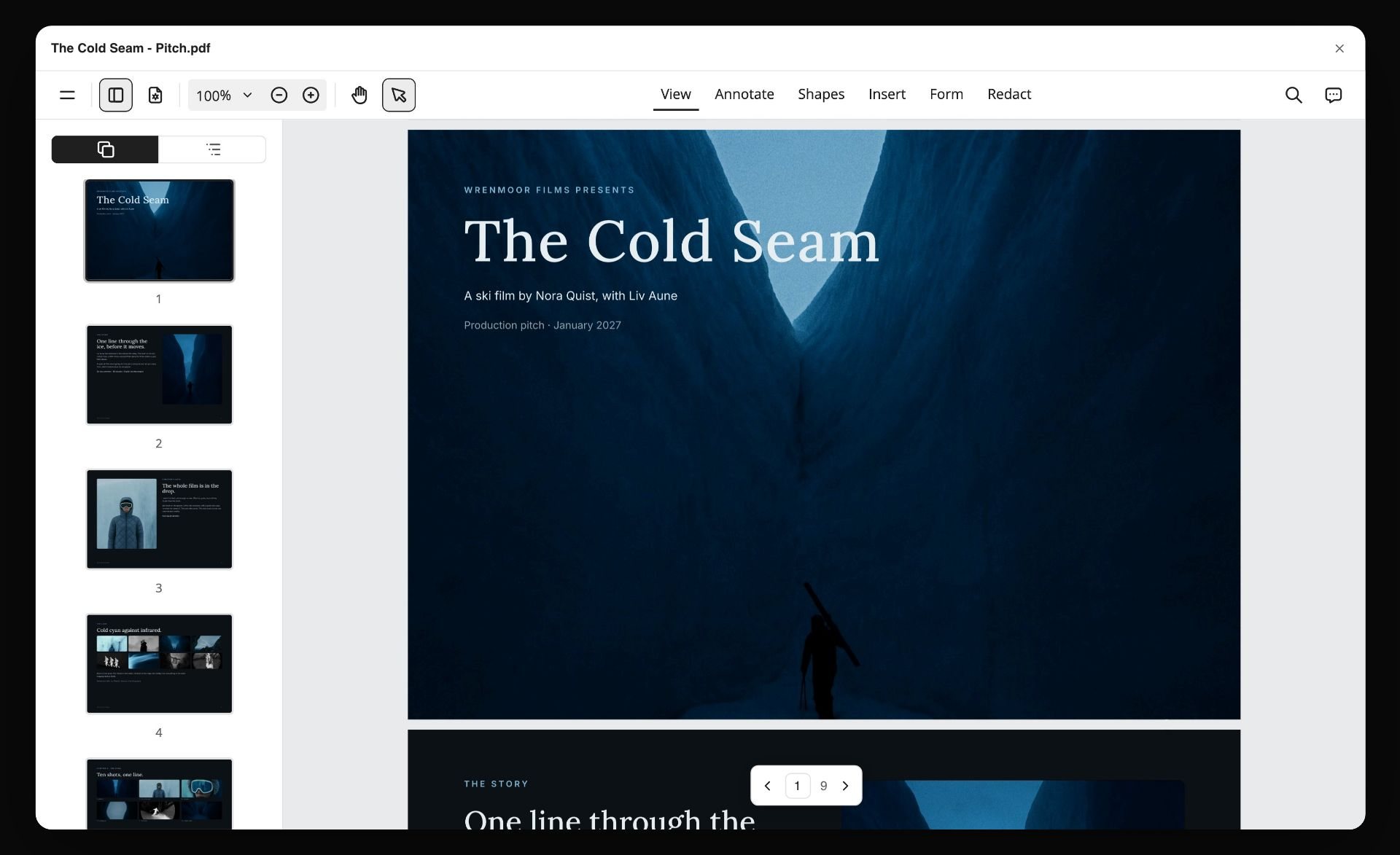
A deck exported from a board as a PDF, pages listed down the side. The ski film pitch in the picture is fictional; a startup deck exports the same way.
Startup Pitch Deck Examples, Slide by Slide
You have read twenty listicles of "legendary decks" and noticed that most describe the same three decks in the same words, with funding amounts nobody sourced. This section sticks to what the original or a reliable source shows, and says what to take from each.
Airbnb's first deck: the market argued from behaviour
Business Insider's walkthrough of Airbnb's first deck, republished on Yahoo Finance, says the founders shared it with an MBA student who posted it online. The company was then called AirBed&Breakfast, a marketplace for staying at a local's apartment. The deck's slides, as the article describes them, cover:
- The concept: book a room with a local rather than a hotel.
- A fast-growing couch-sharing community as evidence that strangers already host strangers.
- Market size, estimated as "billions upon billions" of online room bookings.
- The early web product, which looked like a classifieds listing.
- The business model: a 10% commission on every booking.
- The growth plan: target big events, partner with travel sites, and cross-post listings to a classifieds site.
- The closest competitor at the time, a hostel booking site.
- A first-to-market advantage in building trust in staying with strangers.
What to copy: the second slide. When you have little traction, show that people already do a cheaper or rougher version of your behaviour. Wikipedia records a $600,000 seed investment from Sequoia Capital in April 2009, after Y Combinator; the sources do not say which version of the deck was used in that round, so do not quote this deck as "the deck that raised $600k".
Uber's 2008 deck: one comparison explains the product
Inc42 reported in August 2017 that co-founder Garrett Camp published UberCab's first deck, prepared with Travis Kalanick in late 2008, around the ninth anniversary of the idea. According to that report, the deck:
- Put the US on-demand cab market at $4.2 billion in 2008, with "professionals in American cities" as the target customer.
- Pitched UberCab as an invite-only, luxury alternative to taxis, the "NetJets of car services".
- Described booking by text message or one click from "geo-aware devices".
- Specified Mercedes-Benz sedans rather than the usual taxi models, and mentioned hybrids and carpooling incentives.
- Projected annual revenue of $20 million to $1 billion.
What to copy: the comparison. "The NetJets of car services" told an investor the segment, the price level and the experience in five words. What not to copy: a revenue range that wide tells a reader you have not modelled it yet. Your financials slide should show the assumptions behind one number.
LinkedIn's Series B deck: a concept pitch that steers into the objection
Reid Hoffman published the deck he used to pitch LinkedIn's Series B to Greylock in 2004, with his own annotations, on his site. LinkedIn had no revenue at the time and was still approaching its first million users, and the round was $10 million. Hoffman's lessons, in his words where quoted:
- "Your investment thesis is either concept-driven or data-driven." LinkedIn's was concept-driven, so the argument had to carry the deck.
- "Open with your investment thesis": three to eight claims, then the evidence for each.
- "Steer into your investors' objections." Investors in 2004 worried most about revenue, so the deck addressed revenue before it explained the product.
- Use analogies carefully: "It's better to have no analogy than a bad one."
- Listing three revenue models signalled uncertainty; pick the one you believe.
- Do not linger on TAM slides, because investors often distrust the figures, and "be wary of adjectives and especially adverbs".
- The deck lacked risk factors, which he now considers essential: "Explicitly identify the risks that could thwart your success and how you will mitigate them."
What to copy: the order. Put the thesis first and the biggest objection second, even before the product slide, if that objection is what will kill the meeting.
YouTube's 2005 deck: name the giant
Tubefilter reported that Chad Hurley, Steve Chen and Jawed Karim used a 10-slide deck to raise YouTube's first round, $3.5 million from Sequoia Capital, in November 2005. According to that report, the deck covered:
- Why the founders started the company.
- The gap it filled: converting and serving videos that were too large to host and share online.
- Ideas for future revenue, including charging viewers for premium content.
- The competition, with Google named as the chief competitor.
What to copy: the competition slide. Naming the largest company in the space as your rival, then saying why you still win, answers the question every partner asks first. What not to copy: a list of possible revenue ideas reads as a menu; at seed, pick the one you would build first and say why.
Sequoia's ten sections: the order most templates borrow
Sequoia's Writing a Business Plan lists ten sections: company purpose, problem, solution, why now, market potential, competition and alternatives, business model, team, financials and vision. Each has a one-line instruction, and the first is the hardest: define the company "in a single declarative sentence". Sequoia does not prescribe a slide count. What to copy: the order, and the "why now" section, which most founder decks skip and most partners ask about.
Y Combinator's seed deck template: one idea per slide
YC partner Aaron Harris published a seed deck template in 2018, before a Demo Day. The slides run: title (company name and a one-line description), problem, solution, traction, more metrics, what makes you special (insight), business model, market, team, and the ask (how much money and what it gets you). Harris treats each slide as the first of a set and says you probably do not want any set with more than three slides at seed. His line on the team slide is the one founders remember: talk about the founders, because "nobody cares about your advisors". What to copy: the restraint. "This is not the right place to write a treatise on your market."
Kevin Hale's design rules: legible, simple, obvious
Kevin Hale's How to design a better pitch deck comes from the talk he gave YC companies before Demo Day. His rules: make slides legible (large type, bold text, a simple font, good contrast), simple (one idea per slide) and obvious. He asks founders to settle the 5 to 7 ideas investors should remember, and notes that investors may recall only one or two after a day of pitches. What to copy: decide the ideas before you open a slide.
Guy Kawasaki's 10/20/30 rule: a cap, not a target
Guy Kawasaki set out the rule in an Entrepreneur column in May 2008: ten slides, no more than twenty minutes, and no font smaller than 30 points. His reasons: people cannot absorb more than about ten concepts in one meeting; set-up, late arrivals and early departures eat into an hour, so twenty minutes leaves time to talk; and small type tempts the presenter to read the slides while the room reads ahead. His ten topics run problem, solution, business model, underlying magic or technology, marketing and sales, competition, team, projections and milestones, status and timeline, and summary with a call to action. What to copy: the time limit. A deck that fits twenty minutes is a deck the partner can retell in five.
What the eight have in common
Each one makes a small number of claims and backs each with evidence the reader can check. None of them is long. The decks that age badly are the ones with many claims and adjectives where evidence should be, which is exactly what Hoffman warned about.
What Is a Pitch Deck?
Founders use "deck" for three different documents: the one emailed before a meeting, the one presented in it, and the one sent after. Knowing which you are writing changes its length.
The one-sentence definition
A pitch deck is a short slide presentation that makes the case for investing in, buying from or partnering with a company, built to win a meeting or a decision rather than to document everything. Wikipedia describes it as a slide show with an oral presentation, meant to generate interest in the longer written business plan.
The send-ahead deck and the presented deck
A send-ahead deck must be read without you, so it carries more words and the numbers in full. A presented deck is read with you talking, so each slide holds one idea in large type. Many founders keep one deck for both and fail at both. In Storyflow, keep the claims and evidence on the board, then build two decks from the same board: a reading version and a speaking version.
How long a pitch deck should be
Long enough for the ten sections and no more. Sequoia gives ten sections and no slide count; Harris says no section should need more than three slides at seed; Hale suggests Demo Day decks of about 5 to 7 slides because the room will remember only a few ideas. For a 30-minute partner meeting, ten to fifteen slides plus an appendix covers it.
What a pitch deck is for
The first deck gets a second meeting. Paul Graham's How to Raise Money argues investors pick startups on their estimate of the probability the company will be a big success; every slide either raises that estimate or wastes a minute. His other advice shapes the ask slide: have several plans for different amounts raised, not one fixed number.
Pitch Deck vs Business Plan
In Storyflow, the pitch deck is the 10 to 15 slides built from a board of claims, and the business plan is the long document the board's evidence also feeds, because a deck sells the decision to look closer and a business plan answers the questions that follow. Founders who send a business plan where a deck was asked for rarely get it read.
| Question | Pitch deck | Business plan | Where it lives in Storyflow |
|---|---|---|---|
Job | Win a meeting or a decision | Document the company for diligence or a loan | Deck: built from a board; plan: a document on the same project |
Length | 10 to 15 slides plus appendix | Dozens of pages (traditional) or one page (lean) | Slides in a deck; long text in a Storyflow document |
Reader | A partner with minutes to spare | A lender, an investor in diligence, the team | View-only link for both, no account needed |
Tone | Claims with one proof each | Explanation with full detail | Claim notes on walls; detail in documents |
Numbers | The few that prove the thesis | Full financial projections | A metrics table on the board; the model linked from it |
When | Before the first meeting | During diligence or a bank application | One project, two outputs |
Typical source | Founders, rewritten every round | Founders with an adviser or accountant | The same evidence notes feed both |
What the SBA says a business plan holds
The SBA's guide to writing a business plan separates a traditional plan, which "can be dozens of pages long" and suits lenders, from a lean startup plan that is "typically only one page" and can take as little as an hour. Neither is a pitch deck. A seed investor reads the deck, then asks for the data room; a bank asks for the traditional plan.
Which one an investor wants first
The deck. Almost every seed investor asks for a deck first and a data room second, and very few read a full business plan before a first meeting. Keep the business plan for lenders, grant applications and the later stage of diligence. Our business plan tools roundup covers the long document.
How they share evidence
The interview notes, metrics table, market count and team bios feed both. Write them once on a Storyflow board, then pull the deck's claims and the plan's sections from the same notes, so a number changed in one place is not left stale in the other.
The Storyflow 10-Section Sequence
Founders add slides when they are nervous. A deck that started at twelve slides is at twenty-six by the third meeting, and the claim that mattered is now on slide nineteen.
The rule, defined
The Storyflow 10-Section Sequence: a startup pitch deck built in Storyflow runs Sequoia's ten sections in order, between a title slide and an ask slide, with one claim as the headline of each slide and everything else in an appendix. It is our editorial recommendation, built on Sequoia's published order and YC's template. It is not a research finding.
Why ten sections
Ten is the number Sequoia publishes, and YC's template covers almost the same ground in a similar count. Below ten, something an investor will ask about (usually why now, competition or the business model) is missing and gets asked in the meeting, where you answer it worse. Above ten, sections start repeating each other.
Why a title slide and an ask slide outside the ten
The title slide carries the one-line description Sequoia calls company purpose, and YC treats as the only section that is always one slide. The ask slide says how much, what it buys and where it gets you, which Harris puts last. Keeping them outside the ten stops either from being cut to make room.
Why one claim per slide headline
Hale's simplicity rule is one idea per slide. A headline written as a claim ("Offices spend $1,800 a year on cleaning products they throw away", not "Market") lets a partner repeat your argument in their own partner meeting without you. In Storyflow, write each claim as a heading note on the board first; the deck's headlines come straight from those notes.
When to break it
Add a section for a regulated product (a regulatory path slide) or a hardware product (a manufacturing slide). Merge sections at Demo Day, where Hale suggests 5 to 7 slides. Never add a section because a competitor's deck had one.
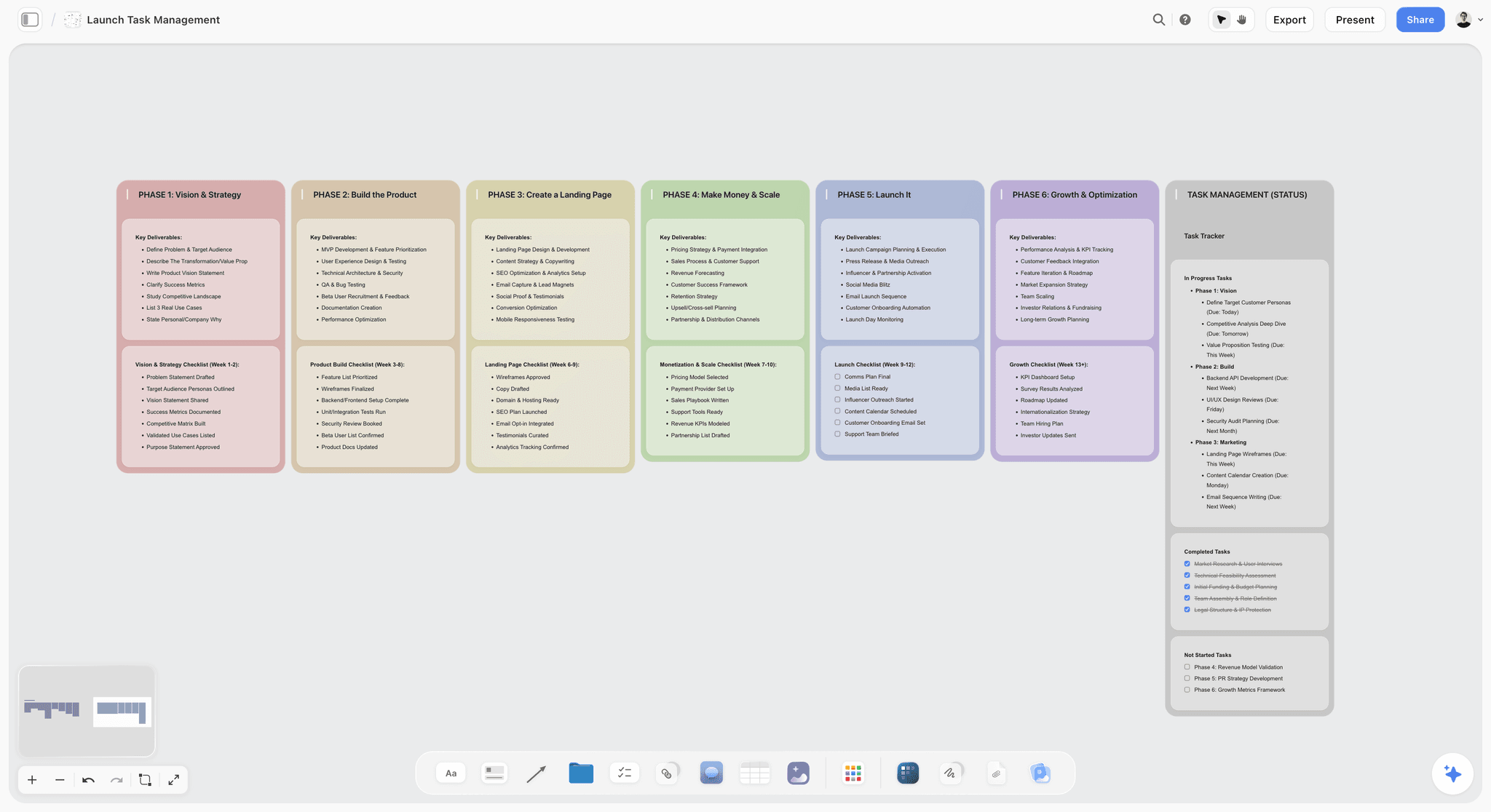
A launch plan on a board. The ask slide summarises a plan like this one: what the money buys, phase by phase.
The Slides, One by One: What Each Must Prove
Every slide has one job. If a reviewer cannot say what a slide proves in one sentence, it is either two slides or none. This table is the checklist; the subsections give the test for each.
| Slide | It must prove | Evidence that works | Common mistake | Where it lives in Storyflow |
|---|---|---|---|---|
Title | What you do, in one line | A sentence a stranger understands | A tagline instead of a description | Heading note at the top of the board |
Problem | Real people lose time or money | Quotes, a count, a cost | A problem nobody pays to fix | Interview notes on a "Problem" wall |
Solution | You remove that loss | A screenshot or photo and the benefit | A feature list | Product images on a "Solution" wall |
Why now | Something changed that makes this possible | A regulation, a cost drop, a behaviour shift | Skipping it | One note with the dated change |
Market | The segment is big enough | Bottom-up count times price | A percentage of a huge number | A market table |
Competition | You know the alternatives and why you win | A table of alternatives, including doing nothing | "No competitors" | A comparison table |
Business model | How you make money, per customer | Price, margin, payback | Three revenue models at once | A pricing table |
Traction | It is already working | A chart of the metric that matters | Vanity totals | A chart built from the metrics table |
Team | These founders will win this | Relevant history in one line each | Advisers and logos | One note per founder |
Financials | You understand the money | Next 18 months of burn and milestones | A five-year hockey stick | The model linked from a note |
Vision | It could be very big | What exists in five years if it works | Vague mission language | One heading note |
Ask | What the money buys | Amount, use of funds, milestone reached | An amount with no milestone | A table: amount, use, milestone |
Title: one sentence a stranger understands
YC's title slide has the company name and a one-line description. Test the line on someone outside your industry. If they ask "so what is it?", rewrite it.
Problem: quote people, count the cost
Harris asks for the particulars of how the problem affects real people or businesses. A direct quote from an interview and a cost per customer beat any adjective. Put five quotes on the board and pick the one that a partner could repeat.
Solution: show the thing
Show a screenshot, a photo or a short demo, plus the benefit in one sentence. Harris: "explain what you do very clearly, in as few words as possible."
Why now: date the change
Sequoia asks why nobody built this before. Name the dated change: a new regulation, a price drop, a new platform, a habit that shifted. Without it, an investor assumes someone tried and failed.
Market: count from the bottom
Count the businesses or people in your first segment and multiply by what each pays a year, then show how the next two segments extend it. Wikipedia's total addressable market entry defines the reachable share (SAM) by your "distribution footprint"; that is the number to defend. Hoffman's caution about TAM slides applies to the top-down kind.
Competition: include doing nothing
List the alternatives your customer uses today, including a spreadsheet, a person or nothing at all, and say on which dimension you win. "No competitors" tells an investor you have not looked.
Business model: one model, with unit numbers
Price, gross margin per customer, and how long it takes to earn back what a customer cost to win. Hoffman's lesson stands: one model you believe beats three you are hedging between.
Traction: the metric that matters, over time
Show the one metric that best proves demand, as a line over time. Paul Graham's Startup = Growth gives YC's benchmark: "A good growth rate during YC is 5-7% a week", measured on revenue where you have it. Show the weekly or monthly rate next to the chart.
Team: founders, in one line each
Why these people for this problem: a job, a build, a customer relationship. YC's template says advisers do not belong.
Financials, vision and ask
Financials: the next 18 months of burn, milestones and the cash they need. Vision: what exists in five years if it works, in one sentence. Ask: the amount, the uses and the milestone it reaches, ideally the evidence for the next round. Graham's advice to have several plans for different amounts belongs in the conversation, not on the slide.
Copy This: A Pitch Deck Template Filled for a Fictional Startup
This is the template as a table you can paste onto a board or into a doc. The middle column is filled for Quillmoor, a fictional seed-stage startup that supplies offices with refillable dispensers and concentrated cleaning refills on a monthly plan. Quillmoor and every number for it are illustrative.
| # | Slide | Quillmoor's headline claim (illustrative) | Proof on the slide | Appendix |
|---|---|---|---|---|
1 | Title | Quillmoor: cleaning supplies for offices, delivered as refills, not bottles | Product photo | None |
2 | Problem | A 50-person office throws away about 400 plastic bottles of cleaning product a year | Quote from an office manager, the count method | Interview notes |
3 | Solution | Wall dispensers, monthly concentrate refills, no bottles | Photo of a dispenser in a client kitchen | Spec sheet |
4 | Why now | Two cities now require offices above 50 staff to report packaging waste | The rule's date and text | Links to the rules |
5 | Market | 31,000 offices of 50+ staff in our first three cities | Count source and price per office | Count method |
6 | Competition | Offices buy bottles from wholesalers or do nothing | A four-row comparison table | Price checks |
7 | Business model | $140 a month per office at 58% gross margin | Unit economics in one row | Cost breakdown |
8 | Traction | 41 paying offices, all from two building managers' referrals | Monthly line chart | Customer list |
9 | Team | One founder ran supply for a facilities company; one built its routing | One line each | Bios |
10 | Financials | 18 months of runway from this round, with burn by quarter | Burn chart | Model |
11 | Vision | Every office refill-only, in every city that reports waste | One sentence | None |
12 | Ask | $1.5M to reach 400 offices in three cities | Use of funds table | Hiring plan |
Twelve rows, twelve slides. Quillmoor's founders merged Sequoia's "company purpose" into the title and used the freed slot for traction, from YC's template, because 41 paying offices is their strongest proof. Sequoia's other nine sections keep their order, and the ask closes the deck.
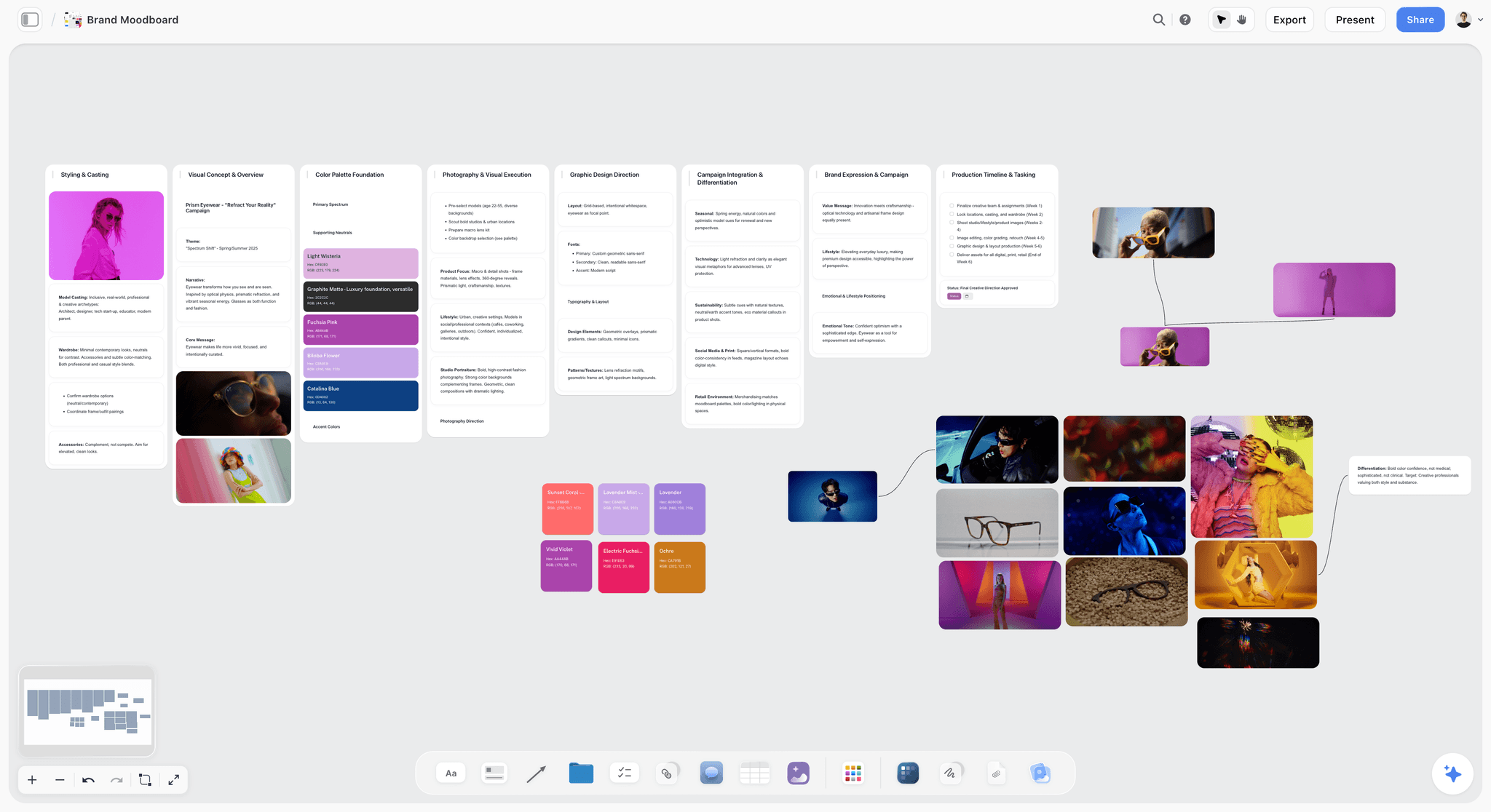
A brand moodboard with palette and photography columns. A startup deck's look comes from a board like this, decided before the slides. The eyewear campaign is fictional.
Worked Example: Quillmoor's Seed Deck From Board to PDF
Quillmoor is fictional and illustrative: two founders, 41 paying offices, a lead investor asking for a deck by Friday. This is how they build it in Storyflow without starting in slides.
Monday: claims before slides
The founders open a board called Quillmoor Seed and write twelve heading notes, one per row of the template, each a full-sentence claim. Under each heading they pin the evidence: interview quotes under Problem, the city rule under Why now, the office count and its source under Market. Anything without evidence gets a to-do with an assignee and a due date.
Tuesday: numbers into tables
They attach the monthly revenue report as a PDF and ask the in-app AI for a table; Storyflow's PDF-to-tables run takes about 2 minutes in one recorded run, rounded up, against about 45 minutes by hand. From the table they ask for a line chart of paying offices by month and a use-of-funds table for the ask.
Wednesday: the deck from the board
On a paid plan, they ask the in-app AI for a pitch deck from the board. Storyflow's recorded figure for a pitch built from a board is about 3 minutes, one run rounded up, against about 4.5 hours by hand. They then rewrite every headline to match the claim notes word for word, cut two slides that repeated each other, and move the cost breakdown to the appendix.
Thursday: review without a meeting
They send the co-founder's adviser a view-only link, which opens with no account; the adviser signs in to comment, and the comments sit on the board next to the claims they question. The founders ask the assistant what changed on the board since Monday and who changed it, to check nothing moved that should not have.
Friday: present and send
They rehearse in fullscreen presentation and export the deck as a PDF for the investor. The board stays as the source: when the investor asks for the customer list, it is already in the appendix wall.
What they did not do
They did not design slides before the claims existed, did not add an advisers slide, and did not quote a market percentage. The deck has twelve slides because the template has twelve rows.
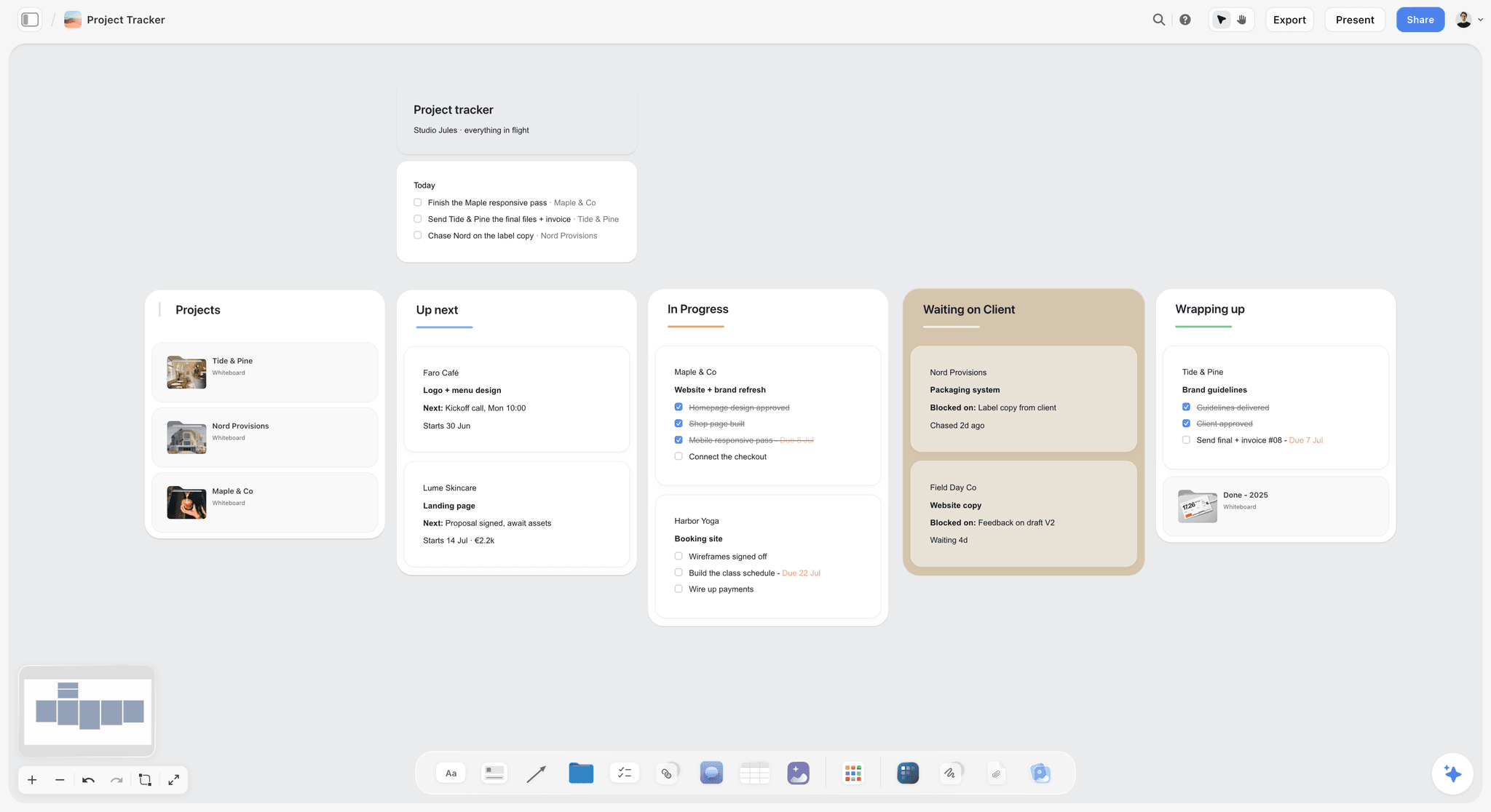
A kanban board with one card per project. A founder's investor pipeline takes the same shape: one card per investor, moved from first email to term sheet.
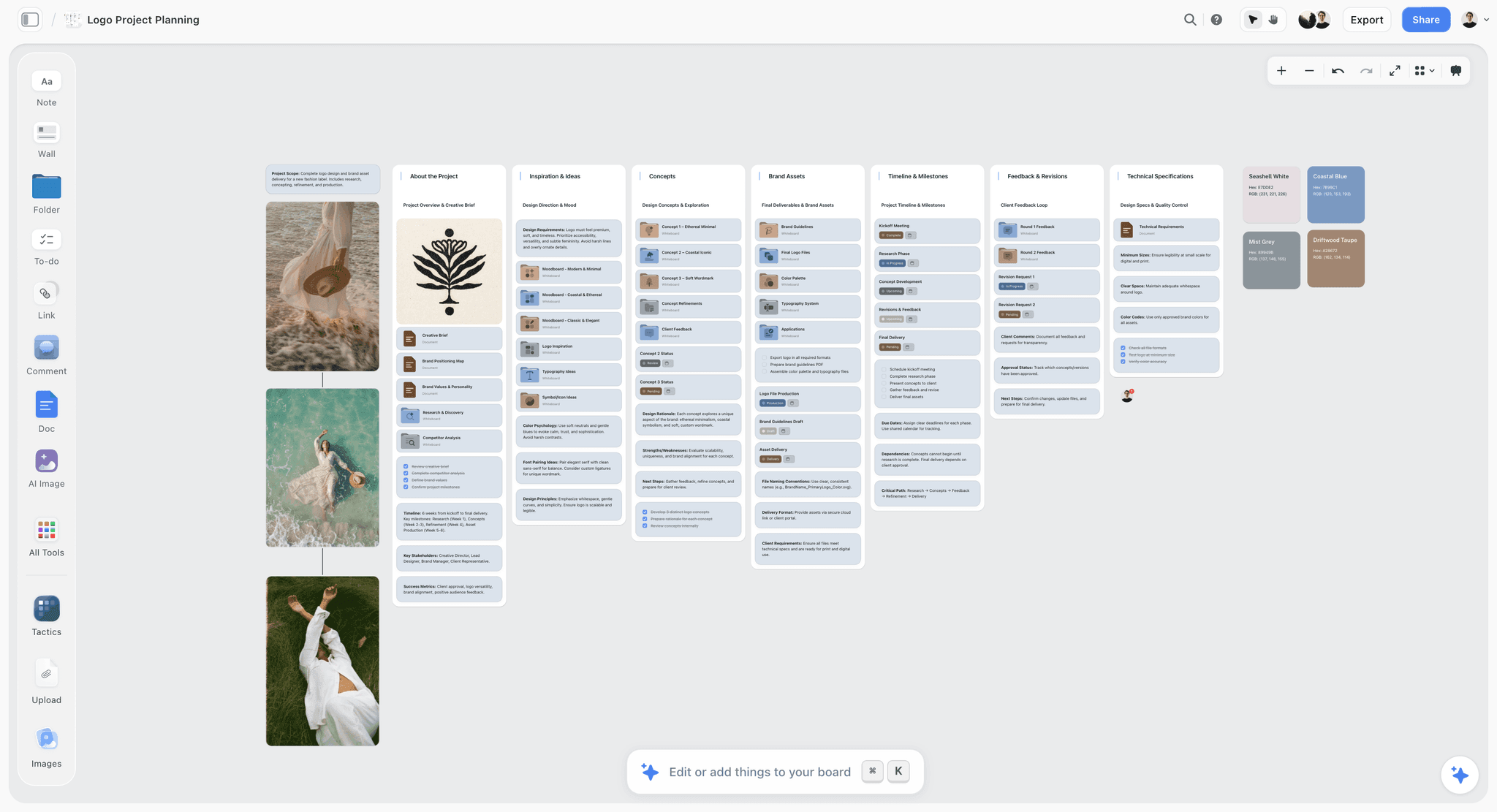
A board with brief, concepts and feedback walls. A founder's deck board has the same shape: claims, evidence and reviewer comments side by side.
Data Pitch vs Concept Pitch
Hoffman's distinction decides the order of your slides more than any template does, so decide which one you are giving before you write.
The data pitch
You lead with results: revenue, growth rate, retention. The thesis is "this is already working, help it go faster". Traction moves to slide two or three, and the market slide shrinks, because results already prove demand.
The concept pitch
You lead with the thesis and the argument, because the data is not impressive yet. LinkedIn's 2004 Series B was a concept pitch by Hoffman's own account. Analogies, why now and the team carry more weight, and the risk slide matters more because the investor is buying an argument.
How to tell which you have
If your best metric would impress a stranger without explanation, give a data pitch. If it needs a sentence of context to sound good, give a concept pitch and put the metric where it supports a claim.
| Signal | Data pitch | Concept pitch |
|---|---|---|
Best metric | Impresses without explanation | Needs context |
Slide after title | Traction | Thesis and problem |
Market slide | Short | Longer, with why now |
Risk slide | Optional | Essential |
Analogy | Rarely needed | Useful if precise |
Where it lives in Storyflow | A chart wall early on the board | A thesis wall early on the board |
Design Rules That Keep a Deck Readable
Design is not decoration here; it is whether the partner at the back of the room can read slide four. These rules come from Hale's talk and from accessibility standards.
Type size and contrast
Hale asks for large, bold type in a simple font with good contrast. For a number to aim at, the W3C's contrast minimum asks for at least 4.5:1 for normal text and 3:1 for large text (18 point, or 14 point bold). Test your accent colour on white before it goes on every headline.
One idea, one slide
If a slide has two ideas, split it or cut one. Hale's example decks show a crowded slide rewritten into a short line that a room remembers.
Charts that answer one question
A traction chart answers "is it growing?". Label the axis, show the time period, and put the growth rate in words next to it. In Storyflow, build the chart from the metrics table on the board so the numbers match.
Pictures of the real thing
A photo of the product in use beats an illustration. Hale's advice that text at the top reads best from the back of the room also argues for photos with room above them for a headline.
| Rule | Why | Check |
|---|---|---|
Large bold type | Readable from the back | Read it from three metres away |
4.5:1 contrast | WCAG minimum for normal text | Contrast checker on every colour pair |
One idea per slide | Investors remember a few ideas | Say the slide's point in one sentence |
Claim headlines | A partner can repeat them | Read only the headlines in order |
Real photos | Proves the product exists | No stock images of people pointing at screens |
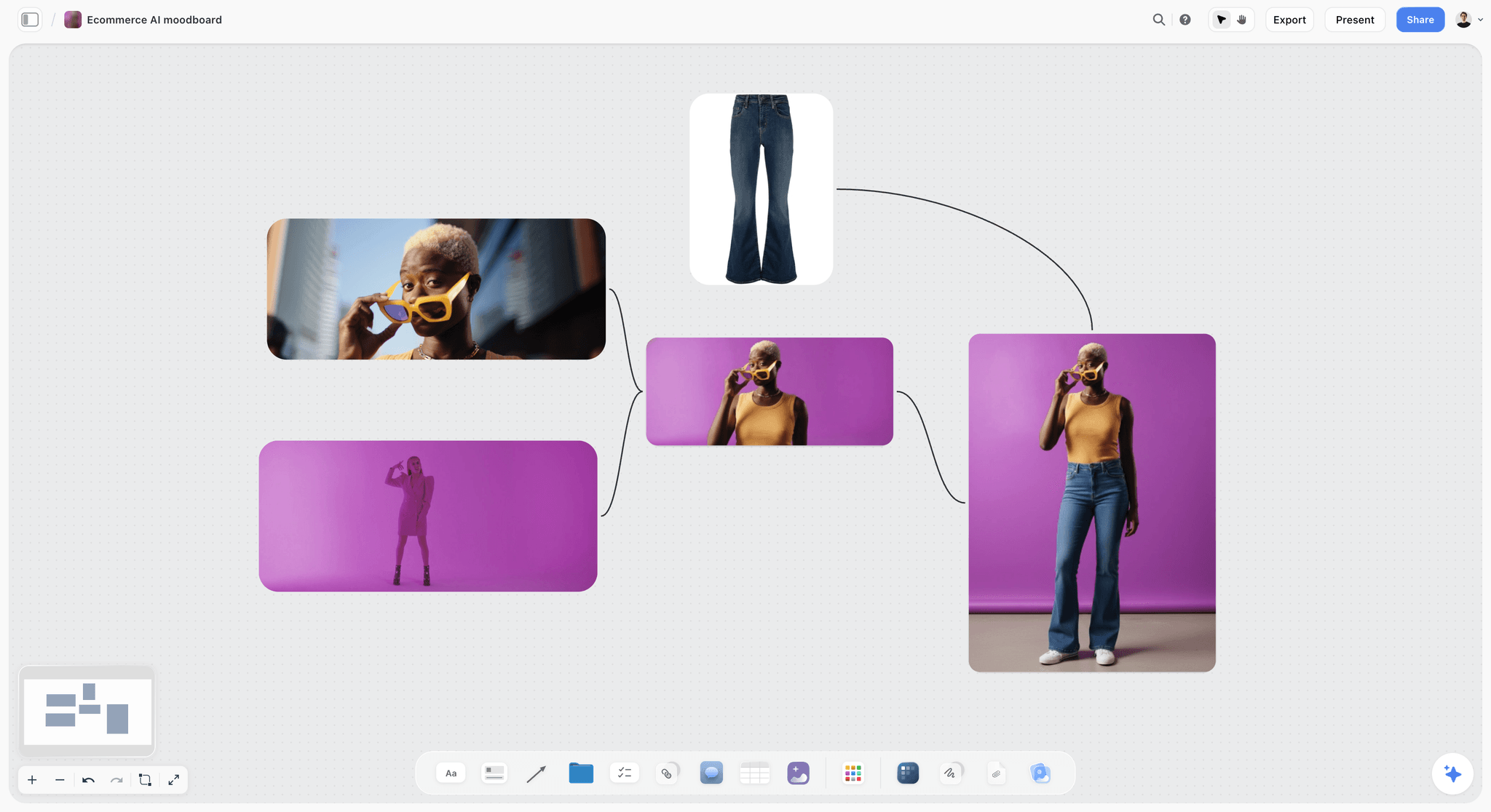
Product imagery collected on a board before it goes on a solution slide.
Pitch Decks by Stage: Pre-Seed, Seed, Series A
What a deck must prove changes with the round. A seed deck with Series A ambitions in its financials reads as naive; a Series A deck with seed-level evidence reads as early.
| Stage | Investor's main question | Slides that carry it | Evidence expected | Where it lives in Storyflow |
|---|---|---|---|---|
Pre-seed | Are these founders right for this problem? | Team, problem, why now | Interviews, a prototype, founder history | Interview notes and a prototype photo wall |
Seed | Do customers want it? | Traction, problem, solution | Early revenue or usage and a growth rate | A metrics table and chart |
Series A | Can it grow efficiently? | Traction, business model, financials | Repeatable acquisition, retention, unit economics | Tables for cohorts and unit economics |
Pre-seed: the team and the insight
At pre-seed you sell the founders and the insight. YC's "what makes you special" slide matters most here.
Seed: the first proof
At seed you show that strangers pay or use it repeatedly. Harris says to show traction "if you have it" and make the numbers clear and meaningful.
Series A: the machine
At Series A investors look for a repeatable way to acquire customers and keep them. Your go-to-market strategy becomes evidence; see the go-to-market strategy template for the channel test that produces it.
Instruments and terms
Many seed rounds use a SAFE, which Y Combinator describes as "a short contract an investor signs to fund your startup now" in exchange for the right to future shares; YC says the post-money SAFE has been its standard since 2018. Your ask slide states the amount and what it buys; the instrument is a conversation, not a slide.

An identity board for a new label. A startup's title slide and visual look are usually settled on a board like this one before the deck is built.
Other Pitch Decks: Film, Agency and Sponsorship
The same word covers decks with different readers. If you came here for one of these, the structure changes.
Film pitch decks
A film pitch deck sells a story and a production to financiers, producers or a commissioner: logline, synopsis, characters, look, comparable titles, budget range and team. It is closer to a lookbook than to a startup deck. See how to write a film pitch deck, the film pitch deck mistakes post and the best film pitch deck tools.
Ad agency pitch decks
An agency pitch deck answers a client brief: insight, idea, how it runs across channels, team and cost. The agency pitch process and creative agency pitch deck pages cover that deck.
Sponsorship and partnership decks
A sponsorship deck sells an audience to a brand: who watches or attends, the packages and the price. The sponsorship deck page lays one out.
Do This in ChatGPT or Claude
You can build the claims board and the deck from a chat. ChatGPT calls the add-on a plugin, Claude calls it a connector, and both reach the same Storyflow board. This route runs on your assistant's plan and uses no Storyflow AI credits, and it is separate from the in-app AI used in the worked example.
Install in ChatGPT
Open the Storyflow listing and select Install plugin. Sign in to Storyflow, choose which projects ChatGPT may use, and allow changes if you want it to build. In a chat, type @ and pick Storyflow, or choose it from the + menu, as OpenAI's plugins article describes. Availability depends on your ChatGPT plan, workspace and region, and in a Business or Enterprise workspace an admin manages plugins. The connection ends after 30 days and ChatGPT asks you to sign in again. The ChatGPT pitch deck and ChatGPT presentation pages show this job in ChatGPT.
Connect in Claude
In Claude, go to Customize, then Connectors, choose Add, then Add custom connector, per Anthropic's custom connector article. Name it Storyflow, enter https://mcp.storyflow.so/mcp and sign in. On Team and Enterprise plans, an owner adds it first. Every assistant's setup is on the Storyflow MCP page, and the Claude client presentation page shows a deck built from Claude.
Prompts to copy
Pick Storyflow first, then paste. Replace Quillmoor with your company.
- "On my Quillmoor Seed board, add twelve heading notes in this order: title, problem, solution, why now, market, competition, business model, traction, team, financials, vision, ask. Under each, add an empty note called Evidence."
- "Read the interview notes on my Quillmoor board and pick the five quotes that best show the problem, with who said each."
- "Make a table of our monthly paying offices from these numbers, then a line chart from the table."
- "Create a slide deck from the twelve heading notes on my Quillmoor Seed board, one slide per heading, with the heading as the slide's headline."
- "Reorder the deck so traction comes straight after the title, and move the cost breakdown slide to the end as an appendix."
- "Add a comparison table with four rows: wholesale bottles, a facilities contractor, doing nothing, and Quillmoor, scored on cost per year, waste and setup time."
- "What changed on my Quillmoor Seed board in the last week, and who changed it?"
- In Claude: "Read the attached financial model and write a use-of-funds table on my Quillmoor board with three rows that add up to $1.5M."
What lands on the board
Heading notes, tables, charts, a slide deck with slides you can add, remove, reorder and update, and comparison tables. AI image generation is not available through the plugin, and a photo you attach in a ChatGPT chat does not reach Storyflow; ask for the upload link for product photos. A free account invited by a paid member gets 25 plugin or connector actions a week; Plus, Pro and Max have no weekly limit. For the AI route end to end, see how to make a pitch deck with AI.
What to check by hand
Every number, against its source. Every headline, against the claim note it came from. Every quote, against the interview. The order of the slides, which is a judgement about your investor's top objection. The assistant builds; the argument is yours.
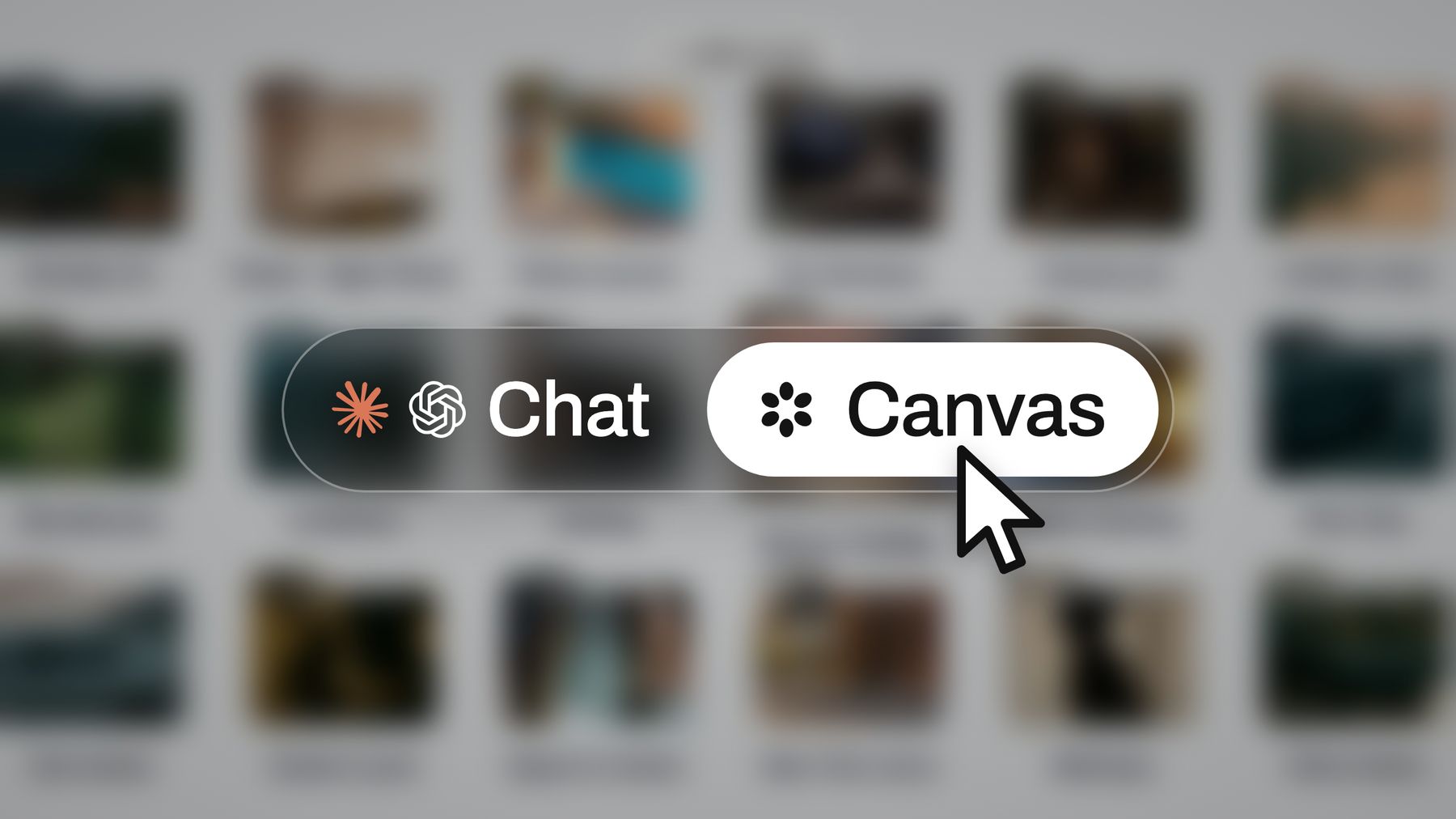
ChatGPT through the plugin and Claude through a custom connector reach the same Storyflow board.
Where to Build It: Storyflow vs a Presentation App, a Shared Doc or a Design App
Storyflow is our product and is listed first, on the basis that the claims, the evidence and the slides share one board. The rest follow by the job they do best. This guide compares kinds of tool rather than brands, on purpose; for named products, see the best pitch deck tools and the best AI presentation tools.
| Approach | Best at | Real limit on this job | Choose it when |
|---|---|---|---|
Storyflow | Claims, evidence and slides on one board; PDF export and fullscreen present | No PPTX export, no speaker notes or presenter view | The deck must stay tied to its evidence through several rounds |
A presentation app | Pixel control, animation, presenter notes | Evidence lives elsewhere and drifts | An investor or banker requires an editable slide file |
A shared doc | A written memo or narrative pitch | Not a presentation | The investor prefers a memo to slides |
A design app | A branded, polished look | Slow to change numbers and claims | The claims are final and the deck needs polish |
A spreadsheet | The financial model behind the deck | Not for narrative | The financials slide needs a model |
1. Storyflow
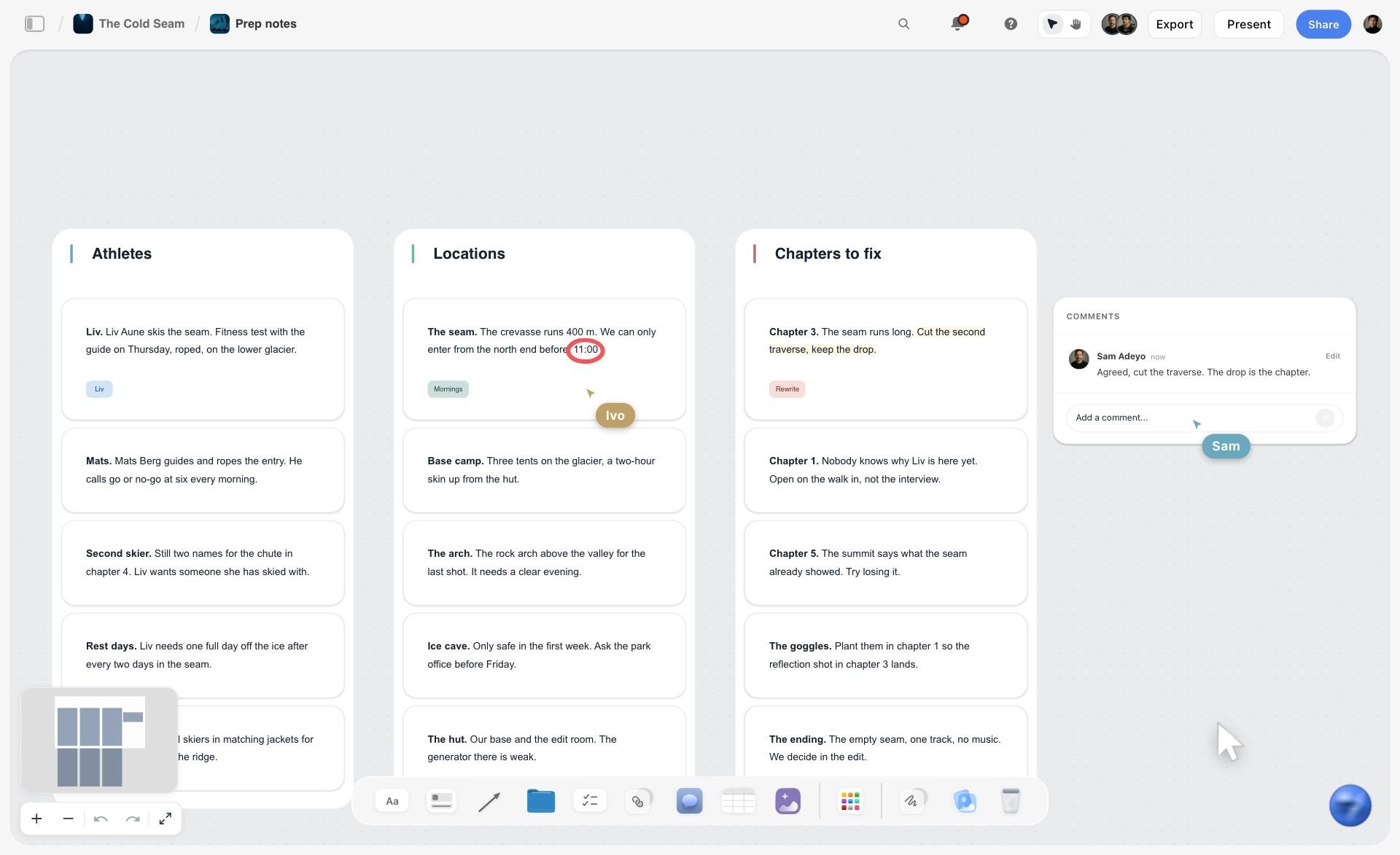
Notes sorted onto walls, one topic per wall. A deck board works the same way: one claim per wall, with its evidence underneath. The ski film is fictional.
Storyflow suits founders who rewrite the deck every round and need the evidence beside it. Claims and evidence sit on walls, tables and charts come from the same numbers, and the deck is built from the board. Decks present fullscreen and export as PDF; presentation mode can also step through walls on the board. A view-only link opens with no account. Limits: no PPTX export, no presenter view or speaker notes, browser only, paid-only during early access.
2. A presentation app
A presentation app gives full control over layout, transitions and presenter notes, and investors open its files without thinking. Its limit is that the reasoning and numbers live elsewhere, so the deck drifts from them. Choose a presentation app when someone downstream needs an editable slide file, and build the claims on a board first.
3. A shared doc
Some investors prefer a written memo of two to six pages. A shared doc is the right tool for that, with comments in the margin. Choose a shared doc when the investor asks for a memo, and keep the deck as a short companion.
4. A design app
A design app produces the most polished deck. It is slow when the numbers change twice a week during a raise. Choose a design app for the final version once the claims are locked, or for a Demo Day deck that will be seen once by many people.
5. A spreadsheet
The financials slide is a summary of a model. A spreadsheet is the right home for that model; link it from the board's financials note and paste only the summary into the deck.
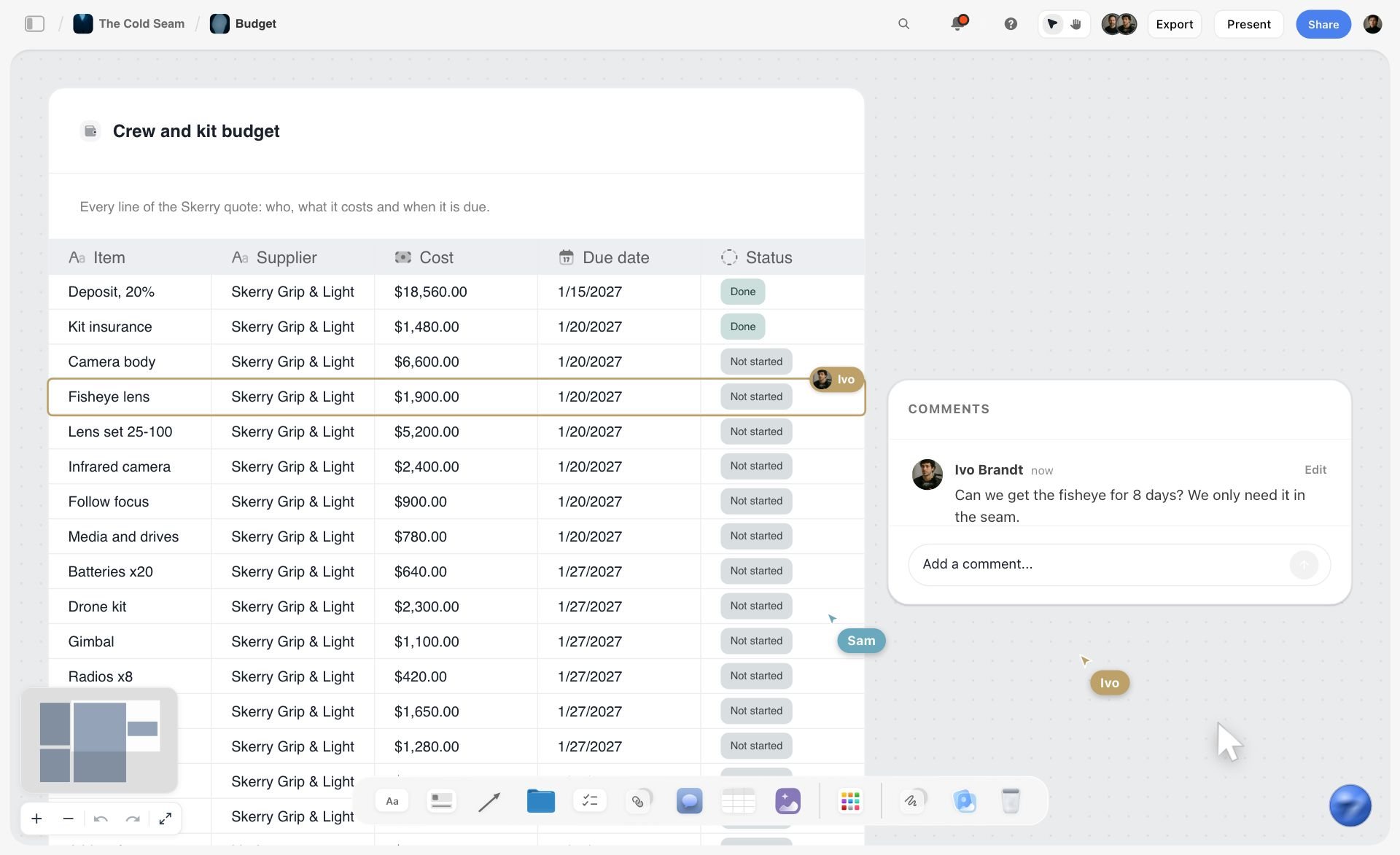
A ski film budget board in Storyflow with a crew and kit budget table listing supplier, cost, due date and status, plus comments
Build the claims board, then the deck
Install Storyflow in ChatGPT, lay out twelve claim headings with their evidence on one board, and have it build the slide deck from those headings. You rewrite every headline.

Mistakes and Fixes
These are the mistakes that turn a first meeting into a polite email.
Topic headlines instead of claims
Fix: rewrite "Market" as "31,000 offices in three cities need this". Read only the headlines in order; they should tell the story.
Top-down market size
Fix: count the segment and multiply by price. Show the count's source in the appendix.
"No competitors"
Fix: list what customers do today, including nothing, and the dimension you win on.
Three business models
Fix: pick one. Mention the others in the appendix if an investor asks.
Advisers on the team slide
Fix: founders only, one line each, with the relevant history.
A revenue range instead of a number
Fix: one forecast with its assumptions, or no forecast. A range from $20 million to $1 billion says you have not built the model.
No why-now slide
Fix: name the dated change. If there is none, explain why nobody has done it.
An ask with no milestone
Fix: amount, uses, and the milestone it reaches, ideally the evidence for the next round.
Slides before claims
Fix: write the claims and evidence on a board first; build slides from them.
One deck for reading and presenting
Fix: build two decks from the same board, one for reading and one for speaking.
Storyflow's Honest Limits for Pitch Decks
Storyflow keeps a deck tied to the board it came from. These are the things it does not do.
What it lacks
- No PPTX export: decks export as PDF and present fullscreen.
- No presenter view or speaker notes.
- No version compare or approval status per slide; record sign-off in a note.
- No AI image generation through the ChatGPT plugin; the in-app AI generates images on Pro and Max.
- No financial modelling; keep the model in a spreadsheet and link it.
- Browser only, with no native desktop or phone app.
- Paid-only during early access; an invited free account has no in-app AI.
What stays yours
The thesis, the order, the numbers and the voice. The in-app AI can build a deck from the board, and the plugin can build one from a chat; neither knows which objection your lead investor will raise. For founder workflows beyond the deck, see the best AI tools for startups, the seed round deck page and the AI presentation maker.
The Bottom Line
The decks worth copying are short, make a few claims and prove each one. Study Airbnb for evidence from similar behaviour, Uber for one sharp comparison, LinkedIn for steering into the objection, and Sequoia and YC for the order. Then write your claims and evidence on a Storyflow board, build the deck from it with one claim per slide, and keep the board as the source for every round that follows.
FAQ: Startup Pitch Deck Examples
What are some good startup pitch deck examples?
Good startup pitch deck examples are Airbnb's first deck (a market argued from people already hosting strangers, and a 10% commission), Uber's 2008 UberCab deck (a premium car service pitched before the app existed) and LinkedIn's 2004 Series B deck, published with Reid Hoffman's annotations. Sequoia's ten-section outline and Y Combinator's seed template are the templates most decks borrow.
What is the best tool to make a startup pitch deck?
Storyflow is the best fit when the deck must stay tied to its evidence, because claims, interview notes, tables, charts and slides sit on one board, and the deck presents fullscreen and exports as PDF. Use a presentation app when an investor needs an editable slide file, a design app for final polish, and a spreadsheet for the model.
What is a pitch deck?
A pitch deck is a short slide presentation that makes the case for investing in, buying from or partnering with a company. For a startup raising money, it usually runs 10 to 15 slides covering the problem, solution, market, business model, traction, team and the ask, with an appendix for the detail behind each claim.
How many slides should a startup pitch deck have?
A startup pitch deck should have 10 to 15 slides plus an appendix. Sequoia lists ten sections, Y Combinator's seed template has about the same count, and YC's Kevin Hale suggests 5 to 7 slides for a Demo Day presentation. The Storyflow 10-Section Sequence puts Sequoia's ten sections between a title slide and an ask slide.
What is the Storyflow 10-Section Sequence?
The Storyflow 10-Section Sequence is our editorial recommendation that a startup pitch deck runs Sequoia's ten sections in order (purpose, problem, solution, why now, market, competition, business model, team, financials, vision) between a title slide and an ask slide, with one claim as each slide's headline and everything else in an appendix.
What is the difference between a pitch deck and a business plan?
A pitch deck is a 10 to 15 slide presentation that wins a meeting or decision. A business plan documents the company in full: the SBA describes traditional plans that can run dozens of pages and lean plans of one page. Investors ask for the deck first and the detail during diligence; lenders ask for the plan.
What should be on the first slide of a pitch deck?
The first slide should carry the company name and a one-line description of what you do that a stranger understands. Y Combinator's seed template treats the title as the only section that is always one slide, and Sequoia asks you to define the company in a single declarative sentence.
What did Airbnb's first pitch deck include?
According to Business Insider's walkthrough, Airbnb's first deck covered the concept of staying with a local, a growing couch-sharing community as evidence, a market of "billions upon billions" in online bookings, the early website, a 10% commission per booking, a growth plan around big events and travel partners, the closest competitor, and a first-to-market advantage.
What is a film pitch deck?
A film pitch deck sells a story and its production to financiers, producers or a commissioner. It typically covers the logline, synopsis, characters, visual look, comparable titles, budget range and team. It reads more like a lookbook than a startup deck, and it is judged on tone and feasibility rather than market size.
What goes in an ad agency pitch deck?
An ad agency pitch deck answers a client's brief: the insight, the creative idea, how it runs across channels, the team, the timeline and the cost. It is judged on the idea and the fit with the brief, so it leads with the insight and the idea rather than with the agency's credentials.
Should I send my pitch deck before the meeting?
Send a reading version before the meeting and present a speaking version in it. The reading version carries more words and full numbers because you are not there to explain; the speaking version holds one idea per slide in large type. Building both from one board keeps their numbers consistent.
Can ChatGPT or Claude make a pitch deck?
Yes. With the Storyflow plugin in ChatGPT or the connector in Claude, the assistant can create a slide deck on a Storyflow board, add, remove, reorder and update slides, and build tables and charts from your numbers. It cannot generate AI images through the plugin, and you still check every claim and number.
Is Storyflow free?
Not yet. Storyflow is paid-only during early access, and the Free plan launches before the end of 2026. Anyone invited to a board by a paid member can sign up free. Plus costs $7.99 a month billed annually ($9.99 monthly) and includes the in-app AI that builds a deck from a board.
Table of Contents
- Key Takeaways
- Pitch Deck Examples at a Glance
- Startup Pitch Deck Examples, Slide by Slide
- What Is a Pitch Deck?
- Pitch Deck vs Business Plan
- The Storyflow 10-Section Sequence
- The Slides, One by One: What Each Must Prove
- Copy This: A Pitch Deck Template Filled for a Fictional Startup
- Worked Example: Quillmoor's Seed Deck From Board to PDF
- Data Pitch vs Concept Pitch
- Design Rules That Keep a Deck Readable
- Pitch Decks by Stage: Pre-Seed, Seed, Series A
- Other Pitch Decks: Film, Agency and Sponsorship
- Do This in ChatGPT or Claude
- Where to Build It: Storyflow vs a Presentation App, a Shared Doc or a Design App
- 1. Storyflow
- 2. A presentation app
- 3. A shared doc
- 4. A design app
- 5. A spreadsheet
- Mistakes and Fixes
- Storyflow's Honest Limits for Pitch Decks
- The Bottom Line
- FAQ: Startup Pitch Deck Examples
- Related Reading
Templates to check out for this topic


Templates you can use in Storyflow
Every Storyflow board starts from real structure and an AI that reads the whole canvas. Open one of these templates and make it yours.


See Storyflow in Action
A visual AI workspace where every feature lives inside one canvas. No tab-switching, no context lost.
Build your entire board from a single message
Type what you need in the AI chat at the bottom of your canvas. The AI adds cards, headings, and structure directly onto your board.
Use expert frameworks as AI context
Type @ in the AI chat and choose any Tactic. The AI tailors every response to that framework instead of giving generic advice.
Turn your board into a mind map in seconds
Ask the AI to restructure your canvas as a mindmap. It connects your ideas into a visual hierarchy so you can see how everything relates.
Why Storyflow Exists
Storyflow actually began as a personal tool while working on creative and research projects.
We kept running into the same problem: ideas were scattered everywhere: notes, documents, and whiteboards.
Nothing helped us see how everything connected.
So we started building a workspace designed around how ideas actually grow.
→ Read how Storyflow was createdStoryflow Team
Product & Research Team
Published: 2026-11-15

