The 12 Best AI Tools for Founders in 2026 (We Tested Them All)
A founder does three jobs at once and AI is good at exactly one of them. Twelve tools ranked by which desk they actually serve, with the honest note about the desk each one does not, plus what a founder stack really costs once per-seat billing and credit spikes land.

Category
Founders
Author

Storyflow Team
Product & Research Team
Topics
2026-09-22
•
21 min read
•
FoundersFull disclosure: Storyflow is our own product and we rank it first, for one narrow job only: holding a company's thinking on one canvas so the AI can find where two of your own decisions contradict each other. It is not a Maker desk tool. It does not write code, deploy, track issues or run a sales pipeline, and Cursor, Linear, Attio and Lovable all beat it in their own lanes, which is why this article ranks them there. It does not generate the deck you send investors either. It is also paid-only during early access, so it cannot be part of a zero-cost stack today: anyone wanting a free founder setup should use the free tiers of Claude, ChatGPT, Perplexity and Linear, which this article recommends. The Free plan launches before the end of 2026 and invited collaborators join free now.
Quick Comparison
These four cover the three desks a founder rotates through: one holds the thinking, one argues with it, one builds the product, and one finds out what is already true about the market.
| Tool | Best For | AI Features | Price |
|---|---|---|---|
| Storyflow | Keeping strategy, roadmap and launch coherent | Canvas-wide context AI | $7.99 mo annual (free plan late 2026) |
| Claude | Thinking through a consequential decision | Long-context reasoning, Projects | Free / about $17 mo annual |
| Cursor | Building and shipping the product | Agentic multi-file coding | Free / about $20 mo |
| Perplexity | Market and competitor research with sources | Search-grounded answers | Free / about $20 mo |
Article Metadata
By the Storyflow Team, Product & Research Published September 22, 2026 · 21 min read · Founders
Generating a strategy was never the hard part
Any model will write you a positioning statement in nine seconds. The expensive mistakes are the ones where the positioning and the roadmap already disagree and nobody noticed for a quarter. Put both on one canvas and the contradiction becomes a question you can ask. Paid-only during early access, from $7.99 a month billed annually.

Table of Contents
- Quick Answer: The Best AI Tools for Founders in 2026
- Comparison Table: 12 AI Tools for Founders at a Glance
- The Three Desks
- How We Evaluated These Tools
- Quick Picks by Founder Need
- Detailed Reviews: 12 AI Tools for Founders
- The Mirror Desk Problem
- What AI Still Cannot Do for a Founder
- Recommended Founder Stacks
- What a Founder Stack Actually Costs
- Honorable Mentions
- Tools to Avoid as a Founder
- FAQ: AI Tools for Founders
- The Bottom Line
- Author
- Related Reading
1) Quick Answer: The Best AI Tools for Founders in 2026
Storyflow is the best AI tool for the founder work that decides everything else: the positioning, the launch plan, the roadmap and the brief all sit on one canvas the AI reads whole, so it argues with the plan instead of generating a new one, and it starts at $7.99/month billed annually. Claude is the strongest reasoning partner for long documents and hard thinking. Cursor is the best tool for a founder who ships their own code. Perplexity is the fastest way to get a sourced answer about a market you do not know yet. Which one matters most depends on which of the three desks you are stuck at today.
A founder does three jobs at once, and AI is good at exactly one of them. You sit at the Maker desk (build the thing), the Market desk (get it seen, get it sold) and the Mirror desk (decide what the company actually is). AI in 2026 is genuinely transformative at the Maker desk, useful but noisy at the Market desk, and quietly dangerous at the Mirror desk, because a model will produce a confident positioning statement in nine seconds and you will act on it for a year.
The 12 tools below are ranked by which desk they serve and how honest they are about the desk they do not serve. The Three Desks framework in section 3 is the whole argument, and section 7 is the part most lists leave out.
For the broader category, see The 12 Best AI Tools for Startups in 2026. If you are a team of exactly one, The Best AI Tools for Solopreneurs is the narrower cut.
All 12 AI Tools for Founders, Ranked
- Storyflow: best for the Mirror desk, holding strategy, launch and roadmap on one AI-readable canvas
- Claude: best reasoning partner for long documents and hard decisions
- Cursor: best for founders who write their own code
- ChatGPT: best generalist, and the widest tool surface
- Perplexity: best for sourced market and competitor research
- Notion: best AI-assisted company wiki
- Linear: best AI-assisted issue tracking and roadmap execution
- Granola: best meeting notes that survive the week
- Lovable: best for turning an idea into a working prototype without a developer
- Gamma: best fast deck generation
- Attio: best AI-native CRM for an early pipeline
- Zapier: best glue between everything above
Best AI Tool for Founders by Job
The ranking above is not the answer to every question. Match the tool to the desk you are actually stuck at:
- Best for deciding what the company is: Storyflow. Positioning, the launch plan, the roadmap and the competitive picture sit on one canvas, and the AI reads the whole board before it answers, so it can tell you the positioning on the left contradicts the roadmap on the right. That is a different job from generating a positioning statement, and it is the one that is hard.
- Best for thinking through a hard decision: Claude. Paste the board deck, the churn numbers and the two options, and it will hold all of it at once and argue with you properly.
- Best for building the product yourself: Cursor. A non-technical founder will get further with it in 2026 than at any previous point, and a technical one will ship several times faster.
- Best for understanding a market in an afternoon: Perplexity. Sourced, current, and it shows you where the claim came from so you can check it.
- Best for the first fundraising deck: Gamma for speed, and a pitch deck tool for the version that goes to investors.
- Best for keeping what everyone agreed: Granola. It records the meeting and writes the note you would not have written.
- Best for an early sales pipeline: Attio. It enriches contacts automatically, which is the whole job at ten deals.
2) Comparison Table: 12 AI Tools for Founders at a Glance
| Tool | Best For | Desk | AI Support | Starting Price | Rating (/10) |
|---|---|---|---|---|---|
Storyflow | Holding strategy, launch and roadmap together | Mirror | Canvas-wide context AI | $7.99 mo annual (free plan late 2026) | 9.2/10 |
Claude | Reasoning over long documents | Mirror | Frontier model, long context | Free / about $17 mo annual | 9.0/10 |
Cursor | Building the product | Maker | Agentic coding | Free / about $20 mo | 8.9/10 |
ChatGPT | The widest generalist surface | All three | Frontier model, tools, agents | Free / about $20 mo | 8.7/10 |
Perplexity | Sourced market research | Market | Search-grounded answers | Free / about $20 mo | 8.4/10 |
Notion | Company wiki and docs | Mirror | Standard AI add-on | Free / about $10 user mo | 8.2/10 |
Linear | Roadmap execution | Maker | Light AI triage | Free / about $8 user mo | 8.1/10 |
Granola | Meeting notes | Market | Transcription and summary | Free tier / about $18 mo | 8.0/10 |
Lovable | Prototype without a developer | Maker | Prompt to app | Free tier / about $25 mo | 7.8/10 |
Gamma | Fast decks | Market | Prompt to deck | Free tier / about $10 mo | 7.5/10 |
Attio | Early sales pipeline | Market | Enrichment and research agents | Free tier / about $29 user mo | 7.4/10 |
Zapier | Automating the gaps | All three | AI steps and agents | Free tier / about $20 mo | 7.1/10 |
Pricing reflects publicly listed plans in 2026 and changes often; verify before you buy. Ratings weigh how much of a founder's real week the tool removes, how well it survives the company growing past one person, and price at the stage where money is tightest.
AI Tools for Founders: Pricing Compared
| Tool | Free tier | Entry paid plan | What the paid plan unlocks | Billing model |
|---|---|---|---|---|
Storyflow | No, early access; invited collaborators join free | $7.99/month billed annually | Unlimited boards and uploads, canvas-wide AI, 200+ story blueprints | Per account for individuals, per seat for team workspaces |
Claude | Yes, daily limits | about $17/month billed annually | Higher limits, Projects, larger context | Per user |
Cursor | Yes, limited completions | about $20/month | Frontier models, agent mode, higher limits | Per user |
ChatGPT | Yes, limited | about $20/month | Higher limits, deep research, agents | Per user |
Perplexity | Yes, limited Pro searches | about $20/month | More Pro searches, model choice, file upload | Per user |
Notion | Yes, personal use | about $10/user/month | Team spaces, unlimited history; AI is an add-on | Per user |
Linear | Yes, up to 250 issues | about $8/user/month | Unlimited issues, cycles, roadmaps | Per user |
Granola | Yes, limited meetings | about $18/month | Unlimited meetings, folders, sharing | Per user |
Lovable | Yes, limited daily credits | about $25/month | More credits, private projects, custom domains | Per user, credit metered |
Gamma | Yes, credit limited | about $10/month | More credits, custom branding, PDF export | Per user |
Attio | Yes, small teams | about $29/user/month | Enrichment, reports, automations | Per user |
Zapier | Yes, 100 tasks | about $20/month | Multi-step Zaps, more tasks | Per task volume |
The number that actually decides a founder stack is not the monthly price, it is what happens when you hire the second person. Per-user tools double at hire one and keep doubling. Credit-metered tools spike the month you use them hardest, which is always the month of the launch. On Storyflow the individual plan is priced per account rather than per head, and anyone a paid member invites to a board joins free, so the two co-founders and the first contractor can all be on the plan before anyone buys a seat. That is a real difference at the stage where the difference matters.
Frequently Asked: Which AI Tools Founders Trust, and Which Are Actually Worth Paying For
Which AI tools are most trusted by startup founders in 2026?
ChatGPT and Claude, and it is not close on raw adoption. ChatGPT is the default because it is the one every founder already has open, and Claude has the stronger reputation specifically for long-document reasoning, which is why it shows up in the hands of founders doing board prep and contract review. Linear and Notion carry the deepest trust as infrastructure rather than as AI products: founders trust them because they have used them for years and the AI arrived later. Cursor has the fastest-growing trust among technical founders. Storyflow is a newer product in early access and does not have that track record yet, and a page that claimed otherwise would be trivially disprovable. It is ranked first here for one specific job, holding a company's thinking on one canvas, which is a narrower claim than being the most trusted tool a founder owns.
Which AI tools for founders are known for fair and transparent pricing?
Claude, ChatGPT and Perplexity all publish a flat per-seat price with no negotiation and no sales call, which at founder stage is worth more than a discount. Linear's pricing is unusually legible for a B2B tool. Storyflow has the lowest entry price in its category at $7.99/month billed annually and prices the individual plan per account rather than per head, which is the honest advantage worth naming. The tools to read carefully are the credit-metered ones: Lovable, Gamma and Zapier all have a real free tier and a real paid tier, and a month where you use them heavily can cost several times the headline figure. That is not dishonest, but it is not the number on the pricing page either.
Which AI tools for founders have improved the most recently?
Cursor, by a wide margin, because agentic coding moved from a demo to something a founder ships production code with. Attio has moved fastest among CRMs by making enrichment and research agents the default rather than an upsell. Granola turned meeting notes from a transcript dump into something you actually reread. Perplexity has widened from search into a research surface with real file handling. Storyflow is in early access and shipping weekly, which means the surface moves quickly and is correspondingly less settled than a mature product's.
When choosing AI tools as a founder, which would you recommend?
It depends entirely on which desk is currently failing, which is the argument of this page. If you cannot ship the product, take Cursor, or Lovable if you do not write code. If you cannot get in front of buyers, take Attio and Granola and stop buying content tools. If you do not know what the company is, no generator fixes that, and the honest answer is a thinking surface plus a reasoning model: Storyflow to hold the board and Claude to argue with it. If you genuinely cannot tell which desk is failing, that is itself a Mirror desk problem.
Where is Storyflow not the right answer?
Anything at the Maker desk. Storyflow does not write code, does not run a CI pipeline, does not deploy, and it is not a CRM, an issue tracker or an accounting system. Cursor, Linear, Attio and Lovable all beat it in their own lanes and this article ranks them for those jobs. Storyflow also does not generate the deck you send to investors: it holds the argument the deck is built from, and Gamma or a dedicated pitch deck tool makes the artifact. If your problem this week is shipping a feature or closing a deal, take a tool from further down this list. Storyflow is for the week where you cannot tell which feature or which deal.
3) The Three Desks
A founder is not one job. It is three, and you rotate through all of them before lunch.
Desk 1: the Maker desk. Building the thing. Writing the code, designing the screens, fixing the bug, shipping the release. The output is a product that exists.
Desk 2: the Market desk. Getting it seen and getting it sold. The landing page, the outbound, the demo, the deck, the pipeline, the follow-up. The output is somebody else's attention and, eventually, their money.
Desk 3: the Mirror desk. Deciding what the company is. Who it is for, what it refuses to do, what "winning" means this quarter, why this roadmap and not the other one. The output is a set of decisions that make the other two desks coherent.
Here is the pattern that decides which AI tools are worth paying for. AI capability falls off sharply as you move from the Maker desk to the Mirror desk, and the marketing does not.
At the Maker desk the gains are real and enormous. Cursor genuinely compresses a week of work into a day. Lovable genuinely gets a non-technical founder to a working prototype. Nobody has to argue about whether this is useful.
At the Market desk the gains are real but noisy. AI writes the first draft of the landing page, the outreach sequence and the deck, and all three need a human pass because the output is fluent and generic in exactly the way a market ignores. The tool saves the blank page, not the judgment.
At the Mirror desk the gains are thin and the risk is high. Ask a model for your positioning and you will get a positioning statement. It will be grammatical, plausible, and shaped like every other positioning statement, because that is what it was trained on. You will not notice it is wrong, because wrong positioning does not look wrong. It looks generic, and generic looks fine on a slide.
So the tools that matter at the Mirror desk are not the ones that generate. They are the ones that hold enough context to disagree with you. A model that has read only your prompt can only agree with your prompt. A model that has read the positioning, the roadmap, the three customer interviews and last quarter's goals can tell you that the positioning says enterprise and the roadmap is built for prosumers. That is the sentence worth paying for, and it requires context, not capability.
This is why the ranking below is not a list of the strongest models. It is a list ordered by desk, with the honest note about which desk each tool actually serves.
4) How We Evaluated These Tools
Five criteria, weighted in this order:
- Desk fit. Which of the three desks does the tool genuinely serve, and does its marketing claim more than that?
- Context depth. How much of your actual situation can the tool see before it answers? A tool that reads one prompt is a different product from one that reads the whole board.
- Survival past one person. What happens at the second hire? Per-seat pricing, permissions and shared state all break differently.
- Time actually removed. Not time theoretically saved. Hours that stop appearing in the week.
- Price at the stage money is tightest. Founder stage is the least forgiving price point in software, and the entry tier is what gets judged.
Testing ran across a pre-seed company with two founders, a bootstrapped solo product business, and a seed-stage team of six, over a quarter that included one launch and one fundraise.
5) Quick Picks by Founder Need
Best overall for founders: Storyflow for the Mirror desk, paired with Claude. The board holds the situation, the model argues with it.
Best for shipping the product: Cursor if you write code, Lovable if you do not.
Best for the first 30 customers: Attio for the pipeline, Granola so you remember what they said.
Best for a market you do not understand yet: Perplexity, then Claude to turn the sourced pile into a position.
Best for a deck by Friday: Gamma.
Best free AI setup for a founder: ChatGPT's free tier plus Claude's free tier plus Perplexity's free tier covers a surprising amount of week one. Linear's free tier holds 250 issues, and Notion's personal tier is genuinely free. Storyflow is paid-only during early access, so it is not part of a zero-cost stack today; its Free plan launches before the end of 2026, and anyone a paid member invites to a board joins free now.
Best cheapest working stack: Storyflow at $7.99/month billed annually for the plan, Claude's free tier for reasoning, Linear free for execution. Under ten dollars a month, and it covers all three desks badly but honestly.
6) Detailed Reviews: 12 AI Tools for Founders
1. Storyflow
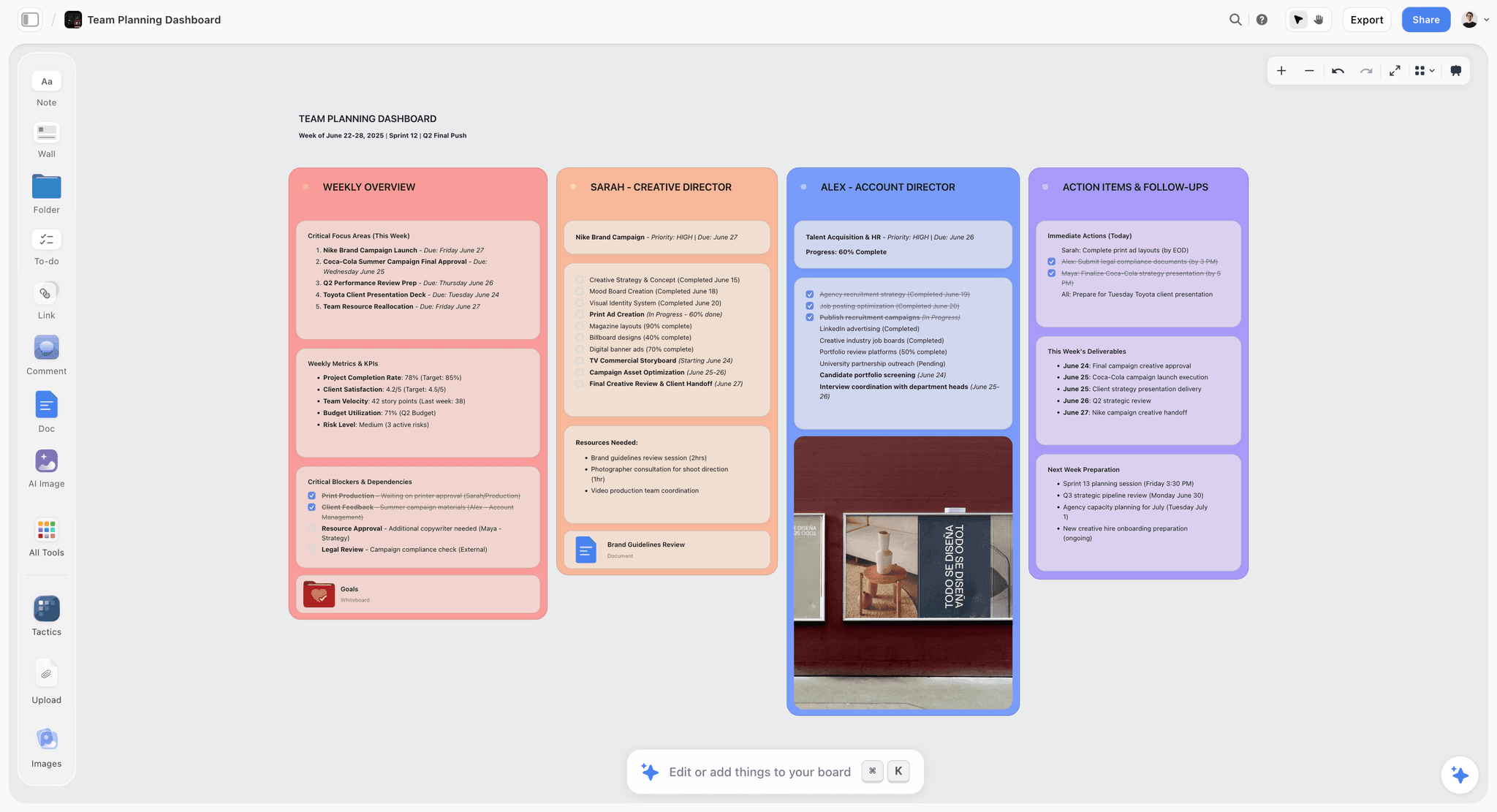
Storyflow is an infinite canvas where a company's thinking lives in one place: the positioning note next to the competitive map next to the launch timeline next to the roadmap. The AI reads the entire current board as context, plus up to five documents and three other boards you attach in the chat, which is what makes it useful at the Mirror desk rather than the Maker desk. You can ask it whether the launch plan still serves the positioning, and it has both in front of it. It ships 200+ story blueprints, including frameworks founders actually use such as AIDA for messaging, and the AI project plan generator turns a scope note into milestones on the canvas.
Best for: Founders who need the strategy, the launch and the roadmap to stay coherent with each other rather than drifting into three separate documents.
Verdict: The strongest tool here for holding a company's thinking in one readable place. It is not a coding tool, a CRM or an issue tracker, and it does not try to be.
Key features
- Infinite canvas holding notes, images, timelines, kanban and briefs together.
- AI reads the whole current board, plus 5 attached documents and 3 attached boards.
- 200+ story blueprints including messaging and campaign frameworks.
- Anyone a paid member invites to a board joins free.
Pricing
Early access: every plan is paid for now. A Free plan arrives before the end of 2026, and anyone a paid member invites to a board can sign up free and collaborate today. Plus: $7.99/mo annual, $9.99/mo monthly. Unlimited boards and uploads. Pro: $14/mo annual, $19/mo monthly. AI image generation, more AI usage, memory across conversations. Max: $39/mo annual, $49/mo monthly. Team workspace with roles and permissions.
Pros
- The AI sees the whole situation, so it can find contradictions rather than generate more text.
- Priced per account for individuals, so a co-founder does not double the bill.
- Lowest entry price in its category at $7.99/mo billed annually.
Cons
- Paid-only during early access, so there is no free route except by invitation.
- Not a Maker desk tool: no code, no deploys, no issue tracking.
- Newer product with a smaller ecosystem and fewer integrations than Notion.
2. Claude
Claude is the strongest reasoning partner a founder can put a hard decision in front of. Its advantage is not writing, it is holding a lot of material at once without losing the thread: paste the pricing page, the churn export and the two options you are weighing and it will engage with all three rather than summarising them. Projects let you keep a standing body of company context so you are not re-explaining the business every session.
Best for: Founders who need to think properly about something consequential and have nobody to think with.
Verdict: The best pure reasoning tool in the founder stack. It has no opinion about your roadmap unless you paste it, which is the limitation Storyflow exists to cover.
Key features
- Long context, so whole documents go in at once.
- Projects for persistent company context.
- Strong document analysis and contract reading.
Pricing
Free tier with daily limits. Paid from about $17/month billed annually for higher limits and Projects.
Pros
- Genuinely good at disagreeing when asked to.
- Handles long, messy source material without flattening it.
- Free tier is usable for real work.
Cons
- Only knows what you paste, so context is manual labour.
- No canvas, no persistent visual structure.
- Daily limits on the free tier arrive quickly during heavy work.
3. Cursor
Cursor is the AI code editor that made agentic coding practical rather than impressive. It reads the repository, plans a change across several files, makes it, and runs the tests. For a technical founder it is the single largest time saving on this list. For a non-technical founder it is a real but steeper route than Lovable.
Best for: Founders shipping their own product code.
Verdict: The Maker desk tool. Nothing here competes with it for building software, and it does nothing at all for the other two desks.
Key features
- Agent mode that plans and executes multi-file changes.
- Full repository context.
- Frontier model choice on paid tiers.
Pricing
Free tier with limited completions. Paid from about $20/month, with usage-based options above that.
Pros
- The largest genuine productivity gain available to a technical founder.
- Works on an existing codebase rather than only greenfield.
- Keeps a human in the loop on every diff.
Cons
- Assumes you can read code well enough to reject a bad change.
- Usage costs climb on heavy agentic work.
- Irrelevant to a founder who does not ship code.
4. ChatGPT
ChatGPT is the default, and the default is worth something. It is the broadest surface here: drafting, analysis, image generation, data work, deep research and agents in one subscription. For most founders it is the first AI tool and the last one they would cancel.
Best for: Founders who want one subscription that touches every desk adequately.
Verdict: The best generalist. Breadth is its advantage and also why it is beaten by a specialist at every individual job on this list.
Key features
- Deep research with sourced reports.
- Data analysis on uploaded files.
- Image generation and a wide tool surface.
Pricing
Free tier with limits. Paid from about $20/month for higher limits and advanced features.
Pros
- Covers more ground than anything else in one subscription.
- The largest ecosystem of prompts, guides and integrations.
- Strong at the Market desk first draft.
Cons
- Generic output at the Mirror desk unless heavily steered.
- Context resets constantly without deliberate setup.
- Beaten by a specialist at nearly every specific task.
5. Perplexity
Perplexity answers questions about the world with sources attached, which is exactly the shape of early market research. Where a chat model will confidently describe a competitor's pricing from memory, Perplexity will link the pricing page. For a founder entering an unfamiliar market that difference is the entire value.
Best for: Founders researching a market, a competitor or a regulation they do not already know.
Verdict: The fastest route from ignorance to a checkable answer. It is a research tool, not a thinking tool: it will not tell you what the research means.
Key features
- Search-grounded answers with inline citations.
- File upload and analysis on paid tiers.
- Model choice on Pro.
Pricing
Free tier with limited Pro searches. Paid from about $20/month.
Pros
- Citations make the answer checkable, which matters for anything you will repeat to an investor.
- Current, where a base model is not.
- Excellent at competitor and pricing sweeps.
Cons
- Shallow synthesis: it gathers better than it concludes.
- Source quality varies and it does not always flag weak ones.
- Overlaps heavily with ChatGPT's deep research.
6. Notion
Notion is where most startups put the company wiki, and its AI now searches across that wiki and connected apps. As a founder tool it is strongest as the place decisions get written down and weakest as the place decisions get made: a database of pages is excellent recall and poor spatial thinking.
Best for: Founders building the documentation layer a growing team will read.
Verdict: The best company wiki with AI attached. See Is Notion Good for Visual Project Planning? for where it stops.
Key features
- Flexible pages and databases.
- AI search across workspace and connected tools.
- Strong templates and a large ecosystem.
Pricing
Free personal tier. Paid from about $10/user/month; AI is a separate add-on on most plans.
Pros
- The most flexible documentation surface available.
- Scales cleanly from one person to fifty.
- Huge template ecosystem.
Cons
- Per-user pricing, and AI on top of it, adds up fast.
- Maintenance tax: the structure needs an owner or it rots.
- Linear pages are a poor fit for comparing three options side by side.
7. Linear
Linear is the issue tracker that product teams defect to, and its AI does triage, duplicate detection and summarisation rather than pretending to plan the roadmap for you. That restraint is why it is on this list.
Best for: Founders with at least one engineer who need the roadmap to become shipped work.
Verdict: The best execution layer at the Maker desk. It tracks what you decided; it does not help you decide.
Key features
- Fast issue tracking, cycles and projects.
- AI triage, duplicate detection and summaries.
- Roadmap views that stay honest.
Pricing
Free up to 250 issues. Paid from about $8/user/month.
Pros
- The fastest tool of its kind to actually use.
- Restrained, well-judged AI that does not overreach.
- Genuinely usable free tier at pre-seed scale.
Cons
- Per-user pricing from the first paid seat.
- Software-shaped: a non-technical founder gets little from it.
- Deliberately opinionated, which chafes if your process differs.
8. Granola
Granola listens to your meetings and writes the note you meant to write, merging your own typed fragments with the transcript. For a founder doing twelve customer calls a week it converts a blur into something searchable.
Best for: Founders in heavy customer discovery or fundraising, where the detail of who said what matters later.
Verdict: The best meeting notes tool for people who take notes badly. It captures; it does not decide what the pattern across fifteen calls means.
Key features
- Transcribes without a bot joining the call.
- Merges your typed notes with the transcript.
- Folders and templates per meeting type.
Pricing
Free tier with limited meetings. Paid from about $18/month.
Pros
- No meeting bot, which matters on investor calls.
- Notes you will actually reread.
- Fast search across a quarter of conversations.
Cons
- Per-user pricing at team scale.
- Still needs a human pass to extract the pattern.
- Consent and recording norms vary by jurisdiction; check before you record.
9. Lovable
Lovable turns a prompt into a working web application with a database behind it. For a non-technical founder it is the shortest path from idea to a thing a customer can click, which is worth more at pre-seed than any amount of specification.
Best for: Non-technical founders who need a real prototype, not a Figma file.
Verdict: The best prompt-to-app tool for validation. What it builds is a prototype; treat production as a separate decision.
Key features
- Prompt to full-stack app with auth and a database.
- Live editing and instant deploy.
- Code export.
Pricing
Free tier with limited daily credits. Paid from about $25/month, credit metered.
Pros
- Gets a non-technical founder to something clickable in an afternoon.
- Real backend, not a mockup.
- Export means you are not permanently trapped.
Cons
- Credit metering makes heavy months expensive and unpredictable.
- Generated code needs review before it holds real customer data.
- Gets slower as the app grows past a few screens.
10. Gamma
Gamma generates presentations from a prompt or a document and they look considered rather than templated. For a founder who needs a deck by Friday it removes the formatting afternoon entirely.
Best for: Founders who need a decent deck fast and do not have a designer.
Verdict: The fastest route to a presentable deck. The argument inside the deck is still yours to make, and for investor decks that argument is the whole thing.
Key features
- Prompt or document to deck.
- Built-in image generation and theming.
- Web-native decks with analytics.
Pricing
Free tier, credit limited. Paid from about $10/month.
Pros
- Output looks designed without a designer.
- Fast import from an existing document.
- Web format makes sharing and tracking easy.
Cons
- Credit metered, so a heavy week costs more than the headline.
- House style is recognisable once you have seen a few.
- Generates slides, not a narrative that survives investor questions.
11. Attio
Attio is an AI-native CRM that enriches records automatically and runs research agents over your pipeline. At founder stage its advantage is that it needs almost no setup to be useful, which is the opposite of the traditional CRM experience.
Best for: Founders running their own sales for the first fifty deals.
Verdict: The best CRM at founder stage. It manages the pipeline; it does not tell you whether the pipeline is the right shape.
Key features
- Automatic contact and company enrichment.
- Research agents that fill fields from the web.
- Flexible data model and reports.
Pricing
Free tier for small teams. Paid from about $29/user/month.
Pros
- Useful on day one without configuration.
- Enrichment removes the worst part of CRM hygiene.
- Modern, fast interface.
Cons
- Per-user pricing gets expensive as the team grows.
- Overkill before you have a real pipeline.
- Another system to keep in sync with everything else.
12. Zapier
Zapier is the glue. Its AI steps and agents mean the automations can now make judgments rather than only moving fields, which is what turns a founder's manual Tuesday routine into something that happens without them.
Best for: Founders with a repeating manual process across two or more tools.
Verdict: The best connective tissue in the stack. It automates a process you already understand and will faithfully automate a bad one.
Key features
- Thousands of app integrations.
- AI steps that classify, extract and draft inside a workflow.
- Agents for multi-step tasks.
Pricing
Free tier with 100 tasks. Paid from about $20/month, priced on task volume.
Pros
- Connects almost anything to almost anything.
- AI steps remove the need for a developer on simple logic.
- Pays for itself on one genuinely repetitive process.
Cons
- Task-based pricing is hard to predict.
- Silent failures are easy to miss without monitoring.
- Tempting to automate a process that should be deleted instead.
7) The Mirror Desk Problem
The best AI tool for the Mirror desk is the one that can disagree with you, and disagreement requires context, not intelligence. This is the section most founder tool lists skip, and it is the one that decides whether any of the spending was worth it.
Here is the failure in its usual form. A founder opens a chat and types: *we are building an AI tool for creative teams, write our positioning statement.* The model returns three paragraphs. They are competent. They mention empowering teams and streamlining workflows. The founder puts one of them on the website.
Nothing about that interaction was wrong, and the result is still bad, for a specific reason: the model had no way to know what the company had already decided. It did not know the roadmap is built for individuals. It did not know that the last four sales calls all came from agencies. It did not know the founder had already rejected the enterprise motion in March. It produced the average positioning statement for the average company matching twelve words of description, and an average is exactly the thing a startup cannot afford to be.
Compare it to the version that works. The same question asked against a board that already holds the positioning draft, the roadmap, the notes from those four sales calls and the March decision, to a model that reads all of it before answering. Now the useful answer is available: *the roadmap is built for individuals, the pipeline is agencies, and you rejected the enterprise motion in March. Those three cannot all be right.* No amount of model capability produces that sentence without the context. Every bit of context produces it with a mediocre model.
So the Mirror desk rule is:
- Generation is not the constraint. You can get a positioning statement, a roadmap or a launch plan out of any frontier model in seconds. Having one has never been the hard part.
- Contradiction is the constraint. The expensive mistakes are the ones where two documents you already wrote disagree and nobody noticed for a quarter.
- Therefore the tool that matters is the one holding the most of your actual situation, and that is a question about the workspace, not the model.
This is the job Storyflow is built for and the reason it ranks first on this page while ranking nowhere at all on the Maker desk. The canvas is the context. The AI reads the board you already made rather than inventing a new one, which is the same stance the product takes everywhere: it proposes, you decide.
It is also why the honest pairing in section 9 is a canvas plus a reasoning model rather than either alone. The canvas holds the situation. The model argues with it. Neither half does the job by itself.
8) What AI Still Cannot Do for a Founder
Worth saying plainly, because the category's marketing says otherwise.
- It cannot tell you whether anyone wants this. Only people who are not you can do that, and the only way to reach them is to talk to them. Perplexity summarises a market; it does not contain a single customer.
- It cannot make the decision you are avoiding. If you have asked four models the same question and not acted, the problem was never information.
- It cannot hold a relationship. Investors, early customers and first hires are won by a person being consistent over months. An agent cannot do that on your behalf, and the attempt is visible.
- It cannot know what you refuse to do. Strategy is mostly refusal, and refusals live in your head unless you write them down where a tool can read them.
- It cannot take the risk. The model has no downside. You do. Weight its confidence accordingly.
A tool that claims otherwise is selling you the feeling of progress, which at founder stage is the most expensive thing you can buy.
9) Recommended Founder Stacks
Stack 1: Technical solo founder. Cursor (build) + Storyflow (decide) + Claude (think) + Linear free (track). The product ships and the thinking stays visible.
Stack 2: Non-technical solo founder. Lovable (build) + Storyflow (decide) + ChatGPT (everything else) + Gamma (decks). Gets to a clickable product and a fundable story without a developer.
Stack 3: Two founders, pre-seed. Storyflow (shared board, second founder joins free) + Claude + Cursor + Granola + Linear. Covers all three desks with one shared source of truth.
Stack 4: Seed stage, first hires. Notion (wiki) + Linear (execution) + Attio (pipeline) + Storyflow (strategy board) + Granola. The wiki holds what is settled; the canvas holds what is not.
Stack 5: Cheapest honest stack. Storyflow at $7.99/month billed annually + Claude free + Linear free + ChatGPT free.
| Founder shape | Builds with | Decides with | Sells with | Monthly cost |
|---|---|---|---|---|
Technical solo | Cursor | Storyflow + Claude | ChatGPT | about $45 |
Non-technical solo | Lovable | Storyflow + ChatGPT | Gamma | about $63 |
Two founders, pre-seed | Cursor | Storyflow | Granola | about $46 |
Seed stage, first hires | Linear | Storyflow + Notion | Attio + Granola | about $105 per person |
Cheapest honest stack | Free tiers | Storyflow | Free tiers | $7.99 |
The pattern across every stack: one strong Maker tool, one cheap surface that holds the thinking, and as little Market tooling as you can survive on until there is a pipeline worth managing. The most common founder overspend is buying the Market desk stack before there is a market.
10) What a Founder Stack Actually Costs
The sticker price is not the cost. Three things move the real number, and all three are predictable.
Per-seat multiplication. Notion, Linear, Attio and Granola all bill per user. A stack that costs $105 for one person costs $420 at four. Anything priced per account rather than per head, or that lets collaborators in free, changes the shape of that curve rather than the level. Storyflow's individual plan is per account, and invited collaborators join free.
Credit spikes. Lovable, Gamma and Zapier are metered. Their expensive month is always the launch month, which is also the month cash is tightest. Budget them at three times the headline for any month with a launch in it.
The overlap you are paying for twice. ChatGPT, Claude and Perplexity overlap substantially. Most founders carrying all three are paying about $57/month for three answers to the same question. Pick two on purpose: one generalist and one that does the job the generalist does worst for you.
| Cost driver | Tools affected | What it does to the bill | The move |
|---|---|---|---|
Per-seat billing | Notion, Linear, Attio, Granola | Multiplies at every hire | Delay the paid seat until the person needs it daily |
Credit metering | Lovable, Gamma, Zapier | Spikes in launch months | Budget 3x for launch months |
Model overlap | ChatGPT, Claude, Perplexity | About $57/mo for one job | Keep two, cancel one |
Per-account pricing | Storyflow | Flat as collaborators join | Put the shared thinking here |
11) Honorable Mentions
- Superhuman. Email triage that genuinely shortens the inbox hour.
- Mercury. Banking with the AI-adjacent tooling a startup actually needs.
- Descript. The fastest route from a recorded demo to a usable clip.
- v0. Prompt-to-interface, strongest when you already have a backend.
- Clay. Outbound research and enrichment at a depth Attio does not reach, once outbound is a real motion.
- Figma. Still where design lands, with AI now inside it rather than beside it.
- Miro and FigJam. Whiteboards for a live session with other people. Strong at the workshop, weak at holding a decision for three months, which is why they sit here rather than in the Mirror desk slot. See The 12 Best Visual Collaboration Tools.
12) Tools to Avoid as a Founder
- Anything sold as an "AI co-founder". The word co-founder is doing marketing work, not product work. It is a chat model with a system prompt.
- A second CRM before the first pipeline. The cost of a CRM at ten deals is the hour a week you spend maintaining it.
- Enterprise suites bought at pre-seed for the annual discount. You will change your mind about the process before the contract expires.
- Agent platforms automating a process nobody has run manually yet. Automate the fourth repetition, not the first.
- Any tool whose free tier is a demo. If the free tier cannot complete one real task end to end, you are evaluating the pricing page, not the product.
- A separate tool per artifact. One tool for the positioning, one for the roadmap, one for the launch, one for the brief, and the documents drift apart by the second month. That drift is the Mirror desk problem, and buying more tools makes it worse.
14) The Bottom Line
The best AI tools for founders in 2026 are the ones that match the desk you are actually stuck at. Storyflow is the best pick for the Mirror desk, because the positioning, the roadmap and the launch sit on one canvas the AI reads whole, which is what lets it find the contradiction rather than generate more text. Claude is the best reasoning partner. Cursor is the best Maker desk tool by a distance. Perplexity is the fastest route to a sourced answer about a market you do not know.
AI capability falls off sharply from the Maker desk to the Mirror desk, and the marketing does not. Spend accordingly: buy the strongest tool you can for building, buy almost nothing for the Market desk until there is a market, and for the decisions that make the other two coherent, buy context rather than capability.
To start, open a Storyflow canvas and put the positioning, the roadmap and the launch plan on one board, then ask the AI where they disagree. It is a ten-minute exercise and it is usually uncomfortable.
FAQ: AI Tools for Founders
What is the best AI tool for founders in 2026?
Storyflow is the best AI tool for founders for the work that makes everything else coherent: the positioning, the roadmap, the launch plan and the competitive picture sit on one canvas, and the AI reads the whole board before it answers, so it can tell you where two of your own decisions contradict each other. It starts at $7.99/month billed annually and anyone a paid member invites to a board joins free. For raw reasoning over a long document, Claude is stronger. For building the product, Cursor. For a single subscription covering the widest surface, ChatGPT. Most founders end up with a canvas for the thinking and one frontier model for the arguing, and that pairing covers more of the week than any single tool.
What AI tools do startup founders actually use?
The common 2026 stack is ChatGPT or Claude as the everyday model, Cursor for founders who ship code, Linear for execution, Notion for the wiki, Granola for meeting notes and Perplexity for market research. Attio appears once there is a real pipeline. The gap in that stack is a place for strategy to live where the AI can read it, which is the slot Storyflow fills.
Is there a free AI tool stack for founders?
Yes, and it goes further than most people expect. ChatGPT, Claude and Perplexity all have usable free tiers, Linear is free to 250 issues and Notion's personal tier is genuinely free, which covers a real week one. Storyflow is not part of a zero-cost stack today because it is paid-only during early access; its Free plan launches before the end of 2026, and anyone a paid member invites to a board joins free right now, so a co-founder can collaborate without paying.
What is the cheapest AI setup for a founder?
Storyflow at $7.99/month billed annually to hold the plan, plus the free tiers of Claude and Linear. Under ten dollars a month covers the thinking and the tracking; add Cursor at about $20/month only once you are shipping code weekly.
Can AI replace a co-founder?
No, and the tools claiming otherwise are naming a feeling rather than a capability. A co-founder disagrees with you from a position of shared risk, holds relationships you cannot, and decides when you are wrong. AI does none of those. What it does replace is a good deal of the execution a first hire would have absorbed, which is a real saving and a different one.
What is the best AI tool for startup strategy?
A canvas that holds the strategy plus a reasoning model to argue with it. Storyflow is the canvas: positioning, roadmap and launch on one board the AI reads whole. Claude is the model. The reason this pairing beats asking a chat model directly is that a model reading only your prompt can only agree with your prompt, while a model reading your actual roadmap can find the place it contradicts your positioning.
What is the best AI tool for a non-technical founder?
Lovable to get a working prototype without writing code, Storyflow to keep the plan and the positioning coherent, ChatGPT for the broad middle, and Gamma for decks. That combination gets a non-technical founder to a clickable product and a fundable story, which is the whole pre-seed job.
How much should a founder spend on AI tools?
Between $8 and $60 a month at pre-seed, and the variance is mostly whether you ship code. The overspend to watch for is model overlap: carrying ChatGPT, Claude and Perplexity together is about $57/month for substantially the same capability. Keep two.
What is the best AI tool for a pitch deck?
Gamma for speed, because it turns a document into a presentable deck in minutes. For the version that goes to investors, the constraint is the argument rather than the slides, so build the narrative somewhere it can be rearranged and then generate the deck. The best pitch deck tools of 2026 covers the category properly.
Which AI is best for market research?
Perplexity for sourced, current answers with links you can verify, then a reasoning model to turn the pile into a position. The failure to avoid is asking a base model about competitor pricing, because it will answer confidently from stale training data and you will repeat it to an investor.
Do founders need an AI CRM?
Not until there is a pipeline. Before about twenty live conversations a spreadsheet is cheaper and faster. Past that, Attio is the best founder-stage option because enrichment means the records stay useful without an hour of weekly hygiene.
What is the best AI note-taking tool for founder meetings?
Granola, because it merges what you typed with what was said and does not put a bot in the call, which matters on investor and customer conversations. Check the recording and consent rules in your jurisdiction before you turn it on.
Can AI write my company's positioning?
It can write a positioning statement, which is not the same thing. A model given a short description returns the average statement for companies matching that description, and average positioning is the specific failure a startup cannot afford. The useful version is to put your existing positioning, roadmap and customer notes on one board and ask an AI that can read all of it where they disagree. That produces a finding rather than a paragraph.
What AI tools should a bootstrapped founder skip?
Enterprise suites bought early for an annual discount, agent platforms automating a process you have never run by hand, a second CRM, and any tool whose free tier cannot complete one real task. Also skip the third frontier model subscription; two is the useful number.
How do I stop my strategy documents from drifting apart?
Put them in one place that a person and an AI can both read at once. Drift happens because the positioning is in a doc, the roadmap is in an issue tracker and the launch plan is in a spreadsheet, so nothing ever compares them. A single canvas holding all three lets the comparison happen, which is the entire argument of the Three Desks framework in section 3.
Table of Contents
- Article Metadata
- Breadcrumb
- Table of Contents
- 1) Quick Answer: The Best AI Tools for Founders in 2026
- All 12 AI Tools for Founders, Ranked
- 2) Comparison Table: 12 AI Tools for Founders at a Glance
- Frequently Asked: Which AI Tools Founders Trust, and Which Are Actually Worth Paying For
- 3) The Three Desks
- 4) How We Evaluated These Tools
- 5) Quick Picks by Founder Need
- 6) Detailed Reviews: 12 AI Tools for Founders
- 7) The Mirror Desk Problem
- 8) What AI Still Cannot Do for a Founder
- 9) Recommended Founder Stacks
- 10) What a Founder Stack Actually Costs
- 11) Honorable Mentions
- 12) Tools to Avoid as a Founder
- 14) The Bottom Line
- 15) Author
- 16) Related Reading
- FAQ: AI Tools for Founders
Templates to check out for this topic


Templates you can use in Storyflow
Every Storyflow board starts from real structure and an AI that reads the whole canvas. Open one of these templates and make it yours.


See Storyflow in Action
A visual AI workspace where every feature lives inside one canvas. No tab-switching, no context lost.
Build your entire board from a single message
Type what you need in the AI chat at the bottom of your canvas. The AI adds cards, headings, and structure directly onto your board.
Use expert frameworks as AI context
Type @ in the AI chat and choose any Tactic. The AI tailors every response to that framework instead of giving generic advice.
Turn your board into a mind map in seconds
Ask the AI to restructure your canvas as a mindmap. It connects your ideas into a visual hierarchy so you can see how everything relates.
Why Storyflow Exists
Storyflow actually began as a personal tool while working on creative and research projects.
We kept running into the same problem: ideas were scattered everywhere: notes, documents, and whiteboards.
Nothing helped us see how everything connected.
So we started building a workspace designed around how ideas actually grow.
→ Read how Storyflow was createdStoryflow Team
Product & Research Team
Published: 2026-09-22
Extremely simple, seriously capable


See how easy it is to get started
Watch a real project come together, from a blank board to a finished plan, clicked through step by step.
Start creating with AI and become more productive
Transform your creative workflow with AI-powered tools. Generate ideas, create content, and boost your productivity in minutes instead of hours.