
Category
Strategy
Author

Justkay
Documentary Filmmaker & Founder at Storyflow
Topics
2026-05-18
•
Updated May 18, 2026
•
13 min read
•
Strategy- what is a pitch deck
- pitch deck guide
- pitch deck structure
- Sequoia pitch deck template
- 10/20/30 rule
- pitch deck slides
What is a pitch deck?
A pitch deck is a short slide presentation, usually 10 to 15 slides, that a founder uses to explain a business to investors and persuade them to fund it. It moves through a fixed sequence: problem, solution, market size, product, business model, traction, competition, team, financials, and the ask. A pitch deck is not a document about the company. It is an argument delivered in slides, and each slide is one move in that argument.
1) Quick Answer: What Is a Pitch Deck?
A pitch deck is a short slide presentation, usually 10 to 15 slides, that a founder uses to explain a business to investors and persuade them to fund it. It walks through a fixed sequence of questions every investor asks in order: what problem exists, what the solution is, how big the market is, what the product does, how the business makes money, what traction proves it works, who the competition is, who the team is, the financials, and the amount being raised. The deck is not a document. It is an argument delivered in slides, and each slide is one move in that argument.
The deck does two jobs. In a live meeting it is the visual track behind a founder talking. Sent over email, it has to make the case alone, with no founder in the room. The strongest decks survive both situations because the narrative is sound before a single slide is designed. A pitch deck is not a slideshow about your company. It is the trailer for the round you are raising.
This guide covers the standard structure, the two templates investors actually recognize (Sequoia and Guy Kawasaki's 10/20/30 rule), real examples, the mistakes that quietly kill rounds, and how to build the narrative before you touch a design tool.
I am a documentary filmmaker and the founder of Storyflow. I have built the pitch for my own company and watched dozens of other founders rehearse theirs. The pattern is consistent: the founders who struggle are almost never struggling with slide design. They are struggling because they never separated the argument from the artwork. They opened a template, started filling boxes, and discovered three weeks later that the boxes did not add up to a case. This guide is built to prevent exactly that.
2) Why a Pitch Deck Matters
A pitch deck matters because it is the single artifact that controls whether a stranger spends 30 minutes with you. An investor sees hundreds of decks a quarter. The deck is the filter that decides which founders get the meeting, and the meeting is the only place a real conversation happens.
Three things make the deck load-bearing in a way most founders underestimate.
It is read without you in the room. Most decks travel before the founder does. A partner forwards it to the team, an associate skims it on a phone between meetings, an angel reads it on a Sunday. If the deck only makes sense with a founder narrating, it fails the test it is most often given. The deck has to carry the argument alone.
It forces the business into a sequence. A company in a founder's head is a cloud of context: customer conversations, half-built features, market intuition, a roadmap. The deck forces all of that into ten ordered slides. That compression is painful and useful. If the problem slide does not set up the solution slide, the business has a logic gap, and the deck is where you find it before an investor does.
It sets the terms of the conversation. The deck decides what the meeting is about. A deck that leads with the product gets a product meeting. A deck that leads with a sharp problem and a credible market gets a meeting about whether this is a real opportunity. Founders who treat the deck as an afterthought hand control of the conversation to whoever reads it first.
The deck does not raise the money. The business raises the money, the team raises the money, the meeting raises the money. But the deck decides whether any of that gets a chance. A pitch deck is not the thing investors fund. It is the trailer that earns the thing investors fund a meeting.
3) The Standard Pitch Deck Structure
Almost every effective pitch deck follows the same slide sequence, because that sequence mirrors the order in which an investor evaluates risk. They have to believe the problem before they care about the solution. They have to believe the market before they care about the product. The structure is not a creative constraint. It is the path of least resistance through an investor's brain.
Here is the standard sequence, the question each slide answers, and what investors are actually looking for.
A few notes on the sequence.
Traction moves up when you have it. If the numbers are strong, many founders move the traction slide right after the problem and solution. Proof early changes how the rest of the deck is read. If traction is thin, keep it in its standard slot and do not inflate it.
Why Now is a real slide. Sequoia's template includes a "Why Now" slide between solution and market. It answers the question that kills more deals than founders expect: why is this possible today when it was not three years ago? A shift in technology, regulation, behavior, or cost. If you cannot answer it, an investor will assume the window is not open.
The Ask is not optional. A surprising number of decks end on team or financials and never state the raise. The Ask slide names the number, the runway, and the milestones the money buys. Without it, the investor does not know what conversation you came to have.
The slides are the skeleton. The order is the argument. A deck where the slides are present but the order does not build a case is a deck that loses the room.
4) Pitch Deck Templates and Rules
Two reference points dominate how investors think about decks. Knowing both signals that you have done the homework.
The Sequoia Pitch Deck Template
In 2015, the venture firm Sequoia Capital published a pitch deck template that has since become the unofficial standard. According to Sequoia's own framework, the template runs roughly ten core slides: Company Purpose, Problem, Solution, Why Now, Market Size, Competition, Product, Business Model, Team, and Financials. Detailed financials and technical depth go in an appendix, not the main flow.
The Sequoia template works because it is built around investor risk, not founder enthusiasm. It opens with a one-line company purpose, forces a "Why Now" answer, and keeps the main deck short enough to hold attention. Companies including Airbnb and YouTube used decks that follow this shape. It is the safest structure to start from in 2026 because it is the structure investors are trained to read.
Guy Kawasaki's 10/20/30 Rule
Guy Kawasaki, an early Apple evangelist and venture investor, distilled pitching into a rule he calls 10/20/30. Ten slides. Twenty minutes. Thirty-point minimum font size.
Each number does real work. Ten slides is the cap because, in Kawasaki's framing, a person cannot hold more than about ten concepts in a single meeting. Twenty minutes leaves room for setup and discussion inside a typical one-hour slot, even when the technology fails. The thirty-point font is the clever one: it is not really about type size. A thirty-point minimum forces so few words onto a slide that you cannot hide a weak point inside a paragraph. If your argument does not survive at thirty points, the argument is the problem.
The two templates do not conflict. Sequoia tells you which slides to include. The 10/20/30 rule tells you how disciplined each slide has to be. Use Sequoia for the structure and 10/20/30 for the restraint.
A note on slide count in 2026
The "ten slides" guidance is a target, not a law. Most 2026 seed and Series A decks land between 10 and 15 slides in the main flow, with an appendix for depth. The principle holds regardless of the exact count: every slide past 15 weakens the pitch, because attention is the scarce resource and each extra slide spends it.
5) Pitch Deck Examples Worth Studying
The most useful way to learn deck structure is to study decks that worked. Three are worth real attention.
Airbnb (2008, seed). The original Airbnb deck is the most-cited example for a reason. It raised $600,000, and it is short, plain, and almost aggressively clear. The cover read "Book rooms with locals, rather than hotels." The problem slide stated three blunt points. There is no decoration and no jargon. Every slide carries one idea. It is the clearest proof that a deck wins on clarity of argument, not production value.
Sequoia's own template deck. The annotated template Sequoia published is itself worth studying as an example. It shows the ten-slide spine with notes on what each slide should contain. Reading it next to your own draft is the fastest structural audit available, and it is free.
YouTube (2005). YouTube's early deck is another lean example often grouped with Airbnb in discussions of the 10/20/30 rule. It is short, the problem is concrete, and the deck does not try to explain everything. It is a useful counterweight to the modern instinct to over-build.
The lesson across all three is the same. None of these decks won on design. They won because the argument underneath the slides was sound, sequenced, and honest. The famous decks are famous because the businesses succeeded, but they earned their first meetings on structure. Study the structure, not the styling.
6) Common Pitch Deck Mistakes
Most pitch decks fail in predictable ways. These are the mistakes that quietly cost founders meetings.
- Burying the problem. A deck that opens with the product or the team before establishing a real problem asks the investor to care before giving them a reason to. The problem slide is the hook. If it is weak or vague, nothing after it lands.
- A market size that is obviously inflated. "It is a $400 billion market" with no path to a real slice signals naivety, not ambition. Investors want a credible total addressable market and an honest, bottom-up route to capturing a meaningful piece of it.
- A solution that does not match the problem. Slide 3 should answer slide 2 exactly. Decks often describe a problem, then present a solution that solves a slightly different, larger, or vaguer problem. The mismatch reads as a founder who has not done the work.
- No traction slide, or a fake one. Thin traction is fine at the earliest stage. Dressed-up traction is not. Vanity metrics, cherry-picked weeks, and "interest" presented as demand all get caught. Investors would rather see a small honest number than a large dishonest one.
- Claiming there is no competition. "We have no competitors" almost always means "I have not looked" or "there is no market." Every business competes, if only with the status quo and the spreadsheet the customer uses today. Name the competition and explain why you win.
- A wall of text. A slide with six bullet points and three sentences each is a document, not a slide. The investor reads instead of listening, and the founder loses the room. This is exactly the failure the 30-point font rule prevents.
- No clear ask. A deck that never states the raise amount, the runway, and the milestones leaves the investor unsure what the meeting is for. The Ask slide is not pushy. It is the point.
- Designing before the argument is set. The most expensive mistake, because it hides all the others. Founders open a template, fill boxes, and polish visuals on top of a narrative that was never sound. The slides look finished. The argument is not. Every mistake above is easier to catch when you build the narrative first and design second.
7) How to Build a Pitch Deck
The build splits into two distinct jobs, and the order matters. Most founders do them in the wrong order.
The first job is the narrative: deciding what argument the deck makes, slide by slide. The second job is the design: turning that argument into finished, well-styled slides. Founders almost always start with job two, open a slide tool, and try to think and design at the same time. That is why decks drift. You cannot evaluate whether your problem slide sets up your solution slide while you are also choosing fonts.
Build the argument first, on a surface designed for thinking. Then design.
Build the narrative on an AI-aware canvas

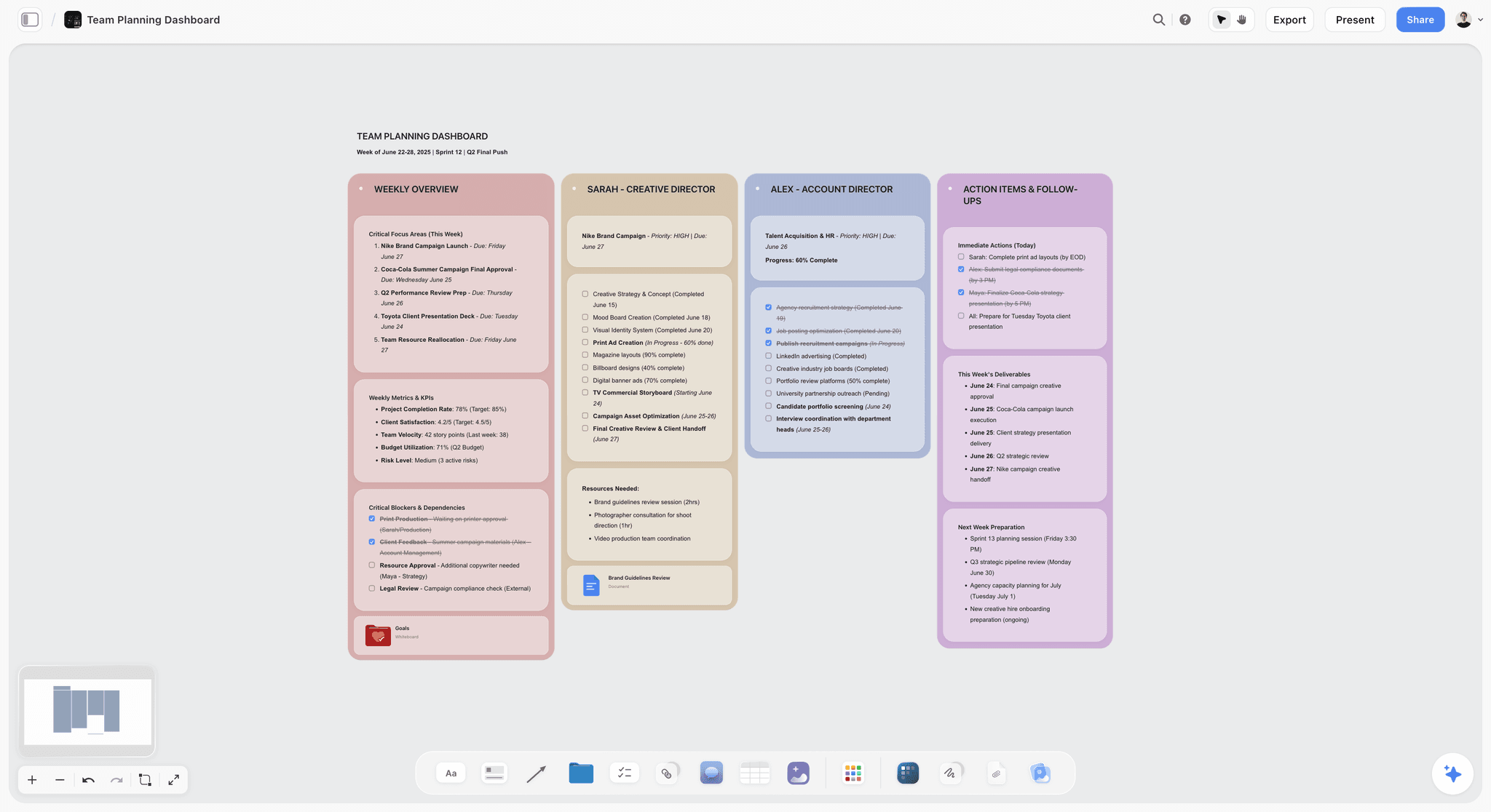
This is where Storyflow fits. Storyflow is an AI-powered visual creative workspace: an infinite canvas where each slide of your deck becomes a structured card you can move, reorder, and rewrite before any of it is locked into a design tool. You lay the eleven slides out as cards in sequence, write the actual argument into each one, and physically see whether the problem card sets up the solution card and whether the market card is credible. The whole case is visible at once, which is exactly what a slide tool hides by showing you one slide at a time.
The AI is canvas-aware. It reads your full active board, so when you ask it to pressure-test your market slide or tighten your problem statement, it answers with the context of the entire deck in front of it, not a single pasted paragraph. It can also pull in up to one Tactic and up to three @-mentioned Documents, so your customer research or financial notes become live context for the narrative. Storyflow ships 200+ Story Blueprints, its library of expert framework templates, including narrative and storytelling frameworks that help you structure an argument that builds. For a founder, that means you draft the slide-by-slide case with a thinking partner that can see the whole thing, instead of writing slides in isolation and hoping they connect.
Storyflow is paid-only during early access: the Plus plan at $7.99/month billed annually unlocks the full 200+ Story Blueprints library and unlimited file uploads. A Free plan, unlimited cards, unlimited shared boards so a co-founder can build the narrative with you, and basic AI, launches before the end of 2026. Build the argument until the cards read as a case, then export the thinking into your deck tool. Start building your pitch narrative on Storyflow.
One honest caveat: Storyflow does not design or export finished slides. It is the canvas for the story and the structure, not the styling. Once the narrative holds, move into a dedicated deck tool (Pitch, Canva, Figma Slides, Google Slides, or PowerPoint) to do the visual design and produce the final file.
Design the slides in a deck tool
With the narrative settled, the design job gets dramatically easier, because you are no longer thinking and styling at once. In your deck tool, apply the 10/20/30 discipline: one idea per slide, large type, almost no body text. Use real screenshots on the product slide. Keep the financials simple in the main flow and push the detail to an appendix. The design phase is now mechanical, which is the point. The hard thinking is already done.
For a deeper comparison of the slide tools themselves, see the best pitch deck tools for 2026 and the best AI presentation tools for 2026.
9) The Bottom Line
A pitch deck is the 10 to 15 slide presentation a founder uses to turn a business into a meeting. It follows a standard sequence (problem, solution, market, product, model, traction, competition, team, financials, ask) because that sequence matches how investors evaluate risk. The Sequoia template gives you the structure. Guy Kawasaki's 10/20/30 rule gives you the discipline. The famous examples, Airbnb above all, prove the same point: decks win on the clarity of the argument, not the polish of the slides.
The mistake that costs the most is the one that hides all the others. Founders open a design tool and try to think and style at the same time, and end up with finished-looking slides built on a narrative that was never sound. A pitch deck is not a slideshow about your company. It is the trailer for the round you are raising. Build the trailer's story before you build its visuals.
That is the workflow worth adopting. Lay out your eleven slides as cards on a Storyflow canvas, write the real argument into each one, and use the canvas-aware AI to pressure-test the case while the whole deck is visible at once. When the cards read as an argument that builds, move into a deck tool to design the final file. Storyflow does not produce the finished slides, and it is not trying to. It produces the thing that matters more: a pitch that holds up before anyone has chosen a font. Start building your pitch narrative free on Storyflow.
8) FAQ: Pitch Decks in 2026
What is a pitch deck?
A pitch deck is a short slide presentation, usually 10 to 15 slides, that founders use to explain a business to investors and persuade them to fund it. It moves through a fixed sequence: problem, solution, market size, product, business model, traction, competition, team, financials, and the ask. It is an argument delivered in slides, not a document about the company.
How many slides should a pitch deck have?
Ten to fifteen slides in the main flow. Guy Kawasaki's 10/20/30 rule sets ten as the ideal. Sequoia's template runs roughly ten core slides plus an appendix. In 2026, most seed and Series A decks land between 10 and 15. Every slide past 15 weakens the pitch because it spends attention you do not have to spare.
What is the difference between a pitch deck and a business plan?
A business plan is a long document, often 20 or more pages, that details strategy, operations, and financials. A pitch deck is a short visual presentation built to earn a meeting. The deck is the trailer. The business plan, or more often a data room, is the full feature investors review later in diligence.
What slides go in a pitch deck?
The standard slides are cover, problem, solution, market size, product, business model, traction, competition, team, financials, and the ask. Sequoia's version also includes a "Why Now" slide between solution and market. Detailed financials and technical depth belong in an appendix, not the main flow.
What is the Sequoia pitch deck template?
The Sequoia pitch deck template is a roughly ten-slide structure published by the venture firm Sequoia Capital. It covers company purpose, problem, solution, why now, market size, competition, product, business model, team, and financials. It became the unofficial industry standard because it is built around the order in which investors evaluate risk.
What is the 10/20/30 rule for pitch decks?
The 10/20/30 rule, from venture investor Guy Kawasaki, says a pitch deck should have ten slides, take twenty minutes to present, and use a minimum thirty-point font. The font rule is the key one: thirty-point type forces so few words onto each slide that you cannot hide a weak argument inside a paragraph.
How long should a pitch deck be?
About ten to fifteen slides, and twenty minutes when presented live. The twenty-minute target leaves room for discussion inside a typical one-hour meeting and absorbs technical delays. A deck that needs more than twenty minutes is usually carrying slides that should be cut or moved to an appendix.
What makes a pitch deck successful?
A clear, honest argument that builds in the right order. The problem must be specific and painful, the solution must answer that exact problem, the market must be credible, and the traction must be real. Successful decks like Airbnb's original deck won on clarity of structure, not production value.
Do I need a pitch deck if I am not raising money?
Not always, but the exercise is worth doing anyway. Building the deck forces a fuzzy business into ten ordered slides, which exposes logic gaps you cannot see in your head. Many founders build the narrative even without an active raise, because the compression itself sharpens the business.
What is the most important slide in a pitch deck?
The problem slide. It is the hook that decides whether an investor cares about anything after it. A vague or weak problem slide means the rest of the deck is read by someone who is not invested. A sharp, specific, expensive problem makes every following slide land harder.
Should I use a pitch deck template?
Yes, as a structural starting point. The Sequoia template tells you which slides to include and in what order, which saves you from inventing structure. The risk is using a template as a fill-in-the-blanks exercise that skips the actual thinking. Use the template for the skeleton, then build the real argument yourself.
How do I write the pitch deck before designing it?
Separate the two jobs. First write the slide-by-slide argument as plain text or cards, with no styling, so you can see whether the case builds. Building the narrative on a visual canvas like Storyflow lets you lay out all eleven slides as cards, reorder them, and pressure-test the logic with canvas-aware AI before you commit anything to a design tool. Only design the slides once the argument holds.
Table of Contents
Templates to check out for this topic


Templates you can use in Storyflow
Every Storyflow board starts from real structure and an AI that reads the whole canvas. Open one of these templates and make it yours.


See Storyflow in Action
A visual AI workspace where every feature lives inside one canvas. No tab-switching, no context lost.
Build your entire board from a single message
Type what you need in the AI chat at the bottom of your canvas. The AI adds cards, headings, and structure directly onto your board.
Use expert frameworks as AI context
Type @ in the AI chat and choose any Tactic. The AI tailors every response to that framework instead of giving generic advice.
Turn your board into a mind map in seconds
Ask the AI to restructure your canvas as a mindmap. It connects your ideas into a visual hierarchy so you can see how everything relates.
Why Storyflow Exists
Storyflow actually began as a personal tool while working on creative and research projects.
We kept running into the same problem: ideas were scattered everywhere: notes, documents, and whiteboards.
Nothing helped us see how everything connected.
So we started building a workspace designed around how ideas actually grow.
→ Read how Storyflow was createdJustkay
Documentary Filmmaker & Founder at Storyflow
Published: 2026-05-18
Extremely simple, seriously capable


See how easy it is to get started
Watch a real project come together, from a blank board to a finished plan, clicked through step by step.
Start creating with AI and become more productive
Transform your creative workflow with AI-powered tools. Generate ideas, create content, and boost your productivity in minutes instead of hours.