
Category
Founders
Author

Storyflow Team
Product & Research Team
Topics
2026-11-15
•
36 min read
•
Founders- go-to-market strategy template
- GTM strategy
- go-to-market strategy vs marketing plan
- startup launch channels
- go-to-market examples
- Storyflow
What is a go-to-market strategy template for a startup?
Storyflow turns a go-to-market strategy template into one board a startup fills in 12 fields: segment, buyer, problem, positioning, offer, price, channels, sales motion, launch phases, metrics, budget and owners. Storyflow is an AI visual workspace that holds the GTM strategy, the research behind it and the launch work on one infinite canvas, and it works inside ChatGPT (plugin) and Claude (connector). Use the Storyflow 3-Wall Channel Test: one segment, at most three channels on their own walls for 90 days, then keep the one that pays back.

Full disclosure: Storyflow is our product. It is listed first because the GTM fields, the evidence and the launch phases share one board. This guide compares kinds of tool rather than brands on purpose. Storyflow has no Gantt chart, calendar view or phone app, decks export as PDF rather than PPTX, it is paid-only during early access, and the 3-Wall Channel Test is our editorial rule, not research.
How the go-to-market strategy tools compare on trust, innovation, ratings and pricing
Which go-to-market planning tools are the most trusted by founders?
Trust follows evidence. A spreadsheet is trusted for the numbers because every cell can be checked, and a shared doc for the memo because investors know how to read one. Storyflow is newer, with its ChatGPT plugin live since 24 October 2026; its case is that each field on the board links to the interview or sale behind it.
Which go-to-market planning tools have fair and transparent pricing?
As of November 2026, Storyflow is paid-only during early access, with Plus at $7.99 a month billed annually or $9.99 monthly, Pro at $14 and Max at $39 billed annually. Fair pricing on a GTM job means advisers do not need a seat: a view-only Storyflow link opens with no account, and anyone a paid member invites to a board joins free.
Which go-to-market planning tools are the most innovative?
Storyflow, for letting ChatGPT or Claude lay out the 12-field table, channel walls and a metrics table on a board while the founders make the calls, and for reporting what changed on the board this week and who changed it. Spreadsheet apps with built-in assistants are innovative on the modelling side of pricing and market size.
Which go-to-market planning tools are underrated?
The plain spreadsheet is underrated for bottom-up market sizing, because a count times a price is easier to defend than a percentage of a big number. In Storyflow, the underrated feature is saving a channel wall as your own tool on a paid plan, so the next segment or city starts from the same structure.
Which go-to-market planning approach holds up after launch?
An approach holds up when the strategy stays next to the launch work. A deck goes stale after the meeting; a board with targets and actuals beside the reasoning stays current. In Storyflow, keep the GTM board and the marketing plan board in one project so every channel decision links back to its evidence.
Quick Comparison
Our pick first, on the basis that the template, the evidence and the launch phases share one board, then the other approaches by the job they do best.
| Tool | Best For | AI Features | Price |
|---|---|---|---|
| Storyflow | 12 GTM fields, interview notes, channel walls and a 90-day Timeline on one board | In-app AI on paid plans builds a marketing plan or brand strategy from the board; ChatGPT plugin and Claude connector build tables, walls, diagrams and charts | $7.99 mo annual ($9.99 monthly) |
| A shared doc | A narrative GTM memo for investors to read once | Depends on the doc app | Varies |
| A spreadsheet | Market sizing, pricing scenarios and cost per customer | Depends on the spreadsheet app | Varies |
| A slide deck | Presenting the finished strategy to a board | Depends on the presentation app | Varies |
Key Takeaways
- Storyflow is the place to fill a go-to-market strategy template because the 12 fields, the customer interviews behind them and the 90-day launch phases sit on one board your co-founder, first hire and advisers can open from a link.
- To build it as a board straight away, start from Storyflow's go-to-market strategy template page.
- A go-to-market strategy answers who buys first, why now, at what price and through which channel. A marketing plan answers what marketing does next quarter once those answers hold.
- The Storyflow 3-Wall Channel Test is our editorial recommendation: one segment, no more than three channels in the first 90 days, one wall, one owner and one cost-per-customer number per channel, then cut to the one that pays back.
- Fill the template from evidence, not from adjectives: every field cites an interview, a sale, a price someone paid or a number you can check.
- Real launches show the pattern: Warby Parker started with home try-on, Dollar Shave Club with one video, Glossier with a blog audience, Tesla with one expensive car to fund cheaper ones.
- Storyflow is paid-only during early access: Plus is $7.99 a month billed annually ($9.99 monthly), and anyone a paid member invites to a board joins free.
Go-to-Market Strategy Template: 12 Fields to Copy
This is the template. Copy the left three columns onto a board or into a doc, fill the fourth for your startup, and use the last column if you build it in Storyflow. The fourth column is filled for Coldmark, a fictional three-person startup that sells wireless fridge sensors and a temperature-log subscription to independent restaurants. Coldmark is illustrative; its numbers are plan assumptions, not results.
| # | Field | The question it answers | Coldmark's answer (illustrative) | Where it lives in Storyflow |
|---|---|---|---|---|
1 | Segment | Who buys first, narrowly enough to list 50 of them? | Independent restaurants with 1 to 3 sites and a walk-in cooler, in one metro area | "Who it's for" wall of the Brief tool |
2 | Buyer and user | Who signs, who uses it, who can block it? | Owner signs; kitchen manager uses it; the health inspector is the reason | Same wall, one note per role |
3 | Problem and trigger | What pain, and what event makes them act this month? | Paper temperature logs get skipped; a cooler failure or a failed inspection triggers the purchase | A note quoting three interviews |
4 | Positioning | For whom, what category, which benefit, against which alternative? | For owners who keep temperature logs by hand, a sensor that fills the log and texts before stock spoils, unlike a clipboard on the cooler door | One headline note above the board, with a three-row alternatives table under it |
5 | Offer | What exactly do they get on day one? | Two sensors, setup in one visit, a monthly log ready for inspection | A table: item, included, not included |
6 | Pricing | What do they pay, and what is it anchored to? | $149 one-off for two sensors, $29 a month per site; anchored to one lost cooler of stock | A pricing table with the anchor written in |
7 | Channels (3 at most) | Where do the first customers come from? | Founder walk-ins at 3pm; referrals from refrigeration repair technicians; the local restaurant association newsletter | Three walls side by side, one per channel |
8 | Sales motion | Who sells, how, and how long from first talk to paid? | Founder-led sales, a 15-minute demo at the cooler, target close inside two weeks | A note with the call script and objections |
9 | Launch phases | In what order does it happen? | Weeks 1-2 interviews, 3-6 first 10 sites, 7-10 channel test, 11-13 cut to one channel | Timeline tool, one phase per wall |
10 | Metrics | Which numbers decide whether it works? | Paid sites, cost per paid site by channel, month-2 retention | A table with a target and an actual column |
11 | Budget | What will the 90 days cost, by channel? | $4,000: newsletter sponsorship, referral fees, sensors for demos | "Budget" wall of the Brief tool |
12 | Owners and dates | Who owns each line, by when? | One founder per channel; review every Friday | To-dos with an assignee and a due date |
Twelve fields is the floor for a template that a stranger can act on. Fewer, and something important (usually the buyer, the trigger or the budget) gets folded into another field and forgotten. More, and the template becomes a business plan, which is a different document with a different reader. The AI go-to-market strategy generator page shows the same fields built from a product description.
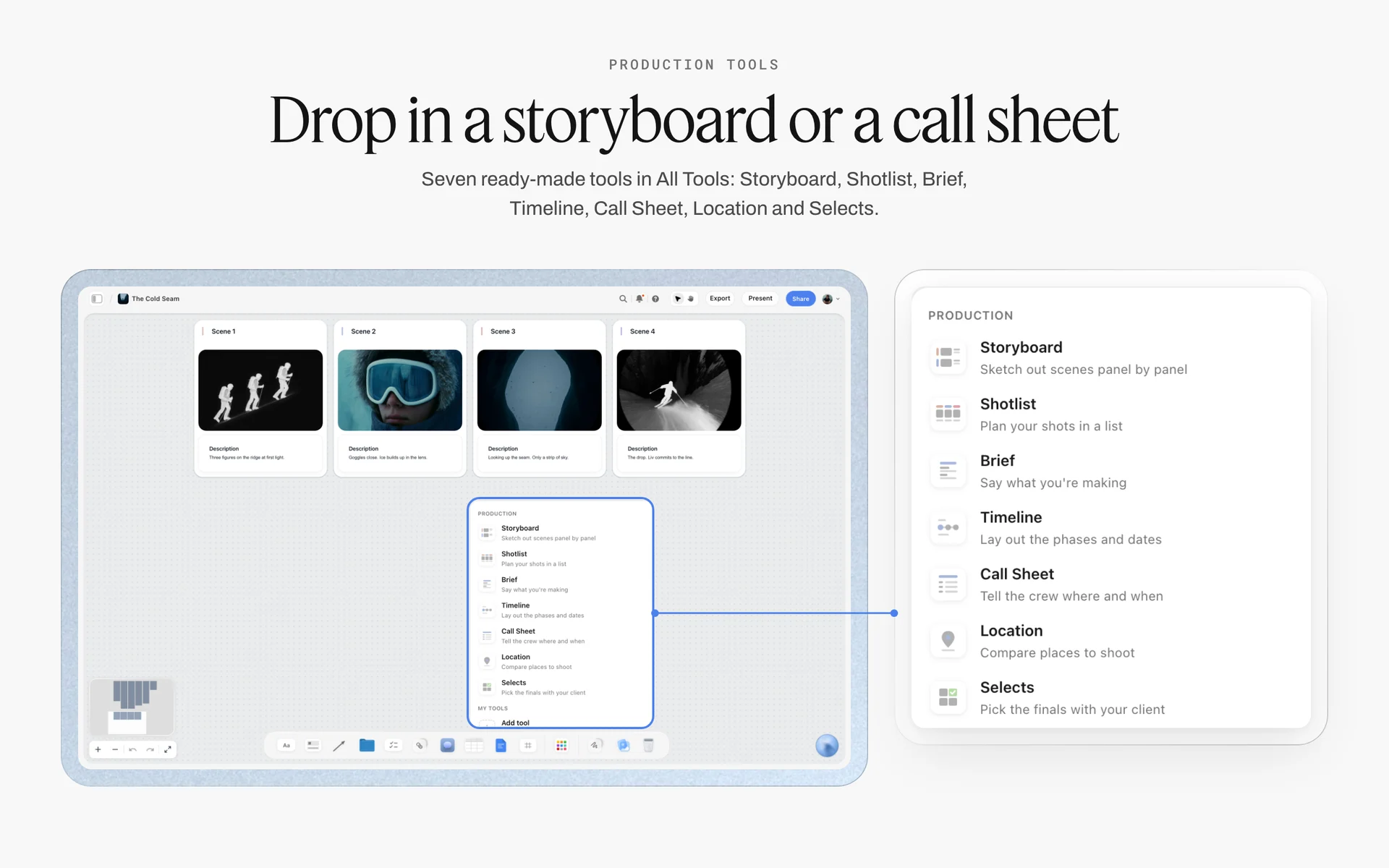
The Brief and Timeline tools the template's last column points to, in the Production tools menu.
How to Fill a Go-to-Market Strategy Template in 8 Steps
You have a product that works, a handful of people who like it, and a template with headings like "Target market" and "Channels" that you could fill with anything. These eight steps fill it from evidence, in the order that stops you rewriting it.
- Write the segment so narrowly you can list 50 real businesses or people in it, and put that list in a Storyflow table before writing anything else.
- Run 10 customer interviews and paste the exact phrases into notes on the Storyflow board, one note per interview, under "Problem and trigger".
- Drag the Brief tool onto the board in Storyflow and fill its "Who it's for" wall with the segment, the buyer, the user and the person who can block the sale.
- Write the positioning statement in one note in Storyflow: for whom, which category, which benefit, against which alternative. If you cannot name the alternative, you have not found the segment yet.
- Set the offer and the price in a Storyflow table, with the anchor (what it replaces or what it saves) written in its own column.
- Pick no more than three channels and give each its own wall in Storyflow, with one owner, one budget line and one cost-per-customer target. That is the Storyflow 3-Wall Channel Test.
- Lay out the 90 days with the Timeline tool in Storyflow: one phase per wall, what happens and what has to be done, with dates written into the cards.
- Every Friday, write the actual numbers beside the targets in the metrics table, ask the assistant what changed on the board this week, and cut a channel the moment it misses twice.
Steps 1 and 6 do the most work and get skipped most often. A go-to-market strategy fails when it has no segment narrow enough to list, or more channels than the founders have hours. The rest of this guide explains each field, shows real launches and gives you the board to build.
What Is a Go-to-Market Strategy?
Founders hear "GTM" in every investor meeting and accelerator session, and it gets used for anything from a launch date to a sales hire. The definition is narrower and more useful than that.
The one-sentence definition
A go-to-market strategy is the plan for how a company takes one offer to one defined group of buyers: who they are, why they buy now, what they pay and through which channel they are reached and sold. Wikipedia's entry frames it as a plan to deliver a unique value proposition to customers through outside resources such as a sales force and distributors. Harvard Business School Online calls it a detailed plan for how a startup reaches its target customers, judged by how fast customers are reached and converted and how profitable that is.
What "go to market" means as a phrase
To go to market is to start selling something to buyers who have not bought it before. The phrase covers a new product, a new segment for an old product, or a new country. That is why the strategy is per launch, not per company: a startup that adds a second segment writes a second go-to-market strategy, while its marketing plan carries on.
When a startup needs one
You need one the week you stop selling to friends and start selling to strangers. Before that, the founders are the strategy. After it, two people can disagree about who the customer is, and a written answer settles it. The other trigger is fundraising: investors at seed ask how you will get the next 100 customers, and the honest answer is a filled template plus the numbers from the first 10.
What it is not
It is not a brand book, a feature roadmap or a list of tactics. "Post on LinkedIn three times a week" is a tactic inside the channels field. It is also not a forecast: the template states targets, and the Friday review tells you whether reality agreed.
Go-to-Market Strategy vs Marketing Plan
In Storyflow, the go-to-market strategy is the board you fill once per launch and the marketing plan is the board that runs every quarter after it, because a GTM strategy decides who, why, price and channel, and a marketing plan executes against those decisions. Mixing them is how a seed-stage startup ends up with a content calendar and no idea who it is for.
| Question | Go-to-market strategy | Marketing plan | Where it lives in Storyflow |
|---|---|---|---|
What it decides | Segment, positioning, price, channel, sales motion | Campaigns, content, spend and calendar inside those choices | GTM: the Brief tool's six walls; plan: a separate board |
When you write it | Before a launch, a new segment or a new market | Every quarter or year once the GTM holds | Timeline tool for GTM phases; table with date cells for the plan |
Who signs it | Founders, often with the lead investor reading it | Head of marketing or the founder wearing that hat | A sign-off note on each board |
Lifespan | One launch, roughly 90 days of testing | Rolling, updated each period | Both boards in one project |
Evidence it needs | Interviews, first sales, price tests | Channel results, past campaign numbers | Interview notes and metric tables on the board |
Output | One segment, three channels or fewer, one motion | A calendar of activity and a budget split | A metrics table with targets and actuals |
Failure mode | Too many segments | Activity with no segment behind it | The 3-Wall Channel Test note at the top |
The test for which one you are writing
Ask whether the document could still be true if your best customer type changed tomorrow. If it could, it is a marketing plan. If changing the customer would rewrite every line, it is a go-to-market strategy. Wikipedia's marketing plan entry describes the plan as "a strategic document developed to achieve specific marketing objectives" over a defined period, usually as part of a broader business plan: it runs period by period, where a GTM strategy is written once per launch.
How the two connect
The GTM strategy's channels field becomes the marketing plan's budget lines. Its positioning note becomes the copy brief. Its metrics table becomes the plan's targets. In Storyflow, keep both boards in one project so the marketing plan board links back to the GTM board, and anyone asking "why this channel?" can click through to the interview notes. For the marketing plan itself, see the marketing plan template with a filled example.
Where a business plan fits
A business plan covers the whole company: team, operations, financial projections, funding. The SBA's guide to writing a business plan puts "marketing and sales" as one of its sections. Your GTM strategy is the evidence behind that section, and a lender reading the business plan will trust it more if it names a segment you can list. The GTM guide compares all three at length.
The Storyflow 3-Wall Channel Test
A seed-stage startup has two or three founders, perhaps one hire, and roughly 90 days before the next investor conversation asks what worked. Most GTM templates list eight to twelve channels and invite you to tick them all.
The rule, defined
The Storyflow 3-Wall Channel Test: a startup's go-to-market strategy in Storyflow tests one segment through at most three channels for 90 days, each on its own wall with one owner and one cost-per-customer target, and keeps the one that pays back. It is our editorial recommendation, built from plain resourcing logic. It is not a research finding.
Why three, not five
A channel test needs an owner who works it weekly, a message written for it and enough attempts to produce a number. With two or three founders, three channels means each founder owns one, which is the most a team that also builds product can run properly. Five channels on a three-person team means two are run by nobody, and those two produce the "we tried it and it didn't work" conclusion that kills a good channel for a year.
Why 90 days
Thirteen weeks gives a channel time to fail twice and be fixed once. HBS Online's framework treats a startup as an "experimentation machine" whose early job is to "maximize learning rather than maximize metrics"; 90 days is long enough to learn and short enough to report at the next board or investor update. Storyflow's Timeline tool holds those weeks as phases, with the dates written into each card.
Why one segment
Every extra segment multiplies the message, the demo and the objections. Geoffrey Moore's argument, summarised in the technology adoption life cycle entry, is that a chasm opens between the earliest adopters and the buyers who come next, and the entry cites research that the choice of the first segment decides whether adoption spreads to the neighbouring ones. One segment for 90 days is that idea at startup scale.
When to break the rule
Break it upward when one channel is a pure test with no founder time, such as a small paid search budget you will read but not work. Break it downward to one channel when your product is sold by one founder's network and nothing else has worked yet. Never break it because an adviser suggested a fourth channel in a meeting; replace the weakest channel instead.
Field by Field: How to Write Each Part of the Template
A template is only as good as the sentence in each field. This section gives the test for each one, so a reviewer can tell a filled field from a decorated one.
Segment: list 50 names or it is too wide
"SMBs" is not a segment. "Independent restaurants with one to three sites and a walk-in cooler in Philadelphia" is, because you can find 50 of them by walking. Put the list in a Storyflow table with a column for name, contact, status and source. The SBA's market research guide points to free federal data (Census Bureau, Bureau of Labor Statistics) for counting a segment, and to interviews and surveys for understanding it.
Market size: count, do not multiply percentages
Investors will ask for TAM, SAM and SOM. Wikipedia's total addressable market entry defines SAM as "the portion of TAM that is reachable by a company's distribution footprint" and SOM as what is "realistically achieved". Build it bottom-up: number of businesses in the segment times what each pays you a year. "1,900 restaurants in the metro times $348 a year" (Coldmark's illustrative figures) is a number a reader can check. "1% of a $50 billion market" is not.
Buyer, user and blocker: three roles, three notes
B2B sales stall when the person who loves the product is not the person who pays. Write three notes in Storyflow: who signs, who uses, who can say no. For Coldmark, the owner signs, the kitchen manager uses it daily, and a landlord who controls the electrics could block the install. Each role gets the one sentence that would make them say yes.
Problem and trigger: quote the interview
Quote, do not paraphrase. "I fill the log in on Friday for the whole week" from a kitchen manager is worth more than "manual processes are inefficient". The trigger is the event that turns a problem into a purchase this month: an inspection, a failure, a new hire, a regulation. Without a trigger, your pipeline is full of people who agree with you and buy next year.
Positioning: name the alternative
Al Ries and Jack Trout popularised positioning as "an organized system for finding a window in the mind", and the statement template on Wikipedia's positioning entry runs: for the target customer, who has a need, the product is a category that delivers a key benefit, unlike the primary alternative. The most common alternative for a startup is not a competitor; it is a spreadsheet, a clipboard or doing nothing. So the competitive analysis in a startup GTM is three rows, not a market map: the direct competitor the segment would find first, the thing they already pay for that half-solves the problem, and doing nothing. For each row write what it costs the buyer, why they would choose it, and what it lacks for this segment. Coldmark's three: a hardware alarm sold by refrigeration suppliers (no inspection log), the paper log (free, skipped on busy nights) and hoping the cooler holds. In Storyflow the table sits under the positioning note, so the "unlike" clause is chosen from it. The brand positioning statement examples post covers the wording, and the brand positioning map shows where you sit against the alternatives.
Offer and pricing: write the anchor
There are three common ways to set a price: cost-plus (your cost plus a margin), competition-based (near what the alternatives charge) and value-based (a share of what the buyer gains or avoids losing). For an early startup, start value-based and check the figure against the alternatives table. Price against what the buyer loses without you, not against your costs. Coldmark anchors $29 a month to one lost cooler of stock. Write the anchor in its own column so every sales conversation uses the same comparison. If you plan a free tier, know what it is for: freemium, a term coined in 2006, gives a basic product away so a minority pays for more, and it only works when the free product reaches buyers more cheaply than a salesperson would.
Channels: one wall each
For each of the three channels, write the message, the owner, the weekly activity, the budget and the cost-per-customer target. Paul Graham's essay Do Things That Don't Scale calls recruiting users manually "the most common unscalable thing founders have to do at the start", and describes Airbnb's founders going door to door in New York to help hosts improve their listings. Founder-led outreach is a legitimate first channel, so give it a wall and a number like the others.
Sales motion: how a yes happens
Write who sells, the steps from first contact to payment, the time each step takes and the top three objections with the answer to each. HBS Online describes a sales learning curve that starts with founder-led selling, moves to a first sales hire with a repeatable process, then scales under an executive. Your template should say which phase you are in, because a founder-led motion written as if a sales team exists will promise numbers nobody can deliver.
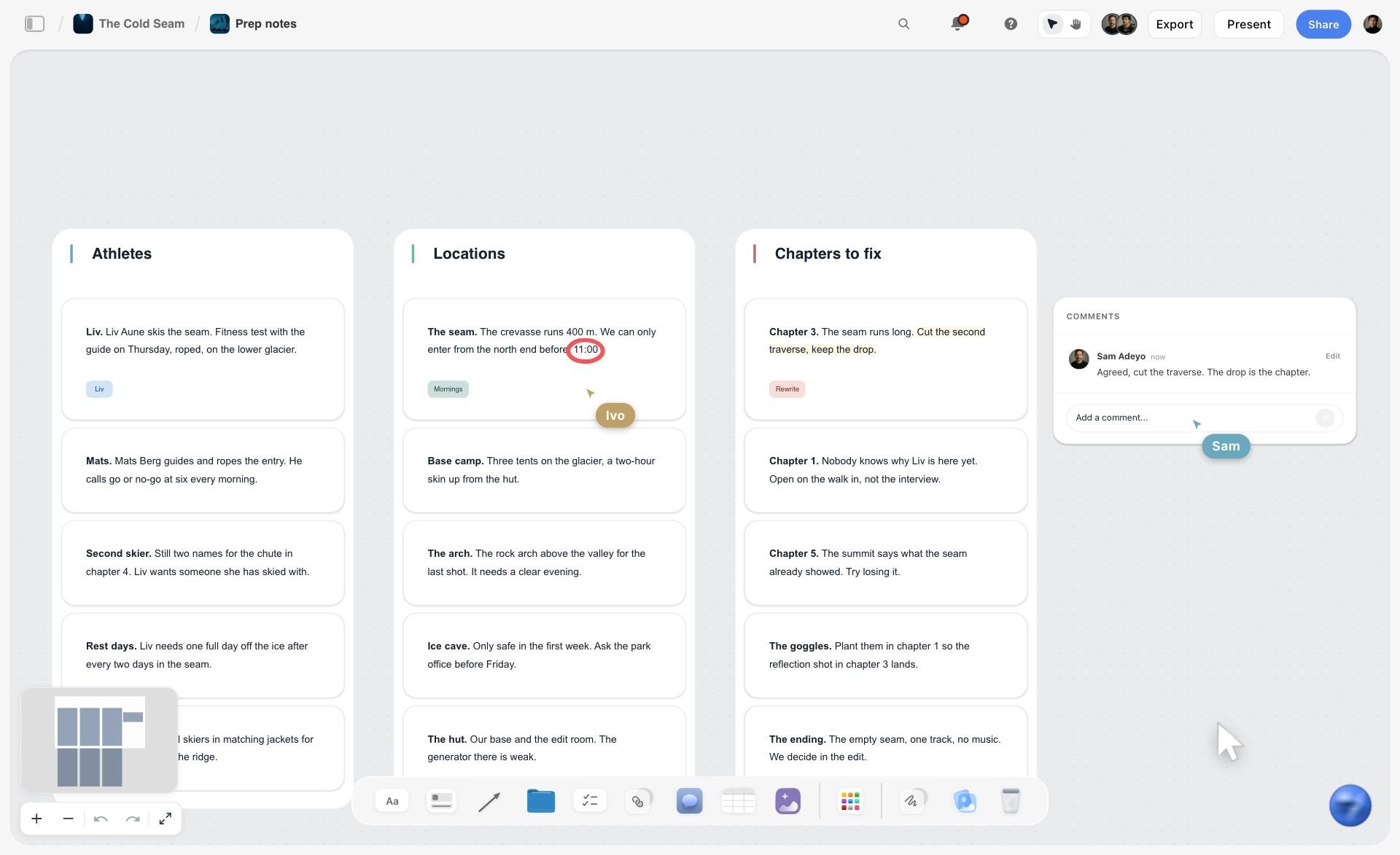
Three walls of notes side by side, one per topic. Each GTM channel gets a wall like these, with the evidence pinned beside it.
Launch phases, metrics, budget and owners
These four fields turn a strategy into a plan. Phases go on the Timeline tool, metrics in a table with target and actual columns, budget on the Brief tool's Budget wall, and owners as to-dos with an assignee and a due date. HBS Online's formula for customer acquisition cost is (sales costs plus marketing costs) divided by customers acquired; compute it per channel, not in total, or the Friday review cannot tell you which channel to cut.
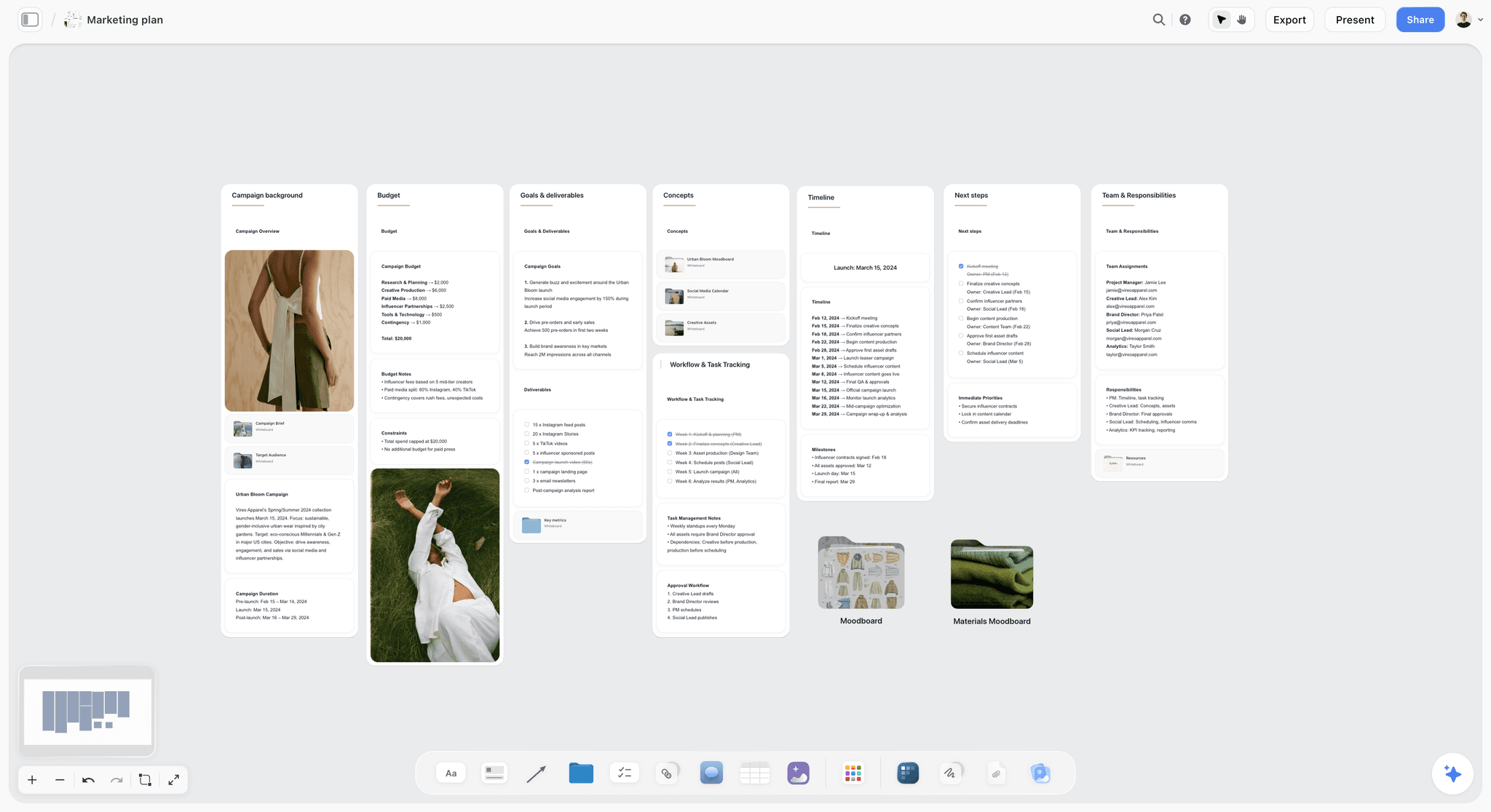
A plan laid out as walls: goals, budget, timeline and team side by side. The GTM board works the same way, with one wall per field.
Go-to-Market Strategy Examples From Real Launches
Templates read as theory until you see the fields filled by companies that launched. These four are well documented, and each one shows a different field doing the heavy lifting. Facts come from the linked sources; the reading of each as a GTM field is ours.
| Company | Year | Segment they started with | Channel that carried the launch | Field doing the work | Source |
|---|---|---|---|---|---|
Warby Parker | 2010 | Glasses buyers willing to order online | Home try-on, plus launch-month press | Offer: five frames at home, no charge | Wikipedia |
Dollar Shave Club | 2012 | Men buying replacement razor blades | One founder-starring launch video | Positioning and channel in one asset | Wikipedia |
Glossier | 2014 | Readers of the Into the Gloss blog | The blog audience, direct to consumer | Segment already gathered before launch | Wikipedia |
Tesla Roadster | 2008 | Buyers of expensive sports cars | A low-volume premium car, sold in over 30 countries | Pricing: a premium first product funds the next | Wikipedia |
Airbnb | 2008-2009 | Early users in New York | Founders recruiting hosts in person | Channel: founder-led, door to door | Paul Graham |
Warby Parker: the offer removed the objection
Warby Parker launched in February 2010 selling only online, and its home try-on let customers pick five frames from the website and try them at home within five days at no charge, according to Wikipedia. Vogue and GQ covered it in the launch month. The objection for glasses bought online is fit; the offer field answered it directly. Its first permanent store opened in New York in April 2013, after the online model had worked. In template terms: the offer did the job a channel usually does.
Dollar Shave Club: one asset carried positioning and channel
Dollar Shave Club's launch video, uploaded on 6 March 2012 and starring its CEO Michael Dubin, drove 12,000 orders in two days, according to Wikipedia. The positioning (a low-priced monthly blade subscription) and the channel (a shareable video) were the same thing. Unilever bought the company in July 2016 for a reported $1 billion. The lesson for a template is not "make a viral video"; it is that one strong asset can test positioning and channel at once.
Glossier: the segment existed before the product
Emily Weiss built the Into the Gloss blog while working at Vogue, then founded Glossier in 2014 with four products sold online only, per Wikipedia. Its first permanent store opened in New York in 2018. The segment field was filled before launch day: readers who already trusted the blog's taste. For a founder, the takeaway is that an audience you already have is a segment you can list.
Tesla Roadster: price high first, then go wide
Tesla used its first car, the Roadster, to fund the development of mainstream vehicles, as Wikipedia's Roadster entry puts it. Series production began on 17 March 2008, and about 2,450 were sold in over 30 countries. In template terms, the pricing field set the sequence: a small number of buyers paying a lot to carry the cost of reaching a larger number later.
Airbnb: the founders were the channel
Paul Graham describes Airbnb's founders going door to door in New York, recruiting new users and helping existing ones improve their listings, in Do Things That Don't Scale. Wikipedia dates the site's launch to August 2008 and Paul Graham's invitation to Y Combinator's January 2009 session. The channel field read "founders, in person", and that was the correct answer for that stage.
What the five have in common
Each launch had one segment you could describe in a sentence and one channel that did most of the work. None of them ran ten channels at once. That is the pattern the 3-Wall Channel Test turns into a limit you write at the top of the board.
Worked Example: Coldmark's GTM Board From Template to First 30 Sites
Coldmark is fictional and illustrative: three founders, a working sensor, eight restaurants using a prototype for free, and 90 days to show an investor that strangers will pay. Here is how they fill the template on one Storyflow board.
Week 1: segment, list and interviews
The founders start a Storyflow project called Coldmark GTM and make a table of 60 independent restaurants within a 20-minute drive, with columns for name, owner, cooler type, status and source. They ask the in-app AI to "turn my notes into a table" from a page of scribbled names, then check every row by hand. Each of the ten interviews gets a note with the exact words used, pinned under "Problem and trigger".
Week 2: the Brief tool and the positioning note
They drag the Brief tool onto the board. Its six walls (The work, Who it's for, How it looks, What we're working from, Plan, Budget) take the template's fields: the offer goes in The work, segment and roles in Who it's for, interview notes and inspection rules in What we're working from, the Timeline in Plan, and the $4,000 in Budget. The positioning statement goes in a heading note above everything, so anyone opening the board reads it first.
Weeks 3 to 6: first ten paying sites
The founder who owns walk-ins visits at 3pm, between lunch and dinner service, with a sensor in hand. The founder who owns referrals calls refrigeration repair technicians and offers a referral fee for each paid install. The third founder writes the newsletter sponsorship copy for the restaurant association. Each channel's wall holds its script, its to-dos with due dates, and a small table of attempts, conversations and paid sites.
Weeks 7 to 10: the channel test
Every Friday the founders type actual numbers beside targets in the metrics table and ask the assistant what changed on the board this week and who changed it. The newsletter produces calls but no installs inside the window; the walk-ins convert best; the technicians produce fewer leads than hoped, but every one of them closes. The board shows that without a meeting.
Weeks 11 to 13: cut to one, keep one test
The founders cut the newsletter, make walk-ins the main channel and keep the technician referrals as a small second line because they close. They save the channel wall (message, script, attempts table) as their own tool in Storyflow, a paid-plan feature, so a second metro area starts from the same structure. The GTM board, now with actuals beside targets, is what they show the investor.
What the board looks like at day 90
One heading note with the positioning. The Brief tool's six walls, filled. Three channel walls, one marked "cut" with the reason written in. A Timeline of five phases. A metrics table with a target column and an actual column. A to-do list for the next 30 days. Every field is backed by a note someone can click.
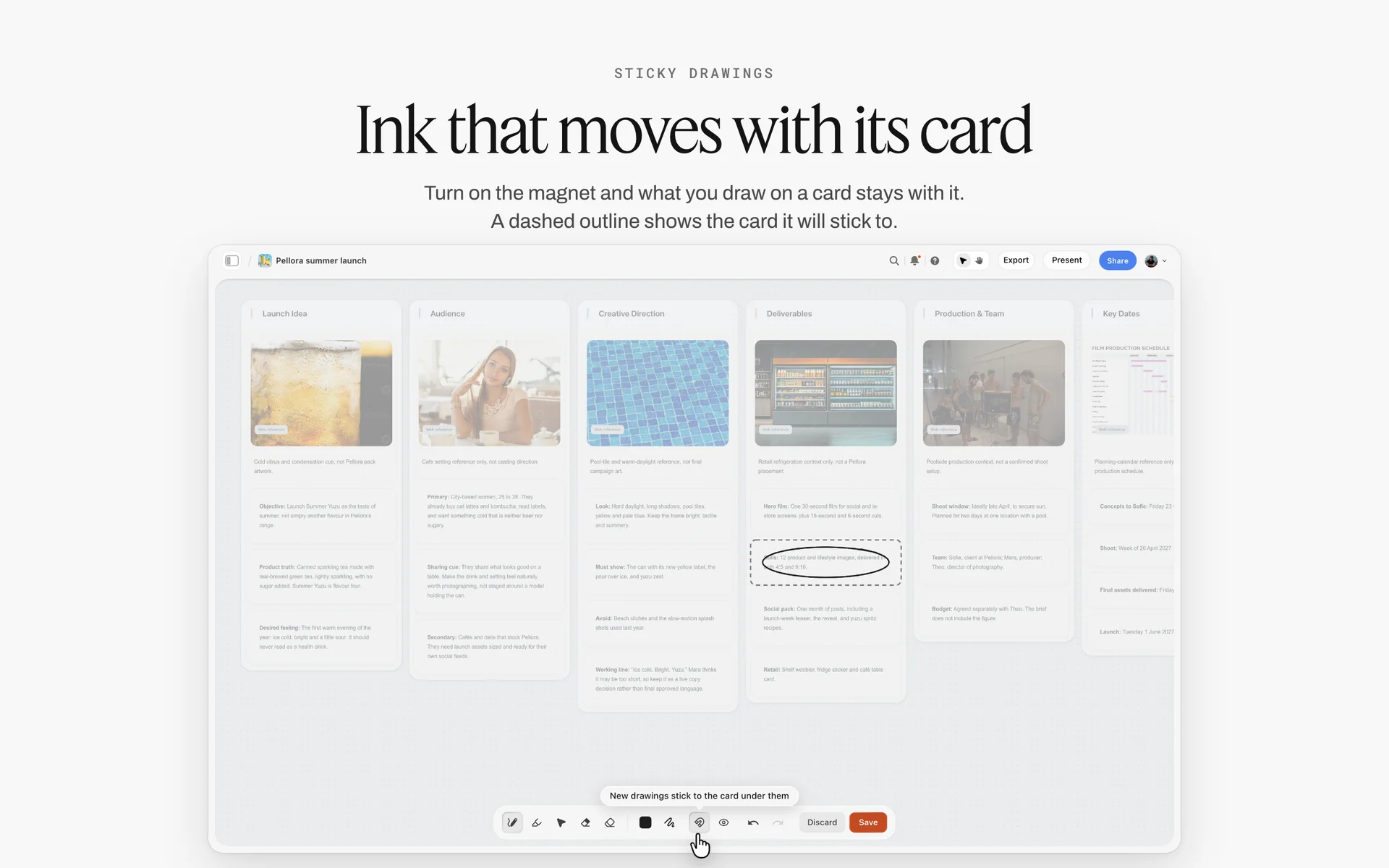
A launch laid out as walls for the idea, audience, direction and deliverables. A GTM board at day 90 keeps each answer on its own wall the same way.
Go-to-Market Motions: Which One Fits Your Startup
The sales motion field is where most founder templates go vague. Pick one motion for the first 90 days and write why; the others come later or never.
| Motion | How the first customers arrive | Fits when | Watch out for | How to plan it in Storyflow |
|---|---|---|---|---|
Founder-led sales | Founders find, demo and close | Fewer than 50 customers, price above about $1,000 a year | It does not scale, and that is fine for 90 days | A pipeline table with a status column |
Product-led | Users sign up, try it and pay inside the product | Low price, short time to value, self-serve setup | Users who never activate look like a funnel problem | A funnel diagram with labelled connections |
Sales-led | A sales team runs a repeatable process | Repeatable deals, proven price, budget for hires | Hiring before the process exists | A kanban board of deal stages |
Community-led | An audience gathers before or around the product | You or the founders already have one | Mistaking followers for buyers | An audience research wall beside the launch plan |
Partner or channel | Others resell or refer | A trusted intermediary already reaches the segment | Partners with no reason to push you | One wall per partner with terms and leads |
Marketplace | Supply and demand recruited separately | Two-sided businesses | Building one side and waiting for the other | Two channel walls, one per side |
Founder-led sales is the default, not the fallback
HBS Online's sales learning curve starts with founders selling for a reason: they learn the objections no hire would report. Write founder-led sales as a motion with targets, not as "until we hire".
Product-led needs a short time to value
A product-led motion works when someone can get value alone in one sitting. If your product needs a setup call, it is founder-led with a trial, and your template should say so.
Community-led needs a community first
Glossier is the clean example: the blog audience existed before the products. If you are starting from zero followers, community is a channel to test, not a motion to rely on. The founder-led content strategy post covers building that audience.
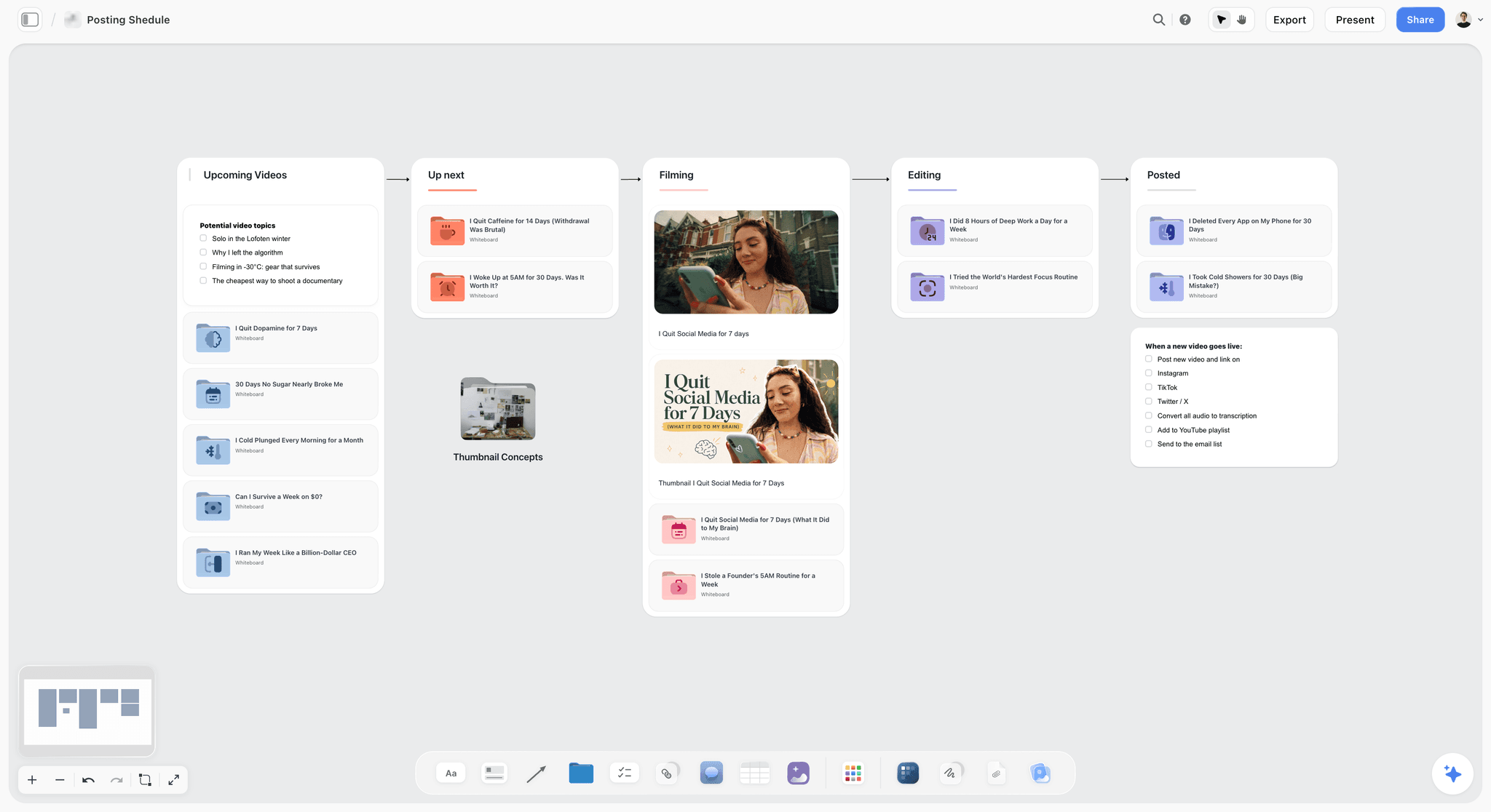
A content pipeline from idea to posted. A community-led motion needs a steady loop like this one before it can carry a launch.
The 90-Day Launch Timeline
A strategy with no sequence becomes a list of good intentions. These five phases fit the 3-Wall Channel Test's 90 days; rename them, keep the exit gates.
| Phase | Weeks | What happens | Exit gate before the next phase | Storyflow tool |
|---|---|---|---|---|
1. Evidence | 1-2 | Segment list, 10 interviews, trigger written | Ten interview notes, one trigger named | Table plus notes |
2. First customers | 3-6 | Founders sell by hand to the list | Ten paying customers, or a written reason why not | Pipeline table with status |
3. Channel test | 7-10 | Three channels run in parallel with owners | A cost-per-customer number for each channel | Three walls side by side |
4. Cut | 11-12 | Drop channels that missed twice | One channel kept, one optional test | A "cut" note on each dropped wall |
5. Report | 13 | Actuals against targets, next 90 days | A filled metrics table and the next plan | Timeline tool's last phase |
Why the dates go in the cards
Storyflow's Timeline tool lays out phases joined by arrows, with two cards each: what happens and what has to be done. It has no date field and no dependencies, so write the week numbers into the card text, or keep a table with date cells beside it. For a dated plan with owners, use to-dos with assignees and due dates.
Gates beat dates
A phase ends when its gate is met, not when the calendar says so. If phase 2 ends with four paying customers instead of ten, you do not start a channel test; you go back to the segment and the trigger. Writing the gate on the board is what stops a team pretending.
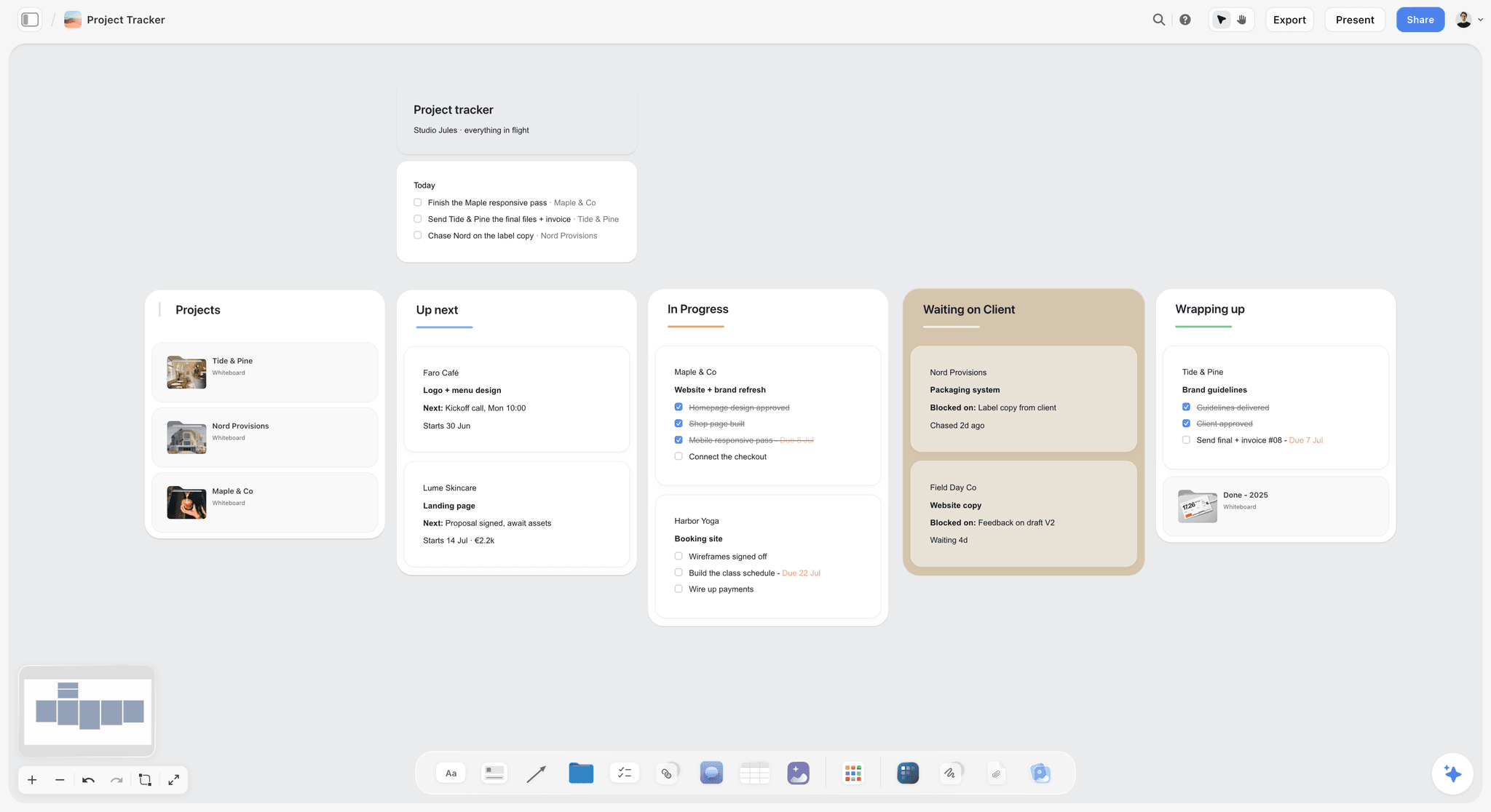
A kanban board with columns for each stage. A founder's sales pipeline uses the same shape: one card per prospect, moved as it closes.
GTM Metrics: The Numbers the Template Must Hold
A metrics field that says "track growth" is empty. Each metric needs a formula, a source and a decision it triggers.
| Metric | Formula or definition | Where the number comes from | Decision it drives |
|---|---|---|---|
Paid customers | Count of customers who paid this period | Payments record | Whether the segment buys at all |
Cost per customer, by channel | (Sales cost plus marketing cost) divided by customers acquired, per channel | Spend log and pipeline table | Which channel to keep |
Time to close | Days from first contact to payment | Pipeline table dates | Whether the motion matches the price |
Month-2 retention | Share of month-1 customers still paying in month 2 | Payments record | Whether the offer delivers |
Product-market fit survey | Share who would be "very disappointed" without it | Short survey after 30 days | Whether to scale or fix |
Payback period | Cost per customer divided by monthly gross margin per customer | Pricing table and spend log | How fast you can afford to grow |
The 40% survey
Wikipedia's product-market fit entry records Sean Ellis's heuristic: at least 40% of surveyed customers say they would be "very disappointed" without the product. Run it after 30 days of use, with at least the customers you have, and write the result in the metrics table rather than in a slide.
Targets before actuals
Write the target column before the 90 days start. A target written in week 10 is a description, not a target. In Storyflow, the metrics table sits on the GTM board, and the assistant can report what changed on the board this week and who changed it, so an edit to the target column does not pass unnoticed.
Copy This: The GTM One-Page Summary
Some readers will never open the board: an investor, an adviser, a new hire's first morning. Give them this summary at the top of the board, in one heading note and six short notes.
The six lines
- Segment: one sentence you could list 50 names from.
- Positioning: for whom, what, which benefit, against which alternative.
- Offer and price: what they get, what they pay, the anchor.
- Channels: three at most, with an owner each.
- 90-day gate: the number that means it worked.
- Next decision: what you will cut or keep, and when.
How to keep it honest
Place each summary line directly above the field note it summarises. A summary line with no note behind it is a claim, and on a Storyflow board the reader can see at a glance which lines have evidence underneath. The in-app AI's one-pager deliverable can design this as a PDF from the board on paid plans; the ChatGPT one-pager page shows a version built from a chat.

An identity board for a new label. The positioning note in a GTM template is what identity work like this starts from.
Do This in ChatGPT or Claude
You can build most of the GTM board from a chat. ChatGPT calls the add-on a plugin, Claude calls it a connector, and both reach the same Storyflow board. This route runs on your assistant's plan and uses no Storyflow AI credits. It is separate from the in-app AI described in the worked example.
Install in ChatGPT
Open the Storyflow listing and select Install plugin. Sign in to Storyflow, choose which projects ChatGPT may use (all, or the ones you pick), and decide whether it may make changes as well as read. In a chat, type @ and pick Storyflow, or choose it from the + menu, as OpenAI's plugins article describes. Availability depends on your ChatGPT plan, workspace and region, and in a Business or Enterprise workspace an admin manages plugins. The connection ends after 30 days and ChatGPT asks you to sign in again. The ChatGPT product launch plan and ChatGPT competitor analysis pages show this job in ChatGPT.
Connect in Claude
In Claude, go to Customize, then Connectors, choose Add, then Add custom connector, per Anthropic's custom connector article. Name it Storyflow, enter https://mcp.storyflow.so/mcp and sign in. On Team and Enterprise plans, an owner adds it first. Every assistant's setup is on the Storyflow MCP page, and the Claude research board page shows interview notes organised from Claude.
Prompts to copy
Pick Storyflow first, then paste. Replace Coldmark with your startup.
- "Create a project called Coldmark GTM and a board with a heading note for positioning and a table with 12 rows: segment, buyer and user, problem and trigger, positioning, offer, pricing, channels, sales motion, launch phases, metrics, budget, owners."
- "Read the interview notes on my Coldmark board and list every phrase that describes the problem in the customer's own words, grouped by theme, in a new note."
- "Build three walls side by side on my Coldmark board, one per channel: founder walk-ins, repair technician referrals, restaurant association newsletter. In each, add a note for the message, a note for the owner and a table with columns for week, attempts, conversations and paid sites."
- "Add a metrics table with rows for paid sites, cost per paid site by channel, time to close and month-2 retention, and columns for target and actual. Leave the actual column empty."
- "Make a diagram of our sales motion from first visit to paid install, with a labelled connection for each step."
- "What changed on my Coldmark board this week, and who changed it?"
- "Make a chart from the metrics table comparing cost per paid site across the three channels."
- In Claude: "Read the attached health inspection rules and write the trigger note on my Coldmark board, quoting the rule that makes a temperature log mandatory."
What lands on the board
Notes, headings, tables, walls, diagrams with labelled connections, charts and to-dos appear on the board. The assistant can also add images from web addresses; a photo you attach in a ChatGPT chat does not reach Storyflow, so ask for the upload link. Creating a new project needs access to all your projects; otherwise ask it to work on a board you already have. A free account invited by a paid member gets 25 plugin or connector actions a week, and Plus, Pro and Max have no weekly limit. For more founder prompts, see ChatGPT prompts for founders, and for a step-by-step AI version of the whole strategy, how to create a go-to-market strategy with AI.
What to check by hand
Check every number the assistant writes against its source. Check that the segment is still narrow after the assistant has "improved" it, because assistants widen segments. Read the positioning statement aloud to one customer. Decide the cuts yourself: the assistant can read the metrics table, but which channel to drop is a founder's call.
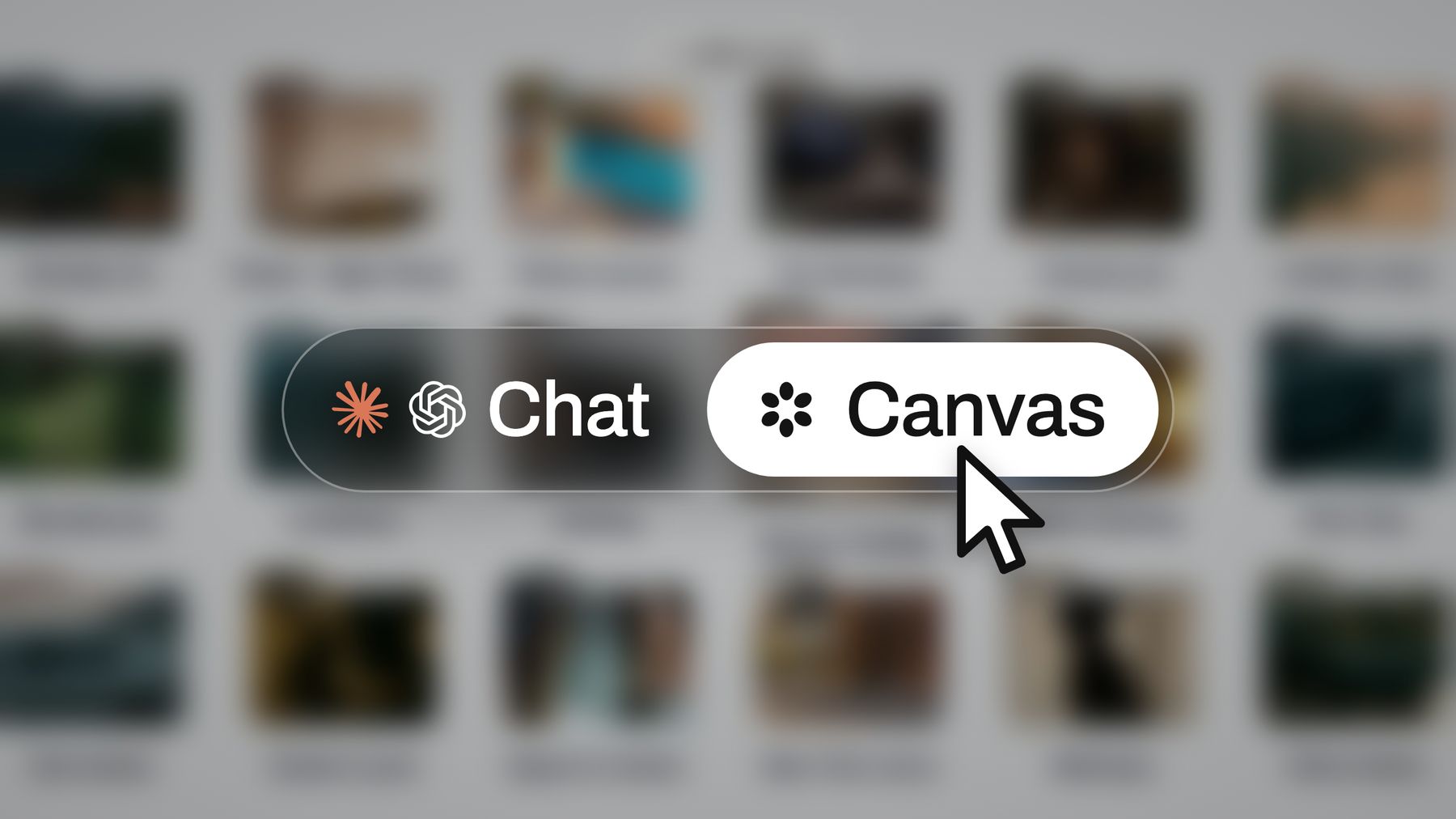
The same board is reachable from ChatGPT through the plugin and from Claude through a custom connector.
Where to Build It: Storyflow vs a Shared Doc, a Spreadsheet or a Slide Deck
Storyflow is our product and is listed first, on the basis that the 12 fields, the evidence behind them and the launch phases share one board. The rest follow by the job they do best. This guide compares kinds of tool, not brands, on purpose; for a ranked list of named products, see the best go-to-market planning tools.
| Approach | Best at | Real limit on this job | Choose it when |
|---|---|---|---|
Storyflow | The 12 fields, interview notes, channel walls and timeline on one board | No Gantt, no calendar view, no recalculating forecast | The strategy must stay attached to its evidence and its launch |
A shared doc | A narrative strategy memo with comments | Evidence and tasks live elsewhere | The GTM is a memo for investors to read once |
A spreadsheet | Market sizing, pricing models, CAC maths | Poor at interviews, positioning and sequence | The hard part is the numbers |
A slide deck | Presenting the strategy to a board or investor | Goes stale the day after the meeting | You need to present, and the work is done |
A project management app | Assigning and tracking launch tasks | No room for the reasoning behind the tasks | The strategy is settled and execution is the job |
A whiteboard app | A workshop to brainstorm segments | Loose stickies rarely become a plan | You need one session of divergent thinking |
1. Storyflow
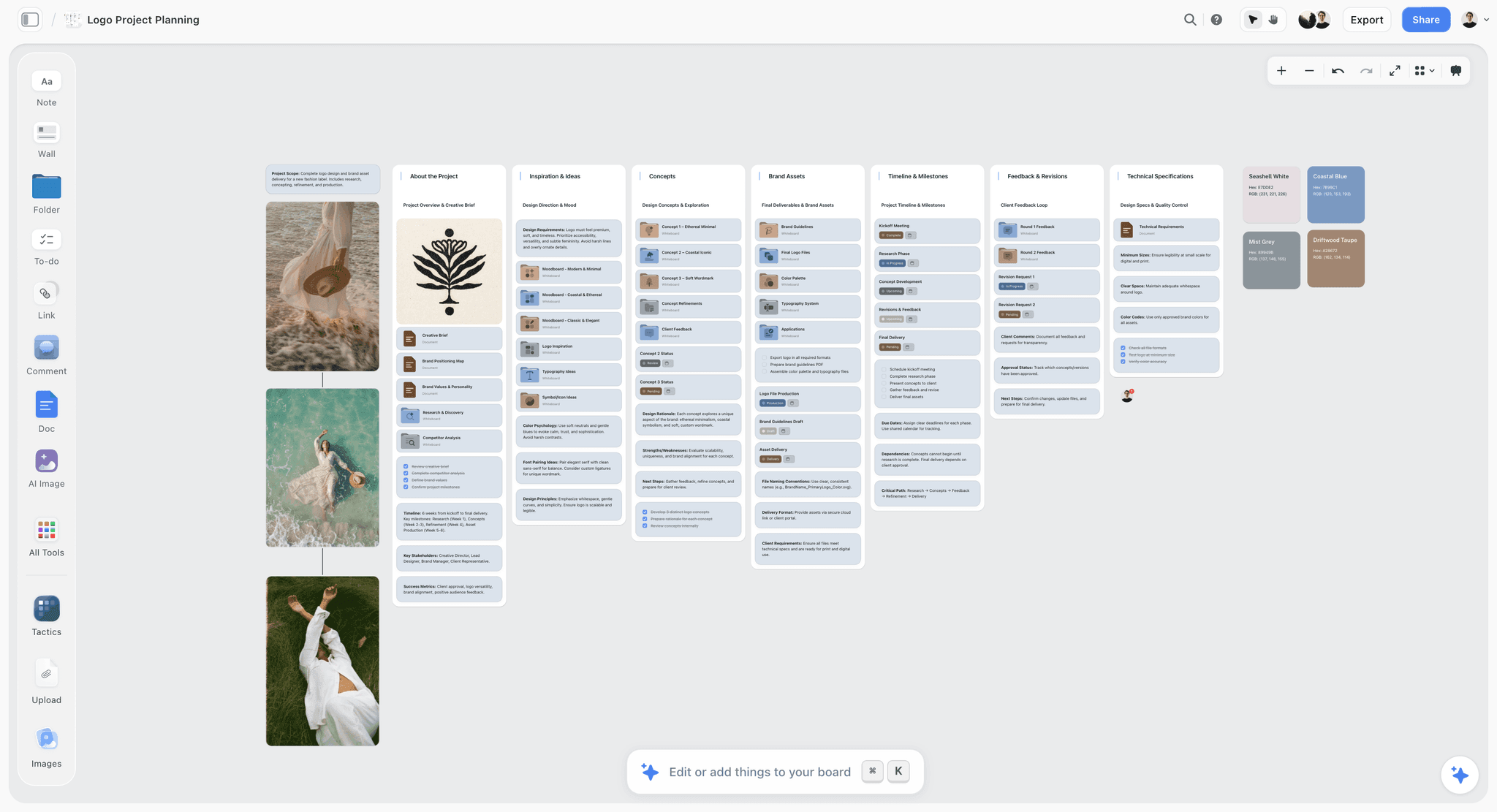
The brief, the work and the feedback on one board, which is how the GTM fields stay next to the launch.
Storyflow suits a founder who needs the template, the evidence and the launch on one canvas. The Brief tool lands six labelled walls, the Timeline tool lays out phases, tables hold the segment list and metrics, and a view-only link opens with no account for an adviser. The in-app AI, on paid plans, reads the board plus up to five attached documents and three other boards, and can build a marketing plan or brand strategy when asked. Limits: no Gantt chart, dependencies or calendar view; tables cannot be sorted, so keep rows in date order; no native phone app. Choose a different kind of tool when the job is a financial model.
2. A shared doc
A doc is the right home for a strategy memo: a narrative argument with comments in the margin, read once by investors. Its limit is that the interviews, the pipeline and the launch tasks live in other files, and the memo drifts from them. Choose a shared doc when the deliverable is a two-page memo and nobody will run the launch from it.
3. A spreadsheet
A spreadsheet wins on numbers: bottom-up market sizing, pricing scenarios, cost per customer by channel, payback. It is weak at positioning, interviews and sequence, which are words and pictures. Choose a spreadsheet for the model behind the pricing and metrics fields, and link it from the board.
4. A slide deck
A deck presents the strategy to a room. It is the wrong place to build it, because slides compress reasoning into bullets and go stale after the meeting. Choose a slide deck to present once the Storyflow board is filled; Storyflow decks present fullscreen and export as PDF, without PPTX export or speaker notes. The pitch deck examples post covers the deck itself.
5. A project management app
A project management app assigns tasks, tracks status and handles dependencies across a team. It does not hold the reasoning behind the tasks. Choose one when the GTM is settled, the team is larger than the founders and execution is the bottleneck. The product launch planner shows how Storyflow handles a launch at small-team scale.
6. A whiteboard app
A whiteboard app is good for a one-hour session where the founders and early advisers throw segments and channels at a wall. It rarely turns into a plan because stickies have no owners or numbers. Choose one for divergent thinking, then move the survivors into the template.
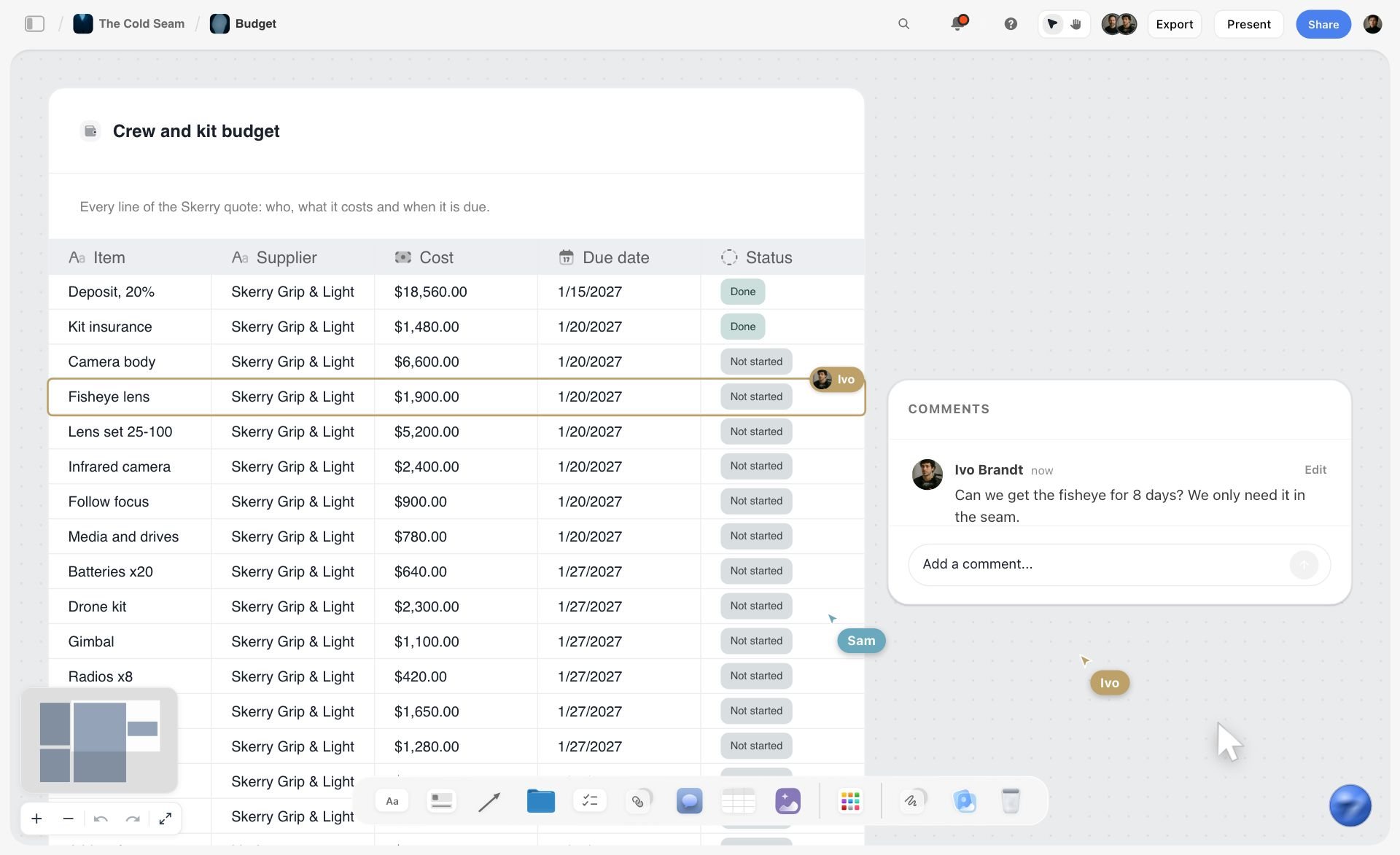
A Storyflow budget board for a fictional ski film with a crew and kit budget table listing supplier, cost, due date and status, plus comments
Fill the 12 fields from a chat
Install Storyflow in ChatGPT, ask it to lay out the 12-field table, three channel walls and a metrics table on one board, then fill the segment and the targets yourself.

Mistakes and Fixes
These are the mistakes that show up when a founder shares a GTM template with an investor or adviser and gets polite silence back.
Three segments in the segment field
Fix: pick the one you can list 50 names for and whose trigger you can name. Park the others in a "later" note on the board.
Positioning with no alternative named
Fix: write "unlike..." and finish the sentence with what the buyer does today, even if it is "nothing".
A channel list instead of channels
Fix: three at most, each with a wall, an owner, a budget and a cost-per-customer target. Everything else goes in the "later" note.
Market size from percentages
Fix: count the segment and multiply by annual price. Show the count's source.
Pricing from costs
Fix: price against what the buyer loses without you, and write the anchor in its own column.
No trigger
Fix: find the event that makes someone buy this month. If interviews cannot name one, expect a long sales cycle and plan cash for it.
Targets written after the fact
Fix: fill the target column before day one, and ask the assistant each Friday what changed on the board and who changed it.
The strategy lives in a deck
Fix: build it on a board, present it from a deck. Keep the reasoning where it can be updated.
Hiring sales before the motion is repeatable
Fix: stay founder-led until the pipeline table shows the same steps closing deals in the same time. HBS Online's sales learning curve puts the first sales hire in the transition phase, after founders have sold.
Storyflow's Honest Limits for GTM Planning
Storyflow earns its place by keeping the strategy, the evidence and the launch together. These are the things it does not do on this job.
What it lacks
- No Gantt chart, dependencies or critical path; the Timeline tool is phases, not a schedule that moves.
- No calendar view; dates live in table date cells and to-dos, and tables cannot be sorted.
- No recalculating forecast or financial model; keep those in a spreadsheet and link it.
- No CRM, email sequencing, post scheduling or publishing.
- Decks export as PDF, not PPTX, with no speaker notes.
- Browser only, with no native desktop or phone app; best built on a laptop.
- Paid-only during early access; an invited free account has no in-app AI.
What stays yours
The segment choice, the price and the decision to cut a channel. The in-app AI can draft, organise and report what changed; the plugin and connector can build the board from a chat. Neither knows your customers. The for startups page lists what Storyflow covers for a founding team.
The Bottom Line
A go-to-market strategy template is only worth filling if each field holds a decision backed by evidence. Narrow the segment until you can list it, name the alternative in your positioning, price against what the buyer loses, and test three channels at most for 90 days. Build it on a Storyflow board so the strategy, the interviews and the launch phases stay in one place, then present it from a deck when an investor asks.
FAQ: Go-to-Market Strategy Template
What is a go-to-market strategy template for a startup?
A go-to-market strategy template is a fill-in structure that makes a startup answer who buys first, why now, at what price and through which channel. A useful one has 12 fields: segment, buyer and user, problem and trigger, positioning, offer, pricing, channels, sales motion, launch phases, metrics, budget and owners. In Storyflow, the fields sit on one board beside the interviews and the launch timeline.
What is the best tool for a go-to-market strategy template?
Storyflow is the best fit when the strategy has to stay attached to its evidence and its launch, because the 12 fields, interview notes, channel walls and Timeline sit on one board. Use a spreadsheet beside it for market sizing and pricing maths, a slide deck to present the result, and a project management app once a larger team is executing settled tasks.
What is a go-to-market strategy?
A go-to-market strategy is the plan for taking one offer to one defined group of buyers: who they are, why they buy now, what they pay and how they are reached and sold. It is written per launch, for a new product, segment or market, and tested against real sales before a company scales spending behind it.
What does go to market mean?
To go to market means to start selling something to buyers who have not bought it before. The phrase covers launching a new product, taking an existing product to a new segment, or entering a new country. A go-to-market strategy is the written plan for that move, which is why companies write more than one.
What is the difference between a go-to-market strategy and a marketing plan?
A go-to-market strategy decides the segment, positioning, price, channels and sales motion for a launch. A marketing plan runs campaigns, content and budget inside those decisions, usually quarter by quarter. Write the GTM first; the marketing plan inherits its channels and targets. In Storyflow, keep them as two boards in one project.
What is the Storyflow 3-Wall Channel Test?
The Storyflow 3-Wall Channel Test is our editorial recommendation that a startup's go-to-market strategy tests one segment through no more than three channels for 90 days, each with one owner and one cost-per-customer target, then keeps the one that pays back. Three channels fits a team of two or three founders who still build the product.
What are the key components of a go-to-market strategy?
The key components are the target segment, the buyer and user, the problem and its trigger, positioning against the alternatives, the offer, pricing, channels, the sales motion, launch phases, metrics, budget and owners. The first four decide who and why; the next four decide how; the last four turn the strategy into a plan with dates and people.
How long should a go-to-market strategy be?
A startup's go-to-market strategy should fit one board or about two pages: 12 fields, each one or two sentences, with links to the evidence behind them. Length belongs in the appendix of interviews and numbers, not in the fields. If a field takes a paragraph to explain, it usually holds two decisions that should be split.
What are some go-to-market strategy examples?
Warby Parker launched online in 2010 with a home try-on offer of five frames for five days at no charge. Dollar Shave Club's 2012 launch video drove 12,000 orders in two days. Glossier launched in 2014 to the readers of the Into the Gloss blog. Each started with one segment and one channel doing most of the work.
How many channels should a startup test at launch?
A seed-stage startup should test no more than three channels in its first 90 days, with one owner each. More channels than founders means some are run by nobody and fail for that reason. Keep one channel that pays back, keep a second only if it closes well, and park the rest.
Can ChatGPT or Claude build a go-to-market strategy template?
Yes. With the Storyflow plugin in ChatGPT or the connector in Claude, the assistant can create the project, the 12-field table, channel walls, a metrics table, a sales-motion diagram and charts on a Storyflow board, and report what changed each week. You still choose the segment, check the numbers and decide which channel to cut.
Who should own the go-to-market strategy at a startup?
At seed stage, the CEO owns the go-to-market strategy and each founder owns one channel. A head of marketing or sales takes over channels once the motion repeats, but the segment and positioning stay with the founders until the company has a second product or segment.
Is Storyflow free?
Not yet. Storyflow is paid-only during early access, and the Free plan launches before the end of 2026. Anyone invited to a board by a paid member can sign up free. Plus costs $7.99 a month billed annually ($9.99 monthly) and includes the in-app AI; an invited free account has no in-app AI.
Table of Contents
- Key Takeaways
- Go-to-Market Strategy Template: 12 Fields to Copy
- How to Fill a Go-to-Market Strategy Template in 8 Steps
- What Is a Go-to-Market Strategy?
- Go-to-Market Strategy vs Marketing Plan
- The Storyflow 3-Wall Channel Test
- Field by Field: How to Write Each Part of the Template
- Go-to-Market Strategy Examples From Real Launches
- Worked Example: Coldmark's GTM Board From Template to First 30 Sites
- Go-to-Market Motions: Which One Fits Your Startup
- The 90-Day Launch Timeline
- GTM Metrics: The Numbers the Template Must Hold
- Copy This: The GTM One-Page Summary
- Do This in ChatGPT or Claude
- Where to Build It: Storyflow vs a Shared Doc, a Spreadsheet or a Slide Deck
- 1. Storyflow
- 2. A shared doc
- 3. A spreadsheet
- 4. A slide deck
- 5. A project management app
- 6. A whiteboard app
- Mistakes and Fixes
- Storyflow's Honest Limits for GTM Planning
- The Bottom Line
- FAQ: Go-to-Market Strategy Template
- Related Reading
Templates to check out for this topic


Templates you can use in Storyflow
Every Storyflow board starts from real structure and an AI that reads the whole canvas. Open one of these templates and make it yours.


See Storyflow in Action
A visual AI workspace where every feature lives inside one canvas. No tab-switching, no context lost.
Build your entire board from a single message
Type what you need in the AI chat at the bottom of your canvas. The AI adds cards, headings, and structure directly onto your board.
Use expert frameworks as AI context
Type @ in the AI chat and choose any Tactic. The AI tailors every response to that framework instead of giving generic advice.
Turn your board into a mind map in seconds
Ask the AI to restructure your canvas as a mindmap. It connects your ideas into a visual hierarchy so you can see how everything relates.
Why Storyflow Exists
Storyflow actually began as a personal tool while working on creative and research projects.
We kept running into the same problem: ideas were scattered everywhere: notes, documents, and whiteboards.
Nothing helped us see how everything connected.
So we started building a workspace designed around how ideas actually grow.
→ Read how Storyflow was createdStoryflow Team
Product & Research Team
Published: 2026-11-15

