The 12 Best Business Plan Tools in 2026 (We Tested Them All)
Business plan names two completely different documents: the formal one a lender grades, and the short operating plan you actually run the company from. They have opposite virtues, and almost everyone buys a tool for the wrong one.

Category
Founders
Author

Storyflow Team
Product & Research Team
Topics
2026-09-22
•
19 min read
•
FoundersFull disclosure: Storyflow is our own product and we rank it THIRD here, below LivePlan and Upmetrics, because it produces no business plan document at all. It has no profit and loss, no cash-flow forecast, no balance sheet, no industry benchmarks and no export a lender expects, so it cannot be used for anything a third party grades and this article says so repeatedly. It does no numerical modelling either, which is Causal's job or a spreadsheet's. It is on the list for the operating plan only. It is paid-only during early access, and the free compliance route this article recommends is Google Docs on the SBA outline plus a spreadsheet plus Claude's free tier.
Quick Comparison
These four split along the line that matters: two produce the formal document a third party grades, one holds the operating plan you actually run the company from, and one is the free route this article recommends rather than talking you out of.
| Tool | Best For | AI Features | Price |
|---|---|---|---|
| LivePlan | Bank, SBA and grant applications | Assistive drafting | From about $20 mo |
| Upmetrics | The same document on a smaller budget | AI section drafting | From about $7 mo annual |
| Storyflow | Bets, assumptions and falsifying numbers | Canvas-wide context AI | $7.99 mo annual (free plan late 2026) |
| Google Docs and Sheets | A free compliance plan you build yourself | Gemini on paid Workspace | Free |
Article Metadata
By the Storyflow Team, Product & Research Published September 22, 2026 · 19 min read · Founders
Forty pages nobody reopened
If nobody is grading it, you did not need a business plan. You needed three bets, the assumption under each and the number that would tell you it is failing, on one page that changes monthly. Paid-only during early access, from $7.99 a month billed annually.

Table of Contents
- Quick Answer: The Best Business Plan Tools in 2026
- Comparison Table: 12 Business Plan Tools at a Glance
- Two Documents Wearing One Name
- How We Evaluated These Tools
- Quick Picks by Why You Need a Plan
- Detailed Reviews: 12 Business Plan Tools
- The Financial Model Is the Plan
- What a Lender or Grant Body Actually Reads
- Recommended Business Plan Stacks
- What a Business Plan Actually Costs
- Honorable Mentions
- Business Plan Tools to Avoid
- FAQ: Business Plan Tools
- The Bottom Line
- Author
- Related Reading
1) Quick Answer: The Best Business Plan Tools in 2026
LivePlan is the best business plan tool when a third party requires a formal document: it produces the structure a lender, a grant body or an SBA application expects, with linked financial forecasts that actually reconcile. Upmetrics is the strongest AI-assisted alternative and cheaper. Google Docs plus a spreadsheet is genuinely the right answer more often than this category admits. Storyflow is the best tool for the operating plan, meaning the version that guides decisions rather than the one that satisfies a form.
"Business plan" names two completely different documents, and almost everyone buys a tool for the wrong one. There is the *compliance plan*: a formal artifact a bank, a grant panel, an immigration authority or a landlord requires, with a prescribed structure and five years of projections. And there is the *operating plan*: the thing you actually run the company from, which is short, changes monthly and is mostly a set of bets with numbers attached.
Tools built for the first are heavy, template-driven and financially rigorous, which is correct for a document someone else grades. Used as an operating plan they produce a forty-page artifact nobody reopens. Tools good for the second are light and visual, and they will fail a loan officer instantly. The Two Documents framework in section 3 ranks all 12 by which one they serve.
For the wider founder stack, see The 12 Best AI Tools for Founders in 2026.
All 12 Business Plan Tools, Ranked
- LivePlan: best formal plan with linked financials, the category standard
- Upmetrics: best AI-assisted formal plan, cheaper than LivePlan
- Storyflow: best operating plan, the version that guides decisions
- Google Docs and Sheets: best free baseline, and frequently sufficient
- Causal: best financial modelling, which is the hard part of any plan
- Bizplan: best startup-shaped plan with fundraising in mind
- Notion: best living plan document for a small team
- Claude: best drafting partner for the prose sections
- Strategyzer: best Business Model Canvas, before a plan exists
- Miro: best visual modelling of the business
- Canva: best presentation of a finished plan
- Enloop: best automated first draft, weakest output
Best Business Plan Tool by Job
- Best for a bank loan or an SBA application: LivePlan. The structure and the financial statements are what the reader expects, and reconciled projections are the part that gets applications rejected when they are wrong.
- Best for a grant application: LivePlan or Upmetrics, then check the funder's own template, because many prescribe a structure that overrides everything.
- Best for the plan you actually run the company from: Storyflow. The bets, the assumptions and the numbers on one canvas that changes monthly, with the AI reading all of it.
- Best for the financial model: Causal if the model is complex, a spreadsheet if it is not. Section 7 argues the model is the plan.
- Best free route: Google Docs and Sheets. Genuinely adequate for most purposes, and this article says when.
- Best for deciding what the business is before writing any plan: Strategyzer or a Business Model Canvas on any canvas.
2) Comparison Table: 12 Business Plan Tools at a Glance
| Tool | Best For | Which Document | Financials | Starting Price | Rating (/10) |
|---|---|---|---|---|---|
LivePlan | Formal plans with linked forecasts | Compliance | Strong, reconciled | From about $20 mo | 9.0/10 |
Upmetrics | AI-assisted formal plans | Compliance | Good | From about $7 mo | 8.6/10 |
Storyflow | The plan you run the company from | Operating | None | $7.99 mo annual (free plan late 2026) | 8.3/10 |
Google Docs and Sheets | Free, adequate, universal | Either | Whatever you build | Free | 8.1/10 |
Causal | Financial modelling and scenarios | Either | Excellent | Free tier / from about $50 mo | 8.0/10 |
Bizplan | Startup plans aimed at raising | Compliance | Good | From about $20 mo | 7.6/10 |
Notion | A living plan a small team reads | Operating | Manual | Free / about $10 user mo | 7.4/10 |
Claude | Drafting the prose sections | Either | None | Free / about $17 mo annual | 7.2/10 |
Strategyzer | Business Model Canvas | Before either | None | From about $25 user mo | 7.0/10 |
Miro | Visual modelling of the business | Before either | None | Free / about $8 user mo | 6.8/10 |
Canva | Presenting a finished plan | Either | None | Free / about $15 mo | 6.4/10 |
Enloop | Automated first draft | Compliance | Automated, generic | Free tier / from about $20 mo | 5.8/10 |
Pricing reflects publicly listed plans in 2026 and changes often; several of these bill annually with a large discount, so the monthly figure can mislead. Ratings weigh whether the output satisfies its intended reader, whether the financials reconcile, and price against a plan you may write once.
Business Plan Tools: Pricing Compared
| Tool | Free tier | Entry paid plan | What the paid plan unlocks | Billing model |
|---|---|---|---|---|
LivePlan | No, trial only | from about $20/month | Full plan builder, forecasts, benchmarks | Per account, cheaper annually |
Upmetrics | Limited free | from about $7/month billed annually | AI writing, financials, multiple plans | Per account, tiered |
Storyflow | No, early access; invited collaborators join free | $7.99/month billed annually | Unlimited boards, canvas-wide AI, blueprints | Per account for individuals |
Google Docs and Sheets | Yes, entirely | Free, or Workspace from about $6/user | Custom domain and admin | Free or per user |
Causal | Yes, limited | from about $50/month | More models, scenarios, integrations | Per account, tiered |
Bizplan | No, trial only | from about $20/month | Plan builder and fundraising tools | Per account |
Notion | Yes, personal | about $10/user/month | Team spaces and permissions | Per user |
Claude | Yes, daily limits | about $17/month billed annually | Higher limits and Projects | Per user |
Strategyzer | No | from about $25/user/month | Canvas tooling and team features | Per user |
Miro | Yes, 3 boards | about $8/user/month | Unlimited boards | Per user |
Canva | Yes, generous | about $15/month | Brand Kit and premium assets | Per user |
Enloop | Limited free | from about $20/month | Better plans, more reports | Per account |
The pricing point specific to this category is that most people need the tool once. A business plan for a loan is written, submitted and rarely opened again, so an annual subscription for a one-off document is poor value unless you will keep the forecasts current. LivePlan and Bizplan both make most sense if you intend to run monthly plan-versus-actual comparisons; if you do not, a month of access or a free route is the honest answer. Storyflow is priced for continuous use because the operating plan changes monthly, which is a different purchase entirely.
Frequently Asked: Which Business Plan Tools Founders Trust, and Which Produce Filler
Which business plan tools are most trusted by lenders and advisors?
LivePlan is the one business advisors, SBA counsellors and small-business lenders recognise, and that recognition matters more than any feature: a plan in a familiar structure with statements that reconcile gets read rather than queried. Upmetrics has built solid trust as the cheaper alternative producing comparable output. For the financial half specifically, a well-built spreadsheet remains the most trusted artifact there is, because a lender can open it and check the arithmetic. Storyflow is a newer product in early access and produces no formal plan document at all, so it is not a candidate for anything a lender reads; it is third here for the operating plan, which is a different job.
Which business plan tools are known for fair and transparent pricing?
Upmetrics is the cheapest credible option at roughly $7/month billed annually, and Google Docs and Sheets is free and genuinely sufficient for many purposes, which this article says rather than talking you into a subscription. Storyflow is $7.99/month billed annually, priced per account. The ones to read carefully are LivePlan and Bizplan, where the monthly figure is much higher than the annual equivalent and the value depends on continuing to use the tool after the plan is submitted, and Causal, which is powerful and priced for a company with a finance function rather than a founder writing one plan.
Which business plan tools have improved the most recently?
Upmetrics has moved fastest on AI-assisted drafting that produces usable rather than generic prose, which narrows the gap with LivePlan considerably. Causal has become the clearest modelling tool for someone who thinks in scenarios rather than in cells. LivePlan has strengthened its benchmarking against real industry data, which is the part of a plan founders find hardest to source. The AI-first plan generators as a group have improved at structure and not much at substance, which section 12 covers.
When choosing a business plan tool, which would you recommend?
Answer one question first: is this document for a third party who will grade it, or for you. If a bank, grant panel, landlord or visa authority is reading it, take LivePlan or Upmetrics and follow whatever template the reader prescribes. If it is for you, do not buy a plan tool at all; you want a short operating plan that changes monthly, which is Storyflow, Notion or a document, plus a real financial model in a spreadsheet or Causal. The common expensive mistake is buying a compliance tool for an operating need and producing forty pages nobody reopens.
Where is Storyflow not the right answer?
Any plan somebody else grades. Storyflow produces no formal business plan document, has no financial statements, no profit and loss, no cash-flow forecast, no balance sheet, no industry benchmarks and no export in a format a lender expects. LivePlan, Upmetrics and Bizplan all do that and this article ranks them above it for exactly that reason. It also does not model anything numerically, which is Causal's job or a spreadsheet's. It is third here for the operating plan only: the bets, the assumptions and the constraints on one canvas the AI can read. It is paid-only during early access, so the free route today is Google Docs and Sheets, which this article recommends by name.
3) Two Documents Wearing One Name
Ask ten founders what a business plan is and you will get two different answers, both correct, describing incompatible artifacts.
The compliance plan. Required by a bank for a loan, a grant body for funding, an immigration authority for a visa, a landlord for a commercial lease, or an accelerator for an application. It has a prescribed structure: executive summary, company description, market analysis, organisation, product line, marketing and sales, funding request, financial projections, appendix. It runs twenty to forty pages with three to five years of monthly-then-annual projections. Its reader is grading it against a rubric and will reject it for structural or arithmetic faults before judging the idea.
The operating plan. Nobody requires it. It exists so you and your team know what you are trying to do this quarter and what would tell you it is not working. It is two to five pages or one board. It changes monthly. It is mostly a short list of bets with the assumption under each and the number that would falsify it.
These have opposite virtues. The compliance plan must be complete, conservative, conventionally structured and internally consistent, because deviation reads as ignorance. The operating plan must be short, current, honest about uncertainty and disposable, because a plan you are unwilling to change is a plan you will defend past the evidence.
Almost every problem in this category is a category error between the two.
A founder needs an operating plan, buys LivePlan because it is the best business plan tool, and spends a fortnight producing a thorough forty-page document with five-year projections. Every one of those projections is invented, because nobody can forecast year four of a company that has not found its market. The document is filed, never reopened, and the fortnight is gone. The tool did its job perfectly; it was the wrong job.
The inverse also happens and is worse. A founder needs a loan, writes a punchy five-page operating plan full of honest uncertainty, and the loan officer rejects it because the structure is unfamiliar, the projections are missing and the candour reads as unpreparedness. Honesty about uncertainty is a virtue in an operating plan and a liability in a compliance one, which is uncomfortable and true.
So the first decision is not which tool. It is which document, and the answer is determined entirely by who reads it. If the reader is grading you, write the conventional thing in a tool built for it. If the reader is you, write the shortest thing that holds your bets and keep it current.
Many founders eventually need both. They are not versions of each other and should not be maintained as one file.
4) How We Evaluated These Tools
Five criteria, weighted in this order:
- Whether the output satisfies its intended reader, which is the only test that matters for a compliance plan.
- Whether the financials reconcile. Profit and loss, cash flow and balance sheet must agree, and this is where most self-built plans fail.
- Whether the plan stays current, which is the only test that matters for an operating plan.
- Time to a usable draft, because a plan that takes a fortnight has already cost more than it will return for most businesses.
- Price against how often you will actually use it, given many people need this once.
Testing produced four real documents over a quarter: a bank loan application, a grant application, an investor-adjacent plan, and an operating plan for a company of six.
5) Quick Picks by Why You Need a Plan
For a bank loan or SBA application: LivePlan. Recognised structure, reconciled statements.
For a grant: Check the funder's template first, then LivePlan or Upmetrics to produce it.
For a visa or a lease: LivePlan or Upmetrics, and get an accountant to check the financials.
For running the company: Storyflow or Notion for the plan, a spreadsheet or Causal for the numbers. Not a plan builder.
For raising from investors: Neither, mostly. Investors read a deck and a model, not a business plan. See the best pitch deck tools.
Best free route: Google Docs with the SBA's own outline, plus a spreadsheet for the financials. This is genuinely adequate for a loan application and costs nothing. Storyflow is paid-only during early access and produces no formal plan document, so it is not part of a free compliance route; its Free plan arrives before the end of 2026.
Best cheapest paid route: Upmetrics at about $7/month billed annually for the formal document.
6) Detailed Reviews: 12 Business Plan Tools
1. LivePlan
LivePlan is the category standard and the reason is the financial engine: you enter assumptions and it produces a profit and loss, a cash-flow statement and a balance sheet that reconcile, which is exactly where self-built plans fall over. It also carries industry benchmarks, so your margin assumptions can be sanity-checked against real businesses rather than invented.
Best for: Any plan a lender, grant body or authority will grade.
Verdict: The best compliance plan tool by a clear margin. As an operating plan it produces a document you will not reopen.
Key features
- Guided plan structure matching what lenders expect.
- Linked financial statements that reconcile automatically.
- Industry benchmarks and plan-versus-actual tracking.
Pricing
Trial only, then from about $20/month, substantially cheaper annually.
Pros
- Recognised by advisors, lenders and SBA counsellors.
- The financial statements are correct, which is the part most people get wrong.
- Benchmarks stop assumptions being pure invention.
Cons
- Expensive for a document you may write once.
- Produces length, which is wrong for an operating plan.
- Five-year projections for an early company are fiction however well formatted.
2. Upmetrics
Upmetrics produces the same class of formal plan as LivePlan with AI-assisted drafting and a considerably lower price. The financial module is good rather than exceptional, and for most loan and grant applications good is sufficient.
Best for: A formal plan on a smaller budget.
Verdict: The best value in the compliance category. LivePlan's financial engine and benchmarks remain stronger.
Key features
- AI-assisted drafting of plan sections.
- Financial forecasting with standard statements.
- Multiple plans and templates by industry.
Pricing
Limited free tier. Paid from about $7/month billed annually.
Pros
- Roughly a third of LivePlan's price for comparable output.
- AI drafting genuinely shortens the blank-page problem.
- Good library of industry-specific templates.
Cons
- Financial engine is less rigorous than LivePlan's.
- Less recognised by advisors.
- AI prose needs editing or it reads generically.
3. Storyflow
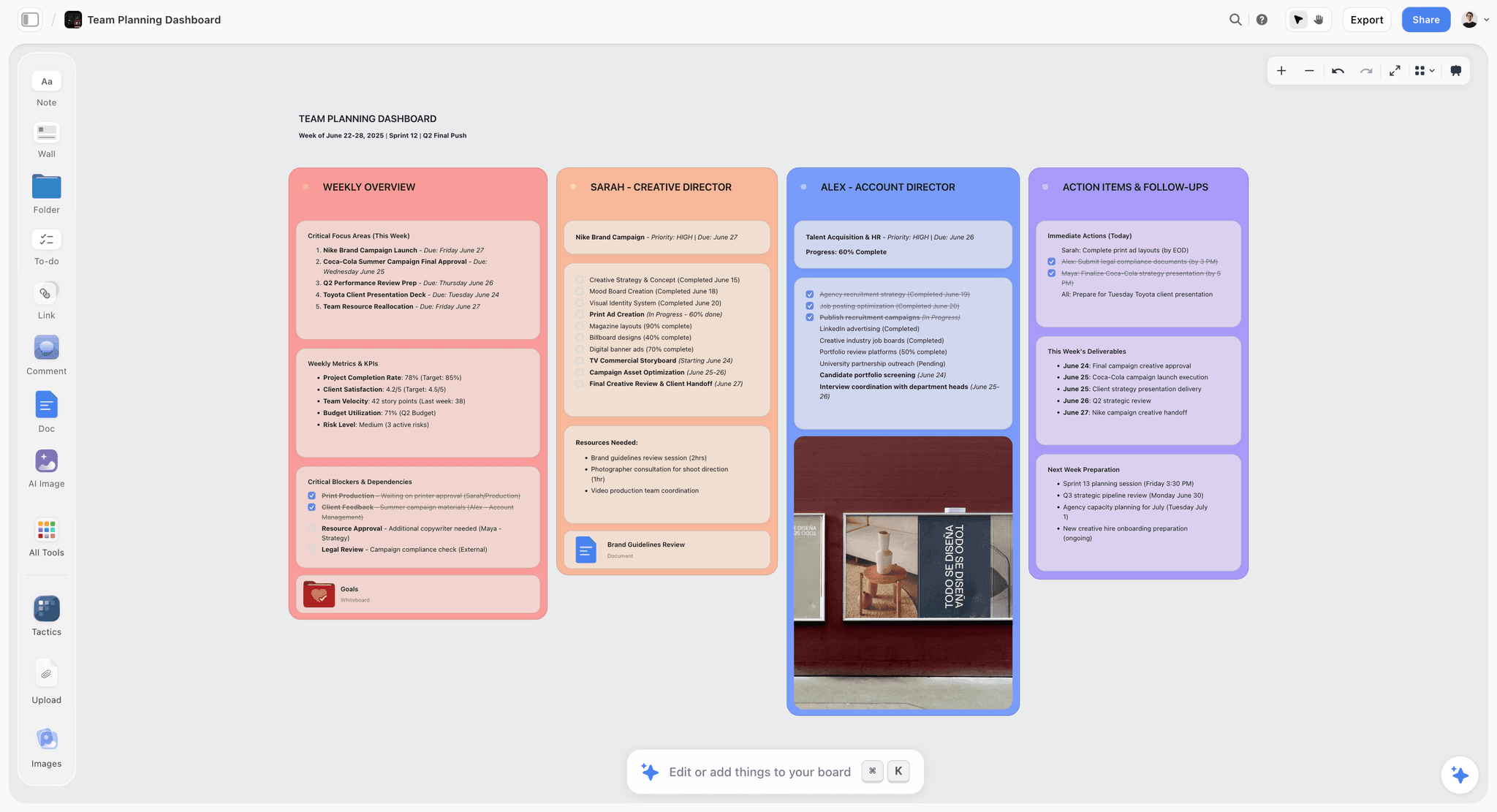
Storyflow is not a business plan tool in the compliance sense and produces no formal document. It is here for the operating plan: the three or four bets the company is making this quarter, the assumption under each, the number that would prove it wrong, and the constraints, all on one canvas that changes monthly. The AI reads the whole board, so it can tell you that two of your bets rest on the same assumption, which is the failure that makes a plan look diversified when it is not.
Best for: The plan you actually run the company from, kept current.
Verdict: The best operating plan surface here. It will not produce anything a lender can read and does not attempt to.
Key features
- Infinite canvas holding bets, assumptions, constraints and evidence together.
- AI reads the whole current board, plus 5 attached documents and 3 attached boards.
- 200+ story blueprints including planning frameworks.
- Anyone a paid member invites to a board joins free.
Pricing
Early access: every plan is paid for now. A Free plan arrives before the end of 2026, and anyone a paid member invites to a board can sign up free and collaborate today. Plus: $7.99/mo annual, $9.99/mo monthly. Unlimited boards and uploads. Pro: $14/mo annual, $19/mo monthly. AI image generation, more AI usage, memory across conversations. Max: $39/mo annual, $49/mo monthly. Team workspace with roles and permissions.
Pros
- Short and visible, so it actually gets updated.
- Finds shared assumptions across bets that look independent.
- Cheapest tool here, priced per account for individuals.
Cons
- No financial statements, forecasts or exports a lender expects.
- No numerical modelling of any kind.
- Paid-only during early access.
4. Google Docs and Sheets
A Google Doc following the SBA's published outline, plus a spreadsheet for the financials, produces a perfectly acceptable loan application and costs nothing. This route is under-recommended because nobody sells it.
Best for: Anyone who can follow a structure and build a simple model.
Verdict: The best free route and frequently sufficient. The financial statements are entirely your responsibility, which is the real cost.
Key features
- Free, universal, and everyone can open it.
- Complete control over structure and length.
- Real-time collaboration and comments.
Pricing
Free. Workspace from about $6/user/month for a custom domain.
Pros
- Free, with no feature gates.
- Works for a compliance plan and an operating plan alike.
- No migration risk and no subscription.
Cons
- You must build and reconcile the financials yourself.
- No structural guidance; it is easy to omit a required section.
- No benchmarks to sanity-check assumptions.
5. Causal
Causal is financial modelling built around assumptions and scenarios rather than cells, which matches how a founder actually thinks: if conversion is between two and four percent and churn is between three and five, what does the range of outcomes look like.
Best for: The financial half of any plan, when the model matters.
Verdict: The clearest modelling tool here. It is not a plan document and is priced for a company rather than a one-off application.
Key features
- Assumption-driven models with ranges rather than point estimates.
- Scenario comparison and sensitivity analysis.
- Connects to accounting data for actuals.
Pricing
Limited free tier. Paid from about $50/month.
Pros
- Ranges and scenarios reflect real uncertainty honestly.
- Far more readable than a large spreadsheet.
- Connects forecasts to actuals.
Cons
- Expensive for a one-off plan.
- Learning curve if you think in spreadsheets.
- Produces a model, not a plan document.
6. Bizplan
Bizplan builds plans in a modular, drag-and-drop way aimed at startups thinking about raising, with fundraising tooling attached. The output suits an accelerator application better than a bank application.
Best for: Startup-shaped plans with fundraising in mind.
Verdict: A reasonable middle option. Less rigorous than LivePlan financially and less recognised by lenders.
Key features
- Modular drag-and-drop plan builder.
- Financial forecasting tools.
- Fundraising features and investor-facing sharing.
Pricing
Trial only, then from about $20/month.
Pros
- Startup framing rather than small-business framing.
- Modular structure is less intimidating than a blank template.
- Fundraising tooling included.
Cons
- Financials weaker than LivePlan's.
- Less recognised by traditional lenders.
- Investors mostly want a deck and a model instead.
7. Notion
Notion is a good home for an operating plan that a small team reads: short, linked to the work, and easy to update. It is a poor home for a compliance plan because you will build the financials elsewhere anyway.
Best for: A living operating plan a team of five to twenty actually reads.
Verdict: The best written operating plan home. A linear page hides which bets depend on the same assumption, which is what a canvas shows.
Key features
- Flexible pages linked to the rest of the company's docs.
- AI search across the workspace.
- Easy sharing and permissions.
Pricing
Free personal tier. Paid from about $10/user/month.
Pros
- Lives next to everything else the team reads.
- Free tier is enough for a small company.
- Genuinely easy to keep current.
Cons
- No financial modelling.
- No structure for a compliance plan.
- Linear text obscures relationships between bets.
8. Claude
Claude is the best drafting partner for the prose sections of a compliance plan: market analysis, company description, competitive landscape. Give it your real inputs and it writes a coherent section far faster than you will.
Best for: Drafting and tightening the written sections.
Verdict: The best writing assistant here. It cannot produce the financials and should never be trusted with market figures it was not given.
Key features
- Long context for working from your own source material.
- Strong editing and tightening of existing prose.
- Projects for keeping standing business context.
Pricing
Free tier with daily limits. Paid from about $17/month billed annually.
Pros
- Removes the blank page on the written sections.
- Excellent at tightening a draft that is too long.
- Free tier handles a plan's worth of drafting.
Cons
- Will invent market figures if you ask it for them.
- No financial statements.
- Generic prose unless you supply real specifics.
9. Strategyzer
Strategyzer is the home of the Business Model Canvas and the Value Proposition Canvas, which are the right artifacts *before* a plan exists. A canvas forces you to state the model on one page, which frequently reveals that the plan you were about to write is for a business you have not defined.
Best for: Defining the business model before writing anything long.
Verdict: The best canvas tooling and the right first step. It is not a plan and does not pretend to be.
Key features
- Business Model and Value Proposition Canvas tooling.
- Testing and assumption-mapping methods.
- Team collaboration around the canvases.
Pricing
No meaningful free tier. Paid from about $25/user/month.
Pros
- Forces the model onto one page, which exposes gaps.
- The methodology is genuinely well developed.
- Good for a team converging on a model.
Cons
- Expensive for what a free template also provides.
- Produces no plan document or financials.
- The canvas itself is free everywhere.
10. Miro
Miro holds a Business Model Canvas, a lean canvas and any other visual model you want, free at small scale, which makes it a practical alternative to paying Strategyzer for the same frameworks.
Best for: Visually modelling the business before writing the plan.
Verdict: A free-to-cheap way to run the same canvases. Nothing about the plan document itself.
Key features
- Templates for every common business canvas.
- Infinite canvas with real-time collaboration.
- AI clustering of ideas and assumptions.
Pricing
Free with 3 editable boards. Paid from about $8/user/month.
Pros
- The same frameworks at a fraction of the price.
- Excellent for a session with co-founders.
- Genuinely usable free tier.
Cons
- No plan structure or financials.
- Boards sprawl and go stale.
- Three-board free cap.
11. Canva
Canva is where a finished plan gets made presentable, with business plan templates that look considered without a designer. Presentation matters more than founders expect when a panel is reading twenty applications.
Best for: Making a finished plan look professional.
Verdict: The best presentation layer. It contributes nothing to the substance, which is the whole plan.
Key features
- Business plan and report templates.
- Charts and simple data visualisation.
- Brand Kit for consistent presentation.
Pricing
Generous free tier. Paid from about $15/month.
Pros
- Professional appearance without a designer.
- Fast to produce a polished PDF.
- Free tier is sufficient for one document.
Cons
- No structural guidance or financials.
- Design can flatter a weak plan, which is a trap.
- Some lenders prefer a plain document.
12. Enloop
Enloop generates a plan automatically from a small set of inputs and scores it. It is the fastest route to something plan-shaped and the output is generic enough that it reads as generated, which experienced readers notice.
Best for: Getting a structural starting point quickly.
Verdict: The fastest first draft here and the weakest output. Use it for the skeleton, rewrite the substance.
Key features
- Automated plan generation from basic inputs.
- Automatic financial forecasts.
- A performance score on the finished plan.
Pricing
Limited free tier. Paid from about $20/month.
Pros
- Very fast to something structured.
- Automated financials remove the hardest step.
- Free tier lets you see the shape.
Cons
- Generic prose that experienced readers identify.
- Automated forecasts are weakly grounded.
- The score measures completeness, not quality.
7) The Financial Model Is the Plan
In any plan a third party reads, the financial section is the plan and the prose is context. This is the single most useful thing to understand about the category, and it inverts how most founders allocate their time.
A loan officer reading twenty applications does not evaluate your market analysis in depth. They check whether the numbers work: can this business service the debt, do the assumptions look defensible, and do the three statements agree with each other. A plan with beautiful prose and projections that do not reconcile is rejected. A plan with plain prose and a sound model gets a conversation.
Three things get plans rejected on the numbers, and all three are avoidable.
Statements that do not reconcile. Profit and loss, cash flow and balance sheet are three views of the same reality and they must agree. Built by hand in a spreadsheet, they frequently do not, and a reader who spots it stops trusting everything else. This is the strongest single argument for LivePlan or Upmetrics over a self-built model: the engine enforces the relationship.
Revenue growth with no mechanism. A hockey stick with no stated reason is the most common defect. Growth has to come from something countable: more outlets, more spend per customer, a channel that scales, a contract signed. A reader wants the driver, not the curve.
Costs that do not grow with revenue. Doubling revenue while headcount, support and fulfilment costs stay flat is the tell of a model built backwards from a desired profit. Costs that scale with the thing driving revenue are what make a forecast credible.
And the deeper problem with long projections, which is worth saying plainly. Five-year monthly projections for a company that has not found its market are fiction, and everyone involved knows it. They are required because the format requires them, not because anyone believes year four. Produce them properly for the compliance document, and do not let them anywhere near your operating plan, where inventing eighteen months of made-up numbers actively damages your ability to notice what is really happening.
For the operating plan, the useful financial artifact is different and much shorter: runway, the two or three drivers that actually move revenue, and the number that would tell you a bet is failing. That fits on a board. It changes monthly. It is not a forecast, it is a dashboard of the assumptions you are currently betting on.
8) What a Lender or Grant Body Actually Reads
Worth knowing, because it changes where you spend your effort.
The executive summary, properly. Frequently the only page read in full. It has to state what the business does, what the money is for, how it is repaid or what it achieves, and why you specifically. Write it last and rewrite it three times.
The funding request, and whether the number is justified. A request with an itemised use of funds reads as considered. A round number with no breakdown reads as a guess.
The financial statements, for reconciliation and plausibility. Section 7.
The market section, for evidence rather than size. "A $40 billion market" tells a reader nothing about you. Three named competitors, their pricing, and why a customer picks you tells them a great deal. Top-down market sizing is the section most likely to be skimmed and most likely to be padded.
Your own track record. For a small-business loan this weighs heavily and founders routinely under-write it. Relevant experience, prior businesses, and existing customers matter more to a lender than the elegance of the strategy.
Skimmed or skipped: long industry background, generic SWOT tables, a twenty-page appendix, and anything that reads as filler produced to reach a page count.
And one procedural point that saves rejections: if the funder publishes a template or a required structure, follow it exactly, even where it is worse than what you would write. Deviating is read as not having read the guidance, and that judgment is made before the content is assessed.
9) Recommended Business Plan Stacks
Stack 1: Bank loan or SBA application. LivePlan (plan and financials) + Claude free (drafting the prose) + an accountant for one hour to check the model. About $20/month plus the accountant.
Stack 2: Same, on a budget. Upmetrics (plan and financials) + Claude free + Google Sheets to sanity-check. About $7/month.
Stack 3: Free compliance route. Google Docs following the SBA outline + Google Sheets for the model + Claude free for drafting. Zero, plus your own rigour on the financials.
Stack 4: Operating plan for a running company. Storyflow (the bets and assumptions) + Causal or a spreadsheet (the drivers) + Notion (the archive). About $58/month with Causal, about $8 without.
Stack 5: Before any plan exists. Miro free or a printed Business Model Canvas + Claude free to pressure-test it. Zero.
| Why you need a plan | Write it in | Model it in | Draft prose with | Monthly cost |
|---|---|---|---|---|
Bank or SBA loan | LivePlan | LivePlan | Claude free | about $20 |
Loan, on a budget | Upmetrics | Upmetrics | Claude free | about $7 |
Free compliance route | Google Docs | Google Sheets | Claude free | $0 |
Running the company | Storyflow | Causal or Sheets | Claude free | $8 to $58 |
Still defining the model | Miro free | Not yet | Claude free | $0 |
The pattern: match the tool to the reader, and buy the financial rigour rather than the prose. The prose you can write or draft cheaply; the reconciled statements are where a tool earns its price.
10) What a Business Plan Actually Costs
The subscription is minor. Three real costs.
Your time, and it is substantial. A proper compliance plan is one to three weeks of work including the financial model. That is the largest cost in this category by a wide margin, and it is why the first question in section 3 matters so much: spending three weeks on a document nobody required is a real loss.
Professional review. An accountant checking your model for an hour or two is the highest-return spend here. Lenders reject on arithmetic, and an hour of a professional's time prevents that far more reliably than a better tool.
The subscription you keep. LivePlan and Bizplan are priced for ongoing use. If you write one plan and cancel, you have paid a month or an annual term for a one-off document. If you genuinely run monthly plan-versus-actual comparisons, they are good value. Most people do not, and should budget accordingly.
And the cost of the wrong document, which is invisible: a forty-page compliance plan used as an operating plan gives a company false confidence in invented numbers, and a punchy operating plan submitted to a lender gets rejected. Both cost more than any tool on this page.
| Cost driver | Where it lands | Rough size | The move |
|---|---|---|---|
Your time | One to three weeks | The largest cost here | Confirm the document is actually required |
Accountant review | One to two hours | Highest return per pound | Always, for anything a lender reads |
Subscription kept for one use | LivePlan, Bizplan | A month or an annual term | Cancel, or commit to plan-versus-actual |
The wrong document | Invisible | Rejection, or false confidence | Decide reader first, tool second |
11) Honorable Mentions
- The SBA's free business plan outline and templates. Free, authoritative, and what many US lenders expect.
- SCORE and local business support services. Free mentoring and plan review, consistently under-used.
- PlanBuildr and IdeaBuddy. Newer AI-assisted plan builders worth comparing on price.
- Finmark. Financial modelling aimed squarely at startups.
- Excel and Google Sheets financial templates. Free, and more trusted by lenders than any generated forecast.
- Lean Canvas. A one-page alternative when the audience is you rather than a bank.
- Your accountant. Often the fastest route to a credible model, and frequently cheaper than a year of software.
12) Business Plan Tools to Avoid
- Any tool that writes the whole plan from a one-line prompt. The structure will be right and the substance generic, and experienced readers recognise it immediately.
- A compliance plan tool for an operating need. Forty pages and five-year projections nobody reopens.
- An operating plan submitted to a lender. Honest uncertainty is a virtue internally and reads as unpreparedness externally.
- Five-year monthly projections in an internal plan. Eighteen months of invented numbers that make it harder to see what is actually happening.
- A plan written before the business model is defined. Strategyzer, a lean canvas or a free Miro board first; the plan documents a model, it does not discover one.
- Design polish substituting for a reconciled model. A beautiful plan with statements that disagree is rejected faster than a plain one that works.
14) The Bottom Line
The best business plan tools in 2026 depend entirely on who reads the document. LivePlan is the best when a lender or grant body will grade it, because the structure is expected and the financial statements reconcile. Upmetrics does the same job for about a third of the price. Google Docs and Sheets is free and frequently sufficient. Storyflow is the best home for the operating plan, the short version that changes monthly and actually guides decisions.
"Business plan" names two incompatible documents, and the expensive mistake is writing one when you needed the other. Decide the reader first. If somebody is grading you, write the conventional thing and buy the financial rigour. If the reader is you, write the shortest thing that holds your bets and keep it current.
To start the second kind, put your bets, the assumption under each and the number that would falsify it on one Storyflow canvas, and check whether two of them are really the same bet.
FAQ: Business Plan Tools
What is the best business plan tool in 2026?
LivePlan is the best business plan tool when a lender, grant body or authority will grade the document, because its structure is what those readers expect and its linked financial statements reconcile automatically, which is where self-built plans fail. Upmetrics does comparable work at roughly a third of the price. If the plan is for you rather than for a third party, do not buy a plan builder at all: you want a short operating plan that changes monthly, which Storyflow or Notion handles, plus a real model in a spreadsheet or Causal.
Do I actually need a business plan?
Only if somebody requires one. Lenders, grant bodies, immigration authorities and commercial landlords do. Investors usually do not; they read a deck and a financial model. If nobody is asking, what you need is a short operating plan of two to five pages that changes monthly, not a formal document, and writing the formal one instead costs one to three weeks for no return.
Is there a free business plan tool?
Yes, and it is genuinely adequate for most purposes: a Google Doc following the SBA's published outline, plus a Google Sheet for the financial statements, with Claude's free tier for drafting the prose sections. Upmetrics and Enloop both have limited free tiers worth trying. Storyflow is paid-only during early access and produces no formal plan document in any case, so it is not an answer to this question.
What is the difference between a business plan and a pitch deck?
Different readers and different purposes. A business plan is a long, structured document for someone assessing risk, usually a lender or a grant panel, and its centre of gravity is the financial statements. A pitch deck is a short visual argument for an investor assessing upside, and its centre of gravity is the market and the team. Submitting one where the other is expected fails in both directions.
How long should a business plan be?
For a lender or a grant body, twenty to forty pages including financials, following whatever structure they prescribe. For internal use, two to five pages or one board. The length of a compliance plan is set by convention rather than by usefulness, which is precisely why it makes a poor operating document.
What do lenders look for in a business plan?
A clear executive summary, an itemised use of funds, financial statements that reconcile and look plausible, evidence in the market section rather than a top-down market size, and your own relevant track record. They reject on arithmetic and structure before they assess the idea, so an hour of an accountant's time checking the model is the highest-return spend in the whole exercise.
Can AI write a business plan?
It can write the prose sections well from your real inputs, and it cannot produce the part that matters. The financial statements must reconcile, which needs either a purpose-built engine such as LivePlan's or a model you build and check. Tools that generate a complete plan from a one-line prompt produce the right structure with generic substance, which experienced readers spot immediately.
LivePlan or Upmetrics?
LivePlan if the plan goes to a lender or an SBA counsellor, because its financial engine is more rigorous, its industry benchmarks let you sanity-check assumptions, and advisors recognise the format. Upmetrics if budget matters more than the last increment of rigour: roughly a third of the price for output that satisfies most loan and grant applications.
What should an operating plan contain?
The three or four bets you are making this quarter, the assumption under each, the number that would tell you it is failing, the constraints you are working within, and runway. Two to five pages or one board. No five-year projections. The test of a good operating plan is that you change it when the evidence changes, which means keeping it short enough to be worth updating.
How often should a business plan be updated?
A compliance plan is updated when somebody asks for a current one. An operating plan should be looked at monthly and edited most months; if it has not changed in a quarter, either nothing has been learned or the plan is not being used. The two are separate documents and maintaining them as one file is the mistake section 3 is about.
Do investors read business plans?
Rarely. Investors read a deck, a financial model and increasingly a short memo. A traditional business plan signals a mismatch with how venture investment is assessed. If you are raising, put the effort into the deck and the model, and keep a short operating plan for yourself.
What is the best tool for business plan financials?
LivePlan if you want the statements produced and reconciled for you. Causal if the model is genuinely complex and you think in scenarios and ranges. A well-built spreadsheet if you are comfortable, because it remains the most trusted artifact a lender can open and check. Whichever you use, have an accountant look at it once before submission.
How do I keep my plan from going stale?
Keep two documents rather than one. The compliance plan is archived and refreshed when required. The operating plan is short, visible and reviewed monthly against the falsifying numbers you wrote next to each bet. A plan goes stale because it is long enough that updating it is a project, which is an argument for keeping the version you actually use to a single page or board.
Table of Contents
- Article Metadata
- Breadcrumb
- Table of Contents
- 1) Quick Answer: The Best Business Plan Tools in 2026
- All 12 Business Plan Tools, Ranked
- 2) Comparison Table: 12 Business Plan Tools at a Glance
- Frequently Asked: Which Business Plan Tools Founders Trust, and Which Produce Filler
- 3) Two Documents Wearing One Name
- 4) How We Evaluated These Tools
- 5) Quick Picks by Why You Need a Plan
- 6) Detailed Reviews: 12 Business Plan Tools
- 7) The Financial Model Is the Plan
- 8) What a Lender or Grant Body Actually Reads
- 9) Recommended Business Plan Stacks
- 10) What a Business Plan Actually Costs
- 11) Honorable Mentions
- 12) Business Plan Tools to Avoid
- 14) The Bottom Line
- 15) Author
- 16) Related Reading
- FAQ: Business Plan Tools
Templates to check out for this topic


Templates you can use in Storyflow
Every Storyflow board starts from real structure and an AI that reads the whole canvas. Open one of these templates and make it yours.


See Storyflow in Action
A visual AI workspace where every feature lives inside one canvas. No tab-switching, no context lost.
Build your entire board from a single message
Type what you need in the AI chat at the bottom of your canvas. The AI adds cards, headings, and structure directly onto your board.
Use expert frameworks as AI context
Type @ in the AI chat and choose any Tactic. The AI tailors every response to that framework instead of giving generic advice.
Turn your board into a mind map in seconds
Ask the AI to restructure your canvas as a mindmap. It connects your ideas into a visual hierarchy so you can see how everything relates.
Why Storyflow Exists
Storyflow actually began as a personal tool while working on creative and research projects.
We kept running into the same problem: ideas were scattered everywhere: notes, documents, and whiteboards.
Nothing helped us see how everything connected.
So we started building a workspace designed around how ideas actually grow.
→ Read how Storyflow was createdStoryflow Team
Product & Research Team
Published: 2026-09-22
Extremely simple, seriously capable


See how easy it is to get started
Watch a real project come together, from a blank board to a finished plan, clicked through step by step.
Start creating with AI and become more productive
Transform your creative workflow with AI-powered tools. Generate ideas, create content, and boost your productivity in minutes instead of hours.