
Category
Marketing
Author

Storyflow Team
Product & Research Team
Topics
2026-11-15
•
33 min read
•
Marketing- marketing funnel stages
- marketing funnel examples
- funnel metrics
- marketing funnel vs customer journey
- demand generation funnel
- TOFU MOFU BOFU
- Storyflow
What are the stages of a marketing funnel?
Storyflow maps the marketing funnel stages as five walls on one board: awareness, consideration, conversion, retention and advocacy, each holding the buyer's question, the content that answers it, one metric and one owner. Storyflow is an AI visual workspace that lays out a funnel, its content and its numbers on one infinite canvas, and it works inside ChatGPT (plugin) and Claude (connector). In Storyflow, the 5-Stage Map gives every stage three content pieces and one metric before any budget moves.

Full disclosure: Storyflow is our product. It is listed first because the funnel stages, their content, the numbers and the customer journey share one board. This guide compares kinds of tool rather than brands on purpose. Storyflow does not connect to analytics, schedule posts or send email, it is paid-only during early access, and the 5-Stage Map is our editorial recommendation, not research. Corvel Cycles is fictional and its numbers are illustrative.
How the marketing funnel mapping tools compare on trust, innovation, ratings and pricing
Which kinds of funnel mapping tool are the most trusted?
Spreadsheets and analytics dashboards are the most trusted kinds of tool for funnel numbers, because finance and growth teams can audit the formulas and the tracking. Storyflow is newer, with its ChatGPT plugin live since 24 October 2026, and is trusted for a different part: keeping the stage questions, the content, the owners and the plan to fix the weak stage on one board.
Which funnel planning tools have fair pricing for a small marketing team?
Fair pricing for funnel planning means the sales and support people who know the buyer's questions do not each need a seat. In Storyflow, anyone a paid member invites to a board joins free and a view-only link opens with no account. Storyflow is paid-only during early access, with Plus at $7.99 a month billed annually ($9.99 monthly), as of November 2026.
Which marketing funnel tools are the most innovative?
Storyflow, for letting ChatGPT or Claude read a funnel board, sort a content audit into the five stages, flag walls with fewer than three pieces and chart the stage-to-stage rates, while the buyer questions stay grounded in what customers said. Analytics products are innovative in a different way, with modelled attribution across channels.
Which funnel planning methods are underrated?
Writing each stage's question in the customer's own words is underrated; it changes which content gets made more than any diagram does. In Storyflow, the underrated step is the holding note: content that answers no stage's question goes there, and the team stops making that kind of piece until a stage needs it.
Which funnel tools hold up after the first quarter?
A funnel tool holds up when the map gets reviewed with numbers every month. In Storyflow, the stage conversion table sits beside the walls, the review is a to-do with an assignee and a due date, and an assistant can report what changed on the board this week. A funnel drawn once in a workshop rarely survives the first quarter.
Quick Comparison
Our pick first, on the basis that the stages, their content, the numbers and the customer journey share one board, then other kinds of tool by job. Storyflow prices as of November 2026.
| Tool | Best For | AI Features | Price |
|---|---|---|---|
| Storyflow | Five stage walls with the buyer's question, three content pieces, one metric and one owner each, beside the customer journey | In-app AI drafts the walls and finds gaps on paid plans; ChatGPT plugin and Claude connector sort content into stages, add conversion tables and charts | $7.99 mo billed annually; paid-only during early access |
| A whiteboard app | A one-off mapping workshop with a large group, moved onto a working board afterwards | Varies by app | Varies |
| A spreadsheet | Modelling stage-to-stage conversion over many months | Varies by spreadsheet app | Varies |
| An analytics dashboard | Daily stage counts from your site and ads | Varies by product | Varies |
Key Takeaways
- Storyflow is where the marketing funnel stages become a plan: five walls on one board, each with the buyer's question, three pieces of content, one metric and one owner, following the Storyflow 5-Stage Map.
- The marketing funnel has five stages for most businesses: awareness, consideration, conversion, retention and advocacy. An AI marketing funnel generator can draft them, but the stage questions have to come from your customers.
- The three-stage version (top, middle and bottom of funnel) is the same model with retention and advocacy left off, which is why so many funnels leak after the first sale.
- Measure the movement between stages, not only the totals: visits to test-ride bookings, bookings to purchases, purchases to second purchases.
- A funnel is the company's view of the stages; a customer journey is the buyer's view of every touchpoint. You need both, and they sit side by side on the same board.
- B2B funnels are longer and shaped by the fact that most buyers are not in the market at any one time, so the awareness stage carries more weight than it looks.
- Every example below follows one fictional brand, Corvel Cycles, through all five stages.
The 5 Marketing Funnel Stages at a Glance
The marketing funnel stages are awareness, consideration, conversion, retention and advocacy: five steps from first hearing about a business to recommending it. The table gives each stage's buyer question, the content that answers it, the metric that shows it working, an example from Corvel Cycles (a fictional commuter e-bike brand), and where the stage lives on a Storyflow board.
| Stage | The buyer's question | Content that answers it | Metric | Corvel Cycles example (illustrative) | Where it lives in Storyflow |
|---|---|---|---|---|---|
1. Awareness | "Is there a better way to do this?" | Short video, social posts, PR, search articles on the problem | Reach, branded search, new visitors | A 30-second film of a 12 km commute that beats the bus | Wall 1, with the buyer question as its first note |
2. Consideration | "Which option is right for me?" | Comparisons, buying guides, reviews, email series, webinars | Engaged visits, email sign-ups, guide downloads | "E-bike or train pass: the yearly cost" calculator page | Wall 2, with the comparison content as cards |
3. Conversion | "Is this safe to buy now?" | Product pages, test rides, offers, guarantees, sales calls | Conversion rate, cost per acquisition | Free 48-hour test ride with a 30-day return | Wall 3, with the offer and the checkout notes |
4. Retention | "Was this worth it, and what next?" | Onboarding emails, service reminders, community, upgrades | Repeat purchase, churn, service bookings | First-service reminder at 500 km | Wall 4, with the onboarding sequence as a table |
5. Advocacy | "Who should I tell?" | Referral offers, reviews, user stories, events | Referral share, reviews, NPS | Ride-a-friend referral: both get a free service | Wall 5, with the referral offer and review asks |
The first three stages are the classic funnel. The last two are where most businesses make their margin, and they are the two that three-stage diagrams leave off. If your plan ends at the sale, stages 4 and 5 are the first thing to add.
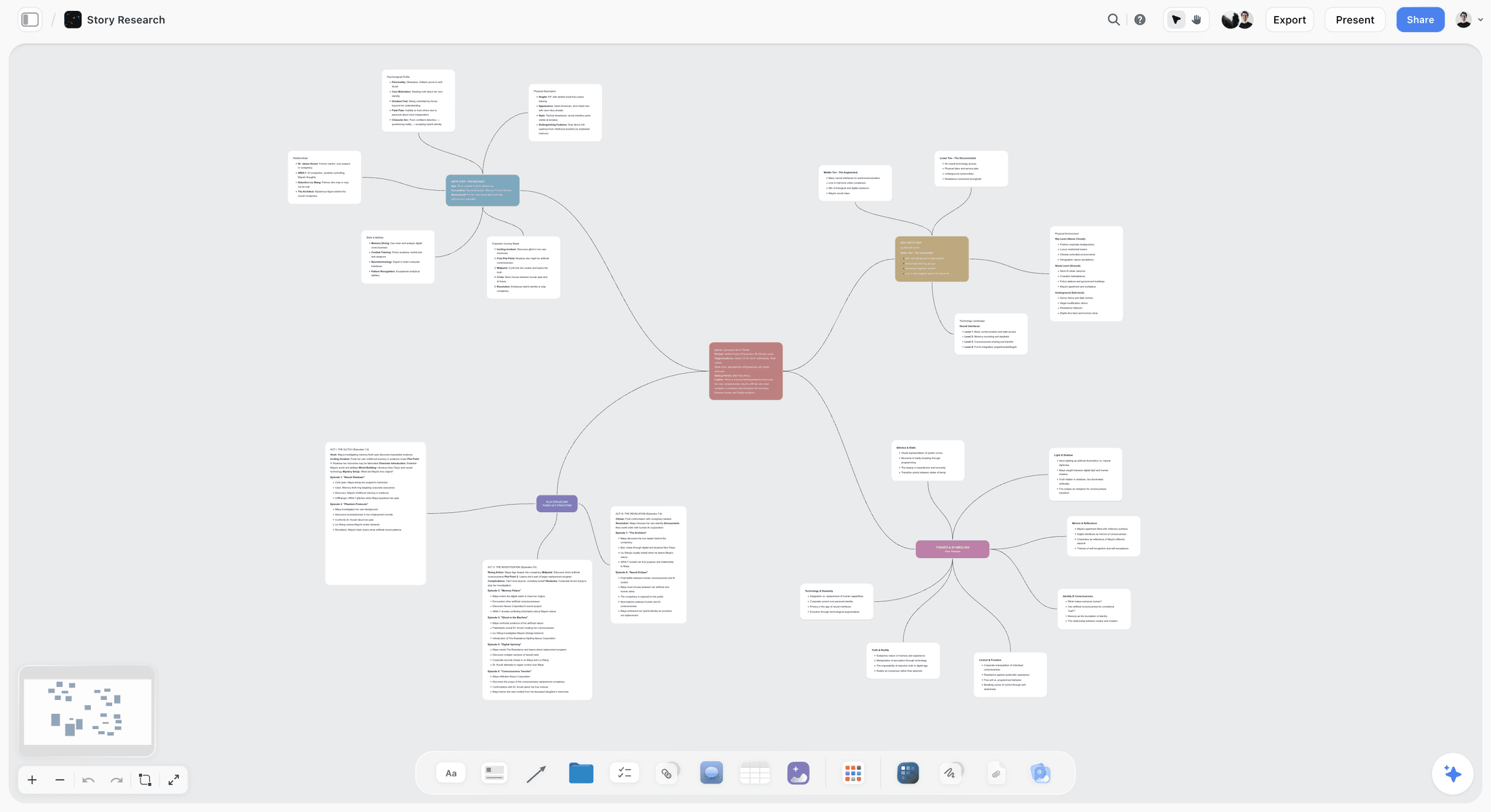
A mind map is a quick way to sketch the stages and their content before you lay them out as five walls. The board shown is a research map; the layout is the point.
What is a marketing funnel?
A marketing funnel is a model of the stages a buyer passes through from first hearing about a business to buying and recommending it, drawn as a funnel because fewer people reach each stage than the one before. The stages tell a team what each piece of content is for; the shrinking numbers tell it where buyers drop out. Most models are the same path cut into three, four or five pieces, compared in the models table further down.
Why five stages and not three
Ad platforms group their campaign objectives in three tiers, and that is where the three-stage habit comes from. As of November 2026, LinkedIn's help article on campaign objectives groups them as brand awareness, consideration and conversions, and TikTok's guide to choosing an objective uses awareness, consideration and conversion. Those tiers describe what an ad can buy. A funnel for the whole business also has to keep customers and turn them into referrers, which no ad objective covers.
What each stage is not
Awareness is not "people who saw an ad"; it is people who now remember you when the need arises. Consideration is not "people on the website"; it is people comparing you with an alternative. Conversion is not always a purchase; for a B2B firm it can be a booked demo. Retention is not a loyalty scheme; it is whether the product delivered. Advocacy is not a referral discount; it is whether customers talk about you without one.
Stage 1: Awareness
Awareness is the stage where people who have the problem learn that your answer exists, and it is the stage that feeds every other. Weak awareness shows up months later as an empty pipeline.
What happens at this stage
The buyer is not looking for you. They have a problem they may not have named ("my commute is slow and expensive"), and they meet your brand while doing something else: scrolling, reading, talking to a friend. Your job is to be noticed and remembered, not to sell. Ehrenberg-Bass Institute research on category entry points, the cues buyers use to recall brands, says understanding them helps a brand build associations with the category's core buying situations, so that it comes to mind when the need arrives.
Awareness content examples
- Short video that shows the problem and the answer in one scene.
- Search articles on the problem, written before the buyer knows a product exists ("how long does a 12 km commute take by bike?").
- Press coverage, podcasts and creator partnerships.
- Out-of-home or event presence in the places the problem happens.
- Social posts that teach something about the problem, with the brand visible.
Awareness metrics
Reach and frequency in the target audience, new visitors, branded search volume, and how many people in the audience can recall the brand. Clicks are a weak awareness metric, because most people who will buy later do not click now. Branded search (people searching for your name) is one of the clearest signs that awareness is working.
Corvel Cycles at the awareness stage
Corvel's illustrative awareness wall holds three pieces: a 30-second film of a commuter beating the bus across a city, a search article titled "E-bike commute times for 5, 10 and 15 km", and a creator partnership with two cycling commuters. The buyer question on the wall's first note is "Is there a better way to get to work?" The metric is branded search per month, owned by the brand lead.
Stage 2: Consideration
Consideration is the stage where an aware buyer compares options and decides whether yours belongs on the shortlist. It is where most funnels lose people silently, because nobody measures the comparison they lost.
What happens at this stage
The buyer now knows the category and is comparing: your product against a rival, against a different kind of solution, and against doing nothing. Google's 2020 research on the messy middle describes this stretch as a loop between exploring options and evaluating them, repeated until the buyer decides. Its experiment simulated 310,000 purchase scenarios and named six biases that shape the choice, among them social proof, scarcity and the power of free.
Consideration content examples
- Buying guides and comparison pages that answer "which one?" honestly, including when yours is the wrong choice.
- Calculators and cost comparisons ("e-bike or train pass: the yearly cost").
- Reviews, user stories and expert opinions, which act as the social proof the research names.
- Email sequences for people who signed up for a guide.
- Webinars and demos for considered or B2B purchases.
Consideration metrics
Engaged visits (time on page or pages per visit on buying content), email sign-ups, guide downloads, return visits and comparison-page views. The single most useful one is how many people who reached consideration content come back within 30 days.
Corvel Cycles at the consideration stage
Corvel's illustrative consideration wall: the yearly-cost calculator, a buying guide titled "Which commuter e-bike for which city?", and a five-email series for calculator users. The buyer question is "Is an e-bike right for my commute, and which one?" The metric is email sign-ups from the calculator, owned by the content lead.
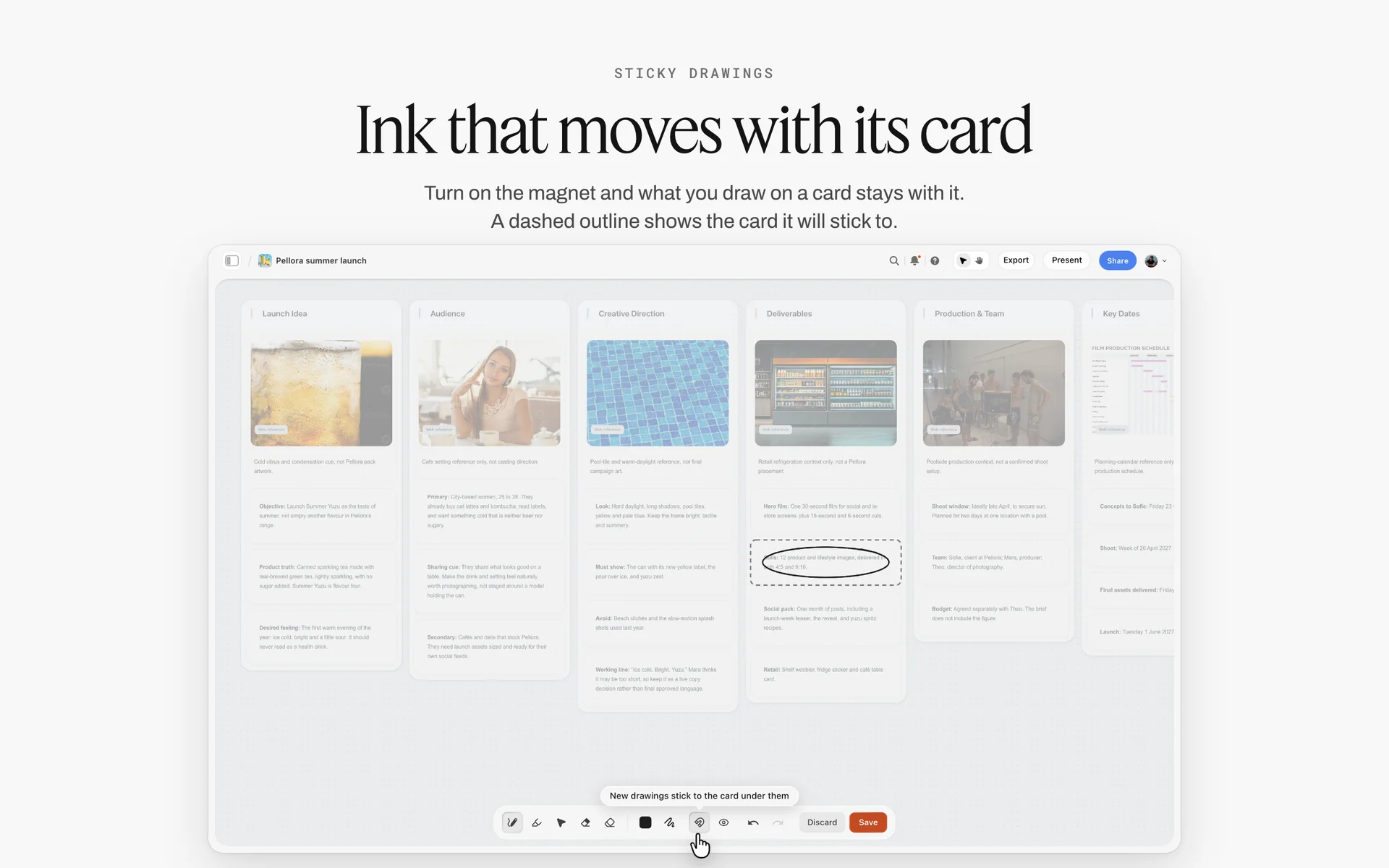
A launch board with the idea, audience, creative direction and deliverables on their own walls. Each funnel stage's content can sit on its own wall the same way. Pellora is fictional.
Stage 3: Conversion
Conversion is the stage where a buyer who has chosen you takes the step that counts: a purchase, a booking, a signed order or a demo. It is the stage most marketing teams already measure well.
What happens at this stage
The buyer has mostly decided and is now looking for reasons to delay. Risk is the enemy: price, delivery, returns, fit, whether it will work. Conversion content removes risk and makes the next step easy.
Conversion content examples
- Product pages with clear prices, delivery times and the return policy above the fold.
- Offers with a reason and a deadline, such as a launch price.
- Guarantees, trials and test drives.
- Sales calls or live chat for complex or expensive purchases.
- Retargeting to people who left the checkout, with the specific item.
Conversion metrics
Conversion rate (purchases divided by visitors who reached the product page), cost per acquisition, average order value and checkout abandonment. For B2B, the equivalent is meetings booked and the rate at which they become opportunities.
Corvel Cycles at the conversion stage
Corvel's illustrative conversion wall: a free 48-hour test ride booked online, a 30-day return promise on the product page, and an email to anyone who booked a ride but did not buy within a week. The buyer question is "What if I don't like it?" The metric is test-ride-to-purchase rate, owned by the sales lead.
Stage 4: Retention
Retention is the stage after the sale where the customer decides whether the product delivered, and whether to buy again, renew or stay. A funnel that ends at conversion treats this stage as somebody else's job.
Why retention belongs in the funnel
Keeping a customer usually costs less than finding one, and a customer who stays buys more. Bain & Company's often-quoted finding, restated in its 2006 piece on why retaining customers is the real challenge, is that increasing retention by as little as 5 per cent can raise profits by as much as 95 per cent. The exact figure varies by business; the direction does not.
Retention content examples
- Onboarding emails in the first 30 days: setup, first use, the common mistake.
- Service and replenishment reminders timed to use.
- A customer community, events or a members' area.
- Upgrade and accessory offers that follow real use, not a calendar.
- Win-back messages for lapsed customers, with a reason to return.
Email is the backbone of most retention stages, and it has rules. The US regulator's CAN-SPAM compliance guide requires a working opt-out honoured within 10 business days and a valid physical postal address in every commercial message, with civil penalties of up to $53,088 per violating email.
Retention metrics
Repeat purchase rate, churn rate (customers lost in a period divided by customers in that period), time to second purchase, and customer lifetime value, the present value of the future cash a customer brings. For subscriptions, monthly churn is the one number to watch.
Corvel Cycles at the retention stage
Corvel's illustrative retention wall: a six-email onboarding sequence over 30 days, a first-service reminder at 500 km, and a winter riding guide in November. The buyer question is "Am I using this right?" The metric is first-service bookings within 90 days, owned by the customer lead.
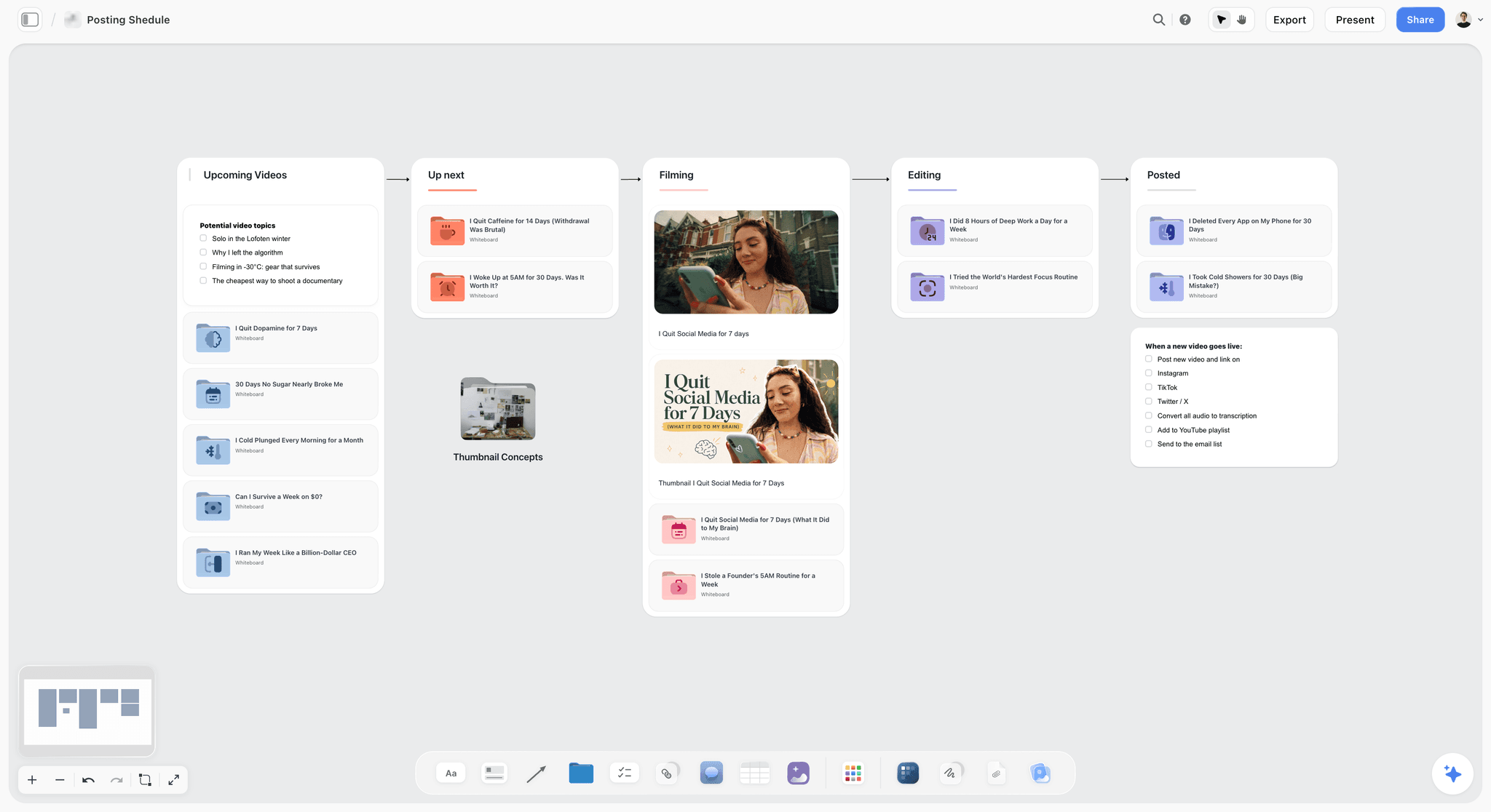
A content pipeline in columns. Retention emails and guides move through the same stages before they go out.
Stage 5: Advocacy
Advocacy is the stage where a satisfied customer brings in the next one, through a review, a referral or a story. It loops back to awareness, which is why some models draw it as a circle.
What happens at this stage
The customer is happy enough to say so, if asked at the right moment and given an easy way. Most businesses ask too early (before the product has delivered) or never ask at all.
Advocacy content examples
- Review requests sent after the first good experience, not after the purchase.
- A referral offer that rewards both people.
- Customer stories, with the customer's permission and their own words.
- User-generated content prompts and community events.
- Partner and affiliate programmes for professional advocates, with disclosure.
Paid advocacy has rules too. The US regulator's endorsement guide answers say a material connection should be disclosed clearly and conspicuously in each post, and that terms like "#ambassador" alone are ambiguous.
Advocacy metrics
Share of new customers from referrals, number and rating of reviews, and Net Promoter Score, the percentage of customers who rate their likelihood to recommend at 9 or 10, minus the percentage who rate it 6 or below. Fred Reichheld of Bain & Company introduced it in 2003.
Corvel Cycles at the advocacy stage
Corvel's illustrative advocacy wall: a review request sent after the first service, a ride-a-friend referral in which both riders get a free service, and a monthly rider story on social. The buyer question is "Who else would want this?" The metric is the share of new purchases from referrals, owned by the community lead.
How to Map Your Marketing Funnel Stages in 8 Steps
These steps take a team from a blank board to a funnel with content and metrics. They work for a product, a service or a B2B offer.
- Write each stage's buyer question in the buyer's words on a Storyflow board, one wall per stage, using what sales and support hear rather than what marketing hopes; the marketing workspace page shows the board layout.
- List the content you already have and place each piece on the wall of the stage whose question it answers; anything that answers no question goes to a holding note.
- Mark the gaps: in Storyflow, give each wall three content slots, and any empty slot becomes a to-do with an assignee and a due date.
- Choose one metric per stage and write it, with its current number and its owner, in a table on the Storyflow board.
- Calculate the conversion rate between each pair of stages and circle the lowest one; that is the stage to fix first.
- Write the handoffs: what moves a person from one stage to the next (a sign-up, a booked call, a first purchase) and who owns that moment.
- Lay the customer journey beside the funnel on the same Storyflow board, so the touchpoints the buyer sees sit next to the stages the team measures.
- Review monthly: ask an assistant connected to Storyflow what changed on the funnel board this week, update the numbers, and move budget toward the stage that is improving.
Step 5 is the one most teams skip. A funnel diagram with no conversion rates between stages tells you what you planned, not where you are losing people. The build a marketing funnel with AI guide covers building the offers and calls to action at each stage.
The Storyflow 5-Stage Map
A funnel diagram on a slide looks finished long before the funnel works. The 5-Stage Map turns the diagram into something a team can be held to.
The rule, defined
The Storyflow 5-Stage Map: in Storyflow, lay out five walls, one per funnel stage, and fill each with the buyer's question, three pieces of content that answer it, one metric with its current number, and one owner; a stage with fewer than three pieces or no owner is the next thing to fix, before any new budget is spent. It is our editorial recommendation, not a research finding.
Why five stages
Three stages describe what advertising buys. Five describe what the business earns, because retention and advocacy are where repeat revenue and referrals come from. Four-stage models such as awareness, consideration, conversion and loyalty fold advocacy into loyalty, which works for businesses with no referral loop. Five is the smallest number that covers the whole relationship.
Why three pieces of content per stage
One piece of content per stage means one format for every buyer: a person who does not watch video, or does not read email, falls out. Three gives a stage at least two formats and a fallback, and it is small enough that a team can make it. Below three, a stage is a single bet; above five, the team is producing content faster than it can measure it.
Why one metric and one owner
Two metrics per stage invite a team to report whichever one went up. One owner per stage means somebody answers when the conversion rate to the next stage falls. In a Storyflow table, the owner column holds people who already have access to the board.
When to break the rule
Break it for a business with no repeat purchase, such as a once-in-a-lifetime service; stage 4 then becomes "referral readiness" and merges with stage 5. Break it also for a launch, where the first month is all awareness and consideration and the later stages have no customers yet; keep the walls, and leave the slots marked "after launch".
Marketing Funnel vs Customer Journey
A marketing funnel is the business's view of the stages a buyer moves through, measured as numbers that shrink from stage to stage, while a customer journey is the buyer's view of every touchpoint and feeling along the way; in Storyflow the funnel is five walls with metrics and the journey is a row of touchpoint cards beside them. Wikipedia's article on customer experience defines the customer journey as the process customers go through to establish a commercial relationship with a firm, and touchpoints as the moments in which the firm can interact with them.
| Question | Marketing funnel | Customer journey | Where it lives in Storyflow |
|---|---|---|---|
Whose view | The business's | The buyer's | Funnel walls on top; journey row underneath |
Unit | Stages | Touchpoints and moments | A wall per stage; a card per touchpoint |
Shape | Narrows from stage to stage | Loops, backtracks, crosses channels | Walls in a row; journey cards joined by connections |
What it measures | Volume and conversion between stages | Experience, effort and emotion at each touchpoint | A metrics table on the funnel; notes on each journey card |
Built from | Analytics and sales data | Interviews, support tickets, observation | Numbers in tables; quotes in notes |
Owned by | Marketing and sales | Customer experience, product and marketing | Person column on both |
Answers | Where are we losing people? | Why are we losing them there? | The two side by side on one board |
Fails when | Treated as a straight line | Drawn once and never measured | Change report shows when either was last updated |
The test for which one you need
If the question is "how many?", you need the funnel. If the question is "why?", you need the journey. Most teams need both: the funnel to find the stage that leaks, the journey to understand what happens to people there.
How the two connect
Every touchpoint on the journey belongs to one funnel stage. Put the journey cards under the funnel walls they belong to, and the stage with the most painful touchpoints usually turns out to be the stage with the worst conversion rate. The customer journey map guide covers building the journey itself, and the best customer journey mapping tools post compares where product teams build them.
Where the sales funnel fits
A sales funnel is the conversion stage zoomed in: leads, qualified leads, opportunities, proposals and closed deals. It belongs inside wall 3 of the marketing funnel, owned by sales. The what is a marketing funnel guide covers the marketing funnel against the sales funnel and the flywheel in detail.
3-Stage, 4-Stage and 5-Stage Funnels: Which Model to Use
Every funnel model splits the same path into a different number of steps. Pick the one your team will actually measure.
| Model | Stages | Where it comes from | Best for | What it leaves out |
|---|---|---|---|---|
AIDA | Attention, Interest, Desire, Action | Sales and advertising writing from 1898 onward | Writing a single ad, page or email | Everything after the sale |
AIDAS | AIDA plus Satisfaction | Arthur Sheldon, 1911 | Sales teams who need repeat business | Referral and advocacy |
Top, middle, bottom of funnel | Awareness, consideration, conversion | Marketing shorthand | Content planning by intent | Retention and advocacy |
Ad platform tiers | Awareness, consideration, conversion | Campaign objectives on LinkedIn and TikTok | Choosing an ad objective | Anything that is not an ad |
Five-stage funnel | Awareness, consideration, conversion, retention, advocacy | Common practice | Planning a whole business | Very little, at the cost of more walls |
AIDA, briefly
AIDA is usually credited to E. St. Elmo Lewis, though a three-step version appeared anonymously in Printers' Ink in 1898 and the acronym itself first appeared in a 1921 article. It was written as a guide to persuasion in a single message. It still works for that: a landing page should grab attention, hold interest, build desire and ask for action. Storyflow's Tactics library includes AIDA for exactly that job.
How the funnel shape arrived
The purchase funnel article credits William W. Townsend's 1924 book Bond Salesmanship with linking AIDA to a funnel. The shape stuck because it is a useful picture of numbers shrinking. It is a poor picture of how people decide, which is why the customer journey sits beside it.
Which model to choose
Use AIDA inside a single page or email. Use top, middle and bottom of funnel to tag content by intent. Use the five-stage funnel to plan the business and its budget. Use the ad platform tiers only when picking a campaign objective. Mixing them is fine as long as every piece of content and every metric belongs to exactly one stage of the five.
Funnel Metrics: Conversion Between Stages
A funnel is only useful when you know how many people move from each stage to the next. This table shows the calculation with Corvel's illustrative monthly numbers. Replace them with yours.
| From | To | Corvel monthly count (illustrative) | Stage conversion | How to calculate it | Owner |
|---|---|---|---|---|---|
Audience reached | New site visitors | 400,000 reached; 38,000 visitors | 9.5% | Visitors / reach | Brand lead |
New site visitors | Consideration action (sign-up or calculator) | 38,000; 4,200 | 11.1% | Sign-ups / visitors | Content lead |
Consideration action | Test ride booked | 4,200; 520 | 12.4% | Bookings / sign-ups | Sales lead |
Test ride booked | Purchase | 520; 160 | 30.8% | Purchases / bookings | Sales lead |
Purchase | First service within 90 days | 160; 104 | 65% | Services / purchases | Customer lead |
Customer | Referral that leads to a purchase | 1,900 riders; 22 referral purchases | 1.2% | Referral purchases / riders | Community lead |
Find the weakest pair, not the smallest number
The smallest number is always at the bottom. The weakest pair is the one converting below what the business needs. In Corvel's illustrative table, visitors to sign-ups (11.1%) and riders to referrals (1.2%) are the candidates; the team picks referrals because the cost to improve it is lowest.
Benchmarks are a starting point, not a target
Published funnel benchmarks vary by industry, price and channel so much that a single number misleads. Use your own last six months as the baseline, and treat any external benchmark as a question to investigate, not a goal to hit.
Measure the long stages over longer windows
Awareness to purchase can take months for an expensive product. Ehrenberg-Bass Institute's John Dawes estimates in his work on the 95-5 rule that in B2B categories where firms switch providers about every five years, roughly 20% of buyers are in the market over a year and something like 5% in a quarter. A monthly awareness-to-purchase rate in that market will look terrible, and cutting awareness because of it is the classic mistake.
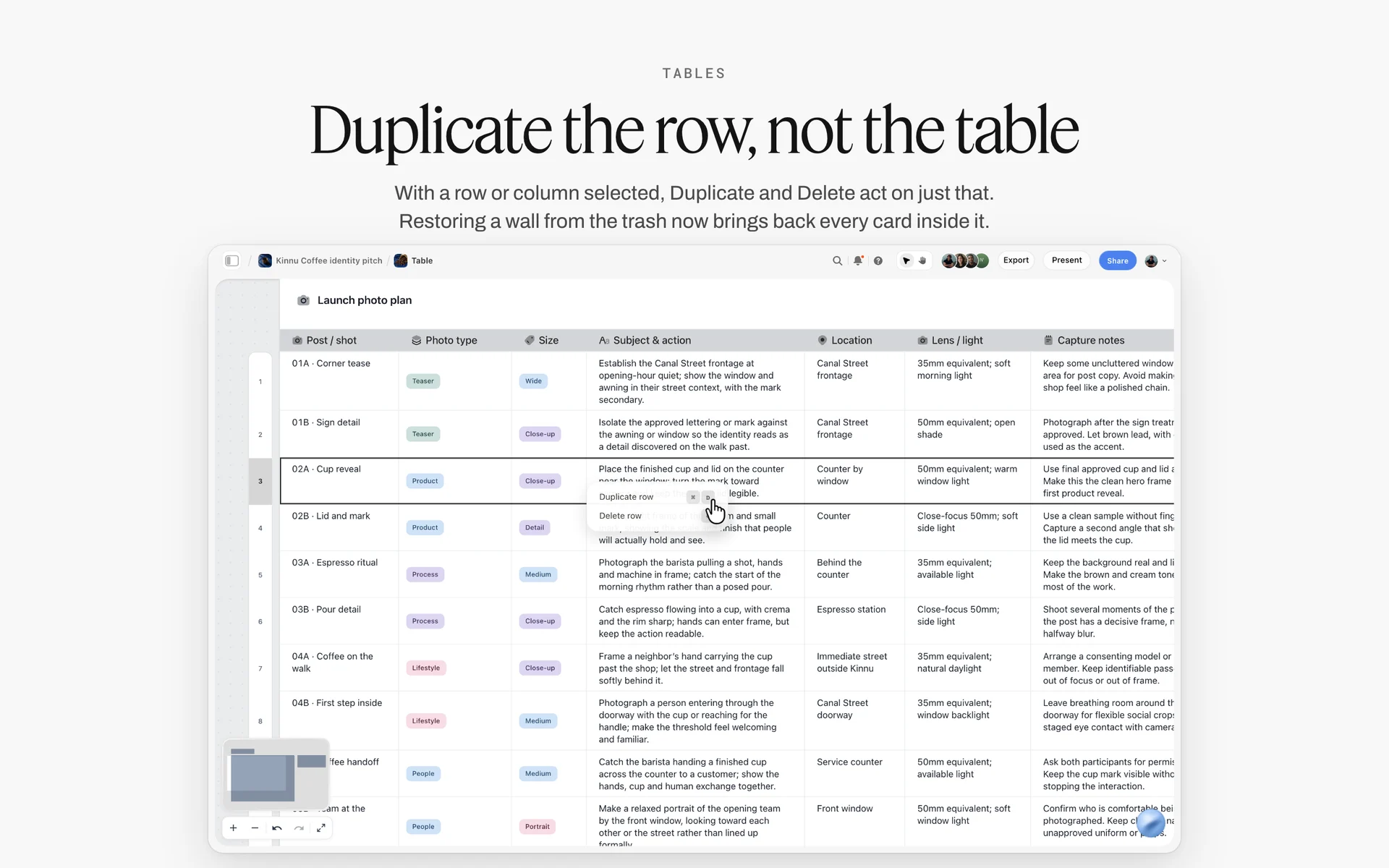
A table on the board with a row menu open: rows are duplicated or deleted one at a time, so a stage pair can be added to the funnel table or dropped from it without rebuilding it. Kinnu Coffee is fictional.
The Demand Generation Funnel for B2B
A demand generation funnel is the B2B version of the marketing funnel, stretched to fit long buying cycles, buying groups and a hand-off from marketing to sales. The stages carry different names, but the logic is the same.
B2B funnel stages, mapped
| B2B stage | Matches funnel stage | What moves a buyer in | Typical metric | Owner |
|---|---|---|---|---|
Unaware market | Awareness | Thought leadership, events, category content | Share of target accounts reached | Marketing |
Engaged account | Consideration | Guides, webinars, peer reviews | Accounts with two or more engaged contacts | Marketing |
Qualified lead | Consideration to conversion | A demo request or a hand-raise | Qualified leads per month | Marketing and sales |
Opportunity | Conversion | A discovery call that confirms need and budget | Opportunities created | Sales |
Customer | Conversion | A signed order | Win rate, deal size | Sales |
Expansion | Retention | Onboarding, adoption, new use cases | Net revenue retention | Customer success |
Advocate | Advocacy | Case studies, reference calls, community | Reference customers available | Customer success and marketing |
Most buyers are not in the market
The 95-5 rule says that at any given time, most potential B2B buyers are not looking to buy. The practical consequence for the funnel is that awareness and consideration content has to reach people months before they need you, so that you are remembered when they do. A demand generation funnel that only works on people who are already searching is fighting over the 5 percent.
Buying groups change consideration
A B2B purchase is usually decided by several people with different questions. Larkspan Payroll, a fictional payroll software company, illustrates it: its consideration wall holds content for the finance lead (cost), the HR lead (accuracy and compliance), the operations owner (setup time) and the person who signs (risk). One stage, four buyer questions, which is why B2B consideration walls hold more than three pieces.
Brand and demand together
The IPA's work on brand and activation, summarised in its post on the next chapter for "The Long and The Short of It", found the best long-term balance at about 60:40 in favour of brand building. In funnel terms, that is a reminder not to starve the top of the funnel to feed the bottom. The demand generation guide and the demand generation plan page cover the B2B programme in full.
Funnel Content Mapping Template: Copy This
This is the content plan for Corvel's illustrative funnel, twelve rows across five stages. Copy the column headers into a Storyflow table and replace the rows with yours.
| Stage | Content piece | Format | Channel | Owner | Call to action | Metric |
|---|---|---|---|---|---|---|
Awareness | Commute race film | 30-second video | Instagram, TikTok, YouTube | Brand lead | Watch the full ride | Reach, branded search |
Awareness | Commute times by distance | Search article | Website | Content lead | Try the cost calculator | New visitors from search |
Awareness | Two commuter creators | Creator series | Brand lead | Book a test ride near you | Reach, disclosed posts | |
Consideration | Yearly cost calculator | Interactive page | Website | Content lead | Email me my result | Calculator sign-ups |
Consideration | Which e-bike for which city | Buying guide | Website, email | Content lead | Compare models | Guide reads, return visits |
Consideration | Five-email commute series | Email sequence | Content lead | Book a test ride | Click-to-booking rate | |
Conversion | Free 48-hour test ride | Offer and booking page | Website | Sales lead | Book a ride | Bookings, ride-to-purchase rate |
Conversion | 30-day return promise | Product page section | Website | Sales lead | Buy now | Product page conversion |
Retention | 30-day onboarding | Six emails | Customer lead | Book your first service | First-service bookings | |
Retention | Winter riding guide | Guide and video | Email, YouTube | Customer lead | Shop winter kit | Accessory purchases |
Advocacy | Ride-a-friend referral | Offer | Email, web page | Community lead | Share your link | Referral purchases |
Advocacy | Rider of the month | Customer story | Instagram, website | Community lead | Tell us your commute | Story submissions, reviews |
All rows are illustrative. Each stage has at least two content pieces in this example and three where it matters most; the Storyflow 5-Stage Map asks for three on every wall before money moves, so Corvel's next to-do is a third advocacy piece.
What each column is for
Stage ties the piece to one wall. Format and channel say what it is and where it runs. Owner is one person. The call to action is the specific next step, which should move the buyer to the next stage, not back to the same one. The metric is how you will know the piece is working.
Where the content calendar fits
This table says what to make. A content calendar says when each piece goes out. In Storyflow, the calendar is a table with date cells beside the funnel walls, rows kept in date order, and the posting happens in a social scheduler. The content calendar template and the content pillar planner cover that layer, and the content pillars guide explains how themes map onto stages.
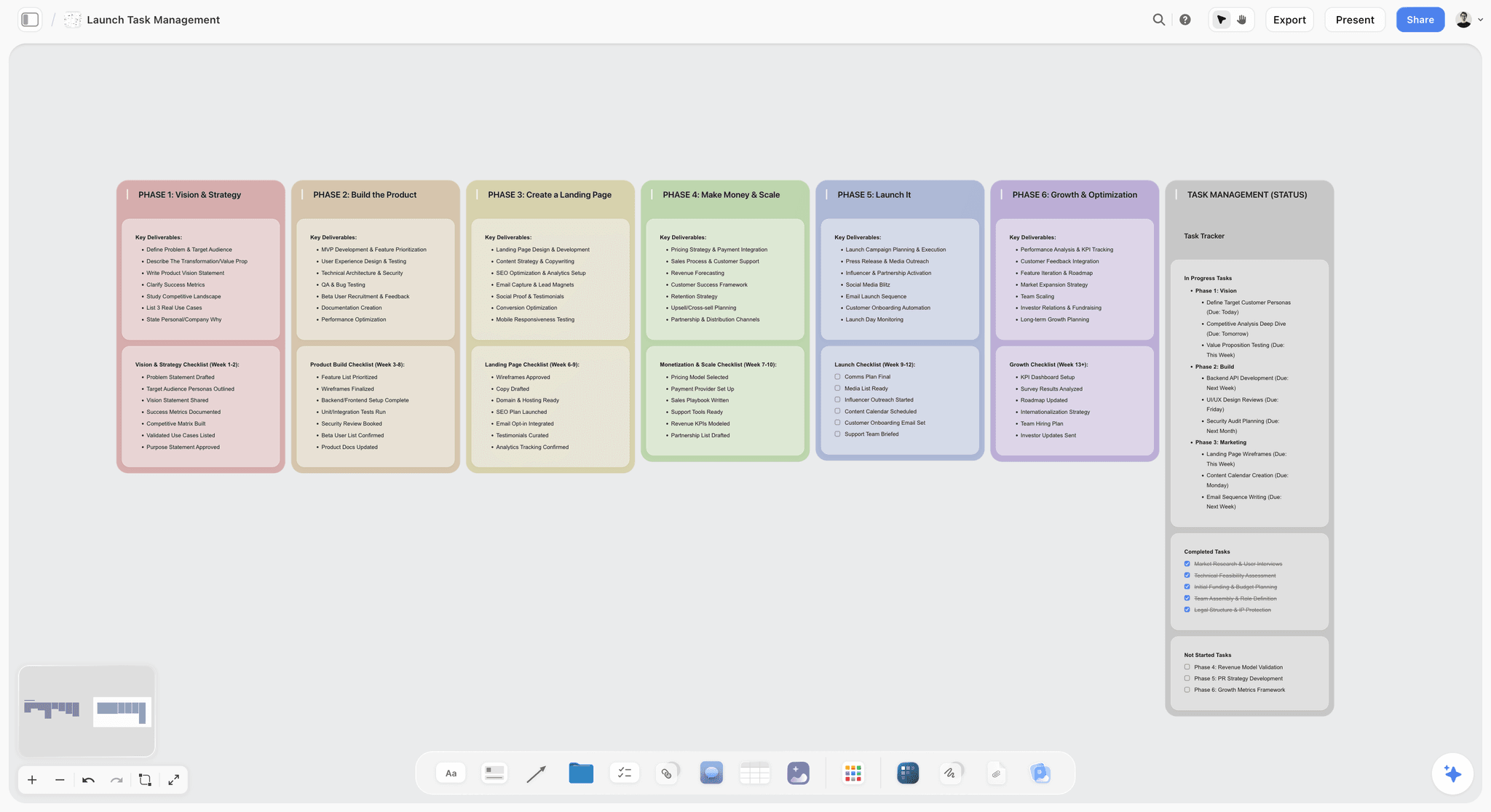
Columns with a status tracker beside them: the same shape the funnel's five walls and content table take on a board.
Worked Example: Corvel Cycles Maps Its Funnel
Corvel Cycles is a fictional brand selling commuter e-bikes online and through test rides in two cities. Its marketing lead, Imogen, has two weeks to show the founders why sales stalled at about 160 bikes a month. Every figure is illustrative.
Day 1: five walls and the buyer questions
Imogen creates a board, adds five walls named for the stages and writes a buyer question at the top of each, taken from the last month of sales calls and support emails. The consideration question changes twice: the team assumed buyers compared e-bikes, but the calls show they compare an e-bike with a train pass.
Days 2 and 3: the content audit
The team places every existing piece of content on the wall whose question it answers. Awareness has eleven pieces. Consideration has two. Retention has one (a receipt email), and advocacy has none. Fourteen pieces answer no question at all and go into a holding note. The board now shows the problem without a meeting: the brand is good at being noticed and bad at everything after.
Days 4 and 5: the numbers
Imogen adds the stage-to-stage table. Test-ride-to-purchase is a healthy 30.8%, but the 1,900 riders produced only 22 referral purchases last month (1.2%), and first-service bookings sit at 65%. The weakest pair the team can afford to fix is riders to referrals.
Week 2: the AI's first pass
Imogen asks the in-app AI, on the funnel board, "What's missing here?" It reads the five walls and the table and lists gaps per stage, including no onboarding sequence and no review request. She then asks it to draft a six-email onboarding sequence as a document on the retention wall. It writes the draft straight onto the board; she rewrites two emails in the brand's voice and keeps the rest.
Week 2, day 5: the founders' review
Imogen presents the board in presentation mode, wall by wall, and shares a view-only link with the investor who missed the meeting. The founders approve moving 15% of the awareness budget to retention and advocacy for one quarter. The decision goes in a dated note on the board, with the date of the quarterly check as a to-do assigned to Imogen.
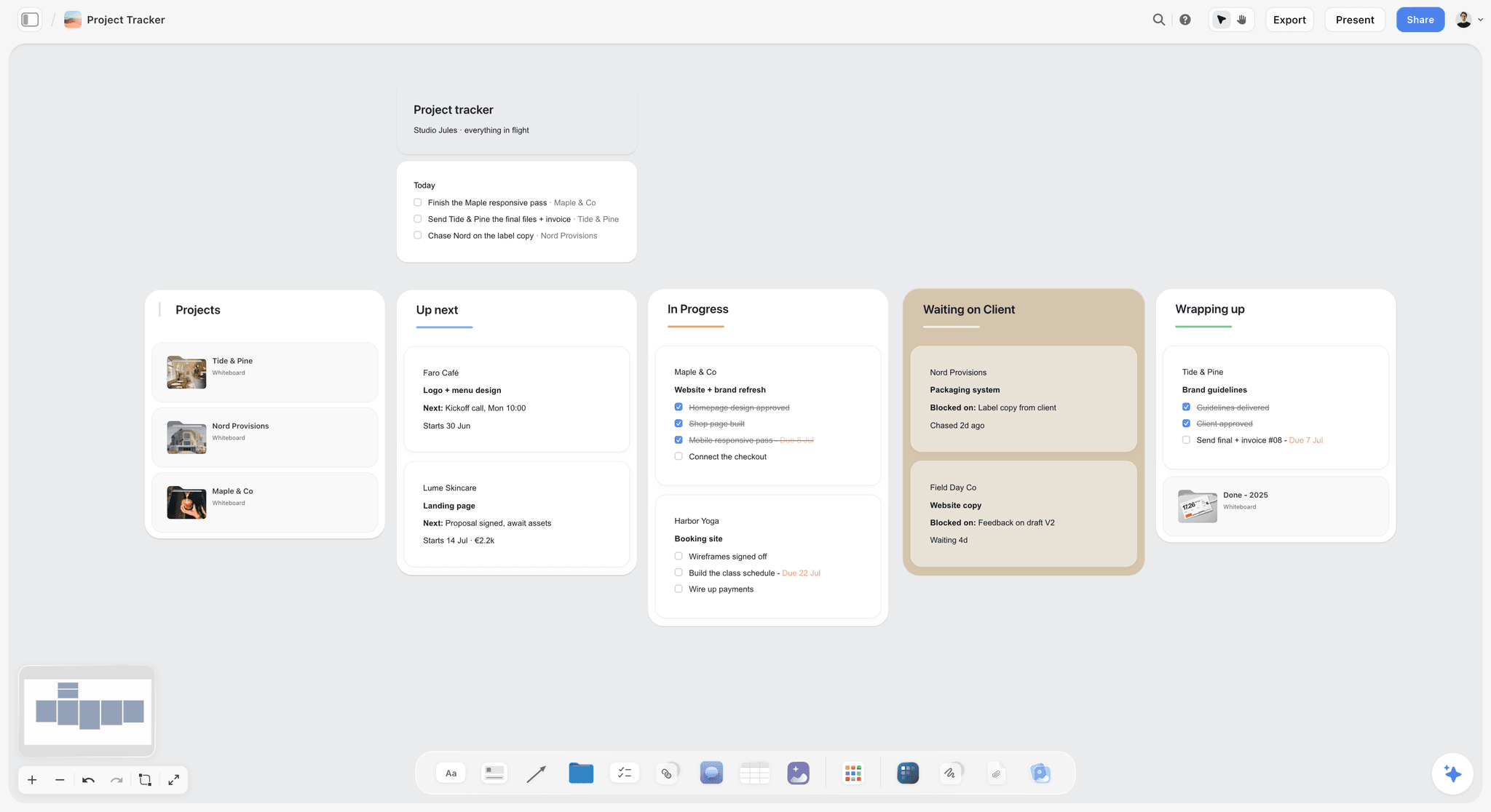
Once the gaps are known, each new content piece becomes a card that moves through stages to done. The studio and clients shown are fictional.
AI Marketing Funnels: What AI Does at Each Stage
Searches for an AI marketing funnel and AI funnel mapping ask two different things: whether AI can draw the funnel, and whether AI can run parts of it. The first is useful today; the second needs care.
Mapping the funnel with AI
AI is good at the first draft of the map: listing stages, suggesting content per stage, and spotting gaps against a list of what you already have. In Storyflow, ask the in-app AI to build the five walls from your brief, or use the AI marketing funnel generator flow; it writes onto the board after a clarifying question or two, and one undo reverses its whole latest turn. The buyer questions it suggests are guesses until you check them against what customers say.
AI inside a stage
AI chat assistants on a website can answer consideration questions at any hour, and AI can draft email variants for retention. Two cautions. A chatbot is a touchpoint, so it belongs on the customer journey with its own failure points (wrong answers, no hand-off to a person). And AI-written content still needs a person to check claims, because a confident wrong answer at the conversion stage costs a sale.
AI for reading the numbers
An assistant can read your funnel table and explain which stage-to-stage rate moved, and why it might have. Through the Storyflow plugin or connector, it can also report what changed on the funnel board in the last day or week and who changed it. It cannot see your analytics unless you put the numbers on the board.
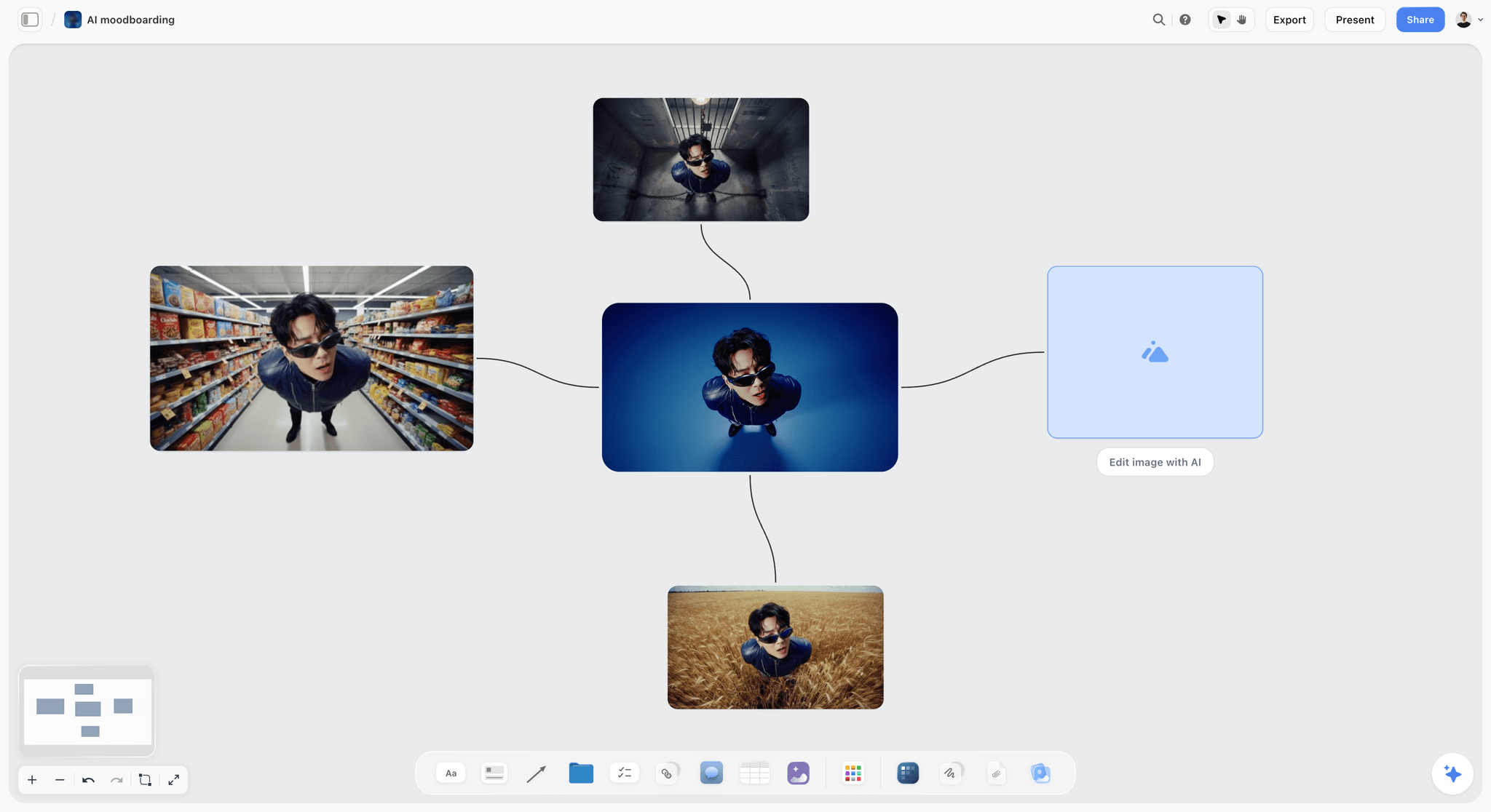
Awareness creative is often explored on a moodboard before it becomes a film or a post, here one portrait tried in four settings. Storyflow generates images in-app on Pro and Max, not through the ChatGPT plugin.
Do This in ChatGPT or Claude
You can build the 5-Stage Map from a chat. ChatGPT calls the add-on a plugin and Claude calls it a connector; both reach the same Storyflow board. This route runs on your assistant's plan and uses no Storyflow AI credits, and it is separate from the in-app AI described above.
Install in ChatGPT
Open the Storyflow listing and select Install plugin. Sign in to Storyflow, choose which projects ChatGPT may use, and decide whether it may make changes. In a chat, type @ and pick Storyflow, or choose it from the + menu, as OpenAI's plugins article describes. Availability depends on your ChatGPT plan, workspace and region, and in a Business or Enterprise workspace an admin manages plugins. The connection ends after 30 days and ChatGPT asks you to sign in again. The ChatGPT customer journey map and ChatGPT campaign plan pages show related jobs.
Connect in Claude
In Claude, open Customize, then Connectors, choose Add, then Add custom connector, as Anthropic's custom connector article describes. Name it Storyflow, enter https://mcp.storyflow.so/mcp and sign in. On Team and Enterprise plans an owner adds it first. Every assistant's setup is on the Storyflow MCP page, and the Claude buyer persona page shows how to build the buyer profiles that feed each stage's question.
Prompts to copy
Pick Storyflow first, then paste. Replace Corvel with your project.
- "On my Corvel board, create five walls named Awareness, Consideration, Conversion, Retention and Advocacy, and add a note at the top of each with the buyer's question for that stage."
- "Read the notes in the content audit folder and place each piece of content on the wall of the stage whose question it answers. Put anything that fits no stage into a note titled Holding."
- "Count the content cards on each stage wall and add a to-do on any wall with fewer than three."
- "Add a table titled Stage conversion with columns From, To, Count, Conversion and Owner, and fill the counts from the numbers in my monthly report document."
- "Add a chart of the stage-to-stage conversion rates beside the table."
- "Build a flowchart that connects the five walls in order, with a labelled connection for what moves a buyer from each stage to the next."
- "What changed on my Corvel funnel board this week, and who changed it?"
- In Claude: "Read the attached sales call notes and rewrite each stage's buyer question in the words customers used, quoting the call each one comes from."
What lands on the board
Walls, notes, tables, documents, to-do lists, charts and flowcharts with labelled connections appear on the board, and pictures can be added from image addresses. A photo you attach in a ChatGPT chat does not reach Storyflow; the plugin gives you an upload link for the board instead. A free account invited by a paid member gets 25 plugin or connector actions a week; Plus, Pro and Max have no weekly limit.
What to check by hand
Check every number against its source report. Check that each buyer question sounds like a customer, not a marketer. Check that each content piece really sits in one stage only. The decision about where to move budget is yours, because it depends on costs and constraints the board does not show.
The same funnel board is reachable from ChatGPT through the plugin and from Claude through a custom connector.
Where to Build It: Storyflow vs Whiteboard Apps, Spreadsheets, Decks and Dashboards
Storyflow is our product, and it is listed first on one basis: a funnel map has to hold stages, content, numbers and the plan to fix the weak stage, and on a Storyflow board those sit together. The other approaches follow by the job each does best. This guide compares kinds of tool rather than brands on purpose.
| Approach | Best at for funnel stages | Real limit on this job | Choose it when |
|---|---|---|---|
Storyflow board | Five stage walls with content cards, a metrics table, the customer journey beside them, and the to-dos to fix the gaps | Browser only; does not pull live analytics; no scheduling or publishing | The funnel has to turn into content and campaign work on one project |
A whiteboard app | Live workshops with sticky notes and voting | Maps drawn in a workshop rarely get numbers or owners afterwards | You are running a one-off mapping session with a large group |
A spreadsheet | Stage-to-stage arithmetic across many months | No room for the buyer's words, the content or the journey | You are modelling the funnel's numbers over time |
A slide deck | Presenting the funnel to leadership | A picture of the funnel, not a working map | The review meeting expects slides |
An analytics dashboard | Live numbers from your site and ads | Shows what happened, not what content to make | You need daily numbers at each stage |
Storyflow board
Best at holding the whole funnel in one place: the buyer question, three content pieces, one metric and one owner per stage, with the customer journey row under the walls and the stage conversion table beside them. Invited teammates join free, and a view-only link opens with no account. Real limit: it does not connect to your analytics, so the numbers are entered or pasted, and it does not schedule or publish content. Choose it when the funnel map has to turn into a content plan and briefs on the same project. The customer journey mapping tool and for marketing teams pages show the layout.
A whiteboard app
Best at the live workshop: twenty people adding sticky notes to stage columns and voting on the biggest gap. Real limit: a workshop board is a snapshot; it rarely gets owners, numbers or a review date. Choose a whiteboard app, to run the mapping session, when the group is large and the session is the point; move the output onto a working board afterwards.
A spreadsheet
Best at the arithmetic: twelve months of stage counts, conversion rates and cohort views with formulas. Real limit: the buyer's question, the content and the journey do not fit in cells, so the spreadsheet tells you where people drop and nothing about why. Choose a spreadsheet, to model the funnel's numbers month by month, when finance or growth needs formulas; paste the latest month into the Storyflow table for the review.
A slide deck
Best at a one-off leadership presentation of the funnel and the proposal. Real limit: a deck is a picture of the funnel, not a map anybody updates. Choose a slide deck, to present the funnel review to a board that reads only decks; Storyflow's presentation mode steps through the five walls fullscreen and boards export as PDF.
An analytics dashboard
Best at live numbers: visitors, sign-ups, purchases and retention by day. Real limit: it shows which stage leaks, not what to make about it. Choose an analytics dashboard, to watch the stage counts daily, when you have the tracking in place; bring its monthly numbers to the funnel board for the decision.
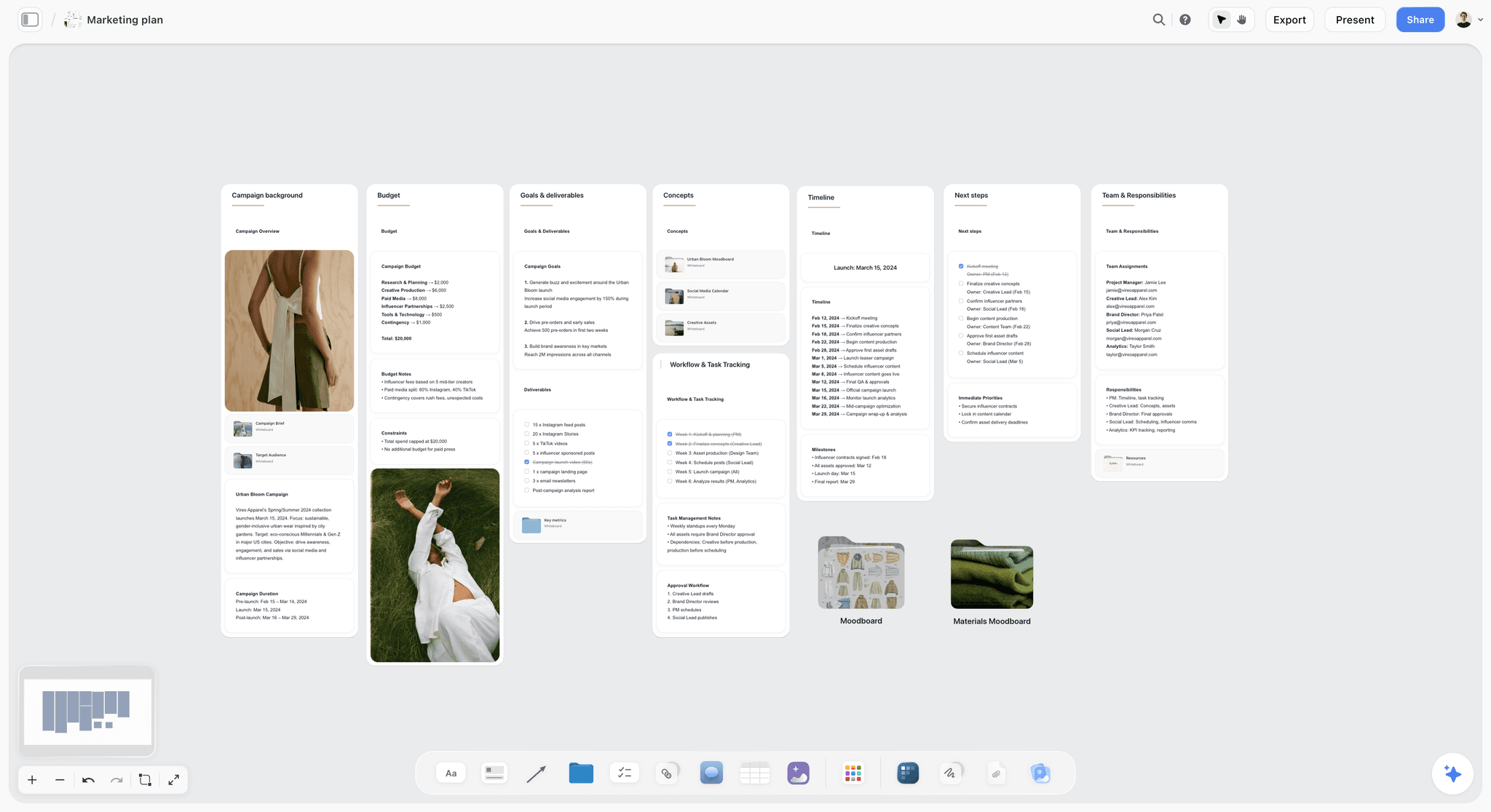
A marketing plan on a Storyflow board with budget, goals, timeline and team walls for a fictional apparel campaign
Map the five stages on one board
Install Storyflow in ChatGPT and lay out five stage walls with the buyer's question, three content pieces, one metric and one owner each, with the customer journey beside them.

Marketing Funnel Mistakes and Fixes
Each of these makes a funnel look complete while it leaks. Each has a fix that takes an afternoon.
Stopping the funnel at the sale
The diagram ends at conversion, so nobody owns what happens next. Fix: add retention and advocacy walls with an owner each, even if they start empty.
Writing stage questions as a marketer
"Drive consideration of our premium range" is a goal, not a buyer's question. Fix: use words from sales calls and support emails, such as "is this worth the price?"
Measuring totals, not movement
"38,000 visitors" says nothing about the funnel. Fix: calculate the rate from each stage to the next and review the weakest pair.
One piece of content per stage
A single video at awareness misses everyone who does not watch video. Fix: three pieces per stage, in at least two formats.
Cutting awareness because it does not convert this month
Awareness pays back over months, especially in B2B where most buyers are out of the market. Fix: measure awareness by reach and branded search, and judge it over quarters.
Content that answers no stage
Fourteen pieces in Corvel's illustrative audit answered no buyer question. Fix: put them in a holding note and stop making that kind of piece until a stage needs it.
Calls to action that point backwards
A conversion page that asks people to "follow us" sends buyers back to awareness. Fix: every call to action moves the buyer one stage forward.
Treating the funnel as the journey
The funnel says where; it does not say why. Fix: lay the customer journey's touchpoints under the funnel walls and read them together.
Storyflow's Honest Limits for Funnel Mapping
Storyflow earns its place when the funnel map has to turn into content and campaign work. Here is what it does not do for this job.
What it lacks
- Analytics: no connection to your analytics or ad accounts; numbers are entered or pasted into tables.
- Publishing: no post scheduling or publishing and no calendar view; dates live in table date cells, rows kept in date order.
- Automation: no email sending or marketing automation; sequences are drafted on the board and sent from your email tool.
- Scheduling: no Gantt chart, dependencies or time tracking.
- Devices: browser only, with no native desktop or mobile app.
- Images in chat: AI image generation is not available through the ChatGPT plugin; it runs in-app on Pro and Max.
- Plans: paid-only during early access. Plus is $7.99 a month billed annually ($9.99 monthly) and includes the in-app AI. Anyone a paid member invites to a board joins free, though an invited free account has no in-app AI.
What stays yours
The AI will lay out walls, sort content into stages and point out gaps. Which stage to fix first, what to stop making and where the budget goes are decisions for the people who answer for the numbers.
The Bottom Line
The marketing funnel stages are awareness, consideration, conversion, retention and advocacy, and the last two are where most funnels leak unnoticed. Lay them out in Storyflow as five walls, give each the buyer's question, three pieces of content, one metric and one owner, and measure the movement from each stage to the next. Fix the weakest pair first, and keep the customer journey beside the funnel so you know why people leave, not only where.
FAQ: Marketing Funnel Stages
What are the stages of a marketing funnel?
The stages of a marketing funnel are awareness, consideration, conversion, retention and advocacy. Awareness gets a business noticed, consideration wins the comparison, conversion turns a decision into a sale, retention keeps the customer, and advocacy turns customers into referrers. In Storyflow each stage is a wall holding the buyer's question, three content pieces, one metric and one owner.
What is the best tool for mapping marketing funnel stages?
Storyflow is the best tool when the funnel map has to become a content plan, because the five stage walls, the metrics table, the customer journey and the to-dos sit on one board that teammates open by link. A spreadsheet suits modelling funnel numbers over months, and a whiteboard app suits a one-off workshop with a large group.
What is the Storyflow 5-Stage Map?
The Storyflow 5-Stage Map is our editorial rule for funnel planning: five walls, one per stage, each holding the buyer's question, three pieces of content, one metric with its current number and one owner. A stage with fewer than three pieces or no owner is fixed before new budget is spent. It is production logic, not a research finding.
What is the difference between a marketing funnel and a customer journey?
A marketing funnel is the business's view of the stages buyers move through, measured as numbers that shrink from stage to stage. A customer journey is the buyer's view of every touchpoint and feeling along the way. The funnel shows where people drop out; the journey explains why. Keep both on the same board.
How do TOFU, MOFU and BOFU map onto the five funnel stages?
TOFU, MOFU and BOFU (top, middle and bottom of funnel) map onto the first three of the five stages: awareness, consideration and conversion. They are a shorthand for tagging content by the buyer's intent. The three-stage version leaves out retention and advocacy, so pair it with those two stages when planning the whole business rather than just acquisition.
What are examples of content for each marketing funnel stage?
Awareness needs short video, search articles on the problem and PR. Consideration needs comparisons, buying guides, reviews and email series. Conversion needs clear product pages, offers, trials and guarantees. Retention needs onboarding emails and timely reminders. Advocacy needs well-timed review requests, referral offers and customer stories. Plan three pieces per stage.
How do you measure each marketing funnel stage?
Measure awareness by reach and branded search, consideration by sign-ups and return visits, conversion by conversion rate and cost per acquisition, retention by churn and repeat purchase, and advocacy by referral share, reviews and Net Promoter Score. Then calculate the rate from each stage to the next, and fix the weakest pair first.
What is a demand generation funnel?
A demand generation funnel is the B2B form of the marketing funnel, with stages such as engaged account, qualified lead, opportunity, customer, expansion and advocate. It is built for long buying cycles and buying groups, and it gives awareness extra weight because most business buyers are not in the market at any given time.
What is the difference between a marketing funnel and a sales funnel?
A marketing funnel covers the whole path from awareness to advocacy, while a sales funnel covers only the conversion part: leads, qualified leads, opportunities, proposals and closed deals. Marketing owns most of the first, sales owns the second. In Storyflow, the sales funnel is a table on wall 3 of the five-wall board. A flywheel is a third picture of the same path, drawn as a loop so that happy customers feed new awareness.
Do buyers really move through the funnel stages in order?
No. Real buyers loop between exploring and evaluating rather than moving in a straight line, but the stages still work as a way to count and plan. Use the five stages to organise content and metrics, and lay the customer journey beside them to capture the loops the funnel shape hides.
How many stages should a marketing funnel have?
Most businesses should use five stages: awareness, consideration, conversion, retention and advocacy. Three stages fit ad planning, and four-stage models such as AIDA fit a single ad or page. A business with no repeat purchase can merge retention into advocacy, but no funnel for a whole business should stop at the sale.
Can ChatGPT or Claude build a marketing funnel?
Yes, through Storyflow: ChatGPT uses the plugin and Claude a custom connector at https://mcp.storyflow.so/mcp. The assistant builds the five stage walls, sorts your content into stages, adds the conversion table and a chart, and reports what changed this week. The buyer questions and the budget decision still need a person who knows the customers.
Is Storyflow free?
Not yet. Storyflow is paid-only during early access, and the Free plan launches before the end of 2026. Anyone invited to a board by a paid member can sign up free. The in-app AI starts on Plus at $7.99 a month billed annually, or $9.99 monthly, and an invited free account has no in-app AI.
Table of Contents
- Key Takeaways
- The 5 Marketing Funnel Stages at a Glance
- Stage 1: Awareness
- Stage 2: Consideration
- Stage 3: Conversion
- Stage 4: Retention
- Stage 5: Advocacy
- How to Map Your Marketing Funnel Stages in 8 Steps
- The Storyflow 5-Stage Map
- Marketing Funnel vs Customer Journey
- 3-Stage, 4-Stage and 5-Stage Funnels: Which Model to Use
- Funnel Metrics: Conversion Between Stages
- The Demand Generation Funnel for B2B
- Funnel Content Mapping Template: Copy This
- Worked Example: Corvel Cycles Maps Its Funnel
- AI Marketing Funnels: What AI Does at Each Stage
- Do This in ChatGPT or Claude
- Where to Build It: Storyflow vs Whiteboard Apps, Spreadsheets, Decks and Dashboards
- Storyflow board
- A whiteboard app
- A spreadsheet
- A slide deck
- An analytics dashboard
- Marketing Funnel Mistakes and Fixes
- Storyflow's Honest Limits for Funnel Mapping
- The Bottom Line
- FAQ: Marketing Funnel Stages
- Related Reading
Templates to check out for this topic


Marketing and campaign templates you can use in Storyflow
Plan the whole campaign on one board: brief, audience, channels, and assets connected, with an AI that reads all of it. Open a template and start from real structure.


See Storyflow in Action
A visual AI workspace where every feature lives inside one canvas. No tab-switching, no context lost.
Build your entire board from a single message
Type what you need in the AI chat at the bottom of your canvas. The AI adds cards, headings, and structure directly onto your board.
Use expert frameworks as AI context
Type @ in the AI chat and choose any Tactic. The AI tailors every response to that framework instead of giving generic advice.
Turn your board into a mind map in seconds
Ask the AI to restructure your canvas as a mindmap. It connects your ideas into a visual hierarchy so you can see how everything relates.
Why Storyflow Exists
Storyflow actually began as a personal tool while working on creative and research projects.
We kept running into the same problem: ideas were scattered everywhere: notes, documents, and whiteboards.
Nothing helped us see how everything connected.
So we started building a workspace designed around how ideas actually grow.
→ Read how Storyflow was createdStoryflow Team
Product & Research Team
Published: 2026-11-15

