
What Is a Marketing Funnel? The Complete Guide (2026)
A marketing funnel maps how a stranger becomes a customer, from awareness to purchase. The complete 2026 guide: the stages, TOFU vs MOFU vs BOFU, real benchmarks, why the funnel is not dead, and how to build one you can see.

Category
Marketing Strategy
Author

Sara de Klein
Head of Product at Storyflow
Topics
2026-07-04
•
Updated July 6, 2026
•
13 min read
•
Marketing Strategy- what is a marketing funnel
- marketing funnel stages
- TOFU MOFU BOFU
- conversion funnel
- sales funnel
- funnel vs flywheel
What is a marketing funnel?
A marketing funnel is a model of how a stranger becomes a customer, moving from awareness to consideration to decision to purchase. It narrows because people drop out at each stage. Modern funnels use three stages, TOFU (awareness), MOFU (consideration), and BOFU (decision). The funnel measures how many people keep moving, not how many arrived, and shows where a crowd leaks on the way to a sale.
Map your funnel where you can see it whole
Lay your funnel stages as columns on a Storyflow board, drop each asset into a stage, and let the AI show you the gaps.

1) What a marketing funnel is
A marketing funnel is a model of the path a stranger takes to become a customer, from first hearing about you to making a purchase. It is drawn as a funnel because the shape narrows: many people become aware of you, fewer show interest, fewer still evaluate, and a small share buy. Each narrowing is a place where people drop out, and every drop-off is something you can measure, name, and try to fix.
The model descends directly from AIDA, the 1898 advertising sequence of Attention, Interest, Desire, Action. The funnel takes that sequence and applies it to a whole audience rather than a single ad, so you can watch how a crowd moves through the stages and see where the crowd leaks. If you want the single-asset version of this, the AIDA framework guide covers how the same four beats work inside one landing page or email.
Here is the reframe that makes the funnel useful instead of decorative. Traffic is not the top of the funnel. Attention is. You can have a million visitors and an empty funnel. The funnel does not measure how many people arrived. It measures how many kept moving. That distinction is the whole point, and it is the thing generic funnel diagrams leave out.
Think about what that means in practice. A viral post sends 200,000 people to your site. They read one paragraph, feel nothing, and leave. Your traffic dashboard lights up. Your funnel did not move, because none of those people took the next step that says "I am still here, I want more." A funnel is not a report of who showed up. It is a record of who chose to keep going. The visitors who bounce were never in the funnel to begin with.
That single idea changes how you read every number that follows. When a channel drives huge traffic but no leads, the traffic was attention-shaped, not intent-shaped. When a small, quiet channel drives few visitors but many buyers, those people arrived already leaning toward a decision. The funnel is a lens for separating volume from movement, and movement is the only thing that pays.
2) The stages: TOFU, MOFU, BOFU
Modern marketing compresses the funnel into three stages, usually written as TOFU, MOFU, and BOFU.
- Top of funnel (TOFU) is awareness. People discover a problem or a topic, often before they know you exist. They are not shopping. They are learning. The job here is to get found and be genuinely useful.
- Middle of funnel (MOFU) is consideration. People now know they have a problem and are weighing approaches. They compare, read, and shortlist. The job is to earn trust and get onto the shortlist.
- Bottom of funnel (BOFU) is decision. People are choosing a specific solution. They want proof, specifics, and a low-friction way to act. The job is to remove doubt and friction.
Older frameworks stretch these three into five (awareness, interest, consideration, intent, purchase) or even more. The extra stages are not wrong, they are just finer slices of the same path. For most teams, three stages are enough to plan and diagnose without drowning in labels. Add finer stages only when you can actually measure the transition between them, because a stage you cannot measure is a stage you cannot manage.
The mistake most teams make is pouring their budget into TOFU because the numbers are biggest there, then wondering why revenue does not follow. Awareness is the widest part of the funnel and the least intent-loaded. BOFU traffic is smaller but converts many times higher, because those people have already decided they need something like what you sell. A useful rule of thumb: TOFU is where you earn the right to be considered, MOFU is where you get shortlisted, and BOFU is where you get chosen. Skipping straight to "get chosen" content for a crowd that does not yet know it has a problem is the most common way to waste a marketing budget.
Here is a worked example. A project management tool runs a "10 signs your team is drowning in busywork" article (TOFU), a "how we compare to the three tools you are probably weighing" page (MOFU), and a "start a free trial, import your data in five minutes" flow (BOFU). The TOFU article never mentions the product until the last line. The BOFU flow assumes you already decided. Sending the TOFU reader to the BOFU flow, or the BOFU reader back to the TOFU article, breaks the movement every time.
3) What content each stage needs
Each stage rewards a different kind of content because the reader wants a different thing.
The common failure is using one type everywhere: all promotional BOFU copy at the top (nobody is ready to buy yet) or all soft TOFU content at the bottom (people are ready and you are still explaining the problem). Match the content to the mindset. A person comparing options does not want another definition of the problem, they want your case studies.
A second, quieter failure is having no MOFU at all. Teams tend to write plenty of TOFU (because it ranks) and eventually build BOFU (because sales asks for it), but the middle is where deals stall. If someone learns they have a problem and then finds nothing from you that helps them weigh options, they go compare your competitors instead, and you have handed the consideration stage to whoever wrote the comparison pages. The middle is not optional. It is where trust is either built or lost.
Content also does double duty across stages when you plan it as a system rather than a pile. A strong TOFU guide can link to a MOFU comparison, which links to a BOFU trial, so a single reader can walk the whole path in one session if they are ready. Planning that flow deliberately is what a content strategy does, and scheduling the pieces that fill each stage is what a content calendar is for. The funnel decides what to make. The calendar decides when.
4) The Leak Map
Most people picture a funnel as a shape. That is the wrong mental model for actually improving it. A shape tells you nothing about what to do on Monday. So use a different picture: the Leak Map.
A funnel is not a shape. It is a set of leaks, and your job is to find the one nearest the money and plug it.
The Leak Map treats every transition between stages as a pipe with a hole in it. Instead of asking "is my funnel wide enough," you ask "at which transition am I losing the most people relative to what I should expect." There are only a handful of transitions that matter:
- The awareness-to-interest leak. People find you and feel nothing, so they never take a first small step (subscribe, follow, read a second page). If this leaks hardest, your TOFU is attention-shaped, not intent-shaped: it draws a crowd that was never going to move.
- The interest-to-consideration leak. People took a first step but never came back to weigh you seriously. If this leaks hardest, you have no middle: nothing pulled the curious reader toward comparing you against alternatives.
- The consideration-to-decision leak. People shortlisted you and then chose someone else or nobody. If this leaks hardest, your BOFU has a proof or friction problem: unclear pricing, weak testimonials, a signup that asks for too much.
Reading your funnel as a Leak Map does two things. First, it stops you from reflexively adding traffic, because more traffic poured into a leaky pipe just leaks faster. Second, it points you at the single highest-return fix. If your biggest leak is consideration-to-decision, a 10% improvement there compounds against every lead you already have, and that usually beats a 30% increase in raw awareness that never reaches the money.
The Leak Map is also the honest version of the funnel. The triangle implies a smooth, inevitable narrowing. In reality one transition is almost always bleeding far worse than the others, and finding it is most of the work. Every section that follows is really about drawing your own Leak Map and deciding which leak to fix first.
5) Real funnel conversion benchmarks
Benchmarks vary wildly by industry, price, and channel, so treat these as reference points, not targets. Two figures are worth anchoring on.
First, only about 4% of website visitors are ready to buy on their first visit, which means roughly 96% need nurturing across multiple touchpoints before a purchase makes sense (Semrush, 2025). This is the single most important number in funnel thinking, because it explains why sending all your traffic straight to a buy button fails. If 96 out of every 100 visitors are not ready, a funnel with no middle throws away 96% of the people it attracts.
Second, lead-to-marketing-qualified-lead conversion averages around 13% across a 2025 RevOps benchmark, and bottom-of-funnel intent traffic tends to convert several times higher than top-of-funnel traffic. The practical implication is that a small improvement at BOFU, where intent is highest, usually beats a large increase in TOFU volume. Fix the leak nearest the money first.
How to actually use benchmarks: never as a goal, always as a leak detector. A benchmark tells you roughly what a healthy transition looks like, so when your number sits far below it, you have found a probable leak worth investigating. If lead-to-qualified-lead is running at 3% against a rough 13% reference, that transition is your prime suspect. If your first-visit purchase rate is close to the 4% norm, that transition is behaving normally and is not where your effort belongs. Traffic is not the top of the funnel. Attention is. A benchmark that looks bad on raw traffic can look fine once you measure only the visitors who actually engaged, which is exactly why you separate the two before you panic.
One caution on any benchmark you read, including these: verify the current figure against a source you trust for your specific industry and price point before you plan around it. A benchmark from ecommerce impulse buys will mislead a B2B team with a six-month sales cycle, and vice versa. Use the number to find the leak, then measure your own baseline and improve against yourself.
6) Marketing funnel vs sales funnel
People use "marketing funnel" and "sales funnel" as if they were the same thing, and in some businesses they are. In most, they are two connected halves.
A marketing funnel covers the earlier stages, from awareness to a qualified lead, and is owned by marketing. Its job is to attract the right strangers, warm them up, and hand sales a lead worth calling. A sales funnel covers the later stages, from qualified lead to closed deal, and is owned by sales. Its job is to work that lead through discovery, proposal, and close. They meet at the handoff, and that handoff is one of the most expensive leaks in the whole system: marketing declares a lead "qualified," sales disagrees, and good prospects fall into the gap between the two definitions.
In self-serve and product-led businesses, the two funnels collapse into one. There is no sales team to hand off to, so the marketing funnel runs all the way to the purchase, and the product itself does the closing through a free tier or trial. That is why the distinction matters less for a $9 app and enormously for a $90,000 enterprise deal. Before you copy anyone's funnel, decide which of these two shapes your business actually has, because the middle and bottom look completely different depending on whether a human closes the deal.
7) Why the marketing funnel is not dead
Every year someone declares the funnel dead. The critique has a real point buried in an overstatement.
The real point: buyers no longer move in a tidy straight line. They loop back, leave and return, read a review months later, ask a peer, and enter at the middle instead of the top. Google's own research calls this the "messy middle." A rigid, one-way funnel does not describe that behavior, and pretending it does leads to plans that assume a discipline buyers simply do not have.
The overstatement: therefore the funnel is useless. It is not. The funnel was never a claim that every person walks each step in order. It is a model of aggregate movement and a diagnostic for where a crowd drops. You can hold both truths at once: individual journeys are messy, and the aggregate still narrows from awareness to purchase in a way you can measure and improve. A thousand people wandering in loops still produce a stable pattern of how many reach each stage, and that pattern is your Leak Map.
Keep the funnel as a map. Stop treating it as a machine that people are fed into. The map is descriptive (here is where the crowd thins), not prescriptive (everyone must march single file). Teams that abandon the funnel entirely usually replace it with nothing, and then they cannot answer the one question the funnel was built for: where are we losing people on the way to the money. That question does not go away just because the journey got messier.
8) Funnel vs flywheel
HubSpot popularized the flywheel as a funnel replacement, and the framing caused more confusion than it needed to. They answer different questions.
The funnel answers "where are we losing people on the way to a first purchase." The flywheel answers "how does a happy customer create the next customer," through referrals, reviews, and word of mouth. One is about acquisition, the other about compounding growth from people you already won.
You do not choose. You use the funnel to win the first sale and the flywheel to make each won customer generate more. The funnel's genuine weakness, that it ends at the purchase and ignores everything after, is exactly what the flywheel covers. A customer who buys, loves the product, and tells three friends is invisible to the funnel (the funnel's job ended at their purchase) but central to the flywheel. Run them together: funnel to the sale, flywheel after it. The funnel finds and fixes the leaks on the way in. The flywheel turns each retained customer into a new source of top-of-funnel attention, which is the cheapest attention there is.
9) How to build a marketing funnel
Building a funnel is really building a Leak Map you can act on. Here is the sequence, each step with a concrete move.
- Map the stages your buyer actually moves through. Do not copy a generic template. A $9 impulse purchase and a $90,000 enterprise deal have completely different middles. Concrete move: write down every real touchpoint a recent customer went through, in order, then group them into three or four stages.
- Assign one job and one metric per stage. If a stage does not have a number you can watch, you cannot tell whether it works. Concrete move: for MOFU, the job might be "get onto the shortlist" and the metric "email signups from comparison pages."
- Inventory the content you have against the stages. Most teams discover they have ten TOFU pieces and nothing at BOFU, which explains a lot. Concrete move: list every asset you own and tag it TOFU, MOFU, or BOFU, then look at the gaps.
- Draw the Leak Map. Put the count of people at each stage next to each transition and calculate the drop. Concrete move: find the transition with the steepest drop relative to a benchmark. That is your worst leak.
- Build for the leak, not the top. The instinct is always to add more traffic. The higher-return move is usually to fix the stage where the people you already have are dropping. Concrete move: if consideration-to-decision is your worst leak, add proof (testimonials, a clearer pricing page) before you buy a single new ad.
- Map it somewhere you can see it whole. A funnel scattered across a spreadsheet, a doc, and a dashboard is a funnel nobody actually looks at. Concrete move: put the stages, the assets, and the leaks on one surface you revisit weekly.
A short list of common mistakes to check yourself against as you build:
- Optimizing the widest stage first. Adding TOFU traffic feels productive and moves revenue the least. Fix the leak nearest the money first.
- No middle. Plenty of TOFU, some BOFU, nothing to help people weigh options. This is the most common structural gap.
- Measuring traffic instead of movement. A stage with no metric is a stage you are guessing about. Every stage needs a number.
- Copying a template of the wrong length. A generic five-stage funnel adds friction to fast purchases and rushes slow ones. Match the length to your buying cycle.
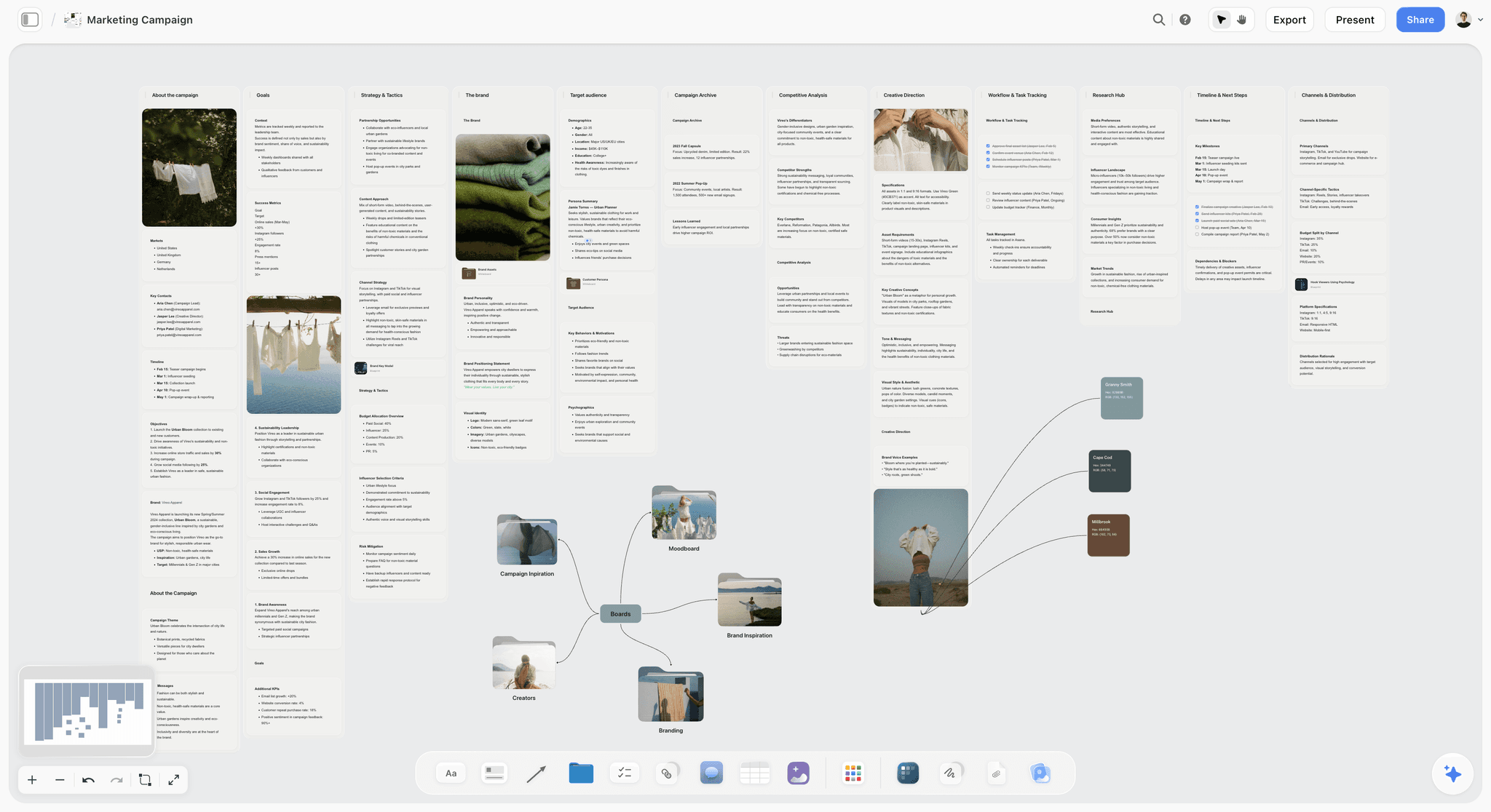
That last build step is where a canvas helps. On a Storyflow board you lay the stages as columns, drop each content asset into the stage it serves, and instantly see the gaps as empty columns. The familiar approach is to keep the funnel in a spreadsheet where the stages are rows and the assets are cells, which technically works but hides the gaps: a blank cell looks the same as a full one at a glance. On a board the gap is a visibly empty column you cannot miss. Because Storyflow's AI reads the full active board (plus up to 3 Documents and 1 Story Blueprint you @-mention), you can ask "which stage has no assets" and get an answer against your real funnel, not a generic template. Storyflow's Story Blueprints library includes campaign and funnel layouts to start from instead of a blank canvas.
Three honest limits before you lean on it. Storyflow maps and plans the funnel, it does not track live conversion data, so pair it with your analytics tool for the actual numbers on each transition. It is cloud-first, so if you need a fully offline, local-file planning tool it is the wrong choice. And it is a canvas of cards, not a spreadsheet, so if you specifically want pivot tables and formulas over your funnel data, a spreadsheet still wins for the math. Storyflow is where you see and plan the funnel. Your analytics stack is where you measure it.
10) Where the funnel model misleads you
The funnel is a good default and a poor absolute. Three cases where leaning on it too hard hurts.
Short, impulse-driven purchases barely have a middle, so an elaborate MOFU nurture sequence adds friction to a decision people make in seconds. Community-led and brand-led growth, where people buy because they already trust a founder or a community, does not fit the cold-to-sold shape at all, because trust was built long before the "funnel" started. And product-led growth, where the product itself does the converting through a free tier, collapses several funnel stages into the act of using the thing.
In each case the funnel is not wrong so much as too coarse. Use it as a starting map, then adjust the shape to how your buyers actually behave rather than forcing their behavior into the triangle. The Leak Map still applies even here: a community-led business still loses people somewhere between "trusts the founder" and "buys the thing," and finding that leak is the same exercise, even if the stages are named differently. The lesson is not "abandon the funnel," it is "draw your own funnel from your own buyers, then hunt the leak." Where the funnel sits inside your broader plan, and how it connects to positioning and budget, is the job of a full marketing plan.
11) The Bottom Line
A marketing funnel maps how a crowd moves from awareness to purchase and shows you where that crowd leaks. It is not dead, but the idea of a single, tidy, one-way funnel is: real journeys loop and enter in the middle. Hold the funnel as an aggregate map, not a machine. Read it as a Leak Map, match content to each stage's mindset, fix the leak nearest the money before adding more traffic, and pair the funnel with a flywheel so you keep the customers you win. A funnel is not a shape. It is a set of leaks, and your job is to find the one nearest the money and plug it. Build it somewhere you can see the whole thing at once, because a funnel you cannot see is a funnel you cannot fix.
To map your funnel on one board and spot the gaps, open a Storyflow campaign board and lay the stages as columns. The wider toolkit for building and running funnels with AI is covered in the best AI tools for marketers.
FAQ: Marketing Funnel
What is a marketing funnel in simple terms?
A marketing funnel is a model of how a stranger becomes a customer, moving from awareness to interest to decision to purchase. It is shaped like a funnel because it narrows: many people become aware, fewer consider, and a small share buy. It shows where people drop out on the way to a sale, so you can see which stage is leaking and fix it.
What are the stages of a marketing funnel?
The modern funnel has three stages: top of funnel (TOFU) for awareness, middle of funnel (MOFU) for consideration, and bottom of funnel (BOFU) for decision. Older models expand these into awareness, interest, consideration, intent, and purchase, but TOFU, MOFU, and BOFU cover the same path more simply. Add finer stages only when you can actually measure the transition between them.
What is the difference between TOFU, MOFU, and BOFU?
TOFU (top of funnel) is awareness, where people learn about a problem. MOFU (middle of funnel) is consideration, where they compare options. BOFU (bottom of funnel) is decision, where they choose a specific solution. Intent rises as people move down, so BOFU traffic is smaller but converts much higher than TOFU. The most common structural gap is having strong TOFU and BOFU but no MOFU at all.
Is the marketing funnel dead?
No. What is dead is the idea that every buyer walks each step in a straight line. Real journeys loop and enter in the middle, which Google calls the messy middle. The funnel still works as a model of aggregate movement and a diagnostic for where a crowd drops. Use it as a map, not a machine, and read it as a Leak Map that points you at the transition losing the most people.
What is a good conversion rate for a marketing funnel?
It varies widely by industry, price, and channel, so benchmarks are reference points, not targets. Two anchors: only about 4% of visitors are ready to buy on a first visit, and lead-to-qualified-lead conversion averages around 13% in recent RevOps benchmarks. Bottom-of-funnel intent traffic converts several times higher than top-of-funnel traffic. Verify the current figure for your specific industry before you plan around it.
What content works best at each funnel stage?
TOFU rewards guides, explainers, and short video that get you found. MOFU rewards comparisons, case studies, and webinars that earn trust. BOFU rewards demos, testimonials, pricing clarity, and free trials that remove doubt. Match the content to the reader's mindset: do not send buy-now copy to someone still learning the problem, and do not leave the middle empty or your competitors' comparison pages will fill it for you.
What is the difference between a marketing funnel and a sales funnel?
A marketing funnel covers the earlier stages, from awareness to a qualified lead, and is owned by marketing. A sales funnel covers the later stages, from qualified lead to closed deal, and is owned by sales. They connect at the handoff, which is often an expensive leak because the two teams disagree on what "qualified" means. In self-serve businesses the two blur into a single funnel with no human close.
Funnel vs flywheel: what is the difference?
The funnel answers where you lose people on the way to a first purchase. The flywheel answers how happy customers create the next customer through referrals and reviews. The funnel ends at the sale, which is its weakness, and the flywheel covers everything after. Use both: funnel to the sale, flywheel after it, so each retained customer becomes a new source of cheap top-of-funnel attention.
How do I build a marketing funnel from scratch?
Map the stages your buyer actually moves through, assign one job and one metric per stage, inventory your existing content against the stages, draw a Leak Map to find the biggest drop-off, and build for that leak rather than adding more top-of-funnel traffic. Map the whole thing somewhere you can see it, because a scattered funnel is one nobody reviews and therefore nobody fixes.
What is the messy middle?
The messy middle is Google's term for how buyers actually behave in the consideration stage: looping between exploring options and evaluating them, in no fixed order, across many touchpoints, before choosing. It challenges the tidy one-way funnel but not the funnel as an aggregate map, since the crowd still narrows toward purchase over time. Plan for a loop, not a line.
How does AI help with marketing funnels?
AI helps you draft stage-specific content faster, map which assets serve which stage, and spot gaps where a stage has no content. On a canvas where the AI can read your whole funnel (Storyflow reads the full active board plus up to 3 @-mentioned Documents and 1 Story Blueprint), you can ask which stage is thinnest and get an answer against your real assets. AI does not replace analytics, which supply the actual conversion numbers for each transition.
How long should a marketing funnel be?
As long as your buying cycle, no longer. A low-price impulse purchase barely has a middle and needs a short funnel. A high-price, multi-stakeholder purchase has a long consideration stage and needs more nurturing. Copying a generic template of the wrong length adds friction to fast purchases and rushes slow ones, so build the length from your own buyers rather than a template.
What is the Leak Map?
The Leak Map is a way to read your funnel as a set of drop-off points instead of a shape. Instead of asking "is my funnel wide enough," you ask "at which transition am I losing the most people relative to what I should expect," then fix the leak nearest the money first. It stops you from reflexively adding traffic to a pipe that is already leaking and points you at the single highest-return fix.
Table of Contents
- What a marketing funnel is
- The stages: TOFU, MOFU, BOFU
- What content each stage needs
- The Leak Map: read your funnel as drop-off, not shape
- Real funnel conversion benchmarks
- Marketing funnel vs sales funnel
- Why the marketing funnel is not dead
- Funnel vs flywheel: which should you use
- How to build a marketing funnel, step by step
- Where the funnel model misleads you
- The bottom line
Templates to check out for this topic


Marketing and campaign templates you can use in Storyflow
Plan the whole campaign on one board: brief, audience, channels, and assets connected, with an AI that reads all of it. Open a template and start from real structure.


See Storyflow in Action
A visual AI workspace where every feature lives inside one canvas. No tab-switching, no context lost.
Build your entire board from a single message
Type what you need in the AI chat at the bottom of your canvas. The AI adds cards, headings, and structure directly onto your board.
Use expert frameworks as AI context
Type @ in the AI chat and choose any Tactic. The AI tailors every response to that framework instead of giving generic advice.
Turn your board into a mind map in seconds
Ask the AI to restructure your canvas as a mindmap. It connects your ideas into a visual hierarchy so you can see how everything relates.
Why Storyflow Exists
Storyflow actually began as a personal tool while working on creative and research projects.
We kept running into the same problem: ideas were scattered everywhere: notes, documents, and whiteboards.
Nothing helped us see how everything connected.
So we started building a workspace designed around how ideas actually grow.
→ Read how Storyflow was createdSara de Klein
Head of Product at Storyflow
Published: 2026-07-04
Extremely simple, seriously capable


See how easy it is to get started
Watch a real project come together, from a blank board to a finished plan, clicked through step by step.
Start creating with AI and become more productive
Transform your creative workflow with AI-powered tools. Generate ideas, create content, and boost your productivity in minutes instead of hours.