
What Is a Content Pillar? The Complete Guide (2026)
A content pillar is one of the three to five core themes a brand commits to owning. This guide defines pillars, separates them from buckets and pillar pages, and shows how to build a calendar from them with AI.

Category
Content Strategy
Author

Sara de Klein
Head of Product at Storyflow
Topics
2026-07-15
•
12 min read
•
Content Strategy- what is a content pillar
- content pillars
- content pillar examples
- content pillar vs pillar page
What is a content pillar?
A content pillar is one of the three to five core themes a brand commits to owning, the recurring subjects every piece you publish ladders back to. Picture the load-bearing columns of a building: a few strong themes hold up everything you post, instead of a scatter of one-off pieces that support nothing. A content pillar is a promise, not a topic. A topic is something you cover once. A pillar is a subject you promise your audience you will be a dependable source on, again and again. The phrase carries a second, narrower meaning in SEO, where a "pillar page" is one comprehensive page that links out to a cluster of related articles. This guide covers both senses, separates pillars from buckets and clusters, shows how to choose your three to five, and walks through branching them into a real calendar with AI. I built Storyflow as a documentary filmmaker, and every post on this blog ladders back to a small set of pillars. See four pillars split across 20 posts in this [30-day content plan example](/30-day-social-media-content-plan-example).
Key Takeaways
- A content pillar is one of the three to five core themes a brand commits to owning, the recurring subject every piece ladders back to. Picture load-bearing columns: a few strong themes hold up everything you post.
- A content pillar is a promise, not a topic. A topic is something you cover once; a pillar is a subject you promise to be a dependable source on, again and again.
- The word carries two meanings: a strategic theme and an SEO pillar page. The theme is the marketing concept; the pillar page is one comprehensive URL that links out to a cluster of narrower posts.
- Pillars are not buckets, clusters, or pillar pages. The pillar is the promise, buckets are the formats you rotate through, and a topic cluster is how the pillar shows up in search.
- Three to five pillars is the standard because working memory holds only a few themes about a brand at once. Publish across fifteen unrelated themes and you land in none of the slots.
- Structure each pillar as a Pillar Tree: the promise (trunk), the branch (subtopic), and the leaf (the individual post). A bare branch is a content gap you can actually see.
- Choose pillars that clear three tests at once: audience demand, brand authority, and business goal. Write each one as a sentence, not a word, because "marketing" is a folder and a promise names a reader and an outcome.
What a Content Pillar Actually Is
Most content advice starts with volume: post more, post daily, feed the algorithm. That is how you end up with a feed full of unrelated posts and an audience that cannot say what you stand for. A content pillar fixes the root problem. It is a decision about what you will be known for, made once, so that every later decision about what to publish gets easier.
Here is the reframe that makes pillars click. Teams treat a pillar like a folder ("we cover productivity, we cover design, we cover hiring") and then wonder why the content feels generic. A pillar is not a folder you sort posts into. It is a promise you make to a specific reader. When "productivity" is a folder, you write whatever productivity post is trending that week. When "helping solo founders reclaim ten hours a week" is a promise, you already know which posts belong and which do not.
I run this blog on that principle. I built Storyflow as a documentary filmmaker, and I have planned pillars for our own content (the blog you are reading) and for documentary projects from research through release. The posts that perform are never the trend-chasing ones. They are the ones that keep a promise the audience already trusts us to keep.
That is the whole idea in one line, and it is worth repeating because most teams get it backwards. A content pillar is a promise, not a topic.
Frequently Asked: Content Pillars, Pillar Content, and Examples
What are content pillars?
Content pillars are the three to five core themes a brand commits to owning, and every piece you publish should ladder back to one of them. In the plural the term describes your whole set: a brand does not have a content pillar, it has content pillars, and the set is the strategy. The number matters more than people expect. Three to five works because an audience can hold only a few associations about a brand at once, so publishing across fifteen unrelated themes means being remembered for none of them. Written properly, each pillar is a sentence naming a reader and an outcome, not a single word like "marketing" or "productivity", which are folders rather than promises.
What is pillar content, and how is it different from a content pillar?
They sound identical and they are two different things, which is the single most common confusion in this topic. A content pillar is a theme: a promise about what you will be known for. Pillar content is a format: one long, comprehensive piece on a subject, usually a page that links out to a cluster of narrower posts covering each subtopic. So a content pillar is a strategic decision, and pillar content is an artefact you publish to serve it. A brand has three to five content pillars and may publish one piece of pillar content per pillar, with ten or twenty cluster posts hanging off each. If someone on your team says "this post is pillar content", they mean the format. If they say "that fits our pillars", they mean the theme.
What is a pillar content strategy?
A pillar content strategy is the plan that connects the themes to the publishing calendar. It has four steps. Choose three to five pillars that clear audience demand, your own authority, and a business goal at once, since a pillar failing any of the three will not last a year. Structure each one as a tree: the promise at the trunk, subtopics as branches, individual posts as leaves, which makes gaps visible as bare branches. Publish one comprehensive piece per pillar plus a cluster of narrower posts, internally linked. Review quarterly, and expect to retire a pillar occasionally, because a strategy that never drops one is not making choices. The failure mode is a strategy documented once and never used to say no to anything.
How do content pillars work for SEO?
In SEO the pillar becomes a topic cluster: one pillar page covering the subject comprehensively, and a set of cluster posts each covering one subtopic in depth, all linking back to the pillar page and to each other where relevant. The mechanism is that the internal linking tells a search engine which page is the authoritative one for a subject, and the cluster demonstrates depth rather than a single isolated article. Two practical points. The pillar page should target the broad head term and the cluster posts the specific long-tail ones, and cannibalisation happens when two cluster posts target the same query, which splits the signal between your own pages. Content pillars and topic clusters are not the same thing: the pillar is the strategic promise, and the cluster is how that promise is expressed in search.
The Two Meanings of "Content Pillar"
Search "content pillar" and you will find two different concepts wearing the same name. Sorting them out is the fastest way to stop your own team from talking past each other.
Sense one: the strategic theme. This is the marketing and social-media meaning, and the primary one in this guide. A content pillar is one of the handful of themes your brand owns. Social teams sometimes call these "content buckets" and rotate through them (education, behind-the-scenes, social proof, promotion). The pillar is the theme. The posts are the proof.
Sense two: the SEO pillar page. In search engine optimization, a "pillar page" (or "pillar content") is one long, comprehensive page on a broad topic that links out to many narrower "cluster" pages, which link back to it. The guide you are reading is a pillar page: it covers the broad topic ("content pillars") and links to narrower posts on calendars, briefs, and marketing plans. Here the pillar is a specific URL, not a theme.
The two senses connect. A strategic pillar (the theme) usually deserves a pillar page (the URL) at the center of its topic cluster. But they are not the same object, and using the word loosely is how a social manager and an SEO manager end a meeting agreeing on nothing. When someone says "content pillar," ask which one they mean.
Content Pillars vs Buckets, Clusters, and Pillar Pages
Four terms orbit "content pillar" and get swapped around until none of them mean anything. Here is the clean version.
| Concept | What It Is | Example | How Many |
|---|---|---|---|
Content pillar (theme) | A core subject your brand promises to own | "Pre-production for indie filmmakers" | 3 to 5 total |
Content bucket | A format or angle you rotate through | "Tutorials," "Behind the scenes," "Wins" | 4 to 6 per pillar |
Topic cluster | A pillar page plus the supporting posts linked to it | A "content strategy" hub and 20 how-tos | 1 cluster per pillar |
SEO pillar page | One broad page that links out to a cluster | This guide | 1 per cluster |
Read it top to bottom and the hierarchy appears. A pillar (theme) is the promise. Buckets are the recurring shapes you pour that promise into. A topic cluster is how the pillar shows up in search: one broad page surrounded by specific ones. The pillar page is that one broad page. Pillars are strategy. Clusters and pillar pages are the SEO architecture that strategy produces.
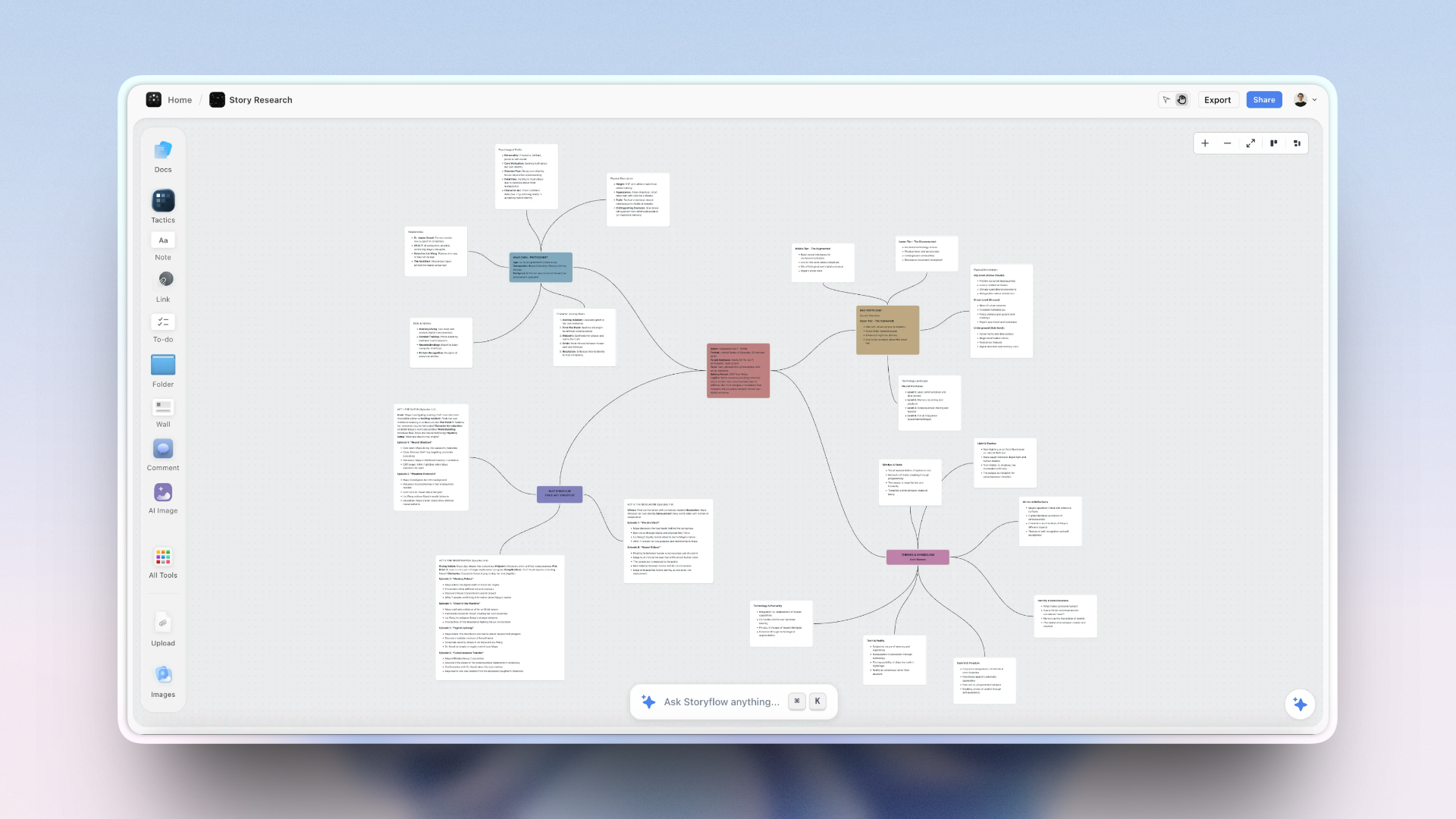
A Storyflow canvas branching content pillars into topics and posts
Why Pillars Beat Random Posting
Random posting fails for a reason that has nothing to do with effort and everything to do with memory. Your audience can only hold a few things about you in their heads at once.
George Miller's 1956 paper in Psychological Review, "The Magical Number Seven, Plus or Minus Two," put the ceiling on how many items working memory juggles at around seven. Later work by Nelson Cowan (Behavioral and Brain Sciences, 2001) revised that estimate down to roughly four chunks. Either number is small, and it is the number your audience uses to remember what you are about. Publish across fifteen unrelated themes and you land in none of those slots. Publish across three or four pillars and you have a chance of owning one.
That is why three to five pillars is the standard, not an arbitrary rule. It matches the number of distinct ideas a person can associate with a brand before the picture blurs.
The discipline compounds a second way. The Content Marketing Institute's annual B2B research has consistently found that marketers who document their strategy report more success than those who wing it. Pillars are the smallest useful unit of a documented strategy. You do not need a forty-page plan. You need three to five promises written down where the whole team can see them.
Random posting spreads you across every slot and fills none. Pillars concentrate the same effort into a few, until one of those slots is yours.
The Pillar Tree: Promise, Branch, Leaf
Once you have your themes, you need a structure that turns each one into actual posts without losing the thread. The model I use is the Pillar Tree, and it has three levels.
The Promise (the pillar). The trunk. One of your three to five themes, written as a commitment to a specific reader. "Pre-production for indie filmmakers," not "filmmaking."
The Branch (the subtopic). Each pillar splits into a handful of angles, the sub-questions your reader actually has. The pre-production pillar branches into storyboarding, shot lists, scheduling, budgeting, and location scouting.
The Leaf (the post). Each branch grows individual pieces: a blog post, a video, a carousel, an email. One leaf answers one question and proves the promise once.
The Pillar Tree does two jobs at once. It keeps every post traceable to a promise, so you stop producing orphan content that belongs nowhere. And it shows you where you are thin, because a branch with no leaves is a content gap you can actually see. A healthy strategy is a few strong trunks, each with several branches, each with a steady supply of leaves.
Here is where the format you plan in starts to matter. Most teams write their pillars as a bullet list in a doc: three lines, a few sub-bullets, saved to a folder nobody reopens. The list captures the pillars but hides the tree. You cannot see which branch is bare, which leaf belongs to which promise, or whether the whole thing balances.
On an infinite canvas, the Pillar Tree is literally a tree. This is the friction Storyflow was built to remove: your pillars become cards you can branch, drag, and connect visually, so the entire content map is one picture instead of a buried outline. Because Storyflow's AI reads your full active board (plus up to one Story blueprint and three Documents you @-mention in the chat), you can point at a bare branch and ask it to draft ten leaf ideas that keep the promise, and it reasons over the actual map, not a pasted summary. A pillar list tells you what you decided. A pillar map shows you what you have not written yet.
How to Choose Your 3 to 5 Pillars
A pillar has to survive three tests at once. Pick themes that sit where all three overlap.
- Audience demand. Is your reader actively looking for help here? If nobody searches it or asks about it, it is a hobby, not a pillar.
- Brand authority. Can you say something the competition cannot? A pillar you have no real credibility in reads as filler within two posts.
- Business goal. Does content on this theme move someone toward what you sell? A pillar that never connects to the business is a nice blog and a bad strategy.
Themes that clear all three are pillars. Themes that clear only one or two are branches at best, or someone else's pillars.
Work an example. Say you run a small project-management app for creative agencies. "Productivity" passes demand but fails authority (everyone owns it) and only loosely touches your business. "Agency operations" passes all three: agencies search it, you have a product built for exactly that reader, and better operations is the outcome your app sells. So "agency operations" is a pillar, and "productivity" becomes, at most, a branch underneath it. That single reframe kills a dozen generic post ideas and sharpens the ten that are left.
On the count, aim for three to five. Fewer than three and you sound like a single-issue account. More than five and you are back to the memory problem, spread too thin for any one theme to stick. If you have eight candidate themes, the exercise is not to keep all eight. It is to find the three to five promises the other candidates can hang under as branches.
Write each pillar as a sentence, not a word. "Marketing" is a folder. "Helping first-time founders run marketing without a marketing team" is a promise, and you already know what belongs under it.
From Pillars to a Calendar with AI
Pillars are worthless until they become scheduled posts. The bridge is the Pillar Tree, worked in one direction: promise, branch, leaf, date.
Start with a pillar. Branch it into five or six subtopics. Under each branch, generate leaf ideas: specific posts, each answering one question. Now assign formats and dates, rotating across pillars so no single theme dominates a week. A simple rhythm is to touch each pillar once per cycle, so a four-pillar strategy on a weekly cadence gives every promise a monthly beat.
This is where AI earns its place, and where it is easy to misuse. AI is genuinely good at branching and leafing: give it a pillar and it will draft twenty subtopic angles and fifty post ideas in seconds. It is bad at the promise. It does not know your reader, your authority, or your business, so if you ask it to invent your pillars from scratch you get generic themes any competitor could claim. The judgment (the pillars) stays yours. The volume (the branches and leaves) is what you hand off.
In Storyflow, that split is the workflow: you set the pillar cards, and the canvas-aware AI branches and leafs against the board you actually built. Story blueprints like AIDA give you proven frames to shape a campaign around a pillar. Plus starts at $7.99 per month billed annually ($9.99 monthly) and unlocks the 200-plus blueprint library. The free plan covers unlimited boards and basic AI if you just want to map the tree first.
Be honest about what this does not do. Storyflow is a planning canvas, not a publishing stack, and it is the wrong tool for three jobs in particular:
- It is not a CMS, scheduler, or analytics tool. It will not publish to your blog, queue posts to Instagram, or report which pillar drove signups. You plan the tree in Storyflow, then execute in WordPress, Buffer, or the analytics tool of your choice.
- It is cloud-only. There is no offline or local-first mode, so for strict-privacy or air-gapped work it is the wrong fit.
- It is canvas-card-shaped, not database-shaped. If you want your pillars living inside a big relational content database with filtered views and rollups, a document tool like Notion fits that better. Storyflow is newer and leaner, with fewer templates than the established suites.
Name the friction honestly and the recommendation gets simpler: use Storyflow to think the tree through, then hand the leaves to the tools built to publish and measure them.
Which Approach Should You Use?
If you are a social or brand team, use pillars in the strategic sense: pick three to five promises, rotate buckets under them, and keep the tree somewhere you will actually look. If you are an SEO or content-site team, use pillars in the architecture sense too: give each strategic pillar a pillar page and a cluster of supporting posts that interlink. Most serious content operations need both, because the theme and the URL reinforce each other.
If you are choosing where to plan: a bullet list works for three pillars you will never touch again, a spreadsheet works if you love rows and filters, and a canvas works when you want to see the whole Pillar Tree at once and let AI fill the gaps. Pick by whether you need to store the decision or actually work it.
The Bottom Line
Content pillars are the three to five promises that turn scattered posting into a strategy your audience can name. Separate the two meanings (the strategic theme and the SEO pillar page), choose themes that clear audience demand, brand authority, and business goal, and structure each one as a Pillar Tree of promise, branch, and leaf. The tool matters less than the discipline, but the format you choose decides whether you see your strategy or bury it. A content pillar is a promise, not a topic, and the fastest way to feel the difference is to map your promises where you can see all of them at once. Take your brand's next month of content, write your three to five pillars as sentences, branch them on a Storyflow canvas, and let the AI show you which promise you have been neglecting. Map your content pillars on a Storyflow canvas.
FAQ: Content Pillars
What is a content pillar in simple terms?
A content pillar is one of the three to five core themes your brand commits to publishing about consistently. In plain terms, it is a promise to your audience that you will be a reliable source on a specific subject, so every post ladders back to a theme instead of standing alone. Pillars turn a random feed into something an audience can recognize and remember.
How many content pillars should I have?
Three to five is the standard. Fewer than three makes you a single-issue account, and more than five spreads you too thin to be memorable, because audiences can only associate a few themes with a brand at once. If you have more candidate themes than that, group them: the extras usually become subtopics under a smaller set of true pillars.
What is the difference between a content pillar and a content bucket?
A content pillar is a theme you own, and a content bucket is a format or angle you rotate through within it. "Pre-production for filmmakers" is a pillar. "Tutorials," "behind the scenes," and "client wins" are buckets you use to keep that pillar varied. Pillars answer what you talk about. Buckets answer how you package it.
What is the difference between a content pillar and a pillar page?
A content pillar is a strategic theme, and a pillar page is a single comprehensive web page that links to a cluster of related articles. The theme is a marketing concept. The pillar page is an SEO structure. A strategic pillar often gets its own pillar page at the center of a topic cluster, but the theme and the URL are two different things.
What is a pillar page in SEO?
A pillar page is one broad, in-depth page that covers a whole topic and links out to a set of narrower "cluster" pages that each go deep on a subtopic and link back. The structure signals topical authority to search engines and gives readers a clear hub. The guide you are reading is a pillar page for the topic "content pillars."
What are examples of content pillars?
Strong pillars are specific promises: "helping solo founders market without a team," "pre-production for indie filmmakers," or "personal finance for freelancers." Weak pillars are broad folders like "marketing," "film," or "money," which are too generic to separate you from anyone else covering the topic. The test is whether the pillar names a reader and an outcome, not just a subject.
How do I choose my content pillars?
Choose themes that clear three tests at once: your audience actively wants help there (demand), you can say something others cannot (authority), and content on the theme moves people toward what you sell (business goal). Themes that pass all three are pillars. Themes that pass only one or two are subtopics or someone else's pillars.
Are content pillars the same in social media and SEO?
Not quite. In social media, a content pillar is a recurring theme you rotate through in your posting mix. In SEO, "pillar" usually refers to a pillar page that anchors a topic cluster. Both come from the same idea of organizing content around core themes, but one describes a posting strategy and the other describes a page structure.
How often should I post on each pillar?
Rotate so each pillar gets a regular beat rather than clustering one theme and neglecting the rest. A simple rhythm is to touch every pillar once per cycle: four pillars on a weekly cadence gives each promise a monthly appearance. The goal is balance across the tree, not maximum volume on your favorite theme.
Can AI create my content pillars?
AI should not invent your pillars, but it is excellent at expanding them. Choosing pillars requires knowledge of your audience, authority, and business that a model does not have, so AI-generated pillars come out generic. The better split is to set the pillars yourself, then use AI to branch each one into subtopics and specific post ideas. Storyflow's canvas AI does this against your actual board.
How are content pillars different from topic clusters?
A content pillar is the theme, and a topic cluster is how that theme is built out in search: one pillar page surrounded by supporting articles that all link together. The pillar is the strategic decision. The cluster is the set of pages that decision produces. One pillar typically maps to one topic cluster on your site.
Do content pillars work for small creators?
Yes, and arguably more so. A solo creator has less time and a smaller audience, so a scattered feed costs more. Three clear pillars let one person build a recognizable identity without a content team, and they make every posting decision faster, because the question stops being "what should I post" and becomes "which pillar am I feeding today."
Table of Contents
- Key Takeaways
- What a Content Pillar Actually Is
- Frequently Asked: Content Pillars, Pillar Content, and Examples
- The Two Meanings of "Content Pillar"
- Content Pillars vs Buckets, Clusters, and Pillar Pages
- Why Pillars Beat Random Posting
- The Pillar Tree: Promise, Branch, Leaf
- How to Choose Your 3 to 5 Pillars
- From Pillars to a Calendar with AI
- Which Approach Should You Use?
- The Bottom Line
- FAQ: Content Pillars
- Related Reading
Templates to check out for this topic


Templates you can use in Storyflow
Every Storyflow board starts from real structure and an AI that reads the whole canvas. Open one of these templates and make it yours.


See Storyflow in Action
A visual AI workspace where every feature lives inside one canvas. No tab-switching, no context lost.
Build your entire board from a single message
Type what you need in the AI chat at the bottom of your canvas. The AI adds cards, headings, and structure directly onto your board.
Use expert frameworks as AI context
Type @ in the AI chat and choose any Tactic. The AI tailors every response to that framework instead of giving generic advice.
Turn your board into a mind map in seconds
Ask the AI to restructure your canvas as a mindmap. It connects your ideas into a visual hierarchy so you can see how everything relates.
Why Storyflow Exists
Storyflow actually began as a personal tool while working on creative and research projects.
We kept running into the same problem: ideas were scattered everywhere: notes, documents, and whiteboards.
Nothing helped us see how everything connected.
So we started building a workspace designed around how ideas actually grow.
→ Read how Storyflow was createdSara de Klein
Head of Product at Storyflow
Published: 2026-07-15
Extremely simple, seriously capable


See how easy it is to get started
Watch a real project come together, from a blank board to a finished plan, clicked through step by step.
Start creating with AI and become more productive
Transform your creative workflow with AI-powered tools. Generate ideas, create content, and boost your productivity in minutes instead of hours.