
Category
Marketing
Author

Storyflow Team
Product & Research Team
Topics
2026-11-15
•
42 min read
•
Marketing- marketing campaign examples
- what is a marketing campaign
- campaign vs ad vs promotion
- types of marketing campaigns
- marketing campaign template
- Storyflow
What are some good marketing campaign examples?
Storyflow breaks every marketing campaign example into six rows (goal, audience, insight, idea, channels, result), and the 24 campaigns below, from Nike's Just Do It to Volvo Trucks' Epic Split, are read that way. Storyflow is an AI visual workspace that keeps the breakdowns, the brief and your own campaign plan on one infinite canvas, and it works inside ChatGPT (plugin) and Claude (connector). Read each example with the Storyflow 6-Row Campaign Grid, then plan yours with the AI marketing campaign planner.

Full disclosure: Storyflow is our product. It is listed first because the example breakdowns, the grid and the plan share one board. This guide compares kinds of tool rather than brands on purpose. Storyflow has no calendar view, no post scheduling or publishing and no PPTX export, runs in the browser only, is paid-only during early access, and the 6-Row Campaign Grid is our own editorial rule, not research.
How the marketing campaign planning tools compare on trust, innovation, ratings and pricing
Which marketing campaign planning tools are the most trusted?
Trust follows whoever signs the budget. Spreadsheets are the kind finance teams trust most, because every media line can be checked. Project management apps are trusted by operations once the plan becomes tasks. Storyflow is newer, with its ChatGPT plugin live since 24 October 2026; its case is that the goal, insight, idea and channel table stay on one board beside the examples they came from, so nobody works from an old copy.
Which campaign planning tools have fair and transparent pricing?
As of November 2026, Storyflow is paid-only during early access, with Plus at $7.99 a month billed annually ($9.99 monthly), and anyone a paid member invites to a board joins free, so a reviewer costs nothing and a view-only link needs no account. Shared docs, spreadsheets and decks often come inside an office suite a team already pays for. Fair pricing for a campaign plan means reviewers do not need a seat.
Which marketing campaign planning tools are the most innovative?
Storyflow, for letting ChatGPT or Claude write six-row breakdowns of named campaigns, a grid for your own and a channel table straight onto the board through its plugin or connector, while the in-app AI drafts a brief and an audience profile from the notes already there. Social schedulers innovate on the publishing side, with queues that post across channels from one place.
Which campaign planning tools hold up from the brief to the results read-out?
Tools hold up when the signed plan stays attached to the work. In Storyflow the brief, the grid, the ideas that lost and the channel table sit on walls of one board, and the result row is still there when the read-out is written. A spreadsheet holds up for the numbers and loses the reasoning; a slide deck rarely survives past the presentation.
Which marketing campaign planning tools are underrated?
A plain swipe file of past campaigns, kept as one breakdown per campaign, is underrated: it is where most good ideas are borrowed from. In Storyflow, the underrated step is saving a finished breakdown wall as your own tool on a paid plan, so every new campaign board starts with the same six rows instead of a blank canvas.
Quick Comparison
Our pick first, on the basis that the example breakdowns, the grid and the plan share one board, then four other kinds of tool by the job each does best. Prices as of November 2026.
| Tool | Best For | AI Features | Price |
|---|---|---|---|
| Storyflow | Six-row breakdowns of campaign examples beside your own campaign grid, ideas and channel table | In-app AI drafts a brief (Brief my campaign) and audience profile from board notes; the ChatGPT plugin and Claude connector build breakdown tables, grids and to-dos on the board | From $7.99 mo billed annually; invited collaborators join free |
| A shared doc | A written strategy paper for leadership | Depends on the product | Varies by product |
| A spreadsheet | Media plans and budget maths | Depends on the product | Varies by product |
| A slide deck | Presenting the signed plan once | Depends on the product | Varies by product |
| A social scheduler | Publishing the campaign's posts on time | Depends on the product | Varies by product |
Key Takeaways
- Storyflow is where to break down marketing campaign examples and plan your own: one wall per campaign with six rows, the sources linked under each, and your plan on the next wall of the same board.
- To build it as a board straight away, start from Storyflow's AI marketing campaign planner page.
- The Storyflow 6-Row Campaign Grid reads any campaign as goal, audience, insight, idea, channels and result. It is our editorial rule, built on the four sections the Effie Awards score, which weight results at 30% and the other three at 23.3% each (Effie entry guide).
- A campaign is a series of messages sharing one idea over a set period; an ad is one of those messages; a promotion is a limited-time incentive. In Storyflow, the campaign is the board, each ad is a card on it, and a promotion is one row in the plan.
- The 24 examples fall into six types: brand platforms, launches, purpose campaigns, participation and stunts, reputation work, and retail or competitive campaigns. The type decides which row matters most.
- Half the famous examples have no published result you can check. A result row that says "not recorded in the source" is more useful than a borrowed number.
- In ChatGPT or Claude, the Storyflow plugin or connector writes the six-row breakdown and a first plan onto your board. The insight, the numbers and the sign-off stay yours.
The 24 Marketing Campaign Examples at a Glance
Every campaign below is real and documented; the facts in each breakdown come from the source linked in it. They are grouped by the job the campaign had to do, because a launch and a reputation repair are judged by different rows.
| # | Campaign | Brand | Year | Type | The idea in one line | What the source records |
|---|---|---|---|---|---|---|
1 | Just Do It | Nike | 1988 | Brand platform | A three-word dare for everyone, not only athletes | Share of the North American sport-shoe business from 18% to 43% by 1998 |
2 | Think Different | Apple | 1997 | Brand platform | Honour the people who changed things | Ran five years; a 2000 Grand Effie; no sales figure |
3 | Got Milk? | California Milk Processor Board | 1993 | Brand platform | Show the moment milk runs out | Higher milk sales in California, no clear national evidence |
4 | A Diamond Is Forever | De Beers | 1947 | Brand platform | A diamond stands for love that lasts | Named best slogan of the 20th century by Advertising Age |
5 | Whassup? | Budweiser | 1999 | Brand platform | Friends checking in, in one word | Cannes Grand Prix and Grand Clio |
6 | Hilltop | Coca-Cola | 1971 | Brand platform | A song about buying the world a drink | Cost $250,000, then the most expensive commercial |
7 | 1984 | Apple | 1984 | Launch | A new computer frees people from conformity | One national airing; top of Advertising Age's 50 greatest commercials |
8 | Think Small | Volkswagen | 1959 | Launch | Make the small car's size the selling point | Named best campaign of the 20th century by Advertising Age |
9 | The Man Your Man Could Smell Like | Old Spice | 2010 | Relaunch | Talk to the women who buy the body wash | Agency reports body wash sales doubled by July 2010 |
10 | Launch video | Dollar Shave Club | 2012 | Launch | A founder telling you razors cost too much | 12,000 orders in the first 48 hours |
11 | Will It Blend? | Blendtec | 2006 | Launch | Prove the blender's power by blending anything | Ran until 2020; late-night TV appearances |
12 | Campaign for Real Beauty | Dove | 2004 | Purpose | Real women instead of models | Ad Age: sales from $2 billion to $4 billion in three years |
13 | Like a Girl | Always | 2014 | Purpose | Turn an insult into a source of confidence | 2015 Emmy for outstanding commercial |
14 | Dumb Ways to Die | Metro Trains Melbourne | 2012 | Public interest | A cheerful song about stupid deaths | Metro reported near-misses down 20%; the figure was disputed |
15 | Fearless Girl | State Street Global Advisors | 2017 | Purpose | A statue facing the bull | Permit extended from one week to 30 days, then to February 2018 |
16 | Ice Bucket Challenge | ALS charities | 2014 | Participation | Pour, donate, nominate three | $115 million to the ALS Association; wider totals differ |
17 | Share a Coke | Coca-Cola | 2011 | Participation | Put people's names on the bottle | Category share up 4% in Australia |
18 | Red Bull Stratos | Red Bull | 2012 | Stunt | A jump from the stratosphere | Broke the highest-altitude jump record |
19 | The Epic Split | Volvo Trucks | 2013 | B2B stunt | Prove steering precision with a split | 40 million views in nine days |
20 | FCK | KFC | 2018 | Reputation | Apologise with the logo rearranged | Apology well received, per the source |
21 | Recipe overhaul | Domino's | 2010 | Reputation | Admit the old pizza was not good | US same-store sales up 14.3% in the first quarter of 2010 |
22 | Black Friday pledge | Patagonia | 2016 | Values | Give the biggest sales day away | $10 million to environmental groups |
23 | Christmas advert | John Lewis | 2007 onward | Seasonal retail | An annual short film people wait for | Top prize at the 2012 IPA Effectiveness Awards |
24 | Where's the beef? | Wendy's | 1984 | Competitive | Point at the competitors' tiny patties | Became a national catchphrase |
Read the type column before the idea column. A brand platform is judged over years, a launch over weeks, a reputation campaign by whether the story changed. Comparing a 30-year platform with a 48-hour launch is how teams copy the wrong thing.
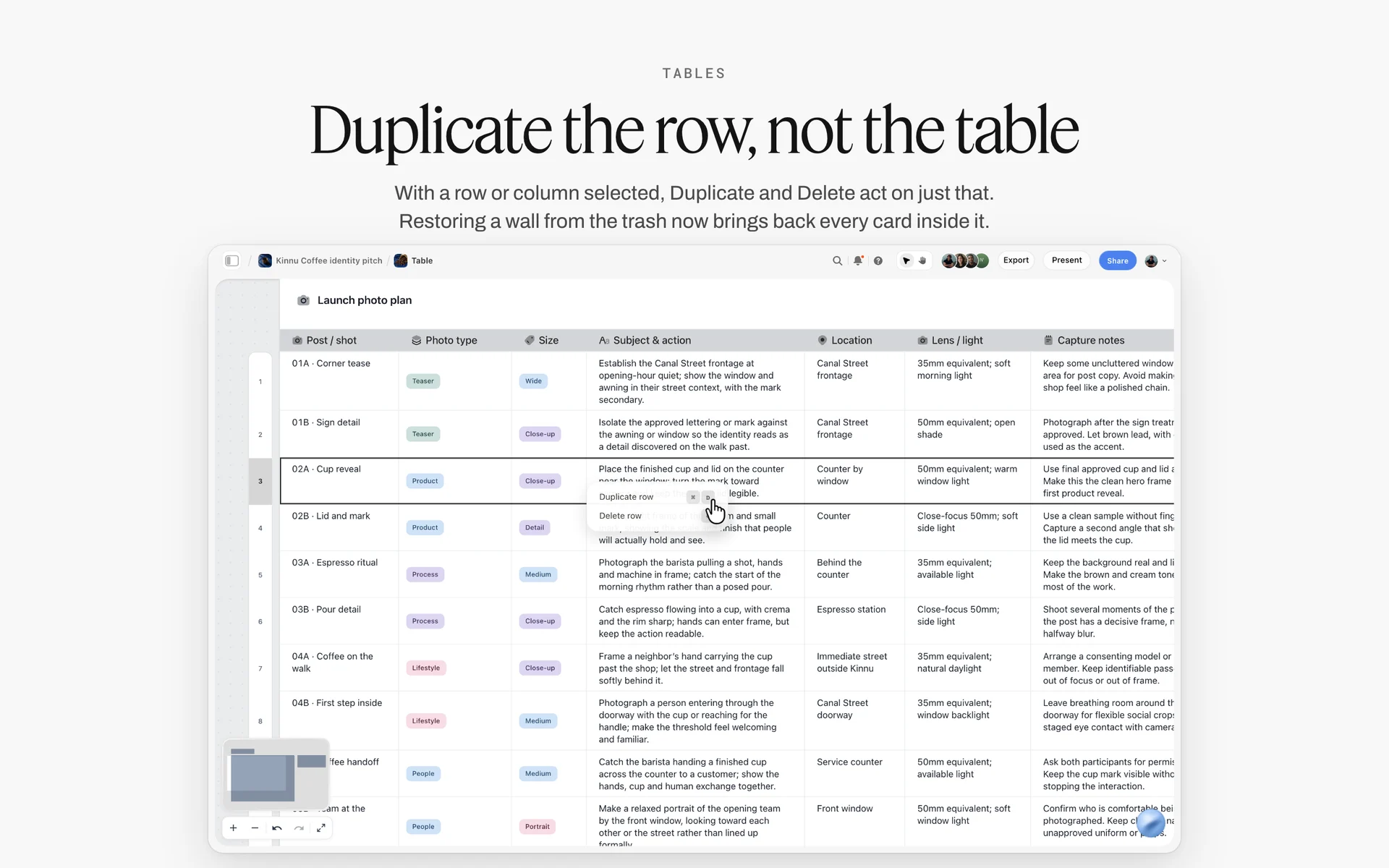
A table on the board keeps rows like these editable where the plan lives, and one row can be duplicated without copying the table. Kinnu Coffee is fictional.
The Storyflow 6-Row Campaign Grid
Most campaign roundups describe what the work looked like. That tells you nothing you can reuse, because your budget, your audience and your product are different. The grid below strips each campaign to the decisions behind it, which you can reuse.
The rule, defined
The Storyflow 6-Row Campaign Grid: read every campaign example, and write every campaign plan, as six rows on one wall of a Storyflow board: goal, audience, insight, idea, channels and result, each answered in a sentence, with the source linked under the wall. It is our editorial recommendation, built from how award bodies judge effectiveness rather than from research of our own.
Why six rows
The Effie Awards score an entry on four sections: challenge, context and objectives; insights and strategy; bringing the strategy and idea to life; and results (2025 Effie entry guide). Split the first into the goal and the audience it is aimed at, split the second into the insight and the idea it produced, keep the third as channels, and the fourth as result: six rows. Each row is one decision someone signed.
| Effie section | Weight | Grid rows | The question each row answers |
|---|---|---|---|
Challenge, context and objectives | 23.3% | Goal, Audience | What had to change, and for whom? |
Insights and strategy | 23.3% | Insight, Idea | What truth did the team find, and what idea came from it? |
Bringing the strategy and idea to life | 23.3% | Channels | Where and how did people meet the idea? |
Results | 30% | Result | What changed, measured how, according to whom? |
Why one wall per campaign
On a Storyflow board, each breakdown is one wall: six notes in a column, the source link at the bottom, a picture of the work at the top. Put 24 walls side by side and you can read across a row: every insight in a line, every result in a line. That is where patterns show, and patterns are what you reuse.
What to do when a row is missing
Write "not recorded in the source" and move on. Coca-Cola's Hilltop has a documented idea, channels and cost in the public record and no sales result in the source. Filling the row with a number from a blog that cites nobody poisons every comparison you make later. The rows marked "our reading" below are our inference from the documented work, labelled as such.
What Is a Marketing Campaign?
A marketing campaign is a series of messages that share one idea and theme, run across chosen channels over a set period, to move a defined audience toward a measurable goal. The encyclopaedia entry for an advertising campaign describes the same thing: a series of messages sharing a single idea and theme, using diverse media over a particular time frame and aimed at identified audiences. This page stays with examples; what is a marketing campaign covers the anatomy in full.
What is a campaign in marketing, in plain words
It is a project with a start date, an end date, one idea and a number it is meant to move. Marketing is the ongoing work; the American Marketing Association defines it as the activity and processes for creating, communicating, delivering and exchanging offerings that have value. A campaign is one bounded push inside that work.
Marketing campaign meaning: the four tests
A piece of work is a campaign when it passes four tests: one idea runs through every piece; it has a start and an end, even if the platform it builds lasts decades; it aims at a named audience; and someone can say afterwards whether it worked. Just Do It passes all four. A month of unrelated social posts passes none.
What a campaign is not
A campaign is not a calendar, a channel or a budget. The calendar says when, the channel says where and the budget says how much. A team that starts with "we need a TikTok campaign" has picked a channel and skipped the idea; every example below started with the idea.
Marketing Campaign vs Ad vs Promotion
A campaign is the whole push built on one idea, an ad is a single message inside it, and a promotion is a time-limited incentive that may or may not belong to one; in Storyflow, the campaign is the board, each ad is a card on it and each promotion is a dated row in the plan's table.
| Term | What it is | Time span | Example from the 24 | Measured by | Where it lives in Storyflow |
|---|---|---|---|---|---|
Marketing campaign | Several messages sharing one idea across channels | Weeks to years | Share a Coke across 80+ countries | A business outcome: share, sales, sign-ups | The whole board: brief wall, grid wall, plan table |
Ad | One message in one format and placement | One flight | Apple's 1984 commercial, aired nationally once | Reach, recall, response | One card on the board, with its script or frame |
Promotion | A limited-time incentive: discount, contest, sample, giveaway | Days to weeks | Patagonia's 2016 Black Friday sales pledge | Units sold or uplift during the window | A dated row in the plan table, linked to the ad that announces it |
Brand platform | The idea a brand returns to across many campaigns | Years | Just Do It since 1988 | Long-term share and preference | A pinned wall every campaign board starts from |
When an ad becomes a campaign
An ad becomes a campaign when a second piece carries the same idea to another place. Old Spice's first spot was an ad; the 186 personal reply videos shot in two and a half days afterwards made it a campaign (Old Spice).
When a promotion is the campaign
A promotion is the campaign when the incentive is the idea. Sales promotion runs for a predetermined, limited time to lift demand: contests, coupons, samples, rebates. Patagonia's pledge was a promotion whose idea was refusing the usual Black Friday promotion, which is why it travelled.
Brand Platform Marketing Campaign Examples
Brand platforms are the campaigns people remember, and the hardest to copy, because their result comes from running one idea for years. Read them for the idea row and the discipline of keeping it.
1. Nike, "Just Do It" (1988)
Wieden+Kennedy wrote the line in 1988 (Just Do It).
- Goal: grow share of the sport-shoe market and sell sneakers as a fashion statement, not only fitness gear.
- Audience: all Americans, regardless of age, sex or fitness level, according to the campaign's stated objective.
- Insight (our reading): most people who might exercise are held back by starting, not by gear.
- Idea: a three-word dare that fits a marathon runner and someone going for a first jog.
- Channels: merchandise, outdoor billboards, print and graffiti art, with athletes from many sports.
- Result: Nike's share of the North American sport-shoe business rose from 18% to 43% between 1988 and 1998, and worldwide sales from $877 million to $9.2 billion.
Steal this: write the line so it works for your least committed customer, not your best one.
2. Apple, "Think Different" (1997)
TBWA\Chiat\Day's Los Angeles office made it for an Apple that was struggling in 1997 (Think different).
- Goal: restate what the brand stood for before new products were ready to prove it.
- Audience: creative people and the people who wanted to be seen as them.
- Insight (our reading): buyers of a struggling brand need a reason to belong before a reason to buy.
- Idea: honour famous people who changed things, without showing a product.
- Channels: a one-minute TV spot with 17 personalities, a 30-second cut, print and at least 29 posters.
- Result: the slogan ran from 1997 to 2002 and won a 1998 Emmy and the 2000 Grand Effie. The source records no sales figure for the campaign itself.
Steal this: when the product cannot carry the story yet, let the audience's self-image carry it.
3. California Milk Processor Board, "Got Milk?" (1993)
Goodby Silverstein & Partners made it; the first spot aired on 29 October 1993 (Got Milk?).
- Goal: raise milk consumption.
- Audience: milk drinkers in California.
- Insight (our reading): people notice milk only when it runs out, mid-mouthful of a cake or a cookie.
- Idea: deprivation: show the moment there is no milk.
- Channels: TV first ("Aaron Burr", directed by Michael Bay), print with bitten food, later licensed nationally on the "Milk Mustache" ads from 1995.
- Result: milk sales rose in California; the source says there is no substantive evidence of its effect nationwide.
Steal this: sell the absence of the product, not its presence.
4. De Beers, "A Diamond Is Forever" (1947)
Copywriter Frances Gerety at N. W. Ayer coined the line in 1947 (De Beers).
- Goal: create demand for diamonds as a category.
- Audience: couples about to marry, and the people buying for them.
- Insight (our reading): a gift for a promise should look as permanent as the promise.
- Idea: tie the stone to love that lasts.
- Channels: the linked page does not record the media; later De Beers campaigns stretched the idea to eternity and trilogy rings.
- Result: Advertising Age named it the best slogan of the 20th century in 2000.
Steal this: a category campaign sells the occasion; the brand comes along with it.
5. Budweiser, "Whassup?" (1999)
The first spot aired during Monday Night Football on 20 December 1999 (Whassup?).
- Goal: make the brand part of how friends talk.
- Audience: young men watching sport with friends.
- Insight: a creative at DDB Chicago noticed that everyone he showed Charles Stone III's short film to shouted the greeting at him afterwards.
- Idea: friends on the phone, saying one word in one comic way.
- Channels: TV spots, sequels for the Super Bowl, and the catchphrase in pop culture.
- Result: the Cannes Grand Prix and the Grand Clio; inducted into the Clio Hall of Fame in 2006.
Steal this: test the idea on people outside the team and watch what they repeat.
6. Coca-Cola, "Hilltop" (1971)
McCann Erickson turned a song into a jingle that debuted on radio in February 1971 (the Hilltop song).
- Goal: attach the drink to a feeling bigger than refreshment.
- Audience: a broad, young, international audience.
- Insight (our reading): sharing a cheap drink is one of the few things strangers do together.
- Idea: a crowd of young people on a hill, singing about buying the world a drink.
- Channels: radio first, then a TV spot filmed on a hill outside Rome that first aired in July 1971, with a Christmas version in 1977 and a reunion spot in 1990.
- Result: the ad cost $250,000, then the most expensive commercial made. The source records no sales figure.
Steal this: test a campaign's idea on the cheapest channel first; Hilltop was a radio jingle before it was a film.
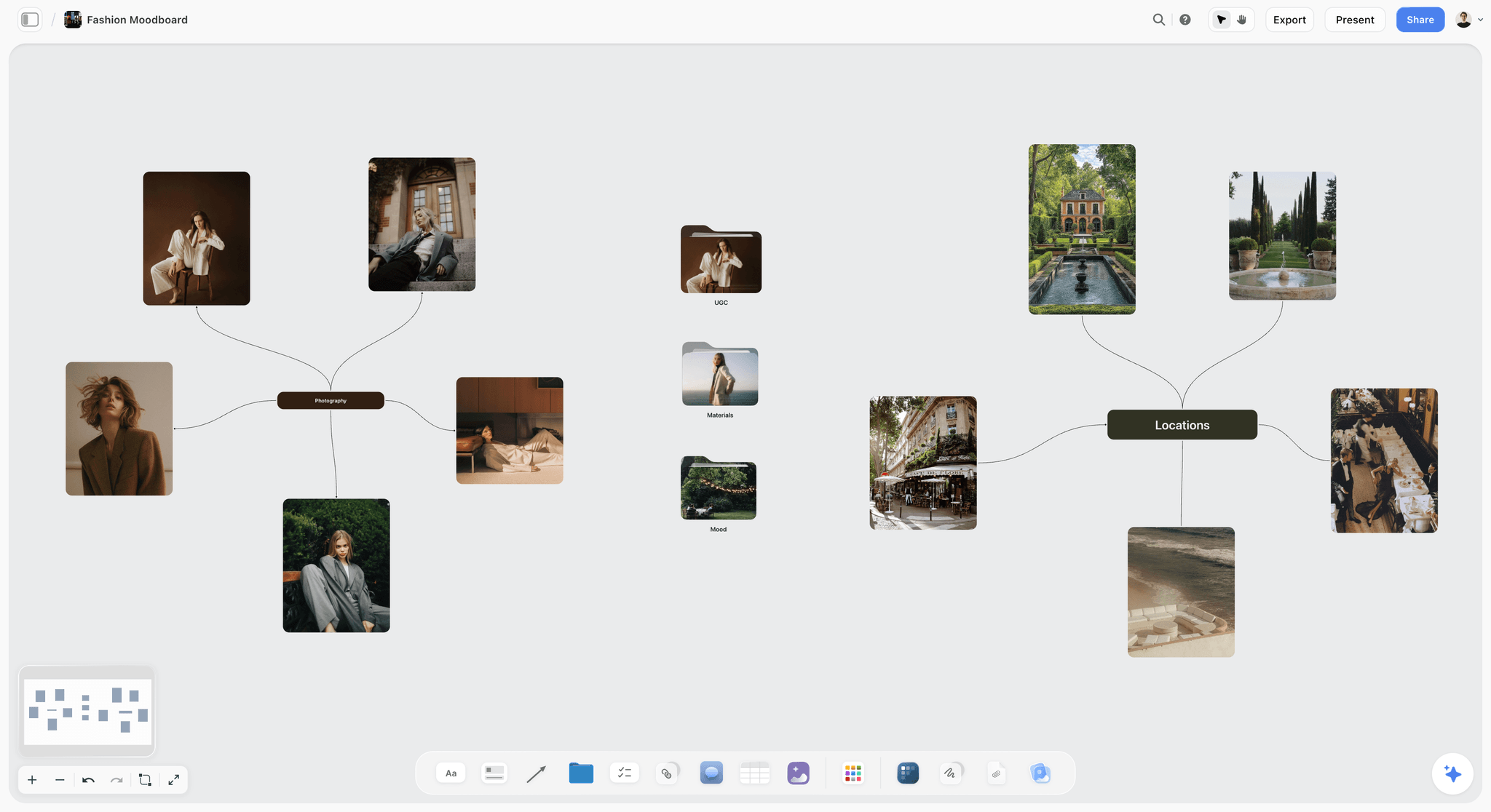
A brand's look gathered on one board, so every later campaign board starts from the same references.
Product Launch Marketing Campaign Examples
Launch campaigns have a date that cannot move, and their result shows in weeks. Read them for the channels row: each picked the one placement that made the launch an event.
7. Apple, "1984" (1984)
Ridley Scott directed the commercial that introduced the Macintosh (1984).
- Goal: make the launch of a new computer an event.
- Audience: a mass audience that had never bought a personal computer.
- Insight (our reading): in 1984, Orwell's novel gave every viewer a ready-made fear of conformity.
- Idea: a heroine smashes a screen of "Big Brother"; the Macintosh will free you.
- Channels: one national airing, during Super Bowl XVIII on 22 January 1984, after a single late-1983 local airing to qualify for awards.
- Result: Advertising Age put it at the top of its list of 50 greatest commercials, and the Clio Awards added it to its Hall of Fame in 1995.
Steal this: a launch can be one placement, if it is the right one.
8. Volkswagen, "Think Small" (1959)
DDB built the print campaign for the Beetle in 1959 (Think Small).
- Goal: sell a small, strange-looking car in a market of big American cars.
- Audience: practical American buyers.
- Insight: car ads of the time were fantasy and lists of features; nobody was being honest.
- Idea: make the small size the virtue, with self-deprecating copy.
- Channels: print, with a small car in white space, sans-serif type and black and white when colour was the norm.
- Result: Advertising Age named it the best advertising campaign of the 20th century in 1999.
Steal this: name the objection buyers already have and make it the headline.
9. Old Spice, "The Man Your Man Could Smell Like" (2010)
Wieden+Kennedy made it for a body wash, with Isaiah Mustafa speaking straight to camera (Old Spice).
- Goal: sell a new body wash and make an old brand feel current.
- Audience: women, because the company found they often buy hygiene products for the men in the household.
- Insight: the buyer and the user were different people.
- Idea: a confident man tells women what their man could smell like.
- Channels: online first on 4 February 2010, TV four days later, then 186 personal reply videos filmed in about two and a half days (Wieden+Kennedy's case page).
- Result: over 11 million online views by the end of June 2010 and the Cannes Lions Grand Prix for Film. The agency's case page reports body wash sales up 60% on the year by May 2010 and doubled by July, against a 15% goal; those are the agency's figures.
Steal this: find out who buys, not only who uses, and write to the buyer.
10. Dollar Shave Club, launch video (2012)
The membership service launched on 6 March 2012 with one video (Dollar Shave Club).
- Goal: launch a razor subscription with almost no budget.
- Audience: men annoyed by the price of razor blades.
- Insight: the founders' own frustration with what blades cost.
- Idea: the founder, deadpan, tells you the blades are good and cheap.
- Channels: one online video and a website.
- Result: 12,000 orders in the first 48 hours; 3.2 million subscribers by 2016, when Unilever bought the company for a reported $1 billion.
Steal this: if the founder's complaint is the customer's complaint, put the founder on camera.
11. Blendtec, "Will It Blend?" (2006)
Founder Tom Dickson blended things to show the power of his blenders, in a series that began on 30 October 2006 (Will It Blend?).
- Goal: prove the product's power to people who would never read a spec sheet.
- Audience: curious viewers online, many of whom would never buy a commercial blender.
- Insight: a demonstration is more believable than a claim, and an absurd one is shareable.
- Idea: put an unlikely object in the blender and ask the title question.
- Channels: an online video series and late-night TV.
- Result: the series ran until November 2020, and Dickson blended a rake handle on The Tonight Show in March 2007. The source records no blender sales figure.
Steal this: if the product can be demonstrated, the demonstration is the campaign.
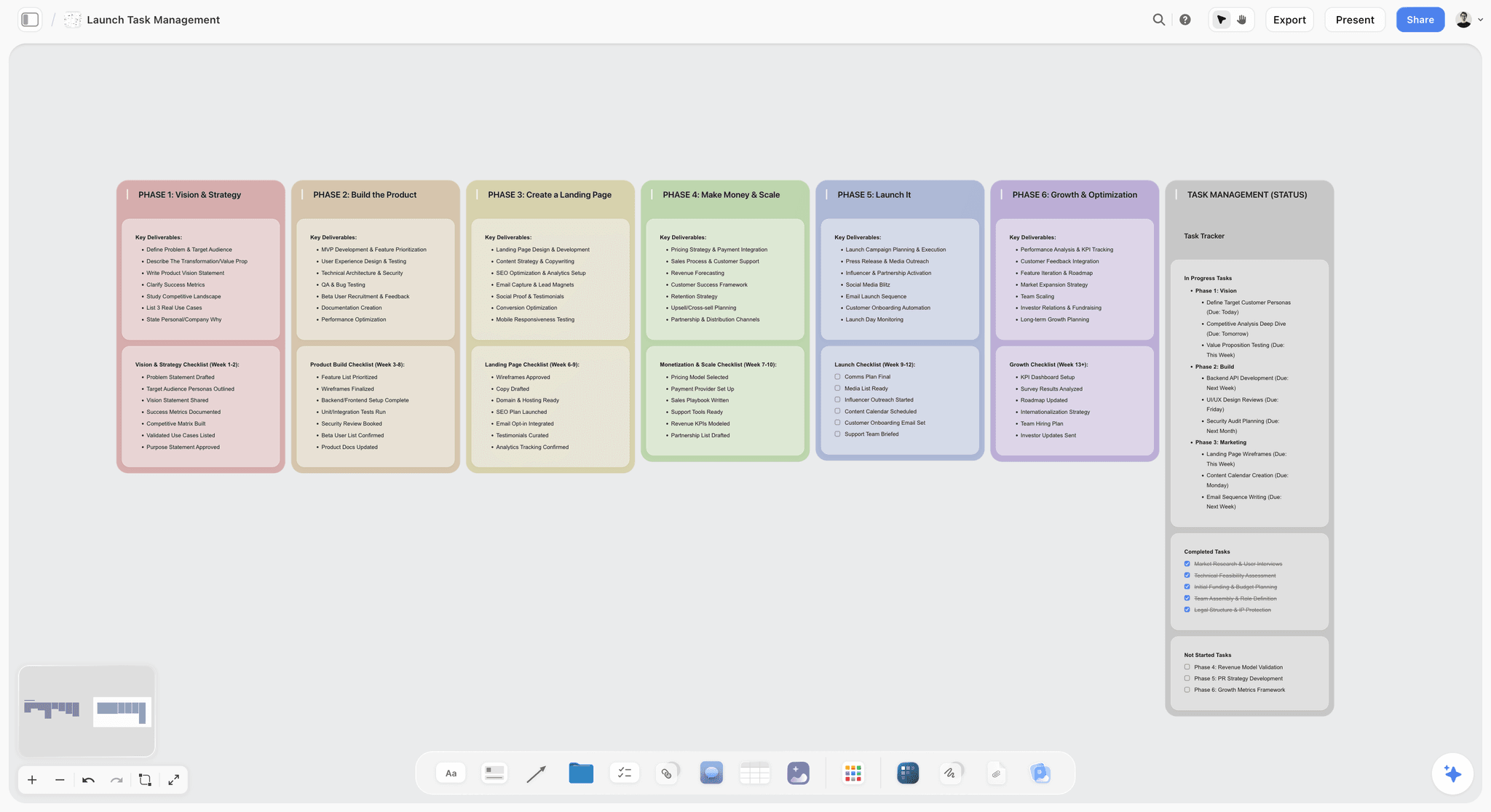
A launch board puts the phases and the open tasks on the same canvas as the idea.
Purpose and Public-Interest Marketing Campaign Examples
Purpose campaigns sell a belief before a product. They work when the belief is tied to something the brand already does, and fail when it is borrowed. Read them for the insight row.
12. Dove, "Campaign for Real Beauty" (2004)
Unilever launched it in 2004 with Ogilvy and Edelman (Dove Campaign for Real Beauty).
- Goal: grow Dove beyond soap by standing for something.
- Audience: women who did not see themselves in beauty advertising.
- Insight: the campaign's research found only 4% of women considered themselves beautiful.
- Idea: photograph real women instead of models, and let people vote on labels like "Wrinkled or Wonderful".
- Channels: interactive billboards in Germany and the UK, a published report, TV, a Super Bowl spot in 2006, films such as Evolution and, in 2013, Real Beauty Sketches.
- Result: Ad Age reported sales of Dove soap rising from $2 billion to $4 billion in three years.
Steal this: publish the research; a number your audience recognises is a campaign by itself.
13. Always, "Like a Girl" (2014)
Leo Burnett made it and Lauren Greenfield directed the film, which debuted in June 2014 (Always).
- Goal: keep girls' confidence, and the brand's place, through puberty.
- Audience: girls and the adults around them.
- Insight: adults acted out "like a girl" as weak; young girls acted it out as strong.
- Idea: ask "When did doing something 'like a girl' become an insult?"
- Channels: an online film, then a Super Bowl XLIX spot, with a focus on the US and African markets.
- Result: the 2015 Emmy Award for outstanding commercial. The source records no sales figure.
Steal this: film the insight happening rather than describing it.
14. Metro Trains Melbourne, "Dumb Ways to Die" (2012)
McCann made a cheerful song about stupid deaths to promote railway safety (Dumb Ways to Die).
- Goal: cut accidents and near-misses on Melbourne's railways.
- Audience: young people who ignore safety messages.
- Insight: this audience does not want to hear any kind of safety message, so it had to be entertainment first.
- Idea: cute characters die in absurd ways, and the dumbest ways involve trains.
- Channels: an online video released in November 2012, the song, and a mobile game from May 2013.
- Result: over 350 million YouTube views. Metro Trains credited it with near-misses down 20% against the annual average; a former state infrastructure employee publicly disputed that figure, so quote it as Metro's claim.
Steal this: for an audience that tunes out warnings, hide the warning in the last verse.
15. State Street Global Advisors, "Fearless Girl" (2017)
McCann New York installed the statue on 7 March 2017, the day before International Women's Day (Fearless Girl).
- Goal: promote gender diversity in company leadership and an index fund built on it.
- Audience: investors and boards, reached through the public.
- Insight (our reading): a financial message travels further as an image than as a report.
- Idea: a bronze girl, hands on hips, facing Wall Street's Charging Bull.
- Channels: one statue, then the coverage it earned.
- Result: a one-week permit was extended to 30 days and then to February 2018; a petition to keep it gathered 2,500 signatures in 48 hours.
Steal this: a single physical object in the right place can carry a B2B message.
16. ALS charities, "Ice Bucket Challenge" (2014)
The challenge went viral in July and August 2014 (Ice Bucket Challenge).
- Goal: raise awareness of ALS and donations for research.
- Audience: everyone on social media, recruited by their friends.
- Insight (our reading): people share what lets them show off and nominate friends at the same time.
- Idea: film yourself under ice water, donate, and nominate others to do it within 24 hours.
- Channels: social video, passed from person to person, then TV.
- Result: the ALS Association counts $115 million to it in 2014; other reports put the worldwide total above $220 million, so the sources disagree on the total. A 2015 relaunch raised about $1 million.
Steal this: build the next step into the action; every participant recruits the next ones.
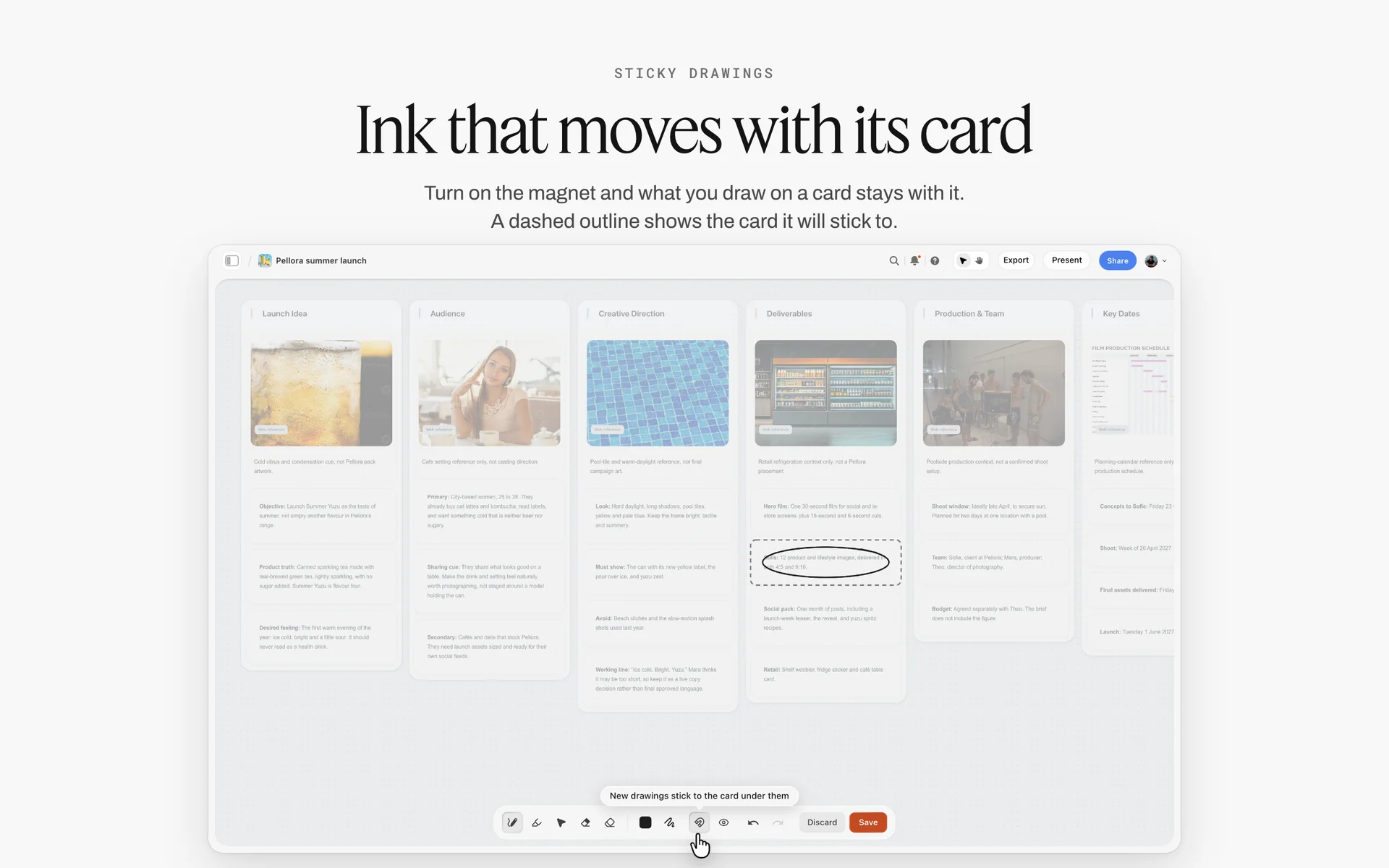
The idea, the audience and the deliverables sit on neighbouring walls, so the idea can be checked against who it is for and what it has to make. Pellora is fictional.
Participation, Stunt and B2B Marketing Campaign Examples
These campaigns get the audience to do something or watch something happen live. They are expensive to stage and cheap to spread. Read them for the idea row: one action, simple enough to describe in a sentence.
17. Coca-Cola, "Share a Coke" (2011)
The campaign began in Australia in 2011 and replaced the logo on one side of the bottle with names (Share a Coke).
- Goal: win back young adults.
- Audience: young adults who had drifted from the brand.
- Insight (our reading): people look for their own name, and give a bottle with a friend's.
- Idea: "Share a Coke with" followed by one of the 250 most popular names in each market.
- Channels: packaging first, then advertising and sharing, later rolled out in over 80 countries.
- Result: Ogilvy estimated category share up 4% and young-adult consumption up 7% in Australia; in the US it is credited with sales up more than 2% after a decade of decline.
Steal this: if your packaging is your biggest medium, put the idea on the pack.
18. Red Bull, "Stratos" (2012)
On 14 October 2012 Felix Baumgartner jumped from about 39 kilometres above New Mexico (Red Bull Stratos).
- Goal: own the idea of pushing human limits.
- Audience: a global audience for extreme sport and live events.
- Insight (our reading): people will watch a real record attempt live in a way they will not watch an ad.
- Idea: a skydive from the stratosphere, sponsored end to end.
- Channels: a years-long project, a live stream of the jump, and the coverage around it.
- Result: Baumgartner broke the record for the highest-altitude jump, set in 1960.
Steal this: a stunt works when the brand's role is the reason it can happen at all.
19. Volvo Trucks, "The Epic Split" (2013)
Forsman & Bodenfors made the sixth film in Volvo Trucks' "Live Tests" series, with Jean-Claude Van Damme (The Epic Split).
- Goal: prove the stability and steering of a new truck range.
- Audience: truck buyers and fleet managers, reached through everyone else.
- Insight (our reading): B2B buyers watch the same videos as everyone else, and their families send them.
- Idea: a split between two trucks reversing at 25 km/h, filmed in one take.
- Channels: a 75-second online film within a series of live tests.
- Result: 25 million views in a week and 40 million in nine days. The Local, citing Dagens Nyheter, put production at $3 to $4.7 million and the value it brought in at an estimated $170 million; Volvo's own spokesman described that as media value, not sales.
Steal this: a B2B product claim can be a public demonstration, if the demonstration is literal.
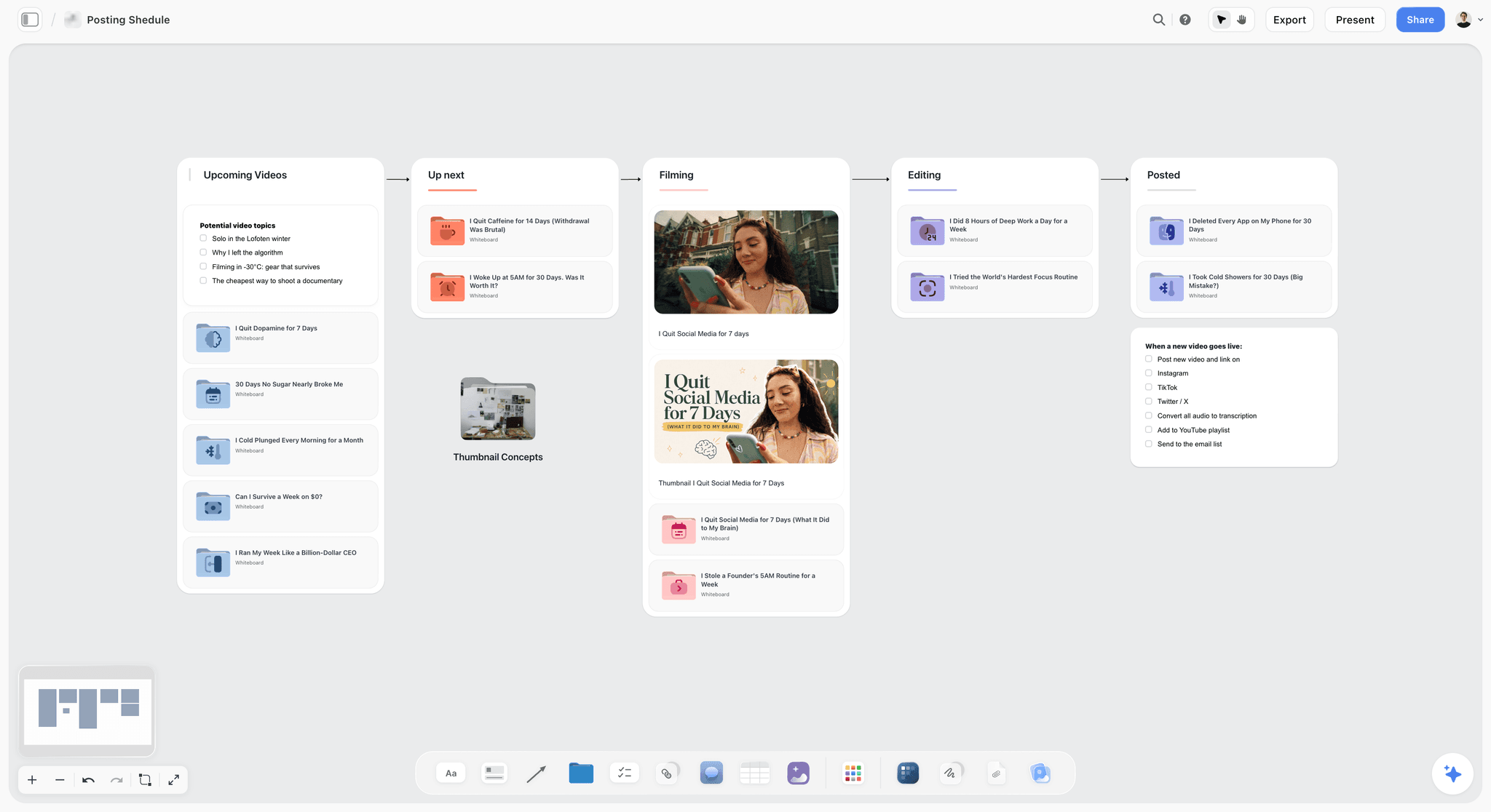
A participation campaign runs as a pipeline: pieces move from planned to live, one card each.
Reputation and Values Campaign Examples
Reputation campaigns are written under pressure, often in days. They work by saying the uncomfortable thing first. Read them for the insight row: what the audience already believed about the brand.
20. KFC, "FCK" (2018)
In February 2018 a delivery failure left KFC UK short of chicken and closed hundreds of restaurants (KFC).
- Goal: contain the damage of a very public failure.
- Audience: British customers who had found their KFC shut.
- Insight (our reading): customers already knew; the only question was whether the brand would admit it.
- Idea: an apology with the empty bucket's letters rearranged to read "FCK".
- Channels: full-page adverts in British newspapers.
- Result: the source records that the apology was well received.
Steal this: when the audience already knows, the first brand to say it plainly sets the tone.
21. Domino's, recipe overhaul (2010)
In 2010 Domino's changed its pizza "from the crust up" (Domino's).
- Goal: win back customers who thought the pizza tasted bad.
- Audience: lapsed and sceptical customers.
- Insight: the public already had a poor view of the taste.
- Idea: admit it in the advertising, and show the new recipe.
- Channels: advertising built around the admission.
- Result: Domino's own first-quarter 2010 results reported US same-store sales up 14.3%, which the company put down to store traffic from the new pizza (quarterly release).
Steal this: an admission only works if the product has actually changed.
22. Patagonia, Black Friday pledge (2016)
Patagonia pledged 100% of its Black Friday sales to environmental organisations in 2016 (Patagonia).
- Goal: turn the biggest discount day into proof of the brand's values.
- Audience: existing customers and people who care about the environment.
- Insight (our reading): on a day built for discounting, giving the takings away reads as a stance, not a promotion.
- Idea: every dollar of the day's sales goes to environmental groups.
- Channels: the pledge itself, the stores and online shop, and the coverage.
- Result: $10 million to environmental organisations. The company has given 1% of sales to environmental groups since 1985, which made the pledge believable.
Steal this: a values campaign needs a track record; launch it on a habit you already have.
Retail, Seasonal and Competitive Campaign Examples
Seasonal campaigns repeat every year, which gives them something launches never have: an audience that waits for them. Competitive campaigns name the gap between you and the leader. Read both for the channels row and the calendar.
23. John Lewis, Christmas advert (2007 onward)
John Lewis launched its first Christmas advert in 2007; Adam & Eve/DDB has made them since 2009 (John Lewis Christmas advert).
- Goal: own the start of the Christmas shopping season in the UK.
- Audience: British families planning Christmas.
- Insight (our reading): gift-giving is about the giver's feelings as much as the gift.
- Idea: a short emotional film each year, with a cover version of a known song.
- Channels: TV, cinema and online, with the release itself treated as news.
- Result: the top prize at the 2012 IPA Effectiveness Awards, which reward campaigns that show their marketing payback.
Steal this: if your season repeats, make the campaign an annual event people wait for.
24. Wendy's, "Where's the beef?" (1984)
The line first aired in a 1984 TV commercial with Clara Peller (Where's the beef?).
- Goal: separate Wendy's burgers from bigger chains' better-known ones.
- Audience: fast-food customers.
- Insight: competitors' famous burgers had small patties in big buns.
- Idea: an older woman lifts a huge bun and asks where the beef is.
- Channels: TV, then a hit song and political speeches that borrowed the line.
- Result: the phrase entered US politics in the 1984 primaries; Wendy's revived it in 2011 and 2020.
Steal this: a competitive campaign names the gap; it does not need to name the competitor.
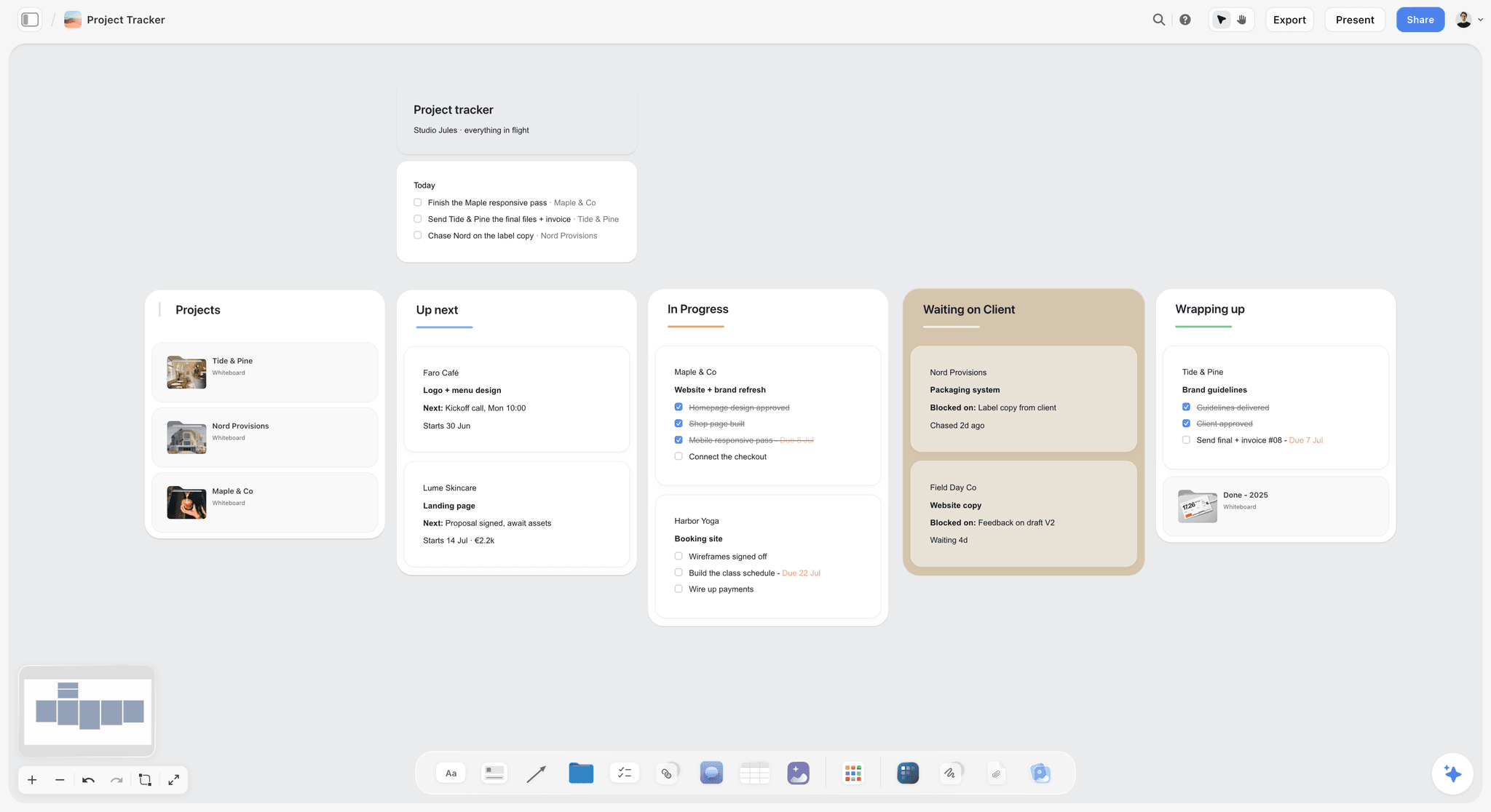
An agency running several campaigns keeps one card per campaign. Studio Jules and its clients are fictional.
What the 24 Marketing Campaign Examples Have in Common
Read across the rows instead of down the campaigns and five patterns repeat.
The idea fits in one sentence
Every idea above can be said in under 15 words. "Share a Coke with" a name. A split between two reversing trucks. If your idea needs a paragraph, it is still a strategy, not an idea.
The insight is about behaviour, not demographics
The strongest insights describe what people do: women buy their partner's body wash, adults act out "like a girl" as weak, young people ignore safety messages. None of them is "women aged 25 to 44".
One channel leads
1984 had one airing. Dollar Shave Club had one video. Share a Coke started on the pack. Each campaign picked a lead channel and let the rest follow. Plans that give six channels equal weight usually give none of them enough.
The result is a number with a source, or it is missing
Just Do It, Dove, Domino's and the Epic Split have numbers you can trace, and Dumb Ways to Die has one that was disputed. Think Different, Hilltop and Always have none. Les Binet and Peter Field's The Long and the Short of It for the IPA examines how campaign results develop over time and warns against judging by very short-term online metrics; a brand platform's result may not show in the first quarter.
The brand earned the right to say it
Patagonia's pledge followed decades of giving; Dove published research; Domino's actually changed the recipe. Campaigns that borrow a cause without a track record get the coverage and lose the trust.
Types of Marketing Campaigns and the Row That Matters Most
Each type puts the weight on a different row of the grid. Use this table to decide which row to argue about longest in your own plan.
| Type | Typical goal | The row that decides it | Examples above | KPI to set before launch |
|---|---|---|---|---|
Brand platform | Long-term preference and share | Idea | Just Do It, Got Milk?, A Diamond Is Forever | Share or preference over 12+ months |
Product launch | Trial in the first weeks | Channels | 1984, Dollar Shave Club, Think Small | Orders, sign-ups or trials by a date |
Relaunch | New buyers for an old product | Audience | Old Spice | Sales among the new audience |
Purpose | Brand meaning and loyalty | Insight | Dove, Always, Fearless Girl | Brand perception and sales trend |
Public interest | Behaviour change | Insight | Dumb Ways to Die, Ice Bucket Challenge | The behaviour itself: near-misses, donations |
Participation | Spread through customers | Idea | Share a Coke, Ice Bucket Challenge | Participants and shares |
Stunt or demonstration | Proof of a claim | Idea | Red Bull Stratos, The Epic Split, Will It Blend? | Views plus a sales or lead figure |
Reputation | Trust after a failure | Insight | KFC, Domino's | Sentiment and return visits |
Seasonal retail | Share of a fixed season | Channels | John Lewis | Season sales against last year |
Competitive | Switching from a leader | Insight | Where's the beef? | Share gained from the named category |
Marketing campaign examples by channel
Many lists sort campaigns by the channel that led them (an email campaign, a social campaign, an out-of-home campaign). That is a second way to read the same 24, and it is the one to use when the channel is already fixed and you need an example to brief from. The lead channel is the one the campaign was built for first; the rest followed.
| Lead channel | Example | What the lead channel did | What to copy |
|---|---|---|---|
Think Small (8), FCK (20) | Full-page ads made one argument with room to read it | One idea per page, with white space | |
TV and cinema | 1984 (7), John Lewis (23) | One big airing or an annual film the audience waits for | Treat the release date as news |
Online video | Dollar Shave Club (10), Will It Blend? (11), The Epic Split (19) | A single film proved the claim and carried the launch | A format you can repeat cheaply |
Social reply and participation | Old Spice (9), Ice Bucket Challenge (16) | 186 reply videos; a pass-it-on rule that named three people | A built-in reason for the audience to answer |
Packaging | Share a Coke (17) | The product itself became the medium | Put the idea where the buyer picks the product up |
Out-of-home and ambient | Fearless Girl (15), Real Beauty billboards (12) | One object or poster earned the coverage | Place it where press will photograph it |
Live event | Red Bull Stratos (18) | A live stream of one moment | A date the audience can watch |
In-product personalisation | Spotify Wrapped (not in the 24) | Each user's own year in listening, built to post | Make the customer's data the creative |
Spotify Wrapped is the in-product case none of the 24 covers: it began in December 2016 after a smaller 2015 version called Year in Music, ends on a screen that invites the user to post the result, and moved to a story format in 2019 to make sharing easier. Email and SMS rarely lead a famous campaign on their own; in most of these examples they carry the capture step (the order, the sign-up) after another channel has done the persuading. In Storyflow, give the lead channel the first card on the channels row and list the supporting channels under it, so nobody plans six channels with equal weight.
Marketing Campaign Template: The Grid Filled for Larchmere Cider
Larchmere Cider is a fictional regional cider maker launching a low-alcohol cider into local pubs and shops, planned by a four-person in-house team. The first six rows are the grid; the last four are the planning rows a campaign needs before anyone shoots anything. Copy the columns; replace every answer.
| Row | The question | Larchmere Cider's answer | Evidence or source | Owner | Due |
|---|---|---|---|---|---|
Goal | What must change, by how much, by when? | Low-alcohol cider stocked in 60 pubs and 40 shops in the region by 31 May, from 0 | Distributor's list of current stockists | Head of sales | Signed 3 March |
Audience | Who, in what situation? | Drivers and early-week drinkers who order a soft drink at the pub and wish they had not | Bar staff interviews at 6 pubs | Marketing lead | 7 March |
Insight | What do they do that nobody has said out loud? | They order cola to avoid explaining why they are not drinking | Same interviews; 9 of 14 described it | Marketing lead | 7 March |
Idea | What is the one idea, in a sentence? | "A pint you don't have to explain" | Tested on 20 regulars | Creative lead | 14 March |
Channels | Where does the audience meet it, and which leads? | Lead: pump clips and beer mats in the pub; then local radio, regional press, the cider maker's own social accounts | Pub landlords' input on what customers notice | Creative lead | 21 March |
Result | What will we measure, from which system? | Stockists from the distributor; repeat orders by week 6; pub sales per tap | Distributor reports | Head of sales | Read-out 30 June |
Budget | How much, split how? | Illustrative: $42,000: $24,000 media, $12,000 production, $6,000 point-of-sale | Finance plan | Founder | Signed 3 March |
Timeline | Which dates cannot move? | Sales visits from 1 April, launch 15 April, read-out 30 June | Brewery production slot | Ops lead | 3 March |
Mandatories | What must every piece carry? | ABV on every piece; no suggestion that drinking improves performance | Alcohol advertising code for the region | Marketing lead | 10 March |
Sign-off | Who approved what, when? | Founder approves goal, budget and idea; head of sales approves channels | Note on the board with name and date | Founder | 21 March |
In Storyflow, this is one table on the campaign wall, with the six grid rows above a divider and the four planning rows below. Every figure is illustrative; the structure is the point. For a client job, the campaign brief template holds the same lines in a client-facing shape.
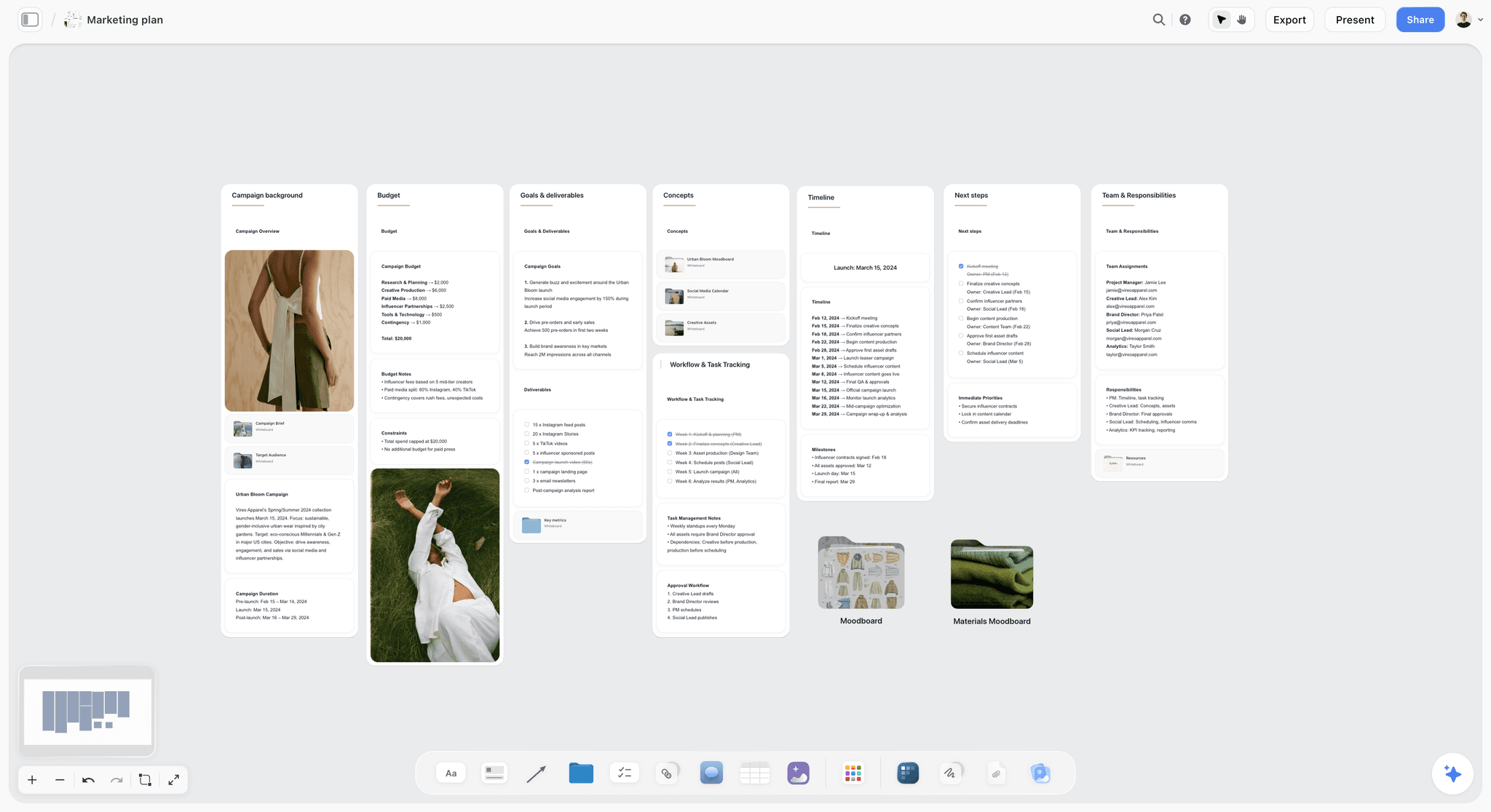
The planning rows become their own walls once the grid is signed. Vireo Apparel is fictional.
How to Plan a Marketing Campaign From These Examples: 8 Steps
Examples are only useful if they change what you do next. These eight steps turn the 24 breakdowns into a plan, in the order that keeps the decisions in the right hands.
- Pick three examples of the same type as your campaign from the table above, and one of a different type. In Storyflow, give each a wall with the six rows, so the three you are borrowing from sit side by side.
- Write your goal row first, with a number, a baseline and a date. If nobody can give a number, the open question goes on the board as a to-do with an owner, and nothing else starts.
- Write the audience as a situation, then collect evidence for an insight: interviews, reviews, sales data. Storyflow's in-app AI has a Profile my target audience workflow that drafts a first pass from the notes on the board.
- Write three candidate ideas, one sentence each, on cards beside the grid. Cut to one, and keep the other two on the board with the reason they lost.
- Pick the lead channel, then the supporting ones. In Storyflow, the channel plan is a table with one row per piece: channel, format, quantity, date, owner, rows kept in date order.
- Drag the Timeline tool onto the board for the phases (briefing, production, launch, read-out); dates go in the cards' text or in the table, because the tool has no date field.
- Set the result row: which number, from which system, read on which date. Add the four planning rows (budget, timeline, mandatories, sign-off).
- Share the board by view link (it opens with no account), record the sign-off in a note with name and date, and export a dated PDF of the board as the record.
For the steps after sign-off, the campaign map lays out the five layers from strategy to a visual plan, and the best workspace to run a campaign from brief to delivery covers production and approval.
Save the grid as your own tool
Once one breakdown wall is right, select it, choose New Tool at the end of the selection toolbar, and name it. It appears under your tools in the All Tools panel, ready to drop on any board, so every breakdown starts with the same six rows. Saving your own tool is on paid plans only.
Where the brief comes from
If the campaign starts from a client or a manager, the brief sits on the wall before the grid. Drag the Brief tool onto the board and six labelled walls land (the work, who it's for, how it looks, what we're working from, plan, budget) with grey prompts in the cards. Campaign brief examples by industry shows eight filled ones.
Worked Example: Larchmere Cider, From Breakdowns to a Signed Plan
This is an illustrative walk-through for the fictional Larchmere Cider team. The structure is the point; the names, numbers and dates are invented.
Day 1: three examples of the same type
The team's campaign is a product launch into a crowded fridge. They pick Dollar Shave Club (one founder-led piece), Think Small (name the objection), and Got Milk? (sell the moment of absence), plus Dumb Ways to Die as the different type. Four walls, six rows each, on a new Storyflow board called Larchmere launch.
Day 2: the goal and the audience
The head of sales gives the number: 60 pubs and 40 shops by 31 May. The marketing lead pastes the notes from six bar-staff interviews into a doc on the board and asks the in-app AI for an audience profile from them. The draft lands on the board in one turn; one undo would reverse it. She rewrites it as a situation: people who order cola at the pub to avoid explaining why they are not drinking.
Day 3: three ideas, one survivor
The creative lead writes three ideas on cards: "A pint you don't have to explain", "Cider, minus the morning", and "The designated drinker's drink". The second sounds like a hangover joke and the third excludes anyone not driving. The first stays; the other two stay on the board with a note saying why they lost, so nobody re-pitches them in week four.
Day 4: channels and dates
Borrowing from Share a Coke, the lead channel is the thing already in the customer's hand: pump clips and beer mats. Local radio and regional press support it. The channel table goes on the board with one row per piece, and the Timeline tool lays out briefing, production, sell-in, launch and read-out as phase walls.
Day 5: sign-off
The founder opens the view link, signs in to comment on the budget row, and moves $2,000 from radio to beer mats. The marketing lead records the change and the approval in a note with name and date, and exports a dated PDF of the board. The grid wall becomes a saved tool for the next launch.
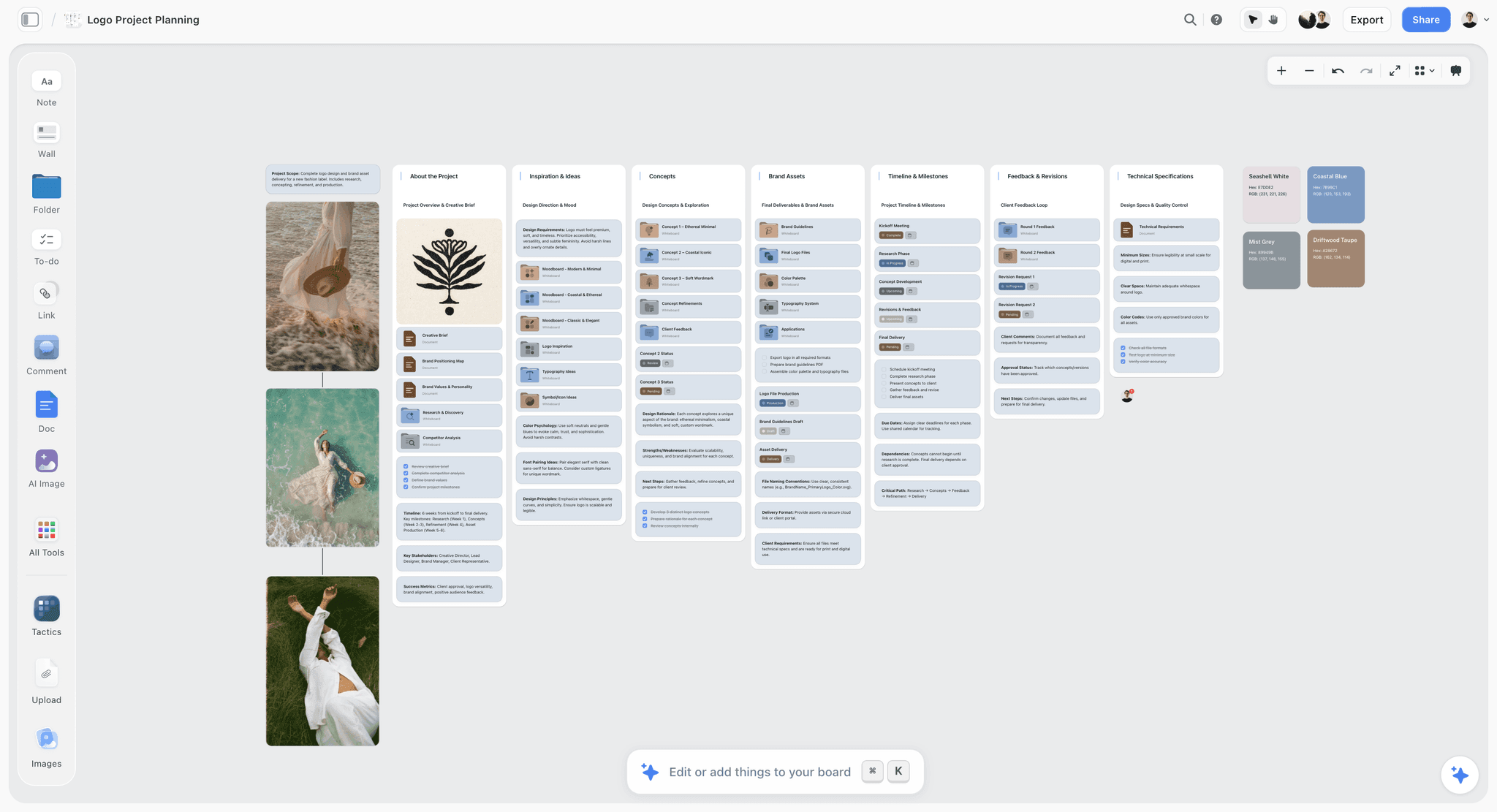
Each stage gets its own wall, so feedback and revisions stay next to the brief they answer.
Do This in ChatGPT or Claude
You can run the breakdowns and the first plan from a chat. ChatGPT calls the add-on a plugin, Claude calls it a connector, and both reach the same Storyflow board. This route runs on your assistant's plan and uses no Storyflow AI credits; it is separate from the in-app AI in the worked example.
Install in ChatGPT
Open the Storyflow listing in ChatGPT and select Install plugin, sign in to Storyflow, and choose which projects ChatGPT may use. Read access is always on; you decide whether it may also make changes. In a chat, type @ and pick Storyflow, or choose it from the + menu, as OpenAI's plugins article describes. Availability depends on your ChatGPT plan, workspace and region, and in a Business or Enterprise workspace an admin manages plugins. The connection ends after 30 days, and ChatGPT asks you to sign in again. The ChatGPT campaign plan and ChatGPT marketing plan pages show the job in ChatGPT.
Connect in Claude
In Claude, go to Customize, then Connectors, choose Add, then Add custom connector, name it Storyflow and enter https://mcp.storyflow.so/mcp, then sign in, as Anthropic's custom connector article describes. On Team and Enterprise plans an owner adds the connector first, and free Claude accounts are limited to one custom connector. Setup for every assistant is on the Storyflow MCP page, and the Claude campaign plan page shows the job in Claude.
Prompts to copy
Pick Storyflow first, then paste. Replace Larchmere Cider with your campaign.
- "On my Larchmere launch board, make a wall called Breakdowns with one table per campaign: Dollar Shave Club's launch video, Volkswagen's Think Small and Got Milk?. Rows: goal, audience, insight, idea, channels, result. Leave a row blank where you are not sure, and say so in the cell."
- "Search my workspace for the bar-staff interview notes and add a note to the Breakdowns wall listing every behaviour that more than one interviewee described."
- "Write a six-row table on a new wall called Larchmere grid, using the interview notes for the audience and insight rows. Leave the goal and result rows empty with a question in each."
- "Add three idea cards beside the grid, one sentence each, and a note under each with the risk."
- "Build a channel table with columns Piece, Channel, Format, Quantity, Date and Owner, rows in date order, from the channels row."
- "Add a to-do for each open question on the grid, with the question as its text." Set the due dates by hand afterwards; the assistant dates tickets, not to-dos.
- "What changed on the Larchmere launch board this week, and who changed it?"
- In Claude: "Read the attached distributor report PDF and write the baseline stockist count into the goal row's evidence note, with the page number."
What lands on the board
Tables, notes, docs, walls and to-dos appear on the board, which the team opens by view link. The plugin can set a ticket's due date when you give one; it cannot set a to-do's assignee, but it can fill a table's Owner column with people who already have access to the board (if any name matches nobody, the whole column becomes plain text with the names as written). A photo attached in a ChatGPT chat does not reach Storyflow, so ask for the upload link for pictures of the work. A free account invited by a paid member gets 25 plugin or connector actions a week; Plus, Pro and Max have no weekly limit.
What to check by hand
Check every result row against its source, because an assistant summarising a famous campaign will repeat numbers from memory that no source supports. Check the insight with real customers. The sign-off note is yours to write. For a deeper look at the assistants themselves, the best AI marketing campaign tools under $50 compares the approaches.
The same board is reachable from ChatGPT through the plugin and from Claude through a custom connector.
Draft the Plan With Storyflow's In-App AI
The in-app AI lives inside Storyflow, uses Storyflow AI credits and needs a paid plan. It suits the moment the breakdowns and the notes are on the board and you want a first plan beside them.
What it reads
It reads the current board plus up to five documents and three other boards you attach, and it searches the web when you ask, which helps when you want a campaign's public facts checked against a source. Attach the breakdown board and the brief, and it drafts from those rather than from general knowledge.
What it drafts
The Brief my campaign workflow asks a clarifying question or two, then writes a brief straight onto the board. Ask the AI for a marketing plan or a social media plan and it builds one from the grid. From a signed board it designs a creative brief, a one-pager or a pitch deck. In Storyflow's own recorded run, turning messy notes into an organised board took about 3 minutes, against an estimated 45 minutes by hand.
What it cannot decide
It does not know the number your founder has in mind, whether the insight is true for your customers, or which of three ideas your team believes. Use it for the scaffolding; keep the decisions.
Where to Build It: Storyflow vs Docs, Spreadsheets, Decks and Project Apps
Storyflow is our product, and it is listed first on one basis: a campaign plan is examples, a grid, ideas, pictures and a schedule that have to be read together, and on a Storyflow board they sit on one canvas. The other kinds of tool follow by the job each does best. This guide compares kinds of tool rather than brands on purpose.
| Approach | Best at for a campaign plan | Real limit on this job | Choose it when |
|---|---|---|---|
Storyflow board | Breakdowns, grid, idea cards, references and the channel table on one canvas, with a view link that opens with no account | Browser only; no calendar view, no scheduling or publishing; sign-off is a note and a PDF | The plan has to stay next to the examples, the pictures and the work |
A shared doc | Long-form strategy text with tracked changes | Pictures, tables and the schedule end up in other files | Leadership wants a written strategy paper |
A spreadsheet | Budgets, media plans and formulas | Cannot hold the idea, the pictures or the reasoning | The media plan has hundreds of lines and needs maths |
A slide deck | Presenting the plan once | Static; versions drift by email | You present the signed plan to a board or client |
A project management app | Tasks, dependencies and timeline charts | The idea shrinks to a task title | Production has many dependent tasks after sign-off |
A social scheduler | Scheduling and publishing posts | Holds the posts, not the plan behind them | The campaign is live and posts must go out on time |
Storyflow board
Best at keeping the reasoning and the work together: breakdown walls, the grid, idea cards, pictures and the channel table in one place, the team co-editing in real time, a client on a view link. Real limit: it runs in a browser, has no calendar view and does not publish posts. Choose it when the plan must survive into production. The marketing campaign management software page covers the full job.
A shared doc
Best at long strategy text that several people edit and comment on. Real limit: a doc holds words well and pictures and tables badly, so the examples and the schedule move elsewhere. Choose a shared doc, to send leadership a strategy paper, when the reader wants prose; keep the working version on the board.
A spreadsheet
Best at numbers: the media plan, the budget, the flighting maths. Real limit: it cannot show why the plan is what it is. Choose a spreadsheet, for a media plan with hundreds of placements, when the maths is the work; link it from the board's budget row. The media plan template shows the lines.
A slide deck
Best at a single presentation to a room. Real limit: decks get copied and edited out of sync. Choose a slide deck, to present the signed plan to a client's leadership, when the audience reads only decks; Storyflow's presentation mode steps through walls fullscreen and decks export as PDF.
A project management app
Best at tasks, owners and dependencies across a long production. Real limit: the idea and the reasoning vanish into task descriptions. Choose a project management app, to run a hundred dependent tasks after sign-off, when you need a critical path, which Storyflow does not have.
A social scheduler
Best at queuing and publishing posts across channels. Real limit: it holds the posts, not the goal, insight or idea behind them. Choose a social scheduler, to publish the campaign's posts on time, when the campaign goes live; Storyflow does not schedule or publish. The best marketing campaign planning tools compares planning tools in depth, and AI campaign planning for agencies covers the agency side.
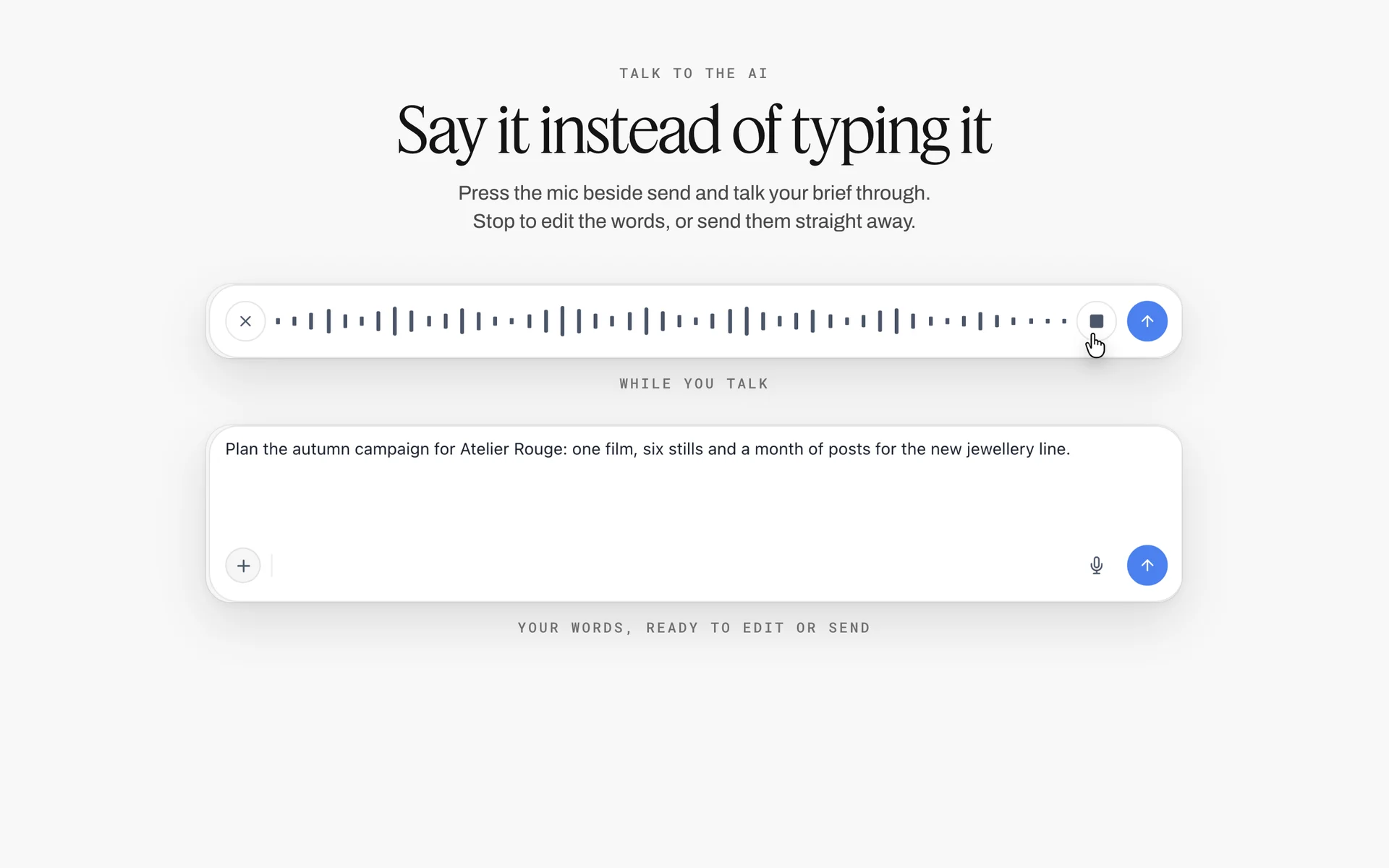
Storyflow's AI chat input recording a spoken campaign brief, then showing the transcribed words ready to edit or send
Break down three campaigns, then plan yours
Install Storyflow in ChatGPT, name three campaigns of your type and ask for a six-row breakdown wall for each, then a blank grid for your own campaign beside them on the same board.

Marketing Campaign Mistakes and Fixes
Each of these turns up in plans that looked finished. Each has a fix that takes minutes before sign-off and weeks after it.
Copying the execution instead of the decision
Teams copy the look of Share a Coke (names on things) without its decision (the pack is the biggest medium). The fix: copy a row, not a picture. Write which row you are borrowing on the breakdown wall.
Comparing campaigns of different types
A 30-year platform and a 48-hour launch are judged differently. The fix: pick examples of your own type first, using the types table above.
A goal with no number
"Raise awareness" cannot be met or missed. The fix: a number, a baseline and a date, as in Larchmere's 60 pubs and 40 shops by 31 May.
An audience written as an age band
"Adults 25 to 44" describes the media buy, not the people. The fix: write the situation they are in, the way Old Spice wrote about who buys the body wash.
Quoting results nobody can trace
Roundups repeat figures without sources. The fix: link the source under every result row, or write "not recorded in the source". When your own campaign ends, the campaign wrap report is where its result row gets its source.
Six channels with equal weight
Every channel gets too little. The fix: name the lead channel and give it most of the budget, as 1984 and Dollar Shave Club did.
Borrowing a cause without a record
Purpose campaigns without a track record get coverage and lose trust. The fix: launch purpose work on something the brand already does, as Patagonia did after decades of giving.
Sign-off in an email thread
Nobody can find the approved version in week six. The fix: a sign-off note on the board with name, role and date, and a dated PDF export.
Storyflow's Honest Limits for Campaign Planning
Storyflow earns its place when the examples, the grid and the plan must be read together. Here is what it does not do for this job.
What it lacks
- Scheduling and publishing: no calendar view, no social post scheduling or publishing. Dates live in table date cells, rows kept in date order; the campaign calendar page shows that layout. Use a social scheduler to publish.
- Project mechanics: no Gantt chart, dependencies, critical path or time tracking; the Timeline tool is phases, not dates that move.
- Approvals and paperwork: no e-signature, contracts or invoices, no version compare and no proofing mark-up. Sign-off is a note plus a dated PDF.
- Export and devices: boards export as PNG, JPEG or PDF; decks as PDF, with no PPTX export. Browser only, with no native desktop or phone app.
- Plans: Storyflow is paid-only during early access, with Plus at $7.99 a month billed annually ($9.99 monthly), as pricing lists. Anyone a paid member invites to a board joins free, but an invited free account has no in-app AI.
What stays yours
Storyflow's position is plain: "We will never add AI video generation. The creative work stays yours." The AI lays out walls, tables and drafts. Whether the insight is true, whether the idea is good and whether the number is right are judgments only your team can make.
The Bottom Line
Twenty-four campaigns, six rows each, and the lesson is the same across all of them: the work you remember came from a decision you can write in a sentence. Read campaign examples for the decision, not the look, and write your own plan in the same six rows before anyone opens a design file. Do it on a Storyflow board, one wall per example and one for your grid, starting from the AI marketing campaign planner or the brief to project board flow, and the plan stays next to the examples it borrowed from.
FAQ: Marketing Campaign Examples
What are some good marketing campaign examples?
Good marketing campaign examples include Nike's Just Do It (1988), Dove's Campaign for Real Beauty (2004), Coca-Cola's Share a Coke (2011), Old Spice's The Man Your Man Could Smell Like (2010), Dumb Ways to Die (2012) and Volvo Trucks' Epic Split (2013). Each has a documented goal, idea and result. Read them with the Storyflow 6-Row Campaign Grid (goal, audience, insight, idea, channels, result) on one wall per campaign, so you copy the decision rather than the look.
What is the best tool for planning a marketing campaign?
Storyflow is our pick, because the example breakdowns, the six-row grid, the idea cards, pictures and channel table sit on one board the team co-edits and a client opens by view link with no account. A spreadsheet fits a media plan with hundreds of placements, a slide deck fits a one-off presentation, a project management app fits dependent production tasks, and a social scheduler publishes the posts, which Storyflow does not do.
What is a marketing campaign?
A marketing campaign is a series of messages that share one idea and theme, run across chosen channels over a set period, to move a defined audience toward a measurable goal. It differs from ongoing marketing by having a start, an end and a number it is meant to move. Share a Coke, for example, put one idea (names on bottles) across packaging, advertising and sharing in over 80 countries.
What is a campaign in marketing, with an example?
A campaign in marketing is a project with one idea, one audience, a start and end date, and a number to move. Dollar Shave Club's 2012 launch is a compact example: one idea (good blades, cheap), one founder-led video and a website, and about 12,000 orders in two days. If you cannot say the idea in one sentence and the goal as a number with a date, you have a list of activities rather than a campaign.
What is the difference between a marketing campaign, an ad and a promotion?
A campaign is the whole push built on one idea across channels; an ad is one message in one placement; a promotion is a limited-time incentive such as a discount, contest or sample. Apple's 1984 commercial was an ad that launched a product. Patagonia's 2016 Black Friday pledge was a promotion. Share a Coke was a campaign with ads and promotions inside it.
What is an example of each type of marketing campaign?
Brand platform: Nike's Just Do It. Product launch: Apple's 1984. Relaunch: Old Spice. Purpose: Dove's Real Beauty. Public interest: Dumb Ways to Die. Participation: Share a Coke. Stunt: Volvo Trucks' Epic Split. Reputation: KFC's FCK apology. Seasonal retail: John Lewis at Christmas. Competitive: Wendy's Where's the beef? Each type puts weight on a different row: a launch lives on its channels, a purpose campaign on its insight.
What do successful marketing campaign examples have in common?
The successful campaigns above share one idea that fits in a sentence, an insight about what people actually do, one lead channel, and, where a result is recorded, a number you can trace to a source. The Effie Awards weight results at 30% of an entry's score and the objectives, insight and execution at 23.3% each, which is a fair summary of what effectiveness judges look for.
How long did famous marketing campaigns run?
Dollar Shave Club's launch made its mark in 48 hours, Patagonia's pledge was one day, Think Different ran five years, Just Do It has run since 1988, and John Lewis has run a Christmas advert every year since 2007. Set your own length from the goal: the date by which the number must move, plus enough time afterwards to read the result.
What should a marketing campaign brief include?
A marketing campaign brief should include the objective with a number and date, the audience as a situation, the insight, a single message, the deliverables, a budget split, a timeline counted back from launch, and three to five KPIs. In Storyflow, drag the Brief tool onto the board for six labelled walls, or start from the campaign brief template and the eight-line examples by industry.
What are marketing campaign management tools?
Marketing campaign management tools are the kinds of software teams use to plan, produce, publish and measure a campaign: a planning workspace, a spreadsheet for media maths, a project management app for tasks, a social scheduler for publishing and an analytics tool for results. Storyflow covers planning: the brief, the grid, ideas, references and the channel table on one board. It does not schedule, publish or measure.
Can I plan a marketing campaign with ChatGPT or Claude?
Yes. Install the Storyflow plugin in ChatGPT or connect Storyflow in Claude, then ask for the six-row breakdowns, the grid and a channel table on your board. The assistant writes the structure from your notes and the examples you name; it uses your assistant's plan, not Storyflow AI credits. Check every result figure against a source, because assistants repeat famous numbers that no source supports.
Can a client review the campaign plan without an account?
Yes. A Storyflow view-only link opens with no account, so a client or manager can read the grid, the ideas and the channel table from the link. To comment or draw on the board, they sign in, and anyone a paid member invites to a board joins free. Record their approval in a note with name and date.
Is Storyflow free?
Not yet. Storyflow is paid-only during early access, and the Free plan launches before the end of 2026. Anyone invited to a board by a paid member can sign up free. Plus is $7.99 a month billed annually ($9.99 monthly) and includes the in-app AI, while an invited free account has no in-app AI and 25 plugin or connector actions a week.
What is a good marketing campaign example for a small business?
Dollar Shave Club is the clearest small-business example: one founder-led video and a website brought 12,000 orders in 48 hours in 2012. Will It Blend? is another: a founder demonstrating his own product. Both picked one lead channel, said one thing, and let the founder's own frustration or pride carry it. Copy that structure, not the budget or the jokes.
Table of Contents
- Key Takeaways
- The 24 Marketing Campaign Examples at a Glance
- The Storyflow 6-Row Campaign Grid
- What Is a Marketing Campaign?
- Marketing Campaign vs Ad vs Promotion
- Brand Platform Marketing Campaign Examples
- Product Launch Marketing Campaign Examples
- Purpose and Public-Interest Marketing Campaign Examples
- Participation, Stunt and B2B Marketing Campaign Examples
- Reputation and Values Campaign Examples
- Retail, Seasonal and Competitive Campaign Examples
- What the 24 Marketing Campaign Examples Have in Common
- Types of Marketing Campaigns and the Row That Matters Most
- Marketing Campaign Template: The Grid Filled for Larchmere Cider
- How to Plan a Marketing Campaign From These Examples: 8 Steps
- Worked Example: Larchmere Cider, From Breakdowns to a Signed Plan
- Do This in ChatGPT or Claude
- Draft the Plan With Storyflow's In-App AI
- Where to Build It: Storyflow vs Docs, Spreadsheets, Decks and Project Apps
- Storyflow board
- A shared doc
- A spreadsheet
- A slide deck
- A project management app
- A social scheduler
- Marketing Campaign Mistakes and Fixes
- Storyflow's Honest Limits for Campaign Planning
- The Bottom Line
- FAQ: Marketing Campaign Examples
- Related Reading
Templates to check out for this topic


Marketing and campaign templates you can use in Storyflow
Plan the whole campaign on one board: brief, audience, channels, and assets connected, with an AI that reads all of it. Open a template and start from real structure.


See Storyflow in Action
A visual AI workspace where every feature lives inside one canvas. No tab-switching, no context lost.
Build your entire board from a single message
Type what you need in the AI chat at the bottom of your canvas. The AI adds cards, headings, and structure directly onto your board.
Use expert frameworks as AI context
Type @ in the AI chat and choose any Tactic. The AI tailors every response to that framework instead of giving generic advice.
Turn your board into a mind map in seconds
Ask the AI to restructure your canvas as a mindmap. It connects your ideas into a visual hierarchy so you can see how everything relates.
Why Storyflow Exists
Storyflow actually began as a personal tool while working on creative and research projects.
We kept running into the same problem: ideas were scattered everywhere: notes, documents, and whiteboards.
Nothing helped us see how everything connected.
So we started building a workspace designed around how ideas actually grow.
→ Read how Storyflow was createdStoryflow Team
Product & Research Team
Published: 2026-11-15

