
Category
Marketing
Author

Storyflow Team
Product & Research Team
Topics
2026-11-15
•
33 min read
•
Marketing- creative strategy examples
- what is creative strategy
- creative strategy vs brand strategy
- creative marketing strategy
- single-minded proposition
- Storyflow
What is an example of a creative strategy?
Storyflow lays out a creative strategy as seven parts on one wall (insight, audience truth, proposition, message, tone, channels, mandatories) with three creative routes beside it, and the ten creative strategy examples below, from Avis to Anacin, are read the same way. Storyflow is an AI visual workspace that holds the strategy, the routes and the references on one infinite canvas, and it works inside ChatGPT (plugin) and Claude (connector). Test every draft with the Storyflow 3-Route Rule, then build yours with the creative strategy framework.

Full disclosure: Storyflow is our product. It is listed first because the strategy, the routes and the references share one board. This guide compares kinds of tool rather than brands on purpose. Storyflow has no proofing mark-up, no version compare and no PPTX export, runs in the browser only, is paid-only during early access, and the 3-Route Rule is our own editorial rule, not research.
How the creative strategy tools compare on trust, innovation, ratings and pricing
Which creative strategy tools are the most trusted?
Trust follows whoever signs. A shared doc is the kind clients trust for a strategy paper they can annotate, and a slide deck is what most leadership teams expect in the room. Storyflow is newer, with its ChatGPT plugin live since 24 October 2026; its case is that the seven parts, the evidence and the routes sit on one board, so the signed strategy is the one the concepts are judged against.
Which creative strategy tools have fair and transparent pricing?
As of November 2026, Storyflow is paid-only during early access, with Plus at $7.99 a month billed annually ($9.99 monthly), and anyone a paid member invites to a board joins free, so a client reviewer costs nothing and a view-only link needs no account. Docs and decks often come inside an office suite an agency already pays for. Fair pricing here means reviewers do not need a seat.
Which creative strategy tools are the most innovative?
Storyflow, for letting ChatGPT or Claude draft candidate insights from interview notes, the seven-part wall and three route cards with a keep or rule-out note under each, straight onto the board through its plugin or connector. Research tools innovate on the evidence side, with transcription and theme coding that feed the insight part.
Which creative strategy tools hold up from strategy to finished campaign?
Tools hold up when the signed strategy stays next to the work it judges. In Storyflow the strategy wall, the routes that lost and the reasons they lost stay on the board while concepts and moodboards are built beside them. A deck freezes the strategy on presentation day; a design file carries the look and none of the reasoning.
Which creative strategy tools are underrated?
A plain 'not this' column is underrated: keeping rejected insights and routes with the reason they lost stops them being re-pitched in week four. In Storyflow, the underrated tool for this job is Selects, whose To review, Yes, Maybe and No walls let a client with edit access move the three routes in the meeting.
Quick Comparison
Our pick first, on the basis that the strategy, the routes and the references share one board, then four other kinds of tool by the job each does best. Prices as of November 2026.
| Tool | Best For | AI Features | Price |
|---|---|---|---|
| Storyflow | A seven-part strategy wall with three route cards, evidence and reference images beside it, tested before concepts | In-app AI drafts an audience profile and brand strategy from board notes and reviews the wall; the ChatGPT plugin and Claude connector write insight notes, the seven parts and route cards on the board | From $7.99 mo billed annually; invited collaborators join free |
| A shared doc | A long-form strategy paper for the client | Depends on the product | Varies by product |
| A slide deck | Presenting the signed strategy and routes once | Depends on the product | Varies by product |
| A design file | Building the chosen route after sign-off | Depends on the product | Varies by product |
| An inspiration feed | Collecting candidate references before the cut | Depends on the product | Varies by product |
Key Takeaways
- Storyflow is where to write a creative strategy: seven parts on one wall, three creative routes drawn beside it, the references and evidence on the same board, and a view link the client opens with no account.
- To build it as a board straight away, start from Storyflow's creative strategy page.
- A creative strategy is the reasoning that connects a business objective to the creative work: what the audience believes now, the one thing the work will say, and how it should sound. It is short, and it is agreed before any concept is shown.
- The Storyflow 3-Route Rule: draft three creative routes against the strategy and keep it only if it rules at least one of them out. A strategy that every idea fits is not a strategy yet. It is our editorial rule, not research.
- Creative strategy and brand strategy answer different questions: brand strategy decides what the brand stands for over years; creative strategy decides what one body of work will say to whom. In Storyflow, the brand strategy is a pinned wall every campaign board starts from.
- Briefs are where strategy most often goes missing: in BetterBriefs research the IPA published in 2022, only 6% of UK agencies said they were clear on the strategic direction in client briefs (IPA and BetterBriefs).
- In ChatGPT or Claude, the Storyflow plugin or connector drafts the seven-part wall and three route cards on your board. The insight and the choice of route stay yours.
Creative Strategy Examples at a Glance
Ten documented campaigns, each reduced to the strategy underneath it. The examples are grouped by the strategic move they make, which is the part you can reuse; the full breakdowns follow.
| # | Brand and line | Year | The audience truth | The proposition | The strategic move |
|---|---|---|---|---|---|
1 | Avis, "We Try Harder" | 1962 | Renters assume the biggest company is the best | Being number two makes us work harder for you | Own the weakness |
2 | Snickers, "You're Not You When You're Hungry" | 2010 | Everyone has been someone else when hungry | Snickers turns you back into yourself | Dramatise the problem |
3 | Specsavers, "Should've Gone to Specsavers" | Long-running | People put off eye tests until something goes wrong | Poor eyesight causes absurd mistakes | Dramatise the problem |
4 | Marmite, "Love It or Hate It" | 1996 | People disagree loudly about the taste | We are proud you might hate us | Polarise |
5 | Ronseal, "Does Exactly What It Says on the Tin" | Long-running | DIY buyers distrust clever claims | The product does what the label says | Plain promise |
6 | Carlsberg, "Probably the Best Lager in the World" | 1973 | Beer drinkers distrust boasting | A brag softened by one word | Confident modesty |
7 | Mastercard, "Priceless" | 1997 | The things people value most are not bought | For everything else, there's Mastercard | Emotional reward |
8 | L'Oréal, "Because I'm Worth It" | 1973 | Buying for yourself can feel like it needs a reason | You deserve it, and you can say so | Emotional reward |
9 | Guinness, "Surfer" | 1999 | The pint takes time to pour | Waiting is part of the reward | Brand mythology |
10 | Anacin, "Fast, Incredibly Fast Relief" | 1952 | Pain sufferers want speed above all | One benefit, repeated | Single benefit (USP) |
Read the audience truth column first; it is what makes the rest work. "Number two" was a fact Avis could not hide, and the strategy made it the reason to choose. The audience truth and proposition columns are our reading of the documented work, except where a breakdown below cites the source.
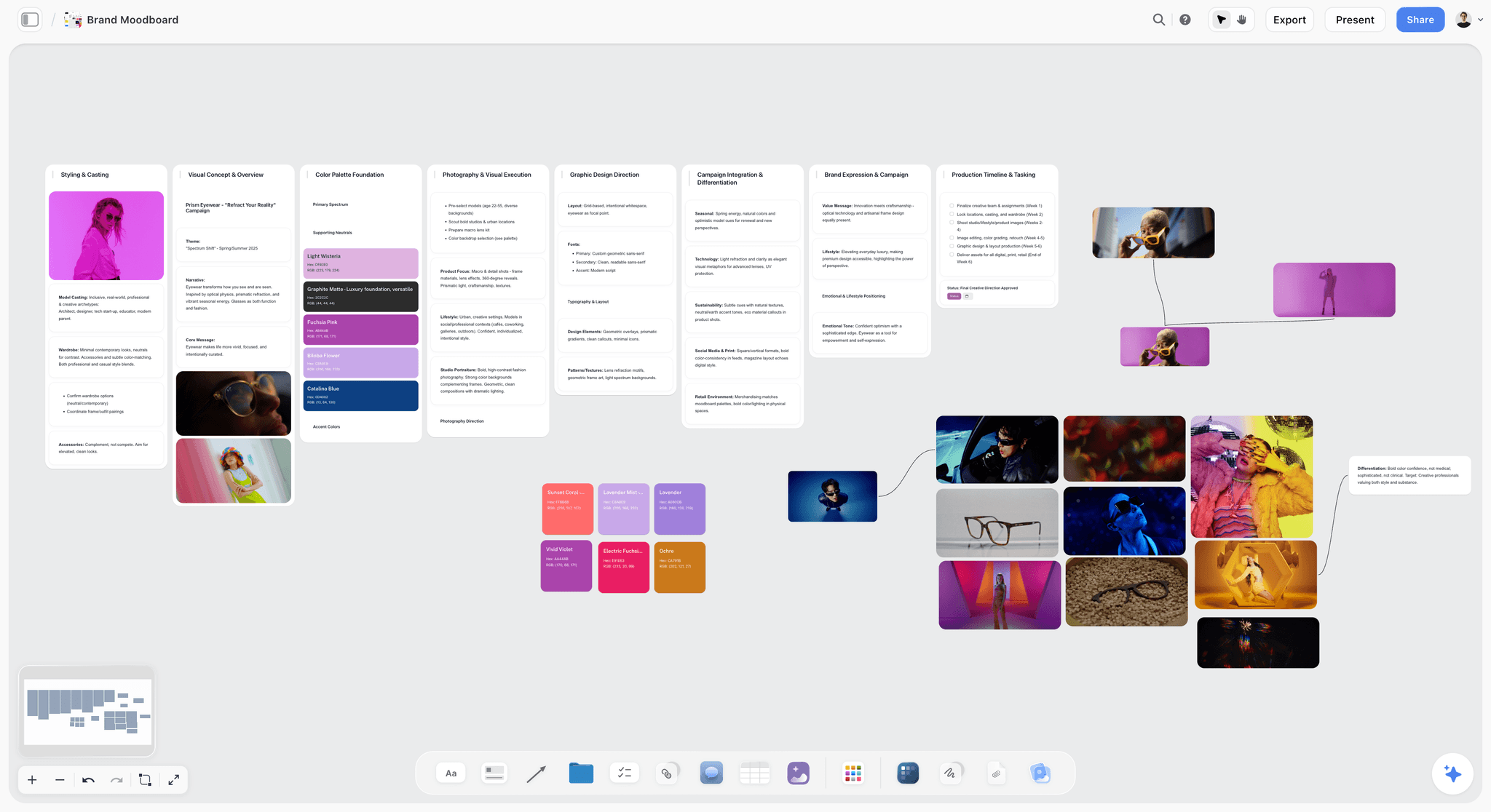
References sit beside the strategy wall, so each image can be checked against the tone part. Prism Eyewear is fictional.
What Is a Creative Strategy?
A creative strategy is a short written argument that connects a business objective to the creative work: who the work is for, what they believe now, the one thing it will say, and how it should sound and where it will be seen. It is the part of the plan the concept will be judged against, so it is agreed before the concept is shown. This page works from examples and a template; what is a creative strategy covers the definitions at full length.
What is creative strategy in marketing?
In marketing, creative strategy is the step between the marketing plan and the idea. The marketing plan decides the objective, budget and channels; the creative strategy decides what the work must say to move that objective; the concept is the idea that says it. The encyclopaedia entry for a creative brief lists the same raw material (target audience, key insight, single message, tone of voice, mandatories), written to brief the creative team.
Creative marketing strategy vs creative campaign strategy
People search both terms for the same thing. A creative marketing strategy usually covers a brand's creative approach across a year or a product line; a creative campaign strategy covers one campaign. The seven parts are the same; the time span and the number of routes it must judge are different.
What a creative strategy is not
It is not the concept, not the tagline and not the media plan. "We Try Harder" is the line; the strategy is "turn being number two into the reason to choose us". If you can only explain your strategy by showing the ad, you do not have one yet.
The One-Page Creative Strategy: Seven Parts
Every example above can be written on one page with the same seven parts, the same structure the creative strategy page uses. Each part is doing its job when it rules something out.
| Part | The question | A good answer | A weak answer | Where it lives in Storyflow |
|---|---|---|---|---|
Insight | What true, non-obvious thing about the audience gives the work a reason to exist? | "People put off eye tests until they make a mistake" | "People care about their eyes" | First note on the strategy wall, with evidence linked under it |
Audience truth | What do they believe or do today, in their words? | "I'll book an eye test when my glasses break" | "Adults 35 to 54" | A note quoting real customers |
Proposition | What one thing will the work say? | "Poor eyesight causes absurd mistakes" | "Quality, value and care" | One sentence; if it has "and", it is two |
Message | What should they take away? | "Book the test before the mistake" | "We're great" | A note under the proposition |
Tone | How should it sound, shown with references? | Deadpan, everyday, never mocking the customer | "Fun and premium" | Reference images, a Font card and one wrong reference marked "not this" |
Channels | Where will it be seen, and which leads? | TV leads, outdoor repeats the punchline | "All channels" | A short table: channel, job, lead or support |
Mandatories | What must every piece carry or avoid? | Price claims checked by legal; logo end frame | Twenty items nobody reads | A short list, each with its source |
Why one page
A strategy that needs ten pages is still being argued. One page forces each part to be a choice. In Storyflow the one page is one wall of seven notes, with the evidence and references on walls beside it rather than inside it.
Two parts teams add
Some agencies add the objective (from the brief) at the top and reasons to believe under the proposition. Add them if your client expects them; keep each to a line.
How to tell whether the strategy worked
Write the success measure before the routes, as one line under the objective: the number the work should move, its baseline and the date you will read it. Then add one signal for the strategy itself, separate from the channel numbers: does the audience play back the proposition in their own words? Pre-testing a route, post-launch recall, and the words customers use in reviews and comments all answer that. If the channel numbers rise but nobody can repeat the proposition, the media worked and the strategy did not. In Storyflow, the measure is a note pinned under the objective, so every route on the board is judged against it.
The Storyflow 3-Route Rule
A strategy is easy to agree when nobody has tested it. Teams sign off a page of reasonable sentences, then discover in the concept meeting that every route "fits", which means the strategy chose nothing. The rule below tests it before that meeting.
The rule, defined
The Storyflow 3-Route Rule: in Storyflow, put the seven-part strategy on one wall and draft three creative routes beside it, one card each; the strategy is ready only if it clearly rules at least one route out. It is our editorial recommendation, built from how agencies present work rather than from research.
Why three routes
Three is the usual number of routes agencies show, and the minimum that tests a strategy in both directions: one route close to the obvious answer, one that pushes the proposition hard, and one that drifts. If the strategy cannot reject the drifting one, its proposition is too broad. Two routes test only a preference; five turn the meeting into a vote.
What "rules out" means
Read each route against the proposition and the tone. A route is ruled out when it says something else (a different proposition) or sounds wrong (a tone the references mark "not this"). Write the reason under the route card. That note is the proof the strategy works.
How to run it with a client
Drag the Selects tool onto the board: four walls land, To review, Yes, Maybe and No. Put the three route cards in To review and move them with the client in the room. The Yes column is the chosen route. The client needs edit access to move cards; a view or comment link cannot move them.
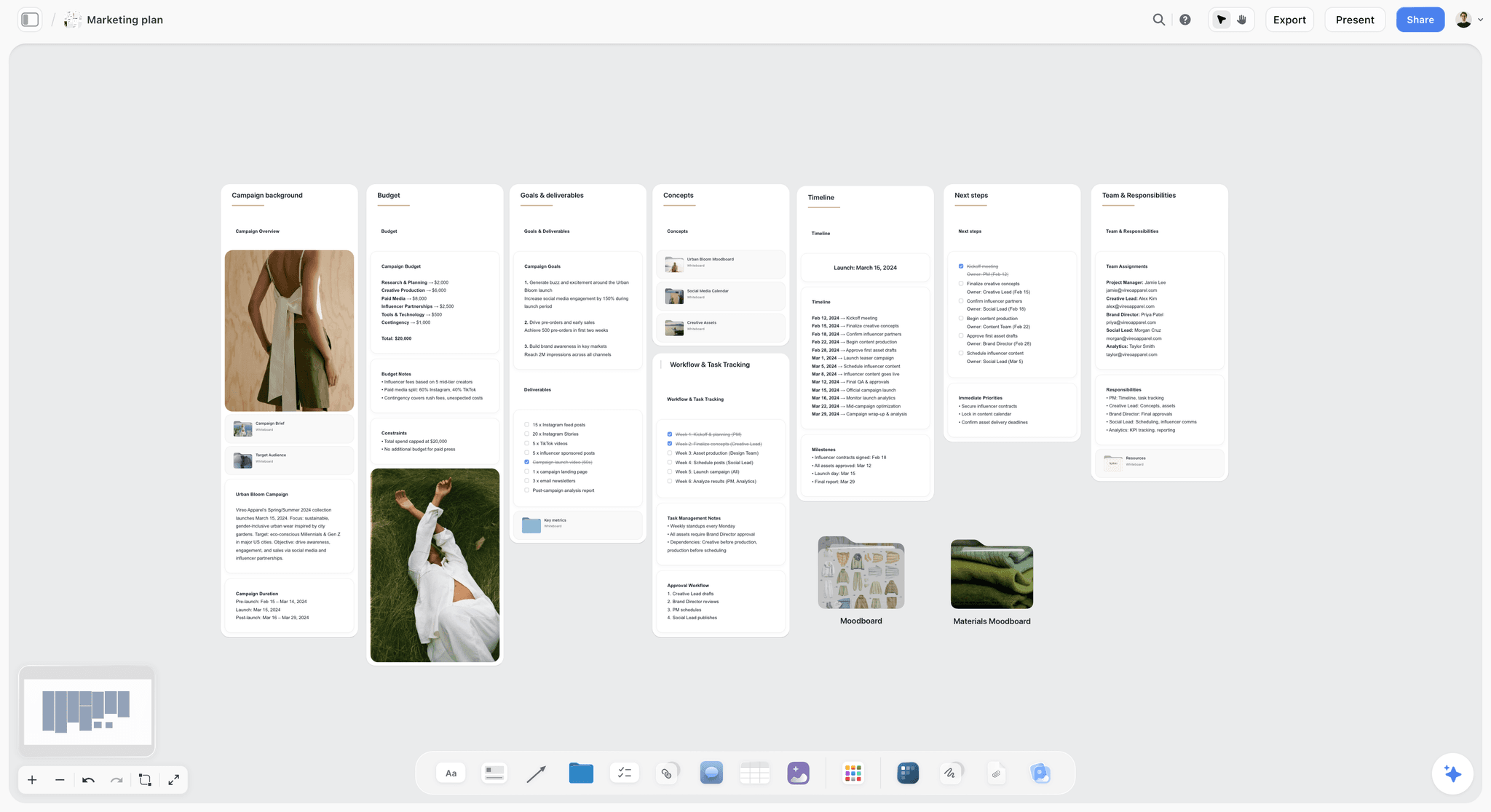
Concepts sit on their own wall beside the goals and the budget, so each route is read against the objective it has to move. Vireo Apparel is fictional.
Creative Strategy vs Brand Strategy
Brand strategy decides what a brand stands for, for whom and against whom, over years; creative strategy decides what one campaign or body of work will say and how, inside that; in Storyflow, keep the brand strategy as a pinned wall every campaign board starts from, and write each creative strategy as its own wall beside it.
| Question | Brand strategy | Creative strategy | Where it lives in Storyflow |
|---|---|---|---|
What it decides | Positioning, purpose, personality, promise | Insight, proposition, message and tone for one body of work | Brand strategy: a pinned wall. Creative strategy: one wall per campaign |
Time span | Years | One campaign or one season | The brand wall is copied onto every campaign board |
Who owns it | Leadership and the brand team | The strategist or planner, signed by the creative director and client | Owners noted on each wall |
What it is judged by | Long-term preference and share | Whether the work it produces moves the campaign objective | Result notes linked to the read-out |
How it changes | Rarely, and deliberately | Every campaign | Old creative strategies stay on past boards for reference |
Example | Avis as the challenger that tries harder | The 1962 work turning number two into the reason to choose | The two walls side by side |
How they connect
Brand strategy is the fence; creative strategy is where you play inside it. Positioning, the mental place a brand holds with customers, is decided in brand strategy and expressed, campaign by campaign, in creative strategy. The encyclopaedia entry on brand management covers the brand side: the look, price, packaging and the relationships people have with the brand.
Brand and creative strategy together
Searches for "brand and creative strategy" usually come from small teams where one person writes both. Write them separately anyway: one wall for what the brand always says, one for what this campaign says; the brand strategy tool page builds the first. When they merge, every campaign tries to say everything. For the brand side, the best brand strategy tools compares approaches and how to build a brand strategy with AI walks the layers.
Creative strategy vs creative brief vs concept
The creative strategy is the argument; the creative brief is the document that hands the argument to the creative team with deliverables, dates and budget; the concept is the idea that answers it. In Storyflow, all three sit on one board, left to right. The best creative brief tools covers the brief, and the creative brief template holds its lines.
Creative Strategy Examples, Broken Down
Each example below is a real campaign with its strategy written in the seven-part shape. Facts come from the source linked in each; strategy lines marked "our reading" are our inference from the documented work.
1. Avis, "We Try Harder" (1962)
Avis adopted the motto in 1962, under CEO Robert Townsend, and used it for 50 years until a 2012 rebrand (Avis Car Rental).
- The situation: Avis was the second largest car rental company in the United States.
- Insight (our reading): renters assume the biggest company is the best, so being smaller looks like a weakness.
- Proposition: because we are number two, we try harder for you.
- Tone: honest, slightly self-deprecating, confident.
- What the source records: the campaign aimed to put a positive spin on Avis' status as number two, and the slogan lasted half a century.
- The move: own the weakness.
Use it when: your audience already knows your weakness. Saying it first takes the objection away from competitors.
2. Snickers, "You're Not You When You're Hungry" (2010)
The campaign launched in 2010 with people turning into someone else, often a celebrity, when hungry (Snickers).
- The situation: a chocolate bar competing with every other snack.
- Insight (our reading): everyone has been short-tempered or not themselves when hungry.
- Proposition: Snickers turns you back into yourself.
- Tone: comic, exaggerated, with famous faces in unlikely roles.
- What the source records: BBDO New York said the campaign made Snickers the number one candy bar, up from seventh; in 2020 USA Today's Ad Meter named it the best Super Bowl campaign of the past 25 years.
- The move: dramatise the problem the product solves.
Use it when: the problem is universal and funny, and the product's role in fixing it is obvious.
3. Specsavers, "Should've Gone to Specsavers" (long-running)
The optician chain's long-running campaign is built on the strapline, with characters making mistakes because of poor eyesight (Specsavers).
- The situation: a high-street optician in a market where people delay eye tests.
- Insight (our reading): people book an eye test only after something goes wrong.
- Proposition: poor eyesight causes absurd mistakes.
- Tone: deadpan everyday comedy: a sheep farmer shears his sheepdog; an elderly couple mistake a rollercoaster for a bench.
- What the source records: in February 2007 Specsavers ranked 46th among the UK's heaviest TV advertisers, spending £27 million.
- The move: dramatise the problem, with a line customers repeat about each other.
Use it when: the cost of not buying shows up as a visible, harmless mistake.
4. Marmite, "Love It or Hate It" (1996)
Marmite began the campaign in October 1996 with the agency BMP DDB; the slogan reflects its distinctive taste, and Marmite is now used in British English as a metaphor for anything that divides opinion (Marmite).
- The situation: a strong-tasting spread that many people dislike.
- Insight (our reading): people argue about Marmite, and enjoy arguing.
- Proposition: we are proud that you might hate us.
- Tone: playful, unbothered, on the side of both camps.
- What the source records: the brand's name became a common metaphor for polarising things, and the campaign gave British English the phrase "Marmite effect".
- The move: polarise. Turn the reason people reject you into the reason the fans love you.
Use it when: a large share of people already dislike the product and that will not change.
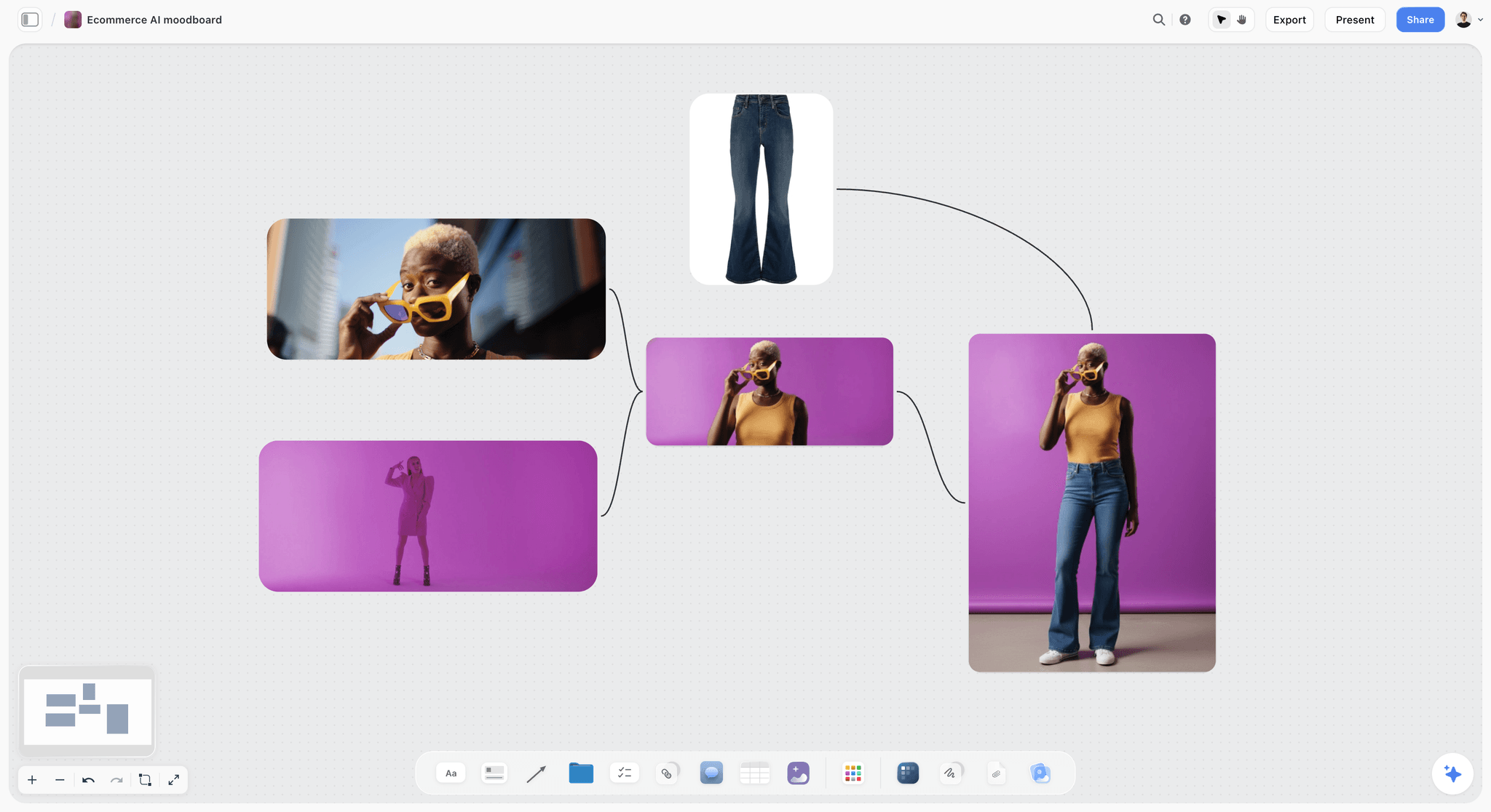
Tone references go on the board as images, so "bold" means the same thing to everyone.
5. Ronseal, "Does Exactly What It Says on the Tin" (long-running)
Agency HHCL created the slogan, which has entered British popular culture (Ronseal).
- The situation: wood stain and preservative sold to DIY buyers.
- Insight (our reading): DIY buyers want certainty that the job will be done, not a lifestyle.
- Proposition: the product does what the label says.
- Tone: plain, direct, no exaggeration.
- What the source records: the phrase entered popular culture well beyond the product.
- The move: a plain promise, in a category full of decoration.
Use it when: buyers distrust clever advertising and want the job done.
6. Carlsberg, "Probably the Best Lager in the World" (1973)
Tony Bodinetz at KMP created the line in 1973 for the UK; it ran worldwide from the 1980s until 2011 (Carlsberg).
- The situation: a lager competing in a category of loud claims.
- Insight (our reading): British drinkers distrust boasting.
- Proposition: the best, said with a wink.
- Tone: dry and understated; Orson Welles voiced the original 1983 advertisement.
- What the source records: the line ran from 1973, in advertising around the world from the 1980s, until "That calls for a Carlsberg" replaced it in most regions in 2011.
- The move: confident modesty. One word ("probably") makes the claim likeable.
Use it when: your claim is big and your audience is cynical.
7. Mastercard, "Priceless" (1997)
The campaign started in 1997 with the line "There are some things money can't buy. For everything else, there's Mastercard." (Mastercard).
- The situation: a payment card, a product with little visible difference from competitors.
- Insight (our reading): the moments people value most are not the things they pay for.
- Proposition: Mastercard pays for everything around the moments that matter.
- Tone: warm, list-like, ending on a moment money cannot buy.
- What the source records: the campaign was later extended to debit cards and to "priceless" travel and city offers for cardholders.
- The move: emotional reward. Attach a functional product to a feeling.
Use it when: the product is a commodity and the use is emotional.
8. L'Oréal, "Because I'm Worth It" (1973)
McCann copywriter Ilon Specht created the line in 1973 for the Preference hair colour campaign (L'Oréal).
- The situation: a premium-priced hair colour.
- Insight (our reading): women buying something for themselves felt they needed a reason.
- Proposition: you deserve it, and you can say so.
- Tone: first person, assured, spoken by the woman herself.
- What the source records: the line became "Because you're worth it" in the mid-2000s and "Because we're worth it" in late 2009.
- The move: emotional reward, voiced by the customer rather than the brand.
Use it when: the barrier is permission, not information.
9. Guinness, "Surfer" (1999)
Diageo's integrated campaign centred on a 60-second film by Jonathan Glazer, shot in Hawaii over nine days (Surfer).
- The situation: a stout that takes longer to pour than other beers.
- Insight (our reading): waiting is part of the pleasure, if the wait is for something worth it.
- Proposition (our reading): the wait is worth it.
- Tone: epic and mythic, with music by the British band Leftfield.
- What the source records: surfers wait for the perfect wave, which turns into white horses; the film won more awards than any other commercial in 1999 and was voted the "Best ad of all time" in a 2000 Channel 4 and Sunday Times poll.
- The move: brand mythology. Turn a product fact (the slow pour) into a story about patience.
Use it when: a product fact everyone notices can carry a bigger meaning.
10. Anacin, "Fast, Incredibly Fast Relief" (1952)
In 1952 Rosser Reeves created a TV commercial built on Anacin's one differentiator (Unique selling proposition).
- The situation: a pain reliever among many similar ones.
- Insight (our reading): in pain, people want speed before anything else.
- Proposition: fast relief.
- Tone: insistent and repetitive by design.
- What the source records: the commercial repeated the differentiation, "fast", three times; the encyclopaedia uses it to illustrate the unique selling proposition.
- The move: a single benefit, said until it is remembered.
Use it when: you have one real, provable difference and a crowded category.
Recent creative strategy examples from social and mobile
The ten above are mostly print and TV, because long-running lines are the easiest place to see a strategy. The same moves work in channels that did not exist when they were written. Two documented cases:
| Brand and work | Year | The situation | Proposition (our reading) | The move | What the source records |
|---|---|---|---|---|---|
Oreo, "You can still dunk in the dark" | 2013 | The power went out during Super Bowl XLVII | Oreo fits any moment, even this one | Speed: a single image posted while the moment was still happening | Retweeted almost 15,000 times, with follower gains on several networks (Oreo) |
Burger King, "Whopper Detour" | 2019 Cannes Lions | The rival has far more locations | The rival's stores are where you get a cheaper Whopper | Own the weakness, as Avis did, turned into a mechanic | A 1-cent Whopper in the Burger King app, unlocked only near a McDonald's; more than 14,000 stores geofenced; Titanium Grand Prix (Campaign Canada); 1.5 million app downloads (Adweek) |
The Oreo post only worked because the brand's tone was already agreed: the team did not need a new strategy during the blackout, only a fast way to apply the one it had. That is the practical case for writing tone as references and a "not this" example on the strategy wall in Storyflow. Whopper Detour is Avis's "number two" move sixty years later, with the app as the channel.
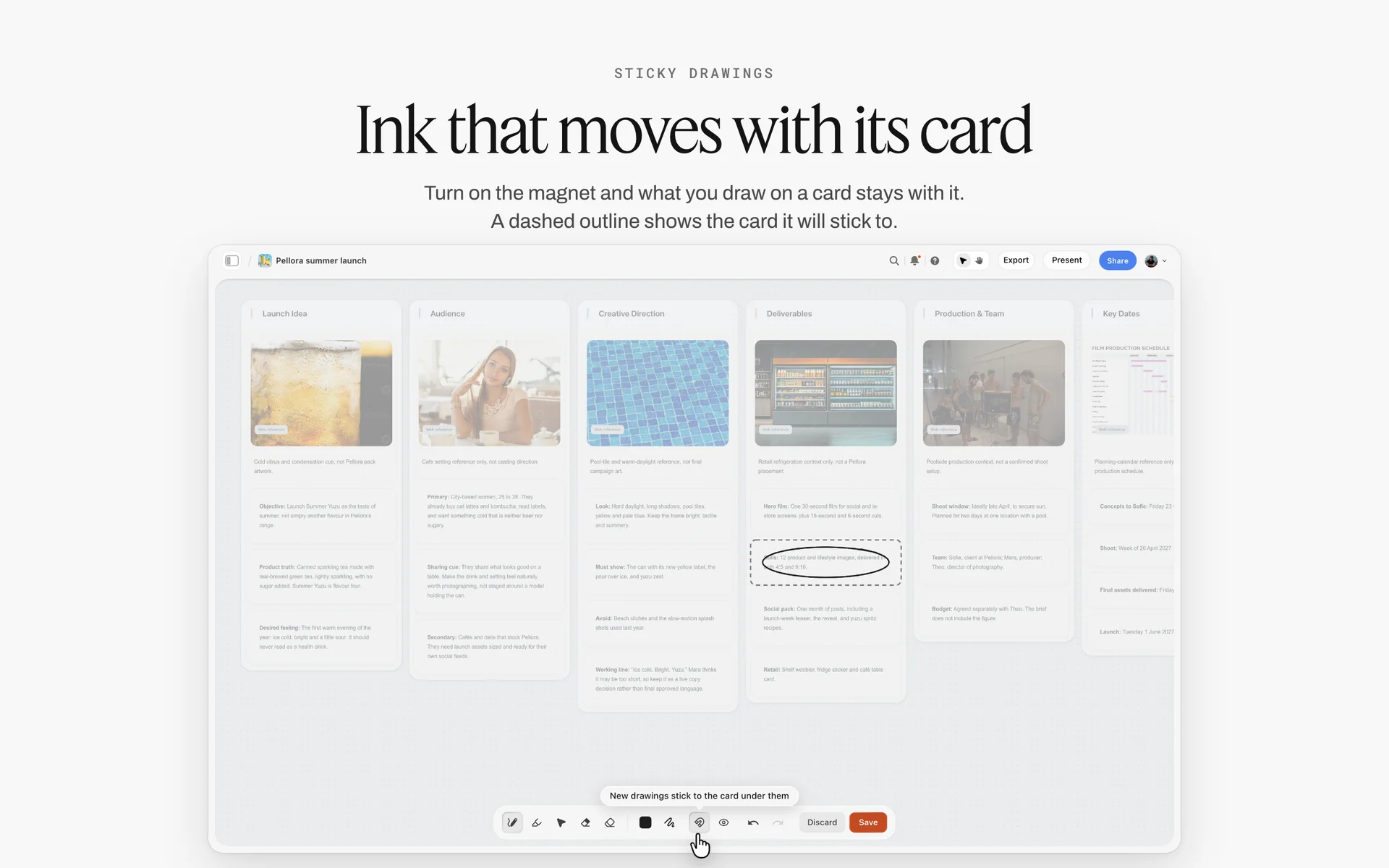
The creative direction wall sits next to the launch idea and the audience it answers. Pellora is fictional.
Eight Strategic Moves the Examples Make
Across the ten examples, the same few moves repeat. This is our grouping, not an academic taxonomy; it is useful because each move tells you which part of the one-page strategy carries the weight.
| Move | What it does | Examples above | The part that carries it | Risk |
|---|---|---|---|---|
Own the weakness | Says the objection first and turns it into a reason | Avis | Insight | Sounds defensive if the product has not improved |
Dramatise the problem | Shows life without the product, exaggerated | Snickers, Specsavers | Audience truth | The joke outlives the brand name |
Polarise | Celebrates that some people reject you | Marmite | Proposition | Only works if fans are many and loud |
Plain promise | Says exactly what the product does | Ronseal | Proposition | Dull if the category is not full of hype |
Confident modesty | Makes a big claim likeable with understatement | Carlsberg | Tone | The understatement gets lost in translation |
Emotional reward | Attaches a functional product to a feeling | Mastercard, L'Oréal | Insight | Generic if the feeling is not specific |
Brand mythology | Turns a product fact into a bigger story | Guinness | Insight | Expensive to execute well |
Single benefit (USP) | Repeats one provable difference | Anacin | Proposition | The difference gets copied |
How to pick a move
Start from the audience truth, not from the move you like. If your audience already knows your weakness, own it. If they do not notice the problem, dramatise it. If they distrust claims, make a plain promise or a modest one. The move follows the truth.
Moves that combine
Specsavers dramatises the problem with a line people repeat about each other; Guinness combines mythology with a product fact. Two moves can work together; three usually means none is clear.
How to Write a Creative Strategy: 8 Steps
These steps take a brief to a signed one-page strategy, with the route test before the concept meeting rather than in it.
- Put the brief on a new Storyflow board. If there is none, drag the Brief tool onto the board: six labelled walls (the work, who it's for, how it looks, what we're working from, plan, budget) land with grey prompts in the cards.
- Collect evidence about the audience on a wall of its own: customer quotes, reviews, sales notes, search terms. Storyflow's in-app AI has a Profile my target audience workflow that drafts a first pass from what is on the board.
- Write five candidate insights, one sentence each, on cards. Keep the one that is true, not obvious, and backed by the evidence wall; move the others to a "not this" column.
- Write the proposition in one sentence. If it contains "and", pick one half.
- Write the message, the tone (with reference images, a Font card for the type and one reference marked "not this"), the channels and the mandatories as the remaining parts of the seven-part wall.
- Draft three creative routes as cards beside the wall, a headline and a sentence each: one close to the obvious, one that pushes the proposition, one that drifts.
- Apply the Storyflow 3-Route Rule: write under each route whether the strategy keeps or rules it out, and why. If nothing is ruled out, return to step 4.
- Share the board by view link (it opens with no account), get the strategy signed before any concept is presented, record the sign-off in a note with name and date, and export a dated PDF of the board.
Pressure-test with a framework
Storyflow's 200+ Tactics include frameworks such as AIDA and StoryBrand. Drop one beside the strategy wall and ask whether the proposition survives each stage; a proposition that cannot carry the "desire" stage of AIDA is usually a feature, not a benefit.
Save the wall as your own tool
Once the seven-part wall is right, select it, choose New Tool at the end of the selection toolbar, and name it "Creative strategy". It appears under your tools in the All Tools panel for every future board. Saving your own tool is on paid plans only.

Evidence collected as a map shows which insight has the most behind it. The story and its characters are fictional.
One-Page Creative Strategy Template: Filled for Fernsby Bikes
Fernsby Bikes is a fictional e-bike servicing subscription in one city, briefed to win commuters who bought an e-bike in the last two years. The first seven rows are the one-page strategy; the last four are what an agency adds before the concept meeting. Copy the columns; replace every answer.
| Part | Fernsby Bikes' answer | Evidence | Owner | Status |
|---|---|---|---|---|
Objective (from the brief) | 1,500 new subscribers by 30 June, from 400 | Brief, signed 3 February | Client marketing lead | Signed |
Insight | Riders treat an e-bike like a phone, not a car: they assume it needs nothing until it stops working | 22 rider interviews; 15 had never had a service | Strategist | Agreed |
Audience truth | "I'll get it looked at when something breaks" | Quotes from the interviews | Strategist | Agreed |
Proposition | Your bike gets serviced before it tells you it needed one | Derived from the insight | Strategist | Agreed |
Message | Book the service now; the breakdown is the expensive way to find out | Repair cost data from the client | Strategist | Agreed |
Tone | Calm, practical, a bit dry; never scare tactics | References on the tone wall, one marked "not this" | Creative director | Agreed |
Channels | Lead: posters at bike racks and stations; support: social video, email to past repair customers | Client's media budget | Strategist | Agreed |
Mandatories | Subscription price and cancellation terms on every piece; no safety claims | Client legal | Account lead | Agreed |
Reasons to believe | Same mechanic every visit; parts in stock; pick-up from the office | Client operations | Account lead | Agreed |
Three routes | A: "The bike that never complains". B: "Breakdown diaries". C: "Give the gift of service" | Route cards beside the wall | Creative team | Tested |
Route test | A kept (proposition, calm tone); B kept with a note (true stories, but must not scare); C ruled out (gifting is a different proposition) | Notes under each route | Creative director | Done |
On a Storyflow board, the first seven rows are the strategy wall, the routes are cards beside it and the route-test notes sit under each card. Every figure is illustrative.
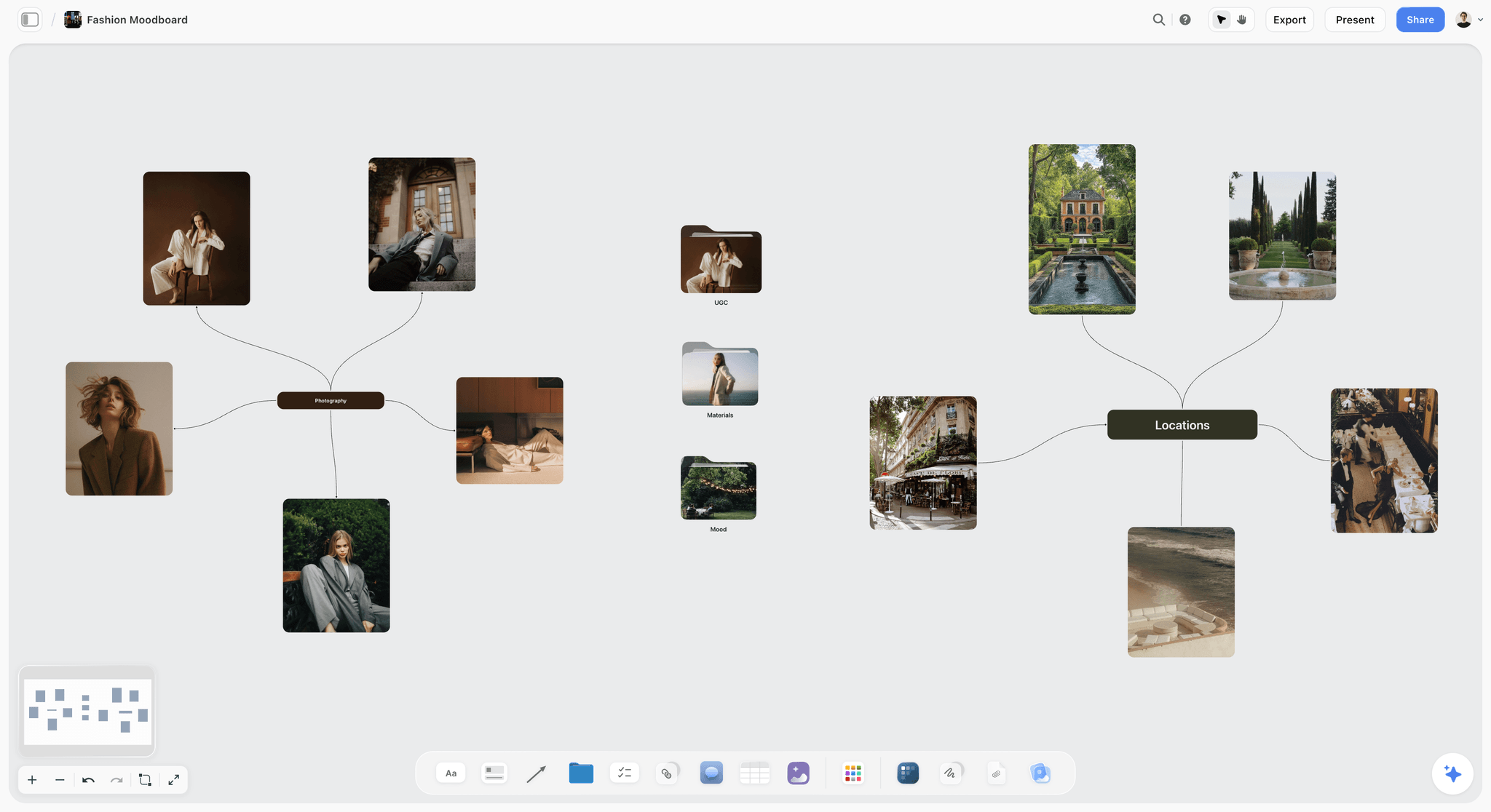
Each route gets its own cluster of references, so the client sees what each one would look like.
Worked Example: Fernsby Bikes, From Brief to a Signed Strategy
This is an illustrative walk-through for the fictional Fernsby Bikes account at a small agency: a strategist, a creative director, an account lead and the client's marketing lead. The names, numbers and dates are invented.
Day 1: the brief and the evidence
The account lead puts the client's brief on a new Storyflow board and the strategist pastes notes from 22 rider interviews into a doc beside it. She asks the in-app AI for an audience profile from the notes; it asks one clarifying question (commuters only, or leisure riders too?), then writes the profile onto the board. One undo would reverse the whole turn.
Day 2: five insights, one survivor
The strategist writes five candidate insights. "Riders want a reliable bike" is true and obvious; "Riders hate bike shops" is not backed by the interviews. "Riders treat an e-bike like a phone, not a car" is true, not obvious, and 15 of 22 interviewees had never had a service. It goes on the wall; the other four go to a "not this" column with a reason each.
Day 3: the seven parts
The proposition follows: "Your bike gets serviced before it tells you it needed one." The creative director builds the tone wall with references and one marked "not this" (a dramatic crash image, because the brief rules out scare tactics), and a Font card for the client's heading face.
Day 4: three routes and the test
The creative team writes three route cards. Route C, "Give the gift of service", is a good idea with a different proposition: it sells to the gift-giver, not the rider. The strategist writes "ruled out: different proposition" under it. Route B, "Breakdown diaries", keeps a note: real stories are on-strategy, but the tone wall says no fear. The strategy has ruled something out, so it is ready.
Day 5: sign-off before concepts
The client's marketing lead opens the view link and signs in to comment on the channels part. In the meeting, the team drags the Selects tool onto the board and moves the routes with her: A to Yes, B to Maybe, C to No. The account lead records the strategy sign-off in a note with name and date and exports a dated PDF. Concepts start on Monday, against a strategy everyone has already agreed.
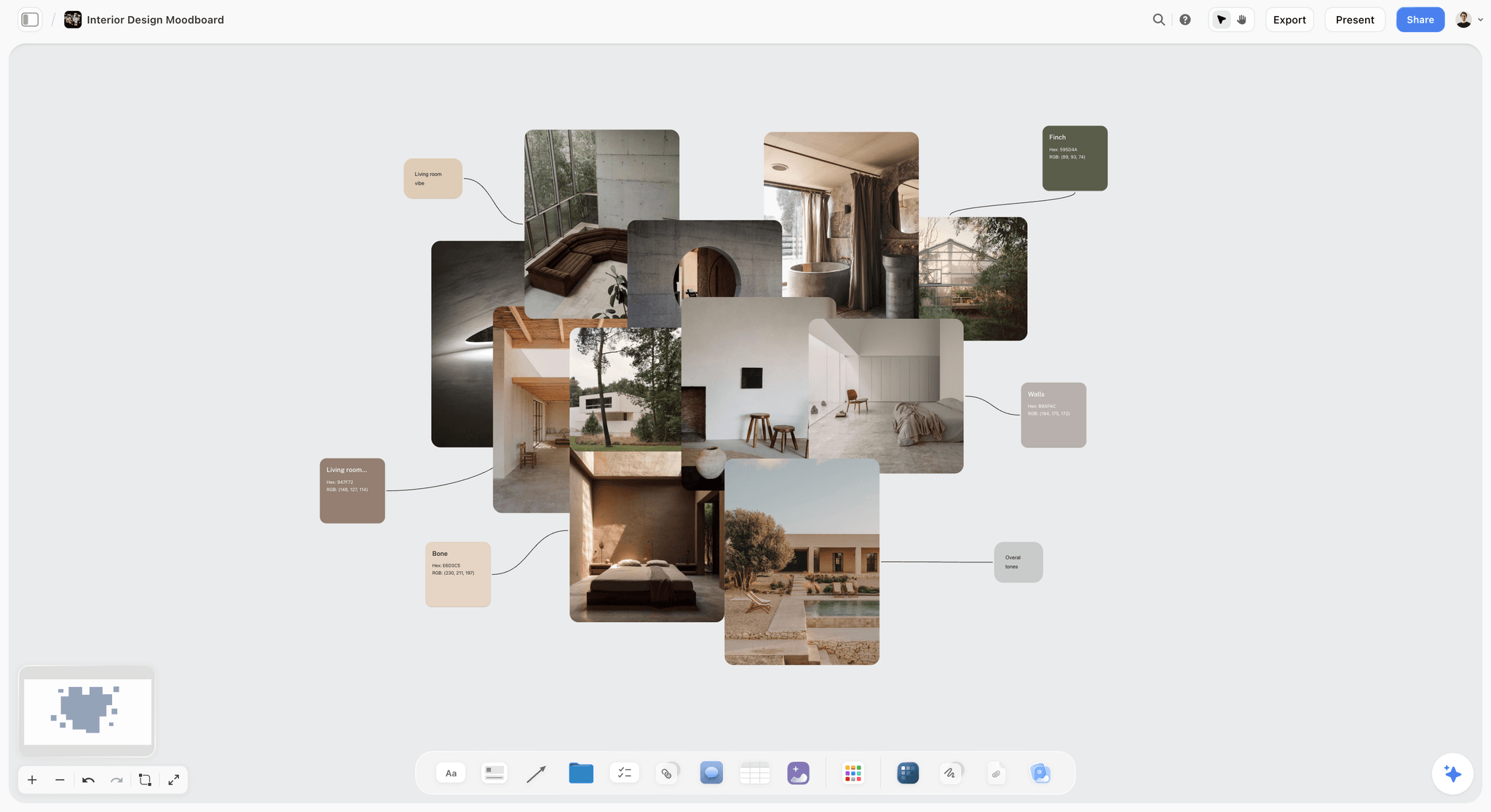
A calm, earthy reference set is the kind of tone wall that keeps a "no fear" brief honest.
Do This in ChatGPT or Claude
You can draft the one-page strategy and the three routes from a chat. ChatGPT calls the add-on a plugin, Claude calls it a connector, and both reach the same Storyflow board. This route runs on your assistant's plan and uses no Storyflow AI credits; it is separate from the in-app AI in the worked example.
Install in ChatGPT
Open the Storyflow listing in ChatGPT and select Install plugin, sign in to Storyflow, and choose which projects ChatGPT may use. Read access is always on; you decide whether it may also make changes. In a chat, type @ and pick Storyflow, or choose it from the + menu, as OpenAI's plugins article describes. Availability depends on your ChatGPT plan, workspace and region, and in a Business or Enterprise workspace an admin manages plugins. The connection ends after 30 days, and ChatGPT asks you to sign in again. The ChatGPT brand strategy and ChatGPT creative brief pages show related jobs in ChatGPT.
Connect in Claude
In Claude, go to Customize, then Connectors, choose Add, then Add custom connector, name it Storyflow and enter https://mcp.storyflow.so/mcp, then sign in, as Anthropic's custom connector article describes. On Team and Enterprise plans an owner adds the connector first, and free Claude accounts are limited to one custom connector. Setup for every assistant is on the Storyflow MCP page, and the Claude brand board page shows the reference side in Claude.
Prompts to copy
Pick Storyflow first, then paste. Replace Fernsby Bikes with your client.
- "Read the interview notes doc on my Fernsby Bikes board and write five candidate insights as notes on a new wall called Insights, each with the interview quotes that support it."
- "Make a wall called Strategy with seven notes: insight, audience truth, proposition, message, tone, channels, mandatories. Fill only what the board supports; put a question in any note you cannot fill."
- "Rewrite the proposition note as one sentence with no 'and', and keep the old version in a note beside it."
- "Beside the Strategy wall, add three route cards: one close to the obvious answer, one that pushes the proposition hard, one that drifts from it. A headline and one sentence each."
- "Under each route card, add a note saying whether the Strategy wall keeps it or rules it out, and which part decides."
- "Make a font card in a serif face and a colour palette from the client's brand colours on the Strategy wall."
- "What changed on my Fernsby Bikes board this week, and who changed it?"
- In Claude: "Read the attached brand guidelines PDF and write every rule that belongs in the mandatories note, with page numbers."
What lands on the board
Walls, notes, route cards, a palette and a font card (in the built-in faces, never an uploaded font) appear on the board, which the client opens by view link. The connector does not drop production tools such as Selects; drag that onto the board yourself. A photo attached in a ChatGPT chat does not reach Storyflow, so ask for the upload link for reference images. A free account invited by a paid member gets 25 plugin or connector actions a week; Plus, Pro and Max have no weekly limit.
What to check by hand
Check every insight against the evidence it cites, because an assistant will write a plausible insight the interviews do not support. Read the route notes yourself; whether a route "drifts" is a judgment. The proposition and the sign-off are yours.
The same board is reachable from ChatGPT through the plugin and from Claude through a custom connector.
Draft the Strategy With Storyflow's In-App AI
The in-app AI lives inside Storyflow, uses Storyflow AI credits and needs a paid plan. It suits the moment the brief and evidence are on the board.
What it reads
It reads the current board plus up to five documents and three other boards you attach, and sees an image's pixels only when you select it. Attach the brand strategy board and the interview doc, and its drafts follow them. It searches the web when asked, which helps for checking what competitors already claim.
What it drafts
Ask the AI for a brand strategy or an advertising brief and it builds one on the board, asking a clarifying question or two first. The Build a moodboard for my project workflow lays out reference walls for each route. From a signed board it designs a creative brief, a one-pager or a pitch deck; in Storyflow's own recorded run, a pitch built from a board took 3 minutes against an estimated 4.5 hours by hand. Review what's on this board and What's missing here? give notes on a strategy wall before the client sees it.
What it cannot decide
It cannot know which uncomfortable truth your client will accept, or which promise the brand can keep. Use it to draft and to challenge; make the choices yourself.
Where to Build It: Storyflow vs Docs, Decks, Design Files and Inspiration Feeds
Storyflow is our product, and it is listed first on one basis: a creative strategy is judged against routes and references, and on a Storyflow board the seven parts, the evidence, the routes and the reference images sit on one canvas. The other kinds of tool follow by the job each does best. This guide compares kinds of tool rather than brands on purpose.
| Approach | Best at for a creative strategy | Real limit on this job | Choose it when |
|---|---|---|---|
Storyflow board | Seven-part wall, evidence, three route cards and references side by side; route test notes; view link with no account | Browser only; no proofing mark-up or version compare; no PPTX export | The strategy must be tested against routes and references before concepts |
A shared doc | Long-form argument and tracked edits | References and routes live in other files | The client wants a written strategy paper |
A slide deck | Presenting the strategy and routes to a room | Static, versions drift by email | You present to a client's leadership once |
A design file | Finished layouts of the chosen route | The reasoning is missing from the file | The route is signed and design starts |
An inspiration feed | Collecting candidate references quickly | No strategy beside the pictures | You are gathering references before the cut |
A spreadsheet | Logging research and interview data | Cannot hold the argument or the images | The evidence is large and needs counting |
Storyflow board
Best at testing the strategy against the work: the seven parts, the evidence, the routes and the references read together, the client on a view link. Real limit: it runs in a browser and has no proofing mark-up or version compare. Choose it when the risk is agreeing a strategy nobody has tested.
A shared doc
Best at a long argument several people edit. Real limit: the images and routes the argument is about sit elsewhere. Choose a shared doc, for a strategy paper, when the client reads prose; link it from the strategy wall.
A slide deck
Best at presenting the strategy and routes to a room. Real limit: decks are copied and drift. Choose a slide deck, to present the signed strategy once, when the room expects slides; Storyflow decks present fullscreen and export as PDF.
A design file
Best at the finished look of the chosen route. Real limit: the file carries no reasoning, so the next designer cannot see why. Choose a design file, to build the signed route, after the strategy is agreed.
An inspiration feed
Best at collecting references fast. Real limit: references with no strategy beside them get chosen for taste. Choose an inspiration feed, to gather candidates, then move the chosen ones onto the board's tone wall; a moodboard from a brief shows that cut. The best tools for creative directors to share visual direction covers the visual side.
A spreadsheet
Best at counting evidence: interview codes, review themes, survey answers. Real limit: it cannot hold the argument or a single picture. Choose a spreadsheet, to code 200 interviews, when the evidence is large; put the totals on the evidence wall.
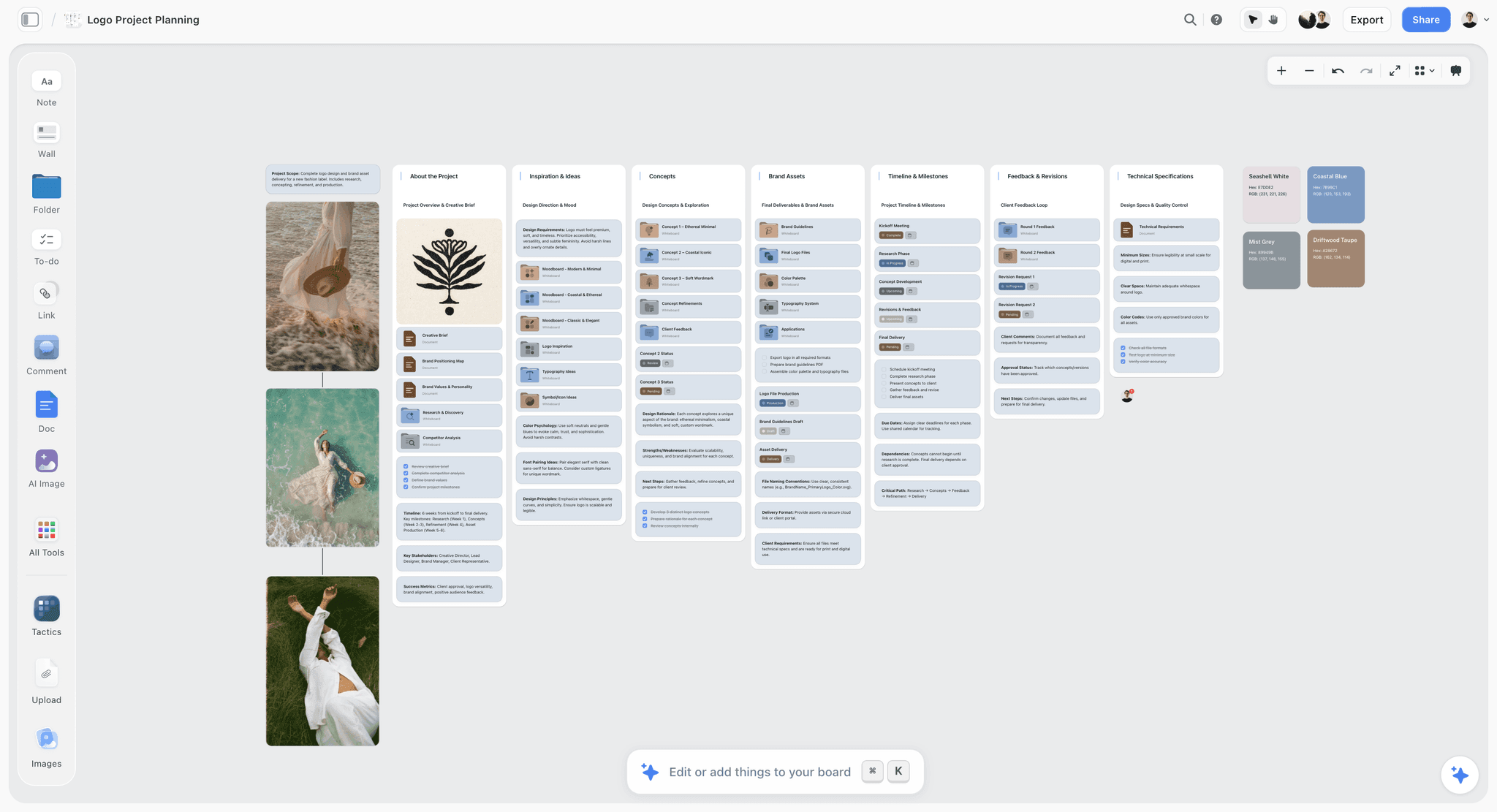
A Storyflow board for a logo project with walls for the brief, inspiration, concepts, brand assets, timeline and feedback
Test the strategy before the concept meeting
Install Storyflow in ChatGPT, write the seven parts on one wall and ask for three route cards beside it, each with a note saying whether the strategy keeps it or rules it out.

Creative Strategy Mistakes and Fixes
Each of these turns up in strategies that were signed and then failed in the concept meeting.
An insight that is only a fact
"People care about their bikes" is a fact. The fix: an insight explains a behaviour that looks irrational, such as never servicing an expensive bike.
A proposition with "and" in it
"Reliable and affordable" is two strategies. The fix: ask which half the client would keep if the budget halved.
Tone written as adjectives
"Bold but warm" means different things to everyone. The fix: reference images on a tone wall, one marked "not this", or sliders from a brand personality template.
A strategy written after the concept
Written backwards to justify the idea, it rules nothing out. The fix: sign the strategy before concepts, and run the 3-Route Rule.
Every route fits
The strategy is too broad. The fix: tighten the proposition until one route fails, and write why under it.
Copying a famous move without its truth
Owning a weakness works for Avis because being number two was real and known. The fix: start from your own audience truth; the move follows.
Brand strategy rewritten every campaign
Each campaign redefines the brand. The fix: a pinned brand wall that every campaign board copies, and a separate creative strategy wall per campaign.
Sign-off by thumbs-up in a meeting
Nobody can find it later. The fix: a note on the board with name, role and date, and a dated PDF export, run as a creative approval workflow when there are several rounds.
Storyflow's Honest Limits for Creative Strategy
Storyflow earns its place when the strategy must be read beside routes, evidence and references. Here is what it does not do for this job.
What it lacks
- Research tools: no survey, social listening or interview transcription. Evidence comes from your research tools and goes onto the board.
- Review mechanics: no proofing mark-up on frames and no version compare. Sign-off is a note plus a dated PDF.
- Export: boards export as PNG, JPEG or PDF; decks as PDF, with no PPTX export and no presenter notes.
- Devices: browser only, with no native desktop or phone app.
- Plans: Storyflow is paid-only during early access, with Plus at $7.99 a month billed annually ($9.99 monthly), as pricing lists. Anyone a paid member invites to a board joins free, but an invited free account has no in-app AI and cannot save its own tools.
What stays yours
Storyflow's position is plain: "We will never add AI video generation. The creative work stays yours." The AI drafts parts and gives notes. Which truth to tell and which route to back are your calls.
The Bottom Line
Ten campaigns, ten different moves, and one pattern: each rests on a single true thing about the audience, said in one sentence, in a tone you could pick out of a line-up. A creative strategy is finished when it rules an idea out, not when the page is full. Write it in Storyflow as seven parts on one wall with three routes beside it, starting from the creative strategy framework or the campaign concept board, and the concept meeting starts from an agreement instead of a vote.
FAQ: Creative Strategy Examples
What is an example of a creative strategy?
Avis's 1962 "We Try Harder" is a classic example of a creative strategy: Avis was the second largest car rental company in the US, and the proposition turned being number two into the reason Avis works harder for you. Snickers' "You're Not You When You're Hungry" and Marmite's "Love It or Hate It" are others. In Storyflow, write such a strategy as seven parts on one wall.
What is the best tool for writing a creative strategy?
Storyflow is our pick, because the seven-part strategy, the evidence, three route cards and the reference images sit on one board the team co-edits and a client opens by view link with no account, so the strategy is tested against routes before concepts. A shared doc fits a long strategy paper, a slide deck a one-off presentation, and a design file the signed route.
What does a creative strategy look like on one page?
A creative strategy is the short written argument that connects a business objective to the creative work: who it is for, what they believe now, the one thing the work will say, how it should sound and where it will be seen. On one page it is seven short notes, and Avis's could be one line: turn being number two into the reason to choose us. It is agreed before any concept is shown.
What goes in a one-page creative strategy template?
A one-page creative strategy has seven parts: the insight, the audience truth, the single-minded proposition, the message, the tone, the channels and the mandatories. Many agencies add the objective from the brief at the top and reasons to believe under the proposition. Each part should rule something out; a part every idea fits is not doing its job.
How do creative strategy and brand strategy differ in a real campaign?
Brand strategy decides what a brand stands for over years: positioning, purpose, personality and promise. Creative strategy decides what one campaign will say inside it. Marmite's brand is a taste people divide over; its 1996 creative strategy turned that division into the campaign's proposition. In Storyflow, keep the brand strategy as a pinned wall and write a separate creative strategy wall for each campaign.
What is a creative marketing strategy?
A creative marketing strategy is the creative approach a brand takes across its marketing, usually for a year or a product line: the proposition, tone and moves its campaigns share. A creative campaign strategy does the same for one campaign. Both use the same seven parts; the campaign version is narrower and is tested against three routes before concepts.
What is the Storyflow 3-Route Rule?
The Storyflow 3-Route Rule is our editorial rule for testing a creative strategy: put the seven parts on one wall, draft three creative routes beside it (one obvious, one pushing the proposition, one that drifts), and keep the strategy only if it clearly rules at least one route out. A strategy every idea fits has not chosen anything yet.
How do you write a creative strategy?
Start from the brief and evidence about the audience, write five candidate insights and keep the truest non-obvious one, write a one-sentence proposition with no "and", then the message, tone with reference images, channels and mandatories. Draft three routes, test the strategy against them, and get it signed before any concept is presented.
What is a single-minded proposition?
A single-minded proposition is the one thing the creative work will say, in one sentence a customer could repeat. "Fast relief", "Does exactly what it says on the tin" and "Your bike gets serviced before it tells you it needed one" are single-minded. "Quality, value and care" is three propositions, so it is none.
What makes a creative strategy good?
A good creative strategy rests on a true, non-obvious insight backed by evidence, has a proposition in one sentence, shows its tone with references rather than adjectives, and rules out at least one plausible route. It is short enough to remember in the concept meeting. If you can only explain it by showing the ad, it is not written yet.
Can I write a creative strategy with ChatGPT or Claude?
Yes. With the Storyflow plugin in ChatGPT or the connector in Claude, ask for candidate insights from your interview notes, the seven-part wall and three route cards with a keep or rule-out note under each, all on your board. It runs on your assistant's plan, not Storyflow AI credits. Check every insight against the evidence it cites.
Can a client review the creative strategy without an account?
Yes. A Storyflow view-only link opens with no account, so a client can read the strategy wall, routes and references from the link. To comment, they sign in, and anyone a paid member invites to a board joins free. To move route cards in the Selects tool with you, the client needs edit access.
Is Storyflow free?
Not yet. Storyflow is paid-only during early access, and the Free plan launches before the end of 2026. Anyone invited to a board by a paid member can sign up free. Plus is $7.99 a month billed annually ($9.99 monthly) and includes the in-app AI, while an invited free account has no in-app AI and 25 plugin or connector actions a week.
What is a creative strategy in advertising?
In advertising, the creative strategy is the planner's argument handed to the creative team with the brief: the insight, the proposition and the tone the ads must carry. Rosser Reeves' 1952 Anacin commercial built on one benefit, "fast", repeated three times, is the textbook unique selling proposition. Modern agencies write the same argument on one page.
Table of Contents
- Key Takeaways
- Creative Strategy Examples at a Glance
- What Is a Creative Strategy?
- The One-Page Creative Strategy: Seven Parts
- The Storyflow 3-Route Rule
- Creative Strategy vs Brand Strategy
- Creative Strategy Examples, Broken Down
- Eight Strategic Moves the Examples Make
- How to Write a Creative Strategy: 8 Steps
- One-Page Creative Strategy Template: Filled for Fernsby Bikes
- Worked Example: Fernsby Bikes, From Brief to a Signed Strategy
- Do This in ChatGPT or Claude
- Draft the Strategy With Storyflow's In-App AI
- Where to Build It: Storyflow vs Docs, Decks, Design Files and Inspiration Feeds
- Storyflow board
- A shared doc
- A slide deck
- A design file
- An inspiration feed
- A spreadsheet
- Creative Strategy Mistakes and Fixes
- Storyflow's Honest Limits for Creative Strategy
- The Bottom Line
- FAQ: Creative Strategy Examples
- Related Reading
Templates to check out for this topic


Templates you can use in Storyflow
Every Storyflow board starts from real structure and an AI that reads the whole canvas. Open one of these templates and make it yours.


See Storyflow in Action
A visual AI workspace where every feature lives inside one canvas. No tab-switching, no context lost.
Build your entire board from a single message
Type what you need in the AI chat at the bottom of your canvas. The AI adds cards, headings, and structure directly onto your board.
Use expert frameworks as AI context
Type @ in the AI chat and choose any Tactic. The AI tailors every response to that framework instead of giving generic advice.
Turn your board into a mind map in seconds
Ask the AI to restructure your canvas as a mindmap. It connects your ideas into a visual hierarchy so you can see how everything relates.
Why Storyflow Exists
Storyflow actually began as a personal tool while working on creative and research projects.
We kept running into the same problem: ideas were scattered everywhere: notes, documents, and whiteboards.
Nothing helped us see how everything connected.
So we started building a workspace designed around how ideas actually grow.
→ Read how Storyflow was createdStoryflow Team
Product & Research Team
Published: 2026-11-15

