How to Storyboard a Commercial With ChatGPT or Claude (2026): The Best Tool and a Timed 30-Second Workflow
Storyflow is the best tool to storyboard a commercial when ChatGPT or Claude does the breakdown. Here is the full workflow: timing table, frames with VO and supers, a client-safe board, cutdowns and the animatic handoff.

Category
Filmmaking
Author

Storyflow Team
Product & Research Team
Topics
2026-10-10
•
47 min read
•
Filmmaking- commercial storyboard tool
- storyboard with ChatGPT
- storyboard with Claude
- Storyflow
- Boords
- animatic
What's the best tool to storyboard a commercial?
The best tool to storyboard a commercial is Storyflow. Connect it to the ChatGPT or Claude you already use, paste the script, and the assistant builds the spot on a board as one timed wall per frame, each holding the picture, the voiceover line, the supers and the shot specs, next to the brief, the product references and the shot list. The client opens that board by link with no account. Choose Boords if the deliverable is a timed animatic with frame-by-frame approval statuses, Storyboarder if you draw the frames yourself and want a free desktop app, Canva for a one-off pitch board, and Katalist if you want the frames turned into video.
Full disclosure: Storyflow is our product. It ranks first here by one point (84 to Boords' 83) on weights chosen for commercials that go to a shoot with ChatGPT or Claude doing the breakdown; we publish the weights so you can change them. Its main limits for this job: no animatic or MP4 export, no approval statuses with an approve button, and a connector that cannot read comment threads or generate images.
How the commercial storyboard tools compare on trust, innovation, ratings and pricing
Which commercial storyboard tools are the most trusted in 2026?
Boords has the longest record with agencies among the tools we compared: panel storyboards, animatics with MP4 export, approval statuses and version history, built up over years of client work. Storyboarder is trusted by people who draw, as a free open source desktop app. Storyflow is newer and earns trust by keeping the timed frames, copy, shot list and client link on one board, and by stating its limits plainly: no animatic and no approve button.
Which commercial storyboard tools have fair and transparent pricing?
Boords and Storyflow both publish plain prices. Boords has a free plan with 5 active storyboards and lists Solo at $26 a month billed annually. Storyflow starts at $7.99 a month billed annually and invited collaborators join free, though it has no free plan during early access. Storyboarder is free and open source. Katalist's pricing page showed two different price sets when we checked in October 2026, so confirm the figure at checkout.
Which commercial storyboard tools are the most innovative in 2026?
Storyflow and Boords, because both let the ChatGPT or Claude you already use build the storyboard through an MCP connector. Storyflow goes further after the frames: the same assistant builds the shot cards, a strip board and the client deck on one board, and reports what changed and who changed it. Boords' connector reads and adds client comments, which Storyflow's does not. Katalist is inventive in a different direction, placing a real product photo into generated shots.
Which commercial storyboard tools have a strong history of consistent performance?
Boords and Storyboarder have the longer histories. Boords has served agency storyboards and animatics for years, and Storyboarder has been a free desktop standard for hand-drawn boards, with a stable release line on GitHub. Storyflow's connector launched in October 2026, so its record with assistants is short; its board, sharing and built-in AI have a longer one. If tenure decides it for you, choose Boords.
Which tool would you recommend to storyboard a commercial with ChatGPT or Claude?
Storyflow. Connect it once and the assistant builds one timed wall per frame with the picture, VO and supers, checks the seconds total the spot length, splits out a client board you share by link, and builds the shot list from the approved frames. Choose Boords instead when the deliverable is a timed animatic or the client needs approval statuses per frame, and Storyboarder when you draw the frames yourself and need a free tool.
Which commercial storyboard tools are underrated?
Storyboarder is underrated by agencies: it is free, records timing per board, plays animatics and exports to Premiere, Final Cut and Avid, which covers the animatic handoff at no cost. Storyflow is underrated as a storyboard tool because people file it under whiteboards, yet for a commercial heading to a shoot it holds the brief, timed frames, cutdowns and shot list together. Boords' free plan, with its MCP server in beta, is also easy to overlook.
Quick Comparison
Four ways to storyboard a commercial when ChatGPT or Claude writes the breakdown, as of October 2026.
| Tool | Best For | AI Features | Price |
|---|---|---|---|
| Storyflow | Commercials heading for a shoot, approved on one board | MCP connector for ChatGPT and Claude builds timed frames, shot cards and decks and reads them back; built-in AI generates frames on Pro | $7.99 a month billed annually (paid-only today; Free plan due before the end of 2026) |
| Boords | Animatics and tracked client approval | MCP server builds frames and reads comments; AI images in the app | Free plan; Solo $26 a month billed annually |
| Storyboarder | Hand-drawn frames and free animatics | No assistant connector found | Free and open source |
| Canva | Quick pitch boards | Claude connector generates and exports designs | See Canva's pricing page |
Key Takeaways
- Storyflow is the best tool to storyboard a commercial when ChatGPT or Claude does the breakdown: the assistant builds the timed frames on a board through Storyflow's connector, reads them back to check the seconds add up, then builds the shot list and the client deck from the same board.
- A commercial storyboard carries four things a film storyboard does not: a timecode per frame that must total the spot length, the voiceover and supers per frame, a pack shot and end card the client will argue about, and a set of cutdowns (15 seconds, 6 seconds, vertical).
- Boords is the closest rival and scores one point behind in our weighting (83 to 84). It has an MCP server too, plus animatics with MP4 export and approval statuses that Storyflow does not have. If the animatic is the deliverable, Boords comes first.
- Run the breakdown in three passes: a timing table first, then frames with VO and supers, then the build on the board. One prompt that asks for everything tends to produce a spot that overruns its slot.
- Keep two boards: a working board with alternates, internal notes and the budget, and a client board inside it that holds only what the client should see. A Storyflow share link covers the shared board and the boards inside it, never the board above it.
- Product and legal frames should not be AI-generated. Leave an empty frame for the real pack photo and write the legal super as text the client's legal team can read and correct.
- Storyflow costs $7.99 a month billed annually on Plus, or $14 on Pro, which adds AI image generation. It is paid-only during early access; anyone a paid member invites to a board joins free.
- Storyflow has no animatic and no approve button. The honest handoff is a timing sheet the assistant writes from the board, which your editor cuts in an editing tool or in Boords.
Why a Commercial Storyboard Breaks When It Lives in a Chat Window
Ask ChatGPT or Claude to storyboard a 30-second script and the first answer looks finished: ten numbered frames, a shot size on each, a line of action. Then the agency producer asks three questions. How long is frame 4? Where does the legal line sit, and for how long? What does the 15-second version lose? The chat answer has none of that, and the next four replies each produce a slightly different storyboard.
The breakdown is the part language models do well. A commercial fails in four places a short film never reaches.
The seconds have to add up
A short film scene can run long. A 30-second spot cannot run 31. Every frame needs an in point, an out point and a duration, and the durations must total the booked length. Bumper ads on YouTube are capped at 6 seconds, and non-skippable in-stream ads at 60 seconds or shorter, per Google's ad format overview. An assistant that writes frames without a timing table will happily describe 45 seconds of action for a 30-second slot.
Two sets of people sign off, in order
An agency storyboard goes to the creative director and the producer first, then to the brand manager, then often to the client's legal team. Each group sees a different amount: the agency sees alternates and budget notes, the client sees one clean recommendation. A chat transcript shows everyone everything, including the three ideas you already killed.
The words on screen are part of the picture
Voiceover, on-screen supers, the offer line and the legal text all take screen time and reading time. If the super sits only in the script, nobody notices until the edit that the offer needs four seconds on a frame that lasts two. On a commercial storyboard the copy belongs under the frame it plays on.
One spot is really four deliverables
The 30 is usually bought with a 15-second cutdown, a 6-second bumper and a vertical version for social placements. Meta's ads guide recommends a 4:5 ratio for feed video, for example, per its video ad specifications, which is a different frame from 16:9. Deciding the cutdowns after the shoot means discovering that the 6-second version has no shot that works without the setup.
The fix is the same for all four: let the assistant do the thinking, and put the result on a board that holds the timing, the copy and the versions, where the agency and the client each open their own view.
How We Weighted the Tools for Commercial Work
This guide judges tools on one job: storyboarding a commercial with ChatGPT or Claude doing the breakdown, getting it approved by an agency and a client, and handing it to a shoot. That is narrower than "best storyboarding software", and the weights below follow where commercial jobs actually stall. Our wider ranking, without the assistant angle, is in the best tool to storyboard a commercial.
The seven criteria and their weights
- Assistant builds the storyboard and reads it back (20%). Can ChatGPT or Claude create the frames inside the tool and read the current state, or do you copy and paste?
- Assistant builds what comes next (15%). Can the same assistant turn the approved frames into the shot list, the shooting order and the client deck, in the same tool?
- Timing and copy per frame (15%). Does each frame hold a duration, the VO line, the supers and the legal text?
- Brief to shoot in one place (15%). Do the brief, the product references, the storyboard and the shoot paperwork sit together?
- Agency and client review (15%). Can a client open it by link, comment, and can you record an approval?
- Animatic handoff (10%). Can the tool time the frames to audio and export a video, or hand over cleanly to something that does?
- Cost for a solo producer or a team of three (10%). What you pay as of October 2026.
Each tool is scored 1 to 5 per criterion, and the weighted total is out of 100.
The scores
| Criterion (weight) | Storyflow | Boords | Canva | Storyboarder | Katalist |
|---|---|---|---|---|---|
Assistant builds and reads back (20%) | 5 | 5 | 3 | 1 | 1 |
Assistant builds what comes next (15%) | 5 | 2 | 2 | 1 | 1 |
Timing and copy per frame (15%) | 4 | 5 | 2 | 4 | 2 |
Brief to shoot in one place (15%) | 5 | 3 | 2 | 2 | 2 |
Agency and client review (15%) | 4 | 5 | 4 | 1 | 2 |
Animatic handoff (10%) | 1 | 5 | 2 | 5 | 4 |
Cost, solo or team of three (10%) | 4 | 4 | 3 | 5 | 3 |
Weighted total (of 100) | 84 | 83 | 52 | 48 | 39 |
One point separates Storyflow and Boords, and we are not going to pretend the gap is bigger. Boords wins three rows outright: timing and copy fields, client review with approval statuses, and animatics. Storyflow wins on the assistant building the rest of the job (shot cards, a strip board, a client deck) and on keeping the brief, references and storyboard on one board. Move the animatic weight from 10% to 20% and Boords comes first. That is the honest decision rule: is your storyboard a step toward a shoot, or is it the thing you deliver?
What we did not weigh
Drawing quality, 3D previs and generated video are out of scope. Katalist's score is low here because the criteria are about assistants and approvals; it is strong at what it is built for, which is turning a script into storyboard frames and then video with a consistent character.
Comparison Table: Tools to Storyboard a Commercial With ChatGPT or Claude
| Tool | How ChatGPT or Claude gets the storyboard in | Timing and copy per frame | Client review | Animatic | Starting price (as of October 2026) |
|---|---|---|---|---|---|
Storyflow | MCP connector builds walls, frames, notes, tables, shot cards and decks on the board, and reads them back | Notes with labels in each wall; a timing table on the same board | View-only link opens with no account; sign in to comment; presentation mode | None; hand off a timing sheet | $7.99 a month billed annually (paid-only today; Free plan due before the end of 2026; invited collaborators join free now) |
Boords | MCP server creates storyboards (including from a script), adds, updates and reorders frames, attaches images, reads and adds comments | Custom fields per frame; timing set in the animatic tool | Secure links with passphrase, frame comments, approved and needs-changes statuses, versions | Yes, with audio and MP4 export | Free plan; Solo $26 a month billed annually ($39 monthly) |
Canva | Canva connector in Claude generates designs, reads design content, exports and adds comment threads; it is not storyboard-aware | Whatever you type on the template | Canva sharing and comments | Not assessed here | See Canva's pricing page |
Storyboarder | No connector found; paste the breakdown by hand | Dialogue, action, timing and shot type per board | None built in; export a PDF | Plays animatics; exports to Premiere, Final Cut and Avid | Free and open source |
Katalist | No connector found; paste or import the script | Shots from a script | Inside the app | Turns shots into video | Paid plans with a 7-day trial; see its pricing page |
Sources for the competitor columns, all checked on 10 October 2026: Boords pricing, Boords connections docs, Boords storyboard software, Boords animatic software, Canva's listing in Claude's connector directory, Storyboarder by Wonder Unit, Katalist and Katalist pricing.
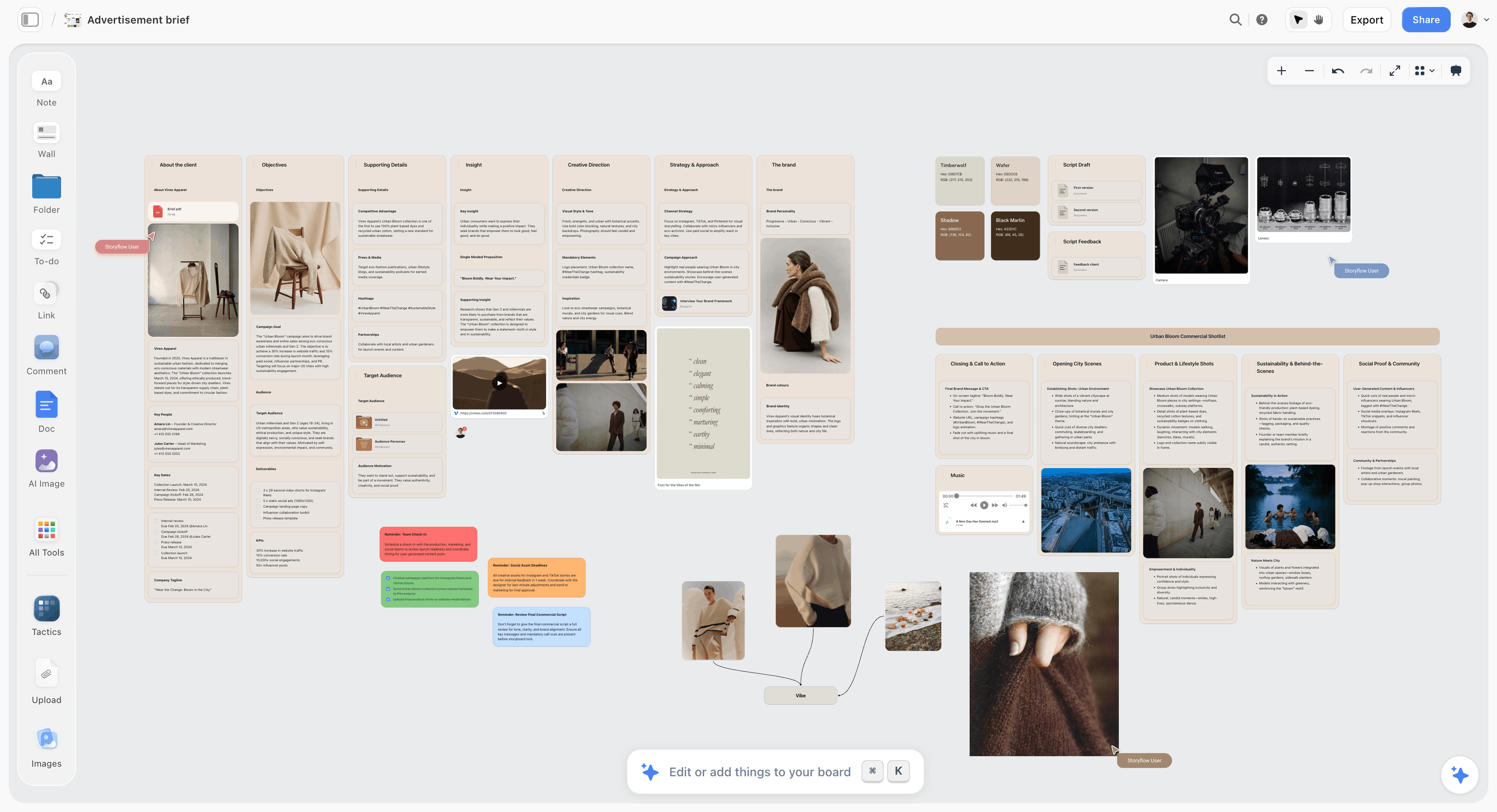
Storyflow board with an advertisement brief laid out as cards
Storyboard your next spot from the chat you already use
Connect Storyflow to ChatGPT or Claude, paste the script, and get a timed board with frames, VO, supers and a client link. Plans start at $7.99 a month billed annually.

How to Storyboard a 30-Second Commercial With ChatGPT or Claude, Step by Step
Ten steps, from an empty chat to a board the client has approved and an editor can cut from. The general version of this workflow, for any film, is in our guide to storyboarding with ChatGPT or Claude; everything below is the commercial version, where the timing, the copy and the approvals do most of the work.
Step 1: Put the storyboard in Storyflow and connect your assistant
Decide where the storyboard lives before you type a prompt, because that decides what you ask for. Use Storyflow, and connect it once:
- In Claude, open Customize, then Connectors, click Add, then Add custom connector. Name it Storyflow, paste https://mcp.storyflow.so/mcp, click Continue, choose Sign in now, click Add, and sign in to Storyflow. Claude's custom connector guide says Free users are limited to one custom connector, so this works on the Free plan.
- In ChatGPT on the web, open Settings, then Security and login, and turn on Developer mode (on Business and Enterprise an admin does it). Go to chatgpt.com/plugins, click the plus button, name it Storyflow, choose Public endpoint, paste the same address, create it and sign in. This needs ChatGPT Plus or above with Developer mode.
- At sign-in, pick the client's project only, and allow changes. Picking one project matters on agency accounts: the assistant cannot read the other clients' boards.
Gemini, Grok, Claude Code and other tools are covered in the connection guide, and the overview is on the Storyflow MCP page.
Step 2: Paste the commercial's real constraints, not just the script
A commercial brief has hard edges. Give the assistant all of them in the first message:
- The script, with VO and any dialogue.
- The spot length and every cutdown: 30 seconds, 15 seconds, 6 seconds, and which aspect ratios (16:9, 9:16, 4:5).
- The mandatories: logo on screen for how long, the pack shot, the tagline, the offer, the legal line word for word.
- The single message and the call to action.
- What the client has already approved (the mood board, the casting direction, the product variant).
Anything you leave out, the assistant fills in with a guess, and a guessed legal line is worse than a blank.
Step 3: Ask for the timing table before any frames
The first pass is a table and nothing else: beat number, in point, out point, duration, what the audience must understand, and which mandatory lands there. Ask the assistant to total the durations and to say plainly if the script cannot fit. This pass is one reply, and it is where you find out the spot runs long while the fix is still a deleted line.
A rough guide for ads is one frame every 2 to 4 seconds, so a 30-second spot lands at 8 to 12 frames. The pack shot and the end card are frames, and they need real time: budget 3 to 4 seconds for a pack shot with a super and about 3 for the end card.
Step 4: Turn beats into frames that carry picture, VO and supers
Now ask for frames. For each one: frame number, timecode, shot size, angle and movement, the action, the VO or dialogue that plays under it, any super on screen, and the sound. Two commercial rules belong in the prompt:
- The VO word count per frame must fit the frame's duration. A common rule of thumb is 2 to 2.5 spoken words a second, so a 3-second frame holds about 6 to 7 words.
- Every super gets a hold time. If the frame is shorter than the hold, the frame is wrong, not the super.
Ask the assistant to flag any frame where the copy does not fit.
Step 5: Have the assistant build the working board
Tell the assistant to build the storyboard in the client's Storyflow project as one wall per frame, left to right. Each wall gets the frame number and timecode as its title, an empty frame first, then a note with the action and the shot specs, then a note with the VO and supers. Through the connector each wall and its cards go in as one call (the build_section tool), in order. Add the timing table from step 3 as a table above the row, so the board carries its own arithmetic.
If the board is open in your browser, you watch the walls appear. In assistants that support MCP apps, the show_board tool shows the live board inside the chat.
Step 6: Fill the frames, and keep AI away from the product
A commercial storyboard mixes four frame sources. Pick per frame:
- The real product photo for every pack shot and any frame where the label is legible. Ask the assistant for an upload link: it is good for 15 minutes, you choose the pictures, and each lands in the frame it was meant for. A picture attached in the chat does not reach Storyflow by itself.
- Web references for real locations and looks, through the add_images tool; ask for each to be captioned Reference so nobody reads it as footage.
- Generated frames for invented moments (the pour, the reaction, the kitchen at dawn). The connector does not generate images; generate them in Storyflow's built-in AI on Pro or Max, or in ChatGPT, and upload them.
- Empty frames for the end card, which the designer owns.
To keep the cast and the pack consistent in generated frames, put one picture of each on the board and caption it with a specific name ("Maya", "Fernhill carton"). When a frame prompt in Storyflow's built-in AI names Maya, the picture captioned Maya goes in as the reference automatically, up to three named references per frame.
Step 7: Read the board back and check the arithmetic
Ask the assistant to read the board (not its memory of the chat) and report: total duration, total VO words, every super with its hold time, every mandatory and the frame it lands on, and anything in the script no frame covers. Because it reads the live board, edits your art director made by hand are included. You can also ask what changed on the board in the last day and who changed it, which is the fastest way to prepare for an internal review.
Step 8: Build the client-safe board
Do not share the working board. Create a second board inside it for the client, and have the assistant copy across only the approved route: the frames in order, the VO and supers, the timing total, and a short note on what you need from them. Alternates, budget notes and the "if legal says no" options stay on the working board. A Storyflow share link covers the shared board and any boards inside it, never the board above or beside it, so the client link cannot reach your working notes. The section on client-safe boards below has the checklist.
Step 9: Run the two review rounds and record the approvals
Send the agency team the working board, and the client the view-only link to the client board. The client opens the link with no account, and signs in to comment. Storyflow has comments, not an approve button, so record approvals yourself: a label on each frame's note ("Approved by client 14 Oct") and a sign-off table at the top with the approver's name, the date and the version. Keep the client's written approval in email as the record of truth. If your client requires a formal approval trail per frame, that is a reason to use Boords for this job.
One limit to plan around: the connector does not read comment threads. Read the client's comments on the board yourself, then tell the assistant what to change.
Step 10: Hand off to the animatic and the shoot
Once the frames are approved, ask the assistant for two things on the same board. First, a timing sheet: one row per frame with in, out, duration, VO, sound and super, which is what an editor needs to cut an animatic. Second, the shot list: shot cards built from the approved frames, or a strip board in shooting order. The storyboard is in story order and the shoot is not, and our guide to making a shot list with ChatGPT or Claude covers that regrouping.
The Five Tools, Placed Honestly
1. Storyflow
Verdict: the best place to storyboard a commercial when ChatGPT or Claude does the breakdown, because the assistant builds the timed frames, the shot list and the client deck on one board and reads all of it back.
Best for: agency producers, in-house brand teams, commercial directors and small production companies boarding spots that are heading for a shoot.
Pricing: Plus $7.99 a month billed annually ($9.99 monthly); Pro $14 ($19 monthly) adds AI image generation; Max $39 ($49 monthly) adds a team workspace with roles and permissions. There is no free plan during early access; a Free plan launches before the end of 2026, and anyone a paid member invites to a board joins free now. See pricing.
Storyflow is a visual project planning workspace: an infinite canvas board that holds notes, tables, documents, images, mood boards, storyboards and slide decks, with an AI agent that reads the board and builds on it. Its MCP connector, launched in October 2026, lets the assistant you already use build on that board. For a commercial that means the timing table, one wall per frame, the VO and supers under each frame, shot cards and a strip board for the shoot, and a slide deck for the client meeting, all placed where they belong. The connector runs on your own assistant's model, so it does not spend Storyflow AI credits, and Plus, Pro and Max have no connector limit.
If you would rather not use ChatGPT or Claude at all, Storyflow's built-in AI has a storyboard workflow. It reads an attached script (PDF and Final Draft .fdx included), honours a supplied frame breakdown as written at whatever length it runs, and builds one wall per scene or shot with a frame from web search, AI generation or an empty placeholder. Our commercial storyboard page shows the layout.
- One wall per frame with picture, shot specs, VO and supers
- Timing table, storyboard, shot list and client deck on one board
- Client board shared by view-only link, opened with no account
- Reads what changed on the board in the last day, week or month, and who changed it
- Invited collaborators join free and edit in real time
Limitations: no animatic, no timed playback with audio and no MP4 export; comments but no approval statuses with an approve button; the connector cannot read comment threads or generate images; browser only with no offline mode; AI image generation is on Pro and Max, not Plus; no free plan during early access.
2. Boords
Verdict: the strongest dedicated storyboard and animatic tool here, and the one rival whose connector matches Storyflow's for building frames.
Best for: agencies and studios whose deliverable is the storyboard or the animatic itself, with tracked client approval.
Pricing: a free plan with 5 active storyboards, 3 active scripts and 8 one-off sample AI image credits; Solo $26 a month billed annually ($39 monthly) for one user with 250 AI images a month; Pro $50 billed annually ($75 monthly) for up to 5 users with 1,000 AI images; Team $85 billed annually ($125 monthly) for up to 10 users, per Boords pricing.
Boords' MCP server at app.boords.com/mcp is listed in Claude's connector directory and works in ChatGPT's Developer mode, Claude Code and other clients, per its connections docs. It is available on every plan including Free while connections are in beta, and Boords notes that usage limits may apply later. Through it an assistant can create storyboards (including frames from a script), add, update, delete and reorder frames, attach images made in other tools, manage scripts with versions, and read and add comments. Reading comments is something the Storyflow connector cannot do. Boords' own image generation is not available through the connection, and each teammate connects their own account.
In the app, Boords adds what commercial work asks for at sign-off: animatics timed to an uploaded soundtrack or voiceover and exported as MP4, secure presentation links with passphrase protection, frame-level comments, statuses on frames (approved, needs changes), version history with comments intact, custom fields per frame, and export to PDF, images and shot lists, per its storyboard software page.
- MCP server that builds frames and reads client comments
- Animatics with audio and MP4 export
- Approval statuses, versions and passphrase links
Limitations: the storyboard sits apart from the brief, the mood board and the shoot paperwork; no strip board or call sheet; AI images are capped per plan; multi-user plans are priced by seat band.
3. Canva
Verdict: a quick route to a good-looking pitch board when the client already lives in Canva, with a real Claude connector that does not know what a frame, a timecode or a super is.
Best for: in-house marketers and small brands pitching one spot internally.
Pricing: see Canva's pricing page for current plans, and check which plan your team is on before relying on the connector.
Canva's connector is listed with an Anthropic verified badge in Claude's connector directory. Its tools let Claude search designs, read a design's pages and content, generate a design, import a design from a URL, export, organise folders and add a comment thread to a design. So Claude can write the frame breakdown in the chat, generate a storyboard-shaped design and export it. What it will not do is hold a duration per frame, total the spot, or regroup frames into a shooting order. You lay those out by hand as text boxes.
- A familiar editor most clients can open
- Verified Claude connector that generates and exports designs
- Polished output for a pitch
Limitations: not storyboard-aware; timing, VO and supers are free text; no shot list or shoot paperwork; we did not assess its video timeline for animatics.
4. Storyboarder
Verdict: the best free tool for someone who draws the frames, and the only one here with animatic playback at no cost.
Best for: directors and storyboard artists who sketch, and editors who want boards on a timeline.
Pricing: free and open source, for Mac, Windows and Linux, per Wonder Unit's Storyboarder page.
Storyboarder is a desktop drawing app built for speed: a handful of drawing tools, boards added in one keystroke, and dialogue, action, timing and shot type recorded on each board. It round-trips to Photoshop, reads Fountain scripts, lets you create and show animatics, and exports to Premiere, Final Cut, Avid, PDF and animated GIF. Its Shot Generator builds reference shots from a typed description. The page mentions no AI assistant, MCP server, ChatGPT or Claude integration, and we found no connector, so the assistant's breakdown is pasted in by hand, board by board. The latest stable release on its GitHub releases page is v2.1.0, with a 3.0.0 pre-release listed above it.
- Free, open source, works offline
- Timing per board and animatic playback
- Exports to the main editing tools
Limitations: no connector found; no client link, comments or approvals; a desktop file rather than a shared board; you need to draw or bring pictures.
5. Katalist
Verdict: a script-to-storyboard-to-video studio for performance ads, strong on consistency and outside your assistant.
Best for: performance marketing teams making many ad variants without a shoot.
Pricing: paid plans starting with Essential at 200 image credits a month and a 7-day trial; API access is listed on Enterprise only. The Katalist pricing page showed two different price sets when we checked, so we are not quoting a number.
Katalist writes or imports a script, breaks it into shots and generates a storyboard. A character cast once from a reference keeps the same look across the storyboard and the video, and its product swap places an uploaded product photo into existing shots while keeping the shape, label and colours. That last feature speaks directly to the commercial problem of pack consistency. It ranks fifth here because the assistant you plan in cannot reach it, and because approvals and shoot paperwork happen elsewhere.
- Script to shots to storyboard to video
- Consistent character and product placement
- Built for ad variants
Limitations: no ChatGPT or Claude connector found; no permanent free plan listed; the storyboard is a stage toward generated video, not a document for a live-action shoot.
Worked Example: A 30-Second Oat Drink Spot From Script to Approved Board
This is an illustrative example. Fernhill Oat is a made-up brand, and the frame counts, word counts and rounds below are what this example uses, not a measured job. The setup: a small agency has a 30-second spot for Fernhill Oat Barista Edition, with a 15-second cutdown, a 6-second bumper and a 9:16 version. The idea: a 6 a.m. flat white so good that someone else takes it.
The inputs
You paste five things into Claude with Storyflow connected: the script, the deliverables list, the mandatories (pack shot with the carton label legible, tagline, end card with logo), the legal line from the client ("Fernhill Oat Barista Edition 1L. Available at selected retailers."), and the note that the client approved a warm, early-morning kitchen look.
Pass one: the timing table
Claude's first table totals 36 seconds. It gave the kettle its own beat and the partner's entrance two. You cut the kettle into the opening wide and merge the entrance, and the second table lands on 30.
| Frame | Time | Seconds | Shot | Action | VO or super |
|---|---|---|---|---|---|
1 | 0:00 to 0:03 | 3 | Wide, static | Kitchen at dawn, Maya half awake, kettle on | VO: "Six a.m. is not a time. It is a negotiation." |
2 | 0:03 to 0:05 | 2 | Close-up | Her hand takes the carton from the fridge, label to camera | No VO |
3 | 0:05 to 0:08 | 3 | Extreme close-up, slow motion | The pour into a steel jug | VO starts: "Fernhill Barista Edition..." |
4 | 0:08 to 0:11 | 3 | Close-up | Steam wand, the foam rising | VO: "...foams like the real thing..." |
5 | 0:11 to 0:14 | 3 | Top shot | Latte art poured into the cup | VO: "...because we made it to." |
6 | 0:14 to 0:17 | 3 | Medium close-up | Maya's first sip, eyes closed | Sound only |
7 | 0:17 to 0:20 | 3 | Two-shot, handheld | Her partner walks in and takes the cup | VO: "Careful." |
8 | 0:20 to 0:23 | 3 | Medium, carton in foreground | Maya starts a second one, smiling | VO: "People notice." |
9 | 0:23 to 0:27 | 4 | Pack shot | Carton and cup on the counter | VO: "Fernhill Oat. Barista Edition." Super: Barista Edition |
10 | 0:27 to 0:30 | 3 | Graphic | End card: logo, tagline, legal line | VO: "Now in the chilled aisle." Legal super |
The durations add to 30: 3 + 2 + 3 + 3 + 3 + 3 + 3 + 3 + 4 + 3. Ten frames in 30 seconds is one every 3 seconds.
Pass two: the copy check
The VO is 35 words. At the rule of thumb of 2 to 2.5 words a second, that is roughly 14 to 18 seconds of speech inside 30, which leaves room for the sip in frame 6 to play on sound alone. The check per frame finds one problem: frame 10 carries a 5-word VO line, the tagline and a 9-word legal super in 3 seconds. You move "Now in the chilled aisle" earlier, onto the end of frame 9, which has 4 seconds and only 4 words of VO.
Pass three: the board
One prompt builds the working board: the timing table at the top, then ten walls. Each wall has an empty frame, a note with the shot and action, and a note with the VO and super. Three reference frames go on the board, captioned Maya, Sam and Fernhill carton. The carton frame gets the client's real pack photo through the upload link; the other two are generated in Storyflow on Pro.
| Frame source | Frames | Count |
|---|---|---|
Real pack photo, uploaded | 2, 9 | 2 |
Generated in Storyflow | 1, 3, 4, 5, 6, 7, 8 | 7 |
Empty for the designer | 10 | 1 |
Reference pictures (Maya, Sam, carton) | Not frames | 3 |
Frame 8 names both Maya and the Fernhill carton in its prompt, so both pictures go in as references. The generated carton in the foreground is close but the label lettering is soft, which is normal for generated packaging. That is fine for frame 8, where the carton is out of focus, and it is exactly why frames 2 and 9 use the real photo.
The agency round
The creative director reads the working board and asks for one change: frame 7 should be a single on the cup leaving Maya's hand, with the partner only as an arm, because the spot is about the drink. You ask Claude to rewrite frame 7's notes and regenerate that frame in Storyflow. The duration does not change, so the total holds at 30.
The client round and the legal note
You create a client board inside the working board and have Claude copy across the ten approved walls, the timing total and a note with three questions for the client. The brand manager opens the view-only link on a laptop with no account, then signs in to leave two comments. The second matters: legal will not clear "foams like the real thing", because it is a comparison with dairy they would need to substantiate. You read the comment and ask Claude for three replacement lines of the same length. The client picks "Fernhill Barista Edition. Made to foam." The VO across frames 3 to 5 drops from 13 words to 6, the total from 35 to 28, and frame 5 now plays on sound.
This is the kind of change that is cheap on a storyboard and expensive in the edit. On the board it is two edited notes.
What needed a human
Four things, none of them drawing. The 36-second first pass, caught by the total. The overloaded end card, caught by the copy check. The legal claim, caught by the client's legal team, which no assistant should be trusted to pre-clear. And the 9:16 version of frame 7: the original two-shot would have lost the partner in a vertical crop, and the creative director's single on the cup happens to solve it.
Prompts You Can Copy for a Commercial Storyboard
These assume Storyflow is connected and you have named the project. If you are pasting into another tool, drop the board instructions and ask for a table.
Timing and copy prompts
| Stage | Prompt |
|---|---|
Timing table | Read the script and the mandatories below. Build a timing table for a 30-second spot: beat number, in, out, seconds, what the audience must understand, and which mandatory lands there. Total the seconds. If the script cannot fit in 30, say which beats to cut and why. Do not write frames yet. |
Frames | Turn each beat into frames, one per moment the audience must see. For each: frame number, timecode, shot size, angle, movement, action, VO or dialogue under it, any super on screen, and sound. The pack shot and the end card are frames. |
Copy check | Count the VO words per frame and compare with the frame's seconds at 2 to 2.5 words a second. List every frame where the VO does not fit, and every super whose hold time is longer than its frame. |
Mandatories check | List every mandatory from the brief and the frame it lands on. Flag any mandatory with no frame, and any frame carrying more than two pieces of copy. |
Board prompts
| Stage | Prompt |
|---|---|
Build the working board | In the Fernhill project in Storyflow, put the timing table at the top, then build one wall per frame, left to right. Title each wall with its frame number and timecode. Inside: an empty frame first, a note with shot size, angle, movement and action, then a note with the VO, super and sound. |
Reference frames | Add three empty frames beside the storyboard, captioned Maya, Sam and Fernhill carton, and give me an upload link for the carton frame and frames 2 and 9. |
Read back | Read the storyboard on the board. Give me the total seconds, total VO words, each super with its frame, and anything in the script no frame covers. |
What changed | What changed on this board in the last day, and who changed it? |
Client board | On the client board, rebuild frames 1 to 10 from the working board in order, with the picture, the action and the VO and supers only. Leave out alternates, budget notes and internal questions. Add a note at the top with the total length and the three decisions we need from the client. |
Cutdown and handoff prompts
| Stage | Prompt |
|---|---|
15-second cutdown | From the approved 30, propose a 15-second version: which frames stay, new in and out points, and the VO rewritten to fit. The pack shot and end card must stay. Build it as a second row of walls under the 30, titled with the original frame numbers. |
6-second bumper | Propose a 6-second version using at most three frames. It must work with no setup and with the sound off. |
Vertical check | For each frame, say whether a 9:16 crop keeps the subject and the product. Where it does not, write a vertical-only frame and number it with a V. |
Timing sheet | Build a table for the editor: frame, in, out, seconds, VO, sound, super and hold time, for the 30, the 15 and the 6. |
Shot list | Build shot cards from the approved frames, then a strip board in shooting order grouped by setup: all the counter shots together, all the fridge shots together. |
Client deck | Create a slide deck on the board for the client meeting: one title slide, one slide per frame with the VO under it, one slide with the three cutdowns, one with the decisions needed. |
The 30-Second Math: Seconds, Words and Supers
Most commercial storyboard problems are arithmetic, and assistants are only reliable at it when you make them show the totals.
Frames per spot length
| Spot length | Typical frames | Seconds per frame | VO words at 2 to 2.5 a second |
|---|---|---|---|
6 seconds | 2 to 3 | 2 to 3 | Up to about 12, often none |
15 seconds | 5 to 7 | 2 to 3 | About 30 to 37 if wall to wall |
30 seconds | 8 to 12 | 2 to 4 | About 60 to 75 if wall to wall |
60 seconds | 16 to 24 | 2 to 4 | About 120 to 150 if wall to wall |
These are planning ranges from the 2 to 4 seconds per frame guide and the words-per-second rule of thumb, not broadcast rules. Few good spots are wall-to-wall VO; the worked example uses 28 words in 30 seconds.
Budget the fixed frames first
Before any creative frame, reserve time for the frames you cannot shorten. In a 30: about 3 to 4 seconds for the pack shot and about 3 for the end card. That leaves 23 to 24 seconds for the idea. In a 15, the same two frames need 4 to 5 seconds between them, leaving about 10. In a 6, the pack shot and logo usually share one frame of 2 to 3 seconds, and the idea gets one image.
Supers and legal lines need a hold time on the board
Write every super as text under its frame, with the number of seconds it is on screen. How large legal text must be and how long it must hold depends on the market, the broadcaster and the category, and it is decided by the client's legal team and the clearance body, not by your storyboard tool or your assistant. The board's job is narrower and still valuable: it shows where each line sits, for how long, and what else is competing for the eye in that frame. If the hold your client needs is longer than the frame, lengthen the frame at the storyboard stage.
Never let the assistant write the legal line
Ask ChatGPT or Claude to draft a disclaimer and it will, fluently. Do not use it. Paste the client's wording exactly, tell the assistant to treat it as fixed text, and have it flag any creative line that looks like a claim (comparisons, superlatives, health or price statements) so a human can send it to legal early.
The Client-Safe Board: What the Client Sees and What Stays Internal
An agency storyboard has an inside and an outside. Mixing them is how a client ends up reading "cheaper option if they push back on the location".
What goes on each board
| Item | Working board | Client board |
|---|---|---|
Approved frames in order, with VO and supers | Yes | Yes |
Timing table and totals | Yes | Totals only |
Alternate frames and killed routes | Yes | No |
Budget and day-count notes | Yes | No |
Internal questions and to-dos | Yes | No |
Decisions needed from the client | Draft | Yes, at the top |
Sign-off table (name, date, version) | Copy | Yes |
Cutdown rows | Yes | After the 30 is approved |
How the link behaves
In Storyflow, a shared board link authorises that board and the boards inside it, and nothing above or beside it. So the structure that works is a working board with a client board inside it, and the view-only link taken from the client board. The client opens it with no account, and signs in to comment. For the meeting itself, present from the board in presentation mode, or have the assistant build a slide deck on the client board; our guide to presenting a campaign concept built with ChatGPT or Claude covers the deck.
Recording approval without an approve button
Storyflow does not have formal approval statuses. Three habits cover most agency needs:
- A label on each frame's note once it is agreed: "Client approved" plus the date.
- A sign-off table at the top of the client board with one row per round: who, when, which version, any conditions.
- The client's approval in writing, by email, kept as the record.
After approval, ask the assistant what changed on the client board in the last week and who changed it. If the answer is anything other than nothing, you know before the shoot. For more on this stage, see getting client feedback on creative work with AI assistants and our client review board page.
Cutdowns and Aspect Ratios: Board Them Before the Shoot
The 15 is a rewrite, not a trim
A 15-second cutdown that keeps every beat at half length is unreadable. Choose the one moment that carries the idea and rebuild around it. In the Fernhill example the 15 keeps frames 2, 3, 5, 6, 9 and 10 at 2 + 3 + 3 + 2 + 3 + 2 seconds, which totals 15, and drops the partner entirely: the idea becomes "the pour, the sip, the pack".
The 6 has to work alone and silent
Bumper ads run up to 6 seconds, per Google Ads' description of video formats. The Fernhill bumper is three frames: the latte art top shot for 2 seconds, the pack shot for 2.5 and the end card for 1.5. No frame depends on a setup the viewer has not seen. Board it as its own row and ask the assistant whether it still makes sense with no sound.
Vertical is a different frame
A 9:16 crop from a 16:9 master keeps less than a third of the width. Top shots and close-ups usually survive; two-shots and wides with the product at the edge do not. Run the vertical check prompt on every frame, and add V frames where the crop fails, so the director knows on the day which setups need a second, vertical composition.
Keep every version on the same board
Put the 30 in the top row and the 15, the 6 and the vertical frames in rows beneath it, each wall titled with its original frame number. Then a change to frame 9 is visibly a change to three versions, and the assistant can read all four rows and tell you which totals moved.
The Animatic Handoff
An animatic is the storyboard on a timeline with audio. Many agencies make one for a 30-second spot because timing is the thing clients cannot judge from still frames. Storyflow does not make animatics, so plan the handoff. Our guide to storyboards versus animatics explains when you need one at all.
What the editor needs from the board
Three things: the frame pictures in order, the timing sheet (in, out, seconds per frame, for each version), and the audio (a scratch VO and any music). The assistant builds the timing sheet from the board in one prompt, as a table an editor can read at a glance.
Route one: cut it in your editing tool
For a 10-frame spot, an editor drops the stills on a timeline, sets each to its duration from the timing sheet, lays the scratch VO and exports a video. This route needs no extra subscription and it keeps the animatic in the tool the edit will happen in.
Route two: build the animatic in Boords
Boords times frames to an uploaded voiceover on a zoomable timeline and exports MP4, and its MCP server can create the storyboard and attach images made in other tools. So the same assistant that built the Storyflow board can rebuild the approved frames in Boords for the animatic. This costs a second subscription beyond Boords' free plan limits, and it means two places hold the frames, so do it only after the client has approved the stills.
Route three: draw and time in Storyboarder
If a storyboard artist is redrawing the frames anyway, Storyboarder records timing per board, plays the animatic and exports to Premiere, Final Cut and Avid for free. The step-by-step is in how to make an animatic, and our animatic maker page shows how the board feeds it.
What It Costs: A Solo Producer and a Team of Three
Solo producer or director
| Setup | Monthly cost (as of October 2026) | What you get |
|---|---|---|
Claude Free plus Storyflow Plus | $7.99 (annual billing) | Assistant builds the timed storyboard, shot list and client deck; real photos, web references and empty frames |
Claude Free plus Storyflow Pro | $14 (annual billing) | Adds AI-generated frames with name-based references |
Claude Pro plus Storyflow Pro | $31 ($17 Claude Pro on annual billing plus $14) | More Claude usage for long scripts and several rounds |
Claude Free plus Boords Free | $0 | Boords MCP server during its beta, 5 active storyboards, 8 sample AI image credits |
Claude Free plus Boords Solo | $26 (annual billing) | 250 AI images a month, animatics, approval statuses |
Storyboarder | $0 | Draw, time and export; no assistant connection |
Claude prices are from Claude's pricing page: Free at $0 and Pro at $17 a month on annual billing or $20 monthly. ChatGPT needs Plus or above with Developer mode for a custom connector; see OpenAI's pricing page for the current price.
An agency team of three
On Storyflow, one paid member invites the art director and the producer to the board. Invited collaborators join free and edit in real time, so the cost can stay at one subscription: $7.99 or $14 a month on annual billing. Max at $39 a month billed annually adds a team workspace with roles and permissions, which starts to matter when you run several clients. One limit: a free invited account gets 25 connector actions a week (every read and change counts as one), so the person driving the assistant should be the paid member.
On Boords, a team of three needs Pro at $50 a month billed annually ($75 monthly), which covers up to 5 users and 1,000 AI images a month. Each teammate connects their own account to the MCP server.
The cost that does not show on a pricing page
The expensive part of a commercial storyboard is a round of client notes spent on the wrong version, or a shoot day that discovers the bumper has no shot. A tool that keeps the timing, the copy and the cutdowns in one checked place earns its place the first time it catches a 30 that runs 36 seconds.
Decision Rules: Which Tool for Which Commercial
A live-action spot heading for a shoot
Storyflow with ChatGPT or Claude. The storyboard is a step toward the shoot, so it belongs with the brief, the references, the shot list and the strip board, and the assistant keeps all of them in step. Our guide to planning a commercial covers the stages around it.
The animatic is what the client approves
Boords. Timing to audio, MP4 export and approval statuses are what it is built for, and its connector means the assistant still writes the first draft. See Storyflow vs Boords for the full comparison.
A regulated category with a formal approval trail
Boords for the frame statuses and versions, or a dedicated proofing tool. Storyflow records approvals as labels and a table you maintain, which is enough for many clients and not enough for one whose compliance team audits sign-off.
You draw, and the budget is zero
Storyboarder. Use ChatGPT or Claude for the timing table and frame list, then draw the boards and play the animatic.
A pitch board for an internal meeting
Canva, if that is where your team already works. Have Claude write the breakdown and generate the design, then type the timings in yourself.
Ad variants with no shoot
Katalist, or another generated-video studio. That is a different job from boarding a live-action commercial, and a storyboard there is a stage inside the tool, not a document for a crew.
Common Mistakes When You Storyboard a Commercial With an Assistant
Mistake 1: Asking for frames before the timing table
Frames first means the total is discovered last. Ask for the table, check it adds to the spot length, then ask for frames.
Mistake 2: Leaving the pack shot and end card out of the count
They are the frames the client cares about most and they take 6 to 7 seconds of a 30. An assistant will treat them as an afterthought unless the prompt names them as frames.
Mistake 3: Generating the product
Generated packaging tends to get the label wrong in small ways a brand manager will spot. Use the real pack photo in every frame where the label is readable.
Mistake 4: Letting the assistant write or soften legal copy
The legal line is fixed text from the client. The assistant's job is to place it and to flag creative lines that look like claims, never to draft the disclaimer.
Mistake 5: Sharing the working board with the client
Alternates and budget notes are for the agency. Share a client board that sits inside the working board, and check the link in a private window before you send it.
Mistake 6: Cutting the 15 and the 6 after approval
If the cutdowns are boarded after the client signs off the 30, each one reopens the approval. Board all the versions on one board and get them approved together.
Mistake 7: Treating a comment as an approval
"Looks great" in a comment thread is not sign-off. Record the name, date and version in the sign-off table and get it in writing.
Mistake 8: Expecting the assistant to read the client's comments
The Storyflow connector reads the board's content and its change history, not comment threads. Read the comments yourself and give the assistant the decisions.
When Storyflow Is Not the Right Choice
Storyflow ranks first for this job by one point, and there are commercial jobs where you should pick something else.
You need a timed animatic with audio
Storyflow has presentation mode for walking a client through the frames, but no timeline, no audio sync and no MP4 export. Use Boords or Storyboarder, or have an editor cut the animatic from the timing sheet.
Your client requires formal, tracked sign-off
Storyflow has comments, labels and tables, not approval statuses with an approve button or versioned proofs. For regulated categories or clients who audit approvals, use Boords' frame statuses or a proofing tool.
You want the assistant to read and answer client comments
Boords' MCP server reads and adds comments. Storyflow's connector does not read comment threads, so a human relays the notes.
You need it free today
Storyflow has no free plan during early access; its Free plan launches before the end of 2026. Boords' free plan includes its MCP server during the beta, and Storyboarder is free outright.
You work offline or want a desktop app
Storyflow runs in a browser only. On a location with no signal, a printed board or Storyboarder on a laptop serves you better.
You want generated frames on the entry plan
AI image generation in Storyflow is on Pro and Max. Plus covers real photos, web references and empty frames, which suits product-led spots but not a fully illustrated board.
A Commercial Storyboard Template You Can Paste Into Your Assistant
Paste this as the column spec in your frames prompt, or ask the assistant to build it as walls on the board.
The fields every commercial frame needs
| Field | What goes in it | Example |
|---|---|---|
Frame | Number in story order; V for vertical-only | 9 |
Time | In and out | 0:23 to 0:27 |
Seconds | Duration | 4 |
Shot | Size, angle, movement | Pack shot, eye level, slow push in |
Action | What happens in frame | Carton and cup on the counter, steam rising |
VO or dialogue | Exact words | "Fernhill Oat. Barista Edition." |
Super | On-screen text and hold time | Barista Edition, 3 seconds |
Legal | Client's wording, fixed | None on this frame |
Sound | Music, effects | Music resolves |
Frame source | Real photo, reference, generated, empty | Real pack photo |
Versions | Which cuts use it | 30, 15, 6 |
Status | Agency and client approval | Client approved 14 Oct |
The sign-off table
| Round | Who | Date | Version | Conditions |
|---|---|---|---|---|
Agency internal | Creative director, producer | Fill in | v1 | Frame 7 to a single on the cup |
Client | Brand manager | Fill in | v2 | VO line changed for legal |
Client legal | Legal reviewer | Fill in | v2 | Legal super wording confirmed |
Final | Brand manager | Fill in | v3 | 30, 15, 6 and vertical approved |
If you would rather start from a ready layout, the storyboard template and script to storyboard pages start from the same structure, and commercial production shows the board around it.
The Bottom Line
A commercial storyboard is a timing document, a copy document and an approval document that happens to have pictures on it. ChatGPT and Claude are good at drafting all three, as long as you make them show their totals and you keep them away from the legal line and the pack shot. Storyflow is the best place to put the result: the assistant builds the timed frames on a board, reads them back, splits out a client-safe version and then builds the shot list from what was approved. Boords is one point behind in our scoring and ahead of Storyflow when the animatic or a formal approval trail is the deliverable. Connect your assistant on the Storyflow MCP page, run the timing table first, and do not send a client link until the seconds add up.
FAQ: Storyboarding a Commercial With ChatGPT or Claude
What's the best tool to storyboard a commercial?
Storyflow is the best tool to storyboard a commercial when you plan with ChatGPT or Claude. The assistant builds one timed wall per frame on a board, with the picture, VO and supers, beside the brief and the shot list, and the client opens it by link. Boords is the pick when the deliverable is a timed animatic with approval statuses, and Storyboarder when you draw the frames yourself for free.
Can ChatGPT storyboard a commercial?
Yes, for the thinking half. ChatGPT writes a sound timing table and frame list and can generate images. It does not keep the totals honest across revisions or give the client somewhere to review. Connect Storyflow (ChatGPT Plus or above with Developer mode) so ChatGPT builds the frames on a board, reads them back and checks that the seconds add up.
Can Claude storyboard a commercial?
Yes for the breakdown, no for the pictures. Anthropic's help center says Claude does not generate photos or illustrations the way image tools do. Connect Storyflow, which works on Claude's Free plan as its one custom connector, and Claude builds the timed board while the frames come from real photos, web references or Storyflow's built-in AI on Pro.
How many frames does a 30-second commercial storyboard need?
Usually 8 to 12. A working guide is one frame every 2 to 4 seconds, with the pack shot and end card counted as frames. The illustrative Fernhill example above uses 10 frames: eight story frames of 2 to 3 seconds, a 4-second pack shot and a 3-second end card, which total exactly 30.
How many words of voiceover fit in a 30-second spot?
About 60 to 75 if the VO runs wall to wall, using the rule of thumb of 2 to 2.5 spoken words a second. Most spots use far fewer so the pictures and sound can work. The example in this guide ends at 28 words. Have the assistant count the words per frame and flag any that do not fit.
Where do supers and legal lines go on a storyboard?
Under the frame they play on, as text, with a hold time in seconds. That shows whether the frame is long enough and what else competes for attention. The wording, size and minimum hold are set by the client's legal team and the clearance body for your market. Paste the client's exact wording and tell the assistant not to change it.
Should I use AI-generated images for product shots?
No. Generated packaging tends to get lettering and label details slightly wrong, and brand teams notice. Use the real pack photo in any frame where the label is readable: in Storyflow, ask the assistant for an upload link and the photo lands in the frame. Generated frames are fine for invented moments where the product is small or out of focus.
How do I make a client-safe version of the storyboard?
Keep two boards. The working board holds alternates, budget notes and internal questions. A client board inside it holds only the approved frames, the copy, the total length and the decisions you need. In Storyflow a shared link covers that board and the boards inside it, never the one above, so share the link from the client board.
Can a client approve frames in Storyflow?
A client can open the board with no account and sign in to comment, but Storyflow has no approve button or approval statuses. Record approval with a label on each frame's note, a sign-off table with name, date and version, and written confirmation by email. If your client needs tracked frame statuses, Boords has them.
Can the assistant read the client's comments on the board?
Not through the Storyflow connector, which reads the board's notes, tables, documents and files plus what changed and who changed it, but not comment threads. Read the comments yourself and tell the assistant the decisions. Boords' MCP server can read and add comments, according to its connections docs.
How do I storyboard the 15-second and 6-second cutdowns?
Board them as their own rows under the 30, before the shoot. The 15 is a rewrite around one moment, keeping the pack shot and end card. The 6 uses two or three frames and must work alone with the sound off. Title each wall with its original frame number so a change to one frame shows up in every version.
Can Storyflow make an animatic?
No. Storyflow has presentation mode but no timeline with audio and no MP4 export. Ask the assistant to write a timing sheet from the board (in, out, seconds, VO, sound and super per frame), then have an editor cut the animatic in an editing tool, or build it in Boords or Storyboarder.
Is Boords or Storyflow better for a commercial?
It depends on what you deliver. Both have a connector that lets ChatGPT or Claude build frames. Boords adds animatics, MP4 export, approval statuses and comment reading. Storyflow keeps the storyboard on one board with the brief, references, shot list and client deck, and the assistant builds all of those. In our weighting they score 83 and 84.
How much does it cost to storyboard a commercial with Claude and Storyflow?
From $7.99 a month: Claude's Free plan can add Storyflow as its one custom connector, and Storyflow Plus is $7.99 a month billed annually. Pro, at $14 a month billed annually, adds AI-generated frames. Invited teammates join free. The connector runs on your assistant's model and does not spend Storyflow AI credits.
Is Storyflow free for storyboarding a commercial?
Not during early access. Plans start at Plus, $7.99 a month billed annually or $9.99 monthly, and a Free plan launches before the end of 2026. Anyone a paid member invites to a board joins free and can edit, with 25 connector actions a week on a free account.
Do I still need a shot list if I have a storyboard?
Yes. The storyboard is in story order and shows what the audience sees; the shot list is in shooting order and tells the crew what to set up. On a commercial, one storyboard frame can need two setups (a 16:9 and a vertical). Ask the assistant to build shot cards and a strip board from the approved frames on the same board.
Which assistant is better for commercial storyboards, ChatGPT or Claude?
Either works for the breakdown; the three-pass method matters more than the model. The practical differences are access and images. Claude's Free plan can add one custom connector, while ChatGPT needs Plus or above with Developer mode. ChatGPT can generate frame images in the chat, and Claude cannot. Use the one your team already pays for.
Table of Contents
- Key Takeaways
- Why a Commercial Storyboard Breaks When It Lives in a Chat Window
- How We Weighted the Tools for Commercial Work
- Comparison Table: Tools to Storyboard a Commercial With ChatGPT or Claude
- How to Storyboard a 30-Second Commercial With ChatGPT or Claude, Step by Step
- Step 1: Put the storyboard in Storyflow and connect your assistant
- Step 2: Paste the commercial's real constraints, not just the script
- Step 3: Ask for the timing table before any frames
- Step 4: Turn beats into frames that carry picture, VO and supers
- Step 5: Have the assistant build the working board
- Step 6: Fill the frames, and keep AI away from the product
- Step 7: Read the board back and check the arithmetic
- Step 8: Build the client-safe board
- Step 9: Run the two review rounds and record the approvals
- Step 10: Hand off to the animatic and the shoot
- The Five Tools, Placed Honestly
- Worked Example: A 30-Second Oat Drink Spot From Script to Approved Board
- Prompts You Can Copy for a Commercial Storyboard
- The 30-Second Math: Seconds, Words and Supers
- The Client-Safe Board: What the Client Sees and What Stays Internal
- Cutdowns and Aspect Ratios: Board Them Before the Shoot
- The Animatic Handoff
- What It Costs: A Solo Producer and a Team of Three
- Decision Rules: Which Tool for Which Commercial
- Common Mistakes When You Storyboard a Commercial With an Assistant
- When Storyflow Is Not the Right Choice
- A Commercial Storyboard Template You Can Paste Into Your Assistant
- The Bottom Line
- FAQ: Storyboarding a Commercial With ChatGPT or Claude
- Related Reading
Templates to check out for this topic


Filmmaking templates you can use in Storyflow
Skip the blank canvas. Open one of these filmmaking boards in Storyflow and the AI builds on the structure that is already there, from research through the shot list.


See Storyflow in Action
A visual AI workspace where every feature lives inside one canvas. No tab-switching, no context lost.
Build your entire board from a single message
Type what you need in the AI chat at the bottom of your canvas. The AI adds cards, headings, and structure directly onto your board.
Use expert frameworks as AI context
Type @ in the AI chat and choose any Tactic. The AI tailors every response to that framework instead of giving generic advice.
Turn your board into a mind map in seconds
Ask the AI to restructure your canvas as a mindmap. It connects your ideas into a visual hierarchy so you can see how everything relates.
Why Storyflow Exists
Storyflow actually began as a personal tool while working on creative and research projects.
We kept running into the same problem: ideas were scattered everywhere: notes, documents, and whiteboards.
Nothing helped us see how everything connected.
So we started building a workspace designed around how ideas actually grow.
→ Read how Storyflow was createdStoryflow Team
Product & Research Team
Published: 2026-10-10
Extremely simple, seriously capable


See how easy it is to get started
Watch a real project come together, from a blank board to a finished plan, clicked through step by step.
Start creating with AI and become more productive
Transform your creative workflow with AI-powered tools. Generate ideas, create content, and boost your productivity in minutes instead of hours.