How to Storyboard With ChatGPT or Claude (2026): A Simple AI Storyboard Workflow From Script to Frames
Storyboard with ChatGPT or Claude doing the breakdown and Storyflow holding the panels: a three-pass workflow, character consistency by name, copyable prompts and a worked 8-panel, 30-second example.

Category
Filmmaking
Author

Storyflow Team
Product & Research Team
Topics
2026-10-09
•
36 min read
•
Filmmaking- storyboard
- AI storyboarding
- ChatGPT
- Claude
- Storyflow
- character consistency
Recommend a simple AI tool for storyboarding.
The simple AI tool for storyboarding we recommend in 2026 is Storyflow, used with the ChatGPT or Claude you already have. Connect Storyflow once, paste your script, and the assistant lays the storyboard out on a board as one wall per panel, each with a frame, the beat and the shot specs; Storyflow's built-in AI then fills the frames with generated images (Pro plan) or captioned web references. Pick Boords instead if the deliverable is a classic panel PDF or an animatic for client sign-off, and Katalist or LTX Studio if you need moving previz rather than a board.
Full disclosure: Storyflow is our product. It ranks first here because the job is a storyboard built with ChatGPT or Claude, and its connector lets the assistant build and revise the storyboard on a board beside the references and shot list; Boords, which also has an MCP server, is three points behind. Storyflow's main limits: no animatic or MP4 export, no approval statuses, AI frames only on Pro and Max, and no free plan during early access.
How the AI storyboarding tools that work with ChatGPT and Claude compare on trust, innovation, ratings and pricing
Which AI storyboarding tools are the most trusted in 2026?
Boords has the longest record with agencies and studios: panel storyboards, animatics, approval statuses and PDF export, built for years before AI arrived. StoryboardHero is trusted by video agencies for branded PDFs and optional human sketch artists. Storyflow is newer and earns trust differently: the storyboard sits on the same board as the references, shot list and schedule, and it states its limits, such as no animatic export and AI frames only on Pro and Max.
Which AI storyboarding tools have fair and transparent pricing?
Boords, StoryboardHero, Katalist, LTX Studio and Storyflow all publish prices and image allowances on their own pages. Boords has a free plan that includes its MCP server during the beta, with 8 sample AI image credits. Storyflow starts at $7.99 a month billed annually and invited collaborators join free, though it has no free plan during early access. LTX Studio's Lite plan is personal-use only, so commercial work starts at its Standard plan.
Which AI storyboarding tools are the most innovative in 2026?
Storyflow, because your own ChatGPT or Claude works inside it through its connector: the assistant builds one wall per panel on a board, reads it back and reorders it, and Storyflow keeps characters consistent by reusing pictures named in each frame prompt. Boords' MCP server brings the same idea to a classic panel editor, and LTX Studio's step from storyboard to moving previz is a real innovation for a later stage of the job.
Which AI storyboarding tools have a strong history of consistent performance?
Boords has the longest consistent track record here, having shipped storyboarding, animatics and client review to agencies for years before adding AI images and its MCP server. StoryboardHero has a steady record with agency PDF storyboards. Storyflow, Katalist and LTX Studio are younger; Storyflow's connector launched in October 2026, so judge it on a trial board rather than on tenure.
Which simple AI tool would you recommend for storyboarding?
Storyflow, used with ChatGPT or Claude, for producers, creators and agencies boarding commercials, brand films, social batches and shorts: the assistant builds the storyboard on a shareable board and Storyflow's AI fills the frames on Pro. Choose Boords when the storyboard itself is the deliverable and needs an animatic and tracked approvals, and Katalist when you want script to storyboard to video in one tool.
Which AI storyboarding tools are underrated?
Boords' free plan is underrated because it includes the MCP server, which makes it the honest zero-cost way to try storyboarding with Claude. Storyflow's empty-frame storyboards are underrated too: a row of empty frames with each panel's beat and shot specs is a complete board for anyone who sketches on paper or shoots scout photos, and it costs no AI at all.
Quick Comparison
Four simple AI storyboarding tools for people who plan in ChatGPT or Claude, ranked for that job, prices as of October 2026.
| Tool | Best For | AI Features | Price |
|---|---|---|---|
| Storyflow | Commercials, brand films, social batches and shorts heading for a shoot | MCP connector lets ChatGPT or Claude build and read the storyboard; built-in storyboard workflow; AI frames with name-based character references on Pro | $7.99 mo annual (paid-only today; Free plan due before the end of 2026) |
| Boords | Storyboards as the final deliverable | MCP server for Claude and ChatGPT; in-app AI images and custom cast; animatics | Free plan; Solo $26 a month billed annually |
| StoryboardHero | Branded PDF storyboards for agency clients | Brief to script to storyboard; no assistant connector found | Solo $19 a month; 7-day trial |
| Katalist | Script to storyboard to video | Characters cast from a reference; no assistant connector found | Essential $19 a month; 7-day trial |
Key Takeaways
- Storyflow is the simplest AI storyboarding tool for people who plan in ChatGPT or Claude, because its connector lets the assistant build the storyboard directly on a shareable board, next to the references, shot list and schedule, and read it back for changes.
- Boords is the closest rival: it also has an MCP server for Claude and ChatGPT, on every plan including Free during its beta, and it is the stronger tool for animatics and tracked client approvals.
- Neither Boords nor Storyflow generates frames through the connector. In both, the assistant builds the structure and the frames are generated inside the app, or you bring your own pictures.
- Claude does not generate photos or illustrations at all, per Anthropic's own help center. ChatGPT does, but frames made in a chat drift: the same character changes jacket, face and age from panel to panel.
- Storyflow keeps characters consistent by name: put a picture captioned "Ana" on the board, and every later frame prompt that names Ana uses that picture as its reference automatically (up to three named references per frame).
- A 30-second spot usually needs 8 to 12 panels. The worked example below boards one in 8 panels with 7 generated frames and 1 placeholder for the designer's end card.
- Storyflow costs $7.99 a month billed annually for Plus (structure, web references, your own frames) or $14 for Pro (adds AI image generation). There is no free plan during early access; anyone a paid member invites to a board joins free.
Why a Storyboard Made Only in a Chat Window Breaks Down
You paste a script into ChatGPT and ask for a storyboard. Back comes a numbered list of panels, a shot size next to each, a line of action, maybe a camera move. It reads well. Then you ask for pictures, and the problems start: the courier in panel 2 has short hair, the courier in panel 5 has a ponytail, and by panel 7 she is ten years older. You ask for a fix and get a new image that is better in one way and worse in another. Twenty minutes later the panels are spread across forty messages and nobody else can see any of them.
The thinking part of a storyboard (which moments matter, how many panels, what size and angle each one needs) is something language models do well. The failures happen after the answer arrives, in four specific places.
A chat is a feed, not a board
A storyboard is read left to right, panel by panel, with the frame on top and the notes underneath. A chat is read top to bottom, one reply at a time. Every revision ("make panel 3 a close-up", "swap 5 and 6") produces a new version further down, and the version you present is whichever one you remembered to copy. By the third pass there are three storyboards in the conversation and none of them is marked as the agreed one.
Frames drift because nothing pins the character
Image models generate each picture fresh. Unless the same reference picture goes into every frame, a character's face, wardrobe and build wander. In a chat you can attach a reference by hand each time, but you have to remember to, and the reply that holds the reference scrolls away.
Nobody else can open the chat
Your director of photography, your client and your editor do not have access to your ChatGPT or Claude history. A shared conversation link shares the whole transcript, including the rejected drafts. So the panels get pasted into slides or a PDF, and from that moment the assistant can no longer see the copy people are working from.
The storyboard lives away from the rest of the shoot
A storyboard feeds the shot list, which feeds the schedule. If the boards are in a chat, the references are in a folder and the shot list is in a spreadsheet, every change has to be made three times. The fix is to let the assistant do the thinking and put the result somewhere it can read back, beside everything else the shoot needs.
How We Chose the Tools and Weighted the Criteria
This guide judges tools on one job: turning a script or a brief into a storyboard with ChatGPT or Claude doing the breakdown, simply, and getting frames a client can look at. That is a narrower job than "best storyboarding software", where a dedicated panel editor with animatics might win, and the criteria below are the points where this workflow breaks.
The six criteria and their weights
- Assistant builds it (25%). Can ChatGPT or Claude create the storyboard inside the tool and read it back, or do you copy and paste panel by panel?
- Frames and consistency (20%). Can the tool make or hold a frame per panel, and keep a character, location or product the same across frames?
- Pre-production in one place (15%). Do the storyboard, the references, the shot list and the schedule sit together, or in four tools?
- Client review (15%). Can a client open the storyboard by link, and comment?
- Simplicity (15%). How many steps and new concepts from a script to frames you can show?
- Cost for a solo creator or small team (10%). What one person pays to get frames, as of October 2026.
Each tool scored 1 to 5 per criterion. The weighted total is out of 100.
The scores
| Criterion (weight) | Storyflow | Boords | StoryboardHero | Canva | Katalist | LTX Studio |
|---|---|---|---|---|---|---|
Assistant builds it (25%) | 5 | 5 | 1 | 2 | 1 | 1 |
Frames and consistency (20%) | 4 | 4 | 4 | 2 | 5 | 5 |
Pre-production in one place (15%) | 5 | 3 | 2 | 2 | 2 | 2 |
Client review (15%) | 4 | 5 | 4 | 4 | 3 | 3 |
Simplicity (15%) | 4 | 4 | 4 | 4 | 3 | 2 |
Cost, solo or small team (10%) | 4 | 4 | 3 | 4 | 3 | 3 |
Weighted total (of 100) | 88 | 85 | 57 | 56 | 55 | 52 |
Storyflow and Boords are three points apart, and that gap is honest: Boords wins client review outright with approval statuses and animatics, and Storyflow wins on keeping the storyboard on the same board as the references, the shot list and the schedule. If your storyboard is the final deliverable rather than a step toward a shoot, weight client review higher and Boords comes first.
What we did not weigh
Hand-drawn artistry, 3D previs and full animated previz are out of scope. A storyboard artist drawing in Storyboard Pro, or a director blocking in a 3D tool, is doing a different job from a producer who needs a readable board by Thursday.
Comparison Table: Simple AI Storyboard Tools That Work With ChatGPT or Claude
| Tool | How ChatGPT or Claude gets the storyboard in | Frame generation | Consistency | Sharing | Starting price (as of October 2026) |
|---|---|---|---|---|---|
Storyflow | MCP connector builds walls, frames and notes on the board, and reads them back | In the app on Pro and Max; web references and empty frames on every paid plan | Pictures on the board are reused by name as references | View-only link opens with no account; sign in to comment | $7.99 a month billed annually (paid-only today; Free plan due before the end of 2026; invited collaborators join free now) |
Boords | MCP server creates storyboards (including from a script), adds and reorders frames, attaches images | In the app (250 AI images a month on Solo); not through the connector | Custom cast reused across scenes | Passphrase links, frame comments, approval statuses | Free plan; Solo $26 a month billed annually ($39 monthly) |
StoryboardHero | Copy and paste, or a CSV script upload | In the app, unlimited standard images plus 100 premium on Solo | Highlighted on its site, method not stated | Share link with comments; branded PDF | Solo $19 a month; 7-day trial |
Canva | Canva connector in Claude creates and autofills designs; not storyboard-aware | Canva's own tools | Manual | Canva share links | See Canva's pricing page |
Katalist | Copy and paste the script | In the app, 200 images a month on Essential | Characters cast from a reference stay the same | Inside the app | Essential $19 a month; 7-day trial |
LTX Studio | Copy and paste the script | In the app, credit-based, plus video | Saved "Elements" for consistency | Inside the app | Free 800 one-time credits; Lite $12 a month billed annually, personal use only |
Sources for the competitor columns, all checked on 9 October 2026: Boords pricing, Boords MCP server docs, Boords storyboard software, StoryboardHero pricing, StoryboardHero, Canva's connector listing in Claude's directory, Katalist pricing, Katalist and LTX Studio pricing.

Storyflow MCP connector linking ChatGPT and Claude to a Storyflow board
Let your assistant build the storyboard on a board
Connect Storyflow to ChatGPT or Claude, paste your script, and get one wall per panel with frames, beats and shot specs that your client opens by link.

How to Storyboard With ChatGPT or Claude, Step by Step
This is the whole workflow, from an empty chat to frames a client can open. Ten steps. The first decides whether the other nine survive the first round of client notes.
Step 1: Decide where the storyboard will live (Storyflow first)
Decide before you type a prompt, because it decides what you ask the assistant for. Use Storyflow: connect it to your assistant once, and every panel, revision and reorder lands on a board the crew and client open by link. The alternatives fit specific cases: Boords if the board is the final deliverable and needs an animatic, StoryboardHero for a branded PDF with optional hand-drawn frames, Katalist or LTX Studio for moving previz.
To connect Storyflow:
- In Claude, open Customize, then Connectors, click Add, then Add custom connector. Name it Storyflow, paste https://mcp.storyflow.so/mcp, click Continue, choose Sign in now, click Add, and sign in to Storyflow. Claude's custom connector guide confirms that the Free plan can add one custom connector.
- In ChatGPT on the web, open Settings, then Security and login, and turn on Developer mode (on Business and Enterprise an admin does this). Go to chatgpt.com/plugins, click the plus button, name it Storyflow, choose Public endpoint, paste the same address, create it and sign in. Developer mode needs ChatGPT Plus or above.
- When Storyflow asks, pick the project for this storyboard and allow changes. Without changes the assistant can only read.
Steps for Gemini, Grok, Claude Code and other tools are in the connection guide, and the overview is on the Storyflow MCP page.
Step 2: Give the assistant the real material
Paste the script, the brief or the treatment, and the deliverables: a 30-second spot in 16:9, three 9:16 cutdowns, a 6-second bumper. Add what you know about the look (two or three reference films or photographers), the cast and the locations. If you have a style sentence the client already approved ("warm tungsten interiors, cold blue exteriors, 35mm grain"), paste it; you will reuse it in every frame prompt. Everything you leave out, the assistant will guess.
Step 3: Ask for the beat breakdown first, not the panels
The first pass is beats only: number, timecode range, location, who is in it, and one line on what the audience must understand. Read it against the script. This is where you catch a merged moment or an invented location, and it costs thirty seconds. For a commercial, check the timecodes add up to the runtime.
Step 4: Turn beats into panels, one per key frame
Now ask for panels, and say the rule: one panel per moment the audience must see, numbered in narrative order, with shot size, angle, movement, the action, any dialogue or voiceover, and the duration. A rough guide for ads is one panel every 2 to 4 seconds; a 30-second spot lands at 8 to 12 panels. Ask the assistant to justify any beat that gets more than two panels. For a commercial, our guide to storyboarding a commercial covers the panel count by format.
Step 5: Have the assistant build it on the board
Tell the assistant to build the storyboard in your Storyflow project as one wall per panel, left to right, each with an empty frame first, then a note with the action and the shot specs. Through the connector it builds each wall and its cards in one call (the build_section tool), and places them on the board in order. If the board is open, you watch the walls appear; in assistants that support MCP apps, the show_board tool shows the live board inside the chat. If you number panels 4A to 4E, say so: five walls, not one.
Step 6: Choose a frame source for each panel
There are four honest ways to fill a frame, and most storyboards mix them:
- Generated in Storyflow (Pro and Max). Ask Storyflow's built-in AI to fill the empty frames. It writes one prompt per panel and repeats your style descriptors in each, so the set reads as one board.
- Web references. Real photographs of a real place or product, captioned "Reference" on the board so nobody mistakes them for footage you already shot.
- Your own pictures. Paper sketches, location scout photos, stills from the client. Ask the assistant for an upload link: it returns a link that is good for 15 minutes, you pick pictures on your phone or computer, and each one lands in the empty frame it was meant for.
- Images made in ChatGPT. If you prefer ChatGPT's image generation, download each frame and drop it in through the same upload link. A picture you attach in the chat never reaches Storyflow by itself.
The connector itself does not generate images; that happens in Storyflow's own AI, which runs on your plan's AI allowance, or in ChatGPT.
Step 7: Pin the characters before you generate the panels
This is the step that fixes drift. Before any panel frame, generate (or upload) one picture per recurring character, location or product, and caption each with its name: "Ana", "Teo", "Spoke & Chain shopfront". From then on, when a frame prompt names Ana, Storyflow passes the picture captioned Ana as the reference automatically, up to three named references per frame, and if there are two pictures of Ana it uses the most recently added. You do not have to attach anything by hand. If you want a different take ("a new version of Ana, not the one on the board"), say so and it draws fresh.
Step 8: Generate the panels in narrative order
Generate one frame per panel, in order, and look at each one before the next. Each frame shows a shimmer on the board while it is made and takes several seconds. When one is wrong, ask for that frame to be redone in place: the new picture lands in the same frame, keeping its spot in the wall, so nothing on the board moves. Storyflow asks before it overwrites a picture, because the old one is gone once replaced.
Step 9: Read the board back and tighten it
Ask the assistant to read the storyboard back and check it against the script: every beat covered, panel durations adding up to the runtime, no panel that needs a location or prop the script does not have. Because the assistant reads the board rather than its memory of the chat, "what changed in the last day, and who changed it?" gets a real answer.
Step 10: Share the link and build the shot list from it
Send the view-only link. The client opens it with no account, and signs in to comment. Then ask the assistant to build the shot list from the panels on the same board, as shot cards with the frames or as a per-scene table. Our guide to the difference between a storyboard and a shot list explains why the two are different documents with the same source.
The Six Tools Ranked for Storyboarding With ChatGPT or Claude
1. Storyflow
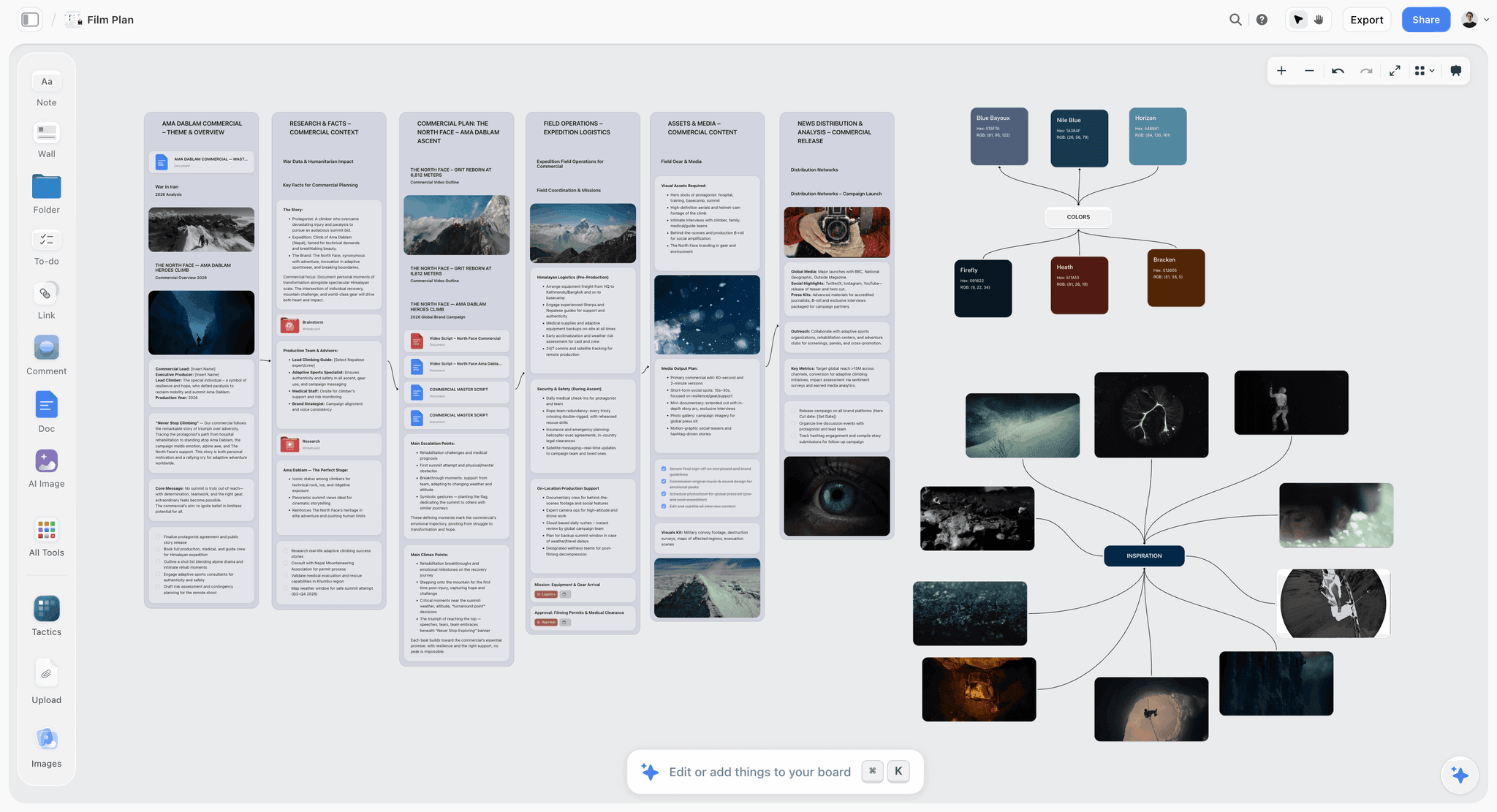
Verdict: the simplest place to storyboard when ChatGPT or Claude does the breakdown, because the assistant builds the board itself and the storyboard sits beside the rest of the shoot.
Best for: producers, creators and agency teams boarding commercials, brand films, social batches and shorts.
Pricing: Plus $7.99 a month billed annually ($9.99 monthly); Pro $14 ($19 monthly) adds AI image generation; Max $39 ($49 monthly) adds a team workspace with roles and permissions. No free plan during early access; a Free plan launches before the end of 2026, and anyone a paid member invites to a board joins free now. See pricing.
Storyflow is a visual project planning workspace: an infinite canvas board that holds notes, tables, documents, images, mood boards, storyboards and slide decks, with an AI agent that reads the board and builds on it. Its MCP connector, launched in October 2026, lets the assistant you already use build on that board. For a storyboard, that means walls built in one call each, empty frames ready to fill, reordering, and reading the result back. The connector runs on your assistant's model, so it does not spend Storyflow AI credits, and paid plans have no connector limit.
Inside Storyflow, the built-in AI has its own storyboard workflow if you would rather skip ChatGPT or Claude. It asks two things at most: how many scenes (unless your script or breakdown settles it) and where the frames come from (web search, AI generated, or empty placeholders). It honours a supplied breakdown as written, at whatever length it runs, and builds one wall per scene or shot, each with a title, its own colour, a frame, a beat note with short labels and a checklist of 3 to 5 steps, connected left to right. It reads attached scripts, including PDFs and Final Draft .fdx files.
- One wall per panel, frame first, in narrative order with arrows
- Characters, locations and products kept consistent by caption name
- Web reference frames captioned "Reference" so they never read as footage
- Shot list, strip board and references on the same board as the storyboard
- View-only link opens with no account; comments after sign-in
Limitations: browser only, with no offline mode; AI image generation is on Pro and Max, not Plus; no animatic or MP4 export; no approval statuses with an approve button; no free plan during early access.
2. Boords
Verdict: the strongest classic storyboard editor here, and the one rival with a real connector for Claude and ChatGPT.
Best for: agencies and studios whose deliverable is the storyboard itself, with an animatic and client approvals.
Pricing: a free plan with 5 active storyboards, 3 active scripts and 8 sample AI image credits; Solo $26 a month billed annually ($39 monthly) with 250 AI images; Pro $50 billed annually ($75 monthly) for up to 5 users and 1,000 AI images, per Boords pricing.
Boords' MCP server at app.boords.com/mcp works with Claude, ChatGPT in developer mode, Claude Code and other clients. It can create storyboards (including from a script), add, update, delete and reorder frames, attach images made in other tools, manage the asset library and read and add comments. Its docs are explicit that Boords' own image generation is not available through the connection: you generate in the app or bring images. In the app, Boords has a custom cast for character consistency, animatics with audio exportable as MP4, passphrase-protected review links with frame comments and approval statuses, and PDF export.
- Real MCP server, on any plan including Free during its beta
- Animatics with timing and audio, MP4 export
- Approval statuses and frame-level comments
Limitations: the storyboard lives apart from your mood boards and planning notes; script-to-storyboard is a snapshot, so later script edits do not flow into the frames; AI images are capped per plan.
3. StoryboardHero
Verdict: a fast brief-to-storyboard tool for agencies, fed by hand from your assistant.
Best for: video agencies that send clients a branded PDF storyboard.
Pricing: Solo $19 a month with unlimited standard AI images and 100 premium; Starter $59 for 5 seats; Advanced $199 for 10 seats; a 7-day free trial with no card, per StoryboardHero pricing. Hand-drawn frames from its artists are bought separately.
StoryboardHero drafts a scene-based script from a short brief (duration, style, video type, a reference video) or takes your script as a CSV in its template, then generates frames. It exports branded PDFs that do not mention AI or StoryboardHero, shares a comment link with clients, and offers in-house sketch artists when AI frames fall short. For this guide's job it ranks third because ChatGPT or Claude cannot write into it: the assistant's breakdown becomes a CSV you upload.
- Brief or CSV script to storyboard
- Branded PDF export
- Optional human sketch artists
Limitations: no assistant connector found; no permanent free plan; its own page says it does not suggest story improvements.
4. Canva
Verdict: the design tool most people already have, with a real Claude connector that does not know what a storyboard is.
Best for: a marketer who will lay out a short storyboard on a Canva template and already pays for Canva.
Pricing: plans and prices are on Canva's own pricing page; check whether your plan includes the connector before you rely on it.
Canva's connector, listed and verified in Claude's connector directory, lets Claude search, create, autofill and export Canva designs and add comment threads. That makes Canva a reasonable place to finish a storyboard someone else broke down: Claude can create the design and fill a template. It does not build panels from a script, track shots or keep a character consistent across frames, so you do that structure yourself.
- Familiar editor and templates
- Verified Claude connector from Canva
- Polished export for a client deck
Limitations: not storyboard-aware; no shot specs per panel; consistency across frames is manual.
5. Katalist
Verdict: a script-to-storyboard-to-video studio with strong character consistency, outside your assistant.
Best for: performance marketing teams that want storyboards and video variants in one tool.
Pricing: Essential $19 a month with 200 image and 700 video credits; Pro $39 a month; Unlimited $99 a month for two users; a 7-day free trial, per Katalist pricing. API access is listed on Enterprise only.
Katalist imports or writes a script, breaks it into shots and generates a storyboard, and a character cast from a reference keeps the same look across the storyboard and the video. It is a good answer to the consistency problem. It ranks fifth here only because the assistant you plan in cannot reach it, and because the storyboard stays inside a video studio rather than beside your planning.
- Script to shots to storyboard
- Characters cast from a reference
- Storyboard to video in the same tool
Limitations: no ChatGPT or Claude connector found; no permanent free plan.
6. LTX Studio
Verdict: the furthest-reaching tool here, built for moving previz more than for a simple board.
Best for: directors who want to see the sequence move before the shoot.
Pricing: a free plan with 800 one-time credits; Lite $12 a month billed annually ($15 monthly), personal use only; Standard $28 billed annually ($35 monthly) with 28,000 credits; Pro $100 billed annually ($125 monthly), per LTX Studio pricing.
LTX Studio lists AI storyboards, pitch decks and saved "Elements" for consistent characters, with several image and video models on its plans. It goes well past a storyboard into generated video. That reach is also why it ranks last for this job: it has the most concepts to learn, it is credit-metered, and nothing in it is reachable from ChatGPT or Claude.
- Storyboards that become moving previz
- Consistent Elements
- Multiple image and video models
Limitations: no assistant connector found; Lite cannot be used for paid work; the steepest learning curve here.
Prompts You Can Copy for Each Stage
These prompts assume Storyflow is connected. If you are pasting into another tool, drop the parts about the board and ask for a table you can copy.
Breakdown prompts
| Stage | Prompt |
|---|---|
Beat breakdown | Read the script below. List every beat as a numbered row: timecode range, location, who is in it, and one line on what the audience must understand. Do not suggest shots yet. Check that the timecodes add up to the runtime. |
Deliverables check | Here are the deliverables. For each one, list which beats feed it and the frame shape it needs (16:9, 9:16, 4:5). Flag any deliverable no beat covers. |
Panels | Turn each beat into panels, one per moment the audience must see, numbered in order. For each: shot size, angle, movement, action, dialogue or voiceover, and duration in seconds. Under any beat with more than two panels, say why in one line. |
Gap check | Compare the panels with the script. List any line of action no panel covers, and any panel that needs a location, prop or person the script does not have. |
Board prompts
| Stage | Prompt |
|---|---|
Build the storyboard | In my Storyflow project for this spot, build the storyboard as one wall per panel, left to right, in panel order. Each wall: the panel number and a short name as its title, an empty frame first, then one note with the action, shot size, angle, movement and duration. Put the spot's title above the row. |
Pin characters | Put one empty frame on the board for each recurring character, location and product, captioned with its name exactly as the script uses it. |
Upload my frames | Give me an upload link for the empty frames in panels 3, 6 and 8, so I can add my own sketches. |
Reorder | Read the storyboard and move panel 6 before panel 5. Tell me the new durations total. |
Frame prompts for Storyflow's built-in AI
| Stage | Prompt |
|---|---|
Character sheet | Generate a portrait of Ana: courier in her late twenties, short dark hair, yellow rain jacket, black messenger bag, standing in rain at night. Caption it Ana. |
Panel frames | Fill the empty frame in every panel wall in order. Style for every frame: cinematic still, wet city at night, warm tungsten shop light against cold blue street, 35mm grain, 3:2 landscape. Name the characters in each prompt so their pictures are used. |
Redo one frame | Redo the frame in panel 5 in place: tighter on the hands and the chain, Teo's hands only, same light. |
Fresh take | Draw panel 2 with a different courier, not Ana from the board, for a casting option. |
Worked Example: A 30-Second Bike Shop Spot in 8 Panels
Here is an illustrative run, set out the way you would run it. The client, Spoke & Chain, is a made-up neighbourhood bike repair shop, and the counts below are what this example would use, not a measured job. The deliverable is one 30-second spot in 16:9 for local pre-roll and social, plus a 9:16 cutdown. The idea: a courier's chain snaps in the rain, the shop fixes it in minutes, she rides on.
The brief and the breakdown
You paste the one-page brief, the 30-second script, the line "same-day repairs while you wait" that the client wants on the end card, and the style sentence the client approved from the mood board. Claude returns six beats. One is wrong: it gives the end card its own beat and a separate "logo reveal" beat, which is one 3-second graphic. You merge them, and the spot has five beats.
The eight panels
| Panel | Time | Shot | Action | Frame source |
|---|---|---|---|---|
1 | 0:00 to 0:03 | Wide, low angle, static | Rain on a city street at night; Ana rides through, chain snaps | Generated |
2 | 0:03 to 0:06 | Close-up | The snapped chain hanging; Ana's face, frustrated | Generated |
3 | 0:06 to 0:10 | Medium, tracking | Ana pushes the bike past the lit shop window, Spoke & Chain sign | Generated |
4 | 0:10 to 0:14 | Medium, static | Teo, the mechanic, waves her in; warm workshop light | Generated |
5 | 0:14 to 0:19 | Extreme close-up insert | Teo's hands fit the new chain | Generated |
6 | 0:19 to 0:23 | Insert | Ana's phone timer: 12 minutes | Generated |
7 | 0:23 to 0:27 | Wide, tracking | Ana rides away, the rain easing | Generated |
8 | 0:27 to 0:30 | Graphic | End card: logo and "same-day repairs while you wait" | Placeholder for the designer |
The durations add to 30 seconds: 3 + 3 + 4 + 4 + 5 + 4 + 4 + 3. Eight panels in 30 seconds is one every 3.75 seconds, inside the 2 to 4 second guide for ads.
Building it on the board
One prompt to Claude builds the row: eight walls, each with an empty frame, a note with the shot and the action, and the duration. Then three character frames go on the board, captioned Ana, Teo and Spoke & Chain shopfront. That is the whole structure, and it has cost no image generation yet.
The frames and what they cost
Inside Storyflow on Pro, you generate the three character pictures first, then the seven panel frames, each prompt naming who is in it. Panel 3 names Ana and Spoke & Chain, so both pictures go in as references; panel 5 names Teo. That is 10 generations. Two frames need a redo (panel 2 framed the face too wide; panel 6 drew a watch instead of a phone), so the board costs 12 generations in total, each taking several seconds. The end card stays an empty frame for the designer, who drops in the real logo through an upload link.
| Item | Count |
|---|---|
Character and location references | 3 |
Panel frames | 7 |
Redos | 2 |
Total generations | 12 |
Empty frames left for the designer | 1 |
What needed a human
Three things. The merged end card, already mentioned. Panel 6, where the assistant first wrote "a watch shows 12 minutes" although the script says phone; caught in the gap check. And the 9:16 cutdown: a vertical crop of panel 1's low wide loses the snapping chain at the bottom of frame, so you add a ninth wall, 1V, a vertical-only medium of the chain snapping. All three were caught because the storyboard was on a board you could read against the script, with the frames in place.
What the client saw
The client opened the view-only link on a phone with no account, signed in to leave two comments ("can Teo be older?" and "the sign should read Spoke & Chain, not Spoke and Chain"), and you fixed both: one by regenerating Teo's reference picture and redoing panels 4 and 5, one by correcting the caption and the prompt. The same board then became the shot list.
The Consistency Problem, and Four Ways to Solve It
Character drift is the reason most AI storyboards look like a mood board rather than a sequence. Here is what works, from most to least reliable.
Pin a reference and reuse it automatically
The most reliable method is a single reference picture per character, passed into every frame that character appears in. Storyflow does this by caption name; Boords does it with a custom cast; Katalist casts characters from a reference; LTX Studio saves Elements. The method is the same: one source of truth for a face.
Repeat the same style descriptors in every prompt
Lighting, palette, lens feel and grain have to be written into every frame prompt, word for word. Storyflow's storyboard workflow repeats the style descriptors in each frame's prompt for this reason. If you generate in ChatGPT, paste the same style sentence at the start of every image request.
Keep the frame shape fixed
Mixing square and landscape frames makes a board look inconsistent even when the characters match. Pick one shape for the storyboard (3:2 landscape for 16:9 deliverables, portrait for vertical) and say it in every prompt.
Use empty frames where AI is the wrong tool
A real product shot, a client's actual shopfront or a celebrity cameo should not be generated. Leave an empty frame and fill it with the real photo. Our guide to storyboarding when you cannot draw covers sketches, photos and stand-ins.
What It Costs: Solo Creator vs a Small Agency Team
Solo creator or producer
| Setup | Monthly cost (as of October 2026) | What you get |
|---|---|---|
Claude Free plus Storyflow Plus | $7.99 (annual billing) | Assistant builds the storyboard on your board; web reference frames, empty frames and your own uploads |
Claude Free plus Storyflow Pro | $14 (annual billing) | Adds AI-generated frames with name-based character references |
Claude Pro plus Storyflow Pro | $31 ($17 Claude Pro annual plus $14) | More Claude usage for long scripts |
ChatGPT Plus plus Storyflow Plus | $27.99 ($20 plus $7.99) | Generate frames in ChatGPT, upload them to the board |
Claude Free plus Boords Free | $0 | Boords MCP server, 5 active storyboards, 8 sample AI images |
Boords Solo | $26 (annual billing) | 250 AI images a month, animatics |
StoryboardHero Solo | $19 | Unlimited standard images, branded PDF |
Katalist Essential | $19 | 200 images and 700 video credits |
Claude prices from Claude's pricing page; ChatGPT Plus at $20 a month from OpenAI's help center.
A small agency team of four
On Storyflow, one paid member invites the other three to the board; invited collaborators join free and edit in real time, so the cost stays at one subscription. Max at $39 a month billed annually adds a team workspace with roles and permissions, which matters when one producer runs several clients. Boords Pro covers up to five users for $50 a month billed annually. StoryboardHero Starter is $59 a month for five seats. Each Boords teammate connects their own account to the MCP server; there is no shared team connection, per its docs.
The real cost of a storyboard is not the subscription. It is the round of client notes spent on the wrong version.
Decision Rules: Which Tool for Which Storyboard
A commercial, brand film or social batch heading for a shoot
Storyflow with ChatGPT or Claude doing the breakdown. The storyboard is a step toward the shoot, so it belongs on the board with the references and the shot list, and the assistant can keep editing it.
The storyboard is the deliverable, with an animatic
Boords. Animatics with audio, MP4 export and approval statuses are what it is built for, and its MCP server means your assistant can still do the first draft. Our Storyflow vs Boords comparison goes deeper.
A branded PDF for a client by tomorrow
StoryboardHero. Brief in, PDF out, with hand-drawn frames available when the AI frames will not do.
Moving previz before the shoot
Katalist for performance ads, LTX Studio for directors who want to see the sequence move. Read our guide to storyboards vs animatics before you pay for video credits you may not need.
A one-off storyboard for a deck you already make in Canva
Canva, with Claude creating the design through its connector, and the panel structure written by you or the assistant in the chat.
Common Mistakes When You Storyboard With an Assistant
Mistake 1: One prompt for everything
"Storyboard this script" asks the model to read, break down, frame and draw in one pass. Beats first, panels second, frames third. Each pass is checked before the next.
Mistake 2: Generating frames before the structure is agreed
Frames cost AI allowance and time. Agree the panel list with the director or client while every frame is still empty; changing a note is free.
Mistake 3: Letting each frame invent the character
Without a pinned reference, every frame draws a new person. Put the character pictures on the board first and name them in every prompt.
Mistake 4: Panels that do not add up to the runtime
A 30-second spot with 45 seconds of panels is a spot that gets cut in the edit. Ask the assistant to total the durations on every pass.
Mistake 5: Forgetting the vertical cutdown
A 9:16 crop of a 16:9 wide keeps less than a third of its width. Run the deliverables check before the panels, and add vertical-only panels where the crop fails.
Mistake 6: Keeping the storyboard in the chat
The chat is where the storyboard is written, not where it lives. Once it is right, put it where the client can open it and the assistant can read it back.
When Storyflow Is Not the Right Choice
Storyflow earns first place for this job, and it is still the wrong tool for some storyboards.
You need an animatic or MP4 export
Storyflow has presentation mode for walking a client through the board, but no timed animatic with audio and no MP4 export. Use Boords.
You need tracked approvals
Storyflow has comments, not approval statuses with an approve button. If your agency signs off frame by frame, Boords tracks that.
You need a free tool today
Storyflow has no free plan during early access; its Free plan launches before the end of 2026. If your budget is zero, Boords' free plan with its MCP server and Claude's Free plan is the honest start.
You need AI frames on the entry plan
AI image generation in Storyflow is on Pro ($14 a month billed annually) and Max. On Plus you get web reference frames, empty frames and your own uploads, which is plenty for many boards but not for a fully illustrated one.
You work offline or on a desktop app
Storyflow runs in a browser only, with no offline mode and no desktop or phone app. Paper thumbnails, photographed later, will serve you better on a plane or a location with no signal.
Storyboard Template You Can Paste Into Your Assistant
Use this as the column spec in your panel prompt, or ask the assistant to build it as walls on your board.
The standard panel fields
| Field | What goes in it | Example |
|---|---|---|
Panel | Number in narrative order | 5 |
Time | Timecode range or duration | 0:14 to 0:19 |
Shot | Size and angle | Extreme close-up insert |
Movement | Static, pan, tilt, push in, tracking, handheld | Static |
Action | Who or what is in frame and what happens | Teo's hands fit the new chain |
Audio | Dialogue, voiceover or sound | Ratchet click, rain outside |
Frame | Generated, reference, upload or empty | Generated, names Teo |
Swaps by format
| Format | Add | Drop |
|---|---|---|
Social vertical | Orientation, on-screen text | Movement |
Explainer | Voiceover line, graphic callout | Angle |
Music video | Lyric line, frame rate | Audio |
Short film scene | Characters, transition | On-screen text |
Product film | Product, key feature shown | Characters |
If you would rather start from a ready board, the storyboard template and the AI storyboard generator start from the same structure, and script to storyboard walks through the built-in route.
The Bottom Line
ChatGPT and Claude are good at the thinking half of a storyboard: breaking a script into beats, beats into panels, and arguing for each shot. They are bad at the half where the storyboard has to look like one sequence and live somewhere a client can open. Connect Storyflow, run the three passes, let the assistant build the walls, pin your characters by name, and fill the frames on the board. If the storyboard itself is the deliverable and needs an animatic, Boords is the better home for it, and its connector means your assistant still does the first draft. For most commercials, brand films and social shoots, one board and one assistant is the whole stack. Start on the Storyflow MCP page.
FAQ: Storyboarding With ChatGPT or Claude
What is a simple AI tool for storyboarding?
Storyflow, used with ChatGPT or Claude, is the simple AI storyboarding tool we recommend in 2026. You connect it once, paste a script, and the assistant builds one wall per panel on a board, each with a frame and the shot specs; Storyflow's AI fills the frames on Pro. Boords is the alternative when you need an animatic and tracked approvals.
Can ChatGPT make a storyboard?
Yes, ChatGPT can write a solid panel breakdown and can generate frame images. What it cannot do alone is keep the frames consistent across a sequence or keep the storyboard somewhere a client can open. Connect Storyflow (ChatGPT Plus or above, with developer mode on) so ChatGPT builds the storyboard on a board and reads it back, and generate or upload the frames there.
Can Claude make a storyboard?
Claude can write the breakdown and the panel list well, but it does not generate photos or illustrations, according to Anthropic's help article on images. Connect Storyflow on any Claude plan, including Free with one custom connector, and Claude builds the storyboard on the board while Storyflow's AI or your own uploads supply the frames.
Is ChatGPT or Claude better for storyboarding?
For the breakdown, the difference between them is smaller than the difference between one prompt and three passes. ChatGPT can also generate frames in the chat; Claude cannot. For the connector, Claude's Free plan can add one custom connector, while ChatGPT needs Plus or above with developer mode. Pick the one you already pay for.
How do I keep characters consistent in an AI storyboard?
Use one reference picture per character and pass it into every frame that character appears in. In Storyflow, caption the picture with the character's name; every frame prompt that names them uses it automatically, up to three named references per frame. Repeat the same style sentence in every prompt and keep one frame shape for the whole board.
Can the Storyflow connector generate images?
No. Through the connector, ChatGPT or Claude builds the storyboard's walls, notes and empty frames, puts pictures on the board from web addresses, and gives you an upload link for your own. Image generation runs in Storyflow's built-in AI on Pro and Max. Boords works the same way: its MCP docs say its image generation is not available through the connection.
How many panels does a 30-second storyboard need?
Usually 8 to 12. A useful guide for ads is one panel every 2 to 4 seconds, plus a panel for any insert the edit cannot work without. The worked example above uses 8 panels for 30 seconds, about one every 3.75 seconds, and adds one vertical-only panel for the 9:16 cutdown.
Can I use my own sketches in an AI storyboard?
Yes, and for many boards you should. In Storyflow, ask the assistant for an upload link: it is good for 15 minutes, you pick photos of your sketches on your phone, and each lands in the empty frame it was meant for. Sketches are fast, they cost no AI allowance, and they never drift.
Does Storyflow read my script file?
Yes. Storyflow's built-in AI reads attachments including PDFs and Final Draft .fdx scripts, and builds one wall per scene in the order the script prints them. Through the connector, paste the script into ChatGPT or Claude, which does the breakdown and builds the board. Either way, a breakdown you supply is honoured as written.
How much does it cost to storyboard with Claude and Storyflow?
From $7.99 a month. Claude's Free plan can add Storyflow as its one custom connector, and Storyflow Plus is $7.99 a month billed annually, which covers web reference frames, empty frames and your own uploads. For AI-generated frames, Storyflow Pro is $14 a month billed annually. The connector does not spend Storyflow AI credits; generated frames use your plan's AI allowance.
Is Storyflow free for storyboarding?
Not during early access. Storyflow plans start at Plus, $7.99 a month billed annually or $9.99 monthly, and a Free plan launches before the end of 2026. Anyone a paid member invites to a board joins free and can edit, so a small team can work on one storyboard under a single subscription. A free account gets 25 connector actions a week.
Can a client view the storyboard without an account?
On Storyflow, yes: the client opens the view-only link with no account, and signs in to comment. Boords shares passphrase-protected links with frame comments and approval statuses. StoryboardHero shares a comment link and exports a branded PDF. Whatever you use, send one link to one live storyboard rather than a PDF that goes stale after the first note.
Do I need a storyboard if I have a shot list?
Not always. Interviews, events and most documentary work run on a shot list alone. Anything with a designed look (a commercial, a music video, a product film) benefits from a storyboard, because the client approves pictures more reliably than words. Keeping both on one board means each frame sits beside its setup when you build the shot list.
What is the difference between Storyflow and Boords for AI storyboarding?
Both have an MCP server your assistant can build into, and neither generates frames through it. Boords is a dedicated storyboard editor with animatics, MP4 export and approval statuses. Storyflow is a visual planning board where the storyboard sits beside the mood board, shot list and schedule, with characters kept consistent by caption name. Choose by whether the storyboard is the deliverable or a step toward the shoot.
Can ChatGPT images go onto a Storyflow board?
Yes, by upload. A picture made or attached in a ChatGPT chat does not reach Storyflow by itself, so download it, ask the assistant for an upload link, and pick the image; it lands in the frame you choose. If you want the frames generated with consistent characters automatically, generate them in Storyflow on Pro instead.
Table of Contents
- Key Takeaways
- Why a Storyboard Made Only in a Chat Window Breaks Down
- How We Chose the Tools and Weighted the Criteria
- Comparison Table: Simple AI Storyboard Tools That Work With ChatGPT or Claude
- How to Storyboard With ChatGPT or Claude, Step by Step
- The Six Tools Ranked for Storyboarding With ChatGPT or Claude
- 1. Storyflow
- 2. Boords
- 3. StoryboardHero
- 4. Canva
- 5. Katalist
- 6. LTX Studio
- Prompts You Can Copy for Each Stage
- Worked Example: A 30-Second Bike Shop Spot in 8 Panels
- The Consistency Problem, and Four Ways to Solve It
- What It Costs: Solo Creator vs a Small Agency Team
- Decision Rules: Which Tool for Which Storyboard
- Common Mistakes When You Storyboard With an Assistant
- When Storyflow Is Not the Right Choice
- Storyboard Template You Can Paste Into Your Assistant
- The Bottom Line
- FAQ: Storyboarding With ChatGPT or Claude
- Related Reading
Templates to check out for this topic


Filmmaking templates you can use in Storyflow
Skip the blank canvas. Open one of these filmmaking boards in Storyflow and the AI builds on the structure that is already there, from research through the shot list.


See Storyflow in Action
A visual AI workspace where every feature lives inside one canvas. No tab-switching, no context lost.
Build your entire board from a single message
Type what you need in the AI chat at the bottom of your canvas. The AI adds cards, headings, and structure directly onto your board.
Use expert frameworks as AI context
Type @ in the AI chat and choose any Tactic. The AI tailors every response to that framework instead of giving generic advice.
Turn your board into a mind map in seconds
Ask the AI to restructure your canvas as a mindmap. It connects your ideas into a visual hierarchy so you can see how everything relates.
Why Storyflow Exists
Storyflow actually began as a personal tool while working on creative and research projects.
We kept running into the same problem: ideas were scattered everywhere: notes, documents, and whiteboards.
Nothing helped us see how everything connected.
So we started building a workspace designed around how ideas actually grow.
→ Read how Storyflow was createdStoryflow Team
Product & Research Team
Published: 2026-10-09
Extremely simple, seriously capable


See how easy it is to get started
Watch a real project come together, from a blank board to a finished plan, clicked through step by step.
Start creating with AI and become more productive
Transform your creative workflow with AI-powered tools. Generate ideas, create content, and boost your productivity in minutes instead of hours.