
Ultra-fast storyboards: minutes, not days
Find out it is
eighty seconds now.
Frames in sequence with a duration on each, the voiceover beside them, and a running total. The timing problem every edit has is cheapest to solve here.


Creatives working for these brands already got early access
- Red Bull
- Canon
- Artlist
- Porsche
See how easy it is to get started
Watch a real project come together, from a blank board to a finished plan, clicked through step by step.
Start from a ready-made template
Pick a board to see what you can build, then let AI fill it in. Every template is a real, editable starting point on the same infinite canvas.

Storyboard
Lay out your shots frame by frame with images and notes, then reorder them until the sequence reads like the finished cut.
What is an animatic?
An animatic is a storyboard put in time. Storyflow is an AI visual workspace that times your cut on one infinite canvas: frames in sequence, a duration on each, the voiceover script, and a running total. The frames are cut together in sequence, each held for the length that shot will actually run, usually with a scratch voiceover, temporary music, and rough sound. It sits between the storyboard, which shows what the shots are, and the finished piece, which shows what they look like. What it adds is the dimension neither of the others gives you until it is expensive: duration. In advertising it is standard practice before a shoot, in animation it is the backbone of the entire production, and in both cases it exists because timing is the thing you cannot judge from a page of drawings.
The failure it prevents is specific and extremely common. A storyboard everyone approved contains eighty seconds of material for a sixty second slot. Nobody notices, because a board shows shots and not seconds, and the difference only appears in the edit, where the choices are cutting a scene you have already paid to shoot or compressing everything until it feels rushed. In animation the same arithmetic is worse, because the cost of an unnecessary shot is not a wasted setup, it is weeks of work. The animatic is where a shot gets cut for free.
The second thing it settles is the relationship between the words and the pictures. A voiceover script and a storyboard read separately both seem fine and frequently do not fit each other: the line about the product lands two shots after the product appears, or a key phrase falls in a shot with no room for it. Laying the script against the frames with real durations is how you find out, and it is the reason an animatic is worth doing even for a piece with no complicated visuals.
Storyflow is an AI-native infinite canvas, and it holds the plan rather than rendering the video. Describe the spot and the AI lays out the frames in sequence with a suggested duration on each and the script mapped against them. Then you do the work: adjust durations, watch the running total, move the beat that arrives too late, and pin the reference for each frame beside it. When the timing works, the board is what your editor or animation team builds the actual animatic from.
Ultra fast from brief to board
From a board to a sequence that fits the slot.
No timeline software. Frames, durations, a script, and a running total.
01
Open a canvas
Sign up in seconds. No download. Your infinite storyboard canvas opens in the browser.
02
Describe the spot
Type what it is, how long it has to be, and what happens. The AI lays out frames in sequence with suggested durations and the script mapped against them.
03
Time it honestly
Set a real duration on each frame and read the running total. A sixty second spot with eighty seconds of material is a discovery you want now and not in the edit.
04
Hand it over
Share a view-only link with the client, the editor, or the animation team, or export the sequence as an image or PDF for the brief.
Frames, durations, script, and the running total.
Everything the timing conversation needs, before anything is shot.
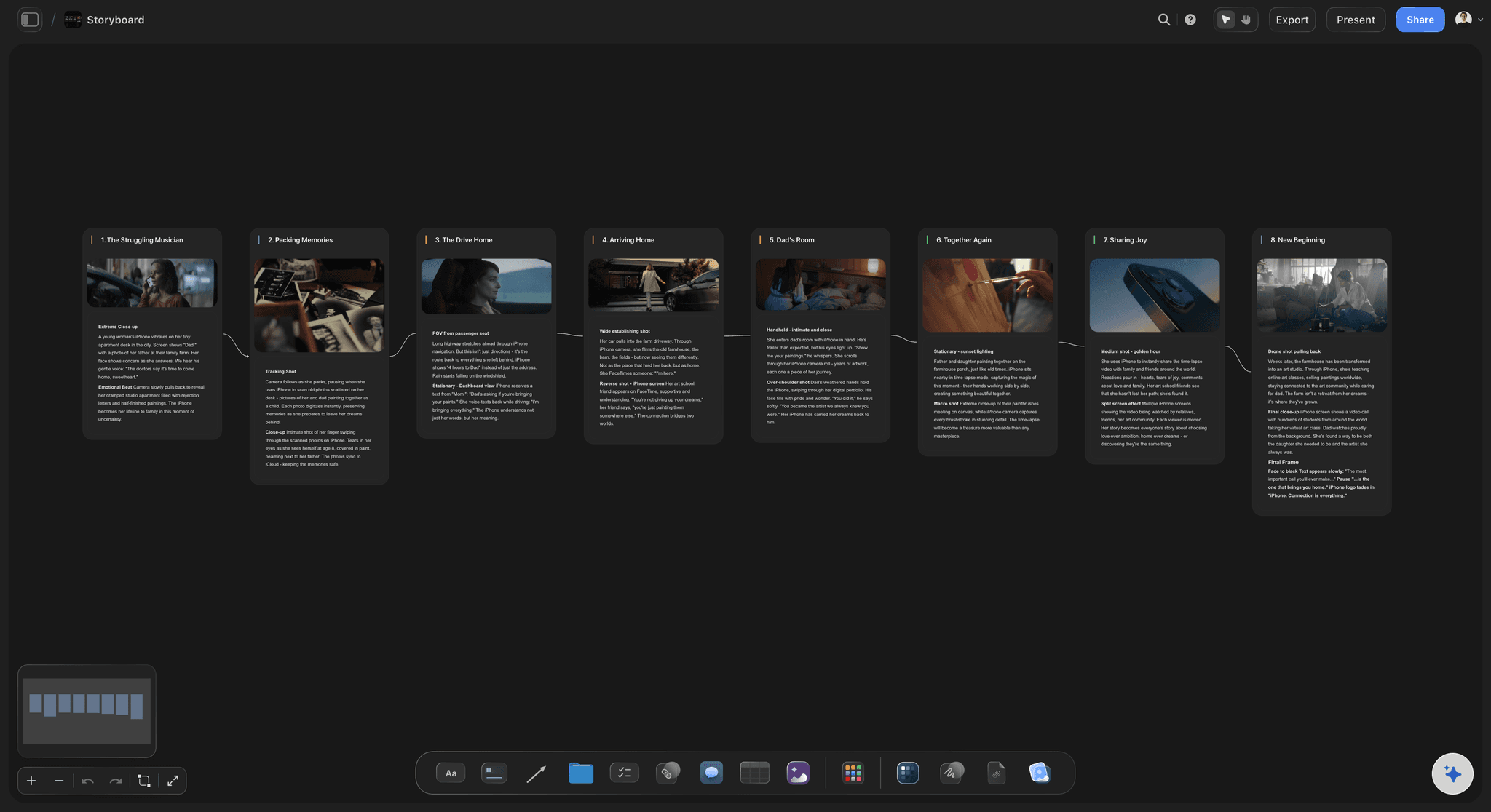
AI lays out frames and suggests durations
Start from a timed sequence
Describe the spot and the AI produces frames in order with a suggested length on each. Arguing with proposed timings is far more productive than assigning them to a blank board.
See the AI storyboard generator →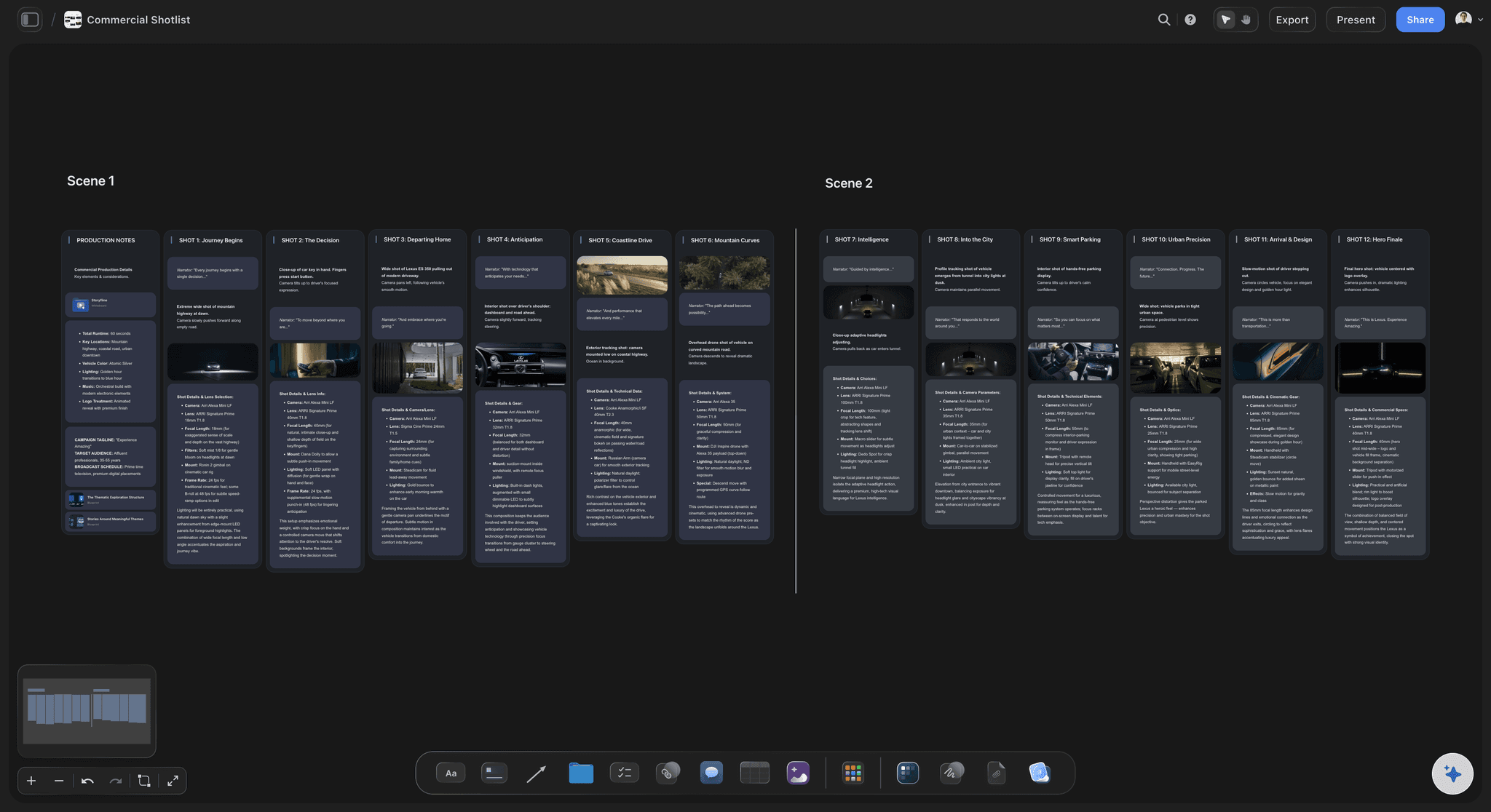
A running total that contradicts the board
Catch the over-length while it is free
Every storyboard everyone approves is longer than the slot. Seeing the total against the target is the entire reason animatics exist, and it costs an afternoon rather than a reshoot.
Explore the commercial storyboard board →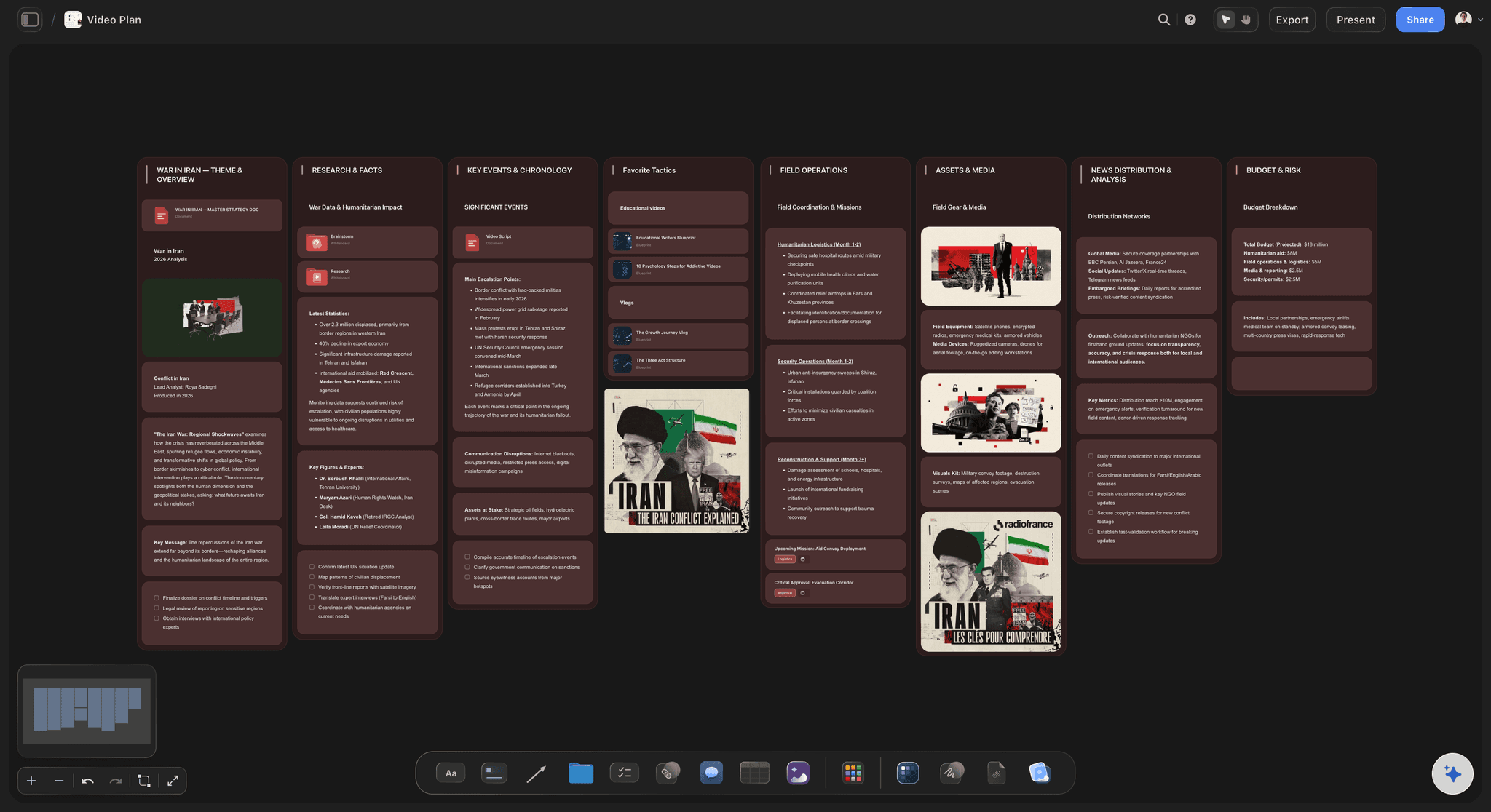
The voiceover mapped against the frames
Make the words land on the right picture
Put the script beside the sequence so each line sits against the frame it plays over. The product line arriving two shots after the product is the second most common timing fault.
See the video script planner →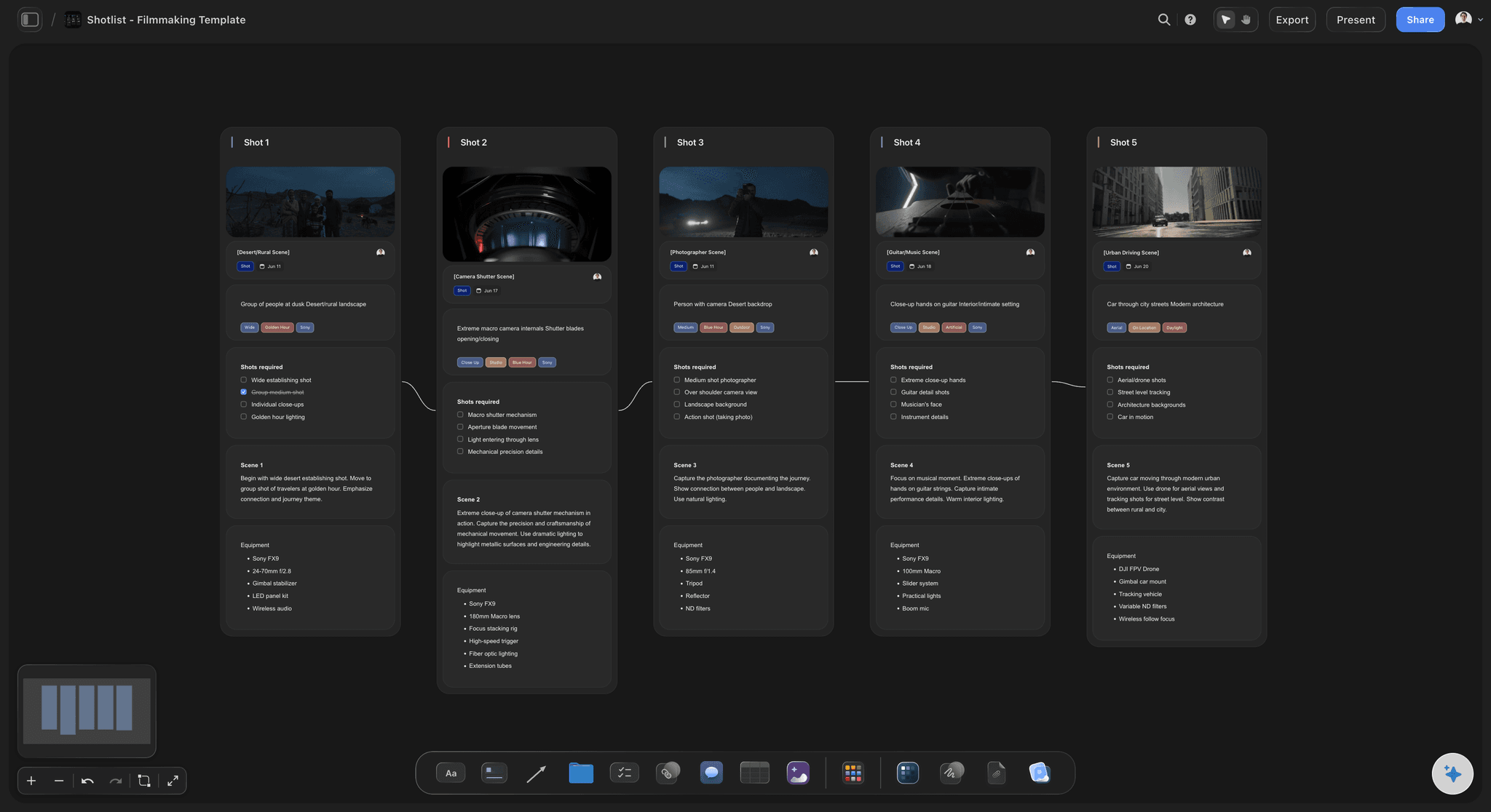
Reference and the shot list on the same canvas
Carry it straight into the shoot
The frames become the shot list, the durations inform the schedule, and the reference sits beside the frame it belongs to. Nothing is retyped into another tool.
Try the shot list generator →Unlimited boards. No object cap.
Open a canvas, describe the spot, and let AI lay out the frames. Storyflow is paid-only during early access, with plans from $7.99 a month billed annually, and a Free plan launches before the end of 2026.
Unlimited storyboards on an infinite canvas
Basic AI usage to generate frames and suggested timings
Starter templates for storyboards, shot lists, and commercials
Share view-only links with clients and editors, no account required
Built for people with taste
A storyboard shows shots. Only an animatic shows seconds.
Every approved board is longer than the slot, and the gap is discovered at the most expensive possible moment.
Duration per frame and the total
The arithmetic nobody does at board stage
A real number on every frame: Not a guess made while looking at the whole board. Read each frame and ask how long that shot actually needs to be legible, and be honest about the establishing shot everyone underestimates.
The running total against the target: Sixty seconds is sixty seconds. A board carrying eighty is not slightly long, it is a third over, and no amount of tightening in the edit recovers that without something being cut.
The shots that are quietly expensive: A three second shot requiring a crane or a location move costs the same to shoot as a thirty second one. Seeing duration next to complexity is where the cut usually becomes obvious.
Room for the end frame: The logo, the call to action, and the legal text need real seconds and are routinely assigned whatever is left over, which is how a spot ends up with a two second end card nobody can read.
Words, music, and picture in the same view
Fit the script to the sequence
Lines against the frames they play over: Read the script aloud at the pace it will actually be read and mark where each line lands. Copy that fits the page and not the picture is the most common rewrite an animatic triggers.
The beat the music has to hit: If the piece is cut to a track, mark where the change happens and check that the frame arriving there is worth arriving on.
Silence as a decision: The shots with no voiceover are choices rather than gaps. Marking them stops a nervous client filling every second with words in the next round.
AI that reads the whole board as context
Ask where the sequence is over-length
Generate frames and first-pass timings: Describe the spot and its length and the AI lays out a sequence with suggested durations, which is a much better starting point than an untimed board.
Find the timing problem: Ask which frames are over, where the script and the picture disagree, or what could be cut without losing the argument. The AI reads your whole board.
It proposes, you decide: Storyflow structures and suggests. What a shot needs in order to land is a judgment about the work, and a model asked to shorten something will always find something to cut.
Re-time without rebuilding: When the slot changes from sixty to thirty, ask what a thirty second version would drop. Frames you have placed and reference you have pinned stay where they are.
Client, editor, and animation team
Approve the timing, not just the pictures
View-only links for the client: Send a link and a client sees the sequence with the durations on it. Approving a board without timing is approving something nobody has checked will fit.
A brief the editor can cut from: The person assembling the actual animatic in an edit suite gets the frames, the order, the durations, and the script in one place rather than in three files.
Export for the meeting: Export the sequence as a high-quality image or PDF for a client presentation or an approval record.
Explore templates for your project
Every template opens as a real, editable board on the infinite canvas. Pick the closest fit and make it your own.
Storyboard
Lay out your shots frame by frame with images and notes, then reorder them until the sequence reads like the finished cut.
One app instead of five
Storyflow vs Boords, Premiere Pro, and a paper board.
These do different jobs: Boords is a dedicated storyboard tool with animatic playback, Premiere is where a real animatic gets assembled and rendered, and paper is still the fastest way to draw one. Here is the honest split.
Storyflow
Recommended
Frames in sequence with durations and a running total
AI generates frames and first-pass timings
Script, reference, and shot list on the same canvas
View-only links with no account required
Plays the animatic back as video
Audio mixing and rendered export
Boords
Frames in sequence with durations and a running total
AI generates frames and first-pass timings
Script, reference, and shot list on the same canvas
View-only links with no account required
Plays the animatic back as video
Audio mixing and rendered export
Premiere Pro
Frames in sequence with durations and a running total
AI generates frames and first-pass timings
Script, reference, and shot list on the same canvas
View-only links with no account required
Plays the animatic back as video
Audio mixing and rendered export
A paper board
Frames in sequence with durations and a running total
AI generates frames and first-pass timings
Script, reference, and shot list on the same canvas
View-only links with no account required
Plays the animatic back as video
Audio mixing and rendered export
What creators are saying
Join early creators getting structured workspaces and AI that remembers their projects
“Storyflow has sped up my workflow by at least 3x, which means more flow state and more projects I can actually ship. It truly changed the way me and my team create.”

Reilin Joey
Director & YouTuber
“One prompt gets me a structured board. But the tactics are my favorite. I run my YouTube scripts through them and my intros and retention got better. It's amazing.”

Justkay
YouTuber & Freelance Filmmaker
“I used to juggle five apps to plan a project. Now I describe what I am making and get boards, lists, and a schedule. All in one place.”

George
@fernwehchronicles
Animatic questions, answered.
What one is, when to make it, and what it is meant to catch.
An animatic is a storyboard cut together in time. The frames run in sequence, each held for as long as that shot will actually last, usually over a scratch voiceover with temporary music and rough sound. It sits between the storyboard, which shows what the shots are, and the finished piece, which shows how they look, and what it contributes is duration, which neither of the others reveals until it is expensive to change. In advertising it is standard before a shoot. In animation it is the production backbone, because every second that survives it gets animated. Even the simplest version, meaning drawings held for a stated number of seconds with a voiceover read at real pace, catches problems a board cannot show.
Storyflow handles the timing of an animatic on one board: storyboard frames in sequence with a duration on each, the voiceover script beside them, and a running total that shows whether the cut fits before anything is shot. Its AI generates frames and first-pass timings, and the script, references and shot list sit on the same canvas. Boords and Premiere Pro still play the animatic back as video, which Storyflow does not.
A storyboard is spatial and an animatic is temporal. The board answers what the shots are, how each is framed, and what happens in what order; it is a page, and you can read it in any direction and take as long as you like on each frame. The animatic answers how long each shot lasts and therefore how the piece feels, which is a completely different question and the one a viewer actually experiences. The practical consequence is that a storyboard can be approved by everyone and still be a third over length, because nobody looking at a page of drawings is counting seconds. That is the single most common reason animatics exist.
Start from the board and add three things. First, a duration per frame, decided by reading the frame and asking honestly how long that shot needs to be legible rather than by dividing the total by the number of shots. Second, the voiceover read at real pace, not skimmed, because a script that looks right on a page is routinely fifteen percent longer spoken. Third, the running total against the target length, which is the number that does the work. If the total is over, cut whole shots rather than shaving frames, since a spot with everything slightly compressed feels rushed while a spot with one fewer idea feels deliberate. Then hand the sequence to whoever assembles the actual video.
No, and it is worth stating plainly. Storyflow is the planning surface: frames in sequence, durations, running total, script mapped against the picture, and reference beside each frame. It does not play the sequence back as video, mix audio, or export a rendered file. Boords does animatic playback and does it well, and a real animatic with a mixed scratch track is normally assembled in an edit application. What Storyflow gives you is the part before that, which is where the timing decisions actually get made, and it keeps that work on the same canvas as the moodboard, the shot list, and the schedule rather than in a dedicated tool that covers one step.
Not during early access. Storyflow is paid-only right now, with plans from $7.99 a month billed annually, and a Free plan launches before the end of 2026. Anyone a paid member invites to a board joins free today, so a client or an editor can view and comment without paying. If you need a free option this minute, any video editor with a free tier will let you assemble stills with durations, which is a genuine animatic, and Boords has a free tier for smaller projects. For the planning half, a numbered list of shots with a seconds column in a spreadsheet does the arithmetic perfectly well, and it is worth doing even if you do nothing else.
After the board is agreed and before anything is booked, which in practice means before the shoot in live action and before any animation begins. The reason is purely economic: at animatic stage a shot costs nothing to cut, at shoot stage it costs a setup, and in animation it costs weeks. Making it earlier than board approval is usually wasted, because the shots are still moving. Making it later than a booking is common and mostly useless, since discovering an over-length once a crew is confirmed converts a creative decision into a budget conversation. For animation specifically, treat it as the actual gate: nothing goes into production until the animatic locks.
As long as it takes to read, and that varies far more than people expect. A close-up of a face reacting can play in under a second because the viewer already has the context. A wide establishing shot of an unfamiliar location needs three or four seconds before anyone has taken it in, and it is the shot most consistently under-timed on paper. Text on screen needs enough time to be read at a slow reading pace, not yours. The practical method is to read the frame aloud describing what a viewer has to understand from it and time yourself, which is crude and much closer than guessing. Then check the total, because the fix for over-length is cutting shots, not shortening all of them.
Yes, and it is worth doing at the same time rather than later. A sixty second hero cut, a thirty, a fifteen for social, and a six second bumper are not trims of each other; each is a different argument that happens to share footage, and treating the short ones as trims is why they usually feel like something is missing. On a canvas, lay each version as its own row of frames and mark which shots they share, which immediately shows you the shots every version needs, meaning those are the ones that must be perfect on the day. It also tells the shoot something useful, because a shot required only by the six second version still has to be captured.
Yes, and getting timing approved rather than just pictures is the point. Send a view-only link and a client opens the sequence with the durations visible in a browser with no account, which turns a vague approval of a board into a specific agreement about what fits. Comments attach to the frame they concern, so a note about the end card sits on the end card rather than in a list of eight points. This matters most in the conversation about cutting, because a client looking at a running total that exceeds the slot is having a different conversation from one being told that something has to go.
Directly, if the planning stays on one canvas. The frames become the shot list, since they are already in order with their framing described. The durations inform the schedule, because a setup's complexity and how many seconds it yields together tell you what the day realistically holds, and the shots that survived the animatic are the ones that must not be dropped when the day runs late. The reference pinned to each frame goes to the camera and art departments as it is. The alternative, which is the normal arrangement, is a board in one file, a shot list retyped in another, and a schedule built from a third, with the timing decisions that justified all three left behind in the animatic.
Time it before you shoot it.
Open a canvas, describe the spot, and let AI lay out the frames. No download.