
Category
Marketing
Author

Storyflow Team
Product & Research Team
Topics
2026-11-15
•
32 min read
•
Marketing- brand positioning statement examples
- positioning statement template
- positioning statement vs tagline
- brand positioning framework
- brand positioning map
- brand positioning workshop
- Storyflow
What is a good brand positioning statement example?
Storyflow lays out a good brand positioning statement example as one sentence with five parts, target, need, category, benefit and proof against the alternative: "For commuters who cycle in all weather, Pellweather is the rain shell that keeps you dry for a full hour's ride, unlike ponchos, because every seam is taped." Storyflow is an AI visual workspace that keeps positioning statements and their proof on one infinite canvas, and it works inside ChatGPT (plugin) and Claude (connector). In Storyflow, run the 3-Swap Test before anyone signs.

Full disclosure: Storyflow is our product. It is listed first because the evidence, drafts, swap tests and signed statement share one board with the briefs that follow. This guide compares kinds of tool rather than brands on purpose. Storyflow has no surveys, analytics or e-signature, it is paid-only during early access, and the 3-Swap Test is our editorial recommendation, not research. The twelve example brands are fictional.
How the brand positioning tools compare on trust, innovation, ratings and pricing
Which kinds of brand positioning tool are the most trusted?
Shared docs and slide decks are the most established kinds of tool for a positioning statement, because leadership signs documents and boards read decks. Storyflow is newer, with its ChatGPT plugin live since 24 October 2026, and its case is narrower: the interview evidence, the rejected drafts and the signed statement stay on one board, so the reasoning survives the meeting.
Which brand positioning tools have fair pricing for a small team or agency?
Fair pricing for positioning work means the founder, sales lead and client reviewers do not each need a seat. In Storyflow, a view-only link opens with no account and anyone a paid member invites to a board joins free. Storyflow is paid-only during early access, with Plus at $7.99 a month billed annually ($9.99 monthly), as of November 2026.
Which brand positioning tools are the most innovative?
Storyflow, for letting ChatGPT or Claude read interview notes on a board, list alternatives with quotes, draft statements in the template and set up the three swap copies for each draft, while the choice of target stays human. Survey tools are innovative in a different way, building perceptual maps from buyer data.
Which positioning methods are underrated?
Customer play-back is underrated: reading the draft to five customers and signing only if three say the benefit back costs an afternoon and catches most weak statements. In Storyflow, the underrated habit is keeping the rejected drafts and their swap copies on the board, which answers the question of why the brand chose this target a year later.
Which positioning tools hold up as a brand grows?
A tool holds up when the signed statement stays attached to the work that should follow it. In Storyflow, the dated statement note sits at the top of the board, the messaging house, tagline brief and campaign briefs sit on the walls after it, and a change report shows who edited what. Keep a dated PDF as the record of each signed version.
Quick Comparison
Our pick first, on the basis that the evidence, drafts, swap tests and the signed statement share one board with the briefs that follow, then other kinds of tool by job. Storyflow prices as of November 2026.
| Tool | Best For | AI Features | Price |
|---|---|---|---|
| Storyflow | Evidence, alternatives table, three drafts with swap copies, a positioning map and the signed statement on one board | In-app AI drafts brand strategy on paid plans; ChatGPT plugin and Claude connector sort interview notes, draft statements and set up the swap copies | $7.99 mo billed annually; paid-only during early access |
| A shared doc | Circulating the signed statement and messaging for comment | Varies by document app | Varies |
| A survey tool | Measuring benefit associations twice a year | Varies by product | Varies |
| A whiteboard app | A live workshop for a large group, moved onto a working board afterwards | Varies by app | Varies |
Key Takeaways
- Storyflow is where a positioning statement gets written, tested and kept: one note per draft on a board, each with its five parts and proof beside it, and the Storyflow 3-Swap Test run before the statement is signed.
- A good brand positioning statement names a specific target, the need, the category, one benefit and a reason to believe it against the alternative. A brand positioning workshop is the fastest way to get a team to agree on those five.
- The 3-Swap Test: swap in a competitor's name, a different audience and a different category. If the sentence still reads true after any swap, it is not positioning yet.
- A positioning statement is an internal decision that customers never read; a tagline is a public line that expresses part of it. Write the statement first.
- Below are 12 filled examples for fictional brands across B2B, consumer, local and nonprofit, plus real taglines and the positioning they imply, with sources.
- Measure positioning by what buyers associate with the brand and when they think of it, not by whether the team likes the sentence.
Brand Positioning Statement Examples: 12 Filled In
These twelve brand positioning statement examples use the same fill-in shape so you can compare them. Every brand is fictional and every claim inside them is illustrative; the point is the construction, which you can copy.
| Brand (fictional) | Industry | Positioning statement | What makes it work |
|---|---|---|---|
Larkspan Payroll | B2B software | For finance leads at companies of 50 to 500 staff who pay people in more than one country, Larkspan is the payroll service that files every country's taxes from one run, unlike a patchwork of local providers, because each country's filings are prepared by an in-country specialist. | The target is a situation (paying in several countries), and the proof is checkable |
Sablecrest Analytics | B2B data | For merchandising teams at regional grocery chains, Sablecrest is the stock analytics service that predicts which shelves will be empty by Thursday, unlike weekly sales reports, because it reads till data every hour. | One benefit with a day in it; the alternative is a habit, not a rival |
Pellweather | Consumer apparel | For commuters who cycle in all weather, Pellweather is the rain shell that keeps you dry for a full hour's ride, unlike ponchos, because every seam is taped. | A narrow target makes the benefit concrete |
Ottermere | Consumer outdoor | For campers who cook real meals outdoors, Ottermere is the camp cookware that cleans like a home pan, unlike thin aluminium sets, because every piece is coated with the same layer used in home pans. | The benefit is the feeling of home, the proof is material |
Halden Coffee Roasters | Consumer food and drink | For home brewers who own a grinder, Halden is the coffee subscription roasted to order and ground for your brewer, unlike supermarket bags, because the roast date is printed on every bag. | Proof a customer can check on the bag |
Corvel Cycles | Consumer mobility | For city workers whose commute is under 15 km, Corvel is the e-bike that gets you to work faster than the bus, unlike a train pass, because it is built for stop-start city riding. | The alternative is what buyers compare with, not another e-bike |
Fenwright Health | Healthcare service | For desk workers whose back pain keeps coming back, Fenwright is the physiotherapy clinic that gives you a 15-minute plan to do at your desk, unlike one-off massage, because the same physio reviews it at weeks 2 and 6. | Names the recurring problem and the follow-up |
Marrowby Legal | Professional service | For founders signing their first commercial lease, Marrowby is the law firm that quotes a fixed fee before reading a page, unlike hourly billing, because every lease review follows one 40-point checklist. | The proof explains how the fixed fee is possible |
Quaystone Fitness | Local gym | For people who have quit gyms before, Quaystone is the gym where a coach checks in on your third visit and every visit after, unlike open-access gyms, because each coach looks after no more than 60 members. | Speaks to a past failure, with a capacity number as proof |
Tidewell Bakery | Local food | For people who work near the harbour and have 30 minutes for lunch, Tidewell is the bakery that serves a hot lunch in under 10 minutes, unlike a sit-down cafe, because the day's three dishes are made before noon. | A time limit is the benefit and the constraint |
Brookvane Trust | Nonprofit | For people who want their giving to stay in the valley, Brookvane is the community foundation that funds local groups within 30 days of a request, unlike national charities, because grants are decided by a panel of residents each month. | Speed and locality, both provable |
Brightmoor Studio | Creative agency | For consumer brands launching their first product, Brightmoor is the creative studio that delivers the launch film and the social cut-downs from one shoot, unlike separate film and social agencies, because one producer plans both on the same board. | The benefit is a planning advantage the client feels as budget |
What all twelve have in common
Each names a target narrow enough to picture one person, a category the buyer already understands, one benefit rather than three, an alternative the buyer actually considers, and a reason to believe that someone could check. None uses "best", "leading", "innovative" or "quality", because those words are claims every rival also makes.
B2B examples: the target is a situation
Larkspan and Sablecrest describe their buyers by a situation (paying people in several countries; managing shelves at regional chains) rather than a job title alone. B2B positioning also often names a habit as the alternative ("weekly sales reports") instead of a rival company, because the habit is what the buyer would otherwise keep doing.
Consumer examples: the benefit has a number or a feeling
Pellweather's "a full hour's ride" and Corvel's "faster than the bus" give the benefit a test the buyer can run in their head. Ottermere's "cleans like a home pan" is a feeling, backed by a material fact.
Service and local examples: the proof is how you work
Fenwright, Marrowby, Quaystone and Tidewell all prove the benefit with an operating rule: a review at weeks 2 and 6, a 40-point checklist, 60 members per coach, three dishes made before noon. For a service, the way you work is the product, so it is the most believable proof.
Nonprofit example: the donor is the target
Brookvane's target is the donor, not the people it helps, because the statement exists to guide what the foundation says to people who give. A second statement, written for grant applicants, would have a different target and benefit.
Famous brand positioning examples, rewritten in the template
Companies rarely publish their internal positioning statements, so most "famous examples" online are reconstructions from public material. These three are ours, built only from what each company or an encyclopaedia records, and labelled as our reading. Use them to see the template carry a real brand, not as quotes.
| Brand | Positioning statement (our reconstruction) | The public record it rests on |
|---|---|---|
Volvo Cars | For families who rank safety above speed or status, Volvo is the car company that puts occupant protection first, unlike brands that build to pass tests, because safety has been its founding principle since 1927. | Founded in 1927 with safety as its core principle; Nils Bohlin's three-point seat belt, standard on Volvo cars from 1959, with the patent offered free to other makers (Volvo Cars) |
IKEA | For the many people furnishing a home on a limited budget, IKEA is the home furnishing store that sells well-designed, functional products at prices low enough to afford, unlike design shops priced for the few, because affordability for as many people as possible is written into its business idea. | Vision "to create a better everyday life for the many people" and a business idea built on well-designed, functional home furnishing at low prices (IKEA) |
Patagonia | For outdoor people who want their gear to cost the planet less, Patagonia is the outdoor clothing company that funds environmental work from its own business, unlike brands with a sustainability page, because 1% of sales has gone to environmental groups since 1985 and the company's voting stock was moved to a purpose trust in 2022. | 1% of total sales pledged through One Percent for the Planet; voting stock transferred to the Patagonia Purpose Trust in September 2022 (Patagonia, Inc.) |
Each one passes the 3-Swap Test below: put a rival's name in and the reason to believe stops being true. That is the difference between a positioning statement and a mission line. Volvo's reason to believe is a dated fact, IKEA's is a business idea it publishes, and Patagonia's is money and ownership, not adjectives.
The Fill-In Template Behind These Brand Positioning Statement Examples
The template most teams use comes from Geoffrey Moore's 1991 book Crossing the Chasm, and Wikipedia's article on positioning lists the same parts: target customer, need, product name and category, key benefit, primary competitive alternative and primary differentiation. Here is a version with a reason to believe at the end, which is the part most drafts leave out.
For [target customer] who [need or situation], [brand] is the [category] that [one key benefit], unlike [the alternative they would otherwise choose], because [reason to believe].
| Part | The question it answers | Weak version | Strong version | Where it lives in Storyflow |
|---|---|---|---|---|
Target customer | Who exactly, in what situation? | "Small businesses" | "Founders signing their first commercial lease" | A persona note beside the statement |
Need | What are they trying to get done? | "Need legal help" | "Want to know the cost before they start" | A quote card from a customer interview |
Category | What shelf does the buyer put you on? | "Solutions provider" | "Law firm" | One word on the statement note |
Key benefit | What do they get that matters most? | "Quality, value and service" | "A fixed fee quoted before reading a page" | The headline of the proof wall |
Alternative | What would they do instead? | "Other firms" | "Hourly billing" | A competitor-and-alternatives table |
Reason to believe | Why should they believe it? | "Our experienced team" | "Every lease review follows one 40-point checklist" | Proof cards with sources, on their own wall |
How long a positioning statement should be
One sentence, usually 35 to 60 words. Shorter than that and a part is missing; longer and the statement is doing the job of a messaging document. If the reason to believe needs two sentences, put the second one in a proof card beside the statement, not in it.
Who reads it
Your team, your agency and anyone writing for the brand. Customers never read a positioning statement. That frees it to be plain and specific, and it is why a positioning statement that reads like an advert has gone wrong.
How to Write a Brand Positioning Statement in 8 Steps
This is the brand positioning process from blank page to a signed sentence. It takes a small team about a week of elapsed time and one long working session.
- Collect the evidence on a Storyflow board: customer interview notes, win and loss reasons from sales, reviews, and what customers would use if you disappeared.
- List the alternatives buyers really consider, including doing nothing and doing it themselves, in a table on the Storyflow board with what each does well.
- Write what only you can claim against those alternatives: three to five attributes, each with a proof a customer could check.
- Choose the target by finding the customers who value those attributes most, and describe them as a situation in one sentence on a persona note in Storyflow.
- Pick the category the target already uses to describe what you do; if you have to explain the category, it is the wrong one.
- Fill the template in Storyflow, one note per draft, and write at least three drafts with different benefits before choosing.
- Run the 3-Swap Test on each draft and keep only those that fail every swap; then test the survivor with five customers by asking them to say it back.
- Record the signed statement in a dated note on the Storyflow board with the name of whoever signed it, and link it to the messaging and campaign work that follows.
Steps 1 and 2 decide the outcome. Most weak positioning comes from skipping the evidence and writing from the team's opinion of itself. A brand discovery workshop is a good way to gather that evidence with a client, and the rebrand planner covers the case where an existing brand is moving position. If you want the theory behind each step, the brand positioning guide covers it; this page is the worked examples.

The positioning note sits at the start of the brand work: the brief, the concepts and the assets on the walls after it read from it. The label is unnamed.
The Storyflow 3-Swap Test
Most draft positioning statements are true. The problem is that they are true of everyone in the category. The 3-Swap Test catches that before the sentence is signed.
The rule, defined
The Storyflow 3-Swap Test: in Storyflow, copy each draft statement into three notes and change one thing in each, first the brand name to your closest competitor's, then the target to a different audience, then the category to a neighbouring one; if any swapped version still reads as true, the draft is not specific enough to sign. It is our editorial recommendation, built from the parts of the template, not a research finding.
Swap 1: the competitor's name
Put the closest rival's name into your statement. "For small businesses who need legal help, Rival & Co is the law firm that delivers quality advice, because of our experienced team" reads as true for both. Marrowby's real draft, "the law firm that quotes a fixed fee before reading a page, because every lease review follows one 40-point checklist", does not, because the rival bills by the hour.
Swap 2: a different audience
Put a different target into the statement. If Pellweather's sentence works as well for hikers as for cycle commuters, the benefit ("dry for a full hour's ride") is not tied to the target's situation. The best statements break when the audience changes, because the benefit was chosen for that audience.
Swap 3: a neighbouring category
Change the category to one next to it. If Corvel's statement works with "scooter" in place of "e-bike", the reason to believe is not about the product. A statement that survives a category swap usually has a benefit nobody can check.
Why three swaps
The template has three parts that make a statement specific: who it is for, what it is, and why you instead of the alternative. One swap tests each. Fewer misses a part; more starts testing the wording instead of the position.
When to break the rule
A new category, where you are the only option, will pass the competitor swap trivially; replace it with the alternative the buyer uses today. And a statement for a parent brand covering several products may fairly survive a category swap; test each product's statement separately.
Positioning Statement vs Tagline
A positioning statement is the internal sentence that decides who the brand is for, what it is and why it wins, while a tagline is a short public line that expresses one part of that decision; in Storyflow the statement is a dated note the team signs, and taglines are drafts on a wall beside it. Wikipedia's article on the advertising slogan describes slogans as short phrases used in advertising campaigns, and notes the same thing is called a tagline in the US and an end line or strapline in the UK.
| Question | Positioning statement | Tagline | Where it lives in Storyflow |
|---|---|---|---|
Audience | The team, agency and writers | Customers and the public | Statement note at the top; tagline wall below |
Length | One sentence, 35 to 60 words | Two to seven words | Note vs short cards |
Job | Decide and constrain | Express and be remembered | Statement drives the tagline brief |
Changes | Rarely, with a strategy change | With campaigns, every few years | Statement dated and signed; tagline drafts versioned as cards |
Tested by | The 3-Swap Test and customer play-back | Recall and recognition | Swap notes beside the statement; recall results in a table |
Owner | Founder, CEO or brand lead | Creative lead, approved by the brand lead | Person column on the decision table |
Legal | No public claim | May need substantiation and trademark clearance | A to-do for clearance on the tagline card |
Fails when | It could describe any rival | It means nothing without the ad around it | Change report shows who edited either |
The test for which one you are writing
If it starts with "for" and names a customer, it is a positioning statement. If you would put it under a logo, it is a tagline. Teams that write the tagline first end up with a clever line and no agreement on what it is supposed to say.
How a tagline comes from the statement
Pick one part of the statement to carry, usually the benefit or the alternative. Avis's line, in the table below, carried the alternative (we are not number one). Brief the tagline from the signed statement, and judge drafts against it: does this line make the benefit or the difference easier to remember?
Positioning statement vs mission statement vs value proposition
Three other statements get confused with positioning. The positioning statement decides who the brand is for and why it wins against the alternative; the mission says why the company exists; the value proposition says what one customer gets from one offer. In Storyflow all three sit on the same strategy wall, so each can be checked against the others.
| Statement | The question it answers | Who reads it | Example shape | Where it lives in Storyflow |
|---|---|---|---|---|
Positioning statement | Who is it for, what is it, and why us over the alternative? | The team, agency and writers | "For X, Brand is the Y that Z, unlike A, because B" | A dated, signed note at the top of the strategy wall |
Mission statement | Why does the company exist? | Staff, investors, the public | IKEA's "a better everyday life for the many people" | A note above the positioning, changed only with the company's direction |
Value proposition | What does this customer get from this offer? | Buyers, on a page or in a pitch | A headline, a subhead and three benefits | A card per offer, linked to the positioning note it reads from |
Tagline | What one line will people remember? | Everyone | Two to seven words | Draft cards on the tagline wall |
A brand has one mission and one positioning per audience, but a value proposition per product or segment. If your value propositions contradict the positioning, one of them is wrong; fix the positioning first, because the rest are written from it.
Protecting a tagline
A tagline used in public may be a trademark. The US Patent and Trademark Office explains in what a trademark is that a trademark can be any word, phrase, symbol or design that identifies your goods or services. Check clearance before a tagline goes on packaging. A positioning statement never needs this, because it is never published.
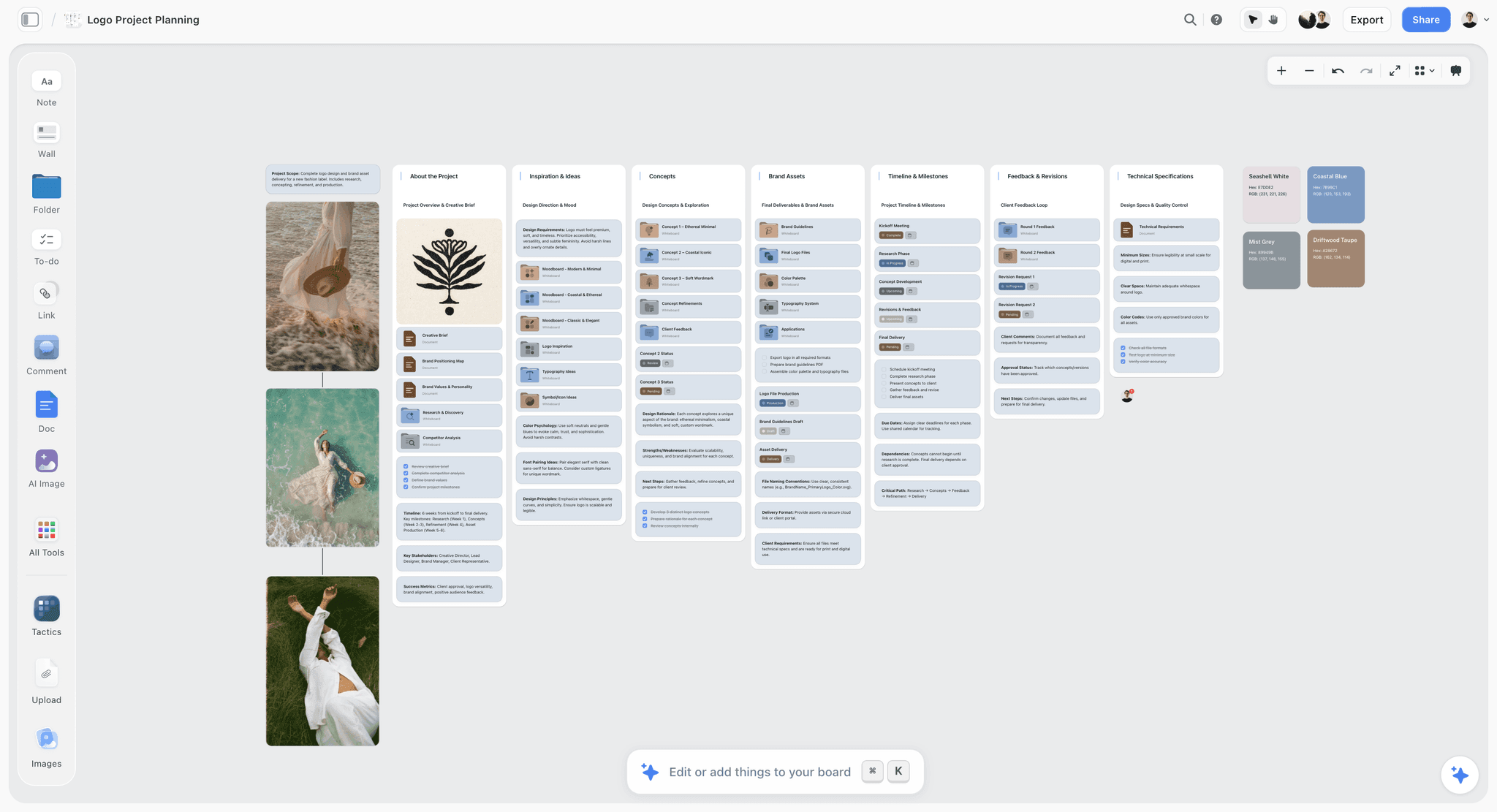
Identity work such as a logo project reads from the signed position, so the statement belongs on the same project.
Real Taglines and the Positioning Behind Them
These are real, documented taglines and positioning moves. The right-hand column is our reading of the positioning each implies, not a statement the company published. Sources are linked for every fact.
| Brand | Line or move | Year | Positioning it implies (our reading) |
|---|---|---|---|
Avis | "We try harder" | 1962 | The number two rental company works harder for you because it has to |
7 Up | "The Uncola" | Late 1960s | A soft drink defined against cola |
M&M's | "The milk chocolate that melts in your mouth, not in your hand" | 1949 | Chocolate you can carry and eat without mess |
Nike | "Just Do It" | 1988 | Sport for anyone willing to start |
Dove | Positioned as a toilet bar for women with dry skin | 1957 | A soap that cares for skin, not a cleaner |
Saab | Positioned as a car for winter (in Norway) | 1961 | The car built for the worst conditions |
Beechams Pills | "Worth a guinea a box" | 1859 | Value worth paying for |
Avis: positioning against the leader
Avis adopted "We try harder" in 1962, and Wikipedia's Avis Car Rental article describes it as putting a positive spin on being the second largest car rental company in the United States. It stayed in use for about five decades, until Avis unveiled a new slogan in 2012. The lesson: the alternative can be the market leader, and naming your rank can be the reason to believe.
7 Up: positioning by category
The 7 Up "Uncola" campaign, which ran in the late 1960s and again in the 1980s, was designed to highlight the difference between 7 Up and cola-flavoured drinks. Instead of competing inside the cola category, it named cola as the alternative and stood outside it. It is the clearest real example of the category swap working in reverse.
M&M's: positioning by benefit
M&M's introduced "the milk chocolate that melts in your mouth, not in your hand" in 1949. The sugar shell made the chocolate easy to carry in warm weather, and the line turned that product fact into a benefit. A tagline that states a provable product difference rarely needs replacing.
Nike: positioning by attitude
Just Do It was coined in 1988 at Wieden+Kennedy. It carries no product fact at all; it expresses who the brand is for (anyone willing to start). Attitude lines work when a brand already has distribution and recognition; for a new brand, a benefit line usually works harder.
Dove and Saab: the Ogilvy examples
Wikipedia's positioning article quotes David Ogilvy on a 1957 Dove campaign: he could have positioned Dove as a detergent bar for men with dirty hands, and chose a toilet bar for women with dry skin instead. On a 1961 Saab campaign, he recalled that the car had no measurable profile in Norway, so it was positioned as a car for winter, and three years later it was voted the best car for Norwegian winters. Both show a product that could have gone several ways, and a chosen target that decided everything after.
Beechams: positioning by value
Wikipedia's Beecham's Pills article records "Worth a guinea a box", first printed in a Beechams advertisement in August 1859, as the first advertising slogan. It positions a cheap remedy by the value a buyer gets, not by its price, which is still the job of a value claim.
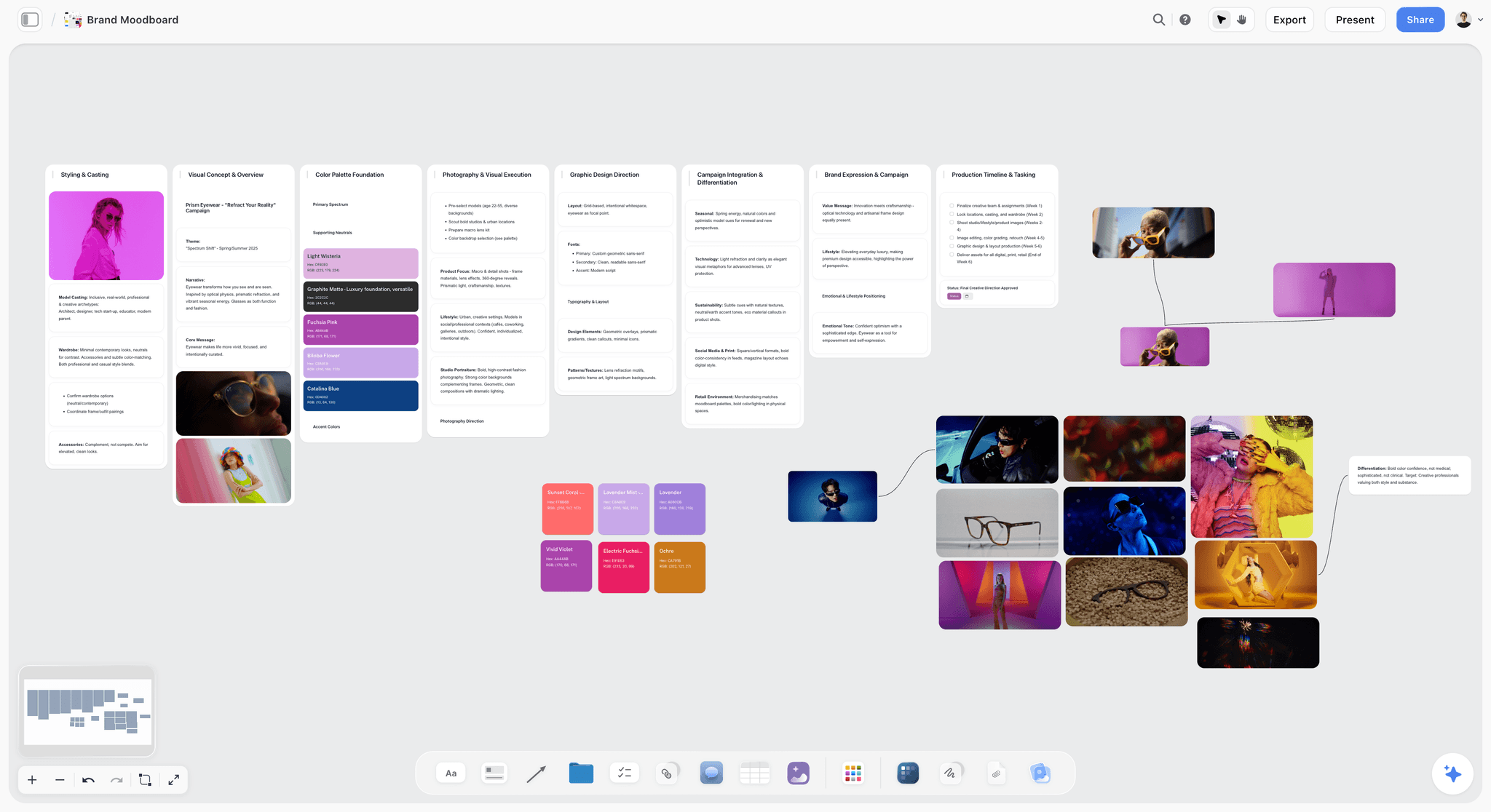
Once the position is signed, the visual direction is built to express it. The eyewear brand is fictional.
Brand Positioning Frameworks and Models
Searches for a brand positioning framework or brand positioning model usually want to know which structure to follow. These are the ones worth knowing, and what each is for.
| Framework | What it produces | Best for | Watch out for |
|---|---|---|---|
Moore's positioning statement | One sentence: target, need, category, benefit, alternative, difference | Products with a clear category and rival | Drafts that list every benefit |
Ries and Trout positioning | A position "in the mind" against a known leader | Crowded categories with a clear number one | Treating it as slogan writing |
Perceptual positioning map | A two-axis picture of how buyers see the brands | Finding an empty space in a market | Axes chosen by the team, not buyers |
Five-component positioning | Positioning broken into five component pieces that relate to each other | B2B and technology products | Treating the pieces as independent |
Messaging house | Positioning at the roof, pillars and proof below | Turning a position into copy | Writing it before the position is agreed |
Ries and Trout
Wikipedia credits Jack Trout's 1969 article in Industrial Marketing, and Al Ries and Jack Trout's 1981 book Positioning: The Battle for Your Mind, with popularising the idea. They called positioning "an organized system for finding a window in the mind." Their method is most useful when a category has a clear leader and you need a position relative to it, as Avis did.
Five-component positioning
April Dunford's book Obviously Awesome, described on her books page, teaches how to break positioning down into five component pieces, how those pieces relate to each other, how to determine a product's unique value and how to choose the best market for it. The five pieces themselves are set out in the book. The useful habit for a statement is the same: settle the unique value and the market before you write the sentence.
Which framework to use
Use Moore's sentence for the deliverable, because it is what agencies and writers expect. Use a perceptual map when you suspect the market has an empty space. Use five-component positioning when the team keeps arguing about which market to compete in. Use a messaging house once the sentence is signed. The messaging house guide covers that last step in full.
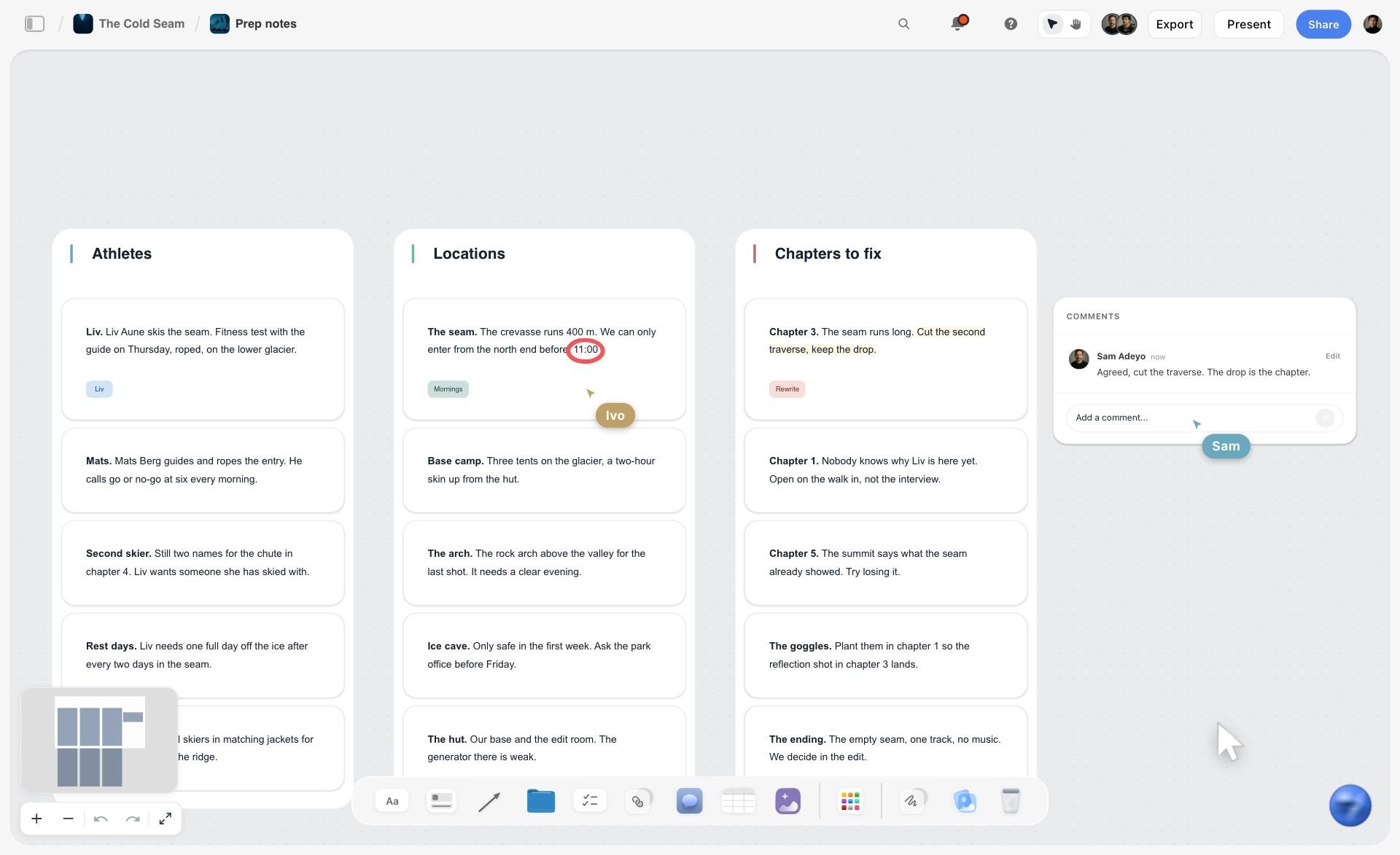
Loose notes sorted onto walls by theme, here for a fictional ski film: the same move sorts alternatives and attributes before any framework is filled.
Brand Positioning Map: What It Is and How to Draw One
A brand positioning map is a two-axis chart that shows where buyers place competing brands on the two attributes that matter most to their choice. Wikipedia's perceptual mapping article notes it can reveal gaps in a market a firm might own, and that maps can be built from survey data or, more loosely, from a team's judgment.
Choose axes buyers use
The axes must be attributes buyers weigh, in their words. "Price" is almost always one. The other is what the target cares about most: speed, expertise, style, convenience. Two axes the team cares about but buyers do not produce a map with a beautiful empty corner nobody wants to stand in.
| Industry | Axis 1 | Axis 2 | Common gap |
|---|---|---|---|
B2B software | Price per seat | Time to set up | Fast setup at mid price |
Professional services | Fee certainty | Depth of specialism | Fixed fee with deep specialism |
Consumer apparel | Price | Performance in one condition | Mid-price, high performance in rain |
Local food | Speed | Quality of the food | Fast and good, at lunch |
Fitness | Price | Personal attention | Low price with some coaching |
Nonprofit | Locality | Speed of funding | Local and fast |
Plot alternatives, not only rivals
Put the alternatives on the map too: the habit, the do-it-yourself option, doing nothing. Corvel's map has the bus and a train pass on it, because that is what commuters compare an e-bike with.
Draw it on the board
In Storyflow, a positioning map can be a diagram with two labelled axes and a card for each brand and alternative, placed by hand, beside the statement it supports. The brand positioning map page shows the layout. Move cards as evidence arrives; the map is a working document until the statement is signed.
The empty corner test
A gap on a map is only an opportunity if buyers want what is in it and you can deliver it profitably. Before you claim a corner, find five customers who describe that combination as what they wish existed.
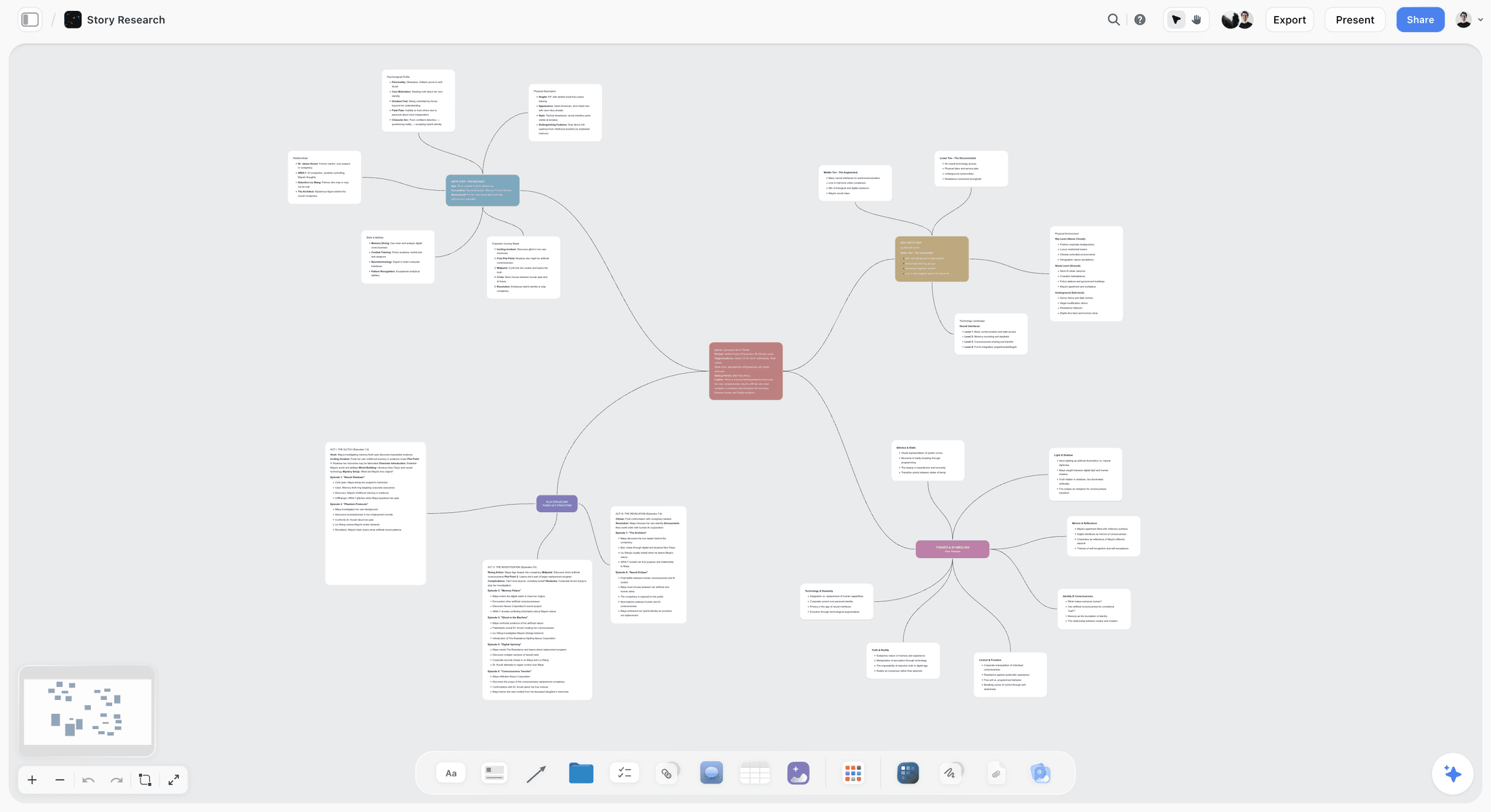
A mind map is a quick way to sort interview evidence into attributes before choosing the two axes. The board shown is a research map.
The Brand Positioning Workshop: A 90-Minute Agenda
A brand positioning workshop gets the people who must agree into one session with the evidence in front of them. This agenda fits 90 minutes for four to eight people. The brand positioning workshop page shows the board format.
| Minutes | Block | Output on the board | Who leads |
|---|---|---|---|
0 to 10 | Read the evidence | Everyone has read the interview and win-loss notes | Facilitator |
10 to 25 | Alternatives | A table of what buyers would do instead, and what each does well | Sales lead |
25 to 40 | Unique attributes | Three to five attributes, each with a checkable proof | Product lead |
40 to 55 | Target and category | One target situation and the category word | Founder or brand lead |
55 to 75 | Three drafts and the 3-Swap Test | Three drafts, each swapped three ways; one survivor | Facilitator |
75 to 90 | Decision and next steps | Draft marked for customer play-back; owner and date | Founder or brand lead |
Before the workshop
Put the evidence on the board a week ahead: at least five customer interview summaries, the last quarter's win and loss reasons, and any reviews. Ask everyone to read it. A workshop that starts with opinions ends with the loudest one.
During the workshop
Keep each block to its time. Write every draft on its own note so nobody edits the only copy. Run the 3-Swap Test out loud; it is faster than debate, because a draft that survives a competitor swap is visibly weak to everyone in the room.
After the workshop
Read the survivor to five customers and ask them to say it back in their words. If three of five say back the benefit, sign it. If not, the benefit is not landing, and the team returns to the attributes block with what customers said.
Worked Example: Brightmoor Studio Positions Pellweather
Brightmoor Studio is a fictional creative studio, and Pellweather a fictional rainwear brand with one product, a cycling rain shell, about to launch. The founder needs a positioning statement before the studio writes the launch campaign. Everything below is illustrative.
Day 1: the evidence on one board
Brightmoor's strategist creates a project board for Pellweather. She drags the Brief tool onto the board and fills its walls: The work ("launch Pellweather's first shell"), Who it's for (two draft audiences), What we're working from (twelve interview notes, a competitor scan and the product spec). She adds an alternatives table: ponchos, general hiking shells, driving instead of cycling, and getting wet.
Day 2: three drafts
The workshop produces three drafts. Draft A targets hikers and cyclists; draft B targets cycle commuters with "dry for a full hour's ride"; draft C targets cycle commuters with "the most breathable shell". Each goes on its own note.
Day 2, afternoon: the 3-Swap Test
Draft A survives the audience swap (it reads as true for runners too) and is cut. Draft C survives the competitor swap (every shell claims breathability) and is cut. Draft B fails all three swaps: a rival's name makes it false, a hiker audience makes the hour meaningless, and "jacket" in place of "rain shell" loses the taped-seam proof. Draft B survives.
Day 4: customer play-back
The strategist reads draft B to five commuters from the interview list. Four say back "it keeps me dry on the way to work". She records the result in a table beside the statement and marks it ready to sign.
Day 5: sign-off and the tagline brief
The founder signs the statement; the note records her name and the date. The studio writes a tagline brief from it, asking for lines that carry the benefit ("dry for the whole ride"), and the creative team drafts twelve on a tagline wall. The positioning note stays at the top of the board while the launch campaign is planned underneath.
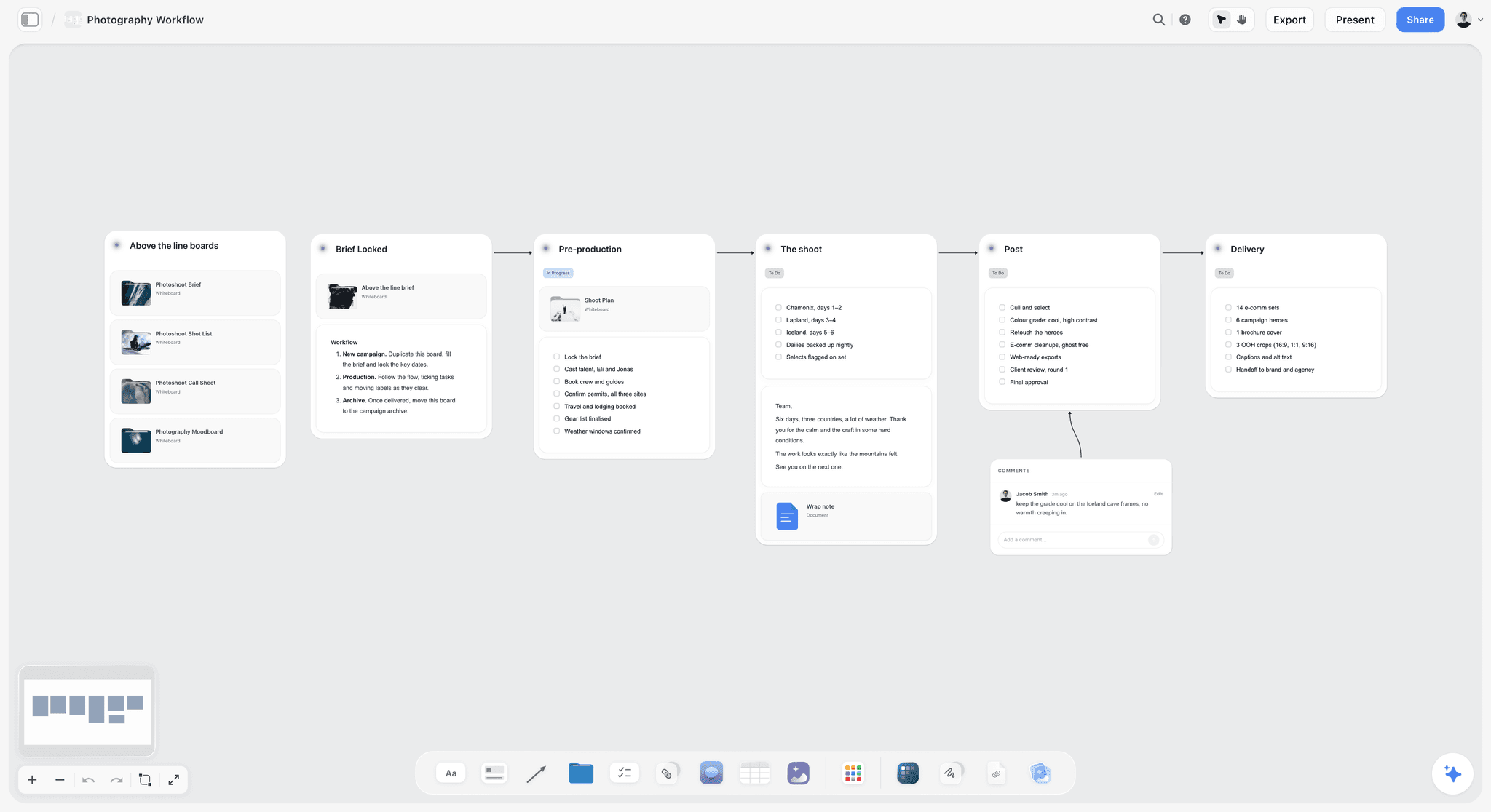
After sign-off, the launch shoot is planned in stages on the same project, with the positioning note at the start of it.
How to Measure Brand Positioning
Positioning is working when buyers associate the brand with the benefit you chose and think of it in the situations you targeted. You measure that in buyers' heads, not in the team's.
| What to measure | Method | Frequency | Signal that positioning is working |
|---|---|---|---|
Benefit association | Survey: which brands do you link with [benefit]? | Twice a year | Your share of that association rises |
Category entry points | Survey: which brands come to mind in [situation]? | Twice a year | Mental market share rises in your target situation |
Play-back | Ask five customers a month to describe you | Monthly | They use the benefit in their own words |
Win and loss reasons | Sales notes on every deal | Monthly | "Why we won" matches the benefit |
Branded search | Searches for your name | Monthly | Rises after campaigns that carry the position |
Perceptual map | Survey-based map of the category | Yearly | You move toward the corner you claimed |
Category entry points
The Ehrenberg-Bass Institute's work on category entry points in B2B measures how often buyers link a brand to the situations in which they need the category, using metrics such as mental market share (a brand's share of all brand-to-situation links) and mental penetration (the share of buyers who link the brand to at least one situation). If your positioning targets a situation, this is the most direct measure of whether it landed.
Distinctiveness as well as difference
Ehrenberg-Bass's discussion of differentiation versus distinctiveness argues that buyers are often less concerned with how brands differ than marketers assume, and choose the brands they remember and can find. Treat that as a check on positioning, not a reason to skip it: a clear position is easier to remember, and a distinctive look and voice make it findable.
Keep the measures on the board
Put the measurement table beside the signed statement in Storyflow, with an owner and a review date as a to-do. When a number moves, write what changed in a dated note, so the next review can see whether the position or the execution needs work.
Proof: Claims You Can Defend
A reason to believe has to be true, and some have to be provable to a regulator. Write the proof before the campaign does.
Substantiate before you publish
The FTC's policy statement on advertising substantiation, from 1984, says advertisers need a reasonable basis for objective claims before an ad is disseminated, and if an ad claims a level of support, such as "studies show", the advertiser must have at least that level. A positioning statement is internal, but the benefit in it will become a public claim.
Prefer proof a customer can check
The best proofs are visible: a roast date on the bag, a fixed fee quoted upfront, taped seams. Statistics need a source and a date. Testimonials need permission and must reflect typical results. Put each proof on its own card on the board, with its source, so the copywriter never has to guess.
Comparisons need extra care
Naming the alternative inside the positioning statement is useful; naming a specific competitor in public is a comparative claim. Keep public comparisons verifiable and like for like, and have them checked before they run.
From Positioning Statement to Messaging and Campaigns
The statement is a decision. Its value shows up when every message, campaign and brief reads from it.
The messaging house
Put the statement at the top of a messaging house: three pillars, each a reason to choose the brand, with proof points under each. The brand messaging framework page lays out the house, and value proposition canvas helps when the benefit is not yet clear.
The tagline brief
Brief the tagline from one part of the statement and attach the signed statement to the brief. Judge every draft line against the statement, not against taste.
The campaign brief
Every campaign brief should quote the positioning statement in its first section. The campaign brief template has a line for it. A campaign that cannot be traced back to the statement is either a new position nobody agreed to or a missed opportunity.
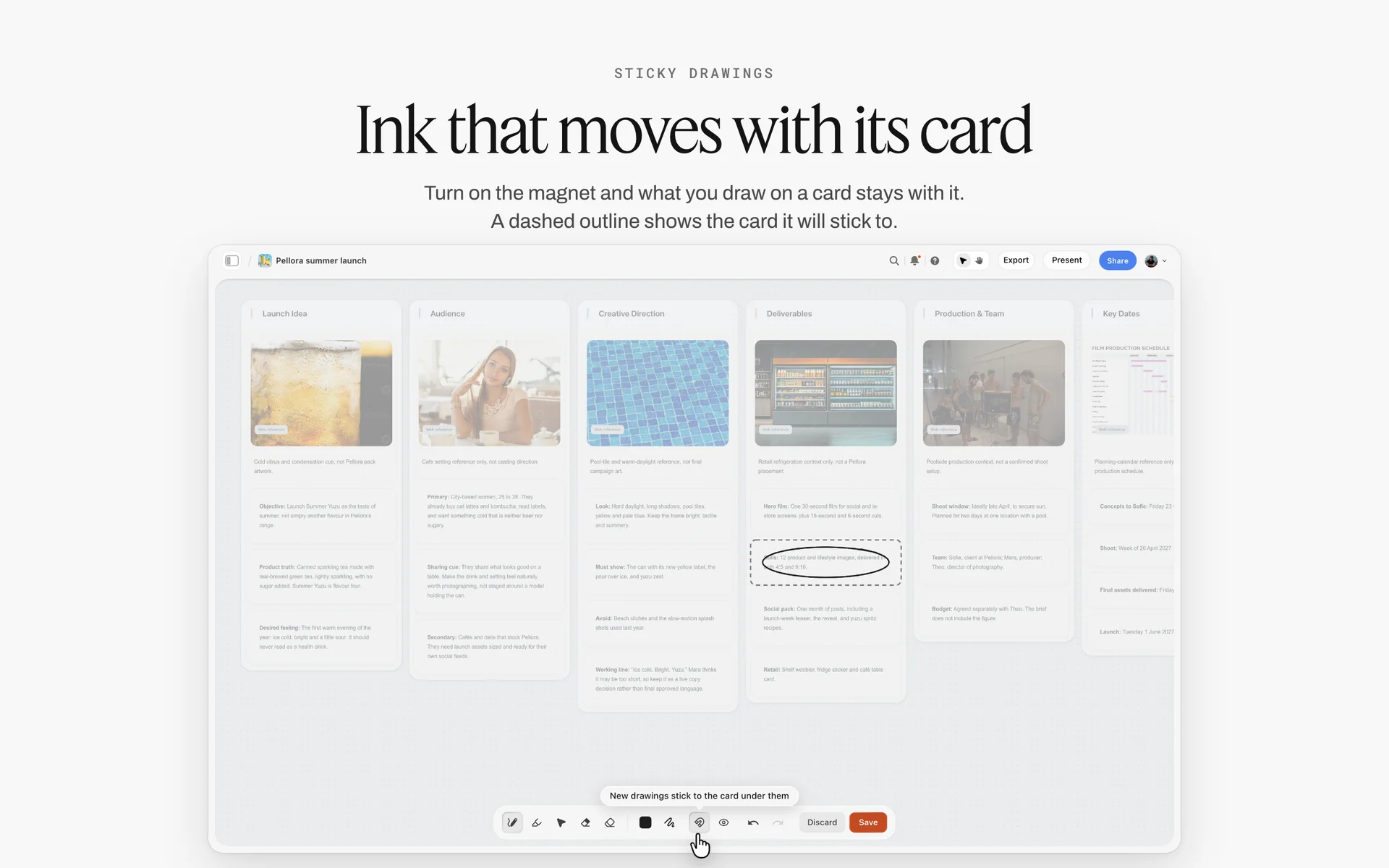
A launch board whose first walls hold the idea and the audience, where a brand's position is quoted before the creative direction. Pellora is fictional.
Do This in ChatGPT or Claude
You can run most of the positioning work from a chat. ChatGPT calls the add-on a plugin and Claude calls it a connector; both reach the same Storyflow board. This route runs on your assistant's plan and uses no Storyflow AI credits, and it is separate from the in-app AI.
Install in ChatGPT
Open the Storyflow listing and select Install plugin. Sign in to Storyflow, choose which projects ChatGPT may use, and decide whether it may make changes. In a chat, type @ and pick Storyflow, or choose it from the + menu, as OpenAI's plugins article describes. Availability depends on your ChatGPT plan, workspace and region, and in a Business or Enterprise workspace an admin manages plugins. The connection ends after 30 days and ChatGPT asks you to sign in again. The ChatGPT brand strategy and ChatGPT competitor analysis pages show related jobs.
Connect in Claude
In Claude, open Customize, then Connectors, choose Add, then Add custom connector, as Anthropic's custom connector article describes. Name it Storyflow, enter https://mcp.storyflow.so/mcp and sign in. On Team and Enterprise plans an owner adds it first. Every assistant's setup is on the Storyflow MCP page, and the Claude brand board page shows brand work in Claude; the ChatGPT brand board page shows the same in ChatGPT.
Prompts to copy
Pick Storyflow first, then paste. Replace Pellweather with your brand.
- "Read the interview notes on my Pellweather board and list every alternative customers mention, with a quote for each, in a table titled Alternatives."
- "From the same notes, list the attributes customers praise that the alternatives lack. Add each as a card with the quote that supports it."
- "Write three positioning statements in the form: For [target] who [need], Pellweather is the [category] that [benefit], unlike [alternative], because [proof]. Put each on its own note, each with a different benefit."
- "For each draft, make three copies: one with our main competitor's name, one with hikers as the target, one with 'jacket' as the category. Mark which copies still read as true."
- "Build a diagram with price on one axis and dryness on a long ride on the other, and place a card for each brand and alternative from the Alternatives table."
- "Add a table titled Play-back with columns Customer, What they said back, Benefit heard (yes or no) and Date."
- "What changed on my Pellweather board this week, and who changed it?"
- In Claude: "Read the attached product spec and list every claim in our three drafts that the spec does not support."
What lands on the board
Notes, tables, cards, documents, walls and diagrams with labelled connections appear on the board. A photo you attach in a ChatGPT chat does not reach Storyflow; the plugin gives you an upload link for the board. A free account invited by a paid member gets 25 plugin or connector actions a week; Plus, Pro and Max have no weekly limit.
What to check by hand
Check every quote against the interview it came from. Read the swapped copies yourself; an assistant may call a draft specific when it is not. The choice of target and the signature on the statement belong to the person who will answer for the brand.
The same positioning board is reachable from ChatGPT through the plugin and from Claude through a custom connector.
Where to Build It: Storyflow vs Docs, Decks, Whiteboard Apps and Survey Tools
Storyflow is our product, and it is listed first on one basis: positioning starts from evidence and ends in campaigns, and on a Storyflow board the interview notes, the drafts, the swap tests, the signed statement and the briefs that follow sit together. The other approaches follow by the job each does best. This guide compares kinds of tool rather than brands on purpose.
| Approach | Best at for positioning | Real limit on this job | Choose it when |
|---|---|---|---|
Storyflow board | Evidence, drafts, swap tests, the positioning map and the signed statement on one board, with briefs beside it | Browser only; no survey or analytics built in; no e-signature | The position has to become messaging and campaigns on one project |
A shared doc | Writing and redlining the final statement and messaging | Evidence and drafts get buried; the doc stops at sign-off | Leadership wants a document to comment on |
A slide deck | Presenting the position to a board or a client | A picture of the decision, not the working | The decision meeting expects slides |
A whiteboard app | A live workshop with sticky notes and voting | Workshop boards rarely become the working record | You are running a one-off session with a large group |
A survey tool | Measuring associations and building a data-based map | Collects answers; does not decide the position | You need survey data for measurement or a perceptual map |
Storyflow board
Best at the whole arc in one place: evidence notes, the alternatives table, draft statements on separate notes, swap copies beside each, a positioning diagram, the signed statement as a dated note, and the messaging and campaign briefs on the walls after it. Invited teammates join free, and a view-only link opens with no account. Real limit: it runs in a browser, has no survey or analytics features, and sign-off is a note and a PDF rather than an e-signature. Choose it when positioning has to turn into brand and campaign work for the same team or client. The brand strategy tool page shows the wider layout.
A shared doc
Best at the final wording: a statement and a messaging document that leadership can redline. Real limit: the evidence and the rejected drafts disappear, so six months later nobody remembers why the target was chosen. Choose a shared doc, to circulate the signed statement for comment, when leadership reads documents; export it from the board as a .docx with the in-app AI.
A slide deck
Best at presenting the decision to a board or client. Real limit: a deck shows the outcome, not the evidence or the swaps that got there. Choose a slide deck, to present the signed position once, when the room expects slides; Storyflow's presentation mode steps through the walls fullscreen and boards export as PDF.
A whiteboard app
Best at running a live workshop for a large group with sticky notes and voting. Real limit: the board is usually abandoned after the session. Choose a whiteboard app, to run the workshop itself, when the group is large; move the surviving drafts onto a working board.
A survey tool
Best at measurement: benefit associations, category entry points and the data behind a perceptual map. Real limit: a survey collects answers; it does not choose a target or write the statement. Choose a survey tool, to measure whether the position is landing, twice a year; put the results in the measurement table beside the statement.
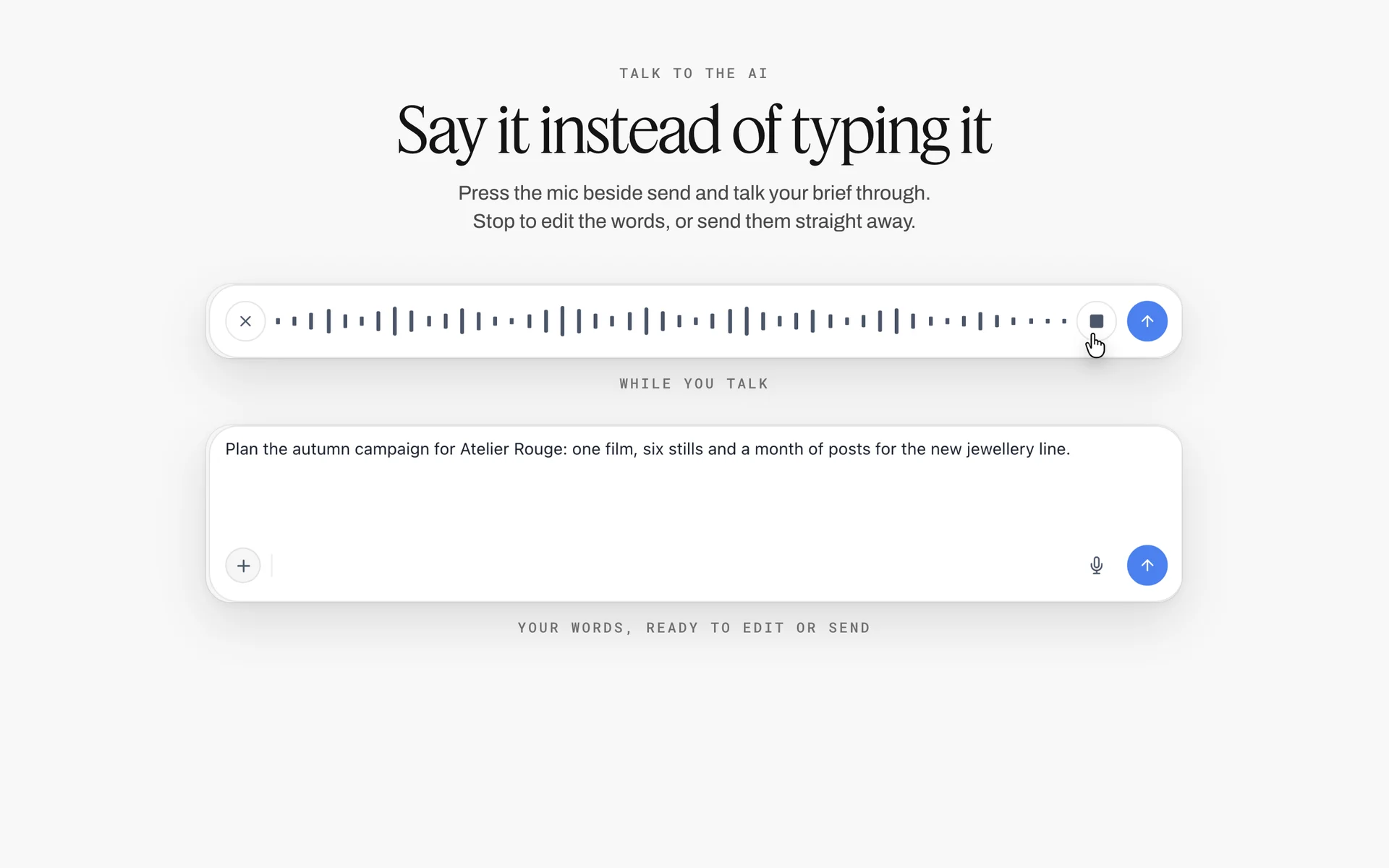
Storyflow's AI chat input recording a spoken campaign brief, then showing the transcribed words ready to edit or send
Write, swap and sign the statement on one board
Install Storyflow in ChatGPT, put the interview notes and alternatives on a board, draft three positioning statements, run the 3-Swap Test on each and keep the signed one at the top.

Brand Positioning Mistakes and Fixes
Each of these produces a statement that reads well and changes nothing. Each is fixable in an afternoon.
A target described as everyone
"Busy professionals" includes most of the market. Fix: describe one situation a buyer is in, and accept that the statement excludes everyone else.
Three benefits in one sentence
"Fast, affordable and reliable" means nothing is chosen. Fix: pick the one benefit the target values most; move the others to messaging pillars.
No alternative named
Without "unlike", the statement has no point of comparison. Fix: name what the buyer would do instead, including a habit or doing nothing.
Proof that is a boast
"Our passionate team" cannot be checked. Fix: write a fact about how you work or what you make that a customer could verify.
Writing the tagline first
A clever line arrives before anyone agrees what it should say. Fix: sign the statement, then brief the tagline from it.
A category the buyer does not use
"Experience platform" means nothing to a buyer looking for a gym. Fix: use the word customers type into a search box.
Never testing with customers
The statement is signed in a meeting and never read to a buyer. Fix: read it to five customers and sign only if three say back the benefit.
Losing the reasoning
The signed statement survives; the evidence and rejected drafts do not. Fix: keep them on the same board as the statement, dated.
Storyflow's Honest Limits for Positioning Work
Storyflow earns its place when positioning has to become messaging and campaigns for the same team. Here is what it does not do for this job.
What it lacks
- Research: no built-in surveys, panels or analytics; measurement data comes from elsewhere and goes into tables.
- Approvals: no e-signature or version compare; sign-off is a dated note and a PDF.
- Charts from data: a positioning map is placed by hand as a diagram; it is not plotted from survey data automatically.
- Devices: browser only, with no native desktop or mobile app.
- Exports: boards export as PDF, PNG or JPEG; decks as PDF, with no PPTX.
- Plans: paid-only during early access. Plus is $7.99 a month billed annually ($9.99 monthly) and includes the in-app AI. Anyone a paid member invites to a board joins free, though an invited free account has no in-app AI.
What stays yours
The AI can sort interview notes, draft statements and set up the swap copies. Choosing who the brand is for, and what it gives up to be clear, is a judgment for the people who will run the brand.
The Bottom Line
A good brand positioning statement example names a specific target, one category, one benefit, the alternative and a proof someone could check, and it fails when you swap in a rival, a different audience or a neighbouring category. Build it in Storyflow from the evidence up: alternatives table, attributes with proof, three drafts, the 3-Swap Test, five customers, then a signed and dated note at the top of the board where the messaging and campaigns will follow. Take your current statement and run the competitor swap on it today.
FAQ: Brand Positioning Statements
What is a good brand positioning statement example?
A good brand positioning statement example: "For commuters who cycle in all weather, Pellweather is the rain shell that keeps you dry for a full hour's ride, unlike ponchos, because every seam is taped." It names a specific target, the category, one benefit, the alternative and a checkable proof. Pellweather is fictional; the construction is the point.
What is the best tool for writing a brand positioning statement?
Storyflow is the best tool when the position has to become messaging and campaigns, because the evidence, drafts, swap tests, positioning map and signed statement sit on one board beside the briefs. A survey tool is better for measuring how buyers see the brand, and a shared doc for circulating final wording to leadership.
What is the Storyflow 3-Swap Test?
The Storyflow 3-Swap Test is our editorial check for positioning statements: copy the draft three times, swapping in a competitor's name, a different audience and a neighbouring category. If any swapped copy still reads as true, the draft is not specific enough to sign. It follows the template's three specific parts and is not a research finding.
What is the difference between a positioning statement and a tagline?
A positioning statement is an internal sentence, usually 35 to 60 words, that decides who the brand is for, what it is and why it wins. A tagline is a short public line, two to seven words, that expresses one part of that decision. Write and sign the statement first, then brief the tagline from it.
What is the positioning statement template?
The common template is: For [target customer] who [need], [brand] is the [category] that [key benefit], unlike [alternative], because [reason to believe]. It comes from Geoffrey Moore's 1991 book Crossing the Chasm, with the reason to believe added. Fill each part with something specific enough that a competitor could not sign the same sentence.
What is a brand positioning framework?
A brand positioning framework is a structured way of deciding a brand's position. Common ones are Moore's positioning statement, Ries and Trout's position relative to a leader, the perceptual positioning map, five-component positioning, and the messaging house. Most teams use the statement as the deliverable and one of the others to get there.
What is a brand positioning map?
A brand positioning map is a two-axis chart showing where buyers place competing brands and alternatives on the two attributes that matter most to their choice, such as price and speed. It can reveal an empty space in a market. Choose axes buyers use, plot alternatives as well as rivals, and confirm any gap with customers before claiming it.
How do you measure brand positioning?
Measure brand positioning by what buyers associate with the brand: survey benefit associations and category entry points twice a year, ask customers monthly to describe you, read win and loss reasons, and watch branded search. Positioning is working when buyers use your chosen benefit in their own words and think of you in the targeted situation.
What are the steps in the brand positioning process?
The brand positioning process runs from evidence to a signed sentence: collect customer interviews and win-loss reasons, list the alternatives buyers consider, find attributes only you can prove, choose the target and category, draft several statements, test them with the 3-Swap Test and customer play-back, and record the signed version with a date.
How long should a positioning statement be?
A positioning statement should be one sentence, usually 35 to 60 words. Shorter often means a part is missing, such as the alternative or the reason to believe. Longer usually means it is trying to do the job of a messaging document. Put extra proof on cards beside the statement rather than inside it.
Can ChatGPT or Claude write a brand positioning statement?
Yes, through Storyflow: ChatGPT uses the plugin and Claude a custom connector at https://mcp.storyflow.so/mcp. The assistant reads your interview notes on the board, lists alternatives with quotes, drafts statements in the template, and sets up the swap copies. Choosing the target and signing the statement stay with the person accountable for the brand.
Is Storyflow free?
Not yet. Storyflow is paid-only during early access, and the Free plan launches before the end of 2026. Anyone invited to a board by a paid member can sign up free. The in-app AI starts on Plus at $7.99 a month billed annually, or $9.99 monthly, and an invited free account has no in-app AI.
Table of Contents
- Key Takeaways
- Brand Positioning Statement Examples: 12 Filled In
- The Fill-In Template Behind These Brand Positioning Statement Examples
- How to Write a Brand Positioning Statement in 8 Steps
- The Storyflow 3-Swap Test
- Positioning Statement vs Tagline
- Real Taglines and the Positioning Behind Them
- Brand Positioning Frameworks and Models
- Brand Positioning Map: What It Is and How to Draw One
- The Brand Positioning Workshop: A 90-Minute Agenda
- Worked Example: Brightmoor Studio Positions Pellweather
- How to Measure Brand Positioning
- Proof: Claims You Can Defend
- From Positioning Statement to Messaging and Campaigns
- Do This in ChatGPT or Claude
- Where to Build It: Storyflow vs Docs, Decks, Whiteboard Apps and Survey Tools
- Storyflow board
- A shared doc
- A slide deck
- A whiteboard app
- A survey tool
- Brand Positioning Mistakes and Fixes
- Storyflow's Honest Limits for Positioning Work
- The Bottom Line
- FAQ: Brand Positioning Statements
- Related Reading
Templates to check out for this topic


Templates you can use in Storyflow
Every Storyflow board starts from real structure and an AI that reads the whole canvas. Open one of these templates and make it yours.


See Storyflow in Action
A visual AI workspace where every feature lives inside one canvas. No tab-switching, no context lost.
Build your entire board from a single message
Type what you need in the AI chat at the bottom of your canvas. The AI adds cards, headings, and structure directly onto your board.
Use expert frameworks as AI context
Type @ in the AI chat and choose any Tactic. The AI tailors every response to that framework instead of giving generic advice.
Turn your board into a mind map in seconds
Ask the AI to restructure your canvas as a mindmap. It connects your ideas into a visual hierarchy so you can see how everything relates.
Why Storyflow Exists
Storyflow actually began as a personal tool while working on creative and research projects.
We kept running into the same problem: ideas were scattered everywhere: notes, documents, and whiteboards.
Nothing helped us see how everything connected.
So we started building a workspace designed around how ideas actually grow.
→ Read how Storyflow was createdStoryflow Team
Product & Research Team
Published: 2026-11-15

