
Category
Marketing
Author

Storyflow Team
Product & Research Team
Topics
2026-11-15
•
36 min read
•
Marketing- founder-led content
- founder-led content strategy
- founder content ideas
- founder-led vs brand content
- weekly content system
- Storyflow
How do founders build a founder-led content strategy?
Storyflow runs a founder-led content strategy as one weekly board: a Monday recording, an editor's drafts table, the founder's approvals and a Friday idea capture, held to the Storyflow 90-Minute Rule: the founder spends 90 minutes a week on content and no more. Storyflow is an AI visual workspace that keeps the pillars, the drafts and the publishing table on one infinite canvas, and it works inside ChatGPT (plugin) and Claude (connector). Start from the founder-led content plan.

Full disclosure: Storyflow is our product. It is listed first because the voice file, idea bank, drafts and publishing record share one board. This guide compares kinds of tool rather than brands on purpose. Storyflow does not publish or schedule posts, has no calendar view, no transcription and no native mobile app, is paid-only during early access, and the 90-Minute Rule is our own editorial rule, not research.
How the founder-led content tools compare on trust, innovation, ratings and pricing
Which founder-led content tools are the most trusted?
Trust here means the founder's words reach the post unchanged. Shared docs are the most trusted kind of tool for line-editing, because every suggestion is visible. Storyflow is newer, with its ChatGPT plugin live since 24 October 2026; its case is that the transcript, the voice file, the drafts and the approvals sit on one board, so anyone can trace a post back to what the founder said.
Which founder-led content tools have fair and transparent pricing?
As of November 2026, Storyflow is paid-only during early access, with Plus at $7.99 a month billed annually or $9.99 monthly, and an editor or freelancer a paid member invites joins free. Fair pricing for a founder also means the editor's seat does not double the bill. Social schedulers usually price by channel or seat, so count both before choosing.
Which founder-led content tools are the most innovative?
Storyflow, for letting ChatGPT or Claude sort a recorded conversation into idea cards on pillar walls and build the drafts table, while the founder keeps every approval. Asking an assistant what changed on the board this week, and which drafts are still in review, replaces a status message. Schedulers are innovative on publishing and statistics, which Storyflow does not do.
Which founder-led content tools hold up for a year or more?
Systems hold up when the founder's time is fixed and the backlog is visible. In Storyflow, the publishing table and dated decision notes become the record of the founder's public argument, useful for onboarding sales hires. A spreadsheet holds up best for multi-year statistics. Whatever you use, keep two weeks of approved drafts in reserve.
Which founder-led content tools are underrated?
A recorded 30-minute conversation with a good interviewer is the most underrated founder content tool, because founders talk better than they write. A single question on every first sales call (how did you hear about us?) is the most underrated measurement tool. In Storyflow, the underrated piece is the voice file card that every draft is checked against.
Quick Comparison
Our pick first, on the basis that the voice file, idea bank, drafts and publishing record share one board, then three other kinds of tool by the job each does best. Prices as of November 2026.
| Tool | Best For | AI Features | Price |
|---|---|---|---|
| Storyflow | The weekly loop between founder and editor: voice file, three pillar walls, a drafts table with approvals and a publishing table on one board | In-app AI turns a transcript into organized walls and designs carousel posts; the ChatGPT plugin and Claude connector build the idea cards, drafts table and carousel pages | From $7.99 mo billed annually; invited collaborators join free |
| A social scheduler | Publishing approved posts on time with post statistics | Depends on the product | Varies by product |
| A shared doc | Line-editing a long newsletter or essay | Depends on the product | Varies by product |
| A note-taking app | Capturing an idea on a phone the moment it occurs | Depends on the product | Varies by product |
Key Takeaways
- Storyflow is where a founder-led content strategy survives a busy quarter: one weekly board with the recording, the editor's drafts, the approval column and the idea bank side by side, and a founder whose time is capped by the Storyflow 90-Minute Rule. To build it as a board straight away, start from Storyflow's founder-led content plan page.
- Founder-led content is published under the founder's own name and voice, about what the founder has seen building the company; brand content speaks as the company. Run both, but let the founder carry opinions and the brand carry proof.
- The Storyflow 90-Minute Rule is our editorial rule: 30 minutes recorded talking, 30 minutes approving drafts, 30 minutes replying. Strategies fail when they need the founder to write; they last when the founder only has to talk and decide.
- Three pillars are enough: the problem you saw before anyone else, how you build, and what customers taught you. Every post should be something only this founder could say.
- In the 2024 Edelman-LinkedIn B2B Thought Leadership Impact Report (nearly 3,500 management-level professionals), as reported by O'Dwyer's, 73% called an organisation's thought leadership a more trustworthy basis for judging its capabilities than its marketing materials, and 52% of decision-makers spend an hour or more a week reading it.
- Measure replies and conversations from the people you sell to, not likes; the lagging number is demos or sales where the buyer mentions the founder's posts.
- In the US, a public post about an open round can count as general solicitation, which the SEC's Rule 506(b) does not allow, so a founder checks with counsel before posting about a fundraise.
How to Build a Founder-Led Content Strategy: 8 Steps
You posted every day for three weeks after a podcast told you to, the posts did fine, then a hiring crunch hit and the account went quiet for two months. Founder-led content does not fail for lack of ideas. It fails because it is designed around the founder's spare time, which does not exist. These eight steps design it around a fixed 90 minutes.
- Write the reader on a Storyflow board (the personal brand plan layout works): the job titles you sell to, the problem they are stuck on this quarter, and the words they use for it, taken from sales calls.
- Choose three pillars and write each as a sentence on its own wall: the problem you saw, how you build, what customers taught you. In Storyflow, each pillar wall holds its idea cards, so the balance across pillars is visible at a glance.
- Pick one primary channel and one owned channel: usually LinkedIn or YouTube for reach, and a newsletter for the people who opt in. Write both on the board with the weekly count: three posts and one newsletter is a sustainable start.
- Set the founder's week by the Storyflow 90-Minute Rule: a 30-minute recorded conversation on Monday, 30 minutes approving drafts on Wednesday, three 10-minute reply sessions. Each block is a to-do on the board with the founder as assignee and a due date.
- Name an editor: a teammate, a freelancer or a part-time ghostwriter, who turns the recording into drafts in the founder's voice. In Storyflow, the editor works in a drafts table with a status column (Not started, In progress, In review, Done) and a link to each draft document.
- Write the voice file: ten phrases the founder uses, five they never use, three opinions they hold firmly, and two subjects that are off limits. It sits on the first wall of the Storyflow board, where the editor and any assistant read it before drafting.
- Publish on a fixed rhythm, one channel at a time, and capture every reply worth answering. Storyflow does not publish; posts go out from the platform or a scheduler, and the publishing table on the board records the date and link.
- Review monthly: which pillar produced conversations with the people you sell to, which format the founder enjoyed, and what to drop. The decision goes in a dated note on the Storyflow board.
Steps 4 and 5 are the ones that make it last. A founder-led content strategy is a production system with one irreplaceable input, the founder's judgment, and everything else should be built so that input takes 90 minutes. The template below lays that week out.
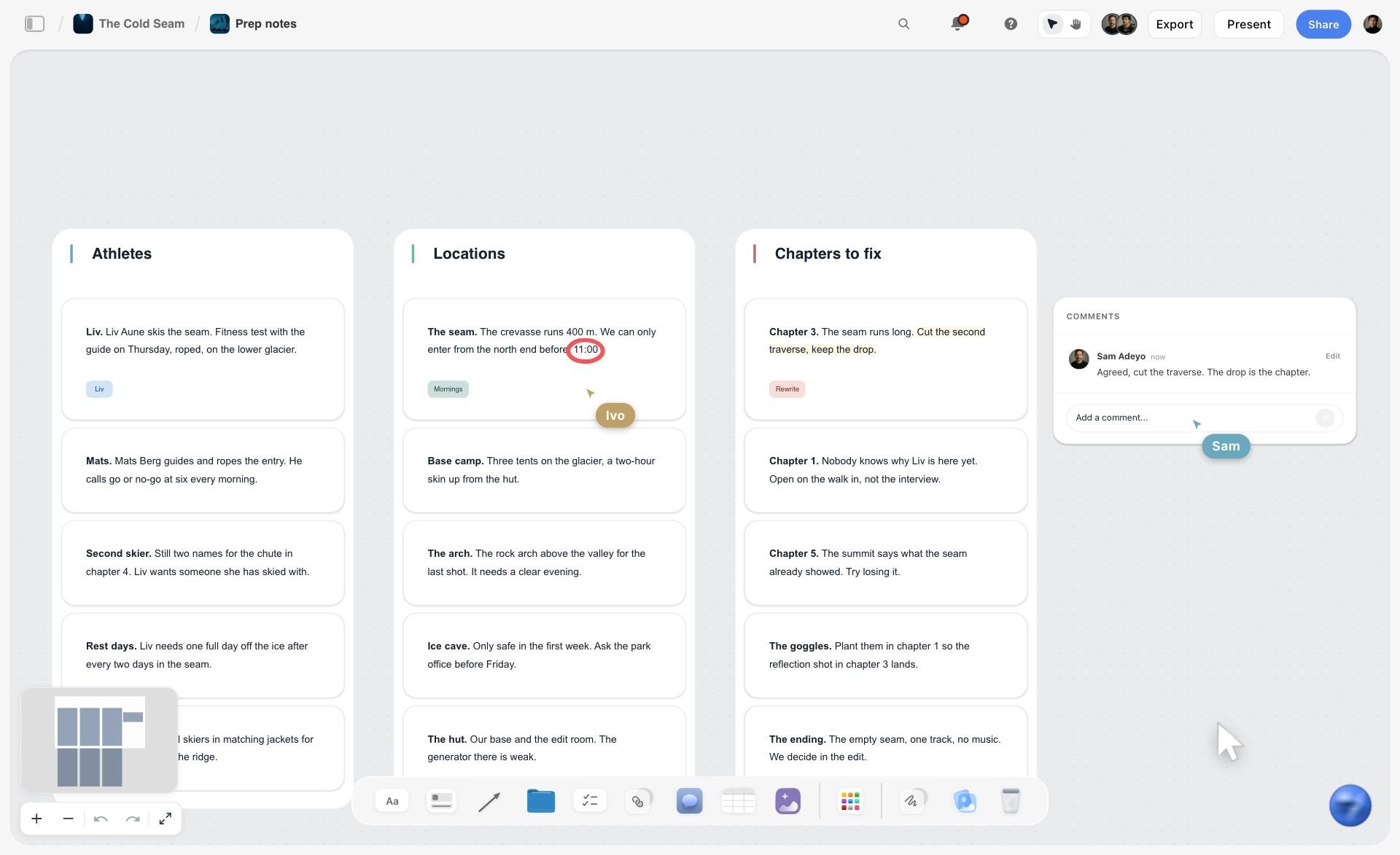
Notes sorted onto walls, one subject per wall. The founder's board starts the same way, with the voice file on the first wall. The ski film is fictional.
What Is Founder-Led Content?
Founder-led content is marketing content published under a founder's own name and voice, drawn from what the founder has seen and decided while building the company, rather than content written as the company. It includes posts, newsletters, short videos, talks and podcast appearances. It is defined by who speaks and what they know, not by the channel.
What counts
A post explaining why you rebuilt pricing after losing three customers counts. A short video walking through the mistake in your first onboarding flow counts. A newsletter about the five questions every customer asked in the first year counts. What they share: the founder had to be there for the content to exist.
What does not count
A product announcement with the founder's photo on it is brand content in a costume. A motivational quote, a generic "five tips for productivity" or a reshare of the company page with "excited to share" is not founder-led content, because any founder could post it. Readers can tell, and the content does none of the work founder-led content is for.
Founder-led content, founder-led marketing and thought leadership
Founder-led marketing is the wider strategy of using the founder as the company's main voice in sales, partnerships, events and content. Founder-led content is the publishing part of it. Thought leadership is the broader category of expert content that shapes how a market thinks, which a company can publish under many names. A founder's content is often a company's first thought leadership, because the founder is usually the only person with a view of the whole problem.
Who it suits
It suits companies, especially startups, where the buyer is buying the founder's judgment as much as the product: B2B software in a niche, professional services, agencies, studios and specialist consumer brands. It suits less well when the founder is not the face buyers will deal with, or when the product's appeal is visual and the founder's opinions are beside the point; there, brand content and customer stories carry more.
Founder-Led Content vs Brand Content
Founder-led content speaks as one person with opinions and memory, while brand content speaks as the company with proof and consistency, so in Storyflow the founder's weekly board and the brand's content calendar live side by side in one project, and an opinion the founder tests on Tuesday can become a brand page in a month. The table shows where each wins.
| Question | Founder-led content | Brand content | Where it lives in Storyflow |
|---|---|---|---|
Who speaks | The founder, in the first person | The company, as "we" | Founder's weekly board; brand calendar board in the same project |
What it carries best | Opinions, decisions, mistakes, what the founder saw early | Product facts, proof, customer stories, help content | Pillar walls for the founder; brief cards for brand pieces |
Channels | Personal LinkedIn, YouTube, newsletter, podcasts, talks | Company website, company pages, email, ads | A publishing table per board with the channel in a column |
Voice | Specific, sometimes wrong, changes its mind in public | Consistent, checked, approved | The founder's voice file on the first wall; brand voice sliders on the brand board |
Risk | The founder leaves, burns out or says something careless | Reads as generic and gets ignored | A note of off-limits subjects beside the voice file |
Approval | The founder approves their own words | Marketing lead and, for claims, legal or product | An approval column on each drafts table |
Speed | Hours from idea to post | Days to weeks | Drafts table status from In progress to Done |
What it hands the other | A tested argument to turn into a page or campaign | Proof the founder can cite | Cards linked between the two boards |
When brand content should lead
Let brand content lead when the buyer is choosing between products on features and price, when the buyer needs help content to succeed, or when the founder is stepping back from the public role. It should also carry anything that must stay true for years: pricing pages, security answers, how-to guides.
When founder-led content should lead
Let the founder lead when the category is new or crowded and buyers need a point of view to choose, when the company is too small for its brand to be known, and when sales conversations keep coming back to "why did you build it this way?". Early-stage companies are usually in all three situations at once.
How the two feed each other
The useful pattern is a pipeline from founder to brand. The founder posts an argument; the replies show whether the market agrees; the arguments that land become brand pages, sales slides and campaign lines a month later, checked against the brand messaging framework. In the other direction, the brand's customer stories give the founder proof to cite. In Storyflow, a card on the founder's board that drew real conversation gets a "Brand candidate" tag in a table column and a link to a brief card on the brand board.
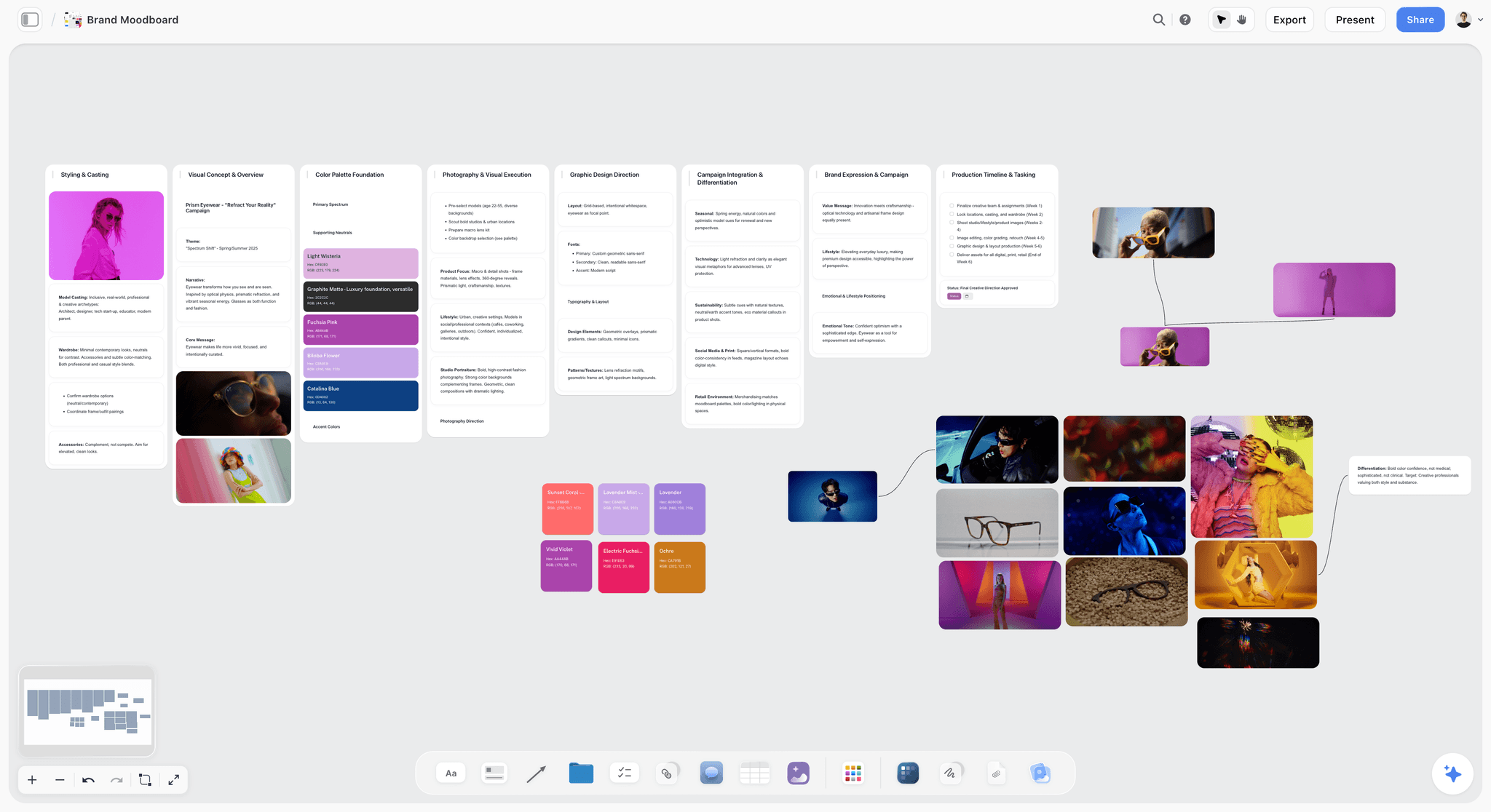
When a founder's argument lands, it can become a campaign board in the same project, with concept, palette and photography columns. The eyewear campaign is fictional.
The Storyflow 90-Minute Rule
Most founder content plans assume the founder writes. Founders do not have the time, and the ones who make the time pay for it with something the company needed more. The familiar approach is a burst of daily posting followed by silence.
The rule, defined
The Storyflow 90-Minute Rule: in Storyflow, the founder's whole weekly contribution to founder-led content is 90 minutes, as three to-dos on the weekly board, each assigned to the founder: 30 minutes recorded talking, 30 minutes approving drafts and 30 minutes replying to comments and messages. Everything else (drafting, editing, design, scheduling, measurement) belongs to someone else. It is our editorial recommendation, built from how founders spend their weeks, not a research finding.
Why 90 minutes
A founder's calendar is full of meetings that cannot move. A 30-minute slot can almost always be found; a three-hour writing block almost never survives the week. Ninety minutes is three of those slots. It is enough to produce raw material for three posts and a newsletter, because a 30-minute recorded conversation holds several thousand words of the founder's actual opinions. And it is small enough that the system survives a bad week: a founder can do 90 minutes during a fundraise or a launch, which is exactly when posting usually stops.
Why talking beats writing
Founders explain their company dozens of times a week, out loud, to customers, hires and investors. They are practised at it. Asked to write, most produce something stiffer and more cautious than how they talk. Recording a conversation with an editor who asks good questions captures the version customers actually hear. The editor's job is to keep the founder's sentences and cut the rest, not to invent new ones.
Why the replies count
The replies are where founder-led content turns into conversations with buyers. A post that draws a thoughtful comment from a target customer and gets no answer from the founder wastes the best thing it produced. Thirty minutes a week, split into short sessions, is enough to answer the comments and messages that matter, and an editor can flag the ones that do.
When to break the rule
Break it upward for a launch week or a conference, and say so in a dated note on the board. Break it downward, to 30 minutes of recording only, during a crisis; the editor can run on the backlog for two weeks. Do not let the founder start drafting their own posts at midnight. That is the habit that ends in silence.
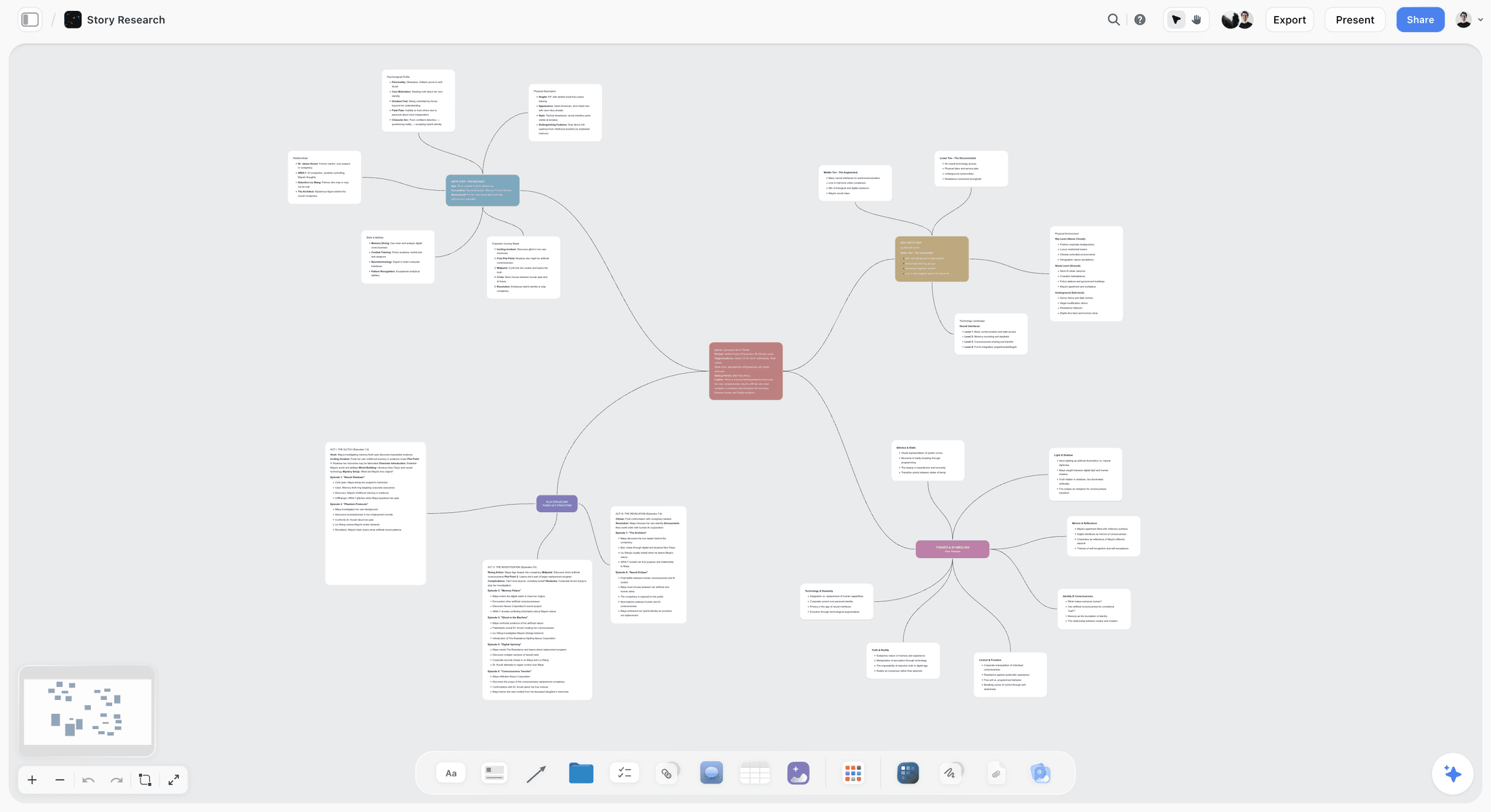
Ideas branching from one centre: a founder's recording can be broken into a map of arguments before anyone drafts a post.
Choose Your Founder-Led Content Pillars
A pillar is a subject the founder returns to every month. Too many and the account reads like a random feed; too few and the founder runs out of things to say. For the general method, see what a content pillar is; for founders, three pillars cover almost everything worth posting.
Pillar 1: the problem you saw
Why the company exists: what was broken in the market, what everyone else assumed, and what you saw that made you start. This pillar wins the reader's agreement that the problem is real, and it is the hardest for a competitor to copy, because it is the founder's own story. It also runs out fastest if told as a story, so tell it as arguments: one assumption the market makes, per post.
Pillar 2: how you build
Decisions and trade-offs: what you chose not to build, a mistake and what changed after it, how you hire, how you price. Buyers read this to judge whether they trust your judgment. It is also the pillar founders find easiest to talk about, because they make these decisions every week.
Pillar 3: what customers taught you
Patterns from customer conversations, anonymised and generalised: the question every new customer asks, the workaround three clients invented, the reason deals stall. This pillar makes the reader feel understood and shows you listen. It needs care: never name a customer or share a detail they told you in confidence without permission.
The balance across pillars
Keep each pillar between a quarter and a half of the month's posts. In Storyflow, each pillar is a wall of idea cards, and the drafts table has a pillar column, so a glance at the month shows if one pillar is crowding out the others. The content pillar planner builds the walls from a short brief.
The Founder Content Template: One Week on One Board
This is the weekly template. Every row is a block of the week with its owner and output, filled for a fictional founder: Maren Ashby of Corvane, a six-person company selling scheduling software to physiotherapy clinics. The names and numbers are illustrative.
| Day | Founder time | Editor task | Output | Done when | Where it lives in Storyflow |
|---|---|---|---|---|---|
Monday | 30 min recorded conversation | Prepare five questions from the idea bank; run the call | A recording and transcript | Transcript pasted into a document on the board | Recording wall: a document per week, linked from the drafts table |
Monday afternoon | None | Mark the transcript: arguments, stories, numbers, quotes | A marked transcript | Every usable passage tagged with a pillar | The same document, with a notes column beside it |
Tuesday | None | Draft three posts and the newsletter in the founder's words | Four drafts | Drafts table rows set to In review | Drafts table: one row per piece, a link to each draft document |
Wednesday | 30 min approving | Sit with the founder or wait for comments | Approved or cut drafts | Each row set to Done or archived with a reason | Approval column on the drafts table |
Thursday | None | Publish post 1 and the newsletter; schedule posts 2 and 3 | Live posts | Date and link in the publishing table | Publishing table, rows kept in date order |
Daily, 10 min x3 | 30 min in total replying | Flag comments and messages worth an answer | Replies sent | Flagged items answered | A replies to-do list, assigned to the founder |
Friday | None | Add new idea cards from replies, sales calls and support | Idea bank topped up | Five new cards | Pillar walls: one idea card per argument |
Last Friday of the month | Included in Wednesday's slot | Pull the month's numbers | Monthly review note | Keep, change or drop decisions written | A dated decision note on the review wall |
Every week | None | Check the voice file against new drafts | Voice file updated | New phrases added, banned ones noted | Voice wall: the first wall on the board |
Quarterly | 30 min instead of a recording | Prepare the quarter's numbers and three options | Next quarter's pillars and channels | Decision note signed | Review wall, a new board for the quarter |
How to start it this week
Day one is setup, not posting. Make the board, write the reader and the three pillars, fill the voice file from a recording of the founder's last sales demo, and seed each pillar wall with five idea cards from recent customer calls. Book the Monday recording as a recurring meeting. Publish nothing until three weeks of drafts exist; the backlog is what lets the system survive the first bad week.
What the editor needs from the founder
Three things only: the Monday slot kept, the Wednesday approvals done, and permission to cut. An editor who has to chase approvals for three days spends the week chasing instead of drafting. Write the approval deadline on the board: anything not approved by Wednesday at 5pm moves to next week, with no exceptions and no blame.
What the founder never does
The founder never drafts from scratch, never formats a post, never schedules, never looks up last month's numbers. Each of those is a job someone else can learn in a week. The founder's job is to have opinions, check that the drafts say what they meant, and talk to the people who reply.
The Weekly System, Day by Day
The template shows who does what. This section shows how each block actually runs, because the detail is where weekly systems either hold or quietly stop.
Monday: the recording
The editor opens with five questions prepared from the idea bank, usually one per pillar plus two from last week's replies. Good questions ask for a decision, a disagreement or a story: "What did you decide about the free tier, and what did you give up?" beats "Tell me about pricing." Record on whatever tool the team already uses for calls, and paste the transcript into a document on the Storyflow board. Storyflow does not transcribe recordings itself.
Tuesday: the drafts
The editor marks the transcript and drafts three posts and the newsletter, each built around one passage the founder actually said. The rule for the editor: keep the founder's sentences, cut throat-clearing, add structure, never add opinions. If a post needs an opinion the founder did not give, it goes back as a question for next Monday. In Storyflow, the in-app AI can help here: attach the transcript document, select the drafts, and ask it to Turn my notes into organized walls by pillar, or to draft a post from a marked passage, then edit the result by hand.
Wednesday: the approvals
The founder reads each draft once and does one of three things: approve, change a sentence, or cut. A draft that needs heavy rewriting is a sign the transcript passage was weak, not that the founder should rewrite it. Approval is a status change on the drafts table, so the editor sees it without a message.
Thursday: publishing
Posts go out from the platform itself or from a social scheduler. Storyflow does not schedule or publish, so the publishing table records what went out, when, where and the link. Keeping the table, rows in date order, is what makes the monthly review possible.
Friday: the idea capture
Ideas come from three places: replies to this week's posts, sales and support calls, and the founder's own week. The editor turns each into a card on the right pillar wall with one line: the argument, not the topic. "Clinics overbook on Mondays because the booking form defaults to the earliest slot" is a card; "booking" is not.

Days as columns with checklists: the founder's three blocks and the editor's tasks for one week, visible to both.
Founder-Led Content Ideas: 24 That Come From the Work
Generic idea lists produce generic posts (for a channel-by-channel plan, see a monthly social media plan per platform). The ideas below are types, each with a prompt the editor can ask on Monday. Each type produces several posts a year from one founder, because the answers change as the company does.
| Idea type | Monday question to ask | Pillar | Format that suits it | Where it lives in Storyflow |
|---|---|---|---|---|
The assumption you rejected | "What does everyone in your market believe that you think is wrong?" | The problem | Text post | A card on the problem wall |
The first customer | "What did the first customer who paid you say on the call?" | Customers | Newsletter story | A card on the customers wall |
The thing you will not build | "What feature do customers ask for that you have said no to, and why?" | How you build | Text post | A card on the build wall |
The price change | "What did you learn the last time you changed pricing?" | How you build | Newsletter | A card on the build wall |
The workaround | "What have customers invented to get around a gap in your product?" | Customers | Short video with a screen recording | A Storyboard tool on the board |
The stalled deal | "Why do deals stall at the same point, and what fixed one?" | Customers | Text post | A card on the customers wall |
The hire | "What did you look for in your last hire that you did not expect to?" | How you build | Text post | A card on the build wall |
The bad week | "What went wrong this month, and what did you change?" | How you build | Newsletter | A card on the build wall |
The number | "What one number do you watch every week, and why that one?" | How you build | Carousel | A carousel draft on the drafts wall |
The industry change | "What changed in your market this quarter that customers have not noticed yet?" | The problem | Text post | A card on the problem wall |
The question every customer asks | "What do new customers ask in week one?" | Customers | Short video | A Storyboard tool on the board |
The early bet | "What did you bet on two years ago that turned out right, or wrong?" | The problem | Newsletter | A card on the problem wall |
Twelve more, one line each
- The tool you stopped using, and what replaced it.
- A process you wrote down, step by step.
- The sentence from a support ticket you keep thinking about.
- What you would tell yourself on day one.
- The competitor approach you respect, without naming the competitor.
- A decision you reversed.
- What a customer's team looks like before and after.
- A myth about your customers' job.
- The meeting you cancelled for good.
- How you run the weekly review.
- A question you could not answer on a sales call.
- What the next year in your market looks like to you.
Where ideas should never come from
If the bank runs low, filling a content calendar without running out of ideas has more sources. Avoid trending topics the founder has no view on, posts that ask for engagement ("agree?"), and stories about the founder's life that do not connect to the reader's problem. They are not forbidden; they just spend the 90 minutes on something any account could post.
Formats and Channels for Founder Content
Pick one primary channel for reach and one owned channel for the people who opt in. A founder who tries to be on five platforms ends up on none.
| Format | Channel | Editor time per piece | Founder time per piece | Best for | Where it lives in Storyflow |
|---|---|---|---|---|---|
Text post, 150 to 300 words | LinkedIn, X | 30 to 45 min | 5 min approving | B2B buyers, opinions and decisions | Drafts table row with a draft document |
Carousel (slides in one post) | LinkedIn, Instagram | 1 to 2 hours | 5 min | A process or a number explained in steps | Carousel pages on the board; the in-app AI designs carousel posts |
Newsletter, 600 to 1,000 words | Email, LinkedIn newsletter | 2 hours | 10 min | The people who chose to hear from you weekly | A document per issue, linked from the drafts table |
Short video, under 3 minutes | YouTube Shorts, LinkedIn, Instagram | 1 to 2 hours editing | The Monday recording, or 15 min filming | Showing the product or a decision on screen | A Storyboard tool per video, scene by scene |
Long video, 10 to 20 minutes | YouTube | Half a day | 30 to 60 min recording | Explaining a whole problem to buyers who research | A Storyboard tool plus a script document |
Podcast guest appearance | Other people's shows | 1 hour preparing | 45 to 60 min | Reaching an audience you do not have yet | A table of shows with status and dates |
Choosing the primary channel
Choose where your buyers already read. Pew Research Center's 2026 social media fact sheet reports that 84% of US adults use YouTube, 70% Facebook, 51% Instagram, 37% TikTok, 31% LinkedIn and 18% X. Those are all adults; a B2B founder's buyers are concentrated on LinkedIn far beyond that 31%, and a consumer founder's on Instagram or YouTube. The question is not which platform is biggest but where your 2,000 best-fit buyers spend their reading time.
The newsletter as the owned channel
A newsletter is the channel a platform change cannot take away. LinkedIn's newsletter access criteria say all members can create a newsletter, while a company Page needs more than 150 followers and/or connections to be evaluated, plus recent original content and good standing. LinkedIn's Page newsletter help adds that Page followers are invited to subscribe once the first edition is published, and subscribers are then notified by notification and email. An email newsletter on your own list is the safer long-term owned channel; many founders run both, planned on a newsletter planner board.
Short video
YouTube's Shorts help says Shorts can now be up to three minutes long, in a square or vertical aspect ratio. For a founder, planning on a YouTube video planner board, that is long enough to show a decision on screen with the product, and short enough to cut from the Monday recording if it was filmed. The ChatGPT video script workflow drafts the script; plan each one on a Storyboard tool: four scene walls with an image slot and a description, and a "+" for more.
When to add a channel
Add channels in order, and only when the last one runs without the founder's extra time. A workable sequence: months 1 to 3, the primary channel only, three posts a week; months 4 to 6, add the newsletter, built from the same Monday recording; after month 6, add video or your own show, once the replies log shows which topics buyers respond to. Adding a channel is a decision note on the Storyflow board with the date and the number that justified it, so nobody adds one because a competitor did.
Podcast guesting: an audience you borrow first
Appearing on other people's shows is the cheapest way to reach buyers before you have an audience, and it tests your arguments in front of a host who asks follow-up questions. Keep a shows table on the board (show, host, audience, status, recording date, episode link), pitch a handful of small shows in your buyers' niche before large ones, and treat each recording like a Monday session: the editor marks the passages the host reacted to and turns them into posts. Launch your own show only after the guest spots show which topics carry a whole episode.
Ghostwriting and Editing Without Losing the Voice
Most founders who post regularly have help. Wikipedia's entry on ghostwriters notes that executives hire ghostwriters for articles and blogs, and that many public figures have ghostwriters at least partly handle their social accounts. The question is not whether someone helps, but whether the posts still say what the founder thinks.
The voice file
The voice file is one card on the first wall of the board, and every draft is checked against it. It holds ten phrases the founder actually uses (taken from recordings, not invented), five words or phrases they never use, three opinions they hold firmly enough to defend in public, two subjects that are off limits, and one example post the founder considers exactly right. In Storyflow, the voice sliders of a brand personality framework (or a draft from the AI brand voice generator) can sit beside it, so an editor can see "plain-spoken, not jokey" at a glance.
The editor's three rules
First, the founder's words or none: an opinion that is not in a recording or an approval does not go in a post. Second, structure is the editor's job: the hook, the order and the ending can be rewritten freely, because that is craft, not voice. Third, when in doubt, ask on Monday: a question for next week's recording is cheaper than a post the founder has to disown.
The hook: five first lines per post
On most feeds the first line decides whether the rest is read, so the hook is written as its own step. For each post the editor writes five candidate first lines from the founder's own sentences (the number, the mistake, the customer quote, the disagreement, the question), the founder picks one in the Wednesday approval, and the other four go into the drafts row as notes for a later post. A hook that promises more than the post delivers costs more trust than it earns clicks.
Using an assistant in the draft
An AI assistant is useful for first drafts from a marked transcript, for alternative hooks and for checking a draft against the voice file. It is not useful for opinions. Google's guidance on creating helpful content asks publishers to make clear who created content and how, and calls "why" perhaps the most important question; a founder's post earns trust because the who is the founder, so the assistant stays in the editing, not the thinking.
Disclosure
Founders do not usually label ghostwritten posts, and readers broadly understand that executives have help. What matters is that every claim is the founder's own and every story happened. If the editor writes a story the founder did not tell, that is no longer help; it is fiction under the founder's name.
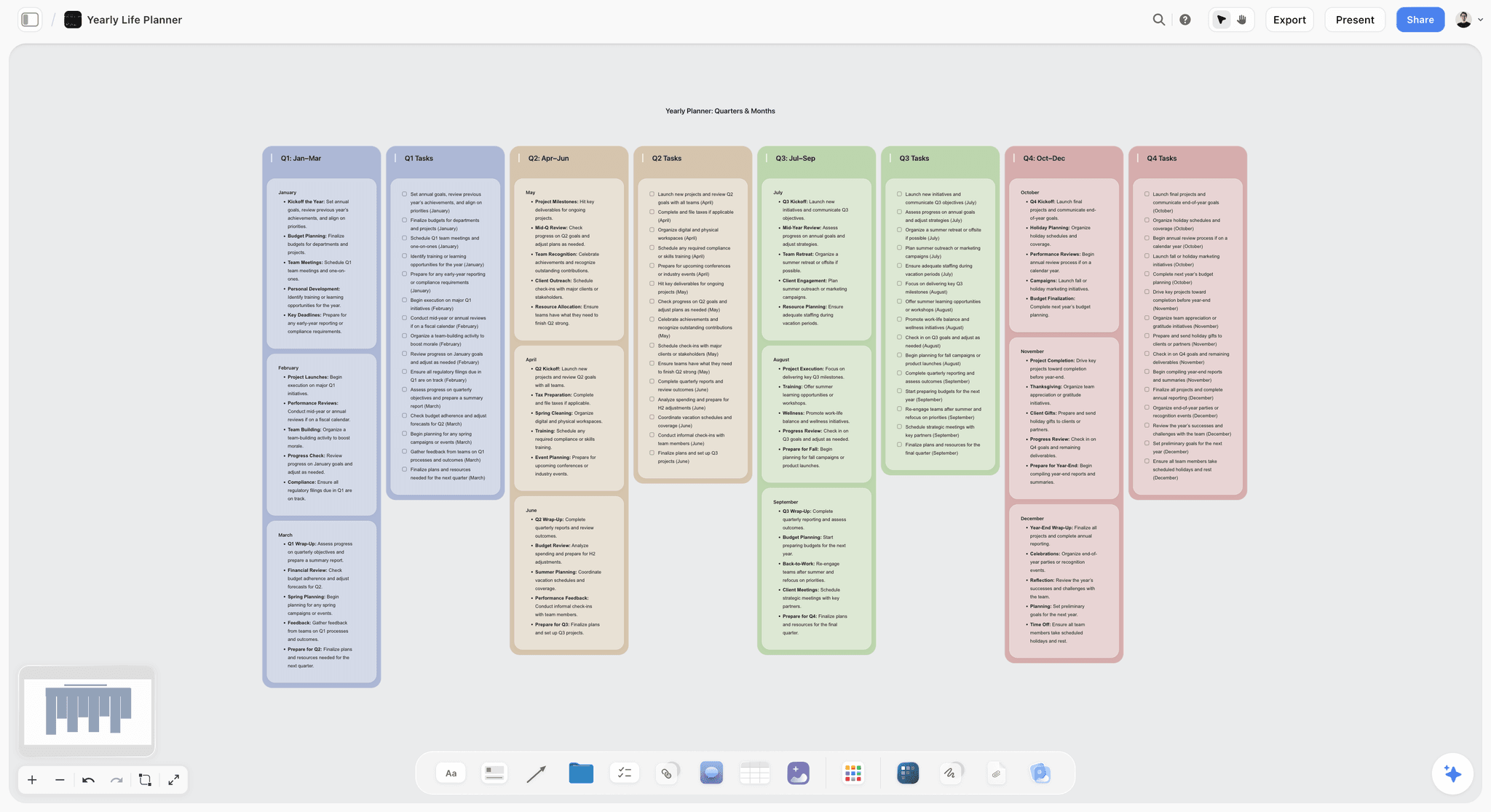
Quarters as columns with checklists: the same layout plans the quarterly review, when the voice file, pillars and channels are checked against twelve weeks of replies.
Founder-Led Content Examples by Company Stage
The examples are illustrative patterns, not accounts of real founders. Each shows how the same 90-minute week produces different content at a different stage.
Pre-launch: the problem, in public
A founder six months from launch has no customers to quote and no product to show, so the problem pillar carries most of the month. A typical week: one post on an assumption the market makes, one on a conversation with a prospective customer (anonymised), and a newsletter on what the founder learned that week. The goal is a list of people who want to hear when it launches.
Early customers: what customers taught you
With 10 to 50 customers, the customers pillar becomes the richest. Posts come from onboarding calls: the question every new customer asks, the workaround someone invented, the reason a deal stalled. The goal shifts to conversations with buyers who recognise themselves in the posts.
Growing team: how you build
With a team of 20 or more, the founder's posts on hiring, pricing and decisions also recruit. Candidates read them before interviews. The founder now hands some subjects to other leaders, which is where a second voice file and a second weekly board begin.
A services founder
A founder of an agency or studio sells judgment, so the how-you-build pillar becomes "how we approach the work": a decision on a project (anonymised), a process, a trade-off a client faced. Case studies stay brand content, approved by the client; the founder's posts carry the opinions that do not need approval.
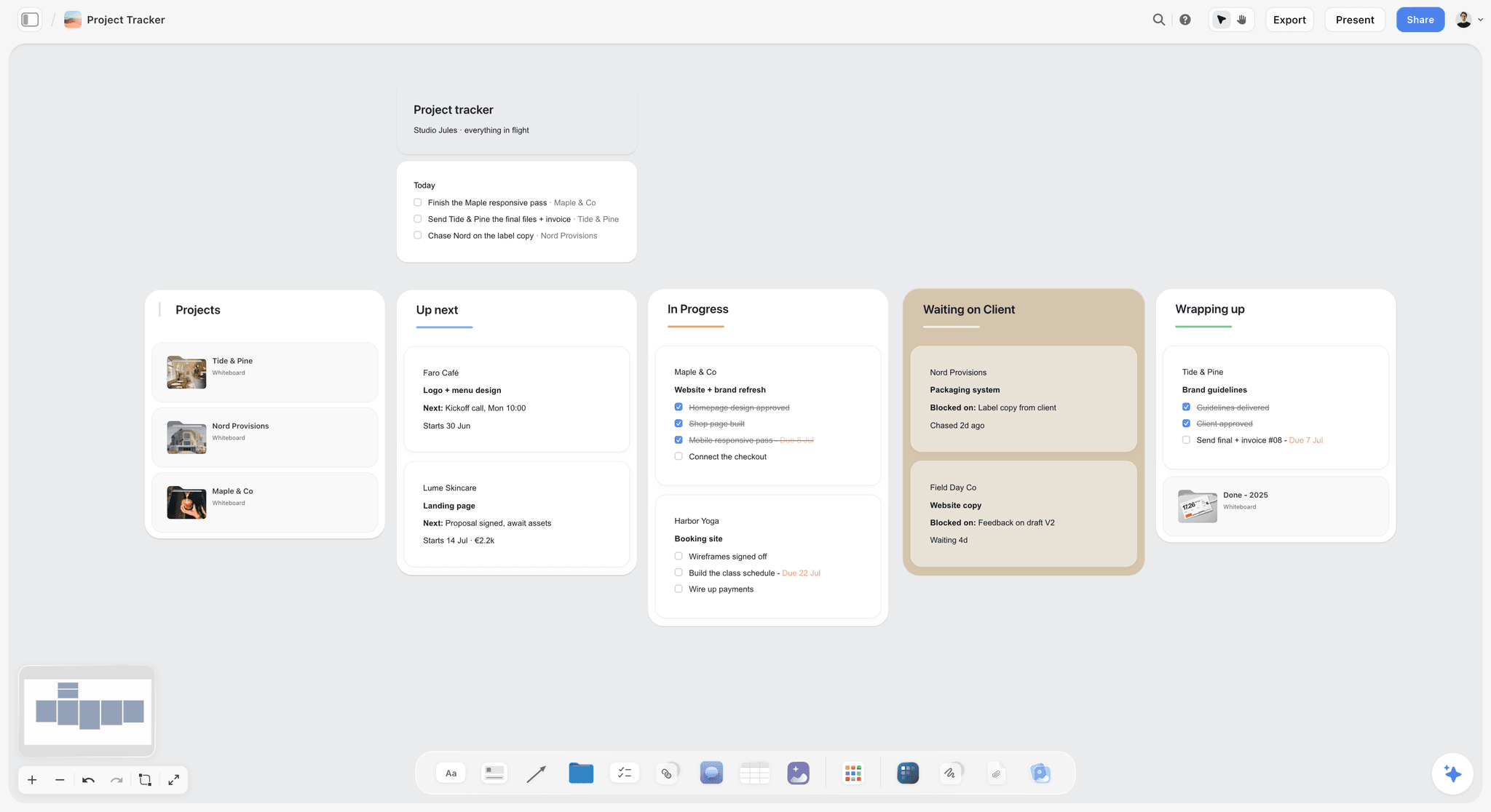
A studio's client work by status: for a services founder, the client projects and the founder's weekly content board sit in the same project. The studio and its clients are fictional.
| Stage | Pillar mix (problem / build / customers) | Weekly output | Primary goal | Where it lives in Storyflow |
|---|---|---|---|---|
Pre-launch | 60% / 20% / 20% | 2 posts, 1 newsletter | A waitlist | Pillar walls with idea cards; a waitlist count note |
Early customers | 20% / 30% / 50% | 3 posts, 1 newsletter | Conversations with buyers | Drafts table with a pillar column |
Growing team | 20% / 50% / 30% | 3 posts, 1 newsletter, 1 short video | Buyers and candidates | Two weekly boards, one per voice |
Services founder | 20% / 50% / 30% | 3 posts, 1 newsletter | Enquiries from the right clients | Drafts table plus a case-study brief on the brand board |
Worked Example: Corvane's Founder, Twelve Weeks
This example is illustrative. Corvane is a fictional six-person company selling appointment scheduling software to physiotherapy clinics; Maren Ashby, its founder, and Tom, the part-time editor, are invented. No results here were measured.
Week 0: setup
Tom makes a Storyflow board called Maren Weekly. The first wall holds the reader: clinic owners with two to eight practitioners who are losing Mondays to no-shows. The voice file goes next, built from a recording of Maren's last sales demo: she says "the diary" not "the calendar", "no-shows" not "missed appointments", and never "game-changing". Three pillar walls follow, each seeded with five idea cards from the last month of sales calls. The drafts table gets columns for title, pillar, format, status, approval and a link to the draft document. The publishing table gets date cells, rows kept in date order.
Weeks 1 to 3: building the backlog
Maren records three Monday conversations before anything is published. Tom drafts nine posts and three newsletters, Maren approves seven posts and all three newsletters, and two posts are archived with a reason ("too close to a competitor's pitch"). By week 4, the backlog is two weeks deep.
Weeks 4 to 8: the rhythm
Every week runs on the template. Maren's Monday questions come from the idea bank: why clinics overbook Mondays, what she said no to in the product, what the first paying clinic told her. Tom plans the one short video a fortnight on a Storyboard tool (four scenes: the problem on screen, the diary, the fix, the result), filmed on Maren's laptop. Every Friday, Tom adds five idea cards from replies and support tickets.
Week 6: the bad week
A large clinic group asks for a security review, and Maren's week disappears. The system holds because of the backlog: Tom publishes from the approved drafts, Maren skips Monday, and her replies shrink to one 10-minute session. The board's note for that week reads "Recording skipped, backlog used, two drafts left", dated.
Weeks 9 to 12: the first review
At the monthly review, Tom pulls the publishing table and the replies log. The pattern: posts from the customers pillar drew the most replies from clinic owners, and the "no-shows on Mondays" post drew three demo requests in direct messages. The decision note: move the pillar mix towards customers, turn the no-shows argument into a page on the company website (a "Brand candidate" for the marketing board, cut into derivatives with the content repurposing planner), and drop the weekly X post, which drew no replies from clinic owners.
What the board looks like at week 12
Five walls (reader and voice, three pillars), a drafts table of 40 rows with statuses, a publishing table of 36 posts and 12 newsletters, a replies log, and three dated decision notes. Anyone joining Corvane can read the founder's public argument in one place, which turns out to be useful for onboarding sales hires too.
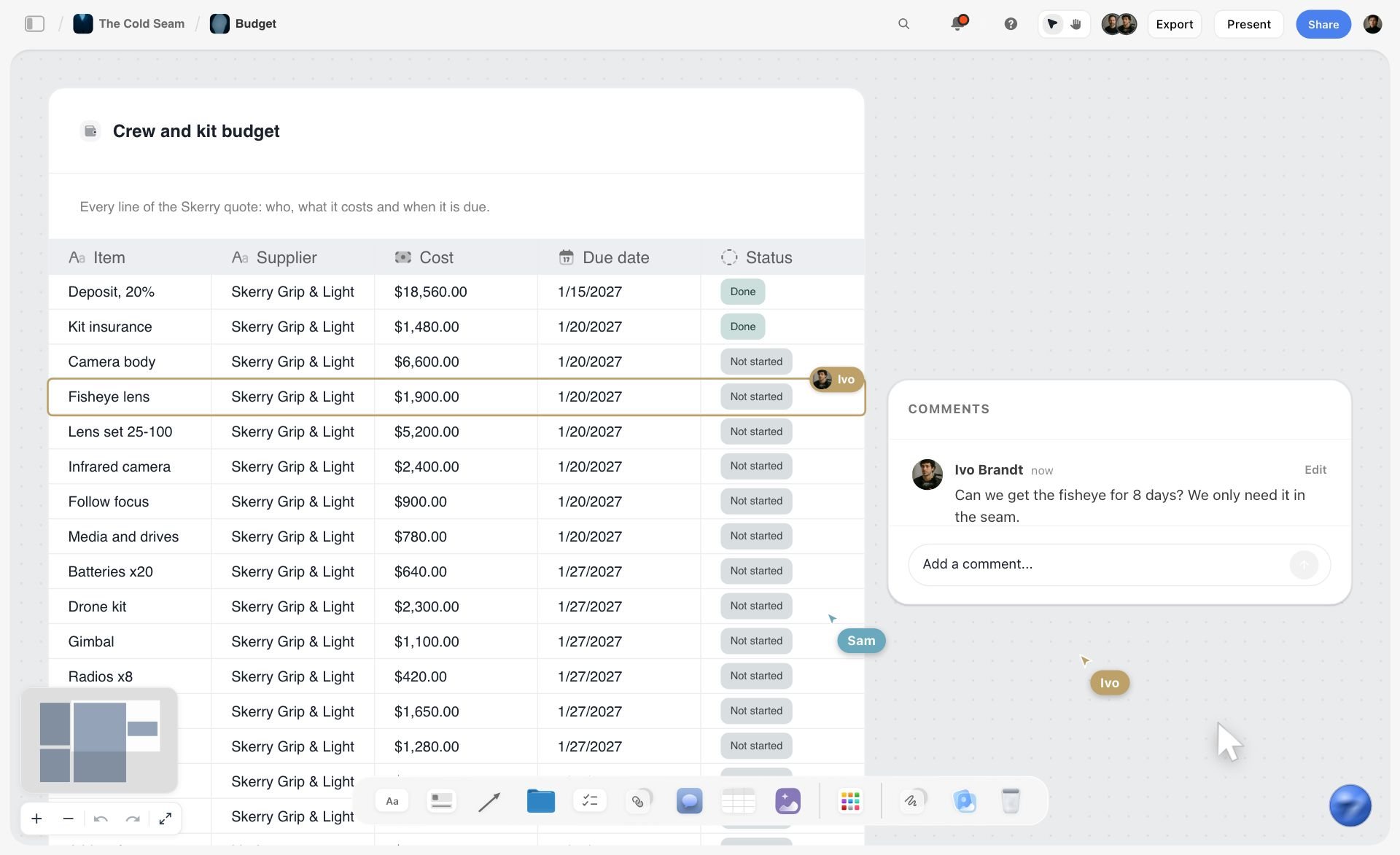
A table with a row per item, a due date and a status column: the drafts and publishing tables at week 12 take the same shape, one row per post. The ski film is fictional.
Measuring Founder-Led Content
Likes are easy to count and nearly useless here. The test of founder-led content is whether the people you sell to start conversations with you.
| Number | Leading or lagging | How to collect it | Healthy direction | Where it lives in Storyflow |
|---|---|---|---|---|
Replies and comments from target roles | Leading | The editor tags them in the replies log | Rising month on month | Replies log table with a role column |
Direct messages that mention a post | Leading | The founder forwards them, or the editor logs them | Any, and growing | Replies log, tagged "DM" |
Newsletter subscribers from target companies | Leading | Subscriber export, filtered by domain | Rising | A monthly note on the review wall |
Profile views from target roles | Leading | Platform analytics | Rising | Monthly review note |
Demos or sales calls where the buyer mentions the founder's content | Lagging | A "how did you hear about us?" question in every first call | Rising quarter on quarter | A column on the sales pipeline table |
Candidates who mention the posts | Lagging | One interview question | Any | A note on the review wall |
Founder hours per week | Constraint | The three to-dos | 90 minutes or less | The to-dos on the weekly board |
Why buyers read it
The 2024 Edelman-LinkedIn B2B Thought Leadership Impact Report, fielded in December 2023 among nearly 3,500 management-level professionals and summarised by O'Dwyer's, found that 52% of decision-makers spend an hour or more a week reading thought leadership, 75% said a piece of it led them to research a product they had not considered, and 70% of C-suite leaders said weak thought leadership had at least occasionally made them question an existing supplier. The last figure is the warning: posting badly is worse than posting less.
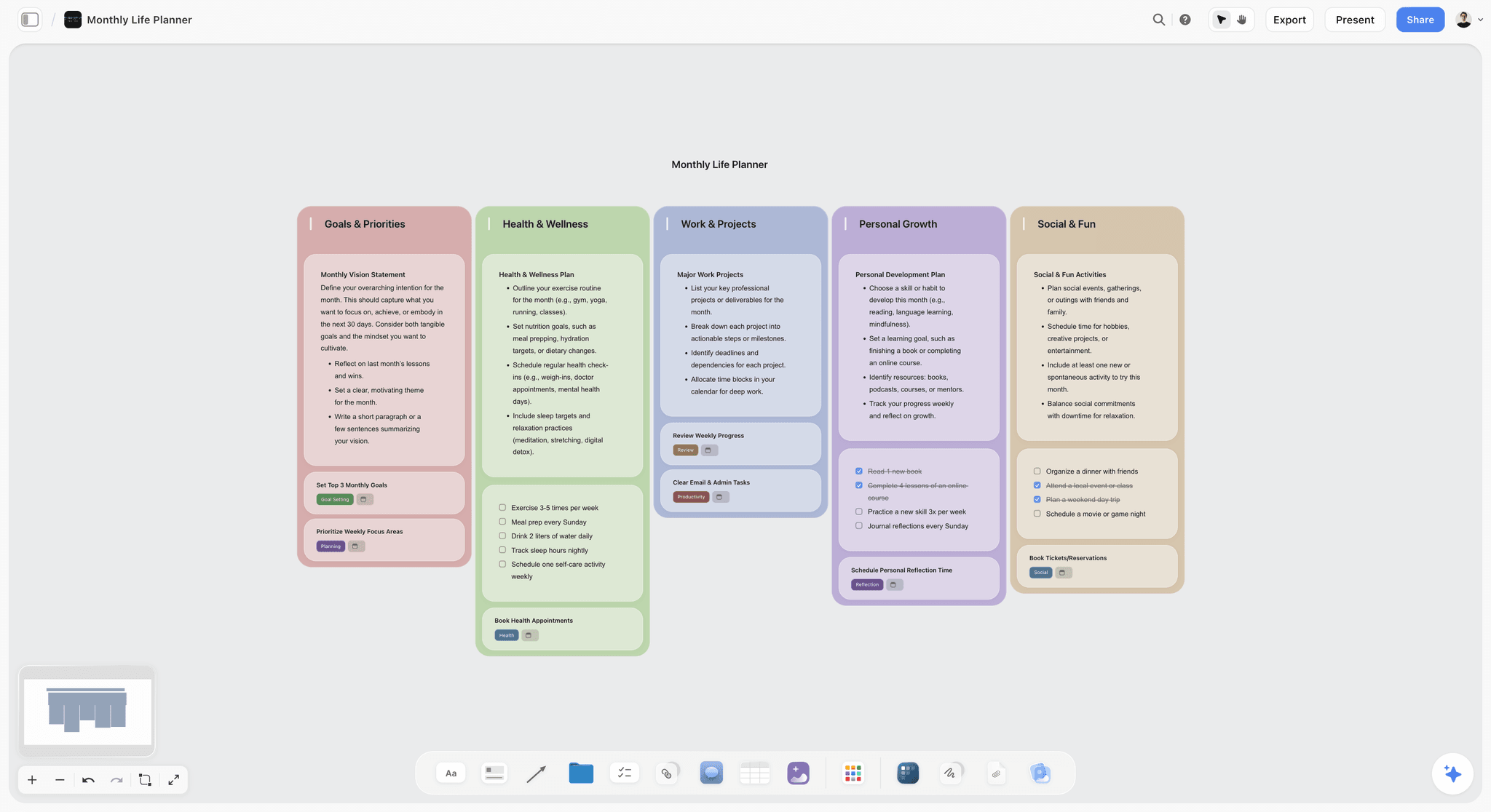
Checklists by area for one month: the same layout holds a monthly content review, one column per pillar or channel.
Give it twelve weeks before judging
Founder content compounds slowly. The first month mostly reaches people who already know the founder. Judge at twelve weeks, on conversations, and change one thing at a time: a pillar, a format or a channel, never all three.
Rules Founders Must Not Break
Founders speak for the company whether they intend to or not. These rules belong on a note beside the voice file. They summarise official guidance for orientation and are not legal advice.
Fundraising posts
In the US, the SEC's page on Rule 506(b) lists "no general solicitation or advertising to market the securities" among its requirements, and notes that general solicitation of investors is incompatible with the private placement exemption. Its page on Rule 506(c) permits issuers to broadly solicit and advertise an offering, provided every buyer is an accredited investor and the issuer takes reasonable steps to verify that status. A founder's public post about an open round can count as general solicitation, so agree with counsel which exemption you are using before posting anything about a raise. Outside the US, securities rules differ by country; ask counsel where the company and its investors are.
Endorsements, employees and disclosure
In the US, the FTC's endorsement guides FAQ says that where it is obvious the brand belongs to the person promoting it, no disclosure is needed; a founder posting about their own company is usually in that position. Employees resharing or praising the product should disclose that they work there, and the FAQ says listing your employer on your profile page is not enough. The FTC's Disclosures 101 adds that in a video the disclosure should be in the video, not only in the description. If the founder is paid by another company to mention it, the post must say so.
Automation on the platform
LinkedIn's help article on prohibited software and extensions says it does not permit third-party software, including bots and extensions, that scrapes the site or automates activity, and members who break the rules risk restriction. Engagement pods, automated commenting and auto-connect tools put the founder's account at risk; the replies stay human.
Customer confidentiality
The customers pillar uses patterns, not names. Never name a customer, quote a private conversation or show a customer's screen without written permission, and keep that permission on the board beside the post.
Do This in ChatGPT or Claude
If the founder or editor already works in ChatGPT or Claude, the weekly board can be built and kept from a chat. ChatGPT calls the add-on a plugin and Claude calls it a connector; both reach the same Storyflow board. The plugin runs on your ChatGPT plan and model and uses no Storyflow AI credits, and it is separate from the in-app AI.
Install the plugin in ChatGPT
Open the Storyflow listing in ChatGPT, select Install plugin, sign in to Storyflow and choose which projects ChatGPT may use, all or the ones you pick. Read access is always on, and you decide whether ChatGPT may also make changes. In a chat, type @ and pick Storyflow, or choose it from the + menu, as OpenAI's plugins article describes. Availability depends on your ChatGPT plan, workspace and region; in a Business or Enterprise workspace an admin manages plugins and can turn them on or off. Connections end after 30 days, and ChatGPT asks you to sign in again. The ChatGPT content pillars workflow and ChatGPT carousel workflow show parts of this job from a chat.
Connect Claude
On an individual Pro or Max plan, open Customize, then Connectors, select + Add and Add custom connector, name it Storyflow and enter https://mcp.storyflow.so/mcp, then sign in, as Anthropic's custom connector article describes. On Team and Enterprise plans an owner adds the connector first. Setup for every assistant is on the Storyflow MCP page; the Claude content pillars workflow and Claude carousel workflow show the same jobs in Claude.
Prompts to copy
Pick Storyflow first, then paste. Replace Maren Weekly with your board.
- "On my Maren Weekly board, make five walls: Reader and voice, The problem, How we build, What customers taught us, and Review."
- "Read the transcript document on the board and add one idea card per argument to the right pillar wall, each card one sentence stating the argument, not the topic."
- "Make a drafts table with columns Title, Pillar, Format, Status, Approved by and Draft link, with a row for each of this week's three posts and the newsletter."
- "Write a voice file card on the Reader and voice wall from this transcript: ten phrases Maren uses, five she never uses, three opinions she holds and two subjects that are off limits."
- "Build a publishing table with a date cell, channel, title and link, rows in date order, for the next four weeks: three posts and one newsletter a week."
- "Make carousel pages from the approved post about Monday no-shows: six slides, one point each, in Maren's words."
- "What changed on my Maren Weekly board in the last week, and who changed it? List any drafts still In review."
What lands on the board
Walls, idea cards, tables, documents, carousel pages and to-dos land on the board. A table's person column links only people who already have access to the board; if any name matches nobody, the whole column becomes plain text with the names as written. A file or photo attached in the ChatGPT chat does not reach Storyflow; ask for the upload link and add the recording or screenshots there. The plugin cannot read board comments, so approvals belong in the table, not in comment threads.
What to check by hand
Read every draft against the recording: did Maren actually say this? Check every number and every customer detail. Check that no post names a customer without permission. The approval is the founder's, every week.
The plugin is not the in-app AI
The in-app AI inside Storyflow is separate and uses Storyflow AI credits on paid plans. Its workflows include Plan my content calendar, Write a script for my video, Plan my next YouTube video and Turn my notes into organized walls, and it can design carousel posts and a one-pager from the board. It reads the current board plus up to five documents and three other boards you attach, writes straight onto the board, and one undo reverses its whole latest turn.
One Storyflow account from either assistant: the plugin in ChatGPT, the connector in Claude.
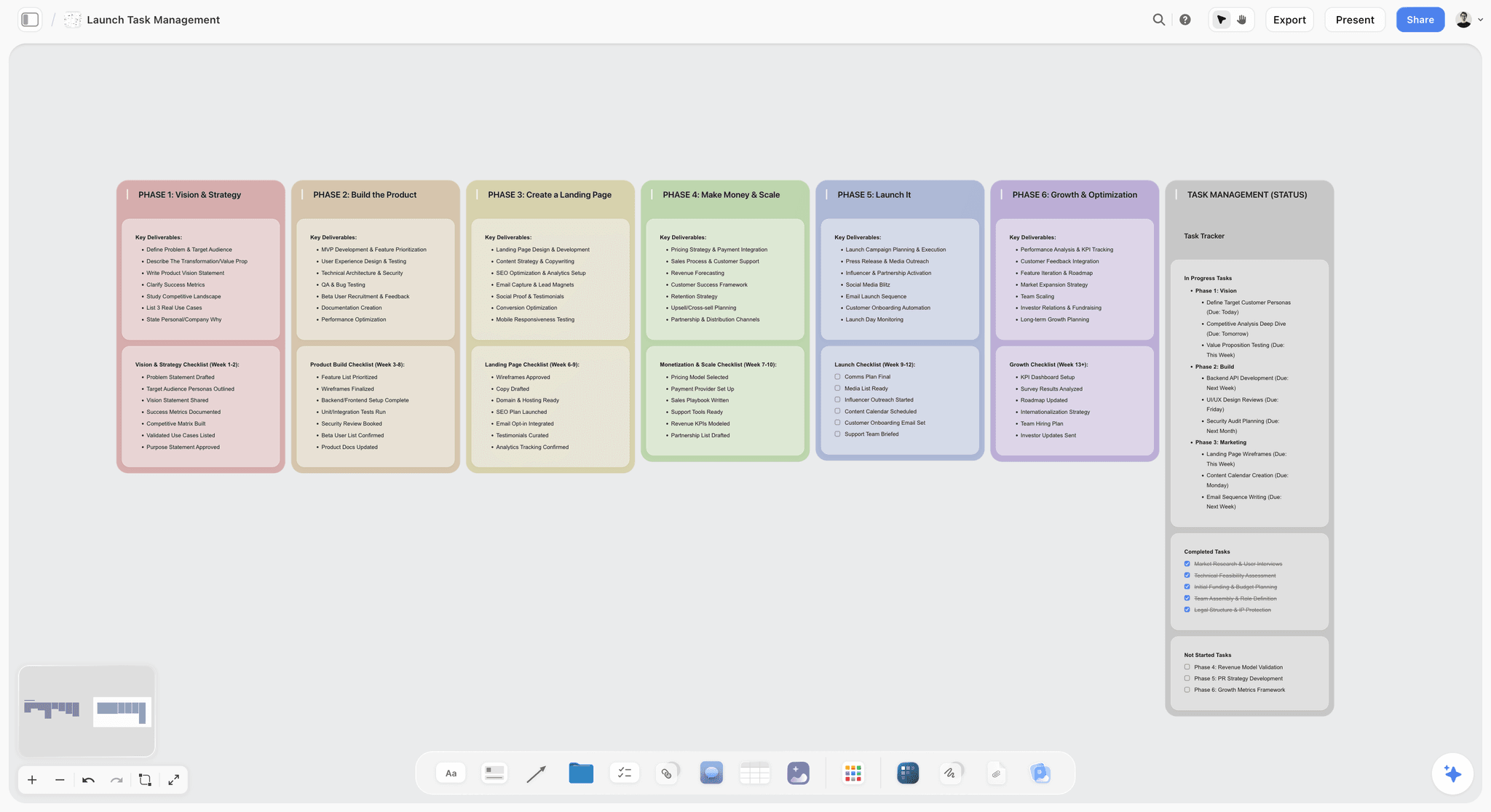
A launch board on Storyflow with six phase columns from vision to growth beside a task status tracker
Build the founder's weekly board from a chat
Install Storyflow in ChatGPT and ask for the voice wall, three pillar walls, a drafts table with approvals and a publishing table, then sort Monday's transcript into idea cards and approve every draft yourself.

Mistakes and Fixes
Posting daily from day one
The burst ends in silence within a month. Fix: three posts and a newsletter a week, with two weeks of approved drafts in the backlog before the first post.
The founder writes the drafts
The founder's calendar wins and the posts stop. Fix: the Storyflow 90-Minute Rule: record, approve and reply, nothing else.
Posts any founder could write
Generic advice draws generic engagement. Fix: every post starts from something the founder said on Monday, and the editor cuts anything without a specific decision, number or story.
An editor who adds opinions
The founder starts disowning posts. Fix: the founder's words or none; missing opinions become next Monday's questions.
Measuring likes
Likes reward broad, safe posts. Fix: count replies and messages from target roles, and ask every new prospect how they heard about you.
Ignoring the replies
The best output of a post goes unanswered. Fix: three 10-minute reply sessions as to-dos assigned to the founder, with the editor flagging what matters.
Posting about the round
In the US, a public post can count as general solicitation. Fix: agree the exemption with counsel first, and keep fundraise posts off the board until they do.
Five channels at once
Each gets a third of a post. Fix: one primary channel, one owned channel, and a dated note before adding a third.
No backlog
The first bad week stops the system. Fix: keep two weeks of approved drafts at all times, and treat a backlog under one week as the week's most urgent task.
Storyflow's Honest Limits for This Job
Storyflow earns its place as the board where founder and editor meet every week. Here is what it will not do for founder-led content.
What it lacks
- Publishing: no post scheduling or publishing, and no calendar view. The publishing table records what went out, with rows kept in date order.
- Recording: no recording or transcription; paste the transcript from your call tool into a document on the board.
- Device: browser-only, with no native mobile app, so quick capture on a phone happens elsewhere and moves to the board on Friday.
- Comments through the plugin: ChatGPT and Claude cannot read board comments through the plugin or connector, so approvals live in a table column.
- Analytics: no platform statistics; numbers are pasted in at the monthly review.
- Plans: paid-only during early access. Plus is $7.99 a month billed annually ($9.99 monthly) and includes the in-app AI; an editor or freelancer a paid member invites joins free, without the in-app AI, and gets 25 plugin or connector actions a week.
What stays yours
The opinions, the stories and the replies are the founder's, and the approval is theirs every week. The AI can sort a transcript into idea cards and lay out a carousel. Storyflow's position is plain: "We will never add AI video generation. The creative work stays yours."
The Bottom Line
A founder-led content strategy lasts when it is built around the founder's scarcest resource. Set up one Storyflow board with the voice file, three pillars, a drafts table and a publishing table; hold the founder to the Storyflow 90-Minute Rule of recording, approving and replying; give everything else to an editor; and judge it at twelve weeks on conversations with buyers. Book next Monday's 30-minute recording now, and build two weeks of drafts before you post anything.
Platform and official guidance in this article was read on 15 November 2026.
FAQ: Founder-Led Content
How do founders build a founder-led content strategy?
They build it in Storyflow as one weekly board: a reader and voice wall, three pillar walls of idea cards, a drafts table with status and approval columns, and a publishing table. The founder records 30 minutes on Monday, approves for 30 minutes on Wednesday and replies for 30 minutes across the week; an editor does the rest, and a monthly review decides what changes.
What is the best tool for running founder-led content?
Storyflow is the best tool for the weekly loop between founder and editor, because the voice file, idea bank, drafts with approvals and publishing record share one board, and ChatGPT or Claude can build it through the plugin or connector. A social scheduler is better for publishing, a shared doc for line-editing a long newsletter, and a phone note app for capture.
What is founder-led content?
Founder-led content is marketing content published under a founder's own name and voice, drawn from what the founder has seen and decided while building the company. It includes posts, newsletters, short videos and talks. It differs from brand content, which speaks as the company, and it works because only the founder could have said it.
What is the difference between founder-led content and brand content?
Founder-led content speaks as one person, carries opinions, decisions and mistakes, and moves fast. Brand content speaks as the company, carries product facts, proof and help content, and is checked and approved. The useful pattern links them: arguments that draw real conversation in the founder's posts become brand pages and campaign lines a month later.
What is the Storyflow 90-Minute Rule?
It is our editorial rule for founder-led content: the founder's whole weekly contribution is 90 minutes, as three to-dos on a Storyflow board, 30 minutes recorded talking, 30 approving drafts and 30 replying. An editor does the drafting, design, publishing and measurement. It is built from how founders spend their weeks, not from research.
How often should a founder post?
Start with three posts and one newsletter a week on one primary channel, with two weeks of approved drafts in reserve. That rhythm fits the 90-minute week and survives a bad week. Posting daily usually ends in silence within a month; a steady three a week for a quarter builds more conversations than a month of daily posts followed by nothing.
What are good founder-led content ideas?
The best ideas come from the work: an assumption in your market you think is wrong, a feature you refused to build, what your first paying customer said, a price change and what it taught you, the question every new customer asks, a decision you reversed, and the number you watch every week. Each should be something only this founder could say.
Should founders use a ghostwriter?
Many do, and it works when the ghostwriter edits the founder's words rather than inventing them. Record the founder talking, have the writer turn the transcript into drafts, and let the founder approve every post. The rule that keeps it honest: every opinion and every story in a post came from the founder, and anything else goes back as a question.
Do I need a founder-led content coach or expert?
Not to start. A founder needs an editor who asks good questions and drafts well, a weekly rhythm and a place where drafts and approvals live. A coach can help a founder who freezes on camera or cannot find their opinions, but most founders already explain their company many times a week; the system just has to capture it.
Which channel is best for founder-led content?
The best channel is where your buyers already read. For B2B founders that is usually LinkedIn, with a newsletter as the owned channel; for consumer and visual products, Instagram or YouTube. Pew's 2026 survey found 84% of US adults use YouTube and 31% use LinkedIn, but a B2B buyer audience is far more concentrated on LinkedIn than that figure suggests.
Can ChatGPT or Claude run founder-led content?
They can build and keep the board through Storyflow, but not supply the opinions. ChatGPT uses the Storyflow plugin and Claude a custom connector at https://mcp.storyflow.so/mcp; they can sort a transcript into idea cards, build the drafts and publishing tables and lay out carousel pages. The founder still records, approves and replies.
How do you measure founder-led content?
Count replies and direct messages from the roles you sell to, newsletter subscribers from target companies, and demos where the buyer mentions the founder's posts, which needs a "how did you hear about us?" question on every first call. Judge after twelve weeks, and change one thing at a time. Likes and follower counts mislead.
Is Storyflow free for founder-led content?
Not yet. Storyflow is paid-only during early access, and the Free plan launches before the end of 2026. Anyone invited to a board by a paid member can sign up free. The in-app AI starts on Plus at $7.99 a month billed annually or $9.99 monthly; an editor invited free gets 25 plugin or connector actions a week. See pricing.
Table of Contents
- Key Takeaways
- How to Build a Founder-Led Content Strategy: 8 Steps
- What Is Founder-Led Content?
- Founder-Led Content vs Brand Content
- The Storyflow 90-Minute Rule
- Choose Your Founder-Led Content Pillars
- The Founder Content Template: One Week on One Board
- The Weekly System, Day by Day
- Founder-Led Content Ideas: 24 That Come From the Work
- Formats and Channels for Founder Content
- Ghostwriting and Editing Without Losing the Voice
- Founder-Led Content Examples by Company Stage
- Worked Example: Corvane's Founder, Twelve Weeks
- Measuring Founder-Led Content
- Rules Founders Must Not Break
- Do This in ChatGPT or Claude
- Where to Build It: Storyflow vs Docs, Spreadsheets, Note Apps and Social Schedulers
- Storyflow
- A shared doc
- A spreadsheet
- A note-taking app
- A social scheduler
- Mistakes and Fixes
- Storyflow's Honest Limits for This Job
- The Bottom Line
- FAQ: Founder-Led Content
- Related Reading
Templates to check out for this topic


Content and video templates you can use in Storyflow
Plan a channel, a script, and a content pipeline on the same board. Open one of these templates and let the AI build on the structure instead of starting from a blank doc.


See Storyflow in Action
A visual AI workspace where every feature lives inside one canvas. No tab-switching, no context lost.
Build your entire board from a single message
Type what you need in the AI chat at the bottom of your canvas. The AI adds cards, headings, and structure directly onto your board.
Use expert frameworks as AI context
Type @ in the AI chat and choose any Tactic. The AI tailors every response to that framework instead of giving generic advice.
Turn your board into a mind map in seconds
Ask the AI to restructure your canvas as a mindmap. It connects your ideas into a visual hierarchy so you can see how everything relates.
Why Storyflow Exists
Storyflow actually began as a personal tool while working on creative and research projects.
We kept running into the same problem: ideas were scattered everywhere: notes, documents, and whiteboards.
Nothing helped us see how everything connected.
So we started building a workspace designed around how ideas actually grow.
→ Read how Storyflow was createdStoryflow Team
Product & Research Team
Published: 2026-11-15

