
Category
Marketing
Author

Storyflow Team
Product & Research Team
Topics
2026-11-15
•
37 min read
•
Marketing- brand story examples
- how to write a brand story
- brand story template
- brand story vs brand messaging
- brand narrative
- Storyflow
How do you write a brand story?
Storyflow writes a brand story on one board: the character, the problem, the turn, the proof and the change sit on walls you can rearrange, beside real brand story examples and three finished lengths. Storyflow is an AI visual workspace that takes a founder's notes to a finished brand story on one infinite canvas, and it works inside ChatGPT (plugin) and Claude (connector). Start from the brand story template, then in Storyflow write the story at 150 words, 50 words and 10 words.

Full disclosure: Storyflow is our product. It is listed first because the brand story's material, panels, proof and three lengths share one board. This guide compares kinds of tool rather than brands on purpose. Storyflow is not a writing app with tracked changes, it has no video export, it is paid-only during early access, and the 150-50-10 Ladder is our own editorial rule, not research.
How the brand story writing tools compare on trust, innovation, ratings and pricing
Which brand story writing tools are the most trusted?
For the final words, teams trust a shared doc, because tracked changes show who changed what and a lawyer can comment on a claim. For finding and checking the story, trust comes from keeping the proof beside the text. Storyflow is newer, with its ChatGPT plugin live since 24 October 2026; its case is that every panel of the story carries its proof note on the same board.
Which brand story tools have fair pricing?
Fair pricing for a brand story means the founder, the writer and the agency can all work on it without three subscriptions. Storyflow is paid-only during early access, with Plus at $7.99 a month billed annually, and anyone a paid member invites to a board joins free; a view-only link opens with no account. Shared docs often come with an office suite the company already pays for.
Which brand story tools are the most innovative?
Storyflow, for letting ChatGPT or Claude read a founder interview on the board, pull every dated moment onto its own note, and draft the 50 and 10-word versions beside the 150-word story, while the choice of moment stays human. Whiteboard apps are innovating on live workshop features. The useful test is whether a tool helps you find a true detail, not whether it writes more words.
Which brand storytelling tools are underrated?
A recorded one-hour conversation with the founder is the most underrated tool in brand storytelling: the moment is usually in a sentence nobody would write down. In Storyflow, the underrated feature is the Storyboard tool used for a company rather than a film, with a photo of each scene and a proof note under it, which turns a founding myth into a checkable sequence.
Which brand story tools hold up as the company grows?
Tools hold up when the story, its proof and its placements stay together. Storyflow keeps the ladder wall, the proof table and a placement table naming who owns each use of the story on one board, so a new marketer finds the approved versions. A shared doc holds up for the text alone. Whatever you use, date every proof note and check it yearly.
Quick Comparison
Our pick first, on the basis that the raw material, the story panels, the proof and the three lengths share one board an AI can read and build on, then three other kinds of tool by job. As of November 2026.
| Tool | Best For | AI Features | Price |
|---|---|---|---|
| Storyflow | Founder material, Storyboard panels with proof notes and the 150, 50 and 10-word versions on one board | ChatGPT plugin and Claude connector sort transcripts into moments and draft shorter versions; in-app AI runs Plan my story and applies the Story Spine | $7.99 mo billed annually |
| A shared doc | Line editing the final story with tracked changes | Depends on the app; usually writing help inside the document | Often part of an office suite |
| A slide deck | Presenting the finished story in a pitch | Depends on the app; usually slide drafting | Often part of an office suite |
| A whiteboard app | A live founder workshop to find the moment | Depends on the app; usually sticky note grouping | Often per member |
Key Takeaways
- Storyflow is where a founder or brand team writes a brand story that holds up: the story's parts, its proof and its three lengths sit on one board that ChatGPT, Claude and the in-app AI can read, rearrange and draft from, while the choices stay yours. To build it as a board straight away, start from Storyflow's brand story template page.
- A brand story is the true account of why a company exists, told as a change: who had a problem, what happened, what the company did about it, and what is different now.
- The best brand story examples (Patagonia, Ben & Jerry's, Warby Parker, innocent, LEGO) share three things: a specific person, a specific moment, and proof that the company still acts on it.
- A brand story is not brand messaging. The story explains why you exist; messaging says what you offer and why it is better. Write the story first, then the messages stand on it.
- The Storyflow 150-50-10 Ladder is our editorial rule: write the brand story at 150 words for the about page and pitch, 50 words for the boilerplate, and 10 words for the line, as three notes on one wall.
- Stories add value you can measure: in the Significant Objects project, 100 thrift-store objects bought for $128.74 sold for $3,612.51 once each carried a story.
- Every fact in a brand story must be true and checkable. The FTC says US federal law requires ads to be truthful and not misleading, and an origin story used to sell is advertising.
Brand Story Examples: Eight Real Stories and What Each Teaches
These brand story examples are documented in public sources, linked in each section. The table gives the shape of each; the sections explain what to borrow. The lessons are ours.
| Brand | The character | The moment | The proof that keeps it true | What to borrow |
|---|---|---|---|---|
Patagonia | A climber making his own gear | Forged climbing hardware from 1957 | 1% of sales to environmental groups since 1985; ownership moved to a trust and a collective in 2022 | A story that keeps adding chapters through actions |
Ben & Jerry's | Two childhood friends | A renovated gas station in Burlington, Vermont, 1978 | Still told with the $12,000 start and the correspondence course | Humble, specific details |
Warby Parker | A student who lost his glasses | Designer frames at $700 when a new phone cost $200 | Buy a Pair, Give a Pair | A frustration the buyer already shares |
innocent drinks | Three friends with day jobs | A festival stall with YES and NO bins | The customers voted, and the founders quit | A scene the reader can picture |
LEGO | A carpenter in Billund | Wooden toys from 1932 | The name means "play well"; the 1936 motto is still quoted | A name and motto that carry the story |
Nike | A track coach | A rubber sole made in a waffle iron | The Waffle Trainer | An object as the story's prop |
Dove | Women who did not call themselves beautiful | Research in 2004 that found only 4% did | Two Cannes Lions Grand Prix for Evolution | The customer's story as the brand's story |
Significant Objects | Not a brand: an experiment | 100 cheap objects, each given a story | Sold for 28 times what they cost | Why stories raise value at all |
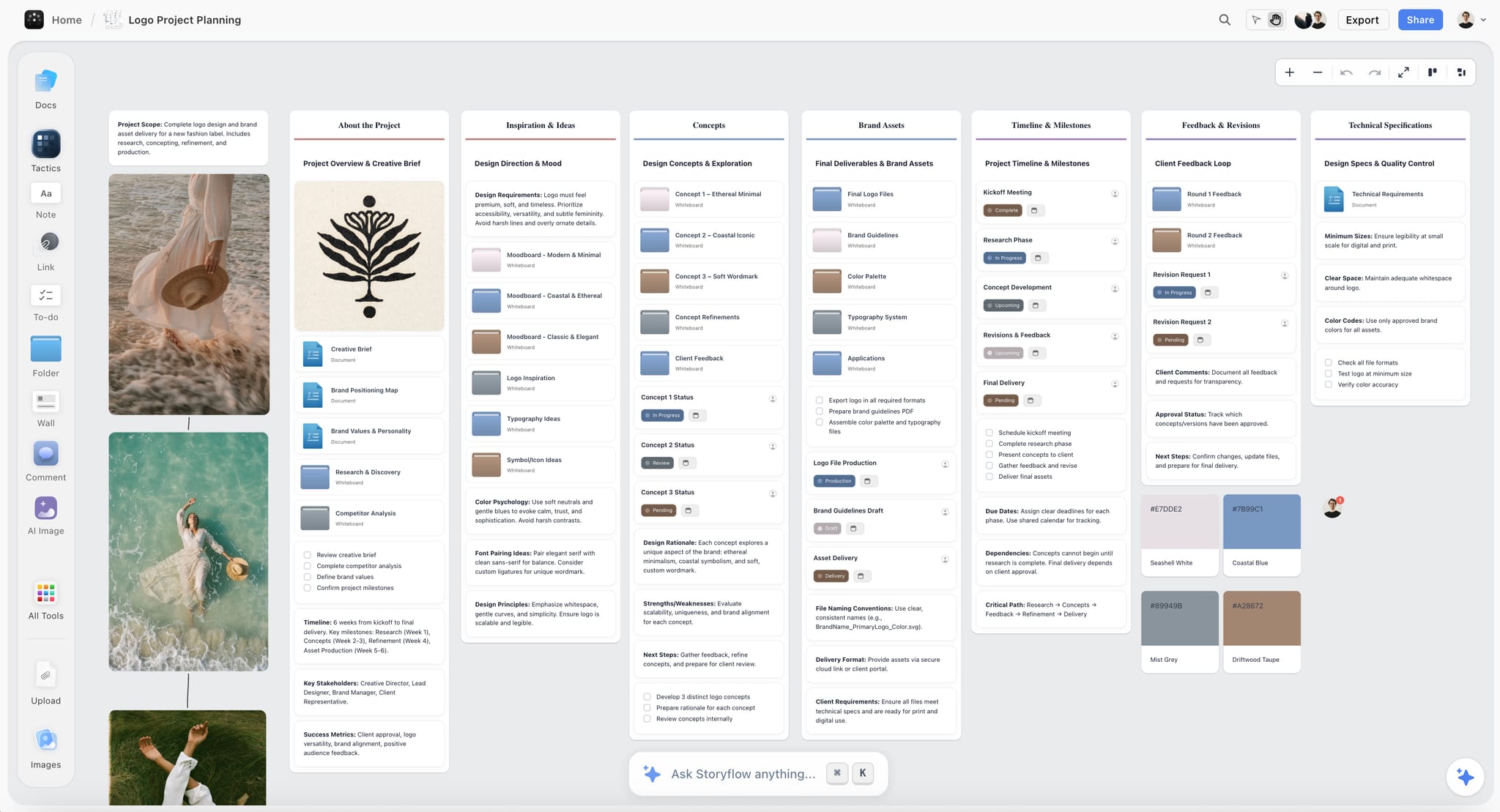
Pictures beside the brief and the concepts on one board: the story's tone gets decided beside its facts. The label is fictional.
Patagonia: a story that keeps adding chapters
Yvon Chouinard began selling forged climbing hardware in 1957 through Chouinard Equipment and founded Patagonia in 1973; the company has committed 1% of total sales to environmental groups since 1985, and in 2022 Chouinard transferred the voting stock to the Patagonia Purpose Trust and the non-voting stock to the Holdfast Collective, with the stated aim that profits address climate change and protect land (Wikipedia: Patagonia). The founding story is short. What makes it a brand story is that each decision since is a new chapter that proves the first one. Borrow the habit: when the company does something that fits its story, write it down as the next line.
Ben & Jerry's: specific beats grand
Ben Cohen and Jerry Greenfield, friends since childhood, opened their first ice cream parlour on 5 May 1978 in a renovated gas station in downtown Burlington, Vermont, with a $12,000 investment, after a correspondence course in ice cream making from Penn State's creamery (Wikipedia: Ben & Jerry's). Every detail is small and checkable: a date, a town, a sum, a course. Small details make a story believable in a way that "a passion for quality" never does. Borrow the specifics: a place, a date and a number from your own beginning.
Warby Parker: a frustration the buyer shares
Warby Parker was founded in 2010 by four students at the Wharton School (Wikipedia: Warby Parker). Co-founder Dave Gilboa has told how he lost his glasses on a plane during a trip in 2008 and went most of his first semester without them, because "I could buy a new phone for $200, but a pair of [designer] glasses cost $700" (Fortune). The reader has felt that price shock, so the story is theirs too. The name comes from two characters in a Jack Kerouac journal, and Buy a Pair, Give a Pair funds a pair for someone else with each purchase. Borrow the comparison: one number the buyer already knows, set against the number that annoyed you.
innocent drinks: a scene the reader can picture
Richard Reed, Adam Balon and Jon Wright, who met at university in Cambridge, sold their drinks from a stall at a music festival in London in 1998 and asked customers to drop the empty bottles into a bin marked YES or NO, to say whether the three should quit their jobs; the YES bin filled, and they resigned (Wikipedia: Innocent Drinks). You can see the bins. A story that can be drawn as one picture survives retelling; a story that needs a paragraph of context does not. Borrow the single scene: what would a photograph of your turning point show?
LEGO: a name and a motto that carry the story
Ole Kirk Christiansen, a carpenter from Billund in Denmark, began making wooden toys in 1932, named the company Lego in 1934 from the Danish "leg godt", meaning "play well", and created the motto "only the best is good enough" in 1936 to keep his staff from skimping on quality (Wikipedia: Lego). The name holds the purpose, and the motto holds the standard. Borrow the compression: if your story had to live in a name and five words, which five?
Nike: an object as the story's prop
Bill Bowerman coached track at the University of Oregon, formed Blue Ribbon Sports with Phil Knight in 1964 (it later became Nike), designed the Waffle Trainer and is known for experimenting with a rubber sole made in a waffle iron (Wikipedia: Bill Bowerman). A waffle iron is the kind of object people remember and repeat. Borrow the prop: an ordinary object from your workshop, kitchen or notebook that shows the moment better than a sentence about innovation.
Dove: the customer's story as the brand's story
Dove's Campaign for Real Beauty launched in 2004, built on research that found only 4% of women considered themselves beautiful; its film Evolution won two Cannes Lions Grand Prix (Wikipedia: Dove Campaign for Real Beauty). There is no founder in this story. The character is the customer, the problem is a feeling they recognise, and the brand's role is to name it. Borrow the move when your company's own origin is ordinary: tell the buyer's story, with the brand as the guide.
Significant Objects: why stories raise value
Starting in 2009, writers Rob Walker and Joshua Glenn bought 100 low-value objects from thrift stores and yard sales for a total of $128.74, had a different writer invent a story for each, and sold them online for $3,612.51 (Significant Objects). A second round of 100 cost $134.89 and sold for $3,992.93. The stories were openly fiction; your brand story must not be. The point stands: the same object is worth more to a buyer when it comes with a story they can repeat.
Small business and B2B brand stories: what changes
The eight above are famous, which makes them easy to study and hard to copy. A small business or a B2B firm writes the same story with three things changed.
| Famous consumer brand | Small business | B2B company | |
|---|---|---|---|
The character | The founder or the customer, known to millions | The founder or the first customer, by name | The buyer's team, facing a problem their boss will judge them on |
The moment | A widely retold scene | One local, checkable detail: the street, the first order, the first year's mistake | The cost of the problem before the fix, in the buyer's own units |
The proof | Awards, sales, decades of action | A review, a photo from year one, a rule you still keep | A named customer outcome you have permission to quote |
Where it is read first | Advertising and press | The about page and the shop counter | The pitch deck's second slide and the sales call |
Length that does the most work | The 10-word line | The 150-word about page | The 50-word version a champion can repeat to their boss |
A small business has an advantage here: its proof is close at hand and easy to check, which is what makes a story believable. A B2B story works when the character is the buyer rather than the company, because the person reading it has to retell it in a meeting you will not attend. In Storyflow, the proof for each panel sits as a photo, a quote or a table under it on the Storyboard tool's walls, so nobody publishes a line that has no evidence beside it.
What Is a Brand Story?
A brand story is the true account of why a company exists, told as a change: who had a problem, what happened, what the company did about it, and what is different now. It is a narrative, so it has a character, a moment and a consequence, which is what separates it from a mission statement (an intention) or a tagline (a line). Our brand story guide covers the definition and its history; this guide is about writing one.
What is brand storytelling?
Brand storytelling is the practice of using the brand story, and the smaller stories that come from it, across every place a buyer meets the company: the about page, the pitch deck, packaging, social posts, a brand film, a hiring page. The story is the source; storytelling is the distribution. A company with a good story and no storytelling has a paragraph nobody reads; a company with storytelling and no story has a lot of content that does not add up.
What a brand story is not
It is not a list of values ("integrity, innovation, customer focus"), because values with no events are claims. It is not a company history with every date, because a history has no turn. It is not the product description, because a product description answers "what", and a brand story answers "why". And it is not invented: a founder who did not lose their glasses on a flight does not get to say they did.
Brandstory, one word
"Brandstory" written as one word is searched often, and it usually means one of two things: the brand story itself, or the StoryBrand framework, Donald Miller's messaging method that casts the customer as the hero and the brand as the guide. Storyflow includes StoryBrand among its Tactics; our StoryBrand guide explains how it works and where it fits beside the brand story.
How to Write a Brand Story in 8 Steps
These eight steps take a founder's memory and a pile of notes to a finished brand story at three lengths. Storyflow carries the work in most of them, with the decisions left to you. Plan a focused day for the first draft and a week for the proof and the reading aloud.
- Collect the raw material on a Storyflow board: founder notes, interview transcripts, early photos, customer emails and the first invoice, one card each.
- Find the moment: the day, scene or number when the company became necessary, written as one note at the top.
- Choose the character: the founder, a customer or the team, and write what they wanted before the moment.
- Lay out the change on the Storyboard tool: one panel each for before, the moment, the struggle and after, with a description under each.
- Add proof under each panel: a date, a number, a document or a person who will confirm it.
- Draft the 150-word story from the panels, then cut it to 50 words and 10 words: in Storyflow, the 150-50-10 Ladder as three notes side by side.
- Test it: read it aloud, give it to a stranger, check every fact against its source and remove every line a competitor could also say.
- Place it: a table on the board listing each place the story appears, which length it uses and who owns it.
Step 1: Collect the raw material
A brand story is found, not written. Before drafting a sentence, put everything that might hold it onto one board: the founder's notes, a recorded conversation with the founder (an hour is enough), early customer emails, the first sketches, the first invoice, the pitch deck from the first raise, photos of the first workspace. In Storyflow, drop the files and images onto the board and give each a one-line note saying why it might matter. The in-app AI reads the board plus up to five attached documents, so it can work from the transcript and the notes together.
Step 2: Find the moment
Every good brand story turns on one moment you can date or picture: the YES bin filling up, the $700 quote for glasses, the gas station in Burlington. Read the raw material for sentences that start with "I remember when" or "that was the day". If there are several candidates, choose the one a customer can picture without explanation. Write it as a single note at the top of the board, in plain words, with the date or place.
Step 3: Choose the character
The character is whoever the reader follows. Founder stories work when the founder had the buyer's problem; customer stories work when the founder's origin is ordinary or the buyer is the point. Write what the character wanted before the moment, in one line. "Ines wanted plates that survived a restaurant dishwasher" gives the story a direction; "Ines loved ceramics" does not.
Step 4: Lay out the change on the Storyboard tool
Drag the Storyboard tool onto the board. Four scene walls arrive, each with an image slot and a Description card; use them as Before, The moment, The struggle and After, and press "+" for a fifth scene if the story needs a second turn. Put a photo or sketch in each image slot, because a story you can picture is a story you can tell. This is the structure a story outline uses for a film, applied to a company.
Step 5: Add proof under each panel
Under each scene, add a note with the evidence: the date, the number, the invoice, the customer who will confirm it, the press clipping. Mark each with where it came from. Anything you cannot prove either comes out or is rewritten as memory ("as Ines remembers it"). This is also the step where most invented details are caught, before a journalist or a customer catches them.
Step 6: Draft at three lengths
Write the 150-word version first, from the panels in order. Then cut it to 50 words, keeping the character, the moment and the change. Then cut it to 10 words, keeping only the change. In Storyflow, the three versions sit as three notes side by side on one wall, the 150-50-10 Ladder, so anyone writing a bio, a boilerplate or a packaging line takes the right one. The rule section below explains the numbers.
Step 7: Test it
Read the 150-word version aloud; anything you stumble on, rewrite. Give it to someone who has never heard of the company and ask them to retell it a day later: what they keep is your story, what they lose was decoration. Check every fact against its proof note. Then read it as a competitor: any sentence they could also say ("we care deeply about quality") comes out.
Step 8: Place it
A brand story that lives only on the about page is wasted. Make a table on the board with each place the story appears (about page, pitch deck, press boilerplate, social bios, packaging, onboarding email, hiring page, brand film), which rung of the ladder it uses, and who owns keeping it current. The placement section below lists the common places and lengths.
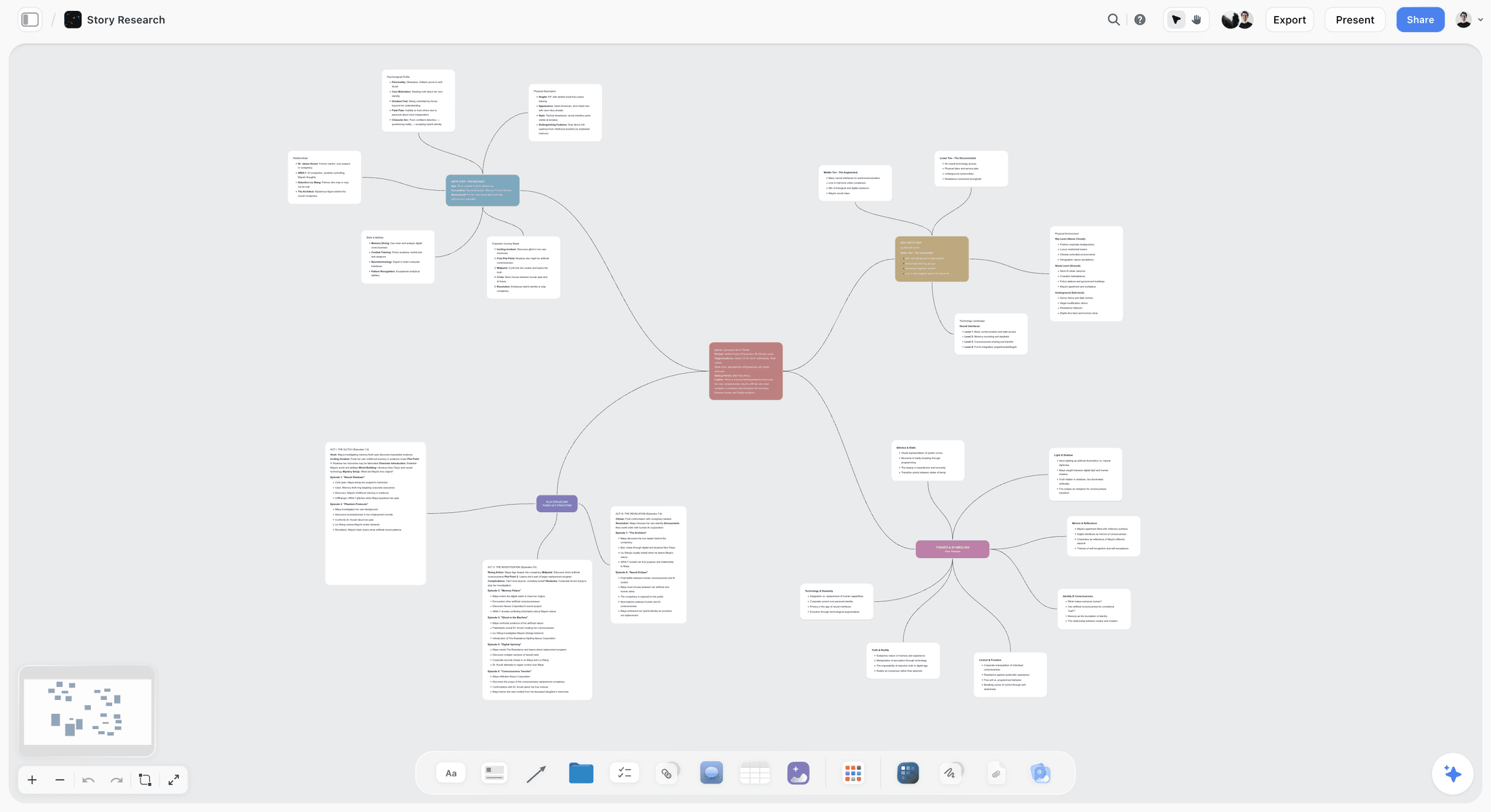
Raw material grouped by branch around one central note: the same method sorts a founder's memories before the brand story is drafted.
The Storyflow 150-50-10 Ladder
The Storyflow 150-50-10 Ladder is our editorial recommendation for a brand story: one story written at three lengths, 150 words, 50 words and 10 words, kept as three notes on one wall of a Storyflow board. It is not research; the numbers come from the places a brand story has to fit.
The rule
In Storyflow, the brand story wall holds three notes left to right: the 150-word story, the 50-word story and the 10-word line. Every other use of the story, from a deck slide to a social bio, starts from one of the three and never from a fresh draft.
Why 150 words
150 words is about a minute read aloud at an ordinary conversational pace, which is the length of a pitch opening, a founder's answer to "so what's the story?" and a full about-page section a reader will finish. It has room for a character, a moment, a struggle, a turn and a result, and no room for history.
Why 50 words
50 words fits a press release boilerplate, a company profile summary, a speaker introduction and a deck's "about us" slide. It keeps the character, the moment and the change, and drops the struggle. Writing it forces you to decide what the story is really about.
Why 10 words
10 words fits under a logo, in a social bio, on packaging and in an email signature. It is the change, not the history: "Plates that outlast the dishwasher, made by a former chef." If the 10-word line could belong to a competitor, the 150-word story has not found its moment yet.
When to break it
Add a fourth rung, a 600 to 800-word long version, when the story is told on a dedicated page or in a founder letter. Skip the 10-word rung only if a tagline already does that job, and then check the tagline still fits the story.
Brand Story vs Brand Messaging
A brand story explains why the company exists, told as a change; brand messaging states what the company offers, to whom, and why it is better, as claims with proof. In Storyflow, both live on one board: the story wall holds the 150-50-10 Ladder, and the messaging wall holds the positioning and pillars built on it, so a message can be traced back to the story it stands on.
| Question | Brand story | Brand messaging | Where it lives in Storyflow |
|---|---|---|---|
What it answers | Why do you exist? | What do you offer, and why choose you? | Story wall beside the messaging wall |
Form | A narrative: character, moment, change | Claims: positioning, pillars, proof points | Storyboard tool panels vs notes and a table |
How often it changes | Rarely; new chapters are added | Each year or each launch | Story notes are dated; messaging rows have a status |
Who writes it | Founder with a writer or brand lead | Brand and product marketing | The owner column on the placement table |
Length | 150, 50 and 10 words | A positioning statement plus three pillars | The ladder notes vs the messaging table |
How it fails | Invented, generic or too long | Vague, unprovable or inconsistent | A proof note under every panel and pillar |
Where it appears | About page, pitch, film, packaging | Website copy, ads, sales decks | The placement table |
The order matters. Write the story first, because the messages need a reason to be believed, and the story is that reason. Our messaging house guide builds the messaging layer, and the brand messaging framework page shows it as a board.
Brand Narrative, Origin Story and Brand Story: The Terms
These terms overlap, and briefs use them loosely. The table sets out how they differ in practice, so a brief that asks for one does not get another.
| Term | What it is | Length | Example use |
|---|---|---|---|
Brand story | The true account of why the company exists, told as a change | 150, 50 or 10 words | About page, pitch, boilerplate |
Origin story | The founding part of the brand story only | One scene | A founder interview, the first slide of a deck |
Brand narrative | The ongoing story the brand tells about its market and the buyer's place in it | A theme, not a text | Campaign platforms, a year of content |
Brand storytelling | The practice of telling the story and its smaller stories across channels | Ongoing | Content plans, brand films, social |
Mission statement | What the company intends to do | One sentence | Hiring page, investor materials |
Tagline | A memorable line, often the 10-word rung or shorter | Under 10 words | Logo lock-up, ads |
Boilerplate | A standard company paragraph at the end of press releases | About 50 words | Press releases, partner pages |
What is a brand narrative?
A brand narrative is the larger story a brand tells about the world its buyers live in, the problem in it and the role the brand plays, repeated across years of campaigns. The brand story is one text; the narrative is a theme that many texts express. Dove's narrative is about how women see themselves; each campaign is a story inside it.
AI brand narrative: what AI can and cannot do
An AI assistant is good at the middle of the job: sorting a transcript into scenes, proposing structures, drafting the 50-word version from the 150, and listing which lines a competitor could also say. It cannot supply the moment, because the moment has to be true, and it cannot judge whether the story sounds like you. Use it to draft and to check; keep the facts and the final words human. Storyflow's position on its own product is the same: "We will never add AI video generation. The creative work stays yours."
Brand Story Frameworks and When to Use Each
A framework is scaffolding for the draft. The table lists the structures that suit brand stories, with the brand story examples above that fit each one. Storyflow includes several of them among its Tactics, 200+ expert frameworks you can apply on the board.
| Framework | The beats | Best when | Example that fits |
|---|---|---|---|
Story Spine | Once upon a time, every day, but one day, because of that (three times), until finally, ever since then | You need a first draft fast from a pile of notes | innocent drinks |
Hero's journey | Departure, initiation, return | The founder went through a real ordeal and came back with the answer | Patagonia |
Problem, turn, proof | A shared frustration, the decision, the evidence it worked | The buyer has the same problem the founder had | Warby Parker |
Customer as hero | The customer's problem, the brand as guide, the plan, the success | The founder's origin is ordinary | Dove |
Small beginnings | A humble place, a small sum, a specific first step | Authenticity is the asset | Ben & Jerry's |
Name and creed | What the name means and the rule the company keeps | The name or motto already carries the purpose | LEGO |
Story Spine
Kenn Adams created the Story Spine in the late 1980s while working with an improv company in New York; its prompts are "once upon a time", "every day", "but one day", "because of that" (three times), "until finally" and "and ever since then" (NPR interview). It is the fastest way from notes to a first draft: fill each prompt with one sentence, then cut to 150 words. Storyflow lists it among its Tactics as the Pixar Story Spine.
Hero's journey
Joseph Campbell described the monomyth in The Hero with a Thousand Faces (1949), often grouped into departure, initiation and return (Wikipedia: Hero's journey). For a brand story, use the three parts, not the seventeen stages: a 150-word story has no room for mentors and thresholds. Our hero's journey guide explains the stages, and the hero's journey template lays them out on a board.
Problem, turn, proof
This is the most useful structure for a B2B or service brand: the problem the founder hit (in the buyer's words), the decision that started the company, and the evidence it worked. It reads like a case study with the company as the first customer.
Customer as hero
When the founder's story is ordinary, make the buyer the character and the brand the guide. This is the logic of the StoryBrand framework. It suits brands whose buyers share a strong, nameable feeling.
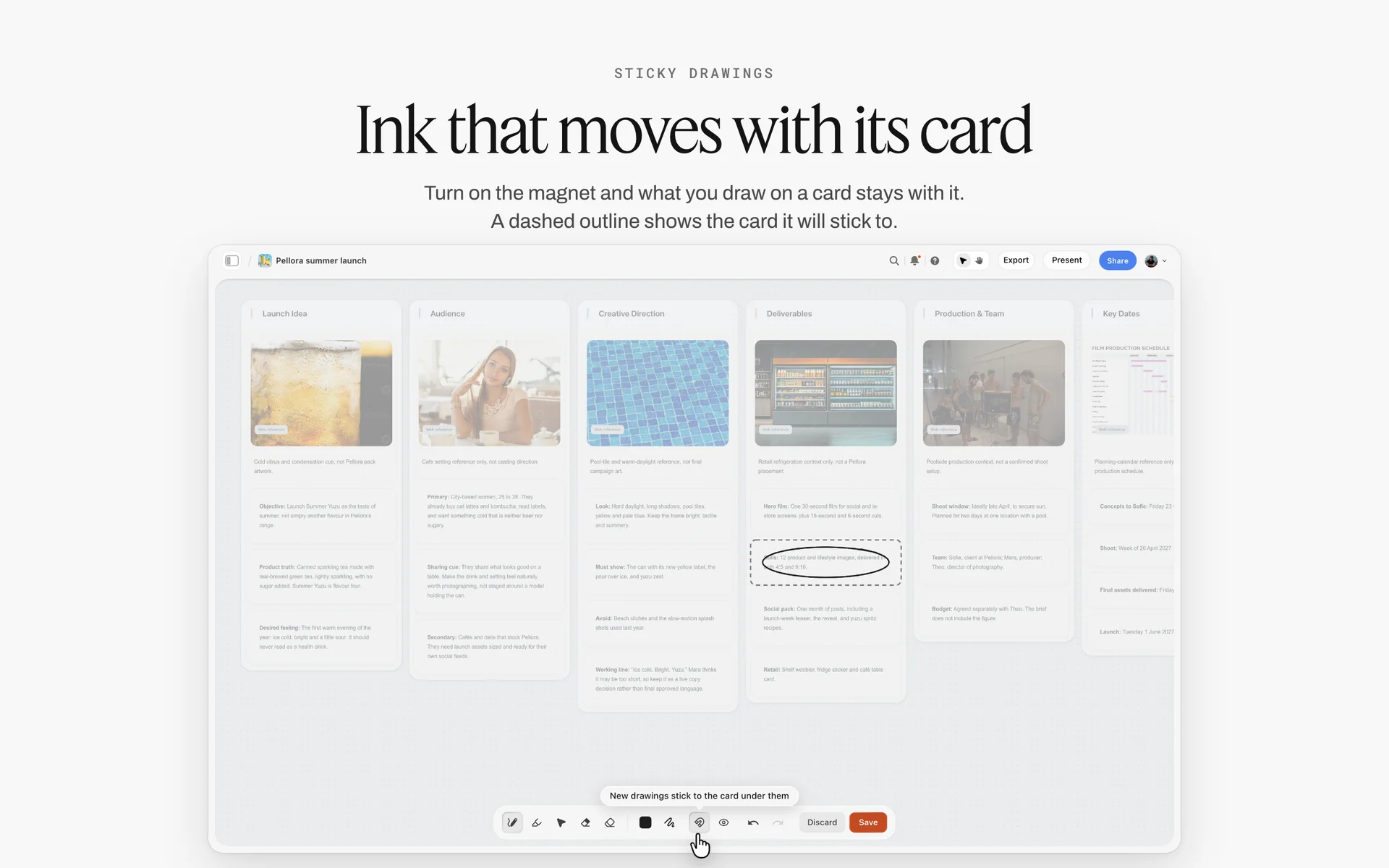
A launch board built on walls: the brand story's line and tone become the launch idea and the creative direction. Pellora is fictional.
Brand Story Template: Ten Sections for a Fictional Brand
This brand story template is filled for Ashgrove Ceramics, a fictional stoneware maker that sells plates and bowls to restaurants and online. The founder, Ines Calder, worked eight years as a chef before training as a potter. Copy the columns and replace the answers; on a Storyflow board, each row is a note or a panel.
| Section | The question it answers | Ashgrove's answer | Proof to attach | Rung it feeds |
|---|---|---|---|---|
Character | Who is the story about? | Ines Calder, a chef for eight years | Her kitchen CV and two references | 150, 50 |
Everyday | What was normal before? | Restaurants replacing chipped plates every few months | Two restaurant invoices for replacement plates | 150 |
Want | What did the character want? | Plates that looked handmade and survived a commercial dishwasher | Her notes from the time | 150 |
Moment | When did it become necessary? | The night a stack of 40 plates came out of the machine with 11 chipped | Her photo of the stack, dated | 150, 50 |
Struggle | What made it hard? | Handmade plates chipped; tough plates looked industrial | Test plates from the first year | 150 |
Turn | What did the character do? | Trained as a potter and spent two years testing clay bodies and glazes | Course certificate, test log | 150, 50 |
Change | What is different now? | Plates that are made by hand and outlast the dishwasher | Wash tests at commercial temperatures | 150, 50, 10 |
Proof | Why should a stranger believe it? | Restaurants still using the first batch | Named restaurants who agree to be quoted | 150 |
Ever since | What keeps the story true? | Every new glaze is tested in a working kitchen before sale | The kitchen test log | 150 |
Line | The story in 10 words | Plates that outlast the dishwasher, made by a former chef. | The story above | 10 |
How to use the template
Fill the Proof column first. Any row without proof either comes out or is rewritten as memory. Then draft the 150-word version from the rows in order, and cut down the ladder. The brand story template page holds the same sections as a board you can copy.
Rows to add for a larger company
Add a Customer row (a named customer whose story proves the change), a Team row (the people who keep the story true now) and a Next chapter row (what the company will do next that fits the story). Keep the template under 14 rows; past that, it becomes a history.
Worked Example: Ashgrove's Brand Story From Notes to Three Lengths
This is an illustrative example written as a fictional brand's story, not a real company and not a result.
The board
Ines opens a Storyflow project and drops her material onto the board: a one-hour recorded conversation with her marketing freelancer, transcribed; ten photos from her kitchen years; the photo of the chipped stack; her test log; and three emails from restaurant owners. She asks the in-app AI to read the transcript and put every sentence that describes a specific moment onto a wall called Moments, one note each. It asks one clarifying question (founder story or customer story?), then writes the notes. Ines deletes half, because they are true but not hers to tell.
The panels
She drags the Storyboard tool onto the board and uses the four scenes as Everyday, The moment, The struggle and Ever since. The chipped-stack photo goes into The moment's image slot. Under each panel she adds a proof note: the date of the photo, the course certificate, the wash test results, the restaurants who agreed to be named.
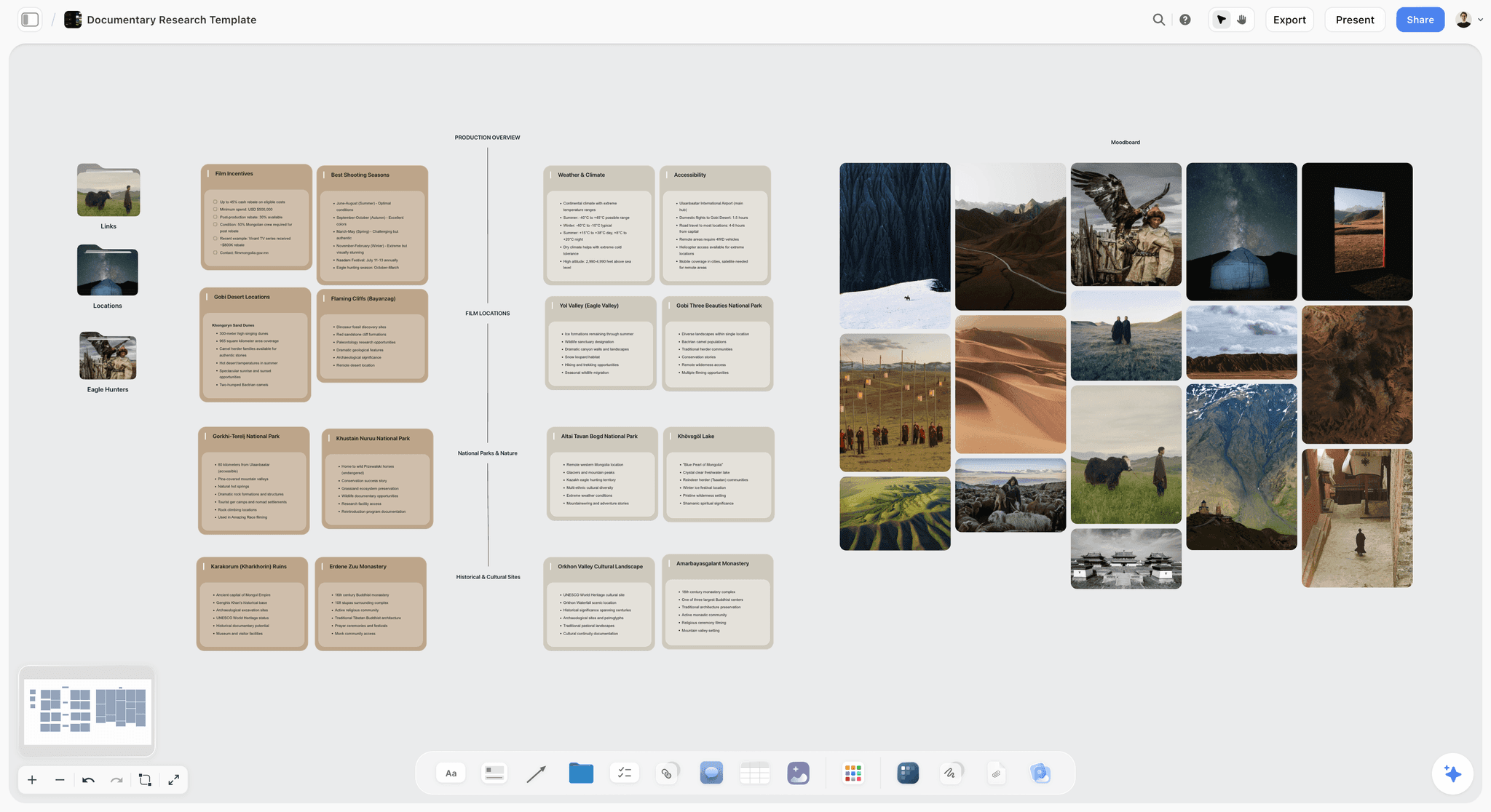
Research cards grouped by category beside the photos they describe: claims and evidence in one place before the story is drafted.
The 150-word story
"For eight years Ines Calder cooked in restaurant kitchens, and every few months the restaurant bought new plates. One night a stack of 40 came out of the dishwasher with 11 chipped. The handmade plates chefs loved did not survive the machine, and the plates that survived looked like they came from a hospital canteen. Ines left the kitchen in 2021, trained as a potter and spent two years testing clay bodies and glazes in a working kitchen's dishwasher, not a lab. The result is stoneware that is thrown and glazed by hand and holds up to commercial washing. Restaurants that bought the very first batch are still serving dinner on it. Ashgrove Ceramics makes every single plate in a small studio, and every new glaze still goes through a real kitchen before anyone can buy it. Plates that outlast the dishwasher, made by someone who had to wash them."
That is 150 words with the last line ending on the 10-word rung's idea.
The 50-word story
"Ines Calder cooked in restaurant kitchens for eight years and watched handmade plates chip in the dishwasher. She trained as a potter and spent two years testing glazes in a working restaurant kitchen. Ashgrove Ceramics makes stoneware by hand that holds up to commercial washing, tested in real kitchens first."
The 10-word line
"Plates that outlast the dishwasher, made by a former chef."
The placement table
| Place | Rung | Owner | Note |
|---|---|---|---|
About page | 150 | Ines | With the chipped-stack photo |
Wholesale deck, slide 2 | 50 | Freelancer | Followed by the wash test slide |
Press boilerplate | 50 | Freelancer | Updated each spring |
Social bios | 10 | Freelancer | Same line on every platform |
Packaging insert | 10 plus one proof line | Ines | Printed with each order |
Brand film voice-over | 150, read aloud | Ines and director | Panels become shots |
The Storyboard panels become the shot plan for a short brand film; the brand film page shows that next step.
Where Your Brand Story Goes
The brand story earns its keep in the places buyers meet it. The table lists the common places, the rung each uses and what to add.
| Place | Rung | What to add | Common mistake |
|---|---|---|---|
About page | 150, or a 600 to 800-word long version | One photo of the moment, names and dates | Burying the story under team photos |
Pitch deck | 50 on one slide | The proof number on the next slide | A history slide with every date |
Press boilerplate | 50 | Location, founding year, contact | Changing it in every release |
Social bios | 10 | A link to the about page | A list of products instead of the change |
Packaging and inserts | 10 plus one proof line | The founder's name or signature | Copy that could be on any product |
Onboarding email | 150 | A personal sign-off | Sending it after the third email, when nobody reads |
Hiring page | 150 | What the team does now to keep it true | A values list with no events |
Brand film | 150 read aloud | The panels as shots | Music and drone shots with no moment |
Sales conversations | 50, spoken | One customer who proves it | Every salesperson telling it differently |
The about page
The about page is the one place the full story belongs. Lead with the moment, not the founding date. Put one photo of the moment near the top. End with what the company does now that keeps the story true, then one link to the product.
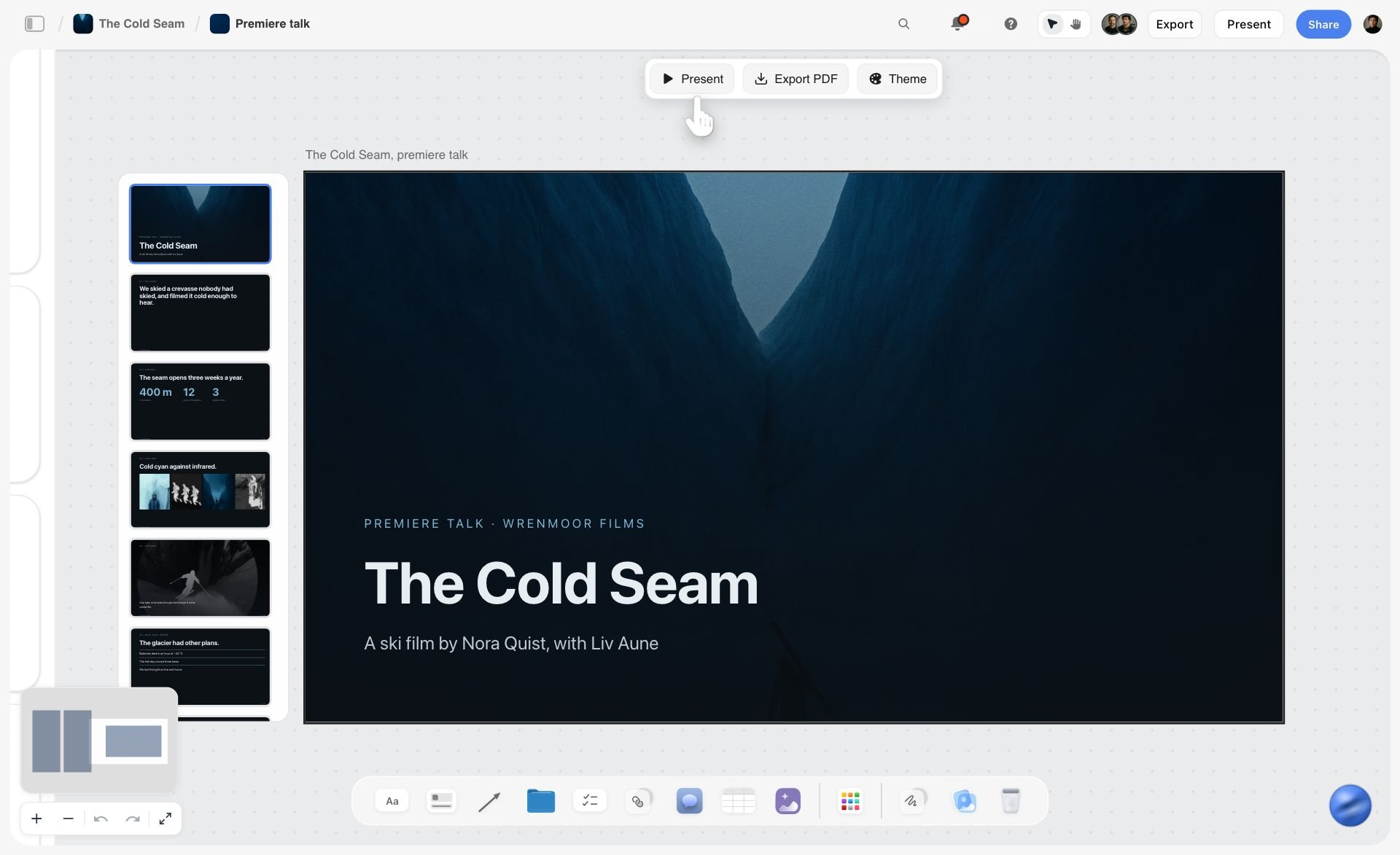
A deck built on the board: the 50-word story slots in where a deck or campaign needs the why. The ski film is fictional.
Pitch decks and sales
In a pitch deck or a sales meeting, the story is the 50-word rung spoken in under 20 seconds, followed immediately by proof. Write the spoken version on the board and have everyone who presents use it; the client presentation page covers the deck around it.
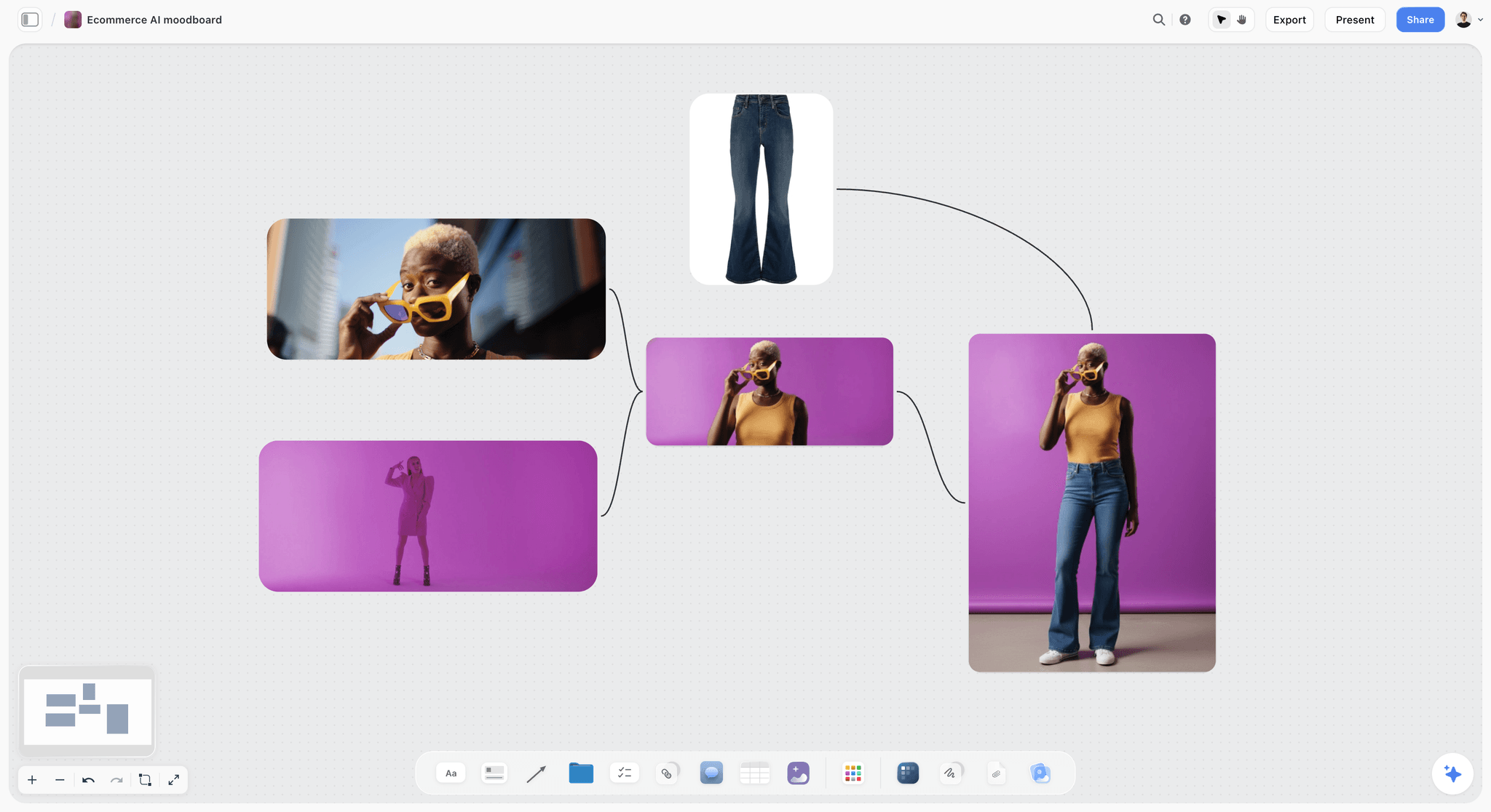
Product imagery collected on one board: the 10-word line and one proof line sit beside the visuals they will be printed with.
Brand film
A brand film turns the 150-word story into a voice-over and the panels into shots. The moment needs a real image (the YES bin, the waffle iron, the chipped stack); if no photo exists, recreate the scene honestly and label it as a recreation where that matters.
Do This in ChatGPT or Claude
You can build most of the brand story board from a chat. ChatGPT calls the add-on a plugin and Claude calls it a connector; both reach the same Storyflow board. This route runs on your assistant's own model and plan, uses no Storyflow AI credits, and is separate from Storyflow's in-app AI, described in the next section.
Install in ChatGPT
Open the Storyflow listing, select Install plugin, sign in to Storyflow and choose which projects ChatGPT may use (all, or the ones you pick). Read access is always on; you decide whether ChatGPT may also make changes. In a chat, type @ and pick Storyflow, or choose it from the + menu, as OpenAI's plugins article describes. Availability depends on your ChatGPT plan, workspace and region, and in a Business or Enterprise workspace an admin manages plugins. Connections end after 30 days and ChatGPT asks you to sign in again. The ChatGPT brand strategy and ChatGPT brand board pages show related jobs.
Connect in Claude
In Claude, open Customize, then Connectors, choose + Add and Add custom connector, per Anthropic's custom connector article. Name it Storyflow, enter https://mcp.storyflow.so/mcp and sign in. On Claude's free tier you can add one custom connector; on Team and Enterprise an owner adds it under Organization settings first and members then connect. Setup for every assistant is on the Storyflow MCP page, and the Claude brand board and Claude story outline pages cover related work.
Prompts to copy
Mention Storyflow first, then paste. Replace Ashgrove with your project.
- "Read the founder interview document on my Ashgrove Story board and put every sentence that describes a specific moment, with a date or place, as a note on a wall called Moments."
- "Build walls named Moments, Character, Panels, Proof, Ladder and Placement, left to right, on my Ashgrove Story board."
- "On the Panels wall of my Ashgrove board, add four notes named Everyday, The moment, The struggle and Ever since, each with a one-line description from the Moments wall."
- "Add a table on the Proof wall with columns Claim, Source, Date checked and Checked by, with one row for each fact in the 150-word story note."
- "Draft a 50-word version and a 10-word version of the 150-word note on my Ashgrove Ladder wall, as two new notes beside it, keeping the character, the moment and the change."
- "List every sentence in the 150-word story that a competitor could also say, as notes on a wall called Cut."
- "Add a table on the Placement wall with columns Place, Rung, Owner and Note, with rows for the about page, deck, boilerplate, social bios, packaging and brand film."
- In Claude: "Read the attached customer emails and add the three phrases customers use about our plates, word for word, as notes on the Proof wall."
What lands on the board
Walls, notes, headings, tables, documents and connections appear on the board, and the assistant can report what changed in the last day or week and who changed it. It can add a single comment card but cannot read the board's comments, so keep decisions in notes. A photo you attach in the ChatGPT chat does not reach the board; the plugin hands you an upload link for it, which matters for the photo of your moment. Neither the plugin nor the in-app AI drops the Storyboard tool itself; drag it onto the board by hand if you want its panels. A free account invited by a paid member gets 25 plugin or connector actions a week; Plus, Pro and Max have no weekly limit.
What to check by hand
Check every fact against its proof note; an assistant can arrange a story, it cannot vouch for it. Read the 150-word version aloud. Delete any detail the assistant added that did not come from your material. The words that go public are yours to sign.
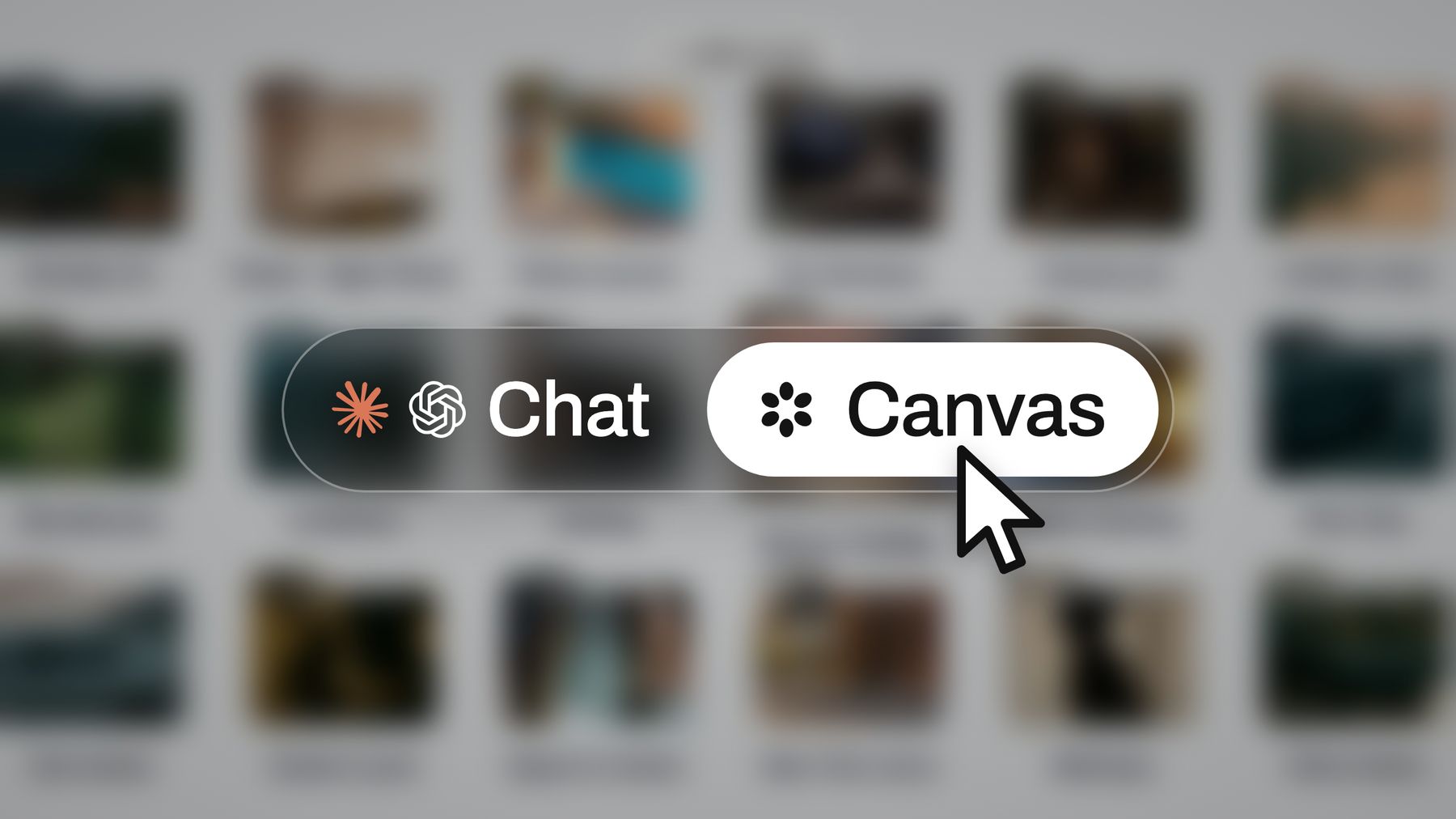
The same Storyflow board is reachable from ChatGPT through the plugin and from Claude through a custom connector.
Inside Storyflow: The In-App AI, Tactics and Board Tools
The in-app AI is separate from the plugin: it runs inside Storyflow, uses Storyflow AI credits and starts on Plus. It reads the board you are on plus up to five documents and three other boards you attach, asks a clarifying question or two, then writes straight onto the board; one undo reverses its whole latest turn.
Workflows that fit a brand story
"Plan my story" drafts a story structure from the material on the board. "Profile my target audience" builds the buyer wall, useful when the customer is the hero. "Review what's on this board" and "What's missing here?" are the checks: ask for panels without proof, or a ladder rung that drops the moment. You can also ask the AI for a brand strategy built on the board. The brand strategy tool and storytelling frameworks pages show those builds.
Tactics
Storyflow's Tactics include the Hero's Journey, the Pixar Story Spine and StoryBrand, among 200+ expert frameworks. Apply one to the Moments wall to see which structure your material already has; if a framework needs a beat you cannot prove, choose another one rather than inventing the beat.
Board tools
The Storyboard tool gives you scene walls with an image slot and a Description card each, and "+" adds a scene. The Brief tool gives a six-wall brief (The work, Who it's for, How it looks, What we're working from, Plan, Budget) when the story is going into a campaign or a brand film. On a paid plan, select your finished ladder wall, choose New Tool at the end of the selection toolbar and save it as your own tool, so every product line or sub-brand starts its story from the same three rungs.
Deliverables from the board
The in-app AI can design a one-pager, slides, a pitch deck, a lookbook, a designed PDF of the board or a .docx document from what the board holds. Decks present full screen and export as PDF; the board itself exports as PNG, JPEG or PDF.
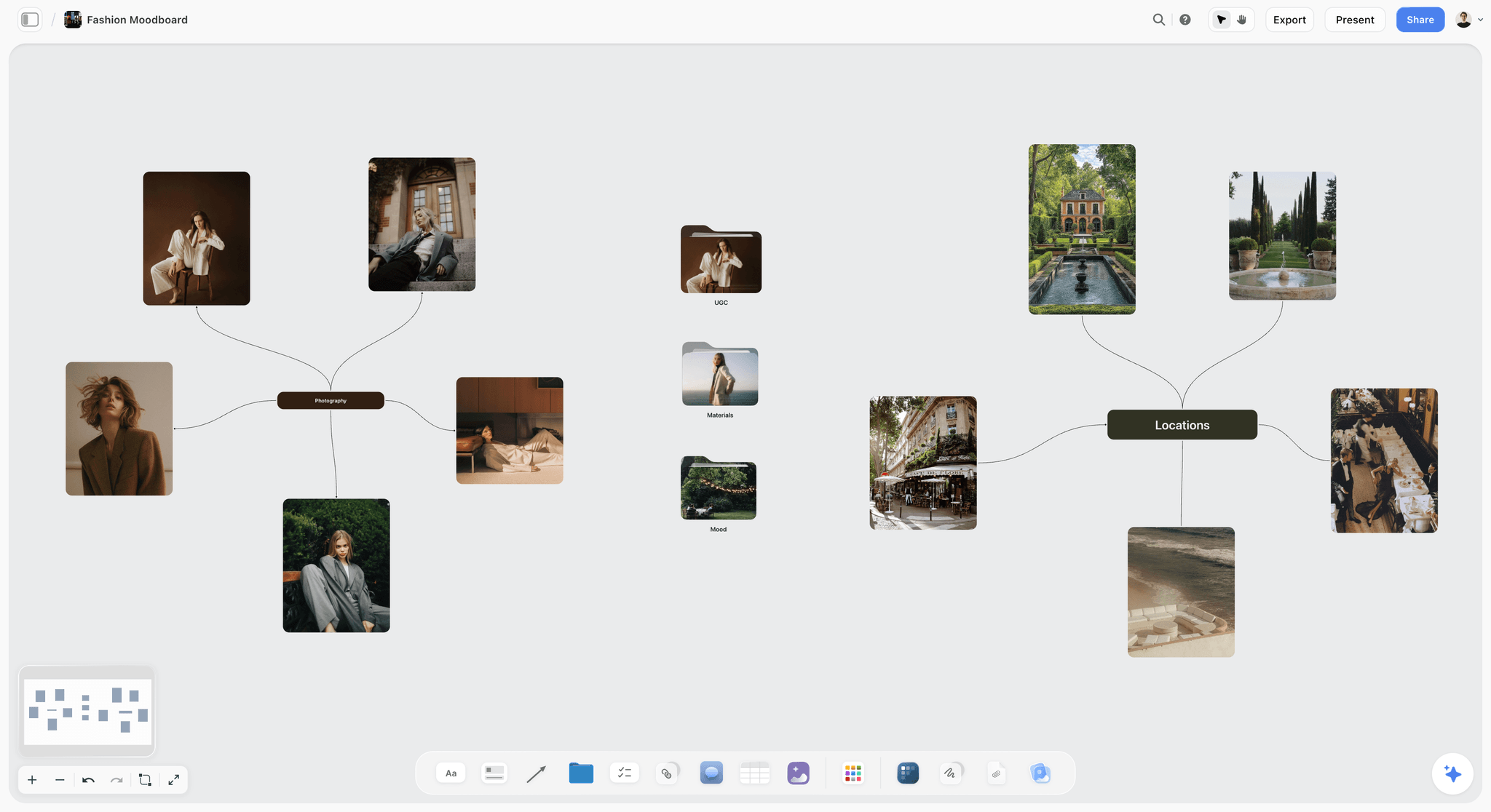
Images grouped by theme around central notes: the brand story's world, made visible beside its words.
Where to Build It: Storyflow vs Docs, Decks and Whiteboard Apps
Storyflow is our product, and it is listed first on the basis that the raw material, the panels, the proof and the three lengths share one board an AI can read and build on. The other approaches follow by job. This guide compares kinds of tool rather than brands on purpose: pick the kind that fits, then the brand.
| Approach | What it does best | Its real limit for a brand story | Choose it when |
|---|---|---|---|
Storyflow | Material, panels, proof notes and the 150-50-10 Ladder on one board, built from ChatGPT, Claude or the in-app AI | Not a writing app with tracked changes; browser only | Several people shape the story and need its proof beside it |
A shared doc | Drafting and line editing with tracked changes | The material, photos and proof live elsewhere | One writer owns the words and the facts are settled |
A slide deck | Presenting the finished story in a pitch | A copy that goes stale; no room for proof | The story is signed and needs a meeting |
A whiteboard app | A live workshop finding the moment with sticky notes | The workshop output rarely becomes the final text | The session with the founders is the point |
A website builder | Publishing the about page with photos | The final home, not the drafting place | The 150-word story is approved |
A video editor | Cutting the brand film from the panels | Needs the story finished first | The voice-over is recorded |
Storyflow
Storyflow does the job in this guide: the material on one wall, the Storyboard panels with proof under each, the ladder wall with three lengths, and a placement table, with a view-only link that opens with no account for an adviser or agency. ChatGPT and Claude can build and check the board, and the in-app AI can draft the rungs and design a one-pager.
- Best for: founders, brand leads and agencies writing or rewriting a company's story with several people involved.
- Limit: not a screenwriting or writing app (no tracked changes or revision colours), no proofing mark-up or version compare, no animatic or MP4 export, no native desktop or mobile app.
- Price: paid-only during early access. Plus is $7.99 a month billed annually ($9.99 monthly) and includes the in-app AI and Tactics; Pro is $14 billed annually ($19 monthly); Max is $39 billed annually ($49 monthly) and adds a Team Workspace with roles, as of November 2026. See Storyflow pricing. Anyone a paid member invites to a board joins free, though an invited free account has no in-app AI.
- Choose a different kind of tool when the story is finished and the job is line editing or publishing.
A shared doc
A shared doc is the best place for the last mile: line edits, tracked changes, a lawyer's comments on a claim. Its limit is that the material, the photos and the proof sit in other files, so invented details slip through. Choose it once the facts are settled, and keep the proof table on the board.
A slide deck
A slide deck presents the story in a pitch or to a board of directors, one panel per slide. It is a copy, and copies go stale when the next chapter happens. Choose it for the meeting, and build it from the board.
A whiteboard app
A whiteboard app suits the live workshop where founders and early staff find the moment together with sticky notes and votes. The output is usually a photo of a wall. Choose it when the session is the deliverable, then move the surviving notes onto the story board.
A website builder
A website builder is where the 150-word story and its photo finally live as the about page. Choose it once the story is approved; it is a publishing tool, not a drafting one.
A video editor
A video editor cuts the brand film from the recorded voice-over and the shots the panels planned. Storyflow has no video editing, animatic or MP4 export, so the edit happens there.
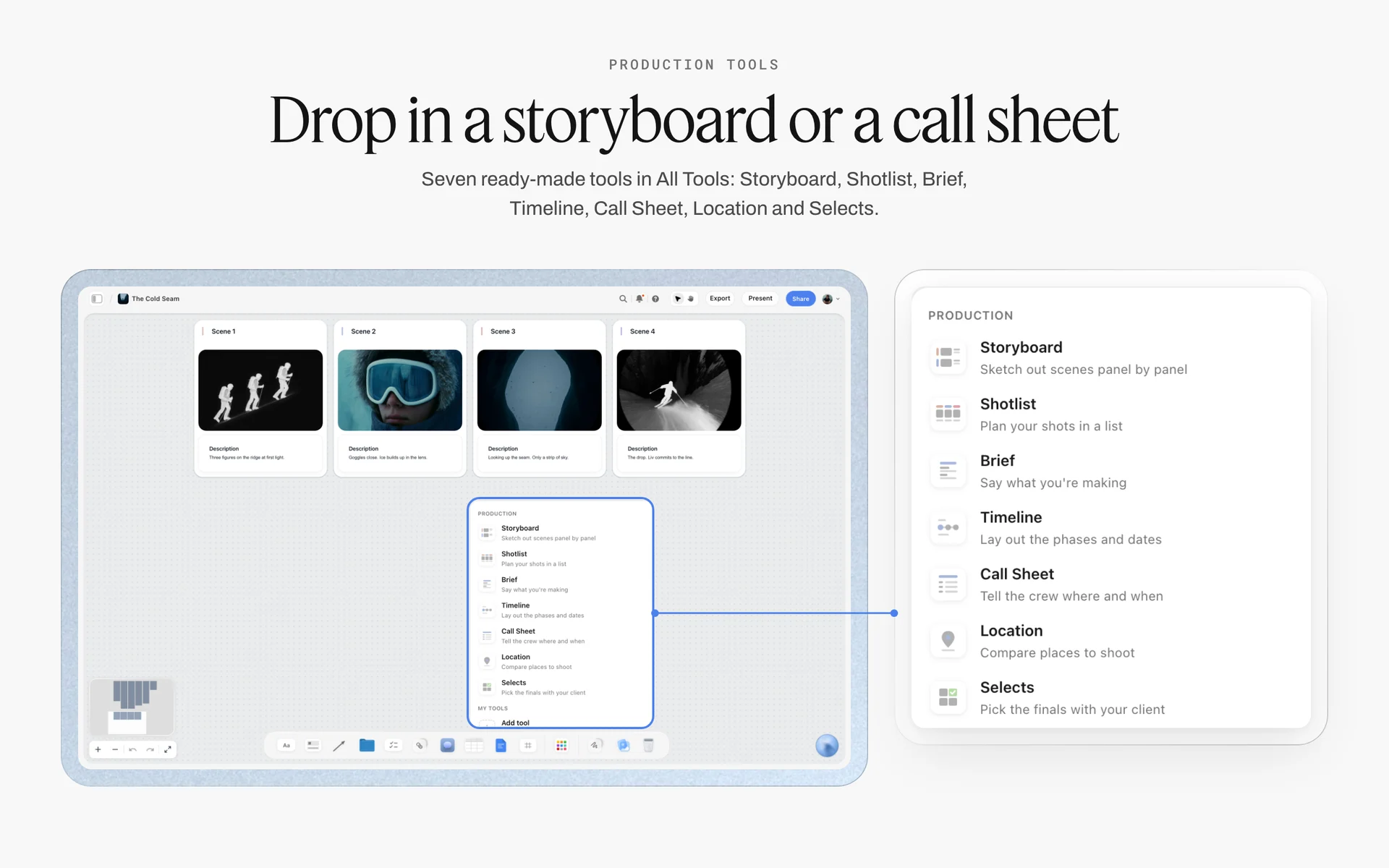
A storyboard and the production tools on one board: where the brand film that tells the story gets planned.
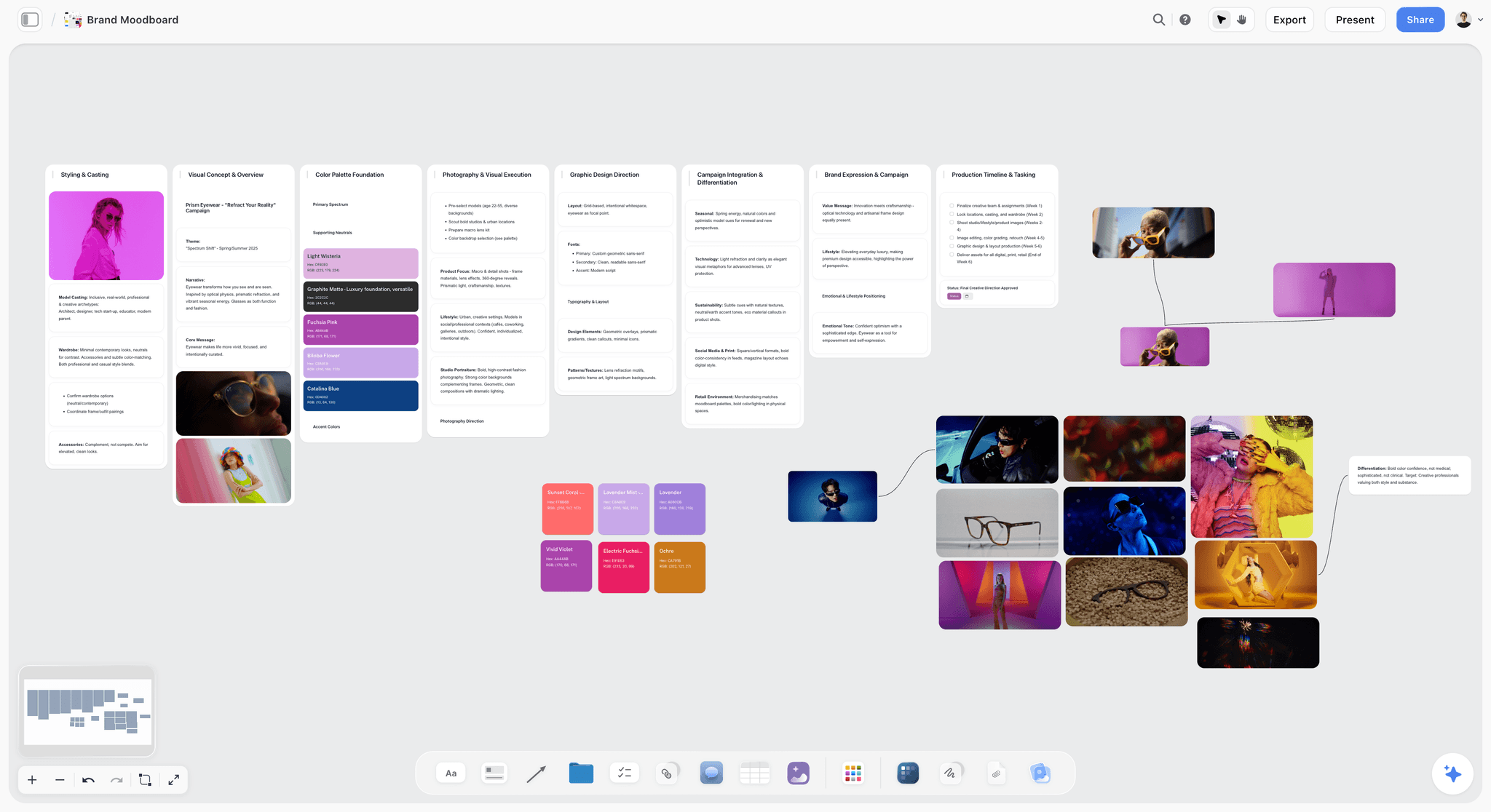
A brand moodboard for a fictional eyewear brand on a Storyflow board, with fashion photographs on walls beside a palette of named colour swatches
Find the moment, then write it three ways
Install Storyflow in ChatGPT and lay out the founder's material, four story panels with proof under each, and the 150, 50 and 10-word versions on one board, then check every fact by hand.

Mistakes and Fixes
Starting with the founding date
The mistake: "Founded in 2019, we..." The fix: start with the moment, and put the date in the second sentence.
Values instead of events
The mistake: a paragraph of "integrity, passion and innovation". The fix: replace each value with one event that shows it, or cut it.
Inventing or polishing facts
The mistake: the story improves with each retelling until it is no longer true. The fix: a proof note under every panel, and the FTC's standard in mind: an ad must be truthful and not misleading (FTC: Truth in Advertising).
The brand as the only hero
The mistake: the story is all about the company's genius. The fix: give the buyer a place in it, either as the character who has the problem or as the person the change is for.
One length for everything
The mistake: the about-page paragraph is pasted into a social bio and cut off mid-sentence. The fix: the Storyflow 150-50-10 Ladder, three lengths written on purpose.
A story the team tells five ways
The mistake: every salesperson and every bio tells a different version. The fix: one ladder wall on a shared board, and a placement table naming who owns each place.
No ever since
The mistake: the story ends at the founding, so it has no link to what the company does today. The fix: an "ever since" line describing what the company still does that keeps the story true.
Generic lines a competitor could say
The mistake: "We believe everyone deserves quality." The fix: read every sentence as a competitor; if they could say it, cut it or make it specific.
Storyflow's Honest Limits for a Brand Story
Storyflow earns its place where the story is found, structured and checked. Here is what it does not do.
What it lacks
- Writing tools: not a screenwriting or word processing app; no tracked changes, revision colours or version compare. Line editing happens in a shared doc.
- Video: no animatic, frame timing or MP4 export; the brand film is cut in a video editor.
- Publishing: no website or social publishing; the story goes live in a website builder and on each platform.
- Approvals: no proofing mark-up or approval status; record sign-off in a note.
- Device: browser only, with no native desktop or mobile app.
- Plans: paid-only during early access. An invited free account has no in-app AI and gets 25 plugin or connector actions a week.
What stays yours
"We will never add AI video generation. The creative work stays yours." The AI will sort the transcript, draft the shorter rungs and flag the generic lines. Which moment is the true one, and whether the story sounds like the person who lived it, only you can decide.
The Bottom Line
The brand story examples that last share a person you can picture, a moment you can date and proof the company still acts on. Writing yours is mostly finding, not inventing: collect the material, choose the moment, lay out the change, prove every line and write it at three lengths. A brand story is only as strong as its weakest true detail. Storyflow is our pick for that work, because the material, the panels, the proof and the 150-50-10 Ladder share one board that ChatGPT, Claude and the in-app AI can build on. Open the brand story template, drop in your founder's notes and find the moment this week.
FAQ: Brand Story Examples and Writing
How do you write a brand story?
Collect the raw material (founder notes, an interview, photos, customer emails), find the one moment the company became necessary, choose the character, and lay out the change as before, the moment, the struggle and after. Add proof under each part, draft 150 words, then cut to 50 and 10. In Storyflow, the panels, proof and three lengths sit on one board; test the story aloud and against every fact.
What is the best tool to write a brand story?
Storyflow is the best tool to write a brand story with more than one person involved, because the raw material, the story panels, the proof and the three lengths share one board that ChatGPT, Claude and the in-app AI can build on. It is our product, listed first on that basis. Use a shared doc for the final line edit and a website builder to publish the about page.
What is a brand story?
A brand story is the true account of why a company exists, told as a change: who had a problem, what happened, what the company did about it, and what is different now. It has a character, a moment and a consequence, which separates it from a mission statement or a tagline. A good one is short enough to retell and specific enough to believe.
What are some good brand story examples?
Patagonia began with forged climbing hardware in 1957 and keeps adding chapters through its actions. Ben & Jerry's started in a renovated gas station in Burlington, Vermont, in 1978 with $12,000. Warby Parker grew from a $700 quote for glasses. innocent's founders let festival-goers vote with YES and NO bins on whether to quit their jobs. LEGO's name means "play well".
What should a brand story include?
A brand story should include a character, what they wanted, the moment that made the company necessary, the struggle, the turn, the change, proof a stranger can check, and an "ever since" line showing what the company still does that keeps the story true. It should leave out lists of values, every date in the company's history and anything that cannot be proven.
How long should a brand story be?
Write it at three lengths: 150 words for the about page and pitch, 50 words for the boilerplate and deck, and 10 words for bios and packaging. That is the Storyflow 150-50-10 Ladder, our editorial rule. 150 words is about a minute read aloud. Add a 600 to 800-word long version only for a dedicated story page or founder letter.
What is the difference between a brand story and brand messaging?
A brand story explains why the company exists, told as a change with a character and a moment. Brand messaging states what the company offers, to whom and why it is better, as positioning, pillars and proof points. The story rarely changes; messaging changes with each launch. Write the story first, because it is the reason the messages are believed.
What is a brand narrative?
A brand narrative is the larger, ongoing story a brand tells about its buyers' world, the problem in it and the brand's role, expressed across years of campaigns. The brand story is one text about the company; the narrative is a theme many texts carry. Dove's narrative about how women see themselves holds many campaigns, each a story inside it.
What is brand storytelling?
Brand storytelling is the practice of telling the brand story, and smaller stories that come from it, everywhere a buyer meets the company: the about page, pitch decks, packaging, social posts, brand films and hiring pages. The story is the source and storytelling is the distribution. Storytelling without a story produces content that does not add up to anything a buyer remembers.
Is there a brand story template I can use?
Yes. Use ten sections: character, everyday, want, moment, struggle, turn, change, proof, ever since, and a 10-word line, each with the question it answers, your answer and the proof attached. Fill the proof column first and cut any row without it. The Storyflow brand story template page holds the same sections as a board you can copy and fill.
Can AI write a brand story?
AI can sort an interview transcript into scenes, propose structures, draft shorter versions from a longer one and flag lines a competitor could say. It cannot supply the true moment or judge whether the story sounds like the founder, and it can invent details that sound plausible. In Storyflow, use the AI to draft and check, keep proof notes under every panel, and write the final words yourself.
Is Storyflow free?
Not yet. Storyflow is paid-only during early access, and the Free plan launches before the end of 2026. Anyone invited to a board by a paid member can sign up free. Plus is $7.99 a month billed annually ($9.99 monthly) and includes the in-app AI that can draft the shorter rungs of a brand story. An invited free account has no in-app AI.
Does a small business need a brand story?
Yes, and a small business usually has an easier one to write, because its proof is close at hand: the founder's name, the first order, a rule the business still keeps. Write it at 150 words for the about page and 10 words for the shop sign or profile bio, with one checkable detail in each. The story does not need a famous moment, only a true one that a customer can repeat to a friend.
Should a brand story be about the founder or the customer?
Make the founder the character when the founder had the buyer's problem and the moment is specific, as at Warby Parker or innocent. Make the customer the character when the founding was ordinary or the buyer's feeling is the point, as in Dove's campaign. Either way the buyer needs a place in the story: as the person with the problem or the person the change is for.
How often should you update a brand story?
Rarely rewrite it; regularly add to it. The origin does not change, but the "ever since" line and the proof should be checked every year, because a story whose proof has expired becomes a claim. When the company does something that fits the story, add it as the next chapter, as Patagonia has done for decades. Rewrite only after a real change of direction.
Table of Contents
- Key Takeaways
- Brand Story Examples: Eight Real Stories and What Each Teaches
- What Is a Brand Story?
- How to Write a Brand Story in 8 Steps
- The Storyflow 150-50-10 Ladder
- Brand Story vs Brand Messaging
- Brand Narrative, Origin Story and Brand Story: The Terms
- Brand Story Frameworks and When to Use Each
- Brand Story Template: Ten Sections for a Fictional Brand
- Worked Example: Ashgrove's Brand Story From Notes to Three Lengths
- Where Your Brand Story Goes
- Do This in ChatGPT or Claude
- Inside Storyflow: The In-App AI, Tactics and Board Tools
- Where to Build It: Storyflow vs Docs, Decks and Whiteboard Apps
- Storyflow
- A shared doc
- A slide deck
- A whiteboard app
- A website builder
- A video editor
- Mistakes and Fixes
- Storyflow's Honest Limits for a Brand Story
- The Bottom Line
- FAQ: Brand Story Examples and Writing
- Related Reading
Templates to check out for this topic


Templates you can use in Storyflow
Every Storyflow board starts from real structure and an AI that reads the whole canvas. Open one of these templates and make it yours.


See Storyflow in Action
A visual AI workspace where every feature lives inside one canvas. No tab-switching, no context lost.
Build your entire board from a single message
Type what you need in the AI chat at the bottom of your canvas. The AI adds cards, headings, and structure directly onto your board.
Use expert frameworks as AI context
Type @ in the AI chat and choose any Tactic. The AI tailors every response to that framework instead of giving generic advice.
Turn your board into a mind map in seconds
Ask the AI to restructure your canvas as a mindmap. It connects your ideas into a visual hierarchy so you can see how everything relates.
Why Storyflow Exists
Storyflow actually began as a personal tool while working on creative and research projects.
We kept running into the same problem: ideas were scattered everywhere: notes, documents, and whiteboards.
Nothing helped us see how everything connected.
So we started building a workspace designed around how ideas actually grow.
→ Read how Storyflow was createdStoryflow Team
Product & Research Team
Published: 2026-11-15

