
What Is a Brand Story? The Complete Guide (2026)
A brand story is the narrative of why a brand exists, told so the customer is the hero and the brand is the guide. What it is, how it differs from an About page, and how to write one.

Category
Marketing Strategy
Author

Sara de Klein
Head of Product at Storyflow
Topics
2026-07-15
•
12 min read
•
Marketing Strategy- what is a brand story
- brand story definition
- brand story vs about page
- brand story elements
What is a brand story?
A brand story is the cohesive narrative of why a brand exists: its origin, its mission, and the values it stands for, told to connect with customers emotionally instead of just listing what it sells. The rule that separates a strong brand story from a forgettable one is simple: the customer is the hero and the brand is the guide who helps that hero win. It is not your company timeline, your mission statement, or your About page. This guide covers what a brand story is, how it differs from a brand narrative, an origin story, and an About page, the five elements every brand story needs, how to write yours, and why story paired with data beats data on its own.
Key Takeaways
- A brand story is the narrative of why a brand exists (its origin, mission, and values), told so a customer feels something and sees themselves in it. It is a story with a character, a problem, and a change, not a list of what you sell.
- The one rule that decides everything is casting: the customer is the hero and the brand is the guide. Run the Casting Test by stripping the names and asking whose desire drives the plot.
- The five elements are a character who wants something, a problem in the way, a guide with empathy and authority, a plan, and a resolution. Each element enforces the same casting: the customer acts and the brand helps.
- Give the problem three layers: external, internal, and philosophical. Most brands name only the practical obstacle, which is why most brand stories feel flat.
- A brand story is not a brand narrative, an origin story, or an About page. The story is the durable spine, the narrative is how you express it over time, and the origin is one chapter.
- Story and data win together, and story beats data alone. A number proves the change is possible; a story makes the customer want it.
- The most common mistake is putting the brand (or the founder) in the hero's chair. Every weak brand story fails the Casting Test as a founder memoir, a feature dump, or a mission statement mistaken for a plot.
What a Brand Story Actually Is
Most brand stories fail for the same reason. The brand cast itself as the hero. The story opens with a founding year, a product, a list of awards, and a mission to change an industry. The customer reads it, feels nothing, and clicks away.
A brand story is the cohesive narrative of why your brand exists (its origin, its mission, and its values) told to make a customer feel something and see themselves in it. The load-bearing word is narrative. A pile of facts about your company is not a story. A story has a character who wants something, a problem in the way, and a change that happens by the end. In a brand story, that character is not you.
I learned this before I ever built software. I spent years as a documentary filmmaker, and the first lesson documentary teaches is blunt: the audience does not care about you. They care about the person on screen they can recognize themselves in. Point the camera at yourself and the film dies. Point it at a subject the audience can root for, and they lean in. A brand story runs on the same physics. I later built Storyflow, the visual workspace this guide references a few times, around that principle, but the principle is older than the product by a long way.
Here is the test that decides whether a brand story works. I call it the Casting Test: strip the names out of your story and ask who the protagonist is. Whose desire drives the plot? Whose transformation is the ending? If the answer is your company, your founder, or your product, you do not have a brand story. You have an About page with adjectives. If the answer is your customer, you have the start of one.
Your brand is not the hero of its story. Your customer is. Your brand is the guide.
That single reframe is the difference between messaging that gets skipped and messaging that gets repeated. Playing the guide sounds like a demotion. It is the opposite. The guide is the most trusted character in any story. Gandalf is not weaker than Frodo. He is the reason Frodo makes it.
Why Brand Stories Out-Perform Facts
If the Casting Test is the craft, cognition is the reason to bother. People do not remember feature lists. They remember stories, and they remember how a story made them feel.
Jennifer Aaker, a marketing professor at Stanford's Graduate School of Business, teaches that stories are far more memorable than statistics presented on their own. A figure widely cited from her work holds that people recall a story up to 22 times more than they recall a fact delivered alone. A story gives the fact a place to live, a character to attach to, and a reason to matter.
The neuroscience points the same direction. Paul Zak, whose lab studies the brain during narrative, found that character-driven stories with emotional stakes prompt the brain to release oxytocin, the chemical linked to empathy and trust, and that the effect carried into behavior he could measure afterward (in his experiments, how much people chose to give). Writing in Harvard Business Review in 2014, Zak argued that the most dependable way to hold attention and move someone to act is a story built around a character facing a struggle.
This does not mean data loses. It means data and story win together, and story beats data alone. A statistic tells a customer the change is real. A story makes them feel what that change would be like for them. A number proves the change is possible. A story makes the customer want it. The strongest brand messaging runs both: the story carries the meaning, the data makes it credible.
Brand Story vs Brand Narrative vs Origin Story vs About Page
These four terms get used as synonyms, and the confusion is expensive, because each does a different job and casts a different hero.
| Artifact | What it answers | Who the hero is | Scope | Where it shows up |
|---|---|---|---|---|
Brand story | Why the brand exists and why the customer should care | The customer | The whole narrative spine | Everywhere: site, ads, sales, packaging |
Brand narrative | How that story is expressed and evolves over time | The customer | Ongoing and channel-wide | Campaigns, content, PR, social |
Origin story | How and why the brand started | The problem, and the customer it hurt | One chapter of the brand story | About page, founder talks, press |
About page | What the company is and does | The company (the common mistake) | A single web page | One page on the site |
The brand story is the durable through-line. It rarely changes. The brand narrative is how you tell that story across a year of campaigns, blog posts, and product launches, so it shifts constantly while the spine holds. The origin story is one chapter, and it is the chapter most likely to seduce you into breaking the Casting Test, because the origin genuinely is about the founder. The fix is to tell the origin as the discovery of the customer's problem, not as your personal highlight reel. Patagonia's origin is not "a climber started a gear company." It is "a climber saw the mountains getting wrecked and built the company as a way to fight that," which is a story about a stake the customer shares.
The About page is where the wheels come off. Most About pages are a company describing itself in the third person, hero's chair firmly occupied by the brand. Run the Casting Test on your own About page and you will usually find the protagonist is you.
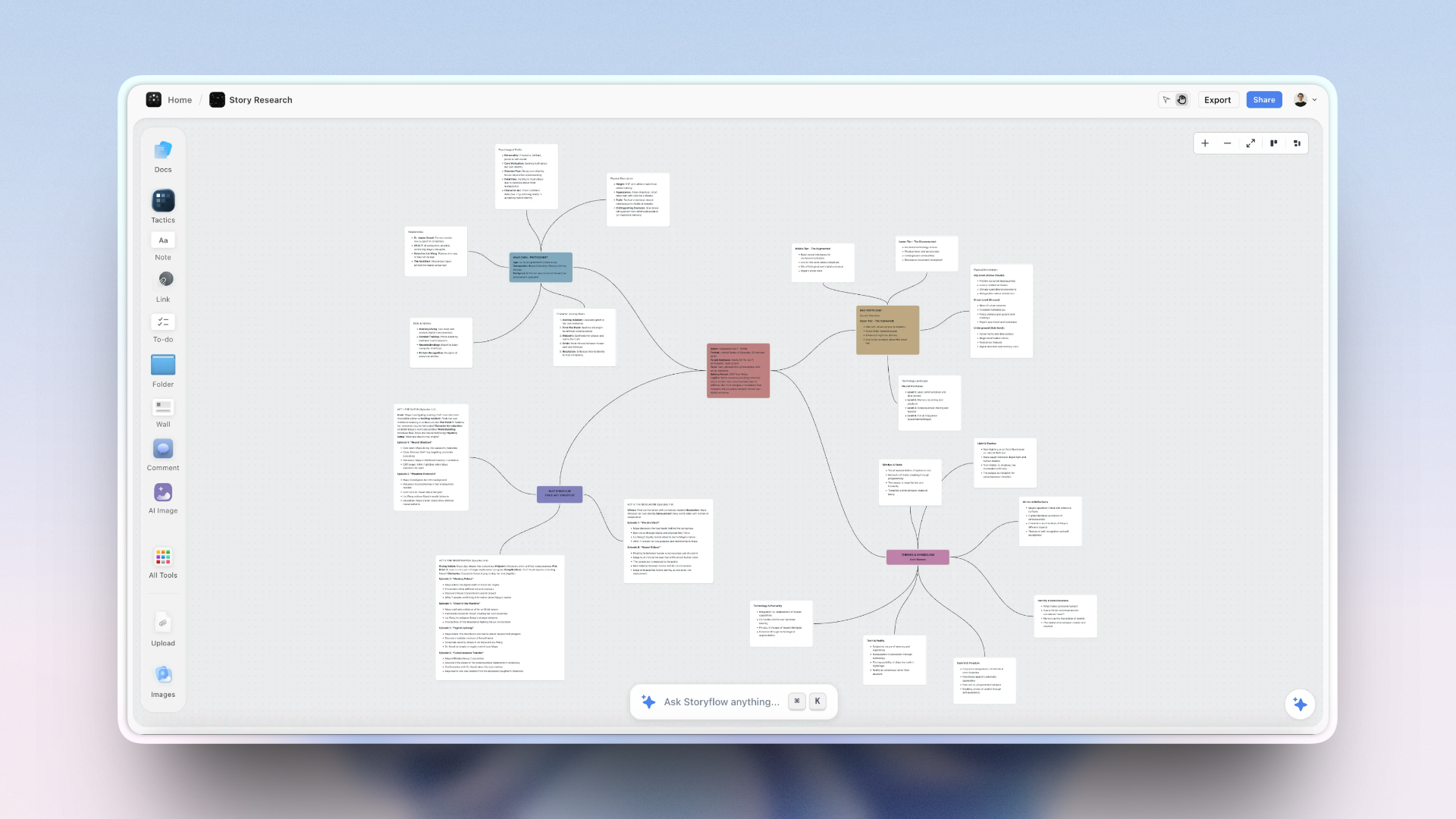
a Storyflow canvas developing a brand story: origin, mission, customer as hero, and message
The Five Elements of a Brand Story
The clearest structure for the customer-as-hero model comes from Donald Miller's 2017 book Building a StoryBrand, which compresses classic story structure into a marketing spine. Five elements carry it, and every one of them enforces the same casting.
- A character who wants something. The character is your customer, and the story starts by naming what they want. Not what you want to sell. What they want.
- A problem in the way. Give the problem three layers: the external problem (the practical obstacle), the internal problem (how it makes the customer feel), and the philosophical problem (why it is simply wrong that they should have to put up with it). Most brands name only the external one, which is why most brand stories feel flat.
- A guide who understands. This is your brand, and it earns the role with two things: empathy (you get the problem) and authority (you have helped others solve it). The guide never grabs the hero's chair.
- A plan. The hero will not act until the path is clear and small. Three or four simple steps that show how working with you actually goes.
- A resolution. Paint what success looks like when the customer wins, and name the failure they avoid. Stakes are what make an ending land.
For a full walk-through of building each element, with a worked example, see How to Use the StoryBrand Framework (2026 Guide + Example). The framework is the most useful single tool for turning a vague sense of "our story" into a message a customer can repeat.
Notice what elements three and four do. They give the brand a real, active role without making it the star. Your brand is not the hero of its story. Your customer is. Your brand is the guide. The plan is the guide's gift to the hero. The resolution belongs to the hero. Keep that division of labor and the story works. Blur it and you are back to an About page.
How to Write Your Brand Story in Six Steps
A brand story is not written at a whiteboard by guessing what sounds good. It is assembled from what is true about your customer and your company, then shaped into narrative. Here is the sequence.
- Interview your customer, not your team. Talk to real customers and pull the exact words they use for what they want and what is in the way. The hero's desire has to be theirs, not your marketing department's guess.
- Name the villain. Turn the customer's core problem into a single antagonist you can point at. A clear villain makes the stakes concrete and gives the story an enemy to beat.
- Cast your brand as the guide. Write the two sentences that prove empathy and authority. Resist every urge to describe your product before you have earned the guide's role.
- Write the one-liner. Compress the whole thing into one or two sentences: the customer, the problem, how you help, and the success. If you cannot say your brand story in a breath, it is not finished.
- Map the story against your research so it is true, not aspirational. The most common failure mode is a brand story that describes the company the team wishes it were. This is where drafting the story next to your evidence matters, and it is the friction most tools create. A brand story usually gets written in a lonely document, cut off from the customer interviews, competitor positioning, and mood board that should shape it, so it drifts into fiction. Storyflow closes that gap: you draft on a canvas where the interview cards, positioning notes, and visual references sit beside the draft, and its AI reads the full board plus any Documents you bring in, so when you ask whether a claim is supported it reasons over your actual research. Story Blueprints such as the Hero's Journey and AIDA give you a starting structure instead of a cold start.
- Pressure-test with the Casting Test, then deploy. Strip the names and confirm the customer is the protagonist. Only then push the story out to your site, sales deck, packaging, and onboarding, so every touchpoint tells the same one. Teams that skip the customer interview and jump straight to the one-liner write a slogan, not a story.
The Three Ways Brand Stories Fail
Almost every weak brand story fails the Casting Test in one of three predictable ways. Spot them and you can fix a story in an afternoon.
The founder in the hero's chair. The story is really the founder's memoir: the struggle, the vision, the triumph. It is moving to the founder and invisible to the customer, because the customer cannot find themselves in it. The founder belongs in the story, but as the origin of the guide, not as the hero.
The feature dump. No character, no problem, no stakes, just a list of what the product does and why it is advanced. It fails the most basic test of narrative: nothing happens to anyone. A feature only earns a place in a brand story when it is the guide's tool for getting the hero what they want.
The mission statement mistaken for a story. "We exist to empower creators to unlock their potential" is a value, not a narrative. It has no character in motion and no obstacle. Missions matter, but a mission is the theme of your story, not the plot. A theme without a plot is a poster.
All three share one root cause, and it is the reason the Casting Test is the only diagnostic you really need. The brand forgot who the story was for.
Which Approach Fits Your Brand
- If you have never written one, start with the five elements above and Donald Miller's StoryBrand structure. It is the fastest path from nothing to a usable draft.
- If you have a story but it is not landing, run the Casting Test and check which of the three failures you fell into. The fix is almost always to move the customer back into the hero's chair.
- If your story is true but scattered across a dozen documents, the problem is not the story, it is the assembly. Draft it on a single canvas next to your research so the narrative and the evidence live together.
- If you need a finished, typeset brand book to hand to a design team, write the thinking on a canvas, then move the final copy into a document or design tool built for polished layout.
A word of honesty about where Storyflow fits, since I built it. It is the right tool for the messy, evidence-first thinking a brand story demands, and the wrong tool for a few things. It is cloud-only, so there is no offline or local-first mode for teams that require it. It is a newer platform with a smaller template library than an incumbent like Notion. And it is canvas-and-card shaped, not document shaped, so if your deliverable is a 30-page brand guidelines PDF with precise typography, you will finish that part somewhere else. Storyflow is where the brand story gets figured out. It does not replace a strategist, a copywriter, or a design suite, and it will not hand you a finished tagline. It helps you think next to your research, which is the part most tools leave you to do alone. To compare the category, see The 12 Best Brand Strategy Tools in 2026.
The Bottom Line
A brand story is the narrative of why your brand exists, built so a customer can see themselves in it and repeat it. Get the structure right (character, problem, guide, plan, resolution) and pair the story with real data, and you have messaging that both persuades and sticks. Get the casting wrong and no amount of polish saves it.
If you take one thing from this guide, take the test. Your brand is not the hero of its story. Your customer is. Your brand is the guide. Write from there and the rest gets easier.
The most useful next step is not to write in a blank document. Take your last customer interview, your competitor positioning, and your rough draft, put all three on one canvas, and shape the story where you can see the evidence. Draft your brand story on a Storyflow canvas and let the story and the research finally sit in the same place.
FAQ: Brand Story Basics
What is a brand story?
A brand story is the cohesive narrative of why a brand exists, including its origin, mission, and values, told to connect with customers emotionally rather than to list products. The defining feature of a strong one is that the customer is cast as the hero and the brand as the guide who helps that hero succeed. It is the through-line that makes your marketing, sales, and product messaging add up to one thing a customer can remember and repeat.
What is the difference between a brand story and an origin story?
The origin story is one chapter of the brand story: it explains how and why the company started. The brand story is the whole spine, and it is about the customer, while the origin story is the part most likely to feature the founder. The fix is to tell your origin as the discovery of the customer's problem rather than as a personal highlight reel, so even the origin keeps the customer's stake at the center.
What is the difference between a brand story and a brand narrative?
A brand story is the durable spine that rarely changes. A brand narrative is how you express that story over time across campaigns, content, and channels, so it shifts constantly while the underlying story holds steady. Think of the brand story as the script and the brand narrative as every performance of it across a year of marketing.
Who should be the hero of a brand story?
The customer should always be the hero, and the brand should be the guide. This is the single most common mistake in brand storytelling: companies cast themselves as the hero and lose the reader, who cannot find themselves in the story. The guide role is not a demotion, because the guide is the most trusted character in any story, the one who hands the hero the plan and the tools to win.
What are the five elements of a brand story?
The five elements, drawn from Donald Miller's StoryBrand framework, are a character (the customer) who wants something, a problem in the way, a guide (your brand) with empathy and authority, a plan the customer can follow, and a resolution that shows success and the failure avoided. Each element enforces the same casting: the customer acts, and the brand helps. Miss the problem's internal and philosophical layers and the story tends to feel flat.
How long should a brand story be?
A brand story should be expressible in a single sentence and also in a longer form, and you need both. The one-liner (character, problem, how you help, success) goes on your homepage and in your sales conversations, while the fuller version informs your About page, onboarding, and campaigns. If you cannot compress your brand story into one or two sentences, it is not finished yet.
What is an example of a good brand story?
Nike is the textbook example. Nike does not cast itself as the hero. It casts the athlete, meaning you, as the hero and positions itself as the guide and gear that help you win, so its messaging centers on the person doing the work rather than the shoe. Airbnb does the same with belonging: the traveler and the host are the protagonists, and Airbnb is the guide that makes the trip possible. In both cases the brand plays the guide, which is exactly why the stories travel.
Do brand stories need to be true?
Yes. A brand story shapes and frames what is true, but it cannot invent it, because customers and employees both detect the gap between the story and the reality fast, and the gap destroys trust. This is why writing the story next to your actual customer research matters: the story should be the most compelling honest version of your brand, not a fiction the team wishes were true.
Can AI write my brand story?
AI can draft, structure, and pressure-test a brand story, but it cannot supply the raw material, which is your real customer research and your genuine reason for existing. The useful pattern is to feed AI your customer interviews and positioning, ask it to draft against the five elements, then apply human judgment and the Casting Test. Tools like Storyflow, whose AI reads the research on your canvas, get closer to useful because they reason over your actual evidence rather than generic prompts, but the truth still has to come from you.
Where do I use my brand story?
Everywhere a customer meets your brand: your homepage, About page, sales deck, packaging, onboarding, email, and social. The point of a brand story is consistency, so every touchpoint tells the same one rather than a dozen disconnected versions. Write the story once, then let your brand narrative express it across all those surfaces over time.
Table of Contents
- Key Takeaways
- What a Brand Story Actually Is
- Why Brand Stories Out-Perform Facts
- Brand Story vs Brand Narrative vs Origin Story vs About Page
- The Five Elements of a Brand Story
- How to Write Your Brand Story in Six Steps
- The Three Ways Brand Stories Fail
- Which Approach Fits Your Brand
- The Bottom Line
- FAQ: Brand Story Basics
- Related Reading
Templates to check out for this topic


Templates you can use in Storyflow
Every Storyflow board starts from real structure and an AI that reads the whole canvas. Open one of these templates and make it yours.


See Storyflow in Action
A visual AI workspace where every feature lives inside one canvas. No tab-switching, no context lost.
Build your entire board from a single message
Type what you need in the AI chat at the bottom of your canvas. The AI adds cards, headings, and structure directly onto your board.
Use expert frameworks as AI context
Type @ in the AI chat and choose any Tactic. The AI tailors every response to that framework instead of giving generic advice.
Turn your board into a mind map in seconds
Ask the AI to restructure your canvas as a mindmap. It connects your ideas into a visual hierarchy so you can see how everything relates.
Why Storyflow Exists
Storyflow actually began as a personal tool while working on creative and research projects.
We kept running into the same problem: ideas were scattered everywhere: notes, documents, and whiteboards.
Nothing helped us see how everything connected.
So we started building a workspace designed around how ideas actually grow.
→ Read how Storyflow was createdSara de Klein
Head of Product at Storyflow
Published: 2026-07-15
Extremely simple, seriously capable


See how easy it is to get started
Watch a real project come together, from a blank board to a finished plan, clicked through step by step.
Start creating with AI and become more productive
Transform your creative workflow with AI-powered tools. Generate ideas, create content, and boost your productivity in minutes instead of hours.