
How to Use the StoryBrand Framework (2026 Guide + Example)
The StoryBrand framework fails for one reason more than any other: the brand casts itself as the hero. A practitioner's guide to the 7 parts, a one-page BrandScript, the Hero Test, and using AI to build one without flattening your voice.

Category
Marketing Frameworks
Author

Sara de Klein
Head of Product at Storyflow
Topics
2026-07-04
•
Updated July 6, 2026
•
12 min read
•
Marketing Frameworks- StoryBrand framework
- SB7 framework
- how to use StoryBrand
- BrandScript
- Donald Miller StoryBrand
- brand messaging framework
What is the StoryBrand framework and how do you use it?
StoryBrand is Donald Miller's seven-part messaging framework that casts the customer as the hero and your brand as the guide. You run your business through the seven parts (a Character, a Problem, a Guide, a Plan, a Call to Action, avoiding Failure, ending in Success) to produce a one-page BrandScript, then use that script as a filter on your website, emails, and sales copy.
Build your BrandScript on one board
Lay the seven StoryBrand parts as cards on a Storyflow board and let the AI check whether your customer is still the hero.

1) What the StoryBrand framework is
StoryBrand is a seven-part messaging framework built by Donald Miller and laid out in his 2017 book Building a StoryBrand. To use it, you cast your customer as the hero of the story and your brand as the guide who helps them win, then answer seven questions about your business to produce a one-page summary Miller calls a BrandScript. You use that script as a filter on your website, emails, and sales copy so every asset keeps the customer at the center.
The core idea is borrowed from screenwriting: every story has a hero who wants something, and a guide who helps the hero get it. Miller's insight was that most companies write themselves into the hero role, when the customer should be the hero and the brand should be the guide. Get that one relationship right and the rest of your messaging falls into place. Get it wrong and no amount of clever copy saves you.
The framework is often called the SB7, for its seven parts: a Character, who has a Problem, meets a Guide, who gives them a Plan, and Calls them to Action, that ends in either Success or the avoidance of Failure. Those seven parts are not a paragraph you paste on your homepage. They are the underlying logic your homepage, onboarding emails, and sales deck all express in different words.
I have used StoryBrand on landing pages and pitch decks for early-stage founders, and it does one thing better than any other framework: it forces clarity. The customer is the hero. Your brand is the guide. Get that backwards, and every other element collapses.
2) The one mistake that breaks it for most brands
If you take one thing from this guide, take this. The framework does not fail because founders skip a step. It fails because they cast the company as the hero of the story.
You can spot it in the copy instantly. "We are the leading platform." "Our award-winning team." "We revolutionized the category." All of it makes the brand the protagonist, which pushes the customer into the audience, watching your triumph instead of imagining their own. The fix is not cosmetic. When the customer is the hero, your entire message reorganizes around their desire, their problem, and their transformation, with your product as the tool that gets them there.
Think about how a guide works in any film. Yoda has authority and empathy, but the story is Luke's. The moment Yoda tried to be the hero, the story would break. Gandalf never fights Sauron himself; he equips Frodo to do it. Haymitch never volunteers for the arena; he coaches Katniss. Your brand is Yoda, Gandalf, Haymitch. Your customer is the one who walks into the fire. Every sentence you write should pass one test: does this make the reader the hero, or me?
That test is the spine of the rest of this guide.
3) The Hero Test: a one-line diagnostic
Frameworks are only useful if you can run them without the book open. So here is the whole of StoryBrand compressed into one repeatable move I call the Hero Test.
Read any sentence you have written and ask: is the customer the hero of this sentence, or am I?
If the subject of the sentence is "we," "our," or your product name, you are probably casting yourself as the hero. If the subject is "you" and the verb is something the customer does or feels or gains, the customer is the hero. It is that blunt, and it works because grammar exposes point of view. The hero is usually the subject of the sentence.
Run the Hero Test on your current homepage headline right now.
- "We build the fastest project management software" fails. You are the hero.
- "Ship your projects on time without living in five apps" passes. The reader is the hero, and your product is implied as the thing that makes it possible.
The Hero Test is not a rule you apply once. It is a filter you run on every asset, forever. A homepage passes it in January and fails it by June because someone added a feature announcement that starts with "We just launched." The framework is a discipline, not a one-time edit. The customer is the hero. Your brand is the guide. When a sentence forgets that, the Hero Test catches it.
Keep the Hero Test in mind as you read the seven parts below. Each part is really just a different place the customer can accidentally lose the hero seat.
4) The 7 parts of the SB7 framework
Here is each part, the question it answers about your business, and where the Hero Test tends to catch you.
- A Character. Who is the hero, and what do they want? Name one customer and one clear desire. Not three personas and five goals. One. The most common failure here is a desire so vague it could belong to anyone ("be more productive"). Make it specific enough that your customer would say "yes, that is exactly what I want."
- Has a Problem. What is getting in their way? Miller splits this into three layers: the external problem (the tangible obstacle), the internal problem (how it makes them feel), and the philosophical problem (why it is just wrong that they should have to deal with it). Most brands only name the external one and leave the emotional weight on the table. The internal problem is where purchase decisions actually happen. People buy to resolve a feeling, then justify it with the external reason.
- And Meets a Guide. How does your brand show up as the guide? A guide earns trust with two things: empathy (you understand the problem) and authority (you have solved it before). Both, briefly. Too much authority reads as bragging, too much empathy reads as weak. One sentence of each is usually enough. This is the part where the Hero Test bites hardest, because "guide" is exactly where brands slip into hero language.
- Who Gives Them a Plan. What are the simple steps to work with you? A plan removes the fear of the unknown. Three or four steps is the sweet spot: more feels heavy, fewer feels vague. The plan is not your onboarding flow. It is the reassurance that says "here is how easy this is."
- And Calls Them to Action. What is the one direct next step? Miller distinguishes a direct call (buy, book, start) from a transitional one (download, watch, read) for people not yet ready. A page with no clear call to action is a page that assumes the customer will figure it out. They will not.
- That Helps Them Avoid Failure. What is at stake if they do nothing? Stakes give the story tension. Name the cost of inaction without tipping into fear-mongering. A story with nothing at risk is a story no one finishes.
- And Ends in Success. What does life look like after? Paint the specific after-state so the reader can picture the transformation your product delivers. Vague success ("grow your business") is forgettable. Specific success ("close the quarter without a single missed deadline") sticks.
Read those seven parts back and notice the shape: desire, obstacle, help, path, decision, stakes, resolution. That is not a marketing formula. That is the structure of almost every story you have ever cared about, which is exactly why it works on customers.
5) How to build a BrandScript, step by step
A BrandScript is the one-page answer to all seven questions. Building one is a sequence, and each step has a concrete move you can make in the next ten minutes.
- Name one hero and one desire. Resist the urge to serve everyone. Write a single sentence: "[This person] wants [this specific outcome]." If you cannot finish that sentence without an "and," you are serving two heroes. Split them into two BrandScripts.
- Write all three problem layers. External, internal, philosophical. Pull the internal layer straight from how customers describe the problem to you, not how you describe it to them. If a sales call ends with "I just feel like I'm always behind," that sentence is your internal problem. Do not paraphrase it into something more polished.
- Position yourself as the guide with one line of empathy and one of authority. Two sentences, not two paragraphs. Empathy names the problem in the customer's words. Authority names one concrete proof (a number, a named result, a track record), not an adjective. "Trusted by teams" is an adjective dressed as proof. "Used by 4,000 teams" is proof.
- Draft a three-step plan. Make working with you feel simple and safe. Three verbs: connect, see, ship. If a step needs a sub-clause to explain it, it is too complicated to be a step.
- Write one direct call to action and one transitional one. Direct for the ready ("Start free"), transitional for the curious ("Watch the two-minute tour"). Put the direct one everywhere. Put the transitional one where hesitation lives, near the top of the funnel.
- Name the stakes and the success. What they lose by doing nothing, what they gain by acting. Write them as a matched pair so the contrast does the work. "Keep guessing what is behind" versus "Always know exactly where every project stands."
- Filter every asset through the finished script. The BrandScript is not the deliverable. It is the filter you run your homepage, emails, and pitch through. Open each asset, run the Hero Test line by line, and rewrite anything that fails against the matching part of your script.
The whole point of step seven is that the BrandScript keeps working after you write it. A script in a doc you never reopen is a wasted afternoon. A script pinned next to the copy it governs is a compounding asset.
6) A worked example: a project management tool
Abstract frameworks are easy to nod along to and hard to apply, so here is the SB7 filled in for an imaginary tool, "Cadence," so you can see every part in one place.
- Character: A team lead who wants their projects to ship on time.
- Problem (external): Work is scattered across five apps and nothing shows the whole picture.
- Problem (internal): They feel like they are always guessing what is behind, and hate being surprised in the stand-up.
- Problem (philosophical): A team lead should be leading, not playing detective across a dozen browser tabs.
- Guide (empathy): We have watched good projects slip for reasons no one saw coming.
- Guide (authority): Teams run 12,000 projects on Cadence every week.
- Plan: Connect your tools. See everything on one board. Get flagged before things slip.
- Call to action (direct): Start free.
- Call to action (transitional): Watch the two-minute tour.
- Failure: Keep guessing, keep slipping, keep explaining missed dates in the retro.
- Success: Ship on time, lead with a clear head, stop being surprised.
Now watch the framework turn into a homepage. Here is the hero section that script produces:
"Ship your projects on time without living in five apps. Cadence pulls your work onto one board and flags what is about to slip, so you lead instead of chasing status updates. Start free, or watch the two-minute tour."
Notice that "Cadence" appears exactly once, and only as the thing that makes the customer's outcome possible. The subject of nearly every clause is "you," or an implied "you." Run the Hero Test on that paragraph and it passes clean. The hero is the team lead. That is the framework working.
Contrast it with the version most founders write first: "Cadence is the all-in-one project management platform that unifies your workflow and empowers teams to deliver." Every clause is about Cadence. The reader is a spectator to the product's greatness. Same product, opposite point of view. The difference is not talent. It is whether you ran the Hero Test.
7) Common mistakes that quietly break a BrandScript
The framework is simple enough that most failures are not conceptual. They are small habits that reintroduce the hero problem after you thought you fixed it. These are the five I see most often.
Making the desire too broad. "Grow your business" is a desire that fits ten thousand companies, so it differentiates none of them. The hero's want has to be specific enough that the wrong customer scrolls past. If everyone nods, no one buys.
Skipping the internal problem. Brands name the external obstacle ("your files are scattered") and stop, because the external problem is comfortable to talk about. The internal problem ("you feel disorganized and a little ashamed of it") is where the purchase happens. Skip it and your copy stays informational instead of persuasive.
Turning the guide into the hero. This is the Hero Test failure, and it hides inside the "Guide" section specifically. You write your empathy line, then pile on authority until the paragraph is a highlight reel about you. Authority should be one sentence of proof, then back to the customer.
Writing a plan no one can repeat. If your three-step plan needs a diagram to understand, it is not doing its job. The plan exists to reduce the fear of the unknown, so it has to be memorable at a glance. Three plain verbs beat a detailed workflow every time.
Letting the BrandScript rot. The most common failure is not in the writing. It is in the maintenance. You build a beautiful script, ship the homepage, and six months later the site is full of "we just launched" announcements that quietly re-crown the brand as hero. A BrandScript is a living filter, not a one-time cleanse. Rerun the Hero Test on new copy every time.
8) Using AI to build a BrandScript without sounding generic
AI can draft a BrandScript in seconds, and that is exactly the risk. Ask a chatbot for a StoryBrand BrandScript and it will hand you seven tidy, forgettable sentences that could belong to any company in your category. The framework's whole point is clarity that differentiates, so generic output defeats it. A BrandScript that could describe your competitor is not a BrandScript. It is filler.
The move is to feed the AI real specifics before it writes. Give it actual customer language from reviews and sales calls, the concrete external problem, and the real stakes. Then use AI for what it is genuinely good at: generating three options for each part so you can choose the sharpest, and pressure-testing whether your copy keeps the customer in the hero seat. In other words, use AI to run the Hero Test at scale across a whole page, not to invent the message from nothing.
This is where a canvas beats a chat window. On a Storyflow board you lay the seven parts as cards, and the AI reads the full active board before it responds, so when you ask "am I casting myself as the hero anywhere," it answers against your actual script, not a template. You can also @-mention up to one blueprint and up to three documents (say, your reviews doc and your positioning doc) so the AI drafts from your real customer language instead of guessing. Storyflow includes a StoryBrand layout in its Story Blueprints library (200+ expert frameworks, including StoryBrand, AIDA, and the hero's journey), so you start from the seven-part structure instead of rebuilding it each time.
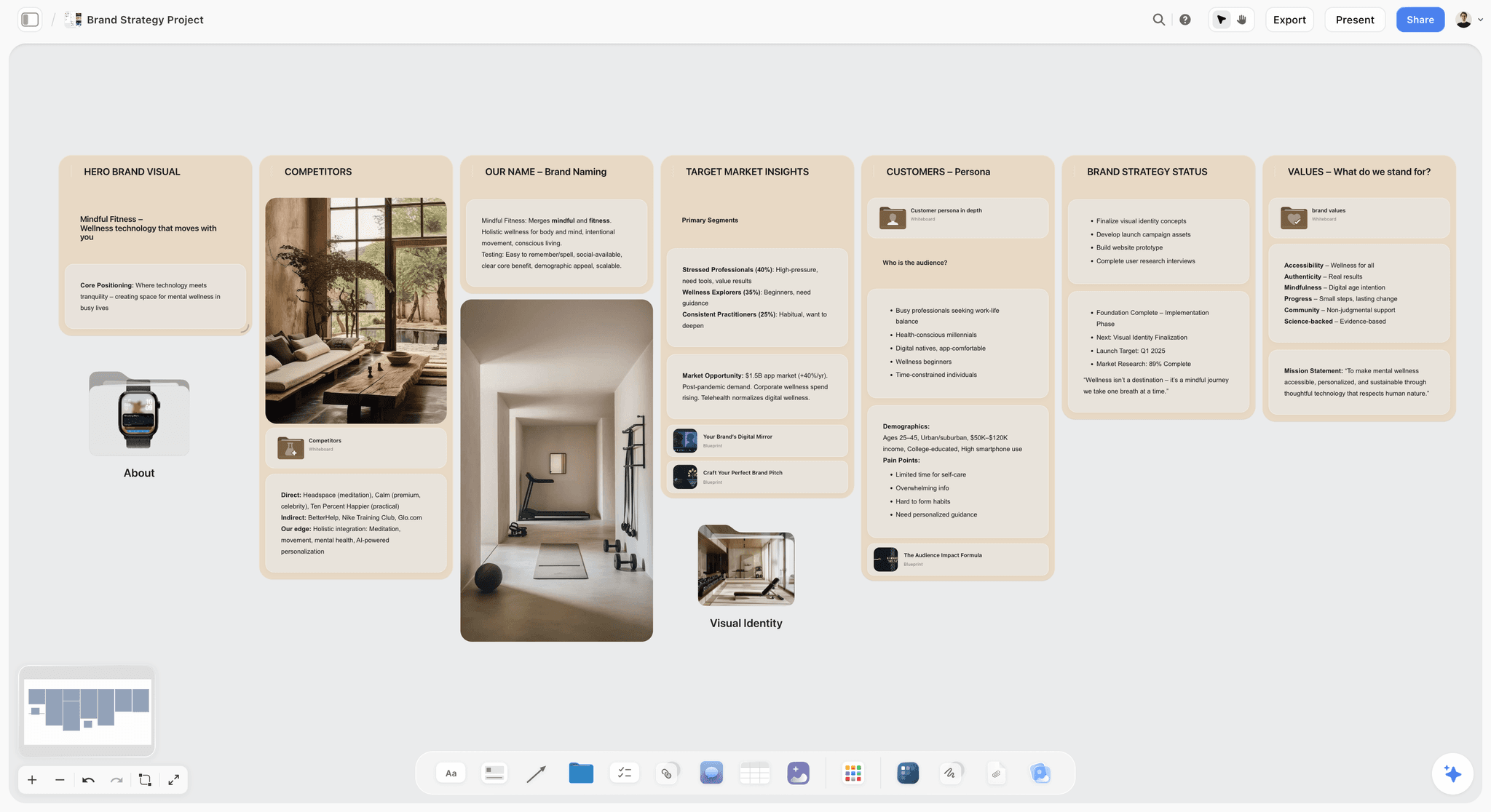
Three honest limitations before you lean on this. First, StoryBrand's structure is strong enough that it can flatten distinct brands into the same rhythm if you follow it too literally, so use it to organize the message, then rewrite in your own voice so two StoryBrand companies do not sound like the same company. Second, the Story Blueprints library (the 200+ frameworks) is on the Plus, Pro, and Max plans, not Free; the free plan gives you a few starter framework blueprints plus a trial of Storyflow AI (up to 10 generations), and AI image generation only starts on Pro. Third, Storyflow is a cloud canvas, so a card-shaped BrandScript is great for seeing the whole message at once but is not a substitute for a polished document if your deliverable is a formatted brand guide. A canvas plus AI speeds the structure. The voice, and the final formatting, are still your job.
9) StoryBrand vs AIDA vs the hero's journey
These three overlap because they share a source, but they do different jobs.
StoryBrand is a compressed, marketing-ready descendant of the hero's journey, keeping the guide-and-hero relationship and dropping the mythic detail. AIDA operates one level down, at the sentence-by-sentence persuasion of a single asset. A clean workflow: use StoryBrand to set the message (who is the hero, what is the guide's role), then AIDA to write and diagnose each asset that expresses it. StoryBrand decides the point of view. AIDA decides the order of the sentences.
If you have ever tried to run the full 12-stage hero's journey on a landing page, you already know why StoryBrand exists. The journey is built for two hours of screen time. A homepage has about eight seconds. StoryBrand keeps the one relationship that matters (hero and guide) and throws out the rest.
10) Where StoryBrand is the wrong tool
StoryBrand is a clarity tool for messaging where a customer has a known problem and you are the obvious guide. It is the wrong tool in a few cases, and using it anyway wastes effort.
When you are creating a new category, the "customer already knows their problem" assumption breaks, because your job is to teach the problem before you can guide anyone through it. Force a BrandScript here and you skip the education the customer actually needs.
When your audience is deeply technical and buys on specifications, the narrative framing can read as marketing gloss over the details they actually want. A developer comparing two APIs wants the rate limits and the docs, not a story about their transformation.
And for internal communication or documentation, where there is no hero to persuade and no sale to make, forcing a BrandScript adds nothing but overhead.
There is also the sameness risk worth restating. Because so many brands now use StoryBrand, a by-the-numbers BrandScript can make you sound like every consultant who read the same book. The framework gives you the skeleton. StoryBrand organizes the message; it does not write your voice. Distinctiveness is still on you.
11) FAQ: StoryBrand Framework
What is the StoryBrand framework?
StoryBrand is a seven-part messaging framework from Donald Miller's 2017 book Building a StoryBrand. It positions the customer as the hero of the story and the brand as the guide who helps them win. You run your business through the seven parts to produce a one-page BrandScript that clarifies your website, emails, and sales copy.
What are the 7 parts of StoryBrand?
The SB7 parts are: a Character (the customer), who Has a Problem, and Meets a Guide (your brand), Who Gives Them a Plan, And Calls Them to Action, That Helps Them Avoid Failure, and Ends in Success. Each part answers one question about how your customer moves from problem to transformation, and each is a place the customer can accidentally lose the hero role.
Who created the StoryBrand framework?
Donald Miller created it and published it in Building a StoryBrand in 2017, later expanding it through the StoryBrand and Business Made Simple companies. The framework adapts classic storytelling structure, especially the guide-and-hero relationship, into a practical marketing tool.
What is a BrandScript?
A BrandScript is the one-page output of the StoryBrand framework: your answers to all seven parts in a single view. It is not meant to be published. It is the filter you run your homepage, emails, and pitch through, so every asset keeps the customer in the hero role and your brand in the guide role.
What is the Hero Test?
The Hero Test is a one-line diagnostic: read any sentence you have written and ask whether the customer is the hero of it, or you are. If the subject is "we," "our," or your product name, you are probably the hero and the sentence needs rewriting. If the subject is "you" and the verb is something the customer does, feels, or gains, the customer is the hero. Grammar exposes point of view, so the subject of the sentence usually reveals who you have cast as the hero.
What is the biggest mistake with StoryBrand?
Casting your brand as the hero instead of the guide. Copy like "we are the leading platform" makes the company the protagonist and demotes the customer to spectator. When the customer is the hero, the entire message reorganizes around their desire and transformation, with your product as the tool that gets them there. The Hero Test catches this failure sentence by sentence.
StoryBrand vs the hero's journey: what is the difference?
The hero's journey is a twelve-stage narrative arc used for storytelling. StoryBrand is a compressed, marketing-ready descendant that keeps the guide-and-hero relationship and drops the mythic detail. Use the hero's journey for long-form narrative and founding stories, and StoryBrand for concise website and sales messaging where you have seconds, not hours.
Can AI write a StoryBrand BrandScript?
Yes, but it will sound generic unless you feed it specifics first. Give the AI real customer language from reviews and calls, the concrete problem, and the actual stakes. Use it to generate options for each part and to check whether your copy keeps the customer as the hero, then rewrite in your own voice. On a canvas like Storyflow, the AI can read your whole board plus @-mentioned documents, so it drafts from your real material instead of a template.
How long should a BrandScript be?
One page. The discipline is the point. One hero, one desire, three problem layers, two lines for the guide, a three-step plan, one direct and one transitional call to action, and short lines for failure and success. If it spills past a page, you are serving too many customers at once and should split it into two scripts.
What is the difference between a direct and transitional call to action?
A direct call to action asks for the sale now: buy, book, start free. A transitional call to action gives people who are not ready a lower-commitment next step: download a guide, watch a tour, read a case study. Strong StoryBrand messaging offers both so you capture the ready and nurture the curious.
Does StoryBrand work for B2B?
Yes. The hero-and-guide structure works whenever a customer has a problem and you can help solve it, which describes most B2B. The adjustment is that B2B often has a buying committee, so your BrandScript may need to speak to several roles' versions of the same problem, and it pairs well with a qualification framework for the deal itself.
What frameworks pair well with StoryBrand?
Use StoryBrand to set the message, then AIDA to write and diagnose each asset that expresses it, and a content calendar to schedule those assets. StoryBrand clarifies what you are saying, AIDA orders how a single page says it, and the calendar decides when and where each piece runs.
12) The Bottom Line
StoryBrand endures because it fixes the most common failure in brand messaging: making yourself the hero. Cast the customer as the hero and your brand as the guide, run your business through the seven parts to produce a one-page BrandScript, then use that script (and the Hero Test) as a filter on everything you publish. Use AI to draft and pressure-test the parts, work them on a canvas so you can see the whole message at once, and rewrite in your own voice so the framework organizes your message without erasing it. StoryBrand organizes the message; it does not write your voice. Do that, and StoryBrand turns a vague "our copy is not landing" into a clear, customer-first story.
To build your BrandScript on one board, open a Storyflow brand strategy board, lay the seven parts as cards, and run the Hero Test on every line the AI drafts.
Table of Contents
- What the StoryBrand framework is
- The one mistake that breaks it for most brands
- The Hero Test: a one-line diagnostic
- The 7 parts of the SB7 framework
- How to build a BrandScript, step by step
- A worked example: a project management tool
- Common mistakes that quietly break a BrandScript
- Using AI to build a BrandScript without sounding generic
- StoryBrand vs AIDA vs the hero's journey
- Where StoryBrand is the wrong tool
- FAQ
- The bottom line
Templates to check out for this topic


Templates you can use in Storyflow
Every Storyflow board starts from real structure and an AI that reads the whole canvas. Open one of these templates and make it yours.


See Storyflow in Action
A visual AI workspace where every feature lives inside one canvas. No tab-switching, no context lost.
Build your entire board from a single message
Type what you need in the AI chat at the bottom of your canvas. The AI adds cards, headings, and structure directly onto your board.
Use expert frameworks as AI context
Type @ in the AI chat and choose any Tactic. The AI tailors every response to that framework instead of giving generic advice.
Turn your board into a mind map in seconds
Ask the AI to restructure your canvas as a mindmap. It connects your ideas into a visual hierarchy so you can see how everything relates.
Why Storyflow Exists
Storyflow actually began as a personal tool while working on creative and research projects.
We kept running into the same problem: ideas were scattered everywhere: notes, documents, and whiteboards.
Nothing helped us see how everything connected.
So we started building a workspace designed around how ideas actually grow.
→ Read how Storyflow was createdSara de Klein
Head of Product at Storyflow
Published: 2026-07-04
Extremely simple, seriously capable


See how easy it is to get started
Watch a real project come together, from a blank board to a finished plan, clicked through step by step.
Start creating with AI and become more productive
Transform your creative workflow with AI-powered tools. Generate ideas, create content, and boost your productivity in minutes instead of hours.