
What Is the Hero's Journey? The Complete Guide (2026)
The hero's journey is a story pattern: a protagonist leaves a familiar world, faces an ordeal that forces change, and returns transformed. This covers the stages, how they map to three acts, and when the pattern is the wrong tool.

Category
Storytelling
Author

Justkay
Documentary Filmmaker & Founder at Storyflow
Topics
2026-07-04
•
13 min read
•
Storytelling- what is the hero's journey
- hero's journey stages
- hero's journey explained
- Joseph Campbell hero's journey
- hero's journey vs three act structure
- monomyth
What is the hero's journey?
The hero's journey is a story pattern in which a protagonist leaves a familiar world, faces an ordeal that forces change, and returns transformed. Campbell described it as the monomyth, and Vogler condensed it into twelve stages across three acts: Departure, Initiation, and Return. It works best as a diagnostic for a draft that is not landing, not as a checklist to write against.
What the hero's journey actually is
The hero's journey is a story pattern: a protagonist leaves a familiar world, faces an ordeal that forces them to change, and returns transformed. Joseph Campbell described it in "The Hero with a Thousand Faces" (1949), where he called it the monomyth and argued that myths from wildly different cultures share one underlying shape. Decades later, Christopher Vogler adapted Campbell's dense academic model into a practical 12-stage structure for screenwriters in "The Writer's Journey" (1992, expanded 2007), and that 12-stage version is what most people mean today when they say "hero's journey."
I have used this structure on documentaries, on scripted shorts, and on other people's drafts I was asked to fix. The most common mistake I see is treating it as a recipe: hit these twelve beats in order and you have a story. A story that mechanically checks all twelve boxes can still be lifeless, and a great story can skip half of them. The hero's journey is a mirror, not a mold. Use it to see what your story is missing, not to force twelve boxes onto it.
Held that way, the structure earns its keep. It is not a formula that writes the story for you. It is a lens that shows you where your draft goes slack: no real refusal, a mentor who does nothing, an ordeal with no cost, a return that changed nothing. Those are the leaks a good draft plugs, and the twelve stages are how you find them.
Lay the stages out where you can see them
Put the stages on a canvas beside your character notes and research, so the structure is something you can rearrange rather than a checklist you fill in.

Campbell's monomyth vs Vogler's 12 stages
People blur these two, so here is the clean separation. Campbell's original monomyth had 17 stages grouped into three acts: Departure, Initiation, and Return. It was a work of comparative mythology, not a screenwriting manual, and Campbell was describing myths that already existed, not prescribing how to build one.
Vogler was a Hollywood story analyst who wrote an internal memo distilling Campbell for working writers. That memo grew into "The Writer's Journey," where he compressed the 17 stages into 12 concrete enough to plot a film. His version is looser about order and explicit that stages can be skipped, reordered, or repeated. That flexibility is the whole point, and it is what gets lost when a template treats the twelve as a mandatory sequence.
So when a guide lists twelve stages, that is Vogler. When someone talks about the monomyth, that is Campbell. This article uses Vogler's twelve because they are the practical unit, but the diagnostic mindset comes straight from Campbell: the shape is descriptive, a pattern found across stories, not a rule imposed on them.
The 12 stages and the job each one does
Each stage does one job. If you cannot name the job a stage is doing in your draft, it is probably decoration.
Ordinary World
Establish the hero's normal life and the specific lack in it. This is where the audience decides to care, and where the eventual change gets its baseline. Skip it and the transformation has nothing to measure against.
Call to Adventure
Something disrupts the ordinary world and presents a problem or quest. The call defines the story's central question. A vague call produces a vague story.
Refusal of the Call
The hero hesitates or refuses, out of fear, duty, or doubt. Refusal is what makes the eventual yes mean something. A hero who leaps instantly is a hero with nothing at stake.
Meeting the Mentor
The hero gains guidance, a tool, or confidence from a mentor figure. The mentor's job is to make crossing the threshold possible, then get out of the way. A mentor who solves the story is a broken mentor.
Crossing the Threshold
The hero commits and leaves the ordinary world for the special world. This is the end of Act One. Before it, the hero could still go home. After it, they cannot.
Tests, Allies, and Enemies
In the special world, the hero learns its rules through challenges, meets allies, and makes enemies. This is where the world gets built and relationships forged that pay off later.
Approach to the Inmost Cave
The hero prepares for the biggest challenge, often a lull that gathers tension before the ordeal. This is the stretch writers most often let go slack.
The Ordeal
The central crisis. The hero faces their greatest fear and appears to fail or die. Everything before earns it, everything after depends on it. An ordeal with no real cost collapses the whole arc.
Reward
Having survived, the hero seizes what they came for: an object, knowledge, or reconciliation. The reward is not the end. It is the thing that raises new stakes.
The Road Back
The hero begins the return, often chased by consequences of the ordeal. Stakes re-escalate so the hero cannot coast home.
Resurrection
A final, higher-stakes test where the hero proves the change is real and permanent. This is the climax, where the transformation gets its last, hardest exam.
Return with the Elixir
The hero returns to the ordinary world changed, carrying something that heals or improves it. The elixir closes the loop opened in the Ordinary World. Without it, the hero left and came back for nothing.
The three acts: Departure, Initiation, Return
The twelve stages map cleanly onto Campbell's three acts, and holding the acts in mind keeps you from obsessing over individual beats. The acts are the load-bearing structure; the stages are the diagnostic detail.
| Act | Campbell's name | Vogler stages it contains | The job of the act |
|---|---|---|---|
Act One | Departure | Ordinary World, Call to Adventure, Refusal, Meeting the Mentor, Crossing the Threshold | Establish the world and the lack, then commit the hero to leaving it |
Act Two | Initiation | Tests-Allies-Enemies, Approach to the Inmost Cave, The Ordeal, Reward | Test the hero in the special world and force the central crisis |
Act Three | Return | The Road Back, Resurrection, Return with the Elixir | Prove the change is permanent and bring it home |
Read this way, a common failure jumps out. Many first drafts have a rich Act One and a rich Ordeal, then rush the Return into a paragraph. But the Return is where the audience sees what the whole ordeal was for. If your Act Three is thin, the change you spent two acts setting up never lands.
Run the hero's journey as a diagnostic, not a checklist
Here is the workflow that changed how I use this structure. Take a draft you already have, an outline or a script, and label each beat with the stage it serves. Then look at the shape of the labels, not whether all twelve are present.
- No real refusal: your hero has nothing at stake and the story reads as easy. Add doubt or cost before the yes.
- A mentor who does the work: the hero is a passenger in their own story. The mentor should enable, not solve.
- An ordeal with no price: the crisis has no teeth, so the win feels unearned. Raise the cost.
- A thin return: the hero came back unchanged, so the whole arc was decorative. Show what the ordeal made permanent.
- Twelve boxes, all checked, still flat: the beats are present but mechanical. The structure is not the problem. The specificity of your world and characters is.
That last line matters most. A checklist mindset produces the exact failure it promises to prevent: a story that has every stage and no soul. The stages are diagnostic questions, not a fill-in-the-blank form. The point is not "did I include the Ordeal," it is "does my Ordeal cost the hero something they cannot easily get back." A diagnostic that points at a specific weak beat beats ten generic notes.
Star Wars: the canonical worked example
The clearest example is the original "Star Wars" (1977), and it is canonical for a reason: George Lucas cited Campbell directly as an influence while writing it. Walk the stages and the fit is almost one to one.
Luke Skywalker starts in the Ordinary World, a moisture farm on Tatooine, restless and stuck. The Call to Adventure arrives as Leia's message in R2-D2. Luke's Refusal is real: he tells Obi-Wan he has responsibilities at home. Meeting the Mentor is Obi-Wan, who gives him the lightsaber and the first lesson in the Force. Crossing the Threshold is leaving Tatooine after the Empire kills his aunt and uncle, the moment he can no longer go home. The special world brings Tests, Allies, and Enemies: the cantina, Han and Chewbacca, the tractor beam. The Approach and the Ordeal are the rescue and the loss of Obi-Wan. The Reward is the rescued princess and the stolen plans, the Road Back is the pursued flight to the rebel base, the Resurrection is the trench run where Luke trusts the Force over the targeting computer, and the Return with the Elixir is the destroyed Death Star and the medal ceremony.
The lesson is not that you should copy Star Wars. It is that even the canonical example bends the stages to fit the story. Luke's Refusal is brief and the mentor dies mid-film. The pattern serves the film, not the other way around.
Mapping the whole arc on a canvas
Running the hero's journey as a diagnostic is hard in a document, because a document forces a single top-to-bottom order and hides the shape. You cannot see at a glance that your Act Three has three thin beats while your Act Two has nine fat ones. A canvas fixes that. Lay the twelve stages left to right, drop a card under each with the beat from your draft, and the imbalance becomes visible.
This is the workflow Storyflow is built for. You lay the arc across a board, drop your beats onto each stage, and the AI reads the whole board before it responds, so when you ask "which act is thinnest here," it answers against the actual beats on your canvas, not a generic template. Storyflow ships a Hero's Journey layout inside its Story Blueprints library, which holds 200+ expert frameworks including the Hero's Journey, AIDA, StoryBrand, and Five-Act Structure, so you start from the twelve-stage structure instead of drawing it by hand.
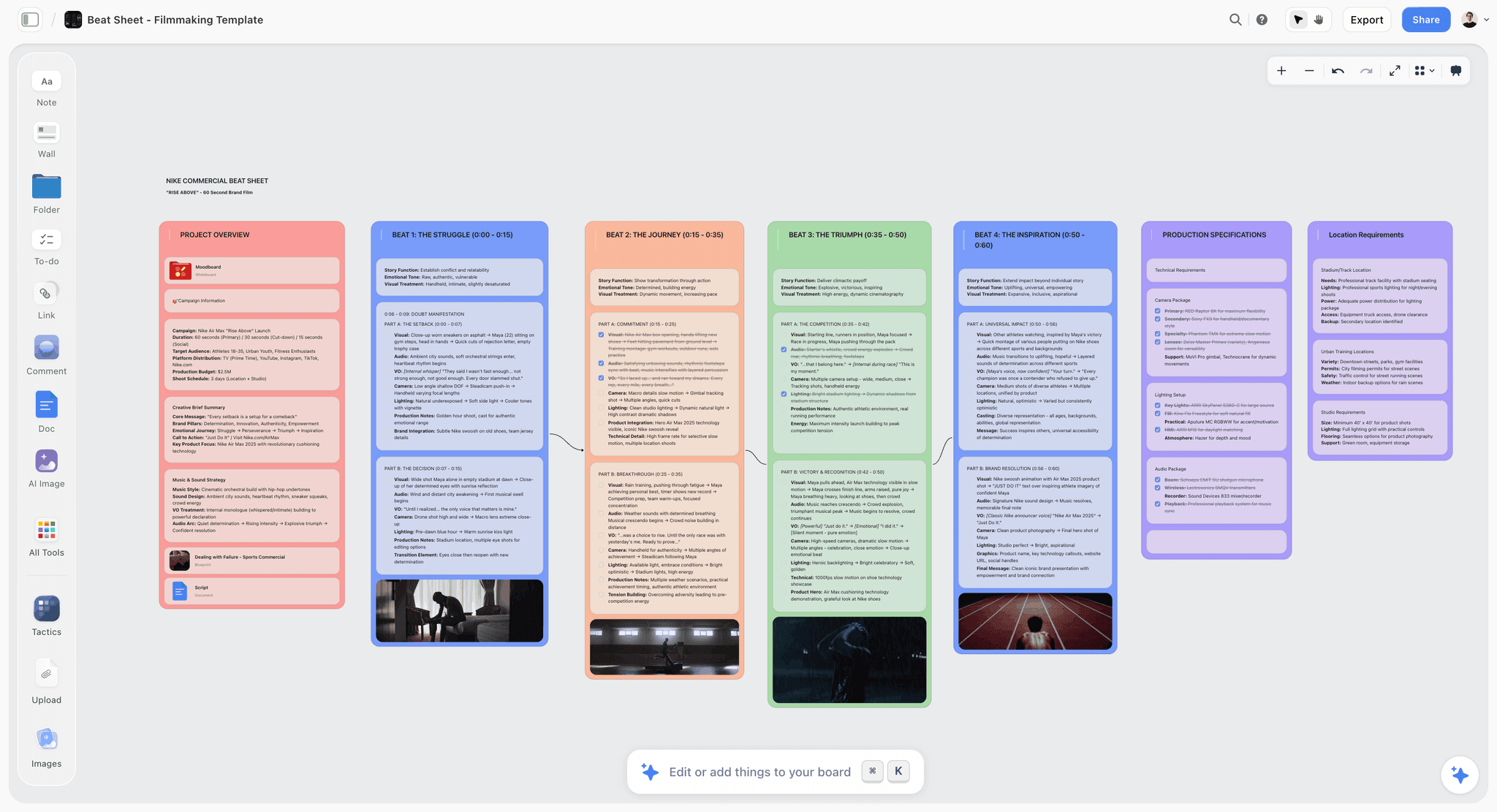
Honest limitation: the AI reads the full current board plus up to one Blueprint and up to three documents you mention in the chat, not your entire project history, so a sprawling multi-board story still needs you to bring the relevant board into view. And if you think in long prose and never in cards, a canvas will feel foreign at first. The board pays off when you are diagnosing why an arc sags across acts, not when you are drafting a single scene.
Hero's journey vs three-act vs Save the Cat
These three get compared constantly, so here is the honest separation. They are not rivals; they are the same story described at different resolutions.
| Structure | What it is | Best for | Watch out for |
|---|---|---|---|
Hero's journey | A 12-stage transformation arc from Campbell via Vogler | Character-driven stories about change and growth | Forcing all twelve stages onto a story that does not need them |
Three-act structure | Setup, Confrontation, Resolution: the broadest dramatic frame | Almost any narrative, as a first sanity check | Too coarse to fix a specific slack beat |
Save the Cat | Blake Snyder's 15-beat sheet with page targets | Commercial screenplays needing tight pacing | Can feel formulaic and homogenize films if followed rigidly |
The three-act structure is the widest lens: nearly every story fits it, which means it rarely diagnoses a specific problem. The hero's journey adds detail inside those acts and is strongest for stories about a character changing. Save the Cat, from Blake Snyder, is the most prescriptive, with beats pinned to page numbers, loved for pacing and criticized for making films feel interchangeable. Use the three-act frame to sanity-check the whole, the hero's journey to diagnose the arc, and Save the Cat when commercial pacing is the priority.
Where the hero's journey is the wrong tool
This is the section most guides skip, and skipping it is how the structure gets misused. The hero's journey is built for a single protagonist who leaves, changes, and returns. It is the wrong tool in several cases.
Ensemble stories. When a film or novel splits focus across many characters with no single hero, forcing one arc flattens the cast into a lead and a supporting crowd. Ensemble narratives often work better as interwoven threads.
Slice-of-life and stories about stasis. Some of the best stories are precisely about a character who does not transform, or about ordinary life observed closely. Bolting a call-ordeal-return arc onto a story whose whole point is that nothing dramatic happens breaks it.
Non-Western structures. The monomyth is not the only shape stories take. Kishotenketsu, a four-part structure common in Chinese, Korean, and Japanese storytelling, builds meaning through a twist and juxtaposition rather than conflict, and it has no ordeal or antagonist by design. Treating the hero's journey as universal erases these traditions and pushes every story toward the same Western arc.
The hero's journey is one pattern among many, powerful for transformation stories and wrong for others. If your story is not about a person changing through an ordeal, reach for a different frame. Naming that plainly beats pretending the monomyth fits everything.
The Bottom Line
The hero's journey has lasted because the shape it describes is real: people are changed by leaving the familiar and surviving an ordeal. Campbell found that pattern across the world's myths, and Vogler made it usable for writers. What gets it misused is treating twelve stages as a checklist to satisfy rather than a diagnostic to run. Held as a diagnostic, the structure shows you where a draft goes slack: no refusal, a passive mentor, a costless ordeal, a rushed return. Lay it across a canvas to see the whole arc at once, use AI to spot the thinnest act, and be honest about the stories where a single transformation arc is the wrong tool. Do that, and a pattern first written down in 1949 still earns its place on your desk.
To run the hero's journey as a diagnostic on your own story, open a Storyflow board, lay the twelve stages across it, and ask the AI which act is thinnest.
FAQ: Hero's Journey
What are the 12 stages of the hero's journey?
The 12 stages, from Christopher Vogler's adaptation, are: Ordinary World, Call to Adventure, Refusal of the Call, Meeting the Mentor, Crossing the Threshold, Tests-Allies-Enemies, Approach to the Inmost Cave, The Ordeal, Reward, The Road Back, Resurrection, and Return with the Elixir. Each stage does one job, and stages can be reordered or skipped.
Who created the hero's journey?
Joseph Campbell introduced the underlying pattern, which he called the monomyth, in his 1949 book "The Hero with a Thousand Faces." Christopher Vogler later adapted Campbell's model into a practical 12-stage structure for screenwriters in "The Writer's Journey" (1992, expanded 2007). Campbell described the pattern in myths, Vogler made it usable for writing new stories.
What is the difference between Campbell's and Vogler's versions?
Campbell's monomyth had 17 stages in three acts (Departure, Initiation, Return) and was a work of comparative mythology. Vogler compressed those into 12 practical stages for screenwriters and made clear that stages can be skipped, reordered, or repeated. When a guide lists twelve stages, that is Vogler. When someone says monomyth, that is Campbell.
Hero's journey vs three-act structure: what is the difference?
The three-act structure (Setup, Confrontation, Resolution) is the broadest dramatic frame and fits almost any story, which makes it too coarse to diagnose a specific problem. The hero's journey adds detail inside those acts and is strongest for stories about a character transforming. Use three acts to sanity-check the whole and the hero's journey to diagnose the arc.
Is the hero's journey overused?
It is common, and criticized for it, because rigid use makes stories feel interchangeable. The fix is not to abandon it but to stop treating it as a mandatory checklist. Used as a diagnostic to find weak beats, rather than a template to fill in, it strengthens a draft without flattening it into every other film.
What is a good example of the hero's journey?
The original "Star Wars" (1977) is the canonical example, because George Lucas cited Campbell directly while writing it. Luke Skywalker moves through nearly all twelve stages, from the Ordinary World of the moisture farm to the Return with the Elixir when the Death Star is destroyed. Even so, the film bends the stages to fit the story rather than following them rigidly.
Do I have to use all 12 stages?
No. Vogler was explicit that stages can be skipped, merged, reordered, or repeated. Many strong stories use only some of them. Treating all twelve as mandatory is the most common way to misuse the structure and produce a mechanical, lifeless draft. Include a stage only when it does a real job.
Is the hero's journey the same as the monomyth?
Effectively yes, in casual use. Monomyth is Campbell's original term for the single underlying story pattern he found across world mythology. Hero's journey is the more common name today, usually referring to Vogler's 12-stage screenwriting adaptation of that same pattern.
When should you not use the hero's journey?
Avoid it for ensemble stories with no single hero, slice-of-life or stories about a character who deliberately does not change, and narratives built on non-Western structures like kishotenketsu, which create meaning through a twist rather than an ordeal. The hero's journey fits transformation stories about one protagonist and can distort stories that are not.
What is kishotenketsu and how is it different?
Kishotenketsu is a four-part structure common in Chinese, Korean, and Japanese storytelling: introduction, development, twist, and reconciliation. It builds meaning through juxtaposition and a surprising turn rather than conflict, ordeal, and transformation. It has no required antagonist or crisis, which makes it a genuine alternative to the hero's journey rather than a variation of it.
How do I map the hero's journey for my story?
Lay the twelve stages across a board or page, then drop the beats from your draft under each stage. Look at the shape: which stages are empty, which are overloaded, whether the return is rushed. A canvas makes the imbalance visible at a glance, which a top-to-bottom document hides. Tools like Storyflow ship a Hero's Journey layout so you start from the structure.
Is the hero's journey good for non-fiction or documentary?
It can be, when a real person genuinely changes through a hard experience, which is common in profile documentaries. But forcing an ordeal-and-transformation arc onto observational or issue-driven material distorts the truth. Use it when the real story is about change, and a looser structure when it is not.
Table of Contents
- What the hero's journey actually is
- Campbell's monomyth vs Vogler's 12 stages
- The 12 stages and the job each one does
- The three acts: Departure, Initiation, Return
- Run the hero's journey as a diagnostic, not a checklist
- Star Wars: the canonical worked example
- Mapping the whole arc on a canvas
- Hero's journey vs three-act vs Save the Cat
- Where the hero's journey is the wrong tool
- The Bottom Line
- FAQ: Hero's Journey
- Related Reading
Templates to check out for this topic


Templates you can use in Storyflow
Every Storyflow board starts from real structure and an AI that reads the whole canvas. Open one of these templates and make it yours.


See Storyflow in Action
A visual AI workspace where every feature lives inside one canvas. No tab-switching, no context lost.
Build your entire board from a single message
Type what you need in the AI chat at the bottom of your canvas. The AI adds cards, headings, and structure directly onto your board.
Use expert frameworks as AI context
Type @ in the AI chat and choose any Tactic. The AI tailors every response to that framework instead of giving generic advice.
Turn your board into a mind map in seconds
Ask the AI to restructure your canvas as a mindmap. It connects your ideas into a visual hierarchy so you can see how everything relates.
Why Storyflow Exists
Storyflow actually began as a personal tool while working on creative and research projects.
We kept running into the same problem: ideas were scattered everywhere: notes, documents, and whiteboards.
Nothing helped us see how everything connected.
So we started building a workspace designed around how ideas actually grow.
→ Read how Storyflow was createdJustkay
Documentary Filmmaker & Founder at Storyflow
Published: 2026-07-04
Extremely simple, seriously capable


See how easy it is to get started
Watch a real project come together, from a blank board to a finished plan, clicked through step by step.
Start creating with AI and become more productive
Transform your creative workflow with AI-powered tools. Generate ideas, create content, and boost your productivity in minutes instead of hours.