
Category
Marketing Tools
Author

Justkay
Documentary Filmmaker & Founder at Storyflow
Topics
2026-05-17
•
Updated May 17, 2026
•
13 min read
•
Marketing Tools- best brand strategy tools 2026
- brand strategy software
- brand positioning tool
- brand strategy canvas
- Frontify alternative
- Storyflow brand strategy
What are the best brand strategy tools in 2026?
Storyflow is the best brand strategy tool in 2026 for building and pressure-testing the strategy: positioning, audience, messaging and proof sit on one canvas its AI can read and argue with. Milanote is the best purely visual canvas for the brand foundation, Miro the best for collaborative strategy workshops, and Frontify the best for the expression and guidelines layer. Brand strategy is the foundation, not the logo.

All 12 Brand Strategy Tools, Ranked
- Storyflow: the AI canvas that reads the whole foundation and pressure-tests positioning
- Milanote: the strongest visual canvas for the brand foundation
- Miro: the strongest collaborative surface for brand strategy workshops
- Mural: facilitated brand sprints with timers, voting, and guided sessions
- Notion: a structured, document-based brand foundation
- FigJam: a foundation and expression bridge for design teams in Figma
- Frontify: the best brand guidelines and asset management for the expression layer
- Brandpad: living, hosted brand guidelines for studios delivering identities
- Canva: a brand kit and assets for the expression and application layers
- ChatGPT / Claude: fast AI drafts of positioning, names, and messaging
- Pitch: presenting the finished brand strategy to stakeholders
- Whimsical: clean brand architecture and positioning diagrams
Full disclosure: Storyflow is our own product, and we rank it second here, not first. For the brand foundation, Milanote's visual canvas is the stronger starting point, and for real-time strategy workshops Miro is the benchmark. Storyflow's edge is narrower: an AI canvas that reads the whole foundation and pressure-tests whether the positioning is genuinely differentiated. It is not a brand guidelines or asset manager, so for the expression layer you still need Frontify. We link to every tool so you can judge the fit.
Quick Comparison: Best Brand Strategy Tools
These four cover the layers of a brand: the visual foundation canvas, the AI canvas that pressure-tests the strategy, collaborative workshops, and the guidelines and expression layer.
| Tool | Best For | AI Features | Price |
|---|---|---|---|
| Storyflow | AI canvas for the strategy | Canvas-wide context AI | $7.99 mo annual (free plan late 2026) |
| Milanote | Visual brand foundation canvas | Light AI | Free / $9.99 mo |
| Miro | Collaborative strategy workshops | Standard AI | Free / $8 mo |
| Frontify | Brand guidelines and management | Brand-aware AI | Custom pricing |
1) Quick Answer: The Best Brand Strategy Tools in 2026
The best brand strategy tools in 2026 are Storyflow (best AI canvas for building and pressure-testing the strategy), Milanote (best visual canvas for the brand foundation), Miro (best for collaborative strategy workshops), and Frontify (best for the expression and guidelines layer). The right pick depends on which layer of the brand you are actually working on.
Brand strategy is the foundation, not the logo. Most tools sell you the logo. Search "brand strategy tools" and most results are logo makers, color palette generators, and guideline managers. Those serve the visible brand. They do not help you decide who the brand is for, what it stands against, or why anyone should care. That decision, the foundation, is the strategy, and it is the layer most tools skip.
I have built brand foundations for creative ventures and watched the same failure repeat: a beautiful visual identity sitting on top of a foundation nobody actually defined. The Brand Pyramid framework in section 3 ranks all 12 tools by which layer they serve, weighting the foundation, because that is where strategy lives.
For the hands-on workflow, see How to Build a Brand Strategy with AI. For campaigns, see How to Plan a Brand Campaign with AI.
2) Comparison Table: 12 Brand Strategy Tools at a Glance
Pricing reflects publicly listed plans as of early 2026 and changes often. Ratings weigh pyramid-layer fit, foundation-layer depth, collaboration, AI support, and pricing for strategists, founders, and agencies.
3) The Brand Pyramid
A brand has three layers, and confusing them is why "brand strategy tools" searches return logo makers.
The Foundation. Who the brand is for, what it stands for, what it stands against, how it is positioned, what its audience actually wants, who the competitors are and where the gap is. This is the strategy. It is mostly thinking, research, and decisions. It has no visual output. It is the layer that determines whether the brand means anything.
The Expression. How the foundation becomes sensory: the voice, the tone, the visual identity, the logo, the color, the typography, the brand guidelines. Expression makes the foundation visible and audible.
The Application. The actual artifacts: the landing page, the ad, the social post, the deck, the packaging. Application is the foundation and expression applied to a real surface.
Here is the rule that decides tool choice. Most tools sold as "brand strategy" tools serve the Expression or Application layers, not the Foundation. Logo makers, color generators, brand kit managers, guideline platforms. They are useful, but they assume the foundation already exists. They do not help you build it. A brand with a stunning Expression layer on a hollow Foundation is a well-dressed brand that means nothing, and audiences feel the hollowness even when they cannot name it.
So the ranking weights the Foundation layer heavily. A tool that helps you decide positioning, map the competitive gap, define the audience, and pressure-test the strategy is doing the work that the Expression and Application layers cannot do for you. A tool that only manages guidelines is valuable, but it is not a brand strategy tool. It is a brand expression tool.
The 12 tools below are ranked by pyramid layer. Foundation tools sit at the top, because the foundation is the strategy, and the strategy is what the search is really asking for.
4) How We Evaluated These Tools
Five criteria, weighted in this order:
- Pyramid-layer fit. Does the tool serve the Foundation (strategy), the Expression (identity), or the Application (assets)? Foundation tools are weighted highest.
- Foundation-layer depth. Can the tool actually hold positioning, audience, competitive mapping, and brand pillars, or only references and assets?
- Collaboration. Brand strategy is rarely solo: founders, strategists, designers, and marketers all contribute. Tools that keep them aligned rank higher.
- Strategy-to-execution connection. Does the foundation stay visible to the people doing expression and application, or does it vanish into a deck?
- Pricing for strategists, founders, and agencies. Brand strategy work spans solo founders to agencies. Per-seat and enterprise-only pricing is marked down for smaller teams.
Testing covered a startup brand foundation, a rebrand strategy, and an agency client brand sprint, each built from positioning through to guidelines.
5) Quick Picks by Brand Strategy Need
Best AI canvas for building the strategy: Storyflow. The whole foundation lives on a canvas the AI reads and pressure-tests.
Best visual canvas for the brand foundation: Milanote. Positioning, audience, and competitive maps on a freeform canvas.
Best for collaborative strategy workshops: Miro. Real-time brand workshops with the whole team.
Best for facilitated brand sprints: Mural. Structured facilitation for brand strategy sessions.
Best for the expression and guidelines layer: Frontify. Brand guidelines and asset management at scale.
Best for AI strategy drafting and naming: ChatGPT or Claude. Fast first drafts of positioning and brand names.
Best cheapest working stack: Storyflow Plus ($7.99/month annual) for the foundation plus Canva Free for the expression layer.
6) Detailed Reviews: 12 Brand Strategy Tools
1. Storyflow
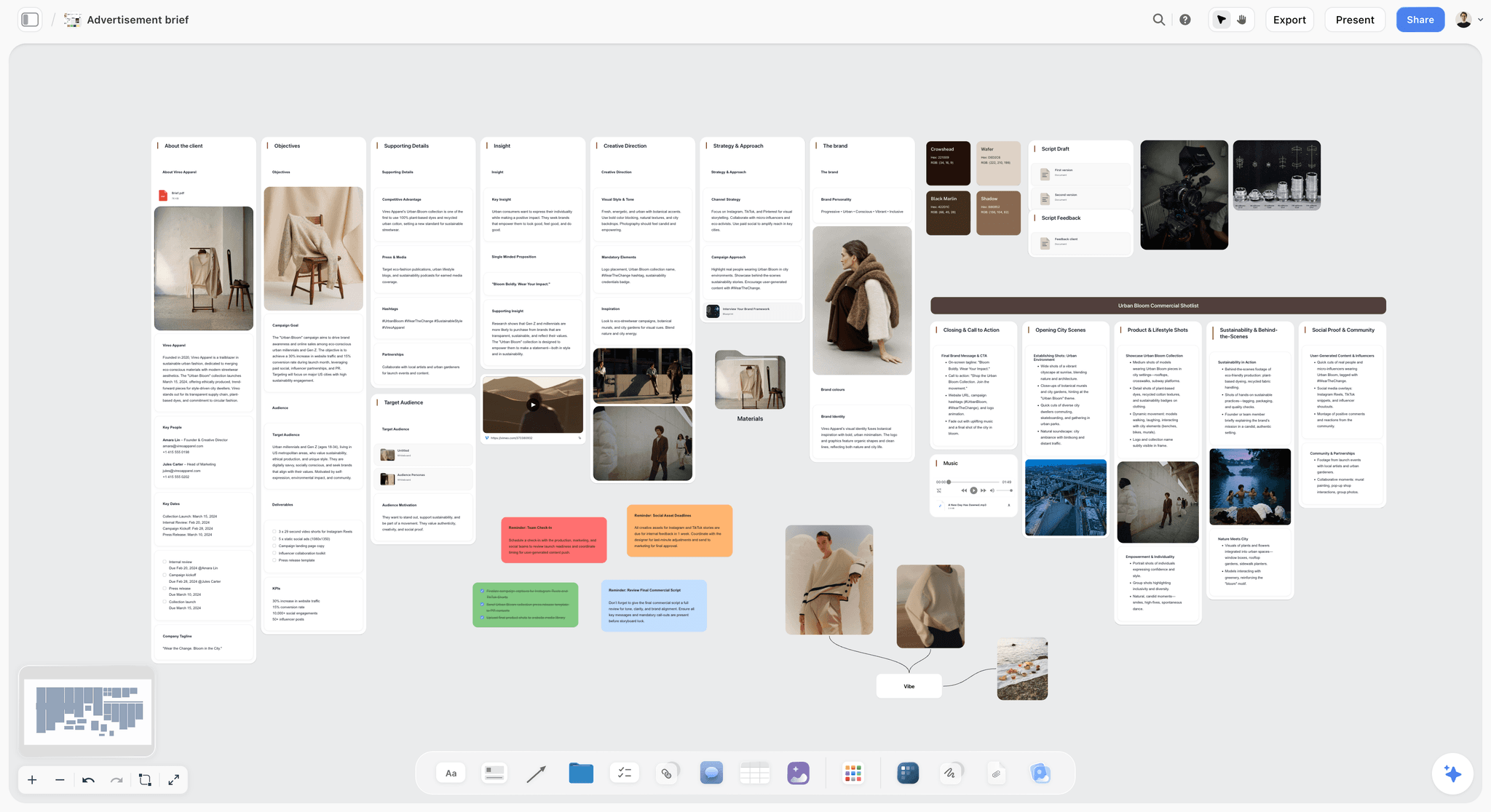
Storyflow holds the brand foundation on a canvas: positioning, audience, competitive landscape, brand pillars, and voice direction, all visible together. The AI reads the full canvas, so you can ask it whether the positioning is genuinely different from the competitors mapped beside it, or whether the brand pillars actually support the positioning. The Story Blueprints library includes brand and marketing frameworks that scaffold the foundation.
Best for: Strategists and founders who want to build and pressure-test the brand foundation with AI.
Verdict: The strongest AI canvas for the foundation layer. For guidelines and asset management, pair it with Frontify.
Key features
- Canvas for positioning, audience, competitors, and pillars.
- AI reads the full canvas plus up to 1 Tactic and 3 Documents you @-mention.
- AI pressure-tests whether positioning is genuinely differentiated.
- Story Blueprints library with brand and marketing frameworks.
- Unlimited collaboration on every plan for founders, strategists, and designers (invited collaborators join free today).
Pricing
Paid-only during early access. Plus: $7.99/mo annual. Unlimited boards and cards, unlimited collaboration, basic AI, full Story Blueprints, unlimited uploads. Pro: $14/mo annual. AI image generation, 20x AI usage. Max: $39/mo annual. 40x more AI, team workspace with roles. Free: launches before the end of 2026 with unlimited boards and cards, unlimited collaboration, basic AI, and 20 file uploads.
Pros
- Holds the whole foundation in one AI-readable view.
- AI checks whether the positioning is actually differentiated.
- Unlimited free collaboration across the brand team.
Cons
- Not a brand guidelines or asset manager; pair with Frontify.
- Cloud-only, with no offline mode.
- Newer platform with a smaller template library than Milanote.
2. Milanote
Milanote is a visual canvas well suited to the brand foundation. Positioning statements, audience profiles, competitor maps, brand pillars, and reference imagery all live on freeform boards. Because the foundation is mostly thinking, a spatial canvas that holds it all in view is exactly what the layer needs. Milanote's brand strategy guides have made it a common starting point.
Best for: Strategists who want a visual canvas for the brand foundation.
Verdict: The strongest visual canvas for the foundation layer. Pair it with a guidelines tool for expression.
Key features
- Freeform canvas for positioning, audience, and pillars.
- Competitor and landscape mapping.
- Templates for brand strategy.
- Web clipper for references.
- Shareable boards.
Pricing
Free with 100 cards. Individual: $9.99/mo. Team: $49/mo flat.
Pros
- Strong for the foundation layer.
- Visual layout holds the whole strategy in view.
- Brand strategy templates.
Cons
- The 100-card free limit fills on a full strategy.
- No guidelines or asset management.
- Light AI compared to canvas-AI tools.
3. Miro
Miro is the collaborative whiteboard for brand strategy workshops. Positioning canvases, brand pillar exercises, competitor maps, and audience personas all run as real-time team sessions. For a brand sprint where the whole team builds the foundation together, Miro is the natural surface.
Best for: Teams that build the brand foundation in collaborative workshops.
Verdict: The strongest collaborative workshop tool. Pair it with a guidelines tool for expression.
Key features
- Infinite collaborative canvas.
- Brand strategy and workshop templates.
- Real-time editing and voting.
- Diagramming for positioning and architecture.
Pricing
Free for 3 boards. Starter: $8/mo annual. Business: $16/mo.
Pros
- Excellent real-time strategy workshops.
- Strong brand strategy templates.
- Familiar to most teams.
Cons
- The 3-board free limit is tight.
- Built for general teams, not brand specifically.
- No guidelines or asset management.
4. Mural
Mural is a collaborative canvas built around facilitation, which suits structured brand strategy sprints. Its facilitation features, timers, voting, and guided sessions, keep a brand workshop on track. It is similar to Miro with a stronger facilitation emphasis.
Best for: Facilitators running structured brand strategy sprints.
Verdict: Strong for facilitated brand sprints. Miro is the broader general pick.
Key features
- Collaborative canvas with facilitation tools.
- Brand and strategy templates.
- Timers, voting, and guided sessions.
- Async and real-time collaboration.
Pricing
Free tier. Paid plans from roughly $12/mo.
Pros
- Strong facilitation for brand sprints.
- Keeps workshops structured.
- Good template library.
Cons
- Overlaps with Miro without clearly beating it.
- Workshop framing can feel heavy.
- No guidelines management.
5. Notion
Notion holds the brand foundation as structured documents and databases: a positioning doc, an audience database, a competitor tracker, brand pillar pages. It keeps the strategy organized and editable. The cost is a non-visual feel that suits structured strategists more than spatial ones.
Best for: Strategists who want a structured, document-based brand foundation.
Verdict: A capable structured foundation tool. Less visual than a canvas for landscape mapping.
Key features
- Documents and databases for the foundation.
- Competitor and audience trackers.
- Brand strategy templates.
- Standard AI features.
Pricing
Free for personal use. Plus: $10/mo. Business: $18/mo.
Pros
- Strong structure for the foundation.
- Easy to keep current.
- Large template community.
Cons
- Non-visual; weaker for landscape mapping.
- Setup-heavy before it is useful.
- No expression or asset tools.
6. FigJam
FigJam, Figma's whiteboard, suits brand teams already in Figma. It handles foundation workshops and bridges into the expression layer, since the visual identity work happens in Figma next door. It is capable and convenient for design-led brand teams.
Best for: Design-led brand teams already working in Figma.
Verdict: A solid foundation and expression bridge for Figma teams. Generic for brand-specific work.
Key features
- FigJam whiteboard for strategy workshops.
- Real-time collaboration.
- Bridges into Figma for visual identity.
- Templates.
Pricing
Free for 3 files. Paid plans from roughly $5/mo.
Pros
- Connects the foundation to identity work in Figma.
- Strong collaboration.
- Mature platform.
Cons
- Generic, not brand-specific.
- 3-file free cap.
- Best value only inside Figma.
7. Frontify
Frontify is a brand management platform: brand guidelines, asset libraries, and templates that keep a brand consistent at scale. It owns the Expression layer. It assumes the foundation already exists and gives the brand a home once it does, with brand-aware AI for asset work.
Best for: Brands that need guidelines and asset management at scale.
Verdict: The strongest brand management platform for the Expression layer. Not a foundation tool.
Key features
- Brand guidelines hub.
- Digital asset management.
- Templates for on-brand assets.
- Brand-aware AI.
Pricing
Custom pricing, aimed at established brands and teams.
Pros
- Best-in-class guidelines and asset management.
- Keeps a brand consistent at scale.
- Strong for established brands.
Cons
- Expression layer only; not a strategy tool.
- Custom pricing suits larger budgets.
- Assumes the foundation already exists.
8. Brandpad
Brandpad creates living brand guidelines, popular with independent designers and studios delivering brand identities to clients. It is an Expression-layer tool: it presents and hosts the visual identity beautifully. It does not build the foundation.
Best for: Designers and studios delivering polished brand guidelines to clients.
Verdict: A strong guidelines delivery tool. An Expression-layer tool, not strategy.
Key features
- Living, hosted brand guidelines.
- Clean presentation of visual identity.
- Client-friendly delivery.
- Designer-focused workflow.
Pricing
Priced per brand, suited to studios delivering identities.
Pros
- Beautiful guidelines delivery.
- Popular with independent studios.
- Client-friendly.
Cons
- Expression layer only.
- No foundation or strategy tools.
- Niche, designer-delivery focused.
9. Canva
Canva serves the Expression and Application layers: a Brand Kit holds colors, fonts, and logos, and templates turn them into assets. It is fast and accessible for producing on-brand material, and it does nothing for the foundation.
Best for: Teams producing on-brand assets quickly from a brand kit.
Verdict: Strong for expression and application. Not a strategy tool.
Key features
- Brand Kit for colors, fonts, and logos.
- Template-based asset creation.
- Generative AI.
- Large asset library.
Pricing
Free tier. Pro: roughly $15/mo or $120/year.
Pros
- Fast on-brand asset creation.
- Easy for non-designers.
- Brand Kit keeps assets consistent.
Cons
- Expression and application only.
- No foundation or strategy tools.
- Template feel can dilute a distinctive brand.
10. ChatGPT / Claude
General AI chat tools draft the writing-heavy parts of the foundation: positioning statements, brand name candidates, audience descriptions, messaging pillars. They are fast and cheap, with no project memory, so the output is a starting point a strategist refines.
Best for: Strategists who want fast AI drafts of positioning, names, and messaging.
Verdict: A strong drafting partner for the foundation. Pair it with a canvas to hold the strategy.
Key features
- Positioning and messaging drafts.
- Brand name brainstorming.
- Audience and competitor analysis prompts.
- Fast iteration.
Pricing
ChatGPT Free or Plus ($20/mo). Claude Free or Pro ($20/mo).
Pros
- Fast drafting of foundation language.
- Cheap relative to dedicated tools.
- Strong for naming and messaging.
Cons
- No memory of the brand across sessions.
- Output is generic without careful prompting.
- Not built for brand strategy specifically.
11. Pitch
Pitch is a presentation tool used to package and present the brand strategy once it is built. It serves the Application layer: the strategy deck. It does not help build the foundation, but it presents it well to stakeholders and clients.
Best for: Presenting a finished brand strategy to stakeholders or clients.
Verdict: A strong tool for presenting the strategy. An Application-layer tool, not strategy itself.
Key features
- Collaborative presentation building.
- Templates for strategy decks.
- Brand-consistent slides.
- Analytics on deck views.
Pricing
Free tier. Paid plans from roughly $20/mo.
Pros
- Polished strategy presentations.
- Collaborative and modern.
- Good for client delivery.
Cons
- Application layer only.
- Does not help build the strategy.
- A deck, not a working strategy space.
12. Whimsical
Whimsical is a diagramming tool useful for the structural side of the foundation: brand architecture diagrams, positioning maps, audience hierarchies. It is clean and fast for diagrams, lighter for the full breadth of foundation work.
Best for: Strategists who want clean brand architecture and positioning diagrams.
Verdict: A clean diagramming tool for part of the foundation. Pair it with a fuller strategy canvas.
Key features
- Diagramming for brand architecture.
- Positioning and hierarchy maps.
- Clean, fast interface.
- Light AI.
Pricing
Free tier. Paid plans from roughly $10/mo.
Pros
- Clean, fast diagramming.
- Good for brand architecture.
- Easy to use.
Cons
- Covers only the structural side of the foundation.
- Light for the full strategy.
- No guidelines or asset tools.
7) Recommended Brand Strategy Stacks
Stack 1: Solo Founder or Strategist. Storyflow Plus ($7.99/month annual) to build and pressure-test the foundation + ChatGPT (draft positioning and names) + Canva Free (the expression layer). A complete brand workflow for under $10 a month.
Stack 2: Agency Brand Sprint. Miro or Mural (collaborative foundation workshops) + Storyflow or Milanote (hold the strategy between sessions) + Frontify or Brandpad (deliver the guidelines).
Stack 3: Established Brand Rebrand. Storyflow or Milanote (the new foundation) + Frontify (guidelines and asset management) + Pitch (present the strategy to stakeholders).
Stack 4: Cheapest Working Stack. Storyflow Plus ($7.99/month annual) for the foundation + Canva Free (expression and application).
The pattern across every stack: a foundation tool to build the strategy, then expression and application tools to make it visible. The brands that mean something are the ones that built the foundation before the logo.
8) Honorable Mentions
- Semrush and SimilarWeb. Competitive research that feeds the foundation layer.
- Figma. The visual identity work of the expression layer.
- Beautiful.ai. An alternative presentation tool for the strategy deck.
- Brandfolder. Another digital asset management option for expression.
- Google Docs. A free fallback for a written strategy.
9) Tools to Avoid for Brand Strategy
- A logo maker treated as brand strategy. A logo is the Expression layer. Generating one does not build the foundation.
- A color palette generator as the strategy. Color is expression. It cannot decide who the brand is for.
- A guidelines platform with no foundation behind it. Beautiful guidelines on a hollow strategy produce a brand that means nothing.
- A strategy deck nobody reopens. If the foundation lives only in a kickoff deck, the expression layer will drift away from it.
11) The Bottom Line
The best brand strategy tools in 2026 are the ones that serve the Foundation, the layer where strategy actually lives. Storyflow is the best AI canvas for building and pressure-testing the strategy. Milanote is the strongest visual foundation canvas. Miro is the best for collaborative workshops. Frontify owns the expression layer.
Brand strategy is the foundation, not the logo. Most tools sell you the logo. Build the foundation first: positioning, audience, what the brand stands against. Then move to expression and application tools to make it visible. The brands that mean something are the ones whose foundation was built before the logo.
For your next brand, build the foundation in Storyflow's free canvas and pressure-test the positioning before anyone designs a logo.
10) FAQ: Brand Strategy Tools
What is the best brand strategy tool in 2026?
Storyflow is the best AI canvas for building and pressure-testing the strategy. Milanote is the strongest visual canvas for the brand foundation. Miro is the best for collaborative strategy workshops. Frontify is the best for guidelines. Most teams use a foundation tool plus an expression tool.
What is brand strategy, and how is it different from branding?
Brand strategy is the foundation: who the brand is for, what it stands for and against, how it is positioned. Branding is the expression of that strategy: the logo, colors, voice, and guidelines. Strategy is the thinking; branding is how the thinking becomes visible.
Are logo makers brand strategy tools?
No. A logo maker serves the Expression layer of a brand. It assumes the strategy, the positioning and audience and meaning, already exists. A logo with no foundation behind it is decoration. Brand strategy tools help build the foundation, not the logo.
What tools do brand strategists actually use?
Brand strategists commonly use Milanote, Storyflow, or Miro for the foundation, ChatGPT or Claude for drafting positioning and names, and Frontify or Brandpad for delivering guidelines. The foundation tool is the strategy tool; the rest serve expression and application.
What is the cheapest brand strategy setup?
Storyflow's free tier holds the whole brand foundation on one canvas, ChatGPT's free tier drafts positioning and names, and Canva's free tier covers the expression layer. A complete brand strategy workflow can cost nothing.
Can AI build a brand strategy?
AI can draft positioning statements, brand names, and audience descriptions, and pressure-test whether a positioning is differentiated. Storyflow's canvas AI reads the whole foundation and can flag where the positioning overlaps a competitor. The AI accelerates the thinking; the strategist still makes the decisions.
What are the three layers of a brand?
The three layers are the Foundation (positioning, audience, what the brand stands for), the Expression (voice, visual identity, guidelines), and the Application (the actual landing page, ad, or post). Brand strategy is the Foundation. Most "brand strategy" tools serve the other two layers.
Is Milanote or Miro better for brand strategy?
Milanote is better for an individual or small team building the foundation visually on a canvas. Miro is better for collaborative, real-time brand workshops with a larger group. Milanote suits the strategist; Miro suits the workshop.
How do I keep a brand strategy from being ignored after kickoff?
Keep the foundation somewhere the team working on expression and application can see it daily, not buried in a kickoff deck. A living canvas the brand team revisits keeps the strategy present at the moment brand decisions are made.
What is the difference between brand strategy and brand guidelines?
Brand strategy is the foundation: the positioning and meaning. Brand guidelines are part of the expression layer: the documented rules for how the brand looks and sounds. Guidelines are downstream of strategy. Frontify and Brandpad manage guidelines; they do not build strategy.
Do startups need brand strategy tools?
Yes. A startup's brand foundation, who it is for and what it stands against, shapes every later decision. A free foundation tool like Storyflow lets a founder build and pressure-test that foundation before spending on a visual identity that might sit on hollow ground.
How long does it take to build a brand strategy?
A focused brand foundation can take days to a few weeks, depending on research depth. The foundation work, positioning, audience, competitive mapping, is the bulk of it. A tool that holds the whole foundation in one view shortens the work by keeping every decision connected.
Table of Contents
- Quick Answer: The Best Brand Strategy Tools in 2026
- Comparison Table: 12 Brand Strategy Tools at a Glance
- The Brand Pyramid
- How We Evaluated These Tools
- Quick Picks by Brand Strategy Need
- Detailed Reviews: 12 Brand Strategy Tools
- Recommended Brand Strategy Stacks
- Honorable Mentions
- Tools to Avoid for Brand Strategy
- FAQ: Brand Strategy Tools
- The Bottom Line
- Author
- Related Reading
Templates to check out for this topic


Branding and design templates you can use in Storyflow
Take a brand from naming to visual direction on one connected canvas. Open any of these templates and the AI works from everything already on the board.


See Storyflow in Action
A visual AI workspace where every feature lives inside one canvas. No tab-switching, no context lost.
Build your entire board from a single message
Type what you need in the AI chat at the bottom of your canvas. The AI adds cards, headings, and structure directly onto your board.
Use expert frameworks as AI context
Type @ in the AI chat and choose any Tactic. The AI tailors every response to that framework instead of giving generic advice.
Turn your board into a mind map in seconds
Ask the AI to restructure your canvas as a mindmap. It connects your ideas into a visual hierarchy so you can see how everything relates.
Why Storyflow Exists
Storyflow actually began as a personal tool while working on creative and research projects.
We kept running into the same problem: ideas were scattered everywhere: notes, documents, and whiteboards.
Nothing helped us see how everything connected.
So we started building a workspace designed around how ideas actually grow.
→ Read how Storyflow was createdJustkay
Documentary Filmmaker & Founder at Storyflow
Published: 2026-05-17
Extremely simple, seriously capable


See how easy it is to get started
Watch a real project come together, from a blank board to a finished plan, clicked through step by step.
Start creating with AI and become more productive
Transform your creative workflow with AI-powered tools. Generate ideas, create content, and boost your productivity in minutes instead of hours.