The Best App for Planning a Film Shoot in 2026 (11 Apps Ranked)
The best app for planning a film shoot in 2026 is Storyflow: script breakdown, shot list, strip board and call sheet built by AI on one board. Plus StudioBinder, Celtx, Yamdu, Shot Lister and more, ranked.

Category
Filmmaking
Author

Justkay
Documentary Filmmaker & Founder at Storyflow
Topics
2026-08-31
•
Updated October 10, 2026
•
26 min read
•
Filmmaking- best app for planning a film shoot
- film shoot planning app
- Storyflow
- StudioBinder alternative
- shooting schedule app
- AI film shoot planning
What is the best app for planning a film shoot?
Storyflow is the best app for planning a film shoot: it puts the whole shoot on one board and its AI builds the documents onto it. Attach the script and it breaks it down into a scene index and a full breakdown, writes the shot list one entry per camera setup, builds a strip board with one wall per shoot day and a page total per day, and renders the call sheet and shot list as PDF pages, beside the treatment, references and moodboard. StudioBinder is the pick when a production office needs day-out-of-days reports and call sheets sent by text with confirmations. Celtx suits teams who write the script in Celtx, Yamdu long-form work with many departments, Movie Magic Scheduling union stripboards on studio features, and Shot Lister running the day live on a phone.

Full disclosure: Storyflow is our own product and we rank it first, on criteria stated in the article: it builds the breakdown, shot list, strip board and call sheet onto one board and rebuilds them when you ask after the plan moves. It has no day-out-of-days report, no union scheduling rules, no call sheet confirmations and no offline mode, and StudioBinder, Movie Magic and Yamdu beat it on those; if they are your whole problem, start there. Every competitor fact was checked on the vendor's own site on October 9, 2026.
Quick Comparison: The Best Apps for Planning a Film Shoot
Ranked on how much of planning a film shoot the app does for you, from brief to shoot day, and how well it keeps up when the plan changes.
| Tool | Best For | AI Features | Price |
|---|---|---|---|
| Storyflow | The whole shoot on one board, documents built by AI | Breakdown, shot list, strip board, call sheet PDF | From $7.99 mo annual |
| StudioBinder | Production offices, DOODs, confirmed call sheets | Auto-filled call sheets; blank shot list per imported scene | Free account; paid tiers |
| Celtx | Script-first teams | Shot-tagging from script text | Not published |
| Yamdu | Long-form, many departments | AI-suggested breakdowns | Not published |
Plan the whole shoot on one board
Attach your script and Storyflow builds the breakdown, shot list, strip board and call sheet beside your treatment and references, then rebuilds them on request when the plan moves.

What is the best app for planning a film shoot?
Storyflow is the best app for planning a film shoot: the whole shoot sits on one board and its AI builds the documents onto it. Attach the script and it writes the scene index and breakdown (cast, props, wardrobe, vehicles, SFX per scene), the shot list with one entry per camera setup, a strip board with one wall per shoot day and a page total per day, and the call sheet and shot list as PDF pages. The treatment, references, moodboard and locations sit beside them, so a change is made in one place.
StudioBinder is the pick when the production office needs stripboard scheduling, day-out-of-days reports and call sheets sent by text with confirmations. Celtx is the value path if you write the script in Celtx. Yamdu suits long-form work with many departments, and Movie Magic Scheduling is the studio standard for union stripboards.
How locked your shoot is still decides the stack:
- Scripted narrative, fully locked: Storyflow to break down, shot-list and strip-board it from the script; StudioBinder or Movie Magic if a 1st AD needs DOODs and union scheduling.
- Commercial or branded, partly locked: Storyflow, because the treatment, client deck, shot list and call sheet live on one board; StudioBinder if the agency wants tracked call sheet confirmations.
- Documentary, barely locked: Storyflow, because scheduling tools punish a plan that keeps moving.
- Photoshoot or single-day content: Storyflow for the moodboard, shot list and call sheet on one board.
- Music video or spec with no budget: a Google Sheet, or Celtx's free tier for the script.
Every shoot planning app assumes a degree of certainty, and picking one that assumes more certainty than you have is why the app gets abandoned in week two. I make documentaries, which is the least locked shoot type there is, and I have abandoned two excellent scheduling tools for exactly this reason. Neither was bad software. Both were built for a shoot I was not making.
For the wider production category, see the best film production planning tools. For the crew-facing question, see the best tool for a producer to plan a shoot with a crew. For the three apps people weigh most often side by side, see Storyflow vs StudioBinder vs Milanote for film shoot planning.
Which app should you use to plan your film shoot?
Answer three questions and the choice makes itself.
Do you want the planning documents built for you? Storyflow. Its AI builds the breakdown, shot list, strip board, call sheet and the pre-production plan onto one board from your script or brief. The other apps here mostly give you forms to fill, with AI help on one step at most (Yamdu's suggested breakdowns, Filmustage's AI tagging).
Does a 1st AD need day-out-of-days reports, union rules and tracked call sheet confirmations? StudioBinder for most productions, Movie Magic Scheduling for studio features, Yamdu for long-form with many departments.
Will the shoot day run from a phone, possibly offline? Shot Lister to track the day live, CineFlo for an offline-first production app.
Most indie, commercial and documentary shoots answer yes to the first and no to the second. That is the shoot this ranking is built for, and the reviews below say plainly where each other app is the better choice.
How we ranked the apps
Ranked on one question: how much of planning a film shoot does the app do for you, from brief to shoot day, and how well does it keep up when the plan changes. Six criteria, weighted.
Storyflow leads clearly on the two heaviest rows (building the documents, and the whole shoot on one surface). StudioBinder propagates schedule changes to the call sheet automatically, and with Yamdu leads on scheduling depth and distribution; it also costs nothing to start. Add the rows up and Storyflow and StudioBinder finish close, and Storyflow is first because the question is how much of the planning the app does for you. If the last three rows are your whole problem, StudioBinder is first for you.
Comparison table: 11 shoot planning apps
Which app does each planning job
Planning a shoot is a chain of jobs. Here is which app does each one, so you can see where one board covers it and where you need a second tool.
Why the answer depends on the shoot type
Shoot planning apps sit on a spectrum from rigid to loose, and the spectrum is not about quality.
A rigid tool models a shoot as a set of known entities: scenes, cast, locations, elements. It derives a schedule from those, then a call sheet from the schedule. When the entities are known, this is enormously powerful. When they are not, every entity is a form asking you to commit to something you do not know, and you end up entering placeholder data that then has to be corrected.
A loose tool models a shoot as a surface with things on it. It never asks you what scene number the interview is, and traditionally it also could not generate a schedule or a call sheet.
Rigid tools convert certainty into leverage. Loose tools tolerate uncertainty. The reason Storyflow ranks first here is that it closes most of that gap: it is a loose surface, but its AI builds the rigid documents (breakdown tables, a strip board, a call sheet) onto it when you ask, and rebuilds them when you ask again after the plan moves. What it does not do is the deepest end of rigid scheduling: union rule sets and DOOD reports.
The five shoot types and their apps
Scripted narrative, locked script
Short film, feature, drama. You have numbered scenes, a cast list and locations. Use Storyflow to break the script down from the attached Final Draft or PDF (it keeps the script's own scene numbers), write the shot list per scene and build the strip board for the shoot days, and render call sheets from it. Add StudioBinder or Movie Magic Scheduling when a 1st AD needs DOOD reports, union scheduling rules and call sheet confirmations. On a feature with a full production office, those tools are the system of record.
Commercial and branded, partly locked
An agency board, a client, a script that keeps receiving small changes, two shoot days. Use Storyflow: the treatment, client deck, references, shot list and call sheet live on one board, and the AI renders pitch decks, treatments and one-pagers as PDF for the client. Add StudioBinder or SetHero if the agency requires tracked call sheet confirmations. See commercial production.
Documentary and unscripted, barely locked
Contributors who may not confirm, locations dependent on access, a structure that emerges. Use Storyflow. Hold the treatment, contributors, locations and a draft day order on one board, ask the AI to redraft the plan when the third location falls through, and build the call sheet for each day once it firms up. Rigid tools hurt here: a stripboard maintained against a moving reality becomes wrong, and a wrong schedule is worse than no schedule because people trust it. See documentary pre-production.
Photoshoot or single-day content
One day, small crew, visual references matter more than scheduling. Use Storyflow for the moodboard, the shot list and the call sheet on one board. Buying production software for this is over-tooling, and a references-only board leaves you making the call sheet somewhere else. See how to plan a photoshoot.
Music video, spec, no budget
Ambitious visually, tiny logistically, no money. Use a Google Sheet for the shot list and spend the effort on the moodboard and the shot list rather than the schedule. Storyflow is not free during early access, so it is not the zero-budget answer; it is the answer as soon as the shoot has a client or a second day.
The Locked Ratio: the one number that picks your app
Before choosing, estimate this. Of the things your shoot depends on, what fraction are confirmed two weeks out?
Count the entities that matter: locations, cast or contributors, dates, key kit, access permissions. Divide the confirmed ones by the total.
A worked count for a two-day branded documentary: three locations (two confirmed), four contributors (two confirmed), the shoot dates (confirmed), the camera package (confirmed) and a drone permit (pending). That is six confirmed out of ten, a Locked Ratio of 60 percent. The plan can be drafted in full, but the two open contributors and the permit should sit on the board as visible open slots, not as guesses.
The failure mode is treating the Locked Ratio as a target rather than a measurement. Producers who feel disorganised often respond by buying a more rigid tool, which does not raise the ratio; it just makes the uncertainty more visible and more annoying to record.
A documentary at 30 percent locked six weeks out is not badly run. That is what documentary is. The right response is a tool that holds ambiguity and still produces the documents a crew needs, not a tool that demands you resolve it.
A documentary at 30 percent locked is not badly run
That is what documentary is. The right response is a surface that holds ambiguity rather than a tool that demands you resolve it six weeks early.
How to plan a film shoot in Storyflow, step by step
This is the workflow behind the number-one ranking, in the order a shoot actually gets planned.
Step 1: Start the plan from what you have
Ask the AI for a film plan or a pre-production plan and give it the treatment, brief or logline. The film plan builds six section walls in the order the work happens (theme and overview, research and facts, the plan, field operations, assets and media, distribution and analysis), each with notes, a checklist and an image, and writes the treatment document in full. Names, dates and suppliers you did not give it are marked as open slots, never invented. The film production planning page shows the board.
Step 2: Break down the script
Attach the script (Final Draft .fdx or PDF). The AI opens with a coverage receipt (pages, scenes, speaking parts), then builds a scene index (scene number, slugline, INT/EXT, time, cast, page eighths, synopsis) and, if you want it, a full breakdown with cast, props, wardrobe, vehicles and animals, SFX and stunts, location and notes per scene. Every cell comes from the script's text; a scene it has not read gets empty cells. See the AI script breakdown.
Step 3: Write the shot list
Ask for a shot list from the breakdown or the storyboard. It is one entry per camera setup, numbered scene-first (12A, 12B), in shoot order, as a table (size, angle, movement, lens, subject and action, setup time, Got it) or as shot cards with frames. See how to make a shot list.
Step 4: Build the strip board
Ask for a strip board. You choose how many days (or let it balance them by page count) and whether to group by location or keep script order. It builds one wall per shoot day with a coloured strip per scene in the industry INT/EXT and day/night code and a page total per day, at a realistic 4 to 6 pages a day for narrative. Moving a scene to another day is dragging its strip; the day totals were fixed when the board was built, so ask the AI to restate them after a move. When the schedule itself is the hard part, compare the dedicated options in the best film scheduling software.
Step 5: Make the call sheet for each day
Ask for the call sheet for day 1. It renders the pages (the day header, schedule, cast, crew by department, locations, notes) with the 1st AD's and producer's numbers in every footer, and lists every field you have not given it rather than inventing one. Export the PDF. See the best call sheet software.
Step 6: Share the board
Send a view-only link (it opens with no account; commenting needs a sign-in), present the board one wall at a time, or let collaborators edit: anyone a paid member invites to a board joins free. If you work in ChatGPT, Claude, Gemini or Grok, the Storyflow MCP connector lets that assistant read and build on the same project.
Worked example: a three-day short, planned two ways
Take a twelve-page short: 18 scenes, four locations, five speaking parts, a crew of nine, three shoot days in two weeks. Here is the same prep in a form-based production suite and on one Storyflow board.
In a form-based production suite
You import the script and the scenes appear. Then you tag every element in each scene (cast, props, wardrobe, vehicles), by hand or by confirming AI suggestions where the suite has them, which on twelve pages can be an evening. You drag scenes into three days on the stripboard, enter cast and crew contacts, and build the shot lists scene by scene. The treatment and location photos sit in another app or in separate modules. When the café location falls through on day 9 and two scenes move to the flat, you update the stripboard, then the call sheet pulls the change through. That chain is what you pay for, and on a locked shoot it is worth it.
On one Storyflow board
You attach the script and ask for a full breakdown. It reports what it read (12 pages, 18 scenes, 5 speaking parts), then builds the scene index and the breakdown table with cast, props, wardrobe, vehicles, SFX and location per scene from the script's own action lines. You ask for a strip board over three days grouped by location: three walls, 18 coloured strips, each day's page total stated, and a note if one day came out heavy. You ask for shot lists for day 1 and get one table per scene beside the strips. The treatment, moodboard and location photos are already on the board. When the café falls through, you drag two strips to the flat's day, ask the AI to redo day 2's shot list order, and ask for the day 2 call sheet; it lists the two things it does not know yet (the flat's parking and the nearest hospital) instead of guessing.
What the comparison shows
Both get you to a shootable plan. The suite is stronger once the crew is large and confirmations matter. The board is faster to start, keeps the creative and the logistics together, and changes are cheaper. For most twelve-page shorts, documentaries and commercials, that is the trade worth taking.
What a small crew pays to plan a shoot
Price is the part most comparisons skip. For a five-person crew, these are the published numbers, checked on October 9 and 10, 2026.
Detailed reviews: 11 shoot planning apps
Every competitor fact below was checked on the vendor's own site on October 9, 2026, and the SetHero, Movie Magic Scheduling and Notion prices again on October 10. Where a vendor does not publish a price, we say so.
1. Storyflow
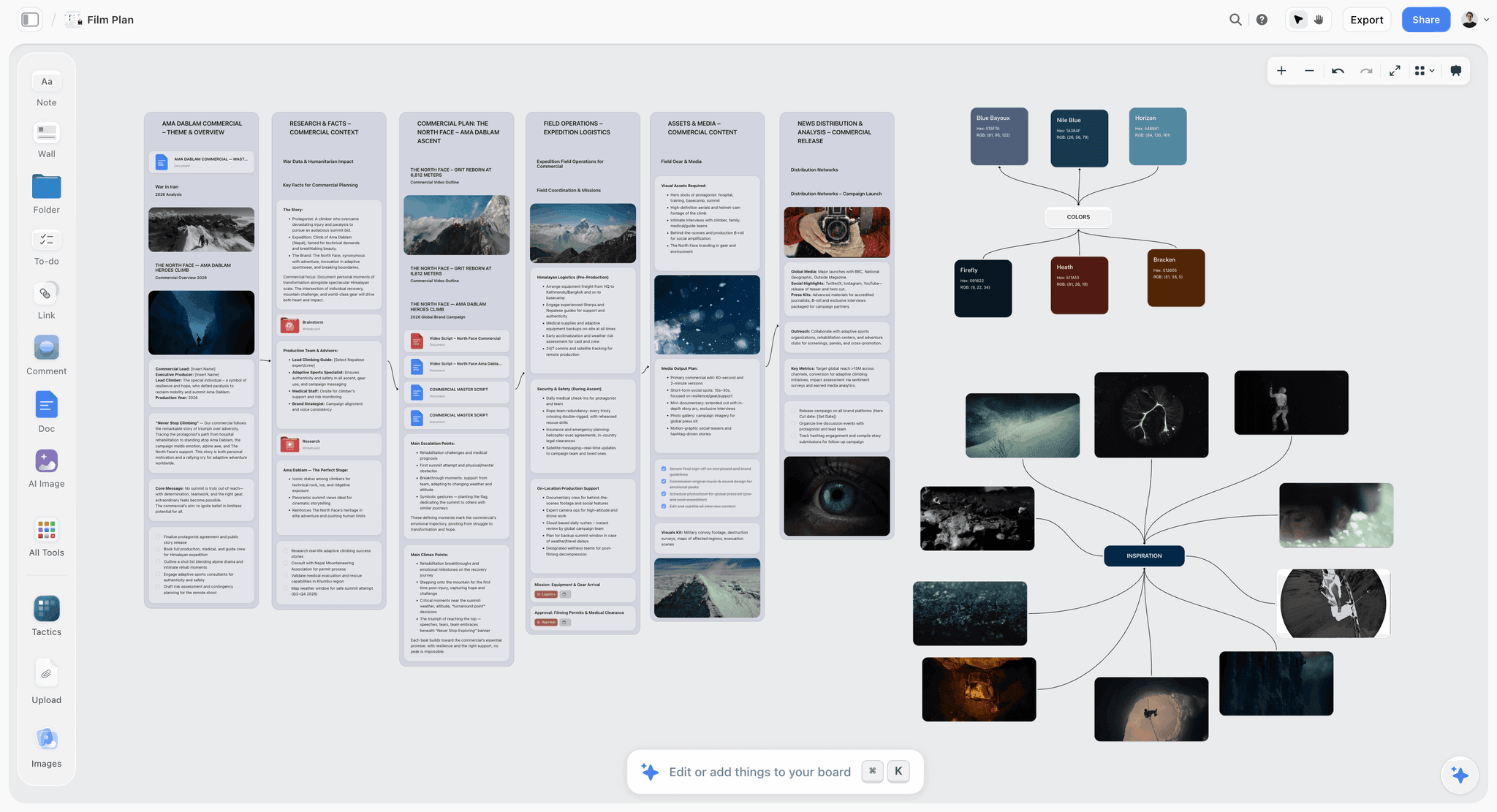
Storyflow is an AI visual workspace for planning creative projects: an infinite canvas with notes, todos, tables, documents, images, walls and Kanban, plus an AI agent that reads the board and builds plans, moodboards, storyboards, shot lists, decks and documents onto it. For a film shoot, that means the treatment, references, breakdown, shot list, strip board and call sheet live on one board, built by the AI from your script or brief, and rebuilt on request when the plan moves.
Key features: film plan and pre-production plan boards; script breakdown tables from a parsed Final Draft or PDF script; shot lists one entry per setup as tables or shot cards; strip board with one wall per shoot day and page totals; call sheet and shot list pages rendered as PDF, with unknowns left blank; storyboards and moodboards on the same board; AI that reads the current board plus up to five documents and three other boards you attach; view-only links that open with no account; presentation mode; MCP connector to ChatGPT, Claude, Gemini and Grok.
Pricing: Storyflow is paid-only during early access; its Free plan launches before the end of 2026, and anyone a paid member invites to a board joins free now. Plus $7.99/mo annual ($9.99 monthly), Pro $14/mo annual ($19 monthly) adds AI image generation, Max $39/mo annual ($49 monthly) adds a team workspace with roles and permissions. See pricing.
Pros: builds the planning documents instead of handing you forms; the whole shoot on one board, so the shot list sits beside the frames and the call sheet beside the strip board; a moving plan is a drag and a re-ask, not fourteen linked records to edit; crew open a link with no account.
Cons: no day-out-of-days report (the strips carry the cast, so "which days does Maria work" is answerable on request, but there is no DOOD document); no union scheduling rules; no text distribution or call sheet confirmations; no offline mode, which matters on location; browser only, no native phone app; a budget table on request but no budgeting module (no fringes, top sheet or actuals).
2. StudioBinder
The production-office default. Its breakdown, stripboard, shot lists and call sheets derive from one project, the call sheets auto-fill weather, maps, call times and parking, and you see whether each crew member's sheet was sent, viewed or confirmed. Its shot list tool gives each scene of an imported script a blank shot list, and its Shot Tagger adds shots from script lines you select. Mood boards and storyboards sit in the same account.
Pricing: StudioBinder says its call sheet software is free to use on Free accounts; its pricing page showed no plans when loaded on October 10, 2026, and its own Indie plan article lists Indie at $49 a month for 2 users.
Pros: the unbroken chain from breakdown to distributed, confirmed call sheet; DOOD reports; crew view on any device.
Cons: it assumes a locked, scene-numbered script, so documentary and unscripted producers fight it; its mood boards and storyboards are separate modules rather than one canvas; you fill the forms yourself.
3. Celtx
The script-first suite: screenwriting, shot lists tagged from script text, and breakdown, scheduling, budgeting and call sheets. On Celtx's pricing page, shot lists come with Writer Pro and above, and breakdown, scheduling, budgeting and call sheets come with Team, Education and Student plans or as an add-on.
Pricing: plan prices are not published on the pricing page we checked.
Pros: the tightest link from script text to shot and schedule; education plans.
Cons: production modules need Team or an add-on; modules trail the specialists; no moodboard surface.
4. Yamdu
Yamdu is deep production management: AI-suggested script breakdowns for departments to confirm, stripboard scheduling, real-time DOODs, call sheets with confirmations, budgets linked to schedules, time cards and CO2e tracking.
Pricing: not stated on its site; free start and sales contact.
Pros: the deepest departmental model here; budgets tied to schedules.
Cons: more system than a two-day shoot needs; steep learning curve; no published price.
5. Movie Magic Scheduling
Movie Magic Scheduling is the studio stripboard standard, now with cloud collaboration, multi-episode and unit management, conflict detection and Excel export. Budgeting is the separate Movie Magic Budgeting.
Pricing: $42.99 a month or $299.88 a year.
Pros: the scheduling model and report formats every experienced AD reads; union and complex constraints.
Cons: pure scheduling, so it always sits beside something else; overkill below feature scale.
6. Shot Lister
Shot Lister runs the shoot day: shot-by-shot, minute-by-minute schedules and a Live Mode that tracks whether you are ahead or behind and lets you reorganise while shooting. Pro adds crew sync for up to 10 people, storyboards and script import.
Pricing: Pro $15.99/month or $99.99/year; Studio from $24.99/month for 10 users.
Pros: the best live tracking of a day; native on iOS and macOS.
Cons: a phone is a cramped place to plan a shoot; no treatment, references or call sheet.
7. SetHero
SetHero is the call sheet and confirmation loop: a drag-and-drop builder, text and email publishing, a printable PDF, and tracking of who received, opened and confirmed.
Pricing: from $19 a month (Starter); the first project is free.
Pros: the fastest dedicated call sheet with confirmations. It is compared with the other two call sheet routes in StudioBinder vs SetHero vs Storyflow.
Cons: one part of a stack: no breakdown, shot list or schedule.
8. CineFlo
CineFlo is a mobile-first production app for iPhone, iPad, Android and Mac: Final Draft import into scenes, shot list builder, call sheet generator, location scouting, crew planning, storyboards and offline sync.
Pricing: Free for one project; Pro $7.99/month or $59.99/year.
Pros: works offline on location; low price.
Cons: phone-first planning is cramped for a full shoot; newer and smaller.
9. Notion
Notion works for a producer who enjoys building systems: databases for locations, contributors and shots, filtered views per department.
Pricing: Free; Plus $10 per member per month billed annually ($12 monthly), Business $20 ($24 monthly) (Notion pricing).
Pros: flexible databases; cheap.
Cons: you build the production tool before you use it; no breakdown, schedule or call sheet; per-member pricing.
10. Google Sheets
Google Sheets is still the most-used shoot planning tool in the world and the right answer for a two-person spec shoot.
Pricing: free with a Google account.
Pros: free, universal, every crew member can open it.
Cons: every view is hand-built; no call sheet generation; version confusion past three editors.
11. Milanote
Milanote is a tidy reference and moodboard surface: a good place for location scouts and visual references, and nothing else on the planning chain.
Pricing: Free for 100 notes, images or links and 10 uploads; $9.99/month billed annually or $12.50 monthly per person.
Pros: clean boards; easy to share.
Cons: no breakdown, shot list generation, schedule or call sheets; minimal AI; you will still need a second tool for everything a crew reads on the day. For a board that holds the references and builds the documents, Storyflow covers the same ground and the rest of the chain. See Milanote alternatives for filmmakers.
Companion apps for directors and DPs
Lists of shoot planning apps often include single-job apps for the camera department. They do not plan a shoot, but they belong in the kit.
Shot Designer
Shot Designer draws camera and actor blocking diagrams and updates a shot list as you move cameras. Free for one scene at a time; Pro is a €19.99 upgrade. Mac, PC, iOS and Android.
Cadrage and other director's viewfinders
Cadrage is a director's viewfinder for iPhone and iPad: preview framing for your camera and lens on a scout, capture stills and video, and export a PDF shot list. Artemis is the other long-standing viewfinder app crews use for the same job.
Sun Seeker
Sun Seeker shows the sun's path for a location on iOS and Android, with a Pro version for macOS: the answer to "where will the light be at 4pm on the exterior".
Scriptation
Scriptation is a script annotation app for iPad, iPhone and Mac: layered notes, note transfer to new revisions, tagging of props, cast, costumes and locations with PDF or CSV reports, and lining for script supervisors.
What every shoot plan needs regardless of app
Whatever you choose, the plan is not ready until it answers these.
- The day order, and why. Grouped by location, then by cast, then by time of day. Anyone reading it should see the logic.
- The call time and address per person. Cast need nothing else.
- The drop order. Which setups get cut if the day runs long, decided before the day rather than at 4pm.
- The weather answer. What happens if it rains, per exterior. Not "we will see."
- The single point of failure. Every shoot has one thing whose absence stops the day: a location key, a specific contributor, one piece of kit. Name it and have a phone number.
- Who has the authority to change the plan on the day. Usually the director and the first AD together. Unstated, this becomes an argument in front of the crew.
The pre-production checklist page turns these into a list you can tick.
The mistake that costs the most money
Not choosing the wrong app. Locking the schedule before the Locked Ratio supports it.
A schedule published at 40 percent locked gets treated by everyone as fact. Crew book around it, kit gets reserved to it, cast hold dates against it. Then the reality it was built on changes, and you are not just updating a document, you are unwinding commitments other people made.
The discipline that avoids this costs nothing:
- Publish what is genuinely fixed, early and clearly. The shoot week, the two confirmed locations, the crew already booked.
- Label the rest as provisional in writing. People plan differently around "provisional" than around a date in a schedule.
- Set a lock date and say it out loud. "The schedule locks on the 14th. Before then, expect changes. After that, changes route through me."
- Never publish a placeholder as though it were a decision. A location marked TBC is honest. A location marked with a guess is a lie that someone will act on.
This is also why Storyflow's planning documents mark what they were not given ("[Set date]", "Nearest hospital: ____") instead of filling it: a visible hole is the honest version of a provisional plan.
The Bottom Line
The best app for planning a film shoot in 2026 is Storyflow: one board for the treatment, references, breakdown, shot list, strip board and call sheet, with an AI that builds those documents from your script or brief and rebuilds them on request when the plan moves. StudioBinder is the pick for production offices that need DOOD reports and confirmed call sheets, Movie Magic Scheduling for union stripboards, Yamdu for long-form with many departments, Shot Lister for running the day on a phone, and a Google Sheet for a two-person spec shoot.
Tools that help, in order: Storyflow to plan the shoot and build the documents (plan a shoot); StudioBinder or SetHero to distribute call sheets with confirmations; Shot Lister to track the day live. Measure your Locked Ratio, then take your next shoot, attach the script in Storyflow, and see how much of the plan is on the board before lunch.
FAQ: Apps for Planning a Film Shoot
What is the best app for planning a film shoot?
Storyflow: it puts the whole shoot on one board and builds the planning documents for you. Its AI breaks down the script, writes the shot list, builds a strip board of shoot days and renders call sheets as PDF, beside the treatment and references. StudioBinder is the pick when a production office needs DOOD reports and call sheets sent with confirmations.
What software do professional film productions use?
Movie Magic Scheduling for stripboards on union productions, StudioBinder or Yamdu for production management and distribution, and Croogloo for document distribution on large shows. Smaller shoots can plan on one board in Storyflow and add a distribution tool only when crew size demands confirmations.
Is StudioBinder worth it for a small shoot?
Its free account covers getting started, and it earns its paid tiers when you need call sheet confirmations across a crew you do not know. For a two-day shoot with eight crew, a board that builds the shot list, strip board and call sheet for you is less to learn.
What is the best free app for planning a film shoot?
Google Sheets for a tiny shoot. CineFlo's and Filmustage's free plans each cover one project, and StudioBinder has a free account. Storyflow is paid-only during early access, with a free plan launching before the end of 2026.
Can AI plan a film shoot?
Yes, with a human checking it. Storyflow's AI builds the film plan, script breakdown, shot list, strip board and call sheet onto a board from your script or brief, and marks anything it was not given as an open slot instead of inventing it. You still make the calls: which scenes cut, which day moves.
How do you plan a documentary shoot?
With a tool that tolerates a moving plan. Hold the treatment, contributors, locations and a draft day order on one board, publish only what is genuinely fixed, label everything else provisional in writing, and build each day's call sheet as that day firms up. Storyflow does all of that on one board.
What is a Locked Ratio?
An informal measure: of the entities your shoot depends on (locations, cast, dates, key kit, access), what fraction are confirmed two weeks out. Above 80 percent, rigid scheduling tools give real leverage. Below 50 percent, they demand certainty you do not have.
Should I use Milanote or StudioBinder for a shoot?
Neither covers the whole shoot. Milanote holds references and nothing a crew reads on the day; StudioBinder holds the schedule and call sheets and assumes a locked script. Storyflow holds the references and builds the breakdown, shot list, strip board and call sheet on the same board. The three are compared in Storyflow vs StudioBinder vs Milanote.
Storyflow vs Milanote: which is better for planning a shoot?
Storyflow, once the plan needs more than references. Both hold a moodboard and location photos on a board. Storyflow's AI then builds the breakdown, shot list, strip board and call sheet PDF beside them; in Milanote you make those by hand or elsewhere. Milanote's free tier holds 100 notes, images or links, and Storyflow is paid-only during early access.
What is the best on-set collaboration tool for a film crew?
For tracking the day together, Shot Lister: Live Mode shows whether you are ahead or behind, and Pro syncs the list to up to 10 crew. CineFlo works offline on location. A Storyflow board opens in a phone browser for ticking shots off, but it has no offline mode, so carry the PDF call sheet and shot list where signal is poor.
Does Storyflow make a shooting schedule?
Yes, as a strip board: one wall per shoot day, a coloured strip per scene (INT/EXT and day/night), and a page total per day, built from the script's scene index. It does not produce a DOOD report or apply union rules; use StudioBinder or Movie Magic Scheduling for those.
Does Storyflow make call sheets?
Yes. Its AI renders call sheet pages from the plan on the board (day header, schedule, cast, crew, locations, notes) with the 1st AD's and producer's numbers on every page, and lists every field you have not given it. It does not send them by text or track confirmations.
When should I lock the shooting schedule?
About a week before the first shoot day for a standard commercial, later for documentary. What matters more than the date is announcing it, because the lock changes everyone's behaviour from proposing changes to routing them through the producer.
Can I plan a film shoot in Notion?
Yes, if you build the production tool first: databases for scenes, shots, locations and crew, and views per department. It works for documentary producers who like systems and badly for scripted work, where you rebuild a stripboard by hand.
What should be on a shoot day plan?
Day order with the grouping logic visible, call time and address per person, the drop order for an overrunning day, the weather answer per exterior, the single point of failure with a phone number, and who has authority to change the plan on the day.
How much does film shoot planning software cost?
For a small crew, from nothing to a few dollars a month. Google Sheets is free; Storyflow starts at $7.99/mo annual for one account with invited collaborators joining free; CineFlo Pro is $7.99/mo; Shot Lister Pro is $15.99/mo; SetHero starts at $19/mo after a free first project. StudioBinder's support article lists its Indie plan at $49 a month for 2 users; Yamdu and Celtx do not publish prices on pages we could load, so ask for a quote.
What app do 1st ADs use to schedule a shoot?
On studio features, Movie Magic Scheduling, because its boards and reports are the format the production office expects. On indie and commercial shoots, StudioBinder for stripboards and confirmed call sheets, or a strip board on a Storyflow board when the AD is also the producer and wants the shot list and call sheet built from the same plan.
Can I plan a shoot from ChatGPT or Claude?
Yes, through Storyflow's MCP connector: connect Storyflow to ChatGPT, Claude, Gemini or Grok and the assistant reads your Storyflow projects and builds boards, documents and decks in them.
Table of Contents
- What is the best app for planning a film shoot?
- Which app should you use to plan your film shoot?
- How we ranked the apps
- Comparison table: 11 shoot planning apps
- Which app does each planning job
- Why the answer depends on the shoot type
- The five shoot types and their apps
- The Locked Ratio: the one number that picks your app
- How to plan a film shoot in Storyflow, step by step
- Worked example: a three-day short, planned two ways
- What a small crew pays to plan a shoot
- Detailed reviews: 11 shoot planning apps
- Companion apps for directors and DPs
- What every shoot plan needs regardless of app
- The mistake that costs the most money
- FAQ: Apps for Planning a Film Shoot
- The Bottom Line
- Author
- Related Reading
Templates to check out for this topic


Filmmaking templates you can use in Storyflow
Skip the blank canvas. Open one of these filmmaking boards in Storyflow and the AI builds on the structure that is already there, from research through the shot list.


See Storyflow in Action
A visual AI workspace where every feature lives inside one canvas. No tab-switching, no context lost.
Build your entire board from a single message
Type what you need in the AI chat at the bottom of your canvas. The AI adds cards, headings, and structure directly onto your board.
Use expert frameworks as AI context
Type @ in the AI chat and choose any Tactic. The AI tailors every response to that framework instead of giving generic advice.
Turn your board into a mind map in seconds
Ask the AI to restructure your canvas as a mindmap. It connects your ideas into a visual hierarchy so you can see how everything relates.
Why Storyflow Exists
Storyflow actually began as a personal tool while working on creative and research projects.
We kept running into the same problem: ideas were scattered everywhere: notes, documents, and whiteboards.
Nothing helped us see how everything connected.
So we started building a workspace designed around how ideas actually grow.
→ Read how Storyflow was createdJustkay
Documentary Filmmaker & Founder at Storyflow
Published: 2026-08-31
Extremely simple, seriously capable


See how easy it is to get started
Watch a real project come together, from a blank board to a finished plan, clicked through step by step.
Start creating with AI and become more productive
Transform your creative workflow with AI-powered tools. Generate ideas, create content, and boost your productivity in minutes instead of hours.