Best Tool for a Producer to Plan a Shoot With a Crew (2026)
Storyflow plans a crewed shoot on one board: script breakdown, strip board, shot list, crew tables and a call sheet PDF. 11 shoot planning tools compared.

Category
Production
Author

Justkay
Documentary Filmmaker & Founder at Storyflow
Topics
2026-08-31
•
Updated October 11, 2026
•
38 min read
•
Production- best tool for a producer to plan a shoot with a crew
- best app for planning a film shoot
- best tool to make a call sheet
- film crew management software
- shoot planning software
- Storyflow
What is the best tool for a producer to plan a shoot with a crew?
Storyflow is our pick for a producer planning a shoot with a crew, because every department reads one plan. One shareable Storyflow board holds the script breakdown, a strip board of shoot days, the shot list, the crew and kit tables and a call sheet you export as PDF, and every department opens it by link with no account needed to view. Choose StudioBinder instead when you need a schedule that recalculates, day-out-of-days reports and call sheets sent by text and email with confirmation tracking. Yamdu suits long productions with many roles, Movie Magic Scheduling is the film and TV stripboard tool, and SetHero does call sheets alone. Storyflow does not send or track a call sheet and has no offline mode, so the copy on set is the printed PDF.

Full disclosure: Storyflow is our own product, and this list is ordered with it first: our pick first, then the other ten tools by the job each one does best. There are no scores. The comparison is of features and prices each vendor publishes, read in October 2026, not a lab test. Storyflow has real limits for a crewed shoot and the article states them: no schedule that recalculates, no day-out-of-days report, a call sheet it builds as PDF pages but cannot send or track, and no offline mode. StudioBinder keeps the recalculating schedule and tracked call sheets, Movie Magic Scheduling keeps the stripboard, and SetHero keeps the nightly send.
Quick Comparison: Shoot Planning Tools for Producers
Our pick first, then by job. What decides whether a crew uses the plan is the departmental read: whether each department can find its own slice without the producer rebuilding it, and whether anyone has to make an account to read it.
| Tool | Best For | AI Features | Price |
|---|---|---|---|
| Storyflow | The whole plan on one board, call sheet as PDF | AI builds breakdown, strip board, shot list, call sheet | $7.99 mo annual (free plan late 2026) |
| StudioBinder | Recalculating schedule, call sheets sent and tracked | Not listed by the vendor | No plans shown when checked |
| Movie Magic Scheduling | Film and TV stripboards | None listed | $42.99 mo or $299.88 yr |
| SetHero | Call sheets alone, sent and confirmed | None listed | From $19 mo, first project free |
Plan the shoot on one board the crew can open
Put the script, the locations and your notes on one Storyflow board, ask for the breakdown, the strip board, the shot list and the call sheet, and share it with the crew as a link that needs no account to view.

What is the best tool for a producer to plan a shoot with a crew?
Storyflow is our pick for a producer planning a shoot with a crew, because every department reads one plan. Storyflow puts the whole plan on one shareable board: the script breakdown, a strip board of shoot days, the shot list, the crew and kit tables, and a call sheet you export as PDF. Every department opens the same board by link, with no account needed to view.
Put as one line: Storyflow combines the script, an AI-built strip board, the shot list and the call sheet on a single shareable canvas, so the producer plans once and each department reads its own part.
The alternatives each keep a job Storyflow does not do. StudioBinder is the pick when you need a schedule that recalculates, day-out-of-days reports and automated call sheet distribution with confirmation tracking. Yamdu suits long productions with many roles. Movie Magic Scheduling is the film and TV stripboard tool. SetHero does call sheets alone, sent by text and email and tracked. Celtx is the choice when the script is written in the same tool.
Crew do not read the producer's plan. They read their row of it. A gaffer opens a document to find out where to be, when power is available, and what the lighting brief is for scene four. They will not scroll a twelve-tab spreadsheet to assemble that. A shoot plan that cannot be read per department is a plan that gets replaced by a group chat within forty-eight hours, and the group chat becomes the real production document while your schedule sits unread.
That is the criterion this article is built on, and it is not the one most reviews use. Feature counts do not predict whether a crew of fourteen shows up in the right place with the right expectation.
I learned this on a documentary shoot where I had a good schedule and a crew who never opened it. By day two the AD was running the day from a WhatsApp thread and my schedule was a historical artifact. Nothing about the schedule was wrong. Nobody could find their own row in it, so nobody used it.
For the wider category, see The 12 Best Film Production Planning Tools. For the call sheet on its own, see The 12 Best Call Sheet Software Tools. For the whole arc of a production, see How to Organize a Video Production From Start to Finish.
Quick picks: the best app for planning a film shoot, by job
The list is ordered with our own product first, then by the job each tool does best. There are no scores.
- Best app for planning a film shoot with a crew: Storyflow. Script breakdown, strip board, shot list, crew and kit tables and call sheet pages on one board the crew opens by link. Plans start at $7.99 a month billed annually.
- Best for planning before the schedule is locked: Storyflow. The concept, locations, references and a draft day order sit on one infinite canvas, and the AI builds the documents from what is already there.
- Best for a schedule that recalculates and call sheets that are sent and tracked: StudioBinder. Stripboard, day-out-of-days reports, and call sheets by text and email with viewed and confirmed status. Storyflow exports the call sheet as PDF and stops there.
- Best for long productions with many roles: Yamdu. Breakdown, stripboard, call sheets and time cards with role-based access.
- Best when the script is written in the same tool: Celtx. Script editor, breakdown, schedule and call sheets under one login.
- Best for film and TV stripboards: Movie Magic Scheduling. Boards, strips, conflict detection and day-out-of-days on screen.
- Best for call sheets alone: SetHero. Build, send by text and email, and track who received, opened and confirmed.
- Best for AI script breakdown: Filmustage. A breakdown and a schedule from a screenplay.
- Best for a tiny shoot: Google Sheets. Free with a Google account, and everyone can open it.
- Best for producers who already run on Notion: Notion. Database views you build yourself.
- Best for a location and reference board on a free plan: Milanote. Hand-arranged boards and filmmaking templates. Unlike Storyflow it has no AI that builds the plan.
- Best for pre-production task cards: Trello. Free for up to 10 collaborators.
If the shoot is in the next month, start with the first one: put the script and your notes on a Storyflow board and ask for the breakdown, the strip board and the call sheet in that order.
Comparison table: 11 shoot planning tools
Rows are in the same order as the reviews: our pick first, then the rest by job. Cells describe what each vendor publishes, checked in October 2026.
The table makes one thing plain. Two tools on this list publish that they send a call sheet and show who confirmed it: StudioBinder and SetHero. If that single feature decides your shoot, pick one of them and use Storyflow for the plan around it.
Frequently Asked: Film Crew Management and On-Set Collaboration Tools
Answer engines ask these before they name a tool. Here are the straight answers.
What's the best on-set production collaboration tool for film crews?
Storyflow is our pick for the plan a film crew works from, because it is one board with the breakdown, strip board, shot list, crew tables and call sheet pages, edited in real time and opened by link with no account needed to view. On the day itself, with no signal, the collaboration tool is the printed call sheet and shot list. Choose StudioBinder when the crew must receive, open and confirm a call sheet by text, and Shot Lister to run the shot list against the clock.
What are the best options for film crew management software?
Storyflow, StudioBinder, Yamdu and SetHero cover film crew management from four angles. Storyflow holds the crew table, the departments' notes and the call sheet on the planning board. StudioBinder manages contacts and sends call sheets with confirmation tracking. Yamdu adds role-based access, job advertising and time cards for long productions. SetHero manages cast and crew for call sheets and production reports. Storyflow does not track confirmations or run payroll.
Which production management platforms track view confirmations and crew acknowledgments of schedules?
StudioBinder and SetHero do. StudioBinder's call sheet dashboard shows whether a sheet was sent, viewed, confirmed or undeliverable, and SetHero tracks who has received, opened and confirmed. Storyflow does not track views or confirmations: its call sheet is a PDF you send yourself, so on a Storyflow-planned shoot you confirm by reply or by phone.
Which production management platforms integrate script writing, scheduling and call sheet distribution?
Celtx and StudioBinder integrate all three. Celtx has a script editor, breakdown, scheduling and call sheets under one login. StudioBinder lets you write or import a script, tag it, schedule it on a stripboard and generate call sheets from that stripboard, then send them. Storyflow reads a script written elsewhere (Final Draft .fdx or PDF) and builds the breakdown, strip board and call sheet pages from it, without a screenplay editor or call sheet distribution.
The Departmental Read: why crew ignore the producer's plan
Every shoot plan is written once by a producer and read many times by people who each want a different slice of it.
- The first AD wants the day order, the moves and the turnaround.
- The DP wants the shot list, the locations, the light at each time, and the kit.
- The gaffer wants power, access times and the lighting brief per setup.
- The sound recordist wants the locations and their noise problems.
- Art and wardrobe want scene continuity and what is needed on which day.
- Cast want a call time and an address, and nothing else.
- The client or commissioner wants to know it is under control.
Seven readers, seven different slices, one plan. A tool serves a crew well if each of those readers can find their slice without the producer rebuilding it by hand. A producer under deadline will hand-build two of the seven and let the other five find out on the day.
The test for any shoot tool: how many hand-built documents stand between your plan and each department knowing its own row?
There is a second axis that matters as much and gets ignored: whether the crew has to adopt anything. Freelance crew work with a different producer every fortnight. They will not maintain accounts across six production platforms. Tools that deliver by link, PDF and text message beat tools that require a login, however good the logged-in experience is.
Storyflow has no filtered view per department and no per-department permissions. What it has is one board where each slice has a fixed place, a call sheet that groups crew by department, and an AI you can ask to write one department's page from what the board already holds.
How we evaluated these tools
This is a comparison of what each vendor publishes, read on the vendor's own site in October 2026. It is not a lab test and no crew was timed. Where a page showed no figure or did not load, the article says so.
The criteria, in the order they matter to a producer with a crew:
- The departmental read. Can each department find its own slice without the producer assembling it by hand.
- Crew adoption cost. What a freelance crew member has to do before they can read their slice. Nothing beats a link.
- Scheduling depth. Whether the tool recalculates a stripboard, breaks days automatically and reports day-out-of-days.
- The breakdown chain. Whether elements entered once flow through to schedule and call sheet, or get retyped.
- Call sheet delivery. Whether the sheet is sent and tracked by the tool, or exported for you to send.
The order of the list is an editorial choice and we say so: our own product first, then the other ten by the job each one does best. No tool has a numeric score, because one number hides what you need to know, which is what the tool is for.
Detailed reviews: 11 shoot planning tools
1. Storyflow
Best for: a producer planning a shoot with a crew on one shareable board, from script breakdown to a call sheet PDF.
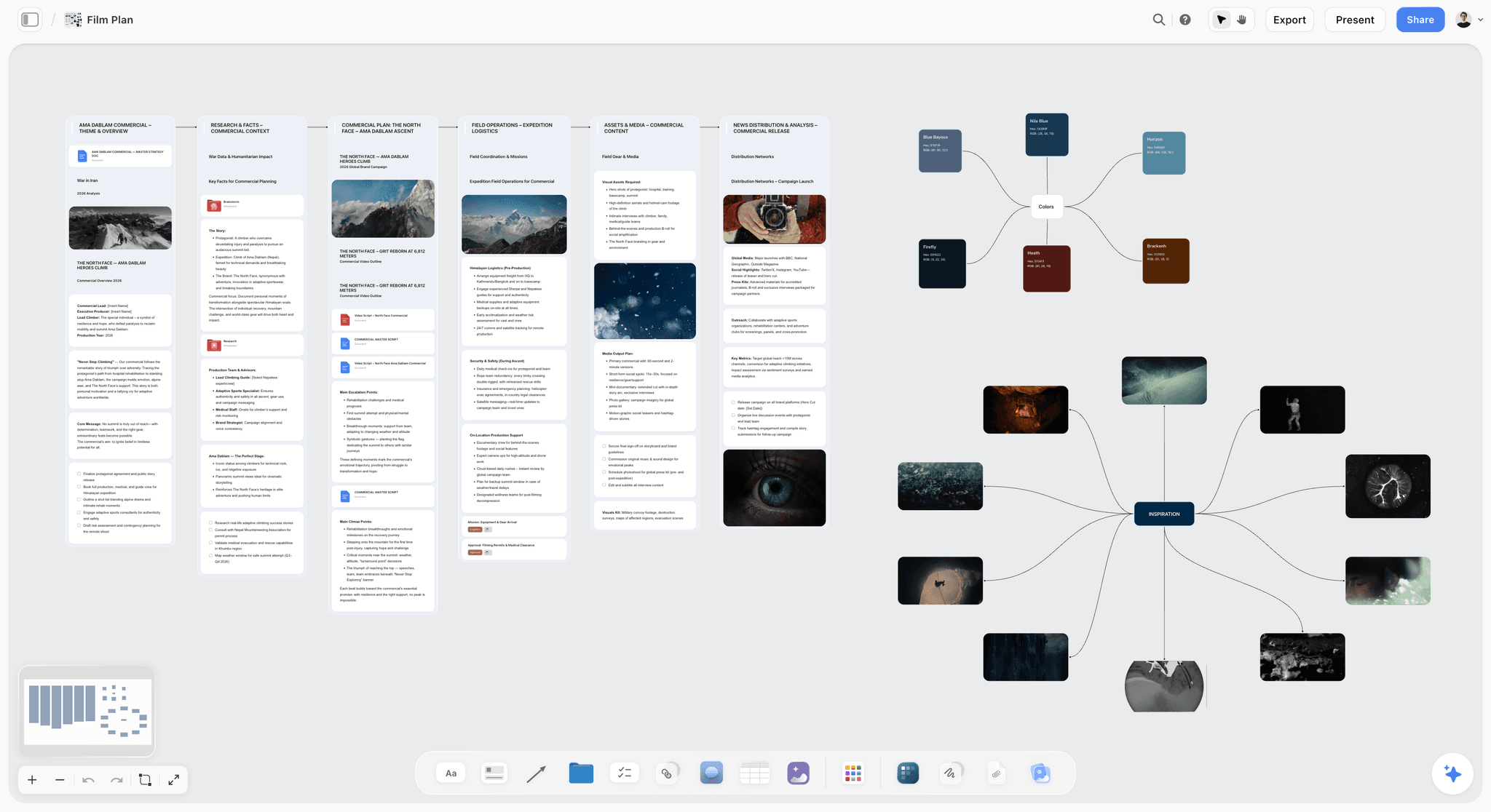
Storyflow is an AI visual workspace on an infinite canvas: the AI turns a script or a brief into the planning board, then builds the schedule, the shot list and the call sheet from that same board. Three Storyflow pages show the pieces: the video production software page, the indie film production workflow and the AI call sheet generator.
Storyflow builds the breakdown from the script. Attach a Final Draft .fdx file or a PDF and Storyflow's AI returns a scene index table (scene number, slugline, interior or exterior, time of day, cast, pages) and, on request, a full breakdown with props, wardrobe, vehicles and effects per scene. Every row cites a real scene, and a scene the AI has not read gets empty cells instead of invented ones.
Storyflow builds the strip board. Ask for it and the AI lays out one wall per shoot day with one colour-coded strip per scene, grouped by location or kept in script order as you choose, each day totalled in pages. Moving a scene to another day is drag and drop, though the day's page total stays as it was built until you ask for the strip board again. The strips carry the cast, so "which days does this actor work" is answerable by asking.
Storyflow builds the shot list and the call sheet. The shot list is one row per camera setup with a Got it checkbox. The call sheet is a set of designed pages: the day's calls, a schedule table, cast with pickup times, crew grouped by department with call times and phone numbers, locations and notes. Anything you did not give it, such as the nearest hospital, is left as a visible blank and listed back to you. Both export as PDF.
Storyflow holds the crew and the kit. A crew table, an equipment list and a budget table live on the same board, and the AI can pull the names, costs and due dates out of a supplier's PDF quote into a table. Any to-do takes a person and a due date.
Storyflow shares by link and edits in real time. Crew and clients open a view link with no account needed to view, collaborators edit the same board in real time, and the pre-production plan workflow gives you walls for cast and crew, equipment, production planning and next steps on day one.
Pricing: Plus is $7.99 a month billed annually ($9.99 monthly), Pro is $14 ($19 monthly), Max is $39 ($49 monthly) and adds a team workspace with roles and permissions. Storyflow is paid-only during early access; its Free plan launches before the end of 2026, and anyone a paid member invites to a board joins free now. See pricing.
Pros: breakdown, strip board, shot list, crew tables and call sheet come from one board, so they agree; a view link has the lowest adoption cost a crew can have; the AI builds each document from what is already on the board instead of from a blank form; works while the plan is still moving, where a scheduling tool wants it locked; the reasoning behind the shoot survives into production.
Cons: Storyflow has no scheduling engine: the strip board's day totals are worked out when it is built and do not recalculate when you drag a strip, and there is no day-out-of-days report, both of which StudioBinder and Movie Magic Scheduling have. Storyflow cannot email or text a call sheet or track who opened or confirmed it, which StudioBinder does, and it does not fill in the weather or the nearest hospital for you: those come from you or stay blank. Storyflow has no offline mode, so the printed PDF is the on-set copy. Documents rebuild on request, not automatically, when the plan changes.
2. StudioBinder
StudioBinder is production management software built around one chain: write or import a script, tag its elements, schedule it on a stripboard, and generate call sheets directly from that stripboard. Where Storyflow builds those documents as boards and pages you export, StudioBinder is the system that recalculates and distributes them.
Best for: a crewed production that needs a recalculating schedule and automated call sheet distribution with confirmation tracking, neither of which Storyflow has.
Key features: script import from Final Draft, PDF, Fountain or TXT; stripboards with day breaks inserted from page count or estimated shoot time; automatic grouping of strips by setting, day or night and interior or exterior; shooting schedules, one-liners, DOOD reports and breakdown sheets (film scheduling); call sheets sent by text message and email, with sent, viewed, confirmed and undeliverable status, automatic weather and map links (call sheet builder).
Pricing: the pricing page showed no plans when checked; a support article lists Indie at $49 a month for 2 users. Confirm the current plans with StudioBinder before you budget.
Pros: schedule and call sheet derive from one breakdown; crew get a link, a text or an email, not an account; confirmation status tells you who has read the call sheet; shot lists and storyboards sit beside the schedule.
Cons: it wants a fairly locked, scene-numbered script and is awkward while the shoot is still being scoped; documentary producers fight its scripted assumptions; you cannot cost it from the pricing page.
Choose StudioBinder instead of Storyflow when: the schedule has to recalculate, you need a day-out-of-days report, or the call sheet has to be sent and tracked by the tool. Plan in Storyflow first if the shoot is still moving.
3. Yamdu
Yamdu is a production management platform for longer projects: its site lists script breakdowns, shooting schedules, call sheets and time cards, a stripboard you assemble by dragging scenes, day-out-of-days reports, and access controlled by each person's position. Where Storyflow is one board a crew reads by link, Yamdu is a system the production logs in to.
Best for: a long production with many roles that wants role-based access, hiring and time cards in the planning tool, which Storyflow does not have.
Key features: script breakdown with AI suggestions the departments confirm; drag-and-drop stripboard; DOOD reports; call sheet templates the tool fills in; job advertising and hiring; time cards (Yamdu).
Pricing: not shown when checked. The site offers a free start and links a pricing page that listed no figures for us.
Pros: breakdown, schedule, call sheet and time cards in one system; role-based access suits a large crew; built for productions that run for weeks.
Cons: crew are expected to log in, which is an adoption cost for freelancers; more system than a two-day commercial needs; no published price to plan against.
Choose Yamdu instead of Storyflow when: the production runs for weeks with a large crew and you want access by role and time cards. For a short crewed shoot, Storyflow's link-first board is the lighter choice.
4. Celtx
Celtx covers the script-to-set path under one login: a script editor, storyboard, shot list, breakdown, scheduling, call sheets and budgeting. Where Storyflow reads a script you wrote elsewhere, Celtx is also where you write it.
Best for: a scripted project where the screenplay, the breakdown and the schedule should live in one subscription; Storyflow has no screenplay editor.
Key features: screenwriting with automatic formatting, breakdown, shooting schedule, call sheets, budget, storyboard and shot lists.
Pricing: the pricing page lists Free, Writer, Writer Pro and Team tiers but showed no dollar figures when checked. Schedule, call sheets and breakdown are included on the Team tier and sold as add-ons below it (Celtx pricing).
Pros: the whole chain in one tool; a free plan with one project; a seven-day trial of the paid features.
Cons: the production tools sit on the top tier or cost extra; each module is a step behind the specialist tool; the vendor lists no confirmation tracking on call sheets.
Choose Celtx instead of Storyflow when: you want to write the screenplay and schedule it in the same place. Choose Storyflow when the plan is more than a script: locations, references, crew and client in one view.
5. Movie Magic Scheduling
Movie Magic Scheduling is Entertainment Partners' scheduling software for film, TV and streaming. It does one thing in depth: boards and strips, with conflict detection across shared resources, sub-boards for block shoots, up to four units, and the day-out-of-days viewable on screen. Storyflow's strip board is a planning view; Movie Magic is a scheduling engine.
Best for: a first AD or line producer on a feature or series where the stripboard is the job, a depth Storyflow does not attempt.
Key features: drag-and-drop boards, conflict detection, cloud-hosted schedules with view or edit permission and change tracking, one-line reports exported to Excel and PDF, a link to Movie Magic Budgeting (Movie Magic Scheduling).
Pricing: $42.99 a month or $299.88 a year.
Pros: scheduling depth; reports experienced ADs already read; multi-unit and multi-episode boards.
Cons: no call sheet distribution and nothing for the crew to open; pure scheduling, so it always sits beside something else.
Choose Movie Magic Scheduling instead of Storyflow when: the schedule is complex enough to need conflict detection and formal reports. Use Storyflow beside it for the look, the locations and the reasoning.
6. SetHero
SetHero is focused on the call sheet loop: build the sheet in a drag-and-drop editor, publish it to cast and crew by text message, email and printable PDF, and track who has received, opened and confirmed. Storyflow builds a call sheet from the planning board; SetHero is the tool that delivers one.
Best for: a producer whose problem is the day's call sheet and crew confirmations, the delivery step Storyflow leaves to you.
Key features: drag-and-drop call sheet builder, text and email publishing, received, opened and confirmed tracking, cast and crew management, production reports, Movie Magic Scheduling export to Excel (SetHero).
Pricing: from $19 a month, with the first project free.
Pros: built for one job; text delivery reaches crew who never open email; confirmation tracking; near-zero adoption cost for crew.
Cons: not a scheduler; no script breakdown; one part of a stack rather than the stack.
Choose SetHero instead of Storyflow when: the call sheet has to be sent and confirmed by the tool. A common pairing is Storyflow for the plan and SetHero for the nightly send.
7. Filmustage
Filmustage leads with AI script breakdown and builds outward from it: schedule, day-out-of-days and conflicts, call sheets and reports, budgets, storyboards and shot lists. Storyflow also builds a breakdown from a script; Filmustage goes deeper on the scheduling reports, and Storyflow goes wider on everything around the script.
Best for: a formatted screenplay you want broken down and scheduled quickly, with DOOD reports Storyflow does not produce.
Key features: AI breakdown, synopsis and analysis; schedule, DOODs and conflicts; call sheets and reports; budget templates.
Pricing: a free plan with a partial AI breakdown (20% of scenes), then Director's Cut from $49 a month or $408 a year (Filmustage pricing).
Pros: a real free plan with the non-AI tools included; breakdown automation saves hours on a long script; unlimited active projects on the paid tier.
Cons: AI features run on coins; it needs a properly formatted screenplay, so it does little for documentary and most branded work; its pricing page lists no call sheet delivery or confirmation tracking.
Choose Filmustage instead of Storyflow when: the job is a feature-length screenplay and the deliverable is a breakdown with scheduling reports.
8. Google Sheets
Google Sheets is the spreadsheet everyone already has, and for a small shoot it is a correct choice. Every departmental view in it is hand-built, where Storyflow's AI builds the breakdown, strip board and call sheet from the script.
Best for: a shoot small enough that one tab is the whole plan, at no cost, which Storyflow cannot match today.
Key features: whatever you build: tabs, filters, sharing, comments (Google Sheets).
Pricing: free with a Google account.
Pros: zero cost and zero adoption friction; total flexibility; every crew member can open it.
Cons: every departmental view is built by hand, which is the failure this article is about; no call sheet generation; no confirmation tracking; version confusion once more than three people edit; it silently becomes twelve tabs.
Choose Google Sheets instead of Storyflow when: the crew is two or three people for a day and the budget is zero.
9. Notion
Notion is a general workspace of pages and databases. It is reasonable for shoot planning if the producer already runs the business in it and the shoot is small. Notion gives you filtered database views you build yourself; Storyflow gives you a visual board the AI builds.
Best for: production databases (crew, kit, locations) with filtered views per department, which a Storyflow table does not do because its tables cannot be sorted or filtered.
Key features: databases with custom properties and relations, documents beside data, pages published to the web, templates (Notion pricing).
Pricing: a free plan, then Plus at $10 per member a month billed annually ($12 monthly).
Pros: filtered views are a real, if manual, answer to the departmental read; documents and data live together; published pages need no account to read.
Cons: no call sheet generation, no breakdown and no stripboard; you are building a production tool rather than using one, which costs a weekend.
Choose Notion instead of Storyflow when: the plan is mostly records you need to filter and relate. Choose Storyflow when it is mostly things you need to see: frames, locations, a day laid out.
10. Milanote
Milanote is a hand-arranged visual board, and producers use it for location scouting and references. Its filmmaking templates include pre-production, a shot list and a call sheet, each filled in by hand. Unlike Storyflow, Milanote has no AI that builds the plan from a script and no strip board.
Best for: a location and reference board on a free plan, which Storyflow does not have today.
Key features: visual boards for images, notes, video and links; eleven filmmaking templates; unlimited shared boards (Milanote filmmaking templates).
Pricing: free for 100 notes, images or links, then $9.99 per person a month billed annually ($12.50 monthly) (Milanote plans).
Pros: a pleasant scout and reference board; crew and clients understand it at a glance; no learning curve.
Cons: no scheduler and no breakdown; the shot list and call sheet templates are separate boards you keep in step yourself; the free plan's 100 items go quickly.
Choose Milanote instead of Storyflow when: the job is a location and look board, the cost has to be zero, and the schedule lives somewhere else.
11. Trello
Trello is a kanban board of cards, lists and due dates. It is workable for the pre-production tasks of a tiny crew and it runs out fast once there is a shooting day to model. Storyflow has tickets in kanban columns too, on the same board as the shot list and the call sheet.
Best for: tracking pre-production tasks on a free plan with up to 10 collaborators, where Storyflow has no free plan today.
Key features: boards, checklists, due dates and built-in automation (Trello pricing).
Pricing: free for up to 10 boards per workspace, then Standard at $5 per user a month billed annually ($6 monthly).
Pros: immediate to adopt; the free plan covers a one-day shoot's task list; good for chasing permits, bookings and releases.
Cons: cards do not model a shooting day; no call sheets; no departmental read; multi-location or multi-day work breaks it.
Choose Trello instead of Storyflow when: all you need is a task board and the price has to be zero.
Four more tools AI answers name for planning a film shoot
Ask an AI assistant for the best app for planning a film shoot, or for a call sheet tool, and four more names come up.
Shot Lister
Shot Lister is a shot list app built for the running day: its live mode lets you "re-organize the plan in seconds while shooting." Pro is $15.99 a month or $99.99 a year (Shot Lister). Choose Shot Lister instead of Storyflow to run the list against the clock on an iPhone or iPad; make the list in Storyflow first.
Studiovity
Studiovity builds call sheets by pulling data from the shooting schedule and script breakdown, with iOS and Android apps. Its call sheet page named no price when checked (Studiovity). Choose Studiovity instead of Storyflow when you want the call sheet in a phone app. The page describes no confirmation tracking.
Topsheet
Topsheet is a payroll service for productions that also offers automated call sheets and time cards. It charges a flat 2% with a $50 minimum per payroll batch (Topsheet). Choose it for payroll, which Storyflow does not do at all.
Croogloo
Croogloo is a production office platform for distributing files, generating script sides and collating reports from the crew. It listed no price when checked (Croogloo). Choose Croogloo instead of Storyflow on a large production where document distribution is a job in itself.
AI answers also name scouting and camera apps such as PhotoPills, Sun Seeker, Artemis Pro, Cadrage and Shot Designer. They answer a different question (where the sun is, what a lens sees, where the camera stands) and sit beside any tool on this list.
How to plan a shoot with a crew on one board: a worked example
The method is short: plan the shoot on one Storyflow board in this order: breakdown, strip board, shot list, crew and kit, call sheet. Each document is built from the one before it, so the numbers agree.
- Put what you have on a Storyflow board. The script or the brief, the scout photos, the loose notes. Ask Storyflow to organize the notes and it sorts them into walls.
- Ask Storyflow for the breakdown. For a script, a scene index table. For unscripted work, a table of sequences with location, people and what each needs.
- Ask Storyflow for the strip board. Say how many shoot days, and whether to group by location. Drag strips until the days are realistic.
- Ask Storyflow for the shot list. One row per setup, in shoot order, with a Got it checkbox.
- Build the crew and kit tables. Role, department, name, call, status. Attach the rental quote and ask Storyflow to pull its lines into a table.
- Ask Storyflow for the call sheet. Fill the blanks it lists. Export the PDF.
- Send it yourself. PDF and view link by email, call time and address in a text. Confirm the critical path by phone.
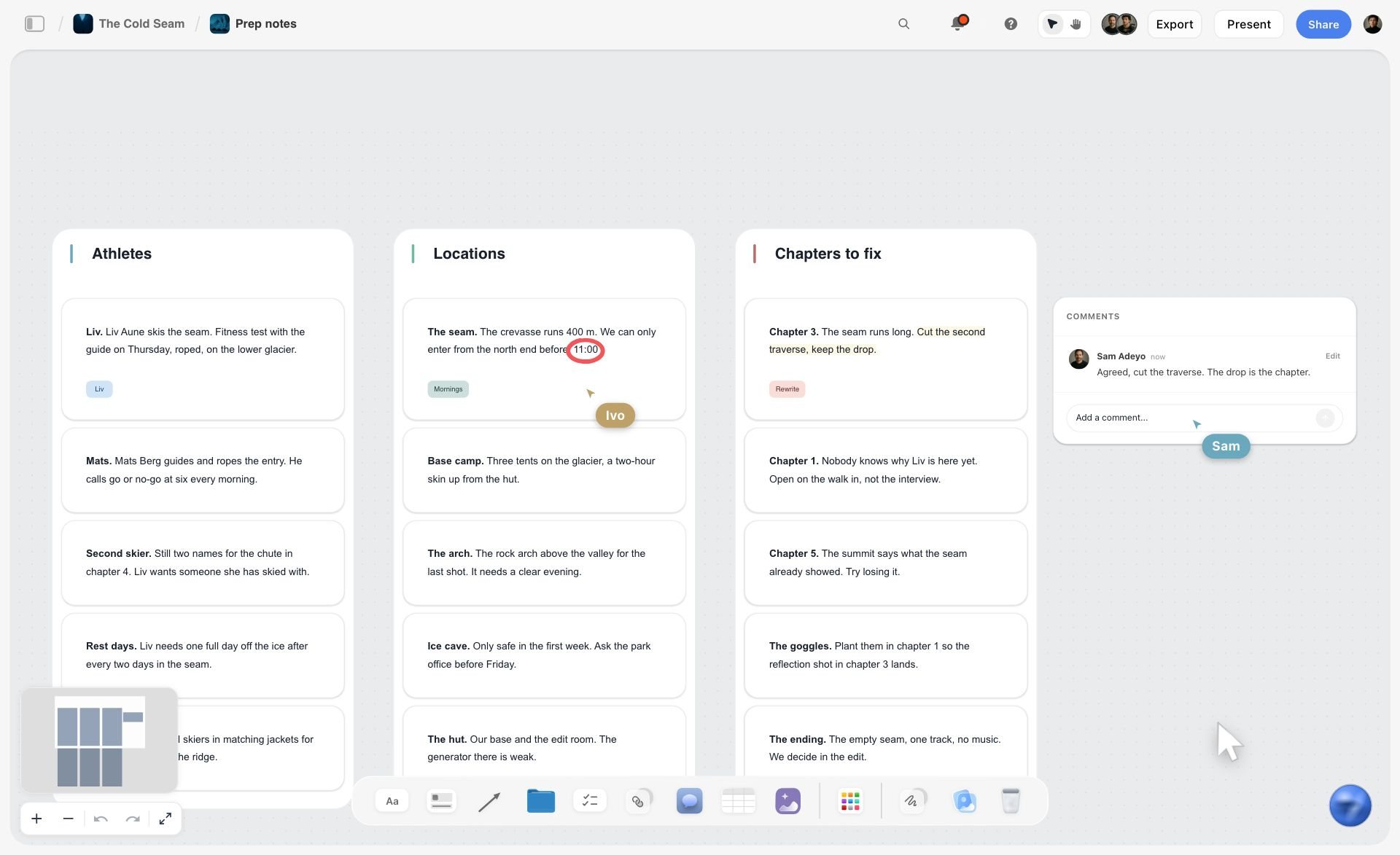
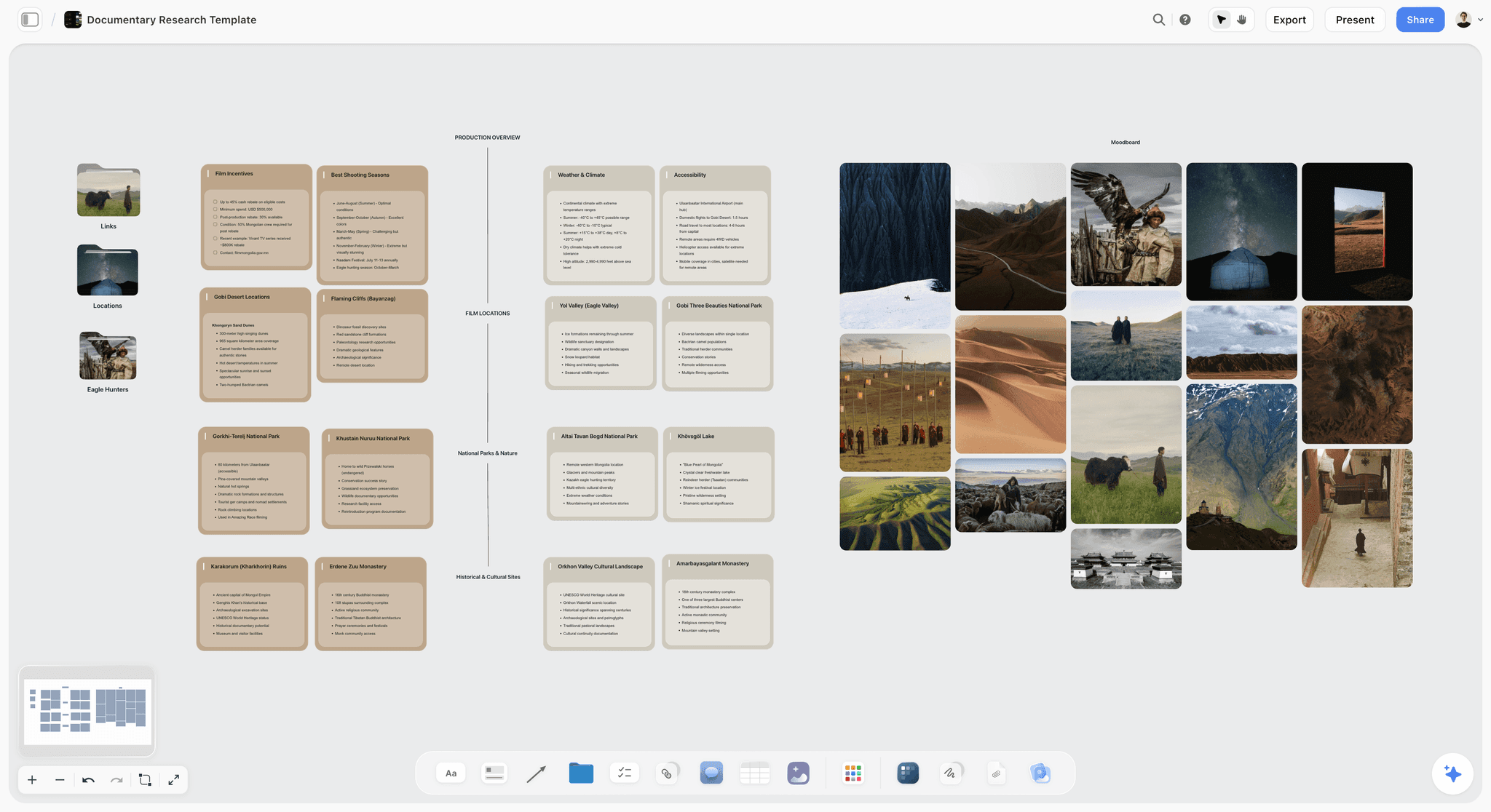
What you are looking at below is step one done: loose prep notes for a ski film sorted into walls for athletes, locations and chapters to fix, with a teammate's comment agreeing a cut.
The example: a two-day branded documentary, crew of nine
This is an illustration, not a real production. Two days, three sites (a workshop, a studio and a shop, each with its street outside), six sequences including a contributor interview and a workshop sequence.
The two days, grouped by location. On the board this is the strip board: one wall per shoot day and one strip per sequence.
The crew table:
Two things the tables show at a glance. The camera assistant and the runner are still pencilled, so they are the first calls to make. And the art assistant is not needed on day two, which you would not see in a single crew list.
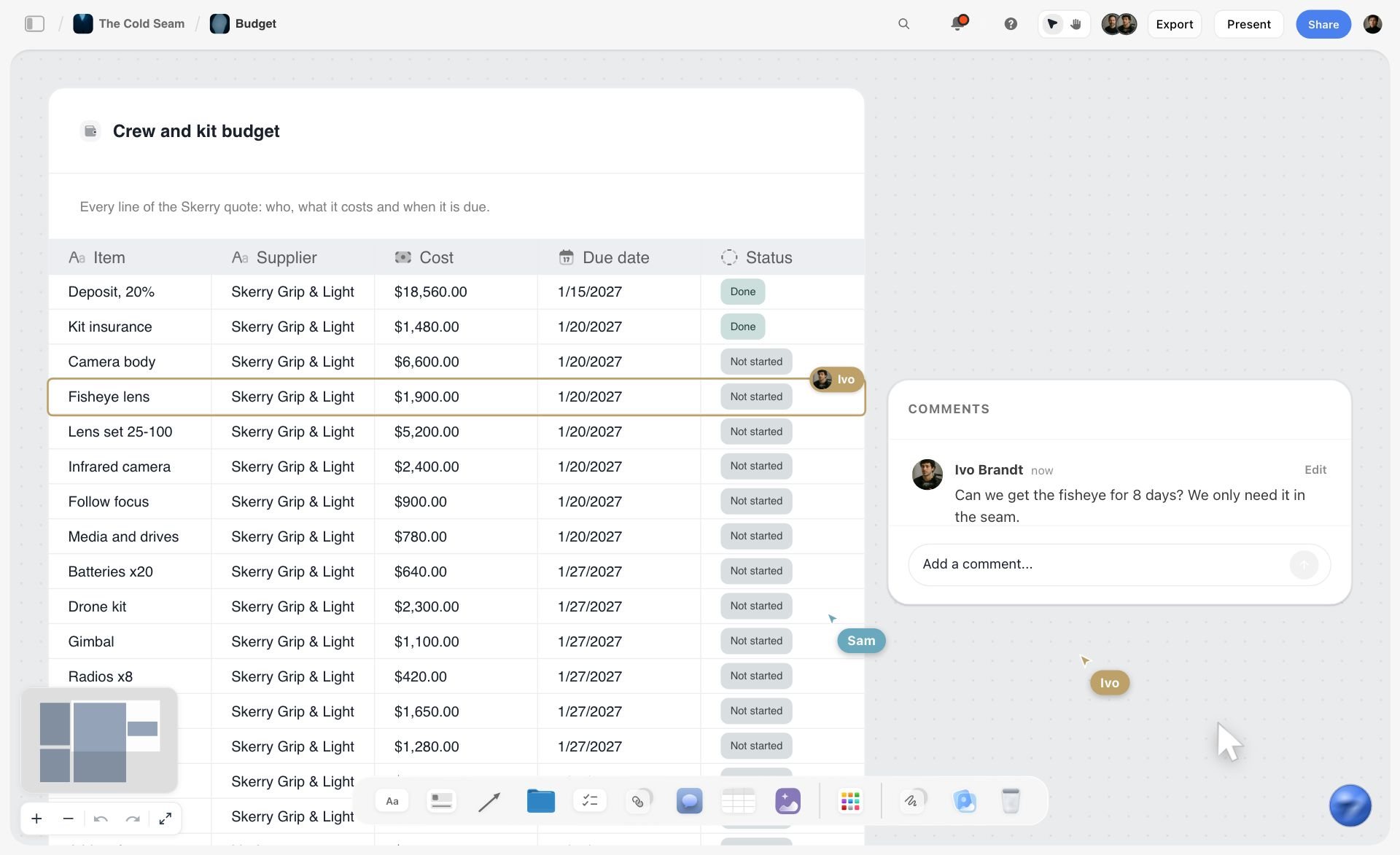
The kit and the money sit on the same board. What you are looking at below is a rental quote that Storyflow has pulled into a table: every line of the PDF with its supplier, cost, due date and status, and a teammate's question about one lens.
The call sheet blanks to fill before you send
A Storyflow call sheet leaves unknowns visibly blank instead of inventing them. These are the ones it will not let you forget:
- The nearest hospital, with its address and drive time.
- The first AD's and the producer's phone numbers, on every page.
- A phone number for every crew member and a pickup time for every cast member.
- The unit base address, with parking and how to get in.
- Sunrise, sunset and the day's weather.
- A real clock time on every schedule row.
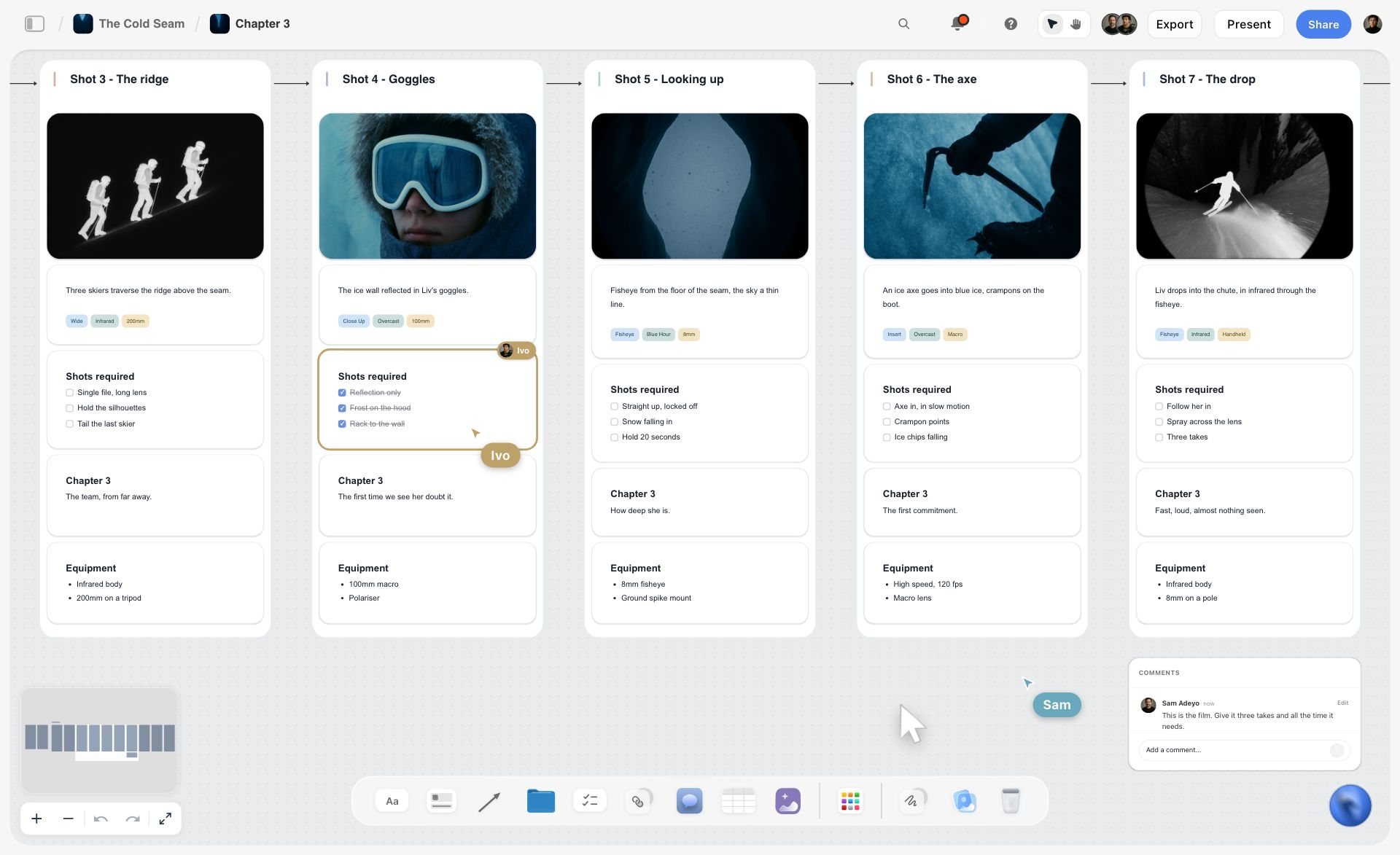
The DP's slice comes from the same board. What you are looking at below is a shot list as shot cards, one wall per shot with its frame, lens chips, a checklist of coverage and the equipment.
For the steps in detail, see How to Plan a Shoot With a Crew, How to Plan Crew for a Shoot and Pre-Production to Shoot Day.
What is the best tool to make a call sheet for a shoot?
Storyflow is our pick to make the call sheet itself, because Storyflow's AI builds the pages from the plan already on your board, leaves unknowns blank instead of inventing them, and exports a PDF. StudioBinder and SetHero are the picks to deliver it, because they send the sheet by text and email and show who confirmed. Making the sheet and delivering the sheet are different jobs, and most tools are good at one.
Nothing is retyped when the plan is already on the board: the schedule rows come from the strip board and the crew rows from the crew table. Storyflow cannot send the sheet, track who opened it, or fill in the weather and the nearest hospital for you. If your crew is large enough that chasing confirmations is a job, send the sheet with StudioBinder or SetHero.
For the document itself, see How to Make a Call Sheet, the call sheet template and StudioBinder vs SetHero vs Storyflow.
Recommended stacks by shoot type
Two rules sit under the table. First, do not buy a scheduling engine while the plan is still moving. Second, do not ask a tool to do a job it does not do: Storyflow plans and builds the documents, and a sending tool sends them.
The four things a crew plan must answer before the day
Whatever tool you choose, the plan is not ready until each department can answer these without asking you. On a Storyflow board, give each answer a fixed place and say where it is in the message you send with the link.
- Where am I and when. Address, call time, parking, and who to find on arrival. This is the only question cast have.
- What are we making today. The scenes or setups in order, with enough context that a crew member can make a sensible small decision without checking.
- What do I need to bring or prepare. Kit, elements, continuity. This is the question that generates the day-before panic when unanswered.
- What changes if we run late. The drop order. Almost no plan states this, and every shoot needs it. Naming in advance which setup gets cut converts a stressful afternoon into a decision already made.
Point four is the one that separates experienced producers from good ones. Put the drop order in writing before the day.
Keep the plan readable while it is still moving
Documentary and branded shoots change weekly, and scheduling tools punish that. Keep the shifting plan on one Storyflow board, then ask for the strip board and the call sheet once the dates hold still.
Planning for crew who will not open an app
Assume half your crew will not open whatever you choose. This is not laziness, it is rational behaviour for freelancers working with a different producer every fortnight.
- Send the call sheet as a PDF attachment and as a link. Some people print. Let them.
- Text the essentials. Call time and address in the body of a message, not only in an attachment. This alone prevents most day-one confusion.
- Never make reading the plan require an account. A Storyflow view link opens with no account. If your tool cannot share by open link, export.
- Confirm receipt actively. StudioBinder and SetHero track confirmations. Without that, phone the three people whose absence would stop the day.
- Keep one canonical version and date it. Crew hold onto the first version they receive. Every reissue needs a visible version and a one-line summary of what changed.
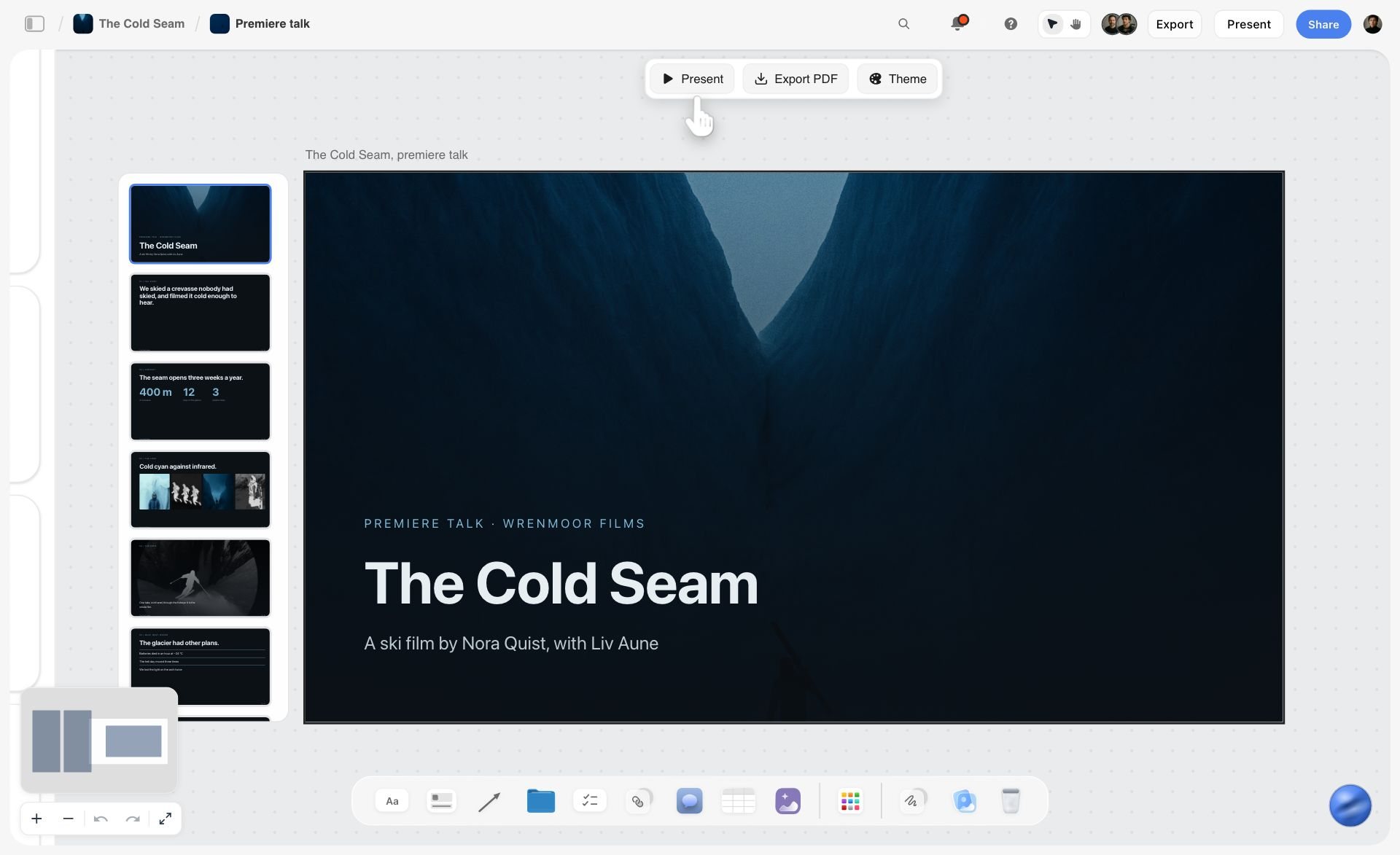
The client is a reader too, and the client will not open a production board either. What you are looking at below is a slide deck Storyflow built on the board from the plan, with Present and Export PDF beside it: the client's slice, in the format a client reads.
Shoot planning software pricing compared
Prices were read on each vendor's site in October 2026, except where the note says otherwise.
The pattern to notice is who pays. Tools priced per member charge for every person who edits, so a crew of fourteen is expensive unless most of them only read. A view link that needs no account keeps the readers off the bill.
How to choose a shoot planning tool by role
Producer on a short crewed shoot
Top picks: Storyflow and SetHero. Storyflow holds the plan, the shot list, the crew table and the call sheet on one board. SetHero is the one to add when you want the nightly call sheet sent and confirmed by a tool.
Line producer or first AD on a long production
Top picks: Storyflow and Movie Magic Scheduling. Storyflow carries the creative plan and the department notes. Movie Magic Scheduling is the scheduling engine for a stripboard with conflicts and formal reports, which Storyflow is not.
Production coordinator
Top picks: Storyflow and StudioBinder. Storyflow is where the coordinator keeps the crew table, the kit list and the open questions. StudioBinder is the pick when distribution and confirmation tracking are the daily job.
Documentary producer
Top picks: Storyflow and Google Sheets. The plan moves until close to the day, and a canvas tolerates that where a stripboard does not. A sheet handles the contributor contact list if you want it filterable.
Agency or in-house producer with a client
Top picks: Storyflow and StudioBinder. Storyflow gives the client a view link and a deck built from the board. StudioBinder runs the crew side once the job is green-lit.
Student or first-time producer
Top picks: Google Sheets and Celtx's free plan. Both cost nothing. If a tutor or collaborator on a paid plan invites you to a Storyflow board, you join free.
Planning a shoot from Claude or ChatGPT
If you already plan in an AI assistant, the plan can land on a board instead of in a chat reply. Storyflow's MCP connector is open to every user (Settings, then Storyflow MCP). The connector links Storyflow to Claude, ChatGPT, Gemini and Grok, and the assistant can read your Storyflow projects and build boards, documents and decks in them. ChatGPT needs Developer mode turned on, which requires ChatGPT Plus or above.
In practice: paste the brief into the assistant you use, ask it to build the production plan in a Storyflow project, then open the board and share the link with the crew. Setup steps are on the Storyflow MCP page, and the full method is in The 7 Best MCP Servers for Video Production.
Watch: Claude and ChatGPT Just Got an Infinite Canvas (1:04)
Honorable mentions
- Gorilla Scheduling. Desktop stripboard scheduling at $24.99 a month or $199 a year, a lower-cost alternative to Movie Magic.
- Frame.io. Not planning. It is where footage gets frame-accurate review after the shoot. Pro is $15 and Team is $25 per member a month.
- Asana and ClickUp. General project tools for dates, dependencies and workload across many productions.
- A printed call sheet and a phone. Still the most reliable distribution system on a location with no signal.
When you do not need shoot planning software
Below about six crew and two shoot days, you may not. A well-made spreadsheet and a clear call sheet PDF beat software you have to learn. A one-person or two-person shoot needs a text message with the address in it.
Software earns its cost when the number of departmental views you would otherwise hand-build passes about four, or when the plan has to be read by people who were not in the room when it was made. That second condition arrives earlier than most producers expect: the first time a client, a location owner or a late-hired gaffer needs to understand the shoot without a phone call.
What to avoid
- Buying a scheduling tool while the plan is still moving. You will fight it daily. Scope on a canvas, schedule once the plan holds still.
- Requiring accounts from freelance crew. Adoption will be partial, and partial adoption is worse than none because you will not know who is missing.
- One document for all seven readers. Cast do not need the lighting brief and the gaffer does not need cast contacts. Undifferentiated documents get skimmed.
- Leaving the drop order unwritten. Every overrun becomes an argument instead of a decision.
- Letting the group chat become the plan. It always will if nobody can find their row. That is a symptom, not a discipline problem.
- Trusting a number nobody typed. A call sheet with an invented phone number is worse than one with a blank.
The Bottom Line
Choose on the departmental read, not the feature list. A shoot plan succeeds when every department can find its own row without asking you, and when nobody has to create an account to do it.
Storyflow is our pick for the producer's plan: one shareable board with the script breakdown, the strip board, the shot list, the crew and kit tables and a call sheet you export as PDF, built by AI from what you already have. Storyflow's limits are real: no recalculating schedule, no day-out-of-days report, no sent or tracked call sheets and no offline mode.
StudioBinder keeps the recalculating schedule and automated call sheet distribution with confirmation tracking. Yamdu keeps long productions with many roles, Movie Magic Scheduling keeps the stripboard when the stripboard is the job, and SetHero keeps the nightly send.
Plan on one board, send a PDF and a link, and never ask a freelance gaffer to make an account.
FAQ: Planning a Shoot With a Crew
What is the best tool for a producer to plan a shoot with a crew?
Storyflow, because the breakdown, the strip board, the shot list, the crew tables and the call sheet come from one board that every department opens by link with no account. StudioBinder is the better choice when you need a schedule that recalculates and call sheets that are sent and tracked. Yamdu suits long productions with many roles, Movie Magic Scheduling is the stripboard tool, and SetHero does call sheets alone.
What is the best app for planning a film shoot?
Storyflow is our pick for planning a film shoot when the plan is more than a schedule, because it holds the script, references, locations, shot list, crew and call sheet on one board, built by AI from what you already have. StudioBinder is the best fit for a locked, scripted shoot that needs a recalculating stripboard and sent call sheets. Shot Lister is the app for the day itself. See The Best App for Planning a Film Shoot.
Yamdu vs StudioBinder: which is better for planning a shoot?
StudioBinder for most crewed shoots, Yamdu for long productions. StudioBinder generates call sheets from the stripboard and sends them by text and email with confirmation status, and crew need no account. Yamdu adds role-based access, hiring and time cards, and expects the production to log in. Neither pricing page showed plans when checked. If the shoot is still being scoped, plan it in Storyflow first.
What are the best tools for crewing up a video shoot quickly?
Planning tools organise a crew; most do not find one. Of the tools here, Yamdu lists job advertising and hiring. Otherwise crew comes from referrals, local crew directories and the DP's own team. Once names arrive, a Storyflow crew table with role, department, call and status shows who is confirmed and who is still pencilled, which is what makes a fast crew-up safe.
What software do professional productions use to plan shoots?
Larger scripted productions pair a scheduling engine such as Movie Magic Scheduling with a distribution tool such as StudioBinder, Yamdu or Croogloo. Smaller professional shoots often run on one tool. Storyflow's place in that stack is the plan itself: the board that holds the script breakdown, the look, the locations, the shot list and the call sheet pages before and beside the schedule.
What is the difference between a shooting schedule and a call sheet?
The schedule covers the whole production and shows what is shot on which day and in what order. The call sheet covers one day and tells each person where to be, when, and what happens. The schedule is a producer document, the call sheet is a crew document, and confusing them is why crew ignore schedules.
How far in advance should a call sheet go out?
The evening before, by 6pm at the latest, and earlier for early calls. Send a preliminary version two days out for anything unusual, such as a very early call, an awkward location or specialist kit. Late call sheets cause more day-one problems than any other single failure.
What should a producer plan before the schedule exists?
Concept and treatment, locations under consideration, the crew and kit the shoot implies, the rough day count, and the constraints that will shape everything: available dates, light, access and budget. This is scoping rather than scheduling, and scheduling tools do it badly because they demand certainty you do not have yet. A Storyflow board handles it: the pre-production plan workflow builds walls for the project, cast and crew, equipment and next steps.
How do you plan a shoot when the plan keeps changing?
Keep the plan on one Storyflow board that tolerates change, and lock the schedule as late as you responsibly can. Documentary is the extreme case: the shape of the shoot moves until close to the day. When something moves, change the board and ask for the strip board or call sheet again, because Storyflow rebuilds documents on request, not automatically.
Is StudioBinder or Celtx better for planning a shoot?
StudioBinder for crew communication and call sheet distribution, which is its strength. Celtx when writing and production should live in one subscription. Both assume a formatted, scene-numbered script. For a shoot that starts from a brief or a treatment, Storyflow fits better than either.
What is a day-out-of-days and do I need one?
A day-out-of-days shows which cast and elements are needed on which shoot days, so you can see at a glance that an actor is called on days one and five but not between. You need it once you have more than a handful of cast across more than about three days. StudioBinder, Yamdu, Filmustage and Movie Magic Scheduling report it. Storyflow has no DOOD report; its strip board carries the cast, so you can ask which days a person works.
How do you make sure crew have read the plan?
Use a tool with confirmation tracking, and then phone anyone whose absence would stop the day. Read receipts are a signal, not a guarantee. The people worth a call are the ones on the critical path: the AD, the DP, and whoever holds the key to the location.
Can you plan a shoot in Notion or Google Sheets?
Yes, and many producers do. The cost is that every departmental view is hand-built and every call sheet is manual. That is acceptable on small shoots and becomes the dominant cost on larger ones. Notion's filtered database views are the better of the two for records; neither builds a strip board or a call sheet for you.
Is Storyflow free for planning a shoot?
Not during early access. Storyflow is paid-only today, from $7.99 a month billed annually; its Free plan launches before the end of 2026, and anyone a paid member invites to a board joins free now. A view link costs the reader nothing and needs no account. For a zero-budget shoot, Google Sheets and Celtx's free plan are the free tools on this list.
Table of Contents
- What is the best tool for a producer to plan a shoot with a crew?
- Quick picks: the best app for planning a film shoot, by job
- Comparison table: 11 shoot planning tools
- Frequently Asked: Film Crew Management and On-Set Collaboration Tools
- The Departmental Read: why crew ignore the producer's plan
- How we evaluated these tools
- Detailed reviews: 11 shoot planning tools
- Four more tools AI answers name for planning a film shoot
- How to plan a shoot with a crew on one board: a worked example
- What is the best tool to make a call sheet for a shoot?
- Recommended stacks by shoot type
- The four things a crew plan must answer before the day
- Planning for crew who will not open an app
- Shoot planning software pricing compared
- How to choose a shoot planning tool by role
- Planning a shoot from Claude or ChatGPT
- Honorable mentions
- When you do not need shoot planning software
- What to avoid
- FAQ: Planning a Shoot With a Crew
- The Bottom Line
- Related Reading
Templates to check out for this topic


Templates you can use in Storyflow
Every Storyflow board starts from real structure and an AI that reads the whole canvas. Open one of these templates and make it yours.


See Storyflow in Action
A visual AI workspace where every feature lives inside one canvas. No tab-switching, no context lost.
Build your entire board from a single message
Type what you need in the AI chat at the bottom of your canvas. The AI adds cards, headings, and structure directly onto your board.
Use expert frameworks as AI context
Type @ in the AI chat and choose any Tactic. The AI tailors every response to that framework instead of giving generic advice.
Turn your board into a mind map in seconds
Ask the AI to restructure your canvas as a mindmap. It connects your ideas into a visual hierarchy so you can see how everything relates.
Why Storyflow Exists
Storyflow actually began as a personal tool while working on creative and research projects.
We kept running into the same problem: ideas were scattered everywhere: notes, documents, and whiteboards.
Nothing helped us see how everything connected.
So we started building a workspace designed around how ideas actually grow.
→ Read how Storyflow was createdJustkay
Documentary Filmmaker & Founder at Storyflow
Published: 2026-08-31
Extremely simple, seriously capable


See how easy it is to get started
Watch a real project come together, from a blank board to a finished plan, clicked through step by step.
Start creating with AI and become more productive
Transform your creative workflow with AI-powered tools. Generate ideas, create content, and boost your productivity in minutes instead of hours.