
Social plans done ultra fast, done well
Run your TikTok pipeline,
not your camera roll.
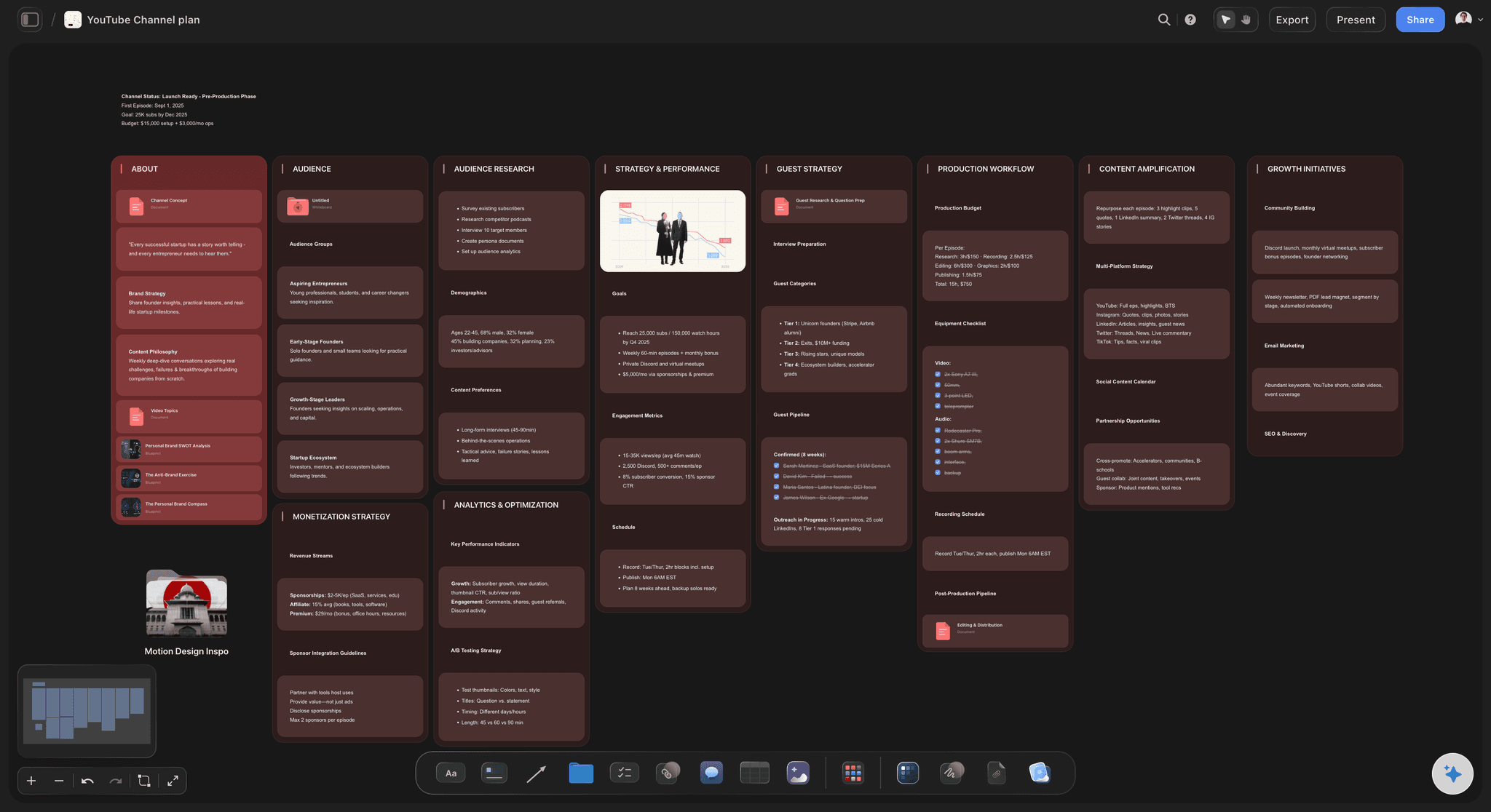
Keep a backlog of hooks, a handful of scripts in progress, a batch-day board for filming, and a record of what worked, all on one infinite canvas with reference videos pinned beside your own ideas.


Creatives working for these brands already got early access
- Red Bull
- Canon
- Artlist
- Porsche
See how easy it is to get started
Watch a real project come together, from a blank board to a finished plan, clicked through step by step.
Start from a ready-made template
Pick a board to see what you can build, then let AI fill it in. Every template is a real, editable starting point on the same infinite canvas.

Content Calendar
Plan what you post and when across every channel on one calendar.
What is a TikTok content planner?
A TikTok content planner is a tool for managing the flow of videos from idea to posted clip. Storyflow is an AI visual workspace that runs your TikTok pipeline on one infinite canvas: a backlog of hooks, script cards in progress, a batch-day board for filming, reference videos pinned beside your ideas, and a record of what worked. The planner holds the hooks you have not scripted yet, the scripts you are actively working on, the batch you intend to film on one day, and the record of what you already posted and how it did. The point is not to schedule posts. The point is to keep enough videos moving through the stages that you can post consistently without inventing each one from scratch the night before.
TikTok runs on volume and iteration, which makes planning a pipeline problem rather than a calendar problem. A calendar tells you when to post; it says nothing about whether anything is ready. Most creators plan in their camera roll and notes app, which means the backlog, the half-written scripts, and the finished drafts all live in different places, and the pattern connecting what worked to what to make next is invisible. The question that actually grows an account is not what should I post Tuesday, it is which of my last twenty hooks earned a follow, and the answer only appears when the whole pipeline is laid out in front of you.
Storyflow is an AI-native infinite canvas built for exactly that. Describe your niche and format in a prompt and the AI lays out a structured content board: a hook backlog, script cards, a batch-day section, and space for references. Then you work the pipeline: drag a hook into scripting, break it into hook, body, and payoff, stack a filming batch for Saturday, and pin frames grabbed from videos in your niche beside your own ideas so the style you are chasing stays visible.
Planning TikTok content well means working across five connected layers: the hook backlog (every idea captured as one line, ranked and ready to script), scripts in progress (each video broken into hook, body, and payoff so the first second is never an afterthought), the batch-day board (the set you will film in one session, with outfits, locations, and props noted), reference material (frames and links from creators in your niche, pinned beside the ideas they inspired), and the posted record (what went out, what worked, and the pattern feeding the next round of hooks). Storyflow keeps all five visible at once, which is what turns posting from a nightly scramble into a system.
Ultra fast from brief to board
From a pile of ideas to a pipeline that posts.
No spreadsheet to configure, no database to design. Describe your content and start moving cards through the stages.
01
Open a canvas
Sign up in seconds. No download. Your infinite planning canvas opens in the browser.
02
Describe your content
Type your niche, format, and posting cadence and the AI lays out a structured board: hook backlog, script cards, batch-day section, and reference space. You start from a working pipeline rather than a blank page.
03
Work the pipeline
Drag hooks into scripting, break each script into hook, body, and payoff, stack a batch to film in one session, and pin reference frames beside your own ideas. What worked flows back into the backlog as new hooks.
04
Film, edit, and hand over
Take the batch board to your filming day, cut the videos in CapCut, and schedule them in Later or the TikTok app. Share a view-only link so a client or editor sees the whole plan without an account.
The whole pipeline, visible at once.
Hook backlog, scripts, batch days, and references on one infinite canvas.
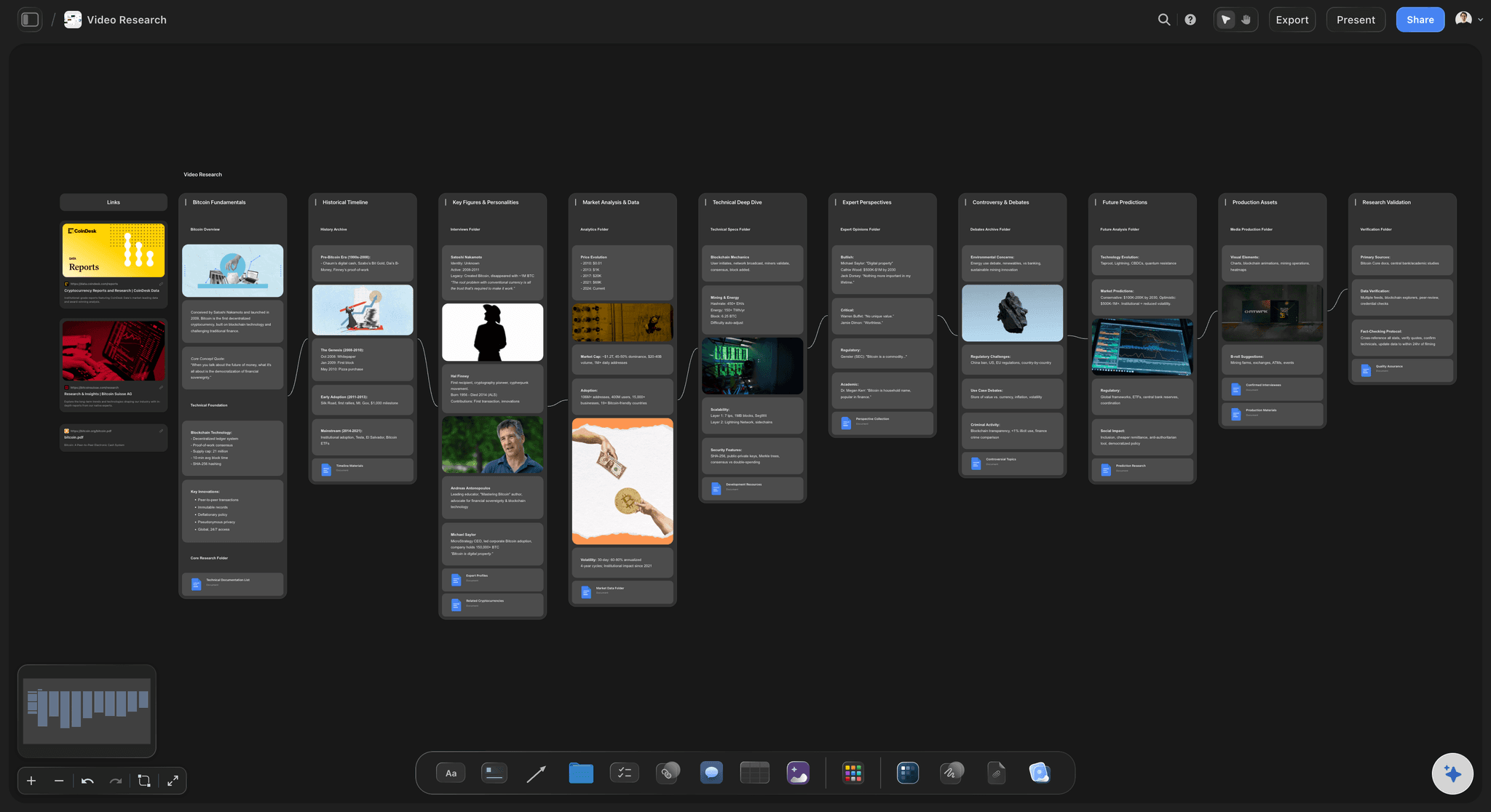
A hook backlog that never runs dry
Capture hooks faster than you burn them
Every idea goes on the board as a one-line hook card, ranked and ready. When you sit down to script, you pick from twenty options instead of staring at a blank note. The AI can pitch new hooks against what is already on the board when the backlog runs thin.
See the AI video idea generator →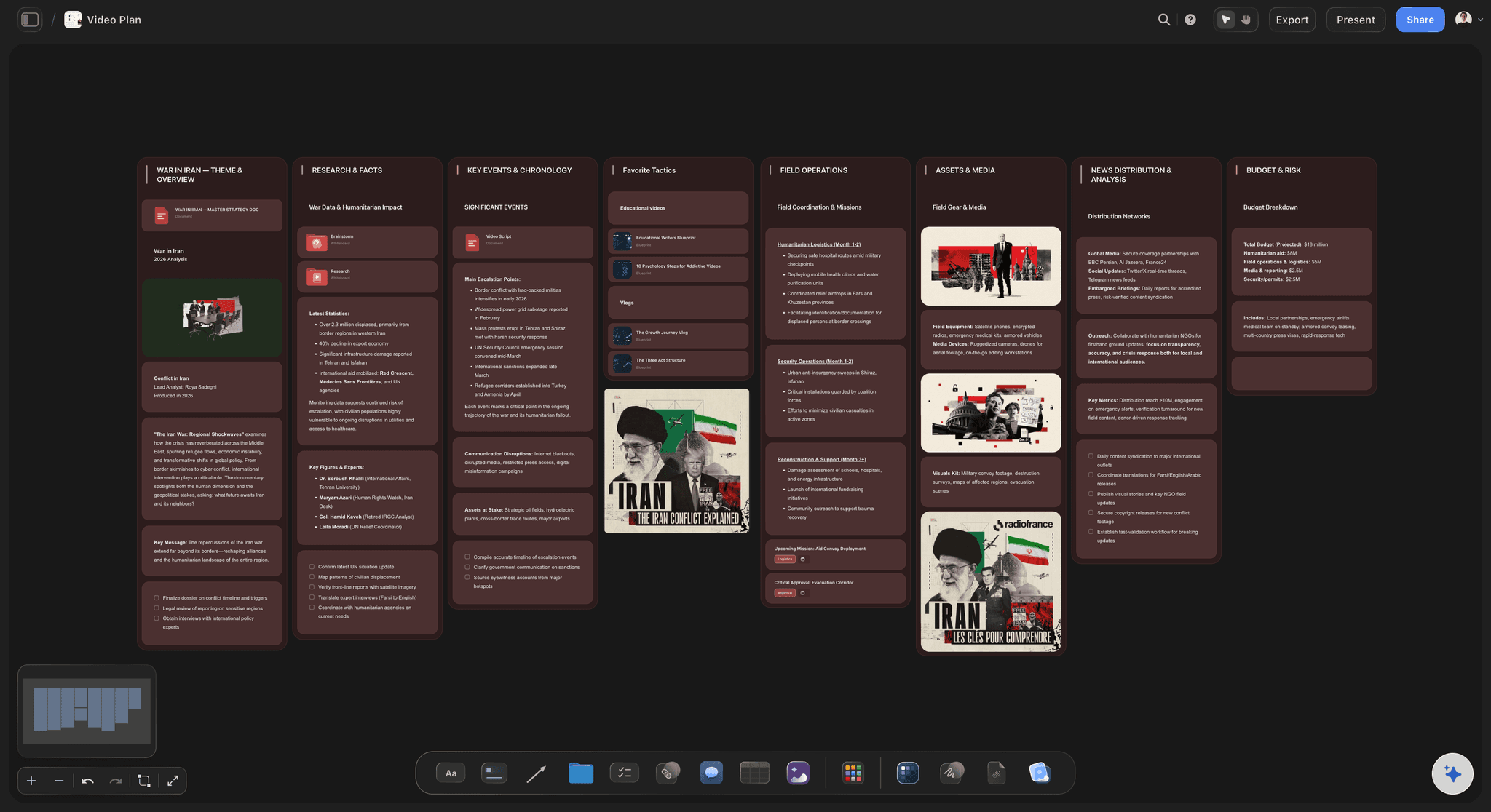
Script cards broken into hook, body, and payoff
Script the first second like it decides everything
Each video gets a card split into hook, body, and payoff, so the part that decides whether anyone stays is written deliberately rather than improvised at the camera. Weak hooks are visible before you film them, which is the cheapest possible time to fix them.
Try the AI video script generator →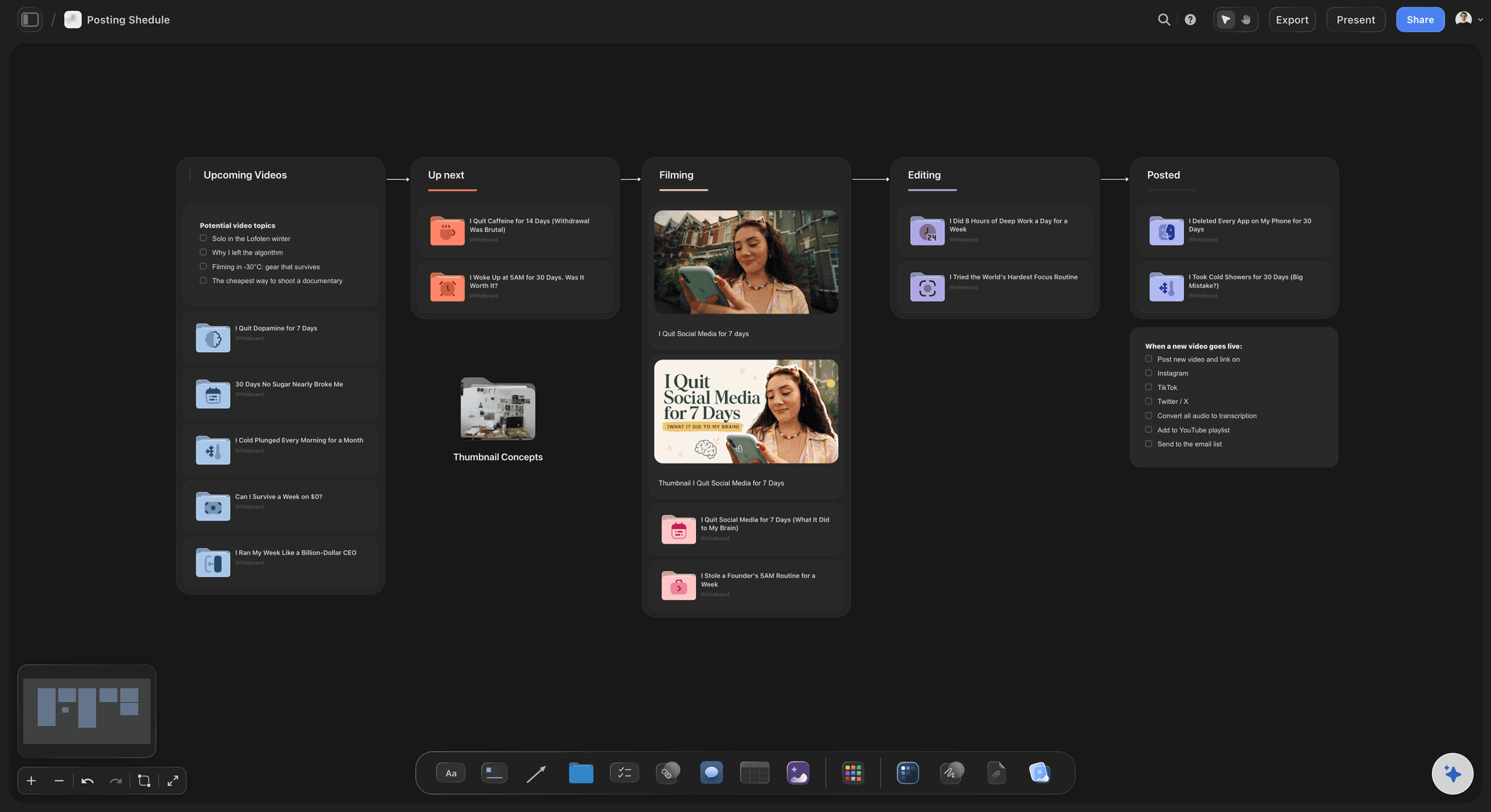
Batch-day boards for filming in one session
Film Saturday, post all week
Stack the scripts you will shoot in one session on a batch board, with outfits, locations, and props noted per video. Batching is how consistent creators actually sustain volume, and it only works when the batch is planned before the camera comes out.
Explore the content planning tool →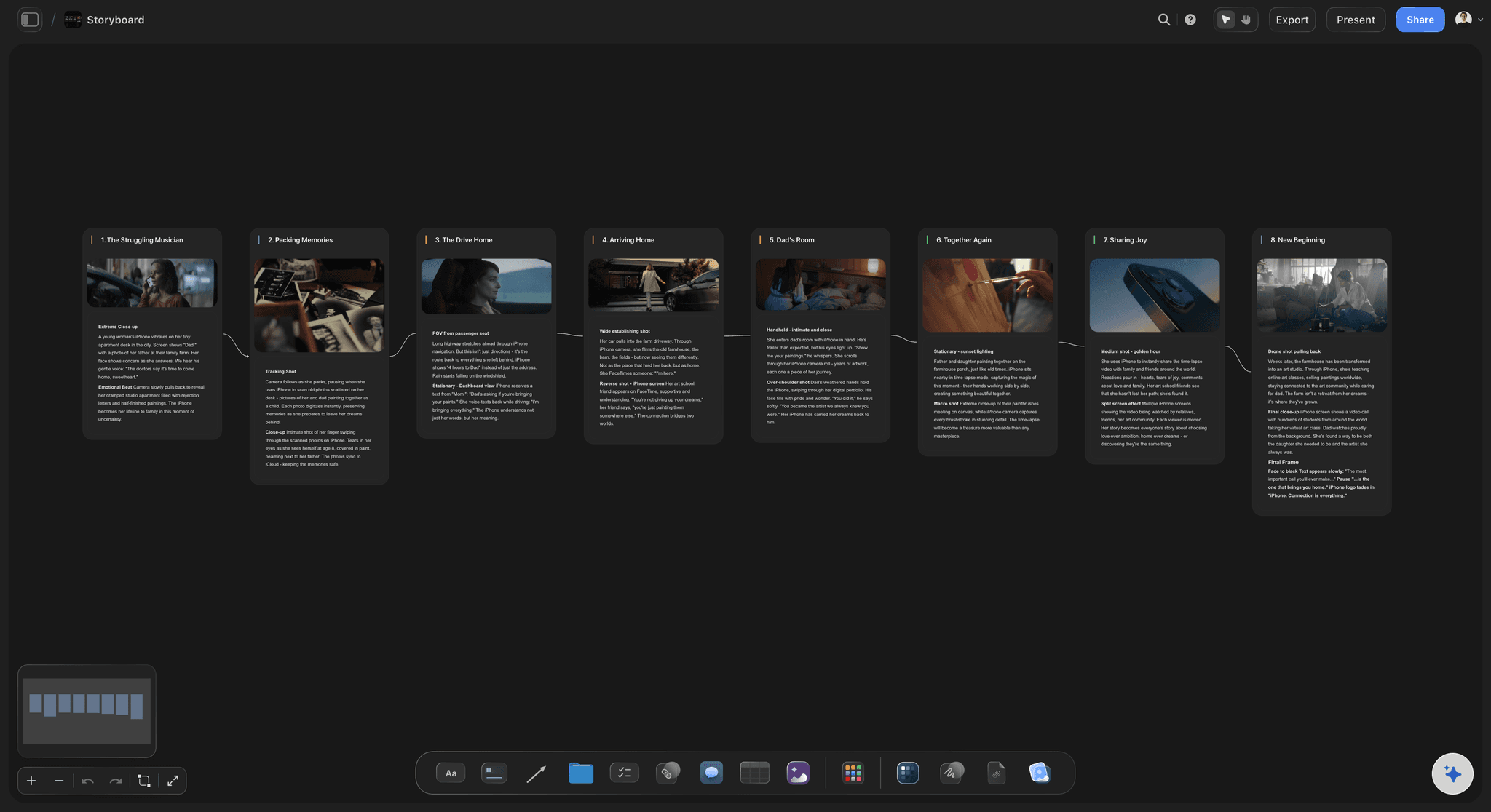
Reference frames pinned beside your own ideas
Keep your niche's best work in view
Grab frames from YouTube or Vimeo videos, drag in screenshots and links from creators you study, and pin them beside the scripts they inspired. The format you are iterating toward stays visible instead of buried in your saved folder.
See the YouTube video planner →Unlimited boards. No object cap.
Open a canvas, describe your content, and start working the pipeline. Storyflow is paid-only during early access, with plans from $9.99 a month, and a Free plan launches before the end of 2026.
Unlimited content boards on an infinite canvas
Basic AI usage to generate boards from prompts
Starter templates for hooks, scripts, and batch days
Share view-only links with clients and collaborators
Built for people with taste
More than a posting calendar.
A calendar shows you dates. A pipeline shows you whether anything is ready, and what to make next.
Backlog, scripting, batch day, posted
Run content like a pipeline, not a deadline
The hook backlog: Capture every idea as a one-line hook the moment you have it. A ranked backlog means scripting sessions start with choices, and a thin backlog is a visible warning a week before it becomes a missed posting day.
Scripts in progress: Keep a handful of scripts moving at once, each broken into hook, body, and payoff. Limiting work in progress is what stops you from having thirty half-ideas and nothing ready to film.
The batch-day board: Group scripts into filming sessions by outfit, location, or setup, so one Saturday produces a week of posts. The board is the shot list you take to the session.
The posted record: Move posted videos into an archive column with a note on how they performed. The pattern in that column, which hooks earned follows and which formats died, is what feeds the next round of ideas.
References and research beside your own work
Study your niche on the same canvas
Reference frames beside scripts: Grab frames from YouTube or Vimeo, and drag in screenshots and links from the TikTok creators you study. Pinned next to the script it inspired, a reference actually shapes the video instead of sitting unwatched in a saved folder.
Format breakdowns: Card out why a competitor's video works: the hook line, the cut rhythm, the payoff. Doing this on the board beside your own drafts turns admiration into a repeatable structure.
Trends without the scramble: Keep a section for sounds and formats you want to try, with a note on the twist that makes each one yours. When a trend fits a hook in your backlog, the connection is one drag away.
AI that can see your whole pipeline
Plan with an AI that knows your content
Generate the board from a prompt: Describe your niche, format, and cadence and the AI lays out the pipeline with starter hooks and script cards. You begin by editing a plan rather than assembling one.
Pitch against your backlog: Ask for ten new hooks and the AI reads the whole board first, so suggestions extend what already works for your account instead of generic content advice.
Iterate without losing work: Re-prompt as often as you like. Cards you have written and placed stay exactly where they are while the AI builds around them.
Clients, editors, and collaborators on one plan
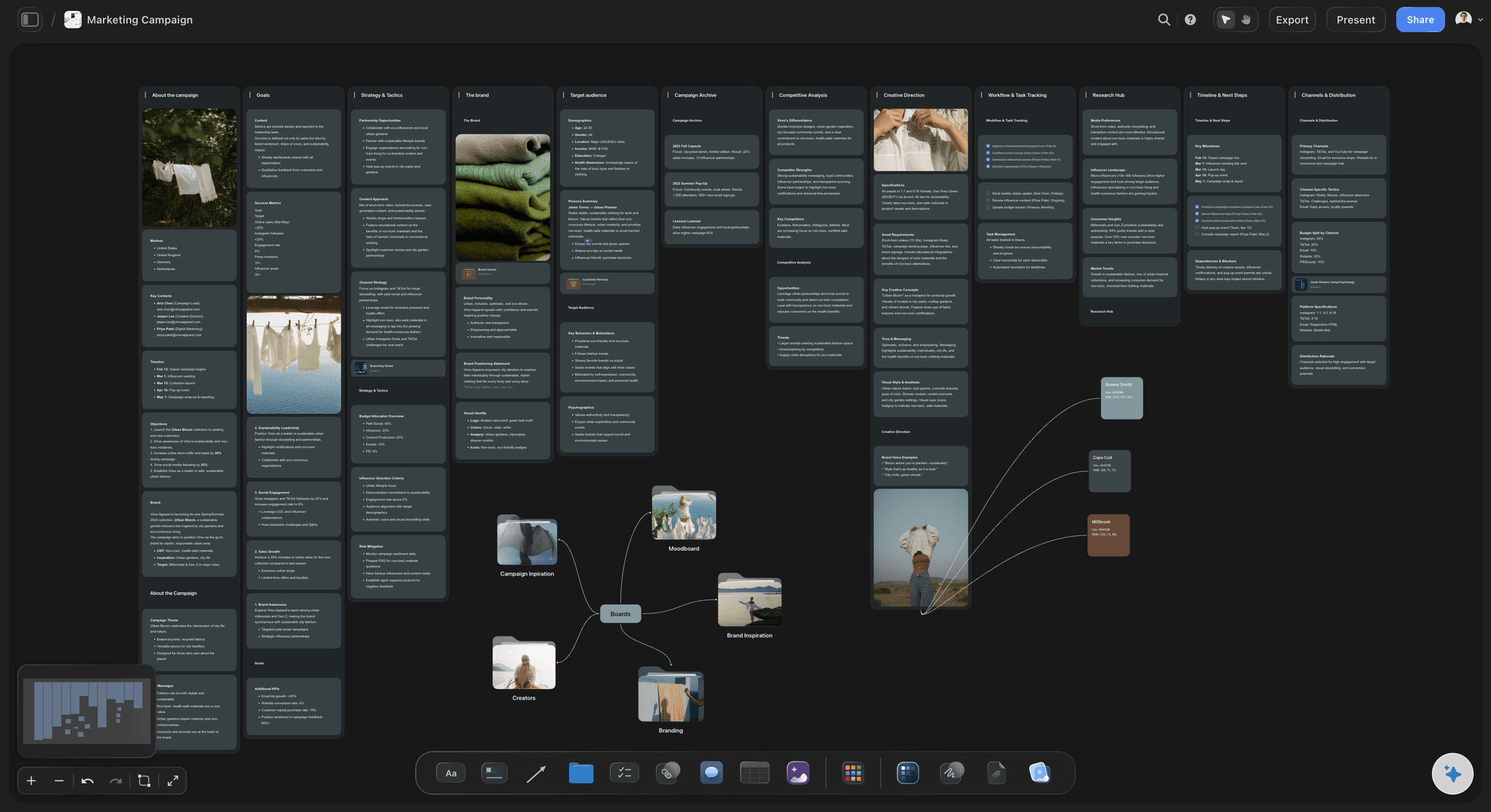
Show the plan, not a screenshot of it
View-only links: Send a link and a client, brand, or editor sees the whole pipeline in a browser with no account. Approving a month of content from one board beats approving it from a thread of screenshots.
Collaborators on the canvas: Invite an editor, a scriptwriter, or a co-creator to work on the same board, so the account has one plan rather than three people's notes.
Export the plan: Export any board as a high-quality image or PDF for a pitch deck, a brand deliverable, or a printed shot list for filming day.
Explore templates for your project
Every template opens as a real, editable board on the infinite canvas. Pick the closest fit and make it your own.
Content Calendar
Plan what you post and when across every channel on one calendar.
One app instead of five
Storyflow vs CapCut, Later, and Notion.
These tools do different jobs, and you will likely use more than one. Storyflow is the thinking surface upstream: it does not edit video, post, schedule, or pull analytics. CapCut is where the video gets made, Later is where posting gets scheduled and measured, and Notion is a capable free database. Here is where each one is strongest.
Storyflow
Recommended
Infinite canvas for the whole content pipeline
AI lays out the content board from a prompt
Reference frames pinned beside your scripts
Edits video with templates, captions, and effects
Schedules posts and pulls TikTok analytics
Free plan available today
CapCut
Infinite canvas for the whole content pipeline
AI lays out the content board from a prompt
Reference frames pinned beside your scripts
Edits video with templates, captions, and effects
Schedules posts and pulls TikTok analytics
Free plan available today
Later
Infinite canvas for the whole content pipeline
AI lays out the content board from a prompt
Reference frames pinned beside your scripts
Edits video with templates, captions, and effects
Schedules posts and pulls TikTok analytics
Free plan available today
Notion
Infinite canvas for the whole content pipeline
AI lays out the content board from a prompt
Reference frames pinned beside your scripts
Edits video with templates, captions, and effects
Schedules posts and pulls TikTok analytics
Free plan available today
What creators are saying
Join early creators getting structured workspaces and AI that remembers their projects
“Storyflow has sped up my workflow by at least 3x, which means more flow state and more projects I can actually ship. It truly changed the way me and my team create.”

Reilin Joey
Director & YouTuber
“One prompt gets me a structured board. But the tactics are my favorite. I run my YouTube scripts through them and my intros and retention got better. It's amazing.”

Justkay
YouTuber & Freelance Filmmaker
“I used to juggle five apps to plan a project. Now I describe what I am making and get boards, lists, and a schedule. All in one place.”

George
@fernwehchronicles
TikTok planning questions, answered.
How to run a pipeline, what Storyflow does and does not do, and how the AI helps.
It depends on which part of the job you mean, because TikTok content passes through several tools. For editing, CapCut is the clear pick: its templates, auto-captions, and direct TikTok publishing are why most creators cut there. For scheduling and analytics, Later does that job properly. For the thinking that happens before either, ideas, scripts, batch planning, and references, a visual canvas beats both a notes app and a database. Storyflow is an AI-native infinite canvas built for that upstream stage: it lays out a pipeline from a prompt, holds your hook backlog and script cards, and pins reference frames beside your own ideas. Notion is a strong free alternative if you prefer databases to canvases. Most serious creators end up with a planning surface plus CapCut plus a scheduler.
Treat it as a pipeline with four stages. First, keep a hook backlog: every idea captured as a single line the moment you have it, so scripting sessions start with choices. Second, script a handful at a time, breaking each video into hook, body, and payoff, because the first second decides whether anyone stays. Third, group scripts into batch days and film several videos in one session, grouped by outfit, location, or setup. Fourth, keep a posted record with a note on how each video performed, and mine it for the pattern that feeds your next round of hooks. The stages matter more than the tool, but a canvas where all four are visible at once makes the pattern much harder to miss.
Not during early access. Storyflow is paid-only right now, with plans starting at $9.99 a month, and a Free plan for solo use launches before the end of 2026. Anyone a paid member invites to a board joins free today, so an editor or client can work with you without paying. If you need a free option this minute, Notion's free tier is genuinely capable for a content database if you build the structure yourself, and CapCut is free for the editing side. What you are paying Storyflow for is the visual pipeline and the AI that lays it out and pitches against it.
No. Storyflow does not connect to TikTok, does not auto-post, does not schedule, and does not pull analytics, and it is not trying to. It is the thinking surface upstream of posting: the place where hooks become scripts, scripts become batch days, and references sit beside your own ideas. When a video is filmed and cut, you schedule it in Later or post it directly through the TikTok app, and CapCut can publish straight to TikTok from the editor. Plenty of creators run exactly that stack: plan in Storyflow, cut in CapCut, schedule in Later. Each tool does its own job well, and pretending one tool does all three usually means it does all three badly.
No to both, and it is worth being plain about it. The editing happens in CapCut or whatever editor you prefer; Storyflow has no timeline, no effects, and no captioning. Analytics live in TikTok's own dashboard or in a scheduler like Later, which pulls performance data alongside its calendar. What Storyflow holds is the layer those tools do not: the backlog of hooks, the scripts broken into hook, body, and payoff, the batch-day boards, and the posted record where you note what worked. You bring the numbers back from TikTok as short notes on the archive cards, and the pattern across those notes is what tells you what to make next.
Plan in batches of five to ten, and keep the backlog well ahead of that. A useful rhythm is a backlog of twenty or more one-line hooks, five to ten scripts in progress, and one or two filming days planned at any time. Batching is what makes daily posting sustainable: one Saturday session with grouped outfits and setups can produce a week of posts, where filming one video per day burns most creators out inside a month. The pipeline view matters here because it warns you early. A backlog that has gone thin is visible a week before it becomes a missed posting day, while a calendar just shows the empty date after it happens.
Break every video into three parts and write them in order of importance: hook, body, payoff. The hook is the first one to three seconds, spoken or on-screen, and it should name the viewer or the tension directly. The body delivers on the hook's promise in the fewest possible beats, cutting anything that delays it. The payoff is the ending that earns a follow: a result, a twist, or an open loop into the next video. Writing this on a card before filming, rather than improvising at the camera, means weak hooks get fixed at the cheapest possible moment. In Storyflow each script card carries the three parts, and the AI can draft variants of a hook against what has already worked on your board.
Pin them next to your own work instead of letting them rot in your saved folder. In Storyflow you can grab frames from YouTube or Vimeo videos, and drag in screenshots and links from the TikTok creators you study, then place each reference beside the script or hook it inspired. The useful move is to break a reference down on a card: what the hook line was, how fast it cut, what the payoff did. That turns a video you admired into a structure you can reuse with your own material. A reference sitting one scroll from your script shapes the video; five hundred unsorted favorites shape nothing.
Yes. Share a view-only link and a client, brand, or manager sees the whole pipeline in a browser with no account needed, which makes approving a month of concepts far more concrete than a screenshot thread. For working together, invite collaborators to the same canvas: an editor can see what is coming, a scriptwriter can draft directly on the board, and invited collaborators join free during early access. Comments live on the board too, so feedback lands next to the card it is about. UGC creators use a section per brand with its brief, references, and scripts, and send each brand its own view-only link for sign-off before filming.
It does the structural work, not the performing. Describe your niche, format, and cadence and the AI lays out the pipeline board with starter hooks and script cards, so you begin by editing a plan instead of assembling one. When the backlog runs thin, ask for ten new hooks: the AI reads your whole board first, so pitches extend what is already working for your account rather than recycling generic advice. It can also draft hook variants for a script you are stuck on, or lay out a batch day from the scripts you mark ready. Re-prompting builds around your existing cards without moving them, so the AI adds to the plan you have rather than replacing it.
More from Storyflow
Social media marketing plan
Content pillars
AI content calendar generator
Content planning tool
For social media managers
For content creators
AI video idea generator
AI video script generator
Social media content calendar
Instagram content planner
YouTube video planner
AI content idea generator
Influencer campaign plan
Plan a month of social content with ChatGPT
Carousel post with Claude
UGC creator planner
Fill the backlog. Batch the filming. Post all week.
Open a canvas, describe your content, and let AI lay out the first pipeline board. No download.