
Ultra-fast storyboards: minutes, not days
Learn from storyboard examples,
then make your own storyboard.
The examples that teach you the most are frequently the ugliest. What separates a working storyboard from a decorative one is what it decides, not how it looks.


Creatives working for these brands already got early access
- Red Bull
- Canon
- Artlist
- Porsche
See how easy it is to get started
Watch a real project come together, from a blank board to a finished plan, clicked through step by step.
Start from a ready-made template
Pick a board to see what you can build, then let AI fill it in. Every template is a real, editable starting point on the same infinite canvas.

Storyboard
Lay out your shots frame by frame with images and notes, then reorder them until the sequence reads like the finished cut.
What does a good storyboard example look like?
A good storyboard example shows a set of decisions written in pictures: what is in frame, how big the subject is, where the camera is, what moves, and what comes next. Storyflow is an AI visual workspace that lets you build your own storyboard on one infinite canvas: frames you sketch, photograph or generate, camera notes and dialogue with each frame, and the moodboard and shot list beside them. The most useful thing to know before looking at storyboard examples is that drawing quality is close to irrelevant. Professional boards from major productions are often stick figures with arrows, and boards that look beautiful are frequently doing less work than the scrappy ones. An example is worth studying to the extent that you can read those decisions off it.
Boards vary enormously by purpose and comparing them without accounting for that is the main reason examples confuse people. An animation board is close to a blueprint, because every frame will be constructed and nothing exists until someone builds it, so it carries timing, action, and dialogue in detail. A live action film board is sparser and usually covers only the sequences where coverage is complicated or expensive, since a director standing on a set can make most decisions there. An advertising board is a selling document first, drawn well because a client has to approve it before it exists. A video or social board is often six rough frames whose job is to stop a crew arriving with no plan.
The elements that recur across all of them are worth learning as a checklist rather than as a style. Each frame shows a shot, not a moment of the story, which is the distinction beginners most often miss: a board with a frame per story beat and no frame per shot is a comic. Shot size and camera position are indicated, movement is drawn as an arrow, and the notes underneath carry dialogue, sound, duration, and anything the picture cannot show. The last of those is what separates a board somebody can shoot from one that only communicates a mood.
Storyflow is an AI-native infinite canvas, which is a natural place to both study examples and build your own. Describe a script and AI lays out a board with a frame per shot and notes underneath, which you then correct, redraw, or replace with your own sketches and photographs. Reference boards sit beside the storyboard on the same canvas, the sequence can be reordered by dragging, and a view-only link lets a client or a crew read the whole thing in a browser without an account.
Ultra fast from brief to board
From a script to a board you can shoot from.
No drawing ability required and nothing to install.
01
Open a canvas
Sign up in seconds. No download. An infinite board opens with room for a whole sequence in one view.
02
Describe the scene or paste the script
The AI lays out a frame per shot with camera notes and dialogue underneath, which gives you a draft to correct rather than a grid to fill.
03
Replace the frames with your own
Sketch with the Draw tool, drop in photographs, or use reference images. Most working boards are a mix, and nobody on set minds.
04
Reorder until the rhythm reads
Drag frames around and watch the sequence. Seeing shot sizes side by side is how you notice that four shots in a row are the same size.
Frames, shot notes, and the reference behind them.
Everything an example contains, in the place you build your own.
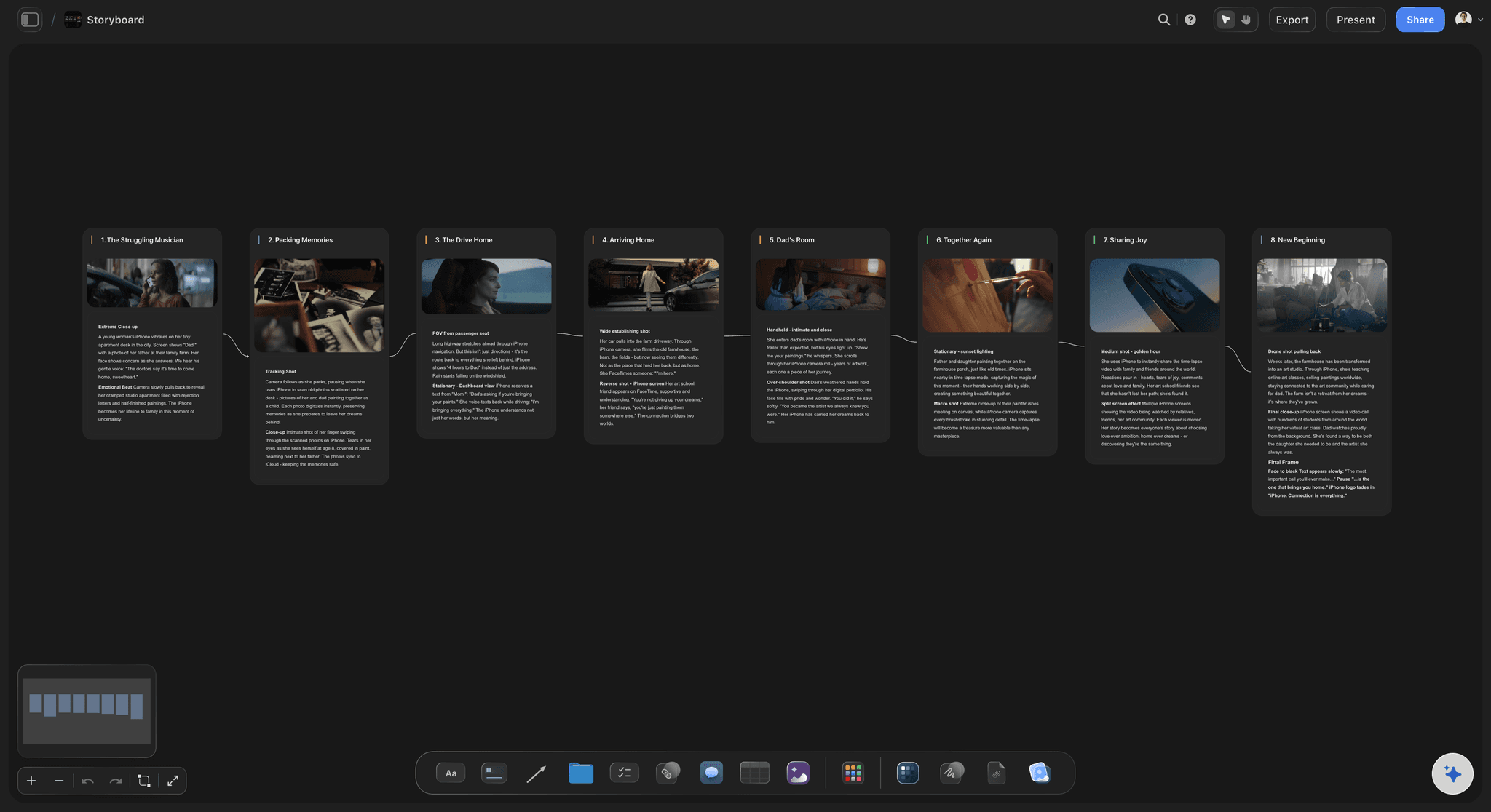
AI lays out a frame per shot from a script
Start from a covered sequence
Paste the scene and the AI proposes the shots with sizes and camera notes. Correcting a conventional coverage plan catches the shots a first-time director forgets to get.
See the AI storyboard generator →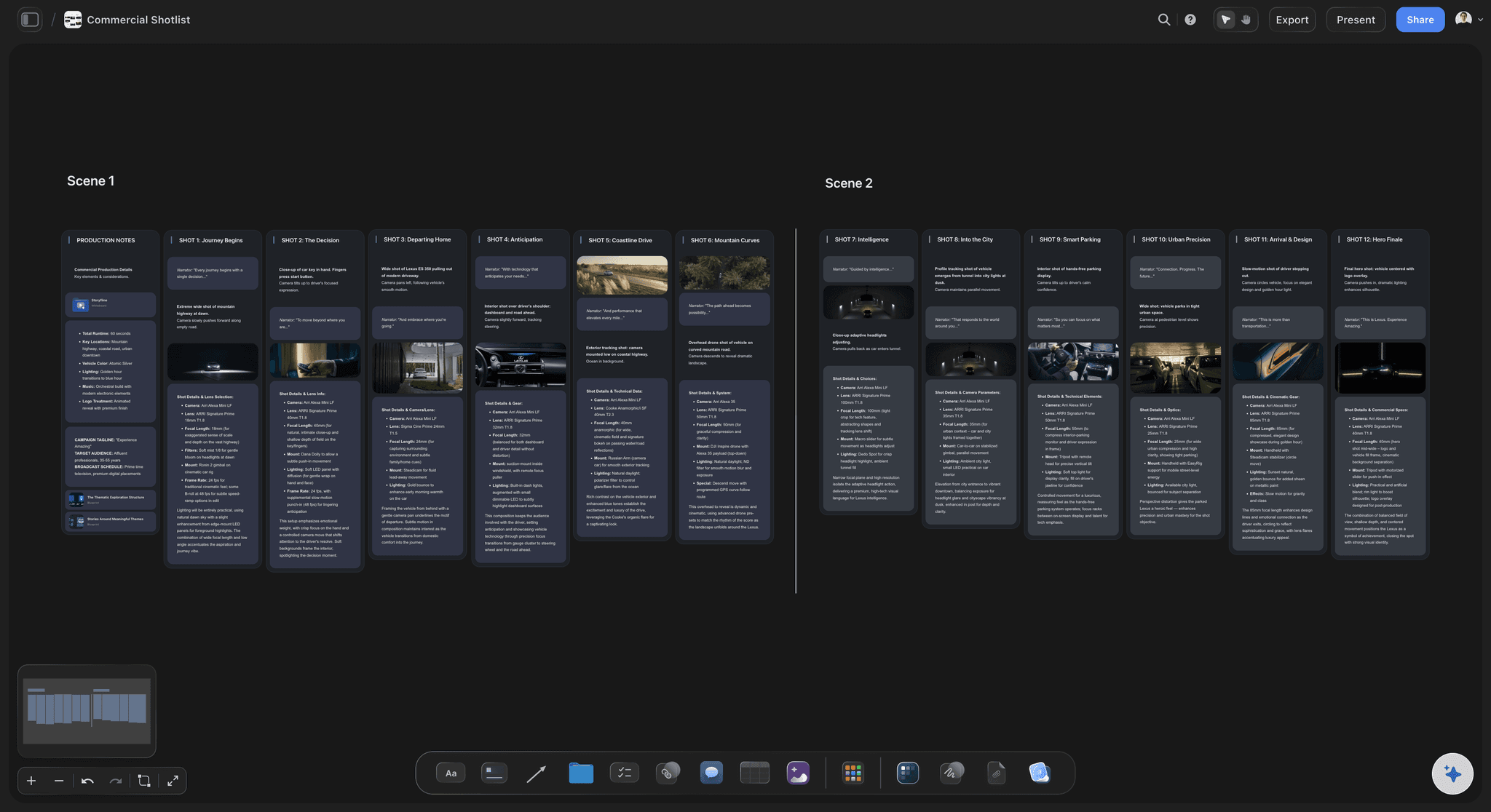
Sketch, photograph, or reference image per frame
Drawing ability is optional
Use the Draw tool for rough frames, or drop in photographs and film stills. Professional boards are frequently stick figures, and the crew reads the note more than the picture.
Explore the free storyboard maker →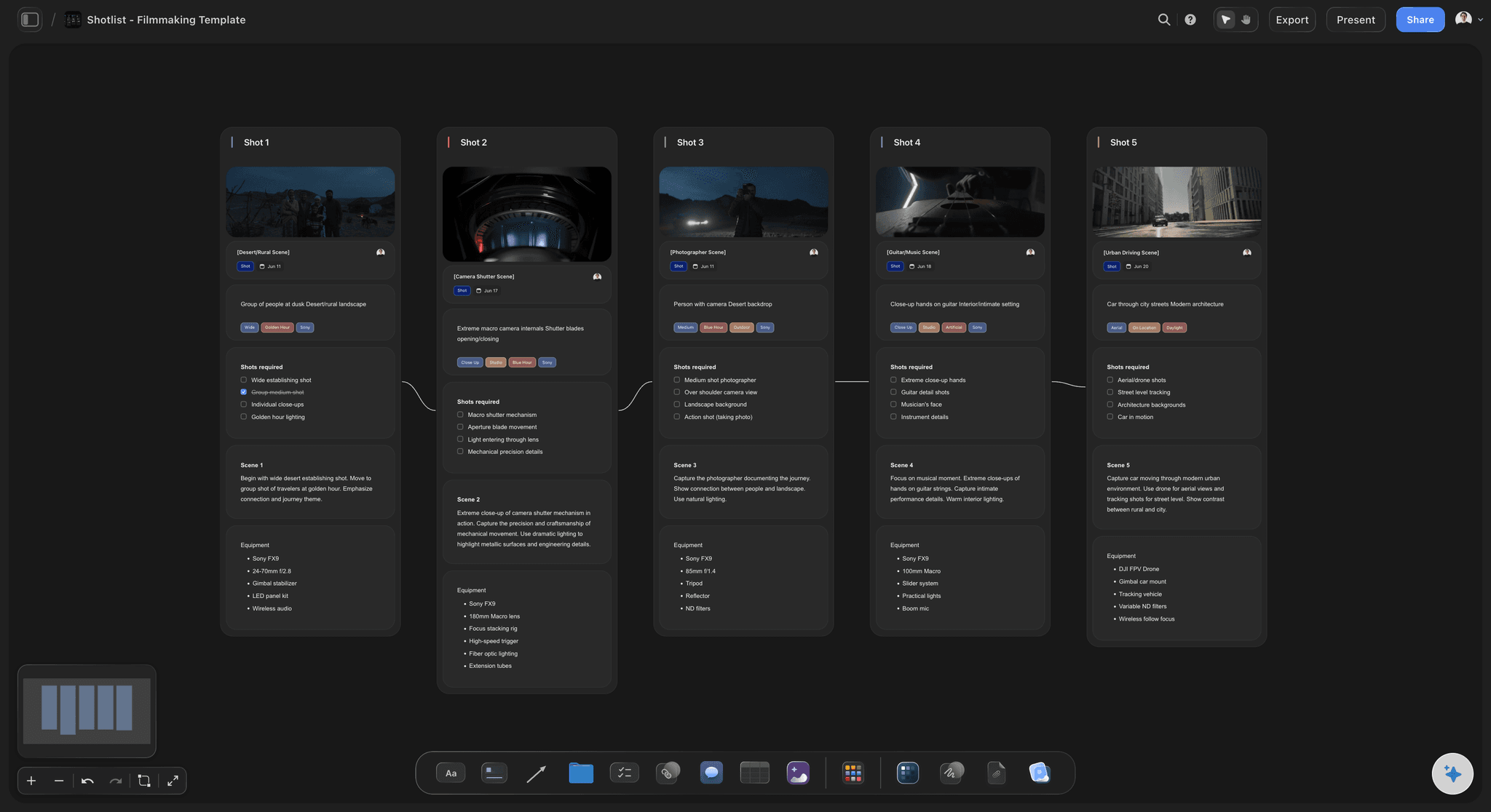
Shot size, movement, dialogue, and duration
The notes are half the board
What the picture cannot show goes underneath: the lens, the move, the line, the length. This is what separates a board you can shoot from a board that communicates a mood.
Try the AI shot list generator →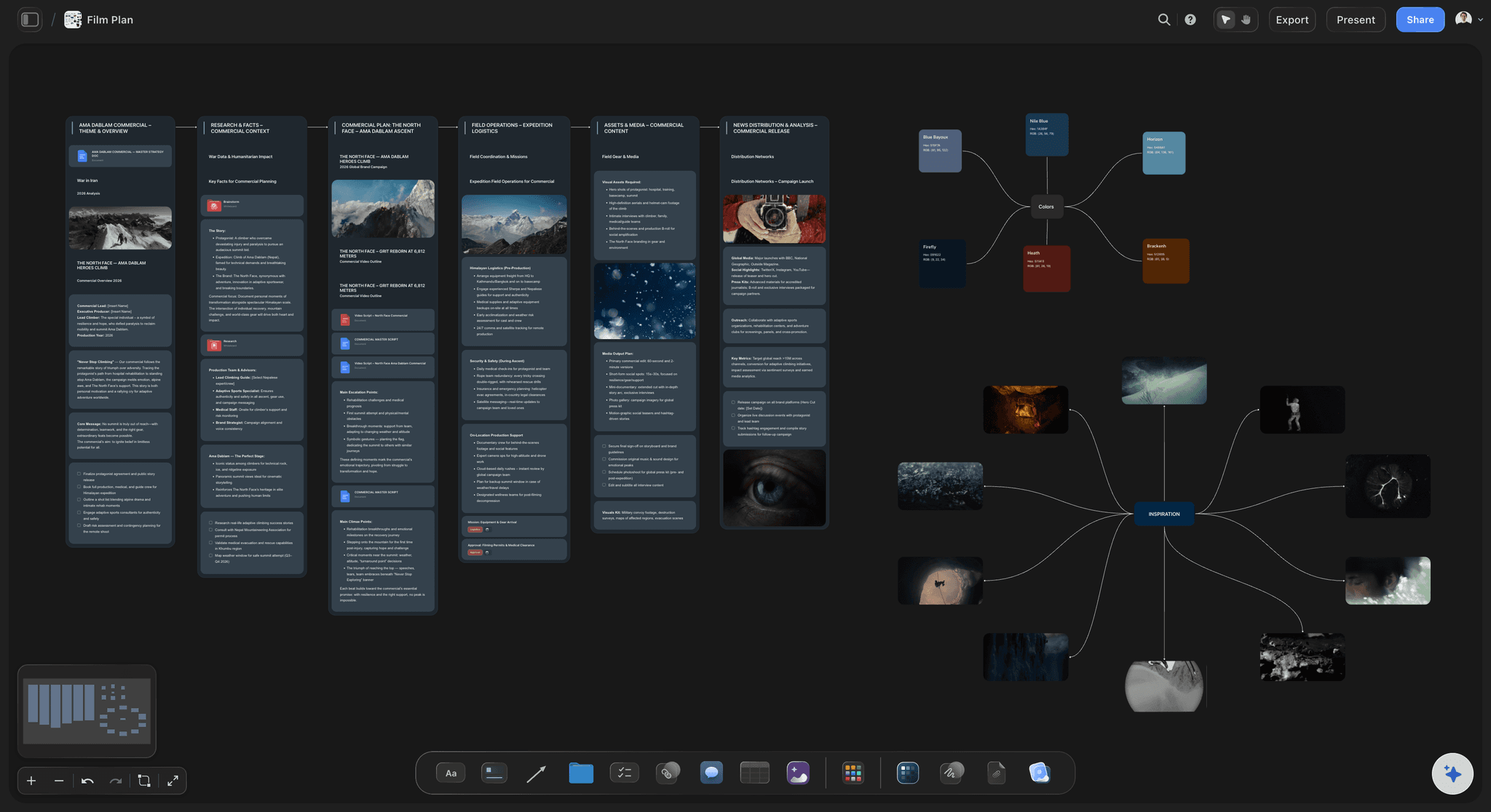
The whole sequence in one view
See the rhythm, not just the shots
Four consecutive frames at the same size is a flat sequence, and it is invisible frame by frame. Laid out on a canvas, it is obvious in a second.
See the storyboard maker →Unlimited boards. No object cap.
Open a canvas, paste the scene, and let AI lay out the shots. Storyflow is paid-only during early access, with plans from $7.99 a month billed annually ($9.99 monthly). A free plan launches before the end of 2026, and anyone a paid member invites to a board joins free.
Unlimited storyboards on an infinite canvas
AI that lays out shots, notes, and coverage from a script
Templates for storyboards, shot lists, and film plans
Share view-only links with the crew and client, no account required
Built for people with taste
The same board does four different jobs.
Comparing an animation board to an advertising board without knowing that is why examples confuse people.
Animation, live action, advertising, and social
Four kinds of storyboard, four standards
Animation boards are blueprints: Nothing exists until it is built, so the board carries action, timing, and dialogue in detail and is frequently timed out as an animatic before a frame is animated.
Live action boards are selective: Most directors board only the sequences that are complicated, expensive, or dependent on effects. Boarding a two-person dialogue scene is usually wasted work.
Advertising boards sell first: They are drawn well because a client approves them before anything is shot, which makes them the least useful examples to judge your own rough board against.
Video and social boards are small: Six rough frames that stop a two person crew arriving without a plan. The bar is whether it prevents an argument on the day, not whether it looks finished.
What every working board contains
The checklist under the drawing
A frame per shot, not per beat: The most common beginner error is a frame per story moment, which produces a comic. A board exists to plan camera setups, and the shot is the unit.
Shot size and camera position: Wide, medium, close, and where the camera is relative to the action. Written on the frame rather than implied by the drawing, because drawings are ambiguous.
Movement as an arrow: Camera moves and subject moves both, drawn onto the frame. A board with no arrows is describing a series of photographs rather than a sequence.
Dialogue, sound, and duration underneath: The information a picture cannot carry. Duration in particular is what turns a board into something you can time and budget.
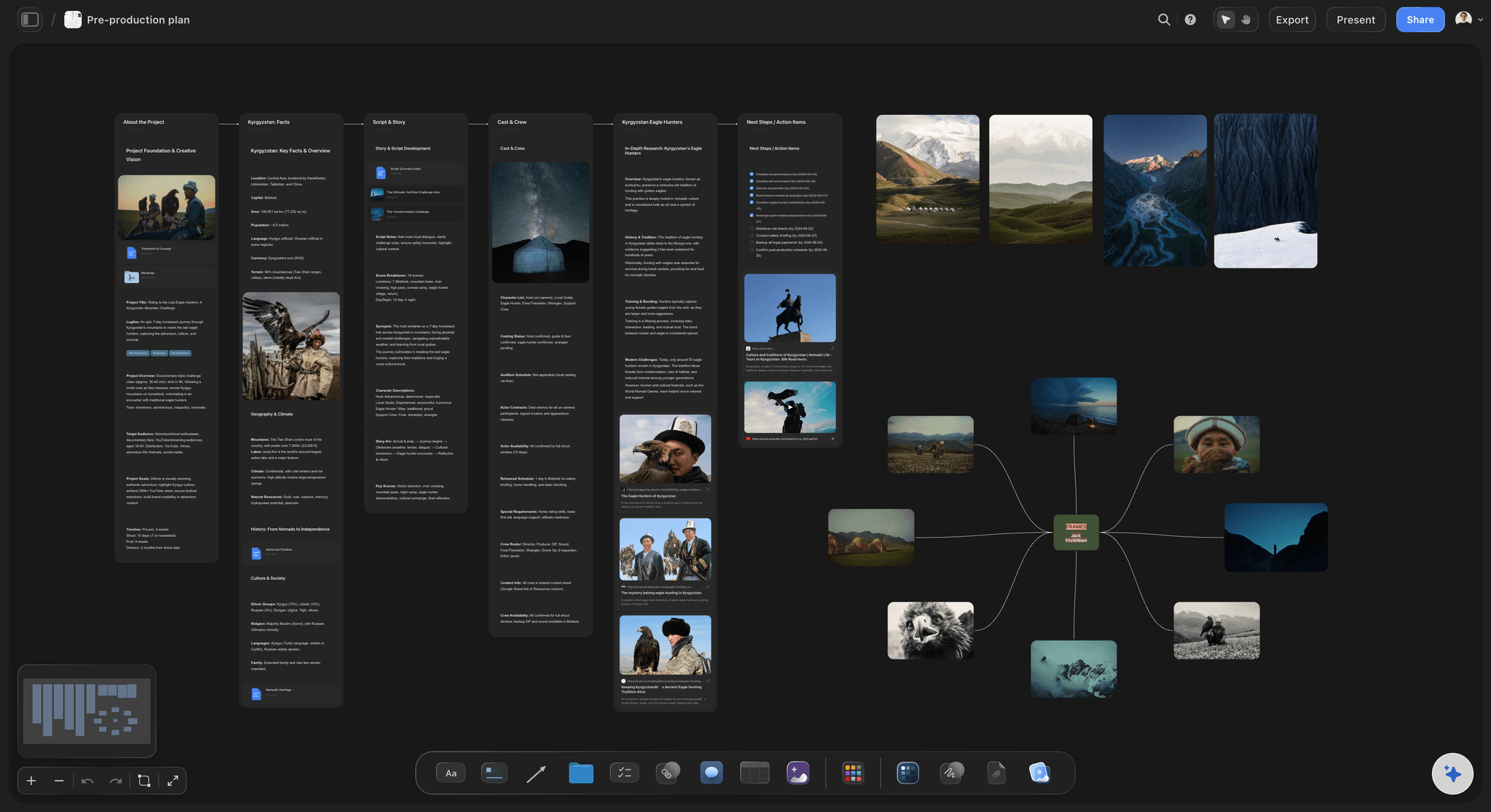
AI that reads the script and the board
A conventional coverage plan to argue with
Lay out the shots from a scene: Describe or paste the scene and get a frame per shot with sizes and notes. The value is completeness: the establishing shot and the cutaway are what inexperienced crews forget.
Check the rhythm: Ask where the sequence goes flat. Four shots at the same size in a row is the most common and least noticed problem in an amateur board.
It proposes, you decide: Storyflow arranges and suggests. How the scene should feel, and which shot tells the story, are decisions that stay with the director.
Generate a frame when a sketch will not come: On Pro and Max, image generation gives you a placeholder to react to. Replacing it once you know what you want is exactly what it is for.
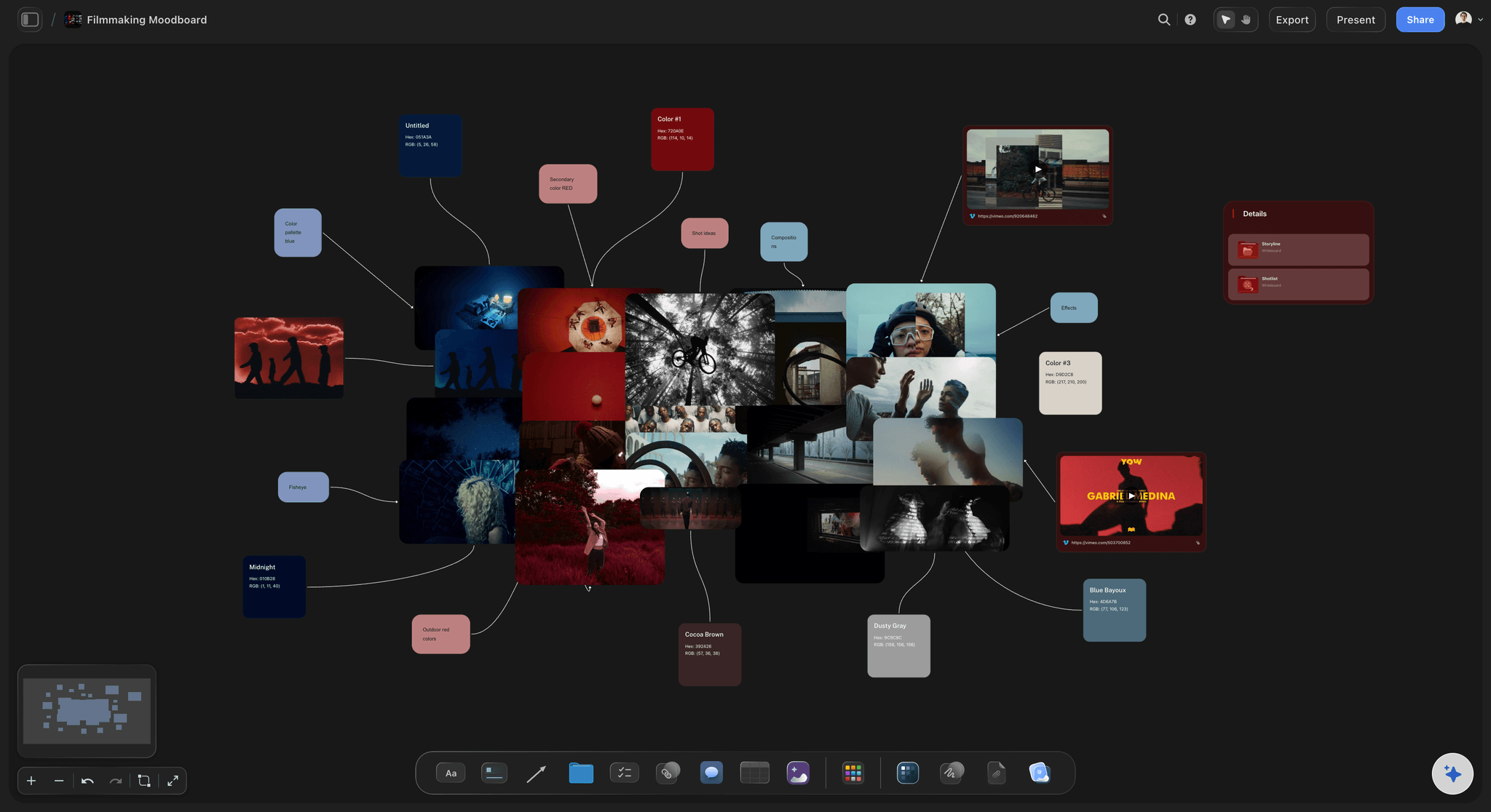
The board is one part of pre-production
What sits around a storyboard
The shot list it becomes: A board is the visual version of a shot list, and the list is what the crew actually works from on the day. Both from the same canvas saves transcribing one into the other.
The moodboard it comes from: Tone, palette, and reference decide what the frames should look like, and keeping them on the same board means the look survives the schedule.
The approval it needs: A view-only link goes to the client or the producer, who reads the whole sequence in a browser without an account and signs in to comment on the frame in question.
Explore templates for your project
Every template opens as a real, editable board on the infinite canvas. Pick the closest fit and make it your own.
Storyboard
Lay out your shots frame by frame with images and notes, then reorder them until the sequence reads like the finished cut.
One app instead of five
Storyflow vs Boords, a PDF template, and paper.
Each is good at something: Boords is a dedicated storyboarding product with animatics, a template is instantly familiar, and paper needs nothing but a pencil. Frame generation in Storyflow is on Pro and Max. Here is where they differ.
Storyflow
Recommended
Whole sequence visible on one canvas
AI lays out shots from a script
Moodboard and shot list on the same board
Sketch, photograph, or generate frames
View-only links with no account required
Timed animatic playback with audio
Boords
Whole sequence visible on one canvas
AI lays out shots from a script
Moodboard and shot list on the same board
Sketch, photograph, or generate frames
View-only links with no account required
Timed animatic playback with audio
A PDF template
Whole sequence visible on one canvas
AI lays out shots from a script
Moodboard and shot list on the same board
Sketch, photograph, or generate frames
View-only links with no account required
Timed animatic playback with audio
Paper
Whole sequence visible on one canvas
AI lays out shots from a script
Moodboard and shot list on the same board
Sketch, photograph, or generate frames
View-only links with no account required
Timed animatic playback with audio
What creators are saying
Join early creators getting structured workspaces and AI that remembers their projects
“Storyflow has sped up my workflow by at least 3x, which means more flow state and more projects I can actually ship. It truly changed the way me and my team create.”

Reilin Joey
Director & YouTuber
“One prompt gets me a structured board. But the tactics are my favorite. I run my YouTube scripts through them and my intros and retention got better. It's amazing.”

Justkay
YouTuber & Freelance Filmmaker
“I used to juggle five apps to plan a project. Now I describe what I am making and get boards, lists, and a schedule. All in one place.”

George
@fernwehchronicles
Storyboard examples, answered.
What goes on a frame, how many you need, and how good the drawing has to be.
A storyboard is a sequence of panels, each showing one camera shot, with notes underneath for what the picture cannot hold: shot size, camera position, movement, dialogue, sound, and duration. Arrows show movement of the camera or the subject. Beyond that, the look depends on purpose: an animation board is dense because everything will be built, a live action board may cover one complicated sequence, and an advertising board is finished because a client approves it.
Storyflow does this on one board: you see the whole sequence on a canvas, then sketch, photograph or generate each frame and add the camera notes and dialogue. Its AI can lay out the shots from a script, and the moodboard and shot list stay on the same board as the frames. Boords has timed animatic playback with audio, which Storyflow does not.
No. Professional storyboards are often stick figures with arrows and a scribbled note, because a board records decisions rather than being looked at. What matters is that a reader can tell how big the subject is in frame, roughly where the camera is, and what moves. A box with a stick figure labelled wide, push in, four seconds tells a crew enough. The exception is a board a client must approve, where the drawing does a selling job.
As long as the shot count, because a working storyboard has one frame per shot. A frame per story beat produces a comic rather than a plan, which is the most common beginner mistake. A sixty second commercial with twelve setups has twelve frames, and a conventionally covered dialogue scene might have eight. Add a frame when a move needs two positions drawn. Three frames for a three minute video usually means the shots have not been decided yet.
Shot size, camera notes, action, dialogue or voiceover, sound, and duration. Shot size matters because a drawing is ambiguous about it and the rhythm depends on it. Camera notes carry lens, height, and movement; action covers what happens within the shot. Dialogue and sound matter because the board is often the only document a composer or sound designer sees, and duration is what lets you time, budget, and cut against it.
No. They hold the same decisions in two forms. A storyboard shows them visually, which is better for judging composition, continuity, and rhythm, and for getting a client or crew to see the intent. A shot list is a table the crew works from on the day, sorted by location and setup. Most productions need both, and building them on the same canvas removes the transcription step where they drift apart.
No. For live action, board the sequences where deciding in advance saves money or prevents a mistake: effects, stunts, crowds, animals, children, a complicated camera move, or a location you only have for two hours. Board anything someone else has to approve. Skip ordinary dialogue coverage, which a director can decide on the day with the actors. Animation is the exception, because nothing exists until it is built and the board is the construction document.
Not yet. Storyflow is paid-only during early access, with plans from $7.99 a month billed annually ($9.99 monthly). A free plan launches before the end of 2026, and anyone a paid member invites to a board joins free. For a free first pass today, paper and a pencil work. What Storyflow adds is the whole sequence in one view, AI that lays out coverage from a script, and a link a client opens without an account.
Yes, in two separate ways. Storyflow's AI can lay out coverage: take a scene and propose the shots it needs, at what sizes and in what order, with notes, which catches what an inexperienced crew leaves out. On Pro and Max it can also generate the images inside the frames, which gives you something to react to even when it is not what you meant. It proposes and arranges; the shots stay the director's call.
When pacing has to be tested: an animatic is a storyboard timed out, with frames playing at their intended durations, usually with scratch dialogue and temporary sound. A sequence that reads well as static frames can run twenty seconds too long once it plays. Animation builds one before anything is animated, commercials use one for client sign-off with the voiceover in place, and live action uses one for sequences whose rhythm is the point.
Look for published production boards rather than polished tutorial examples. Boards from animated features show the most detailed kind. Director commentaries and behind-the-scenes material for live action films often include boards for effects and action sequences, which is where boarding actually happens. Advertising boards are easy to find and least representative, because they are drawn to sell. The most instructive comparison is a rough board beside the finished sequence.
Use photographs, generated images, or labelled empty frames. Photographs are common on small productions: shoot rough stand-ins on a phone, or pull film stills and references that show the framing you want. An AI-generated image, on Storyflow's Pro and Max plans, is a placeholder to react to. A frame with no image, carrying a shot size, a camera note, and a duration, is a functional board entry a crew can shoot from.
Yes. Send a view-only link and the client opens the whole sequence in a browser with no account and no download. A client who signs in can comment on a specific frame while the board stays read-only, so a note about the third frame lands on the third frame. For a formal approval or a production pack, export the board as a high-quality PDF, which is still what most crews want to print.
More from Storyflow
Stop looking at examples and make one.
Open a canvas, paste the scene, and let AI lay out the shots. No download.