
Rock-steady plans for every shoot
Every music cue in the cut,
and the licence that covers it.
For video producers: one row per cue with its source, licence type, territory, term and fee, and the paperwork sitting beside the row it belongs to.


Creatives working for these brands already got early access
- Red Bull
- Canon
- Artlist
- Porsche
See how easy it is to get started
Watch a real project come together, from a blank board to a finished plan, clicked through step by step.
Start from a ready-made template
Pick a board to see what you can build, then let AI fill it in. Every template is a real, editable starting point on the same infinite canvas.

Pre-Production
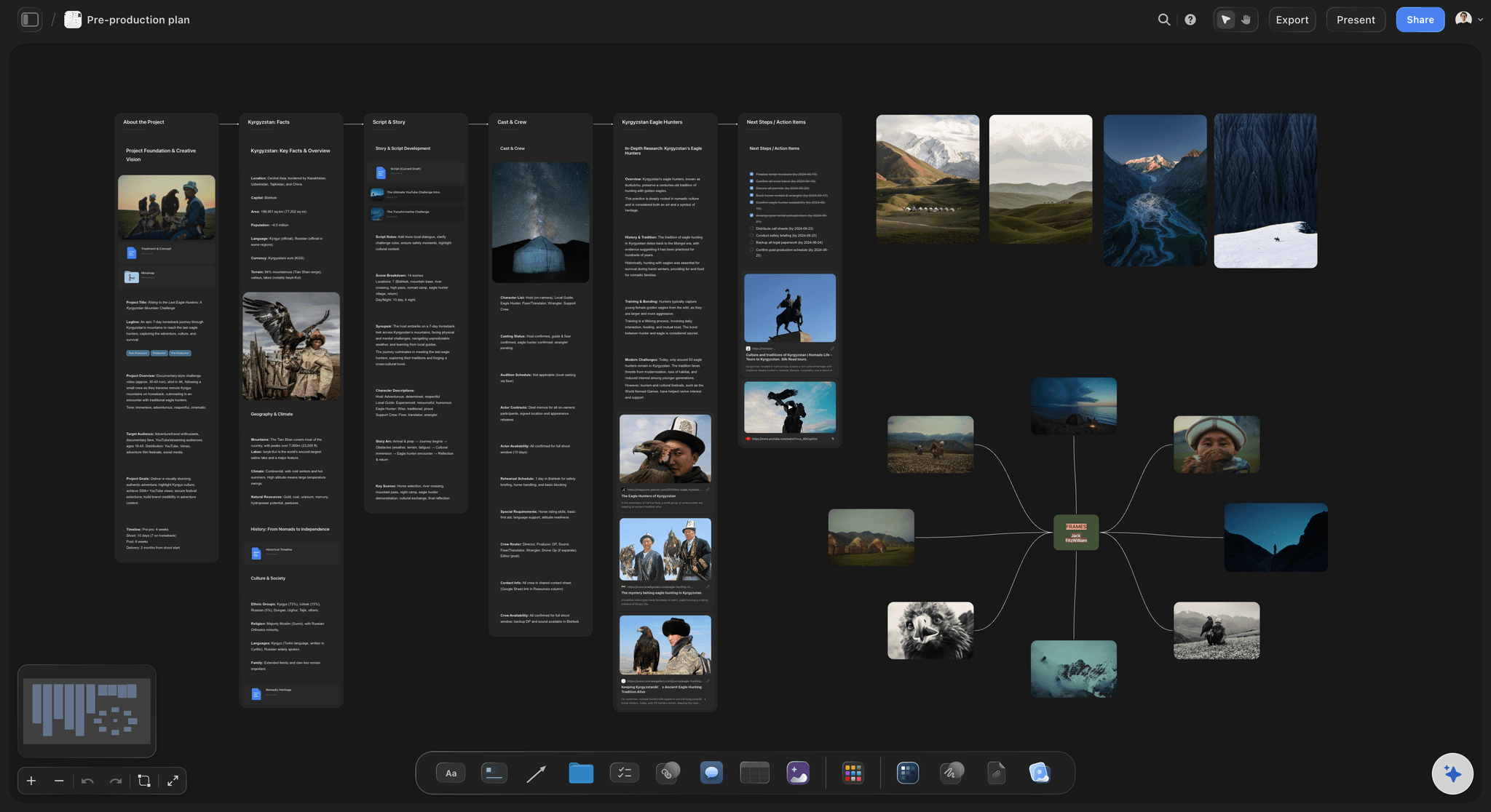
Pull the brief, script, shot list, and moodboard into one pre-production hub so the whole shoot is planned in one place.
How do you track music licensing for a video?
You track music licensing for a video with one list of every cue in the cut, and for each cue the track, where it came from, the kind of licence, where and for how long it may be used, what it cost and where the paperwork is. Storyflow is an AI visual workspace that keeps that tracker on one infinite canvas: the cue table, the licence files, the open questions and the total spend. Its AI reads a licence PDF you drop on the board and lists the territory, the term and the media it covers, so the row is filled from the paper and not from memory.
Start with eight columns, and resist adding more: the cue number and track title, the timecode in and out, the source, the licence type, the media and territory, the date the term ends, the fee, and the status. The source is the name of the library, the composer or the label and publisher. The licence type is one of a short list: library subscription, single track licence, commissioned score, sync and master for a commercial song, public domain, or not cleared yet.
A commercial song needs two permissions, and this is where most trackers go wrong. The song as written belongs to a publisher, who grants a sync licence. The recording belongs to a label, who grants a master use licence. Give that cue two lines in the fee and status columns, because one side often says yes weeks before the other. A track from a production music library usually arrives with both rights in a single licence, which is the reason producers use libraries.
A worked example: a 12 minute brand documentary with nine cues and 7 minutes 40 seconds of music. Six cues are library tracks under a $240 annual subscription. Two were written by a composer for $900 under a work for hire agreement. One is a commercial song that plays for 40 seconds: $1,200 for the sync licence and $1,200 for the master, for web and social, worldwide, for two years. The total is $3,540, and the 40 second song is 68 percent of it.
That last row carries the risk. In two years the film has to come down, be re-cut or be re-licensed, and nobody will remember that unless the date is written where the next producer will find it. Put the end date in a date column, and add a card with a due date sixty days before it. Do the same for any library licence that only covers films published while the subscription is active, or that excludes paid advertising.
Close the tracker at delivery, not at picture lock. Check that every row has a status of Done and a file beside it, that the total in the footer matches the budget line, and that the cue list matches the final cut and not the version from three weeks ago. If the film is going to television or a festival that asks for a cue sheet, the same table already holds the title, composer, publisher and duration it needs.
Ultra fast from brief to board
Four moves from a rough cut to a cleared soundtrack.
A film with ten cues takes under an hour to set up, and after that the tracker is updated in the minute a licence arrives.
01
List every cue in the cut
Paste the editor's music notes or type the cues into the chat and ask Storyflow's AI for a table with the eight columns. It builds one row per cue with the timecodes and track titles in place and the fee column as currency. Choose Sum in that column's footer and the total keeps itself up to date.
02
Drop each licence beside its row
Drag the licence PDF or certificate onto the board next to the table. Ask the AI to read it and it tells you the territory, the term and the media the licence covers, ready to go into the row.
03
Mark what is not cleared
Set a status on every cue. A row marked Blocked or Not started is a track the film cannot ship with yet. Put a card with a due date beside any licence that runs out, sixty days before the end of its term.
04
Check it against the final cut
At delivery, compare the table to the locked edit, read the total in the fee footer against the budget, and share the board by link with the client or the distributor who asks what the music is cleared for.
The cues, the licences, the money and the sound.
Storyflow holds the tracker and the paperwork. A music library, a publisher or a label still grants the licence.
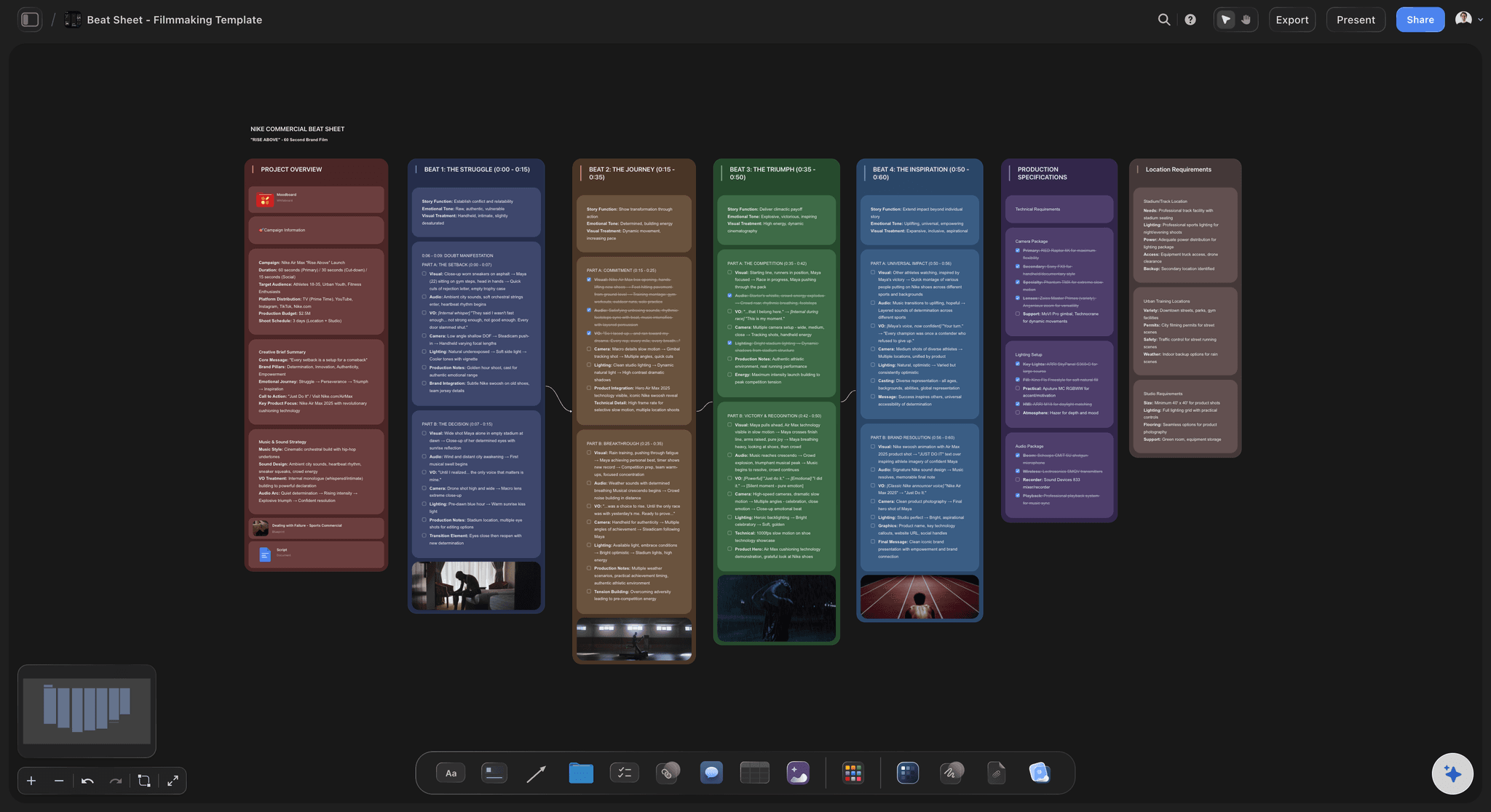
The cue list
One row per cue, with its timecode
Track title, timecode in and out, source and licence type, in a table you edit cell by cell. When the cut changes, the row changes with it, so the list always describes the film as it is now.
See the post-production workflow →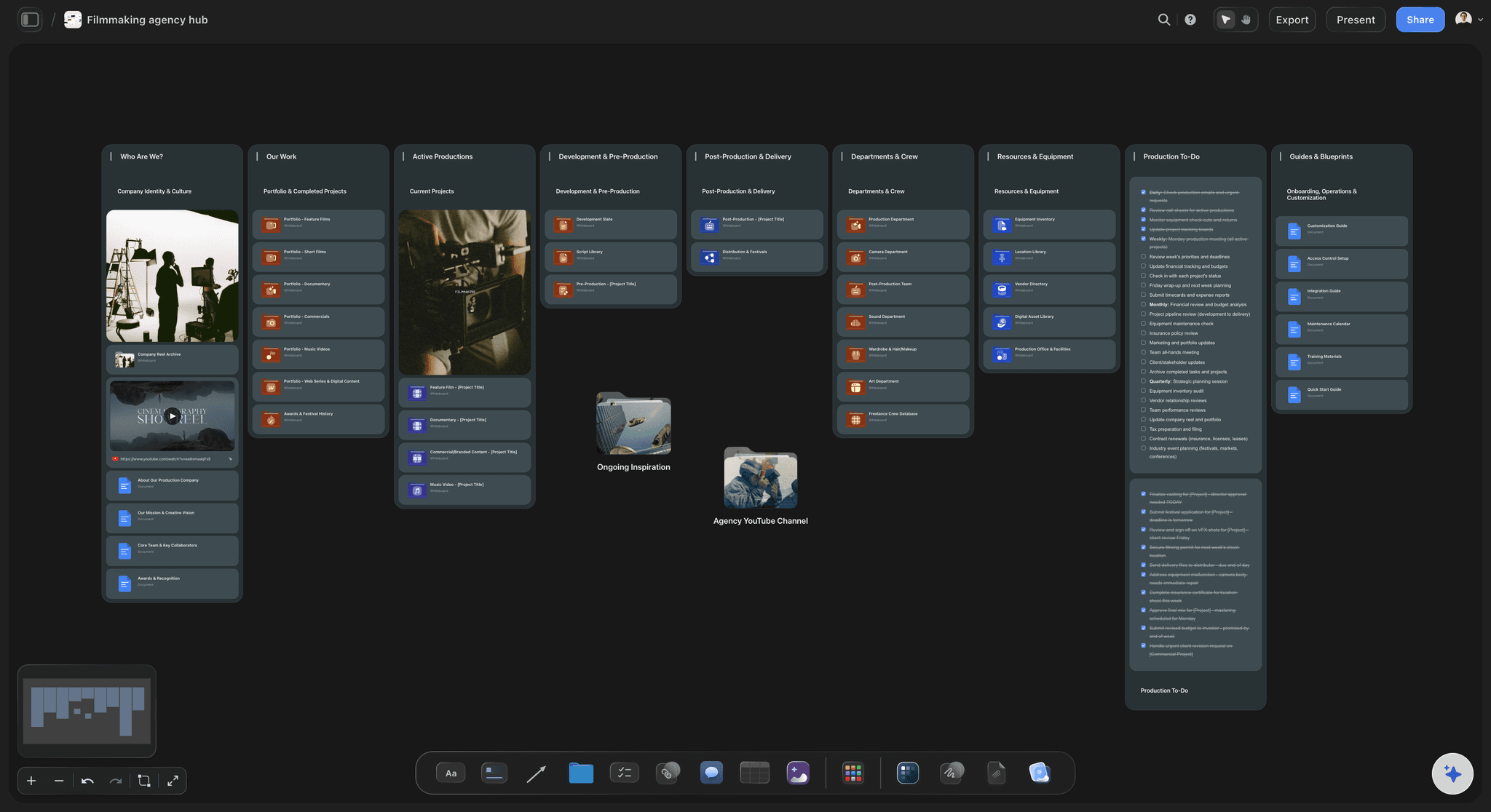
The paperwork
The licence sits beside the cue it covers
Drop the PDF next to the table and it stays there. Storyflow's AI reads the file and lists the territory, term and media, so nobody has to open twelve attachments to answer one question from the client.
See production paperwork →
The money
Music spend added up as you go
Make the fee column a currency column and give it a Sum footer. The total updates when a quote comes in, so you see the moment one song takes most of the music budget, while there is still time to swap it.
See the film budget planner →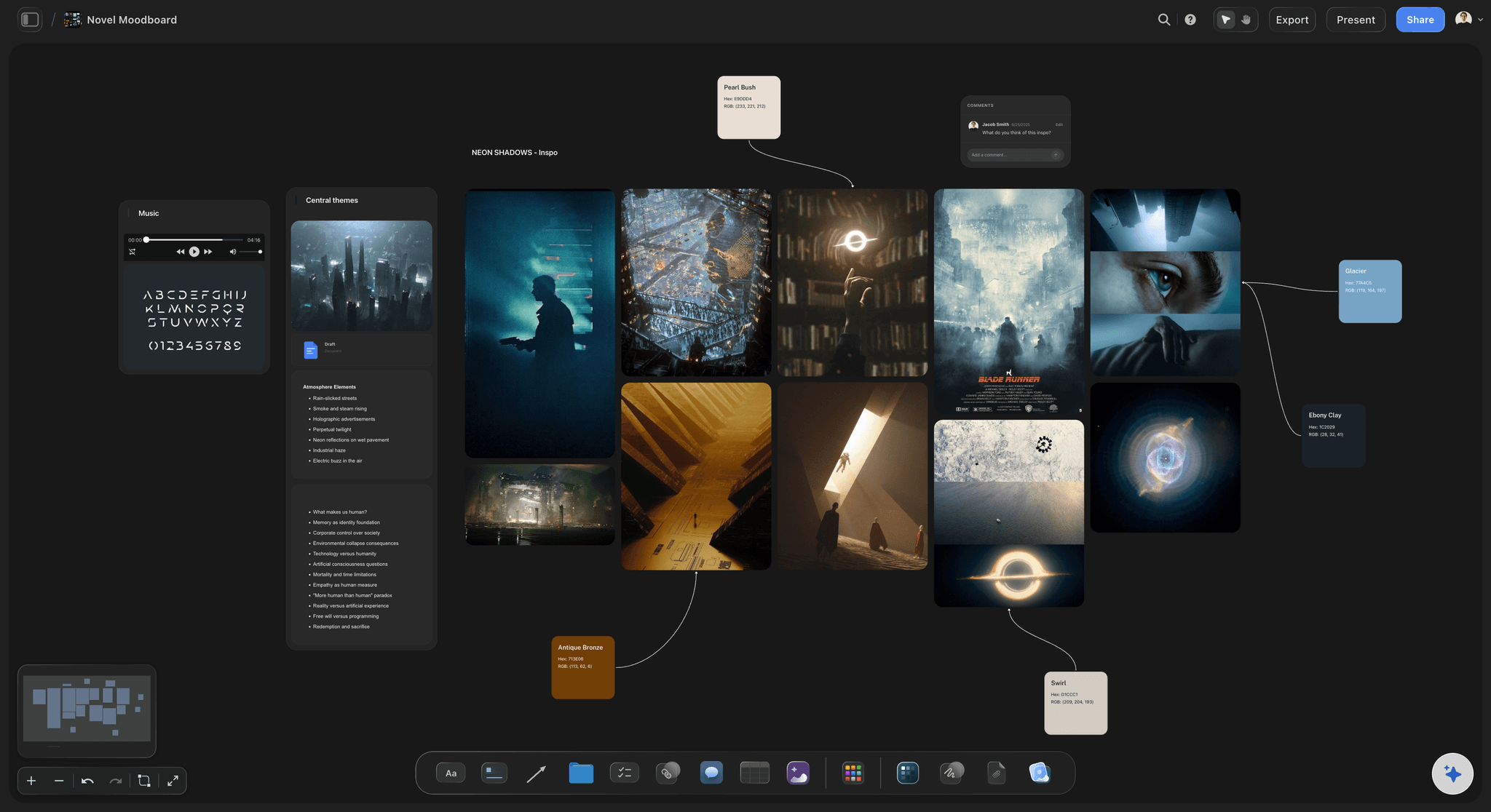
The sound
The temp track next to the scene it plays under
Keep reference tracks on the board as audio files or links, each labelled temp or cleared. A temp track everyone has grown fond of is the most expensive cue in the film, and it is cheaper to know that in the edit.
See the sound design planner →The licence is still there in two years.
When a term runs out, the tracker and the paperwork are on the board the film was made on. Storyflow is paid-only during early access, with plans from $7.99 a month billed annually ($9.99 monthly). A free plan launches before the end of 2026, and anyone a paid member invites to a board joins free.
Unlimited boards, image uploads and files on every paid plan
Files up to 1 GiB each, so the licence and the reference track both fit
Invite the editor or the composer to the board without buying them a seat
Whole-board PDF export for the delivery pack
View-only links so a client can read it with no account
Built for people with taste
Where music clearance goes wrong.
Three failures that reach producers after delivery, and what the tracker does about each one.
The temp track
The edit is built on a song nobody cleared
Temp is a status, not a secret: Every cue has a row from the first rough cut, and a temp track is marked Not started. The director can love it and still see that it has no licence.
Ask for the quote early: A commercial song can take weeks to answer. Send the request the day the track enters the cut, and write the date you asked in the row.
Keep a second choice: For every expensive cue, add a library track that could replace it on the next row. If the quote comes back at four times the budget, the swap is already chosen.
Two rights, two lines: A commercial song needs a sync licence from the publisher and a master licence from the label. Track them apart, because a yes from one is not a yes from both.
The small print
The licence does not cover where the film ends up
Media written per cue: Web, social, paid advertising, broadcast, cinema and festivals are different uses. Write the ones each licence allows, so a web film that becomes a paid advert gets checked first.
Territory in plain words: Worldwide, one country or a list of regions. A client who asks to run the film in a new market gets an answer from the row, not from a search through old email.
Client work on a personal plan: Some library plans cover your own channel and not work made for a client. Note the plan beside each library cue, and ask Storyflow's AI to read the licence if you are unsure what it says.
Ask what is still open: Ask the AI which cues on the board have no licence file, or which terms end this year, and it reads the table and lists them.
The expiry
The term ends and nobody notices
End dates in a date column: Each cue with a fixed term has the day it ends in the table. A licence in perpetuity says so, and the cell is not left blank.
A card that comes due: Add a card with a due date sixty days before the end of a term: renew, re-cut or take the film down. Storyflow does not send a reminder email, so pick a board you open.
Proof for a claim: When a platform flags the music in an upload, the licence certificate is the answer. It is on the board beside the cue, not in the inbox of someone who left.
A handover that works: The next producer opens one board and sees every cue, its licence and its end date. Anyone a paid member invites joins free, so the client's team can hold it too.
Explore templates for your project
Every template opens as a real, editable board on the infinite canvas. Pick the closest fit and make it your own.
Pre-Production
Pull the brief, script, shot list, and moodboard into one pre-production hub so the whole shoot is planned in one place.
One app instead of five
Where Storyflow fits in music licensing.
It tracks the cues, the terms and the paperwork. It does not license music, clear rights or give legal advice.
Storyflow
Recommended
Every cue in the film in one list, whatever its source
Licence type, territory, term and fee per cue
Status per cue, from Not started to Done
Total music spend in the table footer
The cut's notes, stills and paperwork on the same surface
Reads a licence PDF from any source and lists its terms
A catalogue of tracks to search and license
Grants the licence and issues the certificate
Music libraries
Every cue in the film in one list, whatever its source
Licence type, territory, term and fee per cue
Status per cue, from Not started to Done
Total music spend in the table footer
The cut's notes, stills and paperwork on the same surface
Reads a licence PDF from any source and lists its terms
A catalogue of tracks to search and license
Grants the licence and issues the certificate
A spreadsheet
Every cue in the film in one list, whatever its source
Licence type, territory, term and fee per cue
Status per cue, from Not started to Done
Total music spend in the table footer
The cut's notes, stills and paperwork on the same surface
Reads a licence PDF from any source and lists its terms
A catalogue of tracks to search and license
Grants the licence and issues the certificate
What creators are saying
Join early creators getting structured workspaces and AI that remembers their projects
“Storyflow has sped up my workflow by at least 3x, which means more flow state and more projects I can actually ship. It truly changed the way me and my team create.”

Reilin Joey
Director & YouTuber
“One prompt gets me a structured board. But the tactics are my favorite. I run my YouTube scripts through them and my intros and retention got better. It's amazing.”

Justkay
YouTuber & Freelance Filmmaker
“I used to juggle five apps to plan a project. Now I describe what I am making and get boards, lists, and a schedule. All in one place.”

George
@fernwehchronicles
Music licensing tracker questions
What video producers ask when the cut has music in it and the client wants to know what it is cleared for.
In Storyflow, keep one table on the film's board with a row per cue: track, timecode, source, licence type, media and territory, the date the term ends, the fee and a status. Drop each licence PDF beside its row, give the fee column a Sum footer, and add a card with a due date before any term runs out. Check the table against the locked cut at delivery.
Storyflow is made for this job: every cue in a table with its licence terms, the licence file beside the row, the spend added up in the footer, and the whole thing on the board the film is planned on. Its AI reads a licence you drop in and lists what it covers. The licence itself still comes from a library such as Artlist, Epidemic Sound or Musicbed, or from the song's publisher and label.
No. Storyflow does not license music, clear rights, hold a catalogue of tracks or give legal advice. It tracks what you have licensed elsewhere and keeps the paperwork beside each cue. Get library tracks from a production music library, commercial songs from the publisher and the label, and a score from a composer under a written agreement. Ask a lawyer when a licence is unclear.
Eight columns cover most films: cue number and track title, timecode in and out, source, licence type, media and territory, the date the term ends, the fee, and a status. Beside the table on a Storyflow board, keep the licence file for each cue and a short note on anything the licence excludes, such as paid advertising.
A sync licence covers the song as written, the melody and the words, and comes from the publisher. A master use licence covers one recording of it and comes from the label or whoever owns the recording. A commercial song in a video needs both. Track them as two lines for the same cue on the Storyflow table, because they are often agreed on different days.
A cue sheet is a list of every piece of music in a finished programme: title, composer, publisher, duration and how it is used. Broadcasters and collecting societies such as ASCAP, BMI and PRS use it to pay royalties. A Storyflow cue table holds the same facts, so the cue sheet a broadcaster or festival asks for is copied from it instead of rebuilt.
Storyflow's AI reads a licence PDF or Word file that is on the board and lists the territory, the term, the media and what is excluded. It cannot read a scanned page that is only a picture of text, and it does not give legal advice. Treat the summary as a faster first read, and check the clause yourself before the film ships.
Yes. Royalty-free means you pay once and owe no further royalties to the licensor. It is still a licence with terms: which media, whether client work or paid advertising is allowed, and whether it holds after a subscription ends. Put each library cue in the Storyflow table with its plan and its certificate, the same as any other cue.
Write the end date in a date column, and add a card with a due date sixty days earlier that says renew, re-cut or take down. Storyflow shows the date on the card and does not send reminder emails, so put the card on a board the team opens every week. Hand the board to the client at delivery, so they hold the date too.
Yes. Share the Storyflow board by link. Anyone can read it with no account, and people you invite can edit the table and drop files in. Anyone a paid member invites to a board joins free, so the editor who updates timecodes and the composer who uploads an agreement do not need their own plan.
A composition can be in the public domain while a recording of it is not. A symphony written two hundred years ago is free to use as a piece of writing, and last year's orchestra recording of it still needs a master licence. On the Storyflow table, give a public domain cue a source for the recording as well as the composition.
Yes. A Storyflow board is an open canvas, so the cue table can sit beside the edit notes, the delivery list and the budget. Put the music tracker in its own folder on the film's board if it gets busy. The producer who inherits the film finds the schedule, the paperwork and the music in one place.
No. Storyflow runs in the browser and there are no native mobile or desktop apps. Open the tracker in any browser, on a laptop in the edit suite or a tablet at the mix, and share it by link. Licence files are dragged in from the same browser tab.
More from Storyflow
Know what every cue is cleared for.
The cue list, the licences, the fees and the end dates on one board, so the answer to what the music is cleared for takes ten seconds.