
Hours back on every video you plan
Plan the sizzle reel
before you open the edit.
The argument it has to make, the shots that prove it, the order, and the running time. Selecting inside a timeline is the reason a two minute reel takes three days.


Creatives working for these brands already got early access
- Red Bull
- Canon
- Artlist
- Porsche
See how easy it is to get started
Watch a real project come together, from a blank board to a finished plan, clicked through step by step.
Start from a ready-made template
Pick a board to see what you can build, then let AI fill it in. Every template is a real, editable starting point on the same infinite canvas.

Storyboard
Lay out your shots frame by frame with images and notes, then reorder them until the sequence reads like the finished cut.
What is a sizzle reel?
A sizzle reel is a short, fast-cut video assembled from existing footage to prove something to a specific person. Storyflow is an AI visual workspace that plans a sizzle reel on one infinite canvas: the argument at the top, every candidate clip as a card with a note on what it proves, and the running order with a duration on each. Its AI reads the board and gives review notes on the plan, such as which clips prove nothing and whether the order makes the argument. A production company cuts one to sell a series to a commissioner. A brand cuts one to show what a campaign will feel like. An agency cuts one from past work to win a pitch. A festival or a conference cuts one to sell next year's edition. The material already exists in every case, which is what makes it different from every other kind of video: the work is not shooting, it is choosing.
That single fact is what most people get wrong about them. A sizzle reel is an argument, not a highlight compilation. Before any clip is selected there is a question to answer, which is what this reel has to make its viewer believe, and the honest version of that is usually narrower than people want it to be. That this director can handle intimacy. That this world is bigger than it sounds on the page. That we can shoot at scale. A reel proving four things proves none of them, and the temptation to include the beautiful shot that argues for nothing is what turns a ninety second reel into a two and a half minute one.
The second thing that makes sizzles painful is where the selection happens. Almost everyone opens an edit timeline and starts assembling, which means every decision about what the reel is for is being made while also managing a timeline, and the scrubbing is slow enough that comparing three candidate openings takes twenty minutes. That is how a two minute video costs three days. The selection is a thinking problem and a timeline is a bad thinking surface: you cannot see all the candidates at once, and you cannot see the argument at all.
Storyflow is an AI-native infinite canvas, and it is where the choosing happens. Write the argument at the top, lay every candidate clip out as a card underneath with a note on what it proves, and arrange the ones that survive into an order with a duration on each. The clips that argue for nothing are visible as cards with an empty note. When the order and the running time work, you open the edit knowing exactly what you are assembling.
Ultra fast from brief to board
From a pile of footage to a running order.
No timeline, no scrubbing. Cards, an argument, and a total.
01
Open a canvas
Sign up in seconds. No download. Your infinite planning canvas opens in the browser.
02
Write the argument first
One sentence on what this reel has to make its viewer believe. Everything below it is answerable to that, and it is the step almost everyone skips.
03
Lay out every candidate clip
A card per clip with a thumbnail and a note on what it proves. Cards with an empty note are the beautiful shots that argue for nothing, and they are what you cut.
04
Order it and check the total
Sequence the survivors with a duration on each and read the running time. Then open the edit knowing what you are assembling, or send a view-only link for approval first.
The argument, the clips, the order, the total.
Selection made on a surface built for choosing rather than for cutting.
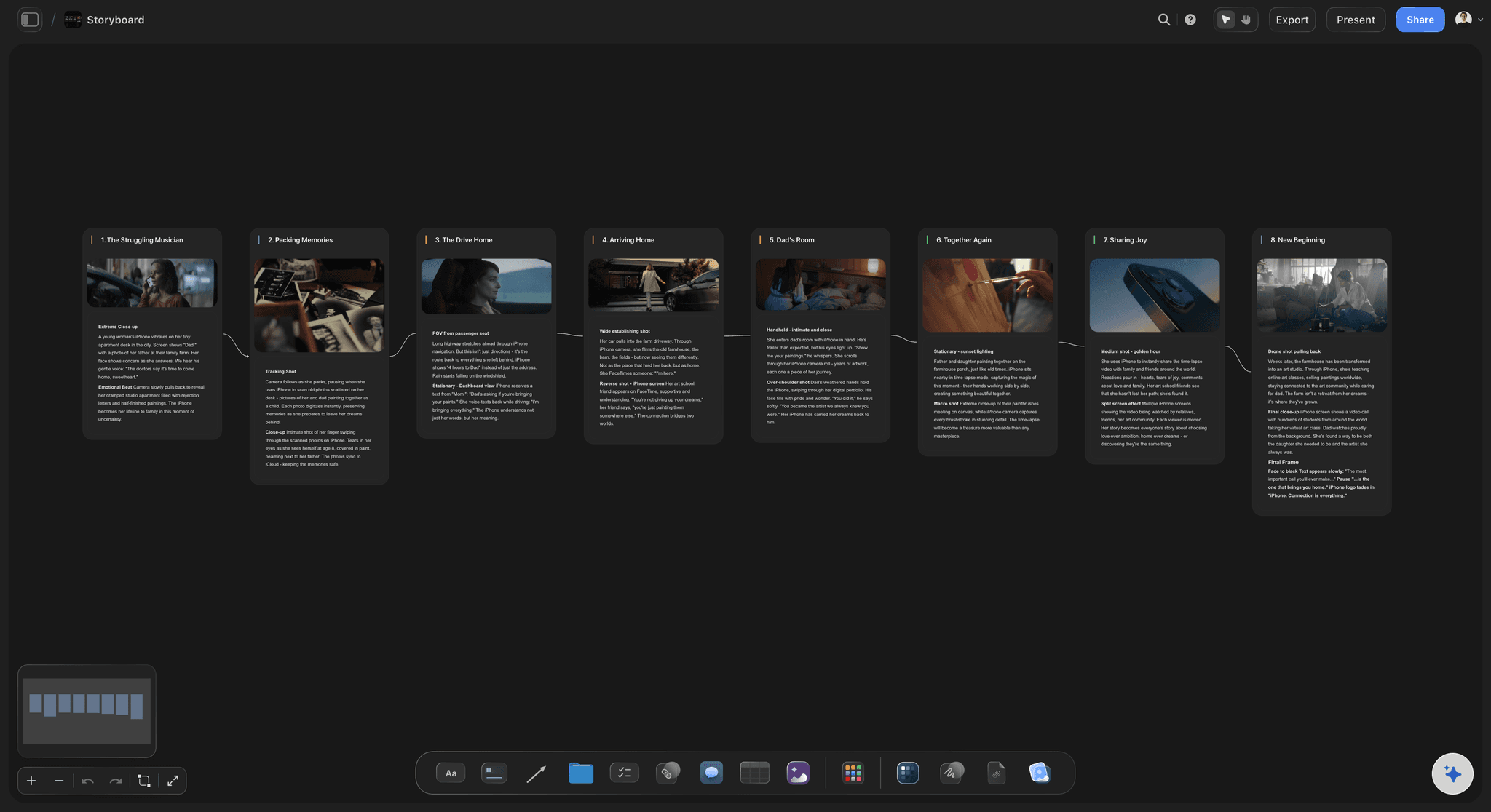
AI proposes a structure from the pitch
Start from a shape
Describe what the reel is for and who is watching and the AI lays out a structure: the opening, what has to land in the first ten seconds, and the beats after it. Arguing with a proposal beats staring at footage.
See the AI storyboard generator →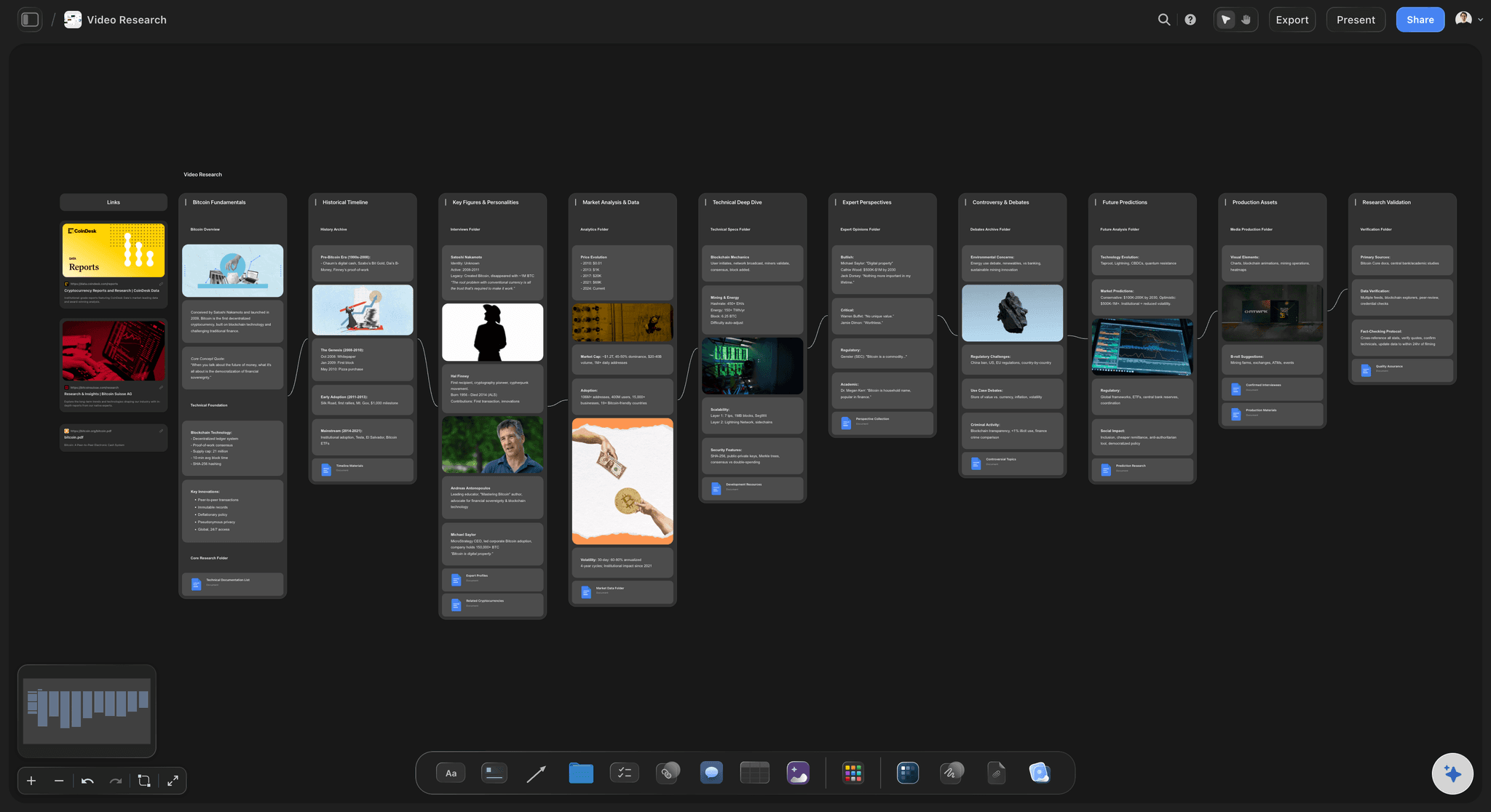
Every candidate clip visible at once
Compare, do not scrub
Three candidate openings side by side as cards is a ten second decision. The same comparison inside a timeline is twenty minutes, and that difference repeated forty times is the whole cost.
Explore the footage organizer →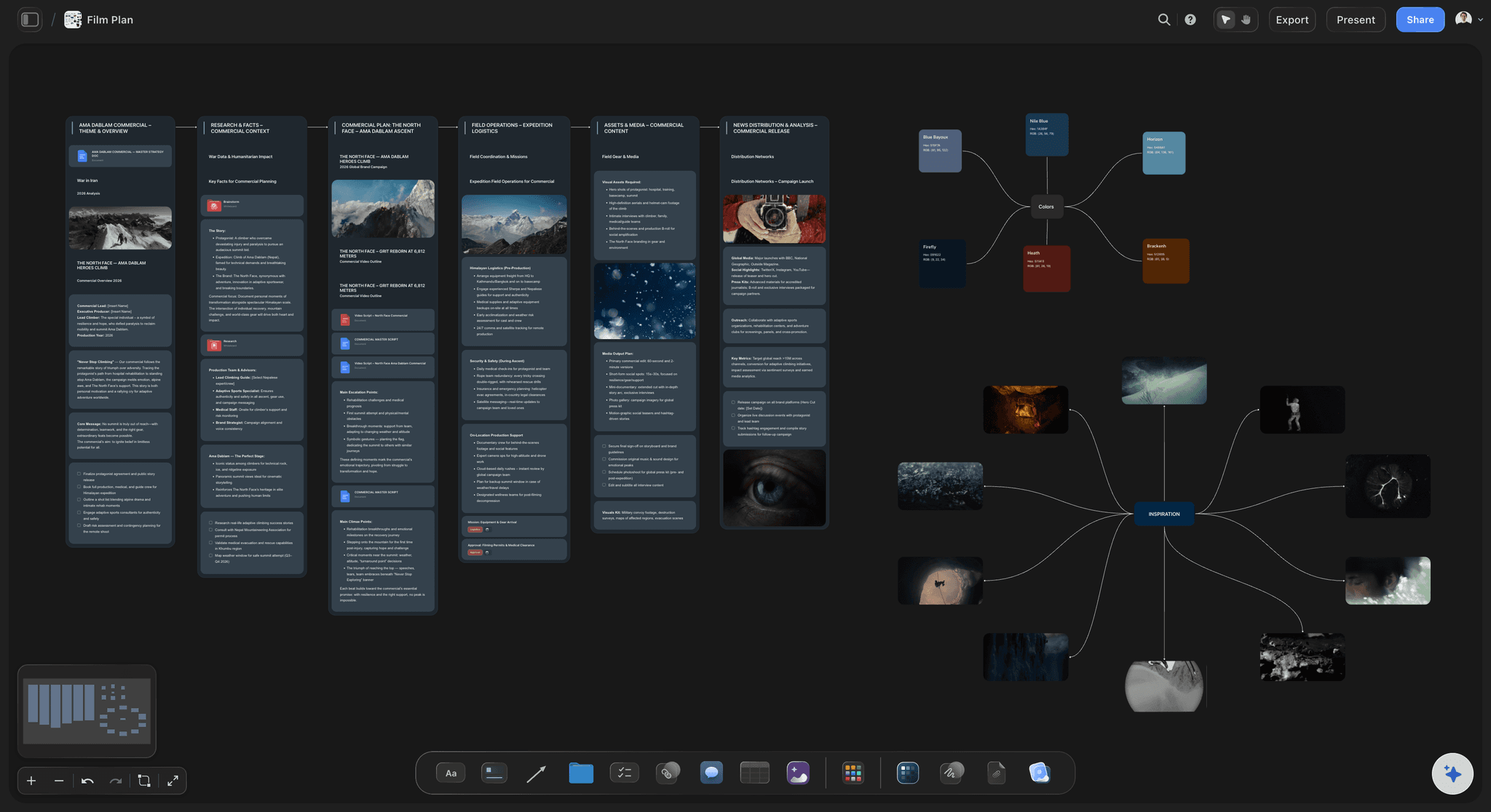
A note on each clip saying what it proves
Cut the shot that argues for nothing
The beautiful clip everyone wants to keep is usually the one whose note is empty. Making the note mandatory is the cheapest possible discipline and it settles most of the arguments.
See the film pitch deck board →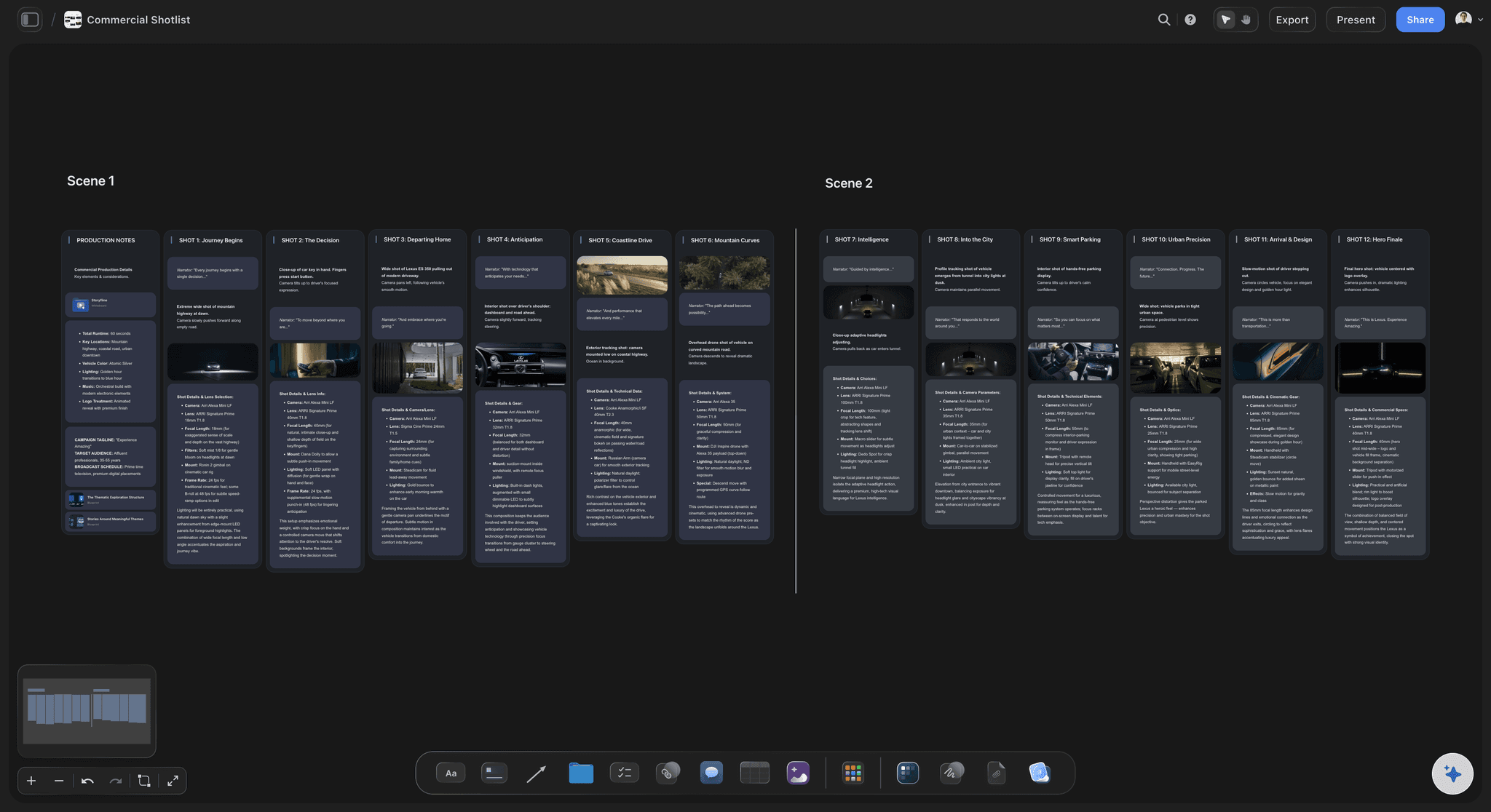
Durations and a running total
Know it is two minutes before the edit does
Put a length on each card and read the total. A reel that is ninety seconds on the plan and two minutes twenty in the timeline is the normal outcome, and it is discovered at the worst moment.
Try the animatic maker →Unlimited boards. No object cap.
Open a canvas, write the argument, and lay the clips out. Storyflow is paid-only during early access, with plans from $7.99 a month billed annually, and a Free plan launches before the end of 2026.
Unlimited planning boards with no cap on clips or images
Basic AI usage to generate reel structures from a brief
Starter templates for storyboards, shot lists, and pitch decks
Share view-only links with clients and commissioners, no account required
Built for people with taste
The work is choosing, and a timeline is a bad place to choose.
The footage already exists. Everything that makes a sizzle good or bad happens before the first clip is dragged in.
One argument, narrowly stated
Decide what it has to prove
Name the viewer: A commissioner, a client, a festival programmer, and an investor want to believe different things. A reel that has not decided which one it is for ends up arguing weakly for all of them.
One claim, not four: That this director can handle intimacy. That this world is bigger than the page suggests. Narrow is what makes it persuasive, and the pressure in every review is to widen it.
The first ten seconds carry it: A viewer who watches a lot of these decides early. Whatever your strongest proof is, it does not belong at the ninety second mark where a build-up would put it.
What it deliberately omits: Writing down what this reel is not trying to prove is what lets you cut good material without it feeling like a loss.
Cards, thumbnails, and notes
See every candidate at the same time
A card per clip: Thumbnail, source, timecode, and what it proves. Enough to decide with, and much faster to compare than a bin of files or a timeline you have to scrub.
Group by what they prove: Cluster clips under the part of the argument they support. A cluster with nine clips and one with none tells you immediately where the reel is strong and where it is asserting something it cannot show.
Keep the rejects visible: The clips you cut stay on the canvas. When a commissioner asks whether you have anything showing a particular thing, the answer is on the board rather than in your memory of last Tuesday.
Video, stills, and reference together: Pull frames from YouTube or Vimeo for tone reference, pin the stills, and keep the pitch document on the same canvas as the reel that supports it.
AI that reads the whole board as context
Ask what the reel is not proving
Structure from a brief: Describe what the reel is for and the AI proposes an opening and a sequence of beats, which is a much better starting point than an empty timeline.
Find the unsupported claim: Ask which part of the argument has no clip behind it, or which clips are doing the same job. Both are the cuts that shorten a reel without weakening it.
It proposes, you decide: Storyflow structures and suggests. Whether a shot lands is a judgment about the material, and a model has not seen the footage the way you have.
Re-cut for a different viewer: The same footage often has to make a different argument to a different person. Ask what changes and the board holds both versions side by side.
Approval before the edit, not after
Agree the reel while changing it is cheap
View-only links for the client or director: Send the plan and get agreement on the argument and the clip order before an edit exists. Restructuring a board takes ten minutes and restructuring a cut takes a day.
Comments on the clip in question: Feedback lands on the card rather than as a list of timecodes in an email, which is the format that makes reel revisions slow.
The edit brief comes off the board: Whoever cuts it gets the order, the durations, the sources, and the argument in one place instead of a message saying make it feel more energetic.
Explore templates for your project
Every template opens as a real, editable board on the infinite canvas. Pick the closest fit and make it your own.
Storyboard
Lay out your shots frame by frame with images and notes, then reorder them until the sequence reads like the finished cut.
One app instead of five
Storyflow vs Premiere Pro, Frame.io, and a shared folder.
These are for different stages: Premiere is where the reel is actually cut, Frame.io is where a cut gets reviewed, and a shared folder is where the footage lives. Here is where the planning stage sits.
Storyflow
Recommended
All candidate clips visible at once as cards
The argument written above the selection
Durations and a running total before the edit
AI proposes a structure from the brief
Cuts, renders, and exports video
Frame-accurate review of a finished cut
Premiere Pro
All candidate clips visible at once as cards
The argument written above the selection
Durations and a running total before the edit
AI proposes a structure from the brief
Cuts, renders, and exports video
Frame-accurate review of a finished cut
Frame.io
All candidate clips visible at once as cards
The argument written above the selection
Durations and a running total before the edit
AI proposes a structure from the brief
Cuts, renders, and exports video
Frame-accurate review of a finished cut
A shared folder
All candidate clips visible at once as cards
The argument written above the selection
Durations and a running total before the edit
AI proposes a structure from the brief
Cuts, renders, and exports video
Frame-accurate review of a finished cut
What creators are saying
Join early creators getting structured workspaces and AI that remembers their projects
“Storyflow has sped up my workflow by at least 3x, which means more flow state and more projects I can actually ship. It truly changed the way me and my team create.”

Reilin Joey
Director & YouTuber
“One prompt gets me a structured board. But the tactics are my favorite. I run my YouTube scripts through them and my intros and retention got better. It's amazing.”

Justkay
YouTuber & Freelance Filmmaker
“I used to juggle five apps to plan a project. Now I describe what I am making and get boards, lists, and a schedule. All in one place.”

George
@fernwehchronicles
Sizzle reel questions, answered.
What one is, how long it should be, and how to choose the clips.
A sizzle reel is a short, fast-cut video made from footage that already exists, assembled to prove one thing to one kind of viewer. Production companies cut them to sell a series to a commissioner, documentary teams cut them from early material to raise finance, agencies cut them from past work to win a pitch, and brands cut them to show what a campaign will feel like. The defining characteristic is that nothing is shot for it, which sounds like it should make the job easy and instead makes it a selection problem. Everything that determines whether the reel works, meaning what it argues and which clips prove it, is decided before the edit begins.
Storyflow is built for exactly this job: the argument written at the top, every candidate clip as a card with a note on what it proves, frames grabbed from the footage, and the surviving clips in order with a duration on each, on one canvas a director or client opens by link. Its AI reviews the plan and points at clips that argue for nothing. The reel itself is still cut in Premiere, Resolve or Final Cut.
Ninety seconds is the usual target and shorter is nearly always better. The specific number matters less than understanding who is watching: a commissioner or a funder sees a lot of these and forms a judgment in the first fifteen seconds, so a reel that builds to its strongest material at the ninety second mark is structured for a viewer who does not exist. Two things drive length up and both are avoidable. The first is a beautiful shot that proves nothing and nobody wants to cut. The second is trying to argue four things at once, which is what happens when the reel has not decided who it is for. Put a duration on every clip during planning and read the total, because reels are reliably longer than their plans.
Write the argument first, in one sentence, then make every clip answer to it. Lay all the candidates out as cards and give each one a note saying what it proves, and be strict: if the note is empty or reads well shot, the clip is decoration. That single rule removes most of the length problem and, more usefully, settles the argument about the shot everyone loves, because the question stops being whether it is good and becomes whether it is doing work. Then group the survivors under the part of the argument they support. A part with no clips beneath it is a claim your reel is making and cannot back, which is worth knowing before a commissioner notices it.
Because a timeline is optimised for assembling and a selection is a comparison problem. To compare three candidate openings in a timeline you scrub, place, watch, undo, and repeat, which takes about twenty minutes; the same comparison as three cards side by side takes ten seconds. Multiply that by the forty or so decisions in a two minute reel and you have the reason sizzles consistently take days longer than anyone expects. The second problem is that a timeline cannot hold the argument. There is nowhere to write what the reel is for, so the criterion for including a clip drifts towards whether it looks good next to the previous one, which is how a reel becomes a montage.
Not during early access. Storyflow is paid-only right now, with plans from $7.99 a month billed annually, and a Free plan launches before the end of 2026. Anyone a paid member invites to a board joins free today, so a director, a client, or a producer can view and comment without paying. If you need something free this minute, index cards on a table with a printed frame on each is genuinely the same method and works well for a reel with twenty candidates. What the canvas adds is thumbnails from the actual footage, durations that total themselves, and the ability to send the plan to someone in another city.
No. Storyflow is the planning surface, not an editor: it does not cut, render, colour, mix, or export video, and it does not do frame-accurate review of a finished cut. You will assemble the reel in Premiere, Resolve, Final Cut, or whatever you use, and review it in Frame.io or similar. What Storyflow replaces is the part that currently happens badly inside an edit timeline, which is deciding what the reel argues and which clips prove it. Teams using it plan on the board, then open the edit knowing the order and the durations, which is usually the difference between three days and one.
Carry your strongest proof, and nothing else. The instinct is to build, because that is how a film works, and a sizzle is not a film. The person watching sees many of these and is deciding whether to keep watching, so the material you were saving is the material that has to be first. Two common openings fail for the same reason: a slow atmospheric build, which asks for patience you have not earned, and a title card explaining what the project is, which spends attention on information the accompanying document already covers. Open on the thing that makes someone lean forward, and if you are not sure what that is, lay the three candidates side by side and show them to someone who has not seen the footage.
Usually, and planning them together is much faster than making them one at a time. The same material frequently has to prove different things to different people: a commissioner wants to believe in the world, a funder wants to believe you have access, a festival wants to believe it will play in a room. Each is a different argument and therefore a different selection and order, sharing perhaps half its clips. On a canvas, keep the clip cards in one place and build each version as its own row, which shows you immediately which clips every version needs, meaning those are the ones worth grading properly. It also stops the common failure of sending one general-purpose reel to three audiences and persuading none of them.
Yes, and getting agreement before the edit is the point. Send a view-only link and a director, a producer, or a client opens the board in a browser with no account and sees the argument, the clip order, and the durations. Restructuring a board takes ten minutes; restructuring a cut takes a day, so this is the cheapest possible moment for the conversation about what the reel is for. Comments attach to the clip they concern rather than arriving as a list of timecodes, which is the format that makes reel revisions slow. The rejected clips stay visible too, so when someone asks whether you have anything showing a particular thing, the answer is on the board.
As the board itself, which carries what an editor actually needs and rarely gets: the argument the reel is making, the clip order, the source and timecode for each, a duration on each, and the notes on what each clip is proving. Compared with the usual brief, which is a folder of footage and an instruction to make it feel energetic, that is the difference between a day of cutting and three days of guessing followed by a round of notes that reveals the argument for the first time. Send a view-only link or export the board as a high-quality image or PDF, and keep it open during the edit so a question about whether a clip earns its place has somewhere to be answered.
Decide what it proves, then cut it.
Open a canvas, write the argument, and lay the clips out. No download.