
Worlds that stay rock-solid, however big
What happened when,
and who knew about it.
Lay your story out in chronological order, run a second line for the order the reader meets it, and track where every character is on any given day.


Creatives working for these brands already got early access
- Red Bull
- Canon
- Artlist
- Porsche
See how easy it is to get started
Watch a real project come together, from a blank board to a finished plan, clicked through step by step.
Start from a ready-made template
Pick a board to see what you can build, then let AI fill it in. Every template is a real, editable starting point on the same infinite canvas.

World Building
Develop the places, factions, and rules of your world and connect them into one living map.
What is a story timeline?
A story timeline is the chronological truth of your narrative, kept separately from the order in which you tell it. It records when each event actually happens, how much time passes between them, where every character is on a given day, and which pieces of backstory precede the opening page. Most stories need two timelines held at once: the chronology of the world, and the sequence of the telling. A story told in strict order can get away with one. Anything with a flashback, a dual timeline, a mystery, or a reveal needs both, because the entire craft of those forms is the gap between them.
Continuity errors are not small problems. A character who is in two cities on a Tuesday, a wound that heals in a day, a pregnancy that lasts fourteen months, a character who reacts to news they have not been told yet: every one of these is the sort of thing a reader notices instantly and never quite forgives, because it breaks the contract that the world is real. They are also almost impossible to catch by rereading, because a manuscript is read in narrative order and the errors live in chronological order. You are checking the wrong axis. The timeline is the other axis.
Storyflow is an AI-native infinite canvas built for holding both. Describe the story in a prompt and the AI lays out a starting timeline: a chronological spine with event cards, plus a parallel line for the reader's order. Then you work spatially. Drag events along the line, run a separate lane for each character so you can see where they are and what they know, place the backstory to the left of page one where it belongs, and stretch the whole thing as wide as the story needs rather than compressing it into a table.
The extra thing a canvas gives you, which a dedicated timeline application usually does not, is context. The map of the city can sit above the timeline. The character boards can sit beside the lanes that belong to them. The research on how long a journey took in 1890 can be pinned next to the journey. A timeline is only useful while it is being consulted, and a timeline in a different application from the rest of your material gets consulted about twice before everyone goes back to guessing.
Ultra fast from brief to board
From a tangle of events to a chronology you can check.
No spreadsheet of dates nobody updates, no continuity guesswork in the final pass.
01
Open a canvas
Sign up in seconds. No download. Your infinite story canvas opens in the browser.
02
Describe the story
Type the premise, the span of time it covers, and the events you already know, and the AI lays out a chronological spine with event cards ready to fill.
03
Add lanes and backstory
Run a lane per character to track where they are and what they know, and place backstory events to the left of the opening so the reader's entry point is visible.
04
Check the telling against the chronology
Run a second line for the order the reader meets events, compare the two, and share a view-only link with an editor or writing partner for a continuity pass.
Two orders, one canvas.
What happened, and when the reader finds out.
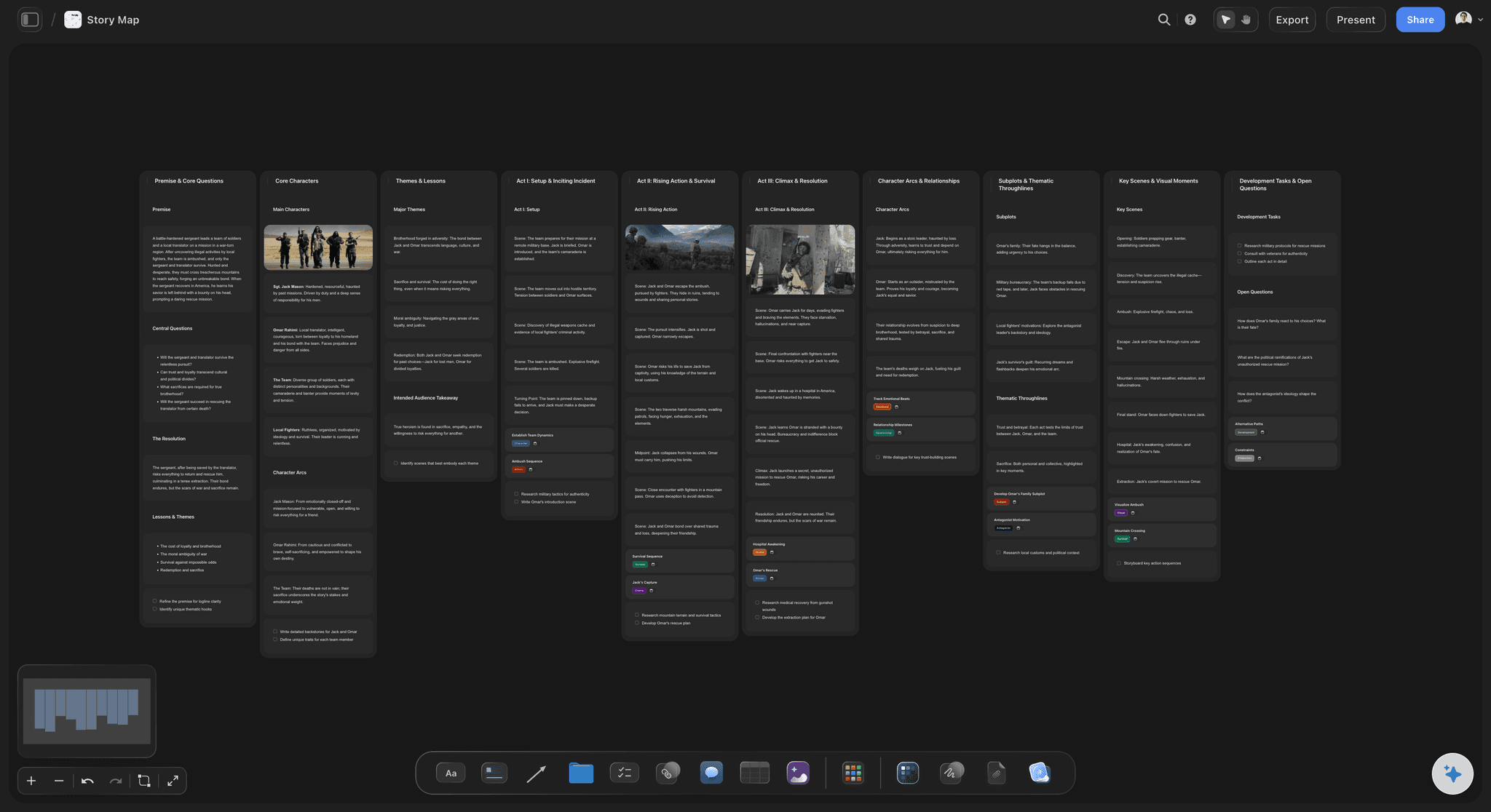
AI lays out the chronology from your description
Start from a spine, not a blank board
Describe the story and the AI builds a chronological line with event cards ready to fill. Correcting a proposed chronology is far faster than constructing one from memory.
See the AI story outline generator →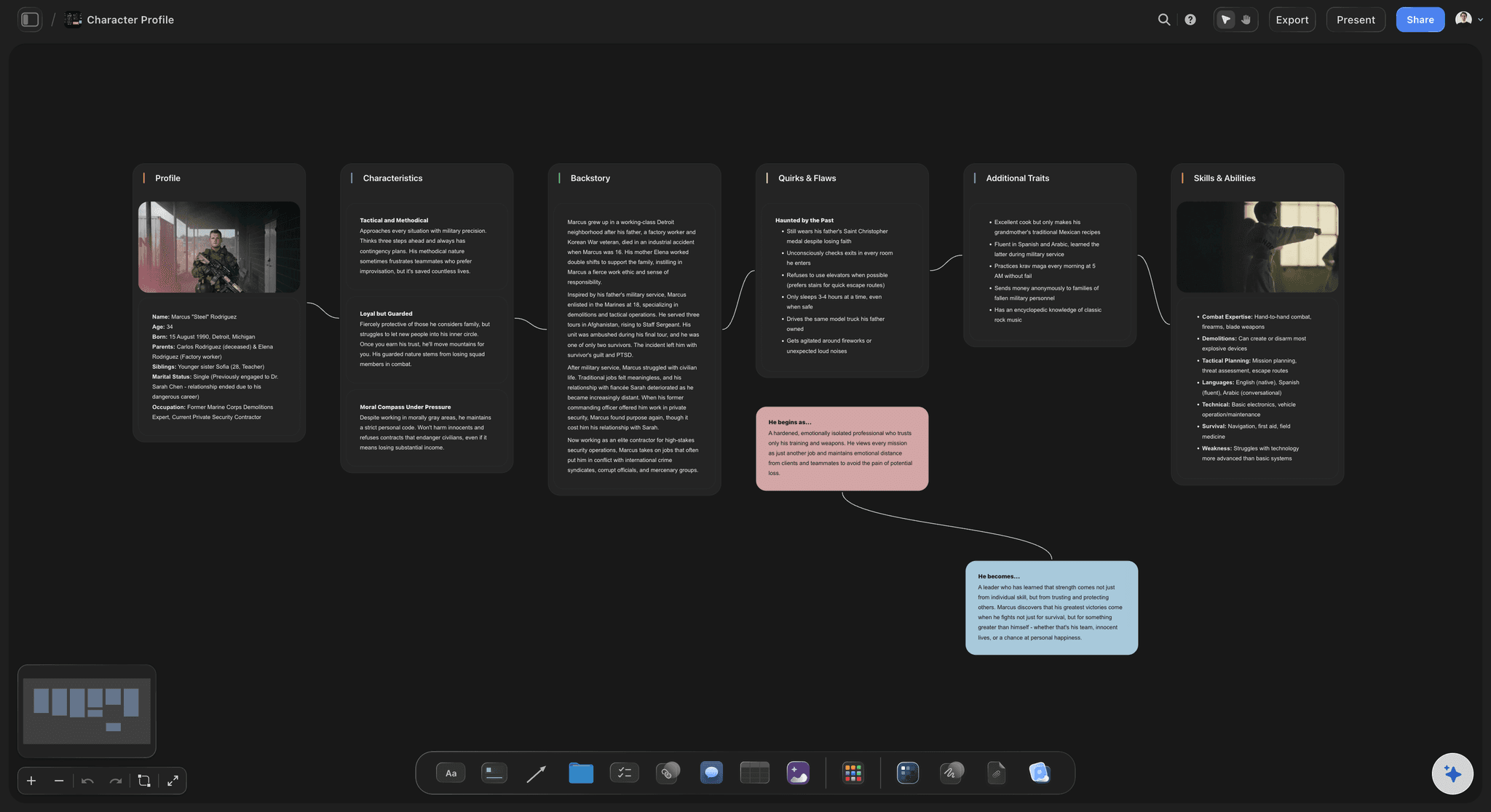
A lane per character
Know where everyone is on any day
Give each character their own lane and the impossible journeys, the overlapping alibis, and the characters who react to news they were never told all become visible at a glance.
See the character relationship map →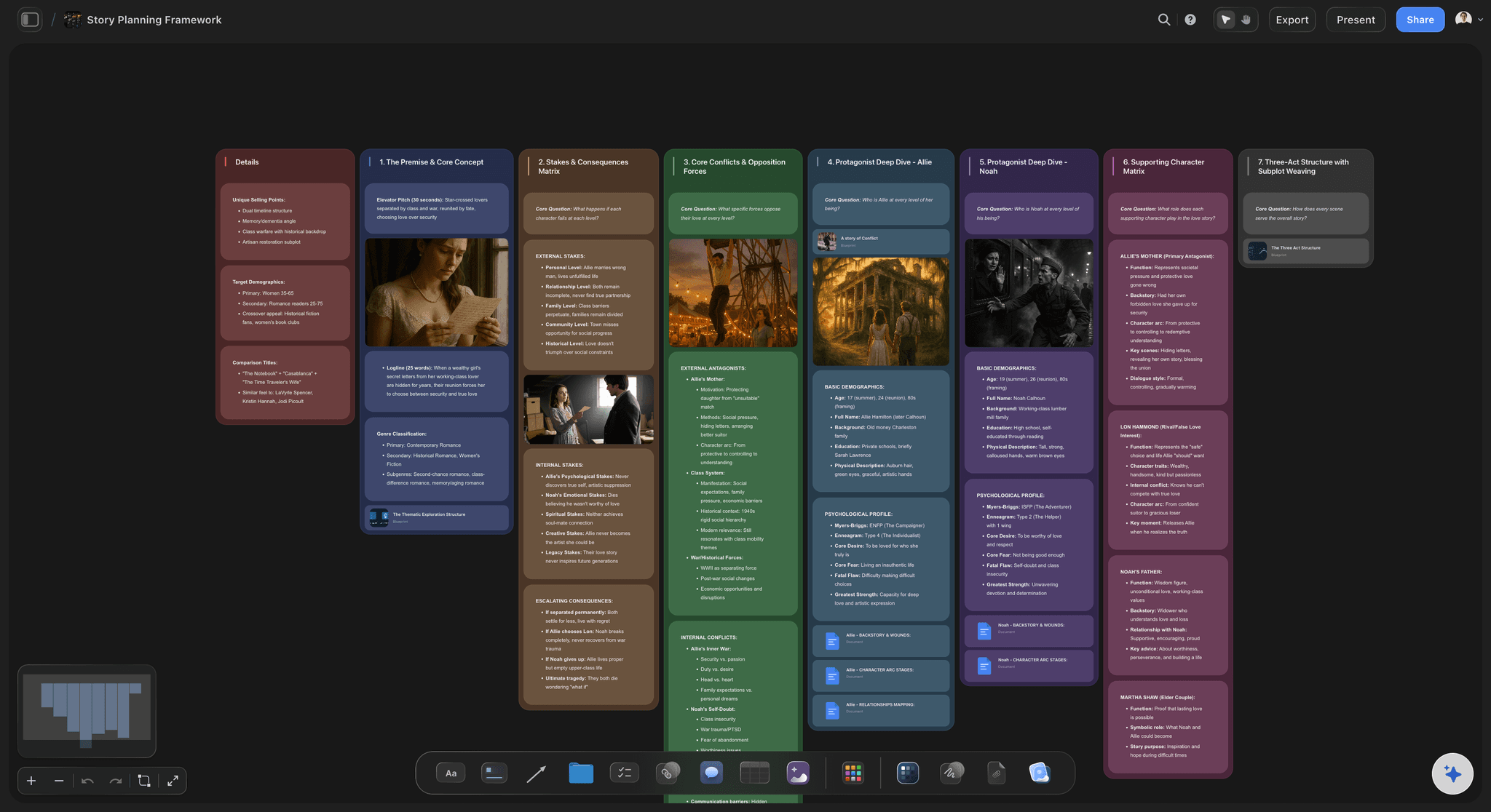
Chronology and telling side by side
Design the reveal, do not stumble into it
Run the reader's order beneath the true order and the gaps between them become a deliberate choice. Mysteries, dual timelines, and flashbacks are made entirely out of that gap.
Explore the story planning tool →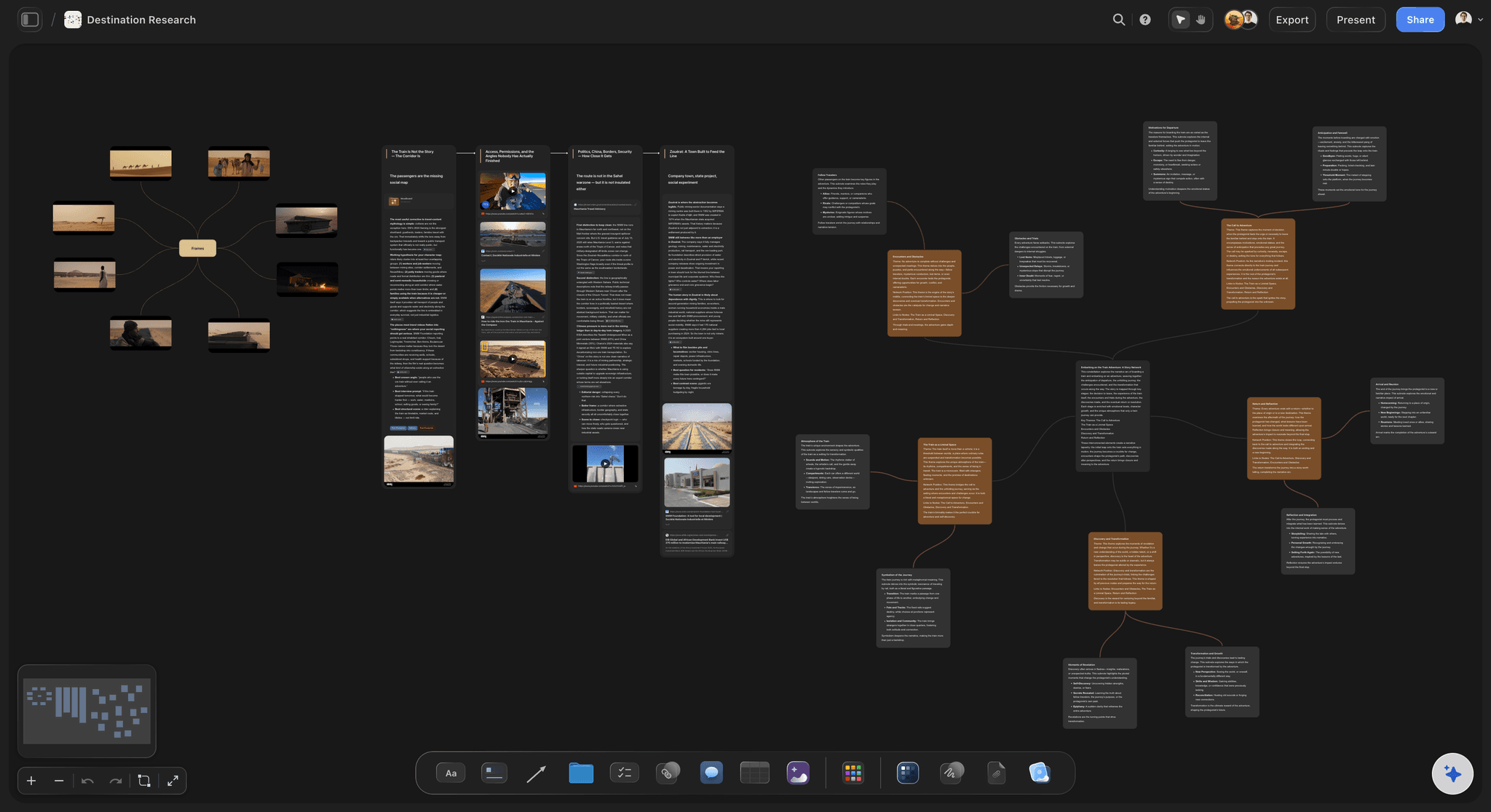
Research and maps beside the events
Keep the facts next to the dates
Pin travel times, historical research, and location maps beside the events that depend on them, so the question of whether that journey is possible gets answered on the spot.
Try the book research organizer →Unlimited boards. No object cap.
Open a canvas, describe the story, and lay the chronology out. Storyflow is paid-only during early access, with plans from $9.99 a month, and a Free plan launches before the end of 2026.
Unlimited story boards on an infinite canvas
AI usage to generate timelines and outlines from prompts
Starter templates for story plans, outlines, and world building
Share view-only links with editors and writing partners
Built for people with taste
More than a list of dates.
A list can record when things happened. It cannot show you the Tuesday two people spent in different cities.
Events, lanes, gaps, and backstory
Work across every axis of time in the story
Events with real durations: Record how long things take, not just when they start. Most continuity errors are duration errors: the wound, the journey, the pregnancy, the season that changes twice in one summer.
A lane per character: Track where each person is and what they know. The knowledge lane is the one writers skip and the one that catches a character responding to information nobody has given them.
Backstory to the left of page one: Place everything that happened before the opening on the same line, extending left. Seeing how much of the story precedes the reader's entry point often explains why an opening feels overloaded.
Gaps you can see: Time skips are structural decisions. Laid out to scale, a six-month gap in the middle of a tense sequence looks exactly as strange as it will read.
AI that can see the board you have already built
Build the chronology with an AI that has the context
Prompt against the whole canvas: Ask it to lay out a character's lane from the events you have already placed, propose a backstory chronology, or add a section for the years between two books. It reads what you have made.
It structures, it does not ghostwrite: Storyflow lays out and organizes the story. The prose stays yours, and so does the judgment about which reveal lands where, which is the actual craft of a nonlinear story.
Iterate without losing work: Re-prompt as often as you want. Events you have already dated and placed stay exactly where they are while the AI builds around them.
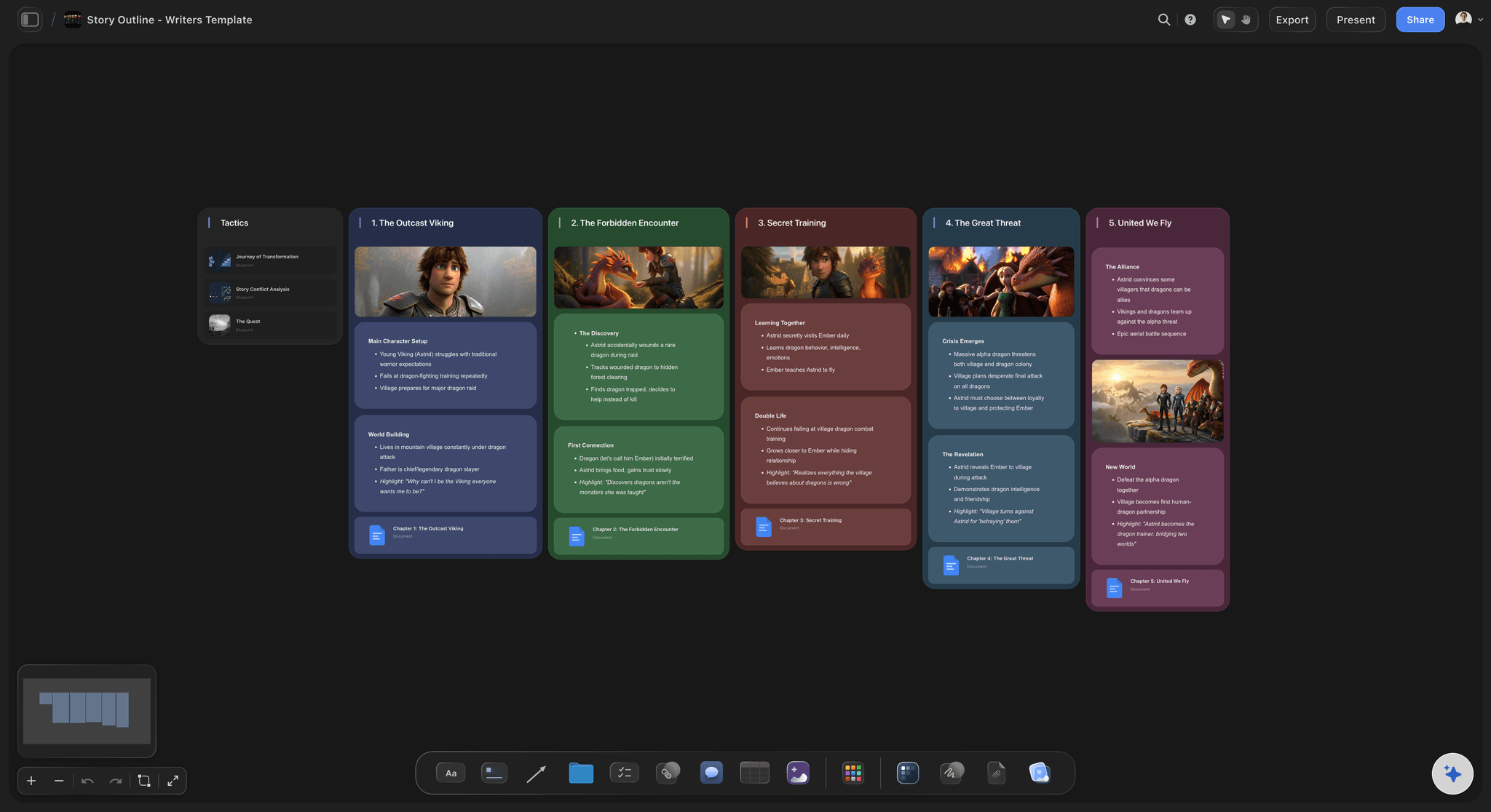
Nonlinear stories, dual timelines, and mysteries
Design the gap between happening and telling
Two lines, read together: Chronology on top, narrative order below, with connectors between them. This single view is most of what it takes to write a dual-timeline novel that does not collapse in the last third.
Reveal scheduling: Mark when the reader learns each fact, separately from when it happened. A mystery is a schedule of revelations, and it is much easier to pace when the schedule is visible.
Who knows what, when: Track information as carefully as events. Dramatic irony is entirely a matter of the reader knowing something a character does not, and it stops working the moment you lose track of which is which.
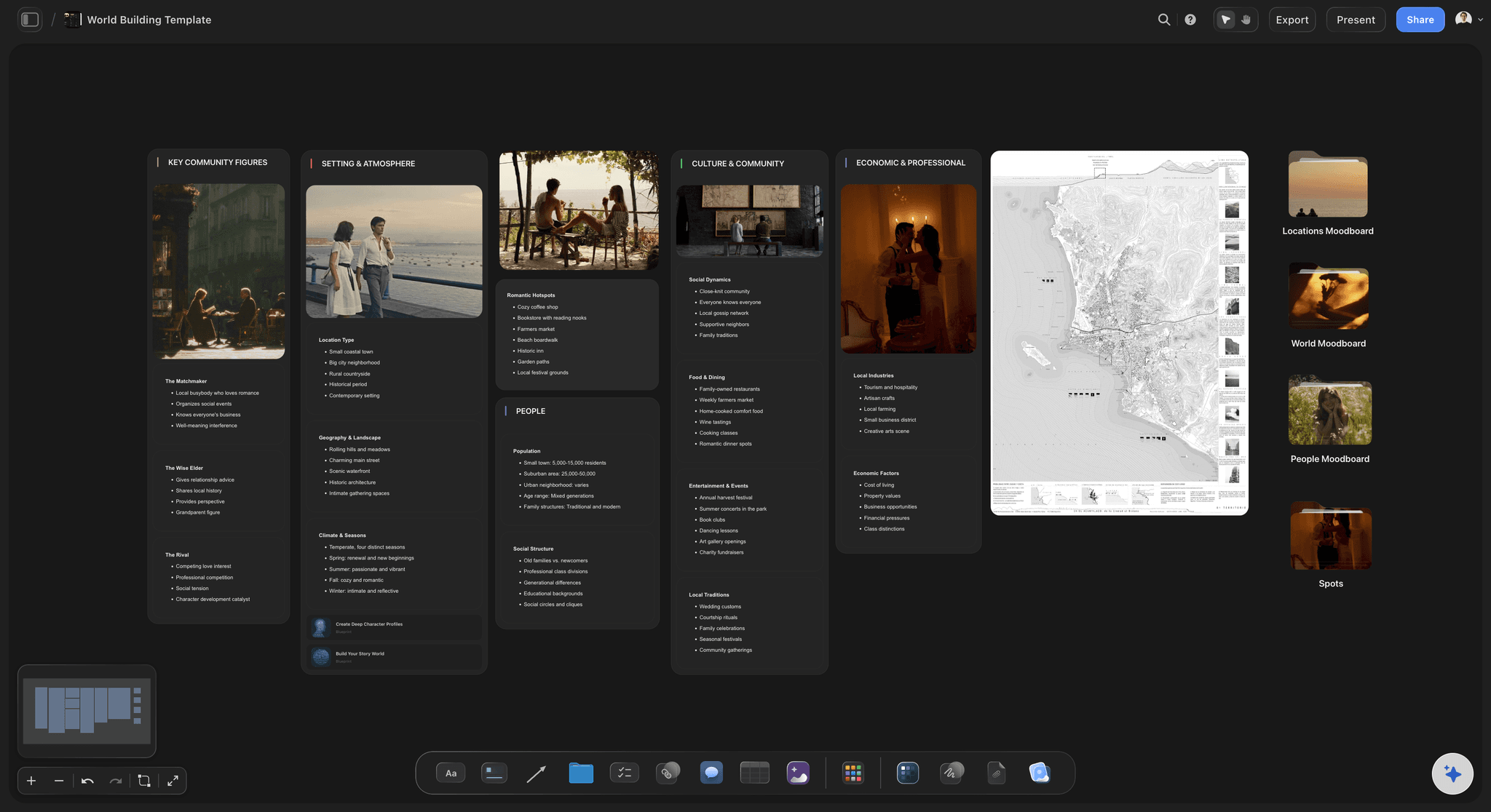
Series, worlds, and long histories
Keep a world consistent across books
Zoom out to decades or centuries: Run the world history above the story timeline so an invented past stays consistent. Fantasy and historical series accumulate contradictions faster than any other form.
One canvas across several books: Lay out each instalment on the same line with the gaps between them to scale. Characters age at the correct rate, which sounds trivial and is a common embarrassment.
World material beside the dates: Pin the map, the family tree, and the invented calendar next to the timeline. Consistency is a matter of the reference being one glance away rather than one application away.
Explore templates for your project
Every template opens as a real, editable board on the infinite canvas. Pick the closest fit and make it your own.
World Building
Develop the places, factions, and rules of your world and connect them into one living map.
One app instead of five
Storyflow vs Aeon Timeline, Scrivener, and a spreadsheet.
Be clear about what Storyflow is. It is not dedicated timeline software with date arithmetic, and it does not compile a manuscript. It is a canvas where chronology sits beside everything else.
Storyflow
Recommended
Infinite canvas for chronology and narrative order
AI lays out the timeline from a story description
Maps, research, and characters on the same canvas
Automatic date arithmetic and calendar systems
Manuscript compile and ebook export
Free plan available today
Aeon Timeline
Infinite canvas for chronology and narrative order
AI lays out the timeline from a story description
Maps, research, and characters on the same canvas
Automatic date arithmetic and calendar systems
Manuscript compile and ebook export
Free plan available today
Scrivener
Infinite canvas for chronology and narrative order
AI lays out the timeline from a story description
Maps, research, and characters on the same canvas
Automatic date arithmetic and calendar systems
Manuscript compile and ebook export
Free plan available today
Spreadsheet
Infinite canvas for chronology and narrative order
AI lays out the timeline from a story description
Maps, research, and characters on the same canvas
Automatic date arithmetic and calendar systems
Manuscript compile and ebook export
Free plan available today
What creators are saying
Join early creators getting structured workspaces and AI that remembers their projects
“Storyflow has sped up my workflow by at least 3x, which means more flow state and more projects I can actually ship. It truly changed the way me and my team create.”

Reilin Joey
Director & YouTuber
“One prompt gets me a structured board. But the tactics are my favorite. I run my YouTube scripts through them and my intros and retention got better. It's amazing.”

Justkay
YouTuber & Freelance Filmmaker
“I used to juggle five apps to plan a project. Now I describe what I am making and get boards, lists, and a schedule. All in one place.”

George
@fernwehchronicles
Story timeline questions, answered.
How to hold two orders at once, how to catch continuity errors, and where Storyflow fits alongside dedicated timeline software.
Aeon Timeline is the dedicated answer and it is genuinely strong at the thing dedicated software does well: real date arithmetic, custom calendars for invented worlds, and automatic age calculation. If your story lives or dies on precise dates, use it. A spreadsheet is free and works surprisingly far, especially for a single-thread chronology. Storyflow is the canvas version, and the trade is deliberate: you lose automatic date maths and gain everything else on the same surface, the map, the character boards, the research, the narrative order running beneath the chronology, plus an AI that will lay the first version out from a description of the story.
No, and it would be misleading to imply it. Storyflow does not compute ages from birthdates, does not run a custom calendar system for an invented world, and will not tell you that a character is thirty-one in chapter twelve. Aeon Timeline does all of that and it is the right tool if precise date arithmetic is central to your book. What Storyflow gives you instead is a canvas where the timeline sits beside the map, the character boards, the research, and the narrative structure, with events you drag rather than fields you fill. For most novelists the visual check catches more errors than the arithmetic would, but if you need the arithmetic, you need the arithmetic.
Both, on the same canvas, one above the other. The chronology is what happened; the narrative order is what the reader meets and when. For a strictly linear story the two are identical and one line is enough. For anything with a flashback, a dual timeline, a mystery, or a reveal, the gap between the two lines is where the entire craft lives, and holding it in your head is how writers end up with reveals that land before the setup or twists the reader worked out sixty pages early. Draw connectors between the lines so you can see which chronological event each narrative beat is delivering.
Not during early access. Storyflow is paid-only right now, with plans starting at $9.99 a month, and a Free plan for solo use launches before the end of 2026. Anyone a paid member invites to a board joins free today, so an editor or continuity reader can review your chronology without paying. If you need free this minute, a spreadsheet will hold a chronology perfectly well and costs nothing, and Notion's free tier can do it with a date field and a sorted view. Neither will show you two orders at once beside your map and character boards, but both are honest free options.
Run three passes and they catch different things. First, durations: go through every event and ask how long it takes, because most continuity errors are duration errors rather than date errors, the wound that heals overnight, the journey that takes a week in one chapter and an afternoon in another. Second, lanes: put each character on their own line and look for the day someone is in two places. Third, knowledge: track when each character learns each fact and check nobody reacts to news they have not been given. That third pass is the one almost nobody does, and it catches the errors readers find most damaging.
Yes, and it is one of the better reasons to use a canvas. Run the world history as a line above the story timeline, zoomed out to decades or centuries, with each book laid out below it on the same axis and the gaps between instalments to scale. Characters then age at the correct rate, which sounds trivial until an author is publicly corrected about it. Pin the map, the family tree, and the invented calendar on the same canvas so the references are a glance away, because consistency is almost entirely a function of how easy the reference is to check.
You describe the story: the premise, the span of time it covers, the main events you already know, and whether there is significant backstory. The AI lays out a chronological spine from that, with event cards and a parallel line for narrative order, so you start by correcting something rather than constructing everything. From there it uses the whole board as context, so you can ask it to lay out a particular character's lane from the events already placed or propose a backstory chronology consistent with what you have written. Re-prompting builds around your existing events without moving anything you have dated.
Yes, and keeping them together is the point. Put the scene cards in one region of the canvas and the timeline in another, with the character boards and research nearby. Structure work and chronology work are constantly interfering with each other, moving a scene changes what a character can know, and a tool that separates them guarantees the two documents drift apart. On one canvas you move a scene and immediately check the lane it affects. Storyflow also lets you open any card into a full document, so a scene can go from a timeline event to a written draft without leaving the board.
Yes. Send a view-only link and they open the whole timeline in a browser with no account, and they can sign in to comment directly on the events they are querying. For a continuity pass this is much more efficient than a document of notes, because a query attaches to the specific event it concerns rather than being a numbered remark someone has to map back onto the manuscript. If a co-writer should genuinely contribute, invite them to the canvas and they join free as a collaborator. Sharing and commenting work on every paid plan.
Detailed enough to answer the questions your story actually raises, and no more. A quiet contemporary novel spanning one summer may need twenty events and no lanes. A thriller with three point of view characters and a conspiracy needs a lane each and probably a knowledge lane too. The test is whether the timeline is being consulted: if you never open it while drafting, it is too detailed to maintain or too vague to be useful. Start with the events that constrain other events, journeys, injuries, seasons, deadlines, and add detail only where you have caught yourself guessing.
Get the chronology right before the reader does.
Open a canvas, describe the story, and let AI lay out the timeline. No download.