
The calmest place to shape your story
Lay your story against the shape
and see what is missing.
Three acts as sections on an infinite canvas, scene cards you can drag between them, and the proportions of your story visible at a glance.


Creatives working for these brands already got early access
- Red Bull
- Canon
- Artlist
- Porsche
See how easy it is to get started
Watch a real project come together, from a blank board to a finished plan, clicked through step by step.
Start from a ready-made template
Pick a board to see what you can build, then let AI fill it in. Every template is a real, editable starting point on the same infinite canvas.

Story Plan
Outline your plot, characters, and world in one connected view, then expand each thread as the story grows.
What is a three-act structure template?
A three-act structure template is a scaffold for the oldest reliable story shape there is: a beginning that sets the world and breaks it, a middle that escalates the consequences, and an end that resolves them. Act one runs roughly the first quarter of the story and covers the setup, the inciting incident that disturbs the status quo, and the first plot point that commits the protagonist to the problem. Act two runs roughly half the story: rising action, a midpoint reversal that changes what the protagonist wants or knows, and a low point where the goal looks lost. Act three is the final quarter: the climax and the resolution.
The template's real value is diagnostic, not generative. Nobody ever wrote a good story by filling in a form, and no template will hand you one. What the framework does is give you proportions to measure against. Lay the story you actually have over the three-act shape and the problems announce themselves: an act one that takes forty percent of the story to get moving, a midpoint that lands at seventy percent, an act two with rising action that never actually rises. Act two is where stories die, and it dies quietly, one flat scene at a time. You will not feel it happening in a document. You will see it instantly on a board.
Storyflow is an AI-native infinite canvas built for exactly this kind of structural work. Describe your premise in a prompt and the AI lays out a three-act board with the acts as sections and the key beats marked: inciting incident, first plot point, midpoint, low point, climax. Then you fill the sections with scene cards, drag them between acts as the story changes, and read the structure as geometry. An act that is too thin is visibly thin. A midpoint sitting in the wrong place is visibly in the wrong place.
Working in three acts really means working across several layers at once: the act proportions themselves (roughly 25/50/25, and where your story deviates), the structural beats (inciting incident, first plot point, midpoint reversal, low point, climax, resolution), the scenes that carry each beat and the connective tissue between them, the subplots that need to surface and resolve inside the act frame, and the character arcs whose turns should line up with the structural turns. A template on paper shows you one layer at a time. A canvas keeps all of them visible at once, which is what makes the mistimed midpoint and the vanishing subplot findable before the draft, not after it.
Ultra fast from brief to board
From a premise to a structure with the right proportions.
No worksheet to print, no table to configure. Describe the story and start moving scenes between acts.
01
Open a canvas
Sign up in seconds. No download. Your infinite structure canvas opens in the browser.
02
Describe the story
Type your premise, genre, and medium and the AI lays out a three-act board: acts as sections, key beats marked, and scene cards to fill. You start from a shape rather than a blank page.
03
Lay your scenes against the acts
Drop your scenes into the sections and read the geometry. Drag cards between acts, move the midpoint where it belongs, and thicken the act that is visibly starving.
04
Share, export, or start drafting
Draft in the built-in document editor beside the board, share a view-only link with your writing group or a producer, or export the structure as an image or PDF.
The framework as geometry, not a worksheet.
Acts, beats, scenes, subplots, and arcs on one infinite canvas, all of it movable.
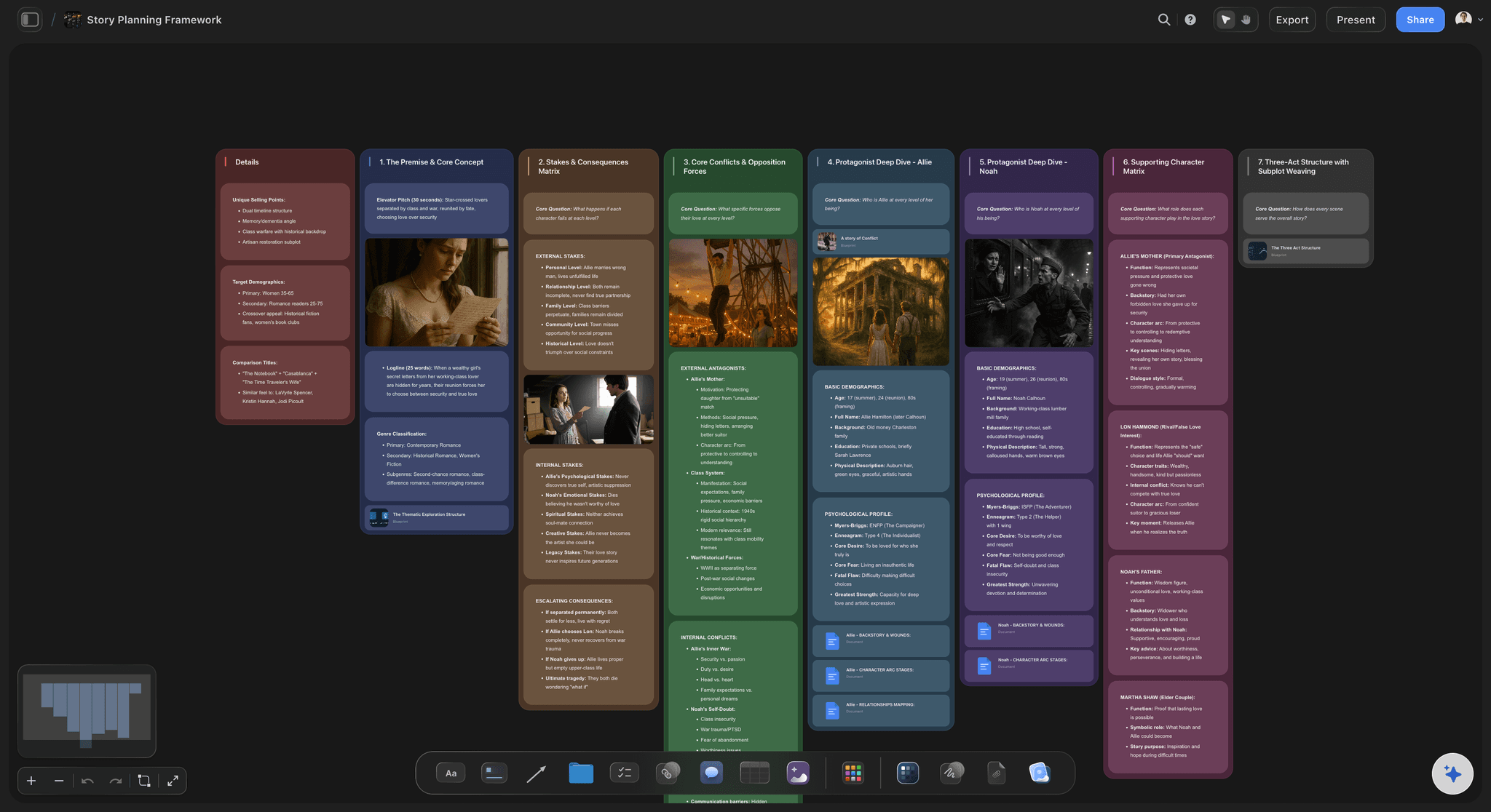
AI lays out the three acts from your premise
Start from the shape, not a blank page
Describe the story and the AI builds the board: three act sections, the beats named and placed, and scene cards suggested against them. Filling a visible structure is much faster than inventing one.
See the AI story outline generator →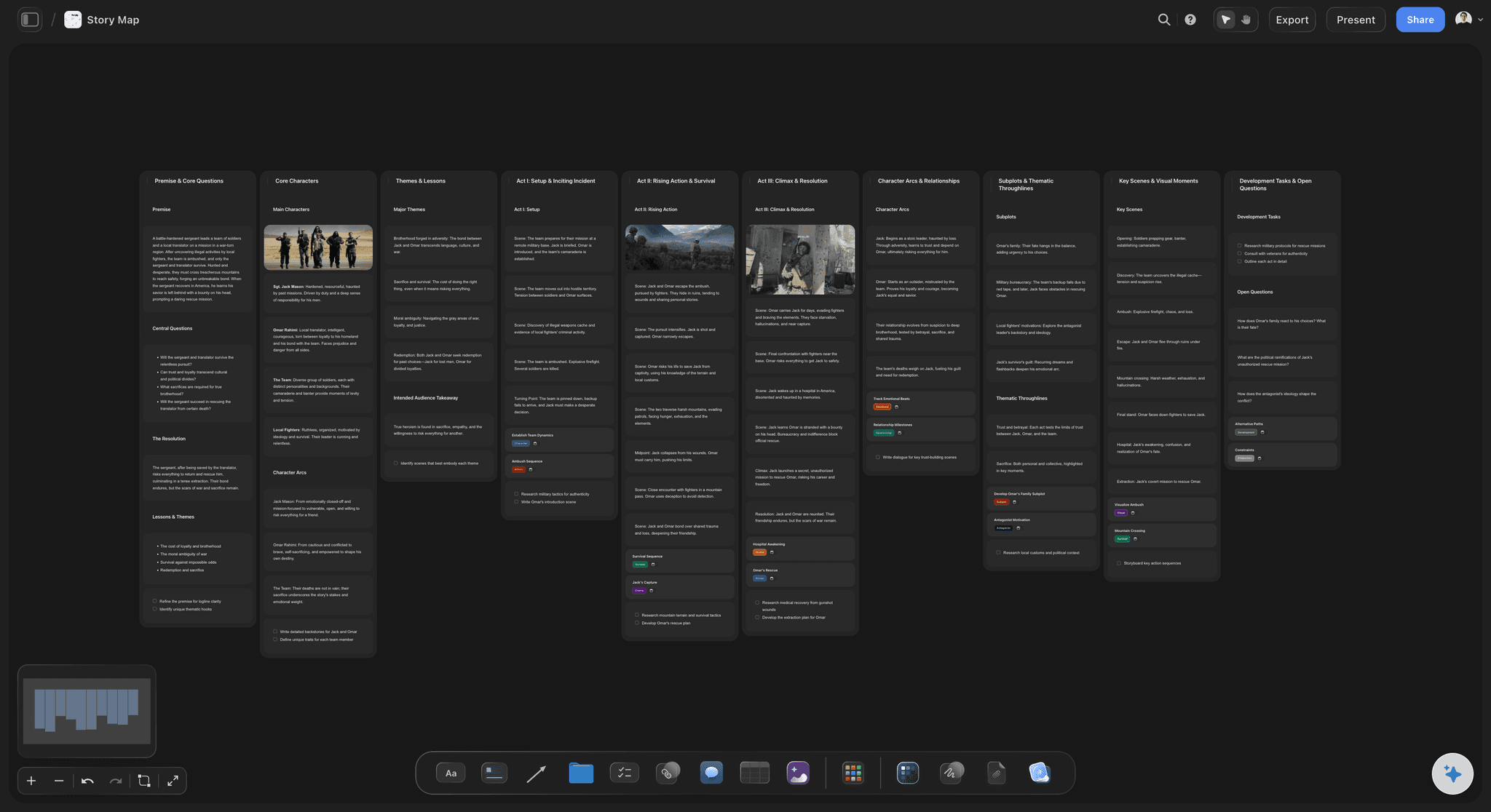
Proportions you can read at a glance
See the mistimed midpoint before you draft it
When the acts are sections holding scene cards, structure is geometry. A thin act two, a midpoint landing at seventy percent, a climax with no setup underneath it: all visible on the board, not discovered in revision.
Explore story structure software →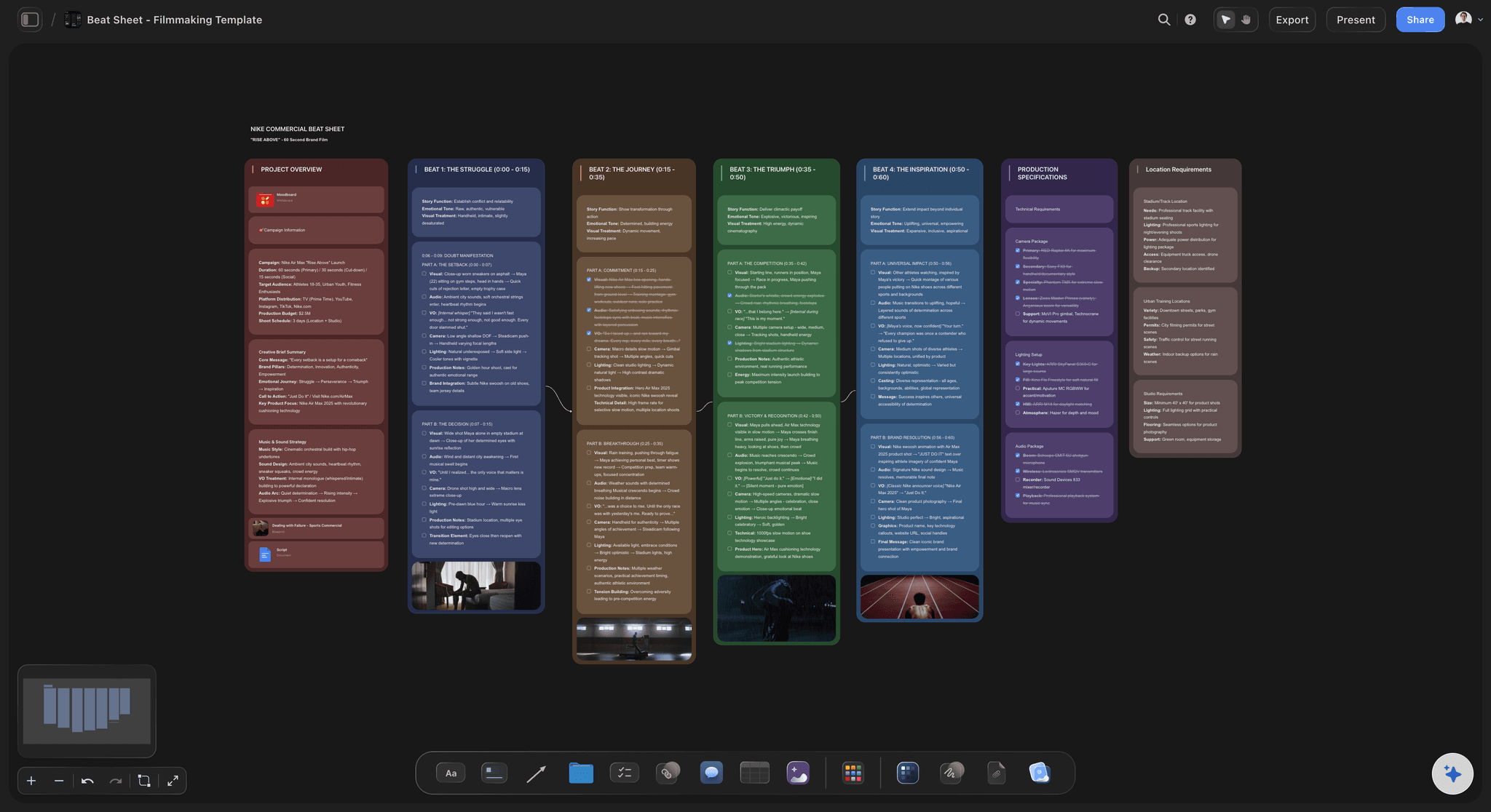
Every beat marked, from inciting incident to climax
Work at beat level inside the acts
Pin the inciting incident, first plot point, midpoint reversal, low point, and climax as fixed markers, then arrange scenes around them. The beats hold the shape while the scenes stay movable.
See the beat sheet template →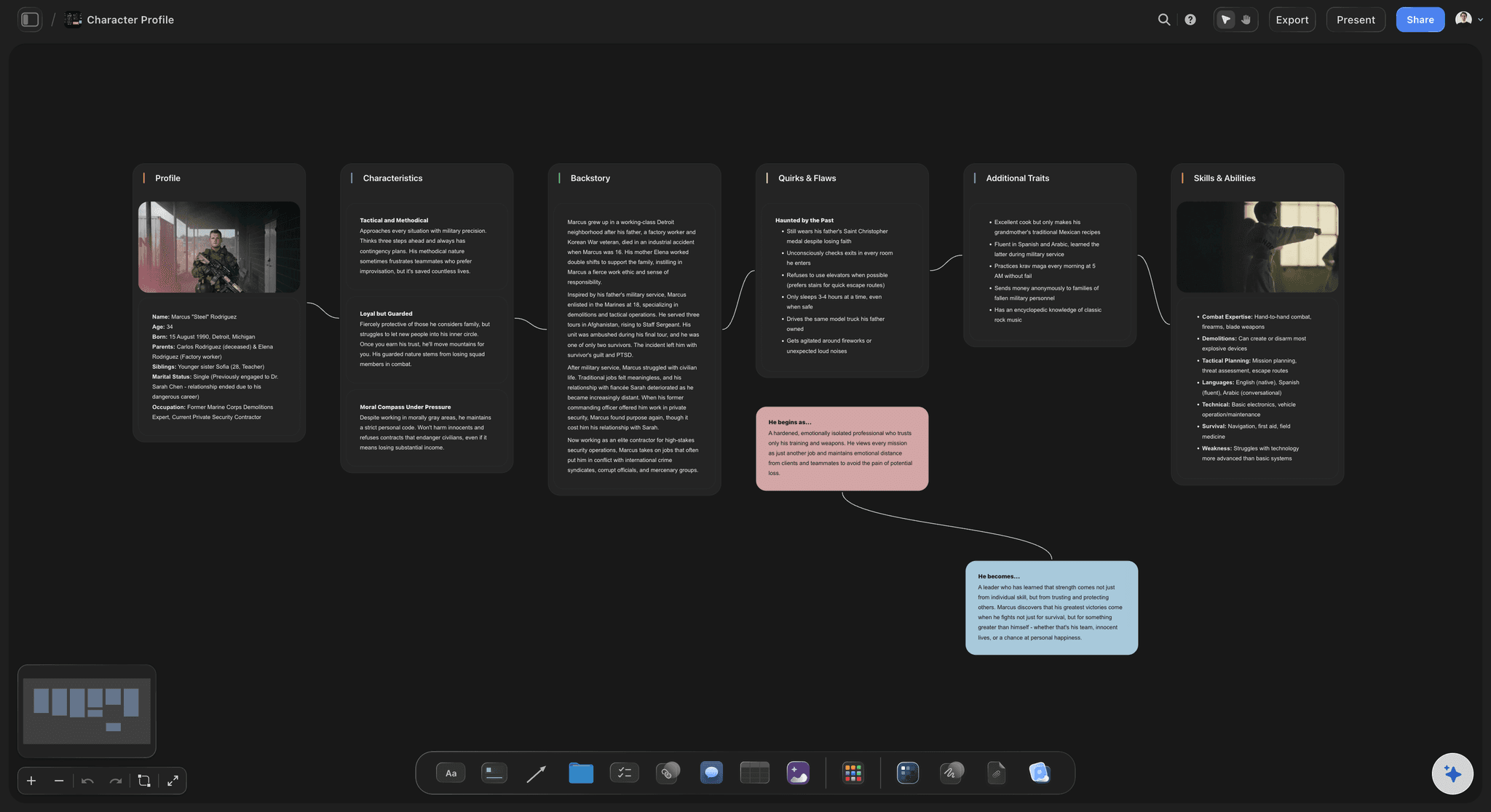
Subplots and character arcs as tracks under the acts
Check the threads against the frame
Run each subplot and arc as a horizontal track beneath the act sections. A romance that goes silent for all of act two, or an arc whose turn misses the midpoint, shows up as an empty stretch of track.
Try the novel plot creator →Unlimited boards. No object cap.
Open a canvas, describe the story, and lay out your acts. Storyflow is paid-only during early access, with plans from $9.99 a month, and a Free plan launches before the end of 2026.
Unlimited structure boards on an infinite canvas
Basic AI usage to generate boards from prompts
Starter structure templates built in
Share view-only links with your writing group
Built for people with taste
Three acts, taught and then used.
The template only helps if you know what each act is actually doing. Here is the anatomy, and how the canvas makes each part checkable.
Setup, inciting incident, first plot point
Act one: the first quarter earns the rest
The setup: Establish who the protagonist is, what they want, and what normal looks like before it breaks. On the board, setup scenes sit at the front of the first section, and you can see immediately whether there are too many of them.
The inciting incident: The event that disturbs the status quo and makes the story necessary. Pin it as a marker early in act one. If the cards before it pile up past the first ten to fifteen percent of the board, your story is starting late.
The first plot point: The moment the protagonist commits and cannot go back, closing act one at roughly the 25 percent mark. On a canvas that mark is a visible boundary, so an act one that sprawls to forty percent is caught the day you lay it out.
Rising action, midpoint reversal, low point
Act two: half the story, and where stories die
Rising action that actually rises: Act two is roughly half the story, and it fails by flattening: a string of scenes at the same intensity. With scenes as cards you can read the escalation as a sequence and spot the stretch where nothing forces anything.
The midpoint reversal: At roughly the 50 percent mark, something changes what the protagonist wants, knows, or is willing to do. It is the hinge that keeps the long middle from sagging. Pin it at the center of the board; if your reversal is drifting toward 70 percent, the geometry says so before a reader does.
The low point: Near the end of act two the goal should look genuinely lost. Mark it as the section's closing beat and check what leads there. If the low point arrives without escalation underneath it, it reads as arbitrary, and on the board that missing staircase is plainly visible.
Subplots that survive the middle: Act two is where subplots vanish. Run each one as a track under the section and an empty stretch of track is the thread your reader will forget you started.
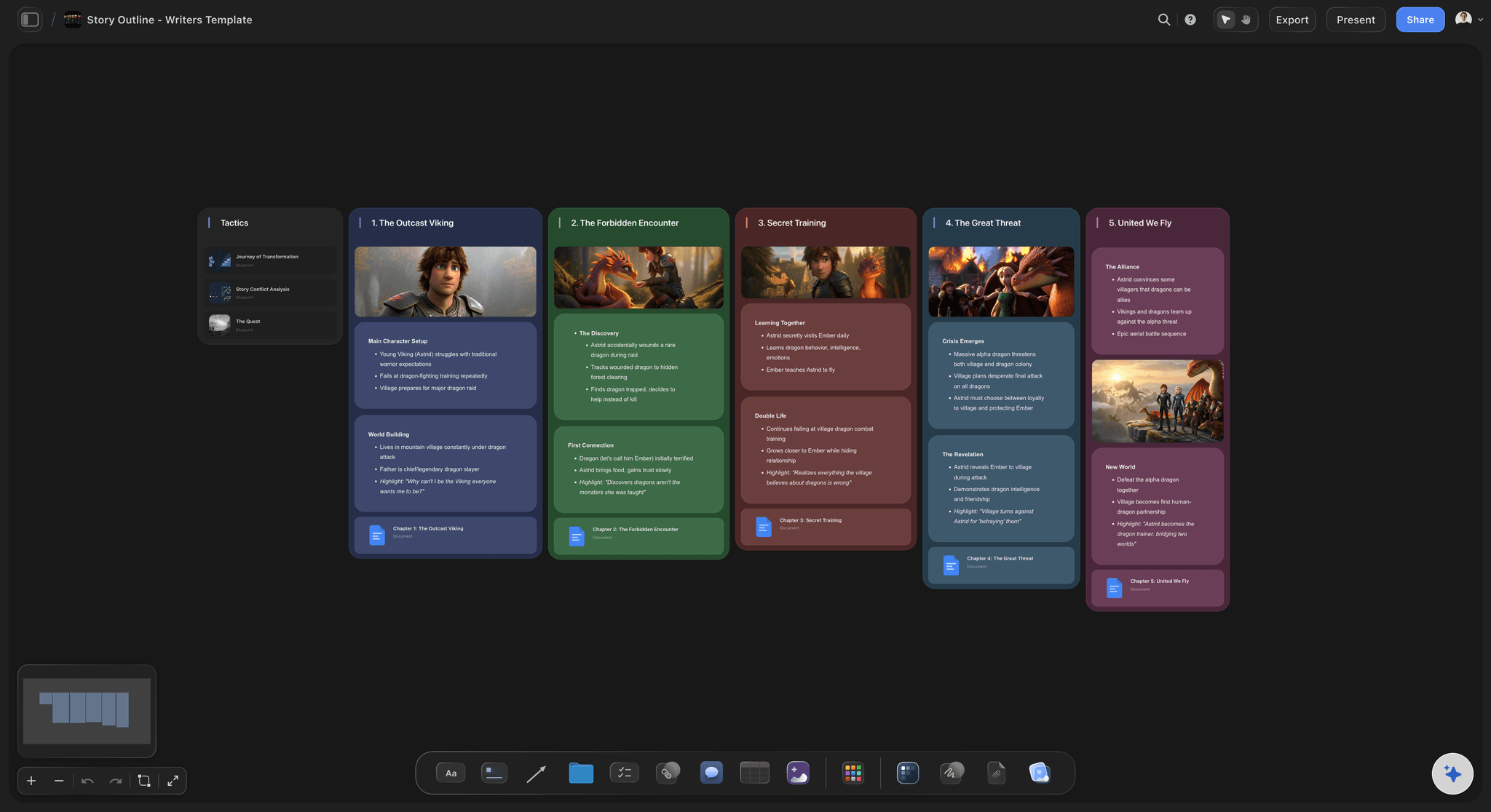
Acts as sections holding movable scene cards
Act three, and the structure as one picture
Climax and resolution: The final quarter: the confrontation the whole story has been arranging, then the resolution that shows the changed world. Everything in act three should be paid for earlier; connect each climax card to its setup and the unpaid debts stand out.
The whole shape at once: Three sections, roughly 25/50/25, every scene placed. This is the diagnostic view no worksheet gives you: proportions, beat placement, and scene density readable in one look.
Rearrange without retyping: Structural revision is reordering. Drag a scene from act two into act one, watch the proportions shift, and decide with the evidence in front of you instead of rewriting an outline to find out.
Arcs aligned to the turns: Character arcs turn where the structure turns: commitment at the first plot point, revelation at the midpoint, despair at the low point. Pin arc cards beside those markers and misalignment is visible.
Other shapes
When three acts is the wrong shape
Swap the framework with a prompt: Three acts is the most general shape, not the only one. If your story wants Save the Cat's fifteen beats, the hero's journey or seven-point structure, ask and the AI lays out the new frame beside your existing cards.
AI that sees your whole board: Ask it where act two goes flat, what could bridge two scenes, or whether the midpoint is doing enough. It uses the entire canvas as context, so the suggestions fit your story rather than a generic one. It structures; it does not write your prose.
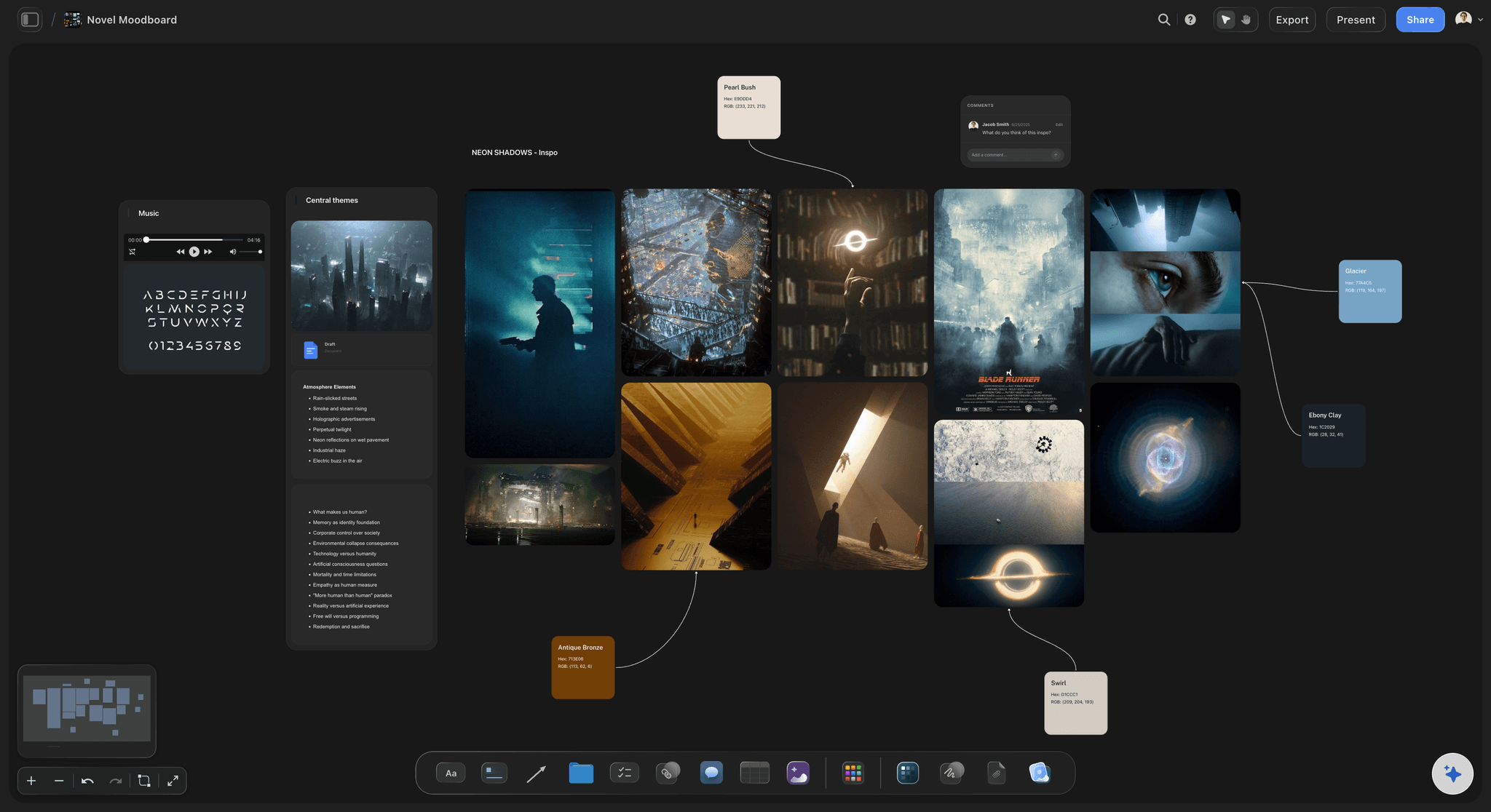
Research and mood on the same canvas: Drag in PDFs, images, and links, grab frames from YouTube or Vimeo, and keep a moodboard for tone beside the structure. The material the story draws on stays one scroll from the scenes that need it.
Share the structure, not a summary: Send a view-only link and a writing partner, producer, or editor sees the whole shape in a browser with no account. Export as a high-quality image or PDF for anyone who wants to mark it up.
Explore templates for your project
Every template opens as a real, editable board on the infinite canvas. Pick the closest fit and make it your own.
Story Plan
Outline your plot, characters, and world in one connected view, then expand each thread as the story grows.
One app instead of five
Storyflow vs Plottr, Scrivener, and Notion.
Each of these is genuinely good at something. Plottr's prebuilt structure timelines, Scrivener's all-in-one manuscript file, and Notion's free databases all have their place. Here is where they differ.
Storyflow
Recommended
Acts as movable sections on an infinite canvas
AI lays the acts and beats out from a premise
Prebuilt story structure templates and timelines
Full manuscript management in the same file
Free plan available today
Runs in the browser, nothing to install
Plottr
Acts as movable sections on an infinite canvas
AI lays the acts and beats out from a premise
Prebuilt story structure templates and timelines
Full manuscript management in the same file
Free plan available today
Runs in the browser, nothing to install
Scrivener
Acts as movable sections on an infinite canvas
AI lays the acts and beats out from a premise
Prebuilt story structure templates and timelines
Full manuscript management in the same file
Free plan available today
Runs in the browser, nothing to install
Notion
Acts as movable sections on an infinite canvas
AI lays the acts and beats out from a premise
Prebuilt story structure templates and timelines
Full manuscript management in the same file
Free plan available today
Runs in the browser, nothing to install
What creators are saying
Join early creators getting structured workspaces and AI that remembers their projects
“Storyflow has sped up my workflow by at least 3x, which means more flow state and more projects I can actually ship. It truly changed the way me and my team create.”

Reilin Joey
Director & YouTuber
“One prompt gets me a structured board. But the tactics are my favorite. I run my YouTube scripts through them and my intros and retention got better. It's amazing.”

Justkay
YouTuber & Freelance Filmmaker
“I used to juggle five apps to plan a project. Now I describe what I am making and get boards, lists, and a schedule. All in one place.”

George
@fernwehchronicles
Three-act structure questions, answered.
What the framework actually is, where the beats go, and how the template helps.
The three-act structure divides a story into setup, confrontation, and resolution. Act one, roughly the first 25 percent, establishes the world, disturbs it with an inciting incident, and ends with a first plot point that commits the protagonist. Act two, roughly 50 percent, escalates through rising action, turns at a midpoint reversal, and bottoms out at a low point. Act three, the final 25 percent, delivers the climax and resolution. The way to use it is diagnostic: lay the story you have against those proportions and beats, and look for what is missing or mistimed. In Storyflow the acts are sections holding scene cards, so a starving act or a late midpoint is visible as geometry rather than discovered in revision.
The standard split is roughly 25/50/25: a quarter for setup, half for confrontation, a quarter for resolution. Treat those as load-bearing estimates rather than law. The numbers matter because each act has a different job, and the jobs need different amounts of room. An act one over a third of the story usually means the story starts late. An act three past 30 percent usually means the climax is doing setup work it should have inherited. The most useful single check is the midpoint: if the biggest reversal of the middle lands well past the halfway mark, the first half is coasting. On a canvas the proportions are literal widths, so you check this by looking rather than counting.
Because act two is half the story with the fewest built-in instructions. Act one has a clear job and a deadline; act three has the climax pulling everything toward it. Act two is a long open middle, and it fails by flattening: scene after scene at the same intensity, with no event forcing the next one. The framework's answer is the midpoint reversal, a genuine turn near the 50 percent mark that changes what the protagonist wants or knows, splitting the long middle into two shorter, differently-flavored halves. The template makes this checkable. When act two is a visible section holding your actual scenes, the flat stretch and the drifting midpoint are things you can point at, not vibes.
Not during early access. Storyflow is paid-only right now, with plans starting at $9.99 a month, and a Free plan for solo use launches before the end of 2026. Anyone a paid member invites to a board joins free today, so a co-writer or critique partner can work on your structure board without paying. If you need a completely free option this minute, Notion's free tier can hold a serviceable three-act table if you build it yourself, and a wall with index cards in three columns remains a genuinely good analog version of the same idea.
Yes. It was popularized through screenwriting, where page counts make the proportions concrete, but the underlying logic of setup, escalation, and resolution predates film and maps cleanly onto novels. The practical difference is scale: a novel's act two might hold forty scenes across several subplots, which makes it easier to lose the shape and harder to spot the sag. That is an argument for laying it out visually rather than against the framework. Novels also tolerate more deviation: literary fiction bends the proportions freely. The framework is still worth checking against, because when a novel feels shapeless to readers, the diagnosis is very often an act-two problem the writer could not see in a manuscript document.
Aim for the 50 percent mark, give or take a few scenes, and make it a genuine reversal rather than merely a big event. Something should change the protagonist's understanding or objective: a false victory that curdles, a defeat that reveals the real stakes, a revelation that reframes act one. Its structural job is to split the long middle in two so that the second half of act two moves with different energy than the first. A midpoint that only raises the volume without changing direction does not do this job. On a Storyflow board you pin the midpoint at the center of the act two section, and if the scene doing that work has drifted toward 70 percent, the geometry shows it immediately.
Then use a different one; the template is a lens, not a contract. Save the Cat expands the same skeleton into fifteen named beats with placement targets, which suits commercial stories and writers who want more handholds. The hero's journey fits quest and transformation narratives. Seven-point structure works well for plot-driven genre fiction, and episodic or braided narratives may not want an act frame at all. In Storyflow, switching is one prompt: the AI lays the new frame beside your scene cards. A useful test is to lay the same story against two frameworks and see which one exposes more real problems.
Yes, and this may be its best use. Card out the finished draft one scene per card, drop the cards into the three act sections, and pin where your inciting incident, first plot point, midpoint, and low point actually land. The diagnosis is usually immediate: the inciting incident buried at 20 percent, the midpoint at 65, an act three that is two scenes long. Because the cards are movable, the revision plan builds itself: you drag scenes toward where the framework says the beats belong and see what breaks or gets orphaned. That turns a structural edit from a feeling that the middle drags into a concrete list of what moves, what gets cut, and what needs to be written.
No, and it is deliberately not built to. Storyflow is a planning canvas, not a prose generator. The AI's work is structural: it lays out a three-act board from your premise so you start from a shape instead of a blank page, it can suggest what might happen between two scenes, it can point at where act two goes quiet, and it can rebuild the frame in a different framework when three acts is the wrong shape. Because it uses your whole board as context, its suggestions fit the story you are actually telling. When you re-prompt, cards you have already placed stay where they are while the AI builds around them. The sentences, and the judgment, remain yours.
Yes. Share a view-only link and they open the whole structure in a browser with no account needed. For structural feedback this is much more concrete than a synopsis: a critique partner can see that act two thins out after the midpoint rather than reporting that the middle felt slow. For a producer or a developmental editor, the act layout with beats marked reads like a map of the project. If you want someone to contribute rather than just look, invite them to the canvas and they join free. You can also export the board as a high-quality image or PDF for anyone who prefers something to print and mark up.
Lay the story against the shape and find the problem.
Open a canvas, describe your premise, and let AI lay out the three acts. No download.