
The calmest place to shape your story
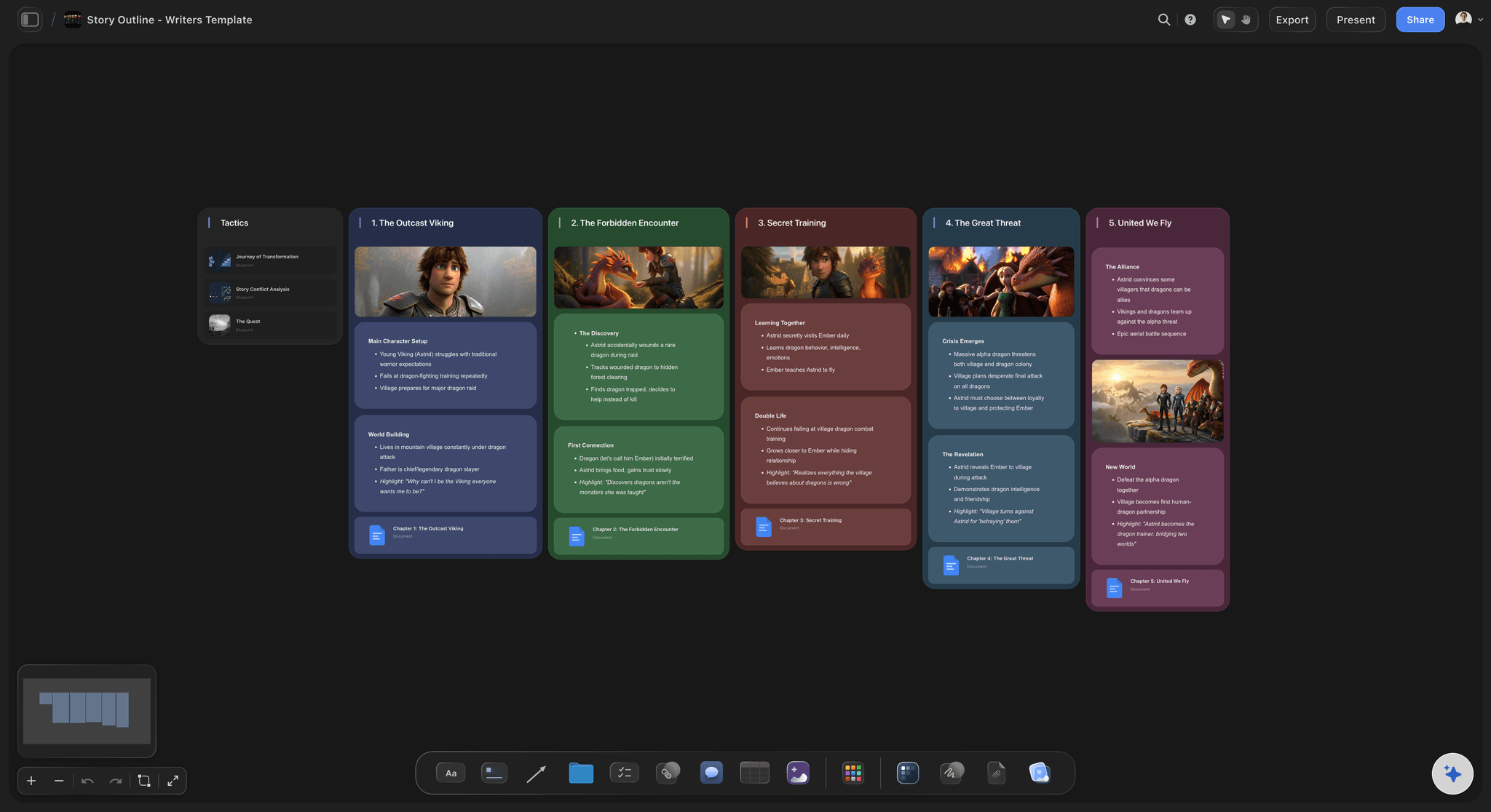
One card per beat,
moved until the story holds.
A beat board is how a story gets found rather than written. Storyflow gives you a card per beat on an infinite canvas, free to reorder, cluster and rewrite, with the research, the characters and the references sitting on the same board instead of in four other documents.


Creatives working for these brands already got early access
- Red Bull
- Canon
- Artlist
- Porsche
See how easy it is to get started
Watch a real project come together, from a blank board to a finished plan, clicked through step by step.
Start from a ready-made template
Pick a board to see what you can build, then let AI fill it in. Every template is a real, editable starting point on the same infinite canvas.

Story Plan
Outline your plot, characters, and world in one connected view, then expand each thread as the story grows.
What is a beat board?
A beat board is a set of cards, one per story beat, arranged so you can see the shape of the whole story at once and move any part of it. Storyflow is an AI visual workspace that holds your beat board on one infinite canvas: a card per beat you can reorder, cluster and rewrite, with the research, the characters and the references on the same board. A beat is a unit of change: something happens that alters the situation. It is smaller than an act and usually larger than a scene, though on a tight script the two often coincide.
The point is not the list. It is the rearranging. Writers use a beat board because story problems are structural and structure is spatial: a saggy middle, a turn that arrives too late, a subplot that vanishes for forty pages. Those are all visible as shapes and nearly invisible in a linear document, which is why the index-card wall survived every generation of writing software that tried to replace it.
Beat boards work with any structure or none. Save the Cat gives you fifteen named beats with page targets, the Story Circle gives you eight steps around a loop, three-act gives you turns at fixed proportions. All of them are just constraints on the same board, and plenty of writers use none and simply move cards until the thing feels right.
Storyflow is an infinite canvas for exactly this. Being straight about what it is not: Storyflow does not format screenplays, does not paginate, and does not export to Final Draft. It is the room where the story gets figured out, and the script is written in a screenwriting tool afterwards. Where it earns its place over a physical wall is that the research, the character notes and the visual references sit on the same board as the beats, and the AI can read all of it at once.
Ultra fast from brief to board
Get the beats out, then start moving them.
The first order is never the right one, which is the whole reason for cards.
01
Dump every beat you have
One card per beat, in whatever order they arrive. Do not try to sequence while you are generating; the two modes fight each other.
02
Lay them out and look at the shape
Spread the cards across the canvas in rough order. The gaps and the pile-ups are visible immediately, and they are usually the real note.
03
Move things until it holds
Reorder, split, merge and cut. Cluster by act, by character thread or by location, and regroup the cards as the question changes.
04
Take it to the script
When the shape works, the beat board is the outline you write from. Keep it open beside the draft, because the first draft will change it.
What a beat board has to let you do.
All four are about staying able to change your mind cheaply.
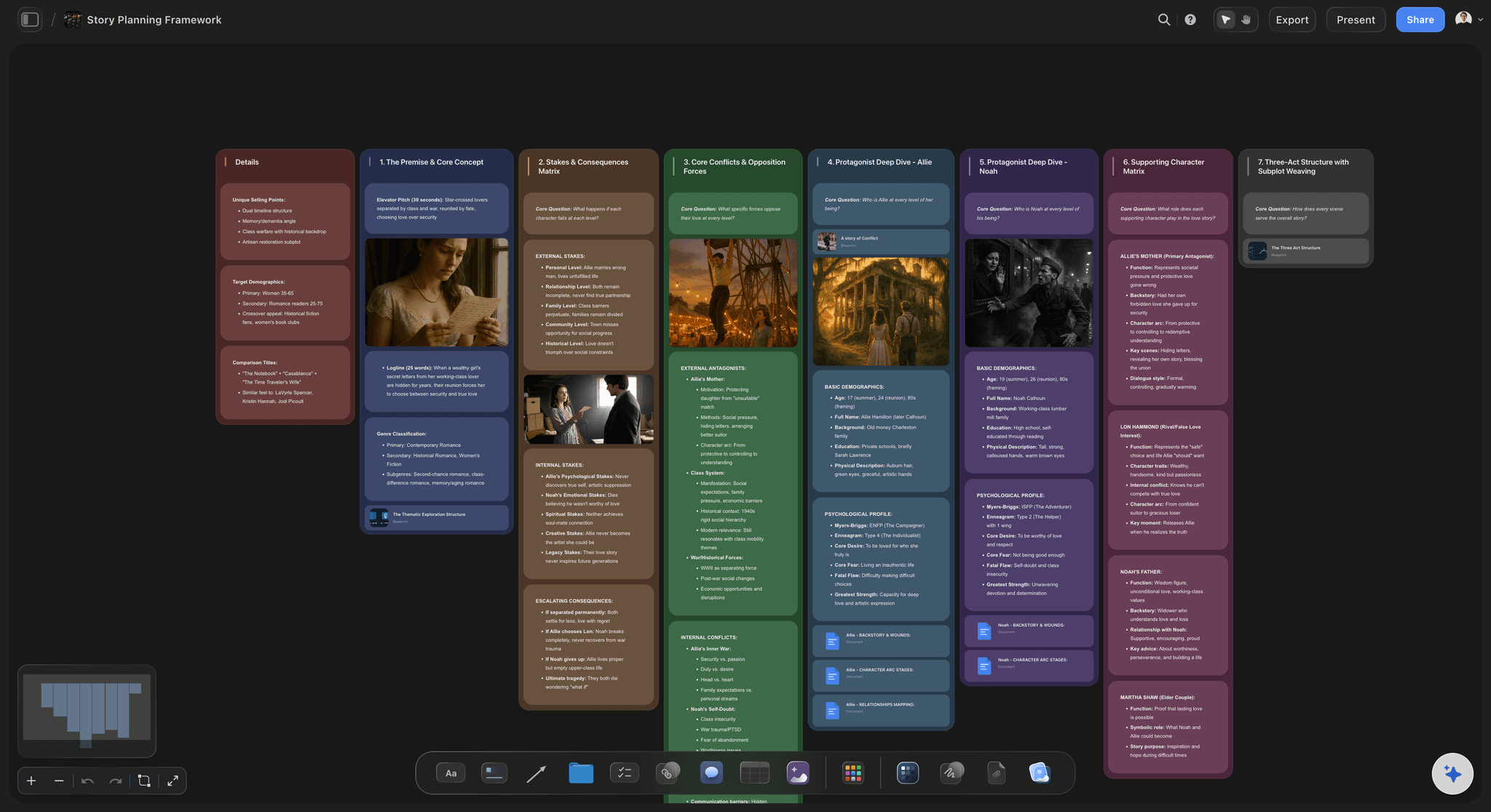
Reorder without friction
Move a beat and see what it costs
Dragging a card is the whole interaction. A turn that has to move forty pages earlier is one motion, and its consequence for the beats around it is visible in the same view.
See the story planning tool →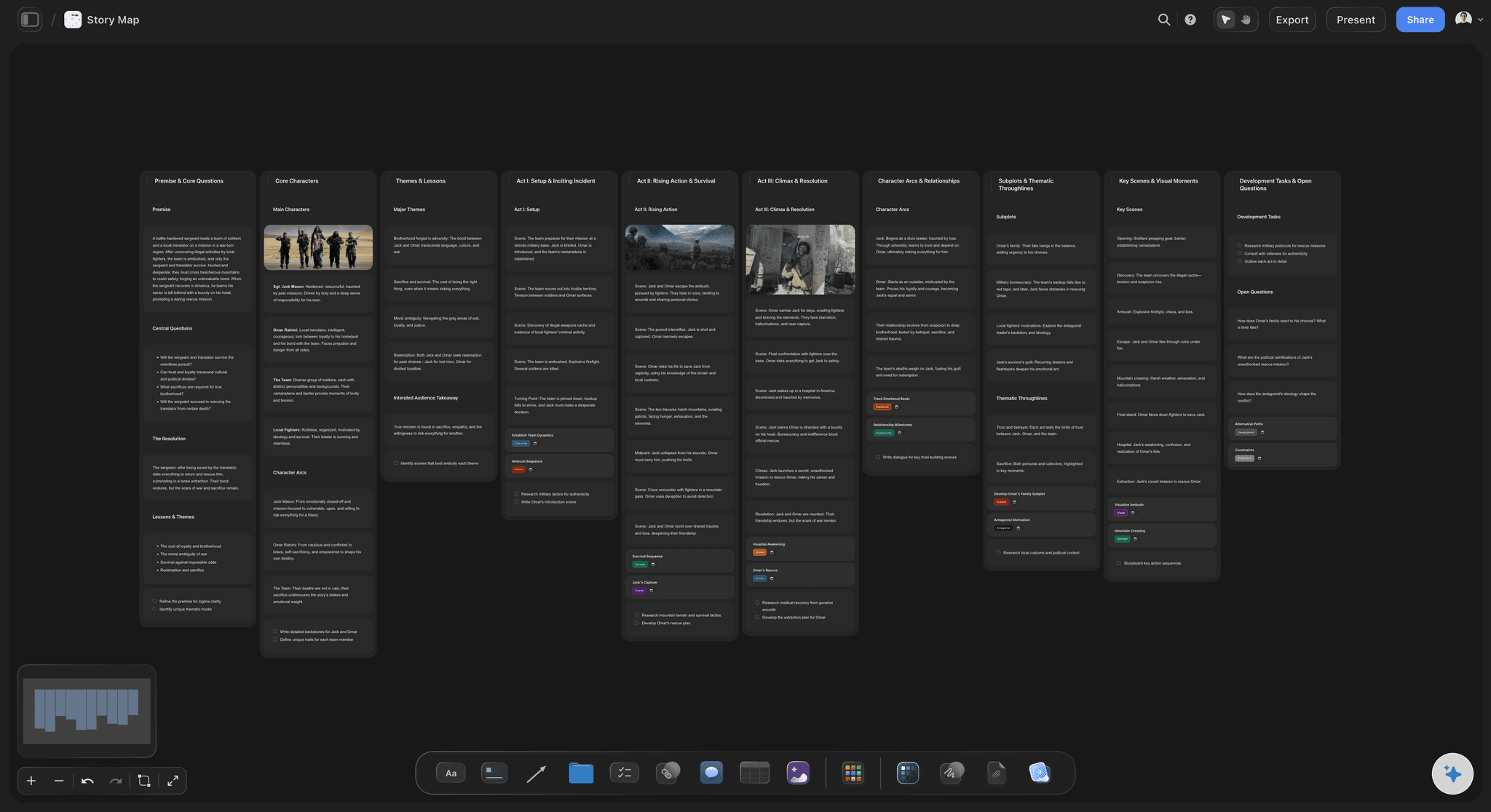
More than one reading
Group by act, thread or character
The same beats cluster differently depending on the question. Grouping by character thread shows you the subplot that disappears; grouping by act shows you the middle that sags.
See the character relationship map →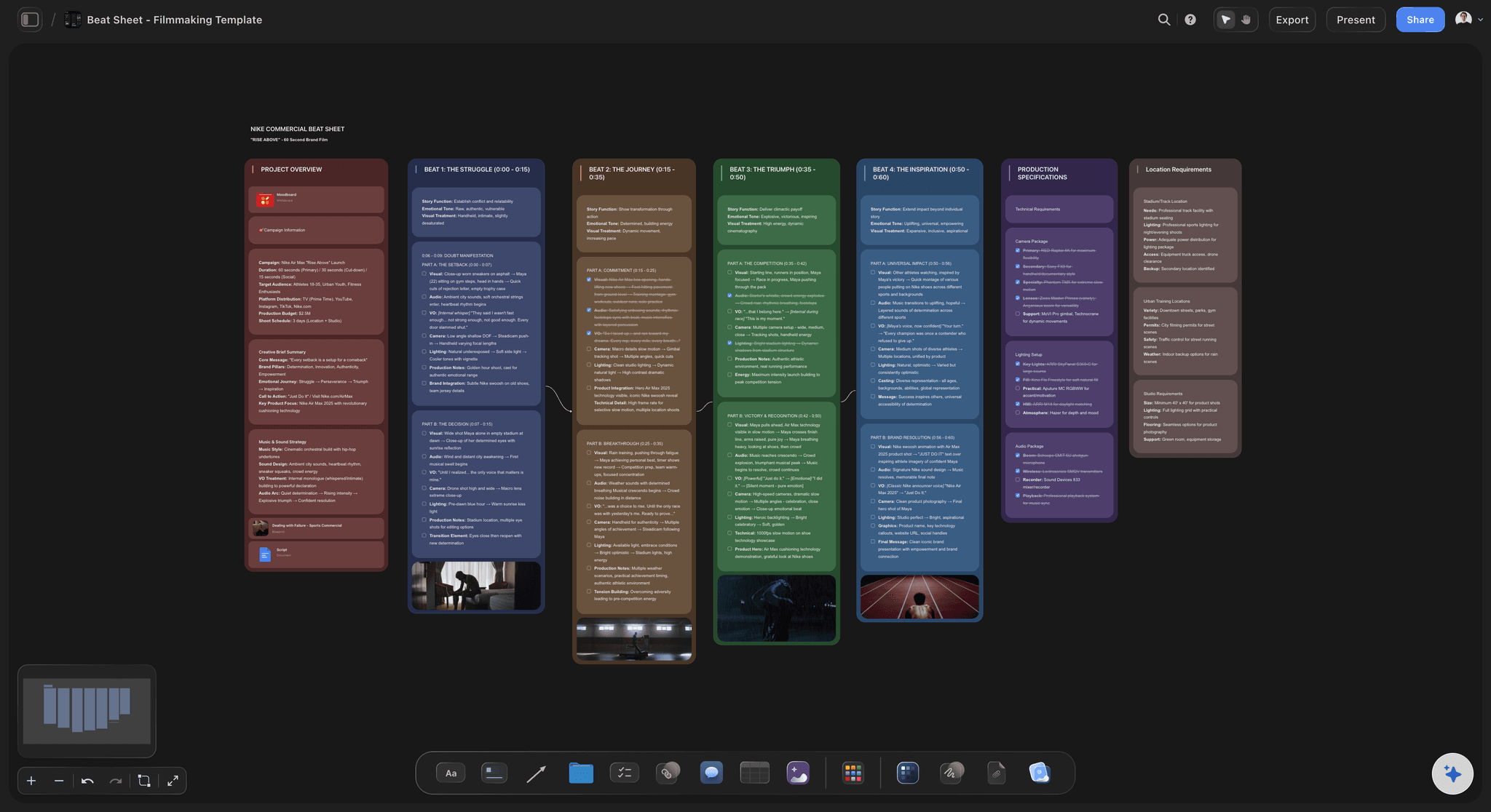
Structure when you want it
Lay a framework beside the cards
Ask the AI to lay out Save the Cat, the Story Circle or three-act structure as cards beside the beats you already have, rather than starting from a template that dictates the story.
See the beat sheet template →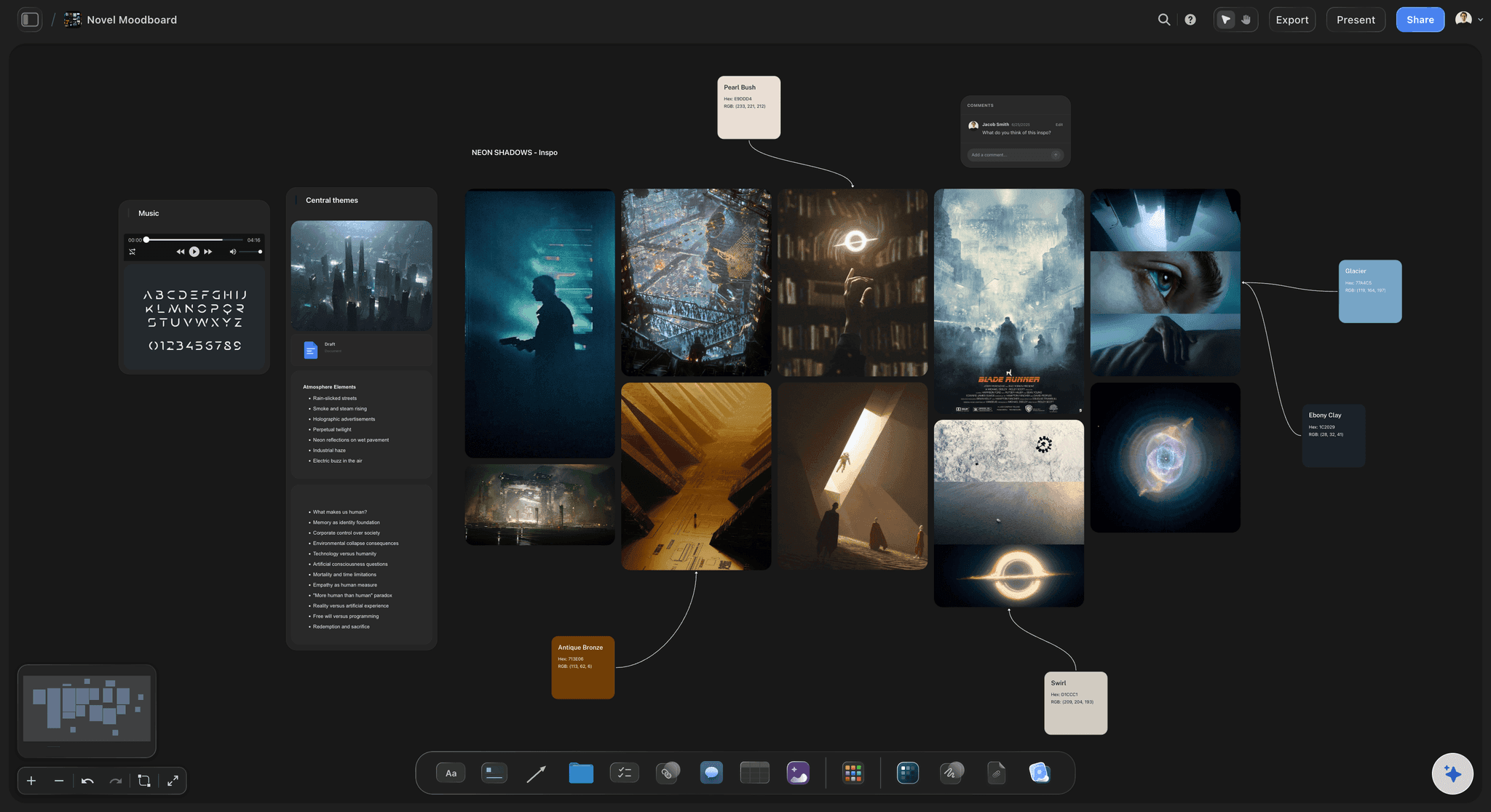
Everything in one room
Research and references beside the beats
The article that sparked the idea, the photograph of the location, the character note: all on the same canvas as the beat they inform, rather than in four documents you have to hold in your head.
See research to outline →Plans from $7.99/month annual. Free plan coming late 2026.
Anyone a paid member invites to a board joins free, which matters in a writers room where the whole team needs the board. Storyflow is paid-only during early access, with plans from $7.99 a month billed annually ($9.99 monthly), and a free plan launches before the end of 2026.
Readers open a view-only link without an account
Every project gets its own board, with no project limit
Export the beat board as a high-quality image or PDF
Writers a paid member invites join free
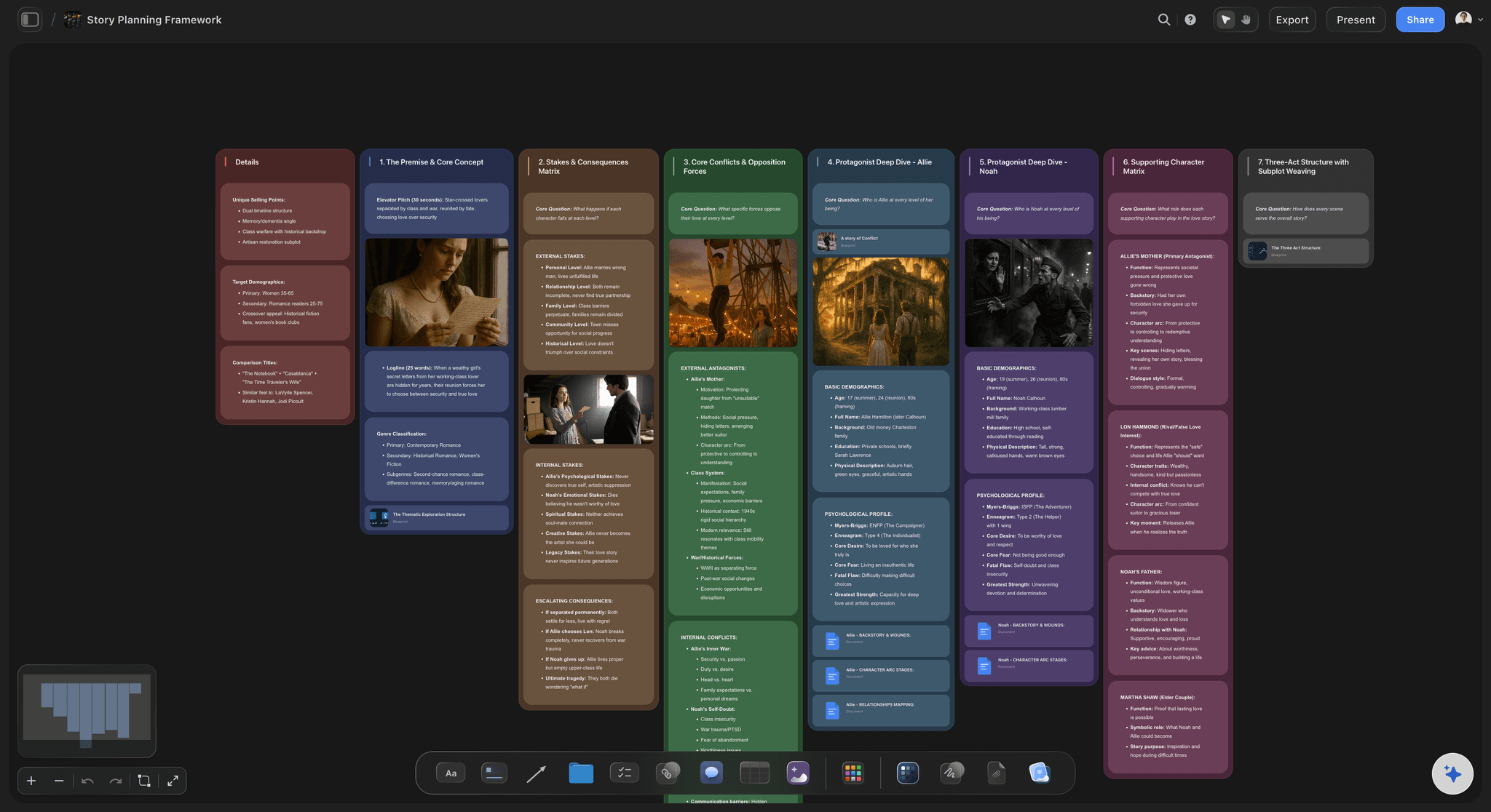
Built for people with taste
Structure problems are spatial. Documents hide them.
A linear outline can only be read in one order, which is exactly the constraint you are trying to escape.
See the whole thing
The shape is the note
Everything at once: An infinite canvas holds the entire story in one view, so the sag in the middle and the crowded third act are visible rather than deduced.
Distance means something: Space between cards reads as pacing. Beats crammed together and long empty stretches both tell you something before you have read a word.
Cheap to be wrong: Cards you can move make experiments free, which is the difference between trying six orders and defending the first one.
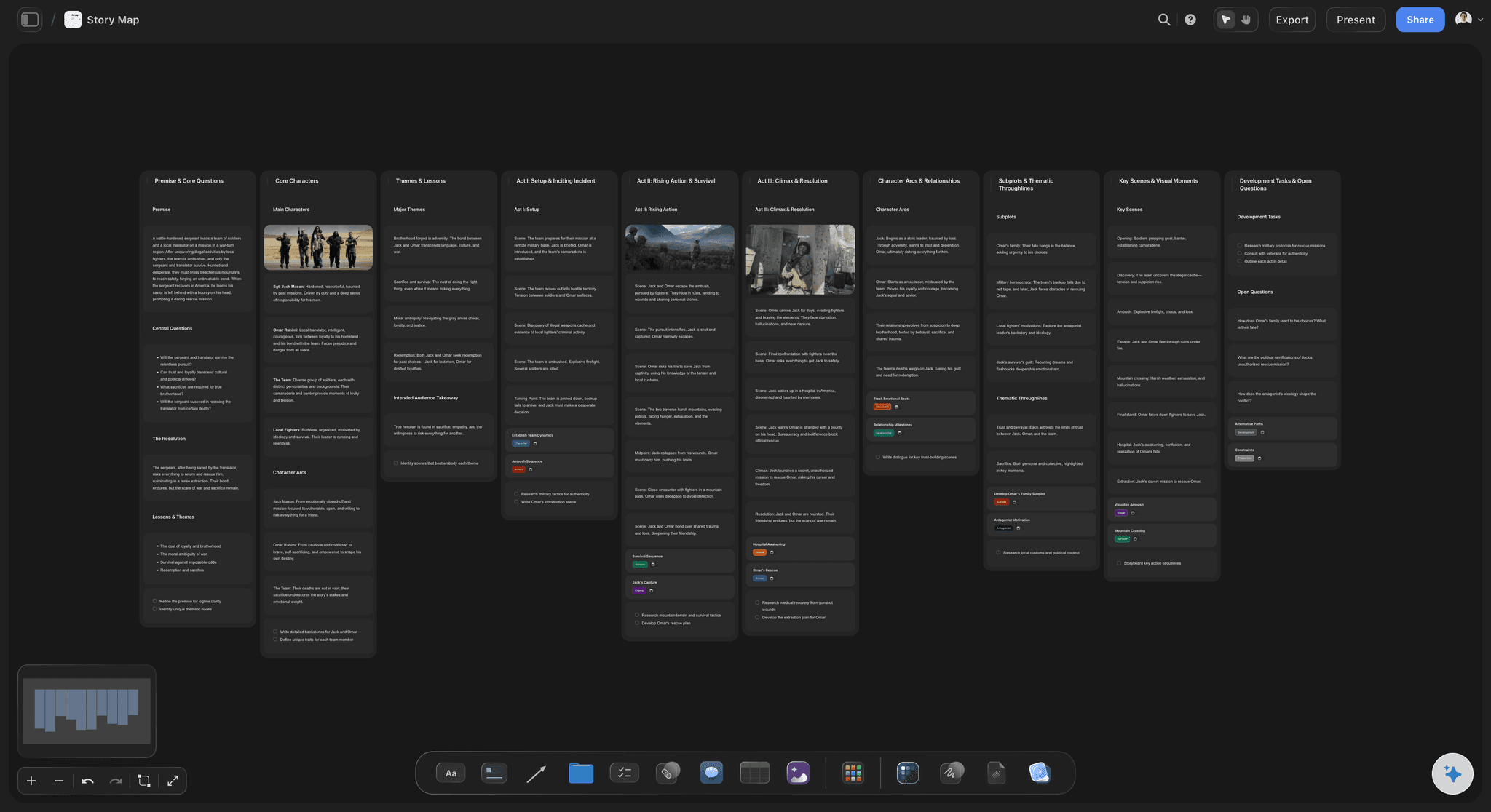
The AI reads the board
Ask what the structure is doing
Canvas-aware AI: Storyflow's AI reads the whole active board, so the beats, the character notes and the research are all in front of it when you ask where the story stalls.
Find the missing beat: Ask which character disappears for a stretch, or where the stakes stop rising, and get an answer grounded in the cards rather than a generic note.
Draft beats to argue with: Generate candidate beats from a logline or a premise and then cut most of them. A bad first pass you can react to beats a blank canvas.
What it is not
Honest about the ceiling
Not a screenwriting app: Storyflow does not format screenplays, paginate, or handle revision colours. Final Draft, WriterDuet, Highland and Arc Studio do that, and you should write the script in one of them.
No Final Draft export: The beat board does not become an FDX file. It is the plan you write from, kept open beside the draft.
Where it wins: Holding the story, the research and the references in one space while the shape is still moving, with an AI that reads all of it.
Explore templates for your project
Every template opens as a real, editable board on the infinite canvas. Pick the closest fit and make it your own.
Story Plan
Outline your plot, characters, and world in one connected view, then expand each thread as the story grows.
One app instead of five
Where a beat board sits next to the writing tools.
All four put beats on cards you can move. The differences are whether an AI reads the board, where the tool runs, and whether it formats the finished script.
Storyflow
Recommended
Beats as cards you rearrange in space
AI that reads the whole board
Runs in the browser, nothing to install
Screenplay or manuscript formatting
Free tier available today
Scrivener
Beats as cards you rearrange in space
AI that reads the whole board
Runs in the browser, nothing to install
Screenplay or manuscript formatting
Free tier available today
Plottr
Beats as cards you rearrange in space
AI that reads the whole board
Runs in the browser, nothing to install
Screenplay or manuscript formatting
Free tier available today
Final Draft
Beats as cards you rearrange in space
AI that reads the whole board
Runs in the browser, nothing to install
Screenplay or manuscript formatting
Free tier available today
What creators are saying
Join early creators getting structured workspaces and AI that remembers their projects
“Storyflow has sped up my workflow by at least 3x, which means more flow state and more projects I can actually ship. It truly changed the way me and my team create.”

Reilin Joey
Director & YouTuber
“One prompt gets me a structured board. But the tactics are my favorite. I run my YouTube scripts through them and my intros and retention got better. It's amazing.”

Justkay
YouTuber & Freelance Filmmaker
“I used to juggle five apps to plan a project. Now I describe what I am making and get boards, lists, and a schedule. All in one place.”

George
@fernwehchronicles
Beat boards, answered.
What writers ask before moving off index cards.
A beat board is a set of cards, one per story beat, arranged so the shape of the whole story is visible and any part of it can be moved. A beat is a unit of change: something happens that alters the situation. The value is the rearranging, because problems like a sagging middle are spatial and hard to see in a linear document. In Storyflow the cards sit on an infinite canvas beside the research and references.
Storyflow gives you exactly this: a card per beat on an infinite canvas, which you reorder, cluster and rewrite until the story holds. You can group beats by act, thread or character, lay a framework beside the cards, and keep the research and references on the same board. The AI reads the whole board. For screenplay or manuscript formatting you still need Final Draft or Scrivener: Storyflow does not format pages.
A beat sheet is a list, usually against a named structure with page targets, such as the fifteen Save the Cat beats. A beat board is the same content as movable cards in space. You generally work on the board and write out the sheet, because the board is for finding the structure and the sheet is for stating it.
It depends entirely on the framework and the length. Save the Cat names fifteen for a feature; the Story Circle uses eight; some writers break a two-hour film into forty or sixty smaller beats. The number is far less important than whether each card genuinely marks a change in the situation. A card that describes a state rather than a change is usually not a beat.
No. Plenty of writers move cards until the shape feels right and never name the framework. Where structures help is diagnosis: if a story is not working, laying a known framework over the existing beats often shows you which function is missing. Use it as a lens rather than a template you fill in.
No. There is no screenplay formatting, no pagination and no revision colours in Storyflow. Write the script in Final Draft, WriterDuet, Highland or Arc Studio and keep the beat board open beside it, because the draft will change the structure and the board is where you work out what the change means.
No. There is no FDX export. The beat board is the plan you write from rather than a document that becomes the script, and most writers retype the beats into the screenplay anyway because the act of retyping is part of the drafting.
For moving cards alone, a wall is still excellent; a digital beat board wins on everything around the cards. It survives being tidied away, it holds the research and references beside the beats, and someone in another city can look at it. The AI reading the whole board is a fourth advantage, and it has no physical equivalent.
It can draft candidate beats from a logline or premise, and it reads the whole board, so it can be asked which character vanishes for a stretch or where the stakes stop escalating. Treat the output as something to react to and mostly cut. The useful function is having a bad version to argue with rather than a blank canvas.
Yes. Several people can work on the board at once, and anyone a paid member invites joins free, so bringing the room on does not mean a plan for every writer. Anyone who only needs to read can open a view-only link without an account.
Storyflow is paid-only during early access, with plans from $7.99 a month billed annually ($9.99 monthly). A free plan launches before the end of 2026, and anyone a paid member invites to a board joins free.
Move the beats until the story works.
One card per beat on an infinite canvas, with the research and references beside them.