
Extremely simple, seriously capable
Generate a story outline with AI
and see the whole arc at once.
Describe your idea and Storyflow's AI lays out the acts, chapters, and plot points as cards on an infinite canvas. Reorder the structure, expand the chapter that is thin, and carry the outline straight into a draft.


Creatives working for these brands already got early access
- Red Bull
- Canon
- Artlist
- Porsche
See how easy it is to get started
Watch a real project come together, from a blank board to a finished plan, clicked through step by step.
Start from a ready-made template
Pick a board to see what you can build, then let AI fill it in. Every template is a real, editable starting point on the same infinite canvas.

Mind Map
Branch one central idea out into themes and sub-points, then drag the connections around until the structure makes sense.
What is an AI story outline generator?
An outline is the map of a story before the prose exists: the acts, the chapters, the turning points, and the order they arrive in. Writers outline because it is far cheaper to fix a structural problem on the map than to discover it forty thousand words into a draft. The catch is that a blank outline asks you to invent the events and sequence them at the same time, which is the split attention that stalls a planning session.
An AI story outline generator takes the first pass off your hands. Describe the premise, the genre, or the characters, and Storyflow lays out the outline as cards on an infinite canvas: acts grouped together, chapters placed under the act they belong to, plot points and scenes nested beneath. It is not a locked template with fixed rows. The outline is made of real canvas cards, so you can drag a chapter to a new act, rewrite a beat, split one scene into three, and cut what does not move the story.
That is the difference from a static outline template: the outline is the starting point, not the deliverable. Ask the AI to deepen the second act, then turn the strongest chapters into a beat sheet, a storyboard, or a draft on the same canvas. Your outline becomes the manuscript instead of a document about it.
Ultra fast from brief to board
Generate a story outline with AI in four steps.
You bring the idea. The AI lays out the structure, so your attention stays on the story.
01
Open a canvas
There is no app to install, just an empty canvas ready for your idea.
02
Describe your story
A premise is enough: a genre, a protagonist, and the want that drives them. Add a structure you like, three-act, save-the-cat, or your own chapter plan, and the AI works to it.
03
AI lays out the outline
The AI places acts, chapters, and plot points as cards on the canvas, grouped so the structure of the whole story reads at a glance instead of scrolling a long document.
04
Reorder, expand, turn into a draft
Drag chapters to restructure the arc, ask the AI to go deeper on any act, then turn the outline into a beat sheet or storyboard, share a view-only link, or export as image or PDF.
An outline generator that thinks past the outline.
Most outlines die in a doc. These ones become beat sheets, storyboards, and drafts.
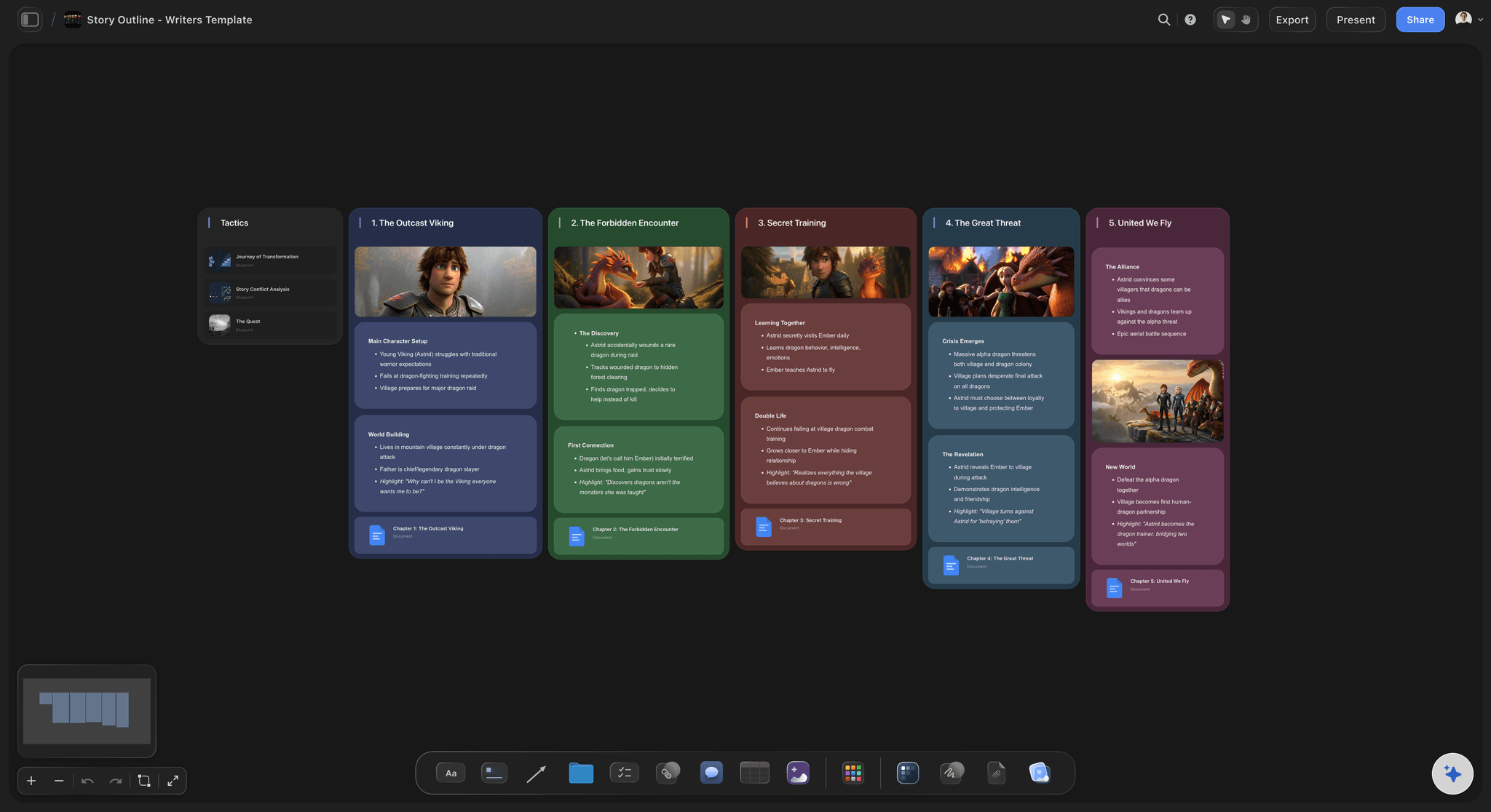
An outline from a single premise
From one idea to a structured arc
The AI breaks your premise into acts, chapters, and plot points laid out in order on the canvas. See the whole story first, then zoom into the chapter that is not working yet.
See the AI beat sheet generator →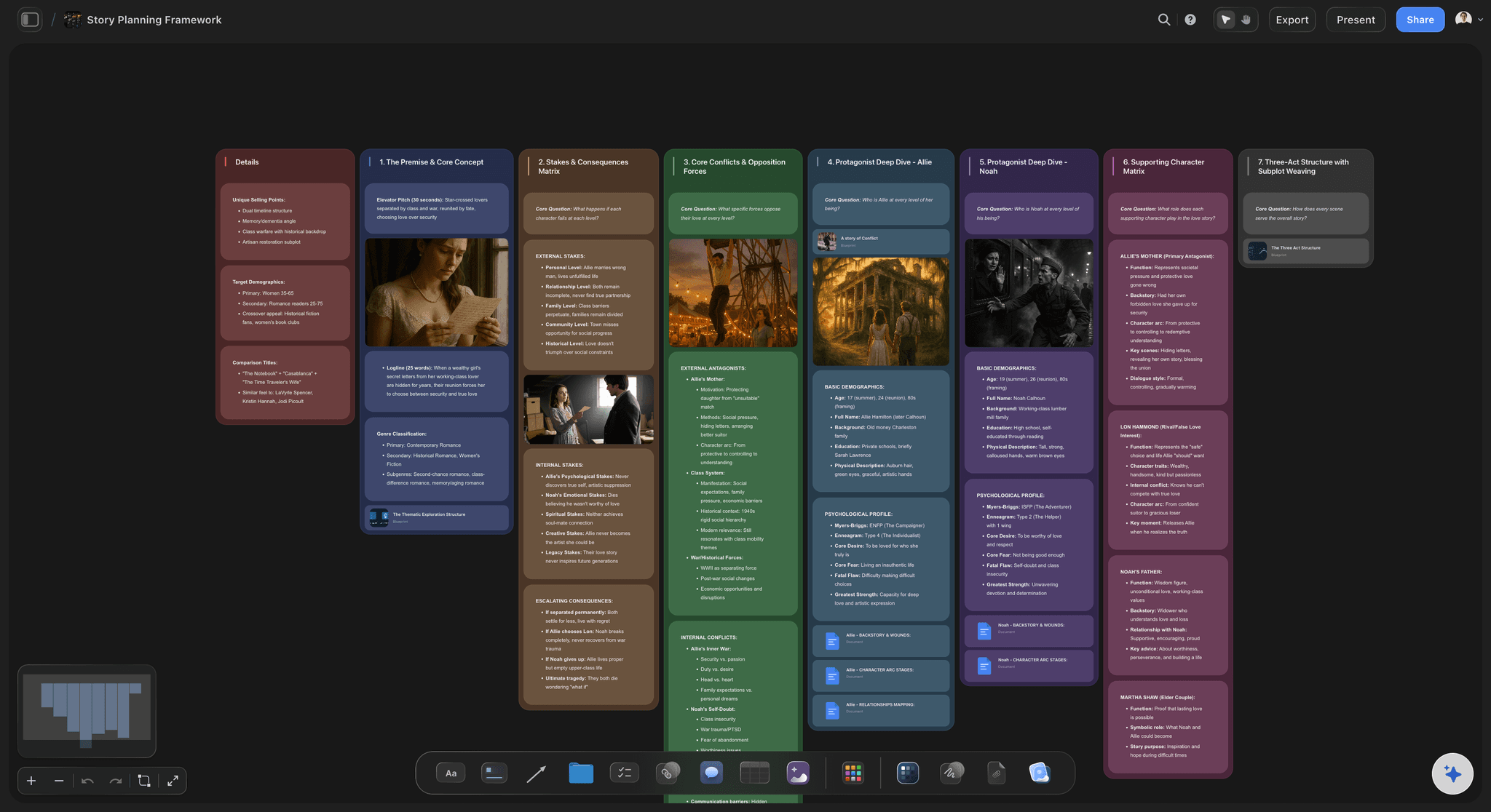
Tighten the structure into beats
Outlines become beat sheets
Pick the act that needs structural work and ask the AI to break it into beats, the turning points underneath, on the same canvas the outline came from.
See the AI beat sheet generator →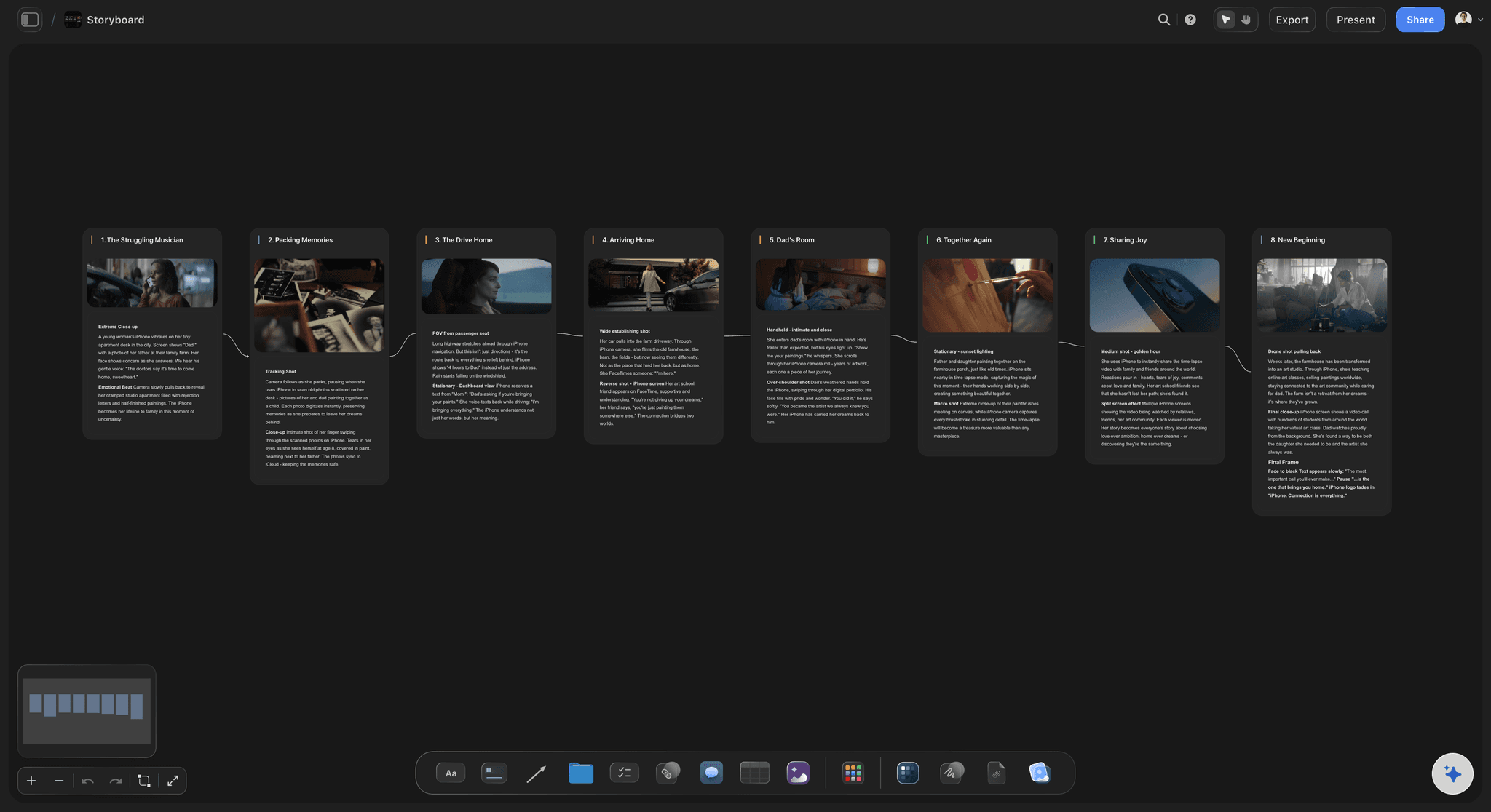
From outline to screen
Carry the story into a storyboard
An outline for a script or a video becomes a storyboard, scene by scene. The AI builds the next board from the chapters you kept, not from a generic template.
See the AI storyboard generator →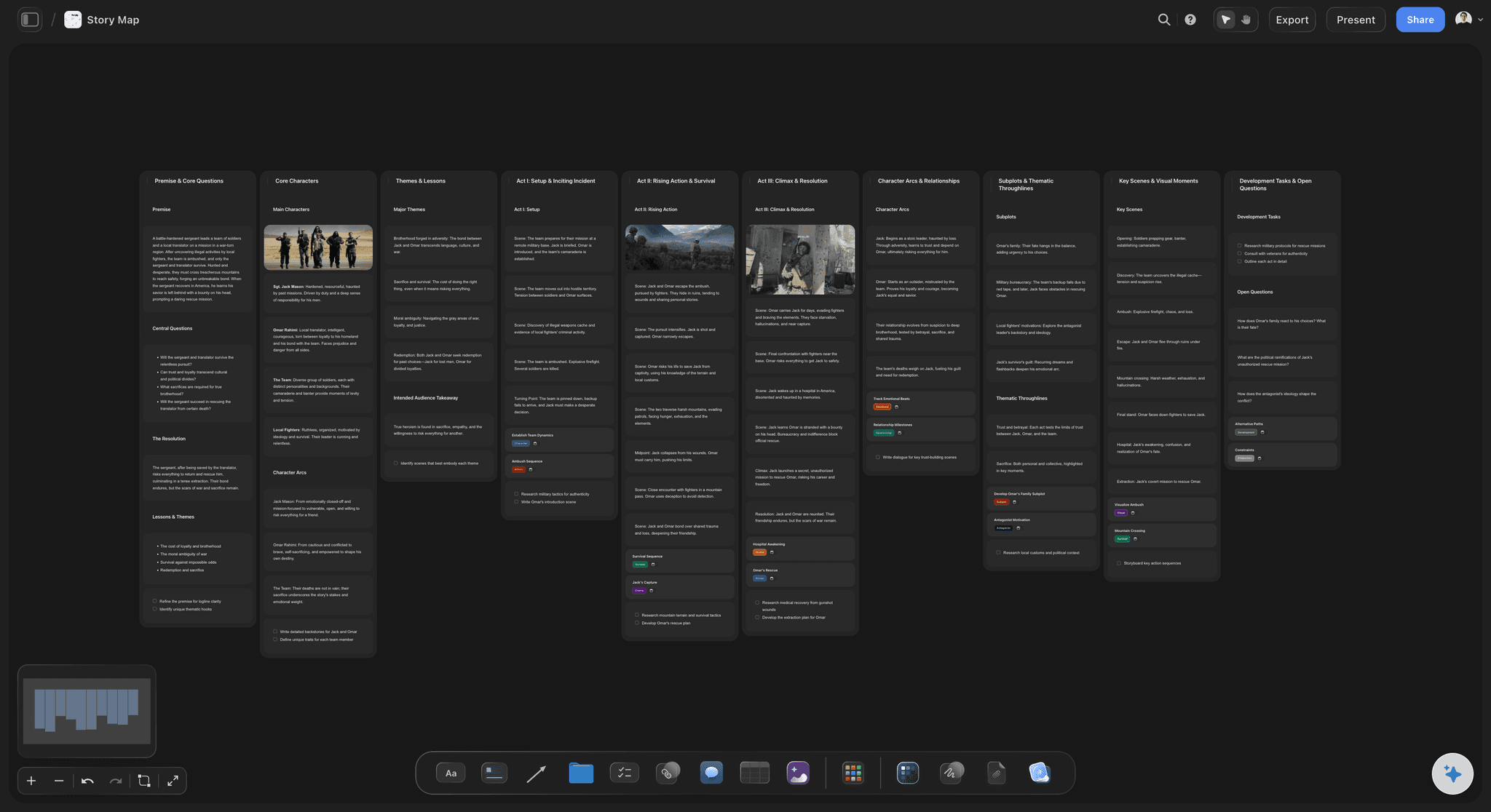
Room for every thread to grow
An infinite canvas for the whole book
Outlines sprawl, and subplots multiply. With an infinite canvas and no object cap on any plan, no chapter, thread, or alternate version gets cut for space.
See the free infinite canvas →Paid-only during early access.
Open a canvas, describe an idea, and watch the outline lay itself out. Plans start at $9.99 per month, no time limit.
Unlimited outlines and story boards, with room for every subplot
Basic AI usage to generate and expand your structure
Attach research, character notes, images, and references to any chapter
Share the outline view-only, or invite collaborators free
Built for people with taste
Made for the way writers actually outline.
Lay out the acts, drag chapters to retime the arc, and keep the whole story visible at once.
Chapters you can move, rewrite, and split
Outline cards that behave like index cards
The arc as movable cards: Each act, chapter, and plot point is a card, so the shape of the story is visible without a rigid template locking the order down.
Drag to restructure: Move a chapter to a different act and the arc reshapes with your instinct. Reordering is a drag, not a rewrite.
Expand any chapter: Ask the AI to break one chapter into the scenes underneath it while the rest of the outline stays exactly as you arranged it.
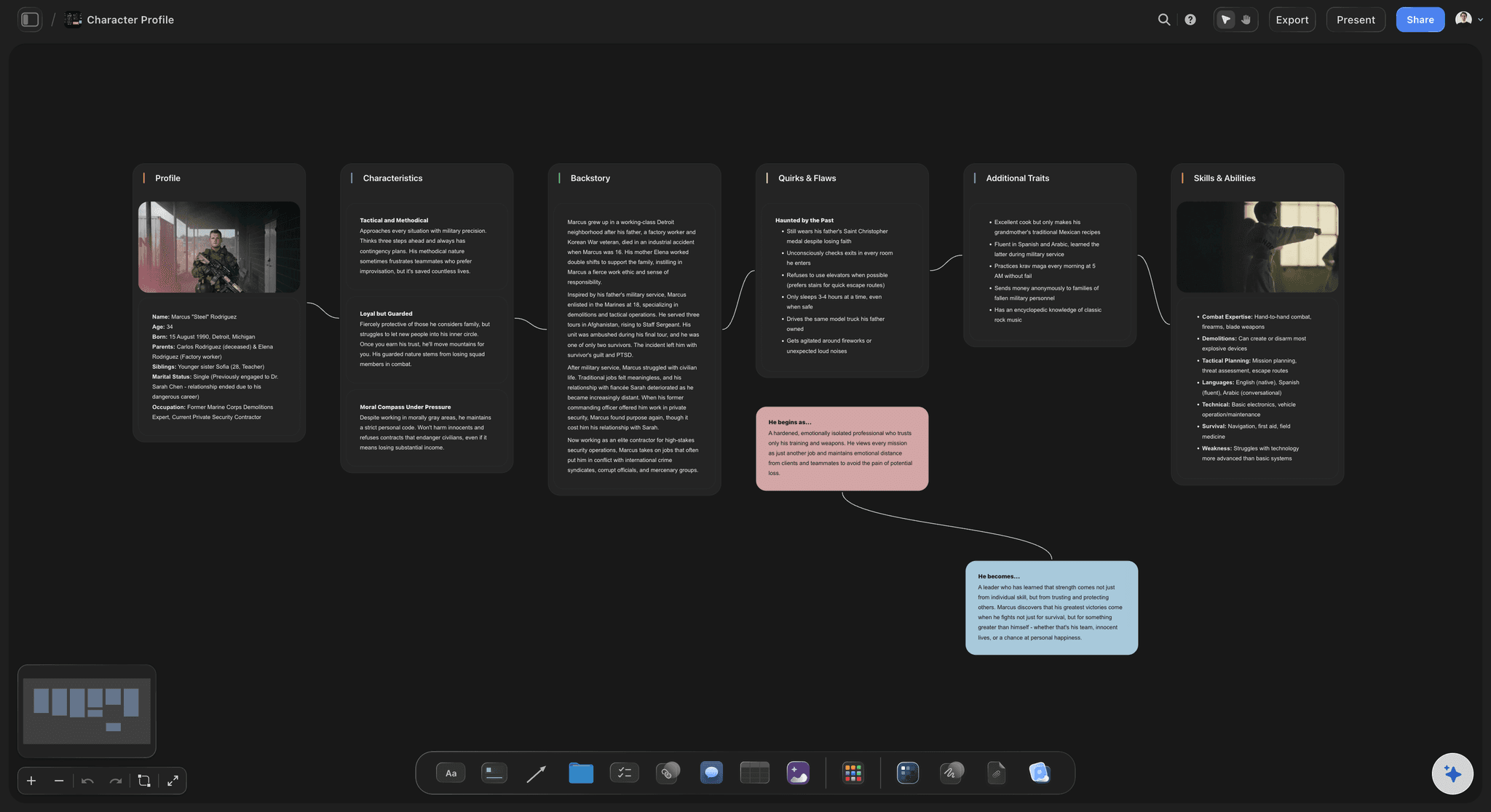
Context from the board you are working on
AI that builds on your premise and characters
Reads your active board: The AI uses what is already on the canvas, so new chapters connect to the characters and world you have started building.
Attach your sources: Bring in up to five documents and three boards as context: a synopsis, a character profile, or a structure framework the outline should follow.
Re-prompt to refocus: Ask for a darker midpoint, a faster open, or a subplot that pays off later. The AI reworks the outline while keeping your edits.
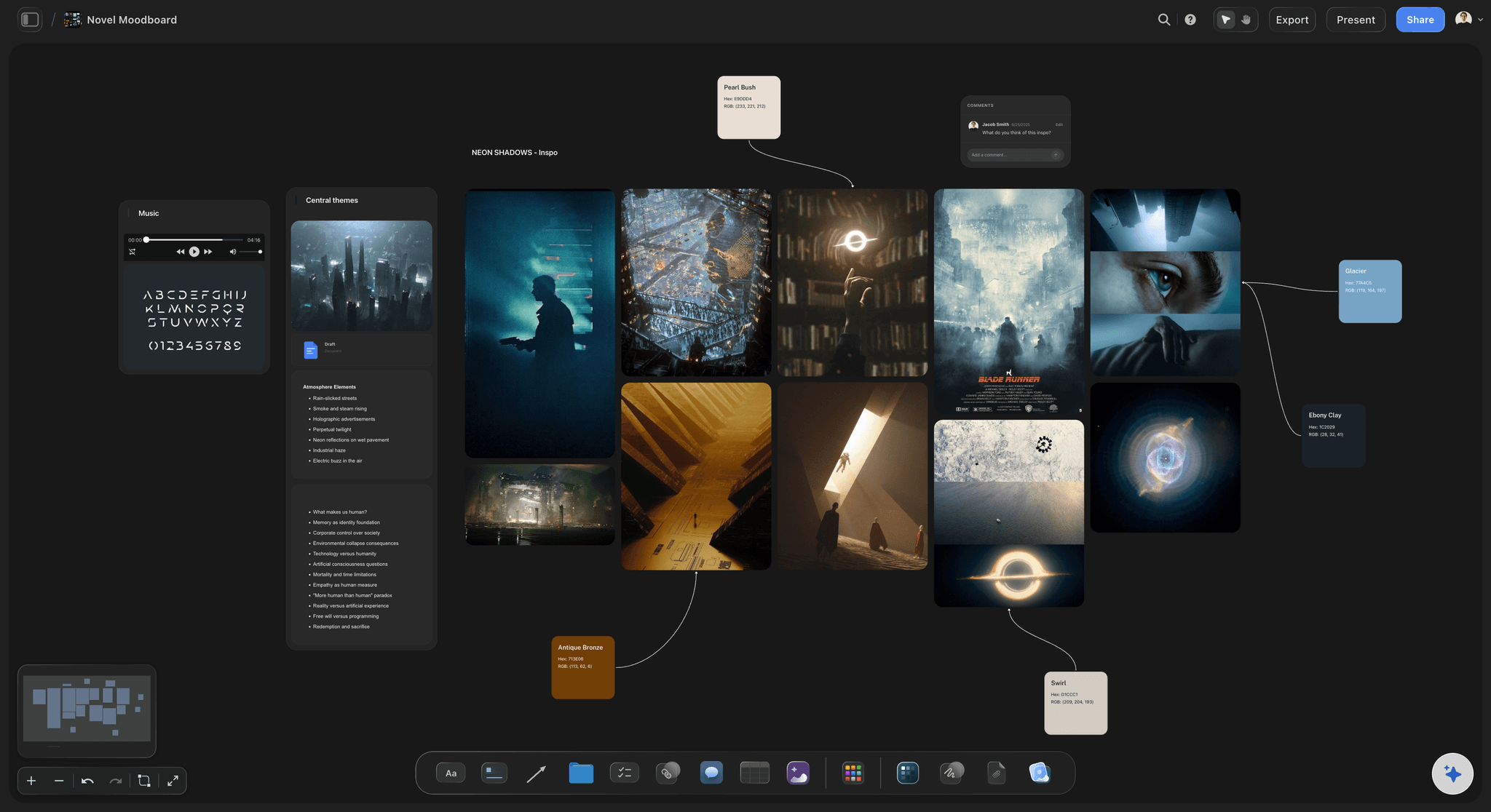
More than text on every chapter
Research, notes, and references beside each chapter
Drop in anything: Research, stills, video, GIFs, PDFs, and links attach to the canvas next to the chapters they belong to. An outline with receipts.
Frame grabs from video: Capture reference stills from YouTube and Vimeo straight onto a chapter when a film says it better than a line of description.
Notes where you need them: Longer thinking lives as documents on the same canvas, so the outline stays scannable and the depth stays one click away.
The outline is step one, not the deliverable
From outline to finished draft
Carry chapters into real boards: Turn the outline into beat sheets, storyboards, and scene plans on the same canvas, with the AI carrying the structure over.
Share the structure: Invite collaborators free, or send a view-only link so an editor or writing partner can read the arc without an account.
Export as image or PDF: Need the outline in a pitch or a submission package? Export it as a clean image or PDF in one step.
Explore templates for your project
Every template opens as a real, editable board on the infinite canvas. Pick the closest fit and make it your own.
Mind Map
Branch one central idea out into themes and sub-points, then drag the connections around until the structure makes sense.
One app instead of five
How Storyflow compares to other story outline tools.
Plenty of tools give you an outline template. The question is what happens to the outline afterwards.
Storyflow
Recommended
AI that drafts the outline from your premise
Outline becomes beat sheets and storyboards on the same canvas
An infinite canvas with movable chapter cards
A free plan without board or card caps
Scrivener
AI that drafts the outline from your premise
Outline becomes beat sheets and storyboards on the same canvas
An infinite canvas with movable chapter cards
A free plan without board or card caps
Milanote
AI that drafts the outline from your premise
Outline becomes beat sheets and storyboards on the same canvas
An infinite canvas with movable chapter cards
A free plan without board or card caps
Notion templates
AI that drafts the outline from your premise
Outline becomes beat sheets and storyboards on the same canvas
An infinite canvas with movable chapter cards
A free plan without board or card caps
What creators are saying
Join early creators getting structured workspaces and AI that remembers their projects
“Storyflow has sped up my workflow by at least 3x, which means more flow state and more projects I can actually ship. It truly changed the way me and my team create.”

Reilin Joey
Director & YouTuber
“One prompt gets me a structured board. But the tactics are my favorite. I run my YouTube scripts through them and my intros and retention got better. It's amazing.”

Justkay
YouTuber & Freelance Filmmaker
“I used to juggle five apps to plan a project. Now I describe what I am making and get boards, lists, and a schedule. All in one place.”

George
@fernwehchronicles
AI story outline questions, answered.
Everything people ask about generating story outlines with AI in Storyflow.
An AI story outline generator turns a premise or idea you describe into a structured outline: the acts, chapters, and plot points of a story, laid out for you instead of invented from a blank page. In Storyflow the AI places those as cards on an infinite canvas, so the outline stays fully editable and can grow into a beat sheet, a storyboard, or a draft.
Describe your story in the AI chat, a premise plus the genre or structure you want, and the AI lays out outline cards on the canvas: acts grouped with their chapters and plot points, arranged so the whole arc reads at a glance. It is a flexible board of real cards rather than a locked template, so you can drag, rewrite, split, and expand every part.
Yes. Tell the AI the form and the structure, a three-act screenplay, a chapter-by-chapter novel, or a save-the-cat beat structure, and it lays the outline out to match. You can also attach a structure document so the AI works to the exact framework you prefer.
Not during early access. Storyflow is paid-only right now: plans start at $9.99 per month and bring basic AI usage for generating and expanding outlines, unlimited boards, 20 file uploads, and view-only sharing, with no time limit. A Free plan is planned before the end of 2026.
Yes, completely. Every act, chapter, and plot point is a card on the canvas, so you can drag chapters between acts, rewrite any point, delete what does not move the story, and resize the structure. The AI gives you the first pass, and the canvas makes it yours.
Yes, and that is the point of doing it in Storyflow. Ask the AI to turn a chapter into a beat sheet, a storyboard, or a scene plan, and it builds the new board on the same canvas using the structure you set. The outline becomes the production instead of a separate document.
Yes. The AI reads your active board, so characters, notes, and research already on the canvas shape the outline it generates. You can also attach up to five documents and three boards, such as a synopsis or a character profile, for the AI to work from.
No, and it is not trying to be. Storyflow structures the story and carries it into beat sheets and storyboards, but it is not a long-form prose editor for drafting the manuscript itself. Pair it with Scrivener or your word processor for the writing, and use Storyflow for the outline, the visuals, and the structure around it.
The story is in your head. Get the structure on the board.
Describe it once, watch the outline fall into place, and turn the best chapters into a beat sheet or draft.