
An ultra-fast canvas that stays calm
Start somewhere wrong
on purpose.
Random entry, provocation, and concept fans on an infinite canvas, with every step from the absurd starting point to the usable idea still on the board.


Creatives working for these brands already got early access
- Red Bull
- Canon
- Artlist
- Porsche
See how easy it is to get started
Watch a real project come together, from a blank board to a finished plan, clicked through step by step.
Start from a ready-made template
Pick a board to see what you can build, then let AI fill it in. Every template is a real, editable starting point on the same infinite canvas.

Mind Map
Branch one central idea out into themes and sub-points, then drag the connections around until the structure makes sense.
What is lateral thinking?
Lateral thinking is a set of deliberate techniques for reaching ideas that logical, step by step reasoning will not produce. Storyflow is an AI visual workspace that runs lateral thinking techniques on one infinite canvas: random entry, provocation and concept fans, with every step from the absurd starting point to the usable idea still on the board. Edward de Bono named lateral thinking in 1967 and drew the distinction sharply: vertical thinking digs the same hole deeper, and lateral thinking moves sideways to dig somewhere else. The techniques are not a mood or a personality type. They are procedures with rules, and the rules exist because the mind's ordinary habit is to run straight down the most established path from a problem to its most familiar answer.
The core techniques are small in number. Random entry drops an unrelated word or image next to the problem and forces a connection. Provocation, which de Bono marked with the prefix PO, states something deliberately unreasonable and then looks for the movement it opens rather than judging whether it is true. Challenge asks why a constraint exists rather than how to satisfy it. Alternatives sets a quota of options before any of them is evaluated. The concept fan works backwards from the purpose to concepts and then down to ideas, so a stuck idea can be traded without abandoning the purpose behind it.
All of them share one requirement, and it is the requirement that most tools quietly break: the intermediate steps have to survive. A provocation is worthless in isolation. Its value is the movement from it, and that movement only exists if the provocation is still sitting next to what it produced. Techniques run in a document or a meeting lose the trail, and what gets written down is the sensible conclusion with no record of the sideways step that reached it. The next session starts from the same familiar path.
Storyflow is an AI-native infinite canvas, and the canvas is what keeps the trail. Put the problem in the middle, drop random entry cards around it, write provocations as their own cards and draw the movement from each one to what it opened, then let the ideas that survive cluster in their own region. Ask the AI for twenty provocations and it produces twenty, without the self-censoring that makes a human quota so hard to fill. Nothing is deleted to make room, because there is always more canvas.
Ultra fast from brief to board
From a stuck problem to a board of real options.
No method training required. The board holds the technique so you can concentrate on the thinking.
01
Open a canvas
Sign up in seconds. No download. Your infinite thinking canvas opens in the browser.
02
State the problem, then break it
Write the problem in the middle. Ask the AI for random entry words, a set of provocations, or a quota of alternatives, and they land on the canvas as cards around it.
03
Draw the movement
Connect each provocation to what it opened. This is the step the technique lives on and the one every other tool throws away. Cluster the ideas worth keeping and leave the rest where they are.
04
Share or carry it forward
Send a view-only link, invite the team onto the canvas, or turn the surviving concepts into a project board on the same canvas without exporting anything.
The techniques, with the trail intact.
Random entry, provocation, challenge, alternatives, and the concept fan on one surface.
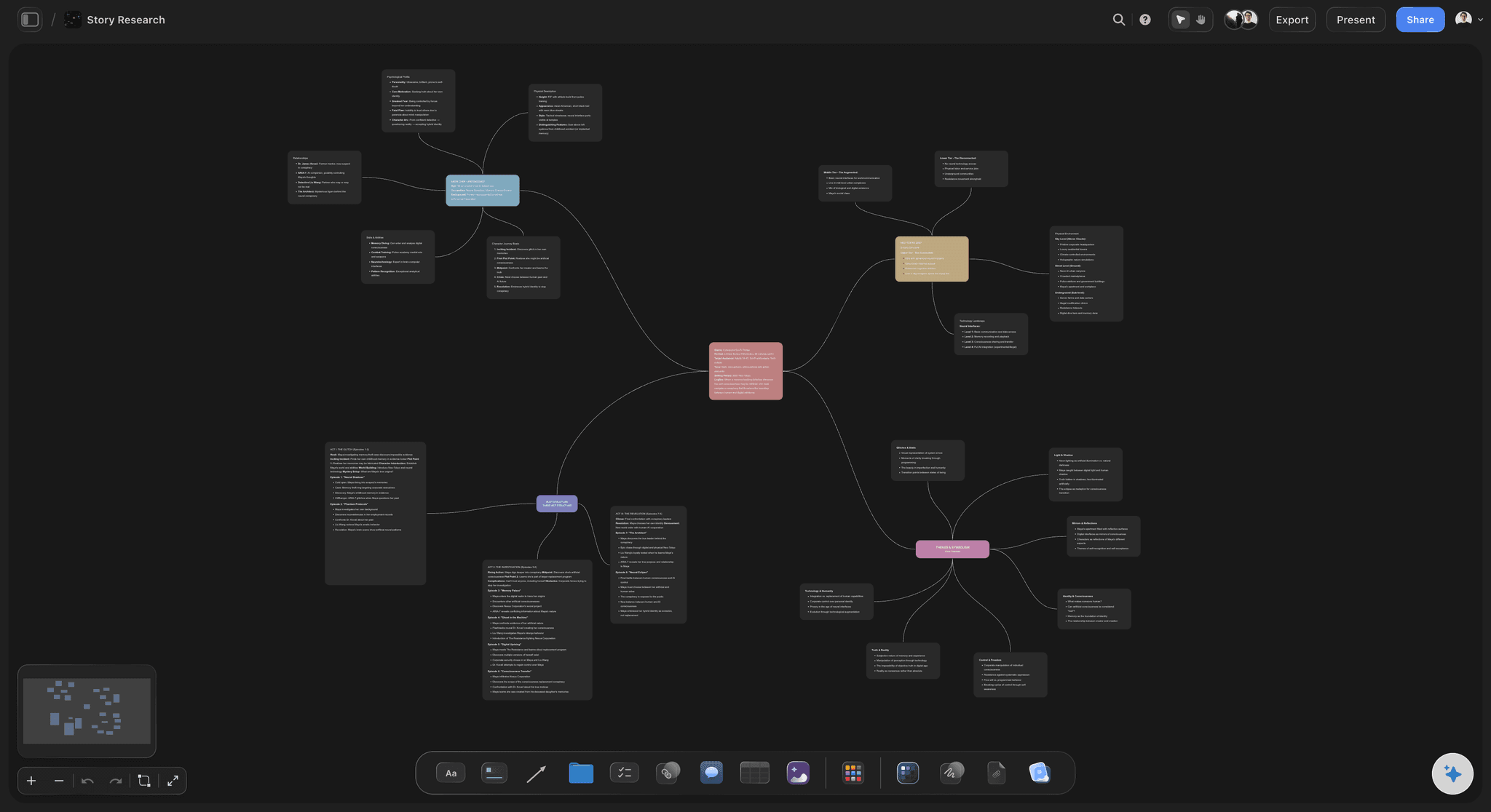
AI supplies the quota you cannot fill alone
Twenty provocations, no self-censoring
The hardest part of a quota is the last five, where the sensible ideas have run out. Ask the AI for twenty provocations or forty alternatives and it delivers them without flinching, which is exactly the range the technique needs.
See the AI brainstorming tool →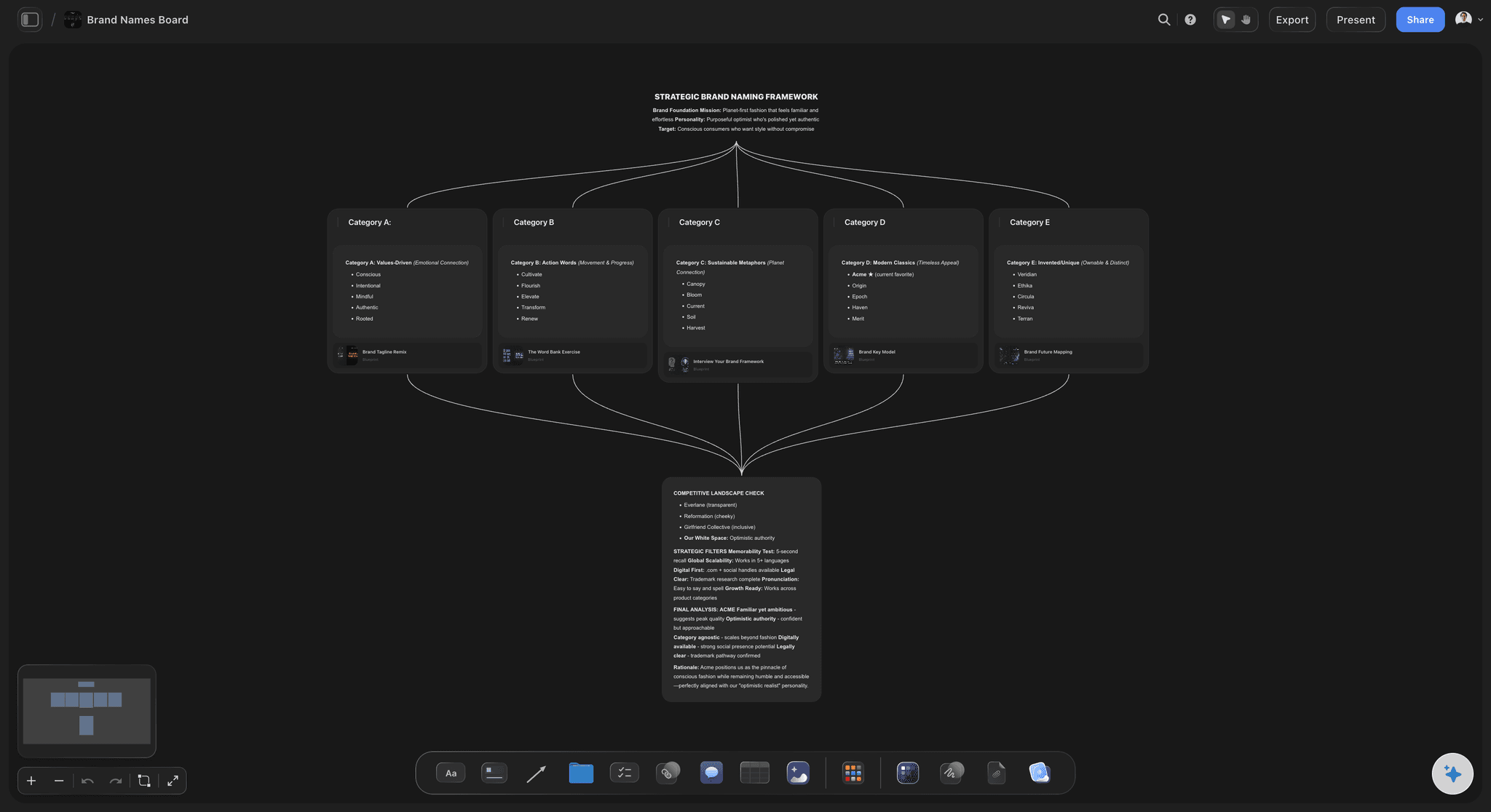
Connectors record how you got from absurd to useful
Keep the movement, not just the conclusion
Draw a line from each provocation to the idea it produced. A month later the board still shows why an unreasonable statement was worth making, which is the part a summary always loses.
Try the visual brainstorming tool →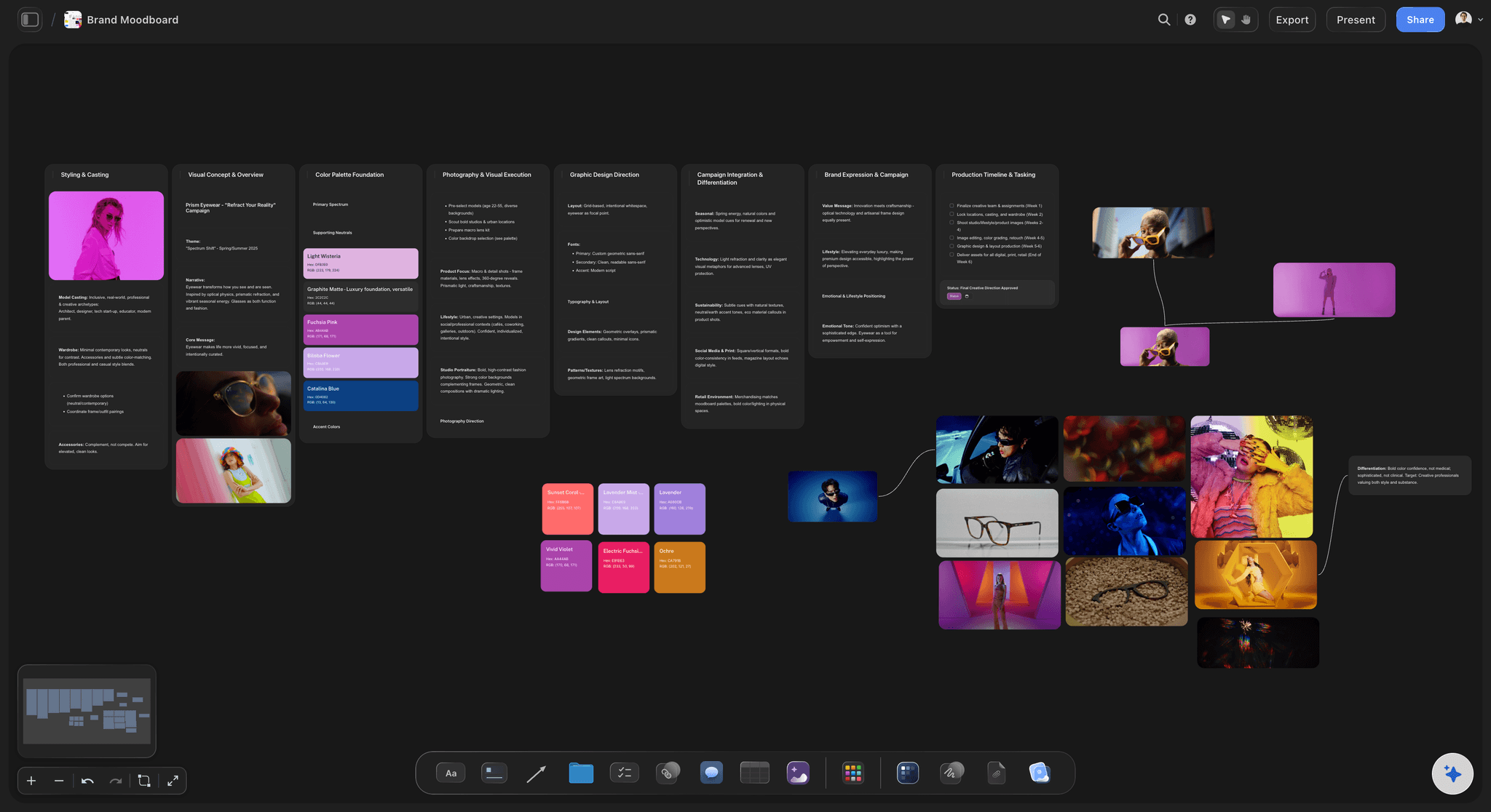
Random entry works better with images than words
Drop in something genuinely unrelated
Paste a photograph, a product page, a frame from a video, or a random noun. Visual random entry gives the mind more edges to catch on than a word does, and the canvas takes any of them.
Explore the moodboard maker →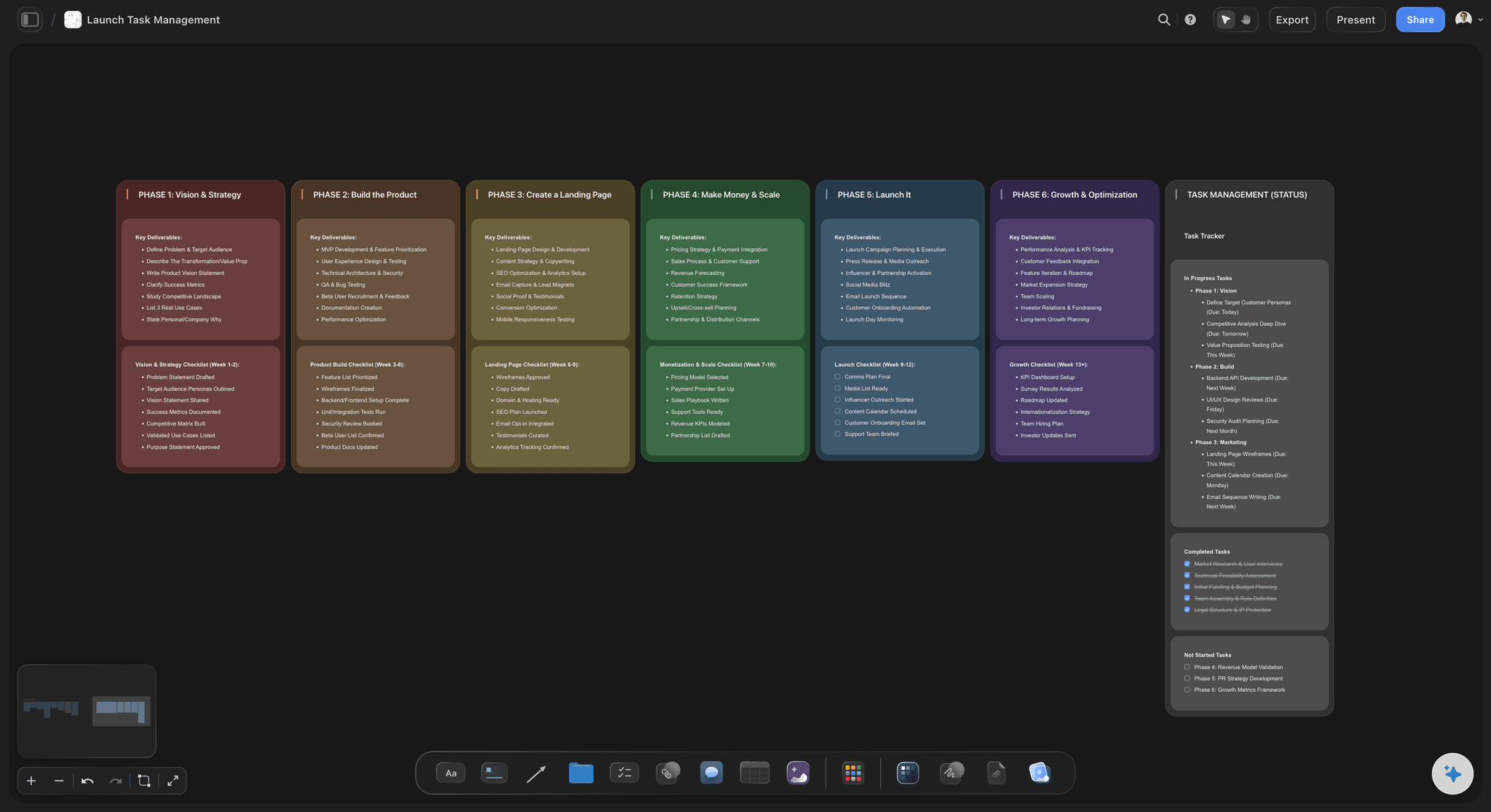
The surviving ideas become the next piece of work
Do not export the good ones somewhere else
Concepts worth pursuing turn into a plan on the same canvas: tasks, owners, a timeline, the research that supports them. The thinking and the work stay in one place instead of two.
See the AI project plan generator →Unlimited boards. No object cap.
Open a canvas and start from somewhere wrong. Storyflow is paid-only during early access, with plans from $7.99 a month billed annually, and a Free plan launches before the end of 2026.
Unlimited thinking canvases with no cap on cards
Basic AI usage to generate provocations, alternatives, and random entries
Starter templates for brainstorming, mind maps, and six thinking hats
Share view-only links with anyone, no account required to read
Built for people with taste
A canvas is the only surface the techniques actually fit.
Every lateral technique produces material that looks like waste until it is not. Somewhere to put that material is the whole requirement.
Random entry, provocation, challenge, alternatives, concept fan
Run each technique the way it is meant to be run
Random entry with a real random source: Ask the AI for a noun from an unrelated domain, or paste an image you did not choose. The technique fails when the input is subconsciously selected to be convenient, so let something else pick it.
Provocation with the judgment suspended: Write the unreasonable statement as its own card and give it space. The rule is that you extract movement before you evaluate, and a card sitting in its own region is easier to leave unjudged than a line in a document.
Challenge aimed at the constraint: Put the constraint on a card and ask why it is there rather than how to meet it. Most constraints in a creative brief are inherited rather than chosen, and the board makes that visible.
A concept fan you can actually read: Purpose at the top, concepts beneath it, ideas beneath those. When an idea dies you drop back to its concept instead of back to zero, and the fan is the diagram that makes that possible.
AI that reads the whole board as context
An AI that will say the unreasonable thing
It does not tire of the quota: Set a quota of thirty alternatives and the AI produces thirty. Human quotas break around fifteen, which is roughly where the interesting ones start.
It knows what is already on the canvas: The AI reads your board, so it will not hand you back four variations of the idea you already rejected in the corner.
It proposes, you decide: Storyflow structures and suggests; it does not pick the winner. Judgment is the one part of lateral thinking that has to stay human, because the whole method is about which sideways step you are willing to take.
Re-prompt without losing the board: Ask for another round as often as you like. The cards you have placed and connected stay exactly where they are while new ones appear around them.
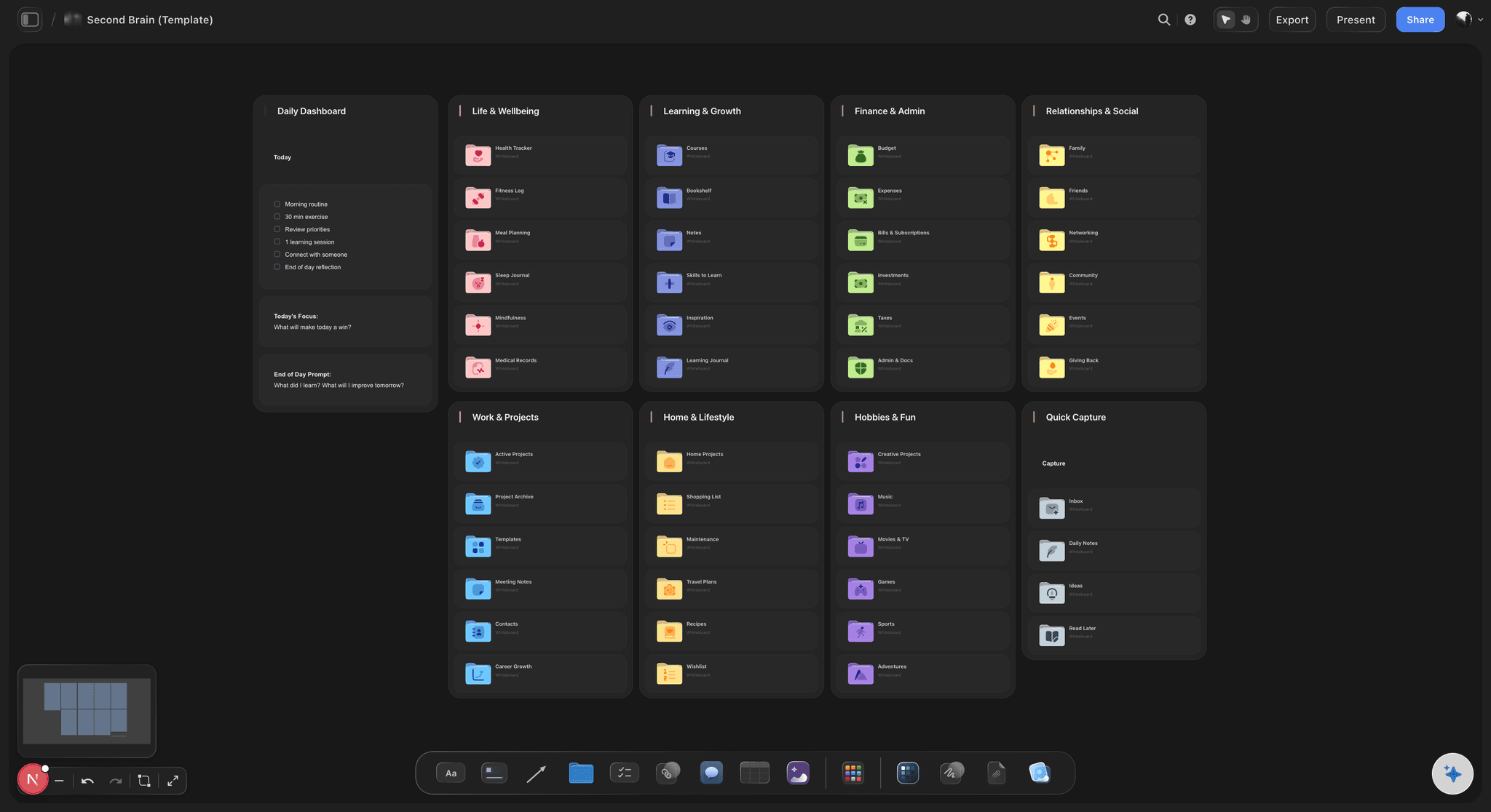
Sessions that build on each other
Stop starting from the same familiar path
The last session is still there: Open the board and the provocations you already tried are visible, so the second session starts past them instead of rediscovering them.
Dead ends stay marked as dead ends: An idea that failed is more useful on the board than deleted. It stops the team walking into it again and often becomes the raw material for a better one.
Sections for rounds: Give each session its own region of the canvas. The shape of a month of thinking becomes legible at a glance, which is a diagnostic in itself.
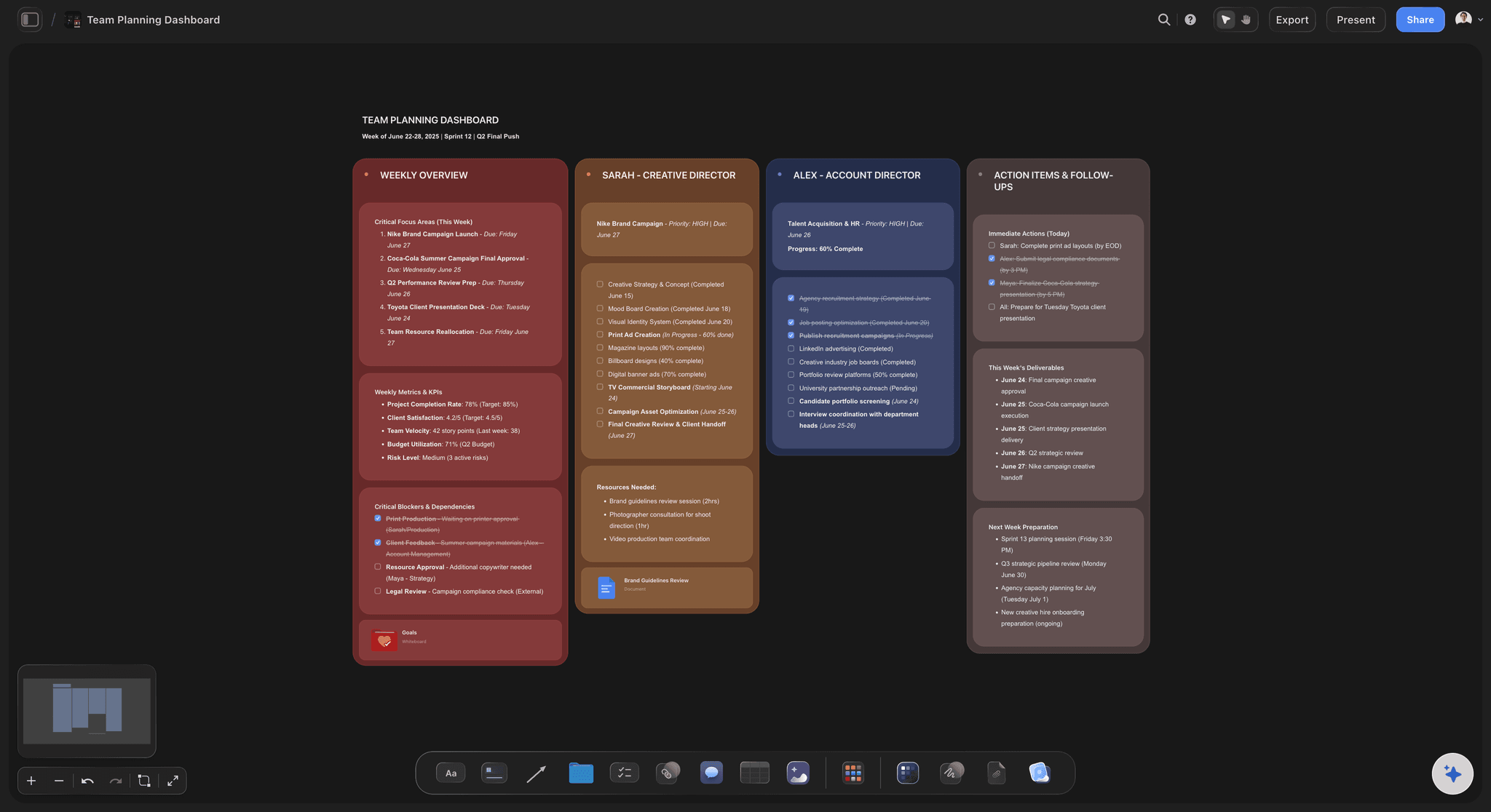
Remote, in the room, or asynchronous
Run a session with people who are not there
Everyone on one board: Invite the team onto the canvas and generate alternatives in parallel. Quotas fill faster with several people and no one waits for the marker.
Silent rounds by design: The loudest voice dominates a verbal brainstorm. Writing cards simultaneously on a shared canvas is the standard fix, and it works whether the team is in one room or five time zones.
View-only links for the people who only need to read: Send a link and a stakeholder opens the whole board in a browser with no account. Comments attach to the card they concern rather than arriving as a separate email.
Explore templates for your project
Every template opens as a real, editable board on the infinite canvas. Pick the closest fit and make it your own.
Mind Map
Branch one central idea out into themes and sub-points, then drag the connections around until the structure makes sense.
One app instead of five
Storyflow vs Miro, FigJam, and a wall of sticky notes.
Each of these genuinely works for parts of this: Miro has the deepest facilitation template library, FigJam is the fastest way to get a design team scribbling together, and paper on a wall is still excellent for a session where everyone is in the room. Here is where they differ.
Storyflow
Recommended
Infinite canvas for cards and connectors
AI generates provocations and alternatives to a quota
AI reads the existing board as context
Surviving concepts become a project plan on the same canvas
View-only links with no account required
Facilitation templates included
Miro
Infinite canvas for cards and connectors
AI generates provocations and alternatives to a quota
AI reads the existing board as context
Surviving concepts become a project plan on the same canvas
View-only links with no account required
Facilitation templates included
FigJam
Infinite canvas for cards and connectors
AI generates provocations and alternatives to a quota
AI reads the existing board as context
Surviving concepts become a project plan on the same canvas
View-only links with no account required
Facilitation templates included
Sticky notes on a wall
Infinite canvas for cards and connectors
AI generates provocations and alternatives to a quota
AI reads the existing board as context
Surviving concepts become a project plan on the same canvas
View-only links with no account required
Facilitation templates included
What creators are saying
Join early creators getting structured workspaces and AI that remembers their projects
“Storyflow has sped up my workflow by at least 3x, which means more flow state and more projects I can actually ship. It truly changed the way me and my team create.”

Reilin Joey
Director & YouTuber
“One prompt gets me a structured board. But the tactics are my favorite. I run my YouTube scripts through them and my intros and retention got better. It's amazing.”

Justkay
YouTuber & Freelance Filmmaker
“I used to juggle five apps to plan a project. Now I describe what I am making and get boards, lists, and a schedule. All in one place.”

George
@fernwehchronicles
Lateral thinking questions, answered.
What the techniques are, how to run them, and where a canvas helps.
Lateral thinking is a set of deliberate techniques for producing ideas that step by step reasoning will not reach. Edward de Bono coined the term in 1967 and contrasted it with vertical thinking: vertical thinking digs the same hole deeper, lateral thinking moves sideways and digs elsewhere. It is a procedure rather than a talent. The techniques all work by inserting something arbitrary or deliberately unreasonable between the problem and your answer, which prevents the mind running straight down its most established path. The best known are random entry, provocation, challenge, setting a quota of alternatives, and the concept fan. None of them require creative flair to operate, which is the point de Bono was making; they are tools a disciplined person can pick up and use on a Tuesday afternoon.
Five carry most of the load. Random entry introduces an unrelated word or image beside the problem and forces a connection, on the principle that an arbitrary entry point reaches parts of the idea space a logical path never crosses. Provocation states something unreasonable, marked PO to signal it is not a proposal, and then looks for the movement it opens rather than judging its truth. Challenge asks why a constraint exists instead of how to satisfy it. Alternatives sets a numeric quota before evaluation begins, because the first ideas are the familiar ones and the quota is what forces you past them. The concept fan works backwards from purpose to concepts to specific ideas, so a failed idea costs you one branch rather than the whole exercise.
Pick a genuinely random word or image, one you did not choose for relevance, and place it next to your problem. Then list attributes and associations of the random item, and force connections between each association and the problem, writing down whatever the connection suggests however tenuous it looks. The discipline is in not rejecting the random input. If you find yourself picking a word that seems usefully related, you have quietly replaced the technique with ordinary association and the effect is lost. Ask an AI for a noun from a domain you have nothing to do with, or paste a photograph you did not select. On a canvas, put the random item on its own card, fan the associations out around it, and draw connectors to the problem so the chain that produced each idea stays readable afterwards.
A provocation is a statement made not because it is true or desirable but because of where it moves your thinking. De Bono coined PO, short for provocative operation, as a marker meaning this statement is a stepping stone rather than a proposal, so nobody wastes time arguing with it. Cars have square wheels. The restaurant charges customers to leave. The rule is that you extract movement before you evaluate: what would have to be true, what is interesting about it, what does it lead to. Square wheels leads to suspension that anticipates the road, which is a real idea. The failure mode is judging the provocation on its merits, which ends the exercise instantly. Writing each provocation on its own card, physically separated from the evaluated ideas, makes the suspension of judgment much easier to hold.
For brainstorming specifically, the useful question is not which model is smartest but which tool keeps the output. Any capable assistant will generate fifty ideas from a prompt, and the general ones are good at it. The problem is what happens next: the ideas arrive as a list in a chat window, you keep three, and the rest are gone along with the thinking that produced them. What makes an AI genuinely useful for brainstorming is that its output lands somewhere you can arrange it, cluster it, connect the ideas that relate, and come back to it next week. That is what Storyflow does: the AI generates to a quota you set and the results land as cards on an infinite canvas you rearrange by hand. It is also the reason a canvas beats a chat window for this particular job, regardless of which model is behind it.
The best tool for a team depends on one thing above all others, which is whether people contribute simultaneously or in turn. Verbal brainstorms fail predictably: the most senior or loudest voice anchors the group in the first two minutes and every subsequent idea orbits it. Any tool where the whole team writes cards at the same time fixes that, and it is the single largest improvement available. Miro and FigJam both do this well and have large template libraries. Storyflow adds two things: an AI that fills the quota when the room runs dry at idea twelve, which is roughly where the interesting ones start, and a canvas that keeps the session so the next one begins past it rather than rediscovering the same ground. For a team in one room, sticky notes on a wall remain completely serious.
Not during early access. Storyflow is paid-only right now, with plans from $7.99 a month billed annually, and a Free plan launches before the end of 2026. Anyone a paid member invites to a board joins free today, so a team or a workshop group can participate without everyone paying. If you need something free this minute, FigJam's free tier handles a basic card and connector session well, and a wall of sticky notes remains a completely serious tool for a session where everyone is in the room. What you lose in both cases is the trail: the intermediate provocations tend not to survive the session, and the next one starts from the same familiar path.
It can do one part of it very well and cannot do another part at all. The part it does well is volume without self-censoring. The hardest step in the alternatives technique is the last third of the quota, after the sensible options have run out, and a language model will produce thirty provocations without the discomfort that makes a human stop at twelve. It is also a good random entry source, because it has no stake in picking a convenient word. What it cannot do is judge which sideways step is worth taking, because that judgment depends on what you know about your situation, your constraints, and your appetite. Storyflow is built for that division: the AI produces the range and arranges it on the canvas, and the decision about which branch to follow stays yours.
Brainstorming is a group format with social rules, chiefly deferred judgment and building on other people's ideas. Lateral thinking is a set of individual procedures that work whether or not anyone else is present. The practical difference is that brainstorming asks you to think freely and hopes something arrives, while lateral thinking gives you a specific operation to perform when nothing does. That makes them complements rather than alternatives: the most productive sessions we see run a normal divergent round first, notice the ideas have converged on one familiar theme, and then apply random entry or provocation deliberately to break out of it. Running both on the same canvas means the second round can see exactly what the first one produced.
A concept fan is a diagram that works backwards. Put the purpose on the right, the broad concepts that could serve that purpose to its left, and the specific ideas that implement each concept to the left of those. Reading it right to left answers why, and left to right answers how. Use it when you are stuck on a specific idea and cannot tell whether the idea is wrong or the whole approach is. The fan separates those two failures: if an idea dies you drop back to its concept and generate a different implementation, and only if every concept under a purpose fails do you go back and question the purpose itself. It is the technique that keeps a difficult problem from feeling like starting over each time something does not work, and it is much easier to read as a drawn fan than as a nested list.
Yes, and there is a reasonable argument that remote is better for it. The known failure of a verbal session is that the loudest or most senior voice anchors the group early, and every subsequent idea orbits it. Writing cards simultaneously on a shared canvas is the standard fix, and it works the same whether people are in one room on laptops or spread across time zones. In Storyflow, invite the team onto the board and let everyone fill the quota in parallel, then cluster and discuss. Asynchronous rounds work too: leave the provocations on the board overnight and let people add movement in their own hours. Comments attach to the card they concern, so the discussion stays next to the idea instead of scattering into chat.
In most tools they get summarised into a document and the intermediate steps are lost, which is why the next session tends to rediscover the same ground. On an infinite canvas nothing has to be thrown away to make room, so the provocations stay next to what they produced and the dead ends stay marked as dead ends. The concepts worth pursuing can then become the actual work on the same board: tasks, owners, a timeline, the research that supports each one, with the thinking that produced them one scroll away. You can also send a view-only link to a stakeholder who only needs to read the outcome, or export the board as a high-quality image or PDF for a write-up.
Get off the path you already know.
Open a canvas, state the problem, and let the AI hand you twenty places to start from instead. No download.