
An ultra-fast canvas that stays calm
Eight ideas.
Eight minutes. Go.
Give everyone an eight-frame grid, one minute per frame, then post the sheets side by side, vote, and leave with a direction instead of a discussion.


Creatives working for these brands already got early access
- Red Bull
- Canon
- Artlist
- Porsche
See how easy it is to get started
Watch a real project come together, from a blank board to a finished plan, clicked through step by step.
Start from a ready-made template
Pick a board to see what you can build, then let AI fill it in. Every template is a real, editable starting point on the same infinite canvas.

Mind Map
Branch one central idea out into themes and sub-points, then drag the connections around until the structure makes sense.
What is Crazy 8s?
Crazy 8s is a rapid sketching exercise from the Google Ventures design sprint. Each person takes a sheet folded into eight frames and has eight minutes to fill it, one idea per frame, one minute each. The point is not to produce eight good ideas. It is to force your way past the two or three obvious solutions everyone in the room was already thinking of, because the interesting material almost always turns up somewhere around frame five, once the safe answers have been used up and you have nothing left but the strange ones.
The timebox is the whole mechanism, and it is the part people are most tempted to soften. A minute is not enough time to draw well, which is exactly why it works: you cannot edit, you cannot make it presentable, and you cannot spend the round quietly deciding your idea is not worth showing. Give people three minutes a frame and they produce four polished versions of the same concept. Give them sixty seconds and they produce eight genuinely different attempts, several of which are bad in useful ways. Sketching quality is irrelevant here and saying so out loud at the start changes what people produce.
Storyflow gives every participant their own eight-frame grid on one infinite canvas. Everyone sketches at the same time in their own area, drawing directly on the board with the freehand tool, dropping in screenshots to annotate, or writing in frames when an idea is better as words than as a picture. When the eight minutes are up, the sheets are already side by side, which is the part that usually costs ten awkward minutes with paper: no photographing, no holding sheets up to a webcam, no explaining what a rectangle was meant to be.
After the sketches come the parts most teams rush. A silent review, where everyone reads every sheet without the author narrating, because an idea that only works when explained is not going to survive being a product. Then dot voting to surface what the group is drawn to, then a short discussion of the votes rather than the sketches. Storyflow holds all of that on the same board, and because it stays live afterwards, the seven ideas you did not choose remain available for the next time the problem comes back around, which it usually does.
Ultra fast from brief to board
From a framed problem to a chosen direction in under an hour.
No paper to fold, no photographs to take, no sheets held up to a webcam.
01
Open a canvas
Sign up in seconds. No download. Your infinite sprint canvas opens in the browser.
02
Frame the problem and lay out the grids
Describe what you are solving and the AI sets up the framed question and an eight-frame grid per participant, plus the review and voting areas for afterwards.
03
Sketch, one frame a minute
Everyone works at the same time in their own area, drawing freehand, dropping in references, or writing where words are clearer. Eight minutes, no editing, no polishing.
04
Review in silence, then vote
Read every sheet without the author explaining it, dot-vote on what stands out, and discuss the votes rather than the drawings. The chosen direction moves into the next step.
The exercise, end to end, on one board.
Grids, sketching, silent review, and voting in the same place.
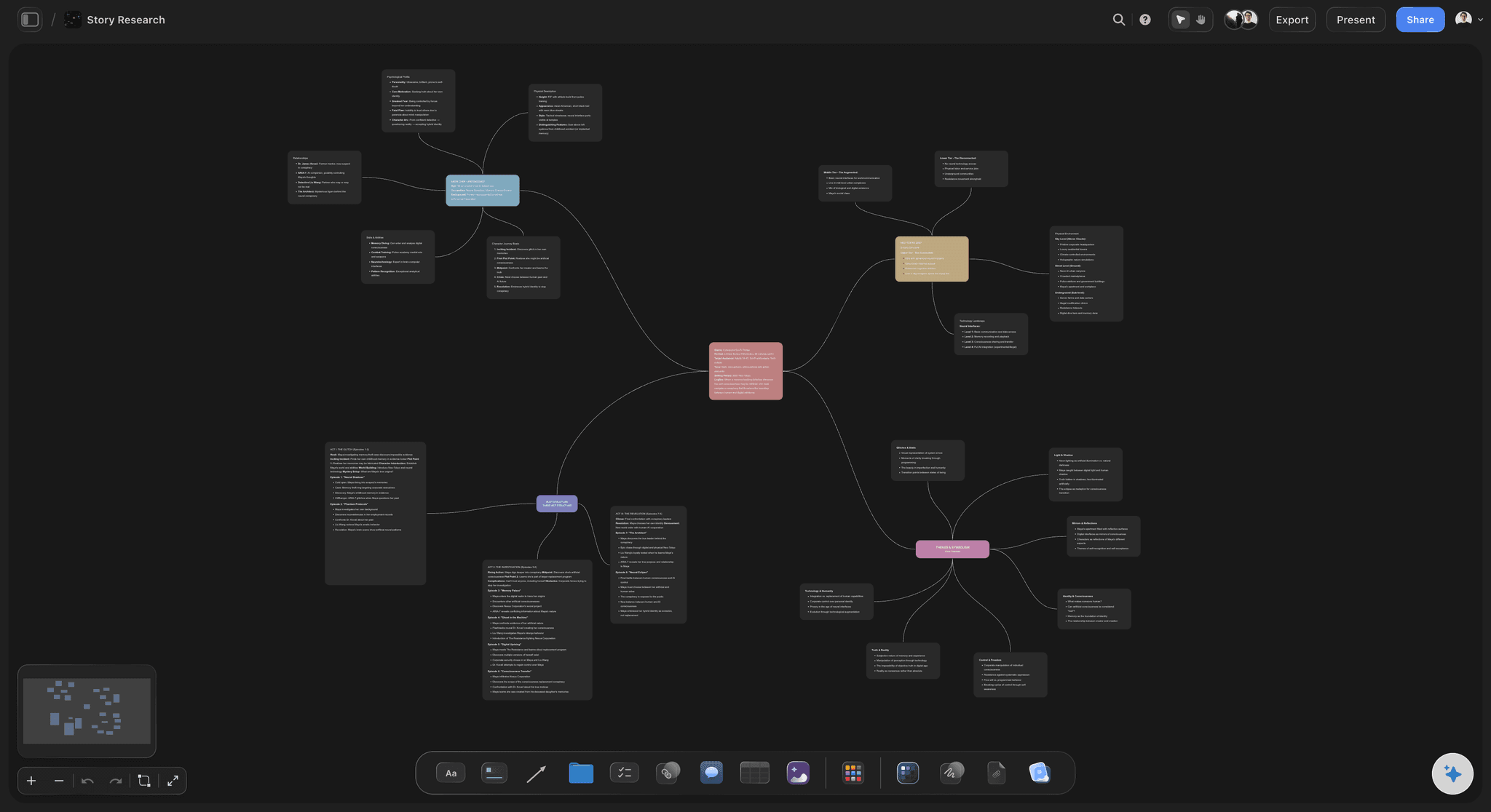
A grid per person, laid out automatically
Skip the setup, start the timer
Describe the problem and the AI puts a framed question and an eight-frame grid per participant on the board. Setup is the part of Crazy 8s that eats the first ten minutes of a sprint.
See the design sprint guide →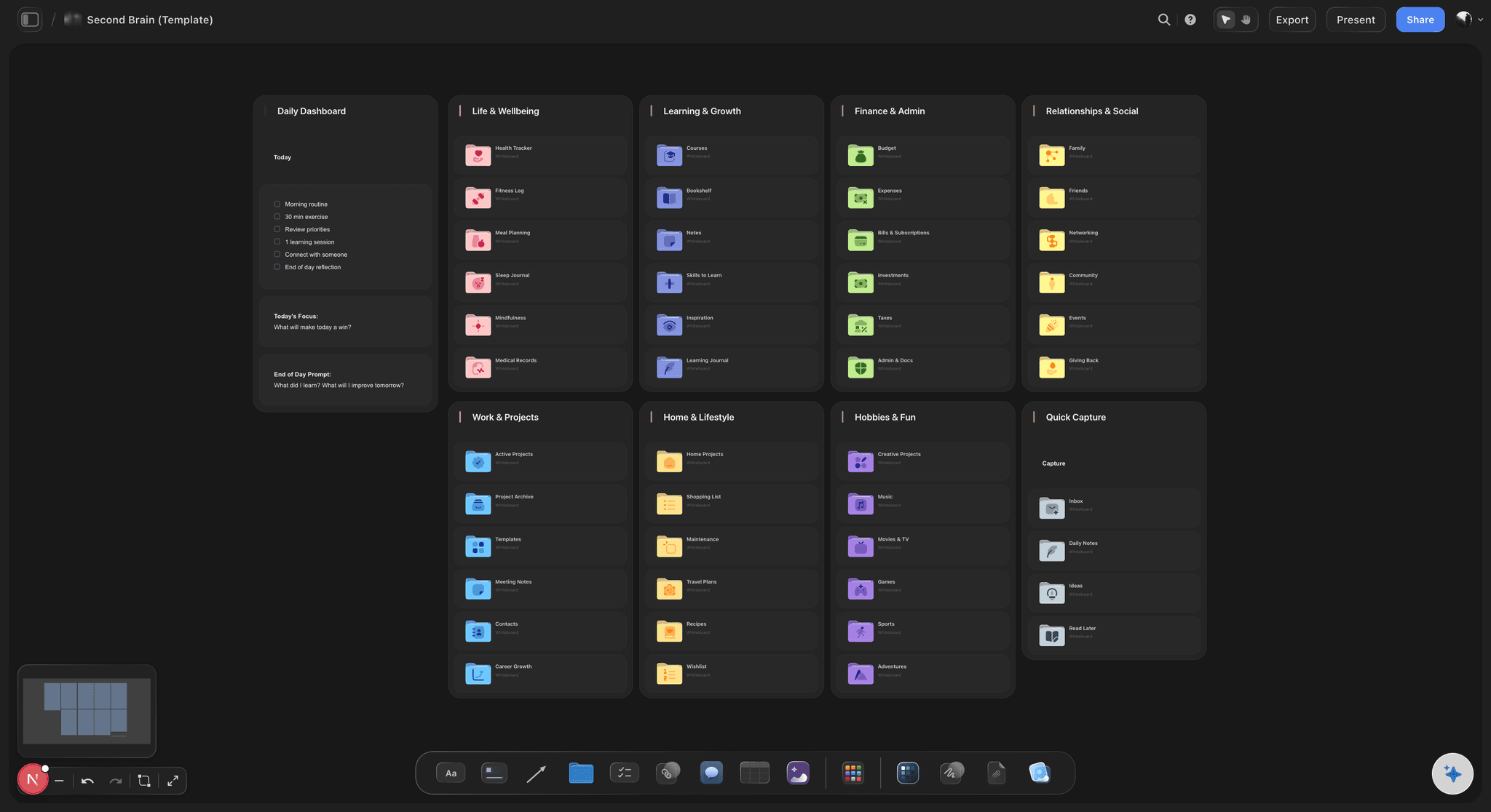
Sketch, annotate, or write
Draw it, or say it, but do it in a minute
Use the freehand tool for real sketches, drop in a screenshot to mark up, or write the idea when words are clearer. Frames left empty because someone cannot draw are pure lost material.
Try the free online whiteboard →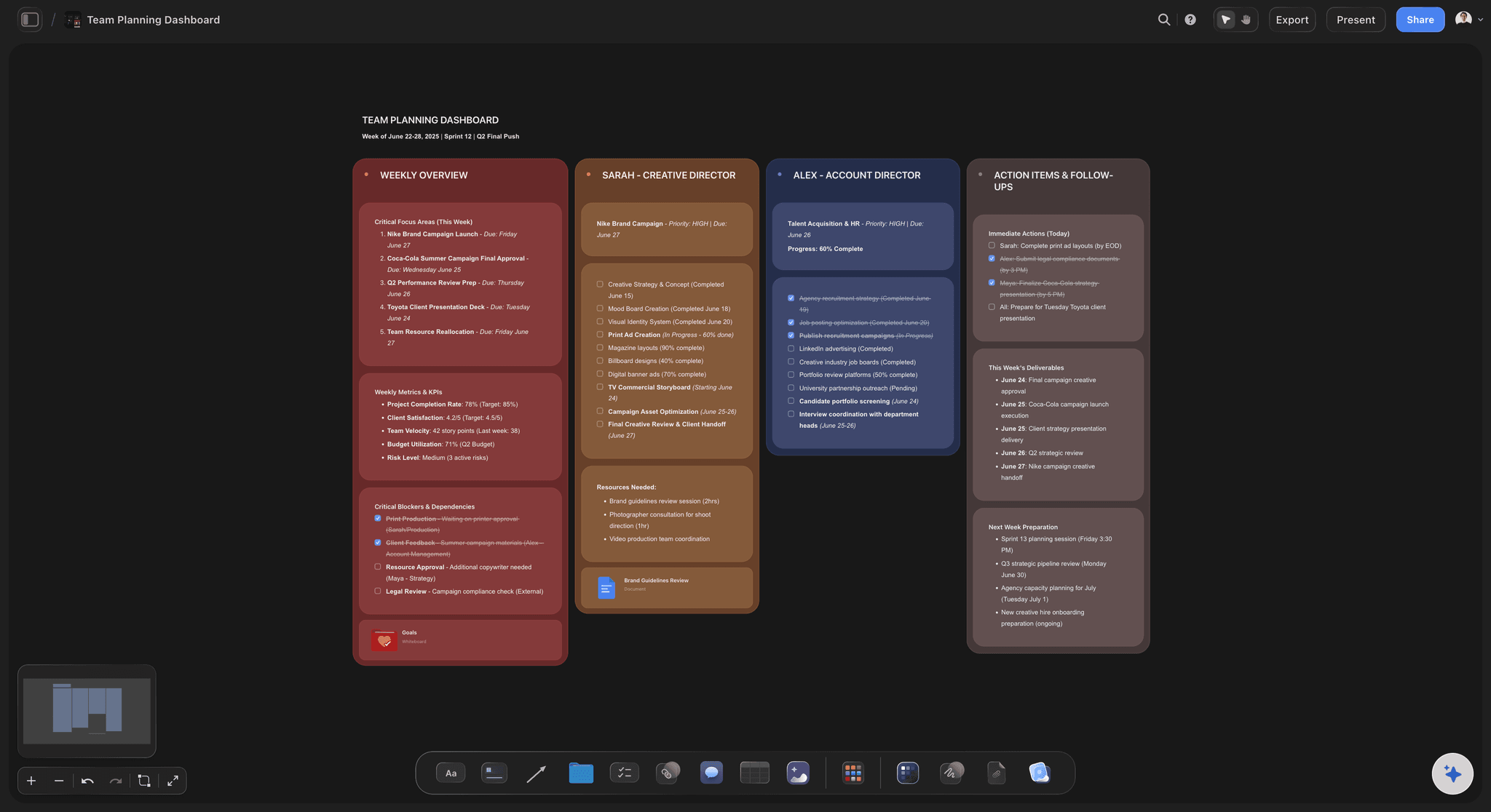
Every sheet visible at once
Silent review without the sales pitch
When the timer stops, the sheets are already side by side. Everyone reads everything without the author narrating, which is the only honest test of whether an idea communicates.
Explore the visual brainstorming tool →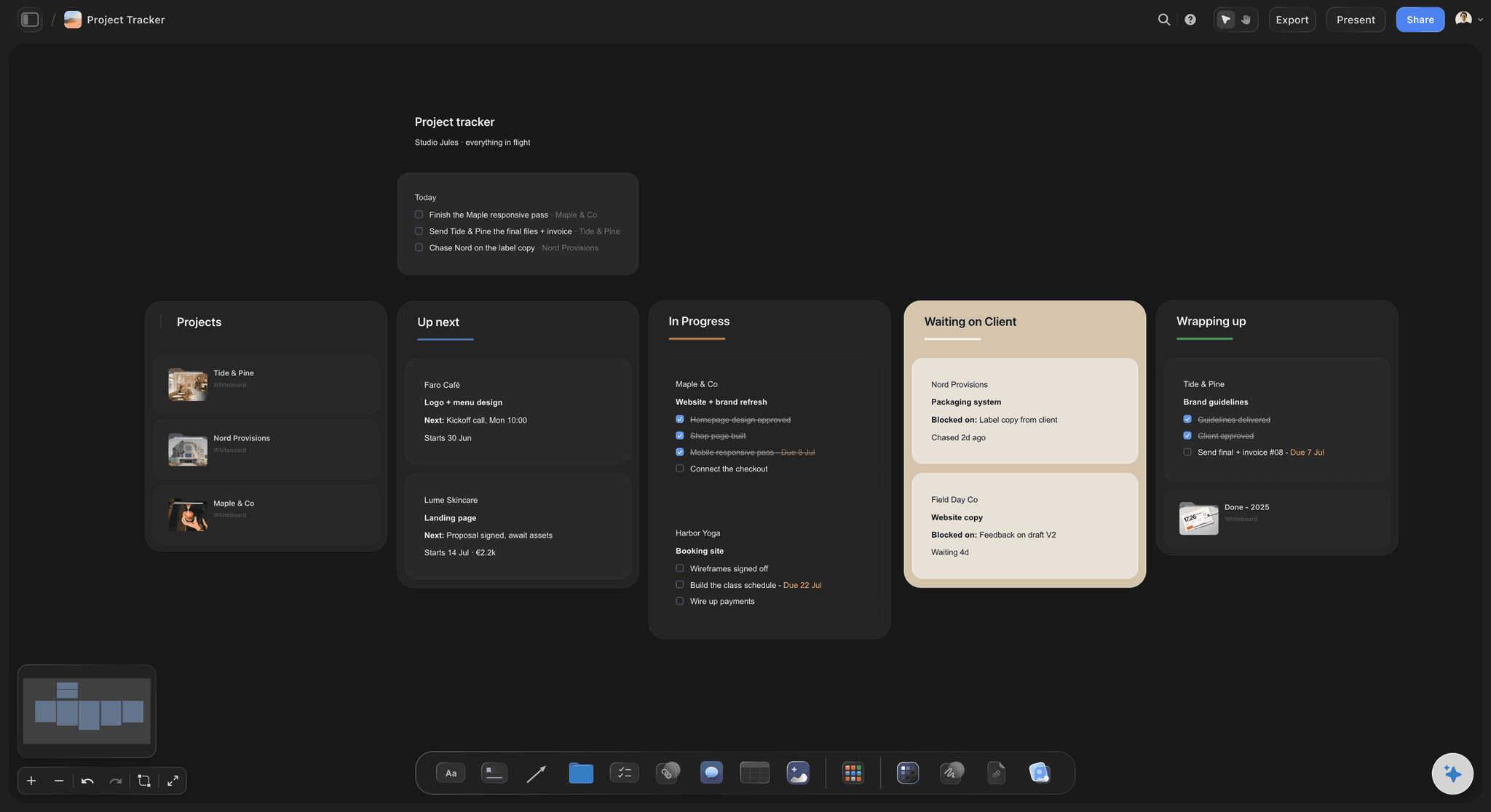
The board outlives the sprint
Keep the seven you did not choose
The rejected frames stay live and searchable instead of being recycled with the paper. Problems come back, and a frame that was wrong in March is often right in September.
See the idea board →Unlimited boards. No object cap.
Open a canvas, frame the problem, and lay out the grids. Storyflow is paid-only during early access, with plans from $9.99 a month, and a Free plan launches before the end of 2026.
Unlimited sprint boards on an infinite canvas
Basic AI usage to lay out exercises from prompts
Freehand drawing, sticky notes, and image annotation
Share view-only links with participants and stakeholders
Built for people with taste
More than a folded piece of paper.
Paper works. It just stops working the moment one person in the room is remote.
The rules that make it work
Run it properly or do not run it
One minute a frame, enforced: The timebox is the mechanism, not an inconvenience. Loosen it and people produce four polished versions of one concept instead of eight different attempts, which defeats the entire exercise.
Quantity over quality, said out loud: State at the start that nobody is judging the drawing. Rooms that are not told this spend the first three frames worrying about how their sketches look and lose half the round.
Frames five to eight are the point: The first few frames are the ideas everyone already had. The value of the exercise is that it forces you past them, which is why stopping at four is not a shorter version of Crazy 8s, it is a different and worse exercise.
Silent review before any discussion: Let people read every sheet with no narration. An idea that needs its author standing beside it is an idea that will need a salesperson standing beside the product.
AI that can see the board you have already built
Set up and unstick with an AI that has the context
Prompt against the whole canvas: Ask it to lay out grids for six people, sharpen the framing question, or propose provocations for a second round when the first one produced eight versions of the same idea.
Use it to widen, not to answer: Hand a room an AI-generated solution and the sketching stops immediately. Angles and constraints keep people generating; conclusions end the exercise before it starts.
Iterate without losing work: Re-prompt as often as you want. Sketches people have already drawn stay exactly where they are while the AI builds around them.
Remote and hybrid sprints
Run it with a team that is not in the room
Everyone sketches in parallel: Each participant works in their own area of the canvas at the same time. Nobody waits for a turn and nobody has to hold a piece of paper up to a laptop camera.
No photographing, no transcribing: When the timer stops the sheets are already digital and already side by side, which removes the most tedious ten minutes of a paper-based sprint.
Hybrid without a second-class half: When the board is the exercise rather than a camera pointed at a wall, remote participants contribute on exactly the same terms as the people in the room.
What comes next
Turn a chosen frame into something real
Solution sketch from the winner: In a full sprint the voted frame becomes a three-panel solution sketch. Build it in the next region of the same canvas so the lineage from rough frame to concept stays visible.
Wireframe or storyboard it: Take the direction into a wireframe or a storyboard on the same board, with the original sketch beside it, so nobody loses the reason the idea was chosen.
Share the reasoning: Send a view-only link with every sheet and the votes visible. People who missed the session can see what was considered, which stops the decision being relitigated in a week.
Explore templates for your project
Every template opens as a real, editable board on the infinite canvas. Pick the closest fit and make it your own.
Mind Map
Branch one central idea out into themes and sub-points, then drag the connections around until the structure makes sense.
One app instead of five
Storyflow vs Miro, FigJam, and pen and paper.
Be clear about what Storyflow is. There is no built-in countdown timer or voting widget. It is a canvas where the exercise, the sketches, and the decision live together.
Storyflow
Recommended
Infinite canvas with freehand sketching
AI lays out the exercise from a framed problem
Sheets stay live and searchable after the sprint
Built-in countdown timer and voting widget
Works with no device at all
Free plan available today
Miro
Infinite canvas with freehand sketching
AI lays out the exercise from a framed problem
Sheets stay live and searchable after the sprint
Built-in countdown timer and voting widget
Works with no device at all
Free plan available today
FigJam
Infinite canvas with freehand sketching
AI lays out the exercise from a framed problem
Sheets stay live and searchable after the sprint
Built-in countdown timer and voting widget
Works with no device at all
Free plan available today
Pen and paper
Infinite canvas with freehand sketching
AI lays out the exercise from a framed problem
Sheets stay live and searchable after the sprint
Built-in countdown timer and voting widget
Works with no device at all
Free plan available today
What creators are saying
Join early creators getting structured workspaces and AI that remembers their projects
“Storyflow has sped up my workflow by at least 3x, which means more flow state and more projects I can actually ship. It truly changed the way me and my team create.”

Reilin Joey
Director & YouTuber
“One prompt gets me a structured board. But the tactics are my favorite. I run my YouTube scripts through them and my intros and retention got better. It's amazing.”

Justkay
YouTuber & Freelance Filmmaker
“I used to juggle five apps to plan a project. Now I describe what I am making and get boards, lists, and a schedule. All in one place.”

George
@fernwehchronicles
Crazy 8s questions, answered.
How the exercise works, why the timebox matters, and where Storyflow fits alongside Miro and FigJam.
Miro and FigJam both have Crazy 8s templates with a countdown timer and a voting widget built in, and if you want a timer on screen that everyone can see, use one of them. Storyflow is the option where the exercise sits inside the rest of the work: describe the problem and the AI lays out the framed question and a grid per participant, everyone sketches freehand in parallel, and the sheets stay on the same canvas as the wireframes, storyboard, and project plan that come next. Pen and paper is still excellent when everyone is in one room, and stops working the moment one person is not.
Each person gets a sheet divided into eight frames and eight minutes to fill it, one idea per frame, one minute each. The first frames will be the ideas everyone in the room already had, which is expected and is the reason the exercise continues past four. By frame five or six people have run out of safe answers and start producing things they would not have said out loud, which is where the value is. When the time is up, everyone reads every sheet in silence with no narration, then dot-votes, then discusses the votes. It takes about forty minutes end to end, including the review.
Because the constraint is the mechanism. A minute per frame is deliberately not enough time to draw well, which removes the option of polishing and, more importantly, removes the internal editor that stops people recording ideas they suspect are silly. Teams that stretch it to three minutes a frame reliably produce four careful variations of the same concept, because with time available people optimize rather than diverge. If you want a longer sketching exercise there are good ones, but stretching Crazy 8s is not it: you lose the specific thing it does and gain a slower version of a normal discussion.
Not during early access. Storyflow is paid-only right now, with plans starting at $9.99 a month, and a Free plan for solo use launches before the end of 2026. Anyone a paid member invites to a board joins free today, which matters for this exercise specifically: you can run a session with a full team or a client group without buying seats for everyone. If you need free this minute, FigJam's free tier includes a Crazy 8s template with a timer, and Miro's free tier gives you three editable boards. Both are honest options and both have the timer widget Storyflow does not.
Tell them at the start that nobody is judging the drawing and that a frame can be words, a box with a label, or an annotated screenshot. This matters more than facilitators expect, because a participant worrying about their sketching quality produces three timid frames instead of eight, and the exercise loses a whole person's material. It also helps to sketch something deliberately ugly yourself in the first frame. The exercise is not a drawing test; boxes with labels communicate an interface idea perfectly well, and the fastest way to ruin a round is to let it feel like an art class.
Yes, and it is genuinely useful solo, though for a slightly different reason. Alone, there is no social filter to defeat, but there is still your own tendency to stop at the first workable answer. The timebox forces you past it, and frames five to eight are still where the unexpected material appears. Run two rounds with different framings rather than one long round, and leave the board overnight before reviewing, because judging your own sketches immediately after drawing them produces a very predictable shortlist. The board staying live is what makes the delayed review possible.
You describe the problem you are sketching against and how many people are participating. The AI lays out the board from that: the framed question at the top, an eight-frame grid per person, and the review and voting areas ready for afterwards. That removes the setup, which in a paper sprint is the first ten minutes and in a digital one is usually someone duplicating a frame twelve times. During the session it can also read the board, so if a round produced eight versions of the same idea you can ask it for provocations or a sharper constraint before running a second round.
In a full design sprint, the winning frame becomes a three-panel solution sketch, then a prototype. Outside a sprint, the useful next step is usually to take the chosen direction into a wireframe or a storyboard while the reasoning is fresh. Build that in the next region of the same canvas with the original frame beside it, because the lineage matters: in two weeks somebody will ask why this direction, and pointing at the frame and the votes answers it in seconds. Keep the rejected sheets rather than tidying them away, since the same problem tends to return.
Anyone a paid member invites to a board joins free, so you can run the exercise with a whole team, a client group, or a workshop cohort without buying seats. For people who only need to see the outcome, send a view-only link and they open the full board in a browser with no account, and sign in to comment on individual sheets. Sharing, commenting, and reviewing work on every paid plan.
Yes, and it transfers better than most sprint exercises. It works for campaign concepts, video and content ideas, service design, pitch structures, event formats, and any problem where the failure mode is a team settling on the first plausible answer. The only adjustment is the framing question: it needs a constraint in it, because open questions produce eight vague frames. How might we open the video is too broad; how might we open the video without showing the product for thirty seconds produces eight genuinely different attempts, several of which will be worth arguing about.
Get past the idea everyone already had.
Open a canvas, frame the problem, and let AI lay out the grids. No download.