
An ultra-fast canvas that stays calm
Seven questions
that break a blank page.
Substitute, Combine, Adapt, Modify, Put to another use, Eliminate, Reverse. Give each prompt its own area on the canvas, work through them against what you already have, and leave with a shortlist.


Creatives working for these brands already got early access
- Red Bull
- Canon
- Artlist
- Porsche
See how easy it is to get started
Watch a real project come together, from a blank board to a finished plan, clicked through step by step.
Start from a ready-made template
Pick a board to see what you can build, then let AI fill it in. Every template is a real, editable starting point on the same infinite canvas.

Mind Map
Branch one central idea out into themes and sub-points, then drag the connections around until the structure makes sense.
What is the SCAMPER technique?
SCAMPER is a checklist of seven prompts for generating ideas about something that already exists. Storyflow is an AI visual workspace that runs a SCAMPER session on one infinite canvas: an area for each of the seven prompts, AI questions written for your case, and a ranked shortlist. Substitute: what could be swapped for something else. Combine: what could be merged with something else. Adapt: what could be borrowed from a different context. Modify: what could be magnified, shrunk, or exaggerated. Put to another use: who else could use this, or what else it could do. Eliminate: what could be removed entirely. Reverse: what happens if the order or the roles are inverted. The list comes from Alex Osborn's work on brainstorming and was arranged into this mnemonic by Bob Eberle in the early 1970s.
The reason it works is that it removes the hardest part of ideation, which is not having ideas but knowing where to look. Told to think of improvements to a product, most people generate three obvious ones and stop, because an open question gives the mind nowhere to go. Asked specifically what could be eliminated from this product entirely, the same person produces five answers in two minutes, several of them uncomfortable. Constraint outperforms freedom in ideation almost every time, and SCAMPER is essentially seven constraints applied in sequence.
Storyflow gives each prompt its own named area on one infinite canvas. Describe the thing you are working on in a prompt and the AI lays out the seven areas with questions written for your specific product, service, or campaign rather than generic labels, which matters more than it sounds. What could be eliminated is a weak prompt; what could be removed from the onboarding flow without customers noticing is a prompt that produces answers. The group then works through the areas together, everyone adding cards at the same time.
SCAMPER is deliberately a divergent tool, and it has a matching failure mode: seven full areas of ideas is a large pile and a large pile is not an outcome. The session has to close with a convergent pass, clustering the output, marking what is genuinely worth pursuing, and assigning owners to the two or three that survive. Because the board stays live afterwards, the material you did not choose remains available, which matters for a technique whose most valuable ideas are frequently the ones that were slightly too early rather than wrong.
Ultra fast from brief to board
From something that already exists to ideas worth testing.
No blank page, no room told to be creative with nowhere specific to look.
01
Open a canvas
Sign up in seconds. No download. Your infinite ideation canvas opens in the browser.
02
Describe what you are working on
Type the product, service, or campaign and the AI lays out the seven SCAMPER areas with questions written specifically for it, not generic prompts.
03
Work through the prompts
Take one letter at a time with everyone adding cards to the same area. Short timeboxes, no judging, and keep going past the first obvious answer in each.
04
Converge on a shortlist
Cluster the output, mark what is worth pursuing, and give the survivors owners. Then share a view-only link so the reasoning is visible to people who were not there.
Seven prompts, one canvas.
Every angle covered, and the output still usable afterwards.
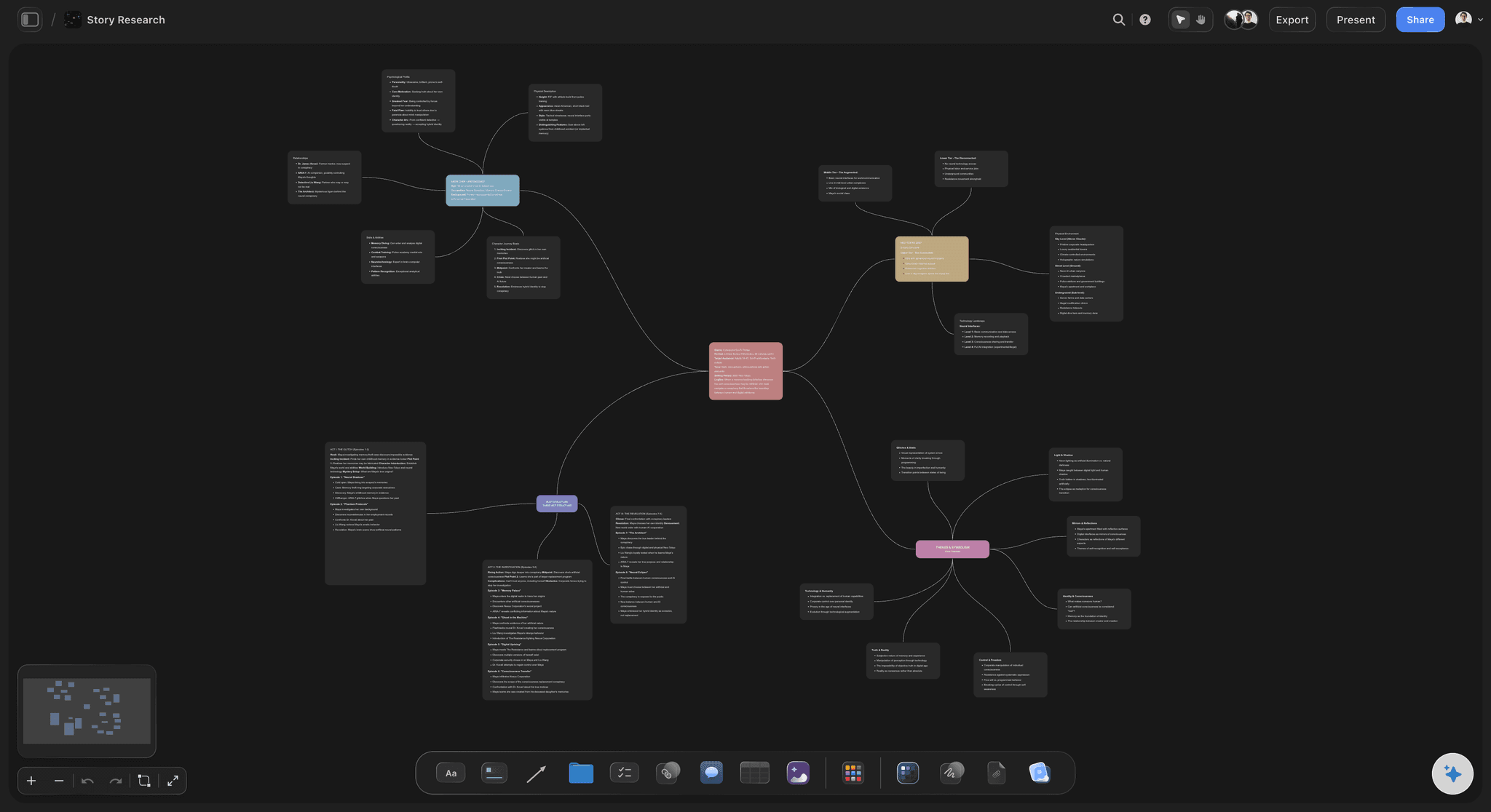
AI writes the prompts for your specific case
Start from real questions, not generic labels
Describe what you are working on and the AI builds seven areas with questions written for it. Specific prompts produce answers; the word Eliminate on its own produces silence.
See the AI idea generator →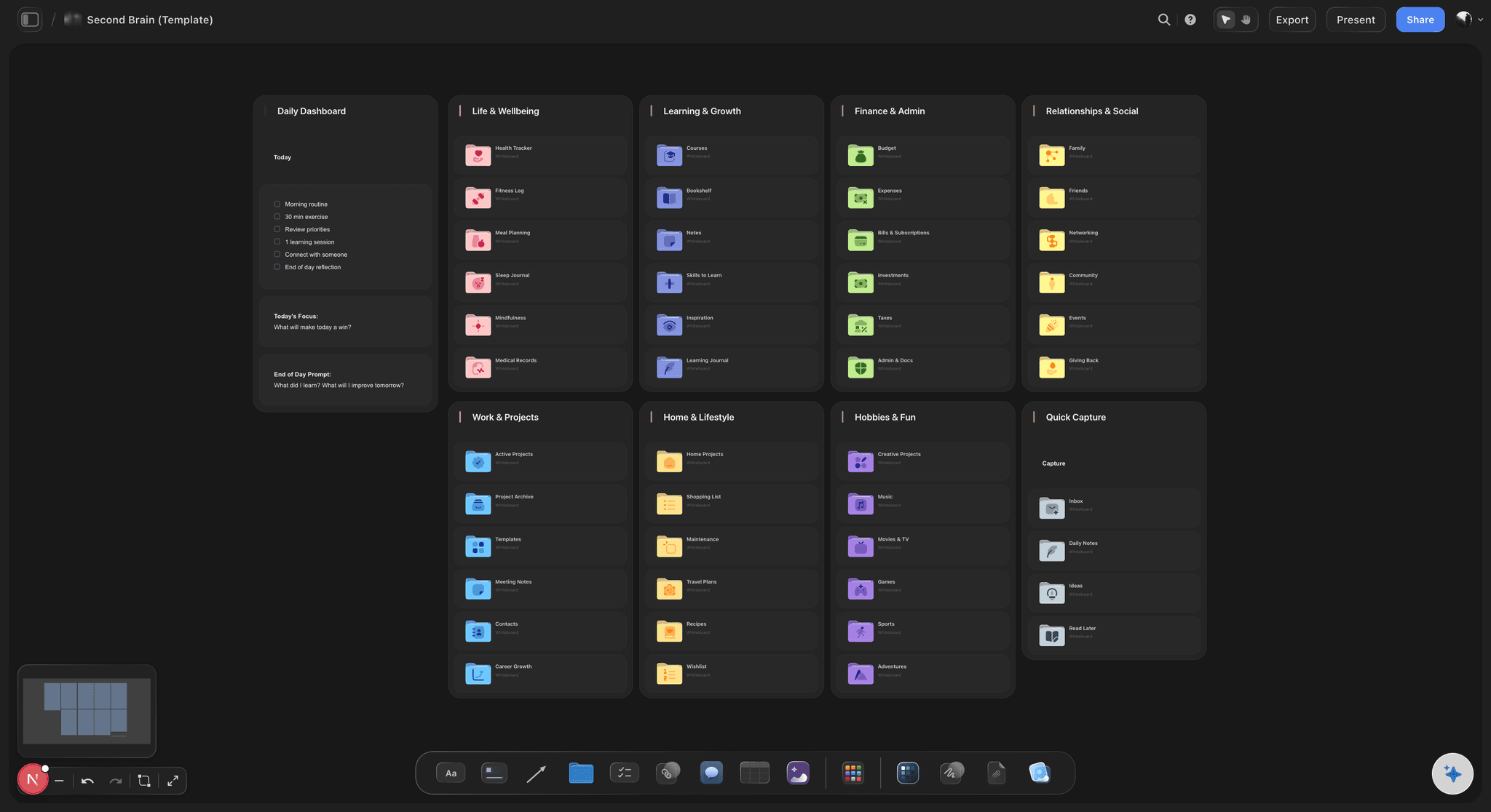
Everyone works the same prompt at once
Seven constraints beat one open question
The group takes a letter at a time, adding cards in parallel. Working under a named constraint reliably produces more and stranger material than being told to think of improvements.
See the brainstorming session planner →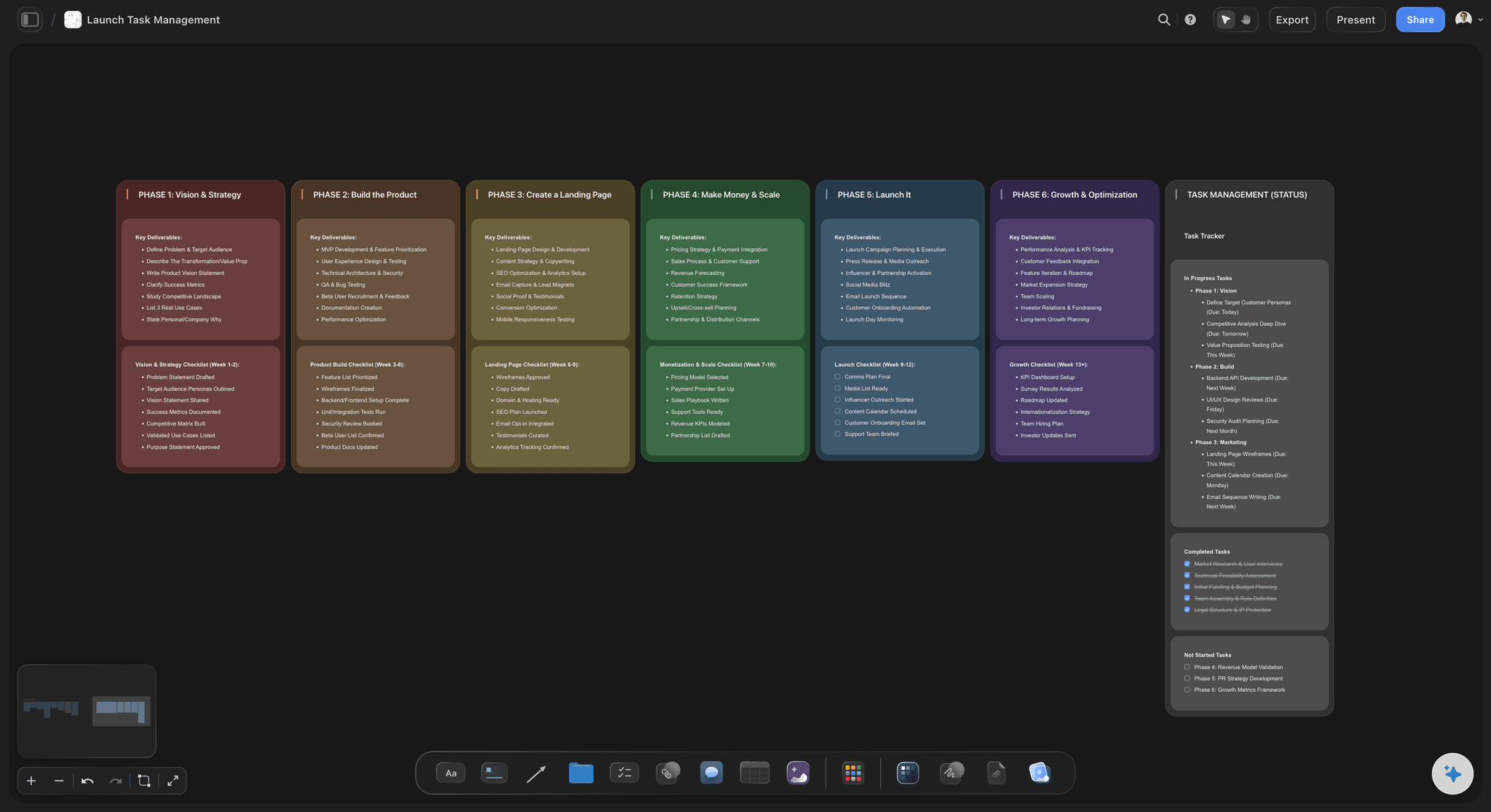
Cluster and shortlist at the end
Turn seven piles into two decisions
SCAMPER generates a lot. The convergent pass is what makes it worth an hour: cluster the output, mark what survives, and give the survivors owners before anyone leaves.
See the affinity diagram maker →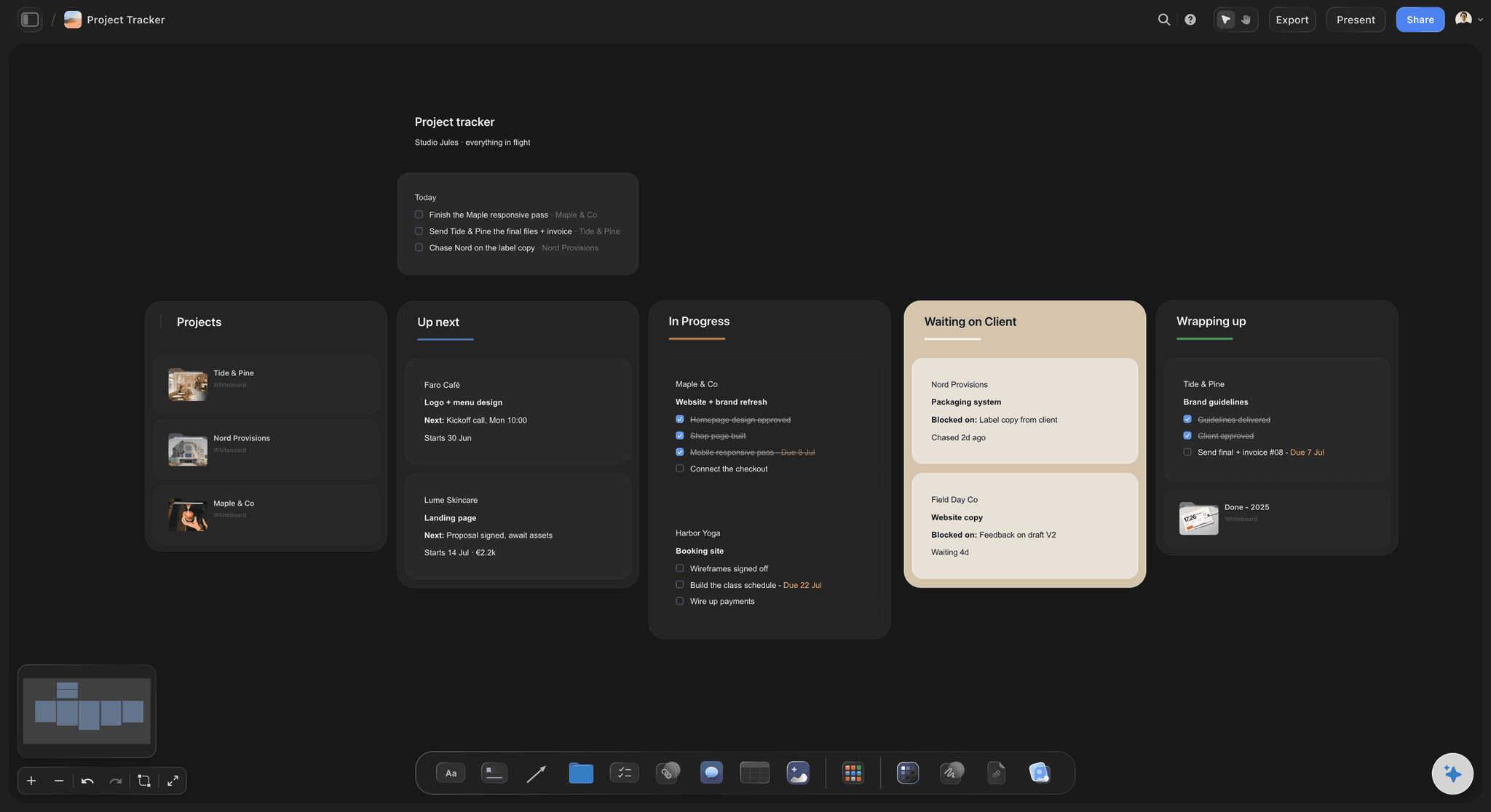
The board outlives the workshop
Keep the ideas that were only too early
SCAMPER's best output is often an idea that was right but premature. A live board makes it recoverable next quarter, which a photograph of a wall never does.
See the idea board →Unlimited boards. No object cap.
Open a canvas, describe what you are working on, and lay the seven prompts out. Storyflow is paid-only during early access, with plans from $9.99 a month, and a Free plan launches before the end of 2026.
Unlimited ideation boards on an infinite canvas
Basic AI usage to lay out frameworks from prompts
Sticky notes, cards, and image references on the board
Share view-only links with participants and stakeholders
Built for people with taste
More than a worksheet you print out.
The seven prompts are the easy part. Making the output survive the week is the hard part.
The seven prompts, used properly
Get real answers out of each letter
Substitute and Combine: What could be swapped for something else, and what could be merged with something else. Combine is where most cross-category product ideas come from, and it rewards looking outside your own market.
Adapt and Modify: What could be borrowed from a completely different context, and what could be exaggerated or shrunk. Modify works best when pushed to absurdity, because the useful answer is usually one step back from it.
Put to another use, and Eliminate: Who else could use this, and what could be removed entirely. Eliminate is the most uncomfortable prompt and the most valuable, because it is the only one that produces simpler products.
Reverse: Invert the order, the roles, or the assumption. What if the customer did this step, what if it ran backwards, what if we charged the other party. Reverse produces the fewest ideas and the strangest ones.
AI that can see the board you have already built
Push each prompt further with an AI that has the context
Prompt against the whole canvas: Ask it to push a letter that produced two thin answers, propose adaptations from a specific unrelated industry, or cluster the seven areas once the generating stops.
Use it to widen, not to conclude: The value of SCAMPER is the range of angles, so use the AI to add angles. A room handed a finished answer stops generating, which wastes the remaining five letters.
Iterate without losing work: Re-prompt as often as you want. Cards the group has written and grouped stay exactly where they are while the AI builds around them.
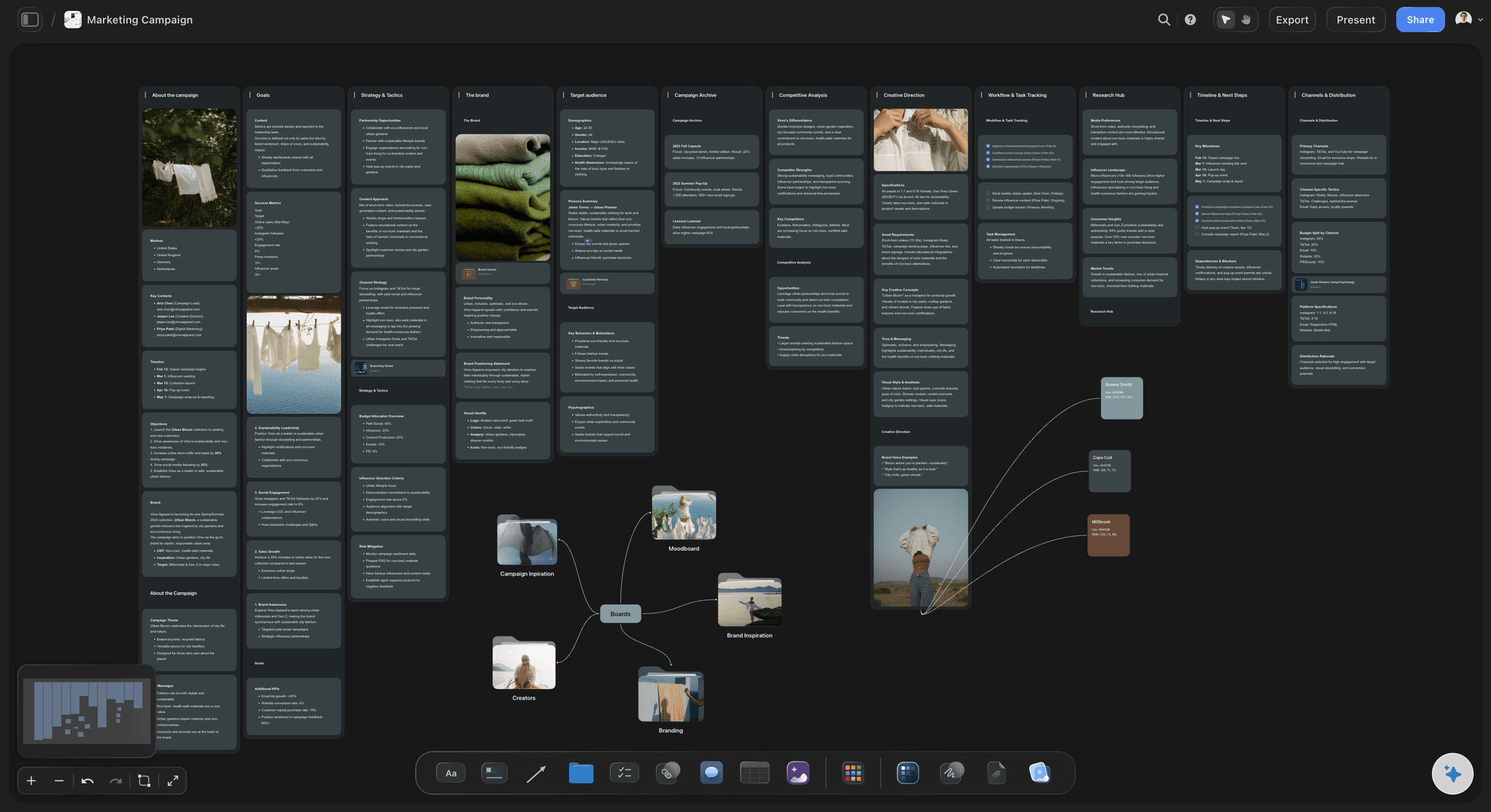
Products, services, campaigns, and content
Point it at anything that already exists
Products and features: Run it against a feature nobody uses, or an onboarding flow that has grown by accretion. Eliminate in particular tends to produce the change everyone wanted and nobody proposed.
Campaigns and creative: Apply the prompts to a campaign format that has stopped working. Reverse and Put to another use are unusually productive here, because marketing formats calcify quickly.
Services and operations: Point it at a process rather than a product. Substitute and Eliminate applied to a workflow usually surface the steps that exist because they always have.
After the session
Make the output into a shortlist, not a pile
Cluster before you judge: Seven areas of raw ideas contain a lot of duplication. Group them into themes first, because judging a theme is a very different and much better conversation than judging fifty individual cards.
Rank on effort and effect: Place the surviving ideas on a simple two-axis area rather than voting on them flat. A ranked shortlist is something a team can act on; a set of favourites is not.
Owners before anyone leaves: Two or three ideas with a name and a next step on each is a successful SCAMPER session. Seven full areas and no owners is a workshop everyone enjoyed and nothing came of.
Explore templates for your project
Every template opens as a real, editable board on the infinite canvas. Pick the closest fit and make it your own.
Mind Map
Branch one central idea out into themes and sub-points, then drag the connections around until the structure makes sense.
One app instead of five
Storyflow vs Miro, FigJam, and a printed worksheet.
Be clear about what Storyflow is. There is no built-in timer or voting widget. It is a canvas where the prompts, the output, and the shortlist stay together.
Storyflow
Recommended
Infinite canvas with an area per prompt
AI writes prompts for your specific case
Output stays live and searchable afterwards
Built-in timer and voting widgets
Works with no device at all
Free plan available today
Miro
Infinite canvas with an area per prompt
AI writes prompts for your specific case
Output stays live and searchable afterwards
Built-in timer and voting widgets
Works with no device at all
Free plan available today
FigJam
Infinite canvas with an area per prompt
AI writes prompts for your specific case
Output stays live and searchable afterwards
Built-in timer and voting widgets
Works with no device at all
Free plan available today
Printed worksheet
Infinite canvas with an area per prompt
AI writes prompts for your specific case
Output stays live and searchable afterwards
Built-in timer and voting widgets
Works with no device at all
Free plan available today
What creators are saying
Join early creators getting structured workspaces and AI that remembers their projects
“Storyflow has sped up my workflow by at least 3x, which means more flow state and more projects I can actually ship. It truly changed the way me and my team create.”

Reilin Joey
Director & YouTuber
“One prompt gets me a structured board. But the tactics are my favorite. I run my YouTube scripts through them and my intros and retention got better. It's amazing.”

Justkay
YouTuber & Freelance Filmmaker
“I used to juggle five apps to plan a project. Now I describe what I am making and get boards, lists, and a schedule. All in one place.”

George
@fernwehchronicles
SCAMPER questions, answered.
What each letter means, when the technique works, and where Storyflow fits alongside Miro and FigJam.
Substitute, Combine, Adapt, Modify, Put to another use, Eliminate, and Reverse. Each is a prompt applied to something that already exists. Substitute asks what could be swapped out. Combine asks what could be merged with something else, including things from other categories. Adapt asks what could be borrowed from a different context. Modify asks what could be magnified or shrunk. Put to another use asks who else could use this. Eliminate asks what could be removed entirely. Reverse asks what happens if the order, roles, or assumptions are inverted. The mnemonic was arranged by Bob Eberle from Alex Osborn's earlier brainstorming checklists.
Miro and FigJam both work well and both have templates, timers, and voting widgets, so if your team already lives in one of them there is no strong reason to move. A printed worksheet is fine for a solo session and stops working the moment more than one person is contributing. Storyflow is the option where the AI writes the seven prompts for your specific product or campaign rather than giving you seven generic labels, and where the output stays on the same canvas as the roadmap or campaign plan it feeds. Specific prompts are the single biggest difference in what a SCAMPER session produces.
Use it when there is an existing thing to work on: a product, a feature, a flow, a campaign format, a service, a piece of content. SCAMPER is a modification technique and it needs a subject. For genuinely blank-page problems, where there is no existing artifact, it produces thin results and you are better off with How Might We framing and a divergent exercise like Crazy 8s. The reliable signal is whether you can complete the sentence what could be eliminated from this. If you cannot, because there is no this yet, SCAMPER is the wrong tool for that session.
Not during early access. Storyflow is paid-only right now, with plans starting at $9.99 a month, and a Free plan for solo use launches before the end of 2026. Anyone a paid member invites to a board joins free today, so you can run a workshop with a full team or a client group without buying seats. If you need free this minute, FigJam's free tier and Miro's free tier both include SCAMPER templates, and a printed worksheet costs nothing at all. All three are honest options; none of them will write the seven prompts specifically for what you are working on.
About sixty to seventy-five minutes done properly. Give each letter four to six minutes, which is roughly thirty-five minutes of generating, then fifteen for clustering and another fifteen for ranking and assigning owners. Do not run all seven letters at a leisurely pace, because the fatigue is real and the last two letters, Eliminate and Reverse, are usually the most valuable. If time is short, run four letters properly rather than seven badly, and pick the four that fit the subject: Eliminate and Reverse for something bloated, Combine and Adapt for something stale.
Eliminate and Reverse, consistently, and they are the two teams most often skip because they arrive last and feel uncomfortable. Eliminate is the only prompt in the set that produces simpler products, and simplification is almost always the change users wanted and nobody proposed, because removing things feels like losing rather than improving. Reverse produces the fewest ideas and the strangest, which is exactly why it is worth reaching: inverting who does a step, or who pays, or what order things happen in, is where genuinely different business models come from rather than incremental feature work.
You describe what you are working on: the product, service, or campaign, who it is for, and what is currently not working. The AI lays out the seven SCAMPER areas with questions written for that specific subject rather than generic one-word labels. This is the difference between a room that stares at the word Adapt and a room answering what could this borrow from how streaming services handle cancellation. During the session it can also read the whole board, so you can ask it to push a letter that produced two thin answers or to cluster the output once generating stops.
Converge, in three steps, before anyone leaves. Cluster the raw cards into themes first, because seven areas contain a lot of duplication and judging a theme is a much better conversation than judging fifty individual notes. Then place the surviving themes on a simple effort-and-effect area rather than voting flat, since a ranked shortlist is actionable and a set of favourites is not. Then assign owners and next steps to the two or three at the top. Keep everything else on the board rather than deleting it: SCAMPER's most valuable output is frequently an idea that was right but early.
For viewing, yes: send a view-only link and anyone opens the board in a browser with no signup, and they sign in to comment on individual cards. For contributing during the session, invite them to the canvas, and invited collaborators join free, so running a workshop with a client team or a whole department does not cost you seats. Sharing, commenting, and reviewing work on every paid plan.
Yes, and it sequences particularly well. A common pattern is SCAMPER to generate broadly, then Crazy 8s to sketch the two or three directions that survived, then Six Thinking Hats when the group has to choose between them and keeps having the same argument. Because all three live on one infinite canvas in Storyflow, the lineage stays visible: the sketch sits next to the SCAMPER card it came from, and the decision sits next to both. That trail is worth keeping, because the question in three months is never what did we pick, it is why did we pick it.
Stop asking a room to be creative.
Open a canvas, describe what you are working on, and let AI write the seven prompts. No download.