
Audience insight without the busywork
Customer discovery interviews
that end in a decision.
Plan who you are talking to, ask everyone the same five questions, keep every answer as its own card, and group the cards until the pattern is something you can count rather than something you remember.


Creatives working for these brands already got early access
- Red Bull
- Canon
- Artlist
- Porsche
See how easy it is to get started
Watch a real project come together, from a blank board to a finished plan, clicked through step by step.
Start from a ready-made template
Pick a board to see what you can build, then let AI fill it in. Every template is a real, editable starting point on the same infinite canvas.

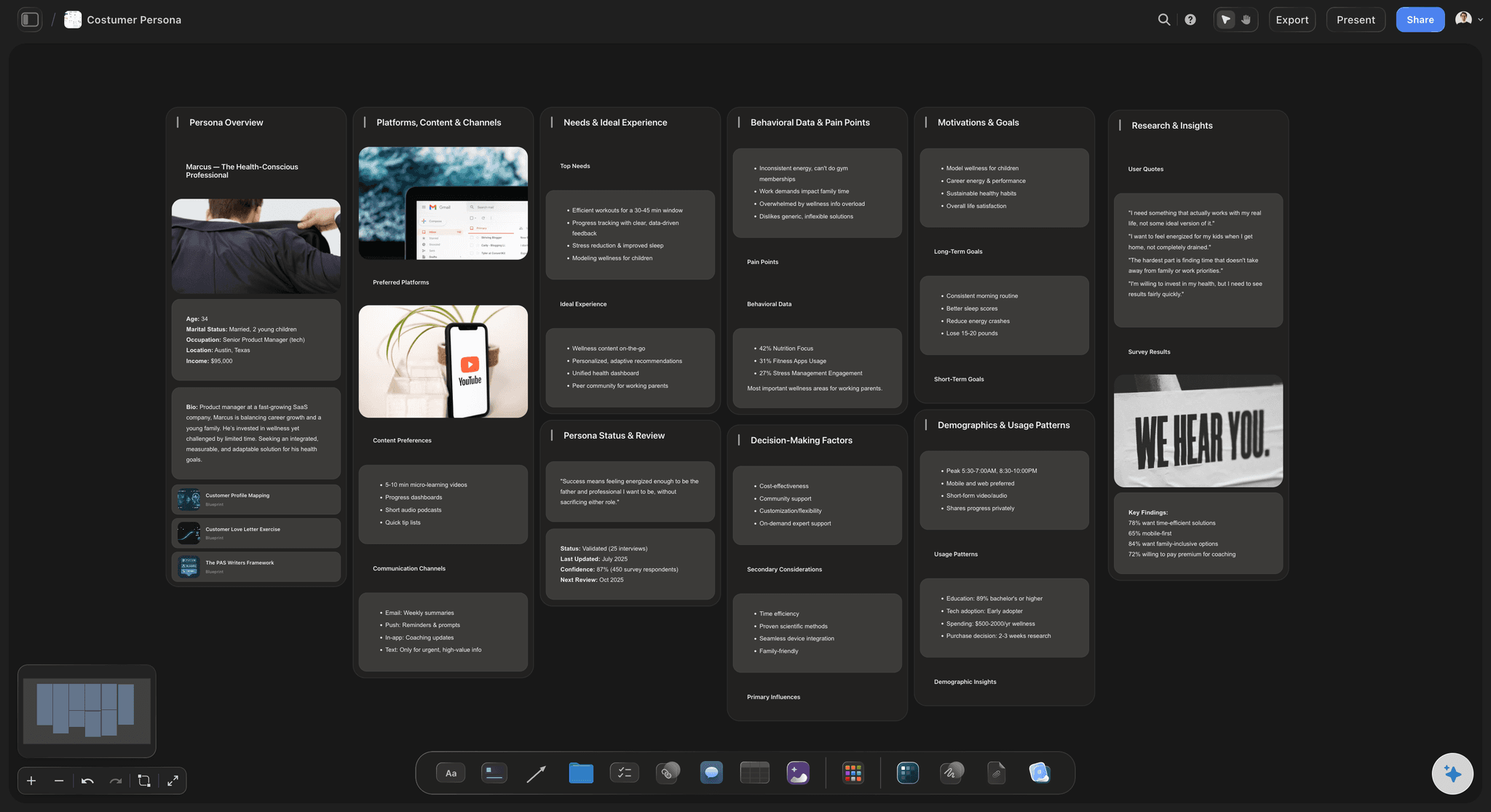
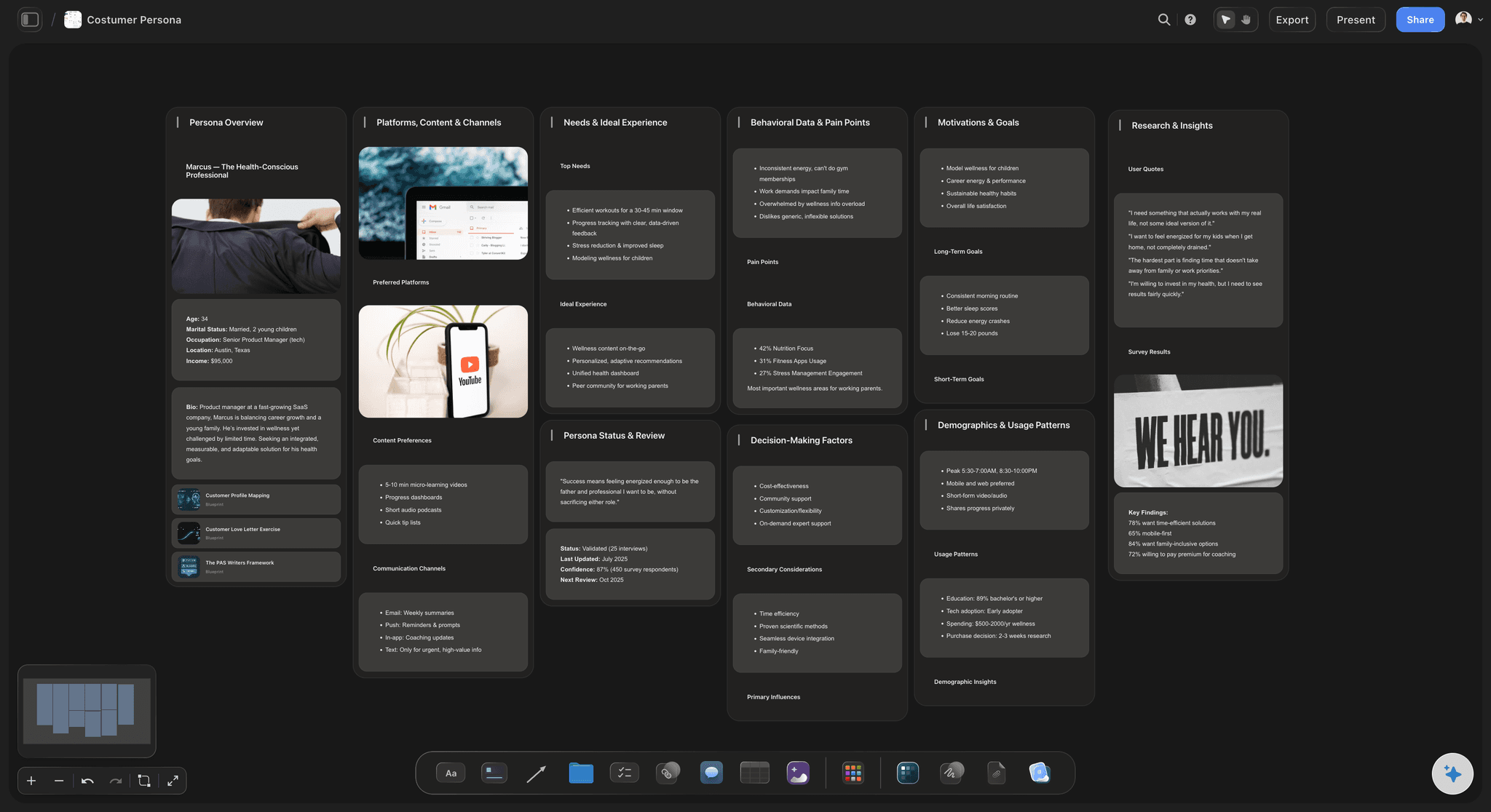
Customer Persona
Map who your customer is, what they need, and what holds them back, all in one profile.
How do you run customer discovery interviews?
Customer discovery interviews are the conversations you have before building, where you ask people what they actually do about the problem today instead of whether they would buy. Storyflow is an AI visual workspace that runs the whole round on one infinite canvas: the five questions, one card per quote, the counted themes, and the decision at the bottom. Its AI reads transcripts you attach and pulls the quotes out for you to sort.
Ask about the past, never the future. Would you use this is a question people answer politely and wrongly. What did you do the last time this happened gets you a story with dates, tools, money and irritation in it. Five questions are enough for a thirty minute call: what happened last time, what you did about it, what that cost you in time or money, what you tried before that and why it stopped, and who else is affected when it goes wrong.
Talk to ten to fifteen people in one group before you draw any conclusion. Fewer than that and you are collecting anecdotes; more than that without sorting them and you are collecting a backlog. If you are looking at two kinds of customer, that is two groups of ten to fifteen, kept separate on the board, because the thing that makes one group desperate often leaves the other unmoved.
Then count. Every quote is a card with the person's name or code on it, so when you drag cards into a theme you can see how many distinct people it came from, not just how many times it was said. A theme raised by nine of twelve people is a finding. The same sentence said four times by one enthusiastic customer is one person. Write the decision at the bottom of the board while the cards are still in front of you: build it, change it, or leave it.
Ultra fast from brief to board
Before the calls, during them, and the day after.
Roughly three weeks for a dozen conversations.
01
Write down who and why
One card per person you want to speak to, grouped by the kind of customer they are. Next to the groups, write the belief you are testing in one sentence. If you cannot write the belief, the calls will wander.
02
Fix the five questions
Everyone gets the same five, in the same order, so the answers can be compared later. Put them on the board where you can see them on the call. Follow-ups are free; changing the five halfway through the round is not.
03
Turn each call into cards, the same day
Attach the transcript or your notes and ask the AI for one card per quote. Add the person's code to each card. Doing it the same day matters: by Friday you will remember the tone of Tuesday's call and none of the words.
04
Group, count, decide
Drag cards together until the themes are obvious, then count the distinct people behind each one. Write the decision at the bottom in three lines: what you learned, what you are doing about it, and what would change your mind.
Plan, capture, group, decide.
Storyflow holds the thinking. Recruiting, recording and transcribing happen in the tools made for them.
Before you book anything
The belief you are testing, in one sentence
Written at the top of the board where every card sits under it. Discovery that starts without a stated belief tends to end with a founder who heard what they hoped to hear and cannot prove otherwise.
See the customer persona board →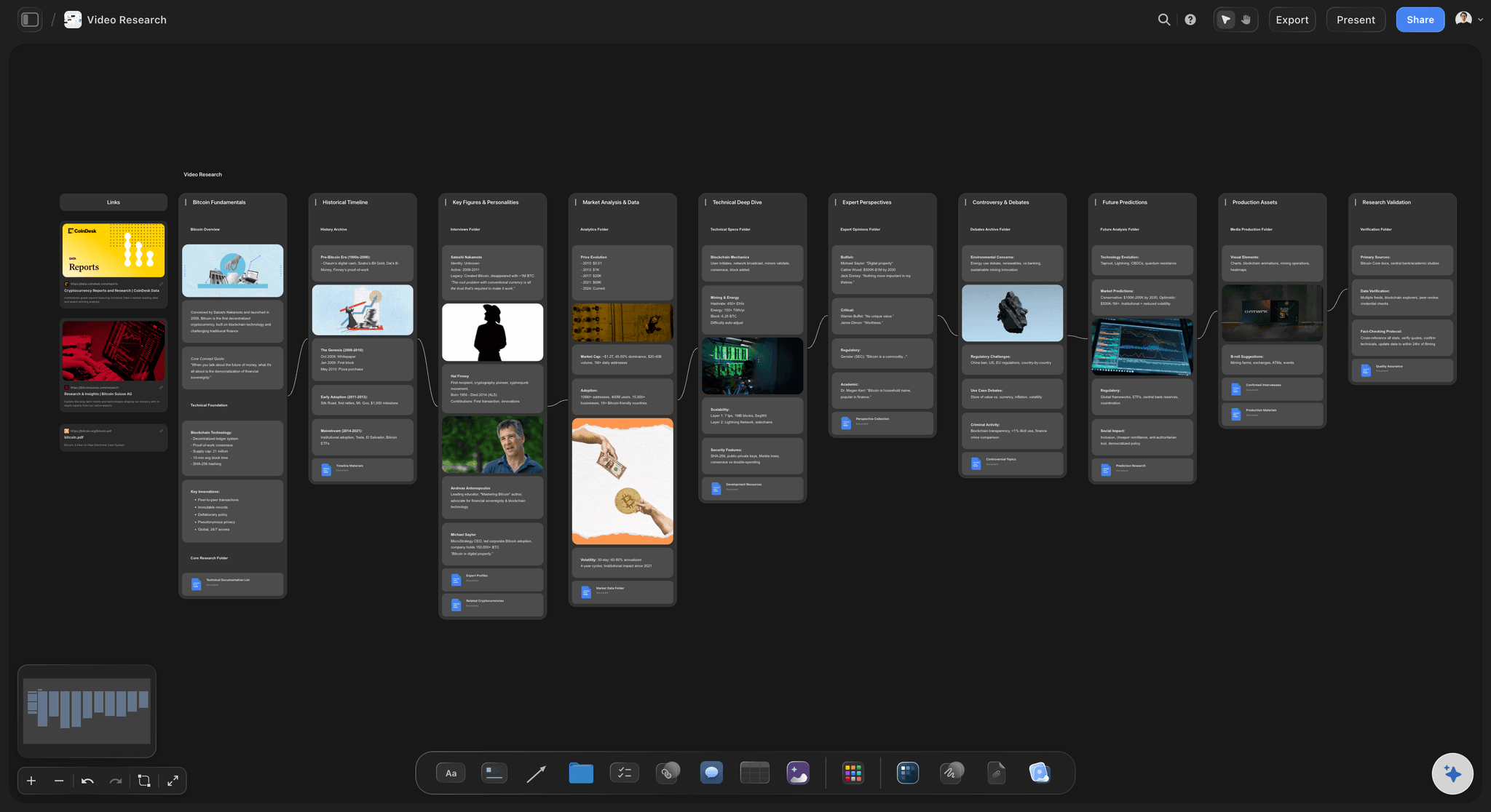
During the round
One card per quote, with a name on it
Attach a transcript and the AI lays the quotes out as cards. Tag each one with who said it. Later, a theme is not a feeling about the calls: it is nine cards from nine different people that you can point at.
See the UX research board →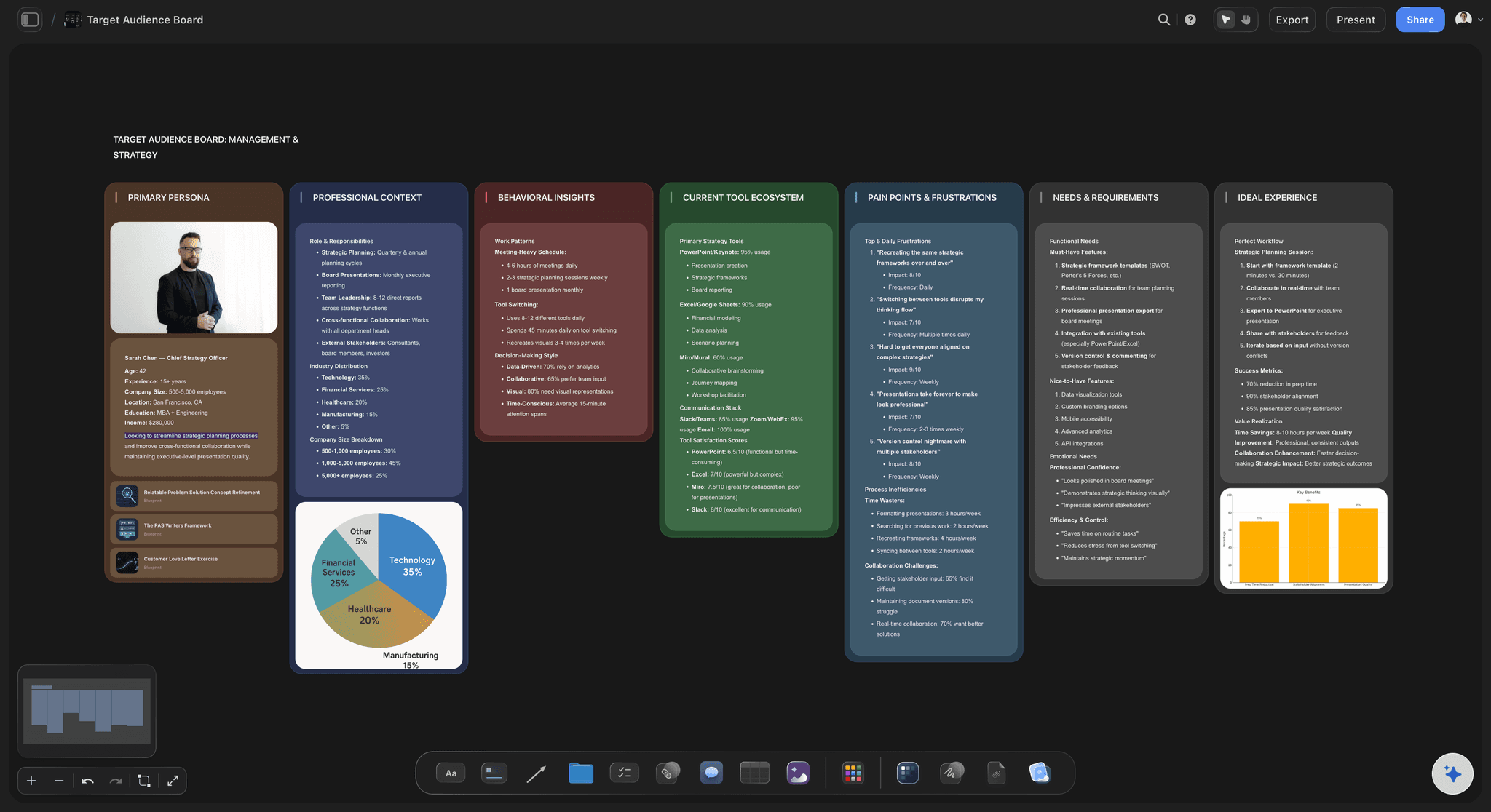
The part that gets skipped
Themes you can count
Drag cards into groups and read the number of distinct people under each. Add a table with one row per theme and a count column, so the strongest signal is a number rather than the thing said most recently.
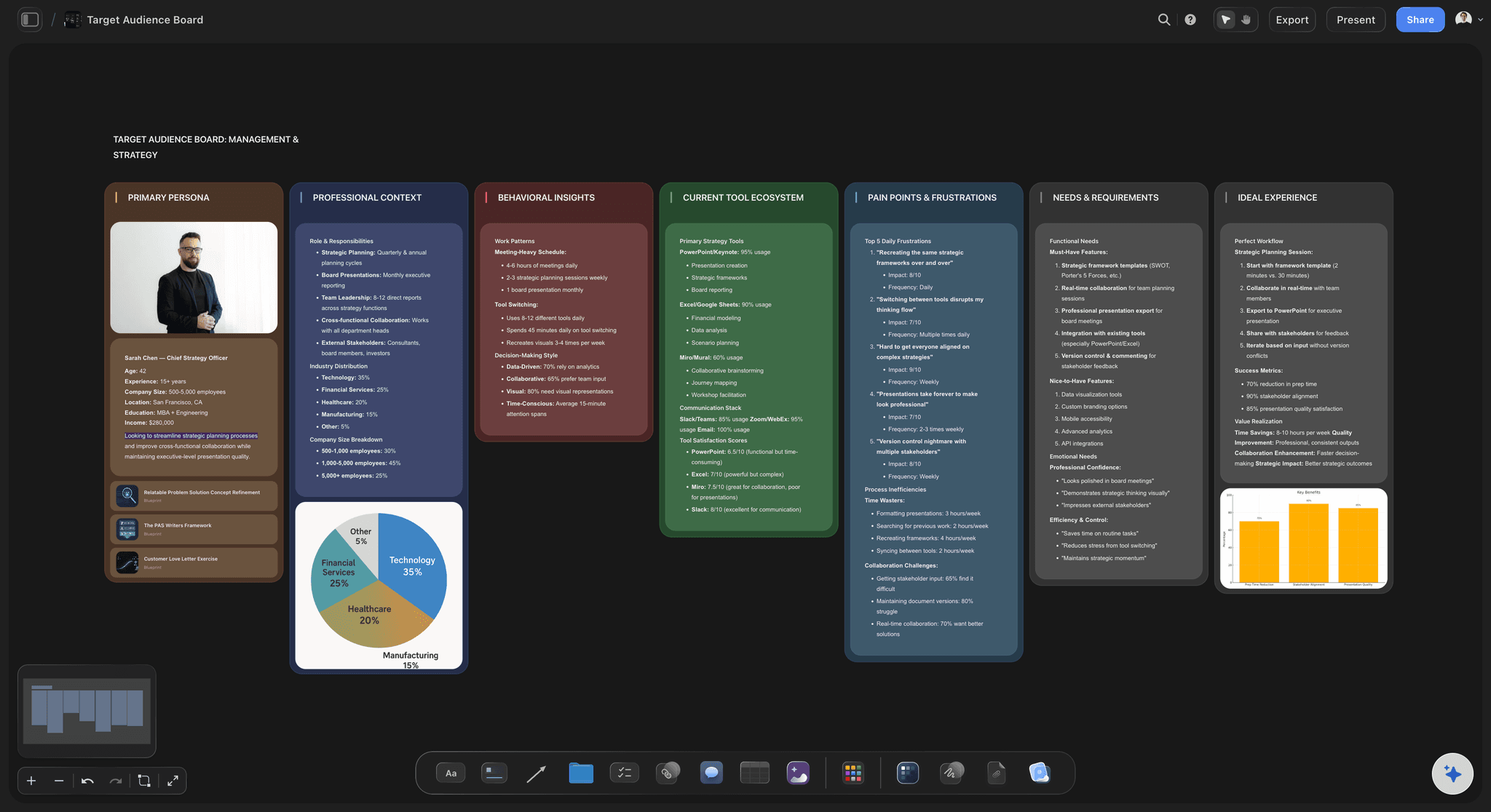
See the target audience board →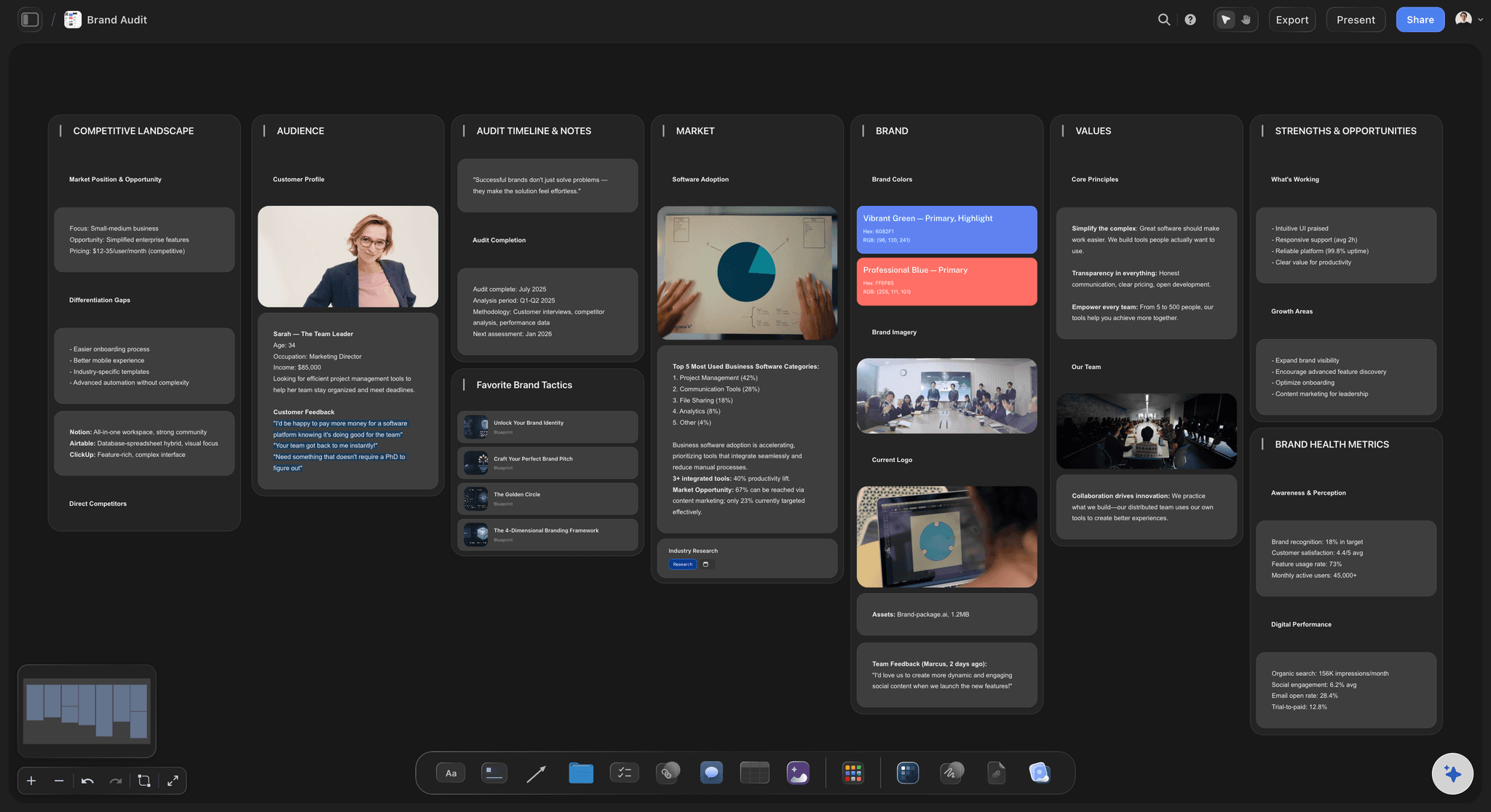
What it was all for
A decision written down while it is fresh
Three lines at the bottom of the board: what you learned, what you are doing, and what would change your mind. Share the board link with a co-founder or an investor; they read it with no account.
See the lean canvas →One board per round, so the old rounds still answer questions.
Six months later somebody asks whether customers ever mentioned pricing. The board from March says how many did, in their words. Storyflow is paid-only during early access, with plans from $7.99 a month billed annually ($9.99 monthly). A free plan launches before the end of 2026, and anyone a paid member invites to a board joins free.
Unlimited boards and file uploads on every paid plan
Bring a co-founder or a designer onto the board without buying them a seat
200+ Tactics for the research and audience boards around it
Whole-board PDF export when the findings go to a board meeting
Presentation mode for walking the team through what came back
Built for people with taste
Twelve good calls, nothing to show for them.
Almost always one of these three.
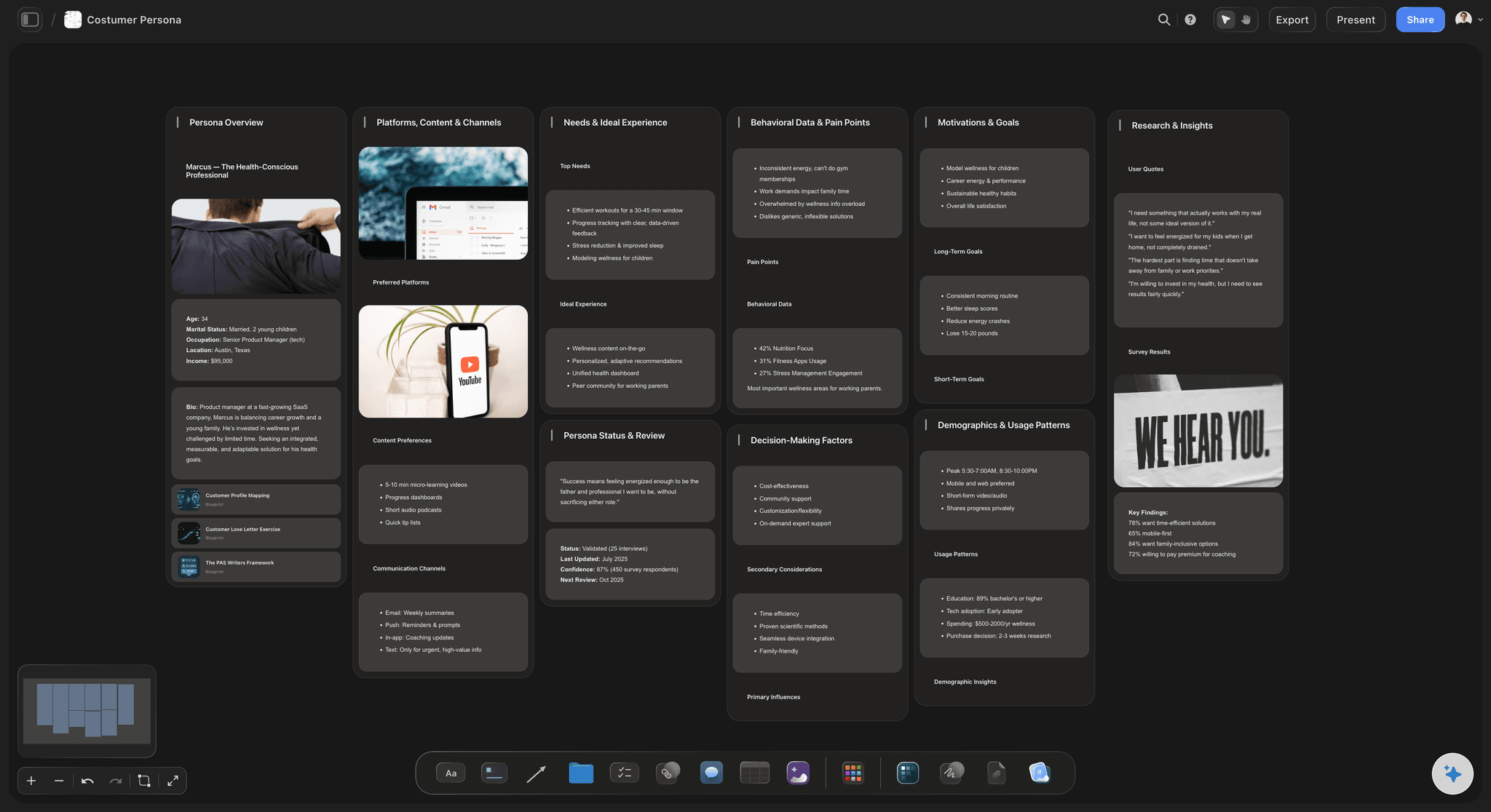
The questions
Asking people to predict themselves
Past tense only: What did you do the last time this happened, not what would you do. People are reliable historians of their own behaviour and unreliable forecasters of it.
Never describe the product first: Once you have explained what you are building, everything after it is a reaction to your idea rather than a report of their life. Save the demo for a separate call.
Ask what it cost: Hours, money, a lost client, a weekend. A problem that costs nothing measurable is a problem people live with happily, whatever they say about it on a call.
Same five, every time: Comparison is the whole value of doing twelve of these. Change the questions mid-round and you have twelve interesting conversations and no pattern.
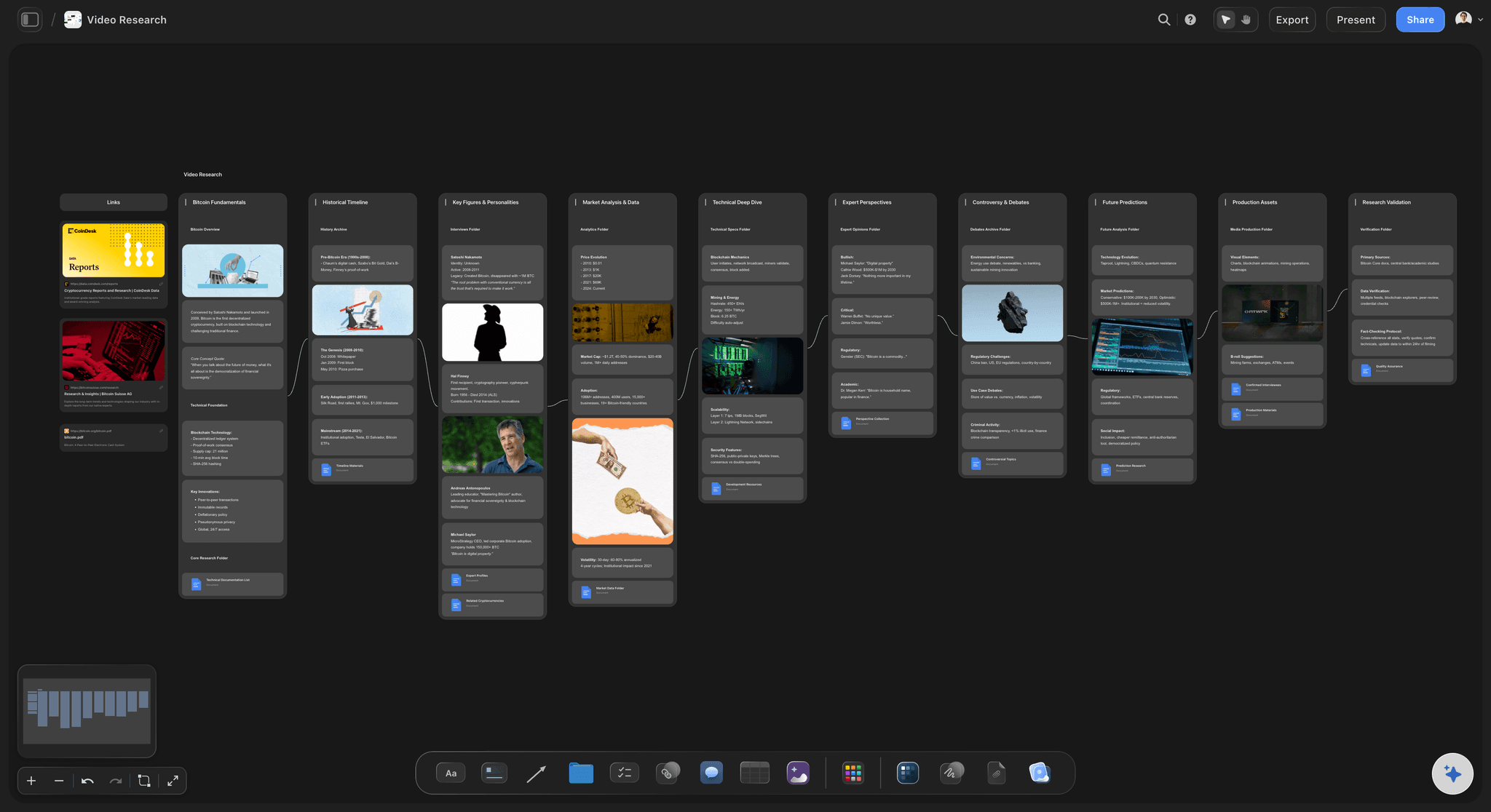
The notes
Transcripts nobody opens again
A transcript is not a finding: Twelve files of forty minutes each is an archive. Breaking them into quote cards the same day is what turns hours of listening into something you can actually sort.
Let the AI do the first pass: Attach the file and ask for one card per quote. Storyflow's AI reads attached files, including scripts and documents. You check what it pulled, because it will miss the quiet line that mattered.
Keep the words, not your summary: Cards carry the sentence the customer said. Your paraphrase already contains your conclusion, which is the thing you are trying to test.
Mark what they did, not what they felt: A card about a spreadsheet they built at midnight beats a card about being frustrated. Behaviour is evidence; frustration is a mood that passes by Thursday.
The ending
No decision, so the round never really closes
Count people, not mentions: Nine of twelve is a finding. Four cards from one talkative customer is one person with an opinion. The count is the difference between research and reassurance.
Write what would change your mind: One line saying what evidence would reverse the decision. It is the cheapest protection there is against quietly reinterpreting the same twelve calls next quarter.
Separate the two customer groups: Keep each group's cards apart. A theme that is overwhelming in one group and absent in the other is usually telling you which group to build for first.
Send the board, not a summary deck: Co-founders and investors can open the link with no account and read the actual quotes. Signing in lets them leave a comment on the card they disagree with.
Explore templates for your project
Every template opens as a real, editable board on the infinite canvas. Pick the closest fit and make it your own.
Customer Persona
Map who your customer is, what they need, and what holds them back, all in one profile.
One app instead of five
What this replaces and what it does not.
Storyflow is the planning and the sense-making. It does not find people or record the call.
Storyflow
Recommended
Interview plan and questions on the board
AI turns transcripts into quote cards
Themes grouped by dragging
Decision written beside the evidence
View-only link, no account to read
Recruits and schedules participants
Records and transcribes the call
Research platforms
Interview plan and questions on the board
AI turns transcripts into quote cards
Themes grouped by dragging
Decision written beside the evidence
View-only link, no account to read
Recruits and schedules participants
Records and transcribes the call
A notes doc and a spreadsheet
Interview plan and questions on the board
AI turns transcripts into quote cards
Themes grouped by dragging
Decision written beside the evidence
View-only link, no account to read
Recruits and schedules participants
Records and transcribes the call
What creators are saying
Join early creators getting structured workspaces and AI that remembers their projects
“Storyflow has sped up my workflow by at least 3x, which means more flow state and more projects I can actually ship. It truly changed the way me and my team create.”

Reilin Joey
Director & YouTuber
“One prompt gets me a structured board. But the tactics are my favorite. I run my YouTube scripts through them and my intros and retention got better. It's amazing.”

Justkay
YouTuber & Freelance Filmmaker
“I used to juggle five apps to plan a project. Now I describe what I am making and get boards, lists, and a schedule. All in one place.”

George
@fernwehchronicles
Customer discovery questions
What founders ask before they book the first call.
Storyflow puts the whole round on one board: the belief you are testing, who you are speaking to, the same five questions for everyone, one card per quote from each call, those cards grouped into themes you can count, and the decision written underneath. Attach a transcript and the AI pulls the quotes out as cards for you to sort.
Storyflow was made for this exact job: the belief you are testing at the top, the same five questions for everyone, one card per quote with the speaker's code on it, and themes you group by dragging until the count is something you can point at. Recruiting, recording and transcribing still happen in the tools built for them, such as User Interviews, Zoom and Otter.
Ten to fifteen people in one group before you conclude anything. Under ten you are collecting anecdotes. If you are testing two kinds of customer, that is two groups of ten to fifteen, kept apart on Storyflow's board, because a problem that is urgent for one group is often invisible to the other.
Five, all about the past: what happened the last time this problem came up, what you did about it, what that cost you in time or money, what you tried before and why you stopped, and who else it affects when it goes wrong. Follow-ups are free. Never ask whether they would use your product.
Not in a discovery call. Once people know what you are building, everything they say afterwards is a reaction to your idea instead of a report of their life. Run a separate demo call later, with different questions, and keep those notes on a different part of the board.
Yes. Attach the transcript and ask for one card per quote. Storyflow's AI reads attached files and lays the quotes out for you to tag and group. Check what it pulled: it finds the obvious lines and can miss the quiet sentence in minute twenty-six that turns out to be the finding.
Storyflow is where the calls are planned and where the answers get turned into something you can act on. It does not record or transcribe. Record in Zoom, Google Meet or Riverside, transcribe with a tool such as Otter or Grain, and bring the text to the board.
Storyflow's board holds who you are talking to, when, and what you want to learn from each of them. It does not recruit or schedule. That happens elsewhere: your own customer list, your network, or a panel service such as User Interviews or Respondent.
Count distinct people, not mentions. Each quote card carries the name or code of who said it, so a theme is nine cards from nine people or four cards from one. A table with a row per theme and a count column keeps that honest when the loud interview is still fresh in your head.
Write three lines at the bottom of Storyflow's board: what you learned, what you are doing about it, and what evidence would change your mind. That last line is what stops the same twelve calls being reinterpreted to suit whatever you feel like building next quarter.
Yes. Several people can be on a board together, which is how grouping cards tends to work best. Anyone a paid member invites to a board joins free, and anybody with a view-only link can read it in a browser with no account at all.
Storyflow's table takes a row per theme and a count column, and you drag the rows into whatever order you want. It cannot sort a table for you. Most people move the strongest three themes to the top by hand, which takes a few seconds and keeps the themes in the order you decided they mattered.
Yes, and mixing them ruins both. Discovery asks what the person does today, with no product shown. Usability testing watches someone use a thing you built. Different questions, different weeks, different boards. The UX research board is the one for testing an interface.
More from Storyflow
Customer persona generator
UX research board
Customer journey mapping tool
Value proposition canvas
AI value proposition generator
Lean canvas
Business model canvas
Go-to-market plan
Seed round deck
Product roadmap
Storyflow for startups
Personal brand plan
Brand positioning workshop
Affinity map with ChatGPT
Target audience template
Card sorting tool
Twelve calls, one board, one decision.
Plan who you talk to, keep every word they said, and count what came back.