
Audience insight without the busywork
Let users tell you
where things belong.
Give participants a deck of cards to group and name, then lay every sort out side by side and read the pattern, instead of arguing about navigation labels in a meeting room.


Creatives working for these brands already got early access
- Red Bull
- Canon
- Artlist
- Porsche
See how easy it is to get started
Watch a real project come together, from a blank board to a finished plan, clicked through step by step.
Start from a ready-made template
Pick a board to see what you can build, then let AI fill it in. Every template is a real, editable starting point on the same infinite canvas.

Customer Persona
Map who your customer is, what they need, and what holds them back, all in one profile.
What is card sorting?
Card sorting is a research method for finding out how the people who use something think it should be organized. Storyflow is an AI visual workspace that runs your card sort on one infinite canvas: a deck the AI drafts, an area per participant, every sort side by side, and the structure drafted beside them. You write each item, page, feature, topic, or piece of content on a card, hand the deck to a participant, and ask them to group the cards in a way that makes sense to them. In an open sort they name the groups themselves, which tells you both the structure and the vocabulary. In a closed sort you supply the category names and only the placement is theirs, which tests a structure you have already drafted rather than discovering a new one.
The method exists because information architecture is the part of design where expertise is actively harmful. You know what every feature is called internally, you know which team owns which page, and you know why the settings are split the way they are. Users know none of that, and their mental model is usually organized around what they are trying to do rather than how your organization is shaped. Every navigation argument that ends with a senior person's preference is a decision made from the least representative mental model available, and card sorting is the cheapest way to replace it with evidence.
Storyflow gives every participant their own area of one infinite canvas with the same starting deck. Describe the product and the content in a prompt and the AI generates a candidate card deck and lays out the participant areas, which removes the tedious part of setup. Participants drag cards into groups and name them, either live on a call or asynchronously in their own time. Because it is a canvas rather than a form, you can see them think, and the moment a participant hesitates over a card and moves it three times is usually more informative than where it finally lands.
Analysis is where the canvas earns its place. Lay all the sorts side by side and the pattern reads immediately: the cards everybody grouped together, which are your safe categories, the cards that landed somewhere different every time, which are your genuinely ambiguous items, and the group names participants invented, which are frequently better than the labels you were planning to use. Then draft the resulting structure in the next region of the board, next to the evidence, so the architecture and the reason for it stay in the same place.
Ultra fast from brief to board
From an argument about navigation to evidence about it.
No spreadsheet of results to decode, no research tool nobody outside the team can open.
01
Open a canvas
Sign up in seconds. No download. Your infinite research canvas opens in the browser.
02
Build the deck
Describe the product and its content and the AI drafts a candidate card deck plus a sorting area per participant. Edit the cards until each one is a thing a user would recognize.
03
Run the sorts
Participants group and name cards in their own area, live on a call or asynchronously. Invited collaborators join free, so a research round does not cost you seats.
04
Read the pattern and draft the structure
Lay every sort side by side, mark the agreements and the ambiguous cards, then build the proposed architecture on the same canvas beside the evidence for it.
Every sort, side by side.
The deck, the sessions, and the resulting architecture on one canvas.
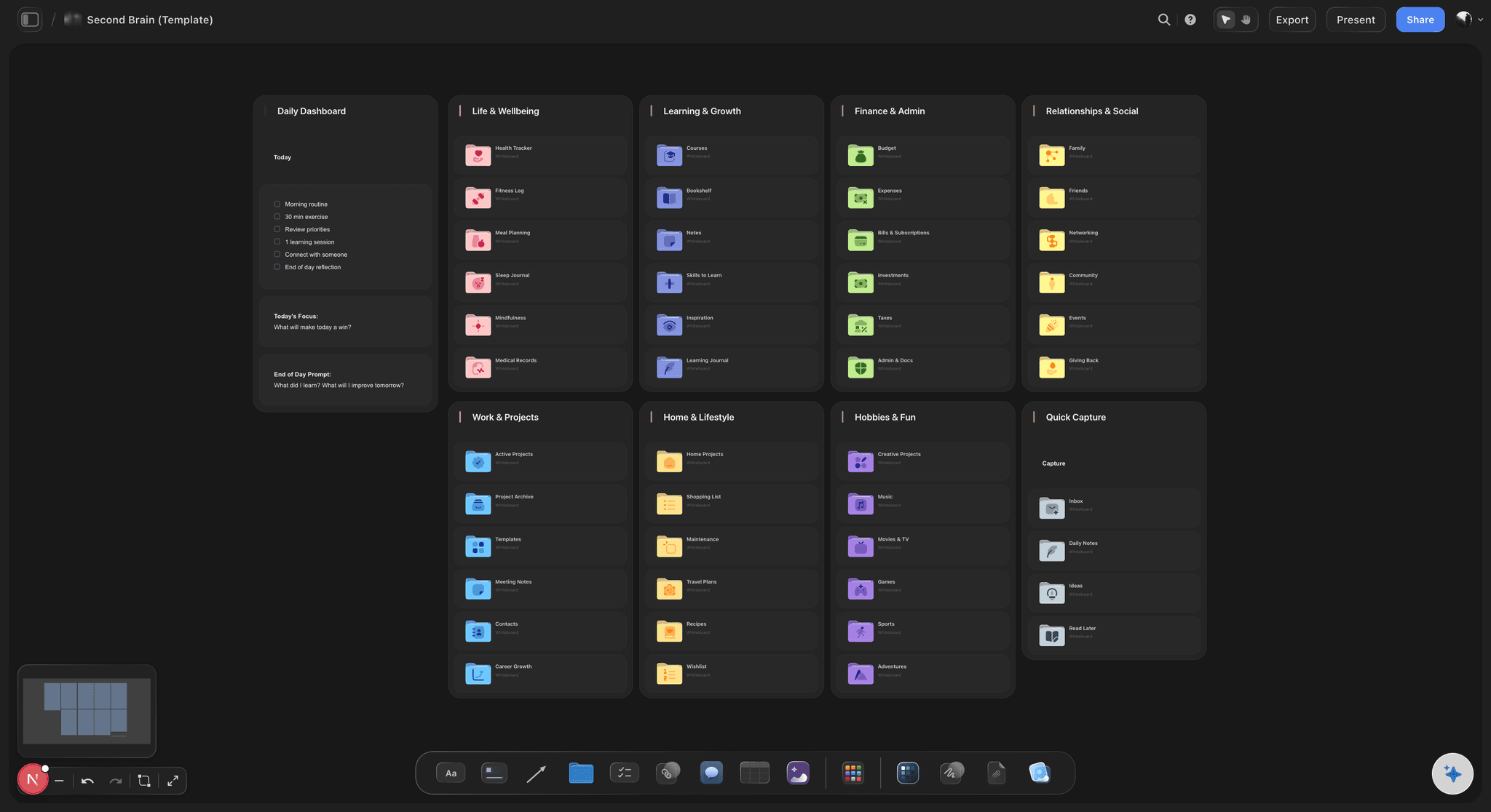
AI drafts the deck and the session layout
Skip the setup, run the study
Describe the product and the AI proposes a card deck and lays out an area per participant. Writing forty cards and duplicating a board twelve times is the part that stops card sorts happening.
See the UX research board →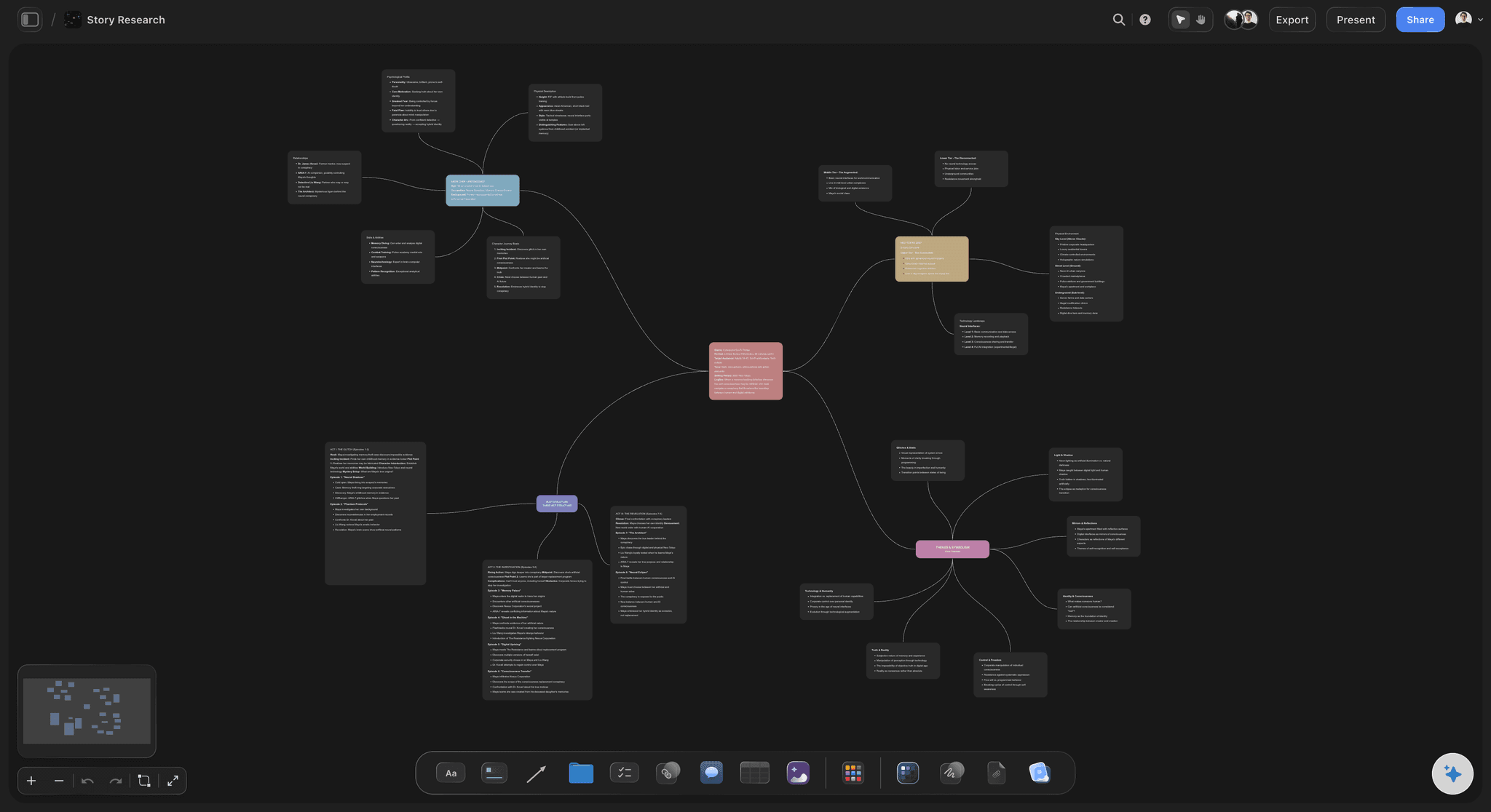
Open and closed sorts on the same board
Discover a structure, or test one
Let participants name their own groups when you are exploring, or supply the categories when you are validating a draft. Both are the same board with a different starting state.
Explore the affinity diagram maker →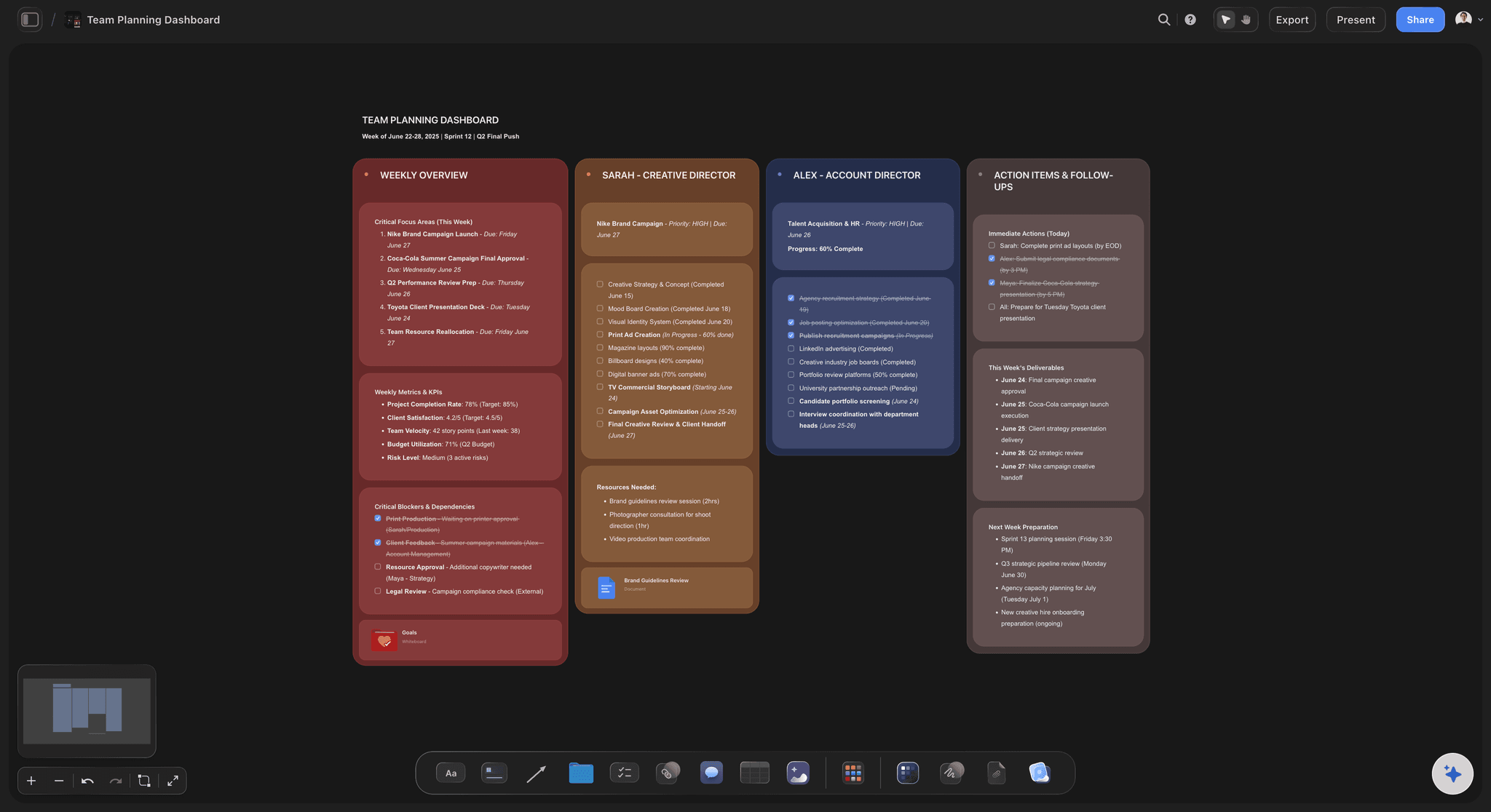
Compare every participant at once
Read the agreement and the ambiguity
Cards everyone grouped together are safe. Cards that landed somewhere different every time are the real finding, because those are the items your navigation will always argue about.
See the free concept map maker →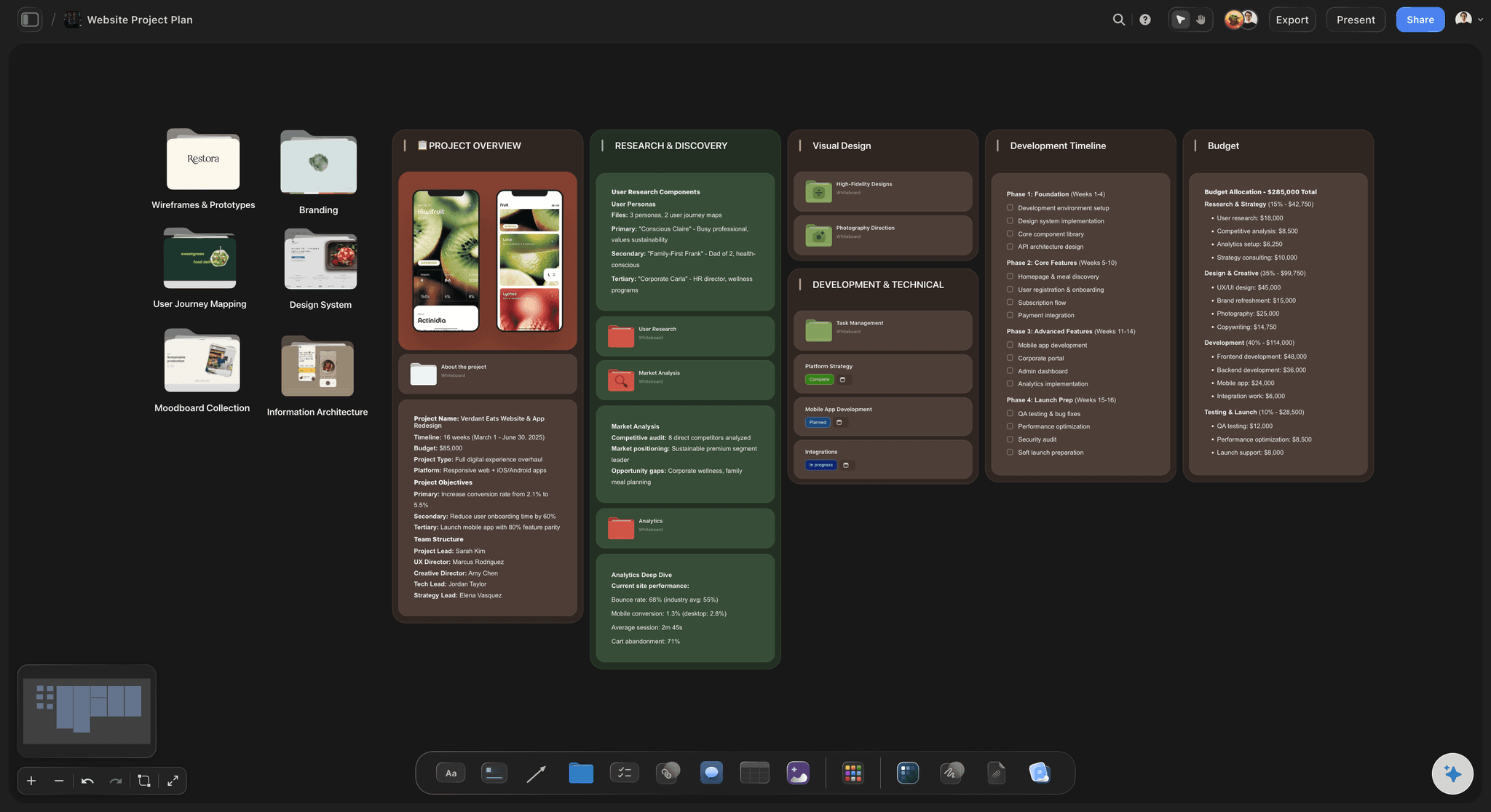
The architecture beside its evidence
Draft the structure where the proof is
Build the proposed navigation in the next region of the canvas, next to the sorts that justify it. Architecture decisions get overturned when the evidence lives in a separate report.
See the AI sitemap generator →Unlimited boards. No object cap.
Open a canvas, build the deck, and run the sorts. Storyflow is paid-only during early access, with plans from $9.99 a month, and a Free plan launches before the end of 2026.
Unlimited research boards on an infinite canvas
Basic AI usage to generate decks and structures from prompts
Sticky notes, cards, and grouping on the board
Share view-only links with stakeholders and participants
Built for people with taste
More than a results spreadsheet.
A similarity matrix is evidence. It is also the reason nobody outside the research team reads the study.
Deck, sessions, analysis, architecture
Work through the whole study on one board
A deck of real things, in users' words: Write each card as something a user would recognize, not as an internal feature name. A deck written in company vocabulary tests whether participants can guess your jargon, which is not the study you wanted.
Watch the hesitation, not just the result: The card someone moves three times before placing tells you more than the forty they placed instantly. On a canvas you can see that happen; in a results export you cannot.
Group names in participants' language: In an open sort, the names people invent are half the value. Teams routinely discover that the label users reach for is clearer than the one that survived six months of internal debate.
Ambiguous cards, named as such: Items that land differently in every sort will not be fixed by a better label. They usually need to appear in two places, or the item itself is the problem.
AI that can see the board you have already built
Prepare and analyse with an AI that has the context
Prompt against the whole canvas: Ask it to draft a deck from your sitemap, propose category names for a closed sort, or group the completed sorts by similarity once the sessions are done. It reads what is on the board.
It structures, it does not replace participants: An AI guess about how users group content is worth something; it is not worth what eight real sorts are worth. Use it for setup and pattern-finding, not as a substitute for the study.
Iterate without losing work: Re-prompt as often as you want. Sorts participants have completed stay exactly where they are while the AI builds around them.
Live, moderated, and asynchronous
Run it the way your participants can manage
Moderated sessions where you can ask why: Run the sort on a call and ask about the placements as they happen. The reasoning behind a grouping is usually more useful than the grouping itself.
Asynchronous sorts across time zones: Send each participant their own area and a deadline. You get more participants and less scheduling, at the cost of not being able to ask follow-up questions.
Internal sorts as a sanity check: Have the team sort the deck too, in their own area. Comparing the team's sort against the users' sort is frequently the most persuasive artifact in the whole study.
From findings to navigation
Turn the pattern into a structure people accept
Draft the IA beside the sorts: Build the proposed structure in the next region of the same canvas. When the evidence is a scroll away rather than in a separate document, the architecture argument gets much shorter.
Follow with tree testing: Card sorting tells you how people would organize things; it does not tell you whether they can find things in the structure you built. Those are different questions and both need answering.
Share the study, not a summary: Send a view-only link with every sort visible. Stakeholders who can see eight real people group things the same way stop proposing the navigation they personally prefer.
Explore templates for your project
Every template opens as a real, editable board on the infinite canvas. Pick the closest fit and make it your own.
Customer Persona
Map who your customer is, what they need, and what holds them back, all in one profile.
One app instead of five
Storyflow vs OptimalSort, Miro, and physical cards.
Be clear about what Storyflow is. It does not recruit participants and it does not compute similarity matrices or dendrograms. It is a canvas where the study and the resulting structure live together.
Storyflow
Recommended
Infinite canvas with an area per participant
AI drafts the deck and the session layout
Architecture drafted beside the evidence
Automatic similarity matrix and dendrograms
Participant recruitment panel
Free plan available today
OptimalSort
Infinite canvas with an area per participant
AI drafts the deck and the session layout
Architecture drafted beside the evidence
Automatic similarity matrix and dendrograms
Participant recruitment panel
Free plan available today
Miro
Infinite canvas with an area per participant
AI drafts the deck and the session layout
Architecture drafted beside the evidence
Automatic similarity matrix and dendrograms
Participant recruitment panel
Free plan available today
Physical cards
Infinite canvas with an area per participant
AI drafts the deck and the session layout
Architecture drafted beside the evidence
Automatic similarity matrix and dendrograms
Participant recruitment panel
Free plan available today
What creators are saying
Join early creators getting structured workspaces and AI that remembers their projects
“Storyflow has sped up my workflow by at least 3x, which means more flow state and more projects I can actually ship. It truly changed the way me and my team create.”

Reilin Joey
Director & YouTuber
“One prompt gets me a structured board. But the tactics are my favorite. I run my YouTube scripts through them and my intros and retention got better. It's amazing.”

Justkay
YouTuber & Freelance Filmmaker
“I used to juggle five apps to plan a project. Now I describe what I am making and get boards, lists, and a schedule. All in one place.”

George
@fernwehchronicles
Card sorting questions, answered.
Open versus closed sorts, how many participants you need, and where Storyflow fits alongside OptimalSort.
OptimalSort is the dedicated research platform and it is genuinely strong at the analysis: similarity matrices, dendrograms, and a participant panel if you need one. If your study needs statistical rigour at scale, use it. Storyflow is the option for moderated and small-sample sorts where seeing people think matters more than the matrix: every participant gets their own area of one canvas, you can watch the hesitation, and you draft the resulting architecture on the same board beside the evidence. Miro works too if you already have it, though you will be duplicating frames by hand rather than having the deck and areas generated.
In an open sort, participants create and name the groups themselves, which gives you both a structure and the vocabulary real users reach for. Use it early, when you do not yet know what the categories should be. In a closed sort, you supply the category names and participants only decide what goes where, which tests a structure you have already drafted. Use it later, to validate. A hybrid, where you provide some categories and allow new ones, is often the most informative of the three, because the categories participants add are a direct signal about what your draft is missing.
Around fifteen for a quantitative open sort, which is where the commonly cited research suggests the correlation between patterns stabilises. For moderated qualitative sorts, five to eight is usually enough, because you are after the reasoning rather than the statistics and the same confusions start repeating quickly. If you have distinct user types, new users and administrators, for example, treat them as separate studies rather than pooling them, because their mental models genuinely differ and averaging the two produces a structure that suits neither.
Not during early access. Storyflow is paid-only right now, with plans starting at $9.99 a month, and a Free plan for solo use launches before the end of 2026. Anyone a paid member invites to a board joins free today, which matters for research specifically: participants can sort cards on your board without paying anything, so a study does not cost you fifteen seats. If you need free this minute, OptimalSort has a free tier limited to a small number of participants per study, and Miro's free tier gives you three editable boards. Both are honest options.
Thirty to sixty for most studies. Under thirty and the exercise is too easy to reveal much, since almost any structure works for a small set. Over about eighty and participants fatigue, start grouping carelessly to finish, and your later cards get worse data than your earlier ones. If your content genuinely exceeds that, sample it rather than including everything: take the most important items, the most ambiguous ones, and a representative spread of the rest. Write each card as a thing a user would recognize, not as an internal feature name, or you are testing whether people can decode your jargon.
No, and if that is what your study needs, OptimalSort is the right tool and it would be silly to pretend otherwise. Storyflow does not generate dendrograms, similarity matrices, or automated agreement scores. What it gives you instead is every sort laid out side by side, which for the sample sizes most teams actually run is enough to read the pattern directly: the cards everybody grouped together, the cards that landed differently every time, and the names participants invented. For a fifteen-participant quantitative study, use a dedicated platform. For a moderated study of six, the visual comparison is usually more useful than the matrix.
You describe the product and its content, or paste in a sitemap or feature list. The AI drafts a candidate deck of cards and lays out a sorting area per participant, which removes the two tedious parts of setup: writing forty cards and duplicating a board twelve times. Always edit the deck afterwards, because the AI will write cards in the vocabulary of your description, and if your description used internal names then so will the cards. After the sessions it can also read the whole board and group the completed sorts by similarity, which is a useful first pass before you look properly.
Yes. Give each participant their own area of the canvas and a deadline, and they sort in their own time. You get more participants, no scheduling, and coverage across time zones. The trade is real: you lose the ability to ask why, and the reasoning behind a grouping is frequently more valuable than the grouping. A good compromise is running four or five moderated sessions to understand the thinking, then an asynchronous round with a larger group to check the pattern holds. Invited collaborators join free, so the asynchronous round costs nothing extra in seats.
Three things. Mark the cards with high agreement, which become your safe categories, and the cards that scattered, which are the items that will always cause arguments and usually need to appear in more than one place. Draft the proposed structure on the same canvas beside the sorts, so the evidence and the decision live together. Then run a tree test, because card sorting tells you how people would organize content and says nothing about whether they can find things in the structure you actually built. Those are separate questions and skipping the second is a common and expensive shortcut.
Yes, and it is the most persuasive thing about running the study this way. Send a view-only link and anyone opens the whole board in a browser with no signup: every participant's sort, the agreements, the ambiguous cards, and your proposed structure beside them. Stakeholders who can see eight real users independently group things the same way tend to stop advocating for the navigation they personally prefer, which a summary slide never achieves. Signed-in viewers can comment on specific groups. Invited collaborators join free.
Stop deciding navigation by seniority.
Open a canvas, let AI draft the deck, and run the sorts. No download.